Normale Ansicht

Gaming the American Revolution Event – 250, Camden, South Carolina, September 24-27

Von: Grant
04. Februar 2026 um 17:06

If you have been following our blog for a while now, you know of my affinity for the history of the American Revolutionary War. I am a proud American, believe deeply in the principles of our land and the Constitution that governs it and am grateful to God every single day that our country was successful in our fight for its freedom in order to create a better society and to assist all peoples with protecting their “unalienable rights” endowed by a Creator, which include “Life, Liberty and the pursuit of Happiness”. I play wargames on the American Revolutionary War and very much enjoy learning about the history and its key battles. There are many out there that feel the same as I do and they have designed lots of these type of games and with 2026 being our 250th Anniversary of the Declaration of Independence, there are events that are planned to celebrate it.

One of which is an event put on by GMT Games and Mark Miklos called Gaming the American Revolution 250 Camden, South Carolina. We are planning to attend and have already marked off the date on our calendar and we would love to see many of you there for 3 days of gaming centered on American Revolutionary Wargames produced and published by GMT Games.

The details of the event are as follows:

The Occasion: Three days of AmRev gaming on the campus of the Camden Revolutionary War Visitor Center located in Camden, South Carolina. Camden was pivotal to the story of the Southern Campaign with two battles fought within 6 miles of each other, bracketed by a British occupation of the town. The Battle of Camden in 1780 was a decisive British victory that crushed the American Southern Army and brought disgrace to American General Horatio Gates. The Battle of Hobkirk’s Hill in 1781 was a British tactical victory that proved to be a strategic defeat. 

Holding a dedicated AmRev War game event in Camden is GMT’s way of recognizing not only the 250th anniversary in our nation’s history but also those in our hobby for whom gaming the American Revolution holds a special place in their heart. Perhaps most importantly, the energy that we will bring to the occasion ensures that the people and the events showcased in these excellent games will not be forgotten. As the proverb says, “As long as you speak my name I shall live forever.”

Dates: September 24-27, 2026. (Thursday through Sunday)

Location: Camden, South Carolina. 

Venues: Liberty Hall, Camden Revolutionary War Visitor Center and Historic Camden.

Registration: $76.00

Travel: 

If flying, Columbia, S.C. is 35 miles away, Charlotte, N.C. is 88 miles away, Charleston, S.C. is 127 miles away, and Greenville/Spartanburg, S.C. is 134 miles away. 

If driving, connect to East-West Interstate 20 and take exit 98 for US 521 toward Camden. Several hotels are at the exit. Our venue is 1-mile away, toward town, and downtown Camden is perhaps one mile further on.

Lodging: There is no official event hotel. Lodging is on your own. Select from a list of nearby hotels to be published on the launch website.

Meals: Meals are on your own, with some hotels serving an included breakfast. See below for a possible group dinner on Saturday. Local restaurants will be listed on the event website.

Games: This event will feature an exclusively-GMT line up of American Revolutionary War games: Battles of the American Revolution Series, Liberty or Death and Washington’s War. In addition, we anticipate having current prototypes of games in development including The Battle of Cowpens, The Battle of Green Spring, and Common Sense available to play. Players are asked to bring their own copies of the GMT Rev War games they hope to play to ensure availability. A limited number of house games will also be available. Respectfully, please leave games by other publishers at home.

Game Schedule: Friday, 9:00 a.m. until 11:00 p.m. Saturday, 9:00 a.m. until 11:00 p.m. Sunday, 9:00 a.m. until 3:00 p.m.

Format: Open gaming; play with a friend or make a new one.

BoAR Eutaw Springs Tournament: For any BoAR players who may want to mark the occasion with competitive play, there will be a single-elimination Eutaw Springs tournament. The winner will receive a theme-appropriate prize.

Attendees: Maximum attendance will be 125. Attending will be Gene and Rachel Billingsley and several GMT designers and developers. Content creators and podcasters will also be in attendance. 

Event registration includes the following non-gaming activities:

Thursday – On arrival day we are planning an evening Meet & Greet at the historic McCaa Tavern, a restored 18th century tavern on the campus of Historic Camden. We will gather at approximately 6:00 p.m. for light refreshments and period entertainment. At sunset, we will light the cressets and adjourn to the back lawn for brief remarks, culminating with two rounds of artillery fire in full darkness.

Friday – Gather at 8:30 a.m. on the lawn in front of Liberty Hall for some brief period entertainment preceding the start of gaming. On this day there will be photo opportunities for those wishing a picture in period dress. All attendees will have access to the grounds of Historic Camden featuring several restored period buildings including the Kershaw-Cornwallis House (HQ for Lords Cornwallis and Rawdon during the British occupation) and a reconstructed British redoubt. The Rev War museum at the Visitor Center will also be available. 

Saturday – Today we will offer two departures by chartered school buses to the Camden battlefield (approx. 8-miles away) where we will enjoy private battlefield tours conducted by Rick Wise, Executive Director of the South Carolina Battleground Preservation Trust. Tours will be conducted at 10:00 a.m. and 2:00 p.m. with departures scheduled accordingly. Each departure will be limited to bus capacities and sign up will be on-site at registration on a first come, first served basis. The grounds of Historic Camden and the museum will be available today as well.

We are currently trying to arrange a private dinner for Saturday night. Reservations will be required and there will be an upcharge to the $76 event price for those wishing to attend. Arrangements may not be completed by the time event tickets go on sale on February 19th. In that case, we will notify all registered players later with information about the dinner, (location, cuisine, cost, time, etc.) and the opportunity to reserve space.

Sunday – Gaming ends at 3:00 p.m. Last chance to visit the sites of Historic Camden, The Old Presbyterian Graveyard, and the Quaker Cemetery, final resting places for several Revolutionary War soldiers. Depart for onward travel.

Agenda for non-registered players: We are working to compile a list of points of interest and other activities for those coming to Camden but who will not be registering to play. This list will include at least one antebellum home open to the public, the National Steeplechase Museum, the Camden Horse & Hound Weekend, antique stores and boutique shops, etc. Entry fees, if any, will be the responsibility of each individual.

More information will be forthcoming soon and the event website where you can register will be available on February 19th.

I am very excited about this opportunity and Alexander and I are already making plans to attend. We look forward to playing several games of the Battles of the American Revolution Series, as we have really only played a few including Brandywine, Savannah and Germantown, as well as talking with fellow devotees to the historical period and seeing the sights. I have been to Camden in the past, but didn’t get a chance to see all of the sites in the area and look forward to learning more about the period and setting.

Because this is a wargaming blog, I am going to share below some of our content we have made regarding AmRev War games for your review:

Gaming the American Revolution – Ranking the Games We Have Played – 2025 Edition

Interview with Mark Miklos Designer of Battles of the American Revolution Volume XI: The Battle of Green Spring: Prelude to Yorktown, July 6, 1781 from GMT Games

Interview with Mark Miklos Designer of Battles of the American Revolution Vol. 10 Battle of White Plains from GMT Games

The Beautiful Boards of Wargaming! – Battles of the American Revolution Volume II: Brandywine from GMT Games

The Beautiful Boards of Wargaming! – Liberty or Death: The American Insurrection from GMT Games

My Favorite Wargame Cards – A Look at Individual Cards from My Favorite Games – Card #59: Sullivan Expedition vs. Iroquois and Tories from Liberty or Death: The American Insurrection from GMT Games

My Favorite Wargame Cards – A Look at Individual Cards from My Favorite Games – Card #53: The World Turned Upside Down from Liberty or Death: The American Insurrection from GMT Games

My Favorite Wargame Cards – A Look at Individual Cards from My Favorite Games – Card #48: George Rogers Clark Leads a Western Offensive from Washington’s War from GMT Games

My Favorite Wargame Cards – A Look at Individual Cards from My Favorite Games – Card #33: Benedict Arnold from Liberty or Death: The American Insurrection from GMT Games

My Favorite Wargame Cards – A Look at Individual Cards from My Favorite Games – Card #22: The Gamecock Thomas Sumter from Liberty or Death: The American Insurrection from GMT Games

My Favorite Wargame Cards – A Look at Individual Cards from My Favorite Games – Card #13: Common Sense from Liberty or Death: The American Insurrection from GMT Games

COIN Workshop: Liberty or Death: The American Insurrection from GMT Games – Indian Faction

Turning the [Wargaming] World Upside Down – A Review of Liberty or Death: The American Insurrection by GMT Games

Best 3 Games with…The American Revolution!

“The Revolution was effected before the War commenced. The Revolution was in the minds and hearts of the people…” – A Review of Washington’s War from GMT Games

Video Review for Battles of the American Revolution Tri-Pack II: Germantown:

Video Review for Battles of the American Revolution: Savannah with Mark Miklos:

Video Interview with Sam London Designer of Common Sense (as of yet unreleased):

Video Interview with Bruno Sinigaglio and Dave Stiffler Designers of Small BoaR Series: Battle of Cowpens:

-Grant
My Favorite Wargame Cards – A Look at Individual Cards from My Favorite Games – Card #64: Guns of August from Paths of Glory: The First World War, 1914-1918 from GMT Games

Von: Grant
03. Februar 2026 um 14:00

With this My Favorite Wargame Cards Series, I hope to take a look at a specific card from the various wargames that I have played and share how it is used in the game. I am not a strategist and frankly I am not that good at games but I do understand how things should work and be used in games. With that being said, here is the next entry in this series.

#64: Guns of August from Paths of Glory: The First World War, 1914-1918 from GMT Games

Paths of Glory is widely thought to be a masterpiece on WWI and after just a few plays of the game, both in person and online on the fabulous Rally the Troops!, I can definitely see why people feel that way. Even though we are novices, the game is just that good and really tells the story of the fruitless efforts of both the Entente and Central Powers as they bashed their heads against each other over control of Europe. The game is long and you generally are going to have to play this one over a long weekend to get it all in and enjoy it properly but it is just such as great tool to understand the complexities of the struggles of trench warfare, supply and the balance of attacking versus taking a breath and regrouping. I really enjoyed the mix of historical events and the choices that I had to wage the war in a way that I felt was appropriate. But, my message to everyone who plays this game is beware of supply. Even in our few plays, supply has been an issue and we have had to make sure we didn’t make a few fatal mistakes that would get us in trouble. I want it to be clear here. I am not good at this game…at all and the nuances of supply and how to play have just eluded me as I continue to make the same errors game after game. But it is really good and I look forward to each new play with enthusiasm and am excited about the chance to get to learn more about this fascinating war that was so very fruitless.

I am going to use snips of the board from Rally the Troops! in this post so it might look a bit different from my normal posts.

With that being said, generally in every single game the Central Powers will start out by playing their Guns of August card. Guns of August is a crucial, high-stakes opening event for the Central Powers on Turn 1, enabling an immediate, powerful, and historical offensive against France and Belgium.

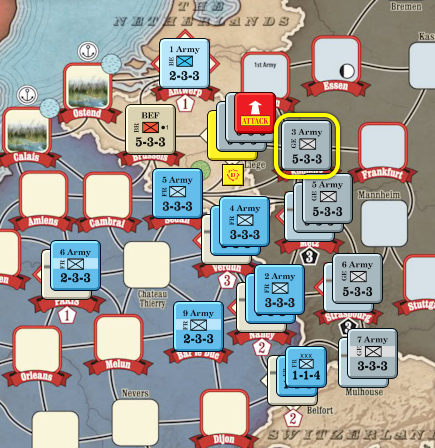
The Guns of August is a 3/4 OPs card that is placed into the CP player’s hand at the outset and gives them the initiative immediately. First off, the card destroys the fortress at Liège and then gives a massive mobilization effort booster by moving 2 German Army counters from their starting spaces including the German 1st and 2nd Armies and then activating them both to attack along with the German 3rd Army who is located at the start of the game setup in Koblenz.

This gives the CP player 2 choices about how to start the war with this attack. They can focus on the British Expeditionary Force located in Brussels or the French 5th Army located in Sedan. The allows the CP to destroy the Liège fortress, advance armies, and immediately attack or pressure the British Expeditionary Force (BEF) and French forces. In my humble opinion, the BEF is the real target here as this unit cannot be replaced or rebuilt and its removal opens up the path for the Germans to take on the fortress at Antwerp.

While the Guns of August card play is an aggressive move, it does somewhat ensure Austria-Hungary can survive potential Russian pressure as the Allied player will have to quickly use their precious resources to fill the gaps created by this opening attack rather than using them to bolster the Russians in the east or to build up the Serbians a bit in the south to prolong the fall of Belgrade. Paths of Glory is a large part about resource management and the constant pressure to continue offensive momentum and rebuild troops through the use of Replacement Points and events to bring on additional troops is a major problem for both sides. You can only attack for so long before you will burn yourself out and will have to spend time to recover and get ready for the next turn’s offensives. Using the Guns of August cards efficiency will free up resources to use elsewhere.

There are alternative openings with the card that can be considered. If not using Guns of August for the event, the CP player can use 1 OP to destroy the Liège fort, allowing them to conserve the card for later or pivot to a more defensive strategy, such as defending the Rhine.

In the end, I would recommend the hammer approach versus any other use of the card as it will really put the pressure squarely on the Allies to do something about what you have just accomplished. In the picture to the right is the normal outcome of these attacks as you can see the BEF is reduced and the French 5th Army has broken and is now replaced by a smaller Corps counter that cannot really do anything offensively and is just there to protect the back side of the Maginot Line from being caught out of supply.

The Guns of August (published in the UK as August 1914) is a 1962 book centered on the first month of World War I written by Barbara W. Tuchman. After introductory chapters, Tuchman describes in great detail the opening events of the conflict. The book’s focus then becomes a military history of the contestants, chiefly the great powers.

The Guns of August provides a narrative of the earliest stages of World War I, from the decisions to go to war up until the start of the Franco-British offensive that stopped the German advance into France. This led to four years of trench warfare. The book discusses military plans, strategies, world events, and international sentiments before and during the war.

The book was awarded the Pulitzer Prize for General Nonfiction for publication year 1963, and proved very popular. Tuchman later returned to the subject of the social attitudes and issues that existed before World War I in a collection of eight essays published in 1966 as The Proud Tower: A Portrait of the World Before the War, 1890–1914.

In the next entry in this series, we will take a look at Georgi Zhukov from Churchill: Big 3 Struggle for Peace from GMT Games.

-Grant

My Favorite Wargame Cards – A Look at Individual Cards from My Favorite Games – Card #63: Militia from Stilicho: Last of the Romans from Hollandspiele

Von: Grant
29. Januar 2026 um 14:00

With this My Favorite Wargame Cards Series, I hope to take a look at a specific card from the various wargames that I have played and share how it is used in the game. I am not a strategist and frankly I am not that good at games but I do understand how things should work and be used in games. With that being said, here is the next entry in this series.

#63: Militia from Stilicho: Last of the Romans from Hollandspiele

Stilicho: Last of the Romans is a very well designed and interesting solo experience that plays in 60-90 minutes. But, due to the unforgiving nature of the random card draws and its reliance on dice luck, that admittedly can be mitigated through cagey card play and proper decisions, the game can be over very quickly. In fact, my very first play a few years ago lasted only 2 rounds and was over in about 15 minutes. Remember that the historical Stilicho only made it to Round 3! The cards are at the heart of the game here and make it a very tense and decision filled experience. Having to analyze each card, measuring its utility against the board state and what pressing matters the player must address while also fretting over having to discard a good Event Card that just isn’t useful at this point in time to take an action can be really agonizing. I think that this design works even better than its predecessor Wars of Marcus Aurelius.

The cards are a form of multi-use cards, as most Card Driven Games are, as they can either be used for the printed events on the cards or simply to be discarded to take one of a number of actions available to the player. It is important to read every aspect of the card thoroughly as some cards have multiple effects, differing effects depending on what the state of the game is or whether one Barbarian has surrendered or may have several prerequisites to that card being allowed to be played.

There are some events that are too important to your efforts to ever discard to take an action as they provide you with such great benefit and are more efficient than taking individual actions. Don’t get me wrong though the playability of a card is always dependent on when in the course of the game the card is drawn. An example of what I am talking about is the Militia Roman Card.

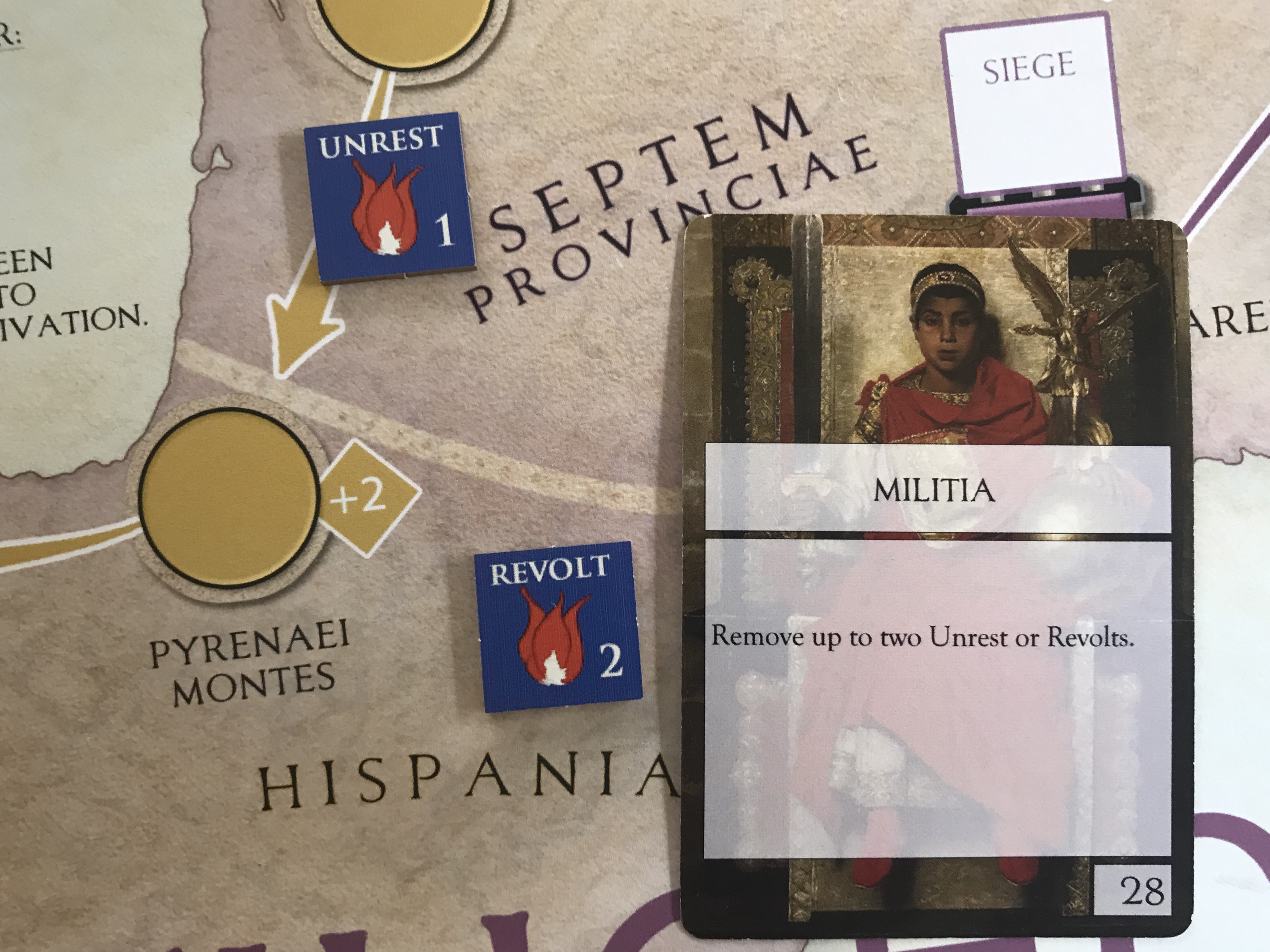
During the game, some cards will cause Unrest Markers to be placed on the various tracks that wind their way through the provinces. These Unrest Markers represent the erosion and weakening of Roman control, the spread of fear throughout the populace due to the threat of usurpers and ultimate civil war as well as the logistical difficulties of defending against barbarian incursions. They act as a critical, accumulating threat that, if left unchecked, can lead to widespread revolts, which are one of the primary ways a player loses the game. Unrest Markers are placed in Dioceses when specific enemy cards (particularly the Vandals) are activated or reach the end of their movement tracks. If a Diocese already contains an Unrest Marker when a new one is triggered, it indicates increasing instability, requiring the player to flip an existing, lower-level Unrest Marker to its “Revolt” side. Unrest/Revolt Markers increase the difficulty of battles in that province. When attacking or defending in a affected Diocese, the marker adds to the enemy’s strength. Also, a major loss condition in the game is having too many Revolt Markers on the board simultaneously. Managing and removing these markers is essential for survival. Unrest Markers are placed in a specific order across the board—starting from Hispania and moving through Gallia to Italia—which dictates the geographic spread of the crisis. Players must spend valuable actions (usually by discarding cards) or use specific Event Cards such as the Militia card to remove these counters from the board. 

Before the late 2nd century BC, Rome used a citizen militia or levy of property-owning men aged 16–46, serving unpaid during summer campaigns. Organized by wealth, they formed three lines—hastatiprincipestriarii—and provided their own equipment. They were crucial for seasonal defense and expansion, as well as for patrolling and safeguarding supply lines, trade routes and newly conquered territories, ultimately transitioning to a professional army after 107 BC. The citizen troops were grouped into maniples based on age and wealth, with the poorest acting as light-armed skirmishers (velites). Service was typically restricted to the annual campaign season, often ending with the Festival of the October Horse on 19 October. The militia employed a three-line, checkerboard formation to allow for tactical flexibility. Due to many reasons, the militia system was phased out after 107 BC in favor of a full-time, professional army, although conscription remained as a, mostly unpopular, option for raising forces.

I wrote a series of Action Points on the various aspects of the game and you can read those at the following links:

Action Point 1 – the Mapsheet focusing on the three Fronts down which your enemies advance, but also covering the different spaces and boxes that effect play such as the Olympius Track, Game Turn Track, Army Box, Leader Box and Recovery Box

Action Point 2 – look at the cards that drive the game and examine the makeup of both the Enemy Deck and the Roman Deck.

Action Point 3 – look into the Roman Phase and examine how cards are discarded to take one of nine different actions.

Action Point 4 – look at a few examples of Battles and how they are resolved.

Action Point 5 – look at a few points of strategy that will help you do better in the game.

I shot a playthrough video for the game and you can watch that at the following link:

I also followed that up with a full video review sharing my thoughts:

In the next entry in this series, we will take a look at Guns of August from Paths of Glory: The First World War, 1914-1918 from GMT Games.

-Grant

My Favorite Wargame Cards – A Look at Individual Cards from My Favorite Games – Card #62: Romanian Autonomy from Twilight Struggle: Red Sea – Conflict in the Horn of Africa from GMT Games

Von: Grant
20. Januar 2026 um 14:45

With this My Favorite Wargame Cards Series, I hope to take a look at a specific card from the various wargames that I have played and share how it is used in the game. I am not a strategist and frankly I am not that good at games but I do understand how things should work and be used in games. With that being said, here is the next entry in this series.

#62: Romanian Autonomy from Twilight Struggle: Red Sea – Conflict in the Horn of Africa from GMT Games from GMT Games

We all love Twilight Struggle….and if you say you don’t, you really do but just want to be different or are a contrarian! The game is phenomenal and has done very well for GMT Games with 8 Printings as well as the Turn Zero Expansion and now a series of smaller geographically focused spin off games starting with Twilight Struggle: Red Sea – Conflict in the Horn of AfricaTwilight Struggle: Red Sea deals with just two regions located in the Horn of Africa including Africa and the Middle East. The game uses the familiar Twilight Struggle formula of Cards with both Events and Operations Points that can be used by players to perform Coups, do Realignment Rolls or place Influence in an effort to gain control of the most Countries in the Regions to score Victory Points and win the game. The game is fast, furious and only lasts 2 hands of cards (unless you choose to play the special 3 Turn variant) so there isn’t a lot of time to mess around and players must be focused on what they are trying to accomplish. The best thing about the game is that it plays in 45 minutes as compared to 3-4 hours for Twilight Struggle.

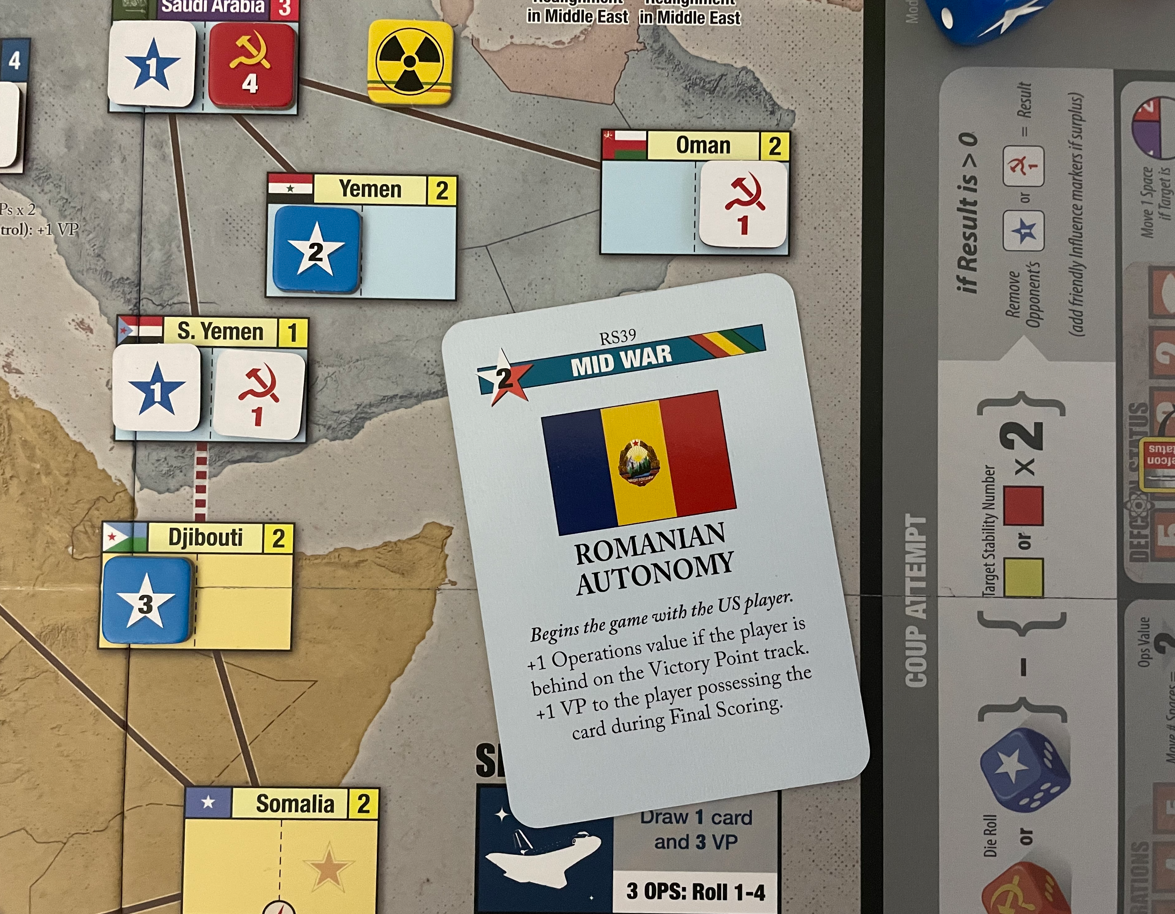
The next card we will take a look at in this series is the special Romanian Autonomy, which is a unique card that doesn’t play from the deck but starts with the US player and resembles one of the classic cards from the original Twilight Struggle called The China Card. And if you have played Twilight Struggle, you know about the China Card. The China Card is a 4 Ops Value Card that can be held by the player in addition to their hand limit thereby giving them an extra card to use. But the card also has a special ability where if the player uses the card for 4 Ops to place Influence only in Asia, it will grant the player +1 Ops Value to use in placing one additional Influence. The China Card also grant’s the player who holds the card at the end of Turn 10 a +1 VP bonus.

In Twilight Struggle: Red Sea, the China Card has been replaced by the Romanian Autonomy Card. This card is not as powerful as the China Card but definitely creates some new opportunities and challenges for the player playing the card. The Romanian Autonomy Card can effect their Ops Value from cards by +1 during the Turn that they play it if they are behind on the Victory Point Track and also grants +1 VP to the player holding the card during Final Scoring. I think this is a really interesting concept and I think was included as a sort of catchup mechanic due to the short nature of the game. I look forward through more plays to seeing how its addition changes things and whether it is overpowered or just right. Once again, a small and subtle change to the game to create a new and interesting experience for the avid fan of Twilight Struggle or players who are new to the system.

Nicolae Ceaușescu visiting Africa during the Cold War.

During the Cold War, particularly under Nicolae Ceaușescu (1965–1989), Romania maintained a distinct, active presence in Africa, including the Horn of Africa, as part of a strategy to distance itself from Soviet influence, gain international prestige, and foster economic exchanges. While major powers like the Soviet Union and Cuba directly intervened in regional conflicts (such as the Ogaden War), Romania focused on building “fraternal” socialist relations through diplomatic, economic, and technical assistance, often operating with a degree of autonomy from the Warsaw Pact. Romania’s actual African strategy in the Horn of Africa, outlined in its 2023 Africa Strategy, emphasizes partnership, peace, development, education, and security cooperation, not territorial autonomy. Romania aimed to be a bridge between Europe and Africa, strengthening ties through cultural exchange, economic projects, and increased diplomatic presence in strategic capitals like Addis Ababa and Nairobi. Under its former communist regime, Socialist Republic Romania pursued economic independence and influenced African nations, but this was distinct from seeking autonomy within Africa. The phrase “Romanian autonomy in the Horn of Africa” is a game term with strategic implications within the game, while Romania’s real-world engagement with Africa is about broader diplomatic and economic partnerships

In the next entry in this series, we will take a look at Militia fromStilicho: Last of the Romans from Hollandspiele.

-Grant

My Favorite Wargame Cards – A Look at Individual Cards from My Favorite Games – Card #61: Mobile Vulgus Time of Crisis: The Age of Iron and Rust Expansion from GMT Games

Von: Grant
13. Januar 2026 um 14:00

With this My Favorite Wargame Cards Series, I hope to take a look at a specific card from the various wargames that I have played and share how it is used in the game. I am not a strategist and frankly I am not that good at games but I do understand how things should work and be used in games. With that being said, here is the next entry in this series.

#61: Mobile Vulgus from Time of Crisis: The Age of Iron and Rust Expansion from GMT Games

I really love Time of Crisis from GMT Games. This is a very light, introductory wargame that is just plain fun to play. I have been playing it a ton on the Rally the Troops! online platform and really enjoy it no matter what the outcome of those games are. One card that I enjoy using is called Mobile Vulgus, which is a 3 value Populace Card that really can be a devious way to usurp your enemies. This card was added to the game in The Age of Iron and Rust Expansion and is one of those cards that is very situational but very good.

As you know, Time of Crisis is a back and forth game that sees players pitted against each other for the control of provinces and ultimately a change in the player who wears the purple robes of Emperor and sits on the throne in Italia. This process is carried out as players play Populace cards to garner Influence points that are then used to Replace a sitting Governor. The problem with the process is the dice. Now, I know what you are saying. Typically, as long as you roll a 2+ on a d6 it is considered a success and garners you a vote but my luck dictates that I will roll multiple 1’s on a roll where you are looking for a number higher than 1. So, if you can somehow get the dice out of the equation, you are better off. Along comes the fantastically powerful card Mobile Vulgus.

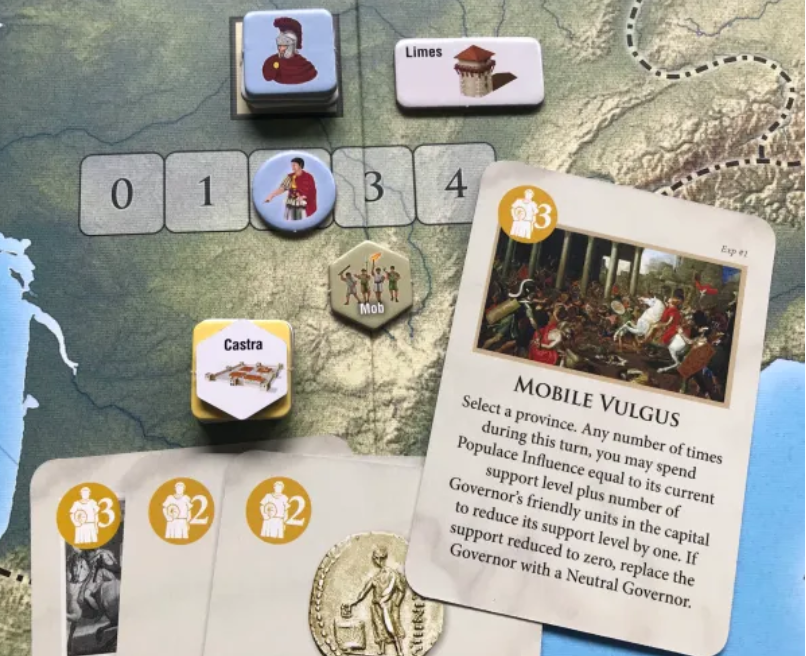
Why exactly do I consider this card so good? Well, you don’t have to rely on rolling dice to get what you want…simple as that. The power is maybe not as efficient as I would like it to be, as you will have to take a Replace Governor Action later to seat your Governor, but it is guaranteed. First off, the card allows you to target a province in which you wish to Replace the current sitting Governor. You normally would play Populace cards to create a number of Influence Points that you would then use to roll 1d6 per point. With Mobile Vulgus you simply play a certain amount of Populace cards to create a total amount of Influence that allows you to overcome their current support level. In the picture above, you can see that the current support level for the Blue Governor in Gallia is at 2. You will also notice though that the Blue General is located in the Provincial Capital with a sizeable army. This army will add to the number of Influence points you will have to spend to reduce that support.

As we examine the Blue General’s stack of forces, we see that he has 3 units under his control, 2 full strength Legions (XIV Gemina and X Gemina) as well as a lone Militia. These 3 units will add to the amount of Populace Influence points that must be spent to effect the support level of the province. Because there are 3 units, we will add those 3 units to the current support level of 2 to bring our target to reduce to 5. In simpler terms 2 for the current support level + 3 for the units in the provincial capital. This then successfully reduces the support level to 1. Remember, that if using a normal Replace Governor action, you would have been rolling 5 dice (1d6 per Populace Influence point spent) and would have needed to roll 2+ and garner 7 votes (calculated by doubling the current support level and then adding in +1 vote needed for each unit in the capital). You couldn’t have possibly done that using only the two cards shown and would have had to play at least one more Populace card with at least 2 Influence points to get to roll 7 dice!

Mobile Vulgus is a Latin phrase that means “the fickle crowd”, referring to the changing nature, opinions and reactions of the general public or an audience, which is a derivation of the English word “mob”.  It literally denotes a movable public, or the unstable crowd and recognizes the inconstancy of popular taste and the ease with which clever politicians can influence the great mass of voters. In game terms, the support of the people can sometimes falter as easily as it can be encouraged.

If you are interested, I wrote a full review for Time of Crisis and you can read that at the following link: https://theplayersaid.com/2017/09/04/the-most-recent-fruits-of-wargame-hybridization-a-review-of-time-of-crisis-the-roman-empire-in-turmoil-235-284-ad-from-gmt-games/

We also posted a full review video and you can watch that at the following link:

In the next entry in this series, we will take a look at Romanian Autonomy from Twilight Struggle: Red Sea – Conflict in the Horn of Africa from GMT Games from GMT Games.

-Grant

❌