❌

Normale Ansicht

History Behind the Cards – A Look at Checkpoint Charlie from GMT Games – Card #10: Moscow Rules

Von: Grant
04. November 2026 um 14:00

I love a different style and focus of wargame. A game that takes a look at an important but somewhat obscure or rarely addressed historical topic, such as espionage or intelligence, and creates a gaming experience tailored around the events to highlight and evoke the difficulties and tension that would have been present. In January 2026, GMT Games announced such a game in Checkpoint Charlie, which is a solo or cooperative game focused on SIS espionage missions in Berlin in the 1960’s designed by Russell Brown. We have posted an interview with Russel and it was very well received and he has now agreed to create a series of History Behind the Cards to highlight the events of the 1960’s Cold War struggle in West Germany but also to share aspects about the game play and how it models the history.

*Note: The cards highlighted in this series and their event text, as well as any pictures used showing any of the various components, are still in the design and development process and as such event effects and text might still change prior to final development and publication. Also the art and layout of the cards are only for playtest purposes at this point and the game will enter the art department as it nears publication.

History Behind the Cards – Checkpoint Charlie from GMT Games – Card #10 Moscow Rules

“Moscow rules meant watch your back. London rules meant cover your arse.”

This quote from Mick Herron’s book, Slow Horses, may be what many people think of when the term Moscow Rules is used today, but there’s a bit more to it than that. Moscow rules were an unwritten set of procedures – spycraft protocols – to keep in mind when operating on the KGB’s home turf. Moscow Rules may have also been used as a cautionary declaration, a spy’s call to arms. In John Le Carrè’s spy novels, George Smiley lets his colleagues know that exceptional caution is warranted just by saying, “Moscow Rules.”

Moscow Rules could include communicating with extra caution, or in code. It could mean keeping a better eye out for someone following you, or being ready to defend yourself. But at its core, it meant that you were effectively operating in enemy territory and could no longer trust the people and places you once took for granted.

In Checkpoint Charlie, the Moscow Rules Event Card puts all of your assets on high alert, giving them a Tradecraft Marker if they don’t already have one. It also adds the Papers Item to the Mission, assuming that your assets dig deeper into their resources, perhaps pulling out old false identities reserved for emergencies. If you’re playing the campaign game, the Moscow Rules Card is not removed when it occurs, so it can show up on almost any mission.

In the next article in this series, we will take a look at ________.

In my opinion, this game looks extremely interesting and I am very much excited to learn more about it. I am appreciative to Russell and his efforts to bring us these cards and to write these entries to share with our readers. I am also very glad that this topic is being covered in a game and look forward to playing this one day soon.

We published an interview with the designer Russell Brown on the blog and you can read that at the following link: https://theplayersaid.com/2026/02/23/interview-with-russell-brown-designer-of-checkpoint-charlie-from-gmt-games/

You can catch up on the posts in this series to date by following the below links:

Card #1: Cousins Operation

Card #2: Cuban Missile Crisis

Card #3: Demonstrations

Card #4: Faceoff with the Soviets

Card #5: Berlin Film Festival

Card #6: General Clay Steps In

Card #7: Ich Bin Ein Berliner

Card #8: Loudspeaker Wars

Card #9: Daily Military Train

If you are interested in Checkpoint Charlie, you can pre-order a copy for $48.00 from the GMT Games website at the following link: https://www.gmtgames.com/p-1211-checkpoint-charlie.aspx

-Grant

Anthropic cracks down on AI game cloning as risk of unauthorised digital copies, reskins grows

03. November 2026 um 12:27

AI giant Anthropic has introduced new restrictions which attempt to stop its Claude coding software from recreating existing games, amid generative AI providing the capability to quickly spin up unauthorised digital clones and reskins.

The changes were spotted in Claude Code’s instructions around October 27, with two new sentences telling the software: “Do build original games, games in a genre, and games from the user’s own designs and assets”, and “Don’t build a recreation of a specific existing game, even if it is renamed or called original”.

Anthropic technical staff member Addy Osmani confirmed the changes in a post on X, saying the company had introduced the restrictions because using Claude to infringe intellectual property rights was already against its usage policy.

Board games are vulnerable to AI-generated imitations because their underlying gameplay mechanics generally cannot be protected by copyright – while generative AI also makes it easier to reproduce those systems digitally, and create alternative imagery and text without directly copying the original game’s protected material.

The potential danger to tabletop publishers was highlighted last year when US software development company Sembit used Claude Code to produce a browser-based version of Catan within four minutes – although that rapidly-assembled version suffered from significant bugs and some non-functioning gameplay features.

Unauthorised online versions of board games are not a new phenomenon, with publishers having faced challenges controlling digital recreations of their titles long before AI coding tools became widely available. But generative AI potentially makes such recreations much easier to produce, lowering the technical expertise, time and cost needed to turn an existing tabletop game into a playable digital version.

Colonist.io, which was launched in 2017 as Katan.io before rebranding in 2019, openly markets itself as a free alternative to Catan, closely reproducing the original game’s rules, gameplay and visual layout while using different artwork. The platform reported 60 million games played and 3.6 million active players across 2025.

Colonist.io states clearly on its website that it has no association with Catan, and argues that its game is legal under US law, citing guidance from the US Copyright Office that gameplay methods cannot be protected by copyright.

The Colonist.io homepage

A 2022 study published in the Iowa Law Review highlighted the Catan rights holders’ apparent decision not to pursue legal action against Colonist.io, contrasting it with an earlier incident in which an Android imitation called Island Settlers was withdrawn following a cease-and-desist notice from Catan’s lawyers in 2011.

Companies which have taken action against unauthorised digital adaptations include Disney, which prompted the closure of the unofficial Disney Lorcana simulator Pixelborn in 2024 over its use of the game’s protected card imagery. Pixelborn creator Pavel Kolev said more than 6.5 million games had been played on the platform before it was shut down.

Anthropic’s new intervention follows controversy over AI-generated video game clones, including cases where developers have withdrawn public demonstrations over concerns that their games could be copied before release.

The new restrictions have already affected attempts to recreate published tabletop games, including a Claude Code user who reported being refused help to build a private online version of an unnamed, commercially released co-op board game.

The user wanted to create a password-protected version allowing friends to play remotely, including one unable to attend in-person sessions, and to introduce AI-controlled players to study the game’s strategy.

Claude refused despite the user specifying that the adaptation would not be publicly distributed, instead offering to help develop an original game using similar co-op and limited-information mechanics.

A separate complaint came from wargame publisher Raymond Weiss, whose Conflict Simulations business has released around 30 tabletop titles since 2017- including three nominees for the Charles S Roberts Awards, one of the longest-running awards honouring conflict-focused tabletop games.

Weiss says he has been using AI-assisted coding to create unlicensed digital versions of other publishers’ wargames for paying customers, calling them private, “personalized builds” for people he says already own the physical version of games which do not already have a digital adaptation. He charges between $400 and $800 per project, according to his website.

He reported on GitHub that Claude Code had begun refusing to continue work on adaptations it previously supported, although he acknowledged that he did not hold licences from the publishers whose games were being adapted.

The restrictions are, of course, limited to Anthropic’s own software. In a November 2 blog post, Weiss said he had already resumed the work interrupted by Claude’s refusals using rival AI coding tools OpenAI Codex and Kimi.

The post Anthropic cracks down on AI game cloning as risk of unauthorised digital copies, reskins grows first appeared on .

History Behind the Cards – A Look at Checkpoint Charlie from GMT Games – Card #9: Daily Military Train

Von: Grant
22. Oktober 2026 um 14:00

I love a different style and focus of wargame. A game that takes a look at an important but somewhat obscure or rarely addressed historical topic, such as espionage or intelligence, and creates a gaming experience tailored around the events to highlight and evoke the difficulties and tension that would have been present. In January 2026, GMT Games announced such a game in Checkpoint Charlie, which is a solo or cooperative game focused on SIS espionage missions in Berlin in the 1960’s designed by Russell Brown. We have posted an interview with Russel and it was very well received and he has now agreed to create a series of History Behind the Cards to highlight the events of the 1960’s Cold War struggle in West Germany but also to share aspects about the game play and how it models the history.

*Note: The cards highlighted in this series and their event text, as well as any pictures used showing any of the various components, are still in the design and development process and as such event effects and text might still change prior to final development and publication. Also the art and layout of the cards are only for playtest purposes at this point and the game will enter the art department as it nears publication.

History Behind the Cards – Checkpoint Charlie from GMT Games – Card #9 Daily Military Train

This is one of the cards I added to Checkpoint Charlie based on conversations with my local coffee shop spy, John (see Card #7). I had assumed most significant traffic from West Germany to Berlin used the autobahn corridor from Checkpoint Alpha at Helmstedt, across East Germany, to Checkpoint Bravo in Berlin. However, the military trains, of which there were three – American, French and British – ran every day, back and forth along roughly the same corridor as the automobile traffic. The US Military Duty Train, which my friend John rode, let out at the station in Charlottenburg and is the basis for this Event Card. It was primarily used by US military personnel, but other people associated with the military could get permission to ride.

Cars full of East German police, or vopos, kept vigilant watch over the autobahn access route, but it was more difficult to keep track of the train and whether western passengers were jumping off illegally somewhere in East Germany, or East German citizens were boarding the train as it slowed for one of its scheduled stops along the way, getting free passage into West Berlin. To solve this problem, all doors on the train were chained and padlocked for the duration of the four-hour journey across East Germany. In Checkpoint Charlie, the Daily Military Train Event assumes that the KGB has been tipped off to the arrival of some interesting person or item on the next train and move to intercept. Charlottenburg Safehouse is placed under surveillance and the Nugget Marker, already detected, is placed there. This can be a useful diversion for your assets, or it can draw KGB agents right into the center of your mission.

The Berlin Military Train operated by the Royal Corps of Transport.

In the next article in this series, we will take a look at Moscow Rules.

In my opinion, this game looks extremely interesting and I am very much excited to learn more about it. I am appreciative to Russell and his efforts to bring us these cards and to write these entries to share with our readers. I am also very glad that this topic is being covered in a game and look forward to playing this one day soon.

We published an interview with the designer Russell Brown on the blog and you can read that at the following link: https://theplayersaid.com/2026/02/23/interview-with-russell-brown-designer-of-checkpoint-charlie-from-gmt-games/

You can catch up on the posts in this series to date by following the below links:

Card #1: Cousins Operation

Card #2: Cuban Missile Crisis

Card #3: Demonstrations

Card #4: Faceoff with the Soviets

Card #5: Berlin Film Festival

Card #6: General Clay Steps In

Card #7: Ich Bin Ein Berliner

Card #8: Loudspeaker Wars

If you are interested in Checkpoint Charlie, you can pre-order a copy for $48.00 from the GMT Games website at the following link: https://www.gmtgames.com/p-1211-checkpoint-charlie.aspx

-Grant

History Behind the Cards – A Look at Checkpoint Charlie from GMT Games – Card #8: Loudspeaker Wars

Von: Grant
08. Oktober 2026 um 14:00

I love a different style and focus of wargame. A game that takes a look at an important but somewhat obscure or rarely addressed historical topic, such as espionage or intelligence, and creates a gaming experience tailored around the events to highlight and evoke the difficulties and tension that would have been present. In January 2026, GMT Games announced such a game in Checkpoint Charlie, which is a solo or cooperative game focused on SIS espionage missions in Berlin in the 1960’s designed by Russell Brown. We have posted an interview with Russel and it was very well received and he has now agreed to create a series of History Behind the Cards to highlight the events of the 1960’s Cold War struggle in West Germany but also to share aspects about the game play and how it models the history.

*Note: The cards highlighted in this series and their event text, as well as any pictures used showing any of the various components, are still in the design and development process and as such event effects and text might still change prior to final development and publication. Also the art and layout of the cards are only for playtest purposes at this point and the game will enter the art department as it nears publication.

History Behind the Cards – Checkpoint Charlie from GMT Games – Card #8: Loudspeaker Wars

The Berlin Wall in the 1960’s was an interesting place. When approaching from the west (actually the south if you were at Checkpoint Charlie), you could walk right up to the wall and peer over. There are stories of East Berliners parking their cars against the wall because a small strip on the western side was actually still in Soviet Territory, and the West Berlin police couldn’t give them a parking ticket. If you were an East Berliner, approaching within fifty meters of the wall would probably get you shot. In either case, if you were close enough to the wall to see over it, you were likely to see propaganda from the other side. Most of this was billboards and banners on the eastern side, but the west had its fair share of slogans supporting democracy and the allies.

The Loudspeaker Wars card commemorates the times when this war of propaganda became audible as well as visual. An ongoing battle between vans equipped with high-powered speakers began when East Germany rolled them up to the wall and began blasting propaganda at deafening volumes. When formal complaints failed, the west responded with their own loudspeakers at the wall, making it almost impossible to carry on a conversation anywhere near them. This became known as the “Noise Offensive,” or the “Loudspeaker Wars.” It continued, on and off, for years.

In Checkpoint Charlie, this card makes intelligence operations at the wall very difficult (removing all Intel Cubes there) and also attracts a crowd of gawkers in the form of a Demonstrations Marker. In addition, if Mayor Brandt is active in the mission, he immediately moves to the wall to take part in the back and forth.

In the next article in this series, we will take a look at Daily Military Train.

In my opinion, this game looks extremely interesting and I am very much excited to learn more about it. I am appreciative to Russell and his efforts to bring us these cards and to write these entries to share with our readers. I am also very glad that this topic is being covered in a game and look forward to playing this one day soon.

We published an interview with the designer Russell Brown on the blog and you can read that at the following link: https://theplayersaid.com/2026/02/23/interview-with-russell-brown-designer-of-checkpoint-charlie-from-gmt-games/

You can catch up on the posts in this series to date by following the below links:

Card #1: Cousins Operation

Card #2: Cuban Missile Crisis

Card #3: Demonstrations

Card #4: Faceoff with the Soviets

Card #5: Berlin Film Festival

Card #6: General Clay Steps In

Card #7: Ich Bin Ein Berliner

If you are interested in Checkpoint Charlie, you can pre-order a copy for $48.00 from the GMT Games website at the following link: https://www.gmtgames.com/p-1211-checkpoint-charlie.aspx

-Grant

History Behind the Cards – A Look at Checkpoint Charlie from GMT Games – Card #7: Ich Bin Ein Berliner

Von: Grant
17. September 2026 um 14:00

I love a different style and focus of wargame. A game that takes a look at an important but somewhat obscure or rarely addressed historical topic, such as espionage or intelligence, and creates a gaming experience tailored around the events to highlight and evoke the difficulties and tension that would have been present. In January 2026, GMT Games announced such a game in Checkpoint Charlie, which is a solo or cooperative game focused on SIS espionage missions in Berlin in the 1960’s designed by Russell Brown. We have posted an interview with Russel and it was very well received and he has now agreed to create a series of History Behind the Cards to highlight the events of the 1960’s Cold War struggle in West Germany but also to share aspects about the game play and how it models the history.

*Note: The cards highlighted in this series and their event text, as well as any pictures used showing any of the various components, are still in the design and development process and as such event effects and text might still change prior to final development and publication. Also the art and layout of the cards are only for playtest purposes at this point and the game will enter the art department as it nears publication.

History Behind the Cards – Checkpoint Charlie from GMT Games – Card #7: Ich Bin Ein Berliner

In the summer of 1963, the Berlin Wall had been in place for almost two years, the reality of a city split between east and west, between Soviet and Western influence, was impossible to deny. Politicians, military leaders, and the people living day-to-day in Berlin continued to argue about the lack of forceful response from the west, particularly the Americans, when the wall went up. Other than a modest buildup of US forces within and around the city, there had been precious little action to re-assure the people of Berlin that the west hadn’t abandoned them.

In June of that year, President Kennedy hoped to change that perception by personally visiting this western city in the center of Soviet-controlled East Germany. He received the reception and the reaction he was hoping for, driving through the city to crowds of cheering West Berliners, and giving his famous speech on the steps of the Rathhaus Shöneberg to a gathered crowd of over one hundred thousand. In a calculated risk, he referred to the city as West Berlin, officially acknowledging the split created by the wall. He introduced his “Fellow Americans” and at the mention of General Clay (Card #6), the crowd interrupted the speech for some heartfelt cheering for the man that saved their city during the Berlin Airlift. Kennedy’s famous line of solidarity, “Ich bin ein Berliner,” — I am a Berliner — came at the end of the speech and may have been a bit off-script.

So how would Kennedy’s speech affect a mission in Checkpoint Charlie? I’m going to answer that with a story.

I spend a lot of time at a wonderful coffee shop near my home, so much time that my iPhone has labeled the location as my “work.” The baristas there know me, and one day one of them asked me what I was working on. “Right now,” I said, I’m working on a board game about spies in Berlin in the 60’s.”

He laughed. “Have you met John?” He pointed to an older customer at one of the tables. “He was a spy in Berlin in the 60’s.”  It was true.

Since then, I’ve had many conversations with John about his time in Berlin. He was Army Intelligence, keeping track of what was going on in the city. He was there when the wall went up. He interviewed the refugees that, for a time, still managed to find a way into West Berlin. And he was there during Kennedy’s speech.

I asked him about the speech and said that in the game it resulted in crowds (a Demonstrations marker) near Tempelhof. He shook his head. “Everywhere. Crowds everywhere. All over the city.”

I’m sorry to report that I’ve restrained the effects of this card and the speech for gameplay reasons, but I haven’t ignored John in every case. The Daily Military Train event (Card #9) exists solely because of his stories, and after removing the Refugees event (Card #13) from the game because I assumed the flow of refugees disappeared after the wall went up, I put it back in because John assured me that they were still coming – he had met and interviewed hundreds of them.

In the next article in this series, we will take a look at the ongoing propaganda efforts from both sides of the Berlin Wall with Loudspeaker Wars.

In my opinion, this game looks extremely interesting and I am very much excited to learn more about it. I am appreciative to Russell and his efforts to bring us these cards and to write these entries to share with our readers. I am also very glad that this topic is being covered in a game and look forward to playing this one day soon.

We published an interview with the designer Russell Brown on the blog and you can read that at the following link: https://theplayersaid.com/2026/02/23/interview-with-russell-brown-designer-of-checkpoint-charlie-from-gmt-games/

You can catch up on the posts in this series to date by following the below links:

Card #1: Cousins Operation

Card #2: Cuban Missile Crisis

Card #3: Demonstrations

Card #4: Faceoff with the Soviets

Card #5: Berlin Film Festival

Card #6: General Clay Steps In

If you are interested in Checkpoint Charlie, you can pre-order a copy for $48.00 from the GMT Games website at the following link: https://www.gmtgames.com/p-1211-checkpoint-charlie.aspx

-Grant
Solitaire Playthrough Video: HISPANIA from Draco Ideas

Von: Grant
21. August 2026 um 14:00

HISPANIA from Draco Ideas is a slick little small box game with a big punch that sees the player controlling the Roman Empire and attempting to subjugate and put down resistance in the provinces of Hispania from 198 to 18BC. The game is extremely flexible and may be played cooperatively by 2-3 players, competitively with 4 players or as a solo game. The game is somewhat of a resource management game as the players must use their limited funds in the form of Denarii wisely to attack and put down revolts springing up around the country as local armies rally support for the resistance to Roman rule.

We published an interview with the designer Miguel Marqués and you can read that at the following link: https://theplayersaid.com/2024/04/12/interview-with-miguel-marques-designer-of-hispania-from-draco-ideas-coming-to-gamefound-soon/

I also wrote a series of Action Point posts on the game and you can read those at the following links:

Action Point 1 – Overview of the Board

Action Point 2 – Overview of the Roman Phase and the various actions available including Move, Garrison, Besiege and Attack

Action Point 3 – Overview of the Hispanic Phase and how the locals spread Revolt and move Armies around the Board

-Grant

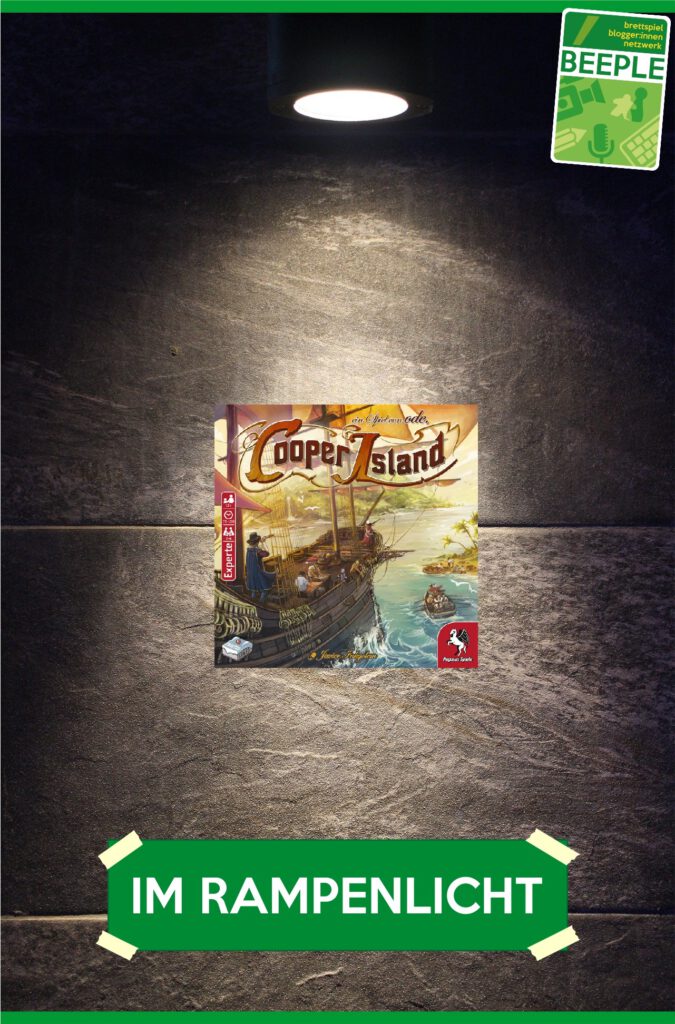
Im Rampenlicht: Cooper Island

10. Juli 2026 um 08:00

Cooper Island | Andreas Odendahl (Ode)| 60 – 120 Minuten | 2 – 4 Personen |Frosted Games/Pegasus Spiele

In Cooper Island versuchen die Spielenden eine Insel fernab ihrer alten Heimat zu kolonisieren und nehmen sich dabei jeweils einen Teil vor und erkunden diesen. Ausgelegte Landschaftsplättchen bieten dabei Ressourcen, die wiederum zur Ernährung der Arbeiter*innen, dem Handel oder dem Errichten von Gebäuden genutzt werden. Auf den Inseln müssen noch Barrieren entfernt, Statuen errichtet und Schiffe beliefert werden. Mit zwei Schiffen, die jeweils in entgegengesetzte Richtungen fahren, werden die Punkte markiert. Werden dabei kleinere Inseln überschritten, gibt es weitere Vorteile. Nach fünf Runden endet das Spiel und wer mit seinen Schiffen am weitesten fortgeschritten ist, gewinnt das Spiel. Soviel zur Setting und einigen Mechaniken, doch kann Cooper Island aus dem Jahr 2019 immer noch Spielende an den Tisch locken? Diese Frage beantworten einige Mitglieder des Beeple Netzwerk für sich im aktuellen Rampenlicht.


Fabian (Bretter Late Than Never)
Cooper, der Hund des Kapitäns, entdeckt nach langen Wochen auf See als erster wieder Land: eine unerforschte Insel, die umgehend nach ihrem Entdecker zu „Cooper Island“ benannt wird. Leider lässt die aktuelle Mission keine ausführliche Erkundung zu und man muss unverrichteter Dinge weitersegeln. Doch einige Jahre später sind wir inklusive Cooper zurück und das Abenteuer beginnt. Von diesem schönen Fluff-Text, der von Spielererfinder Odes realem und kürzlich leider verstorbenen tierischen Freund Cooper inspiriert wurde (der es übrigens auch auf eine Promo-Karte in Underwater Cities geschafft hat), bleibt in diesem knallharten, eigentlich ziemlich abstrakten Euro-Game am Ende nicht viel übrig. Trotzdem startet bei mir jede Partie mit dem Vorlesen dieser Einleitung, weil sie mir so gut gefällt. A propos lesen: Die Spielanleitung ist mit Abstand die beste, die ich bisher gelesen habe. Das Spiel selbst lässt dann Euro-Gamer-Herzen höher schlagen: Doppelhex-Teilchen in die Breite und (!) in die Höhe puzzeln, Ressourcen managen, Aufträge erfüllen, Fähigkeiten freischalten und ein paar der hart zu erarbeitenden Punkte verdienen, um zu gewinnen – ganz wunderbar. Ich freue mich schon auf meinen nächsten Trip auf die Insel. Bis dahin: Gute Reise, Cooper!
Mathias - Cliquenabend Mathias (Cliquenabend)
Ich weiß noch, dass ich meine erste Partie von Cooper Island auf meinem ersten Beeple Wochenende gespielt und das Spiel von Matthias Nagy erklärt bekommen habe (übrigens ein hervorragender Erklärer). Irgendwann – so nach etwa der Hälfte des Spiels – habe ich ihn gefragt, was denn ein gutes Ergebnis für die Erstpartie wäre. Ich meine mich zu erinnern, dass er „so um die 15 Punkte“ gesagt hat – ich hatte zu diesem Zeitpunkt eher so um die fünf und am Ende auch die genannte Punktzahl nicht erreicht. Dennoch hat es mich nicht davon abgehalten weitere Partien zu spielen und es wird endlich mal wieder Zeit Cooper Island auf den Tisch zu bringen. 
Sebastian (Solo Manolo) Sebastian (Solo Manolo)
Ich kenne kein anderes Euro-Spiel, bei dem man ähnlich hart dafür arbeiten muss, ähnliche wenige Siegpunkte zu erreichen. Und ich meine das als Kompliment. Darüber hinaus ist der Solomodus (vor allem für die „damalige“ Zeit) sehr innovativ und gut durchdacht. Ich hatte das Spiel zwar schon länger nicht mehr auf dem Tisch, aber es wird trotzdem permanenter Teil meiner Sammlung bleiben und ich freue mich, bald mal wieder gegen den Solo-Bot Cooper zu verlieren.
Dirk_Huesmann Dirk (Würfelmagier)
So wenig Sieg Punkte für so viel Arbeit. So lässt sich vielleicht das Spielgefühl von Cooper Island zusammenfassen. Selten habe ich so lange für so wenige Punkte gespielt und trotzdem das Gefühl gehabt, so viel zu gestalten. Das Spiel kommt mit relativ eingängigem Regelwerk daher, gerade zu viert ist aber wirklich viel los und einiges zu bedenken. Für mich eines der Euro Spiele, das mich sehr positiv überrascht hat. Schon länger nicht mehr gespielt. Wird mal wieder Zeit. Außerdem gab es einen coolen Solomechanismus.


Wenn Ihr Euch nun etwas intensiver mit Cooper Island befassen wollt, dann schaut Euch doch mal die folgenden verlinkten Artikel an:

Cliquenabend

Spiel: Riffstar – Metal Milestones

31. Mai 2025 um 05:03

Von Klassiker bis Kracher – eure Zeitreise durch Metal & Hardrock: 110 Songs aus 60 Jahren Metal-Geschichte findet ihr in dem Spiel.

Die Anleitung und alle Spielmaterialien könnt ihr hier runterladen, ausdrucken und dann sind sie schnell ausgeschnitten und zusammengeklebt.

Wer Spiele wie Anno Domini oder Hitster kennt, wird die grundlegenden Spielideen wiedererkennen, die abgewandelt und weiterentwickelt wurde:

Es gibt vier Spielvarianten, die zunehmend herausfordernd sind: Level 1 ist für Einsteiger mit einem sehr glückslastigen Spiel. Level 4 ist für echte Metalheads und setzt voraus, dass ihr euch an ein paar Band-, Song- und Albennamen erinnert 😉

Riffstar ist ein Prototyp – alles noch beta, also nicht perfekt. Falls ihr Fehler findet oder irgendwas nicht gut funktioniert, bin ich euch dankbar für eine Rückmeldung – und gerne auch, wenn ihr es richtig gut findet 🤘🤘🤘

Downloadmaterialien

—

Hinweis: Die Songkarten und Jokerkarten müssen ausgeschnitten und dann Vorderseite (QR-Code bzw. Joker) und Rückseite (Songtitelinfos bzw. Jahrzehnt) zusammengeklebt werden.

—

—

—

❌