Dan Dan Dan von Autor Thade Precht, erschienen bei Heldbergs Games, entführt uns in die Welt der japanischen Straßenverkäufer, den so genannten Tekiya. Angeblich eine große Familie, missgönnt jeder dem…
Charge & Spark is a 2 player microgame from Jelly Jelly Games, Japan. I have just played another game that sounds just like this, Bahamut Dispute. Both are about reducing your opponent’s health from 4 to 0, but here the execution is a little different. Humankind is extinct. You are robots competing for supremacy. You win by destroying your opponent or by reaching the centre of
Bahamut Dispute is a microgame from Japan. It is a 2 player game about two kings trying to defeat the other by setting a dragon on their opponent. The structure is simple. On your turn you draw one card, and you may play up to two cards. You need to discard only if you exceed the hand limit. You start with 4 health, and your goal is to reduce your opponent’s health to zero. So far, nothing
Mice Times Japan just published an article about the Asian Board Games Festival in the Philippines, which happened earlier this month. I was a little shocked to find my face on the cover photo. I was just one of many exhibitors interviewed. I am guessing they picked this photo because of the chilli on my head. I'm happy the Malaysian title, Jon's King and Peasant, is featured in the photo too.&
Asmodee’s escalating power as a global TCG distribution giant was evident again in its newly-released annual results, which showed the company’s net sales surging 23% year-on-year to more than €1.68bn.
That annual revenue has swelled around 50% in just three years on the back of huge recent growth in TCGs, including heavyweights Magic: The Gathering and Pokemon as well as a wave of strong performing newcomers such as Disney Lorcana, the One Piece Card Game and Asmodee’s own Star Wars: Unlimited.
Despite Asmodee’s long-time image as a board game publishing heavyweight, more than 72% of its revenue now comes via its distribution of other companies’ games – up from an already hefty 63% in the previous financial year to March 31, 2025.
TCGs now make up the lion’s share of Asmodee’s annual net sales – about 60% in the 2025/26 financial year, up from just over 50% across the preceding 12 month period.
The company’s own board game publishing operation, meanwhile, saw its net sales fall 5.8% in the last financial year – while net sales for the first quarter of this year were down 9.8% compared to the same period in 2025.
Asmodee’s Jan-Mar 2026 and last financial year revenue figures, showing a hefty jump in the portion of its net sales coming from distributing other companies’ games
Asmodee CEO Thomas Koegler was asked directly during a Q&A session on Asmodee’s latest financial results if the company was still primarily a board game publisher, or whether it was “increasingly becoming an infrastructure company for TCGs”.
He said in response, “We have insisted a lot on the fact that one of the strengths of Asmodee is to be a publisher, but the first strength that we do have is our global reach across all categories, from TCGs and board games.
“That’s the superpower of Asmodee – and then being a very strong publisher is a way of accelerating performance.
“So I would say that there is no change, we continue to capture opportunities across the board wherever they come from… our aim is to be a dominant player, bringing all games to the market, anywhere they can.”
The Japon Brand buyout was accompanied by Asmodee launching a new Japan-based design studio, Nekuma, anchoring its push into what it described as a “currently untapped market” for the company.
There were also hints in the Q&A session that Asmodee might be considering a move into Japanese distribution, adding to its existing operations in the region across China, Taiwan and Australia.
Koegler said of Japan, “The first move we have done with Japon Brand and setting up Nekuma is more of a sourcing move, right?
“The Japanese game designers and authors’ market is very dynamic. If you look for instance in recent very successful games – Bomb Busters, which is the Spiel des Jahres from 2025, was originated from Japan, a game like Dnup that we are releasing later in the year is coming from Japan.
Asmodee CEO Thomas Koegler
“So they are very good also at small card games, and we really wanted to, I would say, bolster our publishing capabilities by creating those sourcing activities.
“Distribution wise, for now we are still working with local partners, we have not set direct foot yet.
He added, “It’s a fragmented market, its a very strong TCG market on the local market side, but yes… as I said, it’s a very vivid scene.”
Koegler also made clear that the company is still pursuing M&A opportunities on the publishing side “across all play types that we have, from social games to lifestyle games and tabletop games”.
He said, “I would say that the discussions we have are still as active as they were – we have demonstrated our ability to do various sizes of deals, which is also a very strong signal to potential people that would like to join the Asmodee adventure.”
Koegler said in his introduction to Asmodee’s 2025/26 report that the impact of geopolitical and economic events on the company’s business in the first few months of the year had been limited, but that the firm remained “mindful” of the potential pressures on transport and energy costs.
Asmodee said the impact on the business of transport and energy cost changes due to global political and economic issues had so far been limited
He said in the financial results Q&A session, “From a consumer standpoint, in moments of tensions when there are rising costs, because games are an affordable leisure we tend to suffer less, if not take some opportunities. That’s what we’ve seen in previous crises over the past 10 or 15 years.
“Consumer sentiment-wise, we will see. Although we are always cautious, there is also I think opportunities for us.
“Secondly, in terms of the cost impact. First of all our mix is currently very favourable because trading card games are manufactured very close to where they are sold, like in Europe for European countries mainly – some are manufactured in Asia but its a limited one – in the US for the US, etc.
“Plus they are cheap to transport, so the impact on those is relatively limited. And then we will see with our partners in terms of raw material increases, but again in the overall cost of goods they do not represent a very significant party.
“For board games we have started to see some increase in transportation costs. They did not impact Q4. If we take an example, road freight did represent roughly 20% of the cost base, and they have increased by 10%.
“But again, all of this is quite manageable for us. We expect to be able to mitigate the impact.”
Koegler added that although the process for receiving tariff refunds in the US had begun, after the Supreme Court struck Donald Trump’s swathe of import fees earlier this month, there was uncertainty about both the timing and final amount Asmodee was owed.
He said, “This is still a little bit foggy, blurred – for us, but [also] for many, many other companies out there. So let’s wait for what’s next on this topic.”
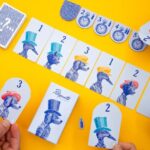
Petiquette, Thomas Sellner’s card game of picking out patterns among hat-wearing animals, has been named game of the year at this year’s Golden Box Awards.
The Oink Games-published design fought off competition from 2025 winner Isao Mukai, who was nominated for Banana Governance – a card-based drafting and bidding game which sees players attempt to satisfy the needs of hungry monkeys better than their opponents.
A comment from the selection committee about Petiquette called the title “a brilliant and sharp work typical of Oink”.
Cards from Banana Governance, designed and published by Isao Mukai
It said, “I’ll never forget the shock I felt the first time I played it. The rules are simple: just give the answer that fits in the single ‘?’ on the cards laid out.
“But… the eyes of those who give the same answer feel friendly. The mouths of those who give a different answer seem to twist. The loneliness of desperately trying to explain when you’re the only one who gives a different answer.
“A mix of various emotions. The unique experience of this game really stands out.”
The annual Golden Box contest was launched four years ago, modelled on the American film industry’s Academy Awards. More than 40 industry professionals from within the Japanese board game sphere voted on this year’s award.
In addition to ‘Best Picture’ for the overall game of the year, the awards also celebrate the best in game design, art, graphic design, production and rulebook work through individual awards.
Cover art for Sweet Lands
Eve Inc-designed Nusutto Cat – also known as Meow Heist – triumphed in this year’s Game Design Award, while best art went to Totsuca Chuo’s Sweet Lands, which was illustrated by Tatsuki Asano and Broni120.
Moyuki Adisawa’s animal jet ski racing game Tornado Splash picked up the Graphic Design Award thanks to the work of iD Creative Co, while the Production Award went to National Economy and Toshinori Iwai.
The selection committee said of the Production Award win: “It’s great when a great game is revived. It’s even better when a great game is revived in the best possible form.
“This new edition not only makes the seemingly impossible revival of this masterpiece a reality, but also reinterprets it in a more refined way.
“The ‘box within a box’ structure, combining the three parts, is exciting even before you start playing, and the ‘household budget’ mechanism that characterizes this game is implemented clearly and beautifully as a ‘safe’.
“This masterpiece hasn’t lost its appeal even after ten years, and this new edition will be loved for even longer.”
Yoshihiko Koriyama worked on the rulebook for that title, with proofreading from Shota Okano and DTP work from Makoto Takami. The selection committee said, “The fact that you can essentially understand the game rules by reading just one page is excellent.”
Bomb Busters designer Hishashi Hayashi collecting his Spiel des Jahres award
The win marked the first Spiel des Jahres triumph for an Asian designer in the prize’s 46-year history, and underscored the huge rise in tabletop designs making their way across from Asia to Europe and North America in the past decade.
Each winner will receive a golden board game box as a trophy.
Winner: Sweet Lands, Totsuca Chuo (Uchibacoya) – art by Tatsuki Asano and Broni120 A Boar, Crab, Dung Beatle, Takuya Iwamura (Kyuhachi Dog) – art by Takuya Iwamura Ghost Lift, Onegear (Engames) – art by Sai Beppu
Graphic Design Award
Winner: Tornado Splash, Moyuki Adisawa (ArcLight Games) – graphic design by iD Creative Vidro, Keita Kasagi (Bamboo Games) – graphic design by Kakuzato Shady Lady, Kaya Miyano (Mob+) – graphic design by Sai Beppu
Winner: Down Down Dungeon, Reiner Knizia (ForGames) Electra Select (The Society for Appreciating Swaying Buds) Snowp, Eisuke Fujinawa, Kazunori Hori (SzpiLAB)
Unsere erstes Date ist vielversprechend. Eine kompakte braune Spielbox aus bedruckter Pappe. Schlicht, nicht glänzend, nichts Aufgesetztes. Darin: Holzfiguren in einer Papiertüte, angenehm schwer, sauber verarbeitet. Eine Anleitung, gedruckt auf…
Aliens und Bienen aufsteigend nach Gefährlichkeit sortieren?
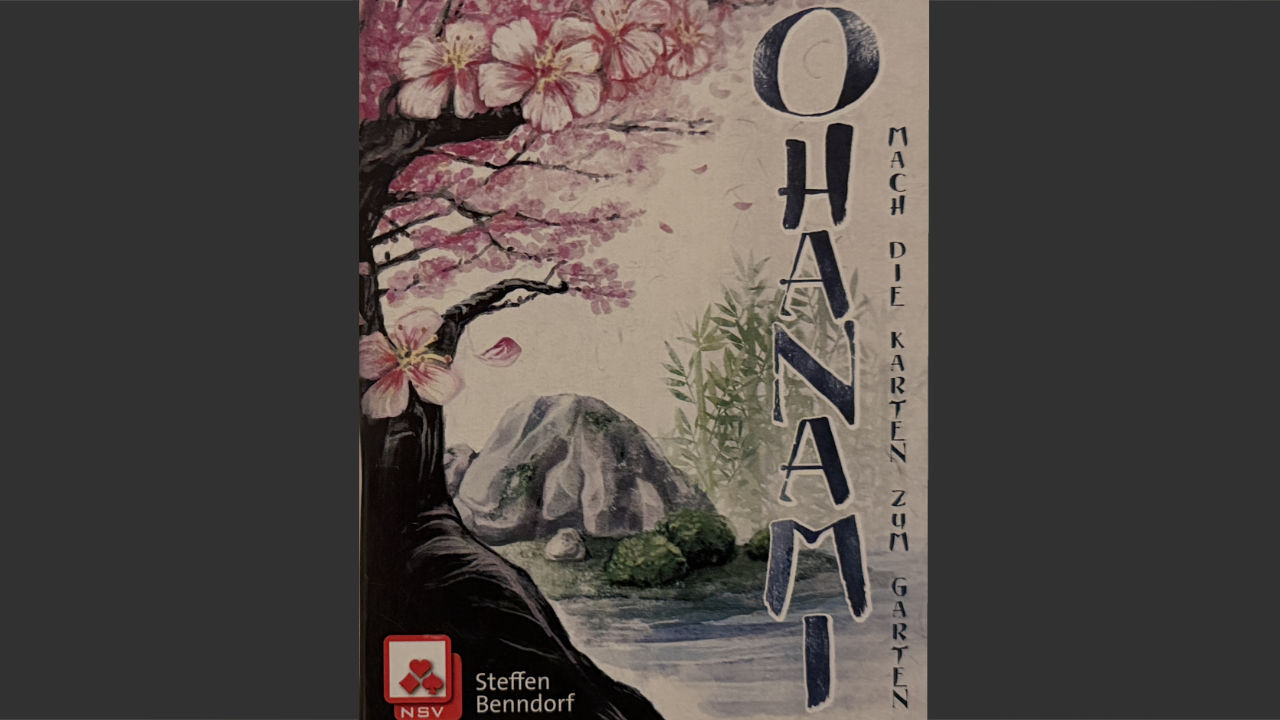
Der Qwixx-Entwickler Steffen Benndorf hat neben einer Reihe Würfelspielen auch kleine Kartenspiele entwickelt. Ohanami ist hiervon sein bestbewertetes auf BGG.
Benannt wurde das Spiel nach dem japanischen Kirschblütenfest O-Hanami. Die Regeln sind so kurz und einfach, dass man sie in 5 Minuten durchlesen kann, auch wenn 10-minütige Regelvideos bequemer sind.
Das Spiel besteht aus 120 Karten in den Werten 1 bis 120 und vier Farben.
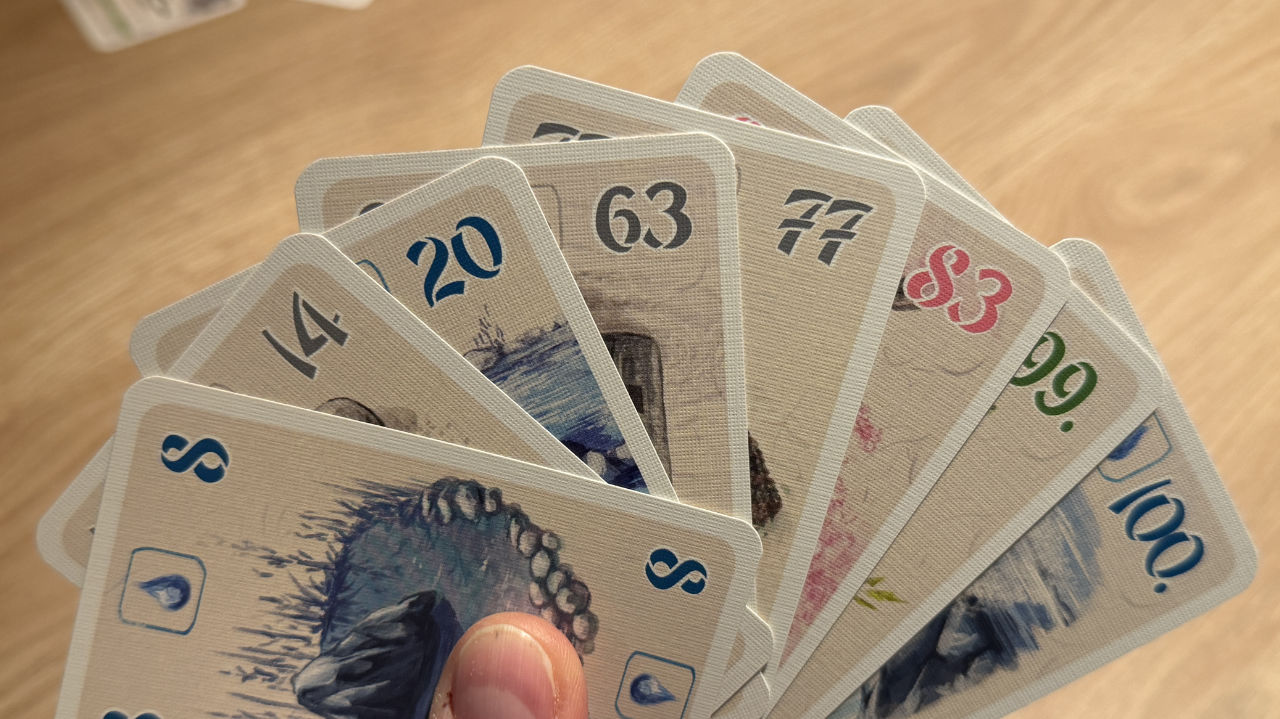
Wir legen über drei Runden Karten in drei Reihen ab. Zu Beginn einer Runde haben wir 10 Karten, von denen wir 2 aus-/anlegen und die übrigen 8 Karten an den Spieler links weiterreichen. Und so erhalten wir selber auch 8 Karten von einem Mitspieler, von denen wir wieder 2 anlegen, wobei wir immer nur kleinere oder größere Zahlen in unseren drei Reihen anlegen dürfen. Alternativ ist es auch möglich, 1 oder 2 Karten, die wir nicht anlegen möchten da die Lücke zu groß werden würde, abzulegen.
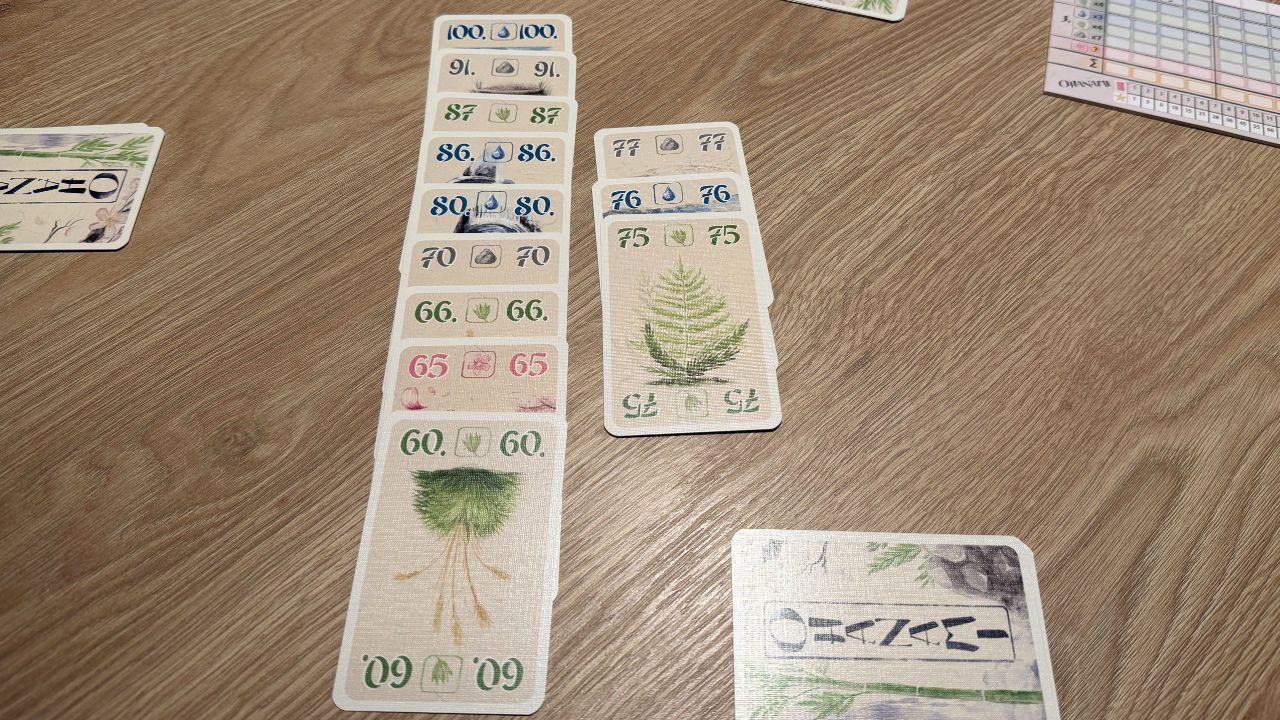
Diese 8 Karten habe ich von meinem Nachbarn erhalten. Die grau- und rosafarbenen bringen erst in Runde 3 Punkte, lege ich sie trotzdem schon an?
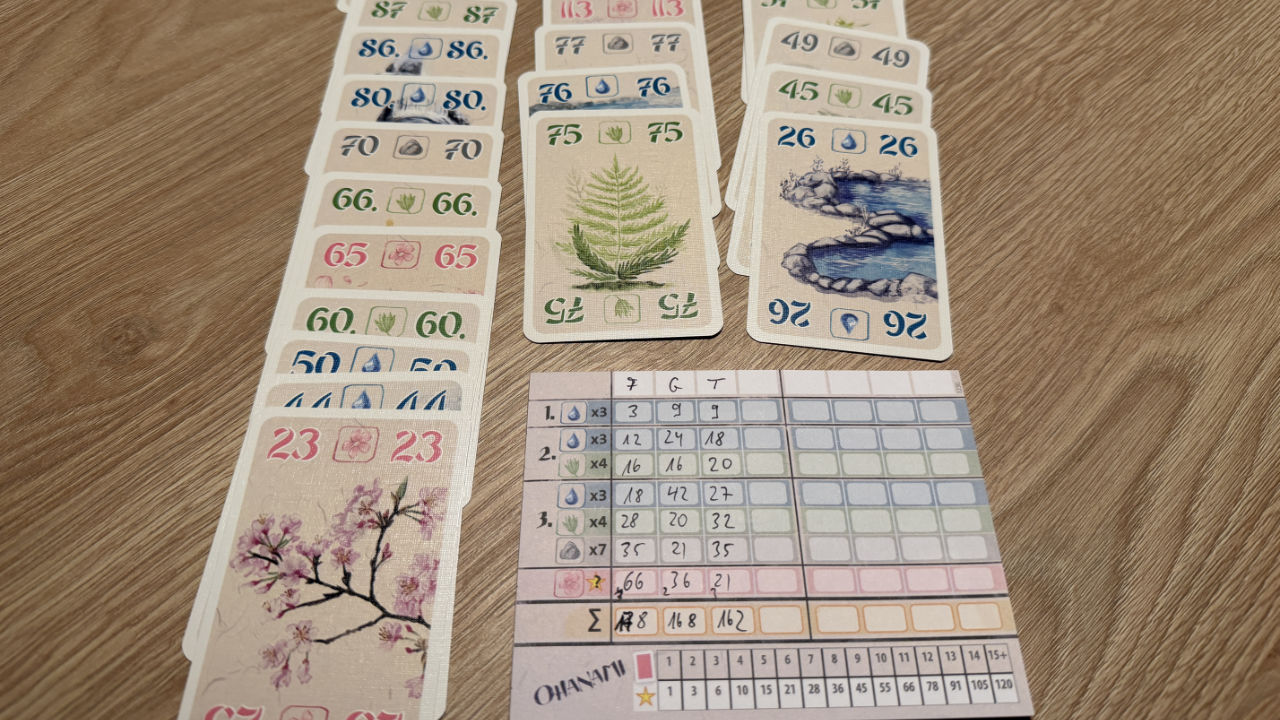
Und so geht es weiter, bis die 10 Karten angelegt wurden, damit die erste Runde beendet ist und dann gewertet wird. Hierbei erhält man für jede ausgespielte blaue Karte 3 Punkte, für die anderen Farben keine. Aber zum Abschluss der Runden 2 und 3 ändert sich dies und die anderen Farben werden wertvoller bzw. werden überhaupt gewertet. Die blauen bringen hingegen in allen drei Runden Punkte, wenn auch nur mit je drei Punkten.
Beginn Runde 2: Bislang habe ich erst in 2 der 3 Reihen Karten angelegt. Nach Runde 2 werden Blau und Grün gewertet.Nach Runde 3 werden alle Karten gewertet und dann alles Summiert. Und hinterher üwird berprüft, ob dies auch richtig gemacht wurde.
Fazit:
Kurze Regeln, kurze Spielzeit. Und da die Kartenwerte gut balanciert sind ist der Ausgang auch immer knapp. „Und für das nächste Spiel habe ich eine neue Strategie und gewinne“, so denkt man …
Das Spielprinzip ist schon ganz gut, die Thematik zum Kirschblütenfest sichert dezente Bilder.
Hätte man das Konzept mit einem Szenario im Weltraum oder einfach mit Aliens kombiniert, wären Punktezählerkritiker sicher besser zu überzeugen. Denn es ist zum Abschluss des Spiels ein ganz schönes Punktesummieren …
Asmodee has ramped up its reignited acquisition strategy by buying Japon Brand from CMON, anchoring the board game giant’s push into a “currently untapped market” for the company.
Japon Brand was instrumental in bringing Japanese designs such as Love Letter and Machi Koro to international markets, after being inspired by the surge in novel games from home-grown designers in the early 2000s.
The company will form the cornerstone of Asmodee’s new Japanese design studio, Nekuma, which will look to find games from local designers that it can release globally, as well as helping Asmodee bring its existing titles to Japanese players.
Asmodee CEO Thomas Koegler said, “Japan is one of the most creative and culturally influential markets in the world. With Nekuma and the integration of Japon Brand, we are building a long-term platform that connects Japanese creators with players globally.
Asmodee CEO Thomas Koegler
“True to Asmodee’s entrepreneurial and bold DNA, this capital-light and agile initiative allows us to invest where creativity is thriving while positioning Asmodee for sustainable growth in Asia.”
Asmodee has grown into a board game publishing and distribution giant thanks to the heavy expansion the business undertook after being bought by private equity firm Eurazeo in 2014.
But the vast bulk of the company’s revenue comes from its operations in Europe, which accounted for more than 76% of its €1.6bn net sales in 2025.
The United States contributed about 13.1% of 2025 net sales, while the company’s entire ‘rest of the world’ net sales – covering every country outside of Europe or the Americas – made up less than 5%.
Asmodee currently has offices in South Korea, China and Taiwan following an expansion to the continent in 2021, with those teams having developed and published localised titles including Splendor Pokémon, Love Letter Cookie Run, Pokémon Chips, and Love Letter Fox Spirit, as well as making use of crowdfunding platforms across the region.
The company said Nekuma would “integrate and expand” that activity under interim head of studio Frederic Nugeron, Asmodee’s current global senior vice president – route to market for the Asia Pacific region.
It said Nekuma would lead game sourcing “to identify and support the most promising Japanese and Asian tabletop game designers”, while Asia-focused publishing will be managed by the company’s existing Korea team.
Nugeron said, “Our ambition with Nekuma is very concrete: be present on the ground, listen to designers, understand cultural nuances, and build trusted relationships within the Japanese ecosystem.
“By combining local expertise with Asmodee’s global reach, we can support creators more closely and bring distinctive Asian games to a worldwide audience.”
Asmodee said Japon Brand would continue to operate with its existing expertise and relationships, with “no impact” on current partnerships or contracts.
But the company has faced a punishing financial situation since, posting losses of $3m across 2024 and nearly $7m for the first half of 2025 – figures which dwarf the overall $4.2m profit it had managed to make over the previous nine years combined.
But the revived M&A process is yet to fully mirror Asmodee’s private equity-fuelled buying spree from the latter half of the 2010s, during which it acquired more than 40 companies and IPs.
That heavy expansion included the company adding more than 20 game studios, including Days of Wonder, Fantasy Flight Games, Lookout Games, Catan Studio and Z-Man Games.
Asmodee CEO Thomas Koegler was asked during the company’s quarterly results presentation last month whether the company was ready to make “more meaningful” acquisitions rather than small bolt-on deals.
He said in response, “Without being specific, the activity in the pipeline is in accordance with our plan. The smaller acquisitions are faster. IP acquisitions and asset deals are faster to execute. I’m satisfied.”
The board game giant’s overall net sales jumped 22.2% across October to December 2025 compared to the same period a year earlier, with the performance of products it distributes for other companies surging more than 50%.
Net sales for games published by Asmodee itself fell almost 13% year-on-year in the quarter, however, weighed down by US net sales slumping 23% to €70.4m.
That drop saw the US fall behind both France and the UK in Q3 in terms of the company’s highest-performing countries for net sales, with France surging 47% year-on-year to over €111m, and the UK growing 41% to €82.7m.
Ein Sohn, der seinem Vater Ehre bereiten will. Eine Ehefrau, die ihre kämpferische Vergangenheit zugunsten ihrer Familie aufgibt. Und ein Ehemann, der sich nicht traut, Traditionen zu hinterfragen. Können sie in The Sword of Kaigen über sich und ihre Rollen hinauswachsen, oder wird der Krieg sie verschlingen?
Captain Tsubasa is a 2 player game based on the manga and anime of the same name. This Japanese manga and anime from the 1980’s is hugely popular not only in Japan but also around the world. It is about football (soccer). In the game you play a football match between two key teams in the story, Nankatsu and Toho. This is a card game, and you will see many characters from the series. If
Nach einer etwas längeren Sommerpause ist es an der Zeit, mal wieder über Spiele zu berichten. Die beste Art, um wieder in einen Schreibfluss zu kommen, ist bekanntlich drauflos zu tippen. Deshalb sei mir verziehen, wenn der folgende Text länger als notwendig wird und etwas umhermäandert. Da wir vor einigen Jahren auch vom Japanfieber angesteckt …

 Anmelden