Anmelden
Outwit Your Fellow Thieves in Buskers
24. September 2026 um 19:20
Rikki Tahta brings Coup energy to La Mame Games' 2026 release

Rikki Tahta brings Coup energy to La Mame Games' 2026 release
This weekend, just a few days before yesterday’s Braided Skies reveal, Stonemaier Games hosted its 13th annual Design Day. On Sunday, the Design Day itself featured designers, playtesters, and gamers from St. Louis and around the country for 12+ hours of playtesting and gaming at Pieces Board Game Bar and Cafe.
The purpose of Design Day is to bring together designers, playtesters, and content creators to give and receive feedback on game prototypes, expand their network within the gaming community, and learn from clever mechanisms in published games. If you’d like to know details about how the day is structured, you can read about previous Design Days here, here, here, here, here, here, here, here, here, here, and here.

Why We Run This Event
On paper, the event doesn’t make much sense. We’re not promoting anything. There’s really no focus on Stonemaier Games at all. To put it simply, Design Day is just something we like doing.
We like doing it for the designers, the playtesters and gamers, and the content creators. The creative energy is palpable and inspiring, and it seems to be a worthwhile, joyous experience for attendees. I’m also on the lookout for future Stonemaier products (so far we’ve published four games that appeared at Design Day), but I’m mostly just trying to be helpful to other creators and maybe help them find the right publisher.
How Does Design Day Work?
How Were the Games?
I truly am inspired and awestruck by the creativity, innovation, and vulnerability of the designers at this event. Everyone puts a lot of work into these games, and I loved listening to the constructive interactions between designers and playtesters.
Design Day isn’t a competition, but as a way of helping designers see how far along their games are, we ask attendees to rate each game on a 1-6 scale indicating how close a game is to being publishable.
Based on this rating scale–basically, how close they are to being a successful publishable game–here are the top-rated games of Design Day 2026, with brief descriptions in the words of the designers:
Other games rated 5.00 on average were Dice Rogue (Joe Totherow), Franchise Wars (Pete Wissinger), Magic Tricks (Chris Porter), and Pips (Ben Morayta).
If publishers are curious to learn more about some of these games, I’m happy to talk to you about them and connect you to the designers (if they’re looking for a publisher)!
Next Year
If you want to attend Design Day next year, you can use this year’s listing to get a notification for 2027, and if there are any extra slots, we’ll likely announce them in our April e-newsletter.
Have you found value in running or attending events related to your industry? As alternatives to Design Day, there are Protospiel, Unpub, and other playtest events around the country, including some at Geekway to the West in St. Louis in May.
***
If you gain value from the 100 articles Jamey publishes on this blog each year, please consider championing this content! You can also listen to posts like this in the audio version of the blog.


Huge demand for Asmodee‘s co-operative puzzle game Take Time has seen the publishing giant print more than 325,000 copies less than a year after release – outstripping even the company’s high expectations which surrounded its record-breaking launch.
Asmodee printed a massive 145,000 copies of Alexi Piovesan and Julien Prothière’s design for its worldwide launch last October, citing heavy enthusiasm from its distribution teams, board game media and pre-release playtesters.
Game line manager Auguste Lecoeur told BoardGameWire, “As soon as the game’s prototype was shown to us and signed, it became an internal priority, with resources and manpower being redirected from other projects to Take Time.
“Huge credit goes to everyone involved in the project for getting it done so quickly while maintaining such a high level of quality, especially considering that the game went through only around six months of visual development.
“When the game was first presented to Asmodee’s distribution units and partners, the enthusiasm was immediate as well, with Take Time being flagged as a key new release for Libellud.
“The same enthusiasm was shared by media outlets and players that were able to test the game prior to its release, so we had multiple positive signals ahead of launch.
“In that sense, we were definitely expecting a strong first print run, but you can never realistically expect to reach 145,000 copies. It was a very pleasant surprise and clearly exceeded our expectations, even though we were prepared for strong numbers.”
Every major reprint of the game since has topped 60,000 copies, Lecoeur said, with Asmodee currently planning another two to three global print runs of the same size each every year to keep up with demand.
Lecoeur said, “At this point, it is clear that Take Time won’t be a ‘one-hit wonder’, a game that enjoys a high initial print run but then quickly fades. Instead, the game is maintaining a strong sales pace and continues to perform well across markets.”
He added, “The game gained strong visibility and positive feedback at conventions such as Cannes’ FIJ and Spiel Essen, while also achieving higher-than-usual numbers online, thanks in part to its visual appeal and the buzz surrounding it.
“More broadly, the game was quickly validated by the core and specialist market, as well as by opinion leaders, critics and content creators within the board game community. It received strong critical acclaim – it is now ranked [in] the top 95 family games on BGG – and was nominated for multiple awards, which played a huge part in its success.
“Sure, we would have loved to win the As d’Or and Spiel des Jahres (who wouldn’t?), but I guess we’re being picky here!”
Success Story
Part of the game’s powerful performance has been down to it penetrating well beyond the specialist board games market, with Asmodee saying its distribution is now relatively evenly split between hobby stores, mass-market retailers and e-commerce.
Lecoeur said, “I’m convinced that this wouldn’t have been possible if the game hadn’t first been embraced by the core gaming community. Their strong support and enthusiasm for the game helped open the door to other distribution channels much more quickly.”
He added that part of Take Time’s wider appeal was down to the game’s compact size and “accessible price point”, as well as its “high level of replayability and substantial gameplay content”.
Those first two elements have become increasingly important amid ongoing financial strain for people in some of Asmodee’s core markets, such as France, Germany, the UK and US, with rising food and energy prices and ongoing economic uncertainty putting pressure on their purchases.
Other successful initiatives which helped boost Take Time’s appeal included what Lecoeur described as an “unusual” cardboard demo kit, with detachable cards and clocks, which could be ordered by distribution units to give players a taste of the game’s core mechanisms.
He said the kit “generated strong enthusiasm at launch”, but added that the format was not something which could be replicated for every one of its releases.
Award nominations also helped drive sales, especially in Germany and France, which Lecoeur said had been two of the strongest markets for the game from day one.
He said Take Time’s Spiel des Jahres recommendation was followed by a higher-than-usual reprint demand from Germany of 30,000 copies – and added that the impact of other ‘smaller’ awards “should not be overlooked”.
Take Time triumphed in this year’s Swiss Gamers Award and also took the Austrian game of the year prize, in addition to its ‘recommended’ nod in the Spiel des Jahres and nomination in France’s As d’Or.
Lecoeur also believes Take Time benefitted from the success of Libellud’s previous release Harmonies, which also picked up a Spiel des Jahres recommendation and the Swiss Gamers Award, as well as a Golden Geek – and was highlighted by Asmodee CEO Thomas Koegler as having had a strong launch.
Lecoeur said, “The fact that Libellud’s previous release, Harmonies, had been a hit certainly helped. It raised expectations around the studio’s next title and put the spotlight on its launch.
“It’s clear that each publisher develops its own reputation and ‘brand’ image based on its releases (among other things) and that this plays a significant role in the confidence they receive from retailers and, to some extent, from players.
“The success or failure of each release will inevitably have an impact on the games that follow, particularly when it comes to forecasts and initial orders.”
Time After Time
Asmodee is now beginning to turn Take Time into a wider product line, with debut expansion Mirage set for release next month, and the company having “many more ideas we’re currently working on for the range”.
Lecoeur said, “As soon as we received the first feedback on the game and it became clear that the launch was going to be massive, the first discussions about an expansion began in April 2025 with Alexi Piovesan and Julien Prothière, the game’s designers, to explore the possibilities for additional content.
“They worked on it and presented an iteration that led to a contract being signed in November 2025, as the first market feedback started coming in and multiple markets were selling out.
“However, this timeline was only possible because the designers were fully confident that the game offered enough design space to support an expansion, and because they presented an idea that genuinely excited the team, both mechanically and thematically.
“We’re not releasing expansions simply for the sake of releasing them or to get a marketing boost. If an expansion is published, it’s because we believe it genuinely adds something to the game and offers players a meaningful new experience.”
He added, “Mirage’s format also played an important role. It is a compact expansion, with a €7.99 MSRP, that introduces a new chapter while also adding a new gameplay twist that can be used to replay the entire base game in a different way.
“It isn’t a large expansion that takes up a significant amount of shelf space in stores or represents a massive financial commitment; instead, it is designed to complement the base game and extend the experience without overshadowing it. Its difficulty is also carefully tuned so that players can enjoy the expansion even if they haven’t finished the base game.
“Regarding expansions and product lines, there is a balance to strike between fully trusting your game and not overcommitting. You want to anticipate demand for expansions and reprints in order to avoid out-of-stock situations or a lack of releases and support that could hurt a game’s prospects in the medium to long-term.
“At the same time, a game needs to demonstrate commercial stability before being turned into a full-fledged product line and treated as such.
“It’s no secret that overproducing a game is one of the easiest ways for a publisher to get into financial trouble, and we’re doing our best to avoid that. We want to support successful games and build on their potential while remaining disciplined about production and inventory.”
A Board Game Arena version of the base game is also due for release in Q4 of this year.
The post “It is clear that Take Time won’t be a one-hit wonder”: Asmodee hit passes 325,000 copies after record-breaking launch first appeared on .
There’s a level of chaos that appears when a player’s turn is up in the new word-association party game Mind Sweeper (2026, Floodgate).
You see, players are staring at a table that has like 50 small cardboard tokens scattered here and there, from easy visuals (like one of those Egyptian-style pyramids, or a sword, or an apple) to some that are a bit opaque, like a single exclamation point. The active player is dealt a card with six words, and separately a number token forcing the player to illustrate a specific word (using those tokens) over the next 60 seconds.
Get your team to guess what the word is, and you score the card. Players can shout anything as soon as the timer starts, adding to the chaos. If they don’t get the word in those 60 seconds, the active player flips the word card in view of all players, then the team gets 60 more seconds to guess which of the six words was the original answer.
Across 10 word cards, you’re looking at a 15-20 minute experience, in a cooperative, high-score challenge that pushes players to get as many of the 10 words right as they can.
The keys here is twofold. Each card’s clue words are…
The post Mind Sweeper Game Review appeared first on Meeple Mountain.
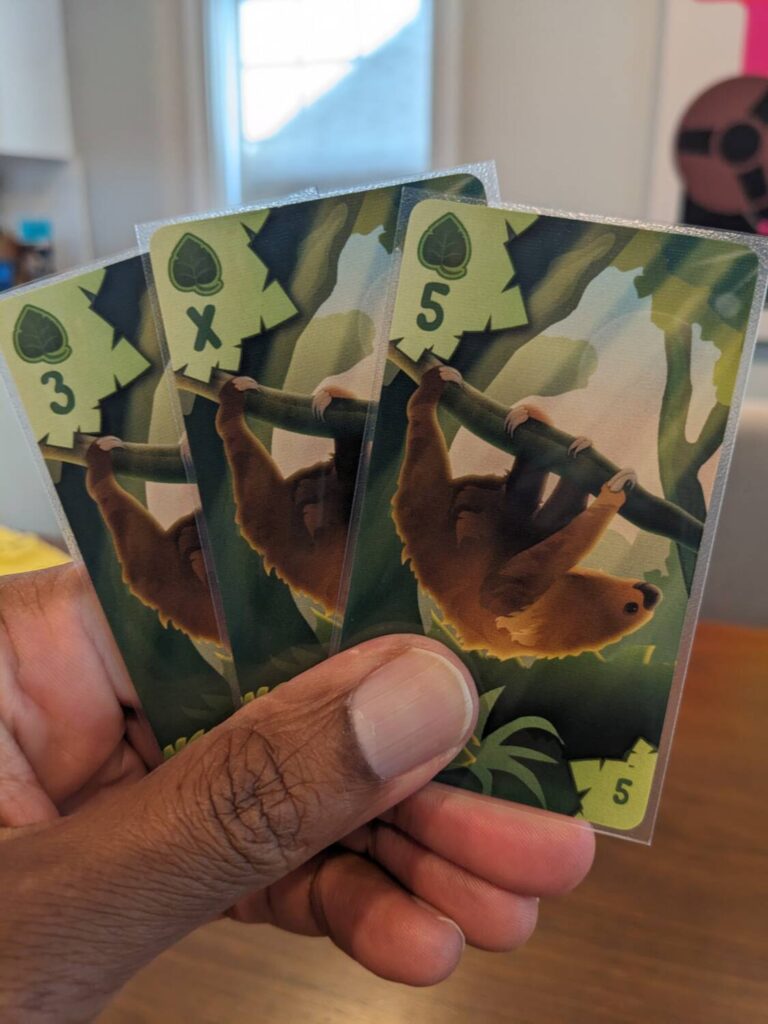
Surplus of Sloths (2026, Weird Giraffe Games) isn’t bad.
It’s a card drafting game where players try to build a hand of ascending card runs across five different suits of sloths. A market wipe mechanic pushes one leftover market card into a “surplus net” after each round, and players can view and gauge whether it is worth trying to score a suit at the end of the game.
I just gave you 75% of the rules, and designer Charlie McCarron (Skyrockets, the Kites riff I quite enjoyed) has given us a game so quick that my 12-year-old and I played it twice within a 15-minute stretch. Even winning one of those two games didn’t impress the 12-year-old, who shrugged their shoulders before admitting that the game was “only OK” before heading off to their room.
You’re right; that’s not an endorsement. My review crew joined me for a four-player game the following day, and the winner of that game also shrugged their shoulders and landed in the same rating range I landed on for this review.
Surplus of Sloths isn’t bad because its scoring mechanic is interesting. In an ideal world, you want to build up a run of three, four, maybe even five low cards of…
The post Surplus of Sloths Game Review appeared first on Meeple Mountain.
One of my favorite things about the games released under Carla and Nick Kopp’s Weird Giraffe banner: the games are often legitimately weird.
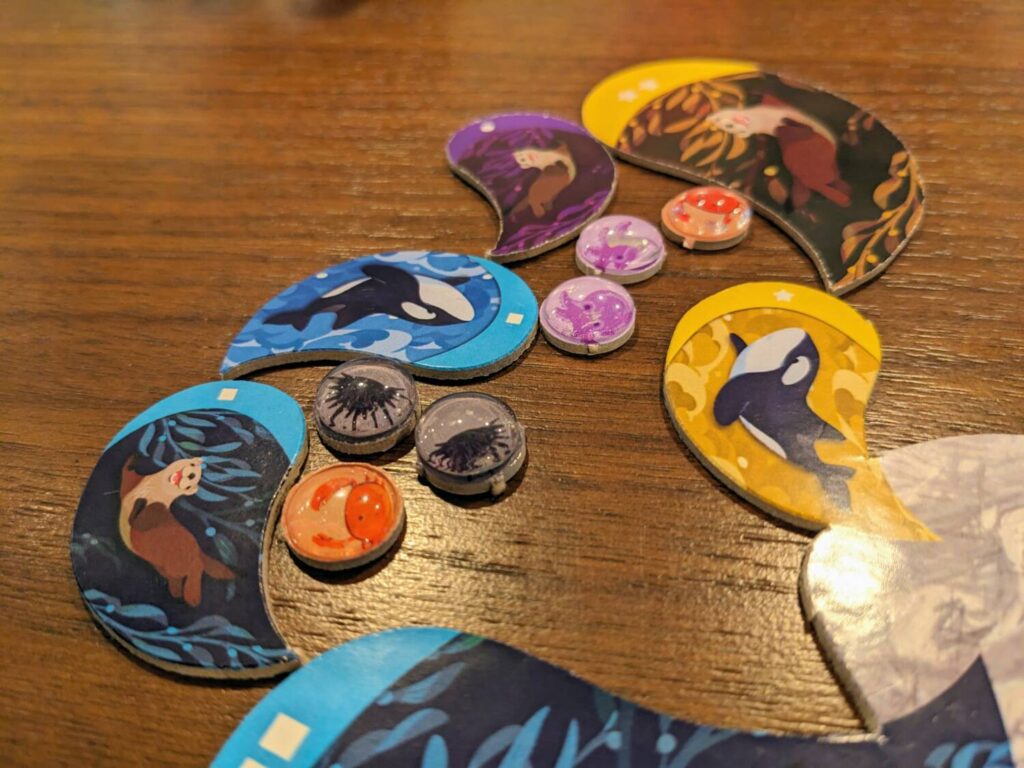
Here’s what I mean. I was explaining the rules to my wife and nine-year-old for our first play of Effervescent (a Carla design currently on crowdfunding, set for release in 2027), and when I tried to explain the main concept of placing sea-based creature tiles in such a way that the tail of a newly-placed tile must touch the head of a previously-placed animal tile, my wife openly balked.
“So, like, this way?” She used a large whale tile as an example.
“Well, sort of,” I began. “Each tile has a head area, a distinct tail point…then, every other part of the tile is a ‘side.’”
“Seems kind of weird,” she said. And our first play went that way, as players took tiles in one of three sizes to create scoring patterns that would trigger with a mix of scoring sequences, tied to “Drift” cards and Harmony cards, the latter of which were established before the game as public milestones that are always available to score.
Turns are simple. Place a tile, and if a placed tile meets a Drift card scoring condition, a player puts…
The post Effervescent Game Review appeared first on Meeple Mountain.
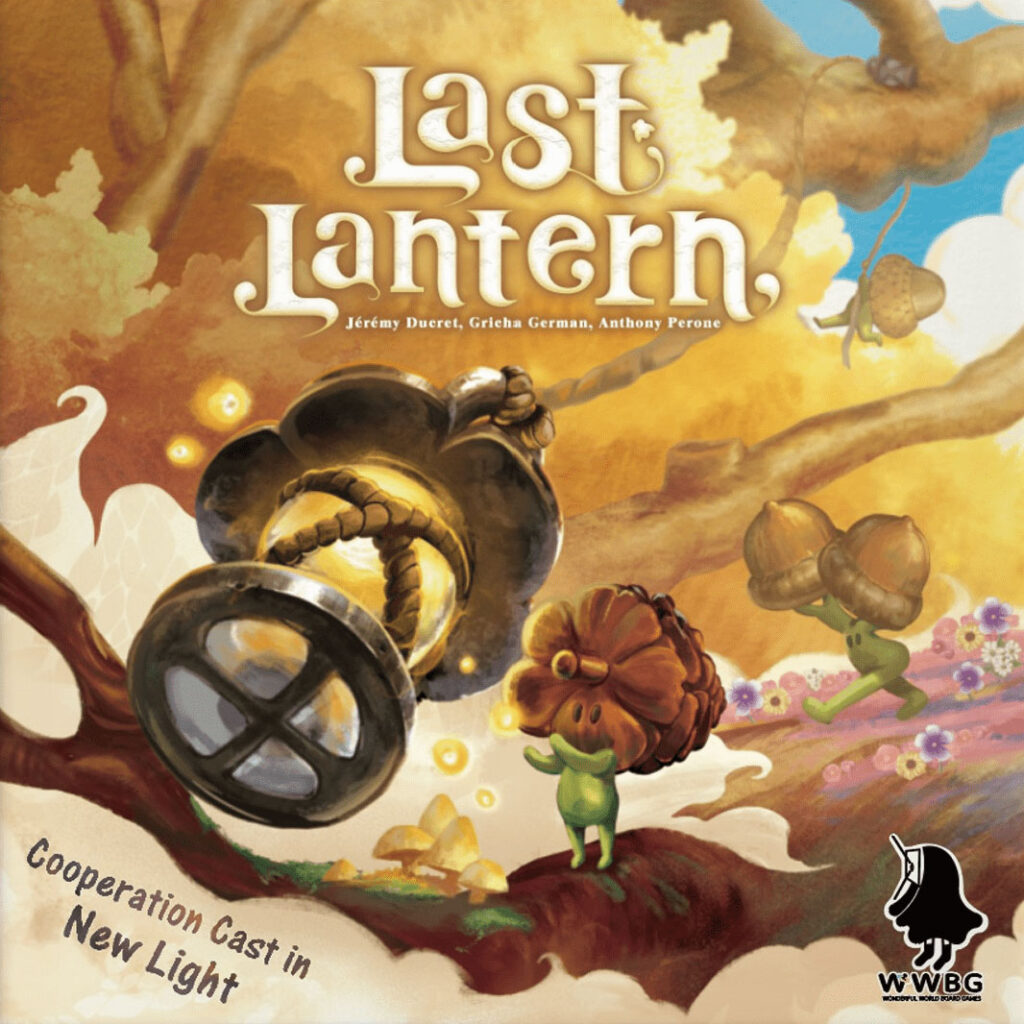
A fog lingers over our tree, and we are lost in our home. We need to set out and place the last lantern to fend off the fog. *Pause for dramatic effect* *Crickets chirp* *sighs* Last Lantern is a cooperative game with points of limited communication for two to four players that plays in about […]
Financially-troubled board game publisher CMON has secured a $19m injection of new capital as it battles to turn around years of heavy losses and dwindling cash reserves – which had left it with just $368,000 in bank and cash balances at the start of August.
The huge investment from new shareholders gives the crowdfunded board game giant much-needed financial breathing room, as it continues its attempt to recover from losses of almost $23m across 2024 and 2025.
CMON warned in the summer that its core business was suffering a “prolonged structural downturn” and was still consuming more cash than it generates, despite a drastic restructuring which has seen the company halve its workforce, sell off some of its biggest game IPs and halt new crowdfunding campaigns.
Those efforts dramatically reduced its losses, with the company reporting a loss of just over $2m for the first half of this year, compared to almost $7m for the same period in 2025.
But CMON’s balance sheet remained under pressure at the end of June, with $7.34m more in short-term liabilities than short-term assets, up from $6.89m at the end of 2025.
A significant part of CMON’s liabilities relates to eight crowdfunded games whose campaigns raised $14m from backers, but which the company has yet to deliver – including DC Super Heroes United, which raised more than $4.4m, and DCeased, which brought in over $2.5m.
CMON’s directors in its H1 report that the liabilities position had caused the company’s directors to give “careful consideration to the future liquidity and performance of the group and its available sources of financing in assessing whether the group will have sufficient financial resources to continue as a going concern”.
The directors added that they believed CMON would be be able to continue operating – but central to that assessment was the success of the planned share sale, which was designed to raise up to HK$150.5m, or about $19m.
Existing shareholders agreed to buy just 7.76% of the new shares offered to them by the August deadline, leaving CMON looking to raise more than $17.5m from other investors through the rights issue – a figure approaching 2.5-times the valuation of the entire company implied by its last share sale in February this year.
But the company has now revealed that placing agent Yuen Meta managed to sell every remaining share on offer, giving the business the full $19m it had been seeking – a significant mark of belief in the beleagured business.
That capital injection is more than 50-times CMON cash balance from early August, and almost double the $9.9m in revenue CMON generated across the whole of last year, although it pales in comparison to the $37m to $45m revenues it posted each year between 2021 and 2024.
CMON said it plans to use 40% of the newly-raised money to fund its day-to-day operations across the next 12 months, including staff costs, royalties, shipping and distribution, professional fees and other administrative and operating expenses.
Of that slice, about 30% – which works out to $2.28m – was set to go towards staff costs including salaries, bonuses and allowances, 30% towards selling and distribution expenses, and 35% towards general administrative and operating expenses, including its sales operation, utilities, insurance, government registration and filing fees, listing fee, repairs and maintenance. The the final 5% was earmarked for paying professional fees
That news could provide some relief to the tens of thousands of backers still waiting for their games via CMON’s heavily-delayed crowdfunding campaigns – although the publisher has not specified exactly how much of the capital will be used to deliver the overdue titles, or whether the capital is enough to ensure all eight will be fulfilled.
CMON has not completed fulfillment of a crowdfunding project since Zombicide: White Death in mid-2025, but did manage to deliver pre-orders for Cthulhu: Dark Providence, Marvel United: Witching Hour and Dune: Desert War in the first half of this year.
Four other pre-order titles: Assassin’s Creed Role Playing Game, The Adventurers, The Dead Keep and Super Fantasy Brawl Reborn, all remain undelivered, although the first of those is currently slated for completion in Q3.
| Game | Amount raised | Number of backers | Fundraise completed | Initial delivery estimate | Latest delivery estimate (as of September 24, 2026) |
|---|---|---|---|---|---|
| Mordred | $669,976 | 5,687 | July 2023 | August 2024 | Q4 2026 |
| Masters of the Universe: The Board Game – Clash for Eternia | $719,664 | 4,182 | January 2024 | November 2024 | Q1 2027 |
| DCeased | $2,564,789 | 12,787 | December 2023 | April 2025 | Q1 2027 |
| DC Super Heroes United | $4,478,989 | 14,040 | August 2024 | August 2025 | Q1 2027 |
| God of War | $832,945 | 4,388 | May 2024 | June 2025 | Q2 2027 |
| Massive Darkness: Dungeons of Shadowreach | $2,854,553 | 9,842 | February 2025 | March 2026 | Q3 2027 |
| A Song of Ice & Fire: Tactics | $1,886,509 | 6,406 | February 2024 | February 2025 | Q3 2027 |
| Degenesis: Clan Wars | $339,742 | 1,232 | June 2024 | July 2025 | n/a |
| Total Dollars | $14,347,167 |
About 20% of CMON’s newly-raised capital is earmarked for repaying debts and other outstanding liabilities, including $2.46m owed to a CMON director and $385,000 of unsecured advances from employees, as well as outstanding production, shipping, royalty and other operating costs.
CMON has slated 25% of the new money for expansion in existing and new markets, including strengthening the company’s presence in Europe through marketing and potential attendance at events including Spiel Essen and Cannes, as well as targeting growth in Japan and the Philippines.
The company added that it plans to put 15% of the new capital towards potential acquisitions as part of a push into digital gaming, although said it had not yet identified any targets.
CMON said it intends to look for between one and three businesses, primarily in Asia-Pacific, valued at between about $1.3m and $2.5m each, which could help it develop digital adaptations of its existing games, companion apps and other digitally-enabled features.
The publisher stressed that it intends to retain physical tabletop games as its core business, with the digital push designed to complement rather than replace them.
CMON’s capital raise has also radically reshaped the ownership of the company, with chairman and CEO Ng Chern Ann ceasing to be the largest shareholder after his overall stake was diluted down from about 20% to just over 5%.
The capital raise has made investor Yip Ka Ki Cherry CMON’s largest disclosed shareholder with a roughly 19% stake, personally and via her investment holding company Legend One.
Yip was already an investor in CMON before the rights issue, with a stake of about 4.8%. Her other previous investments through Legend One include Japanese entertainment business TryHard Holdings.
CMON has also strengthened its board following the capital raise, appointing two new independent non-executive directors – veteran financial management, corporate governance and audit executive Chan Ka Kit, and corporate communications, marketing and investor relations specialist Claire Luk.
The post CMON succeeds with $19m capital raise in major boost to financially-troubled publisher’s turnaround first appeared on .
If you have been following our blog for a while now, you know of my affinity for the history of the American Revolutionary War. I am a proud American, believe deeply in the principles of our land and the Constitution that governs it and am grateful to God every single day that our country was successful in our fight for its freedom in order to create a better society and to assist all peoples with protecting their “unalienable rights” endowed by a Creator, which include “Life, Liberty and the pursuit of Happiness”. I enjoy playing wargames on the American Revolutionary War and very much enjoy learning about the history and its key battles. There are many out there that feel the same as I do and they have designed lots of these type of games and with 2026 being our 250th Anniversary of the Declaration of Independence, there are events that are planned to celebrate it.
One of which is an event put on by GMT Games and Mark Miklos called Gaming the American Revolution – Camden 250 being held in Camden, South Carolina September 24-27th. The event includes 3 days of gaming centered on American Revolutionary Wargames produced and published by GMT Games but also includes several events, gatherings and historic tours of the Camden Battlefield.
We are attending and at the time of the posting of this are already on a flight on our way to Columbia, South Carolina via a short stop in Chicago, Illinois. We are very much looking forward to the event and have plans to play at least 2 games from the Battles of the American Revolution Tri-Pack II including Newtown and Oriskany, as well as any other opportunity that presents itself. We also are going to participate in the various tours of the Camden Revolutionary War Visitor Center and nearby battlefield and also plan to drive to a few others sites on our way home to the airport namely Waxhaws and Cowpens.
At the end of each day, I will be putting together a short summary of what we did that day at the convention. I would like to keep this to just a few paragraphs with several pictures to give you an idea of the games we played that day, people we talked with and other activities we participated in. We will still work on doing multiple videos as well that will be released on the YouTube Channel over the next few months but this written coverage will supplement the videos. This summary will most likely not be posted until near midnight EST each night so you might be checking it out the next morning which is fine.
Finally, if you are at the event please feel free to find us and say hello. I believe that we are very friendly and accessible and love to make connections with our fans and followers. In fact, we have TPA buttons and stickers to give away so just ask. We also would like to take a picture with you so we can document it in our writings.
Please check back each day for a summary of the days exploits. Thanks for following along.
Because this is a wargaming blog, I am going to share below some of our content we have made regarding AmRev War games for your review:
Gaming the American Revolution – Ranking the Games We Have Played – 2025 Edition
The Beautiful Boards of Wargaming! – Liberty or Death: The American Insurrection from GMT Games
My Favorite Wargame Cards – A Look at Individual Cards from My Favorite Games – Card #59: Sullivan Expedition vs. Iroquois and Tories from Liberty or Death: The American Insurrection from GMT Games
My Favorite Wargame Cards – A Look at Individual Cards from My Favorite Games – Card #53: The World Turned Upside Down from Liberty or Death: The American Insurrection from GMT Games
My Favorite Wargame Cards – A Look at Individual Cards from My Favorite Games – Card #48: George Rogers Clark Leads a Western Offensive from Washington’s War from GMT Games
COIN Workshop: Liberty or Death: The American Insurrection from GMT Games – Indian Faction
Best 3 Games with…The American Revolution!
“The Revolution was effected before the War commenced. The Revolution was in the minds and hearts of the people…” – A Review of Washington’s War from GMT Games
Interview with Sam London Designer of Common Sense: An American Revolution, 1775-1783 from GMT Games
Video Review for Battles of the American Revolution Tri-Pack II: Germantown:
Video Review for Battles of the American Revolution: Savannah with Mark Miklos:
Video Interview with Sam London Designer of Common Sense (as of yet unreleased):
Video Interview with Bruno Sinigaglio and Dave Stiffler Designers of Small BoaR Series: Battle of Cowpens:
-Grant
Upland & Prairie is troublesome. Designed by the peerless Peer Sylvester, gorgeously illustrated and produced, and conceptually adjacent to certain Knizian disc- and tile-laying games, it has the makings of something wonderful.
The problem is that it doesn’t work. With some squinting, I believe I can see what Sylvester was going for. But it’s like looking directly at the sun: uncomfortable, fumbling, all its majesty blinded by sheer directness. I have worked to appreciate what is here. But the more I try, the more irritated I become.
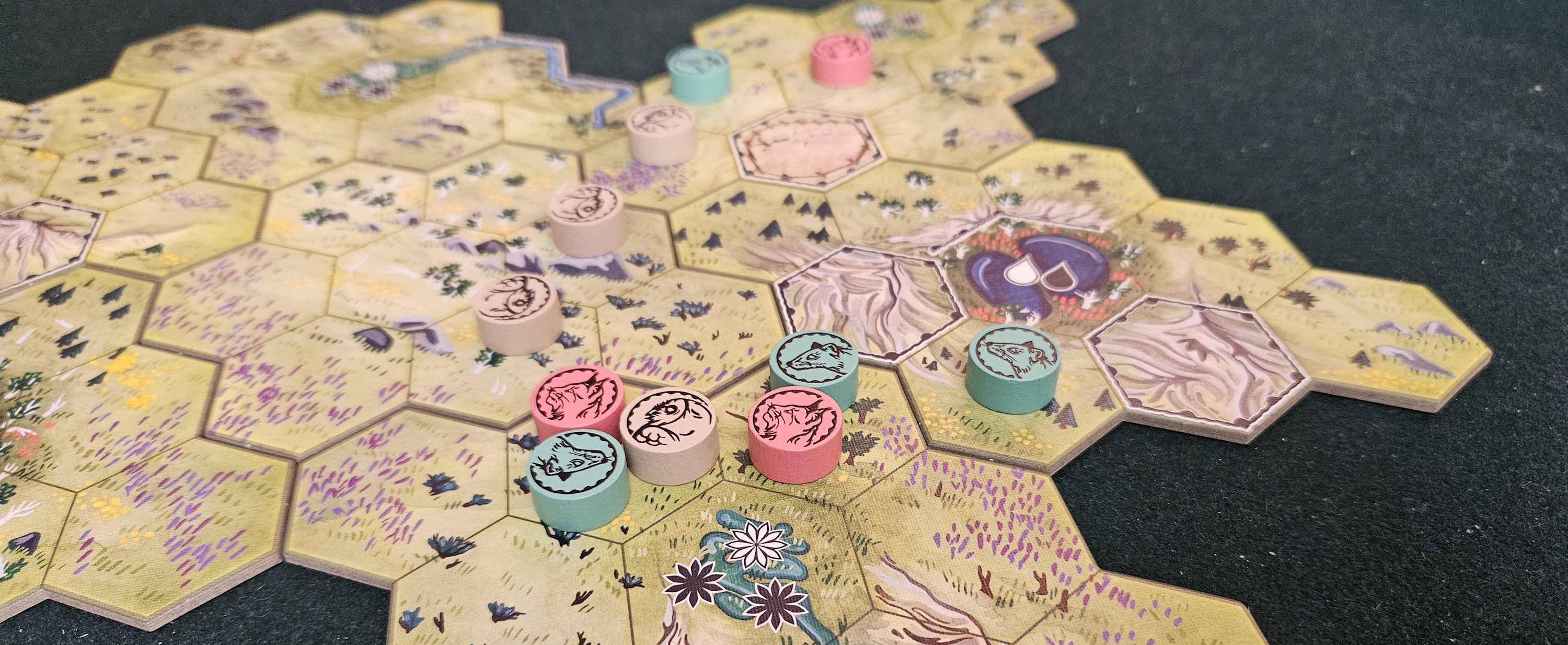
Early moves. Also maybe mid-moves.
At a soil level, Upland & Prairie is about placing discs in three colors to link together either two or three objective spaces. When this happens — if it happens — the color of that space-linking chain determines which type of token becomes the game’s victory condition. Thus, linking rodents means rodent tokens become the game’s means of success. If the chain is composed of owls, you’re hopefully holding the most brown tokens. Predatory cats… you get the idea.
The game’s sole action is dead simple. On your turn, you draw three tokens from the bag. One of these gets placed on the map. Another gets hidden behind your player shield. The third gets tossed back into the bag. Even at its slowest, it’s snappy.
In theory, this exiles players to donkeyspace. If you’re holding the most red tokens, you want the final chain to be red. But placing red tokens means you’re not hoarding red tokens; hoarding red tokens means you’re not placing red tokens. Meanwhile, if an opponent sees you moving to complete the red chain, there’s nothing preventing them from hoarding their own red tokens. It’s a pickle.
Conversely, the game might end with the bag running dry. When that happens, now players are looking to build sets of red, green, and brown tokens. In such on occurrence, hoarding was exactly the wrong thing to do. Now it’s variety you’re after. Choices, choices.
And there certainly are choices. Constrained choices, to be sure. Choices dictated largely by the draw. That’s no problem. They’re still informed choices, and theoretically interesting choices at that. Every little tidbit, every placement, becomes a trickle of water on an arid prairie. When an opponent tucks a ferret (?) into a corner, is that because they’re trying to run out the bag? Or are they just trying to deplete those green tokens because they aren’t holding enough of them? Could this be an opening? Or is it so much static, not a coherent signal?
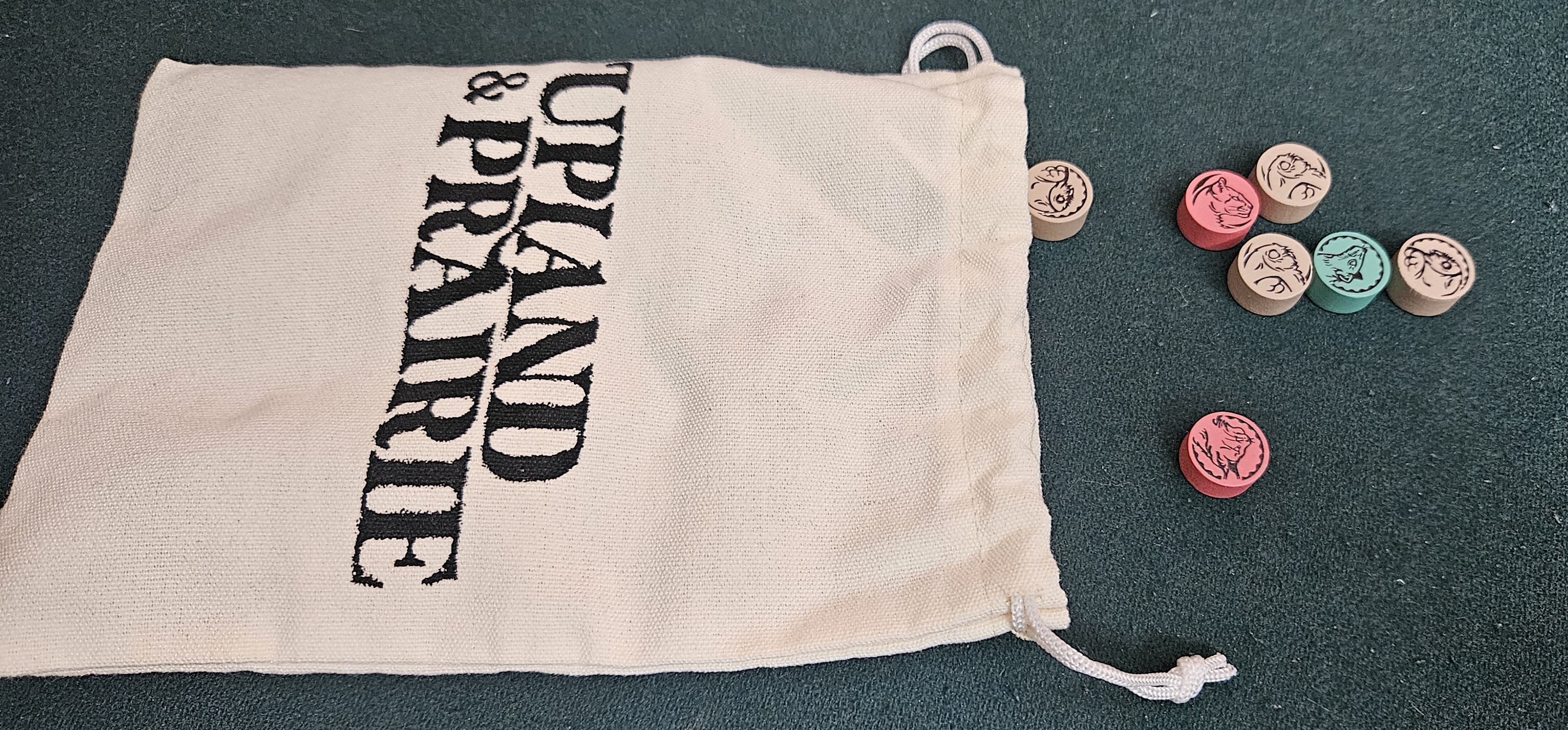
Now that’s one generous bag!
The foremost issue with Upland & Prairie is one of limitation. Not in the sense that it’s too limited. Rather, that it isn’t limited enough.
There are only three colors. Most of the time, this makes blocking a real problem. Now, in the game’s early stages, blocking is simple enough. If owls are threatening to end the session prematurely — a real possibility, given the tiny size of the map — then I might cut off your parliamentary incursion by placing a mountain lion. Easy enough.
But as the game progresses, other tokens might appear from the bag. These push up a tracker that increases how many tokens a space can hold. Where the game begins with each hex limited to a single disc, eventually it becomes possible to hold a second disc, and then a third. These moments, regulated as they are only by the draw-bag, are significantly harder to manage than ordinary token draws. It’s possible, as in a few of our sessions, that the game will open up its geography very early, in which case you might as well beeline toward the finish line with the color you’re holding the most of. If instead the game lingers a while, then the sudden appearance of a population-expanding token tends to favor the player upon whose turn it appeared. Now any bottlenecks can be pried open, and usually with ease.
Meanwhile, because the map is so small, these swings arrive with such suddenness that there isn’t much one can do to preempt them. Even if I’ve successfully walled off a particular species, a shift on my opponent’s turn — whether that’s one opponent or two, or perhaps two opponents and a partner, all depending on play count — can spell a very swift crumbling to that bulwark.
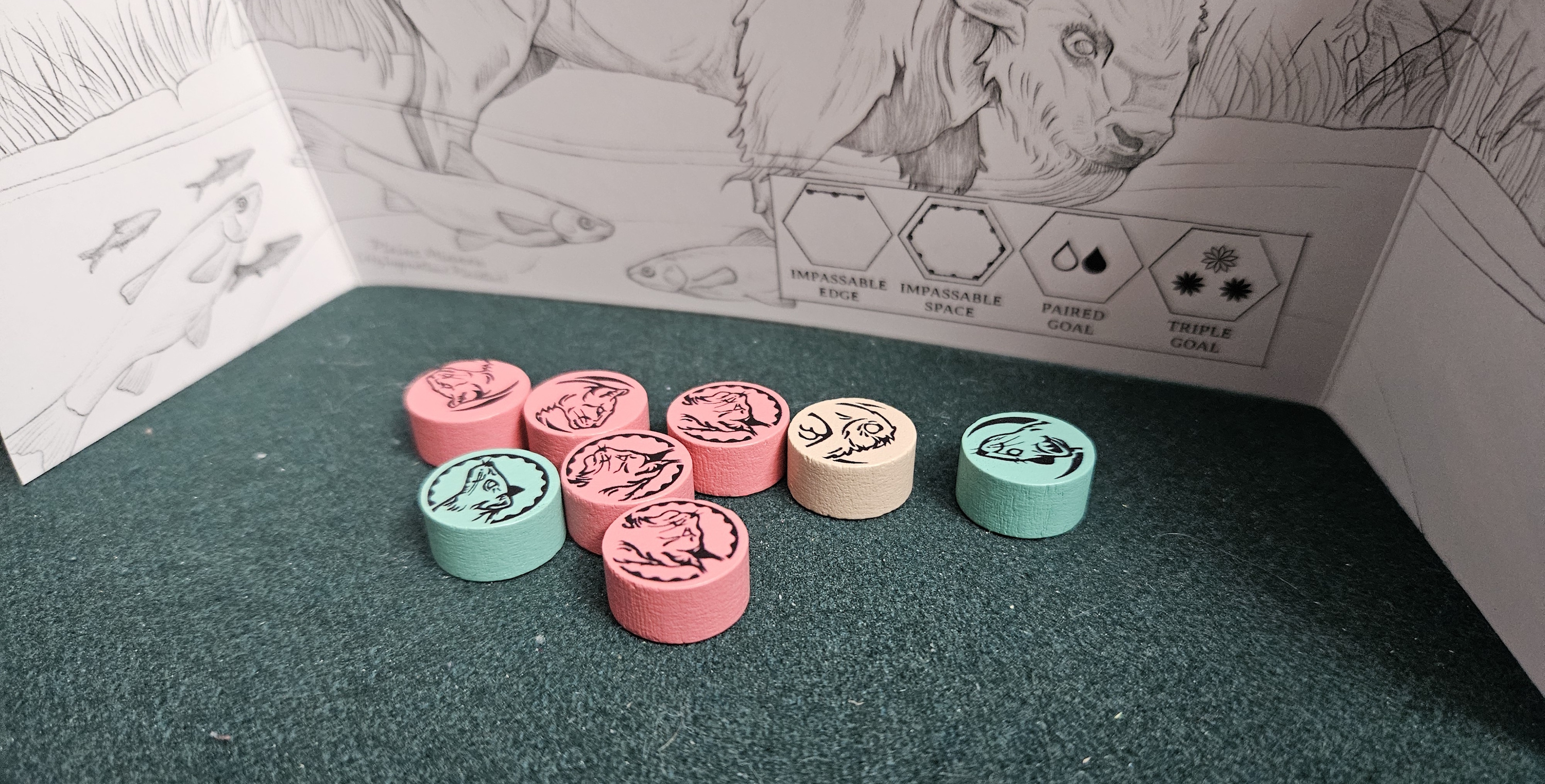
Hidden discs function as your score.
And then, when the game ends, there’s the very real possibility that it will end in a tie. There are tiebreakers, of course, and as in some of Sylvester’s better titles, The King Is Dead foremost among them, knowledge of the tiebreaker might be all-important.
Here, though, the tiebreakers feel more like concessions than objectives that can be shrewdly managed. In the case of a chain, tied players break their stalemate by who would go next in turn order. For an empty bag, it’s all about who holds the most animals of a single type. That might sound functional enough, but I’ve also seen that tally result in a tie. And the rulebook declines to address this possibility with either a second tiebreaker or a desultory “in this case, players share the win.”
This relates to my earlier issue. Upland & Prairie tends to end in a tie for the same reason that blocking is hard: the whole thing is simply too small. The map, the duration, the limits on placement, all of it. Sessions tend to end either swiftly or slightly less swiftly. There just isn’t enough time to build up a sizeable lead in any particular category. Nor is there room to suss out what an opponent is likely holding. The result is a game that presents pleasantly bite-sized decisions, but never enough of them to amount to a meal.
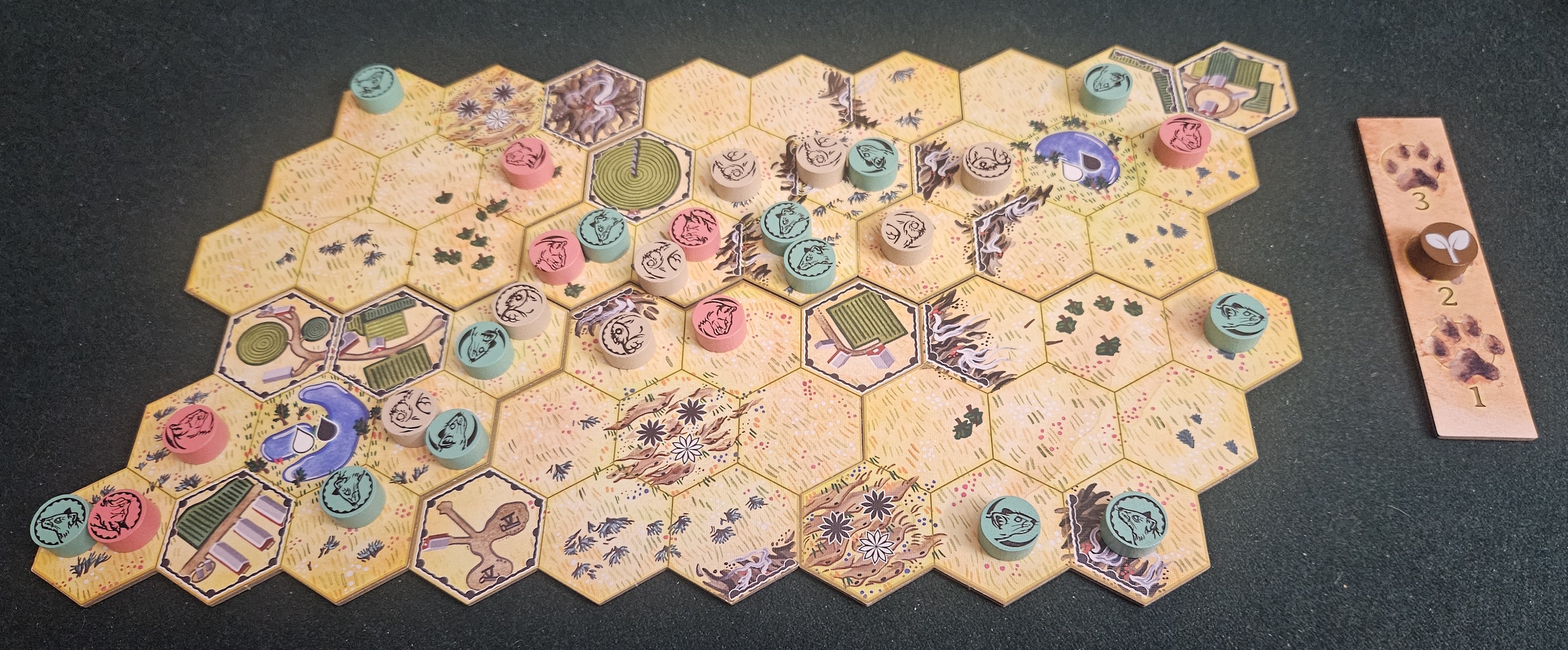
Big Sky. Tiny board.
It’s a shame, because I understand the desire to build a shorter tile-laying game. The famous Knizias — Tigris & Euphrates, Samurai, Qin, Babylonia — weren’t horrible time-hogs. But, sure, they could take a while to develop their board states.
Unfortunately, Upland & Prairie goes too far in the other direction. It prunes down not just the scope, but also the ability to stretch out, to take an opponent’s measure, to switch gears. Instead of coming across as a compact tile-layer, it feels like a novelty, like a mint-tin version of something more robust. And one that doesn’t succeed at compressing its subject matter, at that. This is no highland, no prairie. It’s a strip of lawn in a cookie-cutter suburb.
A complimentary copy of Upland & Prairie was provided by the designer/publisher.
(If what I’m doing at Space-Biff! is valuable to you in some way, please consider dropping by my Patreon campaign or Ko-fi. Right now, supporters can read the next installment in my series Talking About Games, this time tackling the topic of what makes a good list! Naturally, the piece includes a list.)
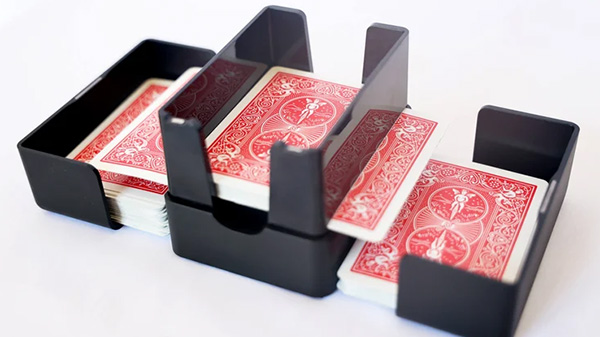
After dealing with clunky gears and stuck cards, we ditched our cheap bargain shuffler for the Lotus V2 and we won't be looking back. Here is why the Lotus became an instant must-have for our game nights.
/pic9360132.png)
by Steph Hodge
Discover three card games hitting the market in late 2026
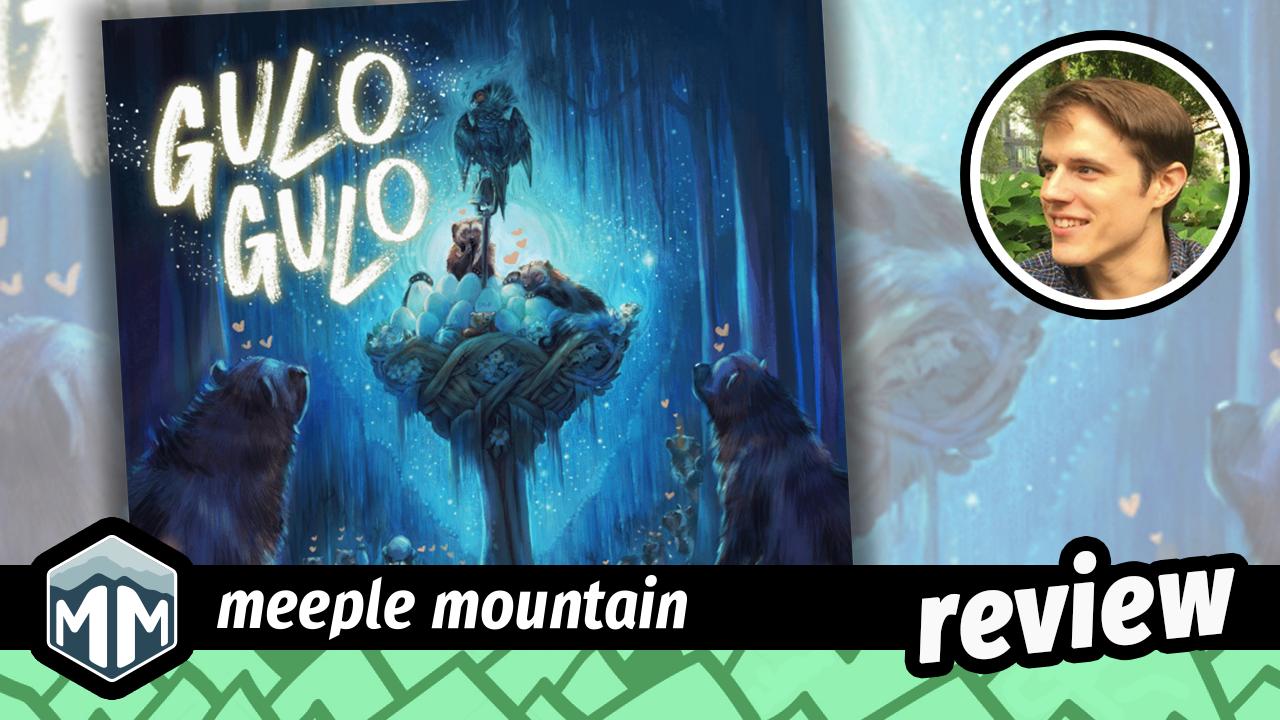
In Gulo Gulo, players compete to rescue a young gulo—a wolverine—from the evil swamp vulture. I say “evil,” but that’s unfair. The wolverine pup was trying to steal one of the bird’s eggs, after all. Is the vulture really evil, or simply a participant in larger systems that force us into binary rolesl? If the game were from the vulture’s perspective, would the gulos not be the evil ones? You could reframe Gulo Gulo as a tower defense game in which the vulture fends off a hoard of ravenous gulos and not have to change any of the facts on the ground. Games really can teach us things, if we have the heart to listen.
Philosophical implications of this exercise and its framing aside, Gulo Gulo is Candy Land with dexterity elements. To move to a new space, you pull a matching egg out of the nest, a wooden bowl full of the colorful ovoid ova. This wouldn’t be much of a challenge at all were it not for the tall and precarious stick that pokes out above the nest, its weighted end causing it to weave and wobble and constantly threaten to fall over. If the stick does fall or if you cause any eggs to fall out and hit the table, you move back to the previous…
The post Gulo Gulo Game Review appeared first on Meeple Mountain.
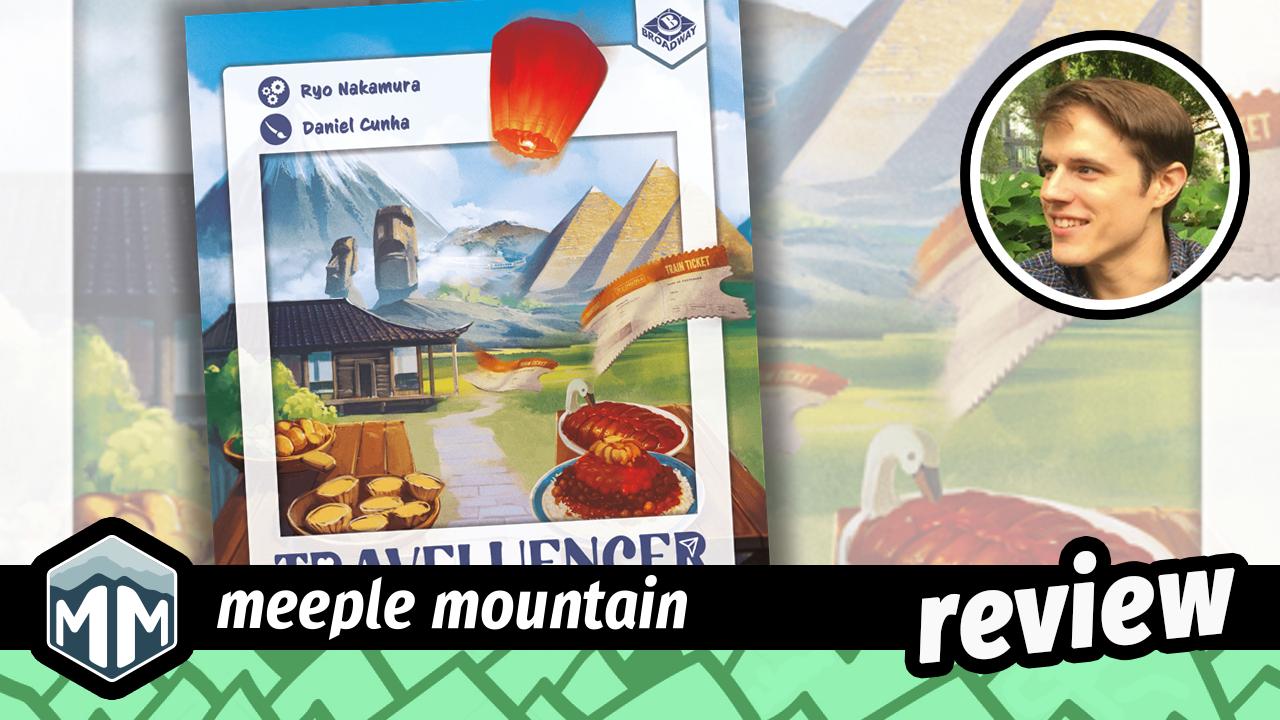
To design a meaningfully thematic trick-taker is no small accomplishment. Other than Traveluencer, Daniel Newman’s Gachapon Trick is the only other one I can think of off the top of my head. In Traveluencer, the players are social media stars, and the cards they play represent both their posts and their view count. The trump suit is whatever topic is trending. The winner gains likes as points. It’s good. It’s thorough.
Mechanically, designers Ryo Nakamura, Zhonghao Yang, and Kai Zu have drawn from an unlikely source: Taiki Shinzawa’s 2019 charmer Inflation!. In both Inflation! and Traveluencer, you can play as many cards into the trick as you want, chaining them to create a single high number. If I play a blue 2, 5, and 7, I’ve played 257. There’s no limit to how many cards you can chain, but you do want to avoid both running out of cards too early and having any cards left at the end of the hand. Tricks missed due to a lack of cards represent periods of inactivity, death itself in the world of social media.
The risk of you running out of cards is minimal. Almost non-existent. There is no…
The post Traveluencer Game Review appeared first on Meeple Mountain.
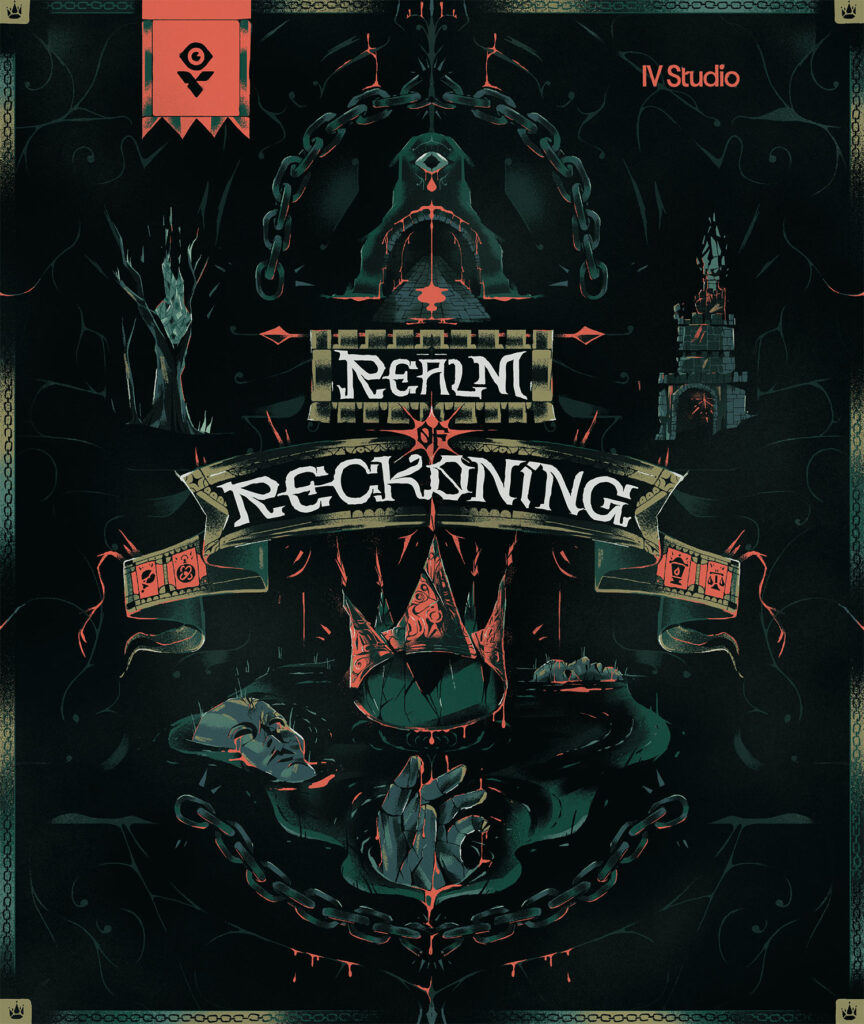
IV Studio’s first game Moonrakers, was the first game I ever crowdfunded. I was struck by their combination of old-school design ideology, paired with marketable and upgraded components and art. Unfortunately, I found Moonrakers too simple to be fine. Because of that opinion, I never really checked in with their output of the last dozen […]
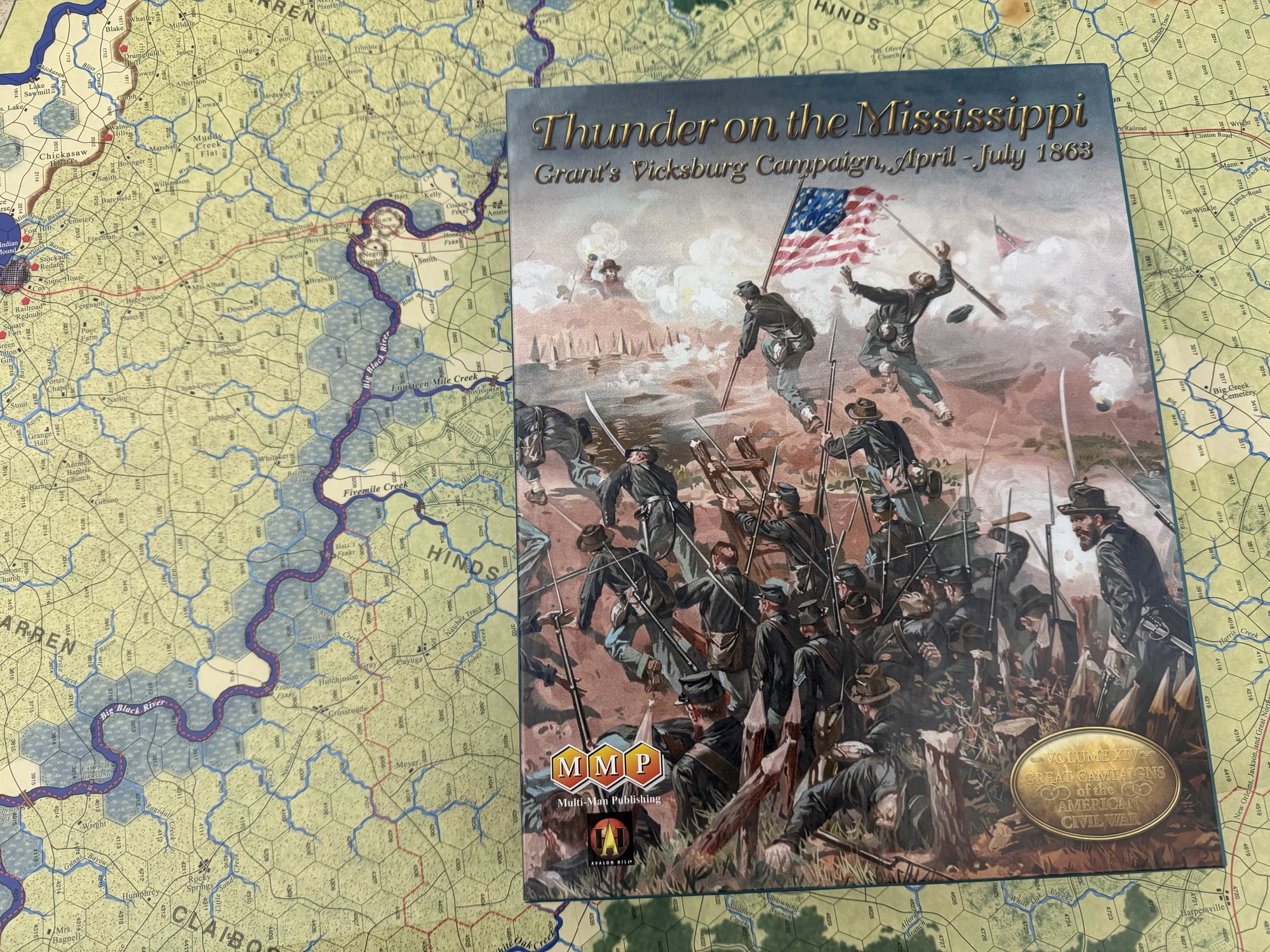
Continuing along in this series devoted to the best looking boards found in the wargaming world where I will highlight the art and layout of a different board in a wargame that we have played to show you the various talents of the artists and graphic designers involved. In my humble opinion, a well designed and attractive board can make all the difference in the world to me enjoying a wargame. Don’t get me wrong, the game has to be good, but if it’s also good looking it always is a better experience. A board can draw me in. Can make me feel that I’m there. Can set the stage for the thematic immersion that we all crave. And I have found many of these type of boards and I want to make sure that I share them with you.
In this entry in the series, we will be taking a look at the fantastic looking board for Great Campaigns of the American Civil War: Thunder On the Mississippi: Grant’s Vicksburg Campaign, April-July, 1863 from Multi-Man Publishing. The board is illustrated by the very talented Charlie Kibler whose work on the Great Campaigns of the American Civil War Series dates back to its creation in 1992. He has done a ton of great looking boards including The Battle for Normandy (2009) from GMT Games, The Day Was Ours: First Bull Run (2021) from Revolution Games, Border Reivers (2023) from GMT Games recently as well as a slew of Advanced Squad Leader boards stretching back through the years and a lot of series games for GMT Games such as Great Battles of the American Civil War and Great Battles of the American Revolution. We have already highlighted a few of his boards in the past like Storm Over Jerusalem from MMP and Battles of the American Revolution Volume II: Brandywine from GMT Games. He is very effective at creating great looking terrain and weaving in very nice details to highlight the main functions of the board and I very much like the simplicity and accurateness of his boards.
The board consists of 2 separate 22″x 32″ full-color map sheets that when combined create a large playing surface. The borders of the board include off-board information that is related to the geography and locations in and around Vicksburg. When I first saw this, I wasn’t really quite sure how to take it but after playing and also thinking about this decision, I really like how it was used to frame up or provide a significant visual contrast to the main game board. The brown coloring really contrasts well with the colorful terrain features and create a clear distinction for the players. I initially thought this was a poor decision and felt that it was a missed opportunity but it works really well.
Here is a closeup of this part of the board so you can get a good feel for what I am talking about.
I always like to look at the game title box/area of the board and find these to be really great insights into the mindset and approach of the artist. On the board for Thunder on the Mississippi, we see Charlie used a washed out period look map for the background of this area. The really interesting part is how it transitions from the non-colored portion of the board title box to the game board itself. There is no connection between the 2 and the elements found on the board are not carried over or connected to the period map. I would maybe have liked to see there be a connection for an immersive approach but I understand that this was not the purpose of the use of the period map.
In Thunder on the Mississippi, there are 2 new terrain features unique to the Vicksburg region introduced including loess hills and coastal bluffs. Loess has not been featured before in GCACW Series games. Each loess hex is depicted with many small tan dots superimposed on an olive base color. This stippling gives it a sandy feel and I think really works well as loess is a fine-grained, powdery soil, a wide belt of which runs on the east side of the Mississippi on a southwest – northeast axis. Because loess is highly susceptible to erosion, it is marked by sharp, irregular ravines, many of which were so overgrown with vegetation as to be nearly impassable to military units.
In the game, loess hexes are identical to woods hexes in terms of Movement Point costs and MP penalties to enter a friendly-occupied hex. Also, loess hexsides untraversed by roads or railroads exert a restricted ZOC the same as woods hexsides similarly untraversed. I think that the type of terrain, and what it does to the units that enter, really mimics the soft soil type as it is always hard to run in sand. I very much like the color used as well and it serves to set this specific terrain type apart from the rest of the board. Here is a look at the western portion of the West Map that is up against the Mississippi River.
The other new terrain feature is that of coastal bluffs, which has also not been featured before in the series. Each coastal bluff hexside has a downhill side in which the light brown bluff line-pattern is uneven and an uphill side in which the bluff line-pattern is smooth. I know that it might be a bit hard to see in the below picture but the downhill side is found on the left side while the uphill side is on the right. Think of it this way…the uphill is simply a straight line border while the downhill side reflects the ravines from erosion and is made up of multi-length lines pointing out. I very much like this new terrain and also think that Charlie did a great job with the distinction even though it is a bit hard to distinguish from afar.
And that brings me to the portion of the board that I think is my favorite. Not because it is some revolutionary technique but because of the power and permanence that is offers the board, acting as an anchor and a framing of the action to be played out on it, and that is the Mississippi River itself. There is no real use of stylized marks or special features shown on the board but it is just a thick and dark blue line that meanders through the countryside. But the dark blue really gives a sense of size and scope and I very much feel that it is important to the board and what is to transpire on it.
I also very much like how Charlie decided to keep in the exact layout of the river and shows its many twists and turns and oxbows that are found along its length.
The board for Thunder on the Mississippi is really a visual masterpiece. It provides great transition from terrain type to terrain type, frames up the board itself very well and uses very smart and poignant color choices, including the loess terrain color and the dark blue of the Old Man, all to create a fantastic canvas upon which to play out this titanic struggle and key turning point of the American Civil War.
If you are interested, here is a link to our video review:
The next board that we will take a look at in the series is The Marianas Campaign: Volume One: Saipan – The Bloody Rock from Compass Games.
Here are links to the previous entries in the series:
Kekionga!: A Dark and Bloody Battleground, 1790 from High Flying Dice Games
Campaigns of 1777 in Strategy & Tactics Magazine #316 from Decision Games
Battle Hymn Volume 1: Gettysburg and Pea Ridge from Compass Games
From Salerno to Rome: World War II – The Italian Campaign, 1943-1944 from Dissimula Edizioni
This War Without an Enemy: The English Civil War 1642-1646 from Nuts! Publishing
Holland ‘44: Operation Market-Garden, September 1944 from GMT Games
Maori Wars: The New Zealand Land Wars, 1845-1872 from Legion Wargames
Imperial Struggle: The Global Rivalry – Britain & France 1697-1789 from GMT Games
Stilicho: Last of the Romans from Hollandspiele
Nevsky: Teutons and Rus in Collision, 1240-1242 from GMT Games
A Most Fearful Sacrifice: The Three Days of Gettysburg from Flying Pig Games
Donnerschlag: Escape from Stalingrad from VUCA Simulations
Keep Up the Fire!: The Boxer Rebellion Deluxe Edition from Worthington Publishing
Liberty or Death: The American Insurrection from GMT Games
Lanzerath Ridge: Battle of the Bulge from Dan Verssen Games
Salerno ’43: The Allied Invasion of Italy, September 1943 from GMT Games
Bayonets & Tomahawks: The French and Indian War from GMT Games
Undaunted: Normandy from Osprey Games
Traces of War from VUCA Simulations
SCS Ardennes II from Multi-Man Publishing
Almoravid: Reconquista and Riposte in Spain, 1085-1086 from GMT Games
Walking a Bloody Path: The Battle of Fallen Timbers, August 20, 1794 from High Flying Dice Games
All Bridges Burning: Red Revolt and White Guard in Finland, 1917-1918 from GMT Games
Storm Over Jerusalem: The Roman Siege from Multi-Man Publishing
Iron, Blood, Snow & Mud from PHALANX
North Africa ’41: The Western Desert, March to December, 1941 from GMT Games
Battles of the American Revolution Volume II: Brandywine from GMT Games
Ardennes ’44: The Battle of the Bulge from GMT Games
Gandhi: The Decolonization of British India, 1917-1947 from GMT Games
Battles of Napoleon: Volume I – Eylau 1807 from Sound of Drums
Tattered Flags No. 01 – Into the Whirlpool from Blue Panther
Alliance: Multiplayer Napoleonic Wargame from Columbia Games
-Grant




/pic8498535.jpg)