Normale Ansicht

The Life & Games of Quintus Fabius Maximus Verrucosus (Cunctator), #1

19. April 2026 um 17:47

We have done quite a few board game assisted biographies on this blog. Today, we are going farther back in time than ever to cover the life & games of the Roman statesman whose life is half shrouded in myth: Quintus Fabius Maximus Verrucosus. You might know him as Fabius Cunctator – Fabius the Delayer. Without further delay, we’ll get right into the first part of his life – his origins, early career, and, when he was already one of the pre-eminent Roman statesmen of his time, the defining event of his life: The war against Hannibal in which he took on an extraordinary office. Let’s go!

If you want to read more posts of this kind, I strongly recommend you subscribe to the blog – all new posts in your inbox right when they go live!

The Aristocrat: Origins

You may have wondered about Fabius’s long name above. This is a good opportunity to look at Roman naming customs, which tell us a little about Fabius, and a lot about the Romans. Quintus was his given name (the Romans used only around 20 given names for boys, and the five most common names (Quintus being one of them) already made up more than three quarters). Fabius was his family name, marking him as a member of the gens Fabia. The three remaining names were various kinds of nicknames – Maximus (“the greatest”) was a name he had inherited from an ancestor, Verrucosus (“the warty one”) he had received himself for a wart on his upper lip, and Cunctator (“the Delayer”) he earned for… well, we’ll get to that.

The Romans were big on family, and so the second name would have been the most important one to them. We’ll thus stick to calling our protagonist Fabius. He might have been even prouder of his family than the average Roman, as his was the patrician gens Fabia, one of Rome’s great aristocratic families. From his birth around 280-275 BCE on, Fabius was thus destined for a political and military career.

We do not know much about his early life. Fabius’s ancient biographers assert that he was deliberate to the point of slowness, but this seems like projecting his later fame of “delaying” back to his youth to maintain unity of character. In any case, Fabius was anything but slow in his career.

Young Roman nobles were expected to gain some military experience. Fabius could do so in the First Punic War, a protracted struggle (264-241 BCE) with Carthage over the control of Sicily and Sardinia. Rome won, mostly due to the almost bottomless manpower from which it could recruit – in addition to the city itself, Rome had founded many colonies all over Italy, and was allied to almost every other city on the Italian mainland. Fabius’s insights into generalship and Rome’s system of alliances would come in handy later.

Rome’s manpower advantage over Carthage is represented by the many Allied Auxiliaries cards in Hannibal & Hamilcar (Jaro Andruszkiewicz/Mark Simonitch, Phalanx).

Cursus Honorum: The Early Career

Well-born Roman men with ambitions could not but go into politics. The Republic offered several elected offices for which they competed. Usually, these were taken one after another in a fixed sequence (the cursus honorum (“course of honors”)), but the rules were not as fixed in Fabius’s 3rd century BCE as they would become later. Thus, Fabius was elected to the lowest office (the quaestorship, responsible for financial administration) twice (first in 237), but, after climbing the second rung on the ladder (the aedilate), he skipped the third (the praetorship) altogether. Instead, he ran the highest office (the consulate) only four years after his quaestorship. The people of Rome elected him consul for the year 233. Fabius had fulfilled all ambitions which a regular Roman noble could have.

Fabius as represented in The Republic of Rome (Richard Berthold/Don Greenwood/Robert Haines, Avalon Hill): While his military value of 5 is excellent, his influence of 3 is only middling (and probably underestimates the sway Fabius held over the Republic for two decades). From the Vassal implementation.

Yet Fabius was not content to be just any Roman noble. While his domestic pursuits were unremarkable – he unsuccessfully opposed a law introduced by the tribune of the plebs Gaius Flaminius which distributed lands in northern Italy to military colonists – he defeated the Ligurians during his consulate and was awarded a triumph for it. That was an extraordinary honor, rarely bestowed. Given that his victory was won against a rather minor enemy, that spoke of Fabius’s political clout.

The triumph was the greatest honor that could be bestowed on a victorious Roman general – and it affirmed the Roman belief in the righteousness and victoriousness of their cause.

Fabius left his consulate as one of the first men in Rome. He consolidated his political power even further, attaining the censorship (an office elected only every five years and correspondingly rare, even amongst former consuls) in 230 BCE, and, in contradiction to traditions prohibiting the repetition of high offices, became consul again in 228. Then, he used his good contacts to the Greek world to ensure that Romans could, for the first time, participate in the Isthmian Games. Two consulates and a censorship would ensure Fabius’s political primacy for the rest of his life.

Ten years after the end of his second consulate, Hannibal invaded Italy.

Invasion: Hannibal in Italy

Carthaginian-Roman relations had remained difficult after the end of the First Punic War. With Rome in control of the islands, the Carthaginians had diverted their energy to Spain. Their leading family, the Barcids, had carved out a large and prosperous colonial empire there. To avoid conflict with Rome, the two empires agreed on a division of spheres of influence. When the Carthaginians clashed with the city of Saguntum, it applied to Rome for help. The Romans resolved to aid Saguntum, even though the city lay in Carthage’s sphere of influence. Some of the ancient authors report that Fabius led a senate faction which favored negotiations over war with Carthage, others – like the generally reliable Polybius – oppose this interpretation. In any case, the hawks prevailed and war was declared on Carthage. The Romans sent an army to Spain, but the Barcid commander Hannibal seized the initiative by skirting the Roman force and crossing the Alps into Italy. Hannibal defeated a Roman army under Publius Cornelius Scipio (the father of Scipio Africanus) at the Trebia river and allied himself with the Gallic tribes in upper Italy. Fabius counseled that Rome avoid engagement with Hannibal and instead rest on its superior strength to wear him out.

In the second year of the war, the two Roman consuls (one of them Gaius Flaminius, Fabius’s opponent from his first consulate) each awaited the Carthaginian army in defensive positions on either side of the Apennine mountains, ready to support each other. Yet Hannibal snuck through the mountains, got into Flaminius’s back, and annihilated his army in a surprise attack on the shores of Lake Trasimene.

Setup for the Lake Trasimene scenario from Commands & Colors: Ancients (Richard Borg, GMT Games): You can see the Romans pinned against the shores of the Lake when the Carthaginians began to emerge from their covered positions in the hills and forests north of the lake. Image from CommandsAndColors.net.

One of Rome’s consuls was dead, the other cut off from the city by Hannibal’s army. The Romans resorted to this leadership crisis with an emergency measure: There was one office whose holder did not have to consult with a colleague – the dictator. Now was the time for such a man.

Dictator: Fabius vs. Hannibal

Traditionally, a dictator would be appointed by the two consuls. Yet one of them was dead and the other cut off from Rome. The remaining senators took matters into their own hands and had the popular assembly elect Fabius dictator. Having an additional experienced general in a crisis offers some advantages, as the Roman player in Hannibal & Hamilcar (Jaro Andruszkiewicz/Mark Simonitch, Phalanx) can attest: The Dictator event places an additional general (whose requirement of a strategy/battle rating of 3-3 makes it likely that it will be Fabius, as there is only one other general of this kind in the game) in Rome, and, as the advantages of unified command are lost in a game which has unified command (the player) anyway, also gives three combat units as a boon.

Another perspective on the office is found in The Republic of Rome (Richard Berthold/Don Greenwood/Robert Haines, Avalon Hill): As all players represent individual Roman factions, putting a dictator in charge can save the Republic from all too many military challenges – but it also runs the risk of making the dictator too powerful to be contained in the political competition of the republic.

Fabius, for one, was all taken up by the current crisis when he was named dictator. He identified the crisis as not only military, but also psychological: The catastrophe at Lake Trasimene had shaken the Romans’ confidence that they would eventually win through their own courage, the help of their allies, and the benevolence of the gods. Fabius began at the latter end. As the highest public official, he was also responsible for attending to religious rites, and he made sure to give them immaculate attention. His ostentatious piety included vowing large public sacrifices to the gods in the coming season, and personally, he promised to build a temple to Venus Erycina, a goddess associated with the gens Fabia.

The religious aspect of Roman life is rarely well understood by modern, secularized, audiences. Board games also don’t get it right very often. The Republic of Rome includes priesthoods which can be conferred on characters (the historical Fabius was a member of the priesthood colleges of both the augurs and the pontifices), but the in-game effect is abstract – it just increases their voting power. Only the pontifex maximus (Rome’s highest priest, literally the “greatest bridge-builder”) has an additional function, as he can veto political proposals (on the grounds that the omens are not favorable). Omens are also the only way in which religion features in Hannibal & Hamilcar: The Good Omen event allows the player to manipulate a die roll.

Religion, the foundation of ancient culture, as a one-time effect.

The two games thus present two differing interpretations: Republic of Rome’s priests are – much like any other Roman aristocrat, from whose ranks they are recruited – concerned with the political advancement of their faction and will use their religious powers as an other tool in this political competition. Hannibal & Hamilcar’s recipient of “good omens” seems to be in fact blessed by the gods (as the omens can manipulate the impact of crossing a difficult mountain pass or the likelihood that a Carthaginian fleet carries reinforcements over the Mediterranean Sea). Neither the former opportunism nor the latter true belief captures the social and cultural importance of ancient religion (without subscribing to the particular Roman form of polytheism) fully, pointing to a certain blind spot in board games.

Fabius’s religious restoration has found less attention among modern readers than his military response to the crisis at hand. In short, after the defeats at the Trebia and Lake Trasimene, Fabius refused to meet Hannibal in a pitched battle. Instead, his army shadowed Hannibal’s, hoping to chip away at his supplies. Such a gradualist, but tenacious approach continues to be referred to as a “Fabian strategy” until today.

Despite Rome’s bad experiences with field battles against Hannibal, the strategy was unpopular. Romans were used to fighting – and winning – battles. Refusing them smacked of defeatism, if not straight-up cowardice. Fabius’s nickname Cunctator (“the Delayer”) stems from the early days of his dictatorship, and it wasn’t meant as a compliment.

The strategy was also initially not successful. Closely observing Hannibal’s army from unattackable positions did nothing to the counter the desolation the Carthaginians visited on the lands of Rome’s allies whose loyalty to Rome now faded. And the one time when Fabius had Hannibal cornered at the plains of Ager Falernus (in September 217 BCE), the Romans were duped: Hannibal feigned a nocturnal attack on the pass by tying wooden torches to the horns of 2,000 oxen, lightly guarded by some of his troops. which resembled an advancing army at night. The Romans, led by Fabius’s second-in-command Marcus Minucius Rufus, engaged in a confused melee in the dark (against Fabius’s explicit command) while Hannibal slipped away by another route with his main force.

Fabius’s reputation reached its nadir after the battle of Ager Falernus. Minucius Rufus was among the Dictator’s many critics. Fabius’s tenuous political position is evidenced by the senate practically appointing Minucius Rufus his co-dictator with an independent command of part of the army – but both parts were to operate in conjunction. Minucius Rufus eschewed Fabius’s careful positioning of the army on the hills to avoid battle and moved into the plains at Geronium to engage Hannibal. He got his wish… but not the way he wanted: Hannibal’s small force at Geronium turned out to be bait, and the reinforcements which Hannibal had hidden nearby started mauling Minucius Rufus’s army. Fabius swept down from the hills with his army. Now Hannibal was under attack from both sides and retreated. While Minucius Rufus’s army had suffered outsized casualties, the battle had not turned into a third disaster.

With Minucius Rufus taken down a few notches – he had to come to Fabius’s camp after the battle and hail him as his second father for the gift of his life – the challenge to Fabius’s authority was met. Yet Fabius was still not popular, and after his six-month term as dictator expired, he returned to private life.

You know who didn’t return to private life? – Hannibal, that’s who. And thus we’ll have a second post on Fabius’s life… soon.

Games Referenced

Hannibal & Hamilcar (Jaro Andrusziewicz/Mark Simonitch, Phalanx)

Commands & Colors: Ancients (Richard Borg, GMT Games)

The Republic of Rome (Richard Berthold/Don Greenwood/Robert Haines, Avalon Hill)

Further Reading

Plutarch’s biography of Fabius (which prizes unity of character over historical accuracy) can be found in an English translation here.

Polybius’s Histories which deal with the rise of Rome in the Mediterranean including the Second Punic War are online in an English translation here.

Fabius has found remarkably little attention by modern biographers. If you read German, I recommend this short, but insightful piece on him: Beck, Hans: Quintus Fabius Maximus. Musterkarriere ohne Zögern [Quintus Fabius Maximus. Model Career without Delaying], in: Hölkeskamp, Karl-Joachim/Stein-Hölkeskamp, Elke: Von Romulus zu Augustus. Große Gestalten der römischen Republik [From Romulus to Augustus. Great Characters of the Roman Republic], Beck, Munich 2000.

Designer Diary: Diplomacy: The Golden Blade Card Game

19. April 2026 um 16:00

by Rosco Schock


The design that became The Golden Blade was the first game I ever designed, and the first iteration of it was way back in the autumn of 2017. I should also be clear that I didn’t set out to design a card game version of Diplomacy; that just kind of happened along the way. I hope you will enjoy this story of how we ended up there.

Background
It might be helpful to first explain the original Diplomacy. Diplomacy was first self-published in 1959 and is a war game that contains almost no random elements. Each player is a Great Power in Europe prior to World War I, with the ultimate goal of controlling a majority of territories known as “Supply Centers” to win. Players must first negotiate with each other during a turn before secretly writing the Orders for their units. All the negotiations between players are non-binding, and it has a reputation as a “friendship killer” when one player betrays another to win. It was frequently advertised as John F Kennedy’s and Henry Kissinger’s favorite game. Diplomacy was inducted into the BGG Hall of Fame in 2025.

Origination
At this point in time, I had never played (or heard of, to be honest) Diplomacy. Although I had been playing a lot of the BGG Top 100 games for a few years, I never tried to design one all by myself… except for that one time in 2013 that I made a set of cards for some vague concept to fix a game we were playing that had people building a city with power level cards of 1/2/3. Fast forward to 2017, when a friend invited me to a monthly board game play testing event.

Luckily, I remembered that I had this set of cards at home in a box. The 1/2/3 cards I uncovered came in three different types of city aspects, and the idea was something along the lines of upgrading your 1s to 2s to 3s or maybe drawing them randomly, but the 3s were rare, and the 1s were common with the 2s in between. (Sadly, these city cards are lost to time, as is the game that they were meant to be a fix for.)

First Version
With the play testing event rapidly approaching, the pressure was on. I needed a game to test with friends before I embarrassed myself in public. I eventually settled on the concept that you built your power such that the first investment got you to power level 1, two more to get to power level 2, and three more to get to power level 3. This power grid concept in the game has never changed. The first person to reach power level 3 in any area is the winner.


As you can see in the image, I moved away from a city, and it became focused on being a country that was trying to win a military, political, or financial victory. Although I wasn’t cognizant of it at the time, looking back, I can see the shadow of influence in this game from 7 Wonders. The idea that your military power level only affected your left and right neighbors.

The missing piece was how to affect your neighbors and how to build your power. I don’t remember specifically, but cards that affect your hand or let your draw cards seem obvious – as well as ones that let you build faster or attack your enemies. Below are the first set of action cards. Looking at the structure of these cards, I can clearly see the influence of decades spent playing Magic: The Gathering. Type-specific cards and type-specific counters feel very natural in this context. Each turn, players would secretly choose one of these actions to play against their left-hand neighbor and one to play against their right-hand neighbor.


One of the pieces of the design that I’m most proud of is the action validity system. I had a thought early on that you can’t bring a knife to a gun fight. So what if you always had access to all your actions, but you were limited by your power level and the power level of that neighbor? What this means in practice is that if you have a power level 1 military, you can’t play military (red actions above) actions against a neighbor with a level 2+ military. Equal is okay, but if they are higher, you lose access to those actions on this side this turn. Even more so, this is separately true for all three areas of influence. Maybe you can’t play military cards on your right, but could still play political or financial actions there, and maybe you can still play military actions on your left.

Finally, I had a game to test. I was able to grab three friends for an impromptu test at my house, and the game played really well, especially given that this was the very first play test. Time to embarrass myself publicly!

Into the Deep End
The first public play test actually went well, and players seemed to enjoy it. My friend asked me if I had an Unpub (a play testing organization) slot for PAX Unplugged. I had no idea what any of this meant, but I was ready to dive in headfirst. I went home and bought a ticket to PAXU, which luckily is only an hour train ride from where I was living. Steven Cole of Escape Velocity Games had posted on Twitter that he was taking pitches at PAXU, so I set up a meeting. Unpub was all booked up, but we met after hours, and I showed him my game with all the pride of my first child. Steven thought it had some potential but would need some changes to fit his product line. More importantly, he told me that he ran a monthly play testing group in Baltimore.

I now had access to lots of play testing to improve my game, and when Unpub Prime was scheduled for March 2018, I signed up for several testing blocks. Play testing with the public is a lot different than play testing with other designers. Throughout the weekend, players kept commenting that the game was kind of like Diplomacy. Later, while I was waiting for testers and talking to my friend (the one who launched me down this rabbit hole), someone walked by and asked about my game. I explained how it worked, and his comment was, “Oh, so basically Diplomacy, the card game. I remember someone asking me to design a version of that.” After he walked away, my friend said “Do you know who that was?” I was oblivious. He was flabbergasted. “That was Geoff Engelstein!” (designer of Space Cadets, Super-Skill Pinball and many more) Later on that weekend, I went up to him to see if he could remember who had asked him to create that design. He eventually remembered that it was Zev Shlasinger (of Z-Man and WizKids fame and currently running Play to Z Games).

Long Slow Wait
As I continued to test the game, I began to introduce it explicitly as Diplomacy: The Card Game. Most players saw a lot of the similarities, but one play testing friend from the Baltimore group named Jeff suggested that I was missing something. There wasn’t a way to betray other players. He had a point. I set off to design another set of three actions that required adjacent players to cooperate, or their action on that side did nothing. Besides the loss of the action you were banking on, there is also the opportunity to be attacked directly via your hand or your power levels.I also decided that these cards should be able to be played regardless of your power levels, since they require you to be vulnerable. Below is the first set of what later became the Promise cards:


Another card that changed during this time, as a version of Trade Pact moved out of financial and into the backstabbing set, was that I added a new card called Resupply to the financial set. Despite a card game already implying the importance of hand management, lots of players were being overzealous with University (Proliferation in the final version) and ending up card-locked. While Resupply only draws you one card, it also can never be blocked, so it can be a good choice if you think this opponent might try to play a blocking card this turn. It also lets you start rebuilding your hand.

One thing that became clear while testing – This game plays like a combination of Rock, Paper Scissors and a bluffing game, but in three dimensions at the same time. What actions does this player have access to? Which one are they likely to choose? Which side are they likely to play it on? What if THEY know that YOU know that is what you should do for an optimal strategy? In my experience, players generally have this same epiphany about halfway through their first game, and it usually goes something like “Ahhh, I get it now. I’ve made so many poor decisions. There are so many things I will do differently next time!” This is one of my favorite things when demoing this game.

I now had an improved and more Diplomacy-like game, and I was off to ProtoATL in 2019 (another Protospiel type testing event in Atlanta). One of the main reasons I wanted to attend was that Zev (with WizKids at the time) was also going to be in attendance. I met up with him and recounted my conversation with Geoff, and he remembered that it had been someone inside Wizards of the Coast (part of Hasbro) who had reached out to him and asked him to source or create a card game version of Diplomacy. This was incredibly exciting because if Wizards were already looking for this game, that would be one less hurdle to getting it published. He asked me to write up a document describing what was the same (familiar onboarding) and what was different (unique selling points). I also realized while talking with him that if I was going to keep calling it Diplomacy: The Card Game, then I needed to make it look more and more like the original. Before I sent him my document, I moved to a military, political, and naval victory as the goal. Blue made more sense as the Navy so the colors got shuffled around, too. If you are not familiar with the original, you control Army units and Fleet units around Europe as you compete for the win. I felt that Votes still captured the political capital you use during your negotiations with other players as you jockey for power.


I had a design where the flavor more closely aligned with the original. I came up with a list of what I thought best positioned the game for success: This is what I sent to Zev:

How is it the same?
Your action selection is still focused on negotiation, bribery, lying, bluffing, and backstabbing.
When someone deceives you or reneges on a deal, it has unfortunate consequences.
You develop your land and sea power with armies and fleets.
You still have neighboring countries that you can attack directly.
You do maintain the ability to negotiate and create alliances that let you attack those that are further away.
To build and maintain your power, you must work together with your neighbors to set up conditions of treachery.
You have the ability to play a more offensive, a more defensive, or a hybrid strategy.
Your action selection still resembles: “I should do A, but they'll do B. Instead, I'll do C, but then they'll do D., but if they do D, I should do A.”

How is it different?
Plays a variable number of players from 3-7 with no substantial change to the 5-minute setup.
It plays about 15 minutes per player, instead of seven hours.
No one is eliminated; everyone plays the whole game; it is quite possible to go from last to first.
All starting positions are the same -- no one starts with either an advantage or a disadvantage.
You only have to plan two actions each turn; there is no overload trying to figure out which ten actions to take.
The map and units have been abstracted and distilled into a player power board that exhibits your strength.
It is currently designed as predominantly cards with a player power board, but could easily move to an all-card game.
In addition to developing and breaking alliances with other players, you also develop your political power in the game element.
Attack resolution is simple and straightforward -- there is no need for a game master or complicated initiative rules.


Zev sent the information along to his contact and we waited. Well, to be fair, it was probably just me. I’m sure he had far more important things on his mind than this. I would see Zev at conventions like Origins or PAXU and ask if he had heard anything, but he hadn’t. I do remain extremely grateful for the time and effort he spent on my behalf to get this game published. While my wait continued, the world stopped. Covid interrupted everything.

A New Hope
In 2023, it was announced that Renegade was releasing a new edition of Diplomacy. I immediately emailed Dan Bojanowski at Renegade and asked if they might be interested in a card game version. I knew that they weren’t going to have a booth at Origins, but suggested meeting up to demo it to anyone in attendance. He got back to me the next day, and we set up a time for me to demo it to Andrew Lupp (VP of Sales) and Thomas Haver (former World Champion and all around Diplomacy advocate/judge/tournament runner). Incidentally, and unknown to me at the time, Thomas was already working as a designer and developer of Diplomacy: Era of Empire, which is a re-imaging of Colonial Diplomacy.

We met at Origins and played a full three-player game. They both thought it had a lot of potential, and Thomas in particular wanted to play it with other Diplomacy players in his network. So I gave them my only copy and hoped for the best. This was a very exciting step forward in the process, and it was great to have an internal champion for the game in Thomas. He has always believed in this game from the beginning, and it would never have been made without his help.

In the fall of 2023, Thomas asked for a digital version to help expand his ability to test with other players. I hopped onto Screentop.gg and created a 3-4 player room and a larger one that would accommodate up to 5-7. However, things stalled a little bit after this. I know Renegade was working on Era of Empire as well, and I’m sure there was some discussion around how much appetite the community might have for new Diplomacy titles. The original has remained a classic for over 60 years for a reason, and the last thing anyone wanted was for any of these new titles to feel like a cash grab.

Dan reached back out in May 2024 and said they were internally discussing a Diplomacy card game again and wanted to run an online test. I did some cleanup of my digital Screentop implementations and was ready to go. In July 2024, we set up a play test with four people internal to Renegade. The playtests went great, and three days later, Dan informed me that they wanted to move forward. However, they first needed to get approval from Hasbro. The game was approved, and I couldn’t have been more excited! However, Hasbro had one request: The game needs to play 2-7 players because all the other Diplomacy titles have a two-player variant.

Home Stretch
Umm, how do you create a two-player game based on negotiation? The two-player variant for the original turns the game into a bidding game where players bid to create their initial positions on the map. One thing I decided from the start was that I wanted to find a way to make the two-player experience resemble the 3+ player experience as much as possible. Since negotiation was out, how do I create the same tension with only one neighbor? Additionally, I’d lost the ability to have players have different access to actions on the left versus the right since you have only one opponent. I decided that what if, instead of a single “conflict” being resolved on each side, players now had to fight two battles on each front? What action is on what side, and the order they resolve in, could create a space for a lot of mind games and second guessing. I had an initial version by December, but was still making tweaks. The big question was whether players were forced to commit each action to a single battle, or were they allowed to respond with either action in response or something else. I tried different versions of these, but they felt too complicated or too obvious. I finally settled on a system where each player had to commit to a vanguard action on their left, and they then “attack” either action their opponent had on this side. This added more bluffing and limited the complete control players had before. Below is the final version:


I created a two-player Screentop room so others could start testing this variant, and then Thomas and I were able to play it again at GAMA 2025. He liked what it was doing and thought we could pull in the France vs Austria name for this variant, which is already the name of a two-player variant in the original Diplomacy. It was also around this time that I got introduced to Marcus Burchers, who runs internal play testing for Renegade. We started running play tests at all player counts using Screentop and collecting feedback.

As we continued testing, one thing that became clear pretty quickly was that the two-player version needed some adjustments. Being only a few months old, it makes sense that it needed more development. While it should be clear that the Promise cards aren’t used with two players, I also chose to remove Invasion (later Stab) for a new card that blocked either type of action but came with a drawback. Part of this was so that there was a blocking card in all three areas, and I also wanted to see what cost players were willing to pay to block anything. As we started receiving feedback, one play tester had an interesting idea: what if Resupply drew cards equal to your power level for Fleets instead of just one? This was quite interesting, but I knew that would imbalance Resupply in the base game, so Convoy was born as the second action card that is swapped out for two-player games. Additionally, I had always thought that Espionage was slightly underpowered, and it dawned on me that this was the fix. It now lets you swap based on your Army power level, and it does that for all player counts. The two-player game was now feeling great.

Next up was fixing the rulebook. Like most designers, writing rulebooks is not my idea of fun nor my greatest skill. However, we all know how a bad rulebook can ruin a good game, so we set out to make it as good as possible. Additionally, Thomas was key in moving the flavor of the game to be maximally aligned with the original. We wanted seasoned Diplomacy players to immediately grok things as much as possible. Actions became Orders. Resources became Units. Deploy became Build. Destroy became Disband. Order cards were renamed to capture flavor. Then we started through at least 12 iterations of full document edits on the rulebook. Most of the rules of the game are very straightforward, but there are a few that can cause a bit of confusion, so we refined them often to get to the most concise and clear verbiage we could.

We also had to start making some component changes to keep the price point and box size that was needed. Initially, I used standard cards for the Units, but we had to move to half-size cards to lower costs and weight. Part of this is that to support a full seven player game, there needs to be quite a lot of the Unit cards so players don’t run out. If you look back to the original prototype, you’ll see that I used to have thin player boards to make the grid for each player's power grid. Those would be way too big to fit in any box. I worked back and forth with Dan a lot before we found the solution. Players now have six chipboard tokens that make the layout on the left and top to create the rows and columns of the power grid without explicitly having them designated. See below:


Final Thoughts
It has been a dream come true having this design get published, but it has been even more fulfilling watching people react to it in person. Thomas and I were at Battlefront: Dayton in the fall of 2025, and we ran the first-ever Diplomacy triathlon with The Golden Blade being the final game. I was running a pre-production copy, so no one in the group had ever played before. It was quite an exciting game. In the first two turns, players completely ganged up on the one very strong player and totally destroyed his hand and power grid. However, after that, they were all much more focused on their own plans. In the end, this player used Proliferate to claim a victory in the game on the last turn. That player ended up tied in the Diplomacy Triathlon event, which had to resort to a second tiebreakers to determine a champion. It was that close! Everyone involved had a great time.

Diplomacy: The Golden Blade even won the Ignis Award for best new game at the event! I’m looking forward to running demos and tournaments at major conventions this year. Come and join me and try this new addition to the storied Diplomacy franchise.

Yotei Game Review

I think many of us in the tabletop media space have a particular set of rules when it comes to reviewing games; everyone takes a different approach.

One of my big things is to get my three, maybe four, plays of a review copy with different groups as often as I can, ideally at different player counts. This is especially true with new game properties (expansions are a little easier to cover, and usually I have superfans of a base game who are better equipped to share their thoughts on an expansion if they know the original game).

I played the upcoming Mighty Boards game Yotei (up on crowdfunding now) with three different groups: my review crew on a Monday, then three friends from my Wednesday gaming group, then my nine-year-old on Saturday. That meant three plays with three different groups spread across six days in the same week, thanks to a tighter-than-normal turnaround time to get this review up.

As a result, I had a range of opinions to measure against my own. Here’s the only thing everyone agreed on: the card and token illustrations by Maria Kato are absolutely gorgeous.

But after that?

Please Pass the Potatoes

Yotei is a tableau-building set collection game for 2-4…

The post Yotei Game Review appeared first on Meeple Mountain.

Ave Uwe: Yellowstone Park Game Review

From the rulebook:

“Welcome to Yellowstone Park, the home of many wild animals. Impressive geysers spray their hot fountains into the blue sky. The players go on a trip through the park, which is shown on the game board. Each player has a hand of animal cards with different colors and numbers. During the game the players try to put their cards down as skillfully as possible on the game board to avoid penalty points.”

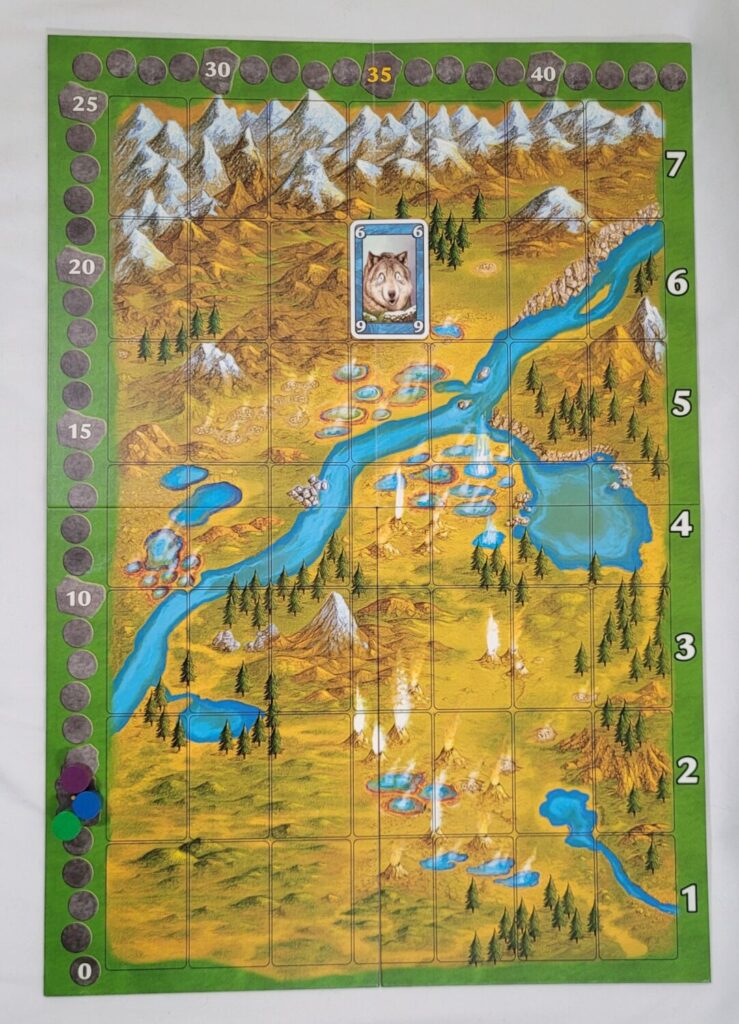
Yellowstone Park is played on a 7x7 grid laid on top of an illustrated overhead view of the titular park. The rows are numbered from 1 to 7 in ascending order, starting from the lowest row and moving upwards. There is a score track running along the left side of the grid. Each player’s score marker begins at the number 5 spot on this track.

There is also a deck of 56 Animal cards. Each card is one of four colors (red, green, yellow, blue) and one of seven numbers (1 through 7). For each number, there are two copies of that number + color pair (two copies of green 1, for instance). Every card features a cartoonish image of an animal, but these illustrations are unimportant for the purposes of the gameplay.

The post Ave Uwe: Yellowstone Park Game Review appeared first on Meeple Mountain.

Solitaire Playthrough Video: Pacific War 1942 Solitaire Travel Game from Worthington Publishing

Von: Grant
19. April 2026 um 14:00

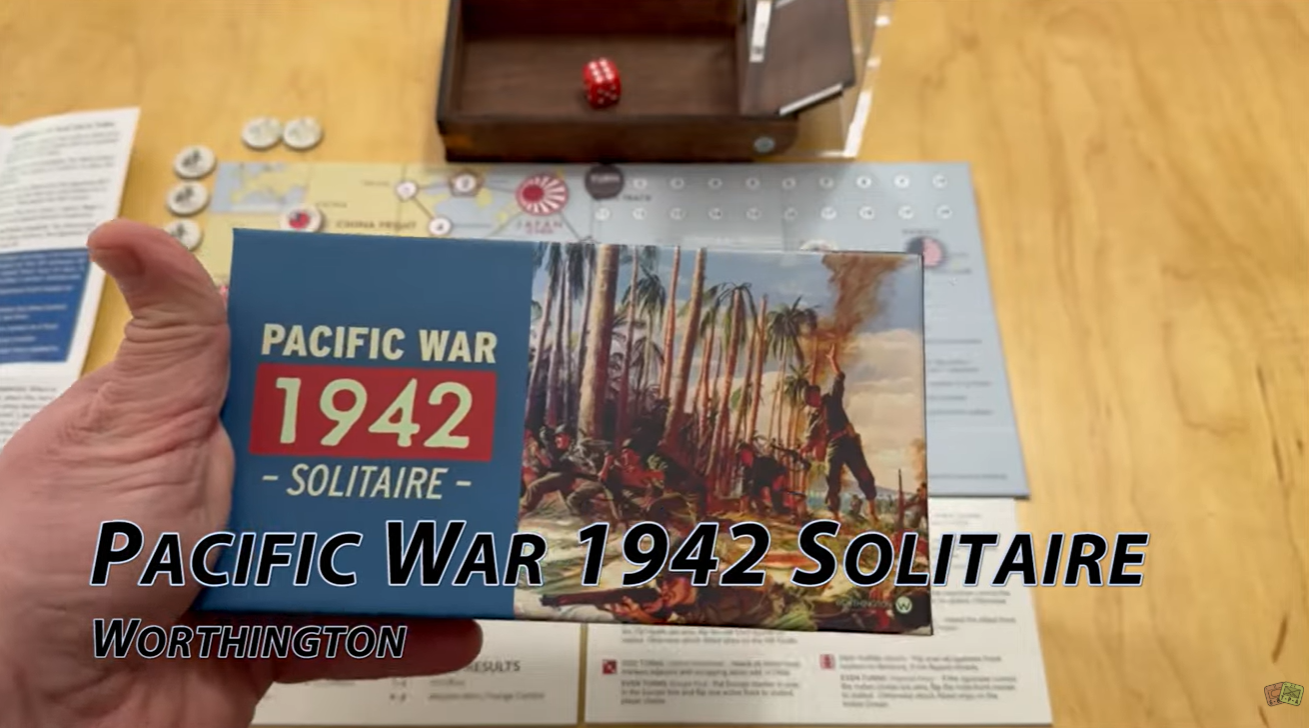
In early 2024, Worthington Publishing announced a unique 2-pack of games on Kickstarter that were marketed as easy to play travel friendly solitaire games. And you know that I love a good solitaire wargame! And when I heard that these games were small, even portable, then I was even more interested. One of the games covered the Pacific Theater of WWII called Pacific War 1942 Solitaire and the other covers the War of 1812 called (you guessed it) War of 1812 Solitaire. These games are designed by Mike and Grant Wylie and each game has 4 pages of rules, a beautiful mounted board and double sided counters. I played both and really very much enjoyed the experience.

I wrote a fairly in-depth First Impression post and you can read that on the blog at the following link: https://theplayersaid.com/2024/08/20/first-impressions-pacific-war-1942-solitaire-travel-game-from-worthington-publishing/

-Grant

Designer Diary: Choconnect

Von: 4docich
18. April 2026 um 16:00

by Sandro Blasich


I've been designing board games for more than 10 years but it all started from fun. I had an opportunity to go to SPIEL Essen and I went and I felt like a kid entering the chocolate factory. I was completely blown away. I was there with a couple of guys that pitched their board games. So, I thought if they can do it, why shouldn't I at least try it too.

Thus I started designing more and more and I finished a board game that I wanted to pitch at Essen. That was in 2017. I had lots of meetings but I had no success. In my opinion, I had good games but nobody was interested enough to publish them. Little by little, I started to loose my enthusiasm for designing games and I told myself that I needed to take a break from game design but I couldn't, new ideas just came to me all the time.

Then, I designed a game just for myself. A friend saw it and he said that I have an excellent game. I didn't plan to pitch it but finally I did it and I signed the contract. However, it took several years for that game to be published (you will read about that game in my next designer diary).

Meanwile, a design group was organized in my hometown and we also had a panel discussion. That's where I met Vedran and we went together on the next SPIEL Essen. I didn't know that he was planning to open a publishing house. Then I showed him my prototype for Choconnect and he liked it. In 2024, he opened the publishing house Snovid Games and it debuted at SPIEL Essen with three games: Galebari, To be continued.. and my game Choconnect.


So, how did I come up with Choconnect? I often play board games with my two kids. One day we played the game Labyrinth and it crossed my mind that that game has an interesting mechanic which is very rarely used. Usually, I start with the mechanics and then I add a suitable theme when I design my board games. I was thinking what to do with that mechanic from Labyrinth. So, I thought of something like Connect 4 but different so that you put tiles instead of chips on all sides of the board and then you slide it so that everything changes all the time which means that you need to think ahead. And that's how the idea for Choconnect was born.

As the game is very abstract I needed to find a suitable theme and I though of my first time at SPIEL Essen and how I felt like a kid in a chocolate factory so a box of chocolates came to my mind. When I told my wife about that she happily approved since she's a proper chocoholic.


Choconnect is an abstract tile laying/pushing game where you are in the role of a chocolatier and you want to arrange chocolates in the best possible way. In Choconnect, you draw randomly a tile from the cloth bag (there are three different types of tiles) and you put it on the board. But the twist is that you can put a tile only on the outer part of the board and if there is already a tile you slide that other tile but it cannot go over the board. You want to make a line of chocolate tiles of the same type either orthogonally or diagonally. It depends on the type of chocolates (three in a row for dark chocolate, four in a row for milk chocolate and five in a row for white chocolate). Whoever succeeds in creating the line first wins the game.


Maja Benčić made a great job with the illustrations and graphic design so you have to be careful not to confuse my board game with an actual box of chocolates. Thank you Maja.

The Fox in the Forest Deluxe Game Review

The Fox in the Forest predates the contemporary trick-taking craze by a few years. It was an early harbinger of what was to come, of the deluge with which we have subsequently been blessed, and it proved successful. Successful enough that now, almost a decade after its initial release, Joshua Buergel’s two-player trick-taking game is getting the Deluxe treatment.

For those who’ve never played, The Fox in the Forest distinguishes itself from the bulk of trick-takers in two ways. Way the first: all of the odd-numbered cards in this non-traditional deck have special powers that trigger when played. Normally, I try not to get bogged down in the weeds when reviewing a game, but I do think the powers here are illustrative: The 1 in each suit lets you lead the next trick even if you lose, the 3 lets you change the trump suit, the 5 lets you draw one of the cards that weren’t dealt that round before discarding any card from your hand, the 7 is worth a point for whoever wins it, the 9 is always considered a trump card, and the 11 forces your opponent’s highest card in the same suit.

If you are at all familiar with the ebb and flow of trick-taking games, you can imagine well the sorts of shenanigans…

The post The Fox in the Forest Deluxe Game Review appeared first on Meeple Mountain.

Unboxing Video: In a Dark Wood: C3 Module 4 – The Hof Gap from Thin Red Line Games

Von: Grant
18. April 2026 um 14:00

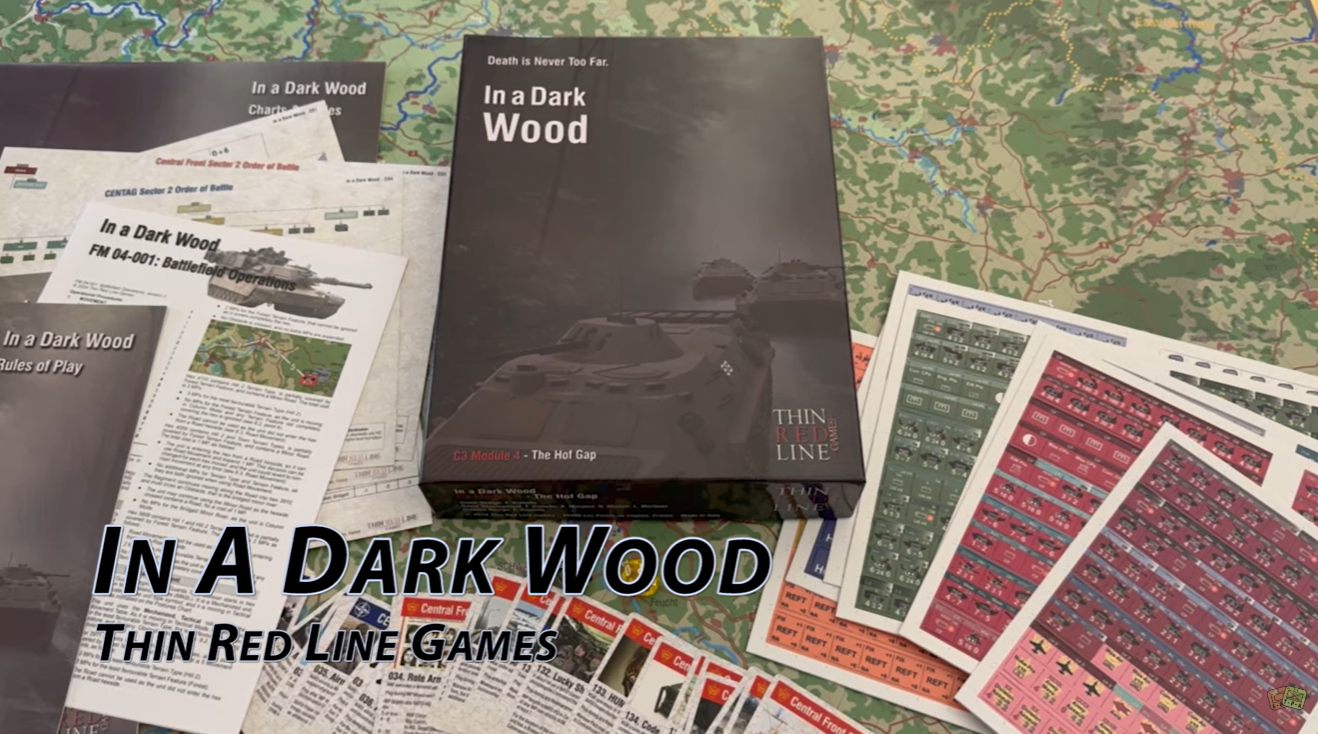
Taking its roots from SPI’s Central Front and NATO: Division CommanderIn a Dark Wood is the fourth module of the C3 series, focused on Command, Control and Communication and pioneered by Less Than 60 Miles – one of the five nominees for the 2019 Charles Roberts Awards as Best Post-WW2, Cold War, & Hypothetical Era Board Wargame.

Several typical wargame mechanics have been reinterpreted, and both sides must fight three equally dangerous foes: the enemy, their own plan and time. Even a simple action can quickly turn into a disaster when facing an opponent using more efficiently the real key to victory: the OODA Loop theorized by John Boyd in the early ‘80s and used today as the basis for several military doctrines.

We published an interview on the blog with the designer Fabrizio Vianello and you can read that at the following link: https://theplayersaid.com/2024/12/30/interview-with-fabrizio-vianello-designer-of-in-a-dark-wood-c3-module-4-the-hof-gap-from-thin-red-line-games/

-Grant

Soothsayers

I can sense the future. I sense that Soothsayers is going to be one of my favourite new-to-me games in 2026. I had not heard of the game prior to playing it. The theme and the art are a little quirky. The backstory is mumbo jumbo to me. However the gameplay completely took me by surprise. I would say there is nothing particularly ground breaking, yet the whole package just works amazingly

GAMA president Nicole Brady loses re-election bid, VP Meredith Placko voted into role

17. April 2026 um 17:49

The president of hobby games trade organisation GAMA, Nicole Brady, has failed in her bid to be re-elected to the role, with vice president Meredith Placko instead being voted in by the board of directors.

Brady, who spent two years as president of GAMA, had been a key driver of a plan for the organisation to become the “epicentre” of global tabletop gaming, underpinned by the unveiling of its first-ever 10-year plan last October.

She was also the organisation’s first female president on her May 2024 election, which at the time also saw the first all-women lineup for GAMA’s board officers in its then 47-year history.

New president Placko is the co-founder of hobby paint company Turbo Dork, and spent two years as CEO of Munchkin publisher Steve Jackson Games before resigning in April last year.

She began a two-year term representing publishers on the non-profit organisation’s board in March 2025, and was elected as GAMA vice president by the board of directors a month later.

New GAMA vice president Ross Thompson

Critical Role marketing manager Ross Thompson was elected as the new vice president at yesterday’s board of directors meeting, while Southern Hobby Distribution‘s Tiffany Reid and Red Racoon Games‘ Jamie Mathy were both re-elected as secretary and treasurer respectively.

Speaking to BoardGameWire about her win, Placko said, “I want to thank Nicole Brady for her work as president over the last few years, especially for establishing the strategic vision.

“I applaud the work that has been done on that 10-year vision. The next step is to turn it into a strategic plan. I do believe it will need evaluation and tweaking, as it very much is a living vision. As GAMA’s needs change, we must be prepared to adapt. 

She added “As a trade organization, we should focus on strengthening and expanding the core elements that benefit our industry.

“GAMA is at a critical juncture: we’ve seen turnover in the last year, we’re about to start the executive director search, and our industry has endured more than its share of crises, including tariffs and economic uncertainty.

“When I pitched myself to my fellow board members, and now to the membership at large, my experiences as an executive and leader in business and the news industry have prepared me to help turn our goals into a solid foundation for which the organization can continue to grow.”

She added, “I applaud the work that has been done on the 10-year vision. The next step is to turn that vision into a strategic plan. I do believe it will need tweaking and evaluation, as it very much is a living vision. As GAMA’s needs change, we must be prepared to adapt.

“Another important issue for me is that as a trade organization, we must lead the way on critical industry matters. Everything from timely updates and actionable measures regarding tariffs and related issues.

“To keep our members informed about domestic and international regulatory changes. And educating and organizing membership on how to advocate for the issues we face at local and federal levels.

“But, none of this can be done by one person alone. It’s imperative that the board works together on all of this. And we work with our committees and leadership at GAMA to turn these ideas and needs into actionable items.

“While I may have a strong vision for what GAMA should be as a trade organization, the decision is not mine alone. The board, the staff, and most importantly the membership drive this organization and make it great.

“Ultimately, one of my most important jobs is ensuring the board is part of the process every step of the way.”

Former GAMA president Nicole Brady

Brady told BoardGameWire she was proud to have created “a strong foundation that future leadership will be able to build on”, despite “people throwing tack strips on the road in front of me”.

She said, “I am proud of the many things I have done to help advance the organization, including making history as GAMA’s first female president.

“My greatest accomplishment as president was spearheading GAMA Vision 2035 at the fall 2024 strategic planning session. We put together a big picture of what we wanted for the future and that focused on becoming the epicenter for tabletop gaming.

“It included expanding internationally and domestically in a meaningful way, creating large scale marketing initiatives (think ‘Got Milk?’), building partnerships, launching a speaker’s bureau, establishing a 501(c)(3) for charitable work, providing educational certification and so much more.”

Brady told BoardGameWire last year that the Vision 2035 ten-year plan was an attempt to get the organisation away from “playing whack-a-mole” on important issues rather than managing them in a long-term strategy.

The array of plans spread across the next decade include boosting its membership within both hobby games and the mass market, expanding itself into a global organisation, shifting its finances away from the current heavy reliance on the annual GAMA Expo and Origins shows, and leading the conversation on sustainability within the industry.

Brady also highlighted her work push GAMA towards global lobbying, legislation and advocacy, over and above initiatives such as the organisation’s trip to DC last year to lobby against the US tariffs situation.

She added, “As treasurer, I called for an audit to address concerns I witnessed. That audit has finally wrapped up thanks to our current Treasurer taking over the project when it stalled and will result in changes that improve the record keeping and financial practices.

“Even with people throwing tack strips on the road in front of me, I was able to create a strong foundation that future leadership will be able to build on.

“I know I have made a lasting positive difference. Many people have shared publicly that my leadership is the reason they joined GAMA, renewed their memberships or have renewed faith in the future of GAMA.

“I did a lot of relationship repair behind the scenes. Seeing positive news instead of constant negativity is a testament to that hard work.”

The GAMA Board of Directors is comprised of twelve individuals elected to represent the six voting membership groups – publishers, retailers, wholesalers, production, media and events, and creators – with half of the cohort up for election each year.

That board in turn elects GAMA’s four officers – president, vice-president, treasurer and secretary – from among themselves each year, with the winner requiring a majority of the 12 votes available.

The current board of directors also includes John Stephens from Total Escape Games, Drew Wehrle from Wehrlegig Games, Heather O’Neill from 9th Level Games, former president Eric Price from Meijia Board Game Factory, Michael Maggiotto Jr from BEST Human Capital & Advisory Group, LegalWATCH’s Eartha Johnson, and Danny O’Neill from Mood Publishing.

GAMA is currently working to secure a permanent replacement for its previous executive director John Stacy, who left the association last October just after the ten-year plan had been revealed.

Leadership consultant Zaria Davis was named as interim executive director last November, while GAMA hired its first COO last September in Melinda Prickett.

Placko told BoardGameWire, “I want to give credit and thanks to Melinda Prickett, GAMA’s COO, who has stepped up in so many ways since John Stacy’s departure. She and the GAMA staff are doing an incredible job.

“Many changes have occurred at the operational level and much work is happening behind the scenes. Melinda and the staff have taken to it all with such earnestness and gusto.

“While the board may have seen a change in leadership, we are a small piece of the GAMA puzzle. I want to make sure Melinda, and the staff who are doing the heavy lifting of this organization, get the recognition they deserve.”

Last month GAMA’s board of directors apologised for some of its elected leaders being “rude and disrespectful” during a “heated” annual general meeting at the recent GAMA Expo trade show.

This year’s GAMA Expo sealed another record attendance, ahead of its planned move to Baltimore in 2027 to contend with rapidly growing demand.

More than 3,820 attendees showed up to this year’s event in Louisville, Kentucky, up almost 12% on last year’s previous record of 3,425 – which had already left the show pressed for space across the exhibition hall and its extensive programme of seminars.

The post GAMA president Nicole Brady loses re-election bid, VP Meredith Placko voted into role first appeared on .

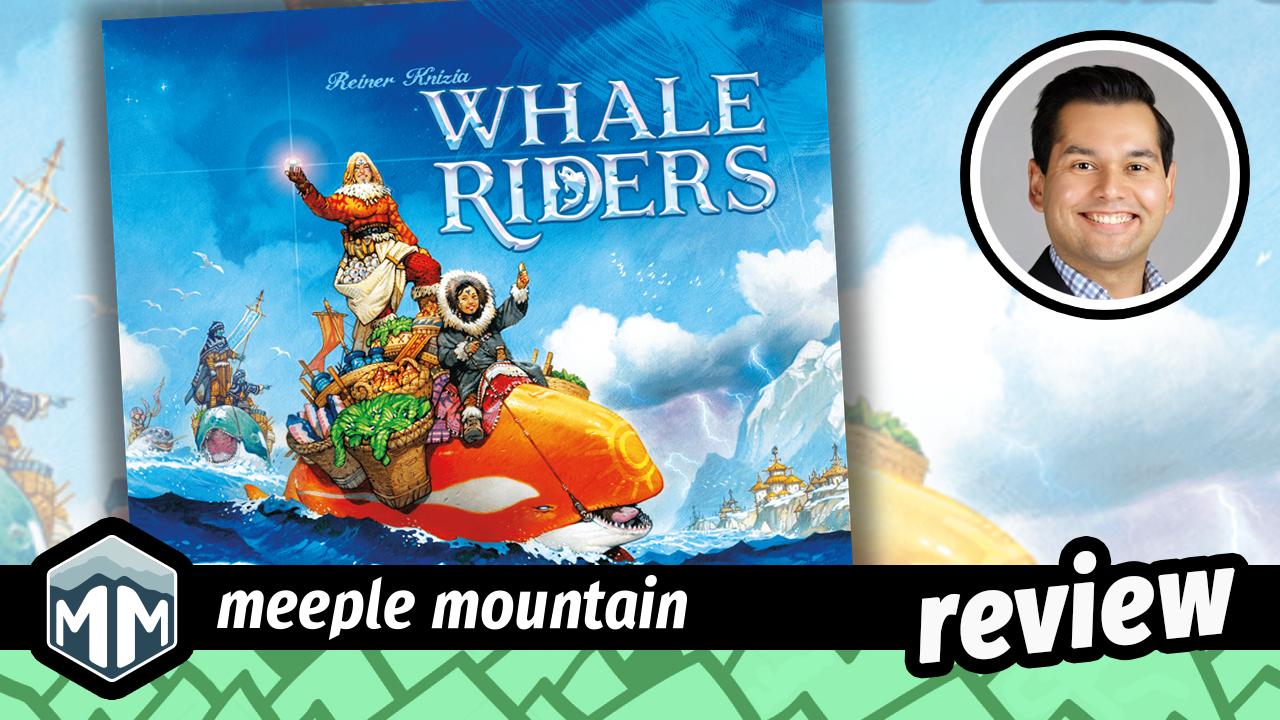
Whale Riders Game Review

Wholly Knizia

Dr. Reiner Knizia is a name synonymous with board games. Even if you haven’t heard of him, you’ve likely played one of his designs; according to Gemini, he has created more than 800 games. Whether it’s Ra, The Quest for El Dorado, Samurai, or Huang, he’s everywhere.    We even had a lovely sit-down with him recently to discuss his highly successful career.

Whale Riders excited me because it comes from a power duo: Knizia on design and Vincent Dutrait on art. Dutrait’s work has become increasingly easy to spot as I’ve gone deeper into the hobby, and here his contribution is excellent. The thematic art is rich, depicting Indigenous Arctic tribes using handsome whales and other massive sea creatures as mounts. But despite that pedigree, this is not one for the Knizia hall of fame.

Ice Race

In Whale Riders, players take two of five possible actions each turn, moving between ports, buying goods, and completing contracts for money and pearls. Play continues until all the pearls have been purchased from the home area, giving the game a race-like structure from start to finish.

Goods in the market are replenished as they are bought, but new tiles can introduce storms that…

The post Whale Riders Game Review appeared first on Meeple Mountain.

2025 Board Game Award Winners

17. April 2026 um 14:56
2025 Board Game Award WinnersA couple of weeks ago, we announced our nominees for our 13th Annual Board Game Awards. As always, it was rough even choosing which games to nominate. Since then, we’ve put our heads together, tested the games, and come up with a consensus. Today, we are excited to announce the winners of our 2025 Board […]

Source

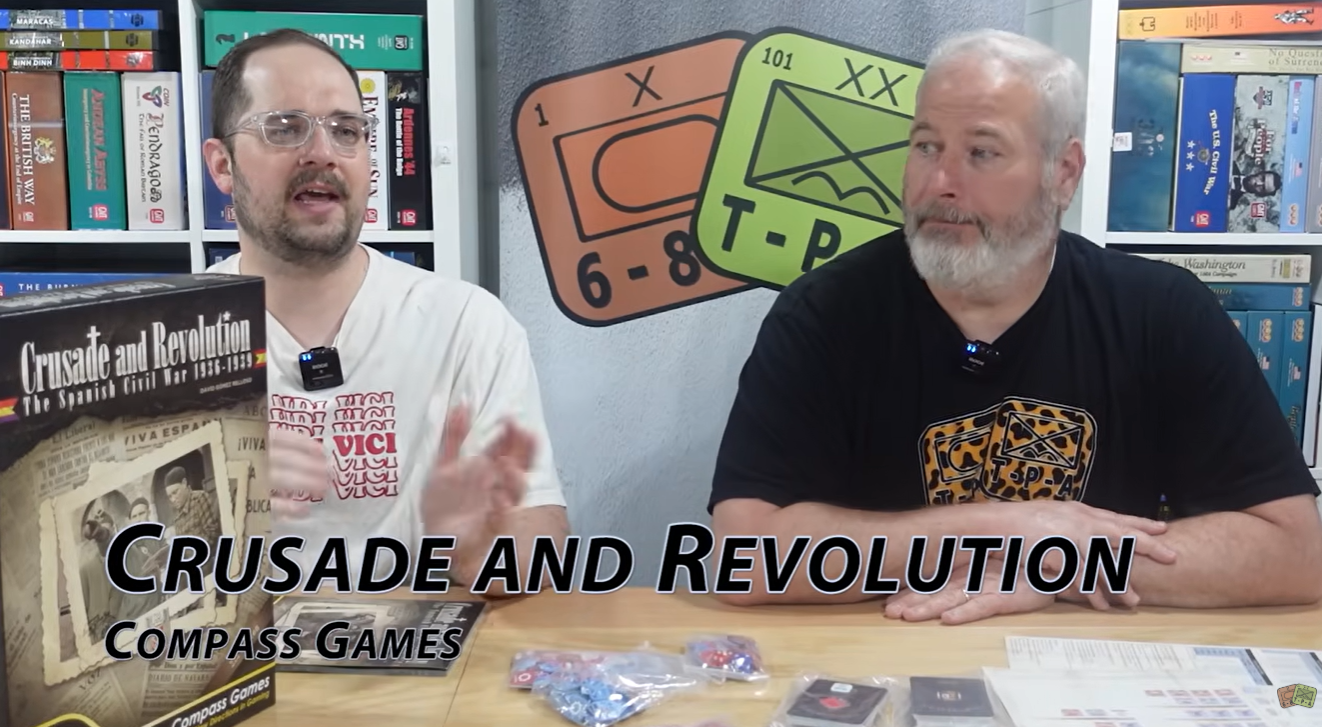
Video Review: Crusade and Revolution: The Spanish Civil War 1936-1939 Deluxe 2nd Edition from Compass Games

Von: Grant
17. April 2026 um 14:00

Crusade and Revolution: The Spanish Civil War 1936-1939 Deluxe 2nd Edition is a card-driven point-to-point movement strategic-operational wargame that covers all the Spanish Civil War (1936-1939). Its rules are based on Ted Raicer’s Paths of Glory. Each player takes command of one of the sides (Nationalist or Republican), and looks after all the aspects that involve a war including mobilization, recruitment, movement of troops, offensives and construction of defenses. There are also historical events that must be taken into consideration, thinks such as foreign military aid, international policy, change of Republican Government, etc.

-Grant

French board game designers’ union SAJ adopts new name to better represent women, non-binary people

17. April 2026 um 00:59

French board game designer association SAJ has renamed itself to make its title more inclusive to women and non-binary people, as well as to better underscore its status as a union.

The Société des Auteurs de Jeux – which translates as society of game designers – was formed in 2017 through the merger of three separate groups, and currently represents more than 800 individual designers.

The organisation has now been rebranded as the Syndicat des Auteurices de Jeux – the Union of Game Designers – following a vote at its annual general meeting at the Festival International des Jeux in Cannes.

SAJ president Audrey Bondurand told BoardGameWire, “We wanted to change this name for two reasons: first, we have officially been a union for several years now, and we wanted our name to reflect that.

“Second, in French, ‘auteur’ is not a gender-neutral word, but a masculine one. ‘Auteurice’ is a contraction of ‘auteur’ and ‘autrice’ (the feminine form). We chose this neologism to include women and non-binary people.”

Bondurand, who worked in a board game cafe and in distribution before publishing her first game, Draky, said part of SAJ’s remit was advocating for the recognition of board games as cultural works, something which is “unfortunately still not the case today in France or in Europe”.

The organisation also offers contract reviews, mediation, accounting advice sessions and general support for designers in the industry, much like its US-based peer the Tabletop Game Designers Association and Germany’s SAZ.

Bondurand added, “Regarding the use of AI, we openly support the position of the CIL (our illustrator colleagues) in opposing generative AI in our published games.”

SAJ said a new website featuring its rebranded title is currently under construction, with the organisation’s existing email addresses currently operating as normal.

The post French board game designers’ union SAJ adopts new name to better represent women, non-binary people first appeared on .

Hey! A Place I’ve Actually Been!

16. April 2026 um 21:16

I'm still not sure about this preview thing. I think it's useful, but also, this game is unlikely to change between now and production. But is "preview" a warning that the details are subject to change, or a warning that the game isn't available to purchase yet? I'm still not sure.

At this point, it doesn’t seem far-fetched to crown Josh Wood the king of tableau-builders. Yes, yes, like a trampler of horse glue I’m invoking Santa Monica yet again, but the more relevant touchstone today is Let’s Go! To Japan, a lovely, if flawed, game about planning a vacation to Tokyo and Kyoto.

Let’s Go! To France is Wood’s follow-up to that latter title. It tackles every single one of my reservations with that game, and then goes on to produce one of the most delightful, evocative, and grounded tableau-builders I’ve ever played. Maybe it helps that I’ve actually been to France. More likely, it’s that Wood knows precisely what he’s doing with every mechanism, component, and locale.

"Tower" is a good example. I know better than to attempt anything else, even if I can say it correctly. I still get guff for having a jokey pronunciation of "Versailles" in a previous review. So many people earnestly believed that I really pronounce it Ver-sah-ay-LEES. I still get messages about that one.

I can even pronounce some of these words.

It’s going to be hard to not turn this into a comparative review with Let’s Go! To Japan, so let’s open with the basics. Let’s Go! To France is a game about planning and executing a trip. Not just any trip. A two-week trip to Paris and some portion of wider France, undertaken day by day and hour by hour.

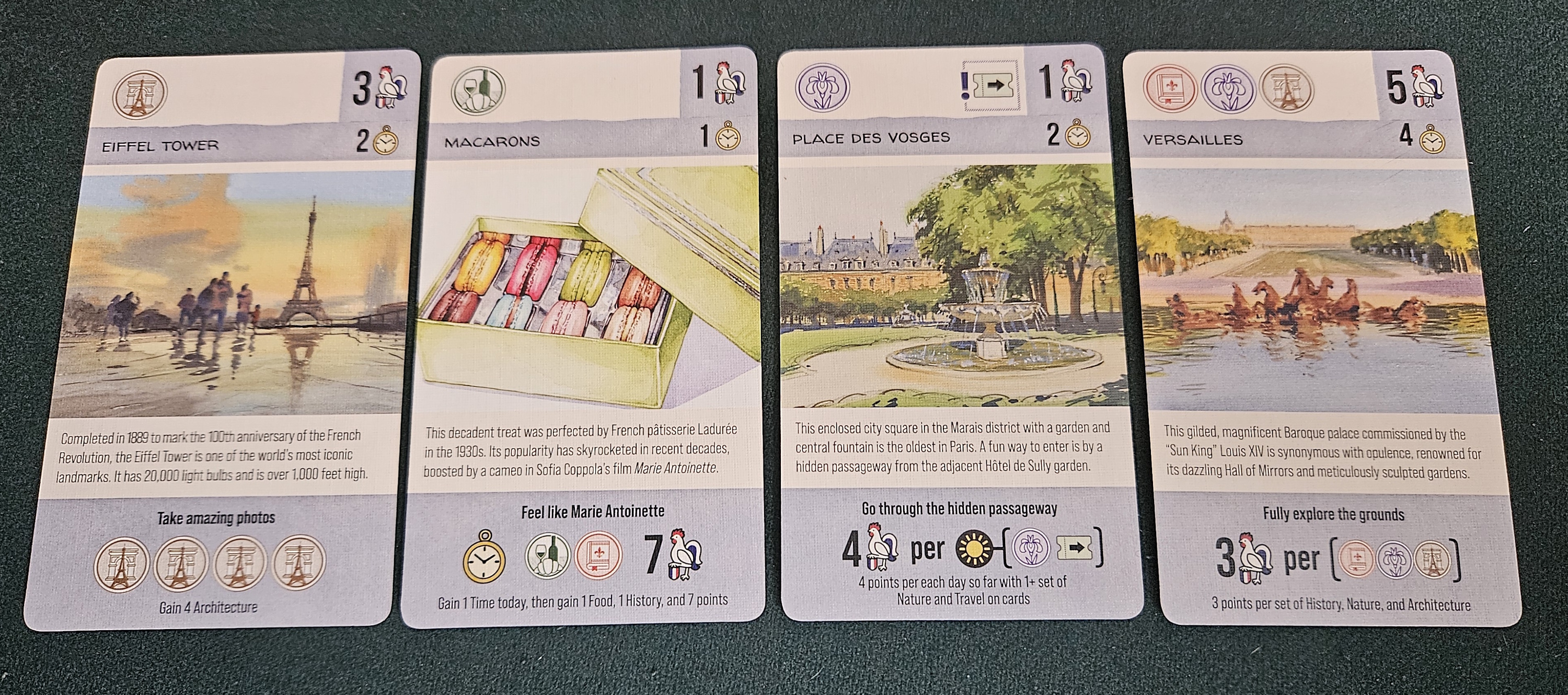
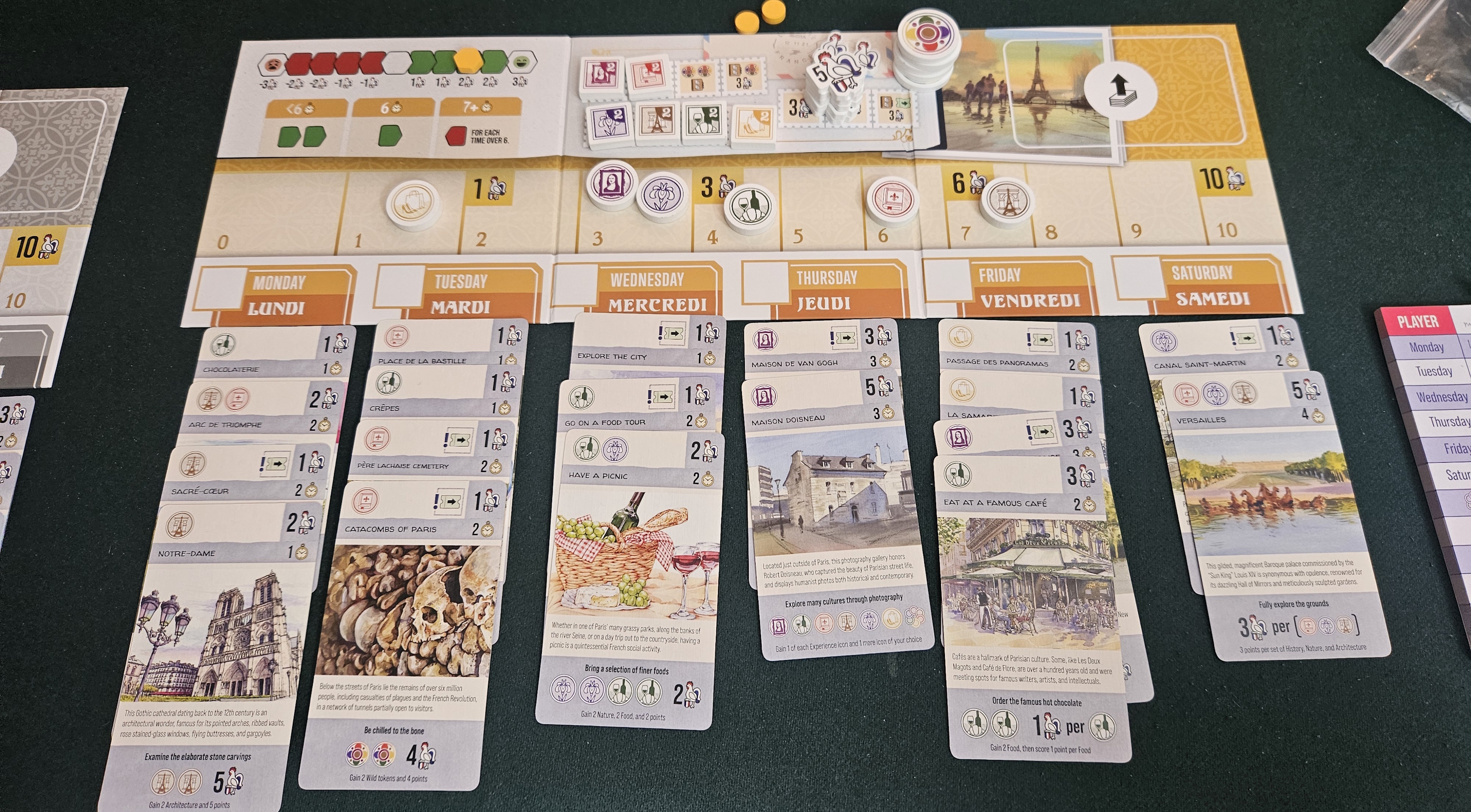
For all that, there’s an elegance to the whole thing. Turns are presented as simple drafts. You receive some cards. One or two of them will get scheduled into your itinerary. The rest are passed around the table. The cards each present a different activity in Paris: visiting a museum, snacking on delicacies, touring a park, shopping at an open-air market, finding an overlooked nook that you’ll boast about to friends for years to come.

Each card has four main components. Victory points — self-explanatory — some icons that increase the appeal of your trip on a numbered track, the amount of time required to fully visit that card, and lastly a scoring opportunity that will only trigger if this is the final event scheduled on any given day. Your objective is largely about optimizing scoring. To offer but one example, visiting the National Archives earns three points for every history icon you placed on that day. That’s a tremendous opportunity if you’ve arranged a day full of tours, but is easily dismissed if you’re planning on shopping or eating instead.

Those other considerations are no slouches, either. It’s possible to absolutely cram a day with activities, but your energy level will suffer, possibly resulting in subtracted points. There are also ideal conditions for each day, earning little bonuses for visiting the park when it’s clear outside or stuffing yourself with pastries on what I imagine is your cheat day. And if nothing appeals, Wood returns with a trick he deployed to great effect previously, letting any card flip to its reverse side to become a generic “Explore the City” activity.

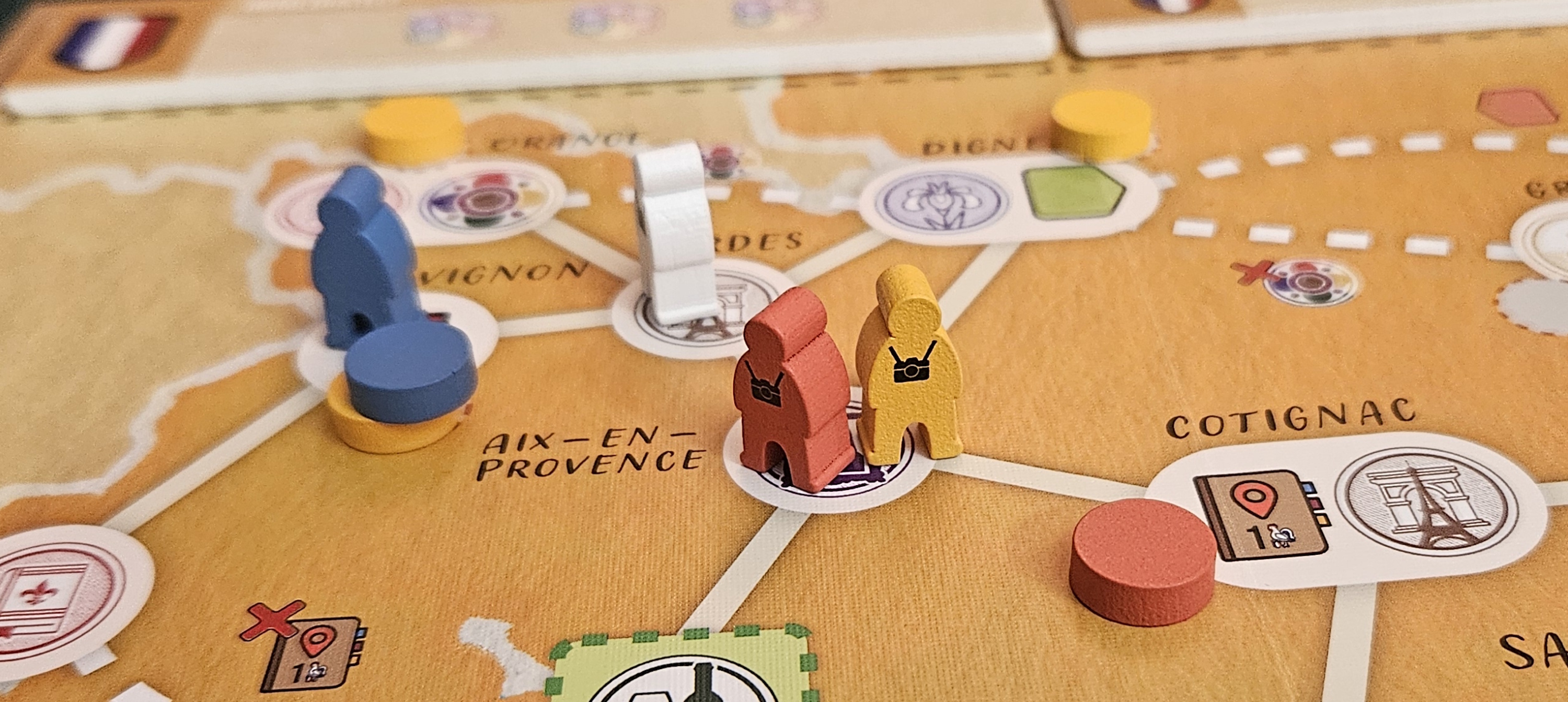
I'm pretty sure some of these are just big cities, but look, if it isn't Paris, it's country, got it?

Spending a week in the country before heading to Paris.

If you’ve played Let’s Go! To Japan, this likely sounds familiar. Indeed, nearly everything here resembles Wood’s previous title, but has become the beneficiary of little tweaks that mark this as the far superior outing.

For instance, there’s the way those Explore the City activities are handled. Previously, exploring Tokyo or Kyoto resulted in your tableau receiving a random card during scoring. This could make or break your day, interjecting some randomness into what was otherwise a carefully structured experience. Here, exploring the city is its own pleasure; one doesn’t need to stumble upon a museum or garden to justify their time spent in Paris. This keeps your tableau in check and feels more appreciative of what makes such a trip worthwhile. Just being here is enough.

Similarly, the ideal conditions for each day are now portrayed as guidelines rather than dictates. It’s worth assigning activities to the corresponding days, but this is only mildly beneficial, and only the first two times you do it. Beyond that, you’re free to schedule your days as you see fit, without worrying that you’re missing out on another drizzle of points. It’s a small thing — basically, you’re earning a benefit just a little earlier than in the previous game — but it goes a long way toward letting you shape your own trip rather than ensuring there’s a history day, a food day, an architecture day, and so forth.

Wait a minute, how dare you name a place Les Invalides? That should be reserved for hospitals and... [touches earpiece] it's a what? Ahem. Never mind.

The tableaux here are much more flexible than those in Let’s Go! To Japan.

The larger change is more structural. Where the previous game saw your vacationer shifting between Tokyo and Kyoto, a system that demanded its own train-hopping minigame, Let’s Go! To France instead divides its trip into two portions. Your main tableau actually represents the second week of your vacation, resolved during scoring. As you place cards into your tableau, however, you might trigger tickets that move a pawn across the countryside. Depending on your destinations — and which region you’ve chosen for the group to explore — it’s possible to begin your week in Paris having already seen some sights, earned some tokens, or maybe even secured a special scoring condition or two.

At times, there’s a sense of vague translocation. You are, in effect, planning Schrödinger’s Vacation, the cards signifying events in both past and future. But it’s a mild discombobulation at worst, one that lasts maybe five minutes before everything snaps into place. The overall process is much smoother than the previous game’s swapping between cities, and provides ancillary benefits to the game’s usual procession of daily scores.

You might, for example, begin your week in Paris already tuckered out from your time in the Loire Valley, prompting you to take it easy for a couple of days or chow down on some crepes for a sugar rush. Or perhaps you’ll arrive already enculturated by old architecture, letting you take advantage of a daily highlight that requires a certain number of icons before awarding big points. Where previously these objectives would only pay out in the later portion of your trip, it’s now possible to assemble a more robust tableau, one that feels rewarding from start to finish.

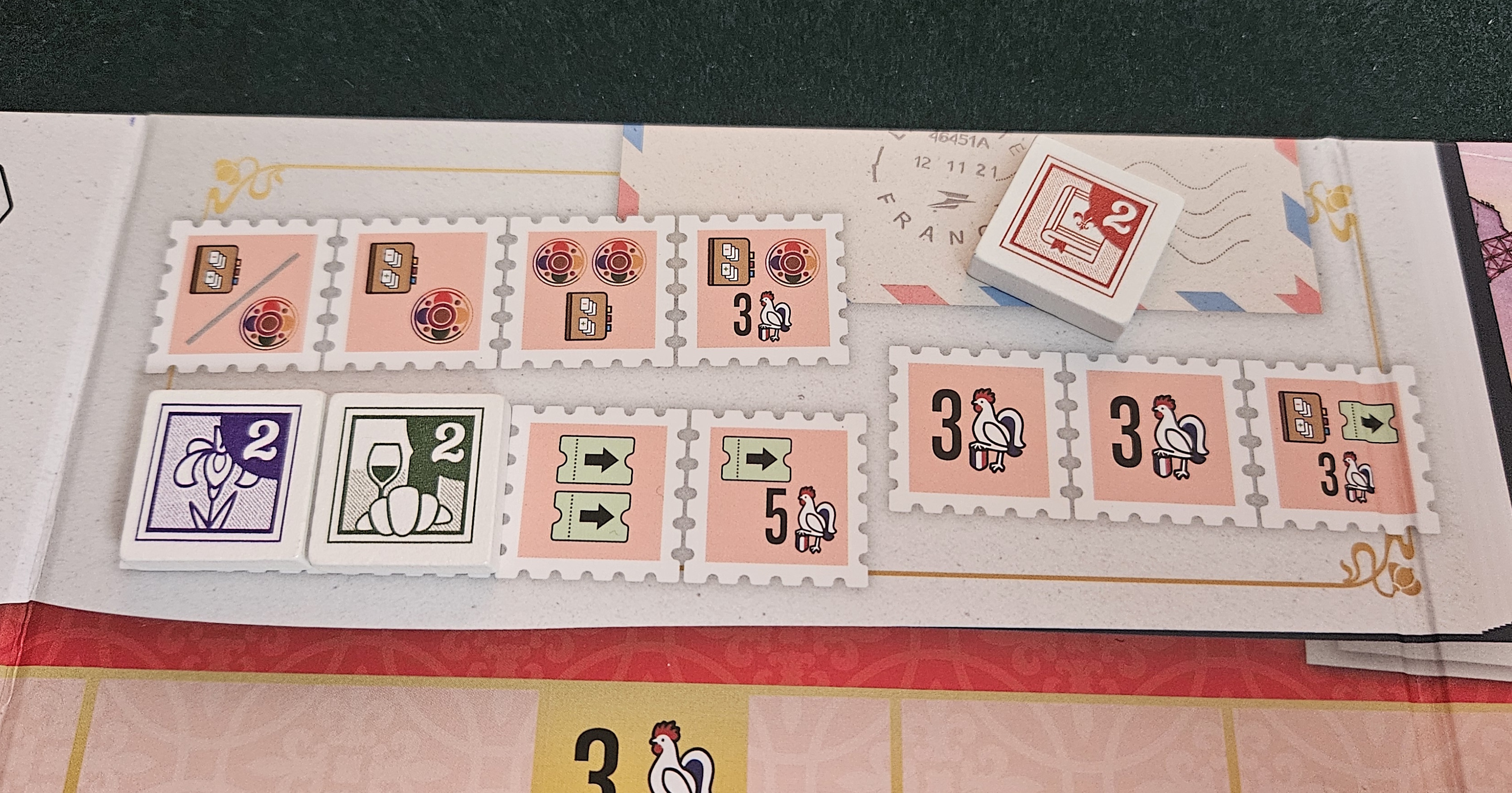
a Belinda's Big Bonus, on the other hand? erm.

I appreciate a bonus.

As before, scoring is an active portion of the game, an event in and of itself where players walk through their trip one day at a time, tallying points and keeping track of their relative energy levels. This helps to digest the game’s point-salad fiber, but it plays an even more important role in contextualizing Paris as a geographic space with its own character and identity.

I’ve often praised Santa Monica as an ideal tableau-builder for the way it asks players to not only create a space, but also to inhabit it, to move around in it, to poke around its nooks and crannies. With Let’s Go! To France, Wood replicates the trick, albeit via an entirely distinct set of mechanisms and representations. This is Paris as a location out of time, the city that is at once a tourist trap and timeless. Around every corner there’s something new to see, some fragment of history that has been improbably preserved across the ages.

And that sense is communicated above the table as well. As one friend put it, you could take the deck to Paris as a reminder sheet of everything there is to see and experience. Playing this game, we found ourselves discussing the spots we’d seen and those we hope to see some day yet to come. The overlooked garden with the hidden entrance, where one friend drank wine and conversed with a farmer. The museum that sparked my imagination more than any other I’d ever walked. The sheer looming size of something. The joy of ducking into a random cafe and having one of the finest meals of your life.

I'd try to squeeze in a meal on Saturday, though.

I’d do that.

The effect is magical. In a sense, Wood has created a transposition of his own, a game at once past and future, both reminiscence and future itinerary.

He’s also crafted a game that’s nearly without parallel. That its best comparisons are Wood’s own past creations is a testament to his skill with this particular medium, but also to the city he’s chosen for us to experience all over again. In improving on its predecessor in nearly every way, Let’s Go! To France deserves its peculiar punctuation. Let’s go, indeed.


A prototype copy of Let’s Go! To France was temporarily provided by the publisher.

(If what I’m doing at Space-Biff! is valuable to you in some way, please consider dropping by my Patreon campaign or Ko-fi. Right now, supporters can read my first-quarter update of 2026: the best board games, movies, books, and more!)

What makes an 18xx Interesting?

16. April 2026 um 16:36

After playing 18CZ (again!), I was trying to pin down why I thought it was “OK” and not “Great.” Why does 1822 PNW make me want to get it back to the table, while CZ is merely a “Yeah, sure.” (I mean it’s still a positive feeling, but more “indifferent plus” than “suggest” or “enthusiastic“) and I think this comes down to one thing that I have touched upon a few times over the years, but bears repeating.

Entanglement — The (Not So) Secret Sauce

By their nature 18xx games are more entangled than most business games. In typical games, each player controls their own (single) corporation. What is good for the company is good for the player, and vice versa. In 18xx, a player can juggle multiple (competing) interests; it can be great to trash a company under your control (shifting its assets to a ‘better’ company).

This brings up the Principal-Agent Problem , but also Implicit Collusion because there might be other shareholders and they will want to know if the company is going to pay out or with-hold, and if it will be headed for a glorious future or Chapter 11.

It can be impossible to state the “right” play is for a company merely by looking at the board. You need to understand the stock split dynamics. Does the president own 60% (and 40% is in the IPO/Bank). Or is it a 40%/30%/30% (in a three player game). Treating those situations identically is a recipe for disaster.

So — The board position is entangled with the players’ stakes. That’s the “hook” of 18xx.

(Acquire also does this, and is rightly acknowledged as one of the greatest games of last century1. Its board play is much simpler, the stock entanglement does the heavy lifting. In Chicago Express the entire game play revolves around implicit collusion — getting the incentives right so that others make plays to your benefit)

Of course there are levels of entanglement, and ripples to the chaos.

How many companies (and which ones) will open?

If the same companies open in the same order every game, the game will likely start to feel the same (although various splits of minors still have interest)2. Varying how many companies (and which) provides variety because the “train rush” is triggered by that one additional company operating. In many games, there might be “semi-permanent” trains. If X companies open, they last. The X+1st company opens and they rust.

Some games (like the ’22 family) randomize the order that some companies show up in, this forces each play into a new line but also means that the number of viable companies might change, which has implications on the train rush.

More subtlety, 1846 achieves the same effect by having some dubious companies that frankly aren’t great. Is it worthwhile to open a second company? Uh, sometimes. For a long time the fact’ that the game’46 had mediocre companies puzzled me, but borderline companies are a ticking time bomb. If the incentives are right, someone will open them just to watch the world burn trains rust. The fact that their ROI isn’t great is borderline.

Thinking about this with 18CZ; I suspect that it does do better at this that I thought … but three players is not its sweet spot3. The train limit is a bit too generous at that count (at least in our meta). Again compare this against ’46, where the number of companies (and trains) varies based on player count to keep things tight.

How entangled is the board?

The game board should be small enough so that each company’s track plays have ripple effects.

The game that best exemplifies this is, naturally, Go. There are “joseki” — opening lines that theoritically should provide roughly equal chances for either side … in that particular corner. Professional players spend an inordinate amount of time on the first 20-30 moves (out of 150-250 ish) because the corners influence each other and the josekis will combine. Joseki A (in the NW corner) may be great if Joseki B is in the NE corner, but terrible if Joseki C is in the NE corner.

So you want to leave things in flux and arrange joseki(s) that work together in your favor.4

In our last few games of CZ, Eastern Side of the Board never impacted the Western Side … everyone met up at Prague, which held enough token slots that most companies could get through, and the ones that didn’t at the end had their runs on the appropriate side. Sure, there was jockeying between companies on each side, but the corners never impacted each other. (Again, might be a problem that is solved at more players).

Which is not to demand that “every company cares about every other company,” but there should be some tension and chokepoints; companies fighting to place track or station tiles. For example, ’46 has Chicago (and Toledo, and Indianapolis). PNW has Seattle and Portland literally fighting over growth.

CZ (at least with three) felt like it had walled off suburbs. My branch in the SE eventually merged with the NW companies (and the Northerner), but it was a minor event. Like finding a run worth an extra few dollars in share. A rounding error, not a bomb.

(1862 almost achieves “every company really cares about every other company”; because of merger opportunities but also because the board is so tight and different company charters will have very different track preferences).

And even companies far apart and destined to ne’er meet; they might compete over tiles. Every 18xx player knows the sinking feeling when you discover a needed tile is missing.56

What doesn’t interest me

Hunting out the extra dollar and operations minutiae all the time. (Hunting out extra money in the opening is the entire point of compound interest). Yes, sometimes that extra dollar really matters. A few bucks might make the difference between buying another certificate. In that case, the extra few dollars is a “bomb7” (a big deal).

Token wars, snatching up the right train, ownership battles, dumping companies … those are always bombs. If the few extra dollars is a bomb only 1% of the time, it can be simplified away. But I’ve learned that in order to entangle the board (and stock) you have to have the possibility of not entangling it. Sometimes even great games can have a relatively dull run.

There are other things that don’t interest me. (I’m no longer fond of the ’30 family’s script of “first company low, second company saves first.” Nothing wrong with that play … but I’ve seen it enough). But in general I’m looking for a reason to play an 18xx title and most of them give me plenty.

  1. The BGG HoF got some things wrong, but they got that right. ↩
  2. I owned 1835 back in …. ’92 or ’93, but never got to try it. I know it has its defenders and variants…. ↩
  3. After writing this, I went and checked BGG and 4p is listed as best with 3p and 6p having the lowest recommended numbers. ↩
  4. I don’t play Go well enough to know how to do this; but I played enough to know this is true. See the proverb “Memorizing Joseki loses two stones.↩
  5. Yes, its a horribly gamey thing …. why should the fact that some company hundreds of miles away built a branch mean you can’t? Well, just imagine that they got a compliant politician to hose you. ↩
  6. Also, I swear that 1846 is influenced by Coriolis rotation of the earth, because tiles that are mirror images with 4 each will have one set empty and the other set untouched. ↩
  7. For those readers unfamiliar with the term, I am using the meaning of “bomb” from a Jonathon DeGann Article, which is still available on the Wayback machine. ↩

Molly House, Fate of the Fellowship, Hot Streak, and Magical Athlete Win 2026 ATA Awards

16. April 2026 um 15:53
Well, the 2026 game awards season has finally begun. The American Tabletop Awards have been around since 2019 and they feature an interesting division of games into four categories. The winner in the Complex category is Molly House, designed by … Continue reading
❌