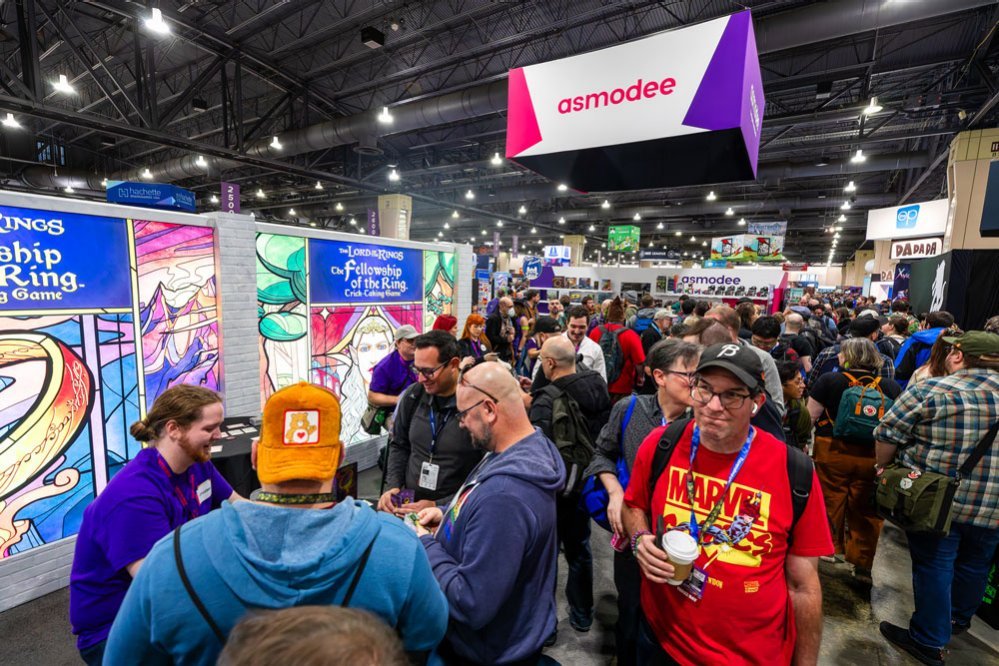
❌

Lese-Ansicht

San Diego Historical Games Convention (SDHistCon) 2026 Daily Debrief Series – Day 3

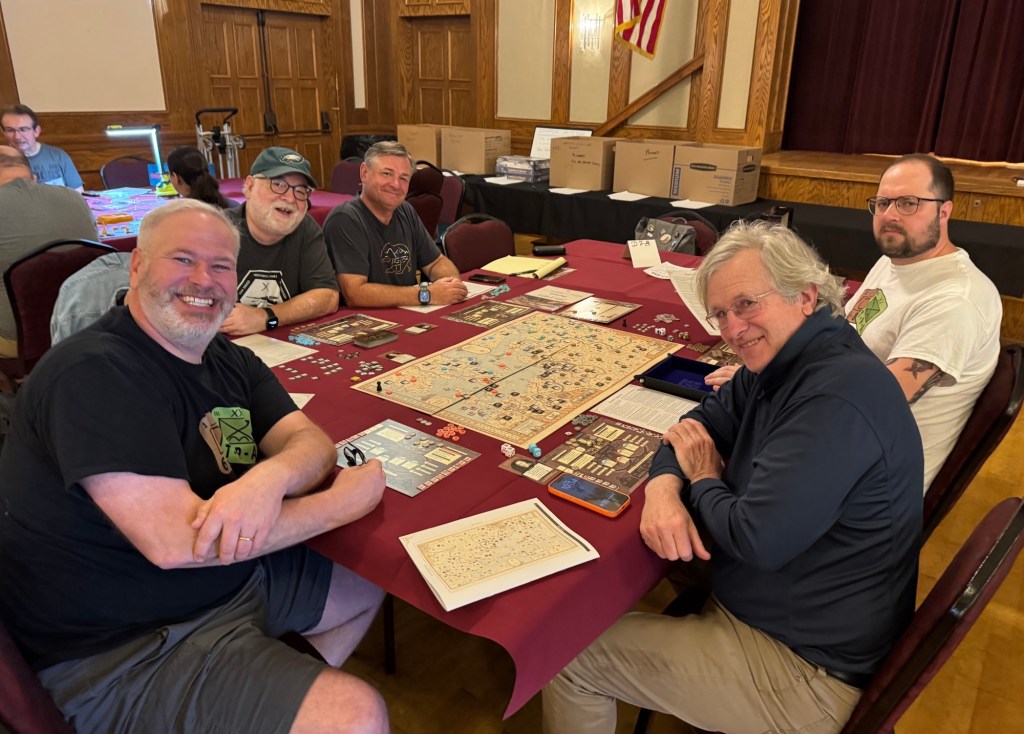
All good things must come to an end and here we are at the end of our 3 days of gaming at SDHistCon. We had a great time and ended up playing a total of 8 games, with some being full plays and others just having been several turns. But we gamed a lot and that is what we do. Play games!

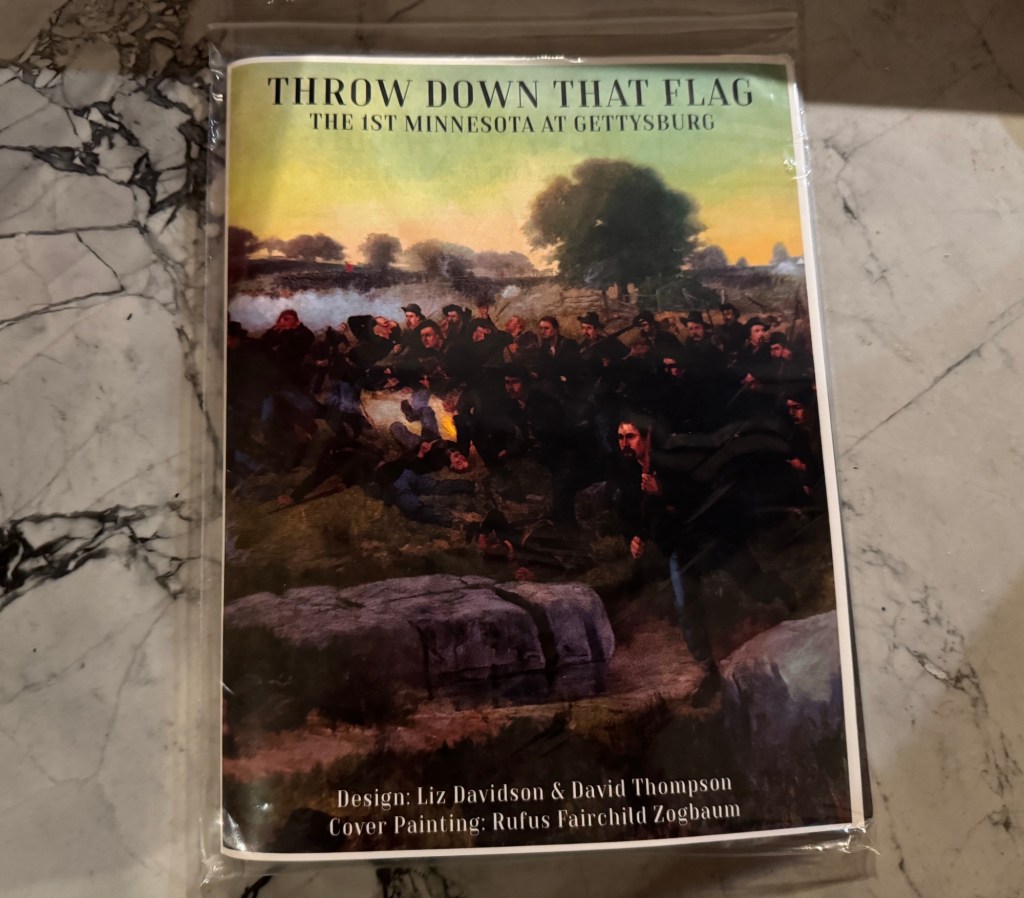
One thing from last night that I wanted to mention was the Night Market, which allows small indie publishers to get their games out for sale. The inaugural Night Market featured 10 different independent designers selling limited-print-run, self-published historical board games and we had a look around and ultimately purchased Throw Down That Flag: The 1st Minnesota at Gettysburg designed by Liz Davidson and David Thompson. The game is a solo game that centers on the 1st Minnesota Volunteer Infantry Regiment during 2 pivotal days of the Battle of Gettysburg July 2 and July 3, 1863. I very much enjoyed this event and wish that I could have bought more but I didn’t have any more room in my luggage.
Now onto today’s events. The 3rd day started with a nice chat with Saul Sanchez from Mexican publisher Malinche Games. Saul is a great guy and we became acquainted with him in 2021 when they launched their first Kickstarter for Patria Libre: The Struggle for Mexican Independence 1810-1821. They are currently working on a reprint of their most popular title Tierra Y Libertad: The Mexican Revolution which I believe will be the 3rd Printing.
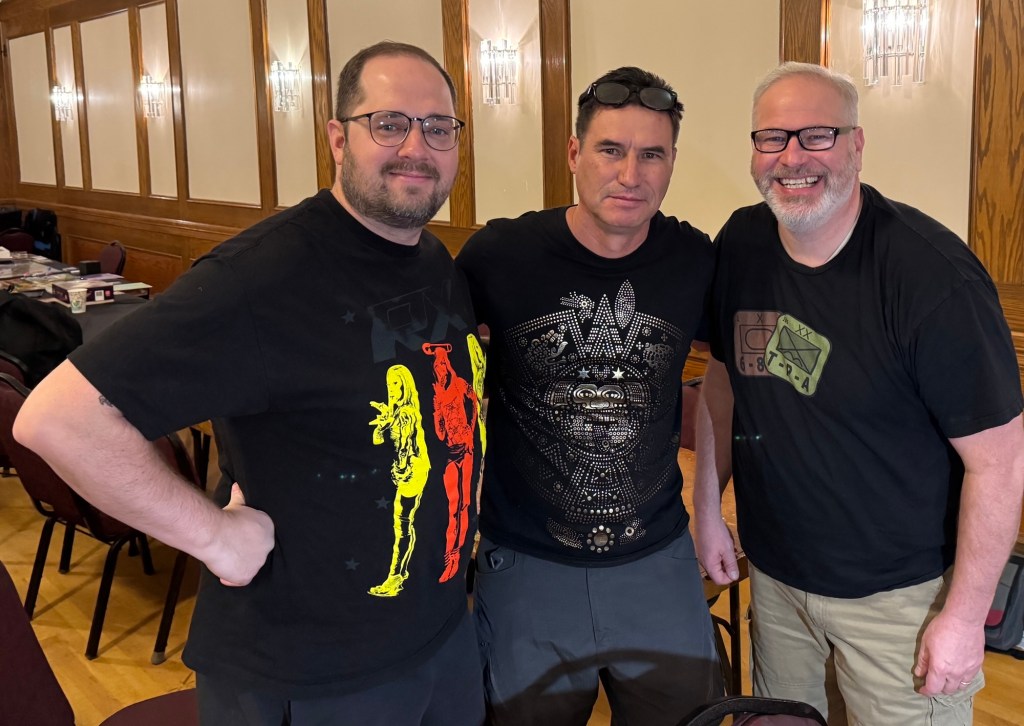
I love these small boutique publishers who have these special passion projects that cover lesser known history and allow them to demonstrate their pride for their country. And it’s always great to put a face to a name as we corresponded multiple times over the past 5 years. I wish Saul the best of luck moving forward and encourage you to give their games a look.

We only played 1 single game today but it was a big and long 5-hour experience as we took on The Other Side of the Hill 2nd Edition from NAC Wargames. So what is this game? Well it’s definitely something and is a bit controversial for some because of the subject matter. But it is a card focused board game designed by Carlos Márquez that attempts to simulate World War II from the perspective of internal political and military members and generals of the German High Command. The game starts in 1939 and at this early phase of the war things are pretty good fur the German war machine as they have plenty of resources and men to fight and annex territory to the east to restore Germany to its pre-WWI state and also develop satellite armies and governments in the Balkans, Italy, North Africa, Norway, Finland and the eastern bloc. But as the game wears on and the western Allies organize and enter the war they will attack in North Africa and Italy and then the Soviets will begin pushing back in the east. This will put a strain on resources and production capabilities as the effects of bombing campaigns and strategic warfare will impact production capabilities.
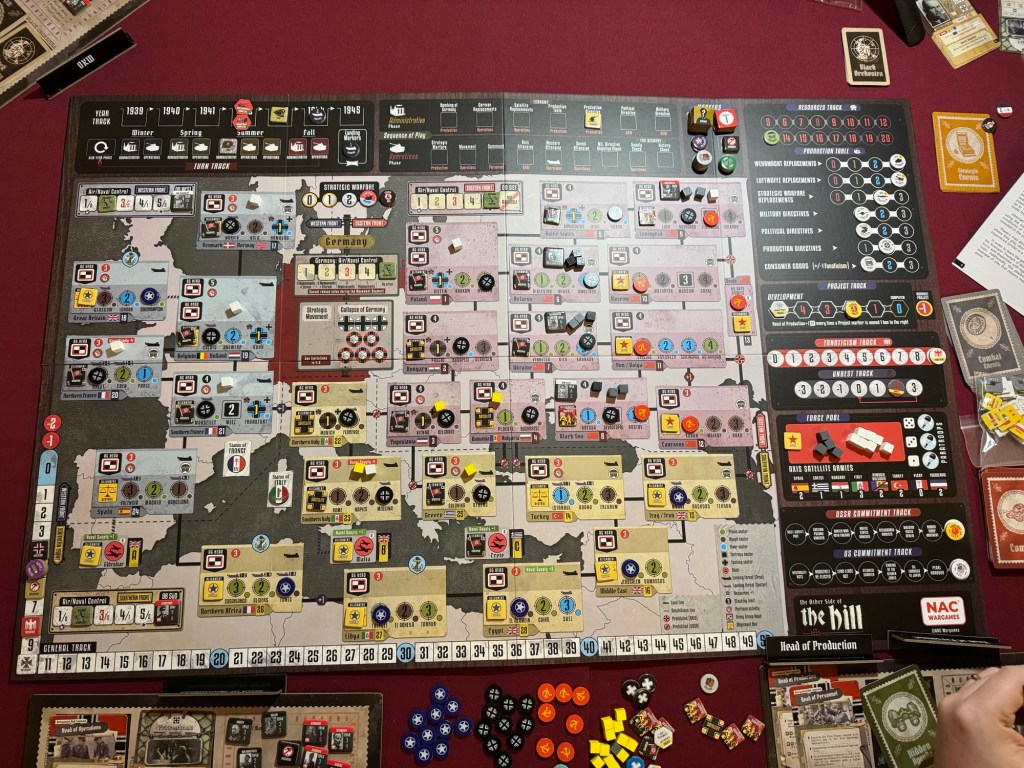
The players represent different political factions inside the Wehrmacht and must struggle for legitimacy and power as the war goes well earning the approval of the Hugh Command and Hitler earning Prestige Points. Germany after all cannot win World War II in the game. Instead, the central question is how long the regime can hold out against the advancing Soviet and Western Allied forces, and which player will come out best during the collapse.
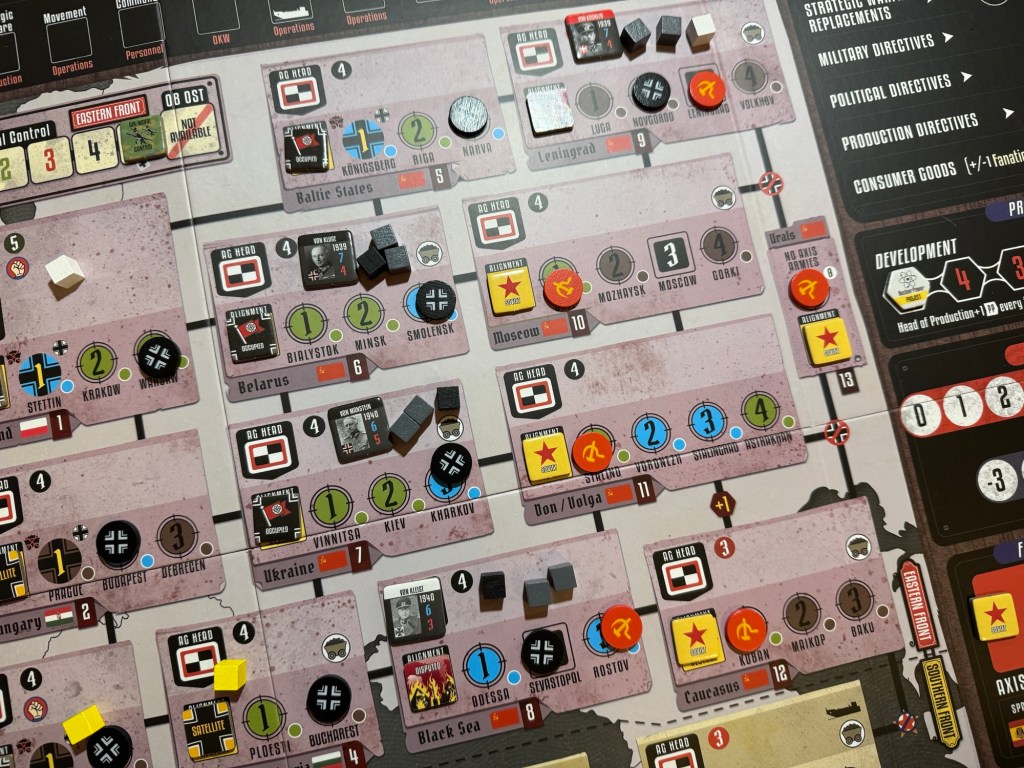
Players will promote and assign historical German generals to different fronts on the board to use their special abilities to win battles and take territory. Victory in battle will earn Prestige, but a single defeat can result in a general’s dismissal. As the fortunes of Germany turn and the war turns sour, players will attempt to fulfill secret Agenda cards representing various factions, such as the Old Guard, Professionals or anti-Nazi Dissidents/Sympathizers. Players must balance cooperating against the Allies with sabotaging or undercutting each other to advance their faction’s hidden goals.
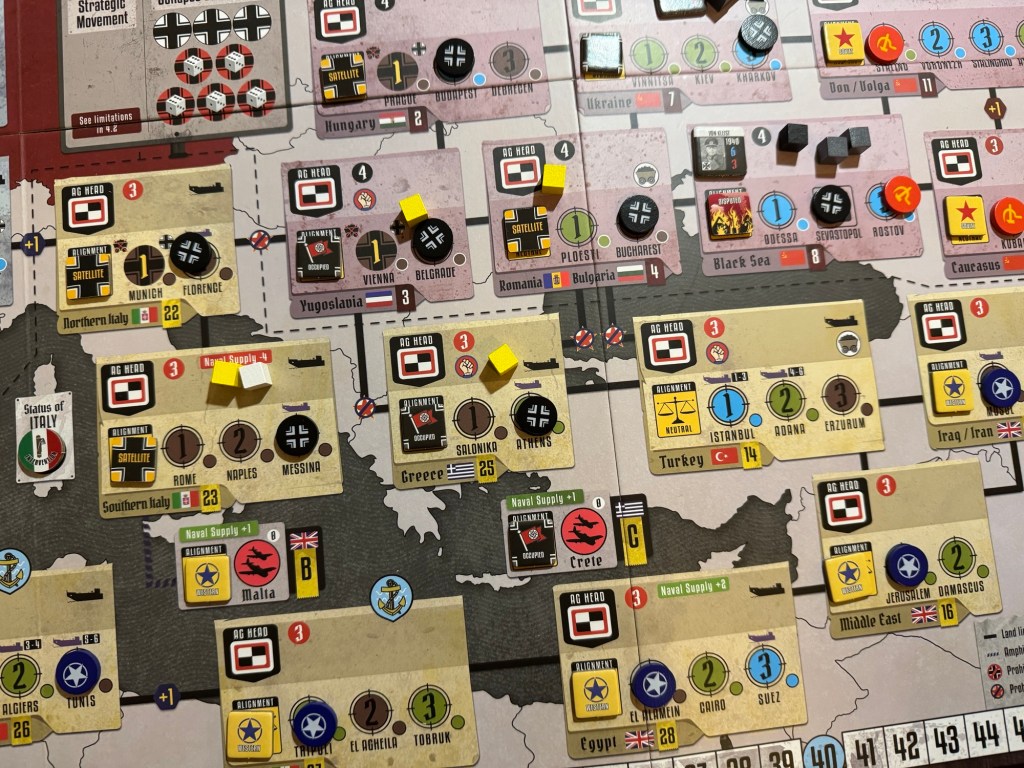
I very much like the thesis of this one and the unique approach to the subject matter. But in practice the game is very long. Almost too long and involved and really gets caught up in so much minutiae that it seems to be an exercise in following the steps of the sequence of play and trying to keep it all moving without missing things or making mistakes rather than a grand strategic look at the decisions of the High Command and the operation of the war. It’s just a lot and to me seemed to be a bit overwhelming. Now this was our first play and we only made it through a few turns in the 5 hours we played but I’m just not sure I’m going to get back to it.
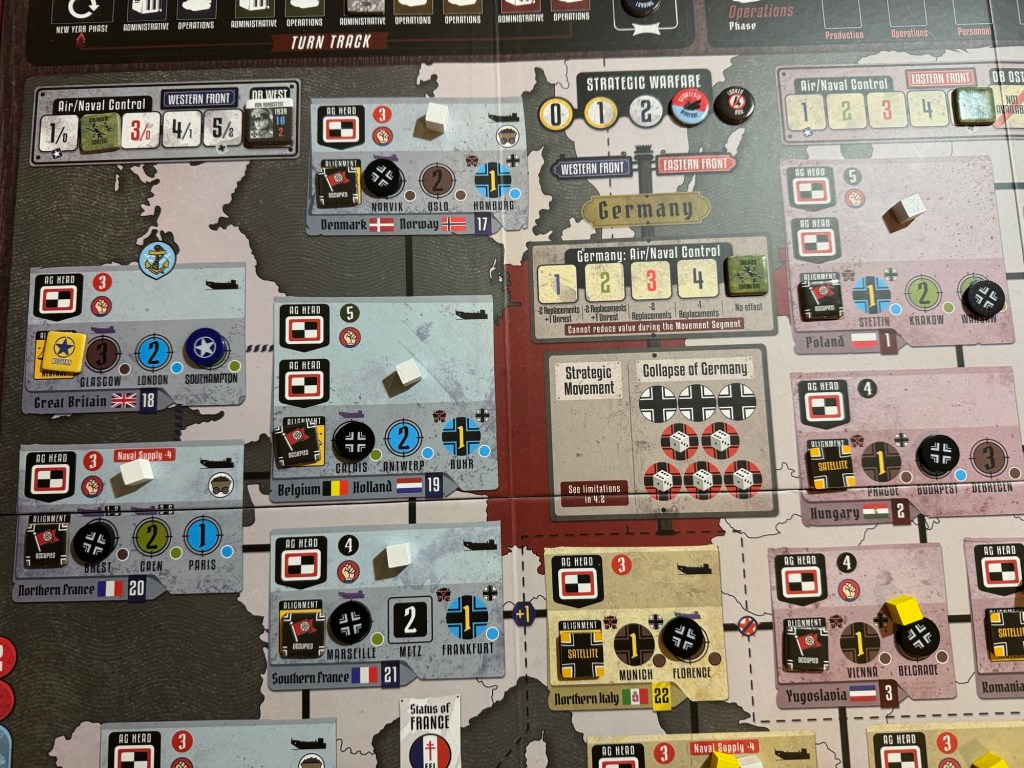
The rules were fine but there were some lacking details and more clarity needed. I think the biggest problem with the components was the size of the text. It was very small and damn near unreadable. Now part of that is I’m old and I need my glasses but these were obviously put together by someone who didn’t have this problem.

Overall the game just seemed a bit much and I am afraid might not be worth the effort. Now I am willing to give it another try but am not sure when that will be.
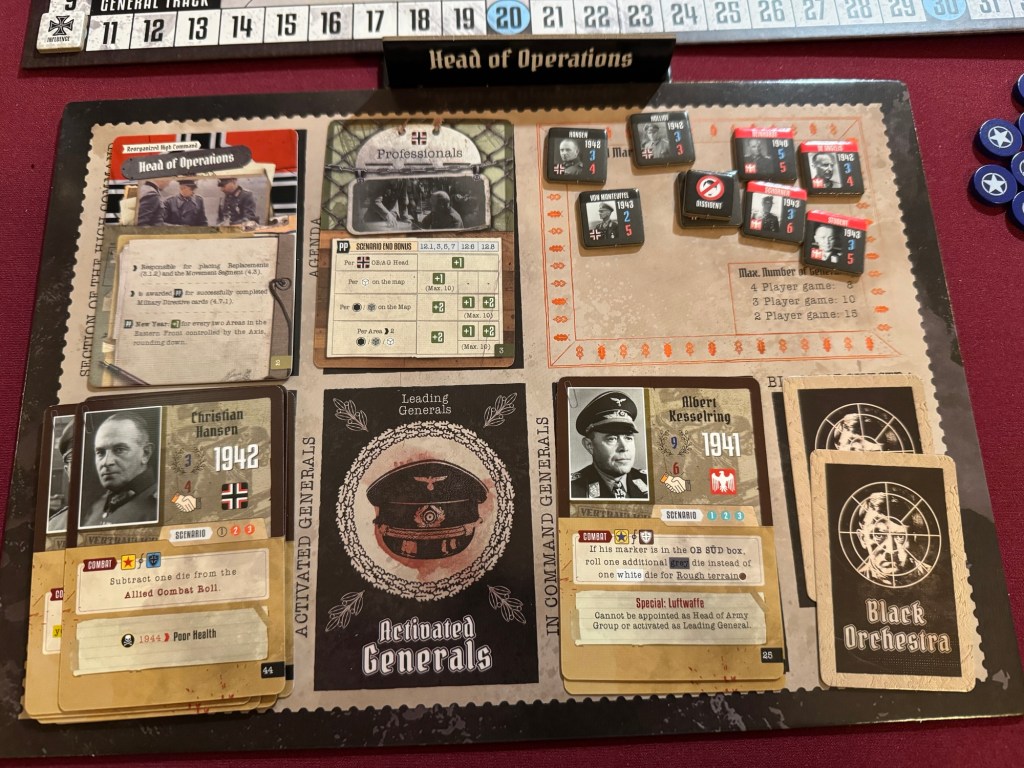
I did very much like the internal competition and petitions of the players to have their particular generals included in the battles as this was a great opportunity to get victories and gain favor. But this changed as a few battles were lost and several generals were dismissed (probably by pistol shot to the head) and the war grew old. There didn’t seem to be as much interest in putting themselves out there and taking the risks. I very much liked this and with the right group this can be a very rewarding part of the game.

In the end we gave up and had a long discussion about the outcome and experience. I think that everyone agreed there was something there but maybe it was too deeply hidden and mired in the due process of the game.

We then went around and stated our goodbyes to friends and compatriots and it was bitter sweet. We are planning to come back next year and we will see them all again but I didn’t want this year to be over. Thank you to SDHistCon and their volunteers. A special thanks to Harold Buchanan as the main organizer and visionary for the con and for his friendship. And thank you to those we played games with over the 3 days. And finally thanks to you all for following along.

-Grant

  •  

San Diego Historical Games Convention (SDHistCon) 2026 Daily Debrief Series – Day 2

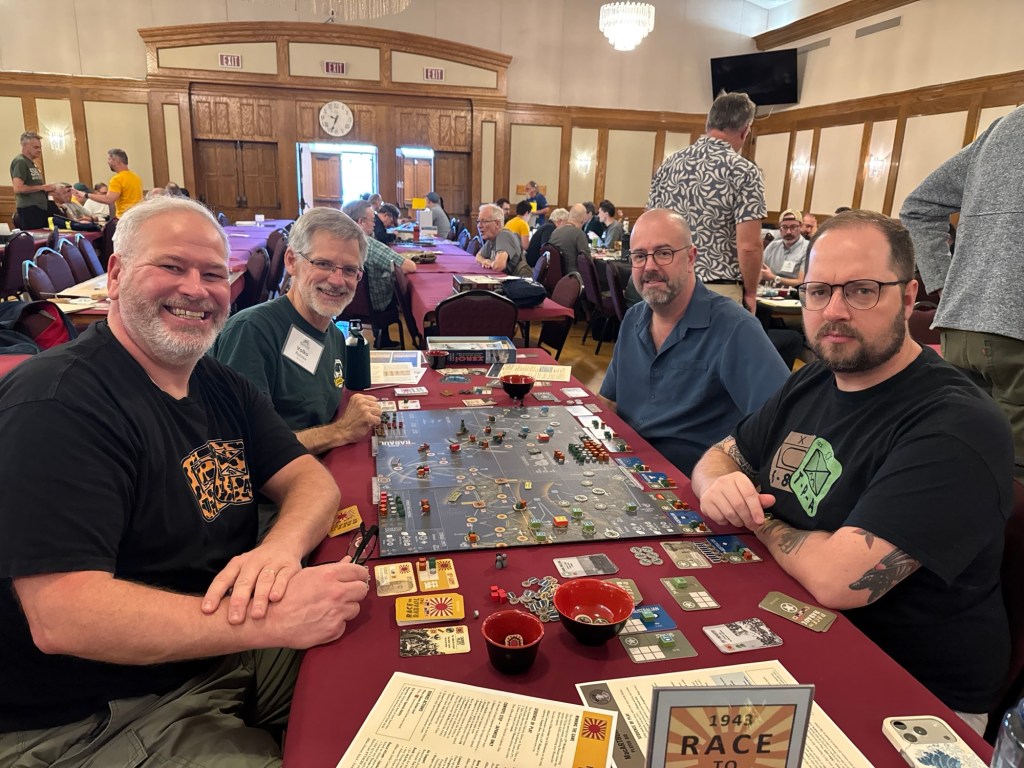
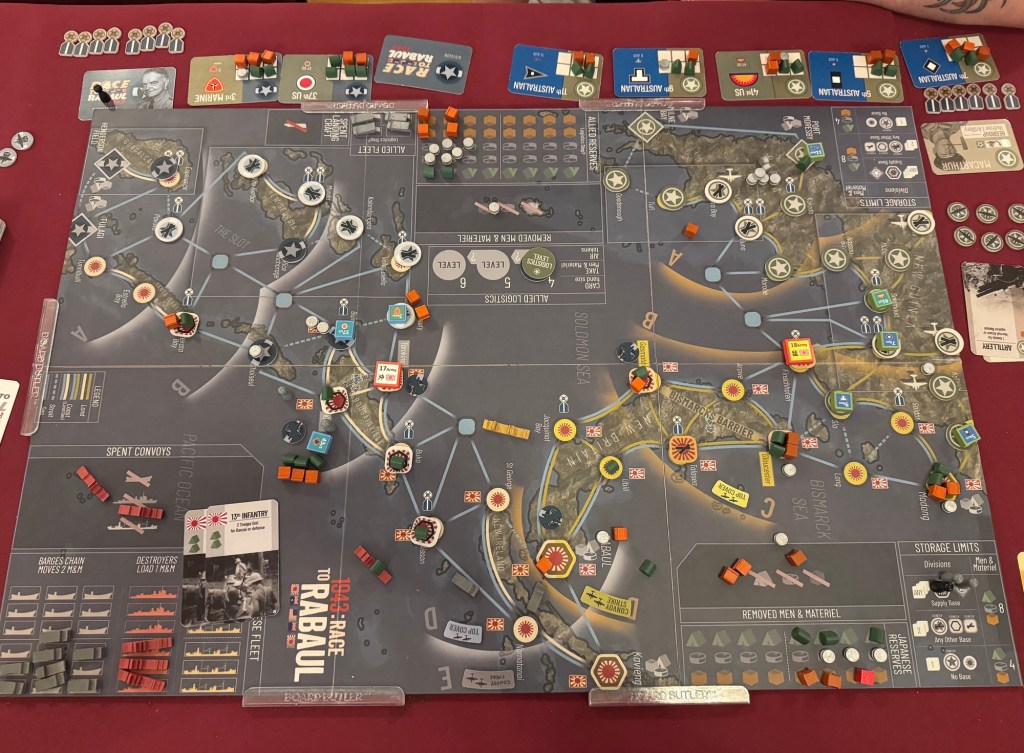
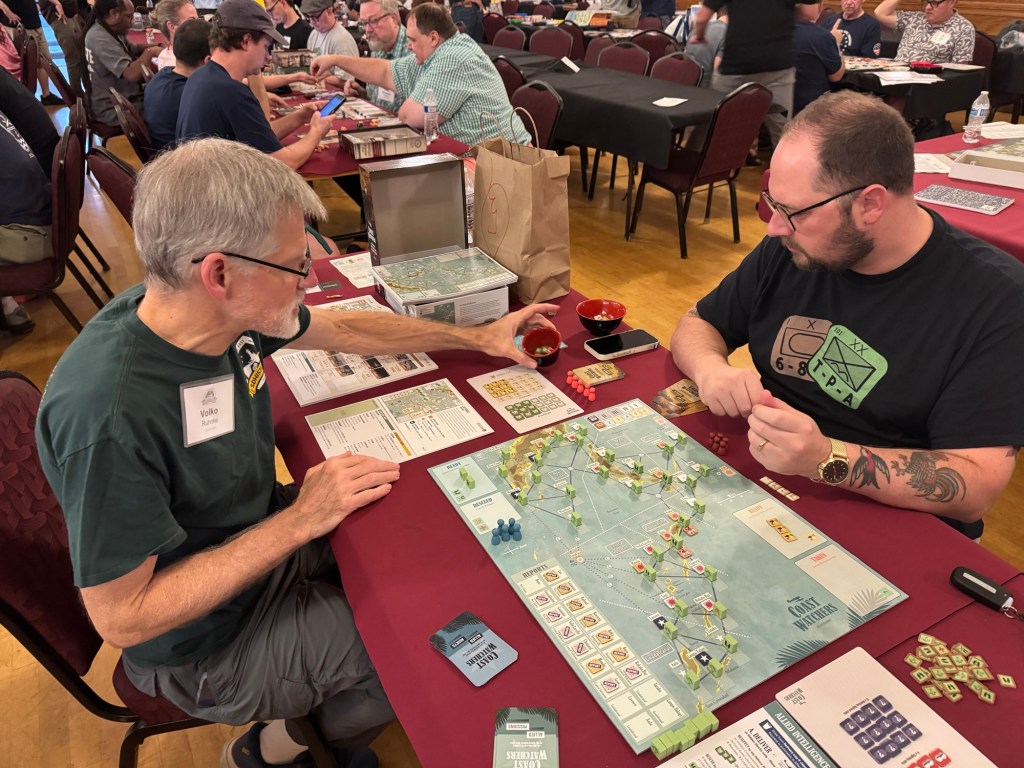
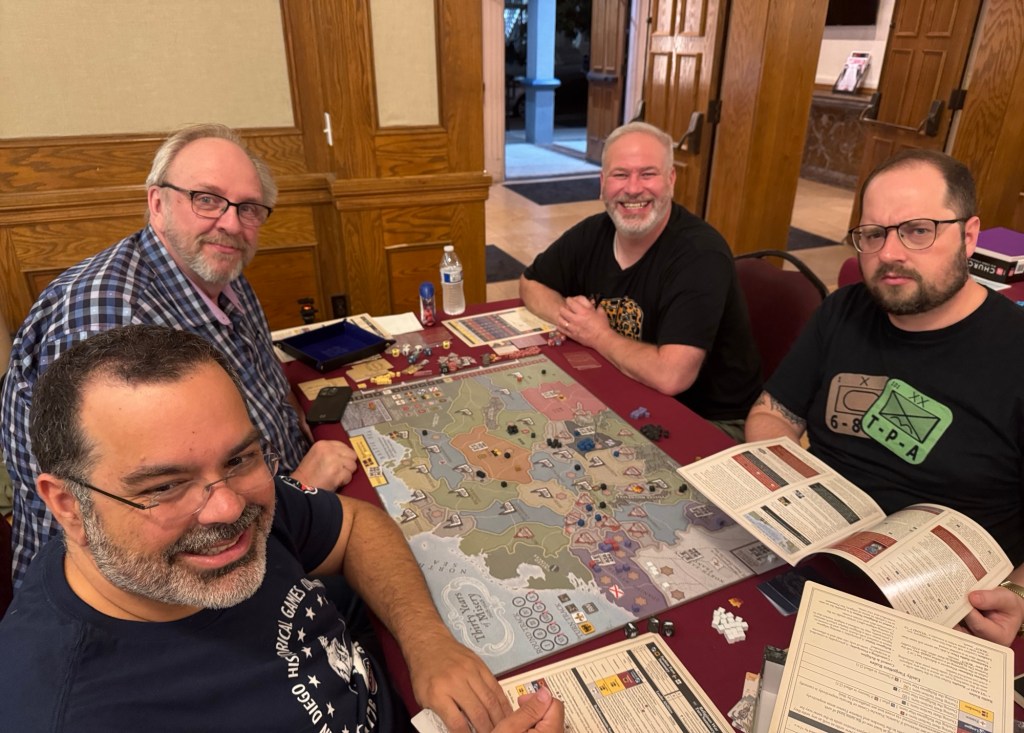
Today was a very busy game filled day. I’m tired tonight so I’m not sure how long this post will be but here goes. We played a total of 4 games today including 1943: Race to Rabaul from PHALANX, Checkpoint Charlie from GMT Games, Coast Watchers from GMT Games and Thirty Years of Misery from VUCA Simulations.

So here is a quick summary of each.

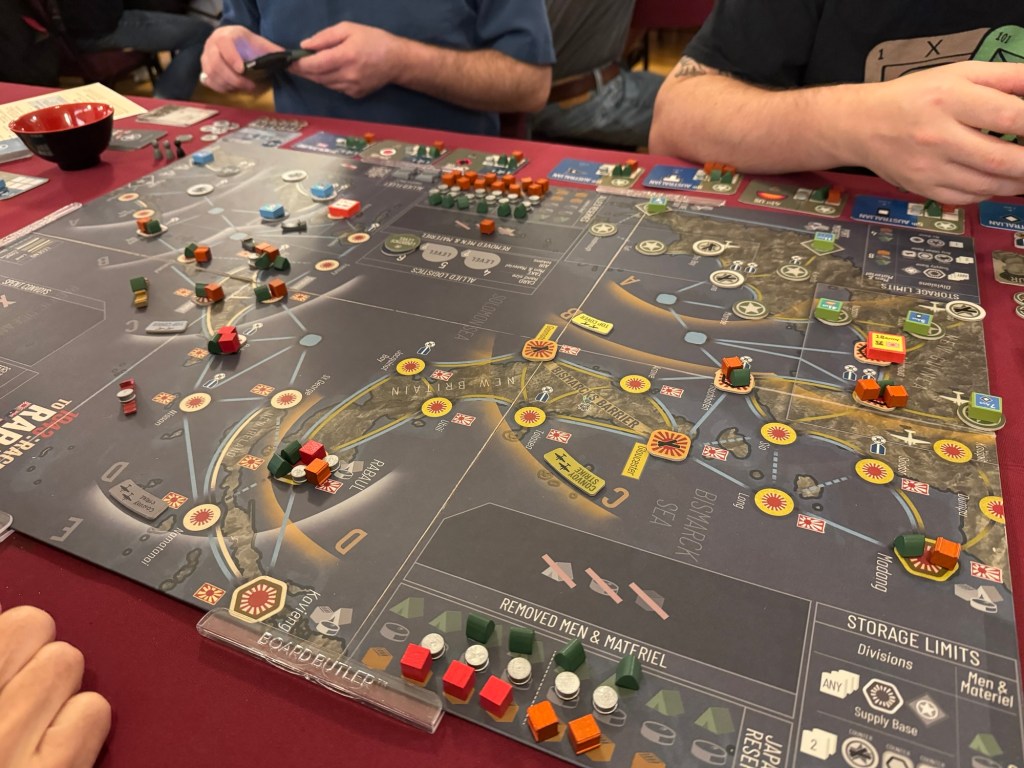
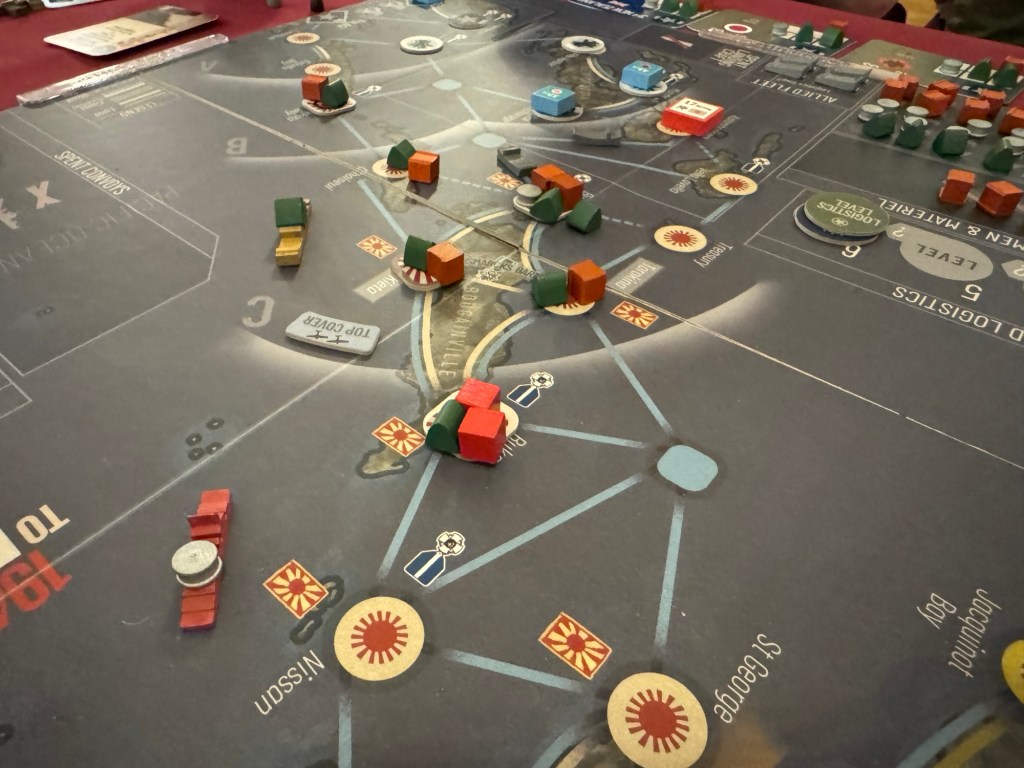
1943: Race to Rabaul is designed by Volko Ruhnke and is a part of Keep ‘Em Rolling Series of logistics focused wargames that includes titles such as 1944: Race to the Rhine and 1941: Race to Moscow. We have played both of the other games in the series but this one is deeper and more involved than the previous volumes. It also feels very much more like a wargame.

The fighting takes place across the South Pacific with the twists that there are 2 teams of players who are fighting each other but also have to contend fur the same pool of supplies and men and have to manage sea, air and land operations.

The Japanese must use Convoys and have to deal Allied Convoy Strikes that eliminate them and the supplies they are trying to deliver. The Allies have it easier as they have an abundance of transports and can move supplies more easily under Air Cover. The problem is that they must take ground and build Air Bases to extend that Air Cover and Convoy Strike range.

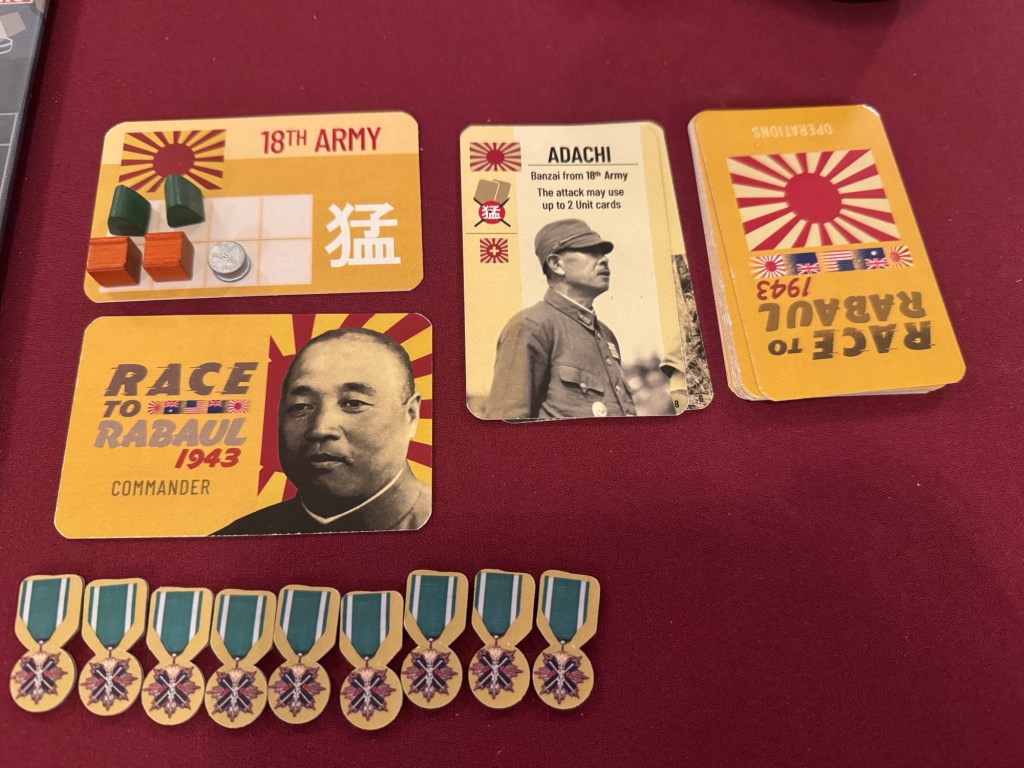
Each side has cards that include operations as well as units and these are played to take actions and can be used in battle to increase strength.

The ultimate goal is to reach a total of 12 medals which come from taking key areas for the Allies and taking Japanese units in battle and for the Japanese preventing the Allies from reaching the Bismarck Barrier and the Japanese causing Allied losses. This one is very well done and we very much enjoyed the experience.

We published an interview with Volko and you can read that at the following link: https://theplayersaid.com/2026/06/15/interview-with-volko-ruhnke-designer-of-1943-race-to-rabaul-from-phalanx/

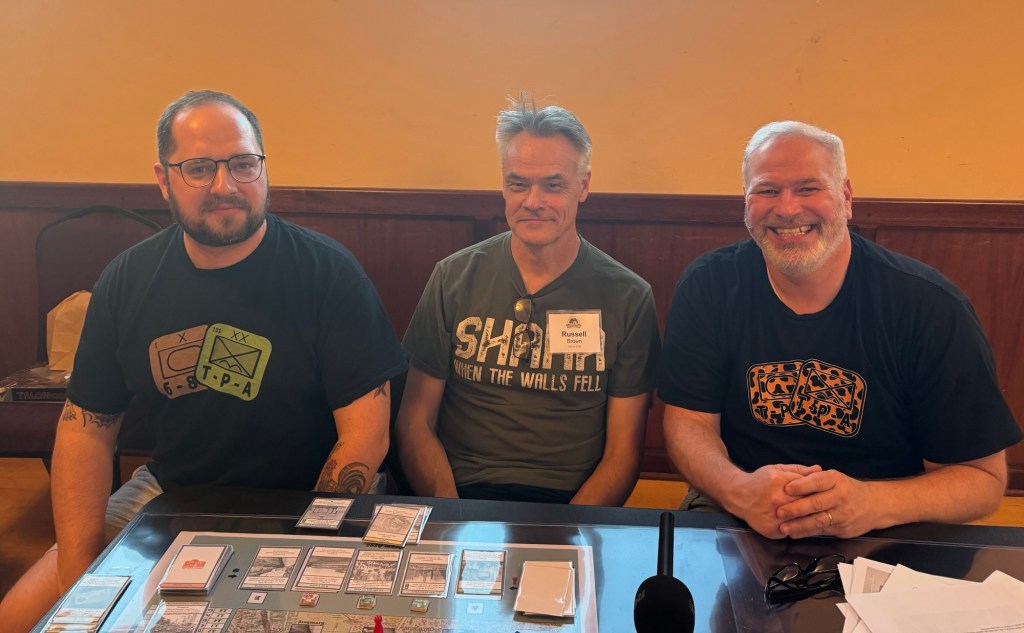
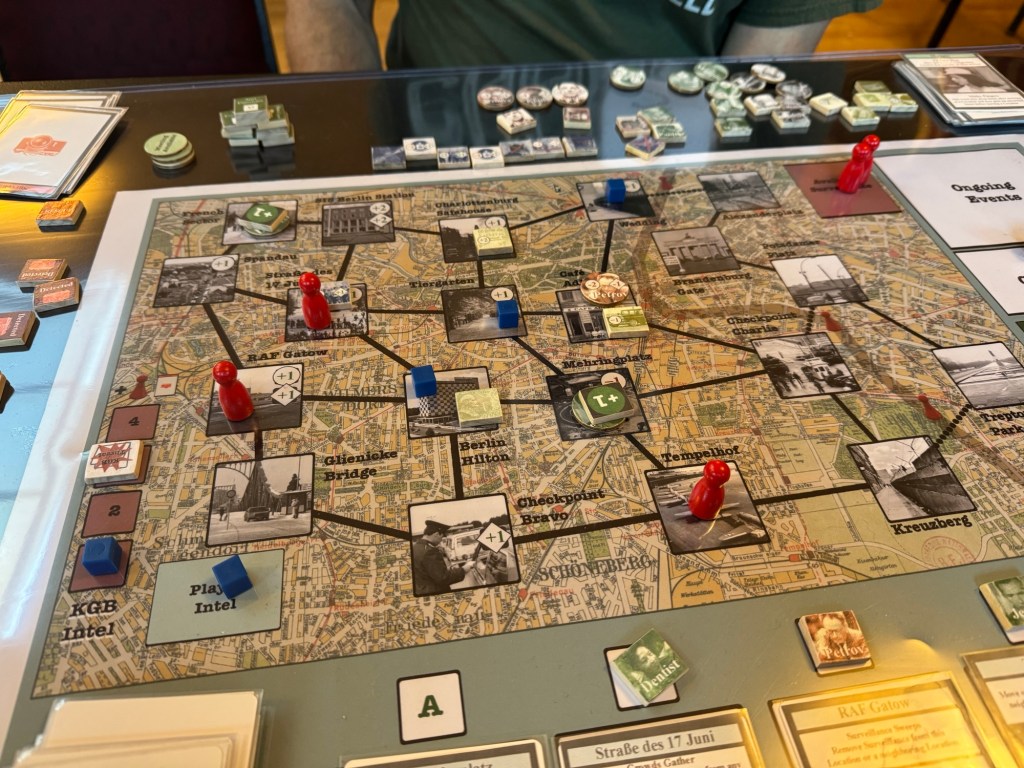
Next up was a look at a prototype game called Checkpoint Charlie with designer Russell Brown and is a solitaire or cooperative game of British Secret Intelligence Service (SIS) espionage missions in Berlin in the early 1960’s.

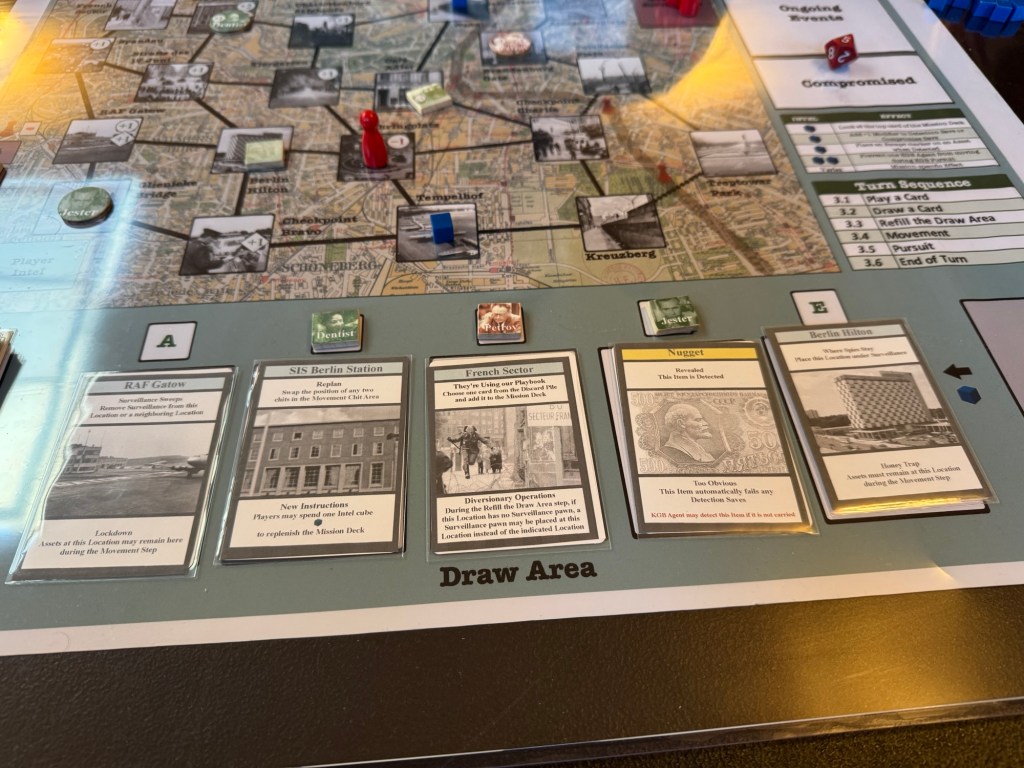
The game is scenario-based, and players must manage a tableau of 5 cards to move their assets and spies around a board showing various locations in Berlin.

Each turn players will draw 1 of the 2 cards on the ends of this row of 5 cards, and then all the other cards shift before refilling the empty position. No card stays in the same location from turn to turn. This is important, because these cards are used to determine where tokens move on the map. Each card location can have a chit above it corresponding to an asset or KGB agent on the map, and every turn, after the cards shift, that asset or KGB agent moves toward the location, item, or asset depicted on the card below their chit. In addition to their role in moving tokens on the map, each card also has an effect printed on the bottom that applies whenever that card is showing in the draw area. As cards are drawn and new cards replace them, these effects come and go and can have significant impacts on the mission.

This is a very good game where players have to plan but these plans are imperfect as you are at the mercy of the lineup of cards. You have to be patient and try to move away from the KGB before your assets are discovered and captured.

We had a great time with this one as we played cooperatively and I think this will be a huge winner.

We published an interview with Russell and you can read that at the following link: https://theplayersaid.com/2026/02/23/interview-with-russell-brown-designer-of-checkpoint-charlie-from-gmt-games/

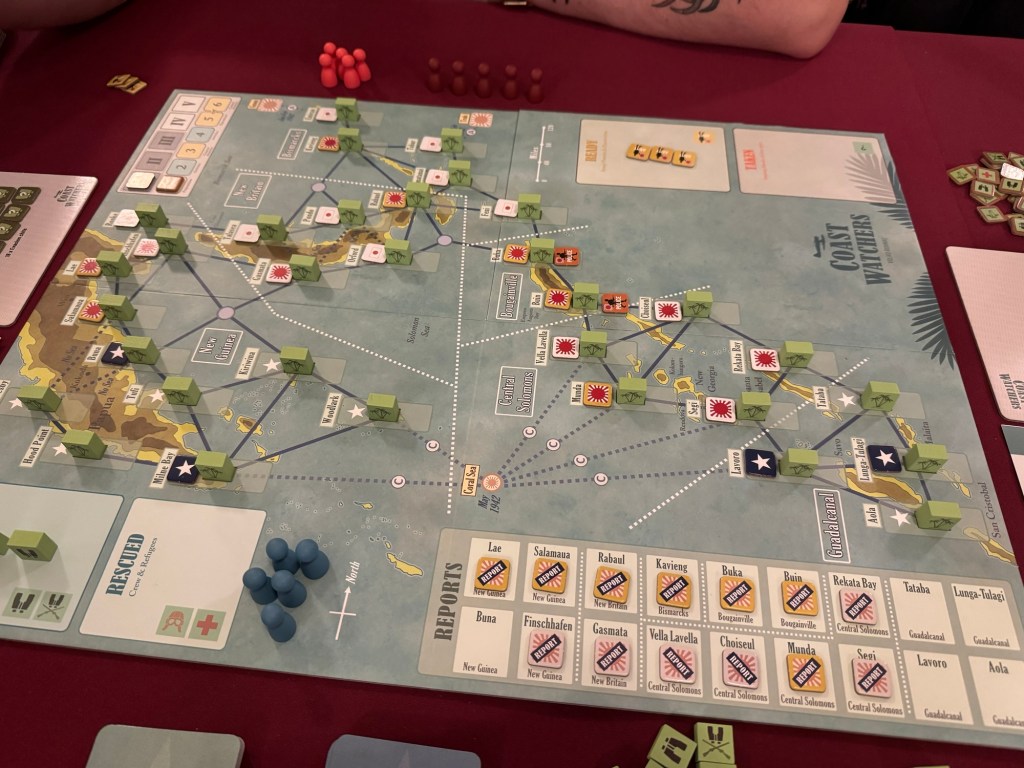
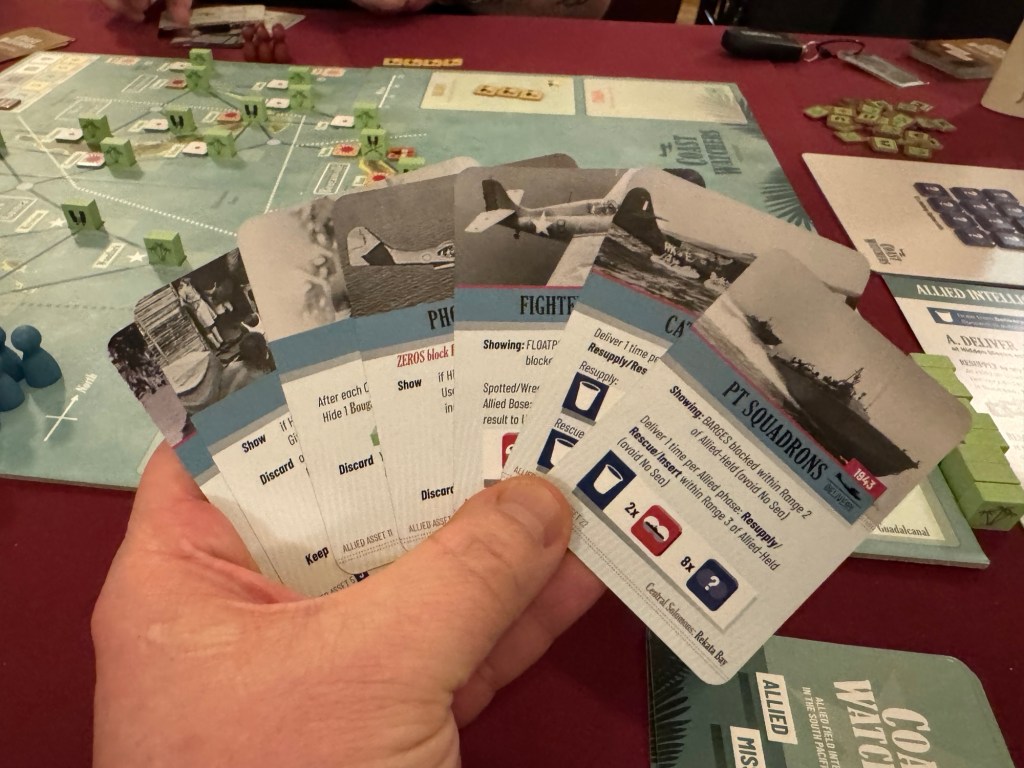
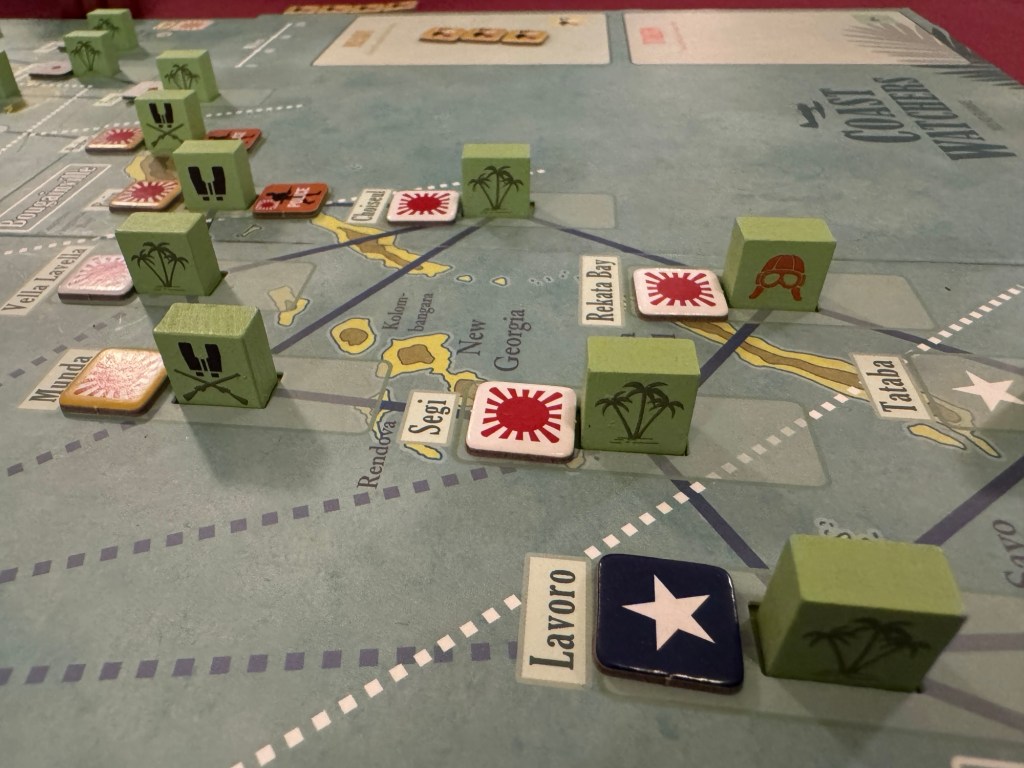
Then we played Coast Watchers from GMT Games with Volko taking us through the game and teaching us. This one was great and I’m looking forward to playing more in the future.

The game is intelligence operations focused with hidden coast watcher units trying to find out information on enemy build-up, movements and to report this information to Allied operations in the South Pacific. The hidden information is via status blocks, secret markers for Japanese movements, blind draw chit cups (Patrol and Delivery) that test success rather than dice and asymmetric objectives.

The game uses cards as well in the firm of missions and assets and players have to choose their cards carefully to be able to have the capabilities and benefits to perform their operations.

I very much enjoyed this one and am still thinking about it several hours later. I think that this one is going to really be a great series as the other games deal with intelligence in different wars and time periods. Just fantastic!

We published an interview with Volko and you can read that at the following link: https://theplayersaid.com/2024/11/04/interview-with-volko-ruhnke-designer-of-coast-watchers-allied-field-intelligence-in-the-south-pacific-1942-1943-from-gmt-games/

At this point we were tired and enjoyed the USMC birthday celebration and had cake that was cut by a Marine saber. We then played a very short learning game of Thirty Years of Misery from VUCA Simulations.

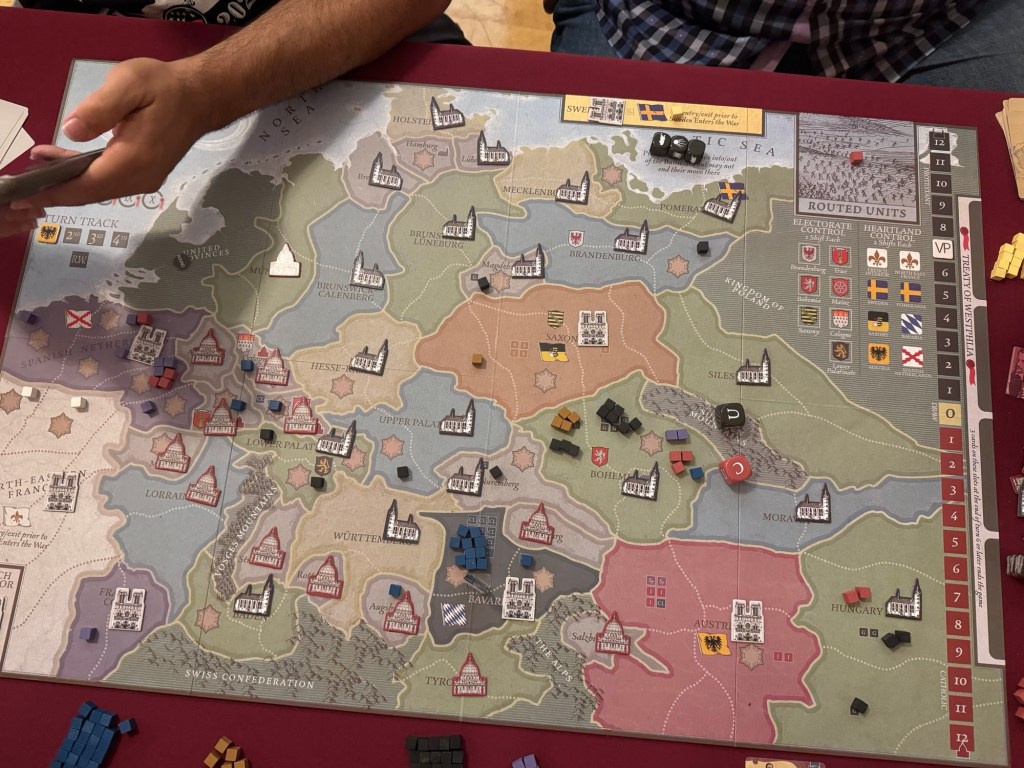
Th game covers the Thirty Years War of 1618-1648 and plays up to 4 players with 2 teams of 2. Players on the same side, the Imperials or the Protestants, must coordinate and work together to win the war, but the victory conditions only allow a single faction within the alliance to win the game.

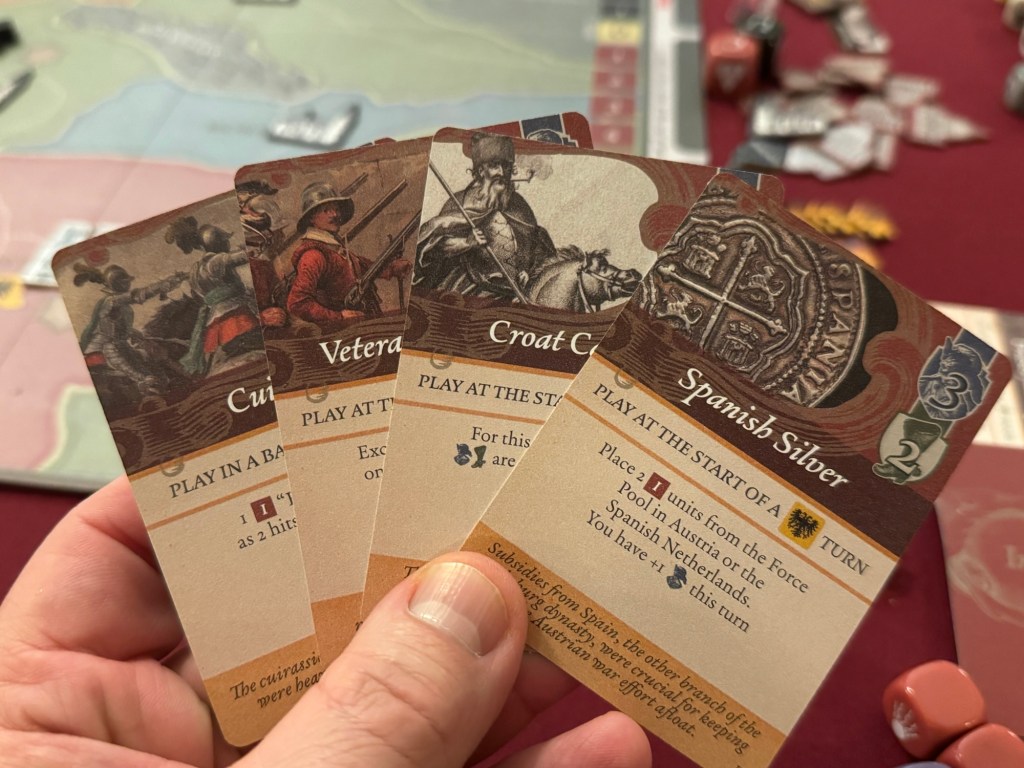
The game is card driven and is based on the Birth of America Series from Academy Games. Random chit pull determines turn order and combat resolution uses different custom dice fur each nation.

This is a fun one and it is designed to be very approachable. Simple movement and combat but there is depth here as you have the religious struggle as players can convert spaces and then can lose them later. Lots of fun and we ended up playing just 3 rounds. We will look for a chance to play more in the future.

Tomorrow is our last day and we have a game of The Other Side of the Hill from NAC Wargames planned. See you tomorrow evening!

-Grant

  •  

San Diego Historical Games Convention (SDHistCon) 2026 Daily Debrief Series – Day 1

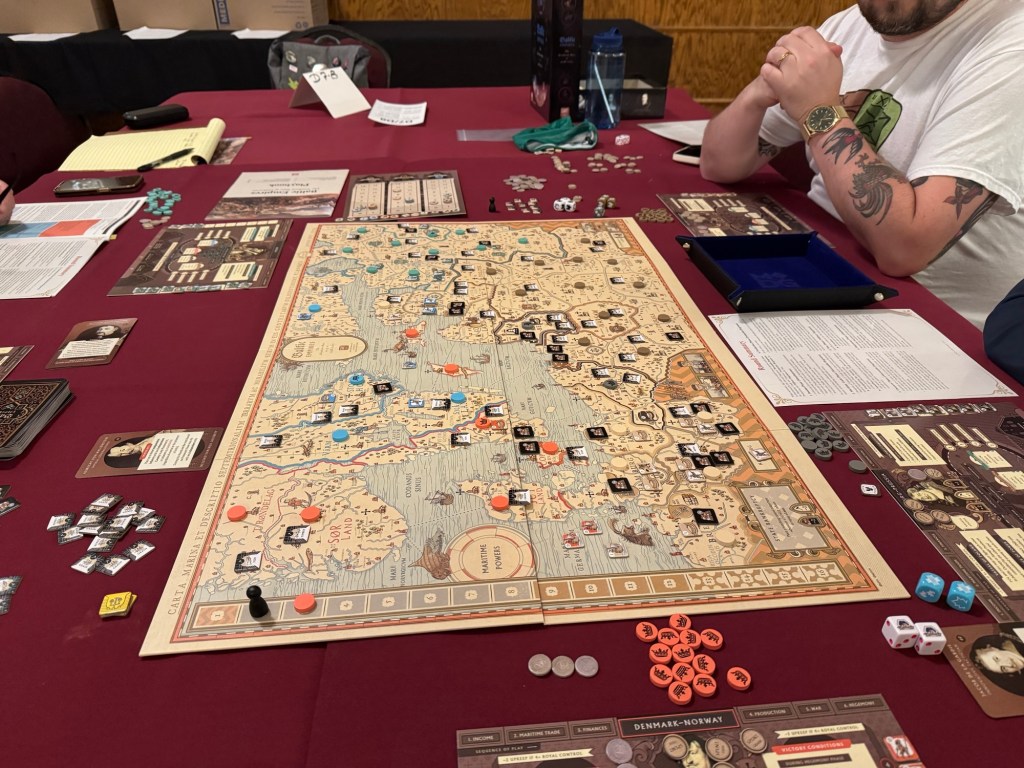
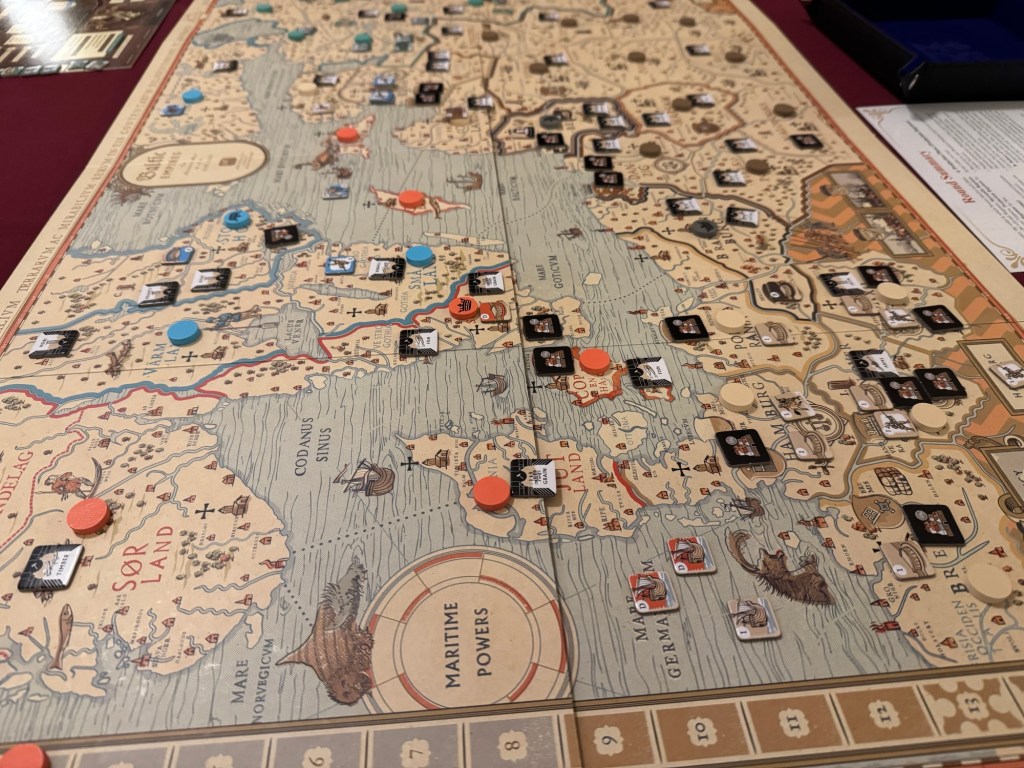
After a pretty rough day of travel yesterday, our plane landed in San Diego around 11:45pm. By the time we got to the rental car center to get our car and made it to the air bnb it was 12:30am. I only got about 5 hours of sleep due to a combination of the room having no curtains, an early sunrise and the time difference. But we made it out of the accommodations around 7:30am and ate breakfast at the very popular Point Break Cafe where we saw plenty of gamers, designers (David Thompson and Liz Davidson), content creators (ZillaBlitz and Grant Linneberg with Pushing Cardboard) and friends we had a fantastic Southern California breakfast and arrived at the S.E.S. Portuguese Hall of San Diego at 8:30am and began setting up for our first game of the day Baltic Empires from GMT Games. 

Baltic Empires covers the period in the Baltic region from the collapse of the Teutonic Order in 1558 to the end of the Great Northern War in 1721. The game really focuses on representing both the mercantilist economic thinking of the time, the very limited resources at hand on the state/ruler level and the destructive nature of warfare and its effects on the local economy. When war occurs in spaces infrastructure can be destroyed and it is very expensive to keep replacing units that just die on the battlefield.

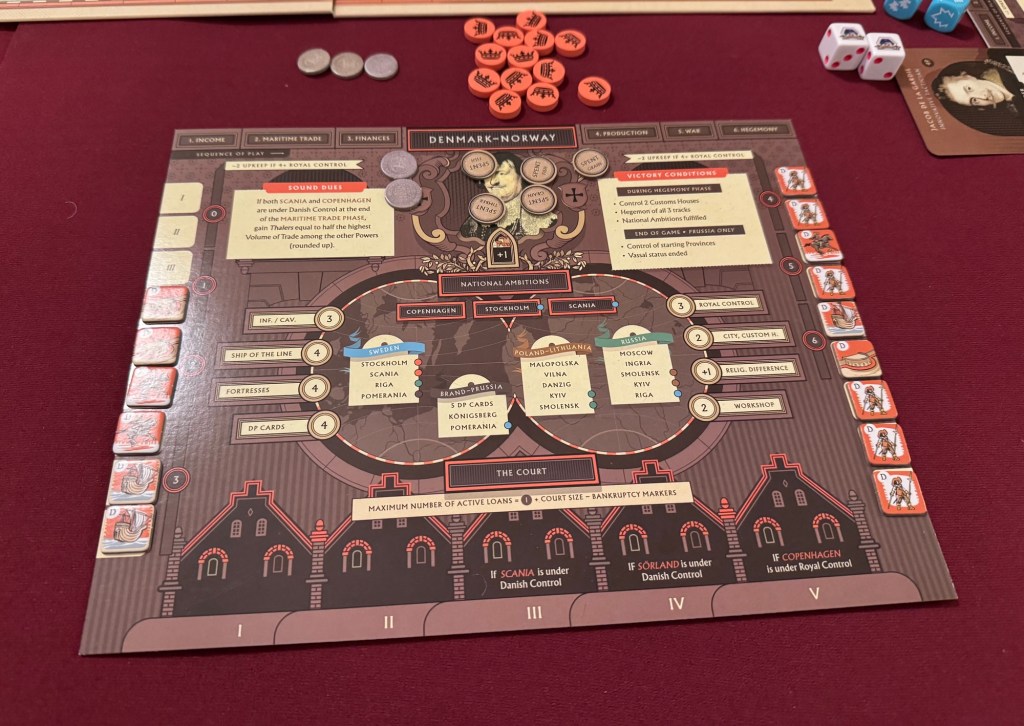
The game has 5 factions including Denmark-Norway, Sweden, Poland-Lithuania, Prussia-Brandenburg and Russia. Each power has 2 common victory conditions and 1 or 2 that are specific to that power. The shared victory conditions are either control of 2 custom houses or being the hegemon on all 3 tracks at the same time.

One of my favorite parts about the game was that each turn, 5 Dramatis Personae Cards are randomly drawn from the deck and become available for purchase by the players in the Production phase. These cards have a wide variety of effects, but can be broadly divided into 4 types: those that have permanent effects, those that have one-time effects, those that affect victory conditions and those that provide a special leader unit. These cards are excellent fun and really create somewhat of a race to purchase the best cards before others can acquire them. Now after having said that our draws of cards for the first 2 turns were not good and hardly anyone invested in them but that changed later.

I loved the game and very much enjoyed the lite nature of the game. The economic system is simple, but manages to capture a lot of key elements of this period. Each province has between 0 and 3 resource icons and between 0 and 2 city icons. If a workshop marker is present on a resource icon the province produces 1 of that type of resource and if a city marker is present on a city icon the province produces 1 thaler (the currency of the game). There is one twist though, as provinces under noble control will contribute a maximum of 1 of the resources and 1 of the thalers produced in it to the central administration while the rest is discarded as it goes into the coffers of the local nobility. Only provinces where royal control has been imposed will contribute their full income to the player. In addition to this there are 3 trade center provinces on the map, and these generate extra income for their controlling player as they are able to tax the trade there. Just a great little game that I hope to explore further later.

Alexander’s Poland ran away with it with a Hegemonic superiority victory (Hegemony leader for Mercantile, Production and Military). Great lite wargame similar to Mare Nostrum from Academy Games.

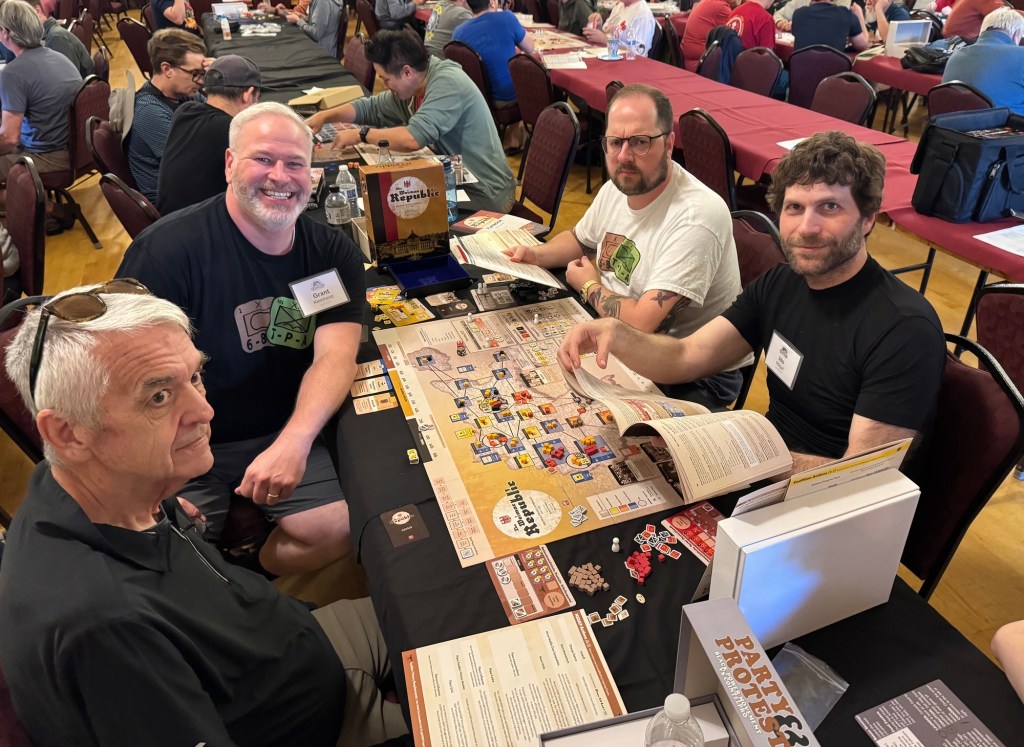
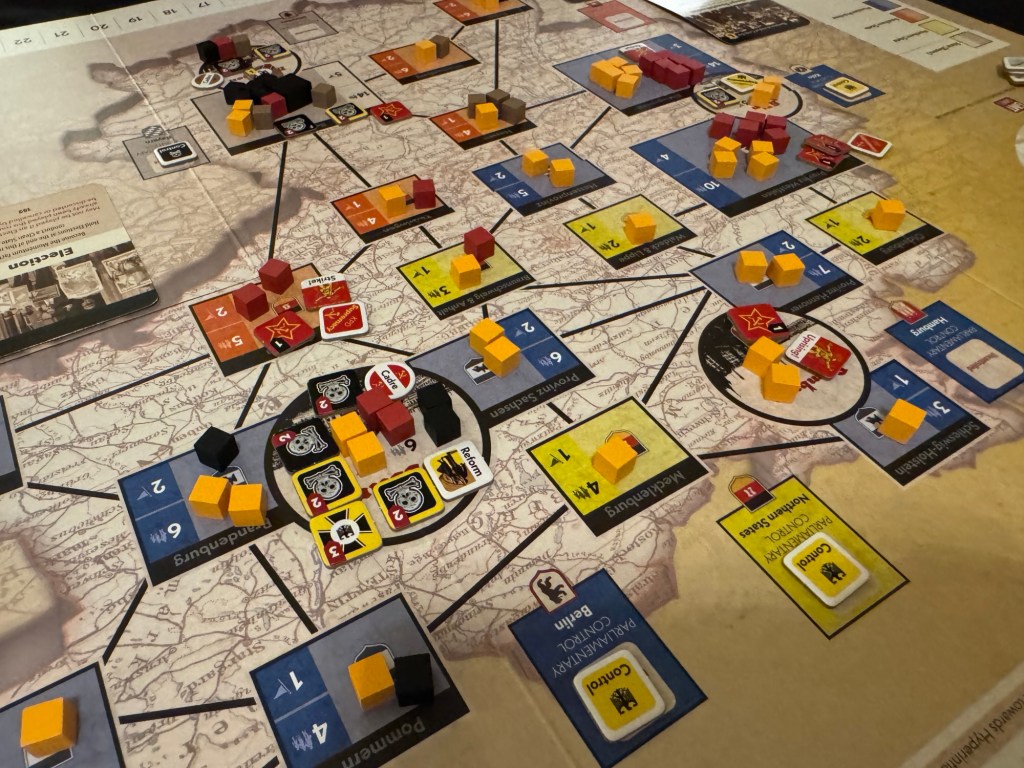
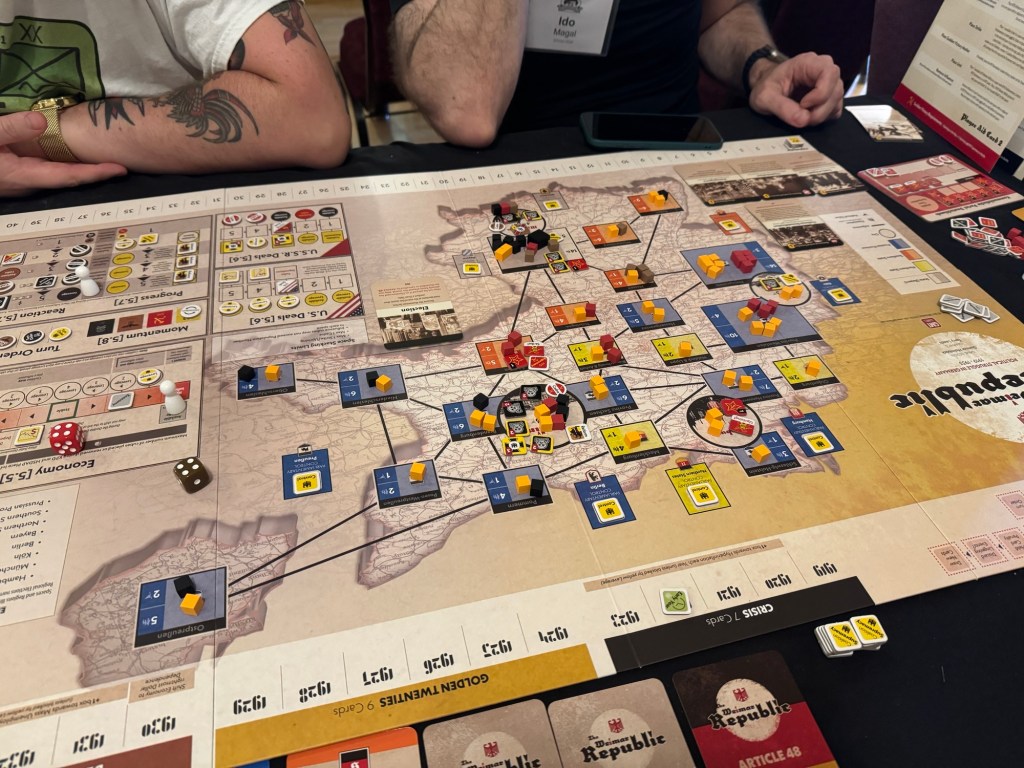
Our next game was a bit deeper and more involved in The Weimar Republic. The game is a Card Driven Game of political struggle in interwar Germany where 4 unique factions compete for dominance including the democratic Coalition, the Soviet-backed Communist Party, Hitler’s National Socialists and the far-right Radical Conservatives. The game covers the Interwar Years between 1919-1933 and represents all of the different fighting factions trying to gain control in Germany’s regions and major cities, to maneuver the political landscape of the Republic, and to dominate through a combination of propaganda, parliamentary elections, street violence and economic influence. This situation sets itself up perfectly for a game to explore the various parties involved.

The game makes me think of a COIN Series like game as each faction has their own unique abilities and powers but also win in their own way. The game also visually looks like a COIN game as it uses multi-colored wooden cubes to represent influence in the various districts of pre-WWII Germany.

A major focus of the game is the concept of Elections. Each Era has a number of Election Cards (based on the historical number of Elections) that are shuffled into the Event Card decks. When an Election Card is played, both a Regional and a General Election is held at the end of that round. Election scoring is based on players’ Dominance over spaces and Regions, with modifiers such as Middle Class Sympathies, Cadres, military Supremacy, etc. Regional Elections gives Parliamentary Control over the game’s Regions while a General Election can potentially end the game – if anyone but the Coalition wins a General Election, that player also immediately wins the game.

Players draw a hand of cards for each Era and use their AP to conduct Actions. You don’t chose between AP and Event as when you play an Event Card the Event always takes place, unless there are some requirements that aren’t met. You don’t need to play a card every turn – in fact you can’t, as there are fewer cards in a hand than turns in an Era and you may only play one Event Card per turn. However, you always have a basic 1 AP that may be used by itself or in combination with any Event Card played, so during some turns you will be using only that basic point. You can also pass which allows you to discard a card and draw a new one.

I very much like what I was doing but need to continue to learn the rules so I know what I should be doing. We had a good time and I look forward to another play in the near future. I was able to pull a victory out as the Coalition, which I understand is generally pretty difficult.

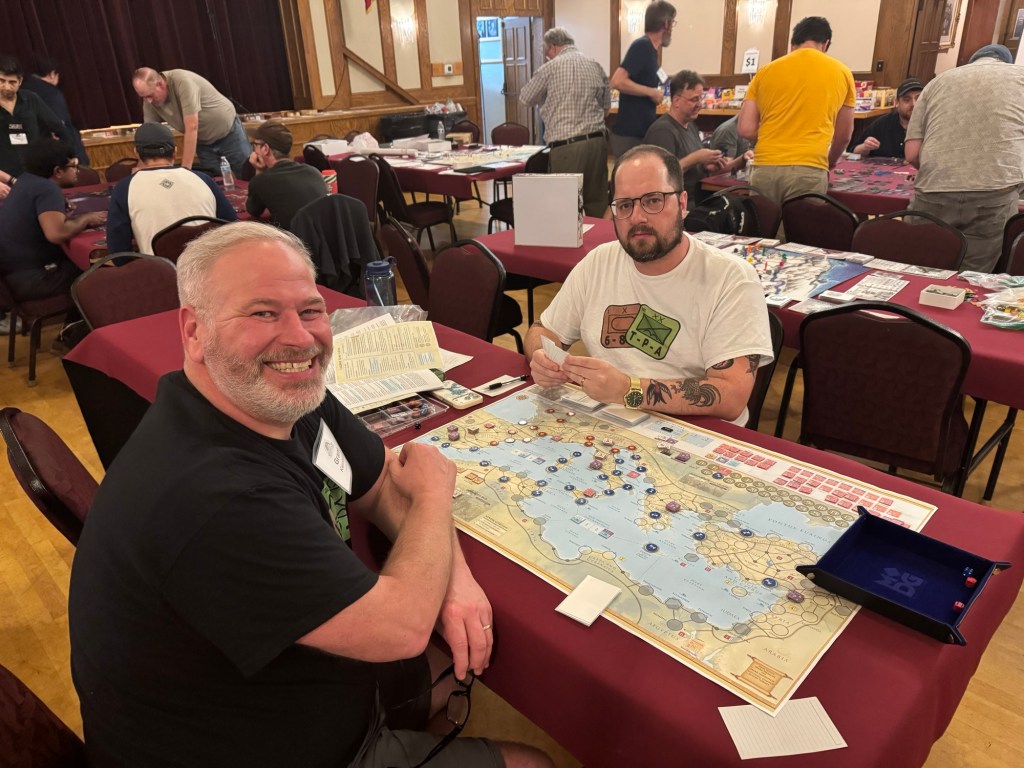
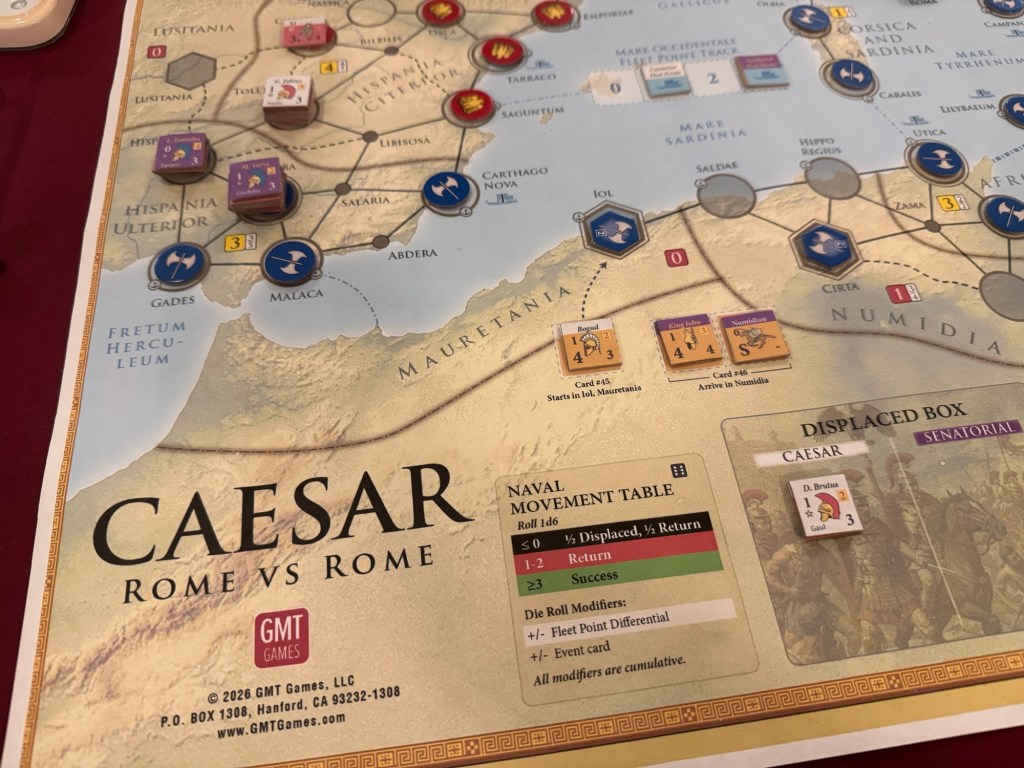
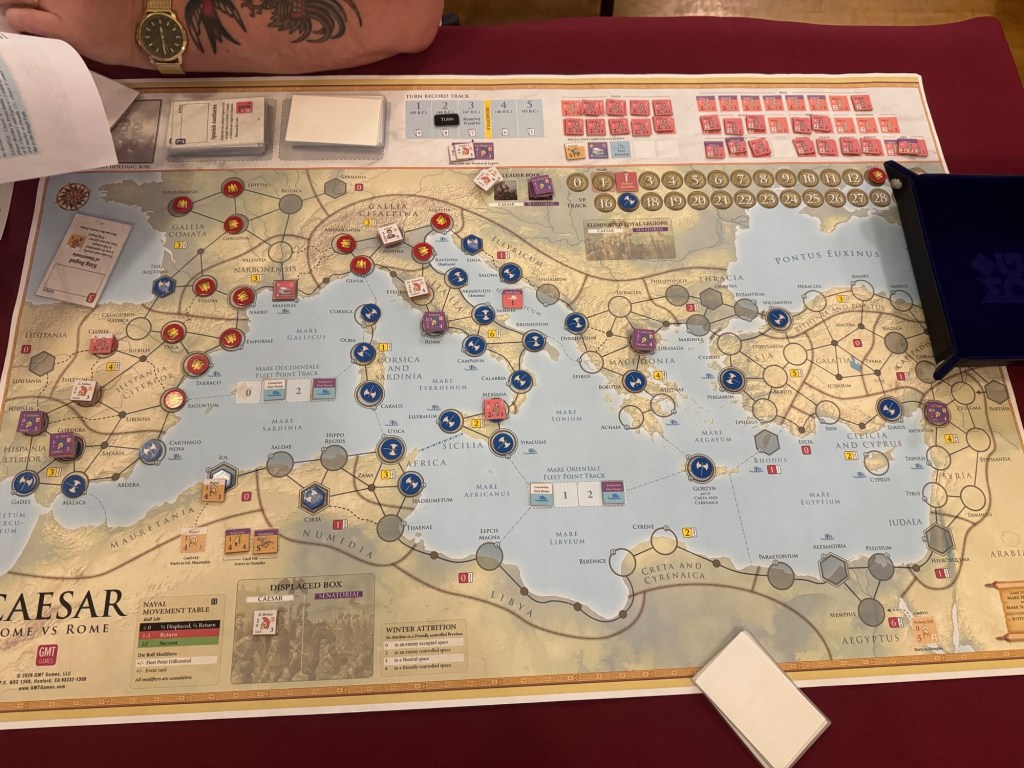
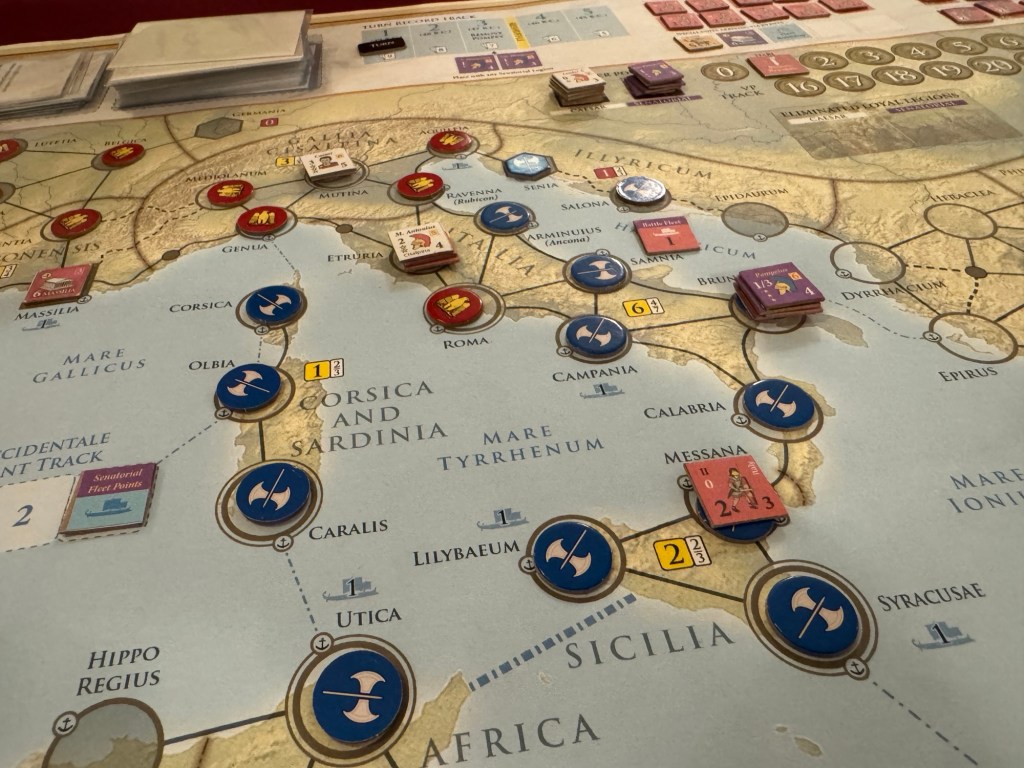
Our final game of the evening was a look at a new and as-of-yet unannounced collaboration between Mark Herman and Mark Simonitch called Caesar: Rome vs Rome. This game is a CDG and uses the same system found in Caesar: Rome vs. Gaul from GMT Games but covers the Roman Civil War where Caesar confronted the Republic and the forces of Pompey.

The game really is focused on the struggle for political control of the empire as players will play events, move armies and fight in order to control the minds of the people.

Battles are commons and a major part of the game but the game is very snappy and only lasts 5 turns.

I think that this one is going to be a winner and I very much appreciated Mark Herman showing us the game. I have been told that it will be announced on the P500 in December.

That was our day! 3 big games and lots of good times were had by all. Tomorrow we have an early morning game of Thirty Years of Misery from VUCA Simulations and I also hope to sit down with Russell Brown to get a look at Checkpoint Charlie from GMT Games and possibly Coast Watchers from GMT Games with Volko. See you tomorrow evening for a synopsis of Day 2.

-Grant
  •  

San Diego Historical Games Convention (SDHistCon) 2026 Daily Debrief Series

Good morning our faithful readers! As this post uploads this morning, we will be preparing to make our way out west to attend SDHistCon 2026 held in sunny San Diego, California at the best little historical games convention on the West Coast! We will not depart until later today on a 3:45pm flight departing Indianapolis and should arrive in San Diego at around 5:30pm on the West Coast. We will be attending the mixer that evening and get settled into our short term rental. We also are taking along The Players’ Aid Wives (Kelly and Paisley) as well as 2 of our children in Marin (my daughter) and Atticus (Alexander’s son) and are excited to spend time with them in the beautiful southern California weather! This convention will include 3 days filled with gaming, designer interviews, looks at new prototypes, visiting with friends, publishers and designers.

This will be our 3rd trip to SDHistCon and we appreciate the constant prodding and encouragement from our friends Harold Buchanan and Andrew Bucholtz to get us out there and I am really excited about attending as we had such a great time the last 2 times we have attended! The San Diego Historical Games Convention is set to be held from November 6th through 9th at the S.E.S. Portuguese Hall of San Diego. The convention is about 2 blocks from the San Diego harbor, just a few miles from the San Diego airport, and is surrounded by delicious restaurants and fairly affordable hotels and other accommodations.

The mission of SDHistCon is to create a diverse and supportive gaming community dedicated to playing, discussing, designing and promoting historically-based board games. Through this commitment, SDHistCon seeks to serve both the existing historical board gaming community as well as grow it through the addition of new voices and perspectives. Recent events run by SDHistCon include this same convention last year, the 2025 Summit Award (given to War Story: Occupied France designed by David Thompson and Dave Neale), an online convention called SDHistCon Winter Quarters in January 2026, and SDHistCon North in Minneapolis/Saint Paul, Minnesota this past July.

At the end of each day, I will be putting together a short summary of what we did that day at the convention. I would like to keep this to just a few paragraphs with several pictures to give you an idea of the games we played that day, people we talked with and other activities we participated in. We will still work on doing multiple videos as well that will be released on the YouTube Channel over the next few months but this coverage will supplement the videos. This summary will most likely not be posted until after 1:30am EST each night, if not a bit later, so you might be checking it out the next morning which is fine.

One of the new things they will be offering this year at the convention is the Skunkworks Event. The idea of the event is similar to publisher speed dating events at other conventions, but it’s intended for more than just publishers. This event, on Friday, November 6th, will feature up-and-coming designers set up at their own tables, where they can give a 5-minute pitch on a single game to other convention attendees, who may be publishers, designers, reviewers or content creators, or others curious about what’s in the works. The Skunkworks Event will be scheduled on the Friday night of the convention to allow participants to schedule follow-up meetings or playtests later in the convention with people particularly interested in their game.

We have at least a few things planned that are official including several multi-player wargames like Baltic Empires: The Northern Wars of 1558-1721 from GMT Games, The Weimar Republic: Political Struggle in Germany, 1919-1933 from GMT Games, The Other Side of the Hill from NAC Wargames and Thirty Years of Misery from VUCA Simulations. We also will most likely be getting in a game of Virgin Queen but have not been able to get that finalized as of yet. We have been invited to participate in the Skunkworks event and I am very much looking forward to what we will see. We are also looking forward to taking a look at other “as of yet unreleased” games that are in design including Foxes and Lions: Renaissance City-States in the Age of Machiavelli from GMT Games, Painkillers from Hawk & Dove Games and Checkpoint Charlie from GMT Games in addition to some others. Should be a ton of fun!

If you are looking for gaming opportunities while attending, please check out the following GeekList that I created on Board Game Geek: https://boardgamegeek.com/geeklist/385692/gaming-opportunities-at-sdhistcon-2026-november-6

There have been multiple games setup on this list since its creation in early October and we are nearing full capacity so check it out and add your name if you are interested in gaming with us. Happy gaming!

Finally, if you are at SDHistCon please feel free to find us and say hello. I believe that we are very friendly and accessible (well at least I am as sometimes the Brit is a bit crusty and gruff!) and love to make connections with our fans and followers. In fact, we have TPA buttons and stickers to give away so just ask. We also would like to take a picture with you so we can document it in our writings.

-Grant
  •  

Call for Playtesters: Rubicon and Basileus Designed by Douglas Walker

From time to time, we assist designers with getting the word out for them as they are looking for playtesters for upcoming designs. Recently, I was contacted by Douglas Walker who is working on 2 designs, one named Rubicon and the other Basileus, and was in need of assistance. He has created a Discord server for potential playtesters called “Doug Walker Playtest Server.” Here is the invite, which won’t expire: https://discord.gg/gSsQRWjPWp.

Doug has provided the following descriptions of the games:

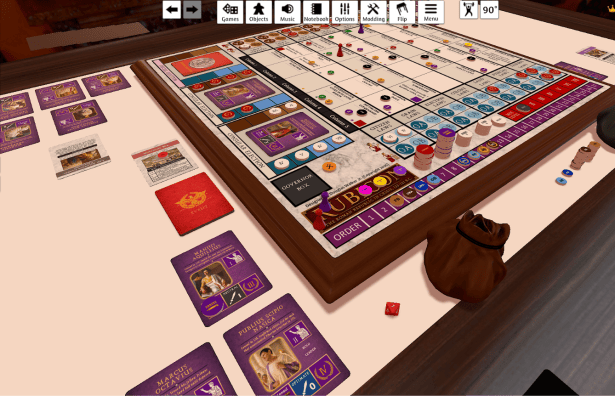
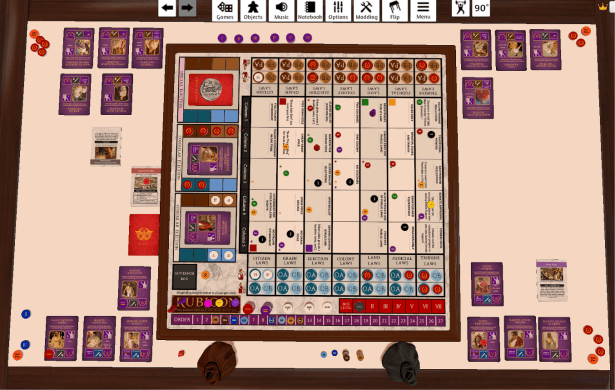
Rubicon is a strategy game about political competition in the late Roman Republic. It is 133 B.C. The Republic of Rome overshadows the Mediterranean world, but internal discord threatens to derail its growing empire. Two political factions vie for dominance—the aristocratic and conservative “Optimates” and the populist and revolutionary “Populares.” The fragile consensus holding together Rome’s elites erodes as conflict grows ever more violent.

In Rubicon, players control a faction of Roman senators belonging to either the Optimate or Popularis faction. More than one player belongs to each faction—but only one player may win the game. Players use their political influence to win elections, gain glory in war, and shape the laws of the Republic to suit their ideology and interests. Rubicon involves simultaneous blind bidding, negotiation and hand management. A thematic push-your-luck mechanic involves violating the unwritten customs of the Republic to unlock powerful actions, at the risk of provoking a deadly pushback. Winning requires carefully balancing cooperating with one’s faction partners to advance shared objectives, such as passing laws, while simultaneously competing with them to advance the glory and reputation of one’s own characters.

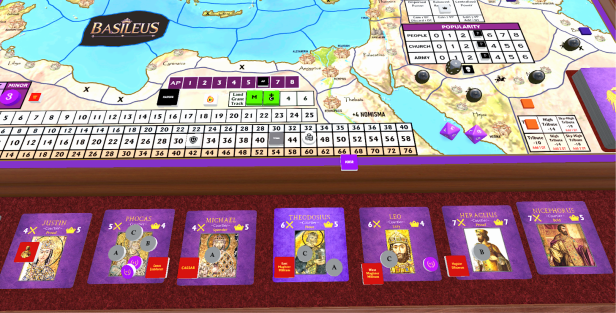
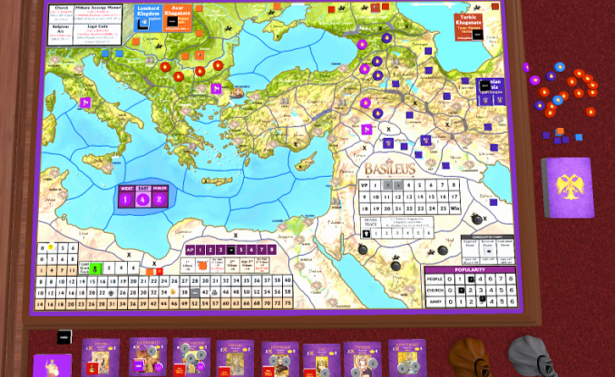
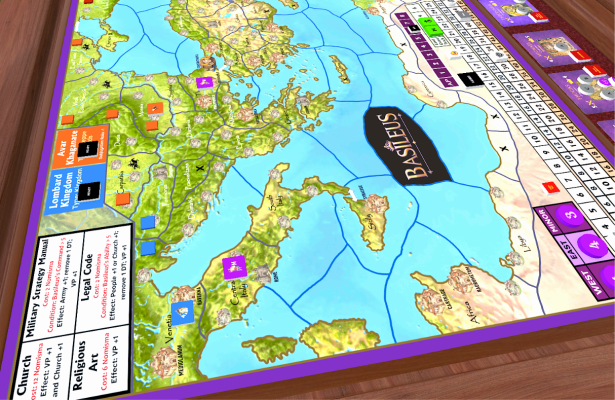
It is A.D. 568, and you live in the East Roman Empire (also known as the Byzantine Empire.) Three years ago, the great emperor Justinian died and was succeeded by his nephew. As the heirs of Caesar Augustus and Constantine the Great, the emperor—or “Basileus”—enjoys total control of the Byzantine state. Yet it is clear that Justinian’s repeated attempt to reconquer lost territory in the west has overextended the empire. He succeeded in re-taking North Africa, Sicily, and Italy—but at an enormous expense in both money and soldiers. Wealthy landowners and small farmers alike are burdened by taxes. The “powerful ones” or “magnates”—men who are educated, own land, and serve the government as high-ranking officials or generals—are unhappy. Justinian’s prestige made him untouchable while alive, but his successor enjoys no such immunity.

Basileus is a card-driven strategy game for three players that simulates politics, war and diplomacy in the East Roman Empire in the 500’s AD. Players take one of two roles: one player—the “Ruler”—controls the emperor (Basileus), while the other two players—the “Magnates”—control both the wealthy and powerful Roman courtiers and non-Roman nations. Players take two actions per turn. There are a certain number of actions available every turn, while strategy cards give extra event and action possibilities to the Magnates. Action cards are chosen simultaneously and resolved in a semi-random order, making gameplay quick and unpredictable. Victory points are awarded for winning battles, conquering territory, and completing literary or artistic achievements. But there’s a catch: the Basileus-Player automatically gains a certain number of victory points each turn. The Magnates must try to make life difficult for the Ruler by lowering the Basileus’s popularity, devastating the Roman economy, leading foreign nations to victory over Roman armies, and building up disloyal characters. If they get lucky, they can initiate a rebellion against the Basileus, depose him, switch roles with the Ruler to become the new Ruler. The Ruler player must try to ensure that the Basileus remains popular with the Romans and successfully defends against foreign threats. But in a world where any failure can be interpreted as divine punishment, the margin for error is razor-thin. Basileus is a tense game where success can be fleeting and danger lurks just around the corner.

Feel free to explore these games and sign up for testing at the following link: https://discord.gg/gSsQRWjPWp

We wish Doug well with these projects and hope that both of these games make it to market in the future as I always love a good game on Rome.

-Grant
  •  

Geek List: Gaming Opportunities at SDHistCon 2026 – November 6-9th

4 weeks from today, we will be attending the San Diego Historical Games Convention (SDHistCon 2026) held in sunny San Diego, California. This convention will include 3 days (for us) filled with gaming, designer interviews, looks at new prototypes, visiting with friends, publishers and designers, and having a great time. This will be our 3rd trip to SDHistCon and I am really excited about attending as we had such a great time the last 2 times we have attended! The San Diego Historical Games Convention is set to be held from November 6th through 9th at the S.E.S. Portuguese Hall of San Diego. The convention is about 2 blocks from the San Diego harbor, just a few miles from the San Diego airport, and is surrounded by delicious restaurants and fairly affordable hotels and other accommodations.

We have decided that we would at least like to play the following 4 multi-player wargames while there including Baltic Empires: The Northern Wars of 1558-1721 from GMT Games, The Weimar Republic: Political Struggle in Germany, 1919-1933 from GMT Games, The Other Side of the Hill from NAC Wargames and Thirty Years of Misery from VUCA Simulations. To facilitate the games, we have created a Geek List on Board Game Geek and I would encourage anyone who is attending to check it out and consider adding your name to the list. These lists are first-come-first-served and once full we will keep at least 1-2 alternates who are interested in case something happens that creates a vacancy. I will be looking at playing a few other games while there, including a few prototypes, but wanted to make sure that we got these big games scheduled at a minimum.

If you are interested in participating in one of our gaming opportunities or if you would like to add your own game entries on the list looking for players you can access the Geek List at the following link; https://boardgamegeek.com/geeklist/385692/gaming-opportunities-at-sdhistcon-2026-november-6

Please let me know if you have any questions and I look forward to seeing many of you at the con!

-Grant
  •  

UK Games Expo creators prep for giant show’s future without them by bringing in AireCon co-founder Mark Cooke

After 20 years growing the UK Games Expo into one of the largest tabletop gaming conventions in the world, founders Richard Denning and Tony Hyams are preparing for their eventual exit by bringing in AireCon co-founder Mark Cooke as operations director.

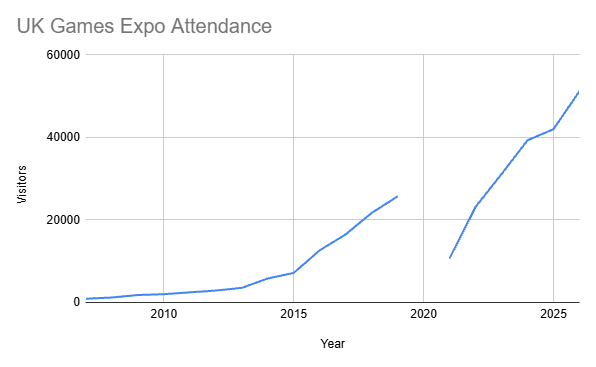
Cooke joins following another record year for UKGE, which has seen its annual unique attendance surge almost 65% since 2023 to reach more than 51,000.

The show has already well surpassed Gen Con in terms of trade hall size, with the British event now spanning about 44,000 sq m – about 40% larger than Gen Con’s trade hall area – and hosting around 900 exhibitors in 2026.

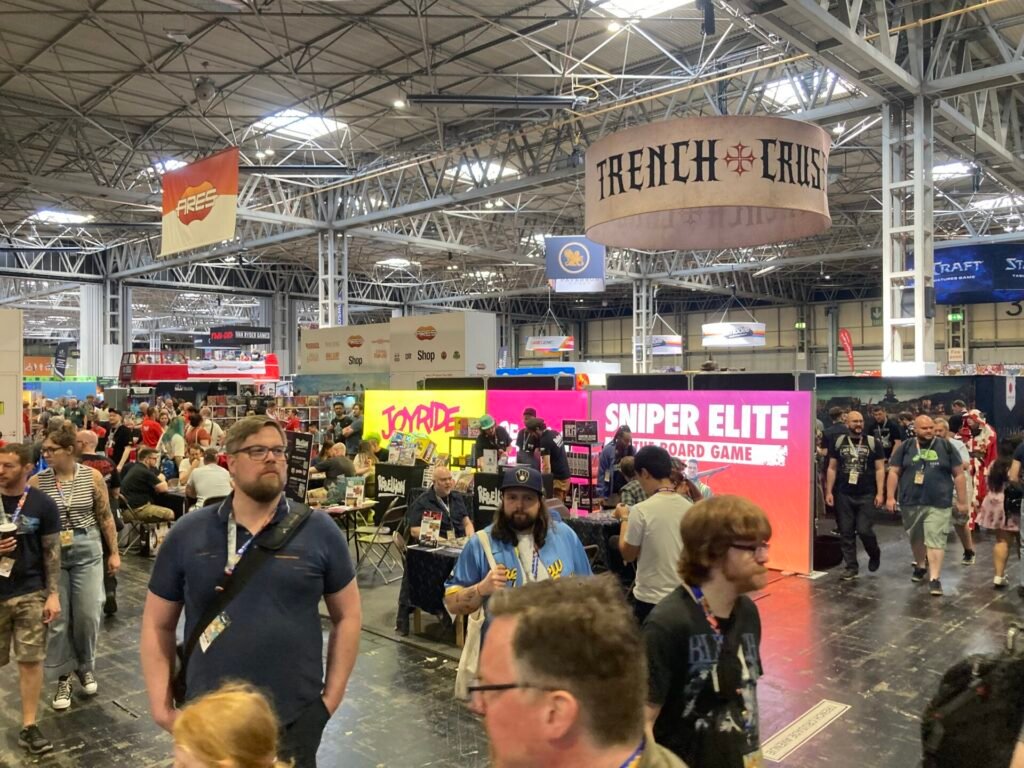
That soaring growth has put increasing pressure on the small organising team at UKGE, with Denning telling BoardGameWire last year that the show had strained a full-time workforce which stood at just six people – although UKGE also relies on more than 200 volunteers, GMs, umpires and other helpers to deliver the convention each year.

Cooke is no stranger to growing a UK board game convention, having co-founded and built AireCon with Ben Clarkson from a 28-person gaming weekend in his flat a decade ago into England’s second-largest board game con, with about 5,000 attendees this year.

His hire by UKGE comes just three weeks after AireCon revealed that despite its own soaring growth, its 2027 show in Harrogate would be its last – saying a combination of factors had “made it increasingly challenging to run AireCon in a way that preserves the character and spirit that made it so special in the first place”.

More than 5,500 people are expected at the final AireCon – which has been nicknamed Airemageddon – with Cooke set to continue working on that final show before moving to UKGE full time.

A statement from UKGE emphasised the hire was part of a phased transition for UKGE’s organisers, and was “not a sudden change of leadership or direction”.

UK Games Expo 2026

It said Cooke would work alongside Denning and Hyams “over the next few UK Games Expo events”, ensuring that knowledge, experience and responsibilities the pair have built up over the last 20 years are handed over “gradually and thoughtfully”.

Denning said, “As UKGE has expanded to now one of the world’s largest shows we have gradually grown our team, adding event managers, administrators and logistics support.

“Bringing in Mark as operations director is the next logical step as we put in place plans to ensure UKGE can run far into the future.

UK Games Expo co-founder and director Richard Denning

“We have known Mark through AireCon and other industry roles for many years now and he is an ideal choice bringing both event management experience, energy and fresh ideas to the team as well as a safe pair of hands as and when Tony and I eventually step away from the show we have built together with others.”

Cooke added, “I’m incredibly excited to be joining the UK Games Expo team and to have the opportunity to play a part in the next chapter of such an important event for the tabletop gaming community.

“I have huge respect for what Richard and Tony have built over the years, and I’m looking forward to working alongside them over the coming events.

“This will be a gradual transition, giving us plenty of time to share knowledge, ideas and experience. My aim is to build on the fantastic foundations already in place while helping UKGE continue to grow and thrive for many years to come.”

Denning and Hyams launched UK Games Expo at Birmingham’s Clarendon Suites in 2007, when the convention attracted about 1,000 visitors.

It moved to Birmingham’s National Exhibition Centre in 2013, and had grown to more than 25,000 unique attendees by 2019 before the Covid-19 pandemic interrupted its run of physical events.

Its growth has accelerated since returning, with unique attendance passing 31,000 in 2023, 39,000 in 2024 and 42,000 last year, before jumping beyond 51,000 at its 20th anniversary event this summer.

UK Games Expo attendance figures since launch. Note: no physical show took place in 2020 due to the Covid-19 pandemic

Denning told BoardGameWire last year that building a world-class trade hall in the UK had been a personal ambition stretching back almost two decades, adding at the time that UKGE was “now fully on the world stage of ‘mega-cons'”.

Despite this year’s record attendance, Denning told BoardGameWire after the show that there was still room for further expansion, particularly around the roughly 500 events taking place during the convention.

The next UK Games Expo is scheduled to take place at Birmingham NEC from June 4 to June 6, 2027.

The post UK Games Expo creators prep for giant show’s future without them by bringing in AireCon co-founder Mark Cooke first appeared on .

  •  

From 1968 Chicago protests to queer life in Georgian London: Summit Award continues to celebrate designs that broaden historical gaming

Games tackling subjects ranging from the 1968 Democratic National Convention protests to the 30-year holdout of Japanese WW2 soldier Hiroo Onoda have been named as finalists in this year’s Summit Award, which aims to recognise historical game designs which have attracted new players or introduced new subjects or perspectives to the hobby.

Battlefields of the Napoleonic Wars, Chicago ‘68, Molly House and Onoda will compete for the fifth edition of the award, which is run by the San Diego Historical Games Convention – an organisation which aims to create a diverse and supportive gaming community dedicated to playing, discussing, designing, and promoting historically-based board games.

Molly House’s nomination continues an extensive awards run for the Jo Kelly and Cole Wehrle design, which won the Complex Games category at this year’s American Tabletop Awards and was also shortlisted for the Diana Jones Award for Excellence in Gaming and best heavy strategy game at this year’s Origins Awards.

The game puts players in the roles of the gender-defying mollies of early 18th century London, attempting to build community and joy while facing persecution by the Society for the Reformation of Manners.

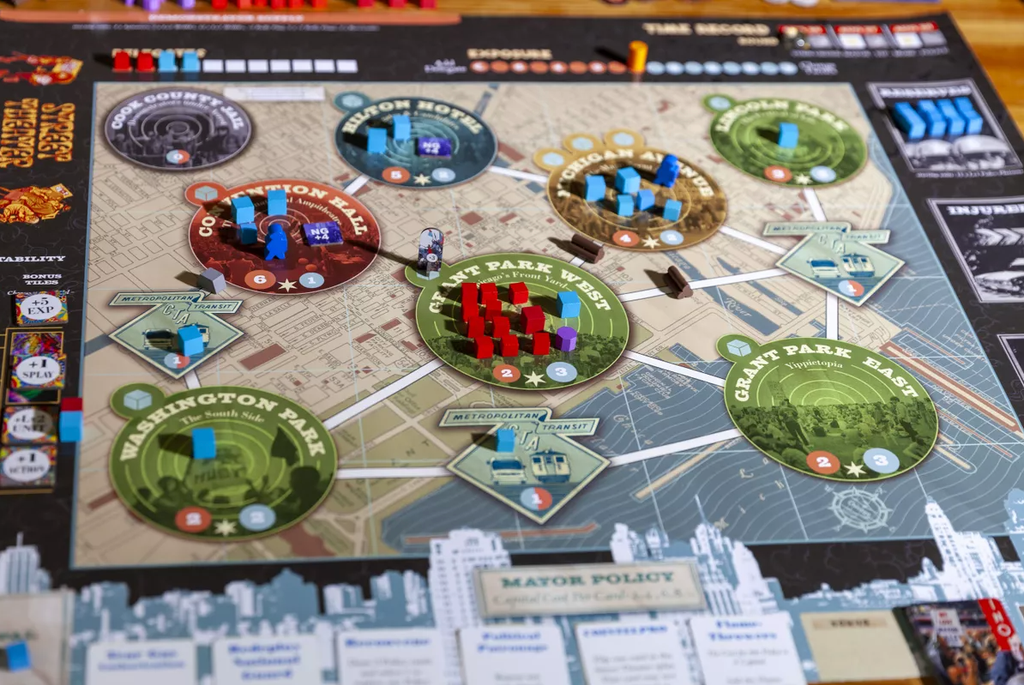
Chicago ‘68, designed by Yoni Goldstein and published by the Dietz Foundation, was the most-selected title during the Summit Award’s public nomination process this summer.

Chicago ’68, designed by Yoni Goldstein || Photo Credit: Yoni Goldstein

The game explores the protests and police response surrounding the 1968 Democratic National Convention, dividing players between Establishment and Demonstrator factions including the mayor’s office, Chicago Police Department, Yippies and National Mobilization Committee To End The War In Vietnam.

Battlefields of the Napoleonic Wars, designed by Paolo Mori and Alessandro Zucchini and published by Ingenioso Hidalgo, uses four different battlefield maps to recreate engagements from the Napoleonic Wars in sessions lasting between 60 and 120 minutes.

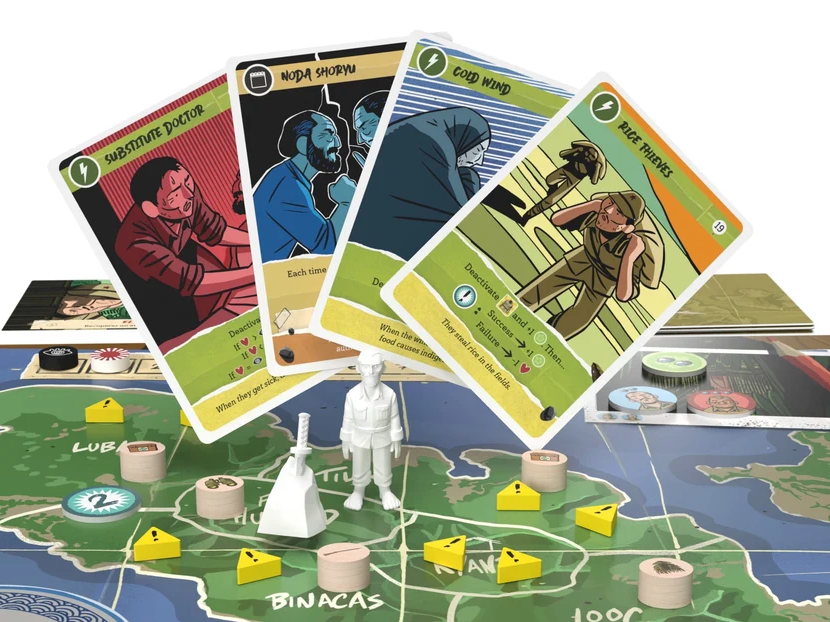
The fourth finalist is Francisco “Pako” Gradaille’s Onoda, a 25-minute solo game published by Salt & Pepper Games which explores the experiences of Japanese soldier Hiroo Onoda, who continued guerrilla warfare on the Philippine island of Lubang until 1974. Judges praised the unusual subject and the way the game asks players to engage with Onoda’s story and decisions.

SDHist also named two honourable mentions in this year’s awards: GMT Games’ The Bell of Treason: 1938 Munich Crisis in Czechoslovakia, designed by Petr Mojžíš, and Absurdist Productions’ Winter Rabbit, designed by William Thompson.

Onoda, designed by Francisco Gradaille || Photo Credit: Salt & Pepper Games

Winter Rabbit, which draws on traditional Cherokee animal stories and was created as a counterpoint to common colonial themes in games, was runner-up in the 2021 Zenobia Award and won the Light Strategy category at this year’s Origins Awards.

The Summit Award considers games across five criteria – ease of teaching, ease of play, uniqueness of topic, novelty of approach and effectiveness as a historical game.

Its previous winners were Fred Serval’s Red Flag Over Paris in 2022, Tory Brown’s Votes for Women in 2023, Alex Knight’s Land and Freedom in 2024 and Dave Neale and David Thompson’s War Story: Occupied France last year.

SDHist, which was launched mainly as a local wargaming group in 2015, is led by wargaming experts including Liberty or Death: The American Insurrection designer Harold Buchanan.

The organisation’s board and board of advisors selected three of this year’s finalists following the public nomination process, which put Chicago ‘68 on the shortlist.

The same groups will select the winner, which is set to be announced at the SDHist Summit convention in San Diego in November.

The post From 1968 Chicago protests to queer life in Georgian London: Summit Award continues to celebrate designs that broaden historical gaming first appeared on .

  •  

PAX doubles down on Unplugged growth with new Houston show – just 12 days after Origins

Gaming convention major PAX is doubling down on the success of its tabletop-focused Unplugged show by launching a second event in Houston, after growing the original into the second-largest tabletop gaming convention in the US after Gen Con.

PAX Unplugged Houston is set to take place at the George R Brown Convention Center from June 25 to 27 next year – marking the first expansion of the Unplugged brand since the dedicated tabletop convention debuted in Philadelphia in 2017.

Company event manager Sean Gonzalez told GamesBeat that PAX had considered several major cities while investigating the feasibility of a second Unplugged show, adding that Houston stood out based on infrastructure, demographics, data from other ReedPop events and demand from the industry.

“Most importantly though, Houston is where exhibitors wanted us to place the event,” he said.

PAX said in a separate announcement that Unplugged Houston will feature an expo floor for tabletop exhibitors alongside panels, tournaments and community events, although it is yet to reveal exhibitors, floor space, expected attendance or badge prices.

The show marks a return to Texas for the business, which previously ran PAX South in San Antonio from 2015 to 2020.

That convention featured both video games and tabletop gaming, but was discontinued after organisers said it had failed to expand during its four years, with the impact of Covid-19 ultimately delivering the final blow.

Gonzalez told GamesBeat Houston offered an opportunity to bring PAX back to the community which had attended PAX South, while giving the new event a more specific tabletop focus.

He added, “While we know that the current state of the economy impacts everyone, we are extremely confident based on the tremendous success we continue to see with the PAX events, particularly our Philadelphia PAX Unplugged, that the market will support PAX Unplugged Houston.”

PAX was launched by Penny Arcade web comic creators Jerry Holkins and Mike Krahulik in 2004 as the Penny Arcade Expo, after the pair decided they wanted a show exclusively to celebrate video gaming and game culture.

Attendees at PAX Unplugged in 2024 || Photo Credit: PAX/ReedPop

About 3,300 people attended the inaugural show, but that attendance had already soared to 58,500 by the 2008 event, leading to organiser to team up with New York Comic Con organiser ReedPop in 2009, and to launch a second con, PAX East, in 2010.

The company expanded again with PAX Australia in 2013 and the short-lived PAX South two years later, before launching the inaugural PAX Unplugged in 2017 after seeing the tabletop sections of its existing PAX conventions continue to expand.

PAX does not disclose precise attendance figures for PAX Unplugged, but says the Philadelphia event draws “tens of thousands” of visitors each year – believed to be north of the 30,000 mark. Its record 2024 show sold out all three days for the first time, filling all 528,000 sq ft of exhibition hall space with more than 350 exhibitors.

That growth puts it some way off the giant attendances of veteran North American tabletop convention Gen Con, which continued its record-breaking run this year to draw in more than 74,000 attendees.

But Pax Unplugged’s success has seen it displace long-running peer Origins as the second-largest tabletop gaming convention in the US – and its decision to launch a second event just 12 days after Origins 2027 is due to take place puts further pressure on the latter event.

Origins has been rebuilding its attendance since the pandemic, but unlike other major tabletop conventions such as Gen Con, Spiel Essen and the UK Games Expo has yet to regain its pre-Covid record of about 20,600.

The show’s attendance fell 2.5% this year to 18,700 – its first annual decline since the pandemic, although the fall came as other measures of activity at Origins remained stable or continued to grow. Exhibitor numbers increased marginally from 410 in 2025 to 413 this year, while the number of scheduled events climbed about 10% from 7,810 to more than 8,600.

PAX has not overtly positioned Houston as a competitor to Origins, but publishers weighing whether to exhibit at both now face the prospect of getting their teams and products to two major US tabletop shows within less than two weeks, alongside the associated staffing, travel, freight and booth costs.

That segment of the year also features the UK Games Expo, which has continued its meteoric growth into one of the world’s largest tabletop gaming conventions after more than 51,000 people descended on Birmingham’s NEC for the show’s 20th anniversary this year.

Badges for PAX Unplugged Houston are due to go on sale later this year, with applications for media and content creators also opening before the end of 2026.

The original PAX Unplugged returns to Philadelphia for its tenth show between December 4 and 6 this year.

The post PAX doubles down on Unplugged growth with new Houston show – just 12 days after Origins first appeared on .

  •  
❌