Normale Ansicht

My Favorite Wargame Cards – A Look at Individual Cards from My Favorite Games – Card #71: The Wartburg from Here I Stand: Wars of the Reformation, 1517-1555 from GMT Games

Von: Grant
31. März 2026 um 14:00

With this My Favorite Wargame Cards Series, I hope to take a look at a specific card from the various wargames that I have played and share how it is used in the game. I am not a strategist and frankly I am not that good at games but I do understand how things should work and be used in games. With that being said, here is the next entry in this series.

#71: The Wartburg from Here I Stand: Wars of the Reformation, 1517-1555 from GMT Games

Here I Stand: Wars of the Reformation 1517-1555 is an experience packaged in a game that attempts to boldly cover the political and religious conflicts of early 16th Century Europe. The game focuses on the struggle of religious reformers such as Martin Luther, John Calvin and Ulrich Zwingli as they battle the Papacy for changes in their views of God and religion. But it is more than just the Holy War as it deals with the other European countries involved in the affairs of the time including France, England, the mighty Hapsburg Empire and the Ottoman Empire in the east. They all played a role in the process of the Reformation and the design brilliantly weaves this all together into an interesting and engaging experience. The game also covers other plot lines and events of the period, including wars, marriages and ascendancies to thrones, using a unique Card Driven Game (CDG) system that models both the political and religious conflicts of the period.

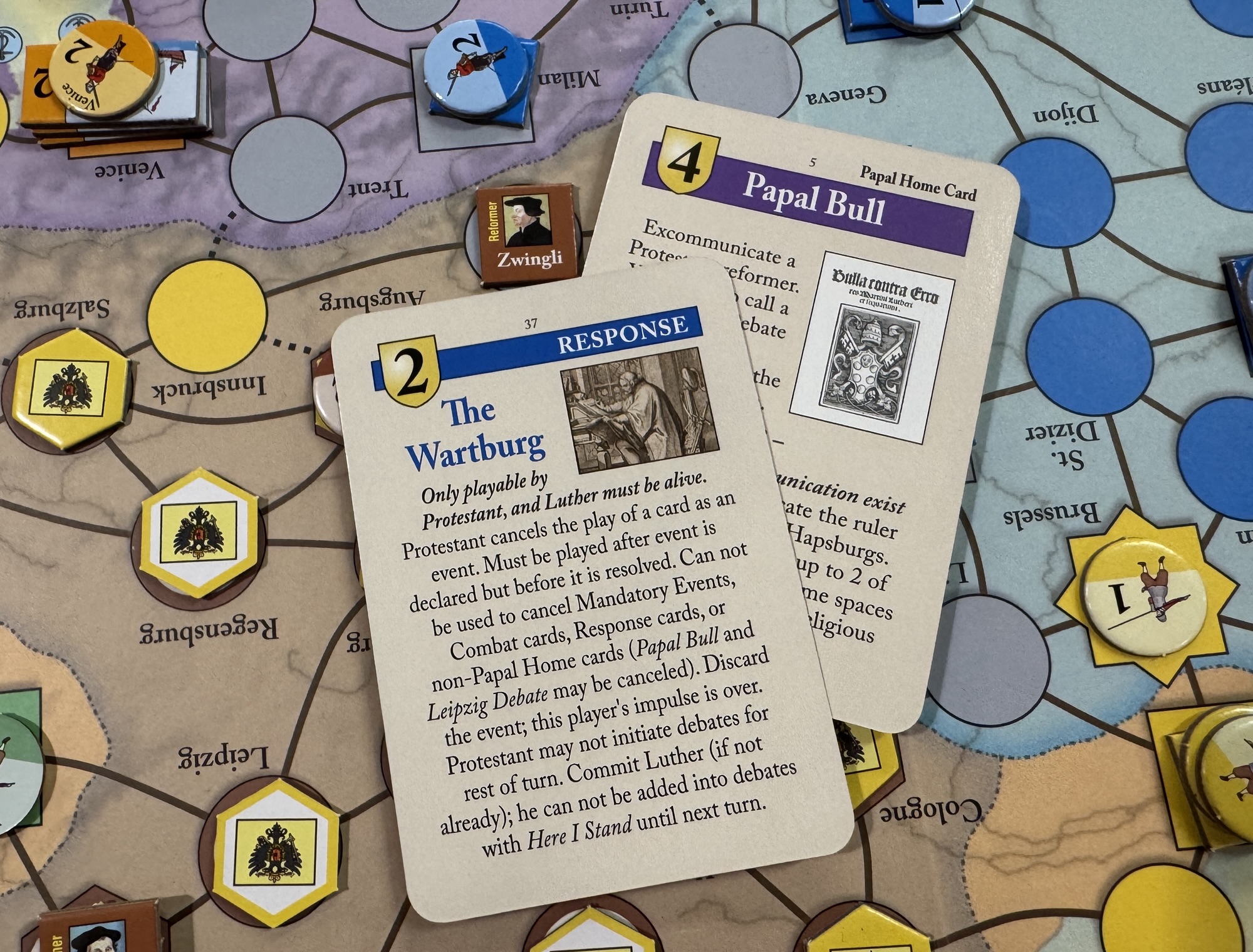
Today, I want to take a look at a very interesting Response card in The Wartburg. Response cards in Here I Stand are event cards that can be played out of turn to interrupt the actions of an opponent or provide immediate reactions to specific game events. Response cards are often used to negate, mitigate, or enhance events and combats, and they may be played during an opponent’s impulse, provided the text allows for this asynchronous timing. These cards also tend to have specific pre-requisites that must be met in order to play the card and The Wartburg states that the card is “only playable by Protestants, and Luther must be alive”. The card itself allows the Protestant player to cancel the play of a card as an event but cannot cancel a Mandatory Event. The card however can cancel the play of the Papal Bull or Leipzig Debate Papal Home Cards, which is probably the way that the card will mostly be used. The card will not only cancel the play of the event but will also end the impulse of the player playing the card. This can be very powerful and when played at the right time can be a game saver for the Protestant player.

For example, in our most recent play at Buckeye Game Fest, I was playing as the Protestants and Bill Simoni as the Papacy. After the forming of the Schmalkaldic League and the Protestants changing into a military power, the focus of the other players turned toward me as I was doing well and near victory. They all then decided to declare war on the Protestants and began to advance upon and attack my fortified Electorates to take away VP I had earned by having both religious and political control in 5 of the 6 as the League was formed. As we came into turn 5, I was at 24 VP and ultimately came up shy of a victory by 1 point at the time. I had been able to take over the entirety of England and change every space and also get about 5-6 spaces in France, but now the Papal Bull came to play and Bill fought me back and forth with him taking over 3-4 spaces followed by me reclaiming 3-4 spaces. It was a beautiful game of back and forth and I used every tool at my disposal to fight him including The Wartburg card to stop the untimely excommunication of Zwingli before he could attempt to embarrass him in a debate. That card play at that very time saved me or most likely he would have used Eck who is his best debater against Zwingli who is just average and I would have lost leading to him being burnt at the stake giving him VP or by allowing him to turn over a few of my hard fought converted spaces back to Catholicism.

The only problem with this card is that it commits Luther so he will be unavailable to be chosen directly to debate during the rest of the turn. But this was a small price to pay at that time and ultimately led to me being able to hold on through the end of Turn 6 where I won a Protestant victory on the tie breaker with England.

Martin Luther stayed at Wartburg Castle from May 1521 to March 1522 under the alias “Junker Jörg” (Knight George) to hide from papal and imperial authorities. During these 300 days of protective custody, he translated the New Testament into German in just 11 weeks, wrote numerous theological works, and grappled with spiritual turmoil. His greatest accomplishment at Wartburg Castle was his translating of the New Testament from Koine Greek into German, which laid the foundation for a unified German language and made the Bible accessible to ordinary people. He also wrote numerous works, including Against Latomus and several tracts. He began his attack on monastic vows during this time, arguing they were contrary to faith. Luther used his time in exile for intense study and writing, referring to his stay as his “Patmos”, referring to the Apostle John’s exile to the Island of Patmos in 95AD. While here though he also experienced significant psychological distress and temptation. According to legend, he threw his inkwell at the devil during a confrontation, leaving a stain on the wall. His exile was organized by Frederick the Wise after the Diet of Worms and the stay was designed to keep Luther safe from those looking for him, ensuring the survival of his reform movement.

In the next entry in this series, we will take a look at Commodus from The Wars of Marcus Aurelius: Rome 170-180CE from Hollandspiele.

-Grant

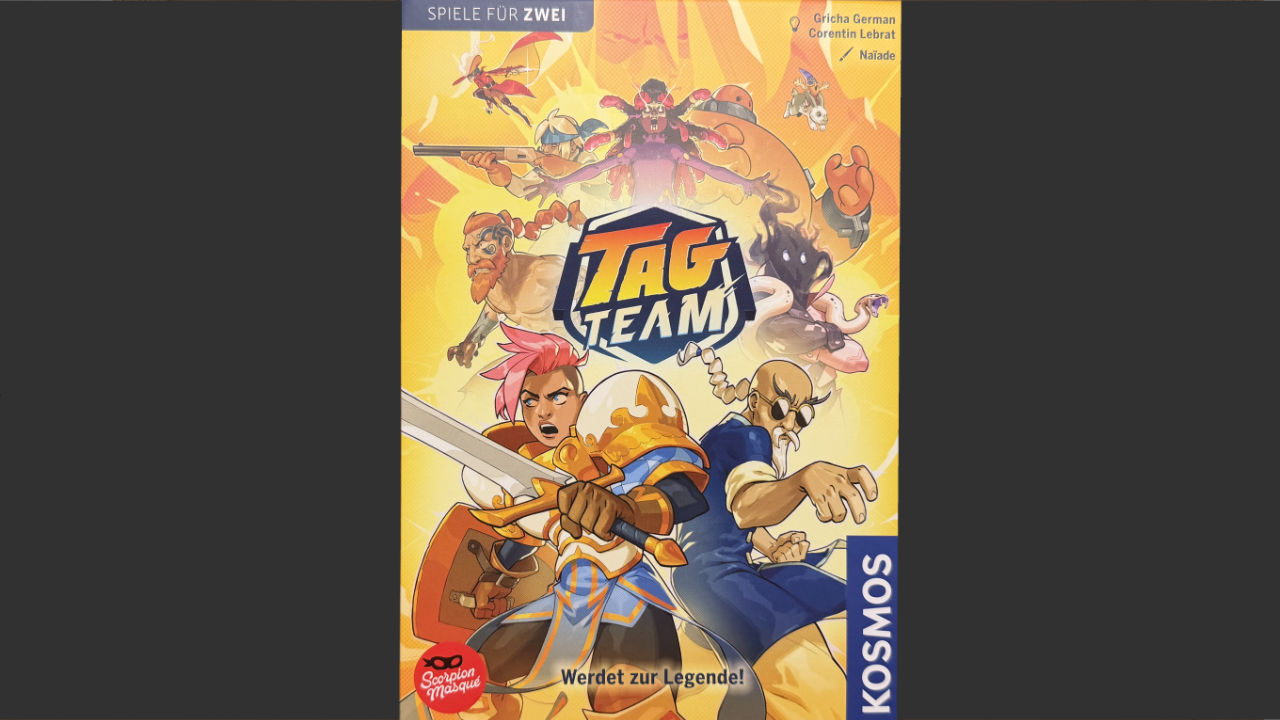
Tag Team

06. März 2026 um 02:33

Als Tag-Team bezeichnet man eine Kombination von mindestens zwei Wrestlern. Diese wechseln sich jeweils während des Matches durch Abschlagen (engl. tag) ein. Bei der ursprünglichen Version des Tag-Team-Matches, nehmen jeweils…

The post Tag Team appeared first on Reich der Spiele.

Tag Team

Von: ferengi
19. Februar 2026 um 17:21

Spielst Du auch gern Autobattler?

Noch vor einigen Jahren hätte ich auf die Frage im Betreff nur dumm geguckt. Seitdem ich aber Challengers! kenne, ist auch dieser Begriff in meinem Sprachgebrauch eingegangen.

In einem Autobattler haben wir und unser Gegner einen Kartenstapel, die wir gegeneinander spielen. Und zwar in der Reihenfolge, wie sie im Stapel liegen. Also automatisch, wir ändern nie die Reihenfolge der Karten. Challengers! macht dieses als Turnierspiel für bis zu 8 Personen. Im Gegensatz hierzu ist Tag Team ein 2-Personen-Spiel. Jeder Spieler hat zwei Kämpfer mit unterschiedlichen Kartendecks und auch sehr unterschiedlicher Spielweise/Sonderaktionen im Team. Wenn jeder Spieler seine zwei Kämpfer gezogen/gedraftet oder anders erhalten hat, guckt man sich erst einmal die Besonderheiten seiner Kämpfer an.

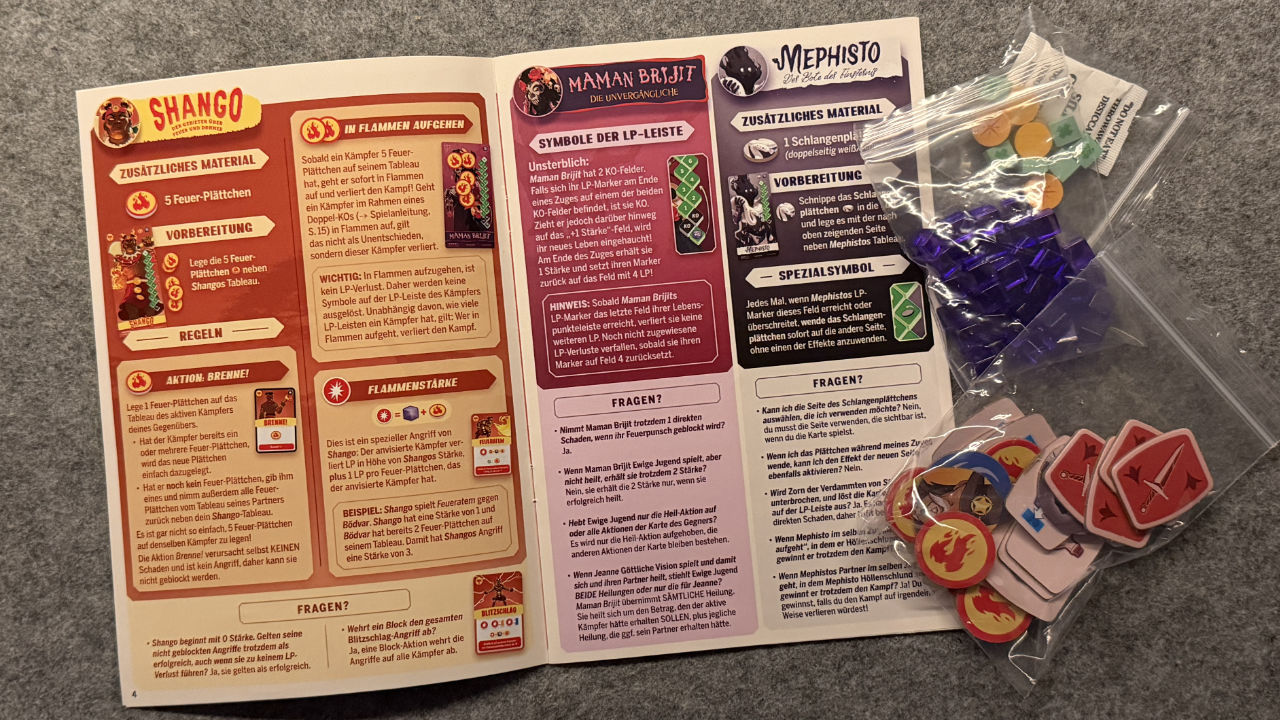
Das Buch mit den Regeln der Kämpfer und die Spielsteine hierzu.

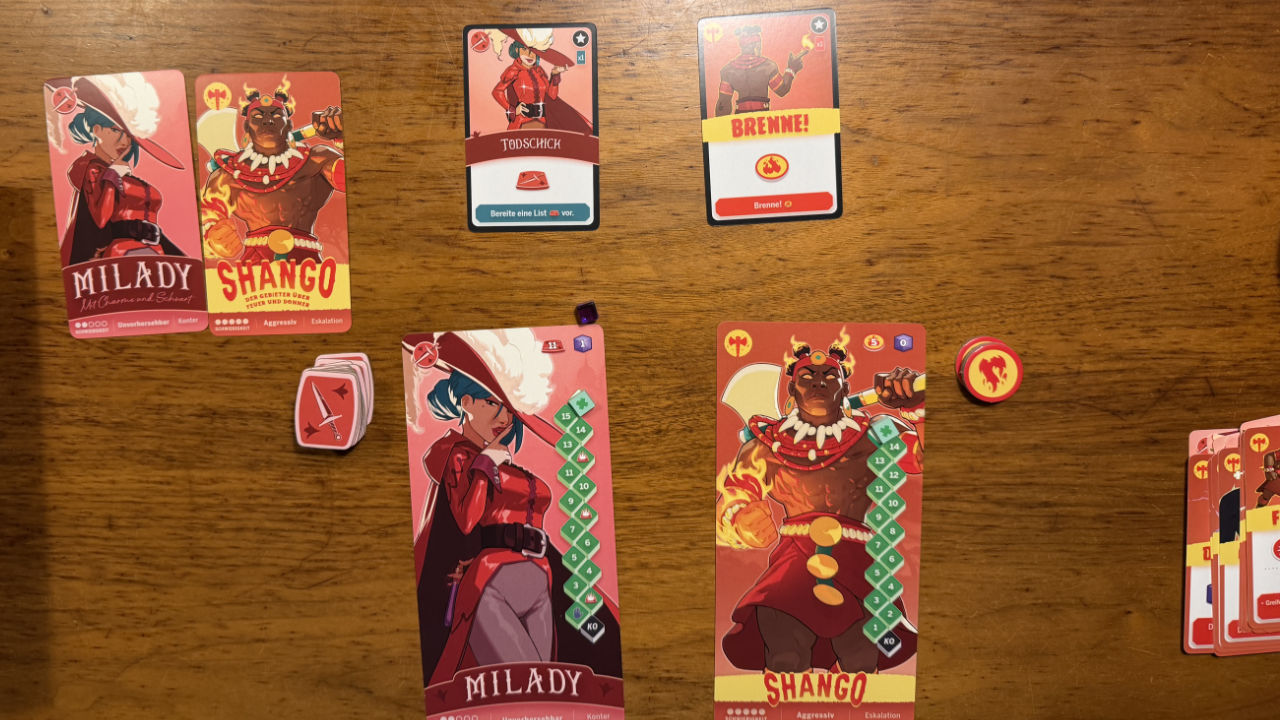
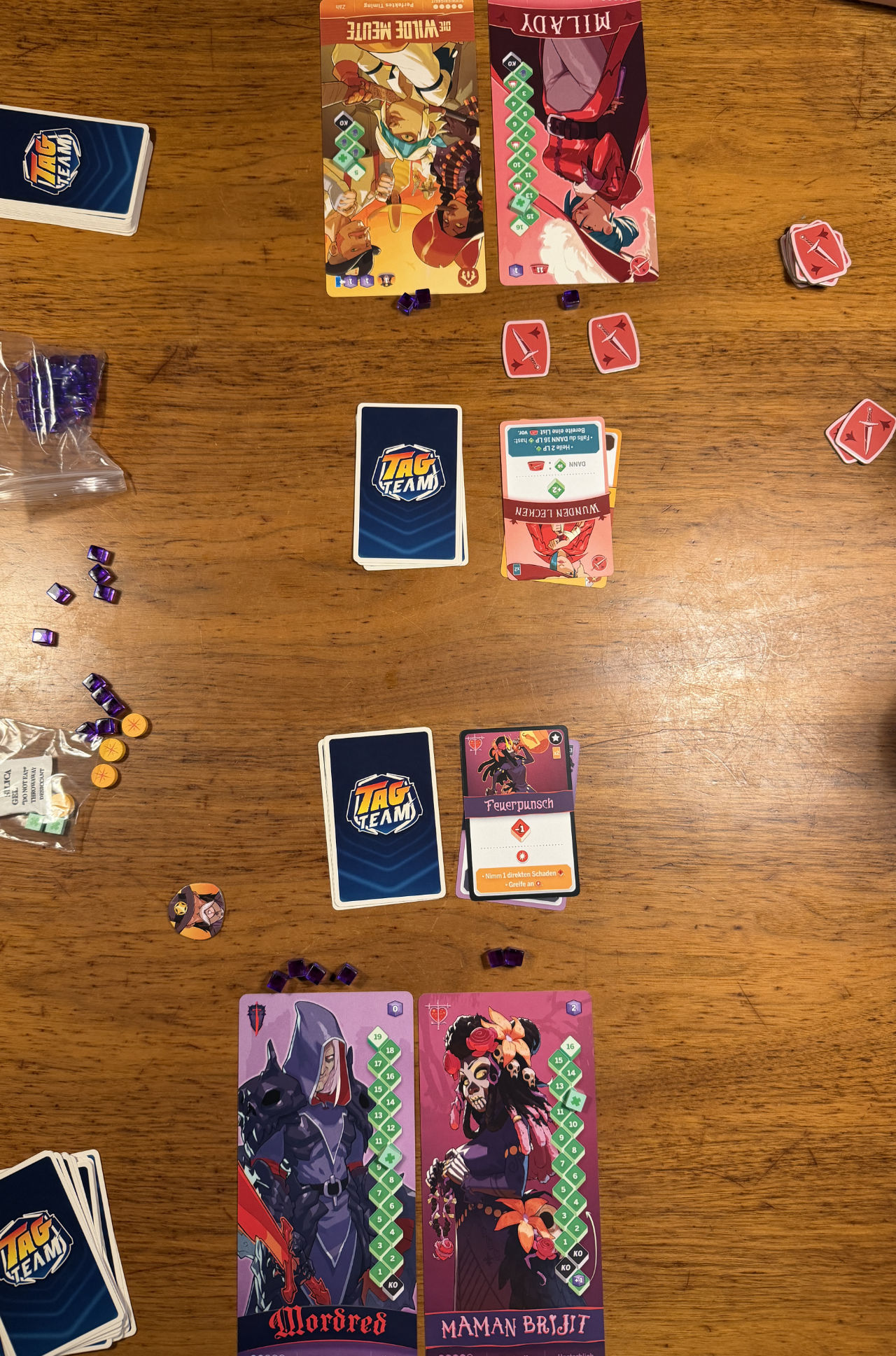
Für jeden Kämpfer hat man eine Startkarte, wir beginne also mit zwei Karten. Jetzt legen wir die Reihenfolge fest, in der wir diese ausspielen möchten. Und dann decken die Spieler die oberste Karte auf. Dieses sind in der Regel ein Angriff, eine Verteidigung, eine Verstärkung oder Heilung oder eine Sonderfunktion des Charakters. Nachdem die ersten beiden Kartenpaare gespielt wurden und somit unser Stapel leer ist, zieht man drei neue Karten und wählt eine davon aus, die wir an eine beliebige Stelle in unserem Deck einschieben. So kann ich an Position X im Stapel eine neue Verteidigungskarte einbauen, da bisher immer an der Stelle X ein starker Angriff kam. Aber rechnet mein Gegner damit und schiebt seine neue Karte vor dem Angriff ein, so dass dieser dann eine Karte später kommt? Mit nun drei Karten im Stapel kann man hier noch gut planen. Komplexer wird es dann in den Runden danach, wenn immer eine Karte hinzu kommt.

Shango ist schwierig zu spielen. Er muss fünfmal den gleichen Gegner ein Feuerplättchen hinlegen, dann ist dieser aber verbrannt und man hat gewonnen.
Das Material sieht schon schick aus.

Fazit:

Das ist schon ein wenig ein Memoryspiel mit Taktikkomponente. Aber lange dauert eine Runde nicht, man muss sich also keine Kartenreihenfolge mit 10 Karten merken. Die unterschiedlichen Kämpfer bringen viel Abwechslung. Perfekt ist es, wenn beide aufeinander abgestimmt sind. Hat man einen Angreifer, der seine Stärke erst langsam aufbaut, dann aber später kaum zu verteidigen ist, sollte man als Kämpfer 2 einen starken Verteidiger mit vielen Heilungssprüchen haben. Ja, man kann auch glücklich zwei starke Kämpfer haben und der Gegner ist platt, bevor er sich entwickeln kann. Aber ein Spiel ist kurz und es geht in den nächsten Fight. Die Karten und Fähigkeiten sind schon sehr unterschiedlich, ich freue mich auf die Erweiterungen. Ein Spiel mit viel Potential und sicher ein Kandidat zum Spiel des Jahres 2026.

Stubenscore: 8,0 / 10


TAG TEAM
BoardGameGeek

Spieledatenbank Luding

Brettspiel (getestet)

My Favorite Wargame Cards – A Look at Individual Cards from My Favorite Games – Card #66: Harwood’s Intuition from The Hunt from Salt & Pepper Games

Von: Grant
19. Februar 2026 um 14:00

With this My Favorite Wargame Cards Series, I hope to take a look at a specific card from the various wargames that I have played and share how it is used in the game. I am not a strategist and frankly I am not that good at games but I do understand how things should work and be used in games. With that being said, here is the next entry in this series.

Card #66: Harwood’s Intuition from The Hunt from Salt & Pepper Games

I have played several hidden movement games over the years and enjoyed them all. Some of these titles have included wargames such as They Come Unseen from Osprey GamesSniper Elite: The Board Game from Rebellion Unplugged and Bomber Command from GMT Games as well as a few board games including Hunt for the Ring from Ares Games. The concept of moving cautiously, attempting to evade pursuers, all while trying to locate and acquire or destroy objectives makes for a very interesting gaming experience. These situations can make for some really tense games that cause your head to ache and your wits to be tested. But they rely on some bluffing as well. Trying to force your opponent to anticipate where they think you should be and then trying not to be there. A really great mechanic in board games but not always easy to pull off and make for a very playable and interesting game. In 2022, we played a new design from Matthias Cramer and Engin Kunter that took this hidden movement concept and put it into a historically based game about the struggle over control of the South Atlantic between the British Royal Navy and the German Kriegsmarine during the early years of World War II called The Hunt from Salt & Pepper Games.

The Hunt is a Card Driven Game where the German player has to attempt to stay hidden while trying to sink merchant shipping as the Royal Navy hunts for them throughout the South Atlantic. The players each have asymmetric actions to use to accomplish their missions and each has a tough time doing what they have to do. But, if they manage their cards wisely, using them as effectively as possible, they can successfully either evade their pursuer or catch their prey.

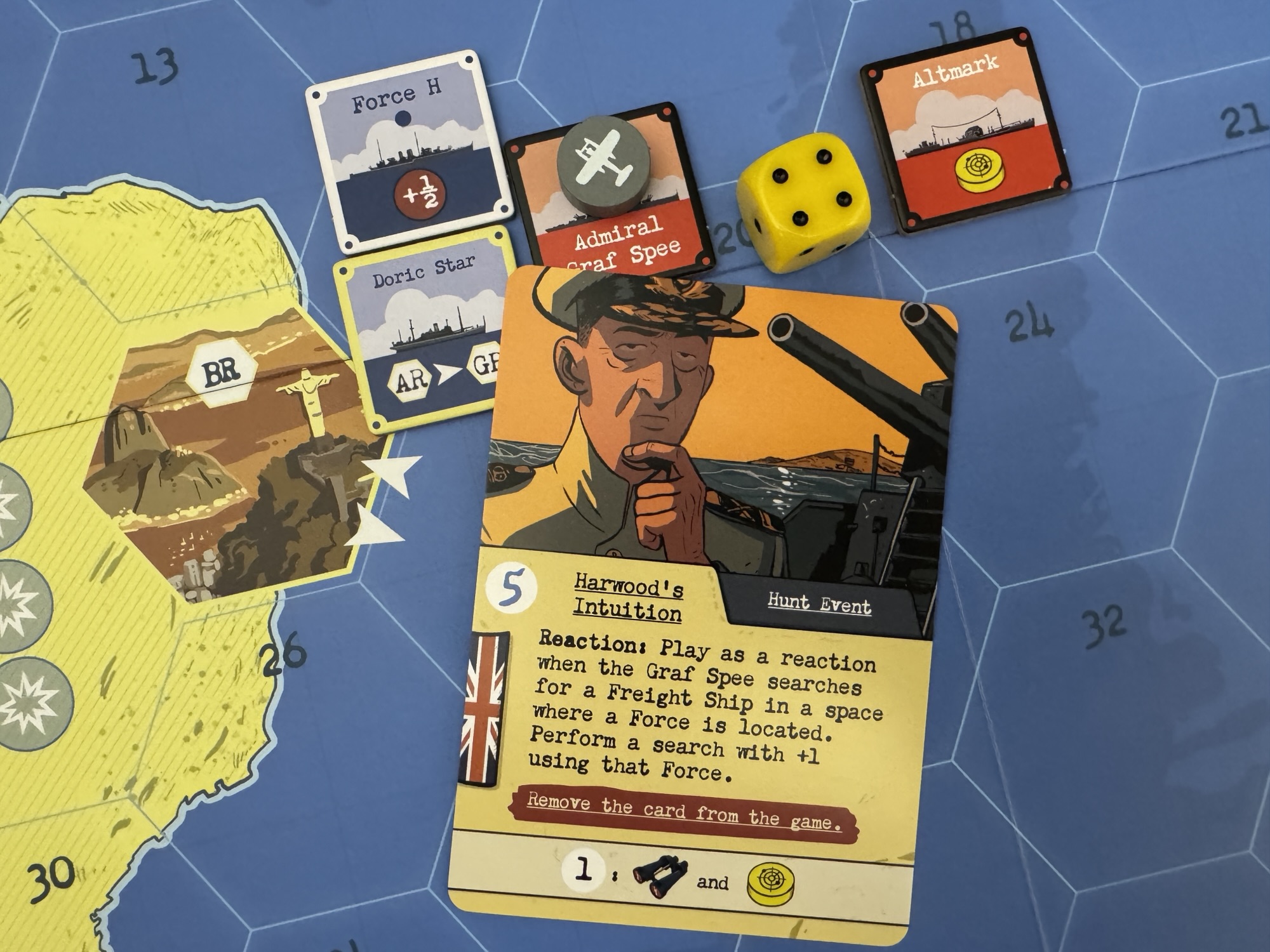
In today’s post, we will take a look at the very useful British card Harwood’s Intuition. Harwood’s Intuition is a 5 Ops card, which makes it a very important card in the British deck as it allows for the taking of 2-3 actions in a single turn, but for which there is an even more important use as an ambush by playing it as a Reaction to a German action. If the German player ever searches for a Freight Ship in a space where there is a British Task Force, and Harwood’s Intuition is played as a reaction, the British will get a free Search action with a +1 DRM to the roll. Normally, a Search requires a 5+ on a d6 to be successful, but with this bonus +1 that will mean success on a 4+ which is a 50/50 proposition. And remember, the point of the game for the British is to find and sink the Graf Spee at the Battle of the River Plate. Such as tasty surprise card for the British! I know that when I play as the Germans, I have to always keep in the back of my mind that this card exists and that if there is a Force present, I have a risk of being ambushed. This is one of the elements that makes this game so good.

The Battle of the River Plate was fought in the South Atlantic on December 13, 1939 and was officially the first British naval battle of World War II. In the months leading up to this infamous date, due to several successful sinkings of merchant shipping by the Graf Spee, the Royal Navy was ordered by Admiral Sir Henry Harwood Harwood to keep observation between Medanos and Cape San Antonio located off the coast of Argentina south of the River Plate estuary. In the lead up to the climactic final battle, following various raider-warning radio messages from the merchantman Doric Star, which was sunk by Admiral Graf Spee off South Africa, Harwood suspected that the raider would try to strike next at the merchant shipping off the River Plate estuary between Uruguay and Argentina. He ordered his squadron to steam toward the position 32° south, 47° west. Harwood chose that position, according to his dispatch, because it was the most congested part of the shipping routes in the South Atlantic and therefore the point at which a raider could do the most damage to enemy shipping. A Norwegian freighter saw Admiral Graf Spee practicing the use of her searchlights and radioed that her course was toward South America; the three available cruisers of Force G rendezvoused off the estuary on December 12th and conducted maneuvers.

Though generally considered a river, the River Plate has been considered by some geographers as a large bay or a marginal sea of the South Atlantic. Principally this is due to the River Plates enormous width, if we are considering it a river the widest in the world, with a maximum width of about 140 miles. Acting as the marine border between Argentina and Uruguay, the River Plate was a main artery of maritime trade and a gateway into the interior of the South American continent.

It was here that Harwood predicted the German raider would strike and his assumption made sense. The River Plate’s Estuary acted as a natural bottleneck for ships with perilous tides and sandbanks additionally hampering any ability for a British Merchant vessel to escape the guns of a German raider. So it was near the Estuary of the River Plate that Harwood’s H.M.S Exeter, Ajax and Achilles would make their stand. With their force concentrated here, on December 12th preparations were made and tactics drawn up in anticipation for an arriving adversary and to spring the trap and catch the elusive Admiral Graf Spee off-guard and send her to the bottom.

Here also is a link to our full video review of the game:

We also published an interview on the blog with the designers Matthias Cramer and Engin Kunter and you can read that at the following link: https://theplayersaid.com/2023/03/13/interview-with-matthias-cramer-and-engin-kunter-designers-of-the-hunt-from-salt-pepper-games-coming-to-gamefound-march-15th/

In the next entry in this series, we will take a look at Frederick Douglas from Votes for Women from Fort Circle Games.

-Grant

❌