Anmelden
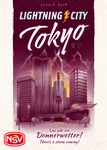


Designer Diary: Lightning City - A shocking Roll and Write
14. November 2026 um 16:00
by Jannik Auth

The story of Lightning City: Tokyo begins in 2021 at my girlfriend Jenni’s old family house. Creativity often comes from boredom, which is one of many good reasons to put away your smartphone from time to time and just be bored for a second. I don’t quite remember what they were doing, but Jenni and her family left for an hour or two, leaving me alone with nothing exciting to do. My love for board games was at a very different stage at that point. I wasn’t yet a maniac playing new games every single week. My family and I were perfectly content playing the same game for a year or more. Dominion by Donald X. Vaccarino, for example, was an endless treasure chest for us. Another game my family and Jenni enjoyed a whole lot at that time was the amazing Cartographersby Jordy Adan. I was fascinated by its modular setup and how much replayability it offered. But there weren’t any expansions for the game yet, so I was sitting there alone in Jenni's room thinking, “Man, some more different cards would be nice!”
Infinitely far from any intention of pitching a game to a publisher, I had played around with two or three very poorly made prototypes before. So it came naturally to me to try creating something similar myself. Instead of building something from a bird’s-eye view, in this game let’s construct something from the bottom up – some houses, I guess. I grabbed some dice and decided their colors would determine which kind of room to draw. Because building one room at a time seemed too slow, I settled on building two rooms at once by choosing two dice. I then wrote down the first four scoring criteria that came to me and could already start playing. From the first roll of the dice, the game was fun. After a few turns, I asked myself, “So, when will it end?” In hindsight, it was pretty amazing that I came up with the whole brewing-storm idea immediately: the storm threatens your buildings, and you need to protect them by adding roofs. This also gave me a timer. Once a certain number of lightning strikes have occurred, the game ends.
By the time Jenni returned, I already had a working game we could try together. By now it has become a staple of my life that Jenni is always the first person to try my prototypes. But at the time, that wasn’t really a thing yet, so she was surprised by how fun this random thing I had come up with was. Over the following weeks and months, I had a lot of fun thinking up different scoring cards and simply playing “Tokyo Districts” like a regular game from my small shelf of around 20 games, improving it little by little.
One amazing thing about creating board games is the people your game meets along the way. Every person who plays it influences the game just a little bit. With Lightning City: Tokyo, this is especially meaningful to me because it’s the only prototype my late father played with us. I vividly remember him being overwhelmed by the fifth scoring category I had added by then, which provided a way to score roofs. After that test, I dropped it and replaced it with a simple rule: “Each building with a roof scores one point per room.” That made the game much more streamlined.
We kept playing “Tokyo Districts” for quite some time, but eventually new games came along, relegating it to the shelf, where it quietly slept for around two or three years. I never really gave any thought to pitching the game to publishers. As time went on, I got much deeper into the board gaming hobby. I randomly stumbled upon a local gaming spot, Spielebrücke, where about 20 people meet every Wednesday to play all kinds of board games. So instead of one or two new games per year, I was now playing three new games per week and living my best board gaming life. My collection grew, and at some point I played Agricola by Uwe Rosenberg, which is still my favorite game to this day. After playing it an absurd number of times, I again felt the urge to create something more or less similar myself.
Much to my surprise, the prototype that came out of that urge was signed by Joachim and Lisa from Steinbock Brettspiele in late 2024. I had randomly connected with the local publisher through the Spielebrücke's WhatsApp group, and what started as a chance encounter eventually became my first signed game, now titled “Era of Pioneers”. All of a sudden, there was this open door: “Wait a minute, releasing a game is actually not quite as impossible as pulling Excalibur out of the stone!” With that realization, I looked up how to pitch prototypes to publishers, and it was clear as day that I had to be at the Spieleautorentreffen in Göttingen in 2025 (editor's note - German game designers convention).
So I finally grabbed “Tokyo Districts” from my shelf again, along with a card game prototype called “Balgerei”. With a rush of motivation, I managed to improve both games by quite a lot. For “Tokyo Districts”, I added foundations to the game sheet, allowing some places to start higher. I also added a rule that if lightning destroys one of your buildings, you may move one of your rooms, reducing frustrating moments. And I simplified the scoring cards.
Then Göttingen 2025 came around, and it was such a great experience: so many fellow designers and editors in the same big room, overflowing with passion for board games. Because no one knew me and I hadn’t made any contacts with publishers online, I expected limited success. But to my surprise, right after the kickoff, two very friendly editors sat down to play “Balgerei” with me and afterwards actually took a copy of the prototype with them.
That great start eased my mind a lot. Because of it, I had no problem sitting through many hours with much less success until, quite late in the event, Jakob from NSV sat down at my table. Apart from the two editors who had tried “Balgerei”, Jakob was the only editor who not only listened to my pitch but also played a full game. I’m very grateful that he took the time because, with the knowledge I have now, the prototype should have looked almost impossible for NSV - or any other German publisher - to publish in terms of components. It wasn’t language-independent, the player boards were too big, and it had far too many dice. Luckily, Jakob wasn’t afraid of the extra work it would cause him, and he took the prototype with him anyway.
In the aftermath of Göttingen, the editor who had taken “Balgerei” expressed interest in the game very early, which made me feel like I might have a good chance with it. But surprisingly, after a few months of waiting, things turned out very differently. While “Balgerei” got close but ultimately wasn’t signed, an email from NSV reached me with a long list of very substantial feedback.
It was amazing to read such a detailed analysis of one of my prototypes. While I was used to working with the valuable feedback of friends, this was very different - and quite impressive. Some suggestions were things I had already tried and knew wouldn’t move the game in the right direction. But others were simply correct and improved the game immediately. The overall message was that the game was already fun, but it still needed a lot of adjustments to become a real candidate for publication.
At the time, I was simply very happy that my prototype had been thoroughly tested by the publisher and taken so seriously. The following weeks of email conversations were a whole lot of fun. From the start, I always felt this belief that we could arrive at a very good result, because the team at NSV was always making good points without forcing anything on me regarding the game’s mechanics. Basically, they pointed out problems and offered possible ideas for solving them, but ultimately let me come up with solutions I was happy with myself.
After we had already made some good improvements, I remember facing something that felt like the final boss. I was using 12 dice in my prototype, which was far too many for the format. The number had to come down significantly. For a week or two, I racked my brains over how to reduce it. I came up with a six-dice solution that played just a little worse than the original prototype, but I thought it was still good enough.
But as I’ve learned by now, it’s exactly in those moments when you think, “It’s fine, whatever,” that the editor comes in and says, “No, it’s not. Do better.” So I racked my brain for another week and finally I got it. By using a die with differently colored sides, I managed to halve the number of dice and make the game even more fun in the process. With that update, I remember Jakob writing that he liked it too and would take that version to show the others at NSV. I was pretty sure that meant they would either sign it now or they wouldn’t. You can imagine how long those days felt while waiting for the answer.
Luckily, the test at NSV went well, and I was finally offered a contract! Obviously, I was super happy. But even after that, we continued improving the game. The biggest thing left to do was decide which scoring cards should be in the final version. There are four categories, each with four scoring cards, for a total of 16. We went back and forth multiple times, ultimately arriving at the right mix of simple yet diverse criteria. This took a few months of work as well. So overall, the development was quite time-consuming for both NSV and me, but definitely worth it. I’m very thankful that they were patient with me at every stage of development and just as eager to put in the work themselves.
At SPIEL Essen 2025, we had an appointment where I was able to physically sign the contract. That meeting was one of the coolest things I’ve experienced. Jenni was able to join, and we not only met the NSV team but also Oliver Freudenreich, who would illustrate the game together with his wife Sandra. Oliver has illustrated games for almost every major German publisher and is such an amazing personality, glowing with creativity and passion.
Regarding the Japan theme of Lightning City: Tokyo, the stars somewhat aligned. Before we met again at Spielwarenmesse Nürnberg 2026, Oliver went on a long trip to Japan, surely fueling his creativity. When we met, he showed us photos from his trip as well as the first sketches for the cover art:
Here's also some sketches of the player boards. In the second one, Oliver experimented with possible icons to use for the four different room types.
By the way, I chose Japan as the setting for the prototype because I’ve always liked Japanese pop culture and had also visited Japan in 2020, just before the pandemic. I wouldn’t have minded if NSV had chosen another theme, but it’s still pretty cool that they kept it. I couldn’t be happier with the whole look, Oliver, and Sandra gave the game. See for yourself what an eye-catcher the final product has become!
As a final note, I feel very lucky that Lightning City: Tokyo actually became a reality. There was a very good chance the prototype would never leave my shelf. I was very inexperienced as a designer and therefore needed a lot of time and help to make this happen. Fortunately, Jenni was there to play the game with me countless times, and later Jakob as editor and the whole team at NSV gave me the time and support I needed to bring the game to life.
Since then, I feel like I’ve already improved quite a bit as a board game designer. At the time I’m writing this, I’ve already received my beautiful copies of the game, and it is just about to hit the market! I hope it will provide people with hours of fun. Thanks for reading!