With this My Favorite Wargame Cards Series, I hope to take a look at a specific card from the various wargames that I have played and share how it is used in the game. I am not a strategist and frankly I am not that good at games but I do understand how things should work and be used in games. With that being said, here is the next entry in this series.
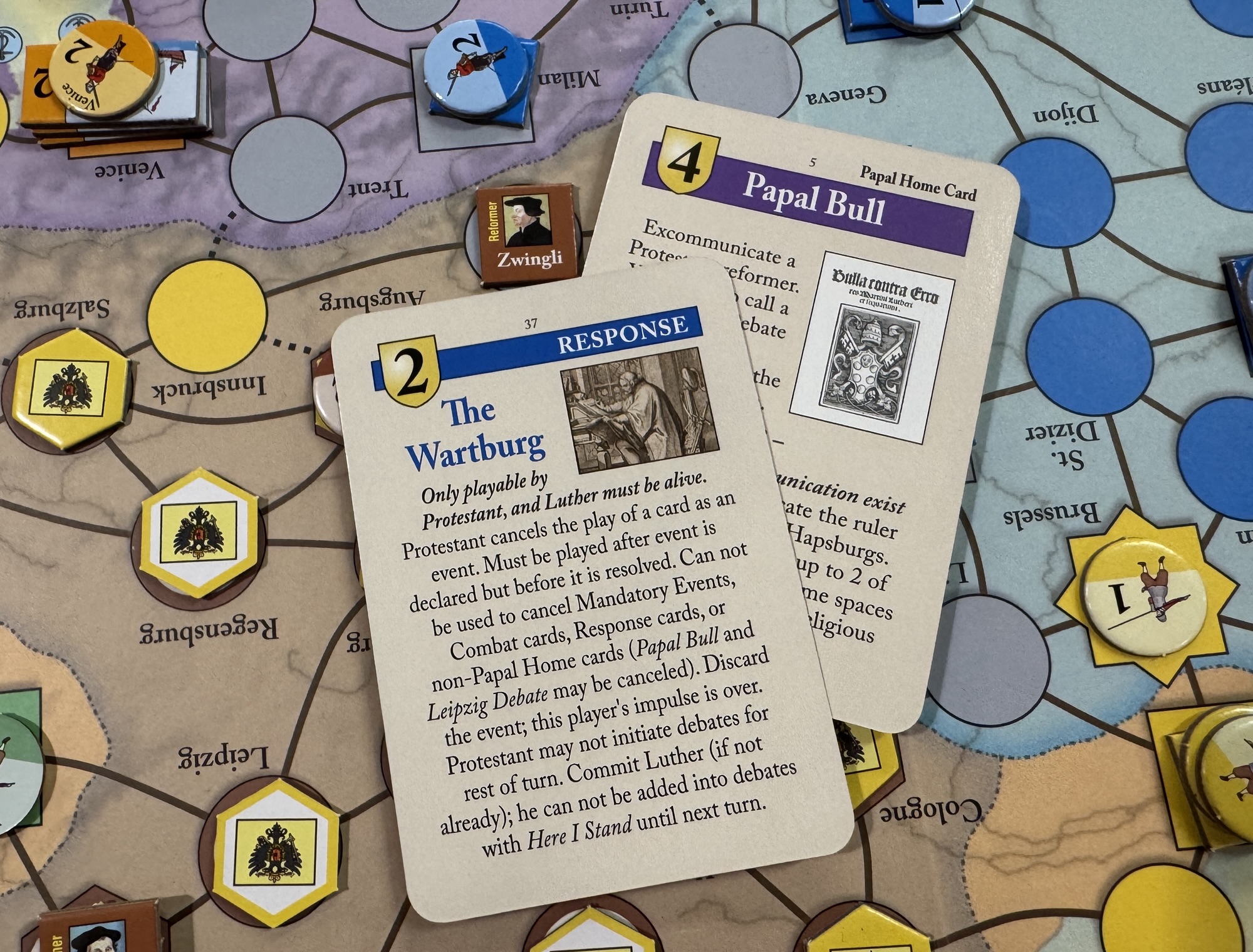
#71: The Wartburg from Here I Stand: Wars of the Reformation, 1517-1555 from GMT Games
Here I Stand: Wars of the Reformation 1517-1555 is an experience packaged in a game that attempts to boldly cover the political and religious conflicts of early 16th Century Europe. The game focuses on the struggle of religious reformers such as Martin Luther, John Calvin and Ulrich Zwingli as they battle the Papacy for changes in their views of God and religion. But it is more than just the Holy War as it deals with the other European countries involved in the affairs of the time including France, England, the mighty Hapsburg Empire and the Ottoman Empire in the east. They all played a role in the process of the Reformation and the design brilliantly weaves this all together into an interesting and engaging experience. The game also covers other plot lines and events of the period, including wars, marriages and ascendancies to thrones, using a unique Card Driven Game (CDG) system that models both the political and religious conflicts of the period.
Today, I want to take a look at a very interesting Response card in The Wartburg. Response cards in Here I Stand are event cards that can be played out of turn to interrupt the actions of an opponent or provide immediate reactions to specific game events. Response cards are often used to negate, mitigate, or enhance events and combats, and they may be played during an opponent’s impulse, provided the text allows for this asynchronous timing. These cards also tend to have specific pre-requisites that must be met in order to play the card and The Wartburg states that the card is “only playable by Protestants, and Luther must be alive”. The card itself allows the Protestant player to cancel the play of a card as an event but cannot cancel a Mandatory Event. The card however can cancel the play of the Papal Bull or Leipzig Debate Papal Home Cards, which is probably the way that the card will mostly be used. The card will not only cancel the play of the event but will also end the impulse of the player playing the card. This can be very powerful and when played at the right time can be a game saver for the Protestant player.
For example, in our most recent play at Buckeye Game Fest, I was playing as the Protestants and Bill Simoni as the Papacy. After the forming of the Schmalkaldic League and the Protestants changing into a military power, the focus of the other players turned toward me as I was doing well and near victory. They all then decided to declare war on the Protestants and began to advance upon and attack my fortified Electorates to take away VP I had earned by having both religious and political control in 5 of the 6 as the League was formed. As we came into turn 5, I was at 24 VP and ultimately came up shy of a victory by 1 point at the time. I had been able to take over the entirety of England and change every space and also get about 5-6 spaces in France, but now the Papal Bull came to play and Bill fought me back and forth with him taking over 3-4 spaces followed by me reclaiming 3-4 spaces. It was a beautiful game of back and forth and I used every tool at my disposal to fight him including The Wartburg card to stop the untimely excommunication of Zwingli before he could attempt to embarrass him in a debate. That card play at that very time saved me or most likely he would have used Eck who is his best debater against Zwingli who is just average and I would have lost leading to him being burnt at the stake giving him VP or by allowing him to turn over a few of my hard fought converted spaces back to Catholicism.
The only problem with this card is that it commits Luther so he will be unavailable to be chosen directly to debate during the rest of the turn. But this was a small price to pay at that time and ultimately led to me being able to hold on through the end of Turn 6 where I won a Protestant victory on the tie breaker with England.
Martin Luther stayed at Wartburg Castle from May 1521 to March 1522 under the alias “Junker Jörg” (Knight George) to hide from papal and imperial authorities. During these 300 days of protective custody, he translated the New Testament into German in just 11 weeks, wrote numerous theological works, and grappled with spiritual turmoil. His greatest accomplishment at Wartburg Castle was his translating of the New Testament from Koine Greek into German, which laid the foundation for a unified German language and made the Bible accessible to ordinary people. He also wrote numerous works, including Against Latomus and several tracts. He began his attack on monastic vows during this time, arguing they were contrary to faith. Luther used his time in exile for intense study and writing, referring to his stay as his “Patmos”, referring to the Apostle John’s exile to the Island of Patmos in 95AD. While here though he also experienced significant psychological distress and temptation. According to legend, he threw his inkwell at the devil during a confrontation, leaving a stain on the wall. His exile was organized by Frederick the Wise after the Diet of Worms and the stay was designed to keep Luther safe from those looking for him, ensuring the survival of his reform movement.
Neva Game Press is really exploring the space of wargame publishing and have games that are being worked on spanning all of history including modern and ancient. They also are looking at non-traditional topics to cover such as the Reformation. Their newest pre-order offering is called Reformation: Fire and Faith and is designed by Clint Warren-Davey. I am keenly interested in this one and have been working with Clint on this interview and maybe a series of other articles on strategies.
Grant: Welcome back to the blog Clint. With 4 published games to your credit what lessons have you learned about the design process and been able to put into practice?
Clint: Thanks for having me back guys! Yes I have learned a lot. Mainly, my iterative loop has become faster. I use mainly digital prototypes on PowerPoint and can get a prototype up and running pretty fast. This means I don’t need to print components and then reprint when things change. I also have a larger “toolbox” of ideas to draw from as I’ve played a wider variety of games. I still have a core design philosophy though – I want games that give players lots of meaningful decisions and a minimum of busywork, plus I generally prefer a high level of player interaction and interdependence.
Grant:How do you pitch games to publishers? What is your approach?
Clint: First I make sure the game is ready. I play-test the game myself a minimum of 20 times. Then I give it to external play-testers (basically my followers on Twitter/X). I keep refining it and make sure all the rules are nailed down. Once I have a fully functional and viable digital prototype, I send an email to a lot of different publishers to see who wants the game. So far, I’ve usually found at least one publisher who will accept each game.
Grant: What is your new game upcoming game Reformation: Fire and Faith about?
Clint: It’s about the wars and religious struggles that tore Europe apart during the Reformation, from 1517 (Martin Luther nailing the 95 Theses to the door of Wittenberg cathedral) to 1555 (the Peace of Augsburg). This is during the “pike and shot” era, which I love. It also includes a lot of political, religious and military conflict that is fascinating on multiple levels. It’s the perfect setting for an asymmetric wargame.
Grant: What image and feeling did you want to convey to players with the subtitle “Fire and Faith”?
Clint: Well this subtitle was decided by my publisher, Jose Neva of Neva Game Press. He wanted to convey both religious and military struggle in the title of the game, hence fire and faith. Before that the game title was undecided – it was either going to be just “Reformation” or “One Hour Reformation” – though upon further development it was clear this game doesn’t really fit with my other “One Hour” games.
Grant: Why was this a game you were inspired to design?
Clint: I am fascinated by the Reformation – both from a religious and a historical perspective. When I converted to Christianity about 10 years ago I had to choose which church to join, which forced me to read more on this time period, and read the arguments put forward by Protestant and Catholic apologists, then and now. I should state here that although I decided upon Catholicism, I hold no ill-feeling towards Protestantism and I understand the impetus behind it.
I was also drawn in by the fascinating geopolitics and tactical level military transformations of the time. The struggles between the French, Habsburgs, English, Ottomans, Venice, Scotland, Hungary, the Papacy and many other much smaller states were kaleidoscopic in their complexity but endlessly entertaining. To take one example of the political maneuvering of the time – the French lost the battle of Pavia to the Habsburgs, partially because 5,000 of their Swiss mercenaries just left and went home to defend their own cantons from rampaging German Landsknechts. Losing Pavia meant that King Francis I was captured. This in turn meant the English sensed weakness and struck in north-eastern France.
Seeking allies against this double threat, the French turned to the one great power that might help them – the Islamic Ottoman Empire! This outraged the Habsburg Emperor Charles V, who had his hands full containing the spread of Protestantism in Germany. The Saxons, Hessians and Brandenburgers following Luther’s lead would be much better used to help defend Vienna from the Turks, but instead both the Pope and the Emperor found themselves facing a full-scale religious revolt at the same time as renewed Ottoman offensives in the Balkans and the Mediterranean. This was all taking place against the backdrop of a military revolution in which pike and shot, and artillery, were replacing feudal levies of armoured knights.
Grant: What other Reformation games did you study for inspiration?
Clint: The complexity of this time period, and the sensitivity of religion as a topic, has meant that few game designers have been willing to tackle it. The exception is Here I Stand, the classic 6-player card-driven game by Ed Beach. This game is a well-renowned and even genre-defining title that managed to cram tons of inter-faction dynamics and historical chrome into the CDG system invented by Mark Herman (who made the first such CDG – We the People). It is absolutely brilliant in so many ways. Baroque, intricate, full of theme. It is almost like a historical equivalent of Twilight Imperium – one of my other favorite games.
The problem? It takes way too long to play for most gamers. Ever since playing Here I Stand many years ago, I had kept the idea of a simplified version at the back of my mind. Then, when I started teaching religious history at a Catholic school, I found myself teaching the Reformation. A classroom game on the topic would sure come in handy. So, in 2024 I made one. The images below give an idea of this, including my very basic graphics made in PowerPoint and Word. In 2025, I revisited the idea and thought it might be worth making into a serious game, still using the basic concepts and inter-faction dynamics borrowed from Here I Stand.
Early prototype version of the board.
Grant: What is your design goal with the game?
Clint: To make a game with 6 asymmetric factions that shows the inter-factional dynamics and key decisions of the period, all with mechanics that are simple enough to be used in a high school classroom AND simple enough for non-wargamers to pick up. Also, a game that players of Here I Stand would enjoy – especially when they are pressed for time. I believe I have succeeded in this goal but time will tell.
Grant: What main mechanics are used in the design?
Clint: The core gameplay loop is very simple. Each faction has a list of actions to choose from. Each turn, each faction will choose two actions. That’s it. But these vary greatly. They include everything from exploring the New World to translating the Bible to raising armies to piracy and everything in between.
All the factions have some actions in common – like Recruit (placing military units) and Campaign (moving and fighting). The two religious factions – the Protestants and the Papacy – are set apart from the others by having most of their actions focus on non-military functions.
Early prototype version of the Papacy Player Board.
The Protestants are trying to convert people to their new faith (or rather, in their terms, restore an older and more purified form of the Christian religion). As such, their overriding focus is placing Followers on the map. As a rough approximation, each Follower piece represents 5-10% of the population converting to Protestantism. What the Protestant faction is aiming for is gaining a majority, or a near-majority, in the countries of Europe. So, their main way of earning Victory Points is by having 5 or more Followers in as many spaces as possible. Now, the Reformation did not initially take hold everywhere. Geographically it was concentrated in Germany above all, then England, then in scattered pockets throughout France. In the game this is basically where the Protestants will be focusing all of their efforts. They start with only 1 Follower on the map in Germany – this represents Martin Luther and the nascent reform movement that started to gather around him in 1517. From this humble beginning, I wanted the Protestants to build up and expand, sometimes rapidly, across the map.
To speed up their placement of Followers, the Protestants can translate the Bible into local languages – German, English and French. This is an idea I took directly from Here I Stand and of course from the actual history of the Reformation. Having the Bible in the vernacular language, and spread by the printing press, was key to the spread of Luther’s ideas. Bible translation is a simple, two-step process in the game. First you need to accumulate “Knowledge” through the Study action and then use the Translate action to place Knowledge markers on the three Bible language spots on the Protestant faction sheet. Initially, this was the only purpose of Knowledge. But then I expanded it to other uses – especially the Debate action, which is a competitive bid against the Papacy that can score a valuable “Issue” token worth a precious VP. These Issue tokens represent the points of dispute in the Reformation, like the role of Scripture, Tradition and authority of the Magisterium. I liked the idea of carefully studying to build up knowledge in preparation for a debate – it’s a case of the game language matching the theme.
Near final look at the board and player boards.
The Papacy works in a similar way to the Protestants – but in reverse. The Pope is trying to remove Protestant Followers, through Preach and Debate actions. Every 3 Protestant Followers is minus 1 Victory Point for the Papacy, so they are incentivized to contain the spread of the Reformation. The Papacy also has ways of building up their own points, through Churches. This general term refers to all the infrastructure of the Catholic religion – not just beautiful cathedrals (like St. Peter’s, which was being built during the Reformation) but also schools, Jesuit universities, seminaries, monasteries, trained clergymen and church councils. I was originally going to have a track or chart on the Papacy faction sheet to measure this but later decided to have it as pieces on the map – the Churches you see in the game.
This was because I wanted the Papacy to have some of physical presence on the map like the other factions. This was loosely inspired by the building tokens in games like Root or the resources placed on the map in Scythe. It has the advantage of opening up the Papacy’s primary victory metric to attacks from the other factions. Just like Protestant Follower pieces, papal Church pieces can be attacked and removed. This represents iconoclasm and persecution of Catholic clergy, as well as periodic waves of destruction like the Sack of Rome in 1527. Unlike Protestant Followers, I had the Papacy’s Churches cost Wealth. This Wealth is gained entirely through the Tithe action – which takes money from any nations that are still Catholic. Early in the game this includes three out of the six factions: Habsburgs, England and France. But England and France might convert to Protestantism, and a greedy Pope constantly demanding their money might hasten this on!
Grant: What are the playable factions? How did you differentiate them?
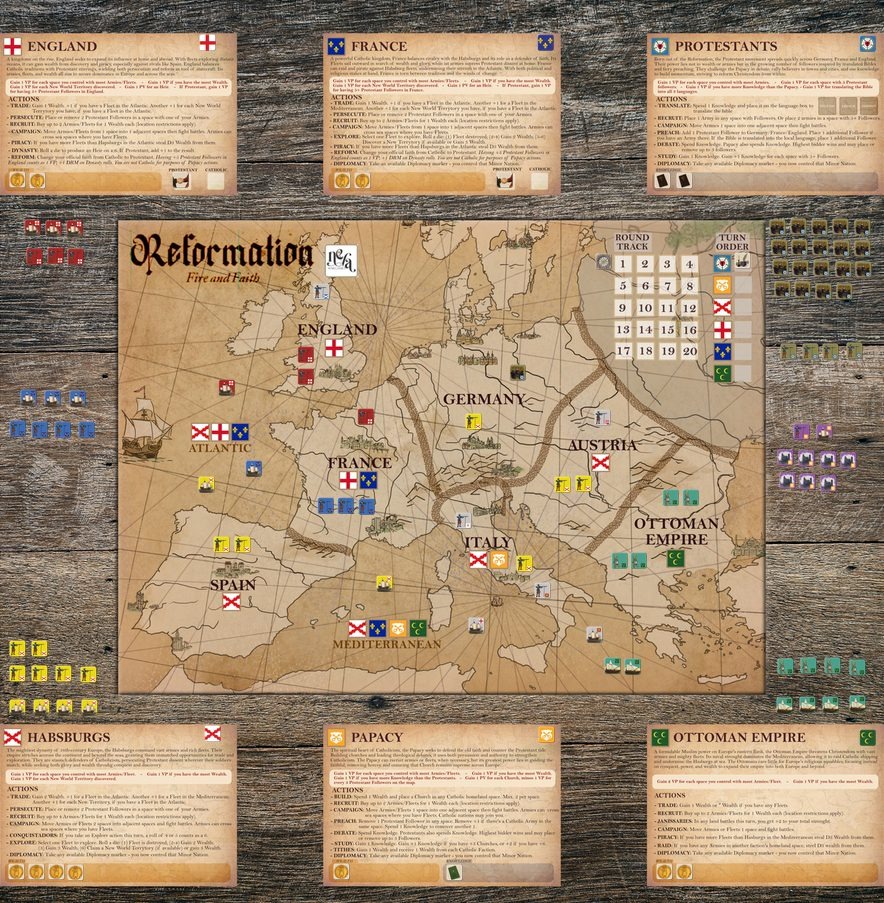
Clint: There are 6 factions in the game: Protestants, Papacy, Habsburgs, England, France and Ottoman Empire. Each one has a faction sheet, like the one below, which summarizes their victory conditions and available actions.
The Protestants and Papacy are religious-focused factions. They do have military forces, but they are relatively few in number and are not the main priority. The Protestants are trying to build up their knowledge of the Bible and translate it into vernacular languages, preach to the masses and debate the Catholics to spread their ideas. Their main goal is getting their Followers on the map. The Papacy is trying to contain the spread of Protestant Followers and remove them from the map as much as possible, plus place their own Churches. Both Churches and Followers are immobile and do not count as military units. But they can be attacked and persecuted off the map.
The other factions – the Habsburgs, England, France and the Ottomans – function more like the nations in a wargame. Amassing armies and fleets, fighting battles, aiming for control of spaces on the map. There are plenty of differences though. The English, French and Habsburgs have the option of Explore action – sending their Atlantic Fleets to explore the New World, gaining varying amounts of Wealth or a valuable New World colony (at the risk of losing the Fleet). This provides a great way for factions to gamble early on in the game in a high-stakes race for colonies. Two tweaks were made to the Explore action during the design process. First, my co-designer Ed Farren suggested that New World colonies should provide extra income during the Trade action if the owner has a Fleet in the Atlantic.
I loved this idea and implemented it immediately. I later thought that the Habsburgs should have a distinct advantage in exploring the New World, what with Hernan Cortez and Francisco Pizarro active during this time. I gave the Habsburgs a way to boost their Explore action with “Conquistadors” – effectively tripling their chance of finding a colony at the cost of an additional action. This means the Habsburgs will be raking in more money. But there are a lot of ways for the other factions to steal it! The English, French and Ottomans can all use the Piracy action to get that Spanish silver, and the Ottomans can also Raid on land if their Armies make it through to Austria.
The relationship between the military/political factions and the religious factions is also fascinating. I kept the Habsburgs as a staunchly Catholic faction – they can’t change their allegiance and will act as the strong right arm of the Holy See throughout the game. But England and France are a different story. England needed a historically-rooted incentive to convert to Protestantism, and this was solved in two ways. First, if England officially converts, they will earn 1 VP if England itself contains at least 5 Protestant Followers. This also gives 1 VP to the Protestant player, so there would be strong reasons for both players to work together in the conversion for England. I also wanted some of the high drama of Henry VIII and his wives without an entire sub-system and chart like Here I Stand. This became the “Dynasty” action – a simple die roll to gain a VP by producing a viable heir to the throne.
If England is Catholic, they need a 6 for this. But converting to Protestantism offers success on a 5 or a 6, as Henry can start divorcing his infertile wives. England can therefore grab 2 VP quite easily by ushering in the Anglican faith, which is handy because their opportunities for expansion on the continent are quite limited. France can also earn VP by converting to Protestantism and having at least 5 Protestant Followers in France. For both England and France, converting to the new faith costs an action – which Ed quite appropriately labelled “Reform”. This could be a wasted action if Protestantism doesn’t end up spreading in that nation or if the Dynasty action still fails. But it’s a live issue. Among experienced players, I expect that the Papacy player and the Protestant player will spend a lot of their table talk trying to convince England and France to side with them in religious terms.
Grant: What is the layout of the board?
Clint: I made the map as simple as possible. There are 7 land spaces: Spain, France, Germany, England, Austria, Italy and the Ottoman Empire. There are 2 sea spaces: the Atlantic and the Mediterranean. And that’s it! But you will find that this still provides plenty of interesting strategic choices, as there are 6 factions crammed into these 9 spaces. So, like the proverbial “knife fight in a telephone booth,” players are stuck in fierce competition from the very beginning. For example, the Papacy, France and Habsburgs all have some presence in Italy in the game’s set up. Plus, there are pieces from neutral nations there – like Venice and Florence. So inevitably there be some conflict there!
Grant: Why did you feel area movement was the best approach? What strategic decisions are forced upon the players by the layout?
Clint: Honestly, I didn’t want this to be game about operational level maneuver, more about strategic level decisions and inter-faction dynamics. The map is very heavily abstracted. But you can see it this way. Every faction has a “homeland” space. The Habsburgs, being the hegemon of Europe, have two (Spain and Austria). Each faction will usually be aiming to keep its homeland secure while pushing into 1 or 2 other spaces. Taking control of a space is a big deal and will involve good timing, negotiation and applying just enough force. Some spaces – like Germany and Italy – will usually become battleground spaces with multiple factions vying for control.
Grant:What is the counter anatomy? What different units are included?
Clint: Like the map, the counter anatomy is as simple as possible. There is really no information on the counters other than their type. There are Armies and Fleets – which are the only military units in the game. There are also two religious “units” – Churches for the Papacy and Followers for the Protestants. These don’t fight and can’t move, but they are essential for the two religious factions to build up their influence and victory points. There are also counters for many other things – New World Territories, the Royal Heir for England, the Issues that can be won in a Debate, Knowledge, Wealth and a few other things.
Grant: What is the scale of the game?
Clint: There’s no specific ground or time scale as many things have been heavily abstracted. But very roughly you could say that each turn represents about 2-3 years and each army piece represents 5,000-10,000 men.
Grant: What actions do players have each turn?
Clint: Players can choose two actions per turn. As explained above, they are different for each faction. But there are some similarities. I will give a list of the actions for each faction.
Many of these are self-explanatory but I will explain some of my favourite ones. Diplomacy means getting a Minor Nation on your side, or pulling one away from an enemy. These Minor Nations include Venice, Florence, Genoa, Hungary and Scotland and they have their own Armies or Fleets or both.
Piracy means using your Fleets to steal money from the enemy. Explore means trying to find a valuable New World Territory – worth VP and more income during Trade actions if you have a Fleet in the Atlantic.
The Persecute action means placing or removing Protestant Followers. The Reform action – available only to England and France – means officially converting your nation to Protestantism.
Dynasty is unique to England and represents Henry VIII trying to get an Heir (worth a VP). It’s a dice roll, but it’s easier when you’re Protestant to represent Henry being able to divorce and try with a different woman.
Janissaries is unique to the Ottomans and gives them a valuable +2 bonus in battle that turn. Conquistadors is unique to the Habsburgs and gives them a bonus on their Explore rolls – making it more likely that they will grab a New World Territory.
Grant: How does combat work in the design?
Clint: Very simple – add up your Armies/Fleets, add a D3 roll, the highest score wins. If there were a total of 7 or more units in the battle, the winner suffers 1 loss and the loser suffers 2 losses. Otherwise, the loser suffers 1 loss.
Clint: How do players obtain victory?
Clint: Every faction can score Victory Points (VP) in multiple ways. The margins here are very tight – typically the winning faction will score 5 or 6 VP while second and third place will have 4-5. So, a single point really matters. Every faction can score VP for control of spaces – this is hard to pull off as you need more Armies or Fleets in the space than all other factions combined. So, you might retain control of your own homeland, but taking control of another space is hard. Aside from control, each faction has other ways of getting VP:
The Protestants earn 1 VP for translating the Bible into all 3 languages (French, English and German), 1 VP for each space on the map with 5 or more Followers, 1 VP for each Issue you win in a Debate and 1 VP for having more Knowledge than the Papacy. So the Protestants need to focus on their religious actions – studying, translating and preaching.
The Papacy earns 1 VP for each Church they have on the map MINUS 1 for every 3 Protestant Followers on the map. They also earn 1 VP for having more Knowledge than the Protestants, 1 VP for each Issue they win in a Debate and 1 VP for having more Wealth than any other faction. So, the Pope also needs to focus more on his religious goals – but can also use the Tithe action to build up Wealth (for building Churches) and maybe get a point for rolling in cash.
The Habsburgs earn VP for each New World Territory they discover – and they are better at it than other factions because of their Conquistadors. They also earn VP for having 2 or more Churches in their homelands (Spain and Austria) and can earn VP for having the most Wealth.
The English earn VP for New World Territories and for having the most Wealth. They can also earn 1 VP for producing an Heir with their Dynasty action. The Dynasty action represents Henry VIII’s efforts to produce a legitimate male heir for his throne, and is easier if England becomes Protestant. England earns 1 VP if it converts to Protestantism and has 5 or more Protestant Followers in England. If it stays Catholic, it earns 1 VP for having 2 Churches in England.
France is basically like England but doesn’t have the Dynasty action. They will focus on military action, exploration and building up Wealth. If they stay Catholic they will want the Pope to build up Churches in France, if they go Protestant they earn VP for having 5+ Protestant Followers in France.
The Ottomans are the most straightforward – they can earn 1 VP for having the most Wealth but mostly they just get VP for control of spaces – they earn 2 per space instead of 1. They are an expansionist juggernaut and don’t care about the religious squabbles in Europe.
Grant: What type of an experience does the game create?
Clint: I think it gives you an understanding of the key inter-factional dynamics of the Reformation era using mechanics that are simple to understand and easy to enact.
Grant: What are you most pleased about with the design?
Clint: The asymmetry, the simplicity and the interaction between the players. I’m also really happy with the “bot” rules which allow you to play at anything from 1 to 6 players, with non-player-controlled factions run by a simple dice-based action sheet.
Grant:What has been the response of playtesters?
Clint: Very positive. Every play-tester has said the game is really fun and easy to learn, their only suggestions have been refinements to improve the balance between the 6 factions. For example, one play-tester noticed that the Debate action was under-powered and that the Protestants and Papacy were scoring fewer VP than the other factions on average. Changing the Debate action to winning “Issue” markers (worth 1 VP each) solved both problems. This is why play-testers are so valuable!
Grant: What other designs are you working on?
Clint: A lot! I will share a few of them with you.
First, there is One Hour Napoleon and One Hour WW1, sequels to my game One Hour WW2. Napoleon should be out this year, WW1 next year.
Then there is Messiah – my “Jesus COIN game” which is set in 1st century Roman-occupied Israel and lets you play as the Christians, Zealots, Pharisees or Romans. Similarly, there is “Testament” – my card drafting game on the entire Old Testament, inspired by 7 Wonders. These are still in development but they have a publisher and will certainly be made.
Anyone interested in my designs should follow me on X at @Clint_Davey1 to keep up to date with all the new releases. Thanks for having me on again!
If you have followed us for a while now, you know how we feel about Here I Stand: Wars of the Reformation from GMT Games. And, you know that we enjoy multi-player wargames. So, this one really seems to b simple and take in the concepts of negotiation and the asymmetry of each of the factions. I think that this game will be a good quick playing substitute for the longer and more involved Here I Stand experience. I cannot wait to get this one hopefully this year.
British board game publisher Alley Cat Games has triumphed in this year’s Diamant d’Or – a prize focused on championing heavier eurogames – after pivoting its strategy several years ago to experiment with crowdfunding more complex designs.
The Toni López-designed dice manipulation game fought off big name titles including Galactic Cruise and Luthier to win the 2026 Diamant d’Or, which was created more than a decade ago to celebrate complex euros the organisers felt were being overlooked by more mainstream board game awards.
Richard Breese’s latest design in his Key series, Keyside, took second place in this year award, while Ants, an ant colony expansion title from frequent Diamant d’Or finalist Cranio Creations, came third.
Speaking to BoardGameWire, Alley Cat Games director Caezar Al-Jassar said the team was “ecstatic” with the win, adding, “we have worked hard for three years to bring Ada’s Dream to gamers and have been blown away by the positive response from our backers and supporters”.
He said, “Ada’s Dream is the most complex game we’ve ever produced. A few years ago we noticed that the trend for Kickstarter games was leaning to heavier and more complex games than we were producing, and so we pivoted to explore creating more games like this.
“This meant a lot of extra work to produce the final game and we are incredibly pleased to see that work has paid off, and that Ada is being celebrated by the Diamant d’Or committee.”
The Diamant d’Or win comes just under a year after Alley Cat announced during its Kickstarter campaign for Baghdad that it would cease producing retail editions of its crowdfunded titles “for the foreseeable future”, amid rising competition on shop shelves and uncertainty around US tariffs.
A statement from the company at the time said,” It is getting harder for Kickstarter games to succeed, both on Kickstarter and in particular at retail stores after the campaign.
“This, coupled with rising costs and the uncertainty surrounding US tariffs, has led us to look at ways of streamlining the business to ensure that we don’t have so much money tied up in stock. We’d much rather invest this money in making more great games!”
Al-Jassar told BoardGameWire, “Considering that these titles are more expensive to produce, ship, and store than smaller more retail friendly games, we kept the decision to move away from retail distribution of our Kickstarter games.”
A small number of copies of Ada’s Dream were briefly available through the Alley Cat website from February 5, but those available to US and European customers have already sold out.
Al-Jassar said, “The initial webstore sales were some stock not needed for fulfilment. However, as there are still backers that did not complete their Pledge Managers, we will be keeping a supply in storage until a set number of months after the end of fulfilment to ensure all backers have the opportunity to receive their copy.
“Regarding future plans for Ada’s Dream, we won’t be producing a print run for retail distribution but may have some more copies available once enough time has passed after fulfilment, and are exploring a future Kickstarter campaign with an expansion and reprint that we hope to launch in early 2027.”
The 2026 Diamant d’Or
WINNER: Ada’s Dream, designed by Toni López (Published by Alley Cat Games)
Second place:Keyside, by Richard Breese and David Turczi (HUCH!, R&D Games)
Third place:Ants, by Renato Ciervo and Andrea Robbiani (Cranio Creations)
Other finalists:
Galactic Cruise, by TK King, Dennis Northcott and Koltin Thompson (Kinson Key Games)
Luthier, by Dave Beck and Abe Burson (Paverson Games)
Philarmonix, by Faris Suhaimi (Archona Games)
Recall, by Helge Meissner, Kristian Amundsen Østby, Kjetil Svendsen and Anna Wermlund (Alion – by Dr Ø)
France’s highest-profile board game prize, the As d’Or, has updated its rules for 2026 to ensure that artist names must appear on a game box in order for designs to be eligible for the award.
The award, which traces its history back to 1988, has required entries to show designer names on their game boxes for several years, in addition to requirements for the game to be published in French and available in the French market during the preceding year.
Board game designers and artists are frequently namechecked on box covers in the current hobby – a far cry from the time of the “coaster proclamation” in 1988, when 13 designers – including El Grande and Tikal creator Wolfgang Kramer – signed a beer mat at the Nuremberg toy fair vowing that none of them would give their games to a company without their names being written on the box.
Exceptions to that have long existed at the mass-market end of the hobby – but further cases have begun to appear in recent years, some due to the use of AI generated images in titles, and others due to stylistic choices by publishers.
Viking-themed card shedding game Odin won last year’s As d’Or, while city-building eurogame Kutná Hora triumphed in the Expert Game category at the 2025 awards, Operation Noisettes won the children’s game prize, and Behind scooped the “Initié” award – which targets regular board game players ready for more challenging mechanisms.
The 2024 winner was also a small-box card game, Trio, potentially giving Flip 7 a boost in this year’s contest.
It added, “It also reflects the current trend: playing games as a couple, and smaller-format games are appealing to the public, and publishers are offering more and more of them.”
The As d’Or traces its history back to 1988, when it was launched to highlight the best games available at France’s Festival International des Jeux in Cannes. The award was merged with the Jeu de l’Année in 2005.
This year’s winners are due to be announced on February 26 during the annual Festival International des Jeux in Cannes.
Last year’s FIJ had a record 110,000 admissions across the five-day event, with 60,000 sq m of exhibition space – up a third compared to 2024.
As we have seen in the last post, Wallenstein had contrived to make many enemies. His only supporter, Emperor Ferdinand, feared to be upstaged by the seemingly all-powerful general. The news in late 1633 – Wallenstein treating with the Swedes, Wallenstein letting Thurn go free, Wallenstein not defending Regensburg and Bavaria, Wallenstein refusing to support the Spanish mission to the Netherlands – mixed with their tendentious interpretations by the Bavarian and Spanish parties at court convinced the emperor that Wallenstein planned betrayal. To forestall this, the Imperial War Council secretly decided to relieve Wallenstein of his command on December 31, 1633.
Wallenstein and his intimates did not know about the dismissal, but they sensed the shifting wind. His brother-in-law Adam Erdmann, Count Trčka, and his marshal Christian von Ilow had Wallenstein’s officers sign a statement of loyalty to their commander in his winter quarters at Plzeň on January 12. They hoped that this show of unity in the army would remind the emperor that he needed his general. The opposite was the case: Ferdinand took it as another sign of treason.
When Wallenstein had been dismissed in 1630, it had caused both the emperor and the electors immense anxiety about his possible reaction. He had taken it meekly then, but what would he do now? As the emperor and his advisors had resolved that Wallenstein was a traitor, they expected the worst – insubordination, rebellion, joining his army with the Swedes. That needed to be forestalled. A secret court found Wallenstein guilty of treason on January 24, 1634. The court reached out to three of Wallenstein’s officers which they deemed reliable – Wallenstein’s second-in-command, Matthias Gallas, the commander of the embattled left wing at Lützen, Ottavio Piccolomini, and the tenacious defender of Dessau Bridge, Johann von Aldringen. To them, they gave the delicate task of delivering Wallenstein to Vienna – dead or alive.
The three executors of the imperial sentence faced a daunting task. Wallenstein was popular with the common soldiers whose pay was guaranteed by their general, not by the emperor whose coffers were notoriously empty and whose will to pay the army notoriously limited. The officers seemed more promising, as they were honor-bound to the emperor, but they had also sworn loyalty to their commander. Gallas got in touch with those they deemed reliable and instructed them not to follow any orders from Wallenstein, Trčka, or Ilow.
By that time, Wallenstein’s health had deteriorated even more. He was barely able to leave his bed and sometimes could not even sign documents. All the while, he waited for a reply from Hans Georg von Arnim on the potential peace with the electors of Saxony and Brandenburg.
Trčka acted on Wallenstein’s behalf in the day-to-day affairs, confident in his command over the soldiers. Only deep into February did it dawn on him and Wallenstein’s other intimates that imperial agents were prising the army away from them – officer by officer, regiment by regiment.
Wallenstein in his winter quarters at Pilsen (the German spelling of Plzeň) with the three executors of the imperial will dancing around him. Cheb, to the northwest of Plzeň/Pilsen would have given Wallenstein an easy exit west in direction of the Swedish-German forces under Bernard of Weimar or north to the Elector of Saxony. From the Vassal module of Thirty Years War: Europe in Agony, 1618-1648 (David A. Fox/Michael Welker, GMT Games).
Nothing was left to Wallenstein but flight. On February 23, he and those faithful to him made away to Cheb, accompanied by a few regiments of loyal troops. They had been joined by the regiment of Colonel Walter Butler on the way and counted on the garrison of Cheb under the command of John Gordon. Both Butler and Gordon had been contacted by the three conspirators who urged them not to obey Wallenstein. For the time being, Butler and Gordon prevaricated.
As Cheb is in the northwestern corner of Bohemia, Wallenstein could easily leave Bohemia for Saxony or be joined by Swedish forces. That put time pressure on Butler and Gordon. If Wallenstein fled, they would be held responsible. If they arrested him, he would be freed again if the Swedish arrived. Thus, they resolved to murder him and his associates.
Gordon invited Trčka, Ilow, and a few more Wallenstein intimates for dinner up in Cheb’s castle on February 25th – together with Wallenstein, who declined on grounds of his constant bad health. Gordon and Butler, both present at dinner, had a group of soldiers commanded by captain Walter Devereux come in, declare for the emperor, and murder Wallenstein’s associates. With all of them dead, Devereux took his small group down to Wallenstein’s residence in the town. They found Wallenstein in bed already. As he got up, Devereux stabbed him to death.
Wallenstein’s leader counter in Cuius Regio.
Wallenstein’s death is handled in a rather detached manner in Cuius Regio (Francisco Gradaille, GMT Games, forthcoming): Like every other leader, Wallenstein has an initial and a last year of service (1625 and 1634, in his case). In the leader deployment phase before the campaigns of 1635, the player will have to remove Wallenstein. Death – be that from plague, battle, or murder – is inevitable and pre-ordained.
The Catholic player in Thirty Years War: Europe in Agony, 1618—1648 has more freedom. As we have discussed in the last two instalments of the series, Wallenstein can be dismissed and recalled in the game. And if he proves to be too influential (and comes close to the threshold at which his influence would give the Protestants a Major Victory), he can also be assassinated (and thus be removed from the game permanently). There is, however, no inevitability of Wallenstein’s death: As his influence is only raised from recruiting troops, taking cities, and successfully attacking with him, the Catholic player can just forgo those, not use Wallenstein anymore and let him live out his old age in peace. Somehow, this never occurred to the historical Ferdinand II. Implicitly, the game’s treatment of Wallenstein’s assassination posits that the active threat which Wallenstein posed in Ferdinand’s view was nothing but a fabrication of the emperor’s paranoia, and that the emperor remained firmly in command at all times.
Twilight of the Thirty Years’ War
Wallenstein had grown rich on land which had been taken from those the emperor had declared rebels. He ended up on the other side of this bargain. His estates in Bohemia and Silesia were seized (Mecklenburg was lost to the Swedes anyway). A good deal went as spoils to all the officers involved in the conspiracy against him. Gallas, Piccolomini, and Aldringen became great magnates, and those on the lower rungs of the plot did not go unrewarded either, down to an additional month’s pay for all the soldiers in the garrison of Cheb whose only contribution had been to stand by idly while Wallenstein was murdered. The rest of Wallenstein’s estates were sold by the emperor to fix some of his short-term financial problems. Wallenstein’s widow Isabelle kept nothing. Only when she pleaded mercy (instead of justice) from the emperor did she receive a small estate to live on.
Wallenstein had died when the war had already been raging for sixteen years. It would last another fourteen before peace was finally made in 1648. Any time Emperor Ferdinand II had been in a position of strength, he had not made concessions to form a lasting peace, but instead increased his demands, prompting the interventions of first Denmark, then Sweden, and finally France (shortly after Wallenstein’s death).
Ferdinand II died in 1637. At the time of peace, the new emperor Ferdinand III was mostly ruined. Protestantism survived, protected by German princes and foreign powers. Sweden controlled the Baltic Sea. Any hopes of imperial hegemony in the empire or of Habsburg hegemony in Europe were dashed. After Spain had conceded Dutch independence, it fought on against France, and lost that war, too, along with its European primacy.
Afterlife
Wallenstein remained fascinating to his contemporaries after his death, and would continue for centuries. Assessments close to his own time hewed closely to the religious beliefs of the writer: Catholics tended to see Wallenstein as a traitor (following the official account of the emperor), Protestants made him into a Machiavellian mercenary leader, often contrasted with the heroic “Lion from the North” Gustavus Adolphus.
Later treatments focused on individual aspects such as Wallenstein’s purported dependence on astrology. You will have noticed that this is the first time since our first post that astrology is mentioned – because there is no evidence that Wallenstein was more interested in it than his contemporaries, let alone that he made decisions based on horoscopes. The speculations on this issue are based in the accounts of those who bore witness against Wallenstein shortly before and after his death, taking pains to stress anything which might indicate that Wallenstein was anything but a devout Catholic. The idea of Wallenstein, the Star-Seeker, is particularly prevalent in the German mind, as playwright Friedrich Schiller dedicated a trilogy of plays to Wallenstein’s last weeks – and presents the general as an indecisive fatalist, done in by his own passivity as well as the cabals of those around him. That’s (masterful) fiction – but it hews close enough to history (Schiller had taught history at the University of Jena and even written a major book on the Thirty Years’ War) to influence anyone whose first contact with Wallenstein was through Schiller’s plays.
By the time document-based historiography had been firmly established in the 19th century, pre-established views on Wallenstein had become so solidified that historians still argued within their confines – mostly on the matter if Wallenstein had, in fact, betrayed the emperor. Slowly, the view that he had not gained ground.
Interpretations of Wallenstein in the 19th and 20th century often were inspired by current politics: Catholic German nationalists hailed Wallenstein as a proto-Greater German unifier. Czech historians like Josef Pekař adopted their compatriot as a proto-nationalist transcending the multi-national Habsburg Empire. Hellmut Diwald saw in Wallenstein the necessary authoritarian answer to overcome foreign domination of Germany (and subsequently plunged himself into New Right revisionism).
When stories of “Great Men” had decidedly fallen out of favor in academic history, Golo Mann revived the genre with his biography of Wallenstein, testing the limits of academic writing with his literary ambitions. His book dispelled some of the myths around Wallenstein and retained others.
Currently, Wallenstein’s heritage as a Bohemian, a nobleman, a (converted) Catholic, and a magnate have received more attention. History is never completed, but only enriched with more perspectives. Wallenstein’s life and its subsequent interpretations are thus also lessons in historiography.
A recent biography which succeeds at dispelling the Wallenstein myth is Mortimer, Geoff: Wallenstein. The Enigma of the Thirty Years’ War, Palgrave Macmillan, London 2010.
For an older, more encompassing biography with literary aspirations, see Mann, Golo: Wallenstein. His Life Narrated, Holt, Rinehart, and Winston, New York City, NY 1976.
On the reception of Wallenstein and his changing image from his contemporaries all the way through the 20th century, see Bahlcke, Joachim/Kampmann, Christoph: Wallensteinbilder im Widerstreit: Eine historische Symbolfigur in Geschichtsschreibung und Literatur vom 17. bis zum 20. Jahrhundert [Conflicting Conceptions of Wallenstein: A Symbolic Figure from History in Historiography and Literature from the 17th to the 20th Century], Böhlau, Cologne/Weimar/Vienna 2011 [in German].
For a short introduction to the Thirty Years’ War, see Schmidt, Georg: Der Dreißigjährige Krieg [The Thirty Years’ War], C.H. Beck, Munich 2010 [in German].
A magisterial monography on the entire war is Wilson, Peter H.: Europe’s Tragedy. A New History of the Thirty Years’ War, Penguin, London 2009.
We haven’t had a game-assisted biography on this blog for two years! Let’s rectify that with one of the most legendary and mysterious generals of all time – Wallenstein, the emperor’s chief commander in the first half of the Thirty Years’ War. Wallenstein, the mercenary. Wallenstein, the astrology addict. Wallenstein, the traitor. …or was he all of these things? We’ll find out!
The early 17th century was a time of barely contained tension in Europe. Four fundamental conflicts would provide the spark, the oxygen, and the fuel for the great conflagration of the Thirty Years’ War:
Since Luther’s 95 Theses had brought forth a new interpretation of the Christian faith, Protestantism, the Catholic church and Catholic princes had aimed to extinguish it. The denominations had reached a tenuous compromise in the mid-16th century based on the principle that the princes could set the religion for their dominions (cuius regio, eius religio). Yet shifts in the balance of religious power since then – mostly in favor of the Catholic counter-reformation, with the notable exception of the lands of the Crown of Saint Wenceslas (Bohemia, Moravia, and Silesia), where the Protestant nobles forming the estates gained in power – threatened the compromise.
The Holy Roman Empire had traditionally been a state where power was shared between the emperor and the princes (most importantly, the seven electors which, as the name indicates, elected the emperor). Other states Spain, France, and England saw a centralization of power around their respective kings. Such a centralization – a true monarchy – also appealed to the emperor.
The Holy Roman Empire in 1618 with its many principalities (note the many coats-of-arms on the map). Bohemia, Moravia, and Silesia are in the center-east. Map of Holy Roman Empire (Mark McLaughlin, 3W).
In the north, the Holy Roman Empire bordered the Baltic Sea. Whoever controlled its shorelines, liberally dotted with merchant cities which had gotten rich in the trade with timber, grain, fish, and many other valuable commodities, would hold the dominium Maris Baltici – the command of the Baltic Sea. The chief contenders in the early 17th century were the Polish-Lithuanian Commonwealth, the Kingdom of Denmark-Norway, and the Kingdom of Sweden… yet others would surely be interested, if only they could gain a foothold on the shores of the Baltic Sea.
The emperor came from the House of Habsburg (or Hapsburg, as it is sometimes spelled in English). Half a century before Wallenstein’s birth, Emperor Charles V had ruled not only the Habsburg possessions in the Holy Roman Empire (including Austria and the Crown of Saint Wenceslas), but had also been King of Spain and held extensive territories in Italy and Burgundy (in modern-day France and the Benelux countries). Charles had split the Habsburg holdings between his brother Ferdinand who succeeded him as Holy Roman Emperor and his son Philip who had inherited all the lands and titles in Spain, Italy, and Burgundy (as well as Spain’s overseas colonies). Individually, the two Habsburg branches were powerful. And together, they were on the verge of European hegemony.
Bohemian, Noble, Soldier, Convert
Wallenstein was born on September 24, 1583, in the Bohemian village Heřmanice, as Albrecht von Waldstein, a scion of an old, but poor Bohemian noble family. While the family name (in either the original Waldstein or Wallenstein’s own preferred Wallenstein spelling) may sound Germanic, Wallenstein’s native tongue was Czech. However, his education in Silesia and Franconia taught him German and Latin, his subsequent European tour as a young man Italian as well as a dose of French and Spanish.
Wallenstein had been orphaned at the age of eleven. As a young nobleman and landholder, he had to chart his own path in life. His lands were neither extensive enough for a comfortable income nor to command his full attention. For a fruitful ecclesial career, Wallenstein was too lowborn. Instead, he resorted to the third suitable career paths for nobles – war – and enlisted in the imperial army for two years in the Long Turkish War.
Wallenstein returned from the war aged 23. Over the next years, he made several momentous decisions. The most important – and least understood – is his conversion. Wallenstein had been raised Protestant like most Bohemians, but converted to Catholicism around the end of his military service. While we cannot search Wallenstein’s heart for his religious convictions, we know that he never displayed particular religious zeal later – and he was remarkably tolerant of other faiths, and regularly entrusted Protestants with important positions under him. From a more worldly perspective, Wallenstein’s conversion isolated himself from most of his Bohemian peers. It was in that regard, though, that his conversion proved fruitful a few years later: When the wealthy Catholic widow Lucretia of Víckov sought to remarry, Wallenstein was one of the few eligible Catholic nobles in the region. He thus came to manage her extensive holdings in Moravia, and, when she died in 1614, the inheritance turned him into one of the richest landholders sworn to the Crown of Saint Wenceslas.
Finally, these years saw another event which would be of great importance to Wallenstein’s biographers (but not so much to him): Following the fashions of the time, he requested a horoscope from the leading astronomer of the time, Johannes Kepler. As horoscopes go, it foretold some things which would happen (albeit at different times than predicted, like his marriage to a wealthy woman), others which wouldn’t (an interest in alchemy and sorcery), and a good deal of vague fluff which could be applied to most people.
Rise in the Conflagration
In 1617, Wallenstein went to war again. This time, he paid out of his own pocket for a cavalry company to join the war against Venice commanded by Ferdinand of Habsburg, Emperor Matthias’s appointed successor. Soon after Wallenstein had joined the fray, Matthias fell seriously ill and Ferdinand was recalled to ensure a smooth transition of power as both the Crown of Saint Wenceslas and the imperial crown were elective. Despite Ferdinand’s reputation as an ardent Catholic counter-reformer (he had forced the conversion of his Protestant subjects in Styria and Carinthia as one of his first acts as an adult ruler), the Protestant-majority Bohemian estates elected Ferdinand king in an act of doubtful strategic vision.
Ferdinand was careful not to violate Protestant rights too flagrantly, yet the estates soon found out that he retained his counter-reformatory spirit when he decided any arising small property disputes in favor of Catholic claimants. Redoubling on their strategic ineptitude, the Bohemian estates now defied the king they had accepted as legitimate just one year before: They threw three of Ferdinand’s counselors out of a window (all of them miraculously survived the fall) on May 23, 1618, and rose in armed rebellion. As their new king they chose Frederick V, elector of the Palatinate and the son-in-law to King James I of England. When Matthias died in 1619, Frederick would be the only of the seven electors not voting for Ferdinand II to become Holy Roman Emperor – a devastating setback for the Bohemians who had hoped that Frederick’s second vote as King of Bohemia would be acknowledged, and that the Protestant electors of Saxony and Brandenburg would also support Frederick.
The Bohemian estates (blue) had a mobilization advantage over the imperial forces and their Catholic German allies (yellow) in 1618. The westernmost blue stack is led by Frederick V in his native Palatinate, the easternmost (in Moravia) by Count Thurn, ready to threaten Vienna (Wien), the seat of Habsburg power in the Holy Roman Empire. Setup for the campaign game of Cuius Regio: The Thirty Years War (Francisco Gradaille, GMT Games, forthcoming) – playtest art.
Wallenstein had been born in Bohemia, but the estate inherited from his wife lay in Moravia. The Moravian estates delayed their commitment to the Bohemian cause which suited Wallenstein well – he had no sympathy for the rebellion. As one of the chief military officials of Moravia, he raised a cavalry regiment which he offered to Ferdinand. Push came to shove when one of the Bohemian armies under Count Matthias of Thurn marched into Moravia in 1619 to rouse the Moravians into supporting the Bohemian rebellion. Wallenstein attempted to spirit his regiment away (knowing the soldiers’ and officers’ sympathies for their Bohemian neighbors). When the major in charge of logistics attempted to swing the regiment in favor of the rebellion, Wallenstein slew him on the spot with his saber. Then he brought the regiment to the emperor’s seat Vienna, and with it, the war chest of the Moravian estates – a welcome present to the always cash-strapped emperor.
Wallenstein had gained the emperor’s favor. While he was not personally involved in the decisive imperial victory over the Bohemian forces at White Mountain (albeit some of his soldiers served under the commander of the Catholic League’s army, Johann Tserclaes, Count of Tilly), that favor gave him access to the inevitable spoils of victory. And here his genius first showed.
Wallenstein became a part of the imperial coin consortium tasked to supply silver and mint debased coins to pay for the emperor’s war efforts. That was a mildly profitable endeavor in itself, but more importantly, it got Wallenstein in touch with men of finance, chiefly the Dutch banker Hans de Witte. Wallenstein used his new-found access to credit to take out huge loans with which he purchased vast estates in Bohemia confiscated from the defeated rebels, and as so much land was auctioned at the same time by the imperial crown, Wallenstein paid bargain prices to became one of the chief Bohemian magnates.
The loans still needed to be repaid. Wallenstein expended most of his energy on developing his estates in the following years, and turned them into an efficiently administered, wealthy domain, for which he was granted the title of Prince of Friedland. Wallenstein’s activities as a landed aristocrat are represented in the most famous game featuring him, Wallenstein (Dirk Henn, Queen Games), which has up to five players (one of them Wallenstein) build markets, churches, and palaces in their holdings… and make some war on the other players should good opportunities arise.
Wallenstein remarried in 1623. His wife Isabel was the daughter of the imperial count Karl of Harrach from the emperor’s inner circle of advisors, giving Wallenstein access to inner workings of the imperial court. Yet despite his successes, Wallenstein was anxious.
His holdings were not secure as long as the exiled Bohemian rebels had hopes of recovering them. Wallenstein thus needed peace, peace on the Emperor’s terms. Yet while the imperial armies had won one victory after another, not only crushing the Bohemian rebels but also invading the Palatinate homeland of their erstwhile King Frederick, the emperor did not know how to make peace. He found himself unable to deal with the roaming armies of Protestant warlords like Ernst of Mansfeld or Christian of Halberstadt. And instead of extending an olive branch to the princes fearing imperial domination, he deposed Frederick and gave the title of elector to his ally Maximilian, Duke of Bavaria – an unthinkable breach of princely privileges.
As Ferdinand also seemed on the verge of rolling back Protestantism in central and northern Germany, the Protestant princes and the powers of the Baltic Sea grew concerned. King Christian IV of Denmark was anxious on both accounts. If he opposed Ferdinand, he could certainly count on the Protestant warlords and Bohemian exiles, and he sounded out eventual allies
among the northern German princes,
the Protestant Dutch (embroiled in their own struggle with for independence from the Spanish Habsburgs),
the English (whose King James I resented the snub to his son-in-law Frederick), and even
Denmark’s rival Sweden, a rising Protestant power in the north.
Nobody knew how big the Protestant intervention from the north would be. Yet it was almost certain that it would come. And the imperial region closest to Denmark was Bohemia. Wallenstein despaired over the emperor’s lack of preparation (caused both by the eternally empty imperial coffers and Ferdinand’s anxiety that raising an army would cause the Protestants to take measures of their own, thus causing the war he wanted to avoid). Wallenstein became convinced that he needed to take the security of his principality into his own hands. He offered to raise and equip an army for the emperor, paying for it up front. After long delaying, Ferdinand accepted his offer.
Ferdinand made Wallenstein chief imperial general in the Holy Roman Empire (contrary to the traditional title of lieutenant general based on the fiction that the actual commander was the monarch himself), created him Duke of Friedland lest he be outranked by other aristocratic commanders, and tasked him to raise his army. Wallenstein would apply himself to the task with his characteristic energy… in the next instalment of this series.
A recent biography which succeeds at dispelling the Wallenstein myth is Mortimer, Geoff: Wallenstein. The Enigma of the Thirty Years’ War, Palgrave Macmillan, London 2010.
For an older, more encompassing biography with literary aspirations, see Mann, Golo: Wallenstein. His Life Narrated, Holt, Rinehart, and Winston, New York City, NY 1976.
On the reception of Wallenstein and his changing image from his contemporaries all the way through the 20th century, see Bahlcke, Joachim/Kampmann, Christoph: Wallensteinbilder im Widerstreit: Eine historische Symbolfigur in Geschichtsschreibung und Literatur vom 17. bis zum 20. Jahrhundert [Conflicting Conceptions of Wallenstein: A Symbolic Figure from History in Historiography and Literature from the 17th to the 20th Century], Böhlau, Cologne/Weimar/Vienna 2011 [in German].
For a short introduction to the Thirty Years’ War, see Schmidt, Georg: Der Dreißigjährige Krieg [The Thirty Years’ War], C.H. Beck, Munich 2010 [in German].
A magisterial monography on the entire war is Wilson, Peter H.: Europe’s Tragedy. A New History of the Thirty Years’ War, Penguin, London 2009.
You’ll find a short discussion of the various origins of the war in Gutmann, Myron P.: The Origins of the Thirty Years‘ War, in: Journal of Interdisciplinary History 18, 4, 1988, p. 749—770, online here (free registration required).

 Anmelden