A silver stake? A crucifix? What, did you think we haven’t tried everything before?
Another big unboxing! Peter checks out everything for Grimcoven, the new boss battler from Awaken Realms!
Before I say anything more, yes, someone did point out to me I pronounced ‘Grimcoven’ incorrectly throughout this entire video, and I’m deeply ashamed about it. We all make mistakes! But anyway, there’s a lot of exciting stuff to check out here, in my first video about this challenging new game from Awaken.
Grimcoven is a gorgeous looking game with enough boss battling goodness to last you many years, so let‘s get into it!
Making high quality tabletop gaming content at the EOG takes time and money. Please consider becoming a Patreon supporter or making a donation so I can continue this work! Thankyou!
It’s been thirteen years since the original release of Jamey Stegmaier’s Euphoria: Build a Better Dystopia. I would say it doesn’t feel like thirteen years, but I’d be lying. Between the pandemic and five or six successive generations of board game iteration, it’s been an eternity. Long enough for a retrospective, certainly.
Speak of the devil. Euphoria: Essential Edition is a remake of the original game, plus some of the stuff from the expansions, minus a few love handles and splotchy moles. Let’s see how the old dystopia has held up after all these years.
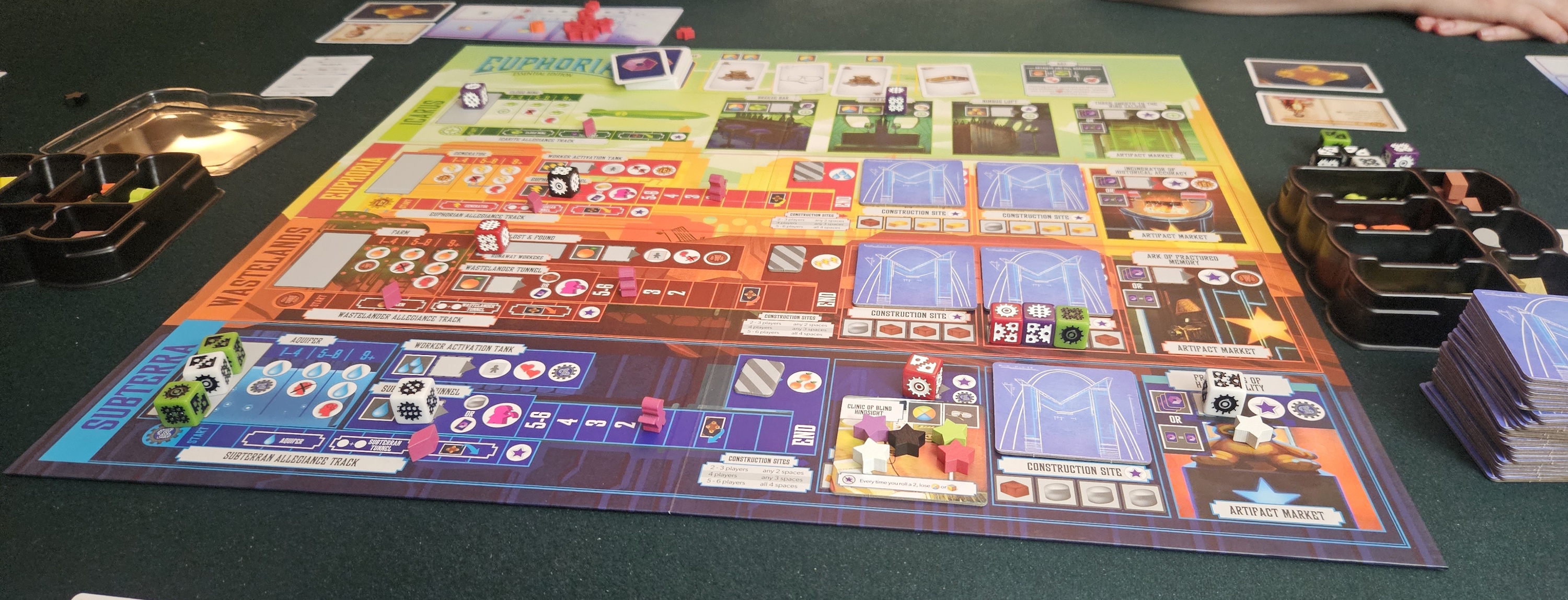
The new board, not quite the same as the old board.
Short version, there’s rebar showing through the concrete.
As before, Euphoria is about your efforts to thrive in a dystopian society. Relatable. Maybe that’s why the intervening decade hasn’t flown by. But I digress. In Euphoria’s case, that dystopian society is divided into four strata, each offering different spaces for your workers to run errands. There are the Euphorians, folks who generate electricity by marching on hamster wheels, Wastlanders who labor in orange groves, Subterrans who pump water through the cracked bedrock, and Icarans… Icarids? Icaruses? Whatever. These guys cook future-meth for keeping everyone’s workers drowsy and compliant.
The status of those workers is never far from mind. At the time of the original game’s release, rolling dice to determine the relative knowledge of one’s workers was a clever touch. If nothing else, it functioned as one of the hobby’s earliest meta-commentaries on the blank slate that was the worker-placement worker. Roll too high, and one of your workers gets wise to the situation and flees from your grasp. Roll too low, and…
… and there’s no penalty for rolling too low. What you really want is to roll doubles. That way, you can spend some morale to place an extra worker, earning two turns in a single go.
Euphoria: meek in the streets, freak in the spreadsheets.
At the time of the original game’s release — there’s a phrase I’ll probably say more than twice — it was easier to overlook the chanciness of the whole thing. Sure, rolling high means losing a worker, and rolling doubles means earning a twofer. But rolling low, I suppose, means you can send a worker to one of the game’s resource production zones without worrying about them learning the shape of their culture. Except, wait, that’s another benefit for rolling low. Darn it.
Okay, so Euphoria is full of luck. Always was, still is. The problem isn’t so much that luck is the sole determiner of whether you succeed, but rather that it’s just enough to prove frustrating. As a genre, Eurogames included more chance in 2013 than they do today. Personally, I miss a bit of chance. But in general, those earlier forms of chance were about mitigation. Even placing towns in Settlers of Catan was about spreading around the odds so that you’d always earn something. In Euphoria, the system feels out of place, and not only among the determinists of 2020s nu-euros.
But let’s set that aside. How has the rest of the game borne the timelapse?
Again, the short version is that it works perfectly well, but never quite eases its grandfatherly creaks and groans. Most actions are tit-for-tat resource conversions. First you send a worker to a resource generator to earn one or two commodities. Then you send them to a tunnel to spend a commodity for a building block. Maybe you spend a wad of commodities for an extra worker. Then you build special markets, which let you exchange commodities, blocks, and artifacts for stars, the game’s victory condition. Repeat. Repeat. Repeat.
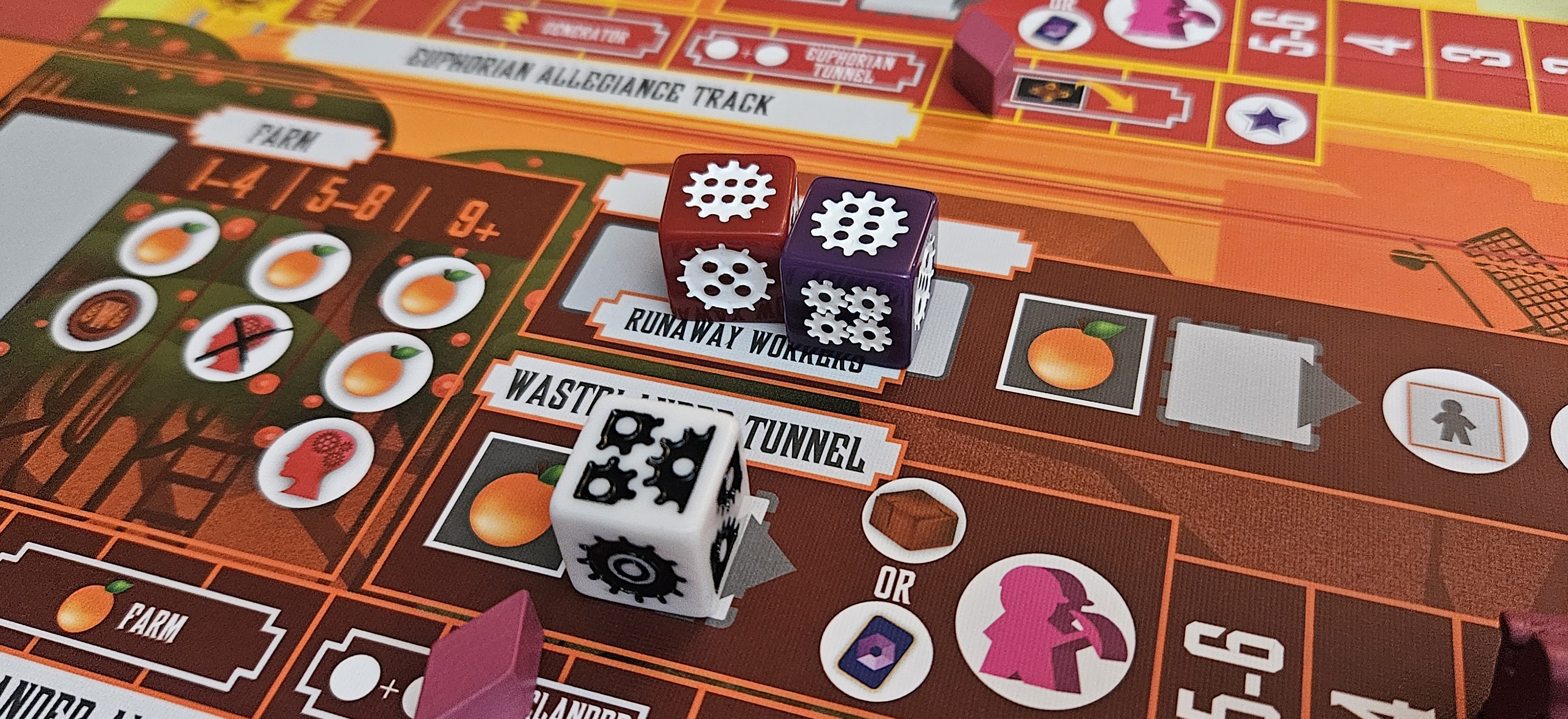
“Runaway workers” sure is a loaded term.
It doesn’t help that the Essential Edition sometimes comes across as more of a Pruned Edition. The board is more legible, but has shed the original map’s sense of place. Just look at that perfect goofball illustration. The new map feels like a spreadsheet setup for a spreadsheet game. Which is fine, as those things go. This is a resource-conversion worker-placement game, after all. You could even make the argument that this new edition has shed the original game’s pretense, including the ethical dilemma cards that, let’s face it, didn’t always add much to the game systems-wise. But, again, they mattered to Euphoria’s sense of place, the notion that players were being forced to compromise their values in order to get ahead. Thanks to the intervening years, a few subtractions, and this updated visual design, it’s easier than ever to see the wires and mirrors behind the illusion.
The remaining good parts are still as good as ever. For example, those markets. As before, building a market means spending a bunch of building blocks, not to mention putting your laborers in a holding pattern until other players join in. This created a certain degree of cooperation, one that could be turned against you at a moment’s notice. Having even a single worker hanging around at a job site is a real sacrifice, fostering opportunities for players to bicker and cajole. That’s great.
Furthermore, the markets themselves are nasty little things. When built, every player who didn’t contribute to its construction is forced to suffer a penalty until they pay a penalty at the new market. Sometimes these are negligible; other times they pose biting impositions that must be rectified as soon as possible. Or even both at once. The Theatre of Endless Monotony reduces how many commodities you earn, but only to a minimum of one. The Institute of Orwellian Optimism treats all your 1s and 2s as 3s when it comes to checking your dice for thoughtcrime. The Courthouse of Hasty Judgment makes it harder to spend artifacts for stars. That sort of thing.
This guy is a cool dude.
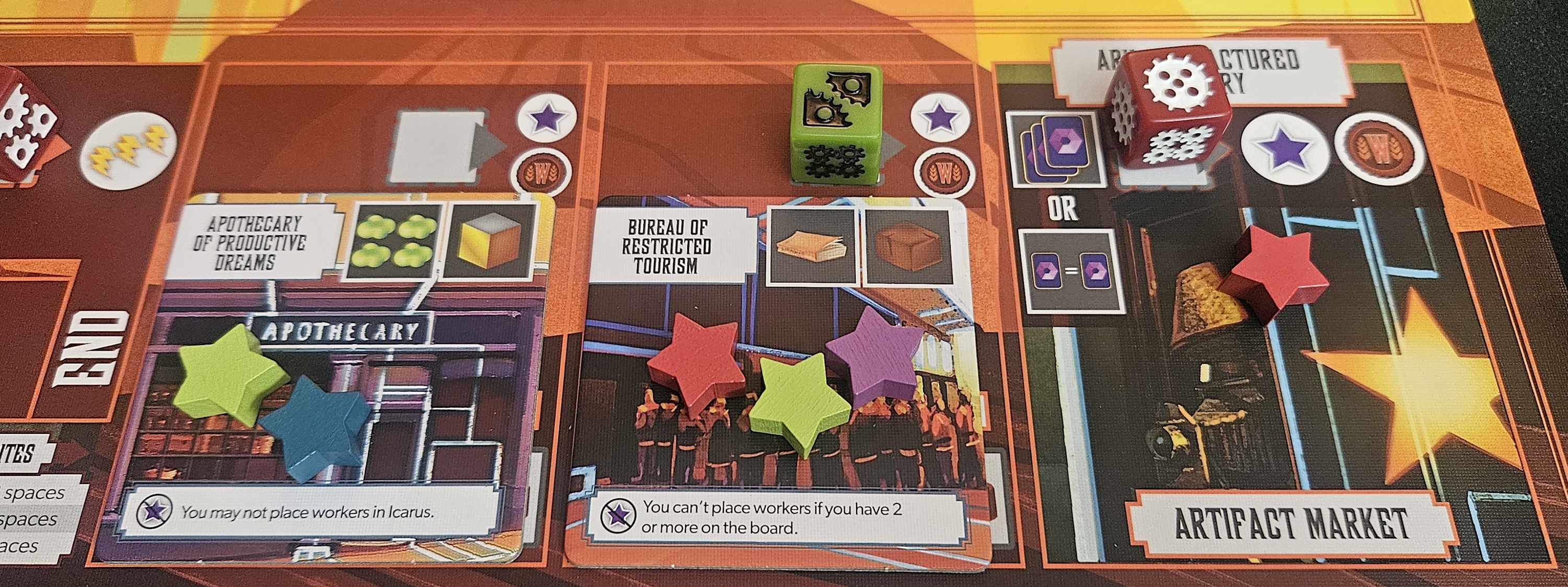
There are some real whoppers in there, too. In one case, we revealed the Apothecary of Productive Dreams. This market prevents some players from sending workers to Icarus. At all. Which effectively locks them out of a full quarter of the board’s spaces. Worse, buying into an already-built Apothecary requires bliss, the very same drug peddled by the Icaroopsies. Not only were some players locked out of Icarus territory, this locking-out was effectively permanent. Was this a fair turn of events? Hardly. But it was interesting. Textured, we might call it. Abrasively textured, sure, but it was refreshing to play a game that would offer such overt penalties rather than ensuring everything ran smoothly all the time.
Between these and the heaps of recruit cards, there’s always something happening on the board. Some market being constructed (or ruining your day), some recruit tweaking the rules to your benefit, some haggling over at the construction site. That’s all great.
The downside is that it never quite breaks free of its shackles. Board games have largely moved on from worker placement, at least in such a straightforward cube-pushing sense. And Euphoria always feels like cube-pushing. Every segment of its dystopia is more or less identical to its peers. The same resources exchange rates. The same methods for hampering one another. The same costs at the artifact markets. And now those four segments are placed side by side so you can see just how closely they align.
In a sense, the Essential Edition is a worthwhile experiment because it highlights just how far game design has come over the past decade. But it’s only a worthwhile experiment for me, a total sicko for how board games change and develop over time. For somebody looking to spend their hard-earned cash, there are better options out there. If I’m going to place dice-shaped workers and suffer random consequences, I’d much rather play Connie Vogelmann’s Apiary, and that’s limiting our selection to titles from the same publisher.
E:EE is full of little textures. Some of them are abrasive.
Because Euphoria has been left behind. By board games as an iterative artform. By our hobby’s collective taste in the role of chance. By an Essential Edition that leaves some of its most interesting ideas in the dustbin. By a culture that’s grown weary of dystopias.
Speaking only for myself, I think it’s time to tunnel through to the other side.
A complimentary copy of Euphoria: Essential Edition was provided by the publisher/designer.
(If what I’m doing at Space-Biff! is valuable to you in some way, please consider dropping by my Patreon campaign or Ko-fi. Right now, supporters can read my first-quarter update of 2026: the best board games, movies, books, and more!)
With this My Favorite Wargame Cards Series, I hope to take a look at a specific card from the various wargames that I have played and share how it is used in the game. I am not a strategist and frankly I am not that good at games but I do understand how things should work and be used in games. With that being said, here is the next entry in this series.
#79: Culper Ring from Liberty or Death: The American Insurrection from GMT Games
In case you didn’t know, I love Liberty or Death: The American Insurrection! This is my 2nd favorite volume in the COIN Series and is such a fantastic game filled with the history of my favorite historical period the American Revolutionary War. Liberty or Death was the COIN Series’ first foray into non-modern warfare and takes us to the 18th Century and the days of the Brown Bess musket, the 18 pound siege cannon and nice and tidy formations better suited for a gentleman’s war. The focus of the game is the struggle of the American Patriots against their mother British government as they have made their intentions clear to become independent with the Declaration of Independence. The game is a multi-faction treatment of the American Revolution, which includes the Patriots and their allies the French against the British and their reluctant allies the Indians.
Liberty or Death is a 1 to 4 player game focused on all aspects of the struggle including financing operations with Rabble Rousing, infiltrating British held cities to Skirmish, blockading major cities with the mighty French fleet, Raiding the frontiers with the Indian nations, the spread of propaganda to build support for the revolution, fort building and small scale battles. So, with this short description you can see that this game is not a “traditional” wargame but does contain some armed conflict. So a game about the American Revolution that isn’t focused on battle you say? How can that be? Well, I will tell you that this game is probably a perfect representation of the multifaceted struggle that wasn’t necessarily decided on the field of combat, but by the little actions of many behind the scenes characters. Yes battle will decide the control of major areas of the board and decide the fate of troops as they must be concerned about being in supply through a network of forts but the game is so much more than just rolling some dice and consulting a CRT!
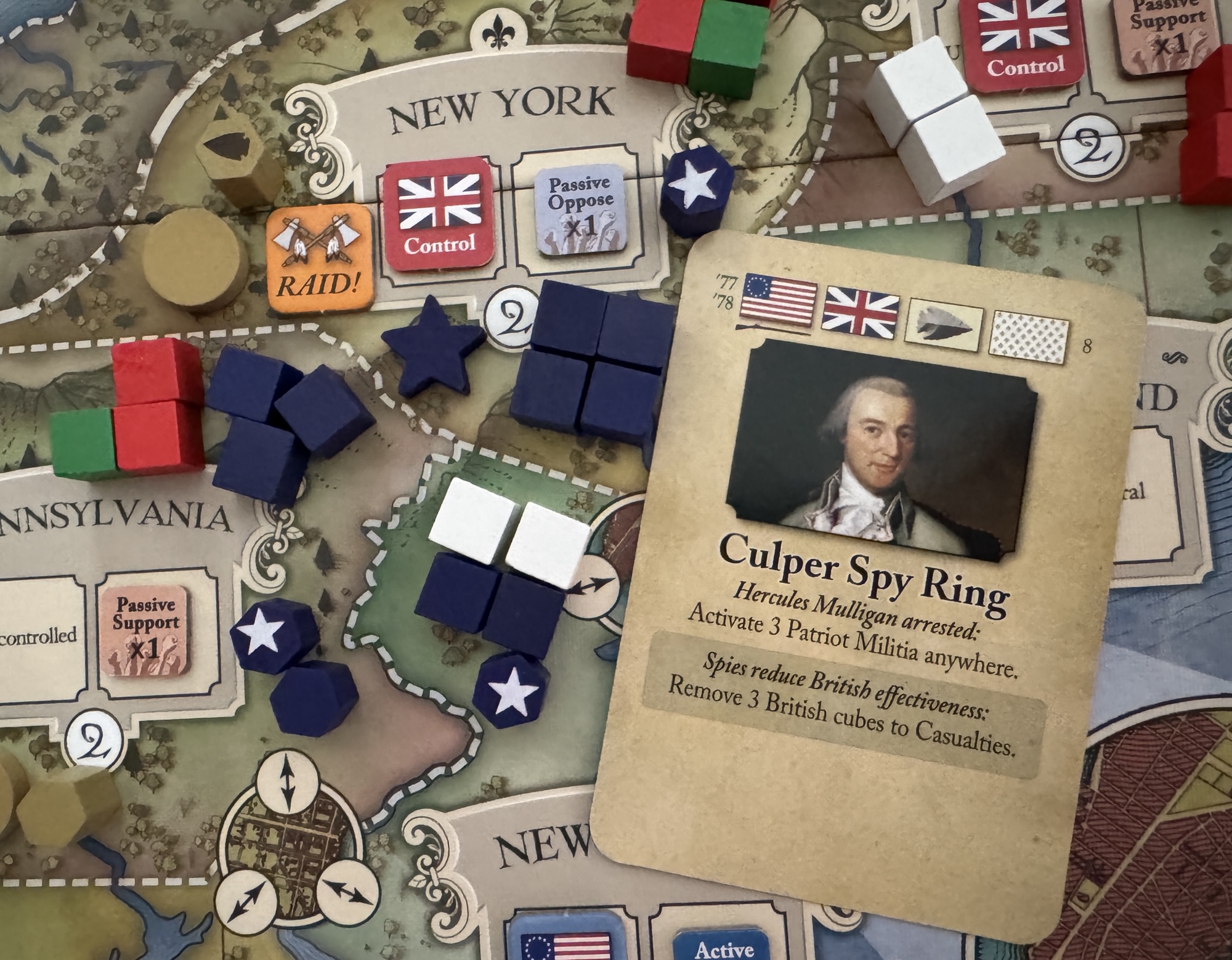
In today’s entry, we are going to take a look at a very interesting card called Culper Spy Ring. I very much enjoy the connection of this card to the history of the American Revolution as it deals with one of the more important aspects of the war being that of reconnaissance and spying to gain intel on the enemy’s plans and the makeup and disposition of their forces. The Culper Spy Ring card allows the British/Indian players to Activate 3 Patriot Militia pieces anywhere on the board. These pieces do not have to be located together in the same space but can be in 3 different spaces if the players chooses. This is a very powerful event as the Patriot Militia are generally only able to perform their actions if they are Underground meaning hidden from the British. Typically their Commands and Special Activities for things such as Rabble Rousing (create Opposition to Crown rule), Persuasion (get Resources) and Partisans (attack Royalist pieces), require at least 1 Underground Militia piece be in the space and typically requires that they be Activated or turned face up with their embossed star icon showing. The process of turning up these Militia pieces normally involves a British March Command into a space with Underground Militia but the process of removing them requires an additional step by taking either a Skirmish Special Activity or a Battle Command. This card allows for these turncoats to be discovered and then removed in a later action. If you also read the card above the action description you will notice that it says “Hercules Mulligan arrested”. Hercules Mulligan was an Irish-American tailor, spy, and founding member of the Sons of Liberty. Operating in British-occupied New York City, he used his high-end tailor shop to befriend British officers, gather critical intelligence, and covertly pass military secrets to General George Washington. Mulligan is credited with twice saving General Washington from capture or ambush. He sent secret messages, often via his trusted assistant Cato, warning Washington of planned British traps. I love the history here and am very glad that the design and development team gave a shout out to this little known American hero who risked his life to perform these spy activities in New York City.
The bottom half of the event is for the Patriot/French player and has an immediate powerful effect that can change the odds of an upcoming Battle or wrest control of a key province from the British at an inopportune time. The event simply allows the removal of 3 British Cubes from the board, consisting of British Regulars or Tories, and then placing them into the Casualties Box. This is a key action because it can cause the shifting of the delicate balance for the British between Combined Rebellion Casualties (CRC) versus Combined British Casualties (CBC). This difference is 1 of the 2 parts of the British Victory Condition and the CRC must be higher than the CBC. I also love the text above this benefit as it states “Spies reduce British effectiveness”. This is an homage to the critical work of these spy rings as they often lead to more beneficial and favorable Patriot outcomes to Battles as they were better prepared or knew the British plans before the battle event took place.
Major Benjamin Tallmadge.
The Culper Spy Ring was an American intelligence network established in 1778 by Major Benjamin Tallmadge and General George Washington. Operating primarily in British-occupied New York City and Setauket, Long Island, the ring provided vital reconnaissance on British troop movements, notably exposing Benedict Arnold’s treasonous plot to surrender West Point. The network utilized a chain of trusted individuals rather than trained military spies from all walks of life. Some of the more famous spies in this vital ring included:
Agent 355: An anonymous female member within the ring whose true identity remains unknown, though she is credited with providing crucial insights
Benjamin Tallmadge (alias “John Bolton”): The spymaster and director of intelligence who managed the flow of information.
Abraham Woodhull (alias “Samuel Culper Sr.”): The primary gatherer of intelligence in Setauket, who oversaw the ring’s daily operations.
Robert Townsend (alias “Samuel Culper Jr.”): A Manhattan merchant and journalist who operated within British circles, collecting firsthand intelligence on the enemy.
Caleb Brewster: A daring whaleboat captain who transported the messages across the treacherous Long Island Sound.
Austin Roe: A Setauket tavern keeper who acted as the primary courier, frequently riding the 55 miles between Setauket and New York City.
The Culper Spy Ring is widely considered one of the most successful intelligence networks of the American Revolution. Its greatest achievements included preventing a surprise British ambush on incoming French forces in Rhode Island and securing the intelligence that led to the capture of British spy master John André. The secrecy maintained by Tallmadge was so effective that the true identities of the spies were not discovered by historians until the 20th century.
This Culper spy network was the feature of a television series on AMC called TURИ: Washington’s Spies that aired from April 2016 through August 2017 and spanned a total of 40 episodes.
The story of the drama covers events from 1776 to 1781 and features a farmer from Setauket, New York and his childhood friends who form an unlikely group of spies called the Culper Ring, which eventually helps to turn the tide during the American Revolutionary War. The series begins in October 1776, shortly after British victories, including the recapturing of Long Island and the Port of New York for the Crown, leaving General George Washington’s army in dire straits. The first episode opens with the following introductory text:
Autumn 1776. Insurgents have declared war against the Crown. Following a successful naval landing, His Majesty’s Army has forced Washington’s rebels into the wilderness. New York City serves as a military base of operations for the British. The Loyalists of nearby Long Island keep vigilant watch out for sympathizers and spies.
I very much enjoyed the tv show and loved watching each episode to see the hidden historical details of the Culper Spy Ring be revealed that have been discovered over the past few hundred years since the events of the American Revolution. Just an amazing example of a grass roots and loosely organized group of Patriots who risked their lives and families to ensure that the cause of Liberty prevailed.
In the spring of 2021, I became fascinated with yomi (the Japanese term that means reading your opponent) and found myself exploring it in several designs. The famous goblet of wine scene from the Princess Bride is an illustrative example of the moment I wanted to capture. One iteration eventually became the core loop of Jonathan Gilmour-Long and my game Making Monsters, which is currently available in stores. In Making Monsters, you’re rewarded for correctly anticipating what your neighbor will do.
For this new game, Jon and I wanted to craft a group yomi experience of one vs. many. The core concept of a single player choosing a location and everyone else trying to guess where it was provided the forum for a group think. We imagined lively discussions about where they might go, inspiring provocative “Princess Briding”. Sparks and magic were there in play test #1, and we knew we had something special.
Bohnanza is one of Jon’s and my favorite games –we love the way the scoring is so simple, yet provides varying incentives to different players, facilitating trading. For our scoring, we simplified some of the math and made sure the maximum number of points per card was no more than 1, so that we could use the cards for scoring and avoid an additional currency.
For the theme, my son Ben said he’d been playing a video game that had an underwater lab, and I immediately knew that setting would work here. We would be marine scientists exploring the ocean from an international sea lab. Each day of the week, a different player would have access to a ship, and all the other scientists would have to guess whether that player would use the ship that explores the deep, the trench, or even the abyss.
Sea Lab Board, Player Board, and some cards from July, 2021
Over the course of many months, we tested all different player counts, lengths of games, tweaks to the points systems, special twists for different locations, and the ins and outs of every system. One turning point was a test with Gil Hova, where he recommended that the players who guess incorrectly at least get a card from the deck. Yes, it would be random, but they would get something to build around. This helped the game keep pushing forward but also extended a hand to a player who might be super unlucky. This eventually became what we know as the River in Pinched. We also tested various complexities. We added a system of Community Projects, where you could find use for cards that didn’t match in your hand. We ultimately found the extra complexity wasn’t necessary.
The game quickly became a play tester favorite among our friends. Some grew into huge fans and asked to play it over and over. This is generally a good sign! By the end of the summer of 2021, we were pitching Sea Lab and by September, a publisher offered to sign it if they could get an IP they thought would be a great fit. They tried for a long time but were unable to secure it, so in the spring of 2024, Jon and I started pitching it again. We showed it to David Chircop and Gordon Calleja in April, and on May 2, they offered us a contract! Jon and I had wanted to work with Mighty Boards for a long time, so we were super excited. And yeah, I liked the idea of the publisher’s names being David and Gordon.
Soon after we signed the contract, David approached us about a new setting concept, which Jon and I thought would fit perfectly. Over the next nine months or so, they worked hard to revise every system and make sure it all made sense and felt seamlessly integrated. Jon and I appreciated how often they checked in with us to make sure we agreed with all the editing and art. That was easy, because the art is amazing, and the theme is perfect!
And I personally want to thank Mighty Boards for including my own beagle Gordon Gordon (he was named Gordon before we got him!) on one of the cards in the game!
We truly hope you will enjoy Pinched! and thank you so much for reading this diary.
Play Testers Michael Addison, Phil Amylon, Jessie Batzel, Chris Chan, Glenn Cotter, Lydia Gallant, Tara Gilmour-Long, Ari Gordon, Ben Gordon, Jen Gordon, Micheal Guigliano, Myles Heffernen, Gil Hova, Nolan James, Jacob Keiser, Suzannah Keiser, Jamie Lichty, Travis Magrum, Pat Moreno, Ian Moss, Daniel Newman, Bryan Oemler, Cici Ogden, Rocco Privetera, Dhaya Ramarajan, Ryan Rodriguez, Jack Rosetree, Micah Sawyer, Catherine Stippell, Max Swietnicki, TAM, Willa Tracy, Bill Ward, Adam Young
My Fifty by Fifty finished a few years ago (four years late). But time marches on. So … Fifty-One. Dice Realms recently got its 25th play and picked up a few more last night, which was nice. (I honestly thought it would make the list years ago, but I’m much more of a proponent that most of the locals).
Also, the local group has switched FLGS to one of the more modern ones that has a liquor license and a kitchen. I haven’t gone much this year, but last night had a large crowd of several different groups, including quite a few couples and one adorable baby. It speaks quite well of the hobby to see such a broad cross-section of people. Now the store just needs to sell a few more copies of High Frontier 4 All (which it does have stocked!) so I can get more opponents, because that’s going to be a hard game to get fifty plays in.
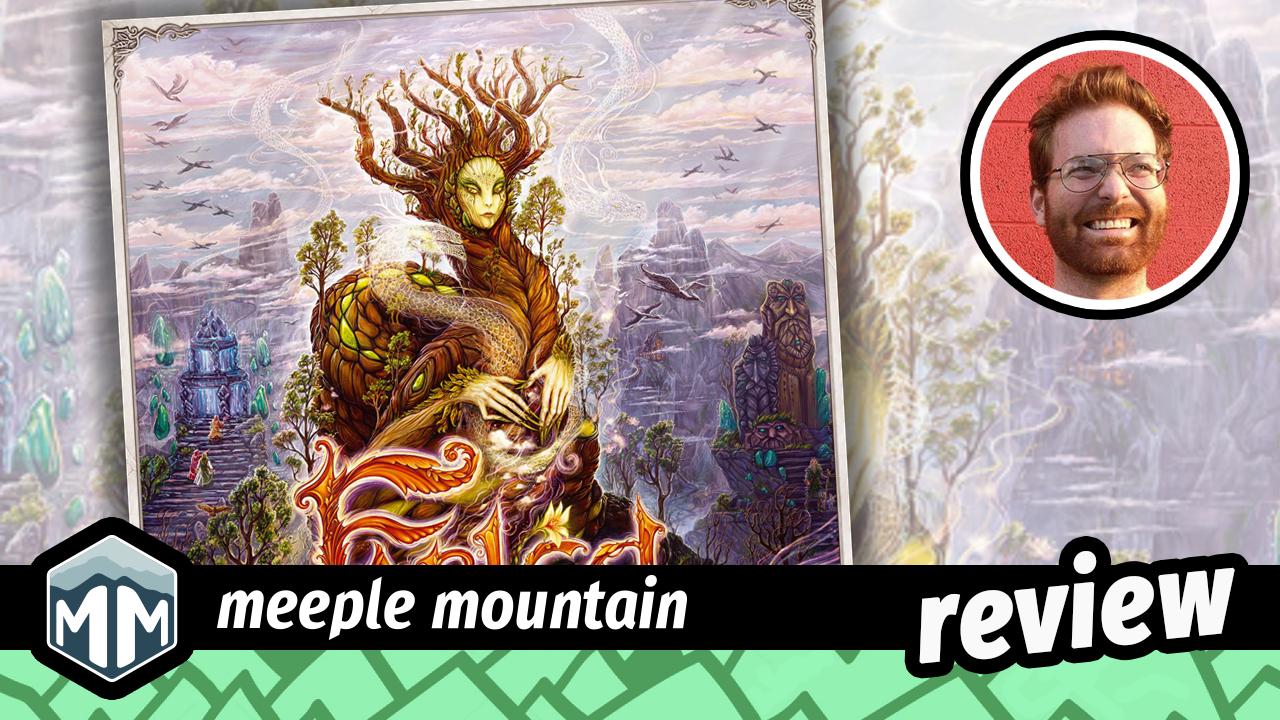
Rarely, I come across a game whose aesthetics overpower my critical sense. Fabled: The Spirit Lands is one of those games. It also makes moving up tracks not look and feel like moving up tracks, which is high praise from a curmudgeon like myself.
Bookington Bear
The object of Fabled: The Spirit Lands is to collect the most red books by the time the game ends. There are several scenarios that alter this formula, but ultimately, it’s a Knizian affair, where if there’s a tie for the red books, you go to the green books, then the blue books, and finally the crummy yellow books.
You can think of the books as cubes of four colors, and what you’re doing throughout most of the game is turning the books from one color to another color. It’s resource conversion at its most basic–two yellow books become a blue, two blues become a green, and two greens become a red.
The game operates with a simple formula, but it has some interesting quirks. Let’s talk tracks.
Take a hike
The game doesn’t call the map cards tracks, but tracks are what you have to work with as a player, so I’m going with it. At the beginning of the game, each…
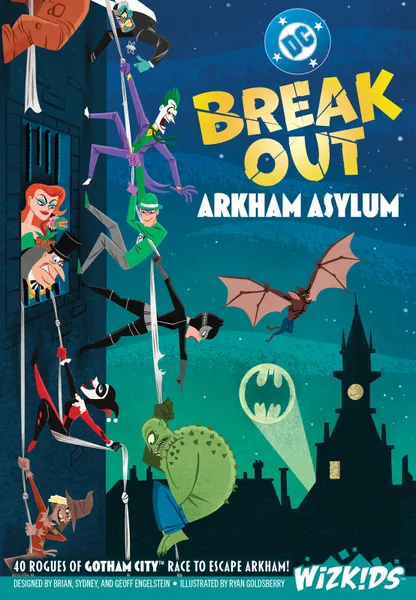
Geoff Engelstein was influential in bringing Takashi Ishida’s Magical Athlete to the United States in 2003. It’s unsurprising that Geoff, alongside his children Brian and Sydney, have tapped into the spirit of that phenomenal race game, pairing its traditional roll and move structure with several new flourishes. In fact, there is so much of that…
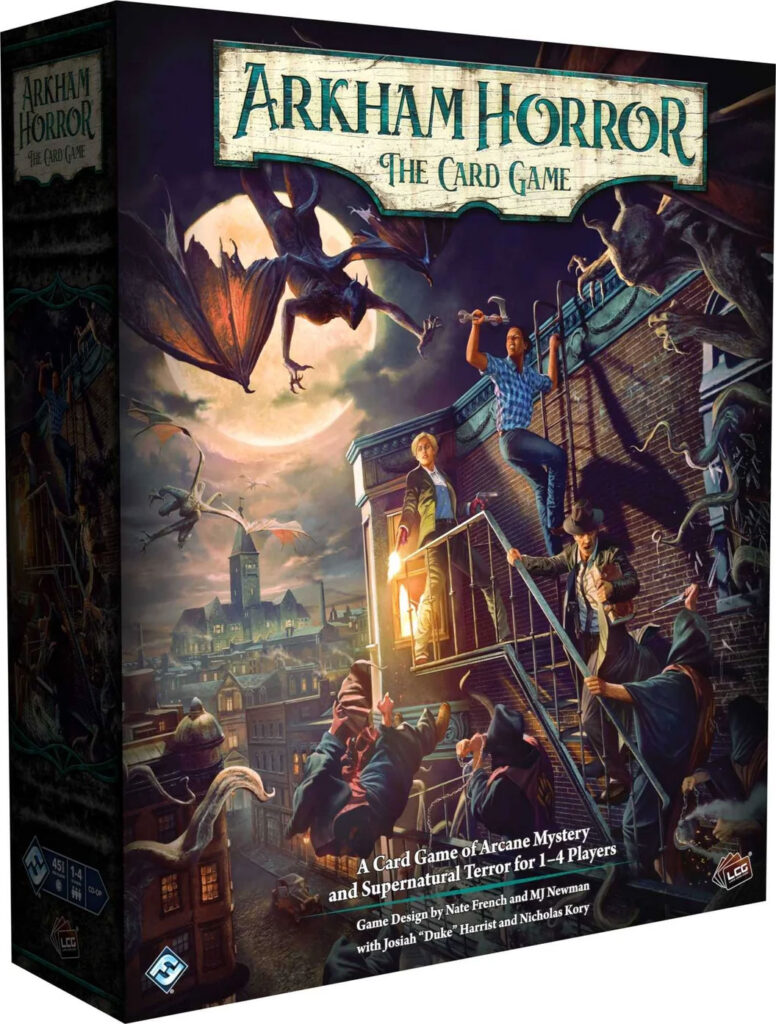
Fantasy Flight Games has been gracious enough to continue to support the Arkham Horror: The Card Game system for almost ten years. During that timeframe, they released several campaigns, standalone scenarios, investigator decks, and supplementary products. Due to a lack of reprints and scarcity, the system was strained by continuing forward while losing the ability […]
Designers don't like it when players criticise their board game, and the response often is that the game was intentionally designed that way. Players complain that a strategy feels unfair, a mechanism is frustrating, or a game simply isn't very clear. Designers reply that that just misses the point. Similar disagreements exist in films, novels, and art, yet board games seem to have them more often, and they are often more personal. Part of the reason may be that board games are not passive experiences. Players are not simply watching events unfold, but instead are interpreting rules and shaping the experience themselves every time the game hits the table.
Ace of Spades Designer: Benja Amorin Publisher: DEVIR Players: 1-2 Age: 14+ Time: 40 minutes Played with review copy provided by publisher Your path of vengeance has led you to Sweet Haven, Arizona. You know that the necromancer who … Continue reading →
Don your black leather and grab your Grimcoven rules and reference!
Awaken Realms are now a decade old as of this writing, and their astonishing success and huge creative output has not only made them one of the best publishers in the business, but the flag bearers for huge, over-the-top productions absolutely drenched in theme and atmosphere. A gaming style I’ve had a soft spot for since I bought my first big box Games Workshop games back in the late 80s.
Grimcoven continues the tradition of wonderful excess, but there are some interesting things here that break the mould a little and tell us that the company isn’t just resting on its laurels. First, it’s a boss battler in which you play one-off games – no overarching campaign here (though you can add a little bit of character development with the Personal Stories expansion). Next, there’s something about this game system that, as I was playing, made me think of that much-used word ‘elegant’ – and I can assure you that’s not a word I use often when it comes to Awaken Realms. Unlike their usual style of dense, many-step phases that you can never remember without a reference sheet close to hand, Grimcoven actually flows smoothly and cleverly from step to step (and where it does get a bit complicated, nice little standees remind you of the sequence of steps).
I’m very happy to see Awaken step back from the long campaigns which demand a commitment of months (and often seem end up in solo play mode as a result), and move more into one-off games and more manageable campaign structures (see Lands of Evershade). Not all of us want to leave a game set up for months, or wish to devote that much extended gaming time to a single game.
Grimcoven is packed with content – there are 6 unique hunters, and each of the 6 ‘big bad’ Griefbounds have 5 scenarios of increasing difficulty (plus combinations of elite enemies and minions), plus expansions give you 2 more hunters and 2 more Griefbounds. Then, if the hunters get corrupted enough, they unlock ‘Pretenders’ – semi-Griefbounds that you can also hunt. The game plays out on modular hexagonal tiles with various terrain setups, and special cards give the terrain even more personality. The dice allocation system that powers the hunters’ actions is nothing revolutionary, but it works smoothly and efficiently here, without all the dice modifier jiggery-pokery that slowed down ISS Vanguard.
And you want the system to be smooth, because this game does not go easy on you, and you have to fully concentrate on your tactics to beat your Griefbound of choice. The game demands careful cooperation between players for success, so this is one of the most engaging cooperative combat experiences I’ve had. Also, as your hunters collect lament (the power currency of the game), you can customise your suite of abilities and gain more dice as you simultaneously become more corrupted, which gives the game a lot of forward momentum. While the difficulty can be frustrating at times, there’s a great sense of wanting to come back and try again if you lose, and there are enough interesting choices to keep you planning what you’ll try next time.
I’m highly impressed by Grimcoven so far, but I have a few more games to play yet before my full review. In the meantime, download my rules & reference (also available on Tabletop Codex) and check out my full ‘boss pledge’ unboxing video, released tomorrow!
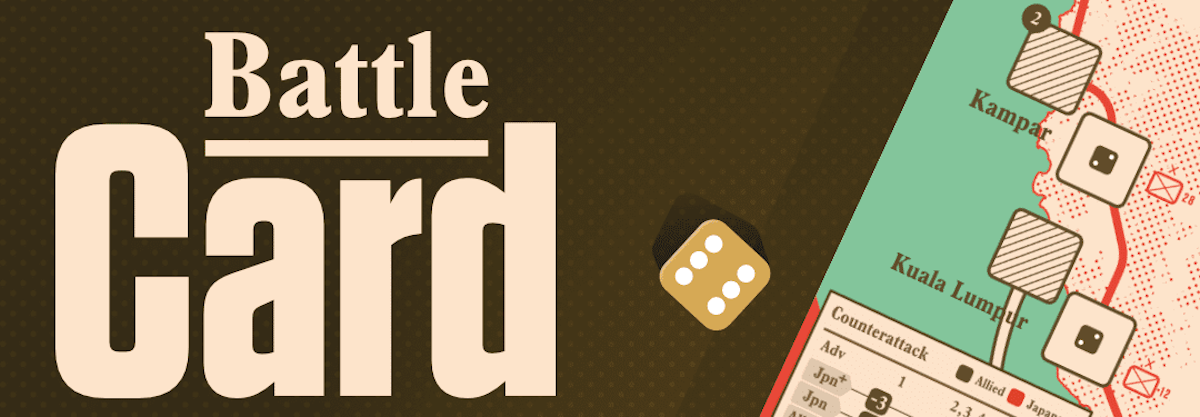
Battle Card is as apt as descriptions get. Designed by David Thompson and Nils Johansson, this is the fourth project in the Postmark Games lineup. Like its earlier peers — Voyages, Aquamarine, and Waypoints — this is a print-and-play title that can be produced with functionally zero budget. Unlike those projects, however, Battle Card is billed as a wargame on a single postcard-sized sheet.
That’s true enough. With a few dice and a smidgen of experience to help interpret the rules, Battle Card covers six engagements from the Second World War. And their format is indeed very small, highlighting some real resourcefulness on their designers’ part in compressing battles and even campaigns into ten-minute experiences.
But unlike those other titles, Battle Card is a mixed bag. I’ll give an example.
Rock on, Canada.
The second of Battle Card’s six scenarios sees Commonwealth forces waging a fighting retreat against Imperial Japanese troops shortly after the attack on Pearl Harbor. Over the course of two months, these forces staggered their positions along the Malay Peninsula, gradually ceding ground in an attempt to withdraw a portion of their forces. Historically, the campaign was catastrophic for the Allies, revealing Japanese air superiority and rapid infantry. (Mounted on bicycles!)
In Battle Card, the situation isn’t much better. Dice represent the armies on both sides, with their pips indicating their current strength. These armies engage in battle — determined by the roll of another die — and shift positions along the twin roads along the peninsula.
Here, the situation is relatively static. As the leader of the Commonwealth forces, your options mostly revolve around when to retreat, whether to defend your position or mount a counterattack, and which units to gradually pull back toward Singapore. No matter the outcome of any individual roll, the game has been fixed, much as it was historically. It isn’t a question of whether the Japanese will overtake your position, but how swiftly.
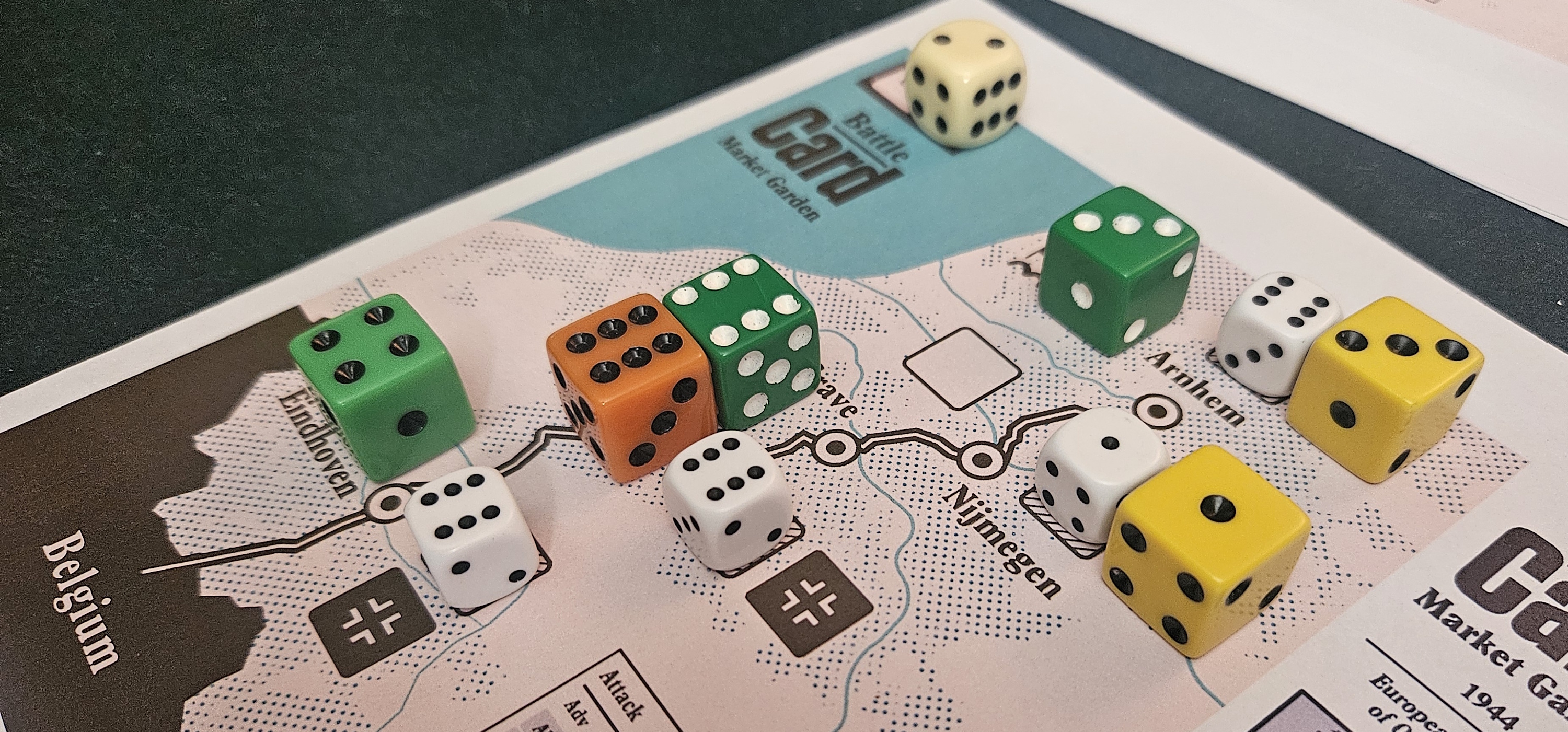
The Market Garden scenario is ostensibly a demo, but it’s fiddlier than those that come afterward.
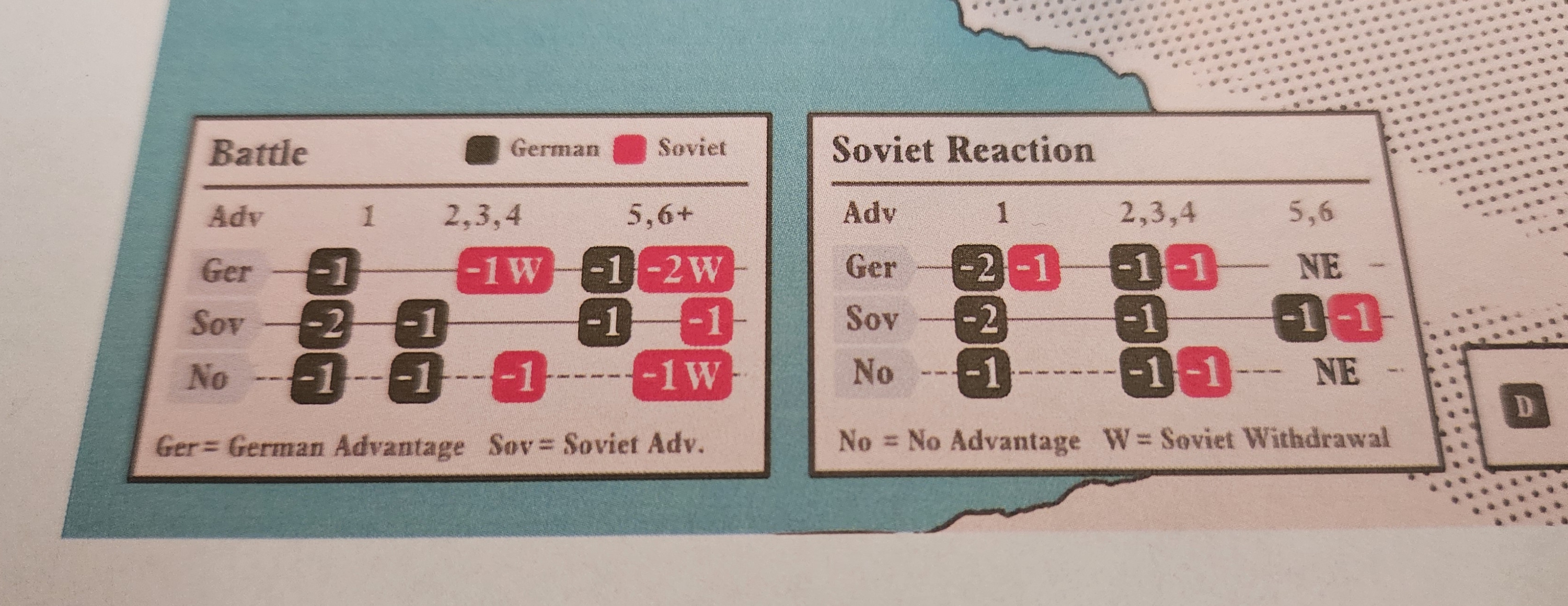
What follows is a strong indication of both the system’s strengths and weaknesses. Your choices, such as they are, are as bite-sized as the game’s footprint. Retreat or hold; defend or attack; withdraw a die along a road. The roll-offs are governed by small combat results tables that factor in whether one side has an advantage — meaning one side’s die has more pips than that of their enemy. As advertised, it’s fast. And, to its credit, the minimalist design does lend some sense of the geography and the central conundrums of the conflict.
In this case, your objective is to withdraw three pips to Singapore, and the way to accomplish this goal is closer to a puzzle than anything offering operational flexibility. Either you stick your troops behind the right line in the sand or you don’t. Either you withdraw in time or you don’t. Either you make high enough rolls or you don’t. No matter the scenario, this is more or less how Battle Card functions. There’s a solution here. That solution still requires the bulk of the rolls to go your way, but that’s the solution, and there’s no deviating from it. Perhaps most damningly, once you’ve uncovered that solution, there’s really nothing else to see.
Yes, yes, I’m the guy who wrote that replayability is overrated. But there are slender games and then there are slender games. Battle Card is the latter. Each play lasts between five and ten minutes. Scenarios are also compact, as befits a game called Battle Card, meaning there aren’t many subtleties to any given fight. If you don’t figure out the trick on your first play, you’re bound to have a strong suspicion heading into your second. After that, it’s really a matter of getting the right rolls.
Combat results tables! We got ’em!
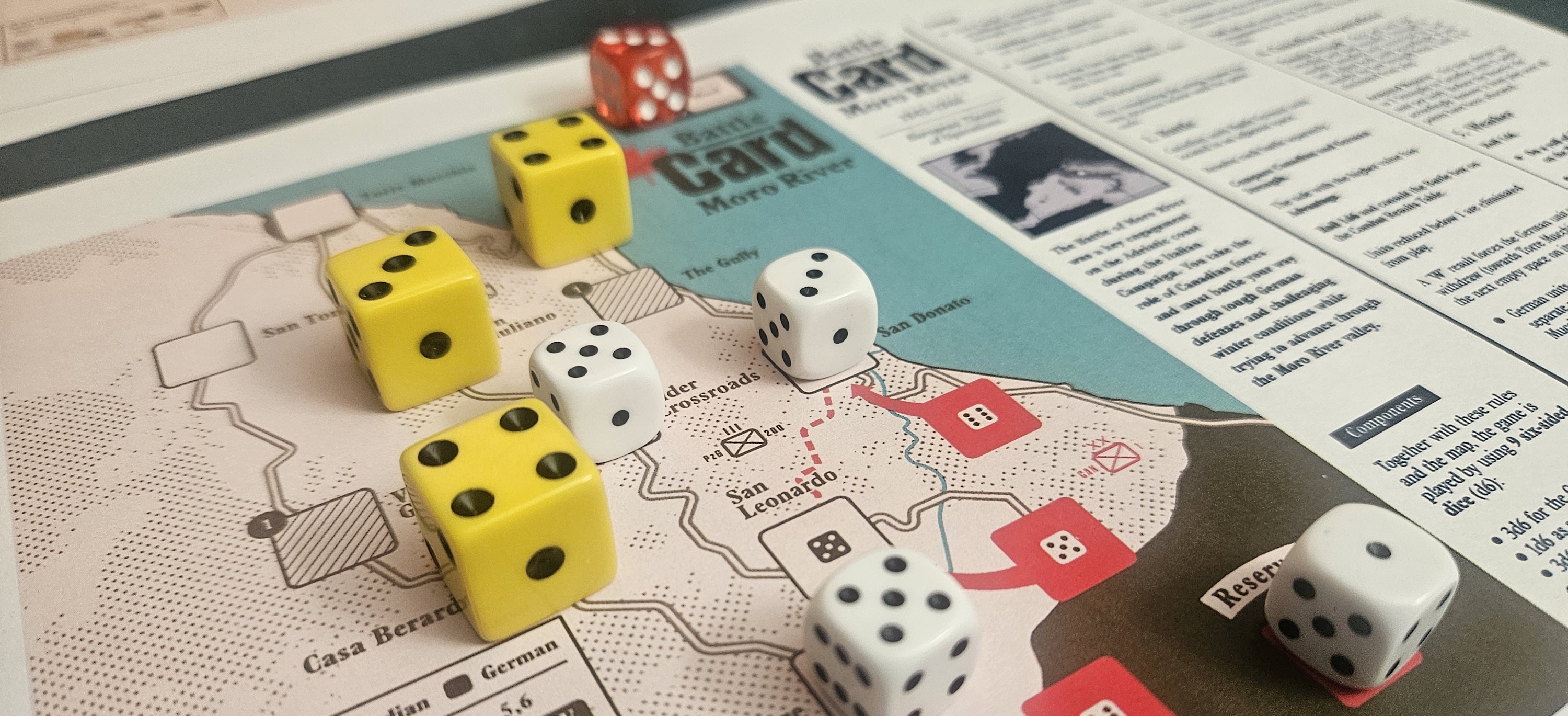
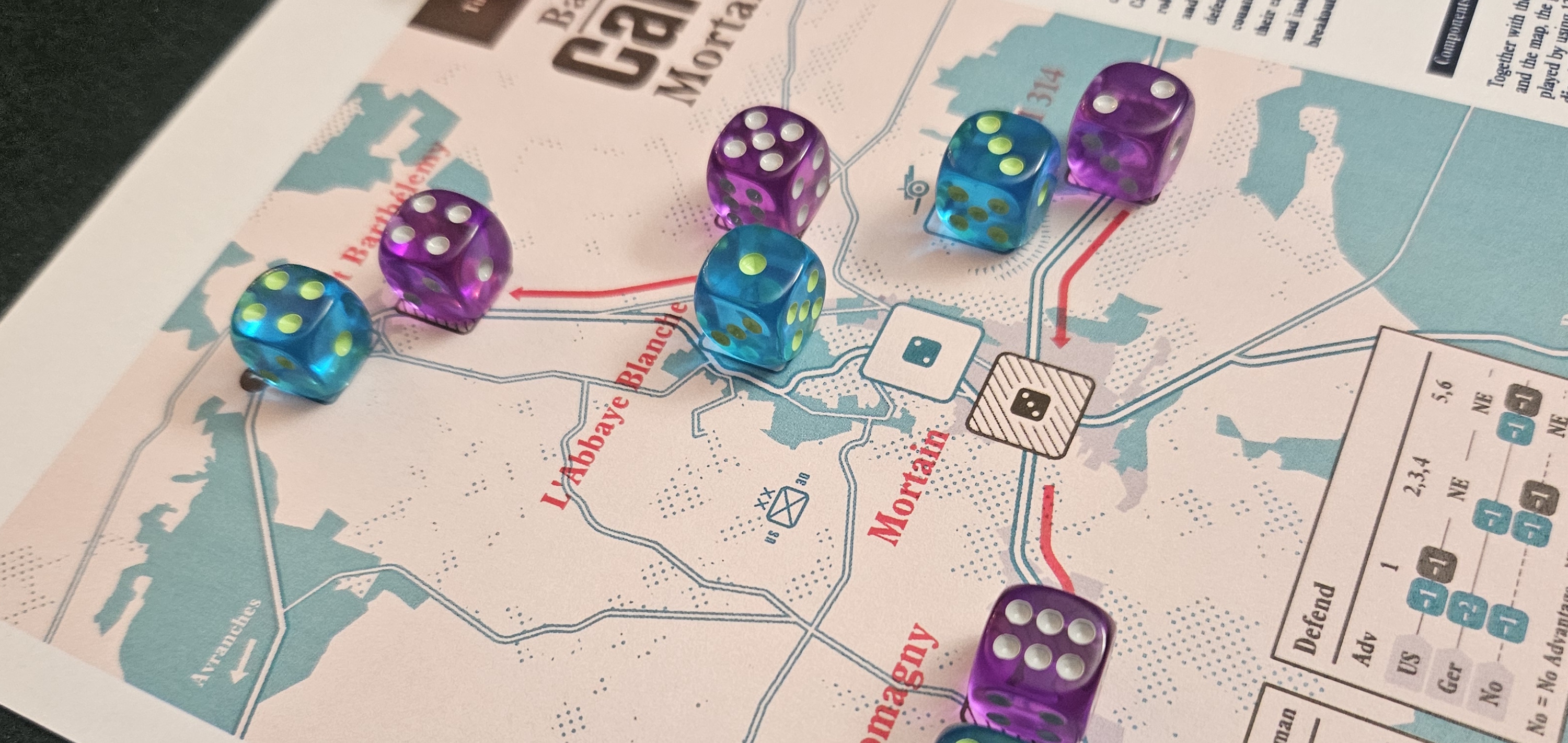
This isn’t to say the whole enterprise is doomed. The best scenarios offer some wiggle room between maneuver and chance. As the Canadians make a three-pronged drive up the Italian boot in the Moro River scenario, they must pause to reinforce any divisions that took a beating. As the Germans plunge toward the Caucasus oil fields, they need to decide when to split their forces into smaller but more vulnerable columns. Choosing where to fire your artillery at Mortain is… well, it isn’t the most complicated decision, but it would also be inaccurate to call it straightforward.
Again, though, that’s about as much mileage as anyone will get out of these print-and-plays. I’ve run through the entire series twice now, and the second time I found myself growing weary. This stands in strong contrast to those other Postmark titles. As score-chasers, there was always a reason to return for another attempt. Here, the entire format feels too compressed, like a States of Siege game without the chrome-laden considerations that made that series so interesting. Mostly, it was a nice way to organize my dice by color and size.
Firing the arty.
In a way, Battle Card isn’t that far off from looking at an animated battle map. All those little arrows and company designators. The towns changing hands. The roads, the weather. The relative strength of any given column. Battle Card is that with some marginal interactivity. As a middle-aged white guy, that’s my ken. But the joke’s on Battle Card. I already own a book of WWII battle maps. This is one instance where pushing the pieces across the board — sorry, the card — isn’t enough of an improvement.
Access to the files to print Battle Card was provided by the publisher.
(If what I’m doing at Space-Biff! is valuable to you in some way, please consider dropping by my Patreon campaign or Ko-fi. Right now, supporters can read my first-quarter update of 2026: the best board games, movies, books, and more!)

 Anmelden




/pic8999350.jpg)