Normale Ansicht

Barely

15. August 2026 um 22:59

It has been two months (nearly) since my last Bridge game, one of the longest spells I’ve gone without in decades. It’s a unit game and (annoyingly) the top four pairs are all in our section …. in our direction. Thankfully we are in the top four … after a few rounds where mostly good stuff happens, my opponents (two Little Old Ladies) have given me an overtrick when I should be down in the prior board when I pick up:

S: KTx H: A7652 D: A5 C: T73

With nobody vul, Partner opens 1 Diamond and RHO bids 1 Spade. I have a standard 2 Hearts bid (no longer game forcing, merely showing 10+ HCP and 5+ Hearts). LHO passes and partner bids 3 Hearts. Now I have a problem. I only have 11 points, but aces are undervalued and my king of spades is almost certainly in the right place. Passing could be right, but four hearts could be cold. On the downside, I wish I didn’t have exactly 3 spades …. either two spades or four would be better, likely.

I decide to bid the game. Maybe the field is there. Maybe I get an extra trick or two, at which point I’m probably still equal/ahead of the game …. as long as I’m in four and the field is in three or four. (Nothing would be worse than to stop in three making five when the field is in four making four). I could aim at 3NT by bidding 3S (asking partner if she has a spade stopper). But even if she does we may have a problem elsewhere and I’d hate it if she thought I was slammish.

So … I bid Four Hearts which ends the auction.

LHO leads the eight of spades and dummy is … unpleasant.

(Dummy) S: 9xx H: K3 D: K97xx C: AQx

S8 led

(My hand) S: KTx H: A7652 D: A5 C: T73

Partner had a tough position. I’d forced her and she had no obvious rebid. I like the 3H bid in practice, but now I’m in 4H … first things first, LHO wins the Spade Ace and plays the Queen, which I cover. Thankfully LHO follows with the deuce. If that had been ruffed … I still have a spade loser, a club loser and at least one heart loser in addition to the spade I’ve already lost. Am I in a weird contract? If so, I might go all out to make. Well, RHO Had AQJxx of spades, so the overcall seems normal. My bid seems normal. 3H seems normal-ish (and everything else looks worse). I think the field is likely to be in hearts, so … I don’t think I’m going to do anything wild. Just try to go down less than normal. Otherwise I might play for 3-3 diamonds and start those without pulling trump.

I mull a while, trying to decide how many rounds of trump to pull, whether to duck one, etc. In the end I decide to play a heart to the king and back to the ace. On the second round LHO drops the heart queen. Hmmm.

A good player would randomize between the queen and jack1. Chthonic would take no inference from this, but LHO isn’t that good and I’m human. I think that LHO started with Qx of hearts and RHO still has JT of hearts left (and higher than mine). So now I run a diamond to my ace and back to dummy’s king. This time RHO follows Jack then Queen. I suspect LHO has T8 and dummy has 9xx, but I don’t really have anything better to do. I lead a small diamond, planning on pitching my losing spade. Who knows, LHO might try to cash her last diamond.

RHO ruffs with the heart ten. This is clearly the mistake I needed to get in the game. I still pitch my losing spade, but now I have a slim hope. RHO tries to cash a spade. I ruff and lead another heart. RHO (as expected) wins the heart and tries to cash another spade … it is a lot to ask for LHO to be squeezed, but at least I know the D9 menace is in the right spot. LHO discards a club and I discard the now useless diamond in dummy.

When I lead a club from hand and LHO plays the club Jack I know the squeeze has worked. Here was the position at Trick 9

               Dummy D: 9 C: AQx
               
D: T C: KJx                       Spade: x (plus 3 cards)

               Heart: x C: Txx
        

The lead of the spade has inflicted a suicide squeeze on my LHO. Ironically, leading a club into dummy’s AQx would have left me a trick short … but any player good enough to do that would never have ruffed the diamond loser earlier.

I cover the jack of clubs with the queen, play the ace, dropping LHO’s king, and then say “Of course I would have never bid four hearts without the club ten.” I got lucky to have KJx of clubs onside (although as it turns out, since clubs were 5-2, it wouldn’t have mattered if RHO had the jack) but on the whole I’m pleased as punch with this hand.

(Although it turns out that the nobody else was in 3H or 4H, so that part of my analysis was way off. The other strong pairs were all in NT and the weak pairs were all over the place, usually way too low).

We get 2nd in our section/direction, but that’s nowhere near the overalls. Seems fair, given the luck I used on that hand.

  1. To clarify, if they started with QJx and played x then one of the equal honors. ↩

The Ultimate Filler Game… Thus Far

15. August 2026 um 16:52

By Kaysee and Max

Hanabi
“Astistic impression is determined by the Artisan League of Fireworks” – Hanabi Rulebook

August – the month when Obon and summer festivals usually happen in Japan, which means more fireworks, or hanabi as it’s called in Japanese, in Japan. We’re not in Japan this August, but it’s also summer here in Germany, which means it’s still very much the travel season now. This also means it’s the time for long train trips (at least for both of us) and so we’ve been looking for a small game to play during our travels. We already have some games that are travel friendly, but we wanted to test whether the cooperative card game Hanabi, which also happens to have won the 2013 Spiel des Jahres award, is the ultimate travel game for us.

It’s a very accessible game in terms of how easy to get a copy of it and in terms of the price. In terms of the rules, it is also very accessible. At its core, Hanabi is a set collection game. The rules for two players are the same for any number of players. Players have to assemble five stacks of five cards with five different colors in ascending order from one to five. There is, however, a big twist. The game doesn’t allow players to see their own hand, only the hand of the other player. They have to choose one of three options on each turn; they can give a hint to another player, discard a card, or play a card. Giving a hint requires turning over an unused clue token and allows the player to chose one color or one number and tell the other player which of their cards are of that color or number. We tried to use the clue tokens as efficiently as possible, as there’s only limited number of them and using them all removes the option of giving a hint for the next turn.

Discarding a card, conversely, requires turning over a used clue token and as such is the main way of gaining the ability to give more hints. The player then has to draw another card to replace the discarded one. Playing a card means selecting it and then turning it over to see whether it fits one of the existing stacks or start a new one, if it’s a one of a new color. If the card doesn’t fit, one of the three error tokens has to be turned over. If all three of them are turned over, the players lose the game. Whether the play was successful or not, the player has to draw a new card to replace the one they played.

Hanabi cards
white cards in ascending order

The twist means that memory and deduction are crucial to succeed. Players need to remember the hints they were given. They can reorder their hand to help their memory, but this can backfire if the order of the cards changes frequently. Combining the limited knowledge of their own hand, that of their partners hand and the information provided by the cards that have already been played and discarded, hopefully allows the player to know which of their cards they can safely play or discard. In our experience there are plenty of times where we had to act based on incomplete information and hope that we made the right choice. In those instances, it is safer to discard than to play a card. Three mistakes while playing cards result in a gameover, mistakes while discarding just have a possibility of limiting the number of points you can achieve.

Hanabi tokens
tokens

All of this means that even just selecting which action to take on your turn is an important and consequential choice. In the beginning, it’s a good idea to give some hints to the other player first, but the clue tokens run out quickly. After that, players have to choose whether to play or discard, even if they don’t have all the information they might want. We don’t think meta gaming, such as making a plan before starting, is necessary if playing with the same person. And since we are boring law abiding citizens, we do not think that house rules are necessary as long as you play with the same person and observe how frequently they use the same tactics.

Our Final Thoughts:
While we haven’t had a perfect run yet, we’ve been enjoying every game session. Hanabi really requires a lot of attention to remember all the hints you are given and to correctly make deductions. The rules might be straightforward and simple, but that doesn’t make the game easy to beat. While it doesn’t have the strongest theme much like many other filler games and it doesn’t have that much let’s-try-again-one-more-time aspect right after finishing the game session (at least for us), it is a really good co-op filler game for two players. Both of us can imagine playing this game when we get old (and hopefully not grumpy) to keep our cognitive skills intact. And given that it doesn’t require much space, we will be bringing it on future long travels.

What we both like:

  • very reasonably priced
  • accessibility
  • very good time killer
  • keeps the mind healthy
  • travel friendly

What we do not like:

  • could get too predictable if played with the same player

What Max also doesn’t like:

  • running out of active clue tokens so quickly

Kaysee’s rating: 4/5
Max’s rating: 4/5

Combined rating: 4/5
4

Title: Hanabi German Edition
Game Design: Antoine Bauza
Illustration: Antoine Bauza, Gérald Guerlais, Laura Michaud
Publisher: Cocktail Games

Photos by Kaysee

The post The Ultimate Filler Game… Thus Far appeared first on Schmeeples.

Designer Diary: Captain Keep Upright

15. August 2026 um 16:00

by JiajiaSong

Hey everyone! I'm Jiajia, the designer of Captain Keep Upright. I'm excited to share the story behind how this game came to life.

Interestingly enough, bringing this game from an idea to reality has been its own kind of "voyage of discovery." It started with a simple joke, went through countless prototypes and playtests, and eventually became the game you see today.

Where It All Started: A Drunken Night at the Bar

The idea for Captain Keep Upright was born in a very fitting place—a bar called Nigu.


It was late 2024, and I was having a few drinks with my bandmates. We were talking about nautical-themed movies and games like Pirates of the Caribbean and Sea of Thieves, and how much we loved that feeling of freedom and adventure on the open sea.

Then someone joked:

"What if you're a broke captain who just managed to buy a terrible old ship, and your only plan to get rich is to get your crew drunk and sail straight into a storm?"

Everyone laughed, but that image stuck in my head.

A reckless captain, a leaking ship, a crew of misfits, and a dangerous journey where every decision could either make you rich or send you to the bottom of the sea.

That was the spark.

The feeling reminded me of games like Dead Man's Draw and Incan Gold—games where every turn makes you ask yourself: "Should I keep going, or should I quit while I'm ahead?"

I wanted to capture that same excitement in a pirate adventure.

The Core Idea: A Push-Your-Luck Pirate Adventure

From the beginning, I wanted Captain Keep Upright to be a push-your-luck game about making risky decisions.

The premise was simple:

You are a captain with more ambition than common sense. Your crew gives you the ability to survive the dangers ahead, but the sea is unpredictable. Every voyage is a gamble.


The challenge was finding the right balance between luck and strategy.

I wanted players to feel nervous whenever they revealed a new Voyage card, while still feeling that their decisions and crew-building choices truly mattered.

The First Prototype: Risk, But With a Twist

My first prototype was rough. Very rough.


I knew I wanted players to build their crews strategically while facing different types of risks. I spent months testing different ideas, trying to find the sweet spot between randomness and meaningful choices.

From the very beginning, two things stayed constant: the Crew Cards and the Voyage Deck.


I loved the idea that your crew wasn't just a collection of characters, but your defense against the dangers of the sea.

One mechanic I especially liked was High Risk, where the crew type that appears most frequently among the cards players did not choose becomes the danger for that round.


This creates a constantly changing threat. Players can't simply follow the same strategy every game—they need to adapt.

Finding the Right Balance: Too Many Choices, Too Little Time

One of the biggest challenges I often face as a designer is having too many possible design options.

Especially for mechanics that aren't the core focus of the game, there are often several approaches that all seem equally viable. My instinct has always been to test everything until only the best solution remains.

I talked with experienced designers from different countries and realized this is actually a challenge many designers share.

Some designers believe in testing every possibility until you find the answer that feels perfect.

Others believe that if a mechanic fits the game's logic and creates a good player experience, it doesn't need endless optimization.

Through this process, I learned that design isn't always about finding the one "correct" answer—it's about finding the answer that best serves the game.

Simplifying the Crew Abilities

One of the biggest early challenges was balancing the Crew Abilities.

I wanted players to feel powerful when they successfully collected a complete set of five crew members of the same type. At the same time, I wanted the game to remain easy to learn because Captain Keep Upright is designed to be a party-weight game.

In early versions, the abilities were too complicated.

Players would often say: "Oh right, I have this ability... but I keep forgetting to use it."

That was a clear sign that something needed to change.

After many iterations, I connected the abilities directly to the Shipwreck mechanic.

If you have three crew members of the same type, you can ignore one disaster of that type.

If you have five, you can ignore that disaster permanently.


The result was much cleaner. Players immediately understood why collecting crew mattered, and those moments when someone survives a shipwreck because of their crew create really satisfying "aha!" moments.

The Treasure Map Evolution

Another major change was the Treasure Map.

Originally, Treasure Maps were simply an end-game scoring bonus. Players could earn one by collecting a complete set of five different crew types.

The bonus was valuable, but scoring it only at the end made it feel less exciting.

I realized the Treasure Map could be more than a reward—it could influence players' decisions throughout the entire voyage.

Instead of being something you simply counted at the end, it became something players actively thought about while playing.


From that moment on, the Treasure Map became an important part of the game.

A Smooth Sailing Rhythm

One thing I especially love about the game is how freely players can decide their own level of risk.

During a voyage, whenever a Voyage card is revealed, each player independently asks themselves, "Do I continue sailing for more treasure? Or do I return to port before disaster strikes?"

There are no group votes and no need for everyone to agree.

Every captain has a different crew, a different strategy, and a different appetite for danger.

This means players naturally leave the voyage at their own pace, and the game keeps moving without constant interruptions.


Adding More Competition: Honor Cards

The Honor Cards were a late addition to the game. We noticed that some players would occasionally end a round with zero Treasure cards, which felt a bit punishing.

They also gave me a chance to bring back some ideas I had removed earlier. In the first prototypes, each crew type had its own unique ability. As I simplified the Crew Ability system, some of those abilities had to be cut—but instead of disappearing completely, they found a new home on the Honor Cards.

The Honor Cards added another layer of competition. Players aren't just collecting crew types for their abilities—they're also competing for the Honor Cards associated with each crew type. The player with the most of a specific crew type claims that Honor Card and its unique bonus.


This added strategic depth and player interaction without making the game more complicated.

Art Direction: Finding the Right Vibe

As a studio, we're proud of our hand-drawn, AI-free artwork.

For Captain Keep Upright, I wanted the art to capture the same feeling as the gameplay: chaotic, funny, and full of adventure.

We worked with our incredibly talented artist, Hairy Tofu.

My request was simple to say, but difficult to achieve: "Make it feel humorous and playful, but also tense and exciting."

At first, it wasn't an easy direction to capture, but Hairy Tofu quickly understood the spirit of the game.


From the quirky crew members to the ghosts, pirates, and sea monsters on the Voyage cards, every illustration is filled with exaggerated expressions and vibrant colors.


The Journey Beyond the Game

Captain Keep Upright has been a labor of love for more than two years.

It started as a messy prototype and slowly became a finished game with hand-drawn artwork, refined mechanics, and countless playtests.

We tested the game extensively in China, and we also had opportunities to share it with both Chinese and international designers. Their feedback helped shape the game in countless ways.

Compared with some more mature board game markets, China's tabletop industry is still developing. For designers, opportunities to connect, exchange ideas, and find guidance can sometimes be limited.

To learn more and seek advice, I traveled more than 4,000 kilometers across China, meeting designers, players, and publishers along the way.


Much like the adventures in the game itself, the people I met became the greatest treasure I found during this journey.

Captain Keep Upright wouldn't be what it is today without all of their support. Thank you!

I believe Captain Keep Upright captures a special balance between luck and strategy—the kind of game where every decision creates a story, and where players always think:

"Just one more voyage."


Thank you for reading my design journey.

I'd love to hear your thoughts:

What does the sea mean to you?

Is it discovering unknown islands? Hunting for legendary treasure? Building the ultimate pirate crew? Or facing a giant Kraken in the middle of a storm?

Who knows? Some of your ideas might even inspire future expansions.
I'd love to hear your answers in the comments!

Fair winds and following seas,

Jiajia
Designer at Qiyu New Things

Revenant Game Review

The new game Revenant (2026, Mindclash Games) arrived about a month ago, and it took me a couple weeks to get the game to the table for my review plays. Between the ruleset (complex) and the playtime (substantial), tabling any game from Mindclash is typically a big endeavor.

Now that I’ve finished four plays—once at three players, twice at four players, then once solo—I have a lot of thoughts. For those on a time budget, I’ll say that Revenant is worth a look, particularly for fans of worker placement games where the options for players truly change over the course of the play experience. I’m also surprised to share how many factors of the Revenant experience align with other classic market manipulation games I love, from Acquire (or games that use an Acquire framework, such as Dawn of Ulos) to 18xx games to any games you know that feature hidden shares.

One thing that Revenant is NOT, though, is a Voidfall game. Let me explain.

Stellar Ventures

Revenant is a worker placement game for 1-4 players. The game is set in the Voidfall universe, so it uses some of the House factions from Voidfall as well as their matching illustrations to illuminate its world-building, and…

The post Revenant Game Review appeared first on Meeple Mountain.

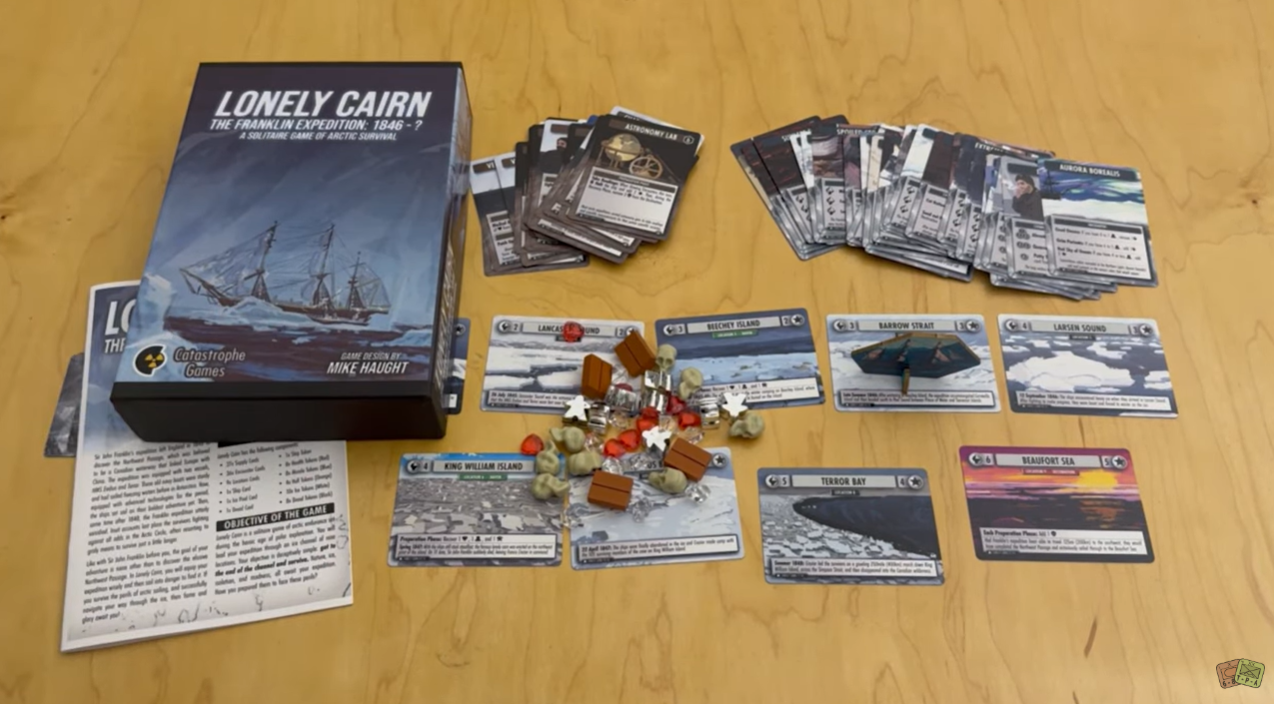
Unboxing Video: Lonely Cairn: The Franklin Expedition 1846-? from Catastrophe Games

Von: Grant
15. August 2026 um 14:00

There are a million ways to die in the Arctic, so carefully choose your supplies and read the ice well, and you just might secure the coveted prize of discovering the fabled Northwest Passage.

Lonely Cairn is a solitaire game about finding the Northwest Passage in the mid 1800’s. Modelled and based upon the ill-fated Franklin Expedition, players will need to equip their expedition and carefully chose what to take with them into the arctic. They will then sail though a channel of icy locations, facing deadly encounters along the way. They must reach the exit by the end of 8 turns, or face being locked in the ice forever.

-Grant

Meow Tiles (Saturday Review)

15. August 2026 um 12:43

The first pair of hands reached the table before the pattern card had settled. Nine cardboard cats were flipped, swapped and turned over in a frantic blur, followed by an excited slap that brought everything to a sudden halt. One tiny mistake was all it took for groans to turn into laughter before everyone eagerly reset their tiles for another attempt. Every new challenge promised to be straightforward, yet somehow each one encouraged just one more round of rearranging the Meow Tiles by Jean-Claude Pellin from Oink Games with art by Rie Takahashi.

The post Meow Tiles (Saturday Review) appeared first on Tabletop Games Blog.

Asian Board Games Festival - Malaysia 2026 - what I saw

The Asian Board Games Festival (Malaysia) was 7 - 9 Aug 2026. This was the third time it was held, and I have been exhibiting there every year so far. It was at the same venue - 1st Avenue Mall in Penang. Here's my experience at ABGF this year.  Three of us - Jon, Buddhima and I - travelled together in the same car from Kuala Lumpur to Penang on Thursday, a day before the event

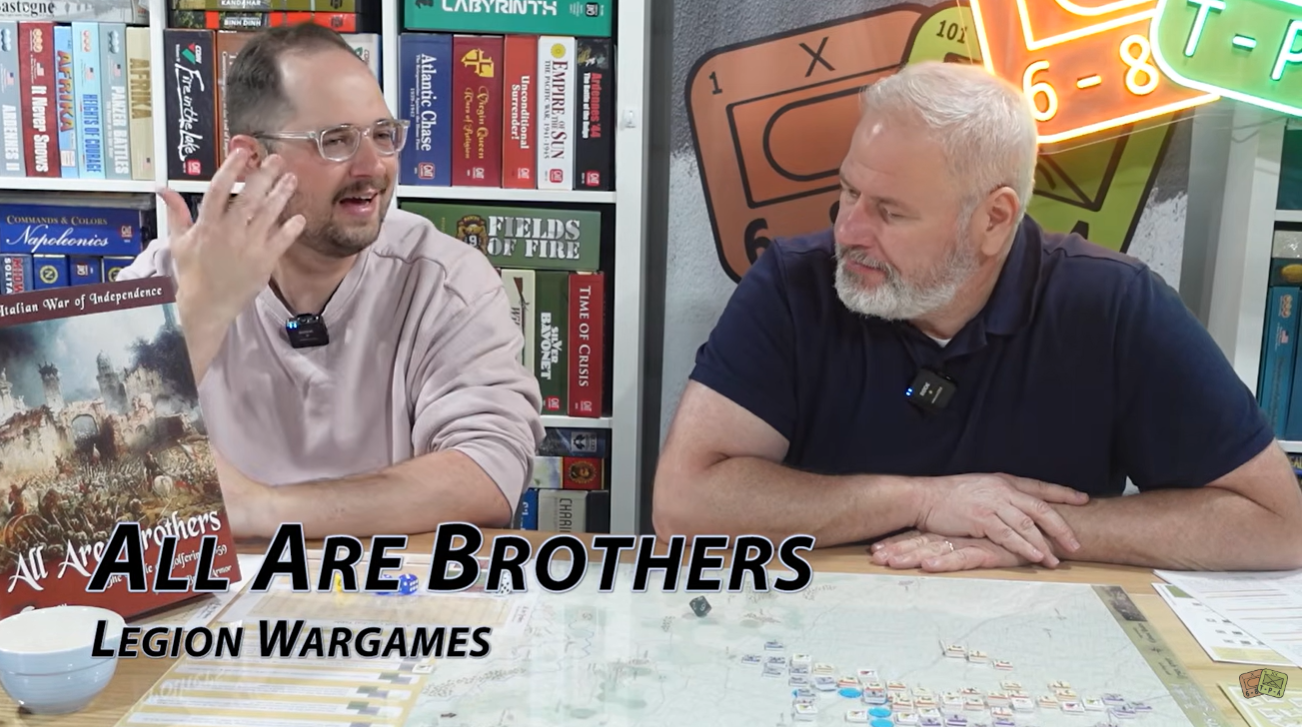
Video Review: All Are Brothers: Solferino 1859 from Legion Wargames

Von: Grant
14. August 2026 um 15:59

All Are Brothers: Solferino, 1859 simulates the decisive battle of the Second Italian War of Independence at the Brigade-level, with some additional Regimental-size and smaller detachments included. National and corps-level leaders are represented, on a map at 500 meters per hex, with 1-hour turns. Five scenarios are included: three that separately cover the north, central, and southern sectors of the battle, as well as a combined full battle scenario, along with a small introductory scneario. The combined scenario is suitable for up to four players (France, Sardinia-Piedmont, Austrian 1st Army, and Austrian 2nd Army).

The battle itself was a grinding slugfest often described as a “soldier’s battle” – a deliberate slight to the often uninspired leadership of the generals and a tribute to an allied victory gained only at the tip of the bayonet. Villagers in the surrounding region would do their best in the days after to treat the myriad wounded, and answer as to why Austrians, Hungarians, Czechs, Serbs, and Slovaks were treated as well as the Italians: “Tutti fratelli” (All are brothers). The battle pits two Austrian armies against the combined forces of France and Sardinia-Piedmont, and features the full panoply of colorful period units – Jagers and Grenzers, massed cavalry divisions of all types, Bersaglieri, French Imperial Guard, and the French African Zouaves and Turcos. Advances in infantry and artillery firepower would soon make the tactics of the time obsolete, and the carnage at Solferino reflected the start of this paradigm shift, soon to be highlighted bloodily by the Austro-Prussian and Franco-Prussian wars.

This treatment of Solferino features an adaptation of Hermann Luttmann’s Blind Swords System (At Any Cost, Hammerin’ Sickles, Stonewall’s Sword) as the core ruleset. The system is heavy on unpredictability and fog of war due to the chit pull mechanic. The chit pull mechanic also very much aids in solitaire play, as does variable activation rules and reinforcement tables. A number of other features help make face-to-face play attractive, including a number of scenario variants and optional rules, a free-setup full battle scenario, and the move-and-countermove of event chit play. Nation-specific event chits also inject some period flavor.

-Grant

Top 10 Stefan Feld City Collection Games

14. August 2026 um 15:14
Bruges CanalsSay what you will about Queen Games and their publishing practices, but when you partner with a game designer like Stefan Feld, you’re bound to generate some good games, even if the boxes are larger than necessary, the prices are a bit high, and the colorful artwork rarely endeavors beyond the Fisher-Price palette. I am […]

Source

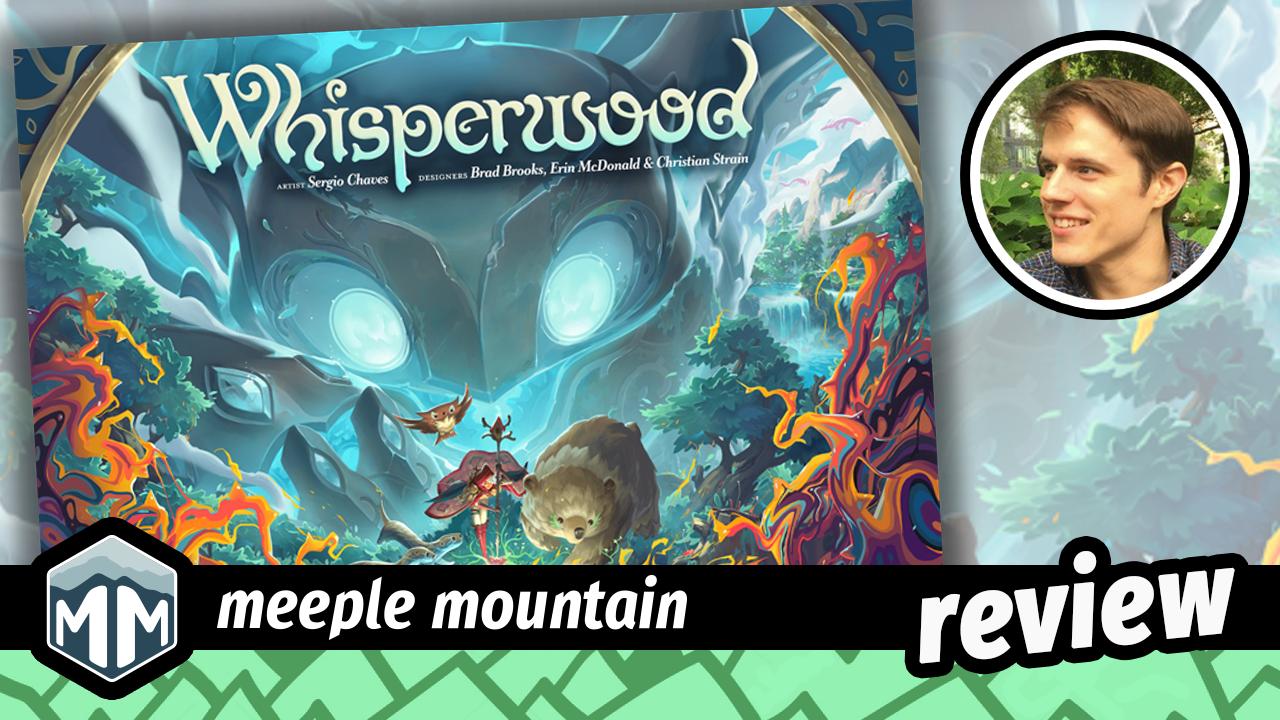
Whisperwood Game Review

About four years ago, I wrote a negative review of the game Lacrimosa. I’d never written a major pan before and, while I stand by the diagnoses in that review, I have come to believe that the review itself was too much. In trying to capture the feelings of exasperation and bloat that Lacrimosa brought up in me, the review itself became exasperating and bloated.

 I’ve played more than my share of unsuccessful games in the years since Lacrimosa, but Whisperwood is the first to evoke similar negative feelings. They are not similar games: Lacrimosa was dry as could be, an efficiency Euro with combos galore. Whisperwood, with its massive table presence, multiple tracks, and plurality of tokens, gives off the impression of a sandbox game. I think that was the goal, anyway.

The board for Whisperwood, a large collection of interlocking tiles with various terrains.

If designers Brad Brooks, Erin McDonald, and Christian Strain had pulled that off, it might have suited the setting. As members of the Council of Druids, players compete to best restore the magical Whisperwood, clearing away Corruption and gaining the favor of ancient Golems. That made manifest as a wide open space in which you can more or less do what you want…

The post Whisperwood Game Review appeared first on Meeple Mountain.

Quick Peaks – The Old King’s Crown, Tycoon: India 1981 , Railroad Tiles, Pax Emancipation, Tembo Tiles ,

The Old King’s Crown - Will Hare

As we put away The Old King’s Crown, there were two seemingly incongruent but true sentiments coming from my play group. The first is simply… that first play was a mess. Total mess. Constant takebacks and missed triggers, being blindsided by some shocking thing you didn’t know your opponents could do, or having your carefully planned turn totally upended by some bonkers, cartoonishly evil play made by another player. The second sentiment, however, was that we all wanted to play again immediately.

Almost everyone agreed that playing with the full four players really escalated the hijinx, so I’d be curious what a three player game would be like. The teach was shockingly smooth, though the real complexity and weight of this game lies in the overwhelming number of abilities and effects printed on the 50-something Kingdom cards, 20 special faction cards, and 16 tactics abilities. I am immediately smitten by this game and want to peel back the layers, while also fully aware that nobody’s first game of this is going to feel super great.

Ease of entry?
★★★☆☆ - There were a few questions
Would I play it again?
★★★★★ - Will definitely play it again

Read more…

The post Quick Peaks – The Old King’s Crown, Tycoon: India 1981 , Railroad Tiles, Pax Emancipation, Tembo Tiles , appeared first on Meeple Mountain.

Africa’s longest-running board game convention eyes grants for local designers as part of 10th anniversary crowdfund

14. August 2026 um 14:29

Africa’s longest-running board game convention is hoping to use its tenth anniversary to put more direct support behind the continent’s emerging designers, with plans for a new grant programme if its latest crowdfunding campaign reaches $20,000.

Nigeria’s African Boardgames Convention (AB Con) has set a $14,000 target to support its November event – more than 50% above the $9,000 goal it set last year – as it prepares to return to a two-day format for the first time since 2023.

The November 27 and 28 event in Abuja will include prototype playtesting, workshops, industry discussions, networking and a marketplace alongside its consumer-facing game demonstrations and tournaments, according to organiser NIBCARD Games.

But potentially more significant for Africa’s developing board game industry are the additions AB Con hopes to unlock if the campaign moves beyond its base target.

Reaching $20,000 would launch an AB Con Designers Grant, providing financial support and mentorship to African tabletop designers to develop prototypes, improve their games and showcase them at future editions of the convention.

A $22,000 stretch goal would introduce an Impact Award recognising people and organisations helping develop the continent’s tabletop ecosystem, while $30,000 would extend this year’s convention from two days to three.

The campaign describes the designer grant as an attempt to create “more opportunities for African games to reach local and international audiences”.

That represents another step in a decade-long attempt by AB Con and organiser NIBCARD to build infrastructure around what was an extremely small modern tabletop design community when the convention began.

AB Con says there were fewer than 10 known indigenous tabletop games and only three published game designers in Nigeria before it launched in 2016, with few places available for people to regularly play modern board games.

BoardGameWire reported last year that the number of known modern games from Nigerian designers had since passed 100, while the number of designers had grown to 25.

AB Con has provided a crucial meeting point and catalyst during that expansion, bringing together designers and publishers alongside manufacturers, retailers, educators and players.

Gamers, publishers, designers and organisers at AB Con 2025 || Photo Credit: AB Con

Nigerian board game company NIBCARD’s role in developing that ecosystem was recognised with the Diana Jones Award for Excellence in Gaming in 2021.

The award committee described the company as being “the multi-faceted company at the heart of the nascent Nigerian games industry”, highlighting its work publishing games, manufacturing for other companies, mentoring designers, running a game café and organising AB Con.

NIBCARD itself says it has now designed more than 70 tabletop games since being founded in 2013, while its activities have expanded across publishing, manufacturing, education and digital games.

While those efforts have proved a pillar of the region’s hobby gaming growth, NIBCARD and AB Con founder Kenechukwu ‘KC’ Ogbuagu told BoardGameWire there were still large challenges around getting Nigerian and African designers and games to break into North American and European markets.

He said, “It’s a combination of several factors, but I would highlight visibility, access, finance, and market access.

“There is a significant lack of visibility for African games and designers. Publishers often don’t get to see the games being created here, while designers have very limited opportunities to meet and build relationships with publishers.

NIBCARD and AB Con founder Kenechukwu ‘KC’ Ogbuagu

“I have experienced this personally. I once received fully funded support to attend Spiel Essen, but was denied a visa. Last year, I was invited to GothCon on a fully funded trip, but I couldn’t even secure an interview date for my visa application.

“Finance is another major barrier. Even when a game is ready, designers need money to market it, work with content creators and reviewers, attend international conventions, and run crowdfunding campaigns such as Kickstarter or Gamefound.

“And for those who choose to self-publish, international shipping can make African games extremely expensive and difficult to compete with in global markets.”

He added, “One of our mission is to see African designers creating games that are enjoyed globally and, ultimately, seeing African-designed games recognised among the best games in the world.

“We have already started working towards this. Last year, with support from the Spiel Foundation, we showcased games from three African designers at SPIEL Essen 2025. We also started a game studio as a way to bring African games to light.

“But even as we build, from over 10 years of experience doing this, a lot of the impact are limited due to lack of funding.

“We are intentionally building AB Con to become a platform where African designers, games, publishers, distributors, and international industry professionals can connect.

“We want publishers from North America and Europe to see AB Con as a place to discover new designers and games from Africa, explore licensing and publishing partnerships, and build long-term relationships with the African tabletop industry.

“This is one reason we are committed to maintaining a two-day convention going forward, with the goal of eventually growing it into a four-day event. We want to create enough time and space for meaningful meetings, playtesting, networking, showcases, and publisher scouting.”

The growing scope of AB Con has repeatedly run up against the economics of staging the convention, however.

The event previously raised more than $23,700 through its 2021 Kickstarter campaign, and self-funded for the following two years – but was forced to return to crowdfunding in 2024 after soaring inflation in Nigeria weighed heavily on its finances.

That year’s campaign raised about $16,000 from 225 backers against a roughly $8,000 target – and AB Con increased its target to $9,000 for 2025, ultimately raising more than $11,000 from 144 backers.

Its new $14,000 base target represents another substantial increase. Organisers said the higher figure reflects both inflation and the cost of restoring AB Con’s two-day format, and will be used for venue and production costs, volunteer support, logistics, marketing, accessibility and expanded programming.

Nigeria continues to experience significant price increases, despite inflation having eased substantially from the levels that prompted AB Con’s return to crowdfunding.

The country’s National Bureau of Statistics currently reports annual consumer price inflation of 15.9% – down markedly from an almost 30-year high of 34% when AB Con launched its 2024 campaign.

Last year’s AB Con campaign was initially intended to support ambitions for as many as 3,000 attendees, compared with roughly 1,300 at the 2024 event and about 1,000 in 2023. The 2025 convention ultimately took place as a one-day event on November 29.

At least seven Nigerian designers showcased projects at the 2025 convention, according to Nigeria’s Independent newspaper, while participating publishers included Althra Games, ICE Game and Jesus Native Games.

AB Con founder and lead convener Kenechukwu ‘KC’ Ogbuagu said, “When we hosted the first AB Con in 2016, our dream was bigger than organizing an event – we wanted to help build an industry.

“Ten years later, we’ve seen designers launch original games, communities grow across Africa, and more people recognize games as powerful tools for learning, culture, business, and connection.

“This anniversary is not only a celebration of how far we’ve come but an invitation for the world to help shape what comes next.”

The AB Con Kickstarter is live now, with the convention scheduled to take place in Abuja, Nigeria on November 27 and 28.

The post Africa’s longest-running board game convention eyes grants for local designers as part of 10th anniversary crowdfund first appeared on .

BGI 431 The One About AI Integration in Hobby Gaming

Von: admin
14. August 2026 um 13:22

BGI 431 The One About AI Integration in Hobby Gaming

Board Games InsiderJoin our Guild on Board Game Geek Guild | Like us on FB

Social media:

Ignacy Trzewiczek / Portal Games: website | FB | Twitter | Youtube

Corey Thompson / Above Board TV:  website | Youtube

Stephen Buonocore / “The Podfather Of Gaming”: website | FB | Twitter | Youtube

Intro Music: Happy Rock – Bensound.com

💾

Two Malaysians one Seoul

Jon from nPips Games (King & Peasant, Furmation of Rome) and Chee Kong from Haribol Way (Zodiac Go) are two of my regular game exhibition buddies. We have been to many game exhibitions together, not just in Malaysia but also in Thailand and in the Philippines. In July, they went to Korea. I could not join them, so I asked them to share their experiences with me. We did

❌