Normale Ansicht

Dark Pact

28. April 2026 um 21:50

So, in late Jan/Early Feb I heard Dark Pact was coming out soon and asked my FLGS to get a copy. One month later they were sure it was coming into their distributorship “soon” and a month after that it was sold out at the distributorship and they never got a copy. It is things like this that make me wonder if they are money-laundering front for … someone1. (Despite that they have a pretty good selection of games). So I got it from Amazon.

I don’t like Ascension, the game Dark Pact is closest to (IMO). Looking at my archives2, I never really get into it, but there are a few things that jump out at me.

  • The random nature of what’s available at any given moment means that often the game is decided by “Oh, he bought a great card, a terrible card showed up. I bought the best thing available … and the next person got a great card.” At least, it feels like that. (Or you can get combat points when you want money points and vice-versa).
  • It’s a snowball, but it takes a long time to roll downhill.

OK, two things.

Since Dark Pact is by Tom Lehmann, I naturally assumed he’d address both of those problems and they are … mitigated. (It is probably impossible to eliminate them).

First — each player has a grimoire of a few staple cards that they can buy if they don’t like what’s on the offer.

Second — what counts as a victory point depends on which Dark Pact(s) you purchase. For Player A it may be curse cards, for Player B it may be treasures, Player C might want Insight Points, etc. “One mans trash is another’s treasure” means that you might be fighting over cards, but you might not.

On the other hand, you need a Dark Pact to win3 and it’s possible that the only ones you see are terrible. But in my five games so far that hasn’t been an issue. (I did play with the “everyone starts with a reasonable Dark Pact” variant once).

Dark Pact still has flaws. I’ve seen people complain that they played their turn and then flipped up Gold/Multiplier cards (which are usually good) for the next player (the first flaw above), and that when it’s not your turn sometimes another player is taking a 2-3 minute turn of play a card, draw some cards, play a card, etc and running through their deck and that you have nothing to do.

That’s true, but it’s also common for the genre. Dominion can (depending on the setup) have that in spades. But for Dark Pact, it is usually a sign that the game is about to end … that player’s engine is up and running …. whereas in Ascension/Dominion you have to wait for the supply (of cards or points) to empty. But Dark Pact has sudden death4 … when a player draws their entire deck, the game is usually over on their turn (or perhaps a turn or two later if they’ve figured out which card their engine is missing).

It’s not totally flawless … setup and teardown take longer than Ascension (or a game of Dominion with just a set or two) unless you always play with the same # of players, but any other flaws are pretty much built into the game’s DNA (unless you object to the art or the theme, I suppose).

Dark Pact is admittedly tedious if you are playing with someone struggling to build an engine, who takes too long on their turns. But that’s always true. I don’t think that Dark Pact is going to be one of Tom’s games that easily flies to 50+ plays,5 but a few dozen plays seem likely.

RatingSuggest

  1. Occam’s Razor suggests I’m overthinking things. ↩
  2. Most of the searches for “Ascension” turn up Slay the Spire stuff, since I am referring to Ascension levels there…. ↩
  3. Probably ↩
  4. Or Sudden Enlightenment ↩
  5. I expected Dice Realms to make fifty, and it didn’t, but he’s got more than any other designer (for me). ↩

Designer Diary: President

by Nicolas Cardona


Hi, I’m Nico Cardona, a board game designer and publisher based in Barcelona, where I also run my small label, Too Bad Games. Today I want to share the design journey behind President, which is probably my first larger design outside the filler space, after titles like Rudolph, Mala Suerte and Panots. More than just telling the story of where the idea came from, I want to focus on the design problems behind it, the systems that failed, and the decisions that finally made the game click.

The Initial Spark

The first seed of President came from a somewhat unusual place: my master’s degree in organizational engineering.

One of the topics that stayed with me the most was game theory. I think it is fascinating for any designer, because at its core it is about incentives, prediction, trust, and decision-making under uncertainty. I was also very interested in graph structures, and at some point those two ideas clicked together in my head.

I started imagining a hierarchy represented almost like a graph or an organizational chart, where your position in that structure would determine how much power you had, and therefore how strong or relevant your actions would be. That was the first real idea behind President. I knew very early that I wanted a game with three levels of hierarchy. Everything else was still unclear.

What I did know from the beginning was the type of experience I wanted. I wanted a game for many players, one where trust mattered, where people had to negotiate, whisper in each other’s ears, make promises, read intentions, and sometimes betray each other. The political theme came later as the perfect frame for those dynamics, but the real starting point was not theme, it was structure and interaction.

The Core Design Problem

The real design challenge was this: how do you make a game for large groups that feels socially alive and interactive, but still has enough weight to feel like a proper game?

I love social games, but many games for large groups tend to fall into one of two extremes. Either they become hidden role games, where the entire experience depends on secret identities, or they become very broad party games, where the interaction is loud and fun but mechanically light. I wanted something in between.

I wanted a game that could handle a big player count, but where the interaction came from timing, hierarchy, negotiation, reading people, and managing risk, not just from shouting or acting.

That ambition created a lot of problems immediately. Early versions were much bigger, with more systems, more layers, more moving parts. In theory, some of those ideas were interesting. In practice, players got lost. The more I added, the more the game drifted away from the fast, readable, socially sharp experience I was actually trying to build.

At some point I had to be honest with myself. If I wanted President to work for a broader audience, and if I wanted the emotions to be immediate, fast, and easy to read at the table, I had to cut aggressively.

That became the real design process of the game: not adding the right things, but removing the wrong ones.

The Versions That Had to Die


One of the earliest versions looked nothing like the final game. At that stage, I was still exploring hierarchy in a much more literal and structural way.

President went through a huge number of prototypes. Some ideas lasted much longer than they should have, simply because I liked them too much.

One of the earliest concepts was that there would be two sides, blue and red, and at some point players could switch allegiances. The idea was that you would push for your side in order to earn bonuses, but maybe change camps when it became convenient. On paper, it sounded politically rich and full of tension. In practice, it was too much. It added another strategic layer, but not the kind of layer the game actually needed. It made the system heavier without making the experience sharper.

There was also an early version where players did not all have the same card set. Instead, cards were drawn, and your position in the hierarchy influenced whether you got stronger or weaker options. Again, this sounded exciting in theory. Higher status could give access to better tools, and the game could reflect power in a more literal way. But it quickly created too much volatility, too much information to track, and too much friction for a game that needed to stay readable, especially at high player counts.

Another difficult thing to abandon was the idea that being President should simply give better rewards than being Vice President or Secretary. At first, that was the direct logic: the higher your office, the bigger your reward. But this created all kinds of problems. It made the hierarchy too obviously dominant, flattened some of the interesting decision-making, and pushed the game toward a more static reward structure.

What finally worked was not giving the top position a directly better reward, but creating situations where being higher in the hierarchy became advantageous depending on what everyone else had played. That shift was crucial. The hierarchy stopped being a blunt reward ladder and became something much more interesting: a system of timing, initiative, leverage, and opportunity.

I also explored versions with more modules, more accumulation systems, and more phases. Some of them were individually fun. But the more I tested, the more I understood that President did not need more content. It needed more precision.

The Breakthrough


At this stage, the game was already much closer to its final identity, but I was still testing which actions deserved to stay and which ones had to disappear.

The real turning point came when I found a cleaner hand system.

Once I moved toward the idea that everyone should share the same set of cards, the whole game began to make sense. From there, I iterated many times, around twenty or thirty meaningful iterations, just to find the final seven cards. I was looking for a very specific combination: cards that worked mechanically, fit the theme, were easy enough to understand, and most importantly created strong interaction, replayability, tension, and memorable moments.

The other big breakthrough was the retrieval structure. Players use cards and lose access to them temporarily, then recover them through specific effects. That gave the system rhythm. It made timing matter. It made players pay attention not only to what others were doing now, but also to what options they might regain later.

At that point, I also realized something essential: if I wanted the game to scale to very high player counts, it could not be turn-by-turn in the traditional sense. The game needed simultaneous action selection. That was one of the decisions that truly made large groups possible.

But I did not want pure simultaneous chaos either. So the solution was subtle: players choose actions simultaneously, but they do not all resolve simultaneously. Resolution unfolds in order, shaped by the hierarchy. That gave the game speed without losing tension. It also made the hierarchy feel meaningful, because it effectively became a shifting initiative system.

That was when the game stopped feeling like a collection of ideas and started feeling like an actual design.

Defamation and the Social Engine

If there is one mechanism that made the whole design click, it was Defame.

Defame allows you to predict another player’s action, either in the current turn or even the next one. If you are right, you steal a victory point from them.

That may sound simple, but in play it changed everything.

The moment this mechanic entered the game, negotiation, promises, and public table talk became much more dangerous and much more interesting. Suddenly you could not afford to become too predictable. If you openly signaled your intentions, someone could exploit that. If you lied too often, people would learn to read you differently. Every deal, every bluff, every political speech at the table became part of the real game state.

In other words, Defame did not just create a fun effect. It connected the social layer to the scoring layer.

That mattered a lot. Many social games have plenty of table talk, but the conversation exists somewhat outside the formal system. Here I wanted the opposite. I wanted the game to reward reading people, misdirecting them, and choosing when to be transparent and when to manipulate. Defame was the mechanism that turned all of that into something tangible.

It is probably the hardest card to explain in the game. I know that. But I made a conscious design decision to keep it anyway. Sometimes you remove complexity because it is unnecessary. Sometimes you keep a little complexity because the payoff is worth it. For me, Defame was absolutely worth it.

Simplifying Without Hollowing It Out

One of the hardest lessons of President was learning that “simpler” does not automatically mean “better”, but it often means “clearer”, and clarity is essential when you want a socially dense game to work with many people.

There were moments when I tried to make the game deeper in a more conventional, gamer-friendly sense. More sub-actions, more differentiation, more layered effects. At one point, even with a smaller set of cards, each card could contain multiple sub-actions depending on hierarchy and context. The result was exactly what you would expect: too much information to retain for a game that was meant to sit somewhere between family game and social strategy game.

The issue was not that players could not understand it eventually. The issue was that every extra rule took energy away from the real experience: reading the table, making alliances, lying convincingly, spotting opportunities, and reacting quickly.

That became my filter for every design decision: does this rule improve the social engine of the game, or does it merely make the system denser?

If it only made the system denser, it had to go.

Scaling to Ten Players

From the beginning, I wanted a game that could work in big groups. Part of that came from watching large groups play games like Secret Hitler and thinking: I want that social energy, but I do not want to rely entirely on hidden roles.

Getting there was not easy. A game that works at eight, nine, or ten players can easily become too flat at three or four. The reverse is also true. Many systems that feel rich at smaller counts become painfully slow or unreadable at larger counts.

What made President viable at ten was not one single trick, but a combination of constraints. Simultaneous action selection reduced downtime. Shared card sets reduced rules overhead. Ordered resolution kept tension and readability. And then the “day cards” added just enough variety to keep the table alive from round to round.

Those day cards were another area where I learned the value of cutting. Early on, I had more than twenty. Eventually I realized that I did not need that much variety. What I needed were six or seven that were truly excellent, cards that created conversation, forced commitment, or encouraged bluffing in a clean and memorable way.

One of my favorites asks players to declare at the start of the round which action they will play. They may lie, of course, but if they actually do what they said, they recover a card. It is a tiny rule, but it creates exactly the kind of moment I wanted from the beginning: table talk with real consequences.

What the Game Taught Me

More than anything else, President taught me how games are really designed.

Theory matters. Studying systems matters. Understanding incentives matters. But at some point you are no longer dealing with theory. You are dealing with a living system that resists you. A prototype is not an idea. It is an argument with reality.

This game forced me to learn through repetition, through failed versions, through mechanics I loved and had to cut, through moments where I thought I was close and then realized I was still too far away.

It also reinforced something I believe very strongly as a designer: interaction is not decoration. It is not just a bonus layer you hope players bring themselves. If you want a game to be socially memorable, you have to build that social energy into the mechanics themselves.

For me, the best moments in games often come from looking at another player and thinking: what are you about to do, and can I trust you? That tension is alive. It creates stories. It creates laughter. It creates the kinds of memories that survive long after the rules are forgotten.

That is what I was chasing with President.

Looking Back


After all the cuts, failed systems, and repeated testing, this was the final form the game took.

People sometimes ask what I would do differently today. The honest answer is complicated.

Of course there are always details one could revisit. Every design contains a thousand possible alternative paths. But in a deeper sense, I would not undo the mistakes, because those mistakes are exactly how I learned what this game needed to be.

I am the designer of President, but I also handled the art direction and published it myself together with Zacatrus, a well-established publisher in Spain that supported the project. By the time the game was already quite advanced, I also showed it to other publishers and saw strong interest there too. That was reassuring, but more importantly, it confirmed something I had started to feel during testing: the long process of cutting, refining, and insisting on the core idea had paid off.

To this day, President is the game of mine I feel strongest about. Not only because of the final product, but because of what it demanded from me as a designer.

It taught me that when a game is trying to do something unusual, especially for large groups, you cannot afford to protect every idea you love. You have to protect the experience instead.

And sometimes, if you keep doing that for long enough, the game finally starts telling you what it wants to be.

Cytress Game Review

The toughest games to review are the ones that are right on the line. They are generally not bad, maybe even a hair better than that, and don’t really stand out. Often, games like this end with one or more players being asked what they thought, and those players doing an exaggerated shoulder shrug, as if to say “yeah, it was…good? Well, I mean, it was…alright? I’d play it again, but only if you wanted to. What are we playing next?”

Cytress, designed by Sean Lee and published in 2025 by Good Games, broadly fits this description. Cytress is a cyberpunk-themed, engine-building worker placement game. You’ll build an engine using cards that can be purchased at one of four locations to increase your income or make trading deals progressively sexier. You’ll place a worker—either a Leader token or one of your three cute, futuristic-looking cardboard car tokens—on a space to trigger an effect. With the car spaces, any other player can also use the action, so there’s no worry or tension tied to opponents blocking the space you want.

When players buy cards and add those to the engine, they also place a crew member on a mini-map, representing the area below the great city of Stratos. This placement…

The post Cytress Game Review appeared first on Meeple Mountain.

My Favorite Wargame Cards – A Look at Individual Cards from My Favorite Games – Card #75: The Second Funnel from The Hunt from Salt & Pepper Games

Von: Grant
28. April 2026 um 14:00

With this My Favorite Wargame Cards Series, I hope to take a look at a specific card from the various wargames that I have played and share how it is used in the game. I am not a strategist and frankly I am not that good at games but I do understand how things should work and be used in games. With that being said, here is the next entry in this series.

#75: The Second Funnel from The Hunt from Salt & Pepper Games

I have played several hidden movement games over the years and enjoyed them all. Some of these titles have included wargames such as They Come Unseen from Osprey GamesSniper Elite: The Board Game from Rebellion Unplugged and Bomber Command from GMT Games as well as a few board games including Hunt for the Ring from Ares Games. The concept of moving cautiously, attempting to evade pursuers, all while trying to locate and acquire or destroy objectives makes for a very interesting gaming experience. These situations can make for some really tense games that cause your head to ache and your wits to be tested. But they rely on some bluffing as well. Trying to force your opponent to anticipate where they think you should be and then trying not to be there. A really great mechanic in board games but not always easy to pull off and make for a very playable and interesting game. In 2022, we played a new design from Matthias Cramer and Engin Kunter that took this hidden movement concept and put it into a historically based game about the struggle over control of the South Atlantic between the British Royal Navy and the German Kriegsmarine during the early years of World War II called The Hunt from Salt & Pepper Games.

The Hunt is a Card Driven Game where the German player has to attempt to stay hidden while trying to sink merchant shipping as the Royal Navy hunts for them throughout the South Atlantic. The players each have asymmetric actions to use to accomplish their missions and each has a tough time doing what they have to do. But, if they manage their cards wisely, using them as effectively as possible, they can successfully either evade their pursuer or catch their prey.

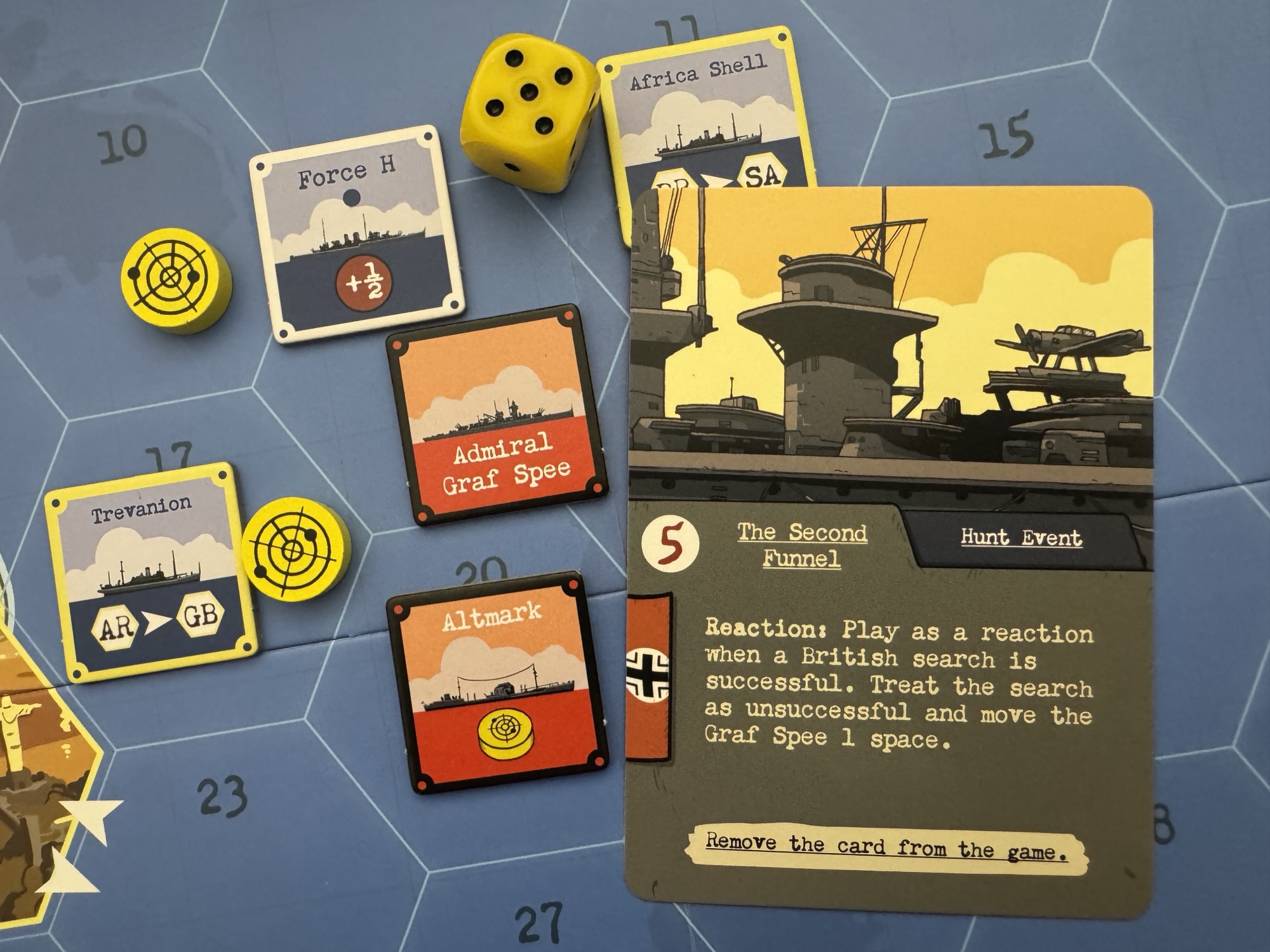
In today’s post, we will take a look at the very useful The Second Funnel. The Second Funnel is a 5 Ops card, which makes it a very important card in the German deck as it allows for the taking of 2-3 actions in a single turn, but for which there is an even more important use as an interrupt to foil a successful British Search by playing it as a Reaction. If the British player ever searches for the Admiral Graf Spee, and The Second Funnel is played as a reaction, the British successful Search will be treated as unsuccessful and the German player will get to move the Graf Spee 1 space away from the space where the Search action was taken. This movement can be into any adjacent space so could be used to also reposition the Graf Spee into a space where a Freighter is located. Such a tasty surprise card for the German player! I know that when I play as the British, I have to always keep in the back of my mind that this card exists and that my efforts might be futile. But, as the British, I would rather that the German play this as the event. These Reaction cards are one of the elements that makes this game so good.

Picture of the Graf Spee taken in 1939 shows the second funnel mounted behind the aircraft catapult at the rear of the ship.

The “second funnel” on the Admiral Graf Spee was a fake structure installed by the crew in late November 1939, during its 1939 Atlantic raid, to alter the ship’s silhouette and disguise its true identity. The dummy funnel, along with a fake gun turret on the bridge, was constructed behind the aircraft catapult to make the German “pocket battleship” look more like a different ship, specifically a British or French warship, to Allied merchant ships. By appearing as a different vessel, the Graf Spee hoped to create confusion and avoid immediate detection and engagement by Allied naval forces while it targeted merchant shipping. The disguise was removed before the Battle of the River Plate in December 1939, so it would not interfere with the ship’s combat operations. The ship’s crew, under the leadership of Captain Hans Langsdorff, often undertook such modifications during its patrol in the southern Atlantic to maintain the surprise of their commerce-raiding mission.

    Here is a link to our full video review of the game:

    We also published an interview on the blog with the designers Matthias Cramer and Engin Kunter and you can read that at the following link: https://theplayersaid.com/2023/03/13/interview-with-matthias-cramer-and-engin-kunter-designers-of-the-hunt-from-salt-pepper-games-coming-to-gamefound-march-15th/

    In the next entry in this series, we will take a look at Military Uprising from The Republic’s Struggle: Battle for the Republic Spain 1931-1939 from NAC Wargames.

    -Grant

    Arkham & Innsmouth Travel Guides Reviews

    28. April 2026 um 13:31
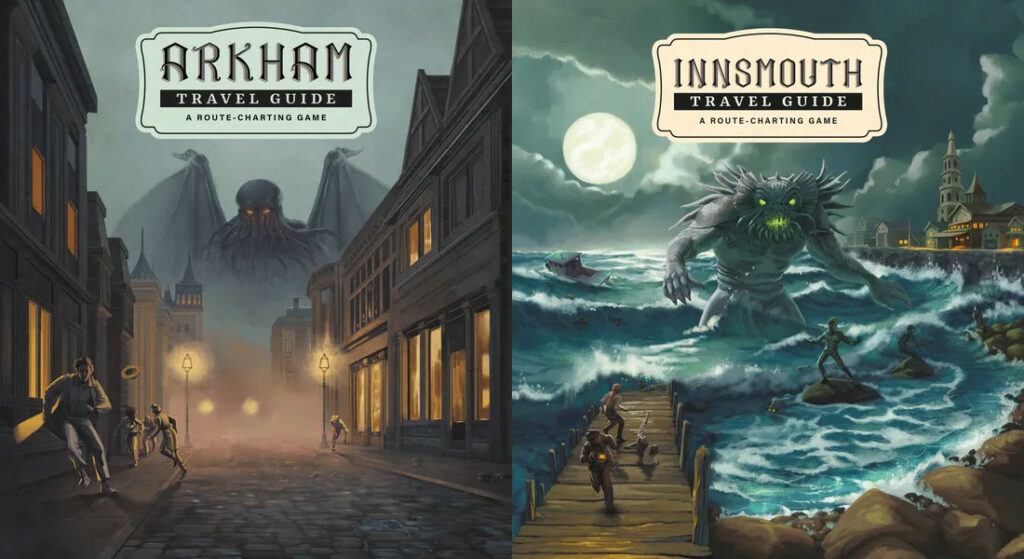
    Arkham & Innsmouth Travel GuidesHave you ever traveled to a destination city and gone on a city tour like a true tourist? I have when I first visited Philadelphia, Seattle, and Las Vegas. All included landmarks and the city’s history, which was interesting and even shocking. My most memorable travel tour was a Chicago one where my group realized […]

    Source

    Dream of the Red Chamber - first prototype

    The game I am publishing this year under Cili Padi Games is Pilgrim Poker, and it uses the theme of Journey to the West (西游记). I also have another game which will be published by Specky Studio - Rebels of the Three Kingdoms, which, of course, is based on Romance of the Three Kingdoms (三国演义). The advantage of using a topic or theme which many people are already familiar with is the

    Matt Carlson: Review of 20 Strong – Tanglewoods

    28. April 2026 um 03:31
    In 20 Strong Tanglewoods, one takes on the role of their favorite fairytale protagonist in this solo dice-rolling game of adventure. Gamers looking for a card-based, solo, lightweight dungeon crawling experience should check it out. 20 Strong is a series … Continue reading

    Lifestyle Content XXX

    27. April 2026 um 23:05

    Now I need to do the same inverted color thing with Wee Aquinas.

    Certain words set my teeth on edge. “Content” is the worst offender. If you want to tell me you don’t care about something, call it content. The other is “influencer.” Michael Barnes, once the finest critic of board games and the source of my first gig writing paid reviews, would sometimes call me an influencer. I never knew what to make of that. I figured he was joking. I hope so.

    Wendybuxxx leans into both terms and understands intimately the hard-edged meanings they carry. As a game it’s an enigma. Combine one measure new-media crossover, another bitter satire, and a third earnest arrested metamorphosis, and the slurry would look something like Wendybuxxx. It carries deep redolences to its author’s previous title — that title being Molly House, the author Jo Kelly — but calls to mind sickly-hued films like I Saw the TV Glow and Love Lies Bleeding. It’s a fascinating artifact. Provided you can get past the purposely confounding cardplay, that is.

    Live in unrelenting proximity to your significant other's rancid B.O.! Pretend you enjoy squatting on public land! Feel the wind in your hair until the skin of your forehead is pulled taut! Like, share, and subscribe!

    Van life! You can poop in a bucket for clout!

    Where to begin?

    Maybe it begins with a story. Wendybuxxx is the tale of influencers brought to life through strange science to sell necrocurrency, the titular wendybuxxx, at the behest of their grave-digging matron, Wendy Miasma. Over the course of three episodes, they will generate content both positive and negative, court controversy — not so much as to get canceled, not so little as to be perceived as tedious — and ultimately burn out bright, millions of adoring fanatics watching oh so parasocially through smartphone screens across the globe.

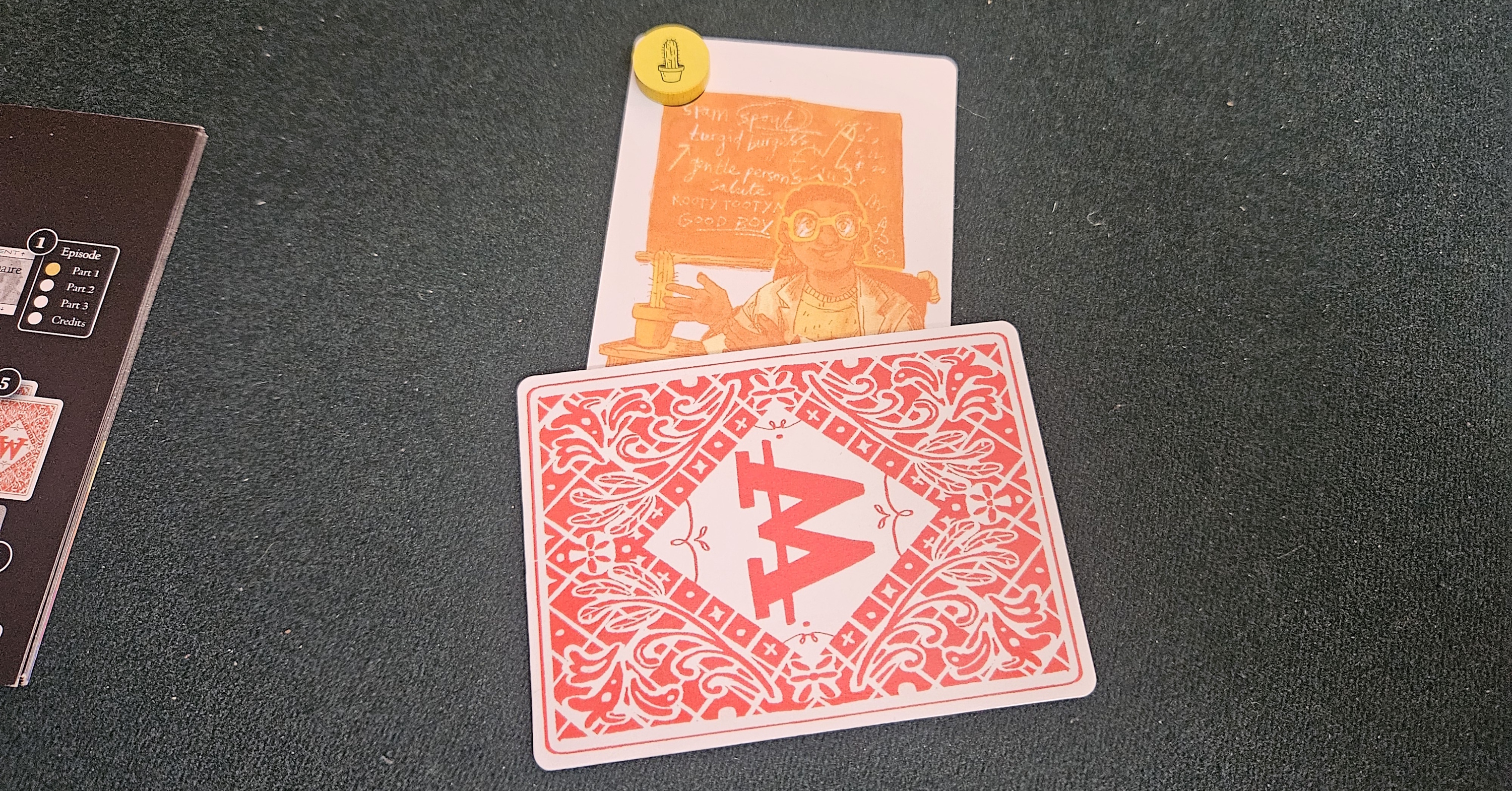
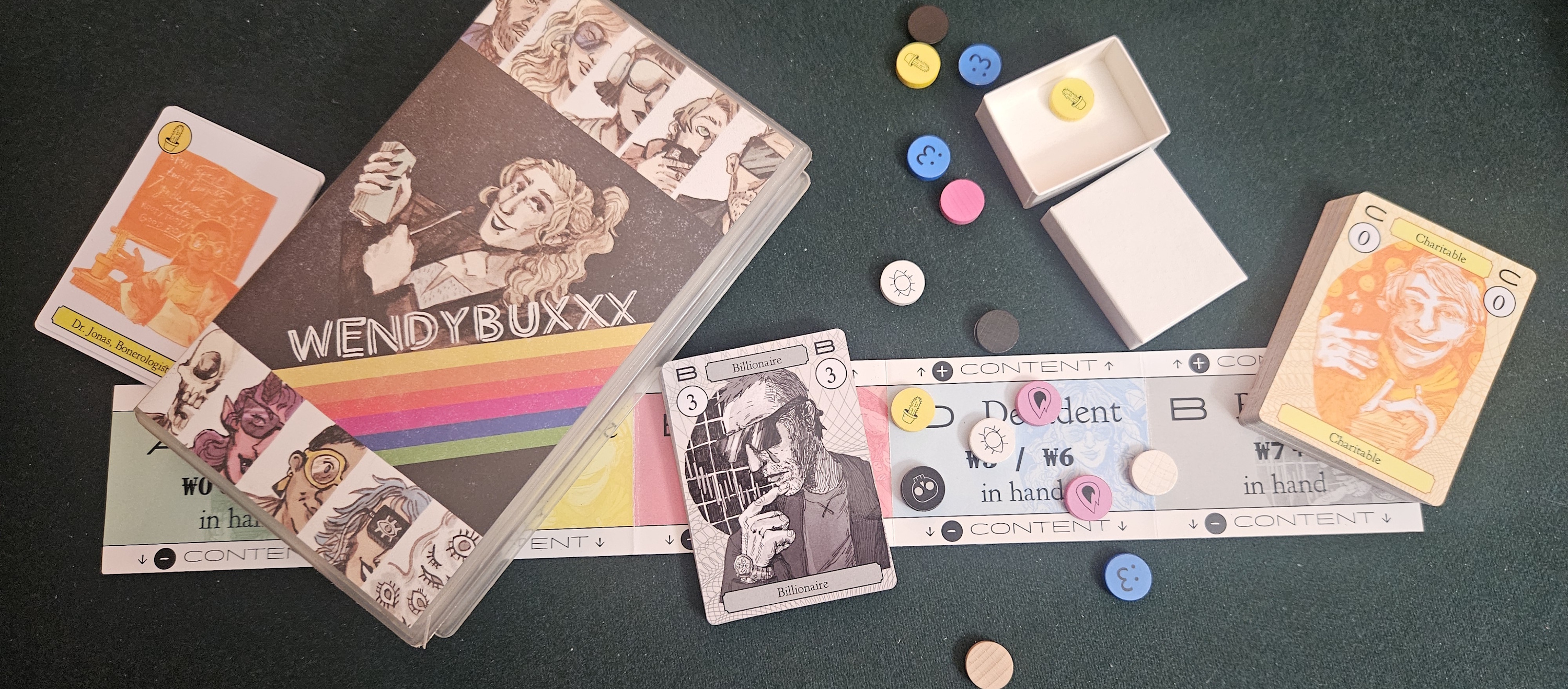
    Maybe it begins with outward appearances. Wendybuxxx arrives in an old VHS rental case from peak-epoch Blockbuster, all milky plastic and dulled edges. There are two boards, one folded in half and the other segmented like an accordion, and cards in five colors with the contrast pumped up until they clash like jagged teeth. The characters are embodiments of dislocation. There’s Holly, the Cyber Witch, winking behind cyberpunk-esque shades, and Dr. Jonas, Bonerologist, eagerly describing the wonderful world of boners. The Eyes have seen too much, the Queen of Hell has shaped gender into a razor-edged weapon, and the Skeleton Salesperson reminds me of the old friend from elementary school who asked if he and his wife could have an important conversation with me, then began his sales pitch with a fumbling, “So, you might have noticed that we wear nice clothes and take care to present ourselves in a certain way…” After fifteen minutes of preamble, his embarrassment caught up to him and he refused to tell me what he was selling. I wish I was making this up.

    Or maybe it begins with the way Wendybuxxx crosses mediums. This isn’t only a board game. One supposes its fathoms might not even be limited to the ten-track album that accompanies the game. What else is down there, through the mirk? Is this a lifestyle? Is this a pale reflection of who we have become as a culture? No, not that. This is no pale reflection. It’s a direct mirror, sunlight beating through the window, not even a smudge of toothpaste on the glass to distract from the full vision of who we are. We stand naked before the brass, and tremble with the knowledge that were we to see ourselves without the benefit of reflection, our terrible beauty would render us statuary.

    Alt-texts are my negative content.

    “Positive” and “negative” content all seem the same to me.

    Or maybe it begins with a description of how this dang thing functions.

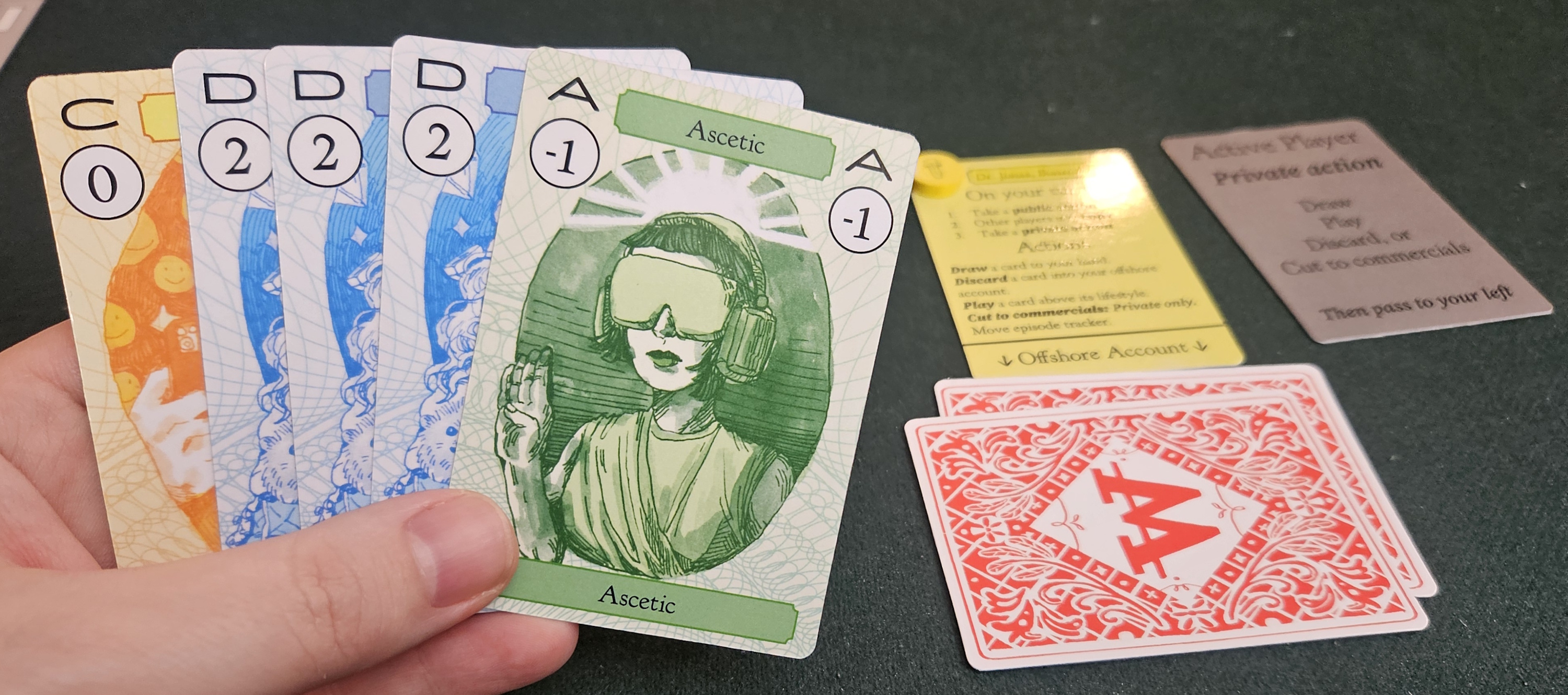
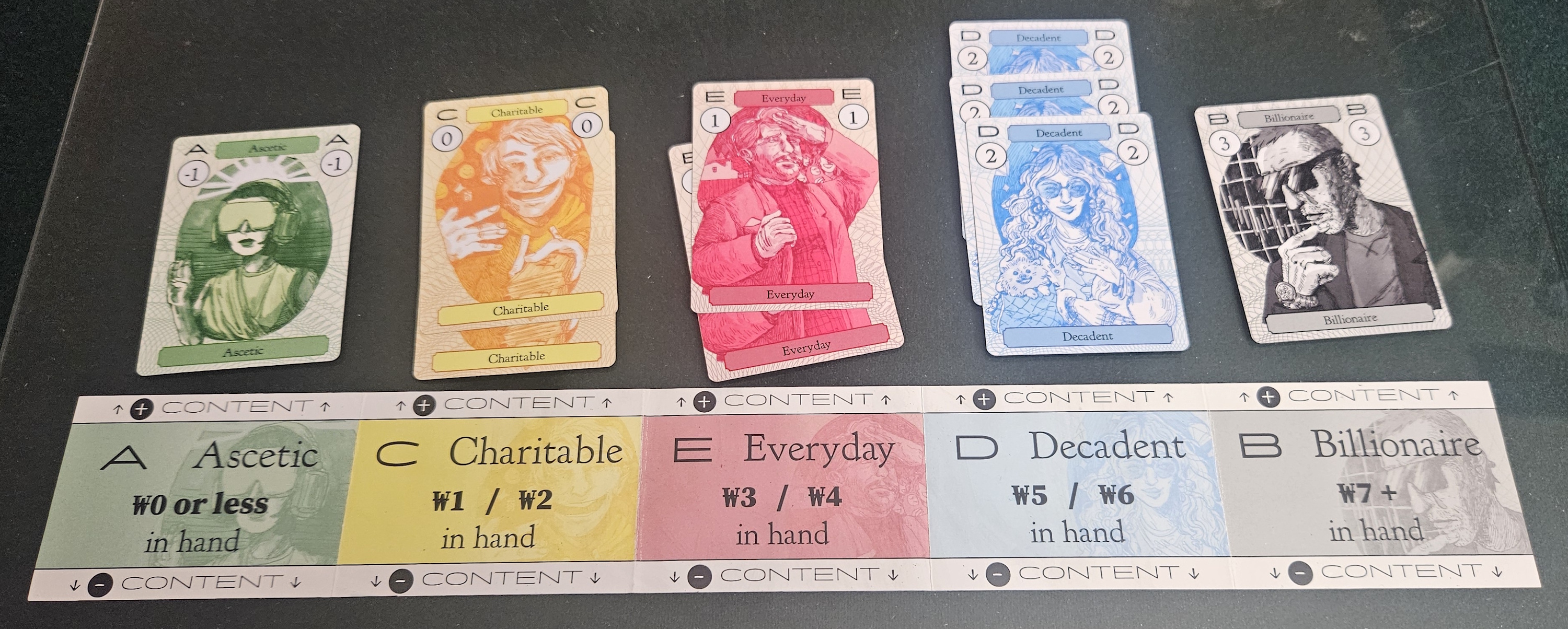
    Imagine a hand of cards, their five suits each representing a different form of influencer/content/slop that’s intuitively familiar to we global beings of bytes and filament. There’s Ascetic (poverty porn), Charitable (donation porn), Everyday (tradlife porn), Decadent (glitz porn), and Billionaire (pretending a bottomless bank account does anything other than wring out your soul until it resembles a cactus porn).

    These cards govern everything in Wendybuxxx. In your hand, their sum represents the embodiment of your personal brand. (“Brand.” There’s another word I despise.) When played to the “content strip,” they become parcels of content ready for the consumption of the masses. When played to your offshore account, they become negative content. Notably, negative content is only distinct from positive content in how they’re advertised.

    Turns are simple, but the life cycle of content is anything but. Turns consist of two actions, one public, which other players are then given the chance to replicate, and the other private, for your lonesome alone. There are only three actions to speak of: one for drawing new content into your hand, another for developing positive content for the numb masses, and a third for concealing negative content in your offshore account.

    It's the not-yet-boners.

    Dr. Jonas, Bonerologist, has a deep dark secret. It isn’t the boners.

    The import of these actions requires a few rounds to clarify, which is another way of saying that while Wendybuxxx is dead simple to play, it’s a real beast to play well. I’ve found that it’s easiest to teach in reverse. Like so:

    (IV) At a round’s completion, the tally in my hand determines which type of content I’ve made my personal brand. For example, if I’m holding a sum of three to four wendybuxxx, that means I’ve made Everyday content my whole deal. I have remade my image into that of the divine tradwife, perpetually pregnant and clad in fetish sundresses, walking barefoot through campylobacter-ridden chicken dung as I grin toothily through my denim prison bars.

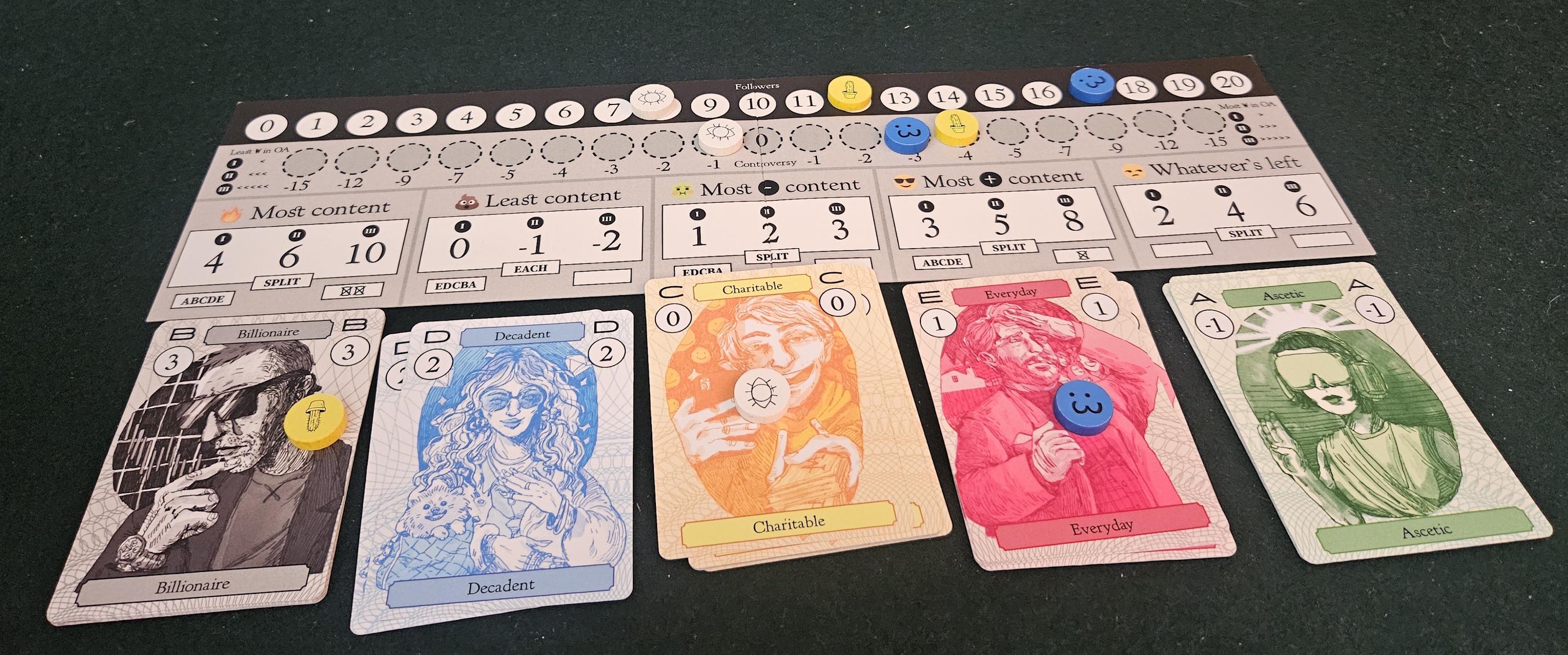
    (III) To churn Everyday content into as many millions of followers as possible, I want to ensure the right cards find their way to the corresponding space on the content bar. This is usually done by generating lots of positive content, but in a pinch heaps of negative content will do. Negative content also has the additional bonus of being secret. No meddling from rival influencers!

    (II) However, negative content may generate controversy. Although the cards in my offshore account will be added to the content bar alongside the positive stuff, their sum, if too high, will cause me to lose followers. Basically, I did a boo-boo and got canceled. Then again, too little controversy and my followers will ditch me out of boredom. The goal is to walk the tightrope of public opinion. It’s one thing to forget about the father of nine I locked inside an abandoned mall to see if he could survive for a month in exchange for fifty grand, but another thing entirely to share a negative opinion about the latest developments in the Marvel Cinematic Universe.

    (I) Turns, then, are all about building a brand that will score high, ensuring you’re holding the right cards to score it, and keeping your controversy levels smack dab in the middle.

    See? Easy!

    I take so much joy from ensuring decadent is always the least-made content.

    Riding the tide of public opinion.

    Fine, fine. But while Wendybuxxx isn’t easy to describe, it’s easier than you might think from description alone. Like the card manipulations in Molly House, Wendybuxxx is all about motion. If two influencers are dumping loads of content into the billionaire category, there’s a good chance their hands are stuffed with enough cards to qualify them as billionaires. Maybe you can get in on the fun by scrounging up enough cards to nibble at their extras. Or maybe splitting an audience isn’t your style, so you focus on something totally different, instead blinging yourself out in jewelry. Or maybe it’s time to sabotage their efforts by tweaking the other categories upward, turning billionaire into the social pariah it deserves to be.

    Point is, the cardplay in Wendybuxxx takes a few rounds to really wrap your head around, but once you’ve internalized the way the cards move, shifting from place to place in little bids and attacks, the game reveals some unusually sharp gameplay. It’s nasty without being direct. Snitty, even. Which is precisely what it should be, given that it’s basically depicting what would happen if the CrunchLabs guy decided to suffocate Mr. Beast in elephant toothpaste.

    (Golly, I hope in twenty years nobody knows what the hell I’m talking about. Wouldn’t that be great.)

    This satirical slant is simultaneously Wendybuxxx’s sharpest corner and its bluntest instrument. Rolling around in the muck of online content creation is fine and dandy, but lifestyle influencers are self-satirizing. I know they’re ridiculous. You know they’re ridiculous. The only people who don’t know they’re ridiculous are so far gone that there’s no reaching them, no matter how many board games with ten-track albums we stack on their kitchen table.

    Fortunately, while the superficial details are every bit as abrasive as millionaires who pretend to live in repurposed shipping containers in coniferous forests, that isn’t all there is to Wendybuxxx.

    scrumptious

    CONSUME CONTENT.

    At its deeper reaches, this is also a game about remaking oneself. It isn’t enough to forge a personal brand. No matter how solid your initial bid, the game will throw a wrench into your plans. Rivals will bring you down. Controversy will dog your heels. Winning lifestyles will go out of fashion. And so the wheel turns. You are one thing. And then you are another thing. In both cases, the game only permits you to become the wrong thing, another clout-chaser, another hollow person who yearns to feel something but has been brainwashed by the internet and late-stage capitalism to make number go up. Wendybuxxx doesn’t wind up as a cautionary fable about lifestyle influencers. It becomes a question mark. What are you. What will you be. Who is it that you must become. Not on the table. But above it. To play Wendybuxxx is to see your worst self realized again and again.

    And, in the seeing — in the playing — maybe Wendybuxxx becomes an opportunity to decide to become something else.

    Or maybe not. Maybe Wendybuxxx is none of those things. That’s would also be all right. Because at worst, Wendybuxxx offers some incisive satire, some sharp card-play, and some eerie color in a world where drab people would drain us dry to fill the black holes in their bellies. As a game, it’s worth the effort.

    Either way, I hope this content has influenced you. Remember to like, subscribe, and share.

    Wendybuxxx will be on Kickstarter tomorrow.


    A complimentary copy of Wendybuxxx was provided by the designer.

    (If what I’m doing at Space-Biff! is valuable to you in some way, please consider dropping by my Patreon campaign or Ko-fi. Right now, supporters can read my first-quarter update of 2026: the best board games, movies, books, and more!)

    Finspan Sharks & Reefs Expansion Reviews

    27. April 2026 um 17:14
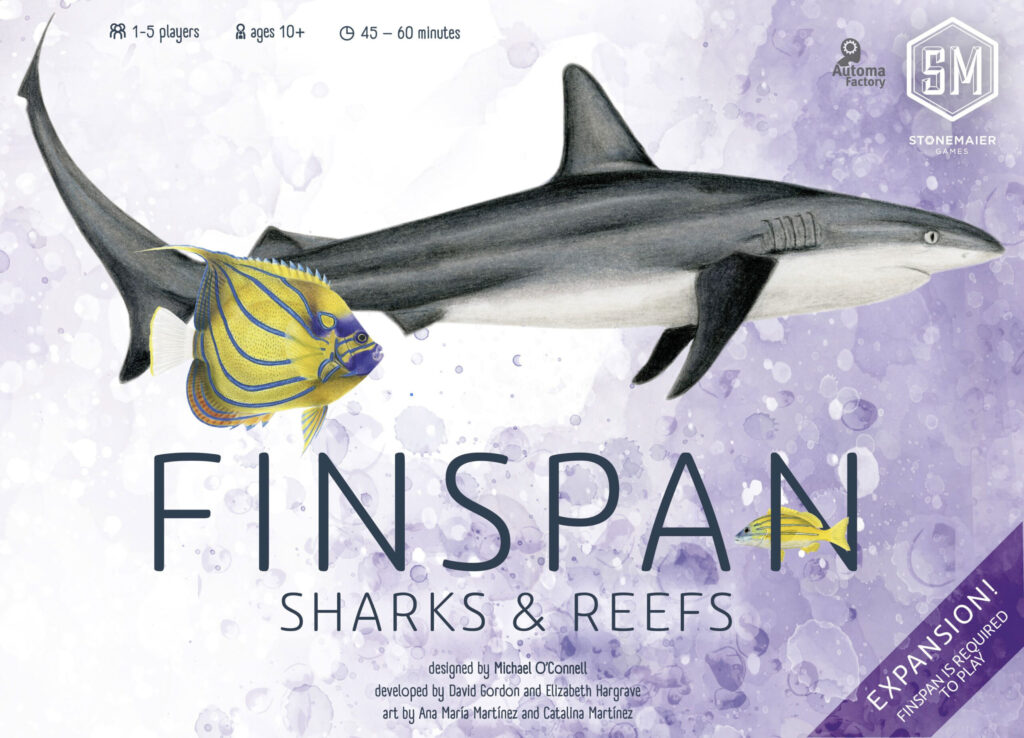
    Finspan Sharks & ReefsI really enjoy board games with a myriad of unique cards, such as Terraforming Mars, Ark Nova, Wingspan, and, of course, Finspan. I love how tactical these games play out. You need to be flexible with your strategy because the cards you get may not synergize well with your current plan, so you need to […]

    Source

    4 Things I Learned from the Savannah Bananas

    27. April 2026 um 16:37

    I’m fascinated by–and in awe of–the Savannah Bananas.

    The Banana Ball League, which started in Savannah, is a new type of baseball where the entire focus is on entertaining fans. In fact, Fans First is the title of the book written by founder Jesse Cole, and across several examples it’s clear the extent to which he applies this ideology.

    Here are my top 4 takeaways from Cole’s recent chat with Simon Sinek on the A Bit of Optimism podcast:

    1. Every game might be someone’s first game. The Bananas have an incredibly long wait list to watch them play–over 4 million people. So when someone attends a Bananas game, there’s a good chance it is their first game. Knowing this, the Bananas approach every game like their first (and perhaps only) chance for every fan to have a great time. I think that’s a neat approach to tabletop games too: What if my game is someone’s first game? Or it ends up being the only game they play for a long time?
    2. Fans can impact the outcome of the game. One of my favorite rules twists in Banana Ball is that if a fan catches a foul ball, it’s an out. In some ways, this is akin to crowdfunding, where backers can have a direct impact on a game’s final form. In others, it’s more like a game being a living entity that fans shape over time via fan-made content (like Wingspan’s promo birds) or lore-driven decisions (like what Thundergryph is doing with Etherstone).
    3. The fan experience is prioritized over the sanctity of the game. I love sports, but I think sometimes long-standing, classic sports forget that they are ultimately a form of entertainment, and that means evolving with the times. A brilliant example from the Bananas is this rule: After a game reaches the 2-hour mark, no new inning can begin. This effectively puts a time limit on a sport that is notorious for dragging on, instead prioritizing the fan experience.
    4. Look at the game through the eyes of the customer. The Bananas travel around the US to a variety of baseball stadiums, and whenever they arrive at a new place, the first thing they do is walk through the stadium and look at the field from various perspectives, including the most distant seats. They do this to see the game through the eyes of every fan, as they want to make sure they aren’t just serving those in the first few rows. I love this mentality, and it’s a great reminder for me to approach our platforms in a customer’s shoes (the content we create, our website, webstores, how our games appear at local retailers, etc).

    Have you been to a Savannah Bananas game? I’m hoping to go someday, and I’d love to hear about your experience.

    ***

    If you gain value from the 100 articles Jamey publishes on this blog each year, please consider championing this content! You can also listen to posts like this in the audio version of the blog.

    Deluxe editions ‘have become sort of an arms race… we often do the opposite’: Roxley CEO Gavan Brown on the stellar success of Brass: Pittsburgh’s $9.1m crowdfund

    27. April 2026 um 16:15

    The follow-up to the top ranked game on BoardGameGeek, Brass: Birmingham, was always like to attract significant attention for its crowdfunding campaign. For Roxley Games’ Brass: Pittsburgh, that interest converted into more than $9.1m, securing the biggest board game crowdfund of 2026 so far and one of the top ten tabletop gaming raises of all time. Roxley CEO Gavan Brown, who co-designed Pittsburgh alongside original Brass creator Martin Wallace, spoke to BoardGameWire about soaring past his expectations for the crowdfund, avoiding the ‘arms race’ of deluxe editions, the advantages of Gamefound over Kickstarter and overcoming the campaign’s biggest mis-step.

    BoardGameWire: Congratulations on the crowdfund! It’s obviously been a massive success, in terms of raw numbers – are these the kind of levels you were anticipating prior to launch, for backer numbers and total funding, or were they above or below where you’ve ended up?

    Roxley Games CEO Gavan Brown: I thought $4m was most likely. If the community and fans felt like we nailed the game, it was POSSIBLE (but highly unlikely) to hit as high as $8m. On the low end, if it funded below $2m I would have felt that we must have dropped the ball in some way, only because of how respected Birmingham is.

    Roxley Games CEO and Brass: Pittsburgh co-designer Gavan Brown

    I think there are plenty of people out there who would look at this campaign and say ‘well of course it performed well, it’s the sequel to the number one game on BGG’. Can you speak to the advantages you might have had going into making this game, in terms of it being a success – and also the ways in which you had to make sure you didn’t take crowdfunding success for granted?

    I’ve said before that starting this project, it felt like we were making The Matrix 4. It’s going to be nearly 10 years between the two titles, so we can’t wait this long and just throw something together. Obviously, there is a cohort of fans who are going to back it regardless, because it’s Brass. On the other hand, Brass players enjoy playing a 3-4 hour economic simulation game about the industrial revolution, so needless to say, they are also some of the most savvy gamers in the hobby who would be absolutely uninterested in a cash grab. So I realized before we started that we would need to create a sequel that fires on all cylinders. Which luckily, that’s the always the objective of myself and Roxley.

    How long has the development process been for this one, and what would you say were the major changes that you made as playtesting and development went on?

    The research went on for years prior to me even beginning. I also kept a document where I would jot down ideas of new mechanisms and dynamics that I wanted the game to feature when they popped into my head. Heavy development for Pittsburgh started in November of 2024. I began working on it every single day of the week.

    I am the type of designer who will gut an entire system if it’s not working how I want to. There is basically no level of redesign that I will refuse to undertake if I believe that the change will make the game better. There were many massive, large-scale redesigns of the system in Pittsburgh, but the largest one was fundamentally redesigning how oil was consumed.

    Initially, oil was only consumed by the kerosene industry. But as time went by, we realized that this resource not being consumed by manufactured goods reduced the competition and interdependence between players, which I feel is a core defining principle of Brass. As I researched oil and its relationship with manufactured goods, I discovered that a massive amount of crude oil was also processed into lubricants used in the making of manufactured goods.

    What was your professional take on the board game crowdfunding environment prior to launching – both for crowdfunding in general, and for higher-priced, deluxe games. Did you make any specific changes / have any particular strategies for the crowdfund based on your knowledge of the current environment?

    The strategy of many publishers is to create deluxe editions of their games to increase average order value. They need to increase average order value because they need the product to cost enough to fuel the advertising needed to fuel the campaign. Roxley was one of the first companies to start leaning into deluxe editions of board games, simply because I (and our team) love the experience of playing games made from high-quality materials.

    So to us, the Collector’s Edition represents the most pure vision of the game. While we do put immense care into the retail ‘Essentials’ version of our products, this is always done after we realize the pure vision of our Collectors Editions. To us, the Collectors Edition is the painting, and the retail is a print. Both can be beautiful, but the painting is made from different stuff.

    So we win because we get to make our ideal version of the game, and it’s a win for the consumer because if we sold the Collectors Edition through retail distribution, it would need to cost over $200. Deluxe Editions across the hobby have become sort of an arms race, with endlessly scaling scope, physical size, number of boxes, vac trays, and plastic in the boxes.

    Our strategy: we do not pay attention to any of this. In fact, we often do the opposite. We focus on making our games as physically small as possible to respect your shelf space. We also choose materials that feel innovative and fit the aesthetics of the game, rather than just adding more plastic miniatures (unless the creative direction or game design calls for them).

    My motto regarding innovation in product and game design is: we aren’t trying to make the ‘next thing’, because someone is making that as we speak. Instead we are trying to make the ‘next next thing’. We spend a great deal of time studying manufacturing methods used outside of boardgaming. For example, yesterday I recorded a video of a nice velvet texture on the inside of a friend’s new Volvo, wondering how we could apply same texture on a vac tray.

    This was your first campaign on Gamefound, after ten on Kickstarter across more than a decade. Why did you decide to switch for this campaign, and has it persuaded you to stick with Gamefound for your next one?

    We do not have any allegiance to any crowdfunding platform. We see them a tool used to realize creative expression, and Roxley will always use the best tool for the job. But in recent years, Kickstarter has mostly remained the same while Gamefound has been silently innovating and refining its service.

    So our decision to use Gamefound was based on them currently being the best tool for the job.

    What did you find where the biggest advantages to using Gamefound as the campaign went on – and were there any aspects which you’d expected to be more beneficial than they were?

    Here’s a few ways we Gamefound is currently leading over Kickstarter:

    • They have a built in pledgemanager
    • They invented pre-campaign updates, which was pivotal in precampaign hype
    • They allow a youtube link for the campaign video
    • Greater level of comment moderation
    • They allow mp4 videos embedded in the campaign page, which also support transparency (making them work better for dark mode), which are vastly more function
    • Responsive design is vastly superior to Kickstarter. When you have a Kickstarter page open on a full screen browser window, the imagery is a little 580px strip in the middle of the page. 2015 called and wants their boilerplate back.
    • Tools to help charge and remit sales taxes on behalf of the creators. Kickstarter simply washes their hands of this and says “It’s the creator’s problem”
    • Greater localization support: we can display every part of the campaign in multiple languages
    • They are highly responsive to the needs of their clients

    What do you think was the most important thing you learned from running this campaign generally, in terms of preparing for future crowdfunds – and maybe for providing others with advice on running theirs?

    Our biggest misstep was not communicating the total value of the Collector’s Edition on day one of the campaign. Every single component of the Collector’s Edition was intended to be upgraded by the end of the campaign. We wanted to ‘surprise’ everyone with these upgrades as the campaign progressed. But Brass already had a deluxe edition released previously, so while the final form of the Collectors Edition does represent immense value, the way it was initially presented did not adequately communicate this.

    We corrected this by discarding the concept of stretch goals (Funding Quests), for this campaign, unveiling all of them in text form on day four, and then doing a spotlight on each one of these upgrades for each day of the campaign. This change immediately got us back on track.

     My advice to other creators:

    • Do not be afraid of changing or redesigning your campaign.
    • Consider not using stretchgoals on a crowdfunding campaign for a sequel to a previous title, which likely carries preconceived consumer expectations with it.

    I think one of the notable aspects of this campaign was the weekly drip-feeding of content updates and reveals from August through December last year, prior to the campaign launch. Is that a strategy you’ve employed before, what was the impact of doing things that way (in terms of e.g. backer numbers, online conversation etc), and would you make any changes to the way you approached it, in hindsight?

    This is probably the best thing we did for the campaign. I don’t think any campaign had utilized prelaunch updates to the level that we had during this campaign. Usually, creators do updates talking about all the new cool components, materials, mechanics, and effort put into the game during and after the campaign. But during the campaign, you need to focus on very short concise messaging to try to get a conversion. After the campaign the customer is already getting the game, and it doesn’t help you sell more.

    But talking about this before the campaign launches allows the players to form a bond with your game and your team before the campaign even launches. If they like what they hear and what they see, they will follow your campaign, which greatly increases hype, followers, and if your updates are interesting and from the heart, it will also increase sales.

    There’s been discussion online from people upset at what they see as a high price level for this campaign – but then more than 37,000 people have backed it to the tune of over $9.1m. Can you speak a little to why you went the direction you did with this campaign – deluxe components, for example, rather than a more basic, more affordable production?

    The Essentials Edition is priced at the exact same MSRP as we sell Brass Birmingham for in Target. It was also pointed out on BGG that after adjusting for inflation, Brass Pittsburgh: Essentials Edition is cheaper than the 2007 Treefrog Games Edition.

    The Collectors Edition provides immense value, and as discussed would need to be priced at upwards of $200 if sold through retail distribution.

    I hear retailers talk about margins all the time, and their need for reaching levels of about 50% for individual titles. Is the pricing of Pittsburgh going to provide any challenges on the retail side, do you think, or are you confident the numbers will work out for both Roxley and retailers of the game?

    Target is regarded as having the most price-conscious demographic in the market. Brass Birmingham currently sells well in Target at $80. We don’t forsee this being any different for Pittsburgh.

    How concerned are you about the impact of further US tariffs changes on producing and delivering Pittsburgh – and what kind of tariff hike could Roxley reasonably absorb before additional fees would have to be charged to backers?

    The tariff situation has been evolving rapidly, and we’re keeping a close eye on it. For US backers, applicable tariffs are effectively a VAT. This is something international customers have always navigated, and now the US is in the same boat.

    What were your expectations around endgame, and what impact has it ultimately had on the game and on the crowdfund for Roxley overall?

    We have never done end game before, and I had never even heard of it until [Roxley director of operations Kira Peavley] said it was running for our campaign. The Gamefound folks reached out to us a few days prior to the campaign ending and suggested we create a little trinket that backers could add to their pledge in order to keep the timer going.

    Because the campaign had done so well, we also decided to come up with an exclusive gift for everyone who backs copy Brass: Pittsburgh collectors edition on Gamefound. Because this gift was to be exclusive to Gamefound, it could not be gameplay related, as Roxley does not offer gameplay-related crowdfunding exclusives (we want people to be able to buy all game content after the campaign). So, we came up with the idea of doing an artfolio that would feature Brass’ artwork from Mr. Cuddington that they’ve created over the years. It will even feature a fabric cover, as you would see in a high-quality hardcover book.

    When the campaign shifted to Endgame, the funding amount was $7,869,841, so it has generated over $1m in extra funding. As for how much impact it has had, that is up for debate: Some of our previous campaigns that have generated an additional 75% of additional funding while the pledge manager was open. But honestly, that doesn’t matter to us… we are very happy with the funding level we have reached, and it makes us happy to reward each of our backers with this extra item as a thank you to them.

    The post Deluxe editions ‘have become sort of an arms race… we often do the opposite’: Roxley CEO Gavan Brown on the stellar success of Brass: Pittsburgh’s $9.1m crowdfund first appeared on .

    Crowdfunding Campaigns of the Week – 4/27/26

    27. April 2026 um 15:13
    Crowdfunding Campaigns of the WeekWelcome to this week’s batch of crowdfunding campaigns. We have a variety of offerings here, so we hope you will find something that catches your eye. Also, if you want to chat with the BGQ team, join our Discord Server where we talk about games, movies, sports, and other fun stuff. Check it out and […]

    Source

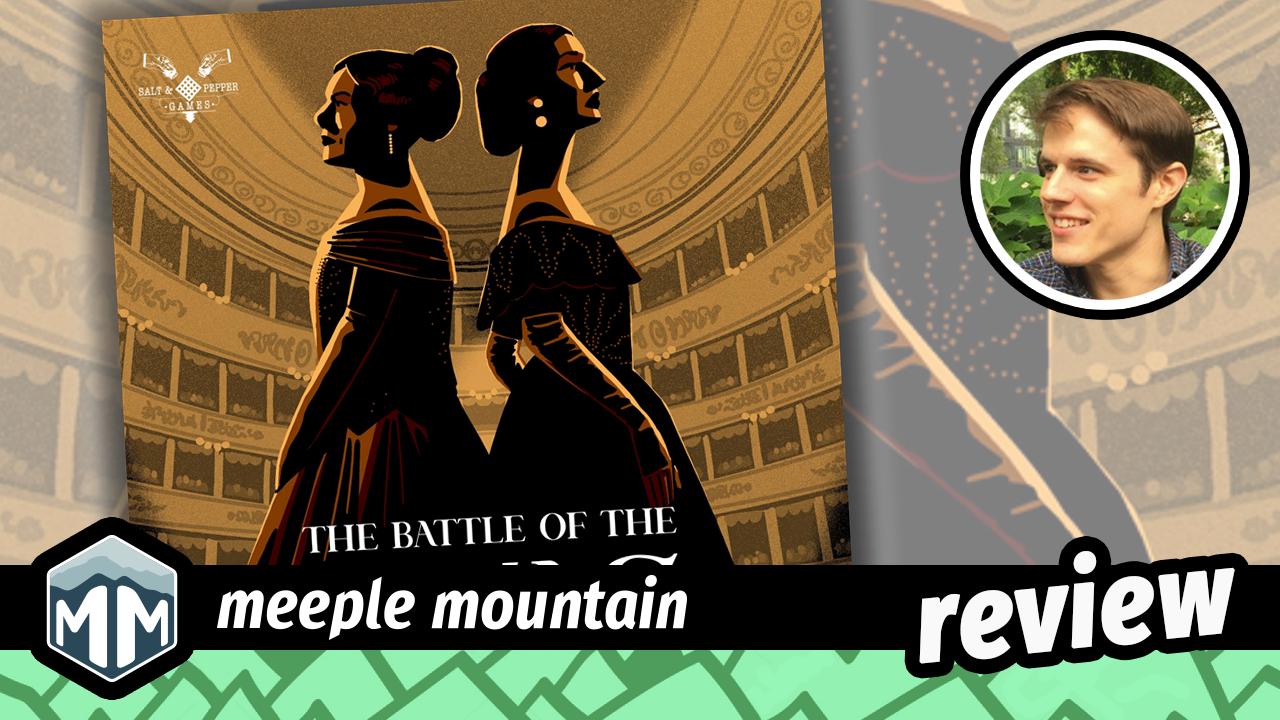
    The Battle of the Divas Game Review

    The history of 20th century music is full of rivalries, be they real, manufactured, or imaginary. As much as they can get in the way, they also serve an important function within the culture of popular music for both artists and audiences. The Beatles and The Rolling Stones, to say nothing of The Beatles and The Beach Boys, were pushed to ever-greater artistic heights as a result of trying to outdo one another. Blur and Oasis sold way more singles as a result of their mutual distaste than they would have otherwise.

    As for the audience, rivalries can produce better music, but they also serve a social function. A rivalry makes room for partisans. “N*SYNC rules, Backstreet Boys drool”—an insane position given that the Backstreet Boys are obviously better singers and could do both party songs and ballads with equal aplomb, while N*SYNC couldn’t sing a ballad if their lives depended on it—gave identity-hungry teenagers something to cling to.

    This is hardly restrained to the world of pop. Before the boy bands, before Britpop, and even before The Beatles and The Stones, there was the rivalry between Maria Callas and Renata Tebaldi, two of the great operatic divas of the 20th century. From our contemporary perspective, it’s easy to see how that played out. Ask anyone over the age…

    The post The Battle of the Divas Game Review appeared first on Meeple Mountain.

    The BK Broiler – A Barbarian Kingdoms Review

    27. April 2026 um 15:00
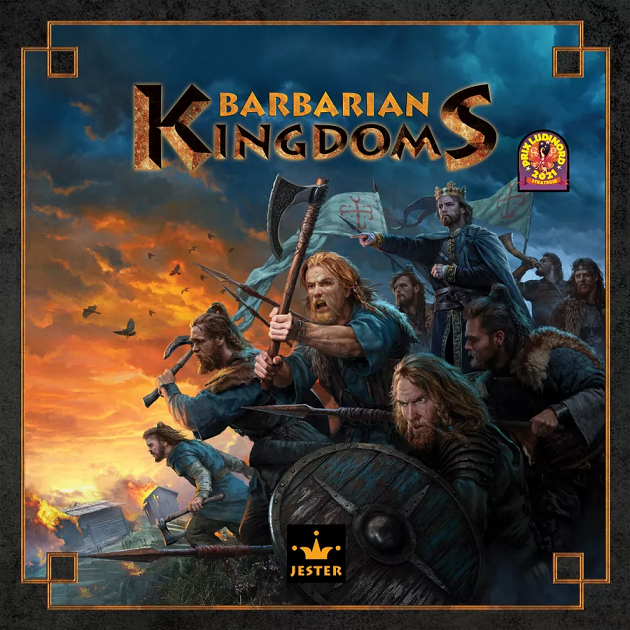
    Barbarian Kingdoms is the kind of modest board game that comes in a standard sized box with a small selection of cards, a reasonable number of tokens, and a surprising absence of miniatures. While it is nearly two years old at this point, it actually appears more long in the tooth and weathered. I wouldn’t…

    Read more →

    Interview with Mark and John Kwasny Designers of A Strong War: The Conflict for North America 1755-60 from Form Square Games Currently on Gamefound

    Von: Grant
    27. April 2026 um 14:00

    Form Square Games has recently offered their next several games on Gamefound, one in their Limits of Glory Series called Jersey New Jersey and the 2nd game a stand-alone non-series game covering the French & Indian War called A Strong War. I think that these games are well timed with this year being the 250th Anniversary of the signing of the Declaration of Independence and I look forward to playing and exploring all of these games. I reached out to the designers of A Strong War named Mark and John Kwasny about an interview to give us a look inside the design and get more information and they were interested in answering our questions. One point about the game before we get into the interview, the title, A Strong War, refers to the type of war the Abenaki Nation threatened to unleash on the land-grabbing British in 1753. The sparks of war, ignited in 1754 near Fort Duquesne by an obscure colonel of Virginia militia, George Washington, spread quickly; soon, flames engulfed the entire globe as England and France vied for control of empire. Over the next 5 years, Regular regiments from the French and British armies, American and French-Canadian provincial units, and Native warriors all fought in a chaotic and violent series of campaigns and frontier raids that culminated in the British conquest of French Canada and the defeat of the Native Nations, most of which had sided with the French.

    If you are interested in A Strong War: The Conflict for North America 1755-60, you can back the project on the Gamefound page at the following link: https://gamefound.com/en/projects/form-square-games/jersey-new-jersey–a-strong-war

    Grant: Mark & John welcome to our blog. First off please tell us a little about yourselves. What are your hobbies? What’s your day job? 

    Mark and John: First of all, thanks for inviting us to do this interview. We appreciate the interest in us and our game! I have watched many of your videos and learned a lot about different games that I have purchased or have considered buying.

    We are both retired. John taught Middle School and High School history for 36 years and I taught American and Military history at the college level for 33 years. One hobby we share is playing wargames purely for fun! We have been wargaming since we first made our own game (60 odd years ago) out of a dozen decks of cards. John is an avid fisherman as well, we both read a lot, especially history, my wife and I do a lot of babysitting with our little grandchildren, and we share the unending quest for the perfect chocolate donut (we live 100’s of miles apart and whenever we can get together, we consume a generous amount of such donuts, trying different ones!).

    Grant: What is your relationship to each other? How has this aided you in your design endeavor? 

    Mark and John: We are brothers and share similar historical interests in military history (he has an MA in Military History, and I have a PhD in Military History). But when it comes to wargames, we have vastly different views on what we like and what works for us in a game. That helped us try to incorporate different styles of play into the design. And John’s pro-French leanings and my pro-British sentiments helped us with the pursuit of play balance!

    Grant: What motivated you to break into game design? What have you enjoyed most about the experience thus far? 

    Mark and John: About 15 years ago a person contacted us about making a game for a new game company he wanted to form. We chose the French and Indian War as the subject. Ultimately that fell through, but by then we had a game we really liked but it is a long game and thus was difficult to play a lot. We were both still working full time and had very limited gaming time. So we decided to boil it down to its essence – we wanted to make a game that gave the same feel for that war but was playable in a short time so we could actually play and complete it! (I don’t know about others, but the percentage of games I have played that I actually finished is not very high!) The key, we decided, was less resources and thus more tension for each decision. Our goal was simply to make a game we loved and could play together or with our other gaming friends. We already had all the research for the French and Indian War, so we took that earlier game and stripped it to its bones. We put ten years into this process of stripping it down: fewer rules, less units, to create more difficult decisions to use what little you have. The current version is the result of that decade of work.

    Grant: What is your upcoming game A Strong War about? 

    Mark and John: As mentioned, it covers the French and Indian War, focusing on the fighting in North America between 1755 and 1760. The game takes a grand strategic approach with the players directing the entire war effort of the two sides through those six years.  

    Grant: What should the title convey about the French & Indian War? 

    Mark and John: Between the title, and the quote it comes from, it indicated a war to the end between British expansion, Native American defense of their lands, and French efforts to maintain control of French Canada. Either the French and their allied Native warriors would stop British expansion or they would lose everything. And therefore it was a strong war, no holds barred!

    Grant: Why was this a subject that drew your interest? 

    Mark and John: Braddock’s Defeat has always been a subject of fascination for both of us. Childhood visits to Fort Michilimackinac, Old Fort Erie, Fort George, Presqu’ile, and other places around the eastern Great Lakes (we grew up in Cleveland and we traveled around the area back in the 1960’s), these sparked our imagination early on. The characters involved deepened this interest: Washington, Braddock, Pontiac, William Johnson, Montcalm, Langlade, St. Luc de la Corne, Robert Rogers. We have both read numerous books over the decades on the war and these people, and I studied it while in graduate school for my focus on 18th Century and American warfare.

    The Wounding of General Braddock by Robert Griffing.

    Grant: What is your design goal with the game? 

    Mark and John: History is important to us, even in a small quick game such as this one. We wanted a good feel for the war and the overall situation, and we wanted a game that sets up quickly, plays quickly, with rules that we believe can be learned relatively easily without lots of charts and details. Also important to us are the types of decisions a player makes. We want those decisions to feel reasonably plausible for that war. Too many games play like WWII no matter their actual subject. We also wanted to be true to the geography of that area of North America – deep, unending forests, rivers and lakes, paths through the woods, limited avenues of approach to the other side, the feel of the constraints imposed by the geography had to be present. And finally, we wanted to create a game that we enjoyed playing over and over and over!

    Grant: What elements do you feel are most important to model in a game set in the French & Indian War? 

    Mark and John: We considered the key to the war were the limited movement opportunities and the limited resources available to both sides. We also wanted to show the contrast between the formal military campaigns of the regular armies, and the frontier style of raids and destruction by the partisan forces. The need to balance these two very different types of warfare and differing types of forces was key in our opinion.

    Grant: What sources did you consult fur the historical details? What one must-read source would you recommend?

    Mark and John: We would suggest two. First, we recommend Francis Parkman’s Montcalm and Wolfe, published in 1884. It has a wealth of information, including the use of sources no longer available. One has to be ready for the 19th century prose, of course, which can help give a true feel for how people saw each other back then but can be difficult to read here in the 21st century. The other book is Fred Anderson’s Crucible of War: The Seven Years’ War and the Fate of Empire in British North America, 1754-1766, published in 2001. It is a comprehensive study of the war.

    [Editor’s Note: I own and have read Montcalm and Wolfe and very much enjoyed the overall vantage point it gave of the war and its inner workings. I also very much enjoyed the ending of the book, including a very dramatic and detailed depiction of the Battle of the Plains of Abraham and the fall of Quebec in 1759.]

    Grant: What is the scale of the game? Force structure of units? 

    Mark and John: The game is deliberately very abstract but the forces available are modeled on the relative strengths of each side. There are yearly turns with multiple activations during each turn/year. It is a game about the Grand Strategy of the war. The focus is on the overall command of the entire theater and the allocation of your limited resources to achieve one of several possible goals. Thus, the force structure is based mostly on what we defined as five different types of combat forces available to the two sides.

    Grant: What different units are available to each side? What special capabilities does each type bring to the battlefield? 

    Mark and John: The French player has French regular units, Canadian militia and Marine forces (referred to as Marines in the game), and frontier partisans representing Native warriors and the French Bush Rangers such as Charles Langlade. The British player has Colonial units and British regular units. Individually, each cube is equal to another cube, but the key is combining the proper types of units to maximize the bonuses in combat. For example, if a French Marine cube attacks a British Colonial cube, both sides roll a 4-sided die and high roll wins.  But if the French player has a Partisan cube with the Marine, he gets a +2 bonus to his roll. Meanwhile, the British player gets similar bonuses for massing his regulars in combat. Regulars do not fight as well on the frontier, making the French Marines and Partisans even more effective out there. The most numerous forces are the British Colonial units who offer no bonuses but are present in many of the battles. Colonial units can also be used to recruit extra regular units.

    Grant: What is used to represent the soldiers in the game? Why was this your preferred medium? 

    Mark and John: We use small wooden cubes. We like the feel and look of wooden cubes and the material feels appropriate for 18th Century warfare. Since there are so few units, wooden cubes seemed the most aesthetically pleasing and easiest way to handle the game’s needs.

    Grant: How many soldier pieces does each side have? Why so few? 

    Mark and John: The French get three regular cubes, four Partisan cubes, and three Marine cubes, thus ten total. The British have nine Colonial cubes and four regular cubes, thus thirteen total. However, Colonial cubes can be converted into regular cubes at the risk of running out of Colonial cubes. We made it with as few units as possible so each decision on how to use each individual cube becomes critical and difficult. Overall, it gives the right feel of British army numerical superiority, the reliance of the French on their Canadian and partisan forces, and the important role of the British Colonials. Each cube is not meant to represent any specific number or specific units. It tries to represent the overall resources available to the commanders of each side.

    Grant: What area of North America does the board cover? 

    Mark and John: The board covers from Alexandria in Virginia to Québec and the St. Lawrence River valley in Canada, and from Louisbourg and the east coast to Fort Duquesne (Pittsburgh) in the west. Thus, it covers the northeast corner of North America.

    Grant: Why did you feel that point to point movement was the best choice for the design? What advantages does this give the game? 

    Mark and John: More and more, we like the simpler feel of point-to-point movement. We have played many hex games but as we get older and less able to manipulate stacks of units in small hexes, we find point-to-point movement physically easier to play. It was also easier to represent the difficult terrain between the two sides, and the very limited avenues available to get at each other. In effect, there are three main land routes (through Duquesne, through Oswego, and along Lake Champlain) as well as the naval option for the British. Using hexes or even areas for so few actual paths between the two sides would have created a lot of dead space. This approach fit with our goal of limited resources, limited avenues of attack, and thus tougher decisions.

    Grant: What is unique about the combat system? 

    Mark and John: Players have very few units and thus have to use each one carefully. There are no real charts needed and though there is some luck, the players can mitigate it to a degree. This is perhaps one of the keys. You commit cubes one at a time in a battle and can call off an attack to save the remaining cubes for use later if the initial rounds of combat go badly. Perhaps the real unique aspect for us is the need to create combinations between which cubes you commit to a battle. And there are only so many combinations possible in a yearly turn, so you have to judge when to use the bigger combinations and when to cut and run. For example, the biggest combination for the French is a combined force of regulars, Marines, and Partisans. But in the first year, the French player has only one regular, so he can only use this super combo (as we always call it!) once in that year. Where does he want to commit this strong force? Does he prefer to defend a critical fort, or to raid the frontier to eliminate Colonial units, or to attack to secure control of a border location? These are the kinds of decisions we enjoy most in our combat system.

    Grant: What type of strategy is needed with this focus? 

    Mark and John: A very careful use of the very limited resources. All games have that to an extent, but with so few units, players have to hoard their units and use them sparingly. You have to look at the whole year (one turn). You can only use each cube once a year. Committing your best forces early might gain an initial advantage but could then leave you with nothing to defend or attack with later in the year. Each battle, each combat round, and each activation has to be weighed carefully with what needs you might have against an unexpected disaster or opportunity later in the year. 

    Grant: How does the actual combat play out?

    Mark and John: Perhaps an example is the best way to give a feel for combat. The British player declares an attack on a French fort at Oswego. He then commits three of his cubes (the maximum you can ever commit to one combat) to make the attack (two British regulars and one Colonial cube). Now the French player has to decide whether he wants to use precious resources to defend Oswego. It is not a home location, but it is next to two vital home locations, Fort Niagara and Fort Frontenac. He decides to defend with the maximum of three cubes as well (one regular, one Marine, and one Partisan). Round 1, the British player has to decide which cube to commit to the battle. He chooses one of his regulars. He could lead with the Colonial and save his regulars in case it goes badly early but leads with his power! The French player then decides which of his cubes to commit first and he starts with his Marines. Now both players roll the 4-sided die and the number rolled is the Strength gained from that cube for this combat. So if both players rolled a 3, then it is 3 to 3 after the first round. That is a tie and therefore if the combat is ended there, the defender wins ties. Instead, the British player commits his second regular and the French player decides to commit his Partisan. Both players again roll a die to determine what Strength they get for these newly committed cubes. In addition, the British player gets a +2 bonus to this roll because he has committed a second British regular. The French player gets +2 to his roll because he has two different types of cubes in this combat. The British player rolls 2 and adds his bonus to get a total of 4 Strength for this second committed cube. The French player rolls a 4 and adds his bonus to get a total of 6 Strength for this second committed cube. After two rounds, the British player has a total Strength of 7 and the French player has a total Strength of 9. If the combat ends now, the French player has a greater total Strength and would thus win. Still, the British player might at this point choose to call off the attack because he will not get any bonus for his remaining Colonial cube whereas the French player will get another bonus when he adds the regulars to the fight. The British player accepts defeat, saves the Colonial cube for use later in the year, the French player saves his regular cube, and the combat is ended.

    Grant: Why did you choose to use a 4-sided die for combat? 

    Mark and John: We wanted to have some randomness in combat so that it was not just a math game. But we wanted to avoid wild swings of results between high and low rolls. We experimented with 6-sided dice, 4-sided dice, 3-sided dice, and 2-sided dice. Ultimately after hundreds (literally) of games, we determined for us the 2- and 3-sided dice did not offer enough randomness and combat was almost reduced to mathematics. The 6-sided dice provided too wide a variance of results. A difference between a roll of six and a roll of one overshadowed any strategy or skill in using the combinations and bonuses. Thus, we settled on a die that I personally hate, the 4-sided die (the triangular shape is hard to pick up!), because it gave us the best feel for some randomness but still allowed players’ skill and strategy to have a large impact on the results as well. Form Square Games has brilliantly come up with a way to generate a result of 1 to 4 using an 8-sided die, and that resolves my hatred of our chosen dice!

    Grant: I see that each player has several paths to victory. What does this look like?

    Mark and John: The multiple paths to victory offer the players strategic choices during the game and between different games. But these paths are not always compatible with each other, and thus players have to choose which to pursue and if/when perhaps to switch to another approach. The British player has two main options, either go for points gained by capturing enough French home forts to win without having to conquer all of Canada, or if his losses on the frontier become too heavy or the French gain too many points in the border locations, he has the option to switch to an all-or-nothing conquest of Canada and ignore points. The French player can also win on points early on by attacking border locations, but he can instead choose to focus more on frontier raiding to eliminate Colonials and win through the destruction of the Colonial military. It is difficult, however, for the French player to do both. Thus, the competing needs of the different paths to victory create tension for each player when determining his strategy year by year and over the course of the entire war.

    Grant: What type of an experience does the game create?

    Mark and John: We wanted an experience that becomes so nerve-wracking that you might just forget to drink your newly opened beer. John did this in one of our test games and it became our litmus test for how good the game was or was not. He opened a beer, we sat down to play, it was one of the better nail-biting contests, and when it was over, he declared he needed another beer. He picked up the open bottle and it was still full! He had become so immersed in the game that he had completely forgotten about his beer. That is the kind of experience we hope people get by being drawn into the excitement of a tense, quick playing game of nerves.

    Grant: What are you most pleased about with the design?

    Mark and John: First, we set out to create a game we enjoyed playing. Once we had done that, our next goal was for somebody else to play it and enjoy it. When Form Square Games expressed interest and said they had had others play it and respond favorably, we were ecstatic. Having them publish our game is the ultimate goal we had pursued for years. For the game itself, as mentioned above, we wanted a game that is quick to setup and play (a typical game lasts an hour or so and can be set up for a rematch in a couple minutes), and that creates tension and tough but meaningful decisions. We have played this game to completion more than any other game we have played, and still look forward to playing it again!

    Grant: What other designs are you working on? 

    Mark and John: We have tinkered with the idea of using this system to create a game covering the American Revolutionary War.  We think it would work pretty well but we have not gone very far with that.  We have also designed and played a game on the Battle of Ligny in 1815, which we enjoy but it is not fully finished or tested either.  We want to represent aspects of tactical combat that we have not seen in other games and have had some good results.  But ultimately, these two were designed again for our own enjoyment and we have not put in the serious work yet required to transform them into publishable games.

    If you are interested in A Strong War: The Conflict for North America 1755-60, you can back the project on the Gamefound page at the following link: https://gamefound.com/en/projects/form-square-games/jersey-new-jersey–a-strong-war

    -Grant

    Two-Handed, Intentionally

    by Justin Bell

    Late last summer, I had dinner with an industry contact, and we got to talking about life, love, and the pursuit of tabletop happiness over a handsome buffet of cheap prosecco, garden salads, and chicken fingers. (Extra honey mustard, please.)

    Eventually, our conversation turned to one of my favorite questions. “What’ve you been playing lately?”

    The contact answered with a grin; like many, this contact mostly talked about games that they are not involved with professionally, since industry folks are usually playing games in development at their own company most of the time. One of their answers really intrigued me.

    “I’m actually playing one of these games ‘two-handed’ a lot recently. In fact, sometimes on weekends, I pour a glass of wine and intentionally do that with titles that I can’t get to the table with my game groups.”

    I paused for a second, making sure I heard this correctly: the contact was intentionally playing multiplayer games as two distinct players, alone?

    “That’s right,” they replied. “Sometimes, I like to take longer turns thinking about what I would do as the active player, and it’s easy to imagine playing as someone else in a game that I know really well.”

    We moved on, but the thought stuck with me. I digested it along with those tasty tenders, and let the thought marinate for most of the last few months.


    As a media member, I “two-hand” review samples all the time, playing as two distinct players to get a feel for how the game plays. I always do this with games I receive that have not been released yet. Designers are often unavailable to teach their upcoming creations directly to peasants like me, so I usually have to grind through a rulebook on my own to learn a pre-production copy (PPC) of a rulebook before a video content creator has been contracted to produce a formal teach video.

    Two-handing (or, “dummy-handing”, in my personal parlance) is a necessary tool for my efforts. I take teaching new games seriously, so the two-handed or three-handed plays really help me suss out the potential questions I’m going to face from other players. Usually, though, I don’t two-hand an entire playthrough…I might do two or three rounds in a four-round game, especially in a game that has mid-game scoring elements or pre-round steps that evolve over the course of a longer play.

    But intentionally two-handing a game all the way to the end? Playing a game from my collection, for fun, by myself, pretending to be multiple players? I’ll be honest: I never even considered it. These days, half the games I review have a dedicated solo mode that simulates a two-player game, or—in what is becoming my growing preference—automas, geared by difficulty level, that can be added to multiplayer games to simulate a higher player count.

    And many of the board games I want to play have a dedicated app or an implementation on Board Game Arena or Yucata, so if I really want to play, say, Race for the Galaxy by myself, I don’t have to two-hand it…I can just pull out my iPad and play against three bots of varying difficulty.

    But there is something to the idea of putting a board game on the table, handling the fancy components, and playing a game live. I already play a lot of video games and I already play a lot of app-based board games, so maybe that industry contact was onto something.

    I looked in my game closet and considered a couple of games on the Maybe Pile. It was virgin territory for me, playing some of the games in my collection two-handed. The results surprised me.


    The current game on the top of the Maybe Pile is Evacuation, the Vladimír Suchý title from a couple years ago. Evacuation is a game I enjoyed when I reviewed it on Meeple Mountain, but it’s a game that has only hit the table once since my review plays in late 2023 when I bought a copy at SPIEL Essen that fall.

    Evacuation’s play mode bit is divisive in my circles. Some players only want to play Evacuation in Race Mode, the rule set that is the main play variant in the game’s rulebook, while others prefer Points Mode, where a full four rounds have to be played to determine a winner. But I think the game hasn’t come out as often as I expected because it never got an expansion (not that it needed one, since there are 3-4 game variants and mini expansions included in the base game) and Suchý fans I know prefer some of his other titles, such as Pulsar 2849 and Underwater Cities, over Evacuation.

    I decided to embark on a two-handed game night with Evacuation in tow. I passed on the glass of wine, but bourbon was handy. One refresher of the rulebook and I had the rules down again—a compliment, for a game that I hadn’t played in more than two years—and setup was a breeze. I set up a Race Mode game for two players, and I was up and running in just a few minutes.

    I went through the motions on my first few turns, in part because I hadn’t played in a while. Evacuation’s big hook is the game’s goal: over a series of rounds, players have to evacuate their population from the “Old World” and settle them on the “New World” on the other side of the main board’s map.

    As it turns out, what players REALLY have to worry about is the production level of the game’s three main resources (food, energy, and steel) on both worlds, tracked with three small discs on each player’s personal board. You start the game with a fully-functioning economy, but then you have to break that economy and rebuild it through settlement on the other side of the board…and, fast. All the while, players have to manage an action point system that gets very expensive very fast, as players spend energy from one or both sides of their personal board to get everything done.

    That race in the base game mode ends when a player has bumped their three resource trackers to space eight or higher, at which point some final calculations are done to come up with a winner. And since I was playing by myself, I took my time feeling out what I remember liking about the game.

    And as I took my turns, trying to build up a profile of what each of the game’s two players should do on their turn, something weird happened…I noticed I was having fun.

    Not just a little fun, mind you; I really enjoyed puzzling out the best way to optimize each player’s board. These medium-weight Euros, the ones that feature tech tracks or personal milestones, make playing a game two-handed very straightforward. So, I used the two different sets of technology tiles to drive each player’s strategy.

    If a tech gave me production powers for, say, steel, I leaned hard in building more “prefab” steel factories. When a tech gave me an ongoing power that provided additional rewards when I built stadiums—in a funny nod to all things sports, Evacuation provides “happy faces” to players who build stadiums, and each player has to build three stadiums for the New World by the end of the game—I went even harder on building more stadiums for that player.

    I tried my best to pretend I was the purple player (purple being my favorite color) and to pretend that the yellow player was my hated rival. Still, I always gave yellow the benefit of the doubt, taking chances to stab the purple player whenever I had the chance. When yellow was the first player at the end of a round (turn order changes only between rounds), I always tried to block purple from getting the best bonuses, the technology upgrades, or the symbols they might need to build new population centers in a future round.

    It felt weird to snipe myself…but hey, I’m a two-hander now!

    The game experience just got better and better. Whether it was purple’s turn or yellow’s turn, it was always MY turn, so downtime was…zero. I experienced all the highs of putting together a solid plan. I’m not the kind of player that usually suffers through “analysis paralysis”, or AP, so I took my time on some turns and breezed through others. But since no one was waiting on me to finish turns, I never felt the burden of other players looking over my shoulder.

    Undoing an action? All good, it’s still my turn, since I’m the only one taking turns! I spent time feeling out how each tech upgrade would benefit future strategy, so it was fun to explore the game in a bunch of different ways, but all during the same game. Having the chance to take so many turns made all the systems click faster, since I had more space to get so much of it wrong.

    I had so much fun that, when the Race Mode game was over (Justin beat Justin thanks to a slight edge in minimum production levels), I decided to run it back. For my second play, I did Evacuation in Points Mode, using the Advanced Action variant as well as personal goal cards, which made it even easier to focus both purple and yellow on their distinct strategies.

    After setting up the second game, I switched out the nine tech tiles from each player board and swapped in a new set for each player. The Points Mode game went the full four rounds, with yellow taking home a much deserved victory and a greater appreciation for the system Suchý created here. By essentially playing the game four times—maybe it’s better to say that I got to explore the system from four different perspectives, rather than doing four complete plays—I finished with my highest set of production levels and took much better advantage of the advanced action system than in previous plays.

    These two plays cemented my belief that Evacuation should stay in my collection. It also left me wondering why I had not tried to two-hand any other games in my collection before now.


    As it turned out, that industry contact was onto something.

    The ol’ two-hander might have legs. I consider myself lucky to have 3-4 game nights a week with friends and family, but I think I will complain a little less often that I cannot get some of my favorites to the table. Those plays of Evacuation only took about two hours in total, so time certainly was not an issue. I’ve got some favorites that are getting a little dusty on the shelf; carving out time for a two-hander once a month is very easy to do, especially on a weeknight where I want something to do while watching the NBA playoffs in the background.

    Now, don’t get me wrong. I’m not about to spend entire weekends intentionally trying to play a heavy strategy game by myself as two or three other players. But I’m open to salvaging plans to play with other humans by just playing a game by myself instead. On nights where I set something up and players bail last-minute, I’m now a bit more open to the idea of playing that game on my own instead of angrily putting the game away.

    A new pile of games is now building, next to the Maybe Pile in the game closet. This pile, the Two-Handed Stack, now serves as an activity to attack solo, especially when the eyes have burned out from staring at a screen for too long.

    My early-to-bed in-laws recently spent the weekend, and that meant I needed a couple of quieter activities I could mess with after everyone went to bed…enter the Stack. Sometimes, I want to show the kids new-to-them favorites from the adult game collection, but they get a better offer to hang out with their buddies for another round of Fortnite. All good…I’ve got the Stack. My pile of review copies runs out early each summer, and using review nights to tackle the Stack sounds good to me.

    Old dog, new tricks? Sounds like my two-handed game nights for the next few months!

    Dale Yu: Review of Carcassone Big Box (aka Carcassone Big Box 7 on BGG)

    Von: Dale Yu
    27. April 2026 um 07:41
        Carcassone Big Box Designer: Klaus-Jürgen Wrede Publisher: Hans im Glueck, Z-Man Players: 2-6 Age: 10+ Time: 35 min + Amazon affiliate link: https://amzn.to/41u2FXV Played with review copy provided by publisher THE ULTIMATE CARCASSONNE EXPERIENCE: The Carcassonne Big Box … Continue reading
    ❌