Anmelden
Fight Bosses, Compress Numbers, and Make Wine from Tiles
20. April 2026 um 08:00
Let's sample another handful of designs debuting at Game Market Spring 2026

Let's sample another handful of designs debuting at Game Market Spring 2026
by Justin Bell

Quick takes on Wabanti, One Mind, dnup, Up or Down?, and Big or Bang
We have done quite a few board game assisted biographies on this blog. Today, we are going farther back in time than ever to cover the life & games of the Roman statesman whose life is half shrouded in myth: Quintus Fabius Maximus Verrucosus. You might know him as Fabius Cunctator – Fabius the Delayer. Without further delay, we’ll get right into the first part of his life – his origins, early career, and, when he was already one of the pre-eminent Roman statesmen of his time, the defining event of his life: The war against Hannibal in which he took on an extraordinary office. Let’s go!
If you want to read more posts of this kind, I strongly recommend you subscribe to the blog – all new posts in your inbox right when they go live!
You may have wondered about Fabius’s long name above. This is a good opportunity to look at Roman naming customs, which tell us a little about Fabius, and a lot about the Romans. Quintus was his given name (the Romans used only around 20 given names for boys, and the five most common names (Quintus being one of them) already made up more than three quarters). Fabius was his family name, marking him as a member of the gens Fabia. The three remaining names were various kinds of nicknames – Maximus (“the greatest”) was a name he had inherited from an ancestor, Verrucosus (“the warty one”) he had received himself for a wart on his upper lip, and Cunctator (“the Delayer”) he earned for… well, we’ll get to that.
The Romans were big on family, and so the second name would have been the most important one to them. We’ll thus stick to calling our protagonist Fabius. He might have been even prouder of his family than the average Roman, as his was the patrician gens Fabia, one of Rome’s great aristocratic families. From his birth around 280-275 BCE on, Fabius was thus destined for a political and military career.
We do not know much about his early life. Fabius’s ancient biographers assert that he was deliberate to the point of slowness, but this seems like projecting his later fame of “delaying” back to his youth to maintain unity of character. In any case, Fabius was anything but slow in his career.
Young Roman nobles were expected to gain some military experience. Fabius could do so in the First Punic War, a protracted struggle (264-241 BCE) with Carthage over the control of Sicily and Sardinia. Rome won, mostly due to the almost bottomless manpower from which it could recruit – in addition to the city itself, Rome had founded many colonies all over Italy, and was allied to almost every other city on the Italian mainland. Fabius’s insights into generalship and Rome’s system of alliances would come in handy later.

Well-born Roman men with ambitions could not but go into politics. The Republic offered several elected offices for which they competed. Usually, these were taken one after another in a fixed sequence (the cursus honorum (“course of honors”)), but the rules were not as fixed in Fabius’s 3rd century BCE as they would become later. Thus, Fabius was elected to the lowest office (the quaestorship, responsible for financial administration) twice (first in 237), but, after climbing the second rung on the ladder (the aedilate), he skipped the third (the praetorship) altogether. Instead, he ran the highest office (the consulate) only four years after his quaestorship. The people of Rome elected him consul for the year 233. Fabius had fulfilled all ambitions which a regular Roman noble could have.

Yet Fabius was not content to be just any Roman noble. While his domestic pursuits were unremarkable – he unsuccessfully opposed a law introduced by the tribune of the plebs Gaius Flaminius which distributed lands in northern Italy to military colonists – he defeated the Ligurians during his consulate and was awarded a triumph for it. That was an extraordinary honor, rarely bestowed. Given that his victory was won against a rather minor enemy, that spoke of Fabius’s political clout.

Fabius left his consulate as one of the first men in Rome. He consolidated his political power even further, attaining the censorship (an office elected only every five years and correspondingly rare, even amongst former consuls) in 230 BCE, and, in contradiction to traditions prohibiting the repetition of high offices, became consul again in 228. Then, he used his good contacts to the Greek world to ensure that Romans could, for the first time, participate in the Isthmian Games. Two consulates and a censorship would ensure Fabius’s political primacy for the rest of his life.
Ten years after the end of his second consulate, Hannibal invaded Italy.
Carthaginian-Roman relations had remained difficult after the end of the First Punic War. With Rome in control of the islands, the Carthaginians had diverted their energy to Spain. Their leading family, the Barcids, had carved out a large and prosperous colonial empire there. To avoid conflict with Rome, the two empires agreed on a division of spheres of influence. When the Carthaginians clashed with the city of Saguntum, it applied to Rome for help. The Romans resolved to aid Saguntum, even though the city lay in Carthage’s sphere of influence. Some of the ancient authors report that Fabius led a senate faction which favored negotiations over war with Carthage, others – like the generally reliable Polybius – oppose this interpretation. In any case, the hawks prevailed and war was declared on Carthage. The Romans sent an army to Spain, but the Barcid commander Hannibal seized the initiative by skirting the Roman force and crossing the Alps into Italy. Hannibal defeated a Roman army under Publius Cornelius Scipio (the father of Scipio Africanus) at the Trebia river and allied himself with the Gallic tribes in upper Italy. Fabius counseled that Rome avoid engagement with Hannibal and instead rest on its superior strength to wear him out.
In the second year of the war, the two Roman consuls (one of them Gaius Flaminius, Fabius’s opponent from his first consulate) each awaited the Carthaginian army in defensive positions on either side of the Apennine mountains, ready to support each other. Yet Hannibal snuck through the mountains, got into Flaminius’s back, and annihilated his army in a surprise attack on the shores of Lake Trasimene.

One of Rome’s consuls was dead, the other cut off from the city by Hannibal’s army. The Romans resorted to this leadership crisis with an emergency measure: There was one office whose holder did not have to consult with a colleague – the dictator. Now was the time for such a man.
Traditionally, a dictator would be appointed by the two consuls. Yet one of them was dead and the other cut off from Rome. The remaining senators took matters into their own hands and had the popular assembly elect Fabius dictator. Having an additional experienced general in a crisis offers some advantages, as the Roman player in Hannibal & Hamilcar (Jaro Andruszkiewicz/Mark Simonitch, Phalanx) can attest: The Dictator event places an additional general (whose requirement of a strategy/battle rating of 3-3 makes it likely that it will be Fabius, as there is only one other general of this kind in the game) in Rome, and, as the advantages of unified command are lost in a game which has unified command (the player) anyway, also gives three combat units as a boon.
Another perspective on the office is found in The Republic of Rome (Richard Berthold/Don Greenwood/Robert Haines, Avalon Hill): As all players represent individual Roman factions, putting a dictator in charge can save the Republic from all too many military challenges – but it also runs the risk of making the dictator too powerful to be contained in the political competition of the republic.
Fabius, for one, was all taken up by the current crisis when he was named dictator. He identified the crisis as not only military, but also psychological: The catastrophe at Lake Trasimene had shaken the Romans’ confidence that they would eventually win through their own courage, the help of their allies, and the benevolence of the gods. Fabius began at the latter end. As the highest public official, he was also responsible for attending to religious rites, and he made sure to give them immaculate attention. His ostentatious piety included vowing large public sacrifices to the gods in the coming season, and personally, he promised to build a temple to Venus Erycina, a goddess associated with the gens Fabia.
The religious aspect of Roman life is rarely well understood by modern, secularized, audiences. Board games also don’t get it right very often. The Republic of Rome includes priesthoods which can be conferred on characters (the historical Fabius was a member of the priesthood colleges of both the augurs and the pontifices), but the in-game effect is abstract – it just increases their voting power. Only the pontifex maximus (Rome’s highest priest, literally the “greatest bridge-builder”) has an additional function, as he can veto political proposals (on the grounds that the omens are not favorable). Omens are also the only way in which religion features in Hannibal & Hamilcar: The Good Omen event allows the player to manipulate a die roll.

The two games thus present two differing interpretations: Republic of Rome’s priests are – much like any other Roman aristocrat, from whose ranks they are recruited – concerned with the political advancement of their faction and will use their religious powers as an other tool in this political competition. Hannibal & Hamilcar’s recipient of “good omens” seems to be in fact blessed by the gods (as the omens can manipulate the impact of crossing a difficult mountain pass or the likelihood that a Carthaginian fleet carries reinforcements over the Mediterranean Sea). Neither the former opportunism nor the latter true belief captures the social and cultural importance of ancient religion (without subscribing to the particular Roman form of polytheism) fully, pointing to a certain blind spot in board games.
Fabius’s religious restoration has found less attention among modern readers than his military response to the crisis at hand. In short, after the defeats at the Trebia and Lake Trasimene, Fabius refused to meet Hannibal in a pitched battle. Instead, his army shadowed Hannibal’s, hoping to chip away at his supplies. Such a gradualist, but tenacious approach continues to be referred to as a “Fabian strategy” until today.
Despite Rome’s bad experiences with field battles against Hannibal, the strategy was unpopular. Romans were used to fighting – and winning – battles. Refusing them smacked of defeatism, if not straight-up cowardice. Fabius’s nickname Cunctator (“the Delayer”) stems from the early days of his dictatorship, and it wasn’t meant as a compliment.
The strategy was also initially not successful. Closely observing Hannibal’s army from unattackable positions did nothing to the counter the desolation the Carthaginians visited on the lands of Rome’s allies whose loyalty to Rome now faded. And the one time when Fabius had Hannibal cornered at the plains of Ager Falernus (in September 217 BCE), the Romans were duped: Hannibal feigned a nocturnal attack on the pass by tying wooden torches to the horns of 2,000 oxen, lightly guarded by some of his troops. which resembled an advancing army at night. The Romans, led by Fabius’s second-in-command Marcus Minucius Rufus, engaged in a confused melee in the dark (against Fabius’s explicit command) while Hannibal slipped away by another route with his main force.
Fabius’s reputation reached its nadir after the battle of Ager Falernus. Minucius Rufus was among the Dictator’s many critics. Fabius’s tenuous political position is evidenced by the senate practically appointing Minucius Rufus his co-dictator with an independent command of part of the army – but both parts were to operate in conjunction. Minucius Rufus eschewed Fabius’s careful positioning of the army on the hills to avoid battle and moved into the plains at Geronium to engage Hannibal. He got his wish… but not the way he wanted: Hannibal’s small force at Geronium turned out to be bait, and the reinforcements which Hannibal had hidden nearby started mauling Minucius Rufus’s army. Fabius swept down from the hills with his army. Now Hannibal was under attack from both sides and retreated. While Minucius Rufus’s army had suffered outsized casualties, the battle had not turned into a third disaster.
With Minucius Rufus taken down a few notches – he had to come to Fabius’s camp after the battle and hail him as his second father for the gift of his life – the challenge to Fabius’s authority was met. Yet Fabius was still not popular, and after his six-month term as dictator expired, he returned to private life.
You know who didn’t return to private life? – Hannibal, that’s who. And thus we’ll have a second post on Fabius’s life… soon.
Hannibal & Hamilcar (Jaro Andrusziewicz/Mark Simonitch, Phalanx)
Commands & Colors: Ancients (Richard Borg, GMT Games)
The Republic of Rome (Richard Berthold/Don Greenwood/Robert Haines, Avalon Hill)
Plutarch’s biography of Fabius (which prizes unity of character over historical accuracy) can be found in an English translation here.
Polybius’s Histories which deal with the rise of Rome in the Mediterranean including the Second Punic War are online in an English translation here.
Fabius has found remarkably little attention by modern biographers. If you read German, I recommend this short, but insightful piece on him: Beck, Hans: Quintus Fabius Maximus. Musterkarriere ohne Zögern [Quintus Fabius Maximus. Model Career without Delaying], in: Hölkeskamp, Karl-Joachim/Stein-Hölkeskamp, Elke: Von Romulus zu Augustus. Große Gestalten der römischen Republik [From Romulus to Augustus. Great Characters of the Roman Republic], Beck, Munich 2000.
by Rosco Schock
I think many of us in the tabletop media space have a particular set of rules when it comes to reviewing games; everyone takes a different approach.
One of my big things is to get my three, maybe four, plays of a review copy with different groups as often as I can, ideally at different player counts. This is especially true with new game properties (expansions are a little easier to cover, and usually I have superfans of a base game who are better equipped to share their thoughts on an expansion if they know the original game).
I played the upcoming Mighty Boards game Yotei (up on crowdfunding now) with three different groups: my review crew on a Monday, then three friends from my Wednesday gaming group, then my nine-year-old on Saturday. That meant three plays with three different groups spread across six days in the same week, thanks to a tighter-than-normal turnaround time to get this review up.
As a result, I had a range of opinions to measure against my own. Here’s the only thing everyone agreed on: the card and token illustrations by Maria Kato are absolutely gorgeous.
But after that?
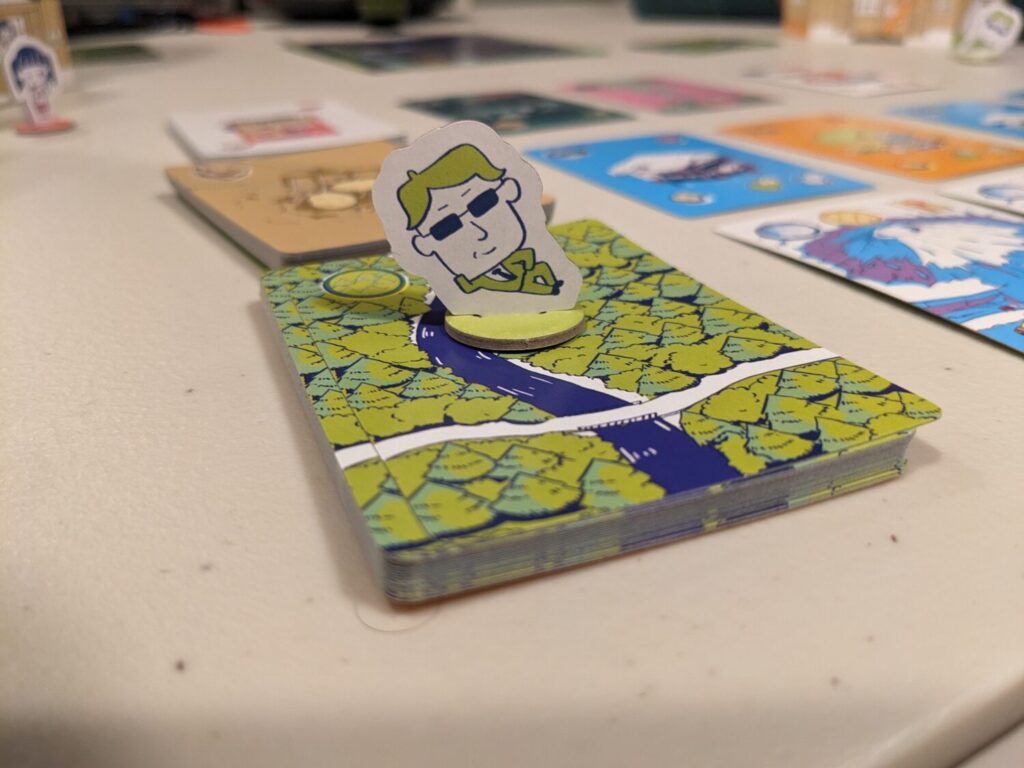
Yotei is a tableau-building set collection game for 2-4…
The post Yotei Game Review appeared first on Meeple Mountain.
From the rulebook:
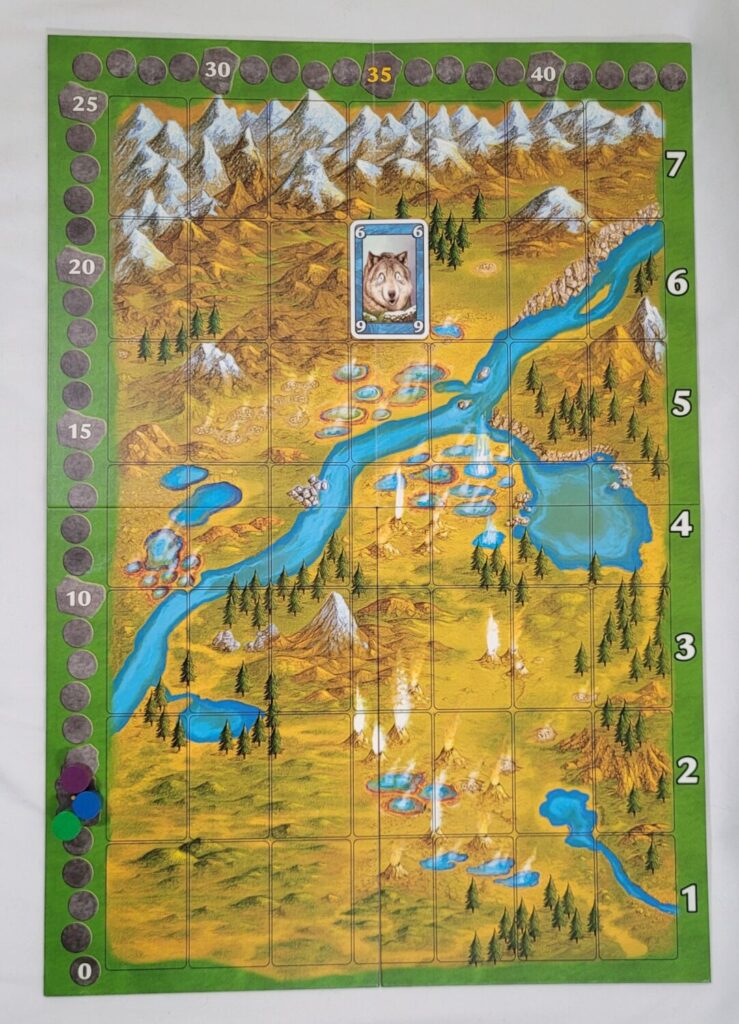
“Welcome to Yellowstone Park, the home of many wild animals. Impressive geysers spray their hot fountains into the blue sky. The players go on a trip through the park, which is shown on the game board. Each player has a hand of animal cards with different colors and numbers. During the game the players try to put their cards down as skillfully as possible on the game board to avoid penalty points.”
Yellowstone Park is played on a 7x7 grid laid on top of an illustrated overhead view of the titular park. The rows are numbered from 1 to 7 in ascending order, starting from the lowest row and moving upwards. There is a score track running along the left side of the grid. Each player’s score marker begins at the number 5 spot on this track.
There is also a deck of 56 Animal cards. Each card is one of four colors (red, green, yellow, blue) and one of seven numbers (1 through 7). For each number, there are two copies of that number + color pair (two copies of green 1, for instance). Every card features a cartoonish image of an animal, but these illustrations are unimportant for the purposes of the gameplay.
The post Ave Uwe: Yellowstone Park Game Review appeared first on Meeple Mountain.
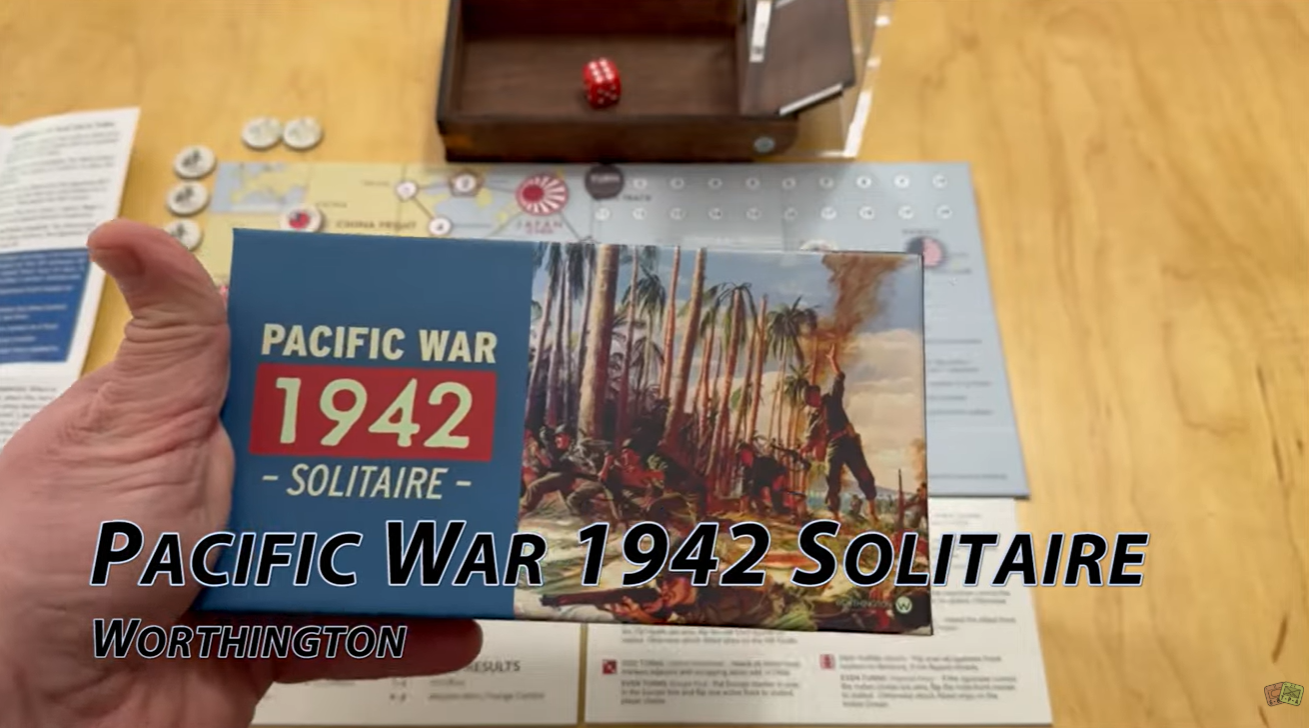


In early 2024, Worthington Publishing announced a unique 2-pack of games on Kickstarter that were marketed as easy to play travel friendly solitaire games. And you know that I love a good solitaire wargame! And when I heard that these games were small, even portable, then I was even more interested. One of the games covered the Pacific Theater of WWII called Pacific War 1942 Solitaire and the other covers the War of 1812 called (you guessed it) War of 1812 Solitaire. These games are designed by Mike and Grant Wylie and each game has 4 pages of rules, a beautiful mounted board and double sided counters. I played both and really very much enjoyed the experience.
I wrote a fairly in-depth First Impression post and you can read that on the blog at the following link: https://theplayersaid.com/2024/08/20/first-impressions-pacific-war-1942-solitaire-travel-game-from-worthington-publishing/
-Grant
The Fox in the Forest predates the contemporary trick-taking craze by a few years. It was an early harbinger of what was to come, of the deluge with which we have subsequently been blessed, and it proved successful. Successful enough that now, almost a decade after its initial release, Joshua Buergel’s two-player trick-taking game is getting the Deluxe treatment.
For those who’ve never played, The Fox in the Forest distinguishes itself from the bulk of trick-takers in two ways. Way the first: all of the odd-numbered cards in this non-traditional deck have special powers that trigger when played. Normally, I try not to get bogged down in the weeds when reviewing a game, but I do think the powers here are illustrative: The 1 in each suit lets you lead the next trick even if you lose, the 3 lets you change the trump suit, the 5 lets you draw one of the cards that weren’t dealt that round before discarding any card from your hand, the 7 is worth a point for whoever wins it, the 9 is always considered a trump card, and the 11 forces your opponent’s highest card in the same suit.
If you are at all familiar with the ebb and flow of trick-taking games, you can imagine well the sorts of shenanigans…
The post The Fox in the Forest Deluxe Game Review appeared first on Meeple Mountain.
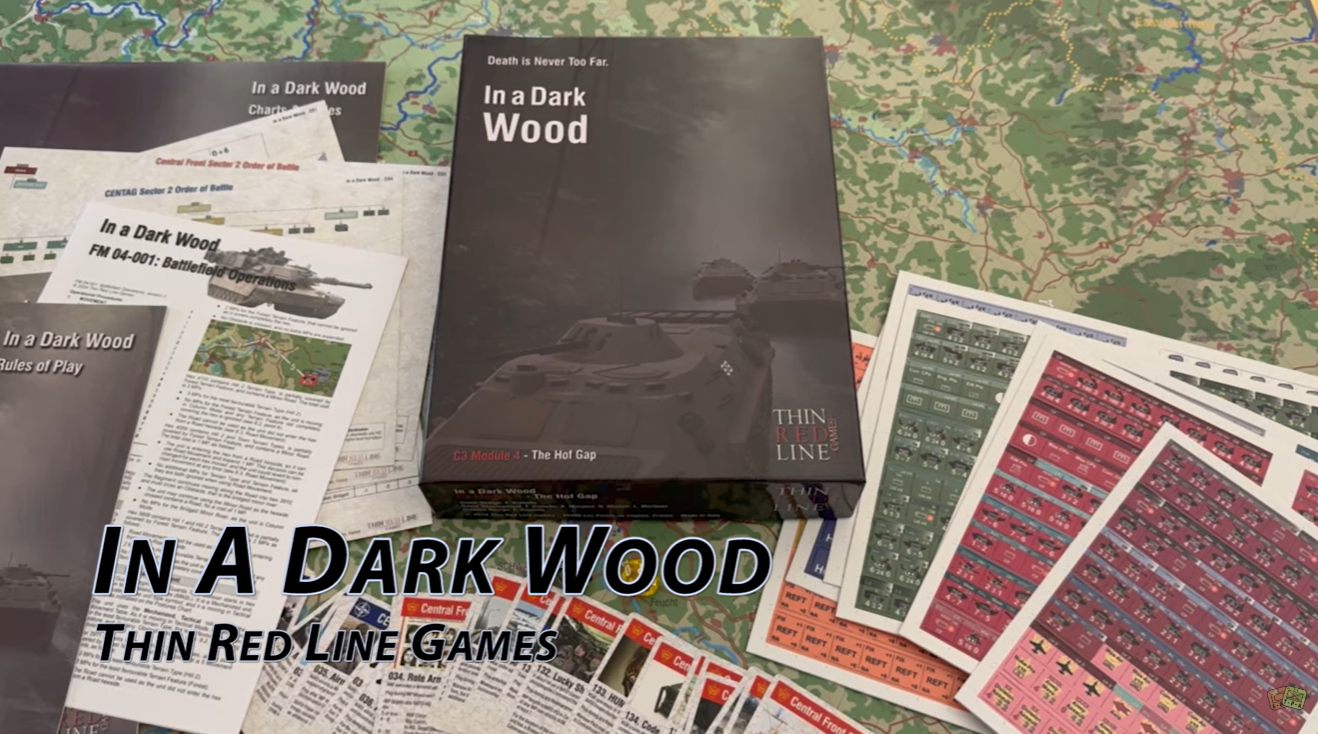
Taking its roots from SPI’s Central Front and NATO: Division Commander, In a Dark Wood is the fourth module of the C3 series, focused on Command, Control and Communication and pioneered by Less Than 60 Miles – one of the five nominees for the 2019 Charles Roberts Awards as Best Post-WW2, Cold War, & Hypothetical Era Board Wargame.
Several typical wargame mechanics have been reinterpreted, and both sides must fight three equally dangerous foes: the enemy, their own plan and time. Even a simple action can quickly turn into a disaster when facing an opponent using more efficiently the real key to victory: the OODA Loop theorized by John Boyd in the early ‘80s and used today as the basis for several military doctrines.
We published an interview on the blog with the designer Fabrizio Vianello and you can read that at the following link: https://theplayersaid.com/2024/12/30/interview-with-fabrizio-vianello-designer-of-in-a-dark-wood-c3-module-4-the-hof-gap-from-thin-red-line-games/
-Grant

The president of hobby games trade organisation GAMA, Nicole Brady, has failed in her bid to be re-elected to the role, with vice president Meredith Placko instead being voted in by the board of directors.
Brady, who spent two years as president of GAMA, had been a key driver of a plan for the organisation to become the “epicentre” of global tabletop gaming, underpinned by the unveiling of its first-ever 10-year plan last October.
She was also the organisation’s first female president on her May 2024 election, which at the time also saw the first all-women lineup for GAMA’s board officers in its then 47-year history.
New president Placko is the co-founder of hobby paint company Turbo Dork, and spent two years as CEO of Munchkin publisher Steve Jackson Games before resigning in April last year.
She began a two-year term representing publishers on the non-profit organisation’s board in March 2025, and was elected as GAMA vice president by the board of directors a month later.
Critical Role marketing manager Ross Thompson was elected as the new vice president at yesterday’s board of directors meeting, while Southern Hobby Distribution‘s Tiffany Reid and Red Racoon Games‘ Jamie Mathy were both re-elected as secretary and treasurer respectively.
Speaking to BoardGameWire about her win, Placko said, “I want to thank Nicole Brady for her work as president over the last few years, especially for establishing the strategic vision.
“I applaud the work that has been done on that 10-year vision. The next step is to turn it into a strategic plan. I do believe it will need evaluation and tweaking, as it very much is a living vision. As GAMA’s needs change, we must be prepared to adapt.
She added “As a trade organization, we should focus on strengthening and expanding the core elements that benefit our industry.
“GAMA is at a critical juncture: we’ve seen turnover in the last year, we’re about to start the executive director search, and our industry has endured more than its share of crises, including tariffs and economic uncertainty.
“When I pitched myself to my fellow board members, and now to the membership at large, my experiences as an executive and leader in business and the news industry have prepared me to help turn our goals into a solid foundation for which the organization can continue to grow.”
She added, “I applaud the work that has been done on the 10-year vision. The next step is to turn that vision into a strategic plan. I do believe it will need tweaking and evaluation, as it very much is a living vision. As GAMA’s needs change, we must be prepared to adapt.
“Another important issue for me is that as a trade organization, we must lead the way on critical industry matters. Everything from timely updates and actionable measures regarding tariffs and related issues.
“To keep our members informed about domestic and international regulatory changes. And educating and organizing membership on how to advocate for the issues we face at local and federal levels.
“But, none of this can be done by one person alone. It’s imperative that the board works together on all of this. And we work with our committees and leadership at GAMA to turn these ideas and needs into actionable items.
“While I may have a strong vision for what GAMA should be as a trade organization, the decision is not mine alone. The board, the staff, and most importantly the membership drive this organization and make it great.
“Ultimately, one of my most important jobs is ensuring the board is part of the process every step of the way.”
Brady told BoardGameWire she was proud to have created “a strong foundation that future leadership will be able to build on”, despite “people throwing tack strips on the road in front of me”.
She said, “I am proud of the many things I have done to help advance the organization, including making history as GAMA’s first female president.
“My greatest accomplishment as president was spearheading GAMA Vision 2035 at the fall 2024 strategic planning session. We put together a big picture of what we wanted for the future and that focused on becoming the epicenter for tabletop gaming.
“It included expanding internationally and domestically in a meaningful way, creating large scale marketing initiatives (think ‘Got Milk?’), building partnerships, launching a speaker’s bureau, establishing a 501(c)(3) for charitable work, providing educational certification and so much more.”
Brady told BoardGameWire last year that the Vision 2035 ten-year plan was an attempt to get the organisation away from “playing whack-a-mole” on important issues rather than managing them in a long-term strategy.
The array of plans spread across the next decade include boosting its membership within both hobby games and the mass market, expanding itself into a global organisation, shifting its finances away from the current heavy reliance on the annual GAMA Expo and Origins shows, and leading the conversation on sustainability within the industry.
Brady also highlighted her work push GAMA towards global lobbying, legislation and advocacy, over and above initiatives such as the organisation’s trip to DC last year to lobby against the US tariffs situation.
She added, “As treasurer, I called for an audit to address concerns I witnessed. That audit has finally wrapped up thanks to our current Treasurer taking over the project when it stalled and will result in changes that improve the record keeping and financial practices.
“Even with people throwing tack strips on the road in front of me, I was able to create a strong foundation that future leadership will be able to build on.
“I know I have made a lasting positive difference. Many people have shared publicly that my leadership is the reason they joined GAMA, renewed their memberships or have renewed faith in the future of GAMA.
“I did a lot of relationship repair behind the scenes. Seeing positive news instead of constant negativity is a testament to that hard work.”
The GAMA Board of Directors is comprised of twelve individuals elected to represent the six voting membership groups – publishers, retailers, wholesalers, production, media and events, and creators – with half of the cohort up for election each year.
That board in turn elects GAMA’s four officers – president, vice-president, treasurer and secretary – from among themselves each year, with the winner requiring a majority of the 12 votes available.
The current board of directors also includes John Stephens from Total Escape Games, Drew Wehrle from Wehrlegig Games, Heather O’Neill from 9th Level Games, former president Eric Price from Meijia Board Game Factory, Michael Maggiotto Jr from BEST Human Capital & Advisory Group, LegalWATCH’s Eartha Johnson, and Danny O’Neill from Mood Publishing.
GAMA is currently working to secure a permanent replacement for its previous executive director John Stacy, who left the association last October just after the ten-year plan had been revealed.
Leadership consultant Zaria Davis was named as interim executive director last November, while GAMA hired its first COO last September in Melinda Prickett.
Placko told BoardGameWire, “I want to give credit and thanks to Melinda Prickett, GAMA’s COO, who has stepped up in so many ways since John Stacy’s departure. She and the GAMA staff are doing an incredible job.
“Many changes have occurred at the operational level and much work is happening behind the scenes. Melinda and the staff have taken to it all with such earnestness and gusto.
“While the board may have seen a change in leadership, we are a small piece of the GAMA puzzle. I want to make sure Melinda, and the staff who are doing the heavy lifting of this organization, get the recognition they deserve.”
Last month GAMA’s board of directors apologised for some of its elected leaders being “rude and disrespectful” during a “heated” annual general meeting at the recent GAMA Expo trade show.
This year’s GAMA Expo sealed another record attendance, ahead of its planned move to Baltimore in 2027 to contend with rapidly growing demand.
More than 3,820 attendees showed up to this year’s event in Louisville, Kentucky, up almost 12% on last year’s previous record of 3,425 – which had already left the show pressed for space across the exhibition hall and its extensive programme of seminars.
The post GAMA president Nicole Brady loses re-election bid, VP Meredith Placko voted into role first appeared on .
Dr. Reiner Knizia is a name synonymous with board games. Even if you haven’t heard of him, you’ve likely played one of his designs; according to Gemini, he has created more than 800 games. Whether it’s Ra, The Quest for El Dorado, Samurai, or Huang, he’s everywhere. We even had a lovely sit-down with him recently to discuss his highly successful career.
Whale Riders excited me because it comes from a power duo: Knizia on design and Vincent Dutrait on art. Dutrait’s work has become increasingly easy to spot as I’ve gone deeper into the hobby, and here his contribution is excellent. The thematic art is rich, depicting Indigenous Arctic tribes using handsome whales and other massive sea creatures as mounts. But despite that pedigree, this is not one for the Knizia hall of fame.
In Whale Riders, players take two of five possible actions each turn, moving between ports, buying goods, and completing contracts for money and pearls. Play continues until all the pearls have been purchased from the home area, giving the game a race-like structure from start to finish.
Goods in the market are replenished as they are bought, but new tiles can introduce storms that…
The post Whale Riders Game Review appeared first on Meeple Mountain.
A round-up of business happenings in the tabletop game industry
A couple of weeks ago, we announced our nominees for our 13th Annual Board Game Awards. As always, it was rough even choosing which games to nominate. Since then, we’ve put our heads together, tested the games, and come up with a consensus. Today, we are excited to announce the winners of our 2025 Board […]
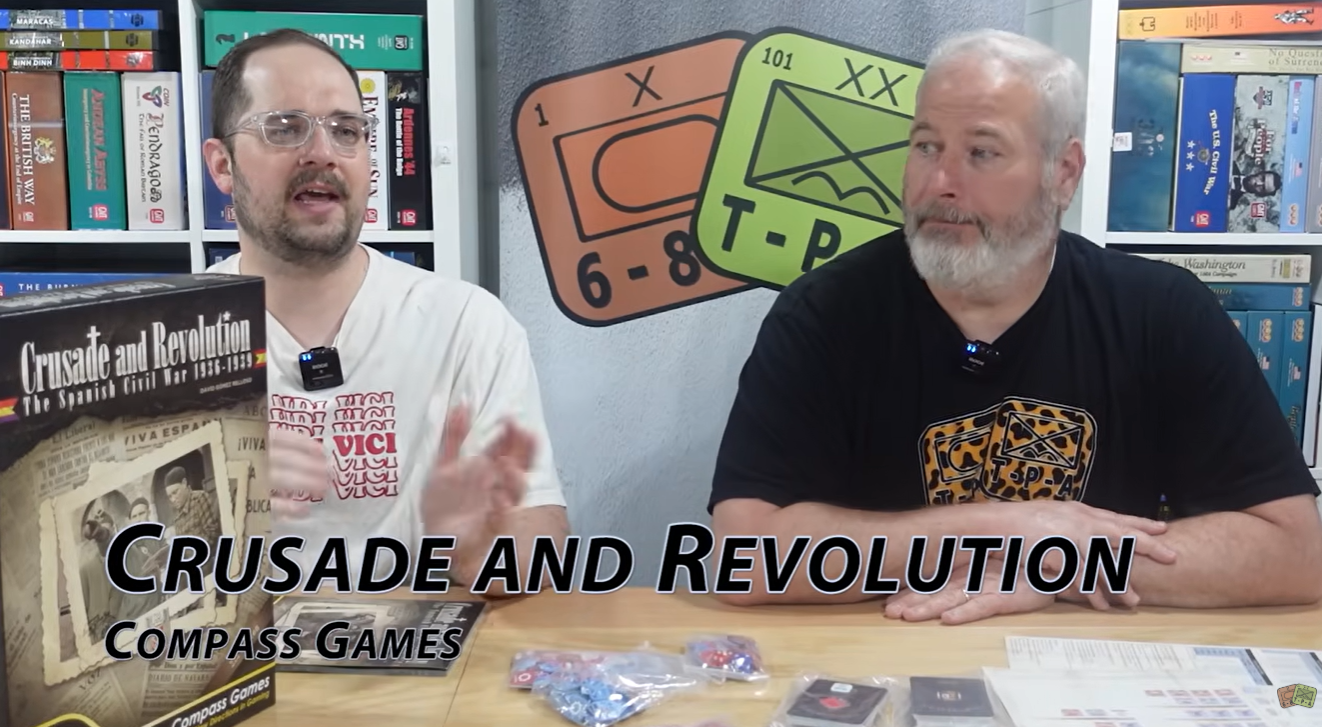
Crusade and Revolution: The Spanish Civil War 1936-1939 Deluxe 2nd Edition is a card-driven point-to-point movement strategic-operational wargame that covers all the Spanish Civil War (1936-1939). Its rules are based on Ted Raicer’s Paths of Glory. Each player takes command of one of the sides (Nationalist or Republican), and looks after all the aspects that involve a war including mobilization, recruitment, movement of troops, offensives and construction of defenses. There are also historical events that must be taken into consideration, thinks such as foreign military aid, international policy, change of Republican Government, etc.
-Grant

/pic9536215.jpg)


/pic9149607.jpg)
/pic8105651.jpg)