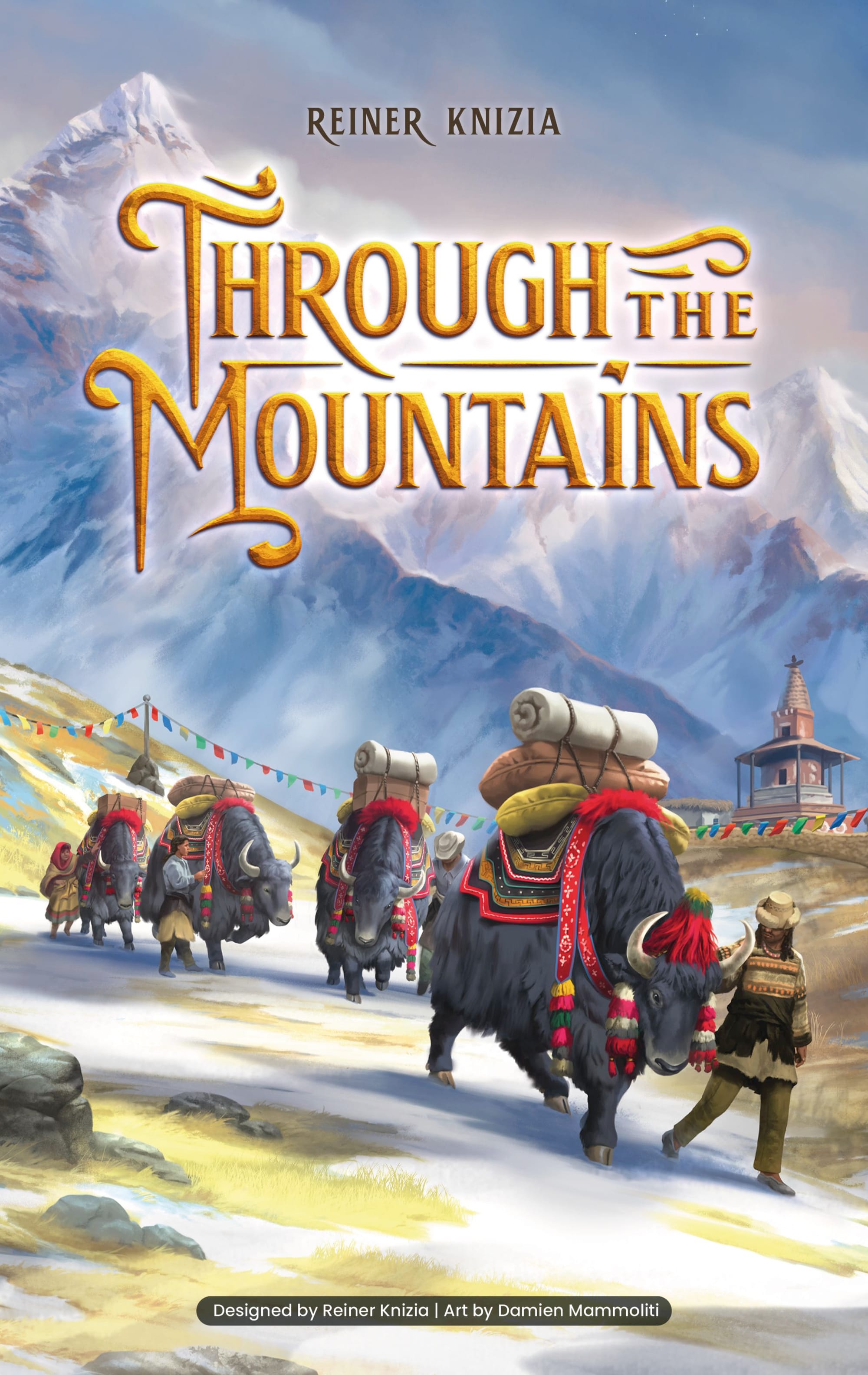
Der US-Verlag Allplay sammelt auf Kickstarter für „Through the Mountains, Through the Desert Deluxe + MORE!“, die Kampagne wurde von Kickstarter selbst als Staff Pick ausgezeichnet. Herzstück ist Through the Mountains, laut BoardGameGeek eine eigenständige Fortsetzung von Reiner Knizias Klassiker Durch die Wüste von 1998. Stand unseres Abrufs (06.11.2026) stehen 313.449 US-Dollar bei 2.353 Unterstützenden (3.134 Prozent des 10.000-US-Dollar-Ziels), Kampagnenende ist bereits der 13. November 2026, also in rund einer Woche.
Vom Sand in die Berge
In Durch die Wüste bauen die Spielenden Karawanenrouten durch ein Hexfeld-Wüstengebiet und sichern sich Oasen, Knizias Spiel gilt seit 1998 als Klassiker und steht in der Dice Tower Hall of Fame. Through the Mountains überträgt laut Verlagsbeschreibung dasselbe Grundprinzip, Routenbau auf einem Hexfeld, mit vorausschauender Platzierung, in eine Bergwelt mit Yaks statt Kamelen. BGG führt das neue Spiel explizit als Implementation des Originals, die Fortsetzungs-Behauptung ist damit nicht nur Kickstarter-Marketing, sondern auch über die Spieledatenbank belegt. Die Altersfreigabe steigt dabei um ein Jahr: Durch die Wüste läuft seit jeher ab 10, Through the Mountains ab 11 Jahren. Ob die Yak-Figuren auf dem Spielfeld wie beim Original über Farbe und Form zugleich erkennbar sind oder nur noch über die Farbe, lässt sich aus den verfügbaren Quellen nicht eindeutig klären, eine Vorschau beschreibt lediglich „verschiedene Posen“ und farbige Kopfschmuck-Elemente, ohne die spielerische Funktion davon zu erklären.
Vier Spiele in einer Kampagne
Die Kampagne bündelt mehr als nur Knizias neues Spiel: Dazu kommen eine Deluxe-Neuauflage von Through the Desert selbst (mit Kunstharz-Kamelen und Metall-Anführern statt Standardkomponenten) sowie zwei völlig eigenständige Titel, die mit Knizia nichts zu tun haben. Triskel, ein abstraktes Spiel, stammt von Kory Heath, 5 of a Kind, ein Shedding-Spiel mit Deckbuilding-Elementen, von Pete Wissinger, der sich nach eigenen Angaben von Haggis und dem Videospiel Balatro inspirieren ließ. Wer nur Knizias neues Spiel will, pledgt gezielt die „Through the Mountains“-Stufe, nicht das Gesamtpaket.
Pledges und Lieferung
Die Standard-Ausgabe von Through the Mountains kostet 39 US-Dollar, die Deluxe-Version mit Kunstharz-Yaks, Holzmeeples und Metall-Anführern 99 US-Dollar, eine Collector's Edition mit zusätzlichen Metall-Punktemarkern 139 US-Dollar, dazu zahlreiche Bundles über mehrere Spiele hinweg.
Zu Größe oder Griffigkeit der Metall-Anführer und -Punktemarker macht die Kampagne keine Angaben. Lieferung ist für alle Stufen auf August 2027 angesetzt. Versandkosten außerhalb der USA werden laut Kampagne erst im Pledge-Manager berechnet, konkrete Zahlen für Deutschland oder Europa waren auf den uns zugänglichen Seiten nicht zu finden, ebenso wenig Angaben zu möglichen Einfuhrabgaben oder Zollgebühren bei einer Lieferung aus den USA. Zur Lieferzuverlässigkeit von Allplay zeigt die eigene Fulfillment-Seite des Verlags für zwei seiner vier dort gelisteten, bereits abgeschlossenen Kampagnen („Container, GRUNTZ, Triangulation“, 10. Oktober 2025, und „Mountain Goats/Enchanted Ivy“, Ende Januar 2026) einen Versandstand von jeweils 99 Prozent. Die tatsächlich jüngste Kampagne, „River Valley Jewelcraft“, hat die Versandphase laut derselben Seite dagegen noch gar nicht begonnen, ein verlässliches Gesamtbild lässt sich daraus also nur eingeschränkt ableiten, auch weil die Zahlen von Allplay selbst stammen und nicht unabhängig geprüft sind.
Eckdaten zu Through the Mountains
Spielerzahl: 2 bis 4
Spielzeit: 40 bis 60 Minuten
Alter: ab 11 Jahren
Designer: Reiner Knizia
Illustration: Hien Le
Verlag: Allplay (USA)
BGG-Wertung: 8,50 bei nur 1 Stimme, nicht belastbar (Snapshot 06.11.2026)
Kickstarter-Kampagne: 10.000 US-Dollar Ziel, 313.449 US-Dollar bei 2.353 Unterstützenden (3.134 Prozent, Snapshot 06.11.2026), Laufzeit bis 13.11.2026, Lieferung ab August 2027
Was wir davon halten
28 Jahre nach dem Original ist Through the Mountains keine schnelle Zweitauflage, sondern eine späte Fortsetzung, mit einer einzigen BGG-Stimme lässt sich über die Qualität noch nichts sagen. Dass die Kampagne gleich vier Spiele bündelt, von denen zwei gar nichts mit Knizia zu tun haben, macht das Angebot unübersichtlicher, als der Titel suggeriert, wer gezielt nur die Fortsetzung will, sollte beim Pledgen genau hinschauen. Allplays eigene Fulfillment-Bilanz liest sich solide, Selbstauskunft eines Verlags bleibt aber immer mit Vorsicht zu lesen, ein Grund, den August-2027-Termin blind für bare Münze zu nehmen, ist das trotzdem nicht.
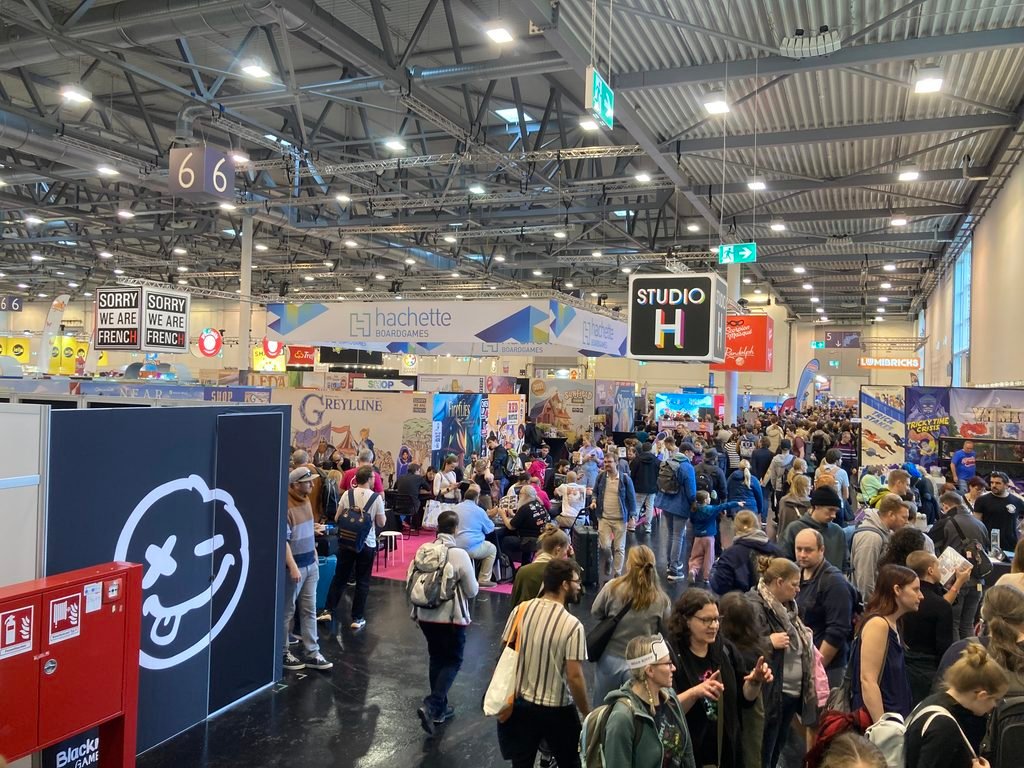
Spiel Essen has broken its visitor record for the fourth consecutive year by hitting a record 230,000 attendance – with publishers reporting bumper sales despite increasingly fierce competition for attention from more than 2,000 new releases.
The world’s largest board game fair once again sold out all four days this year, drawing 10,000 more visitors than in 2025 after expanding into an eighth exhibition hall and taking over the entirety of the Messe Essen exhibition centre – its home for over 40 years – for the first time.
Almost 1,000 exhibitors from 53 countries packed into the 2026 show – up 5% compared to last year – while the event’s floorspace grew to a record 81,200 sq m – larger than 15 American football fields.
But that ability to squeeze in larger and larger crowds has now reached its limit, Merz Verlag managing director Carol Rapp confirmed to BoardGameWire, with any further growth set to come via new events and experiences rather than increased attendance or exhibition space.
She said, “It will stay at 230 [thousand]”, adding that although the show was technically below its “legal maximum” attendance, the current levels allowed for visitors to make their way around the already crowded show floor more easily.
A shortage of exhibition space, however, has already been a recurring problem for Merz Verlag – which has been forced to introduce waiting lists for prospective exhibitors in each of the last three years, despite repeatedly expanding the show.
Organisers had to repeatedly rearrange hall layouts ahead of the 2024 show in order to accommodate as many publishers as possible while keeping safe amounts of aisle space. Expanding out into Hall 7 last year failed to eliminate the problem, and despite another expansion into Hall 8 this year, all available stands were booked up ahead of the April 30 application deadline.
That leaves the organiser facing the prospect of turning away more prospective exhibitors in future years, with no further exhibition halls available to accommodate them.
BoardGameWire reported in March this year that Spiel organiser Merz Verlag had “no intention” of relocating the show away from Essen in order to continue its expansion, saying that the event would remain in its current home “for the foreseeable future”.
Rapp has now doubled down on that sentiment, saying, “We are well aware that we are pushing Messe Essen to its absolute limits. But to immediately dispel any rumors: A relocation is not on the table.
“Our focus now is on continuing to refine and develop Spiel at the Essen location in the coming years.”
Expanded Focus
That development had already been apparent in recent years, with Spiel beginning to break out from its long-time status as a game-buying fair and opportunity for business meetings by adding a series of new events.
They include introducing Games Workshop’s Golden Demon miniature-painting competition in 2024, running a world record-setting game of Catan – Connect with more than 1,100 people in 2025, and adding the TCG Awards and Warhammer 40,000 laser tag this year.
The organiser also launched Essen spielt! in 2026, a partnership with the city which brought gaming events to venues across Essen during the fair – and said it plans to develop the initiative further in 2027.
Other new developments for 2026 included a business matchmaking platform aimed at helping publishers, designers, retailers and other industry professionals find potential business partners and arrange meetings before arriving at the fair.
Rapp told BoardGameWire she was pleased with how this year’s expansion had worked out – particularly the addition of a new northern entrance, which noticeably helped spread visitors more effectively across the exhibition halls, and helped reduce the vast queues which have formed at the start of each day in previous years.
She added that the new Hall 8 had also exceeded expectations, despite initial uncertainty about how exhibitors would make use of the slightly unusually-shaped space.
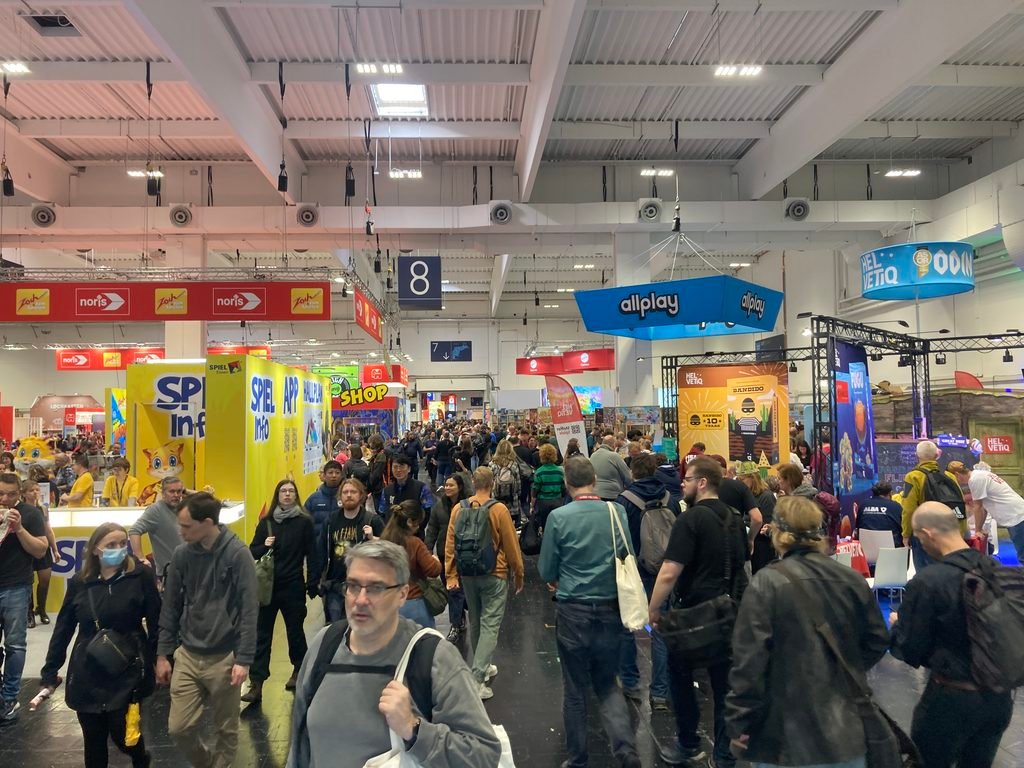
US publisher Allplay took Spiel up on an offer to move into a central position in the new Hall 8 – and COO Joe Wiggins told BoardGameWire that shift had paid off handsomely, with sales up 40% compared to the previous year’s show, marking the publisher’s most successful Spiel to date.
He picked out Enchanted Ivy as one of its big hits of the show, saying demand for the 450 copies of the title it brought was “non-stop” until the game was sold out at 3pm on opening day.
Wiggins said sales were good across its portfolio, from light titles to heavier strategy games – adding that the new location right at the show’s main entrance meant visitors were far more likely to discover its booth.
That interest was capitalised upon by Allplay through its decision to run a large number of demo tables as part of its booth, with Wiggins saying seeing games in action had helped draw people in, even if they weren’t a “typical” Allplay customer.
German publisher Pegasus Spiele also reported stronger-than-expected sales, despite arriving at Essen with relatively conservative expectations.
Company co-CEO Karsten Esser told BoardGameWire on Friday afternoon that sales were already ahead of the equivalent point in 2025, even without the benefit of a single major award-winning release driving demand.
Pegasus brought more than 40 new releases to the event, and said the breadth of its portfolio had helped compensate for the absence of an obvious blockbuster title.
Other exhibitors BoardGameWire spoke to also reported substantial sales increases, while the consensus generally was that last year’s busy Friday, Saturday and Sunday were added to this year with a Thursday which felt like a return to pre-Covid crowds.
Spiel Squeeze
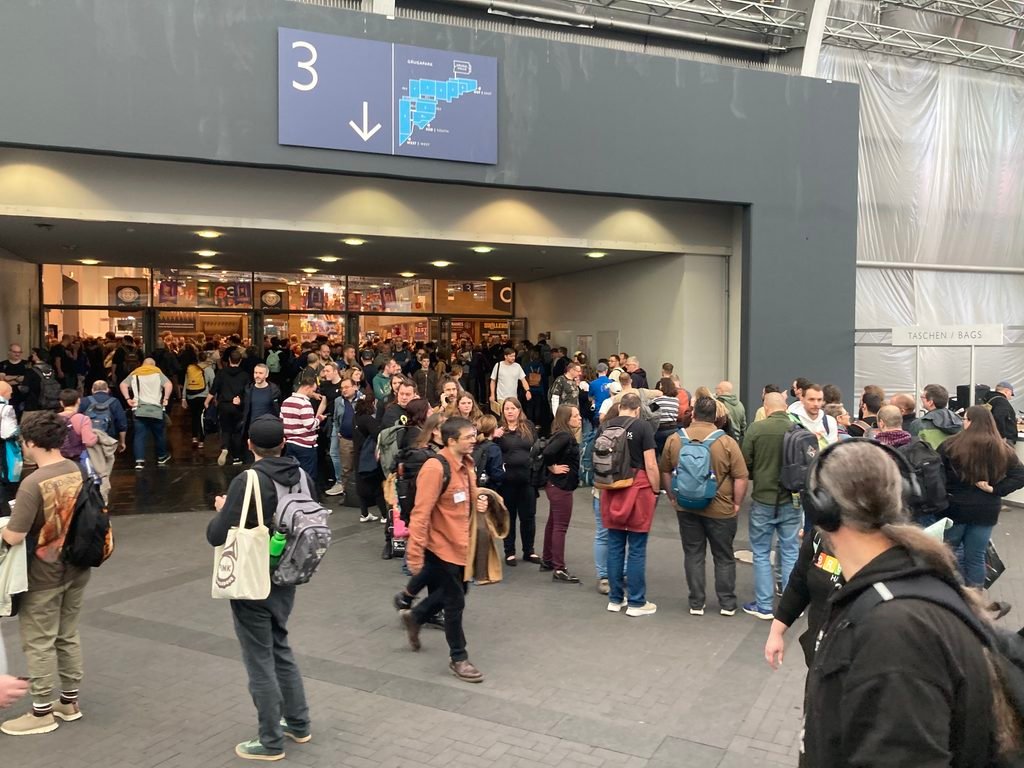
While most halls saw attendees flowing easily, if slowly, around them during the fair, the long and narrow Hall 3 once again proved the trickiest to get around – especially given the enormous queues which formed at several different booths during the show.
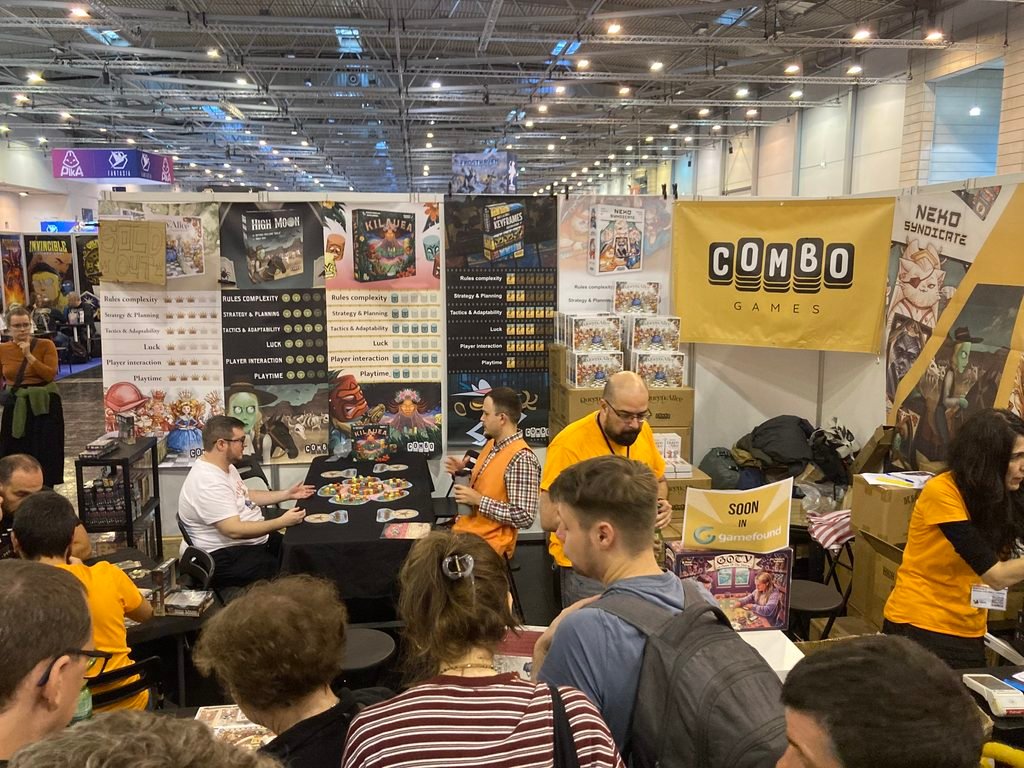
Chief among those were the queues at Spanish publisher Combo Games, which snaked along one whole end of the hall and out of the doors – creating a line Carol Rapp said was among the longest she had ever seen at the show.
Combo had benefitted from its new release Queen Alice, which combines elements of chess with eurogame mechanics and an Alice in Wonderland-inspired setting, being the ‘most-thumbed’ title on BoardGameGeek’s Spiel Essen preview – leading to a sea of attendees trying to reach the booth to get their hands on the game.
The queue for Queen Alice publisher Combo Games at Spiel Essen 2026, snaking out of Hall 3 and into the Galeria food court
Company co-founder Antonio Guillamó told BoardGameWire on the show floor that it had brought about 2,000 copies of the game to Essen, including stock earmarked for fulfilling Gamefound pledges, but had sold out by around lunchtime on Friday.
Demand was so intense that the Combo team was forced to concentrate purely on sales rather than demoing its games – and the huge buzz created other problems for the publisher.
Guillamó told BoardGameWire that Spiel had been “fighting” the publisher over the long queues, which ended up blocking access to other booths such as the nearby Dice Throne.
Rapp told BoardGameWire Spiel had provided advice on how to guide the queue to avoid it blocking other booths, as well as providing extra security from Messe Essen – which Combo had to pay for – to help manage the line.
The Combo Games team demoing and selling some of their other titles after Queen Alice had sold out
She said, “They had one of the hottest titles of the show, and nobody can plan for that. I get that, and the team gets that. But if the crowd waiting to buy is turning into a safety issue, then we have to do something.”
Rapp said her team was always “counting the seconds on the first day” to find out where the biggest queues were emerging, in order to step in quickly and help prevent any blockages.
She added that another blockage at the 2026 event had arisen at Pegasus Spiele, with large groups of people congregating by the booth after buying their games – saying that Pegasus was told to fix the issue or their booth would be closed. That problem was sorted the next morning by introducing a guard rail, she said.
Rapp said in an interview with German board game channel Brettspiel-Kollektiv that one exhibitor had repeatedly ignored instructions intended to keep queues under control, leading organisers to prohibit further sales for the remainder of the day. The publisher involved was not identified.
She stressed to BoardGameWire that managing congestion was essential to keeping the event safe and enjoyable, particularly as the number of visitors and exhibitors continued to grow.
“As long as the people are moving, everything is fine,” she said. “As soon as you have a block, a cluster or whatever, in the aisles, and it’s taking too long, people will go crazy.”
The pressure of accommodating record numbers at Spiel also extended beyond the exhibition halls, with severe crowding on Essen’s public transport system each morning in the run-up to the show opening.
Standing Out
The growing scale of Spiel has also brought fresh challenges for publishers trying to stand out among the thousands of games competing for attention.
This year’s 2,012 new releases represented another increase on the prior record, with the volume of new titles becoming a significant consideration for companies deciding when and how to launch their games.
The head of one large board game publisher who spoke to BoardGameWire at the show suggested that while smaller publishers often needed the exposure provided by major events such as Spiel, the rising competition on site might make it more beneficial for them to spread releases more evenly through the year.
He argued that publishers should consider whether launching at a quieter time of year might make it easier for their games to attract attention – particularly given that consumers were increasingly buying board games year round rather than concentrating their purchases around Christmas.
The challenge was echoed by other industry figures at the event, who described an increasingly crowded market in which the quality of new games continued to improve, but with individual releases potentially struggling to establish themselves.
Value Judgement
For publishers, however, Spiel’s value continues to extend well beyond the opportunity to sell games directly to consumers – something especially crucial given the high cost of running even a small booth at the event.
While the base cost of the smallest booth option – 15 sq m – comes in at about €1,500, that figure can easily balloon to several thousand euros after adding mandatory charges for booth partitions, waste disposal, and the cost of transporting, paying for and accommodating even tiny numbers of booth staff.
Pandasaurus Games told BoardGameWire ahead of the event that it had heavily downsized its Spiel Essen booth this year, having previously spent more than €50,000 ($57,000) attending Spiel with its larger setup.
The US publisher shifted to using European Player Network, Asmodee‘s specialist English-language sales and distribution operation in the region, to handle its stock and sales at the giant German show this year – removing the need for Pandasaurus to transport and store hundreds of games, staff its own retail operation and devote much of its booth to selling them.
Pandasaurus CEO Nathan McNair estimated to BoardGameWire that the costs under its current model would fall between $20,000 and $25,000, with the expectation of selling similar numbers of games under the new setup.
Archona Games, the publisher of titles including Small Star Empires and Pest, told BoardGameWire at the event, “Our focus here isn’t the sales so much. It’s always nice to sell, and I mean, I’d love to have the success of some of the other currently hot games out there – I wouldn’t say no!
“But I think for us, the strategic sort of part of it is really what we do with our community as well as our partners.”
They said in-show meetings with potential partners had already created promising opportunities for 2027, and added that demoing games, gathering feedback and building customer relationships were all key reasons for attending the fair.
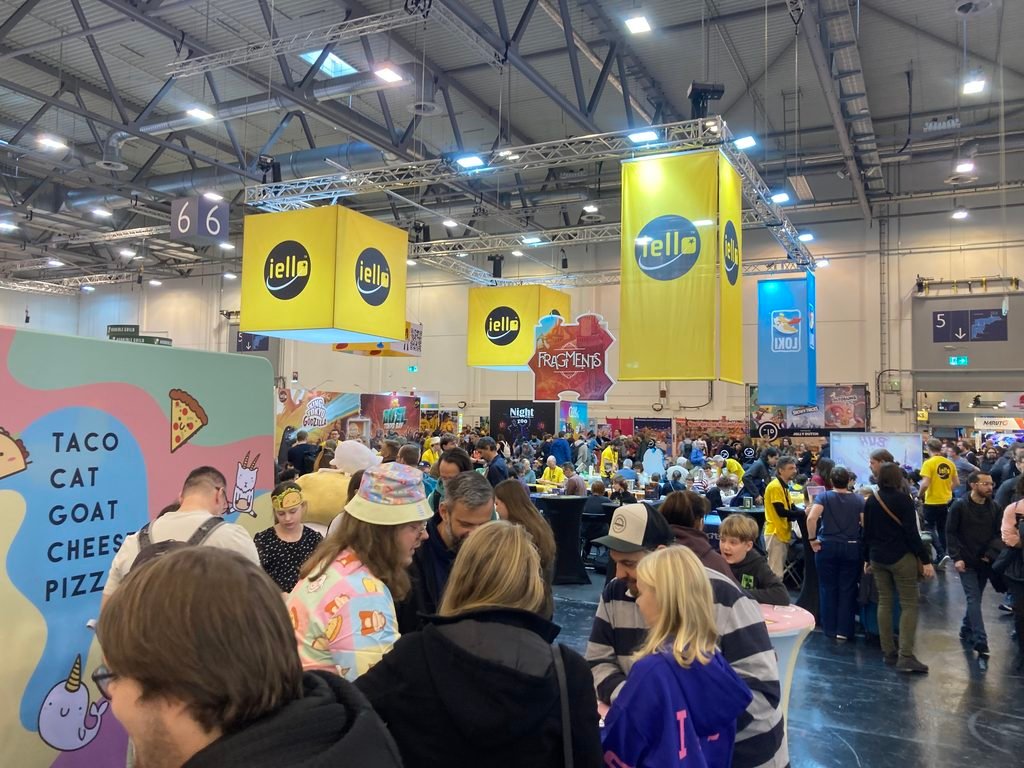
French publisher IELLO’s large booth and demo area at Spiel Essen 2026
IELLO communications manager Roger Anthony-Gerroldt told BoardGameWire at the show that it had brought six staff dedicated to scouting new games and localisation opportunities, with three project managers seeking new designs for its main catalogue, two looking for titles to bring to the French market, and another representing its children’s games brand Loki.
He told BoardGameWire the team spent much of the event moving between meetings with designers and publishers, hoping to discover games capable of becoming long-term commercial successes.
He said, “They just take meetup after meetup after meetup, and they look at a lot of designs, and they hope that they find the diamond that will take the place in the market and stay here.”
But he acknowledged that identifying those potential hits was increasingly difficult, with IELLO typically finding only one or two games each year that met its ambitions – and some promising projects ultimately failing to make it into the company’s catalogue.
That challenge has become more pronounced as the number of new releases continues to grow, Anthony-Gerroldt said, with even successful titles increasingly struggling to maintain sales beyond their first year or two.
Ukrainian publisher Boardova, meanwhile, described its first experience running a booth at Spiel as a valuable opportunity for promoting its games and building relationships – while stressing that the costs of attending meant the event should be viewed as a wider marketing investment rather than simply a sales opportunity.
Pegasus Spiele co-CEO Karsten Esser
Pegasus Spiele co-CEO Karsten Esser told BoardGameWire that direct sales at Spiel remained an important part of covering the company’s costs of attending, saying, “Well, to be honest, we run the company because we want to earn money. Of course, we love games, but we are also interested in earning money. I have to say, therefore, yes – the number of games that we sell here do matter, and they help us to break even. And maybe we can even reach a surplus. We will see.”
But he added that the longer-term value of the fair came from the market intelligence it provided, particularly the opportunity to gauge consumer demand across the company’s new releases, and identify which titles might become future commercial successes.
AI Divide
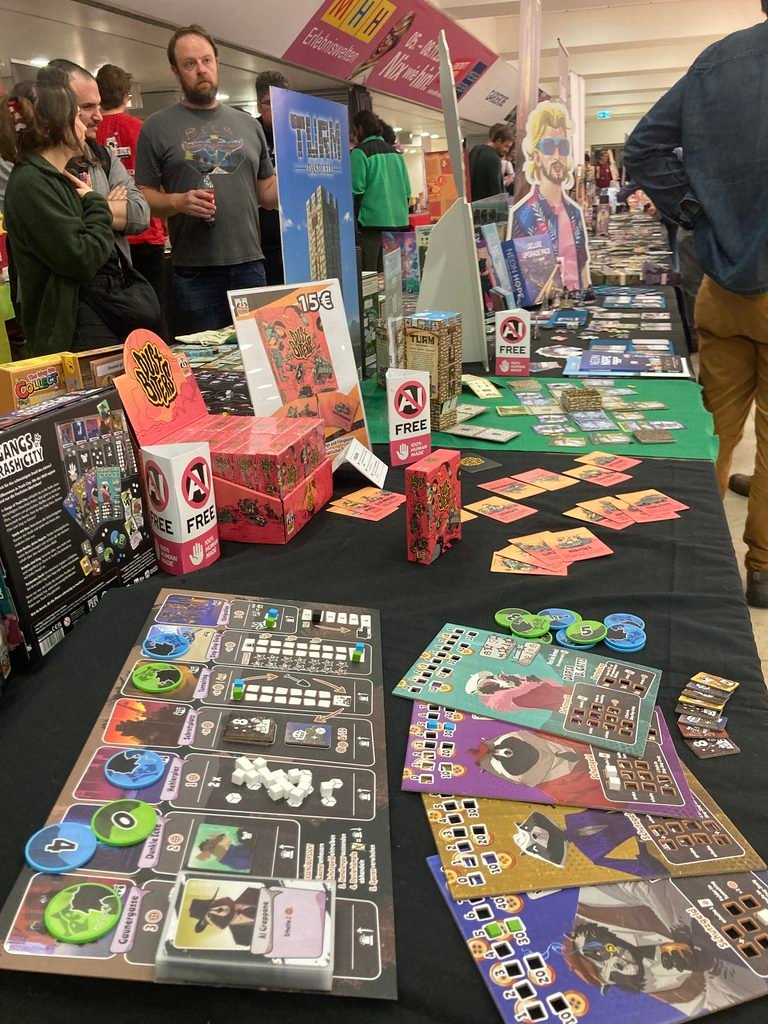
The ongoing debate over the use of generative AI in tabletop gaming was also visible at this year’s Spiel, with an anti-AI sign campaign from Neon Hope publisher Hopeful Games taking place, while some publishers and accessories sellers were clearly making use of generative AI for their artwork.
AI-Free signs at the Press Preview event at Spiel Essen 2026
Spiel organiser Merz Verlag has yet to introduce restrictions on exhibitors using AI-generated artwork, in contrast to several other major tabletop conventions which have adopted explicit policies in the past year.
UK Games Expo introduced a strict AI policy several weeks ago, prohibiting exhibitors from displaying or selling products created wholly or substantially using generative AI, while PAX Unplugged bans the sale of products incorporating substantial AI-generated content.
Origins Game Fair also requires products sold or distributed at the event to be created by human artists and creators. Gen Con, meanwhile, prohibits AI-generated imagery in its Art Show, although it has not introduced an equivalent general ban for exhibitors.
Rapp told BoardGameWire at the time that the organiser had reconsidered its approach following the backlash, but did not believe it was Spiel’s place to make decisions about the wider industry’s use of AI.
The absence of a general exhibitor ban three years later leaves Spiel as an outlier among the major tabletop game conventions.
BoardGameWire contacted Merz Verlag in September with a series of questions about whether the show planned to follow suit with its own AI policy, but was told by a spokesperson that the topic was too wide ranging to be able to address while preparations for this year’s event were taking place.
Future Plans
With its exhibition halls full and visitor numbers now capped, Spiel’s organisers face the challenge of finding new ways to develop the event without increasing its physical footprint.
Rapp told BoardGameWire during the show that Merz Verlag was still exploring what that might look like, with the company due to hold its annual planning workshop this month.
“Maybe it’s focusing more on events, like you said, or celebrating the industry. I don’t know yet, but we will have some good stuff coming up next year,” Rapp said.
Spiel Essen 2027 is scheduled to take place from October 21 to 24.
It’s almost too obvious to state aloud, but there’s a lot to be said for the games we actually play. Case in point, Enchanted Ivy, the solitaire game by Sarah Joshua. When I sat down this morning to begin writing this review, I went through the usual steps. Picking and editing the images. Uploading the template and arranging everything into logical order. Glancing through a few notes.
But then I thought to myself, maybe I don’t understand this game yet. Even though I’ve played it well over thirty times. One more session. In endless mode with randomized guests. Just one extra play to make sure I know what I’m talking about.
And then, with such inevitability that I’m not sure why I ever thought differently, I played it twice. That’s Enchanted Ivy for you.
Some of these guests are fighting. Perfect for playing my mandolin!
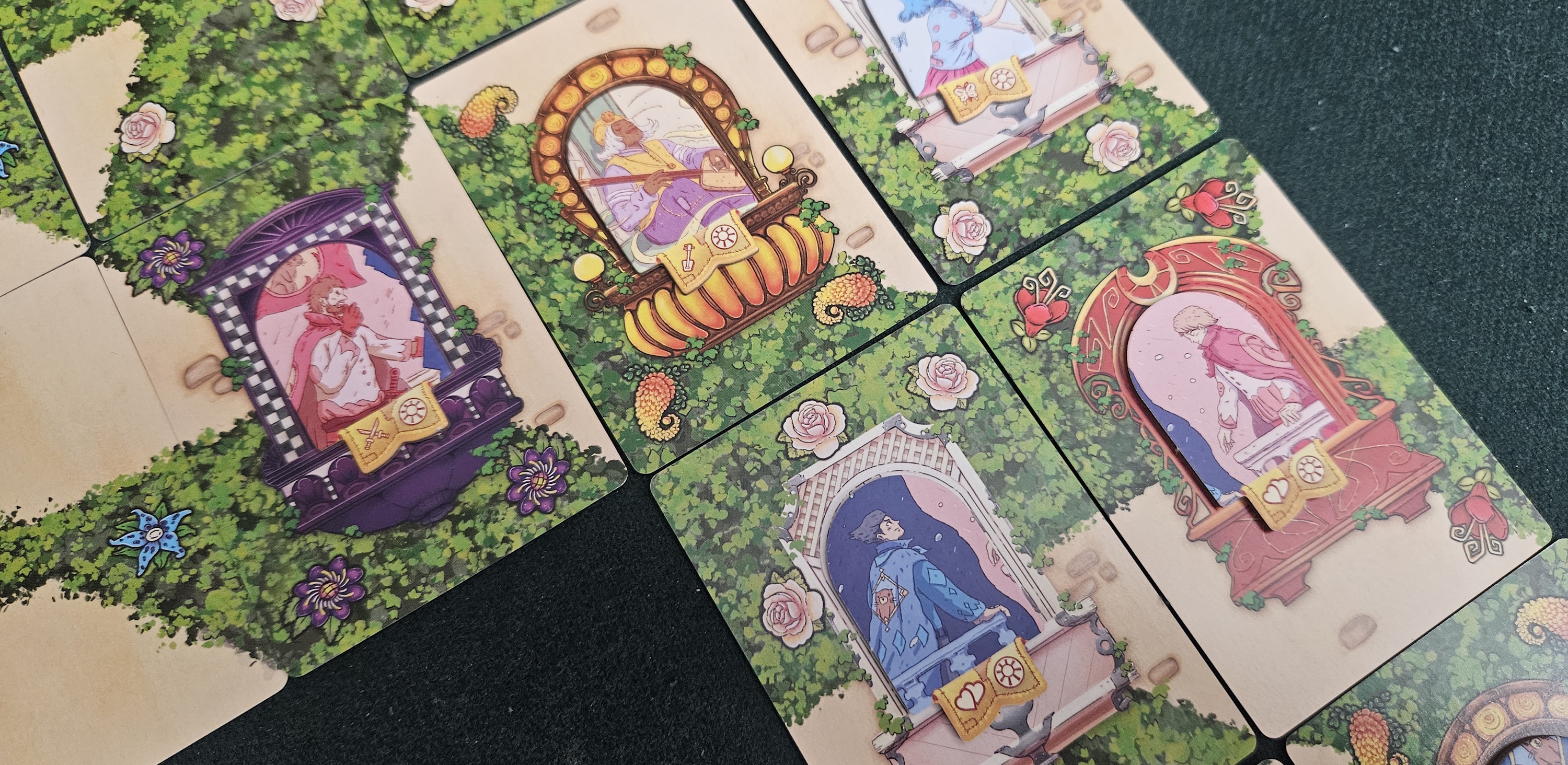
Enchanted Ivy is about building an inn. It’s a magical inn, always shifting, and covered with ivy and blossoms. The arrangement of that ivy is the first layer of the game’s challenge. The more interconnected the ivy — the fewer gaps in its protective foliage — the more points you score.
But Enchanted Ivy isn’t only about the structure. It’s also about the guests who will inhabit it. Every card can be flipped over. One side shows the ivy growing along the plaster and brickwork. The other shows the same, but with the addition of a balcony. These are the spaces for your guests to inhabit.
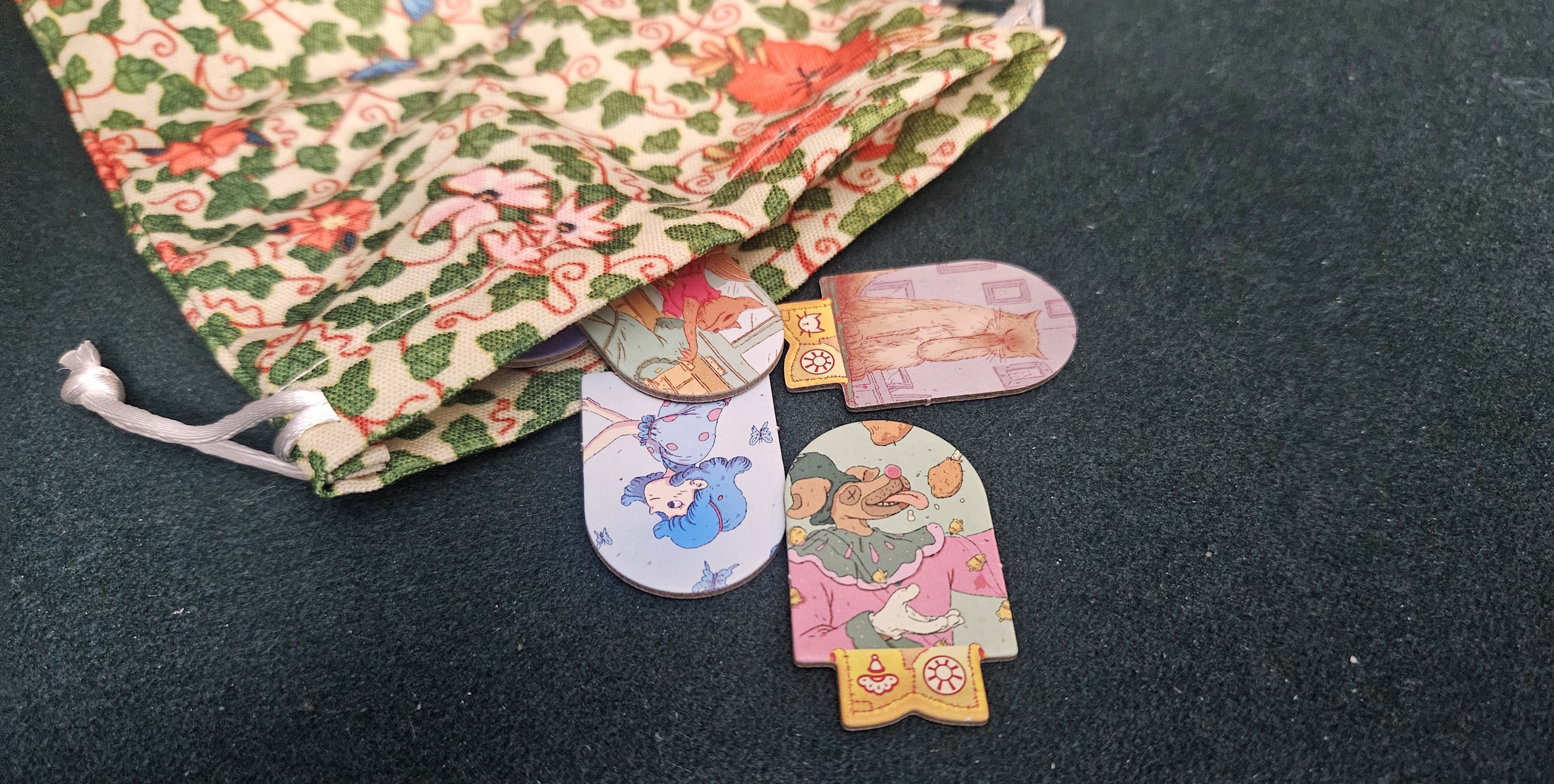
Turns are simple. You draw two cards and two guests. Both cards will be placed: one on its bare side, the other for its balcony. Onto the balcony you’ll place a single guest. Then you draw back to two cards and two guests. Simple.
Picking which fussy goofball to welcome into the inn.
Except the only simple thing about Enchanted Ivy is its turn structure. Your guests are the real challenge. To a one, they’re fussy. Fussy and wonderful. And since most sessions require you to balance the needs of ten or so guests, whether you’re tackling one of the game’s ten scenarios or tinkering with the randomized endless mode, their needs clash almost immediately.
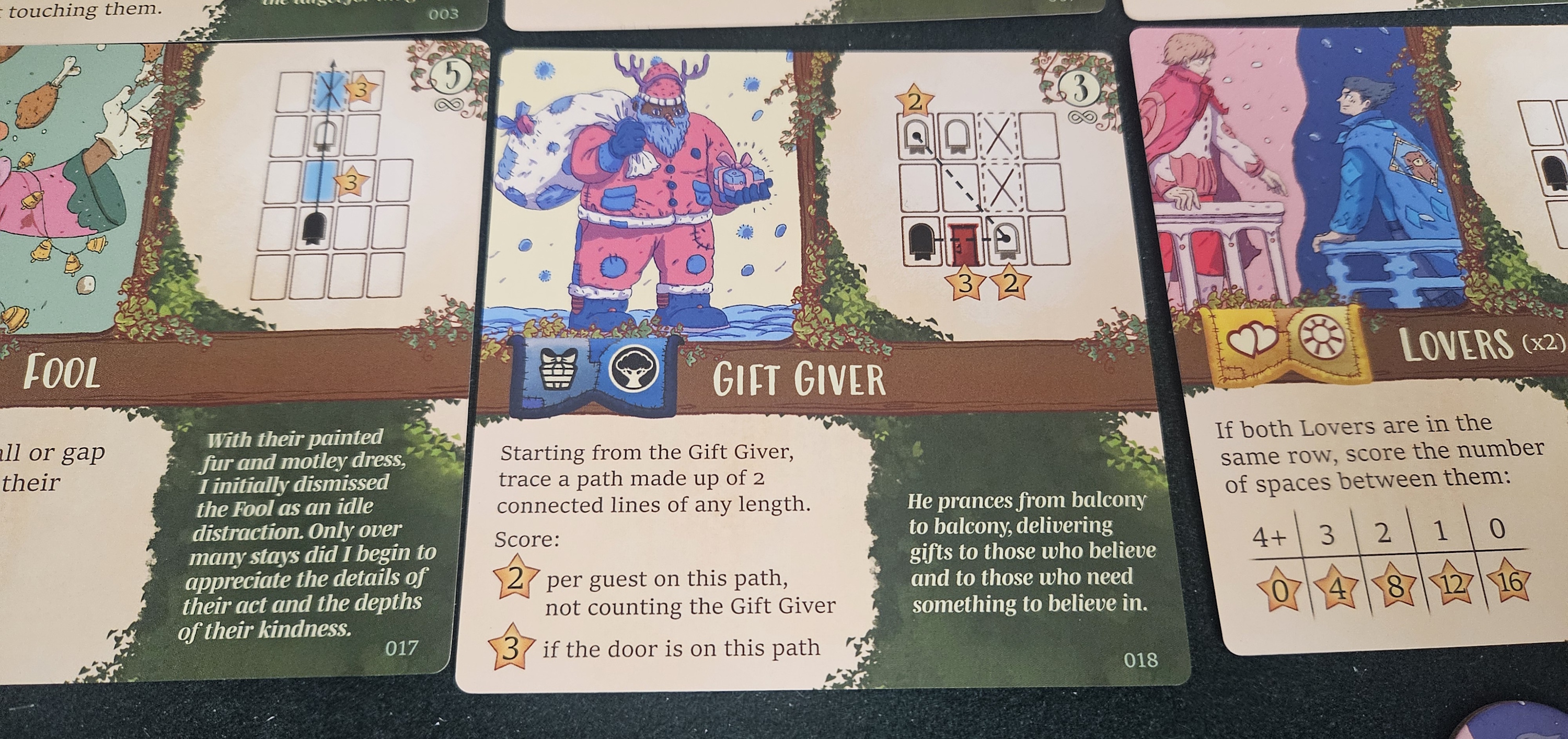
For example, today I was faced with some tough conflicting imperatives. Some of my guests were all about proximity. Such as the Dog, who wants to keep his three heads affixed to as many guests as possible, and the Gift Giver, a Santa knockoff who can only be bothered to walk in two straight lines through the inn, but scores quite a few points for every room he leaves a present at. Others, though, wanted room to spread out. Like the Adventurer with his grappling hook, ready to swing across gaps to say hello, or the Washer, needing another window somewhere across the way to suspend her clothesline from — the farther all the better for hanging additional wet underthings — or the Firebreather, determined to regurgitate flames against empty diagonals.
At times, the sheer bulk of these needs — having to house an Astrologer who wants an unobstructed view of the night sky next to a Cat that intends to wander from sill to sill — can seem overwhelming. Especially when you first reveal all those guests. Ten! Ten! How am I going to keep ten people straight?
Each guest has their own scoring objective.
To its credit, this is where Enchanted Ivy really shines. The scenarios, which present a lovely little tale about coming to accept one’s changing identity (I smell a metaphor!) introduces guests steadily but not so quickly that they become overwhelming. And really, the whole thing is brief enough that it usually demands a second session to see how many extra points can be wrung from a set now that you know your guests’ peccadilloes.
Very quickly, I developed favorites. The Fighters, paired guests who must be kept apart at all costs. The Raven Keeper, observing the comings and goings from above. The Architect and his invisible lines across the way. Of course, there were also those guests for whom my welcoming smile was more of a rictus. The Fool and his juggling. The Mystery Knight insisting that his bath demands privacy. The Justice’s demand for absolute symmetry of guest placements. That hag.
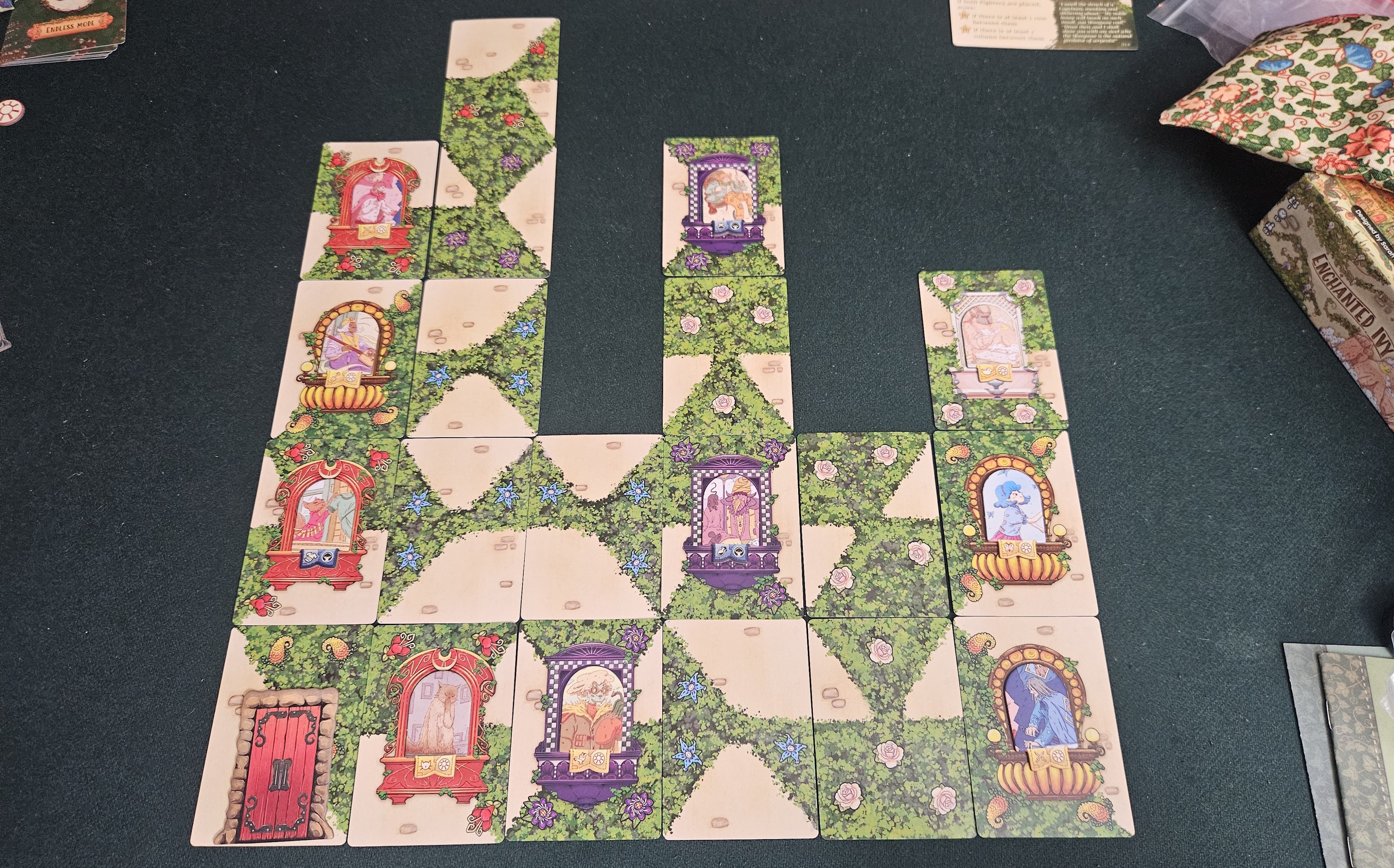
No matter the combination, though, there’s a fairness to the process. Sure, it’s possible for a bad draw to smash your plans. I’m speaking in a more holistic sense. Before Enchanted Ivy jumbles the pieces together, it shows you the parameters. The guests who must be housed. The shape your inn will take today. Who’s going to be a problem. If you’re playing a scenario, which optional challenges you can tackle. And then you take those pieces and make something beautiful.
I always take a moment to look over my completed inn.
Lots of board games are about making something beautiful, whether visually or mathematically. Enchanted Ivy lets you do both. But more than that, it asks you to linger. To spend an extra minute. To observe the flaws in your creation and appreciate them.
Which is to say that even after all those sessions, even after learning how to manage the game’s thirty-odd guests, after checking off every scoring goal and special objective in the campaign, I keep coming back for one more visit. This is one of the finest solitaire games I’ve played in… well, in ever.
A complimentary copy of Enchanted Ivy was provided by the publisher.
Editor’s note: GAMA is a BoardGameWire sponsor, and has advertised Game Store Day on the site – but this article is not a paid placement, I just think it’s interesting enough to cover editorially!
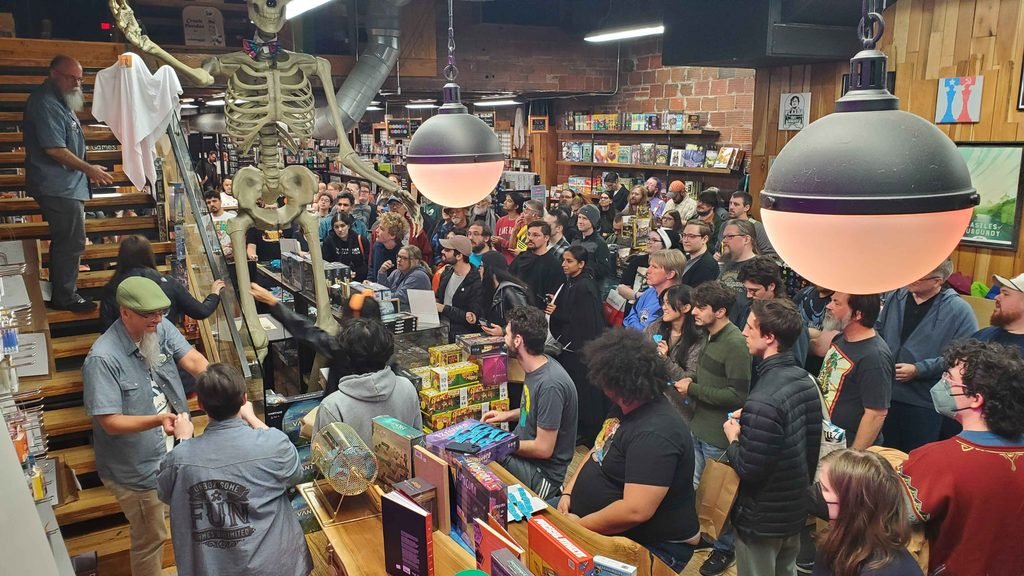
Game Store Day, GAMA‘s annual initiative aimed at getting more people into local game stores to play, shop and take part in events, is growing for its second year after retailers and publishers were given substantially more time to prepare than for its debut.
Almost 300 retailers are currently signed up for this year’s Game Store Day on November 7, while nearly 60 tabletop publishers have committed games to a new promotional box, as GAMA looks to establish the event as a long-term fixture on the tabletop industry calendar.
GAMA board member and Red Raccoon Games owner Jamie Mathy told BoardGameWire that rising retailer participation was the clearest measure of success for Game Store Day at this stage, with this year’s 297 sign-ups already ahead of last year’s total with over a month to go.
But he believes there is scope for the event to grow significantly bigger in future years – and said GAMA had already learned lessons from 2025’s relatively short-notice launch.
He said, “Last year, Game Store Day was something [GAMA’s] Team Retail had been advocating for, and then suddenly it was announced and launched with less than eight weeks to prepare. That wasn’t enough time for a lot of retailers to really build it into their calendars or plan meaningful events around it.
Game Store Day 2025 at Games Unlimited in Pittsburgh
“This year stores have had roughly four months to prepare, and we’ve had substantially more time to bring publishers into the program. The Publisher’s Box and other publisher initiatives give retailers additional reasons and tools to build something around the day.
“I think we’ll learn from this year as well. Ideally, I’d like stores and publishers to have even more lead time in future years.”
He added, “There are estimates of roughly 5,000 hobby game stores across North America. If we could eventually get 500 stores participating, that’s approximately 10% penetration and I would consider that a tremendous accomplishment. Getting to 1,000 stores – roughly 20% – would be amazing, even if that’s an ambitious long-term goal.
“More importantly, numbers like that would demonstrate to publishers and retailers that Game Store Day isn’t a one-time novelty. It’s something that has become part of the industry’s calendar.
“There’s a comparison to Free RPG Day here. It started relatively small, retailers can purchase a box of promotional products if they want those materials for their customers, and over time it has become something stores and consumers recognize.
“But ultimately, the part that excites me isn’t the box or even a particular participation number. It’s seeing hundreds of independent stores across the country celebrating our industry on the same day and giving people a reason to come together and play games.”
The short notice for last year’s launch left no time to run a Publisher’s Box – but 59 publishers including Leder Games, CGE, Blue Orange, Capstone Games and Bezier Games have agreed to contribute this year, with another four waiting to take part and others having approached GAMA after submissions had closed.
Publishers contributing to this year’s Publisher’s Box for Game Store Day
The $179 box will contain games, demos, promotional items and other material for participating stores – and Mathy said physical weight and shipping limits had now become the main constraint on adding more publishers.
“Probably, and that’s a wonderful problem to have,” Mathy said when asked whether GAMA would eventually need to rethink how publishers participate if interest continues to grow.
“This is only year two and the first year we’ve even offered a Publisher’s Box. Let’s learn from what works and what doesn’t this year.
“But if publisher interest continues growing, we’ll obviously need to think creatively about how publishers participate rather than assuming everything always has to fit into one physical box.”
Publishers are also beginning to build their own initiatives around the event aside from the promotional box.
Allplay is making 4,900 copies of new game Woo available exclusively to retailers participating in Game Store Day, with COO Joe Wiggins saying, “Allplay has been looking for new ways to work closer with our brick and mortar partners. When GAMA announced Game Store Day, we knew this would be an amazing opportunity. Allplay is all in.”
Mathy told BoardGameWire he believed part of the publisher interest was the difficulty some have in reaching hobby game retailers.
He said, “Game stores are incredibly diverse. We have different ownership styles, different product mixes, different customer bases and very different areas of specialization.
“Red Raccoon, for example, goes much deeper into board games and RPGs than many stores do, and that’s part of what has made us a regional destination. Another successful game store may have a completely different mix.
“That fragmentation makes it difficult for publishers to know where to spend their marketing dollars if they’re trying to get a product in front of retailers.
“Game Store Day gives them a self-selecting group of engaged retailers. A store willing to spend $179 on a box without knowing exactly what will be in it, because they believe in the idea and intend to build an event around it, is probably a pretty attractive audience for a publisher trying to get its products noticed.”
The increased publisher involvement brings Game Store Day closer to events such as Record Store Day – which GAMA has cited as an inspiration – where exclusive products, offers and other incentives have become part of the draw for customers.
But Mathy said, “I don’t personally think Game Store Day needs to become Record Store Day for games. The Publisher’s Box is a great addition, but to me it’s a bonus rather than the purpose of the event.
“I participated last year with essentially an idea, a logo and a store-locator website, and we had 35 people come specifically for our Game Store Day events.
“At its core, I think this should be a day when we celebrate local game stores, bring people together and play games. Publisher exclusives and promotional items can absolutely help stores make the day special, but they aren’t the reason Game Store Day exists.”
That vision has been taken up by participating stores including Oddwillow’s Game Haven in Wisconsin, which is partnering with its local library for activities including button-making, storytimes, miniature painting and game demos.
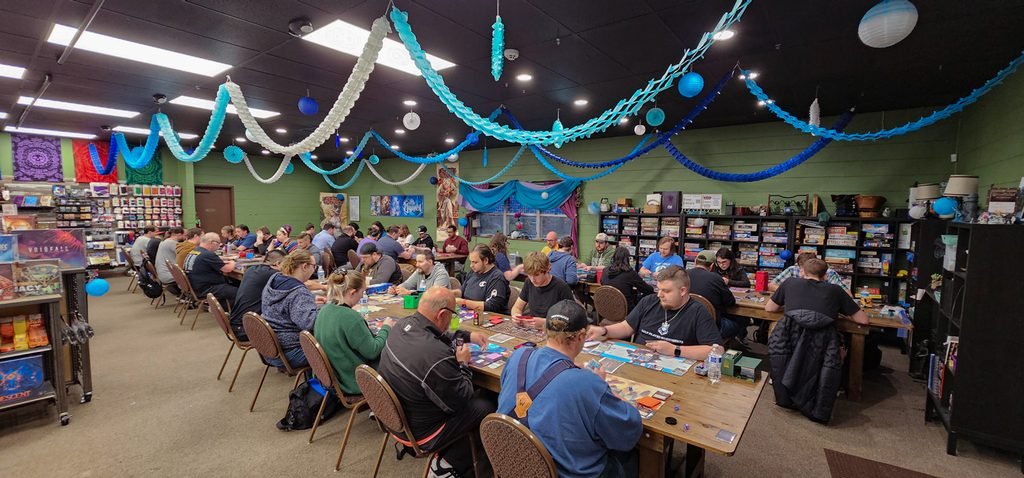
Gamers taking part in Game Store Day 2025 at Oddwillow’s Game Haven in Wisconsin
Pennsylvania’s Lookin’ For Games, meanwhile, is combining its first Game Store Day with game demos and a special Blood on the Clocktower event with a 24-hour gaming fundraiser for Extra Life benefiting Children’s Hospital of Philadelphia.
Neil Goldberg, the owner of the New York-based Main St Board Game Cafe, said the event was a chance to focus customers on the experience offered by their local game store while also encouraging people to think of board games as gifts ahead of the holiday season.
Mathy said, “GAMA provides the umbrella, publishers can provide additional support, but individual stores make Game Store Day their own and use it to celebrate the communities they’ve built around games.”
Die größte Leistung des Brettspiels Container besteht darin, dass es keinen Markt simuliert. Es erschafft einen – und überlässt ihn vollständig den Menschen am Tisch. Wer hier nach der perfekten Engine sucht, denkt schnell in die falsche Richtung. Der eigentliche Motor des Spiels ist Interaktion. Sie bestimmt Preise, schafft Nachfrage und treibt die Wirtschaft an.
Auf den ersten Blick sieht alles vertraut aus: Fabriken produzieren Waren, Lagerhäuser werden gebaut, Schiffe transportieren Container und am Ende gewinnt, wer wirtschaftlich erfolgreicher war. Doch schon nach wenigen Runden wird klar, dass das Brettspiel Container (Allplay) etwas völlig anderes versucht. Hier gibt es keine fixen Preistabellen oder einen unsichtbaren Marktmechanismus, der Angebot und Nachfrage reguliert. Stattdessen entsteht die gesamte Wirtschaft ausschließlich durch die Entscheidungen der Mitspielenden.
Kein Glück, sondern Strategie und Interaktion!
Das klingt zunächst abstrakt. Tatsächlich sorgt genau dieser Ansatz aber dafür, dass sich kaum ein anderes Wirtschaftsspiel so lebendig, unberechenbar und gleichzeitig nachvollziehbar anfühlt. Schauen wir uns genauer an, worum es in Container geht.
Aufbau und Spielablauf
Der zentrale Kniff von Container ist ebenso einfach wie genial: Niemand darf die eigenen Waren selbst nutzen.
Produzierte Container landen zunächst in den Lagerplätzen des eigenen Spielertableaus. Dort versieht man sie mit Preisen und hofft darauf, dass andere sie kaufen. Denn um Waren in den eigenen Hafen zu bekommen, müssen Container zwingend aus den Fabriken der Konkurrenz stammen. Eigene Produkte sind tabu. Das gilt auch für den Schiffsverkehr: Schiffe dürfen ausschließlich fremde Häfen anlaufen und dort Container erwerben.
Diese Regel zieht sich konsequent durch das gesamte Spiel und sorgt dafür, dass alle dauerhaft voneinander abhängig bleiben. Wer Gewinne erzielen möchte, braucht Kundschaft. Wer seine Schiffe beladen möchte, braucht funktionierende Häfen. Wer Container für die Endwertung sammeln will, ist darauf angewiesen, dass andere überhaupt produzieren.
Und wie steuert man sein Schiff? In jedem Zug führst du genau zwei Aktionen aus, mit denen du Fabriken oder Lagerhäuser baust, Waren produzierst, Container von Mitspielenden kaufst, Preise anpasst, Bankauktionen initiierst oder dein Schiff bewegst. Das Steuern erfordert vorausschauende Planung, da eine Überfahrt stets zwei Aktionen kostet: Mit der ersten Aktion ziehst du dein Schiff von einem Ort auf das offene Meer, mit der zweiten steuerst du einen fremden Hafen zum Einkaufen oder Container Island zur Versteigerung der Fracht an.
Der eigentliche Höhepunkt jeder Partie sind die Lieferungen nach Container Island. Auf diesem Planteil in der Tischmitte werden die geladenen Waren versteigert. Alle anderen bieten verdeckt auf die komplette Schiffsladung. Die transportierende Person entscheidet anschließend, ob sie das Höchstgebot annimmt oder die Waren lieber selbst behalten möchte.
Dadurch entstehen immer wieder spannende Entscheidungen. Ist das Gebot hoch genug? Will man der Konkurrenz wirklich diese wertvolle Lieferung überlassen? Oder zahlt man lieber selbst und nimmt die Container für die eigene Wertung?
Zusätzliche Würze bringt die Off-Shore-Bank ins Spiel, die als Kreditgeber und Auktionsplattform fungiert. Sie sorgt dafür, dass Kapital ständig in Bewegung bleibt und gibt dem Markt eine weitere Ebene, auf der sich Chancen ergeben können. Gleichzeitig macht sie die aktuelle Allplay-Ausgabe deutlich zugänglicher als frühere Versionen. Die Regel selbst empfiehlt die Variante mit Off-Shore-Bank inzwischen sogar ausdrücklich für Neueinsteiger.
Mit deinen errichteten Fabriken kannst du in deinem Spielzug……Container der entsprechenden Farbe produzieren, für die du individuelle Verkaufspreise festlegst.
Was Container eigentlich ausmacht
Die größte Überraschung erlebt man meist nach der ersten Partie. Viele Spieler gehen zunächst davon aus, dass möglichst viele wertvolle Container gesammelt werden müssen. Das erscheint logisch. Schließlich dreht sich das ganze Spiel um Container.
Doch Container belohnt etwas anderes. Entscheidend ist nicht, wer die meisten Waren besitzt, sondern wer das Geld am effizientesten durch die eigene Wirtschaft bewegt. Die Container sind letztlich nur Mittel zum Zweck. Sie werden produziert, gehandelt, transportiert und versteigert, um Kapital zu erzeugen.
Das führt zu einer Erkenntnis: Es ist absolut möglich, eine Partie mit vergleichsweise wenigen Containern auf der eigenen Insel zu gewinnen. Wer kontinuierlich kleine Margen erwirtschaftet, den Markt versorgt und clever investiert, steht am Ende oft besser da als jemand, der ausschließlich auf die Schlusswertung schielt.
Genau dadurch fühlt sich Container so anders an als viele moderne Eurogames. Statt eine möglichst perfekte Engine aufzubauen, beobachtet man ständig die anderen am Tisch. Wer hat Geld? Wer braucht Waren? Wer verlangt plötzlich deutlich höhere Preise? Wer kauft ungewöhnlich viel auf?
Das Spiel versteckt nur wenige Informationen. Die eigentliche Herausforderung besteht darin, die sichtbaren Informationen richtig zu deuten.
Die beladenen Schiffe in Container schippern zwischen den Häfen und Inseln des Spielfelds umher. Tipp: immer mit blauer Tischdecke spielen – sieht super aus.
Ein Wirtschaftsspiel, das Interaktion ernst nimmt
In vielen heutigen Strategiespielen kann man sich weitgehend auf das eigene Tableau konzentrieren. Die Mitspielenden dienen oft eher als Hintergrundkulisse.
Container geht den entgegengesetzten Weg. Wer die Konkurrenz ignoriert, verliert meist. Jede Preisentscheidung beeinflusst den gesamten Markt. Jeder Kredit verändert die verfügbare Liquidität. Jede Auktion sendet Signale darüber, welche Waren gerade begehrt sind.
Besonders faszinierend wird es, wenn sich am Tisch erste wirtschaftliche Rollen entwickeln. Vielleicht konzentriert sich jemand auf die Produktion bestimmter Farben, während andere vor allem als Händler oder Transportdienstleister auftreten. Solche Spezialisierungen entstehen nicht durch Spielregeln, sondern ausschließlich durch die Dynamik der Partie.
Dadurch erzählen viele Partien ihre ganz eigene Wirtschaftsgeschichte.
Man erinnert sich hinterher nicht an besonders clevere Kartenkombinationen oder ausgeklügelte Punktemotoren, sondern an den Moment, als plötzlich niemand mehr Geld hatte. Oder an die Auktion, bei der alle viel zu hoch geboten haben. Oder an die Person, die mit unscheinbaren 1-Dollar-Gewinnen Runde für Runde den gesamten Markt kontrollierte.
Container Island: Alle Container, die du hierhin in deinen Lagerplatz gebracht hast, zählen am Spielende für die Wertung.
Fragen und Antworten
Ist Container vom Glück abhängig?
Nein. Zufallselemente beschränken sich auf die zufällige Zuteilung der Startfabriken und die verdeckten individuellen Wertungskarten zu Beginn der Partie. Es gibt weder Würfel noch Kartenzieh-Mechanismen im weiteren Spielverlauf. Sämtliche Entwicklungen, Preisstrukturen, Gewinne und Marktverschiebungen resultieren ausschließlich aus den offenen Entscheidungen und Geboten am Tisch.
Warum darf ich meine eigenen produzierten Container nicht selbst transportieren oder verkaufen?
Das ist die fundamentale Designregel von Container, um Multiplayer-Solitär zu verhindern. Fabrikgelände und Hafen sind auf dem eigenen Tableau strikt getrennt. Man kann Waren nur von fremden Fabriken in den eigenen Hafen einkaufen und Schiffe dürfen ausschließlich fremde Häfen anlaufen. Dieser Zwang stellt sicher, dass eine funktionierende Wertschöpfungskette entsteht, bei der jede Partei auf die Interaktion und Liquidität der anderen angewiesen ist.
Handelt es sich bei der Allplay-Ausgabe um eine Neuauflage des Klassikers von 2007?
Ja. Das Spiel erschien ursprünglich 2007 bei Valley Games und wurde später durch eine limitierte Jumbo-Ausgabe (10th Anniversary) ergänzt. Die Neuausgabe von Allplay modernisiert das Grafikdesign, bietet maßstabsgetreue Kunststoff-Schiffe und -Container und integriert die Offshore-Bank standardmäßig in das Spielgeschehen, enthält aber auch Regeln für die klassische Erstausgabe-Variante.
Mein Fazit
Container gehört zu den Spielen, die von ihrer Spielgruppe leben. Man muss sich lernend mit der Mechanik auseinandersetzen und sich auf das zentrale Spielprinzip für anderthalb bis zwei Stunden Spielzeit einlassen. Sonst kann es passieren, dass der Markt völlig aus dem Gleichgewicht gerät oder der Geldfluss unbeabsichtigt austrocknet. Das ist manchmal frustrierend, gehört aber auch zum Reiz des Designs.
Denn anders als viele Wirtschaftsspiele rettet Container die Spielenden nicht vor ihren eigenen Entscheidungen. Wenn niemand handeln möchte, entsteht eine Rezession. Wenn alle Geld horten, trocknet der Markt aus. Wenn Preise unrealistisch werden, leidet die gesamte Wirtschaft.
Bemerkenswert ist dabei, dass sich das nie wie ein Regelproblem anfühlt. Vielmehr entsteht der Eindruck, dass die Gruppe gemeinsam einen Markt geschaffen hat – und nun mit dessen Konsequenzen leben muss.
Container ist kein Spiel für Menschen, die jede Runde exakt durchrechnen möchten. Es ist chaotischer, offener und deutlich sozialer als viele moderne Expertenspiele. Wer sich darauf einlässt, erlebt jedoch etwas Seltenes: eine Wirtschaft, die nicht vom Spiel verwaltet wird, sondern vollständig durch die Menschen am Tisch entsteht.
Genau deshalb fühlt sich Container auch heute noch überraschend frisch an. Während viele Wirtschaftsspiele vor allem Systeme simulieren, simuliert Container Verhalten. Preise, Nachfrage, Liquidität und Vertrauen entstehen hier nicht durch Regeln, sondern durch die Entscheidungen der Spielenden.
Das macht die erste Partie manchmal holprig. Die dritte oder vierte hingegen kann zu den faszinierendsten Wirtschaftsspiel-Erfahrungen gehören, die das Hobby zu bieten hat.
Lastwagen und goldene Metal-Container in der Erweiterung.
Die Erweiterung „More Containers“
Die modulare Erweiterung More Containers ergänzt das Grundspiel um drei voneinander unabhängige Module.
Truck Companies machen die bislang abstrakten Lkw-Transporte zu einem eigenen Wirtschaftszweig. Wer eine Spedition besitzt, verdient an den Einkäufen anderer Spieler mit.
Player Loans ersetzen klassische Bankkredite teilweise durch Kredite zwischen den Spielern. Dadurch entstehen zusätzliche Verhandlungen und interessante Machtverhältnisse.
Luxury Containers führen goldene Container ein, die sich flexibel für die Schlusswertung einsetzen lassen und neue taktische Möglichkeiten eröffnen.
Keine dieser Erweiterungen ist zwingend notwendig, aber alle passen erstaunlich gut zur Grundidee des Spiels und erweitern die vorhandenen Marktmechanismen sinnvoll.
Pro & Contra
Was mir gut gefällt:
Einzigartige Spielerökonomie ohne künstliche Marktmechanismen
Hohe Interaktion und permanente Beobachtung der Mitspielenden
Spannende Auktionen mit vielen psychologischen Entscheidungen
Tolles Spielmaterial und frisches Design
Was ich weniger mag:
Erste Partien können holprig verlaufen
Entfaltet seine größte Stärke erst mit vier oder fünf Personen
Wer klassische Engine Builder erwartet, könnte zunächst enttäuscht sein
Hinweis: Wertungen vergeben wir im Bereich 0 bis 4 Sternen. Spiele mit 0-1,5 Sternen sind sind schlecht, mit 2 bis 2,5 Sternen durchschnittlich. Ab 3 Sternen beginnen die empfehlenswerten Spiele. Nur außergewöhnliche Titel erhalten 4 Sterne („Four-Star Game“).
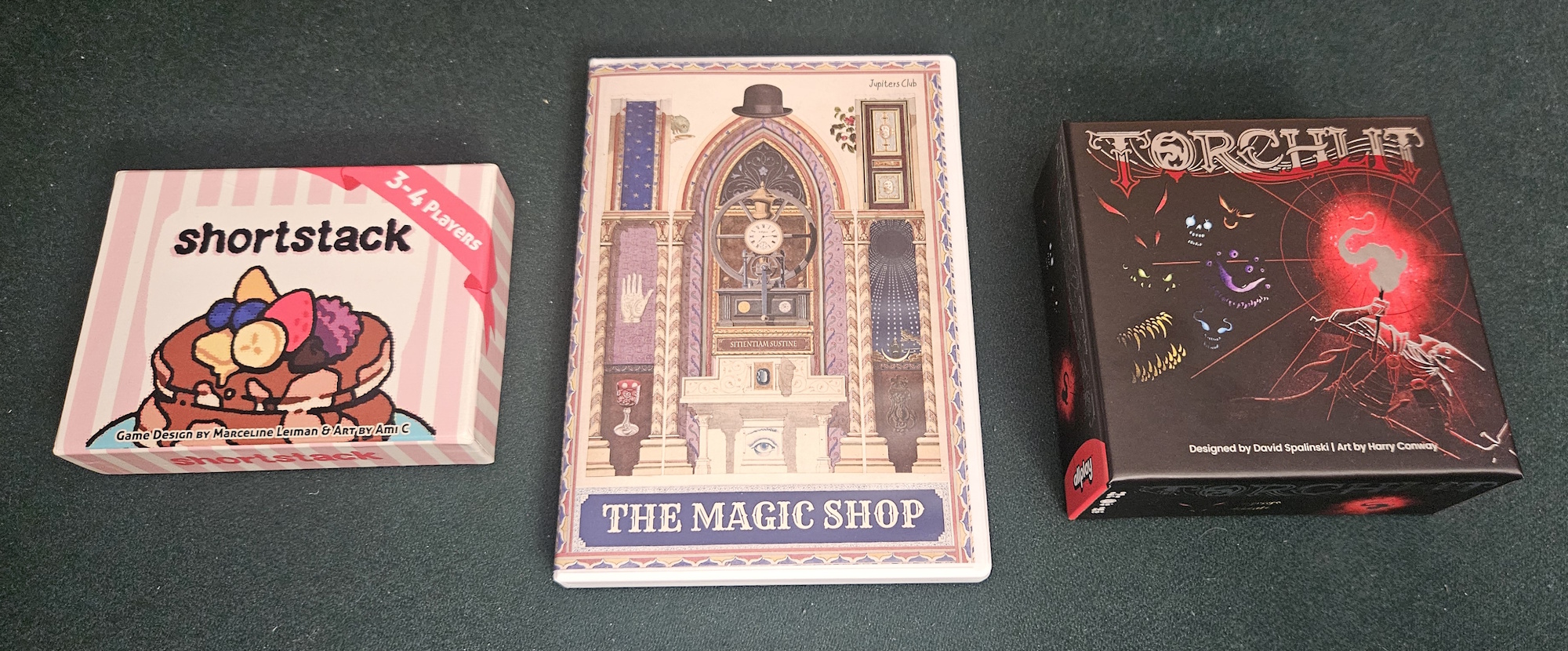
All I play anymore is trick-taking games. Fortunately, it’s an uncommonly smart genre. Today I’m covering three titles that highlight both the format’s breadth and what makes trick-taking one of tabletop’s most enduring pastimes — and one of its meanest.
In other words, these are trick-takers for jerkwads. Compliment intended.
I am not gonna review eating 18 pancakes.
Shortstack
Marceline Leiman has been busy. After the success of High Tide, it seems like her designs are popping up everywhere. (Pro tip: Dino Racer has the juice.) Most recently, Shortstack has been making the rounds.
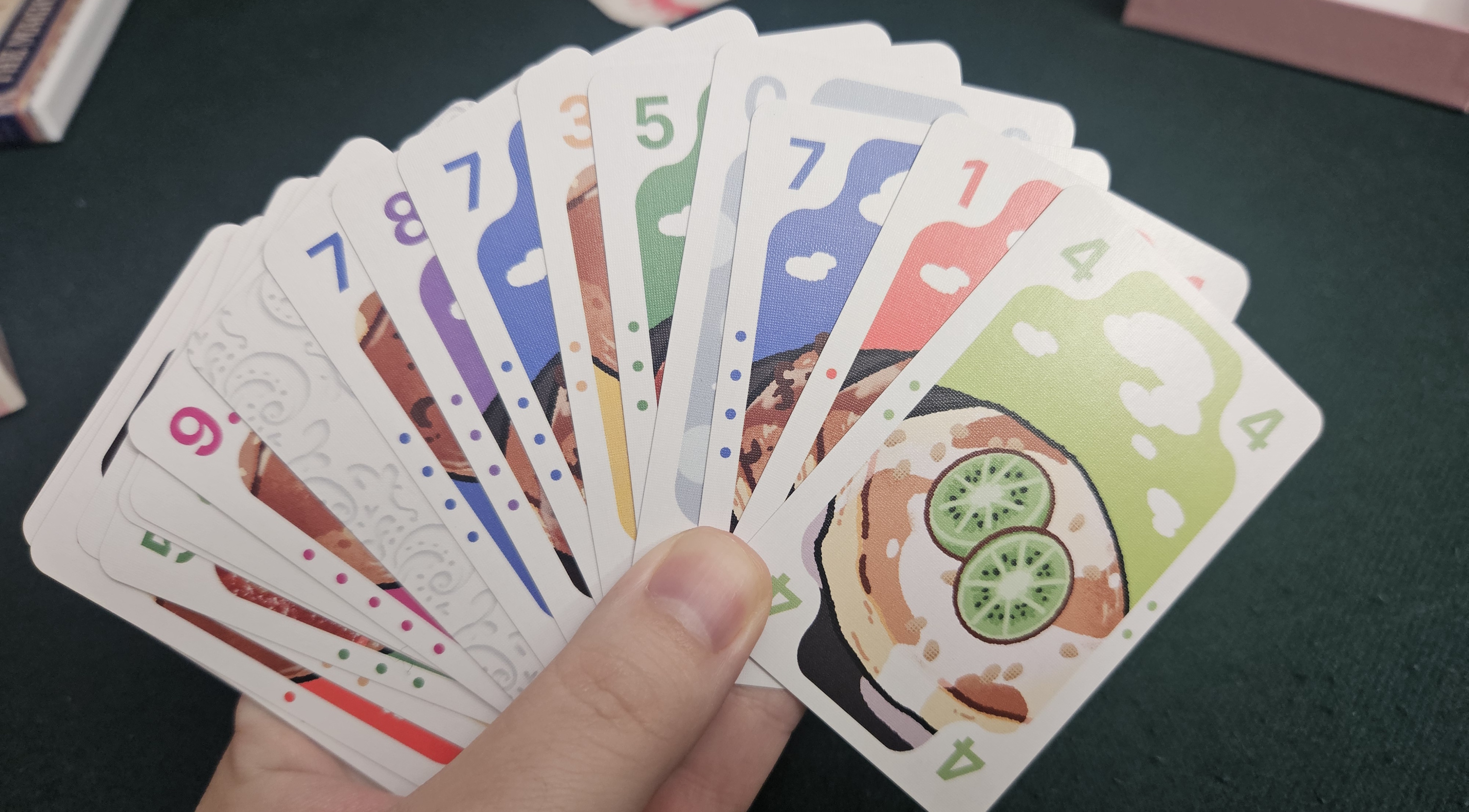
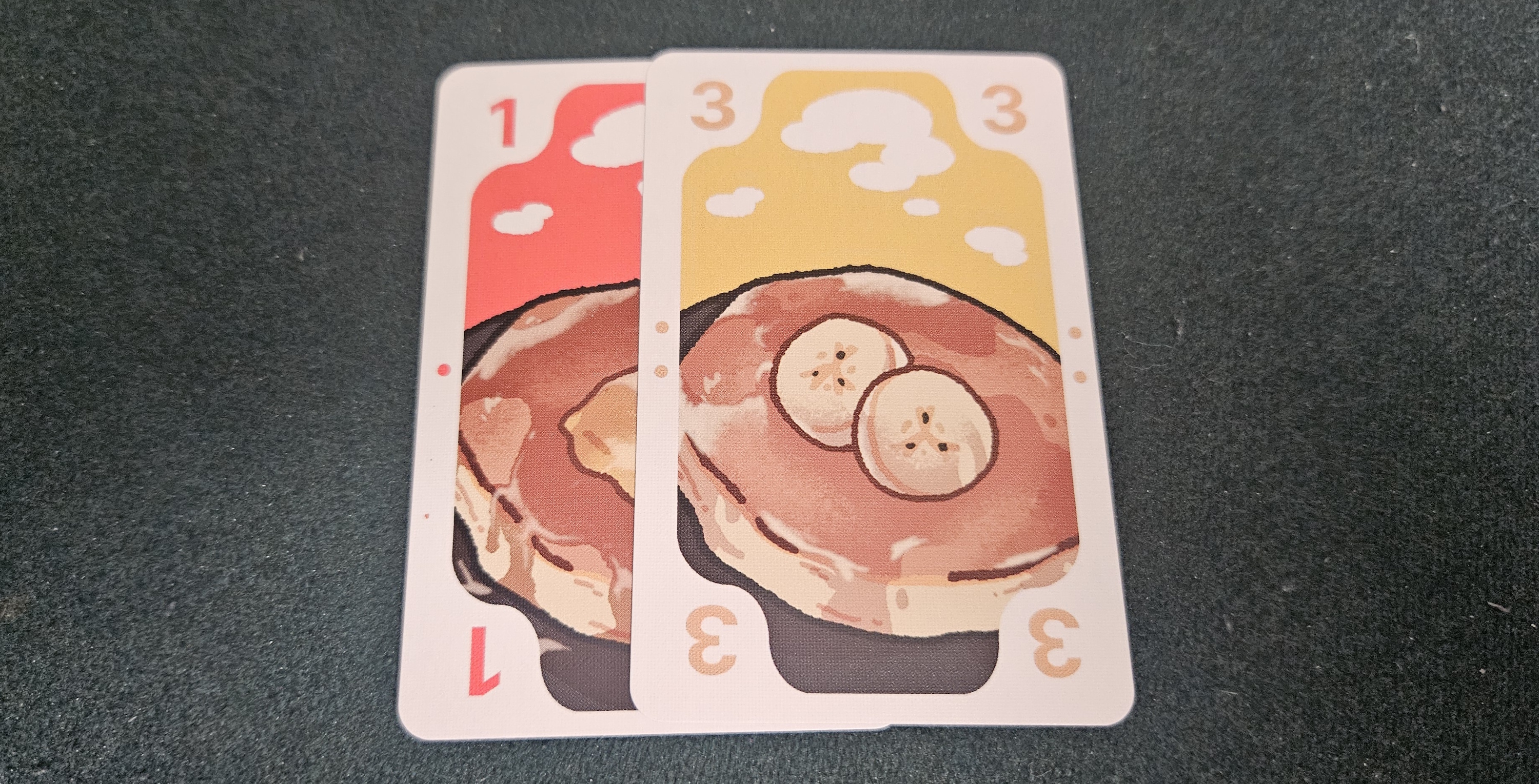
To begin, your hand is massive. Nine cards, then a “napkin” (also a card), then nine more cards. The reason for this division becomes clear right away. Rather than playing a single card, every trick is built from two separate components, one from the left side of the napkin and the other from the right. The first card’s number becomes the “suit” while the second becomes the “rank.”
Simple enough, and a wrinkle that constitutes the entire sub-genre of domino trick-takers. But two things set Shortstack apart from the pack. The first is that “perfect pancakes” — those where the rank and suit are identical — are outright winners. You’re still required to follow suit if possible, but your dichotomous hand makes it easier than usual to claim tricks at unexpected moments. This produces quite a bit of flexibility, important for claiming high-value tricks that will likely award a point at the end of the round.
Now that’s more acceptable.
The other thing that’s different about Shortstack is even more impactful: if you eat too many pancakes, you’re gonna hurl. Leiman is too polite to actually state this outright, but we’re professional translators of subtext round these parts. If you take too many tricks, all your pancakes are “thrown out” (read: barfed), you score nothing, and everyone else at the table earns a point. Presumably because they’re laughing at your misfortune.
This alters Shortstack from straightforward into a nasty affair indeed. Your flexible hand makes it easier to claim tricks, but also offers little opportunities to nudge an opponent into chowing down on too many pancakes. It always seems like there are two or three rounds too many. While it’s technically possible, in the three-player game at least, to get through a hand without ejecting all that batter across the table, it isn’t likely.
The result isn’t my favorite short-form trick-taker; personally, I would rate this one alongside Nebular Colors, which I appreciated without wanting to come back to. But it’s still a simultaneously charming and vicious little thing. Like Marceline Leiman herself, perhaps? I couldn’t tell you. I’ve never met her. But when she keeps producing such digestible razor blades, one starts to wonder.
More games should use CDs as soundtracks and play surfaces.
The Magic Shop
More games should come in DVD cases with soundtracks on compact disc. Even better, those discs should double as game boards. Even bettah, those games should be adaptations of short stories from the turn of the century. And not this century. The one before that.
The Magic Shop, designed by Reader on Jupiter, calls to mind their previous title The Man Who Was Thursday not only for its packaging and soundtrack, but also its fascinating approach to adaptation. In this case, the work being reimagined is H.G. Wells’ 1903 short story “The Magic Shop,” and much like the story’s father and son, we’ve stumbled into a shop, found ourselves trapped, and must now accomplish increasingly bizarre feats of endurance and navigation in order to leave. Basically, it’s a 19th-century IKEA.
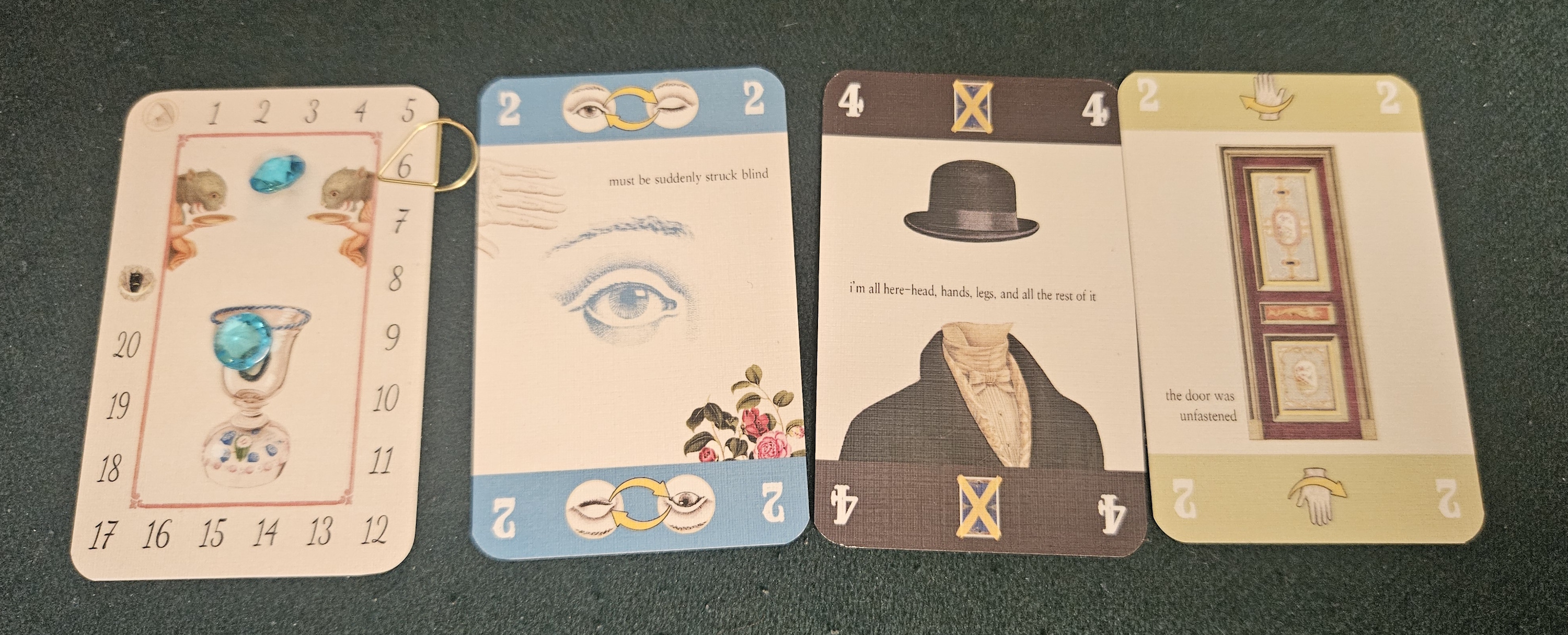
While it’s tempting to spend this entire time discussing the game as an adaptation, which is utterly delightful in its impressionism, capturing the whimsy and some measure of the story’s menace without recreating even a single narrative beat, we’re here to talk shop. For the most part, The Magic Shop’s trick-taking is relatively straightforward. You want to win tricks, but only as many as you’ve contracted. Your bid matches the rank of whatever card you devote at the start of the hand, but in a gesture of goodwill every card also allows a bid of either three or zero on its reverse side. In practice, this usually means shooting for either three tricks or none at all.
As with Thursday, everything about this game is gorgeous.
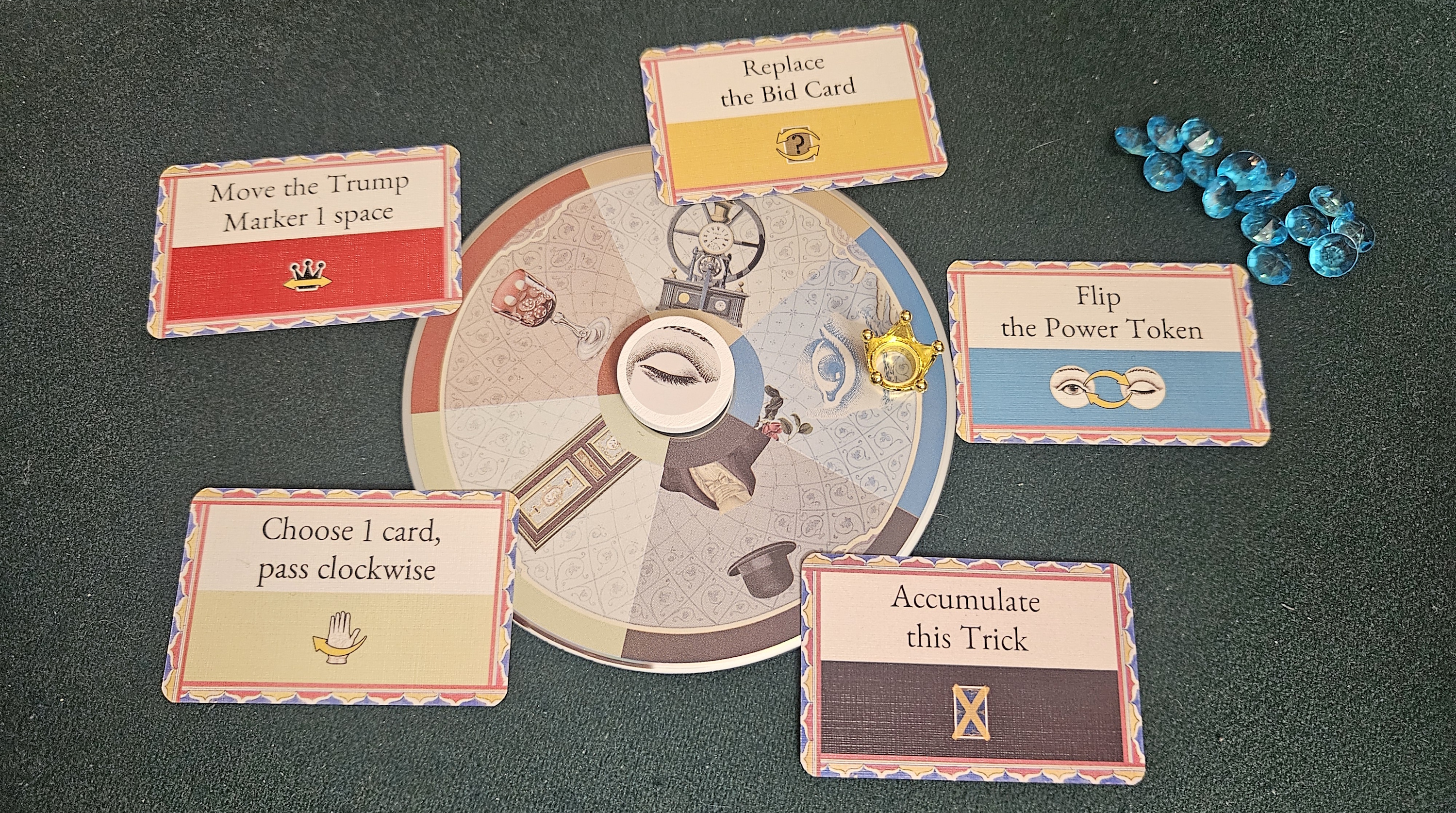
Here’s where it gets wacky. Whenever a trick is taken, the winner also gets to perform a magic trick. These are tied to the suits, which limits what the winner is permitted to cast. Furthermore, while the winner is always free to use the suit of their own card, they also have the option of using any of the cards played into the trick — but only if they take a “thirst token” that awards additional points to any rival who meets their bid for the round.
As for the actual magic tricks, these give The Magic Shop much of its flair. One of them changes the trump suit; another flips an eye token so that low ranks now outclass high ranks. Perhaps the meanest is the one that forces everybody at the table to pass a card clockwise, perfect for ruining bids. This can be ameliorated by the suit that lets you swap out your bid for another card from your hand (phew!), although this can be summarily wrecked by the one that forces the current trick to “accumulate.” This means that rather than awarding the trick, it instead sits off to the side to be claimed by whomever takes the next one. And yes, multiple accumulations can be strung together. Ever wanted to win four tricks at once? Probably not when your bid is set at three and you’ve already taken two.
You can probably already tell that The Magic Shop is a highly tactical trick-taker; its merger of exacting contracts and ongoing flux makes for quite the ride. I’m convinced it’s possible to play well, but I’ll be damned if I know how. Once again, I love what Reader on Jupiter is doing, but there’s really no separating my affection from the game’s aesthetic, approach to adaptation, and general mischief. Those who fear chaos really should avoid this one at all costs. Personally, I dig it.
It feels like we’ve been here before…
Torchlit
Speaking of chaos, David Spalinski’s Torchlit is one of those games that first appears entirely uncontrolled. Don’t be deceived. This is a highly strategic trick-taker. It’s just that there’s room for some truly cruel plays, usually as a result of some jerk deciding you need to be taken down a peg.
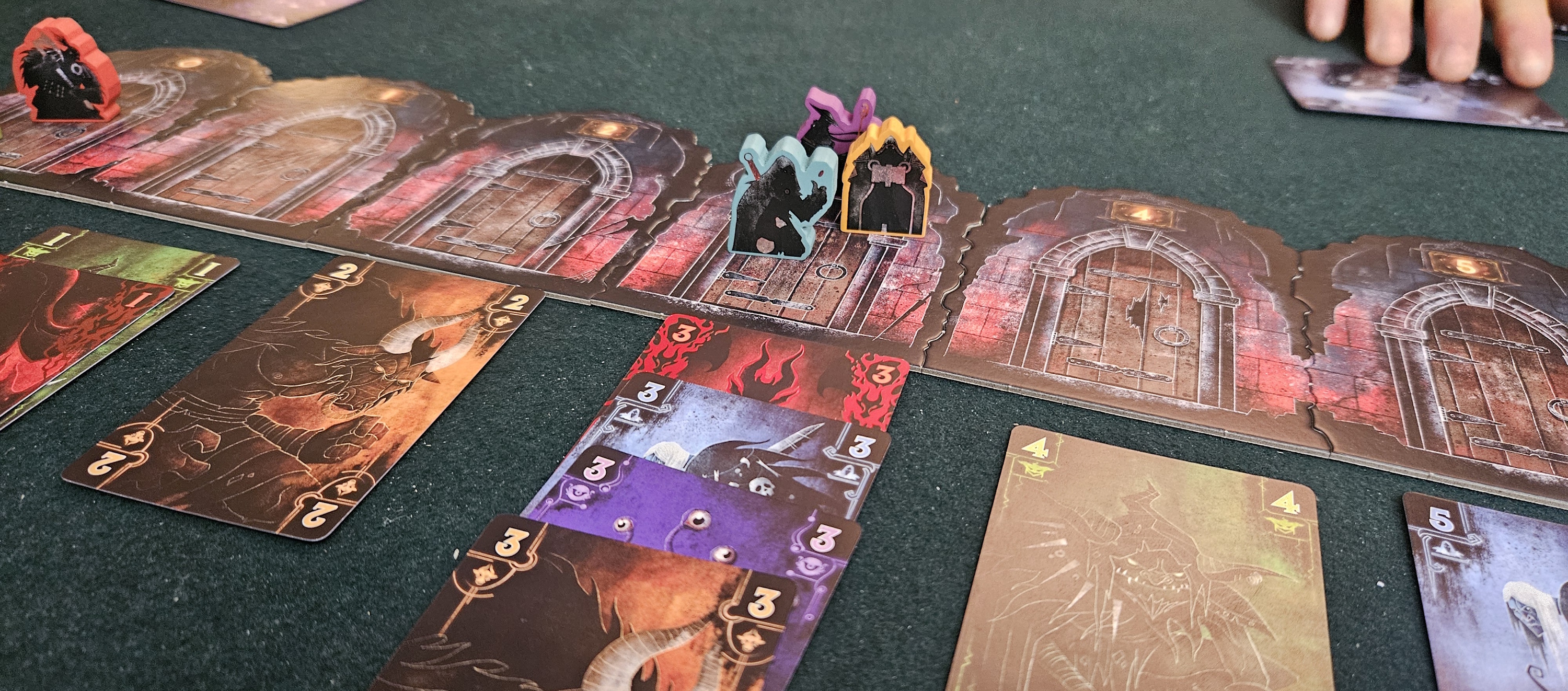
Here, those jerks are adventurers. Dungeon delvers. Ruin ransackers. Your goal is to march into the current dungeon, earn some gold, and march out again. Gold mostly comes from looted corpses; at the end of the hand, every monster on your space is worth a coin. Two coins, if we’re talking about dragon cards.
Wait, there’s more. At the start of the hand, you flip one of your cards face-down. This is your torch. Yes, it’s a — say it with me — contract bid! If you wind up on your chosen room, you earn some extra money. If not, your torch is added to its designated room, where it awards any other adventurers the gold instead.
Making matters significantly harder is the way you move through the dungeon. The winner of each trick moves forward… and so does anybody whose card rank matches theirs. So while it’s possible to piggyback on a hero’s success, it’s also possible to get piggybacked. As in, hauled up on a rival adventurer’s and dragged kicking and screaming past the room you bid on. Like you’re some kinda hobbit being taken to Isengard.
These monsters sure are sticky.
Meanwhile, the rooms are populated by monsters according to the cards that were played into the current trick, but they’re doled out by whomever deployed the lowest rank. This means there are two games going on: the death march through the dungeon as decided by the winner, but also the local cash piñatas as seeded by the loser. Unless those two happen to be the same player. Then that punk gets to decide everything. Which is entirely possible, especially if somebody sweeps a trick by winning with a low dragon card.
All told, these contrasting imperatives give Torchlit its venom-tipped fangs. When I wrote about its self-published version a while back, I argued that it was very nearly a hybrid trick-taker, as much about your position on the board as about the tricks themselves. The intervening years have only deepened that impression. Torchlit is something like a push-your-luck game, except it’s less about luck and more about dodging and/or taking advantage of your fellow dungeon divers. The new edition by Allplay is incredibly handsome, making it more widely available to those who aren’t able to gobble up the latest indie darling.
Of today’s titles, this is the strongest. Honestly, it might be one of my favorite trick-takers of the past few years. But make no mistake, it’s every bit as nasty as the others. It may not include regurgitated flapjacks or unexpected magic tricks, but there are plenty of little barbs to dig into your rivals’ plans. Between this and the similarly jerkwaddy Chasing Shadows, Spalinski is on a roll.
Complimentary copies of Shortstack, The Magic Shop, and Torchlit were provided by their designers/publishers.
(If what I’m doing at Space-Biff! is valuable to you in some way, please consider dropping by my Patreon campaign or Ko-fi. Right now, supporters can read the next installment in my series Talking About Games, this time tackling the topic of what makes a good list! Naturally, the piece includes a list.)
Allplay is making its biggest strategic shift since its predecessor Boardgametables.com entered publishing in 2018 – launching a trio of new product lines aimed at markets well beyond the accessible, smaller-box strategy games that have defined it to date.
The publisher’s newly-announced Masterworks, Epics and Creations lines mark its expansion into heavyweight eurogames, large-scale adventure titles and licensed or fandom-driven games respectively – beginning with a remake of highly-regarded Chad Jensen design Dominant Species.
Allplay’s decision to broaden its portfolio into larger, more expensive productions stands out as one of the more ambitious publisher expansion plans announced this year – especially given many have been shifting towards smaller-box, lower risk releases amid ongoing cost pressures such as tariffs and rising manufacturing expenses.
The move represents a notable evolution for a company that has built its reputation around approachable strategy games with consistent box sizes and accessible price points, alongside carefully-produced new editions of established hobby titles such as Container. Notable titles from the publisher to date have included releases like River Valley Glassworks, Mountain Goats and Things in Rings.
“We’ve always made games with constraints – on principle”, Allplay COO Joe Wiggins said. “We’re proud of what we’ve been able to make with these constraints.
“The consistent box sizes, accessible price points, and simpler rulesets are great for families and gamers who want strategy without rules overhead.
“Those core products aren’t going away. But now that we’re eight years into publishing games, we’re ready to show what else we can do.”
Allplay began life as boardgametables.com in 2014, specialising in high-end, custom-built wooden gaming tables manufactured in the US, before dipping its toes into board game publishing four years later.
The business rebranded as Allplay at the beginning on 2023 to better reflect its expansion, having reached the point where it was also providing bags, playmats and shelves, in addition to having published 17 board games and eight expansions.
When asked what gave Allplay the confidence to expand its remit again given the current challenges in the hobby games environment, Wiggins told BoardGameWire, “In the last four years we have gone from eight titles to 75. We are not known for bad games or shoddy components, but rather timely deliveries and solid productions.
“We have a very strong team and system in place, and while this growth might mean bigger impacts we have been for three years producing over 20 games per year – and this will see us lowering to about 12 – 15. We’re opening bandwidth to allow for these projects.”
He added, “This wasn’t a decision we made lightly. It was very specific and thoughtful in how we wanted to grow”, and went on to point out: “In the last five years we’ve gone from four of us at Allplay to now hiring our 22nd full time person, with an army of freelancers helping as well. We’ve been ready for this step!”
The most eye-catching announcement was the launch of Masterworks, a heavyweight strategy line created in partnership with acclaimed graphic designer and artist Ian O’Toole, whose portfolio of work includes Voidfall, On Mars and Galactic Cruise.
Rather than simply commissioning artwork, Allplay said O’Toole will become a full partner in the Masterworks line, helping select projects as well as contributing to their development, graphic design and visual direction.
Wiggins told BoardGameWire, “We are seeking out the best heavy euros to bring to market and he is key in the selection, development, art, and graphic design. He isn’t a paid artist – he’s a full partner in the line. We fully believe each release will make a massive impact on the heavy euro scene.”
He added that despite kicking off with a high-profile established title in Dominant Species, almost all of the games in the three lines will be new designs.
Wiggins said, “We just had such an amazing opportunity to launch with Dominant Species, which is one of our favorite all time games and will make such an impact when this amazing game gets phenomenal art and graphics for a modern gaming audience. Don’t expect too many classics – though I do have my eye on one for later down the road in the Masterworks line.”
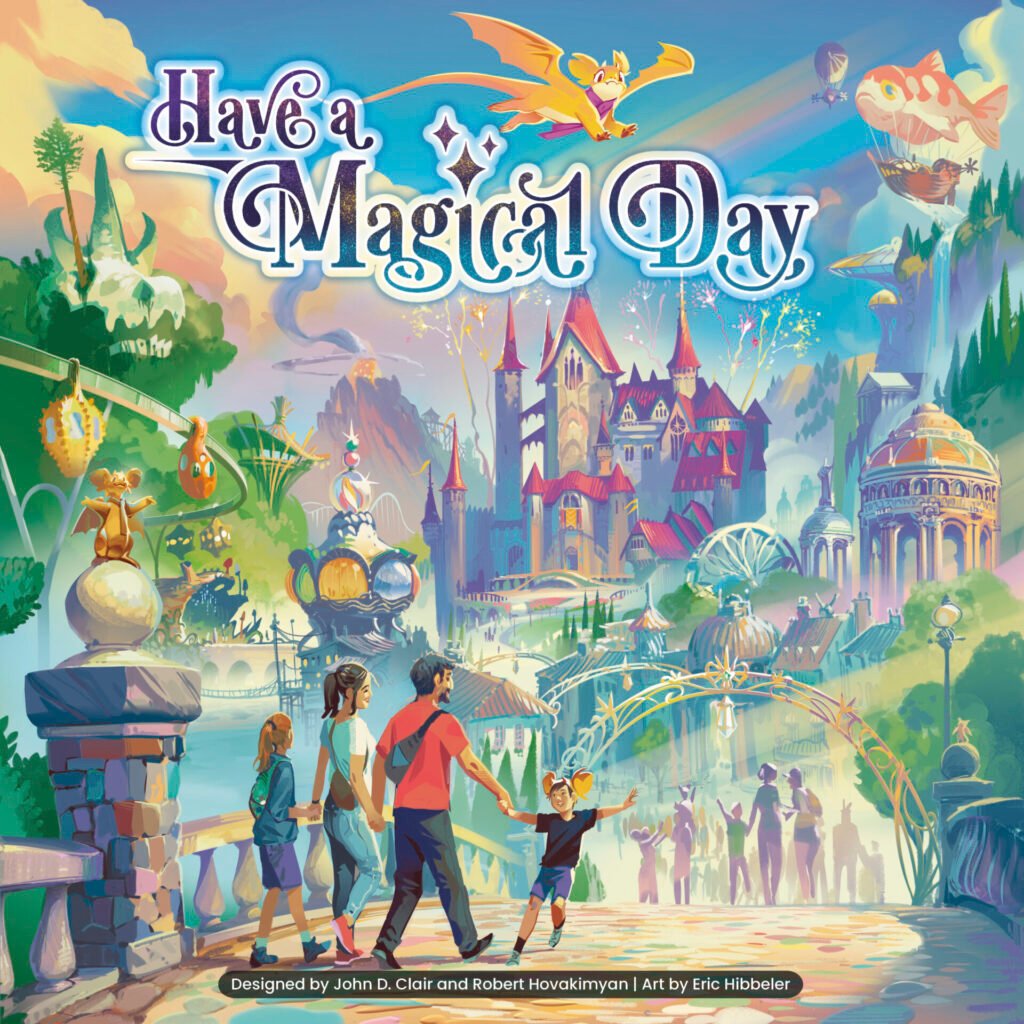
Alongside Masterworks, Allplay’s Epics line will be dedicated to larger-scale hobby games including Sail Legacy and new survival game Crash Landed, while Creations will focus on games built around recognisable fandoms and licensed intellectual property – beginning with John D Clair’s theme park-themed Have a Magical Day.
Box cover for John D Clair design Have a Magical Day, published by Allplay
Allplay has been clear that its existing publishing strategy will continue alongside the new initiatives, including a Kickstarter campaign in October for Through The Mountains – a sequel to Reiner Knizia’s Through the Desert, for which it ran a crowdfund at the end of 2023.
Wiggins told BoardGameWire that the company had been working on some of its expansion ideas since 2024 – adding that the commercial success of its Allplay partner programme had been key in giving the company the resources to expand its operations.
That partner programme has seen Allplay team up with more than 40 other publishers such as Bitewing Games, Kinson Key Games and Cardboard Alchemy, giving them access to its own infrastructure and providing services such as fulfillment for crowdfunding projects.
Wiggins told BoardGameWire, “As a group we are all stronger and can rely on each others success. Our partnership allows them to focus more on making more and better games and that lets them grow which lets us grow. It’s very symbiotic.”
That network will also help shape the company’s crowdfunding strategy for its new publishing lines, Wiggins said, giving it crucial information on how to successfully market different weights and styles of games.
He said, “When we launch Dominant Species we are able to key into audiences that liked Container and Galactic Cruise. When we launch Crash Landed we have access to the audiences of Tidal Blades 2 and Arydia, [and] when we launch Have A Magical Day we can speak to people who have loved Flamecraft and River Valley Glassworks.
“And people that come to us for Dominant Species will find Galactic Cruise… etc. We’re all working as a team and this is a big difference maker. Lifting each other up.”
This might sound funny, but the game that kept springing to mind while playing Gruntz, the tiny-as-it-gets wargame by Carter Scott, was none other than Kurt Vonnegut’s GHQ. Like that ancient (but now resuscitated) title, Gruntz is about a pair of World War-era armies bashing it out on the field. They’re both highly attritional, encouraging a tit-for-tat gameplay that’s either enthralling or exhausting depending on your tolerance for swapping one piece for another.
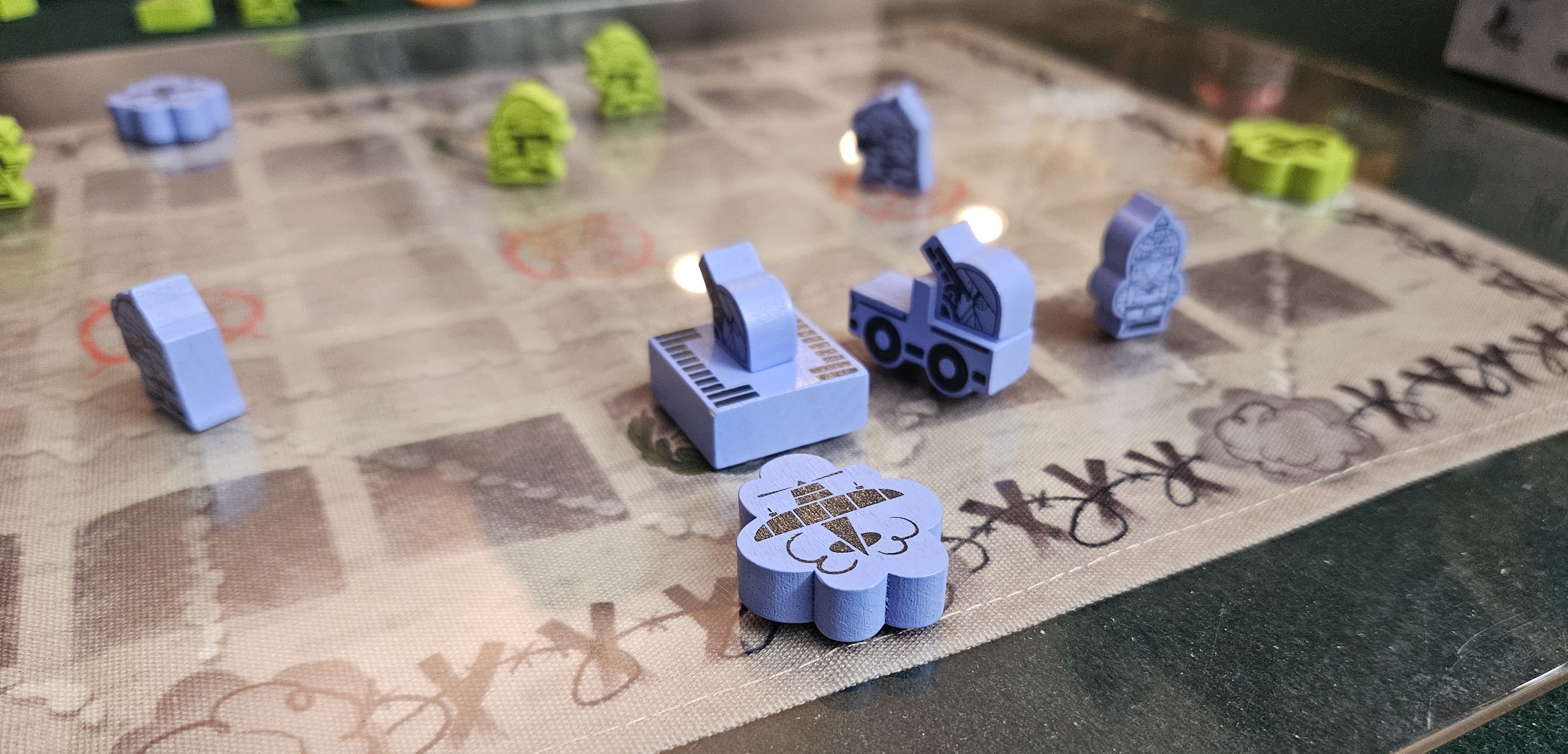
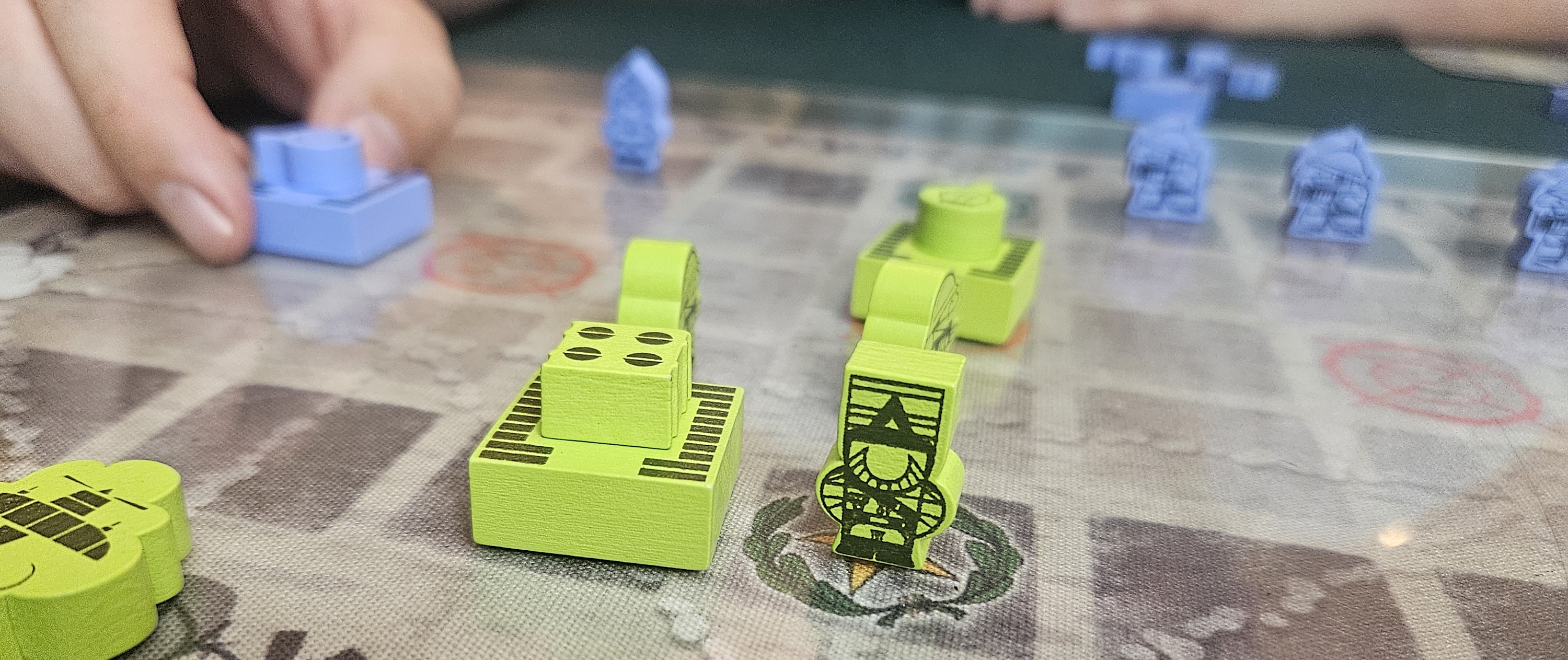
More than that, they’re both games about both movement and reinforcement. It isn’t enough to position your troops smartly. You also need to know when — and what — to call up from the rear. In the case of Gruntz, that sometimes means snapping a range of equipment onto a chassis to create a custom-built war machine.
This is never not cool. Because magnets, baby. I’m always in a mood for magnets.
Screening my fighter with plentiful anti-air.
The parallels don’t stop there, although I’m hell-bent on preventing this from becoming a comparison piece between two board games that are similarly under-known and probably wouldn’t appreciate the association anyway. Still, there’s something to be said about the way these titles portray their miniature battlefields. Where GHQ was a pale representation of Vonnegut’s WWII battlefields, dominated by artillery and armor, with infantry more or less serving as a screen for the good stuff, Gruntz is more timeless. Which is a polite way of saying that it isn’t quite as distinctive, history-wise, despite the visuals and hardware looking a little more Great War.
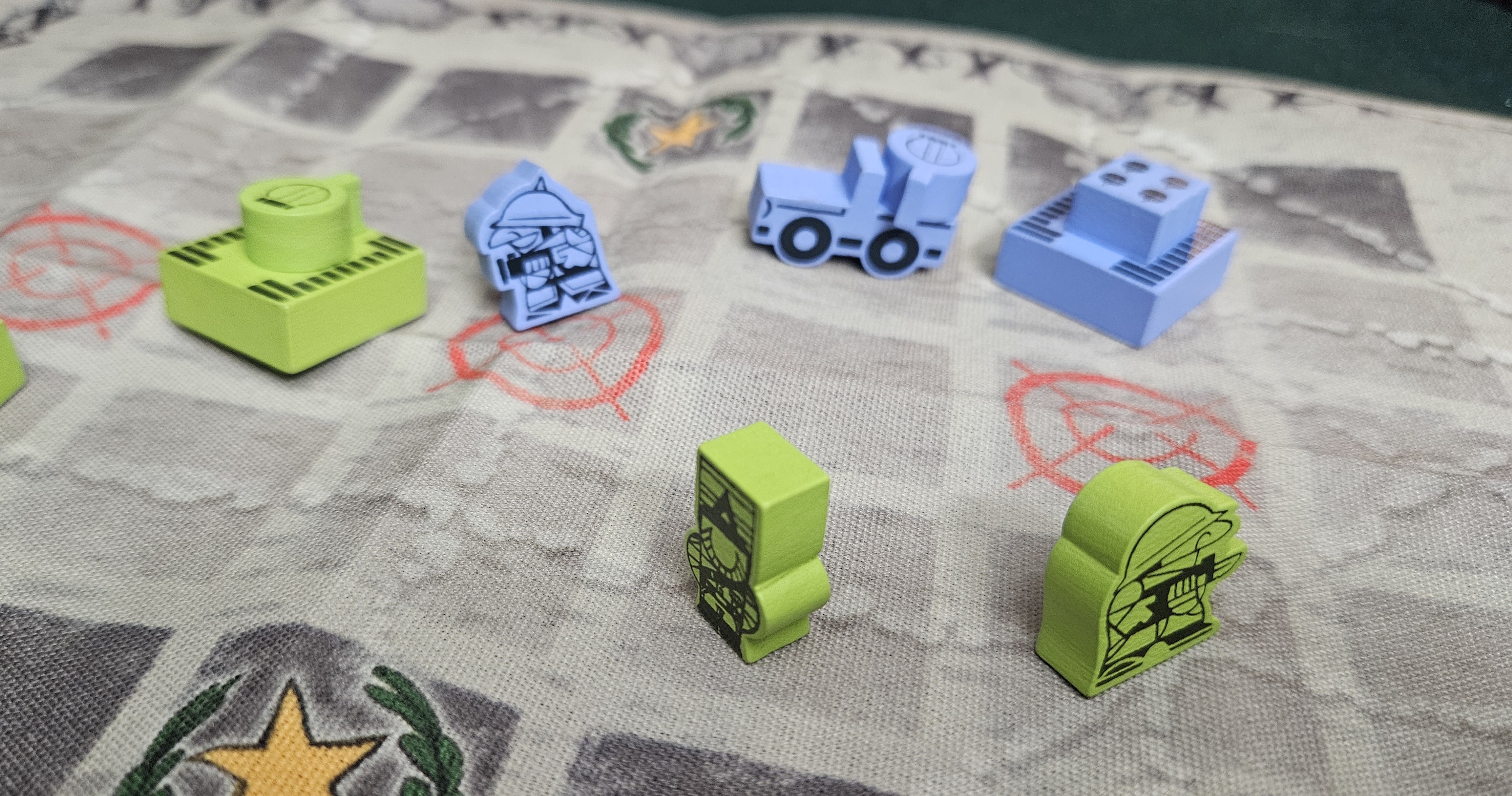
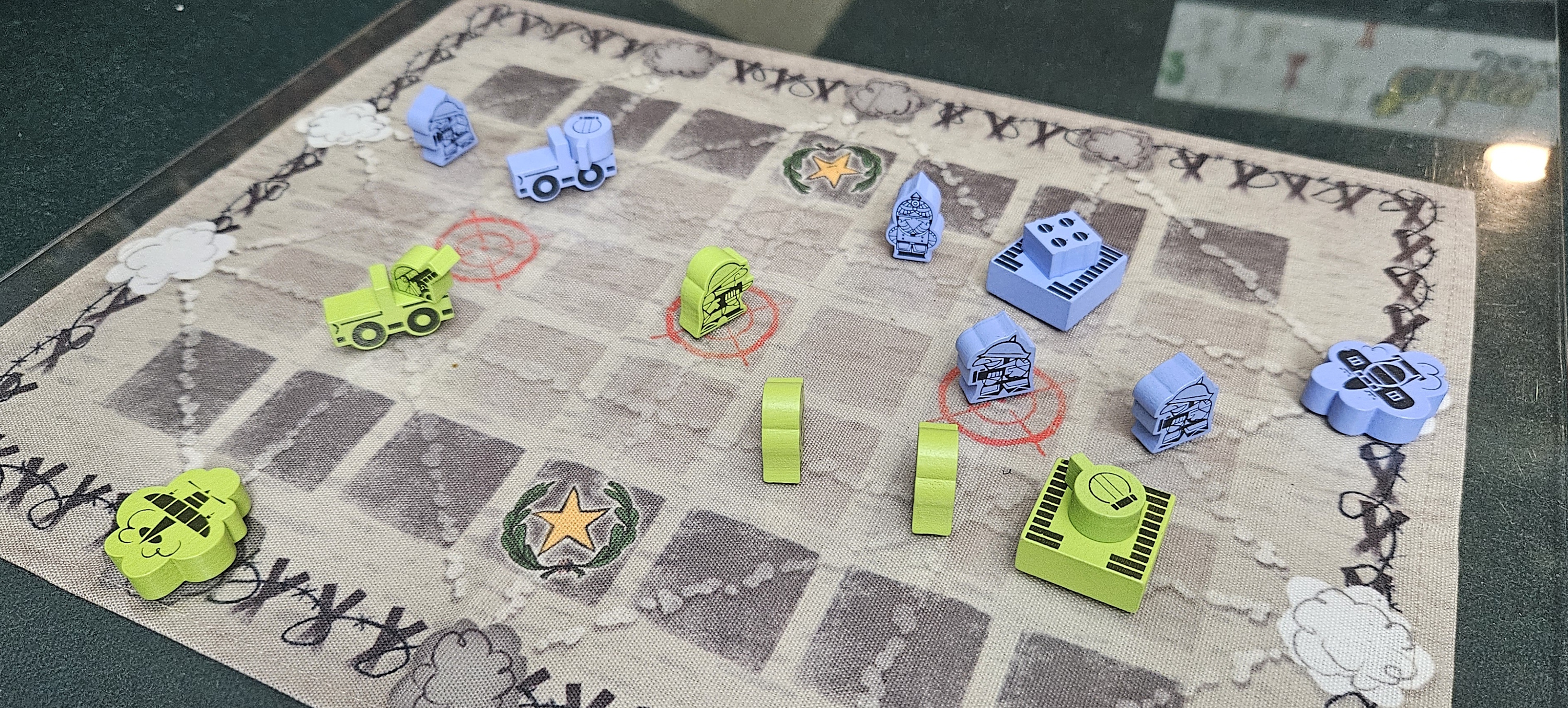
Perhaps the best place to start would be with the units. Infantry — the titular gruntz — represent a never-ending supply of bodies. Really, that’s their main trait: when killed, they bounce back into their general’s reserve rather than disappearing permanently from the table. They’re also useful for capturing control points, and can be moved en masse thanks to a captain who’s the spitting image of a gentleman officer in the midst of a war that’s very quickly eliminating the aristocracy at a pace that leaves every revolution red-faced with envy.
Those control points are the game’s biggest advantage over something like GHQ. Controlling two of the map’s three points at the end of a turn will award a star; controlling all three is worth two stars. Reaching three stars means victory, so there’s a strong incentive to usher your boys forward, even if it means they’ll get chewed up on the following turn.
To oblige said chewing, there are ample instruments. Both sides have access to quite the range of hardware. There are planes, both fighters and bombers, which tootle along wisps of contrail over the main battlefield, and are especially keen to obliterate anyone foolish enough to position their manpower in a straight line. These are matched on the ground by vehicles, which are built of two components, chassis and attachment. The chassis, whether armor or truck, either trundles or sprints across the battlefield, while providing more or less protection. The attachments, meanwhile, offer anti-air capabilities — more of an area denial strategy than an actual threat, it should be noted — a cannon for defeating anything in range, or a transport for depositing infantry closer to enemy lines.
By mixing and matching the best attachments, you can assemble the right tools for the current crisis. That’s the idea, anyway. Most of the time, armor gets the cannons and trucks become speedy transports. It’s a case of play mirroring life, a bit like how evolution tends to produce crabs because armor and pincers present obvious competitive benefits.
Tanks checking their ranges.
Very much unlike GHQ, which allowed its generals to divvy up their moves and reinforcements as they saw fit, Gruntz employs a stricter formula. Either you move twice and deploy once or move once and deploy twice. This ensures a steady stream of troops will enter the battlefield, and also that many of those troops will be demolished before the last clouds of smoke have blown clear.
Its most conspicuous absence is artillery. This is its biggest departure from something like GHQ, not to mention easy historical placement. Put simply, this is not simulationist fare. Units capture their peers in the manner of chess, by moving onto them, rather than pelting their targets from a quarter-mile out. The effect, then, is approximate to playing with little green army men, all bayonets and glory rather than ignoble death from afar.
To be clear, this isn’t a complaint so much as an errant thought. For all its symmetry, Vonnegut’s attempt reflected the unfairness of the war he took part in, the absence of rules, the capriciousness of the howitzer and the carpet bomb. Writing about the former war, Hemingway described modern combat as dying like a dog for no good reason.
In Gruntz, your gruntz die for good reason. The stakes are crystal clear. To defeat someone, you move into range of the counter-attack. This imbues the process with a necessary attrition. Of course, you try to avoid losing troops. A well-positioned flak cannon can stave off a bomber; a tank in the right spot can discourage an infantry push. But this isn’t a game about decapitating the serpent so much as trading bites with it, fang for fang and venom for venom, until one side is too exhausted to continue.
The fabric mat is a pain to deal with.
There are always back-of-mind benchmarks for combinatorial titles like this, and these exchanges make Gruntz feel more like Checkers than Chess, more about constant trades than graceful maneuvers. The one exception would be the aircraft, which glide over entire lanes and columns. A bomber is one of the few things that can ruin a tank’s day, which makes its appearance rather potent indeed. This can lead to interesting bottlenecks, anti-aircraft guns strangling any viable avenues of approach, only to grow obsolete the moment the threat has subsided.
The entire thing is full of misdemeanors like that. Obsolete units. A playmat that’s too creased to allow the gruntz to stay upright. The ease with which reinforcements appear, all but necessitating a protracted first act to clear out the chaff and force both sides to prioritize a few units. These are shortcomings, not outright game-breakers, but that only makes them more galling.
And then there’s the expansion. Allplay does this thing where they sell premium pieces separately from the main game. In most cases, it’s a positive practice. Those who want the metal bits can pay a few dollars more, while those of us who are fine with cardboard punch-outs can settle for the more affordable core box. It’s a smart middle ground.
Here, though, there’s an entire expansion that’s omitted from the main box despite only requiring a pair of reminder sheets and five cardboard tokens. Supplies, it’s called, and it adds — you guessed it — little supply markers. These can be spent to activate special abilities, like charging all your gruntz forward at once, making a crucial extra move with a vehicle, or swapping a now-obsolete AA gun for a big stonking cannon.
On its own, the Supplies expansion improves my opinion of the game considerably. It’s exactly what Gruntz needs to shine, adding a crucial but rules-light layer of resource management atop the game’s straightforward rules. Using a bomber to drop a bunch of paratroopers is incredibly cool, not to mention game-swinging; the limitation, naturally, is that your opponent also has access to their own cache of supplies. Without the expansion, Gruntz is handsome and interesting, but deeply flawed. With it, the flaws are still present, but dulled sufficiently that it becomes one of the more formidable precious-scale battlefield games out there.
The view from on high.
All told, Gruntz is a strange offering, especially for Allplay’s small box line. Its direct conflict and zero-chance combat make it more confrontational than one might expect. This is no feel-good trick-taker or Peter Hayward deduction game. There will be blood. Or at least scrapings of green and blue crayon across the pavement.
Despite its shortcomings, however, I feel kindly toward Gruntz. It doesn’t have the pedigree of GHQ, and its diminutive scale may preclude it from broader adoption. But there’s something here, a certain sangfroid, some marginal strategy, that makes me want to get better at maneuvering its dweeby little guys and chonky tanks and turbulent aircraft. I want to stroll my captain into the enemy base for a more elegant win. I want to figure out how to keep its gun-trucks alive long enough to swing a battle. Is the depth there? I have my doubts. But it feels like something is lurking there, beneath the fabric.
Also… it has magnets. How do they even work? We may never know. Like I said, put magnets in your game and I’ll give it higher marks than otherwise. That’s a Space-Biff! promise.
A complimentary copy of Gruntz was provided by the publisher.
(If what I’m doing at Space-Biff! is valuable to you in some way, please consider dropping by my Patreon campaign or Ko-fi. Right now, supporters can read the next installment in my series Talking About Games, this time tackling the topic of what makes a good list! Naturally, the piece includes a list.)
Ruins, the card-building, card-shedding game by John D. Clair, served to answer a question that’s been niggling at the back of my skull since I first played Mystic Vale almost a decade ago. Namely, why don’t I like these things?
Not John D. Clair games, to be clear. I like plenty of his games. Rather, these of his games, the ones about sliding inserts into sleeves to build custom cards. At a notional level, it’s a solid concept. Plenty of digital card games let you modify your cards. By using inserts and sleeves, these titles circle some of that bespoke nature back to its origin point. Yet none of Clair’s experiments with the form, whether Mystic Vale, Dead Reckoning, Unstoppable, or now Ruins — which is based on an earlier title, Custom Heroes — has really landed with me.
I now know why. It isn’t the sleeving that’s the problem. It’s that Clair doesn’t exhibit much trust in his own sleeves.
Custom cards are cool.
To start at the beginning, Ruins is a shedding game, which means that every round is a race to empty one’s hand of cards. You dump them either one at a time or as matching sets, and then one-up the competition with better offerings, around and around, until players’ hands start depleting. Going out first earns more points than going out later.
It’s such a basic setup that adding modifiers is one of those “oh duh” ideas, perfect in its simplicity. And Clair’s approach to drafting those modifiers is superb. The gist is that everybody begins with three resource tokens — campfires, but don’t worry about that, the setting is nonsense — which they can spend on various inserts. Most nudge the card’s rank upward. What was once a card with a value of nine becomes a fourteen, later the fourteen becomes a nineteen, that sort of thing. There are other abilities as well. Like, say, turning a card into a wild rank, ready-made for pairing with other cards. Or letting a card clone itself. Or rekindling your spent campfires. Or drawing and discarding extra cards in hope of picking up something that matches better with your hand. Or, only a few times per game, marking a card as permanently yours, ready to be plucked from a rival’s hand at the start of a new round.
This transforms Ruins into a highly reactive experience. Normally in a shedding game, somebody will play a tough set — for example, four 5s — and you’ll glance at your hand and go, “Oh, that’s impossible to follow, I’ll pass for now.” Shedding, like trick-taking, is generally more about long-term planning than moment-to-moment play. In Ruins, that tendency is flipped on its head. Up against that tough set, you’ll look at your hand and then at the market and go, “Okay, if I buy that +3 and that +6, and attach them to these other cards, now I can follow my opponent’s play by dropping four 13s.” You’re still playing the long game, since big plays tend to deplete your resources, not to mention burn options out of your hand. But the play is highly responsive, standing in contrast to what is customarily a more measured form of play.
At its best, this is exciting and immediate, and even at this level sometimes Ruins gets away from itself. Stuffed with modifiers, cards eventually become little math problems. It’s one thing to note that a card’s value is 11 plus 4. But how about 11 plus 4 plus 8 plus 7? Now keep those values sorted across all the cards in your hand. Now adjust those values by the modifiers in the market. By the game’s third round, the slowdown is noticeable. So much for “exciting and immediate.”
Even so, this core concept would make for a fine shedding game. It’s punchy. Lean. Feels distinct from other shedders. I’d even call it the best use of Clair’s inserts-in-sleeves gimmick.
Shame how he kept packing it with extra servings.
The market offers all sorts of inserts.
For whatever reason, Clair determined that Ruins wasn’t done baking. The modifiers weren’t enough, so more stuff kept getting tossed in. Even as the game’s sleeved cards grew heftier with each added insert. Even as the deck’s bulk become noticeable with each shuffle. Even as its mathematical load grew more tedious. Even as the game’s cognitive load bulged outward with its overloaded sleeves.
So, for instance, we get cards that aren’t only moddable, but reversible. At the start of each round, you’re allowed to flip a card over to its opposite side. This tweaks its rank and perhaps adds a special ability. Okay, fine. This can help mitigate a bad draw.
But then there are all the special abilities, some of which slow down play even further. Like the insert that forces somebody to draw an extra card. Or the one that sees you drawing and discarding to fine-tune your hand. Early on, these are fine and dandy. Later on, when people are constantly pausing to evaluate their options, they become downright irritating.
But then there’s the skipping rule. Whenever somebody plays an exact duplicate of what was played before them, the next player in sequence must auto-pass. In a game that often revolves around passing, that can prove fatal. To get technical about it, this problem is compounded for a couple of reasons. First, Ruins sees card ranks ballooning at their upward ranges thanks to all those inserts; but second, thanks to the ability to modify cards on the fly, it’s often possible to craft a response that will force a pass. These combine to give leading players a strong edge. And if there’s anything Ruins did not need, it was a tendency to favor leading players even more.
But then there’s the way everybody but the final player needs to shed their entire hand. What happens when someone accomplishes this goal? The next person in clockwise order becomes the next leading player. In the game’s latter stages, when cards have gone through said ballooning and holding the lead has been thoroughly strengthened, it isn’t uncommon for this order to calcify. Player A goes out, the lead passes to Player B, Player B goes out, the lead passes to Player C, and so forth. There’s potential for disruption there, but the range of modifiers is so wild that it becomes nigh impossible to hit the right targets anymore.
But then — and this is the last one, I promise — there’s that awful conclusion. Ruins doesn’t just keep score. Oh no. Instead, it only ends when somebody reaches enough points and then goes out first in the next round. Barring that, Ruins asks for a final tiebreaker round solely between those who have reached its highest threshold. I hope you like waiting. I don’t. At least not enough to sit through another sluggish round of Ruins that I’m not even involved in.
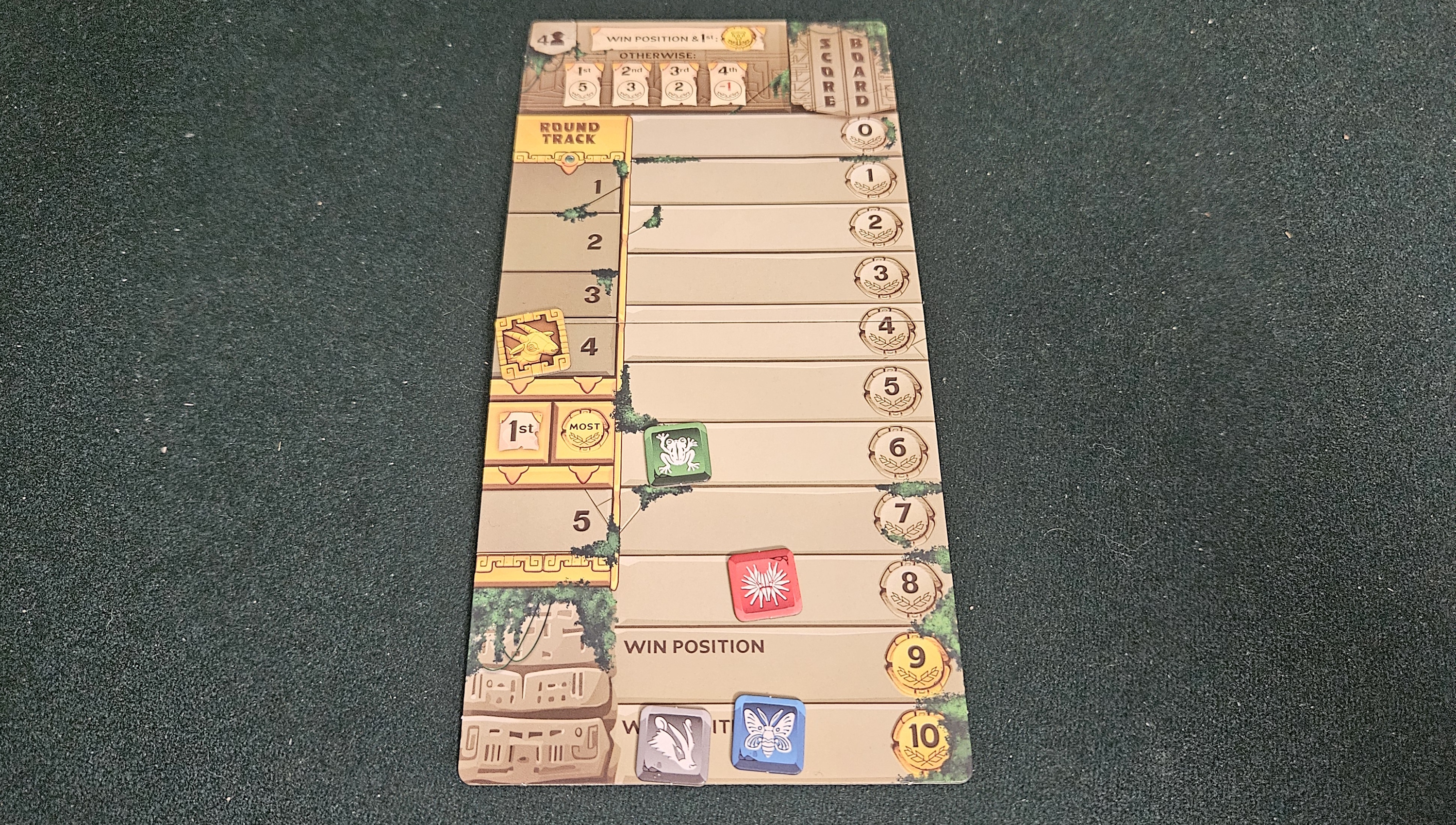
I genuinely don’t know what’s going on with this score track.
I know some of these points are overly technical, and I apologize for that. But I’m trying to illustrate a point. The point being that Ruins began with a crackerjack idea, only Clair kept adding more and more stuff, some of it useful and interesting, but much of it ill-considered and sluggish. Eventually, its basic idea got buried. The effect was not unlike lighting a battery of firecrackers — and then dumping a load of gravel over the top of the whole show.
There’s a good inserts-in-sleeves game in here. There was a good inserts-in-sleeves game in Dead Reckoning and Unstoppable. Someday, I hope Clair trusts those good inserts-in-sleeves games rather than burying them.
A complimentary copy of Ruins was provided by the publisher.
(If what I’m doing at Space-Biff! is valuable to you in some way, please consider dropping by my Patreon campaign or Ko-fi. Right now, supporters can read the next installment in my series Talking About Games, this time tackling the topic of what makes a good list! Naturally, the piece includes a list.)

 Anmelden