Normale Ansicht

Valor Mountain challenges hobby game publishing’s “safe bet” mentality as it ramps up ambitions

16. Juli 2026 um 18:36

After years spent engaging with publishers and designers – both at Capstone Games and through his Board Again Gaming podcast – Christopher High believes the several thousand new board games and expansions released each year are pushing publishers towards commercially safer bets. Now he’s wagering his company Valor Mountain Games can succeed by taking chances on the kinds of titles other publishers are passing over.

High, who spent the past two years as a product manager at Ark Nova and Gaia Project publisher Capstone, co-created Valor Mountain in 2023 alongside Tim Densham as an offshoot of the latter’s historical games-focused publisher Catastrophe Games.

He became sole owner of Valor Mountain in May after buying out Densham’s share of the business – and now plans to expand the company from creating small side projects into a business targeting five or six traditional print-run releases a year.

High told BoardGameWire he is “putting his own money on the line” betting on a strategy built around taking chances on games other companies might reject – saying he believes the hobby industry has become increasingly focused on commercially safe decisions, leaving opportunities to back more unusual designs and under-represented creators.

Christopher High and Tim Densham from Catastrophe Games

He said, “Generally publishers make safe decisions. And that’s their job. As far as breaking the mold, I rarely see a game anymore that truly ‘wows’ me in this sense.

“It happens, it just seems like our industry defaults a lot to what they think will sell a game rather than being willing to take a risk”, adding that he highly rates the kinds of designs currently being put out by publishers such as DVC, Hollandspiele and CMYK.

He added, “There are tons of games that get passed over in traditional publishing because they aren’t safe bets. I want to be a smart business person, but I also want to take some risks on designs and designers that are doing interesting things.

“There are literally thousands of products that come out each year which are just iterations of previous designers, maybe smashed together in a new way. It would be fantastic to give some games a chance at a larger audience which would be too risky for other publishers.

“I also want to give voice to more artists and designers who may be from overlooked or under-represented communities. As to genres, I would love to see a truly branching narrative euro game that isn’t afraid to let you push the limits of what’s acceptable in that genre.”

Asked whether his comments about ignoring what other publishers are doing reflected increasing “trend chasing” within hobby games, he replied “Yes”, adding “I have to do my own [thing].

“….What I do need is community and art. I want these things and my values to drive what we do as a company, not the market. The market is and will always be fickle.”

High’s new strategy has seen Valor Mountain seal a partnership with Pink Troubadour Games, which will see it bring several of the European publisher’s titles to the North American market – including Pilgrims: Curious Adventures, Movie Fight, Loony Clues and Dirt & Glory.

High’s previous employer Capstone partnered with Pink Troubadour while he was with the US company, to bring SETI creator Tomáš Holek’s design Galileo Galilei to North America.

High told BoardGameWire, “I had a good working relationship with the Pink Troubadour team when I worked for Capstone. However, I reached out after I was done working at Capstone to see if there were new ways I could work with them. 

“I am planning on taking steps to foster our relationship as I see their trust as essential, since in some ways we are a new company to the market.”

High added, “It’s exciting, and it came about because I reached out to them since I saw that these games were not available in the North American English market.  They are a wonderful team to work with, and it is my hope to do more games in the future with them as our capacity increases.”

High seems especially enthusiastic about bringing family-weight competitive movement puzzle game Pilgrims: Curious Adventures to North America, saying, “I played the video game it is based on and it is super quirky. The board game, like the video game, is very straightforward.

“If I had to describe it in one word: chill. I think it is that perfect type of game for those who want to explore board games without diving in too deep, it feels like you are doing something without being overwhelmed.

“It’s one of those bridge games between gamers and non-gamers and has delightful artwork from Amanita Design.”

Valor Mountain has also dipped its toes into crowdfunding again, following campaigns for a trio of small-box titles in 2023 and roll and write game Birdsong in August last year – all of which raised between about $1,300 and $3,000.

The new campaign features a trio of trick-taking titlesSupercollider, Growing Groves and The Franciscan Diamond, the latter of which High said was a great example of the kind of Valor Mountain release other publishers might not take a chance on.

He said, “Trick-taking games are probably past the zenith of recent popularity, plus this game has a super obscure scoring system. It’s by an unknown designer, but it is really clever.

“I love it. Will anyone else? Maybe? I think it’s going to be a divisive game though.”

He added, “I hope to eventually move away from crowdfunding. There are lots of reasons I don’t like it. However, with all of the capital outlay I have right now, I need just a little more to ensure I can do everything I want to do this fall.

“My project goal on there is a true goal, it helps ensure the proper operational flow of putting these games out.”

High also credited years of conversations with designers and publishers through the Board Again Gaming podcast with shaping his approach to publishing, and helping “keep my curiosity alive”. 

He said, “I love talking to and hearing from designers. It reminds me how little I know and how much there is to learn.

“The world is a big place and people have so much creativity. I want to help bring more of that to a wider audience.”

For High, that curiosity may ultimately be Valor Mountain’s defining characteristic. Whether betting on unusual designs proves commercially successful remains, by his own admission, an open question.

Asked whether a publisher can succeed by deliberately pursuing games larger companies pass over, High said: “I don’t know. I guess I will find out as I put my own money on the line.”

Valor Mountain’s latest Kickstarter campaign runs until August 10.

The post Valor Mountain challenges hobby game publishing’s “safe bet” mentality as it ramps up ambitions first appeared on .

Middling Kingdom

18. Juni 2026 um 23:01

Sigh.

At this point, the civilization genre needs an intervention. We could all sit in a circle on folding chairs we borrowed from the local church. Set out a little tray of cheeses and olives. Have plenty of tissues on hand for everyone. Speak in that voice we reserve for serious moments. “Hey,” someone would say, breaking the ice. “I’ve noticed you’ve been in a rut lately.”

Rising Cultures, designed by Aske Christiansen and Francesco Testini, almost begs to be described entirely via comparisons. It’s a lower-fidelity Imperium, a blown-out Ancient Realm. Clash of Cultures in how closely it sticks to an inherited form, as far as possible from Arcs on the personal-to-longue-durée matrix. Not as good as any of the bests, but neither so bad that it’s worth observing for its missteps.

Made it purple and gold, apparently.

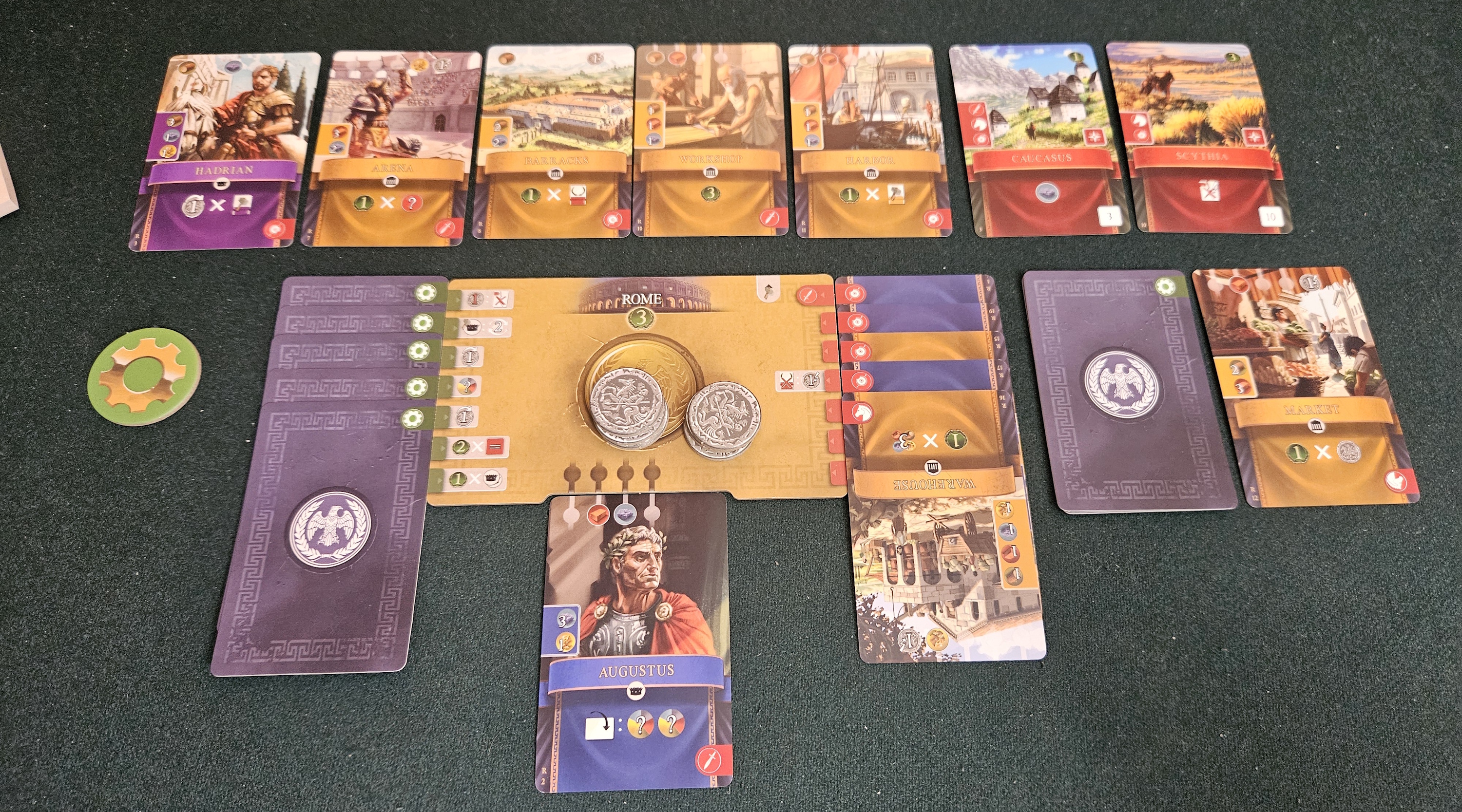
What have the Romans done for this tableau?

No sooner is its lid cracked than Rising Cultures reveals a few inborn limitations. There are four civilizations to helm, three of which are Egypt, Rome, and Persia, those old standbys that aren’t exactly going to blow anybody’s hair back. The experience is two-player-only. No solitaire, although what follows will be mostly solitary in nature, nor welcoming of a third or fourth player, although it feels like the designers could have pushed it to those heights had they really wanted to.

Also, there are heaps of icons. So many icons, in fact, that each civilization comes with its own fold-out crib sheet that translates every single line of the boards and every single card. Oh, and sometimes explains concepts in eight-point font that must be scraped from the surrounding info-spatter. Transcribing these details calls to mind City of Six Moons, another civilization game Rising Cultures is very much unlike.

From there, the gameplay grumbles into action. And it’s good action. Each round sees players figuring the best use for the four cards they’ve drawn from their hand. Scratch that; three of them will be used, the fourth will return to the top of the deck to reappear on the next go. The action economy is thus strictly limited. Three cards per round. Seven rounds per game. Nominally, that’s twenty-one actions in total.

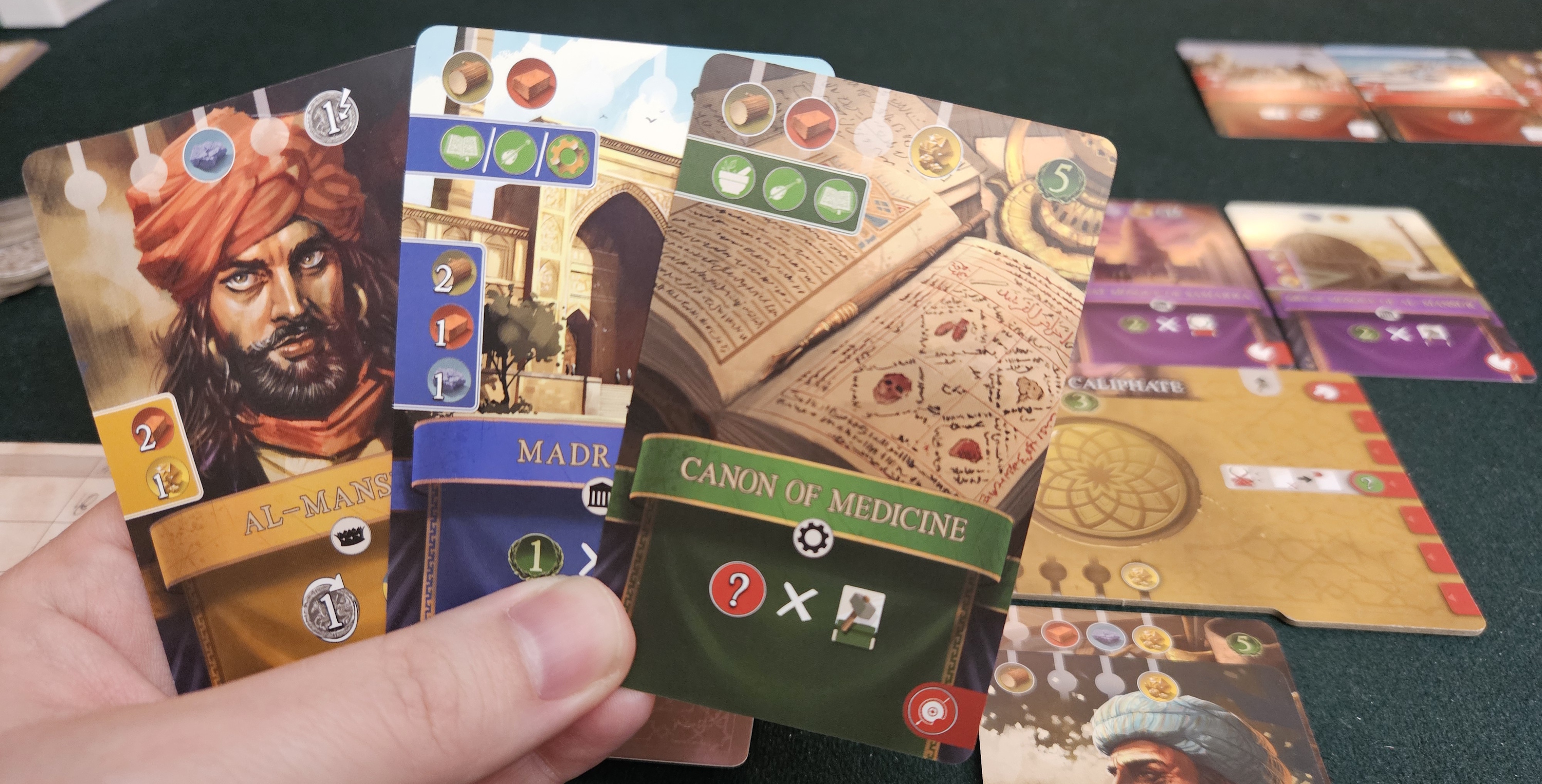
Of course, there are plenty of ways to break this rubric, although Rising Cultures isn’t quite as combo-tastic as some of its peers. At any given time, there are four main uses for each card. First — and flimsiest — you can discard it to pick up two coins. This always feels like a defeat. Second, you can slot it into your empire as resources, the bricks and stone and so forth necessary to, third, build cards into your tableau. This is the most durable option, permanently earning access to that card’s best benefits, whether scoring abilities or ongoing perks. Fourth, any card can enter your military. More on that in a moment.

If only I had a nickel for each time I'd typed that phrase...

Each turn revolves around a few cards.

As processes go, this is good stuff. Interesting stuff. Compelling stuff. Cards aren’t quite multi-use, in the sense that they might tempt players to wander distinct avenues. If possible, you’d probably want all of them in your main tableau. But that isn’t possible, and anyway there’s a clever tradeoff whenever you build a card. Basically, you’re given the option of flipping the bottommost resource onto your civilization board, unlocking further abilities but decreasing your overall wealth. It’s a smart move, one that goes a long way toward preventing players from falling into a formula where they spend their first few cards on resources and then keep building everything afterward.

Little by little, your civilization takes shape. That shape, naturally, is largely predetermined by whichever faction you’re playing at the moment. The Romans go to war a lot. The Egyptians must manage the ebb and flow of the Nile. The whole thing feels a lot like Imperium, except you’re going through a deck once rather than cycling through and improving it over multiple stages.

At points, players are invited to glance at one another across the table. Usually this happens when gearing up for the fight that caps each round, when some province will be awarded to only one side depending on whichever civilization has assembled the most suitable army. In rare cases — okay, one case — a civilization offers bonus actions to its rival. Beyond that, this is a heads-down affair.

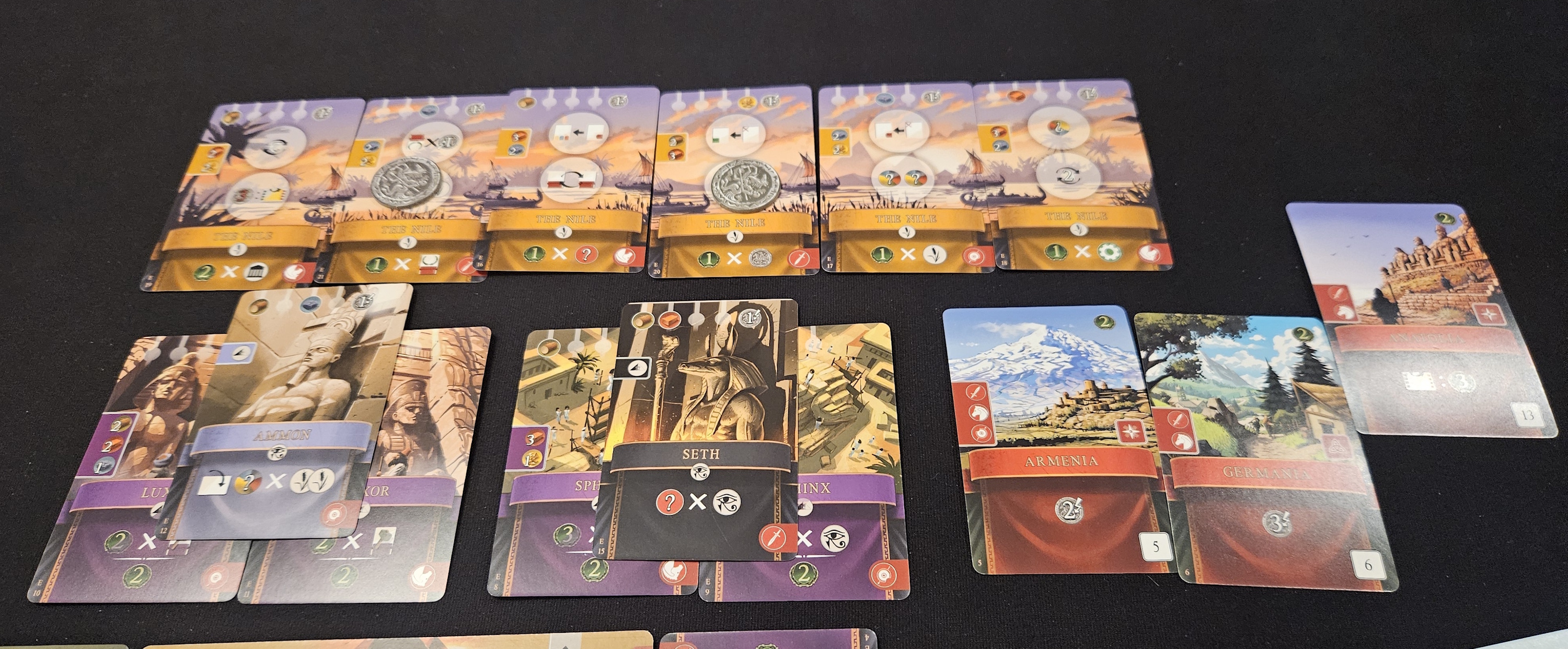
Which is fine. I’m not slamming multiplayer solitaire. But I am left wondering where Rising Cultures’ identity might be found. Its four civilizations each play like their own puzzle. With their cards jumbled together, all those natural synergies out of order, can you assemble them into a points engine that outpaces your opponent’s? Maybe. It depends. On the shuffle, sure, but also on whichever faction sits before you. Some are more complicated than others. Egypt has that shared Nile row going both for and against it. The Abbasid Caliphate requires some strict sequencing in order to usher in its era of science, which is notably tougher than the slapdash approaches available to Rome and Persia.

I'm not trying to be bummy. But now and then there's a game so uninspiring, so boring to write about, so middling, that all I want is to go down for a long nap.

The Egyptians are in the Nile about this game.

What it never manages, unfortunately, is to stand apart. At its best, it feels like a microgame that got too big for 18 cards, or like a less generous and less flexible version of Imperium with half as many civilizations and a stricter play count. It isn’t weird or experimental, but neither is it especially standard, in the sense that it might appeal to someone who’s looking for an unvarnished civgame. The result is a middle-of-the-road title that says and accomplishes little. I don’t expect it to survive the test of time.


A complimentary copy of Rising Cultures was provided by the publisher.

(If what I’m doing at Space-Biff! is valuable to you in some way, please consider dropping by my Patreon campaign or Ko-fi. Right now, supporters can read the next installment in my series Talking About Games, this time tackling the topic of what makes a good list! Naturally, the piece includes a list.)

Capstone Announces Streamlined Terra Mystica Game Terra Nova

02. Juni 2022 um 19:47

June 2, 2022 – Publisher Capstone Games has announced a brand new Streamlined Terra Mystica Game Terra Nova. The brand new creation from newcomer designer Andreas Faul takes the original area control game and takes it down to more manageable levels. The game is expected to debut with a $54.95 MSRP at Spiel in Essen with the worldwide release shortly thereafter on October 26, 2022.

Terra Nova 3d Game Box

In Terra Nova, players choose from 10 different factions, each with different abilities. Spread out on the central map as skillfully as possible and achieve certain goals from round to round. In peaceful competition with the other factions, erect buildings and settle new territories. Use your faction’s special abilities in a clever way to control the largest territory at the end, and win with the most points.

Terra Nova Board Game Components

A game of Terra Mystica has been known to go 4 hours plus. This new take on the games has a game time estimation of 60 – 90 minutes.

This new version of the game comes ten years after the original Terra Mystica was released in 2012 and five years after the successful sci-fi implementation the Gaia project released in 2017. Both games are both still incredibly popular but they are long and intense, making them not for everyone. This new title looks to broaden out that base, with the gameplay ideals that so many have been attracted to over the years.

Source: https://capstone-games.com/board-games/terra-nova/


What are your thoughts on the announcement of this streamlined Terra Mystica game Terra Nova? Let us know in the comments below!

❌