Egal in welchem Universum, die Zwerge sind bekannt für ihr handwerkliches Geschick, egal ob Techniker, Steinmetze oder Schmiede. Auch bei Warcrow ist die Nation von Mounthaven keine Ausnahme. Micro Art Studio bieten in ihrer Pre-Painted-Reihe nun passendes Gelände aus MDF an, das eines Zwergenbaumeisters würdig ist.
Solo board gaming has surged from a niche feature to a major component of modern hobby board gaming in just a few years, according to a new academic analysis of more than 104,000 titles spanning almost a century of board game design.
The research, published in the journal Simulation & Gaming, analysed metadata from BoardGameGeek’s vast trove of titles, covering games published between 1930 and 2025.
It found that solo play ranked as the third most prevalent component in games released between 2020 and 2025, behind only dice rolling and hand management – a trend boosted by many publishers treating a dedicated solo mode as a commercial necessity over the past few years.
Co-op play also loomed larger in recent years, appearing in 2.9% of game listings in the 2010s and 3.7% between 2020 to 2025, having not appeared in the top ten mechanisms across any of the preceding eight decades.
The report also noted the extraordinary growth in games present in the BGG database since the turn of the millennium.
It said the number of titles published per decade grew about 22%, to about 9,400, from the 1980s to the 1990s, before more than doubling to over 21,000 titles in the 2000s, and surging to more than 38,000 in the 2010s.
Image Credit: Azael Herrero
The report, titled Monopoly to Ark Nova: An Empirical and Cultural History of Modern Board Game Design (1930–2025), was created by members of the LudIA research group at the European University Miguel de Cervantes, together with a researcher from the University of Valladolid.
“It remains four players in every historical period. Despite enormous changes in production, mechanisms, themes, and audiences, four players continue to represent a central configuration in board game design.
“The mean maximum player count nevertheless increases in recent periods, suggesting greater representation of party games, large-group games, and titles offering more flexible player ranges.”
While solo gaming provides the study’s clearest illustration of how the hobby has evolved, the broader picture is one of increasing diversity in game design.
The researchers found the number of documented mechanisms expanded from 69 during the 1930s to 192 in the 2020s, suggesting designers have dramatically broadened the range of tools available to them.
Rather than replacing older ideas, however, modern games increasingly combine multiple established mechanisms into hybrid systems – a trend the study says is reflected in the changing role of dice.
Image Credit: Azael Herrero
Roll-and-move dominated games throughout the 1930s to the 1960s, appearing in roughly a quarter of all titles in those decades, before steadily declining to the point where it no longer features among the ten most common mechanisms in the 2020-2025 period.
Dice themselves remain widespread, of course, but are now more commonly used for action selection, resource production, drafting, risk management and other strategic systems than for simply determining player movement.
The research also traces the changing influences that have shaped modern hobby gaming.
Simulation and wargames introduced mechanics such as hex grids, movement points and simultaneous action selection during the 1970s and 1980s, before the Eurogame boom of the 1990s and 2000s saw hand management, tile placement, set collection, drafting, auctions and area majority become increasingly common. Solo gaming, cooperative play and variable player powers then rose sharply during the 2010s and early 2020s.
The researchers also found BoardGameGeek ratings have increased over time, alongside modest rises in complexity and playing time, although they cautioned that these trends should not be interpreted as evidence that modern games are objectively better than earlier designs.
Instead, they point to factors including the site’s hobby-focused audience, changing player expectations, greater visibility and recency bias for newer releases and the influence of marketing and self-selection.
After years spent engaging with publishers and designers – both at Capstone Games and through his Board Again Gaming podcast – Christopher High believes the several thousand new board games and expansions released each year are pushing publishers towards commercially safer bets. Now he’s wagering his company Valor Mountain Games can succeed by taking chances on the kinds of titles other publishers are passing over.
High, who spent the past two years as a product manager at Ark Nova and Gaia Project publisher Capstone, co-created Valor Mountain in 2023 alongside Tim Densham as an offshoot of the latter’s historical games-focused publisher Catastrophe Games.
He became sole owner of Valor Mountain in May after buying out Densham’s share of the business – and now plans to expand the company from creating small side projects into a business targeting five or six traditional print-run releases a year.
High told BoardGameWire he is “putting his own money on the line” betting on a strategy built around taking chances on games other companies might reject – saying he believes the hobby industry has become increasingly focused on commercially safe decisions, leaving opportunities to back more unusual designs and under-represented creators.
Christopher High and Tim Densham from Catastrophe Games
He said, “Generally publishers make safe decisions. And that’s their job. As far as breaking the mold, I rarely see a game anymore that truly ‘wows’ me in this sense.
“It happens, it just seems like our industry defaults a lot to what they think will sell a game rather than being willing to take a risk”, adding that he highly rates the kinds of designs currently being put out by publishers such as DVC, Hollandspiele and CMYK.
He added, “There are tons of games that get passed over in traditional publishing because they aren’t safe bets. I want to be a smart business person, but I also want to take some risks on designs and designers that are doing interesting things.
“There are literally thousands of products that come out each year which are just iterations of previous designers, maybe smashed together in a new way. It would be fantastic to give some games a chance at a larger audience which would be too risky for other publishers.
“I also want to give voice to more artists and designers who may be from overlooked or under-represented communities. As to genres, I would love to see a truly branching narrative euro game that isn’t afraid to let you push the limits of what’s acceptable in that genre.”
Asked whether his comments about ignoring what other publishers are doing reflected increasing “trend chasing” within hobby games, he replied “Yes”, adding “I have to do my own [thing].
“….What I do need is community and art. I want these things and my values to drive what we do as a company, not the market. The market is and will always be fickle.”
High’s previous employer Capstone partnered with Pink Troubadour while he was with the US company, to bring SETI creator Tomáš Holek’s design Galileo Galilei to North America.
High told BoardGameWire, “I had a good working relationship with the Pink Troubadour team when I worked for Capstone. However, I reached out after I was done working at Capstone to see if there were new ways I could work with them.
“I am planning on taking steps to foster our relationship as I see their trust as essential, since in some ways we are a new company to the market.”
High added, “It’s exciting, and it came about because I reached out to them since I saw that these games were not available in the North American English market. They are a wonderful team to work with, and it is my hope to do more games in the future with them as our capacity increases.”
High seems especially enthusiastic about bringing family-weight competitive movement puzzle game Pilgrims: Curious Adventures to North America, saying, “I played the video game it is based on and it is super quirky. The board game, like the video game, is very straightforward.
“If I had to describe it in one word: chill. I think it is that perfect type of game for those who want to explore board games without diving in too deep, it feels like you are doing something without being overwhelmed.
“It’s one of those bridge games between gamers and non-gamers and has delightful artwork from Amanita Design.”
Valor Mountain has also dipped its toes into crowdfunding again, following campaigns for a trio of small-box titles in 2023 and roll and write game Birdsong in August last year – all of which raised between about $1,300 and $3,000.
He said, “Trick-taking games are probably past the zenith of recent popularity, plus this game has a super obscure scoring system. It’s by an unknown designer, but it is really clever.
“I love it. Will anyone else? Maybe? I think it’s going to be a divisive game though.”
He added, “I hope to eventually move away from crowdfunding. There are lots of reasons I don’t like it. However, with all of the capital outlay I have right now, I need just a little more to ensure I can do everything I want to do this fall.
“My project goal on there is a true goal, it helps ensure the proper operational flow of putting these games out.”
High also credited years of conversations with designers and publishers through the Board Again Gaming podcast with shaping his approach to publishing, and helping “keep my curiosity alive”.
He said, “I love talking to and hearing from designers. It reminds me how little I know and how much there is to learn.
“The world is a big place and people have so much creativity. I want to help bring more of that to a wider audience.”
For High, that curiosity may ultimately be Valor Mountain’s defining characteristic. Whether betting on unusual designs proves commercially successful remains, by his own admission, an open question.
Asked whether a publisher can succeed by deliberately pursuing games larger companies pass over, High said: “I don’t know. I guess I will find out as I put my own money on the line.”
Aristeia ist die blutige Unterhaltungssportart im Infinity-Universum. Kämpfer*innen, Aristos genannt, treten in einer Arena gegeneinander an. Todesfälle kommen vor, doch dank der Cube-Technologie kann ihr Bewusstsein in einen neuen Körper übertragen werden. Mit Infinity Hexadome Legends gehen Corvus Belli nun mit der zweiten Edition des Brettspieles an den Start. Auch in der nicht allzu fernen […]
Die Pferdeherren bekommen nach über 20 Jahren endlich neue Modelle für die zentrale Einheit der Fraktion: die Reiter. Grund genug, nicht nur die neuen Modelle einmal genau unter die Lupe zu nehmen. Wir schauen uns die gesamte Armee von Rohan an – mit allen Vor- und Nachteilen.
Warhammer: The Old World bekommt endlich ein Grundset für zwei Spielende. Und dazu noch eine sehr spannende Kombination aus dem Großkaiserreich Cathay und den Kriegern des Chaos. Wir werfen für euch einen kurzen Blick in die große Box und zeigen euch, was euch alles erwartet.
Asmodee’s recently-launched party games studio Moodbox Games has unveiled its first four releases, with Guess the Mess, Link Out Loud, Photo Dump and Who Says? Friends set to hit retail shelves in July.
The announcement marks the first product reveal from the women-led studio, which Asmodee launched last October as part of a push to reach players beyond traditional hobby gamers.
Moodbox says its games are designed around a philosophy that “playing games should feel like a dose of serotonin”, with a focus on approachable rules, social interaction and creating memorable shared experiences for families and friend groups.
Moodbox head Kelli Schmitz said, “The goal with Moodbox Games is to create experiences that instantly bring energy, laughter, and connection to the table.
“This first lineup reflects the kind of social play we know people are craving right now — games that are approachable, highly interactive, and memorable whether you’re playing with family, close friends, or a large group.”
The initial range draws on a mix of established and emerging tabletop design talent, including Happy Salmon co-designer Ken Gruhl, his Mantis co-creator Jeremy Posner, Word on the Street designer Jack Degnan and first-time published designer Annika Wierichs.
Guess the Mess is a family party game for ages eight and up from Degnan and development studio Hedyverse, which challenges players to decipher deliberately chaotic clues in a race against their opponents.
Link Out Loud || Photo Credit: Asmodee
Link Out Loud, designed by Posner and Gruhl and also developed by Hedyverse, is a team-based word association and communication game in which players attempt to make connections and relay them to teammates under pressure.
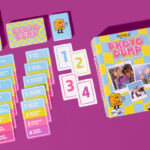
Photo Dump, designed by Wierichs and developed by Hedyverse, takes a co-op approach, using players’ own photos as clues in a storytelling-focused experience.
The fourth title, Who Says? Friends, is a quote-guessing game designed by Lloyd Mintz and developed by Bolt Games, with players aiming to identify memorable lines and pop-culture references either individually or in teams.
Moodbox highlighted that Guess the Mess, Link Out Loud and Photo Dump were developed, edited and published by teams of women, describing the process as a “collaborative and inclusive creative approach from concept to shelf”.
The studio is led by former Catan Studio director of brand development Kelli Schmitz and long-time young adult-focused book editor Shaina Olmanson, who joined Asmodee as an operations and communications manager in May last year.
Prior to leading Moodbox Schmitz spent a year working on inventor relations for Asmodee’s social games in the US market, across its family game studio Zygomatic, quiz and party games-focused Bezzerwizzer Studio, and Dotted Games, which Asmodee launched in 2024 to create new LEGO board games.
Moodbox’s development partner Hedyverse was co-launched in 2024 by Jessica Aceti – who previously helped establish Seattle-based game design collective Prospero Hall, was VP of business development, marketing and licensing at board game design studio Forrest-Pruzan Creative, and helped launch Funko Games after Funko acquired Forrest-Pruzan Creative in 2019.
It followed that a month later by picking up the rights to party game Time’s Up! from R&R Games, continuing an expansion push predicated on social games being the fastest growing category of the board games market.
Asmodee said at the time of the ATM acquisition that it expects a compound annual growth rate (CAGR) for social games of between 4% and 8% between 2025 and 2030, compared to about 4% for the wider board games market, citing mass market sales research for the US and ‘main European countries’ conducted by Arthur D Little.
Beim Miniaturenmalen gilt schon immer, dass gute Pinsel aus Kolinsky-Haaren gefertigt sein müssen. Pinsel aus Synthetik-Haaren haben den Ruf, nur eine günstige Alternative für Anfänger*innen oder für Arbeiten, unter denen die Pinsel leiden, zu sein. Seit einiger Zeit gibt es ein Umdenken und Wölfer & Braun stoßen in diese Lücke.
Aufnahme: 09.02.2026 Sendedatum: 15.03.2026 Themen 00:00:00 Intro & Begrüßung 00:00:57 Zur Person 00:01:46 Was sind Wargames? 00:07:56 Jans Weg ins Wargaming 00:13:40 Vorteile von Spielen gegenüber anderen Medien 00:24:43 Selbstständigkeit […]
Lese Zeit: 6MinutenMinis Malen zur Entspannung Wie schon im August habe ich mir auch in diesem Monat wieder die Miniatur des Monats geholt, um sie für den Malwettbewerb beim Warhammer Shop am Wiener Westbahnhof für den monatlichen Malwettbewerb einzureichen. Mein Ziel: Gewinnen […]

 Anmelden


 Egal in welchem Universum, die Zwerge sind bekannt für ihr handwerkliches Geschick, egal ob Techniker, Steinmetze oder Schmiede. Auch bei Warcrow ist die Nation von Mounthaven keine Ausnahme. Micro Art Studio bieten in ihrer Pre-Painted-Reihe nun passendes Gelände aus MDF an, das eines Zwergenbaumeisters würdig ist.