Play to Z ist ein kleiner Brettspiel-Verlag, der aber von einem Veteran gegründet wurde. Ich spreche mit Zev über seinen Werdegang, über die Entstehung seines Verlages, aktuelle Neuheiten und mehr. Play to Z Neuheiten, Einblicke, Pläne und mehr News Spannende Einblicke in den kleinen Verlag erhalten ihr im Folgenden Interview. Hallo Zev. Bitte stell dich […]
While I have not played a bunch of games focused on the Punic War, the few that I have played are very good and I am always interested in a good Ancients combat game. Last fall, GMT Games announced a new 2nd Punic War game called Punicus: The Second Punic War designed by a newcomer in Carlos Oliveras. I have been very eager to learn more about this game and reached out to Carlos recently for an interview and he graciously accepted.
*Keep in mind that the design is still undergoing playtesting and development and that any details or component pictures shared in this interview may change prior to final publication as they enter the art department.
Grant: Carlos welcome to our blog. First off please tell us a little about yourself. What are your hobbies? What’s your day job?
Carlos: Thank you for supporting the hobby in these times. As for me, I’m a guy—well, more like a man with presbyopia now—who’s starting to struggle to read the counters without glasses. I’m into the same things most people of my generation grew up with: films, books, and music, plus a hobby that wasn’t nearly as widespread in Spain in the ’80s and ’90s: games—Eurogames, role-playing, video games, and above all, wargames. And to pay for all that, I work as a naval architect.
Grant: What has motivated you to break into game design? What have you enjoyed most about the experience thus far?
Carlos: I’ve been involved in wargames for quite a while. For instance, I was the rules editor for Mark Simonitch’s Stalingrad ’42, I put together the player aids for Craig Besinque’s Conquest & Consequence, and I translated Successors into Spanish—so I suppose the next natural step was this: designing my own game.
There are a lot of fun parts to creating a game, but there’s one aspect that may not be strictly “design” and yet is genuinely enriching: working with so many people from so many different places. You realize that despite differences in countries, cultures, and ways of being, people—if they want to—can understand each other, and we’re not as different as we sometimes think. If there were more wargames, there’d be less war. Coming away with that conviction leaves you with something genuinely positive.
Grant: What is your upcoming game Punicus about?
Carlos: I haven’t exactly found some untouched topic that no one has ever made a wargame about — honestly, I wasn’t that original. It’s another Second Punic War game: Hannibal, Scipio, and the whole cast. It’s a block wargame with cards of medium complexity, designed to be playable in an afternoon.
Grant: What games gave you used in inspiration for your design? Why?
Carlos: Punicus is built on Craig Besinque’s HellenesSystem, one of my all-time favorite games—one of Craig’s real gems. I’ve played it so much that I always wanted to see it applied to other settings: the Second Punic War, the Gallic Wars…I kept hoping Craig would eventually design something along those lines. In the end, I got over my hesitation and decided to do it myself.
Grant: What is the scale of the game? Force structure of units?
Carlos: Because this war is so long, if I want the game to be playable in an afternoon it has to take a very strategic, high-level view. Each turn represents one year. As for the units, given how diverse (and sometimes contradictory) the sources are, I’ve adapted the order of battle to what produced the best balance during playtesting. For example, even though it seems Hannibal began the war with more elephants than his brother, in the game they both start with the same number of elephants.
Grant: How are the units represented? What is the layout of the blocks?
Carlos: The units are essentially wooden blocks with stickers. In short, the sticker shows the unit type (infantry, auxilia, cavalry, etc.); its Combat Value (the number of dice it rolls in combat); its Combat Rating, which determines when it attacks (in alphabetical order) and what it hits on or uses to cause routs; its Movement Rating; and, very importantly, its Home Box, which tells you where that unit can be recruited.
Grant: What advantage do blocks offer the design?
Carlos: Basically, it’s the fog of war. And not just because you don’t know what unit is in a given block—you also don’t know its exact strength state, since a single block can have up to four step levels. On top of that, there’s the physical feel of handling something solid like wood, which—without taking anything away from cardboard counters—is simply satisfying. I know that’s not strictly a design point, but it matters. If I have the choice, I’ll always prefer playing Punicus on the table rather than on Vassal.
Grant: Why was this a subject you wanted to create a game on?
Carlos: I love history, and I have to admit that when I was a kid, Hannibal’s campaign really blew my mind—elephants, crossing the Alps…to me it was like a movie, with the extra thrill that it had actually happened. Years later I was lucky enough to play Mark Simonitch’s Hannibal, and it made me feel like a kid again. So when I found myself with the chance to create a Second Punic War game using the Hellenes engine, I didn’t hesitate. And yes—designing it has been just as fun as discovering who the Carthaginians were back then, and as fun as playing Hannibal years later.
Grant: What are the unique features with the system used for the game?
Carlos: If we compare it to Hellenes, what sets Punicus apart is basically three things. First, the addition of non-combat units such as Generals and Catapults. Generals, for example, improve the units they are stacked with, and if that general also happens to be an active leader for their side, they can apply their special ability. For instance, Marcellus’s special ability improves the assault capabilities of the units with him. Second, new actions like production, piracy, and diplomacy—yes, you can take cities by sending ambassadors and persuading their citizens they’ll be better off with you. And third, the addition of a personal player board where each side can invest Supplies into researching projects, letting you shape your long-term strategy.
Grant: What unique elements of the Punic Wars did you want highlight in the game?
Carlos: I’d like the game to capture two things. First, the asymmetry between the sides. Carthage starts with tremendous striking power, but its enemy is far away. Rome is a sleeping giant: it loses battles, but it keeps standing—unyielding, impossible to discourage. You know it will wake up; how long it takes, and what form that awakening takes, will shape the rest of the war. Second, I wanted to reflect how the war evolves. Early on, players have fewer options, but as the campaign advances new possibilities open up to explore—investing in projects, diplomacy, piracy, and so on. The idea is that turns shouldn’t feel repetitive as the game goes on.
Grant: What various unit types are included in the game? What is unique about these units?
Carlos: There are three classes of units: Civians, Barbarians, and non-combat units. Civians represent the era’s city-based forces: Infantry, Auxilia, Cavalry, Elephants, and Fleets. Each unit type has something that makes it distinct. For example, Cavalry can perform a special attack called Harrying. Elephants are a powerful arm, but with the drawback that they can panic your own troops. Barbarians are slow but hard-hitting units, with the key trait that they dissolve in Winter—unless they are with Hannibal. Finally, there are the non-combat units: Generals and Catapults. They cannot operate on their own, but they can significantly influence battles.
Grant: How are cards used in the design? What are Action Points?
Carlos: The game is played in Years. At the start of each Year, each player is dealt six cards. In each of the seasons that make up the Year, players choose one of their cards face down and reveal them simultaneously. The card’s orientation determines whether the player will resolve its event or use its Action Points—one or the other. Each Action Point allows you to take one action, chosen from: Movement Actions (from standard Maneuvers to Piracy actions), Building Actions (recruiting and reinforcing), Production and Diplomacy.
Grant: Can you share a few examples of the cards?
Carlos: Yes, of course. Here is the “Hannibal Leads Carthage” Card and its key features. This card starts on the Carthaginian player board. It is a Leader card: while it remains on the player board, it grants its player its Leader Value (additional Action Points) and also gives Hannibal’s block a Virtus, or special ability—in this case, it means that any Barbarians with him do not dissolve in Winter. You can also see a value labeled Damage. When a unit crosses a mountain border, or a Fleet runs into a storm, you draw a card to see whether it takes damage.
Grant: How are cards used for research?
Carlos: At the start of the Year, players still play their cards either as events or for Action Points, but in this segment those Action Points are not used to take actions. Instead, they are used either to make an offering to a god (which will allow future appeals to that god to do things like reroll dice) or to invest Supplies in projects. This is the only time projects can be researched. That means that if, in the previous Year, a player didn’t produce Supplies—or spent them on maintaining troops during Winter—they may have no opportunity to research at all.
Grant: What different research options are available and what are their benefits?
Carlos: There are basically three branches: one that boosts production, one that increases naval power, and one that benefits land forces. It’s also worth noting that the projects for each side are not 100% symmetrical, which further differentiates how Rome and Carthage play.
Grant: How does activation work?
Carlos: Units don’t activate on their own; players have to spend their cards’ Action Points to move them. In other words, if a player plays a card as an Event, they won’t be able to move their units that season—the only combat they might still carry out is siege attrition from sieges established in earlier turns. Likewise, if a player plays a card for Action Points but it only provides 1 AP and they spend it on something other than movement—for example, using that AP to produce—then their troops won’t move that season. So each turn you have to think carefully about what you do, because your Action Points are limited: if you do one thing, you can’t do another. It’s that Twilight Struggle feeling of always being short on points—more or less.
Grant: What is the layout of the player boards?
Carlos: The player boards are dual-layer boards, so units and Supply cubes can sit neatly recessed in place. Each player board has a Praetorium, an area that holds units the player cannot recruit at the start of the game; these units will enter play later through Diplomacy Actions or Events. There is also the Proiecta section, where players invest and accumulate Supply cubes while researching projects. At the top, there are slots to hold groups of blocks in case the stack becomes too large to keep on the main map. At the bottom of the player board are the Rostra, where each side places the cards of its active leaders.
Grant: What key choices are forced upon the players?
Carlos: Each season, the player has to ask themselves which card to use and how to use it: for Action Points or for the Event. On top of that, the decision must factor in that the number of Action Points has a direct impact on initiative—who will act first that season. In principle, you don’t know in advance whether you will go before your opponent or not, so even what you intended to do with your Action Points when you committed the card may have to change, because your opponent has altered the board situation. That card-use choice is a recurring one every turn, but there are more decisions. For example, when you are besieging a city and the battle phase arrives, you have to decide what to do: attrition or assault. And for the defending side, when you are assaulted you have the option to capitulate—you lose the city, but in a less dishonorable way than if you were to lose the assault. Also, in battles a side can always choose to withdraw at the start of its round to execute an ordered retreat and limit losses.
Grant: How does combat work?
Carlos: It’s fairly straightforward. In a battle, blocks are revealed and sorted alphabetically by their Combat Rating. Blocks attack in letter order (A/B/C/D…), with defenders acting before attackers when the letter is the same. A block attacks with a number of dice equal to its printed Combat Value, and it scores hits and routs according to its Combat Rating. For example, an A2 block would attack first because it’s an “A” unit, scoring hits on 1–2 and causing routs on 5–6. Each hit reduces the strongest opposing block, and each rout forces the weakest opposing block to leave the battle. When all blocks in the combat have attacked, the Combat Round ends. Combat Rounds repeat until one side is eliminated or retreats. Combat also changes depending on the battle type. For example, in an Assault, the forces inside the city are treated as A2 blocks and they also receive a defensive bonus.
Grant: How is victory achieved?
Carlos: There are different types of victory. A Decisive Victory requires reaching 15 points and controlling an enemy Core City. A Negotiated Victory can be achieved with only 12 points. If neither of those victory conditions is met and the game reaches the end of its campaign years (which, in principle, players also won’t know in advance), a final comparison determines who wins—or whether the game ends in a draw.
Grant: What do you feel the game models well?
Carlos: What I think the game models well is the overall course of the war. It’s not that it perfectly models individual battles or grand strategic movements, because the game is somewhat sandbox in that respect. It’s more about the feeling that, with the sides being so different, both players are under constant pressure to perform at their best—because one mistake can swing the whole game. It feels like a war, not just a series of skirmishes. For example, Carthage starts with an impressive striking force, but its native recruitment base is far away and the war is long, so there’s constant pressure: victory can’t rely on a single great general forever. Rome, on the other hand, knows its potential is enormous, but it has to survive long enough to actually bring that potential online before its opponent brings it down.
I have come to Italy not to make war on the Italians, but to aid the Italians against Rome. – Hannibal Barca
Grant: What has been the experience of your playtesters?
Carlos: I think they’re having a good time. The fact that they want to play it again means the game has them hooked. And beyond that, their help has been invaluable—adding rules that turned out to be fundamental, or even almost creating cards like Mutiny. We’ll most likely put out a call for a new round of playtesters in an upcoming GMT newsletter, so if anyone’s interested, keep an eye out.
Grant: What are you most pleased about with the design?
Carlos: What I’m enjoying most is that the playtesters (including the developer, Joe Dewhurst) have had very few questions about the rulebook wording. It also helps that I started from a very polished manual like Hellenes.
Grant: What other designs are you contemplating or already working on?
Carlos: Right now, almost all my time goes into Punicus, but I have rough outlines for a block game about the Spanish Civil War (something like Spain Front, maybe) and a solo game about a certain Julius Caesar.
I love a good block wargame! And, in my opinion, this game looks extremely interesting and I am very much excited to learn more about it. I also very much like the idea of investing in technology and projects. Just such as neat addition to any wargame as you have to balance investing in replacements for your lost troops or new abilities and strength.
A new company on the scene recently is Ingenioso Hidalgo which was created by Paolo Mori. Yes, that Paolo Mori who has designed such interesting little wargames as Blitzkrieg! World War II in 20 Minutes, Caesar!: Seize Rome in 20 Minutes amongst others. He has partnered with Alessandro Zucchini on a new design, which is Ingenioso Hidalgo’s first game, called Battlefields of the Napoleonic Wars. We reached out to these two to get some insight into the design and they were more than glad to share.
Grant: Paolo and Alessandro, welcome to our blog. First off please tell us a little about yourself. What are your hobbies? What’s your day job?
Alessandro: I live in Modena, in Northern Italy, where I work as an Energy Manager in a steel factory. My hobbies are strictly related to games. I love studying Military History and Philosophy and playing wargames. I also like board games (in the past I have designed quite a few) and RPG’s. I’ve been playing Dungeons & Dragons with my friends for 40 years now.
Paolo: I live not far away (about an hour drive) from Alessandro, in the wooded hills near Parma, with my wife and two children. My job is to take care of digital communications for the local university, but in reality I have been on leave for three years to focus solely on game design (and, since last year, on the Ingenioso Hidalgo publishing venture ). In addition to board games, I have a passion for history.
Grant: What motivated you to break into game design? What have you enjoyed most about the experience thus far?
Paolo: Those who know us know that we have worked on very different types of games, and that is what we like to do most: explore different genres and themes. Lately, we have developed a passion for historical games, and we have found that designing a game is an excellent way to study and to spark curiosity and interest in players.
Grant: What is your upcoming game Battlefields of the Napoleonic Wars about?
Paolo: To tell the truth, the game is no longer ‘upcoming’. It was published in April 2025, and we are working on a first reprint (the first print run sold out) which should be available between April and May. Battlefields of the Napoleonic Wars is a game system that allows you to recreate the battles of the era, from small skirmishes with a few thousand men on each side to decisive pitched battles. The aim of the game is to be accessible, both in terms of the complexity of the rules and the length of the game, but also faithful to the specific elements of Napoleonic warfare. Ultimately, it aims to be a fun game to play!
Grant: What is the scale of the game? Force structure of units?
Paolo: The scale of the counters depends on the battle chosen, and can vary from one counter for every 1,000 men to one for every 4,000 for infantry, while for cavalry and artillery the scale is naturally different. The maps can be of three different sizes, and the scale also varies from one hexagon (they are large hexagons of almost two inches) for every 400 yards to one for every 800 yards.
Grant: How are the units represented? What is the layout of the counters?
Paolo: This is one of the first original features of the game. Each unit on the battlefield is represented by two rectangular counters, which, depending on their mutual arrangement within the hexagon, indicate at a glance the type of formation that the unit takes: column, line, or square (or disordered).
The counters have no numbers or values, only two icons (one on the back) that generically represent the type of unit: infantry, cavalry, or artillery. The color of the icons indicates the ‘quality’ of the unit: gold for heavy cavalry or elite infantry, silver for medium cavalry or light infantry, white for light cavalry or line infantry. Each of these units has some simple special rules that govern how they move or fight. Finally, the background of the counters can only be one of two colors. Blue for the French army or its allies. Red for the opposing coalition army.
Grant: Why was this a subject you wanted to create a game on?
Alessandro: I have always been passionate about wargames, especially Napoleonic wargames, and I had already enjoyed creating alternative rules or other regulations for playing certain battles in the past, often trying to simplify or make the rules of some particularly complex games more interesting. That’s why I challenged Paolo to create a wargame together.
Paolo: On the contrary, I have never been a wargame player, even though I have always been fascinated by them. But the commitment required in studying the rules and the playing time has always been overwhelming for me. That’s why I accepted Alessandro’s challenge. The aim was to make a wargame that I could finally play. For me, it was also a very stimulating way to study a historical period that I had never explored in depth.
Grant: What are the unique features with the system used for the game?
Paolo: There are essentially three distinctive features of the game. The first, which we have already mentioned, is the formation system, which is not only very visually appealing but also has an impact on how these units behave on the battlefield. The second feature is the unit activation system, which we will discuss in more detail later. The third is a combat system that uses special dice, which does not use tables but retains all the necessary depth.
Finally, as an extra, the format of the game is also unique. The ‘generic’ counters are associated with many different battlefields, each of which is represented by its own map and a folder containing this map, which is used during the game as a ‘board’ containing all the special rules and information necessary to manage the battle.
Grant: What is your design goal with the game?
Paolo: The idea was to create a game that both groups would enjoy! In other words, a game that would appeal to experienced wargamers looking for a ‘refreshing’ experience that could be enjoyed in an evening, as well as board game players who had always wanted to try historical wargaming but had never da
Grant: What unique elements of the Napoleonic Wars Era did you want highlight in the game?
Paolo: We wanted to emphasize the different formations, which move and attack in very different ways. The lines are not very mobile but are useful for firing and mowing down opponents. The columns move more quickly and are useful for breaking through enemy positions and throwing the enemy into disarray. Finally, the squares…are squares. Immobile, but very useful for defending against cavalry assaults.
For the rest, we have tried to convey all – or almost all – the subtleties of the battles of the time within a very straightforward set of rules.
Grant: What various unit types are included in the game? What is unique about these units?
Paolo: The units represent the three main ‘arms’ of Napoleonic warfare: infantry, cavalry, and artillery, but each unit is further characterized by a color that indicates its type. So we have light, medium, and heavy cavalry (each with specific movement or combat bonuses, with cuirassiers, for example, resembling early tanks); regular, veteran, and elite infantry (the famous guard that never breaks ranks). At present, there are no ‘national’ peculiarities for the various armies (apart from the special rules included in some battles).
Grant: How does activation work? What are the Order Tokens used for?
Paolo: The activation uses a somewhat unusual system, which betrays our background as board game designers. Players take turns placing their Order tokens on the Order spaces on a board positioned next to the battlefield. By placing the Order token, the player decides what type of unit and formation to move (e.g., infantry in column or artillery) or what special action to perform (e.g., maneuver or activate units near a leader). The same space cannot be used more than once by a player. When the Order tokens are exhausted – or when the player believes it is necessary to do so – a Rally order must be executed, which allows the player to reorder their units and recover the Order tokens so that they can be used again.
Grant: What different actions can be chosen?
Paolo: Some actions allow you to move specific units and formations, such as “Infantry in Column,” “Infantry in Line,” “Cavalry,” and “Artillery.” Others allow you to perform specific actions, choosing which units to activate. For example, “Maneuver” allows you to move units twice their capacity, but without attacking. “Leader Action” allows you to choose units adjacent to one of your Leaders. “Elite Units” allows you to give an ‘extra activation’ to cuirassiers or guards. Finally, Rally is the ‘recovery’ action, which allows you to re-form disordered or broken units, move leaders on the battlefield, and bring in any reinforcements, but at the cost of earning victory points for your opponent, in a sort of ‘inertia’ of battle.
Grant: How does combat work in the game?
Paolo: As we said, there are no tables in the game. Combat is resolved using special dice, which have a sort of built-in CRT. Instead of thinking about the modifiers to apply before rolling, in combat you will always roll two dice (one if the opposing unit is in a space that provides cover), and only after rolling will you check the outcome of the attack. Each side of the dice shows a requirement that you must meet for that side to be considered a ‘success’. Some examples of requirements are having a Leader near the attacking unit; attacking with a higher quality unit; firing on a unit in column; assaulting with cavalry, etc. If that condition is met in the attack, that face is valid, and its effect is verified, which can be a casualty or a retreat, which also makes the attacked unit disordered. It is a streamlined but refined system that saves a lot of time in calculations and in finding the perfect strength ratio.
Grant: How do you differentiate fire versus assault combat? What was this important?
Paolo: We have taken this concept to the extreme. Units in line (infantry or artillery) can only fire, while units in column (infantry or cavalry) can only charge. The two types of attack use different colored dice, which have different requirements and effects. For example, an assault will be more effective against a line unit, or if carried out by cavalry, and its main effect will be to push the opponent away and throw them into disarray. Fire, on the other hand, will be more effective against a column or if carried out by artillery, and its main effect is to reduce the strength of the target.
Grant: How do units respond to attacks? What results are possible and how can units evade or respond to certain attacks?
Paolo: Of course, there are the classic reactions of Napoleonic battles! Infantry can react to a cavalry charge by forming a square, just as cavalry can react by evading the infantry charge. Furthermore, if the unit being charged is in line, it can always fire back in the hope of throwing the attackers into disorder and nullifying the attack.
Grant: What is the makeup of the special dice?
Paolo: The dice for assault and fire have already been described…But one is missing! When attacking, a player can always decide to add the Black Hazard Die to their dice. This is a special die because its sides never have a requirement, and its results tend to be positive, but…with some risk involved. It is possible that the attacking unit will be thrown into disarray or suffer a loss. It is a die that can change the outcome of the battle, useful when you really need to push forward, perhaps to recapture a village or a valuable hill.
Grant: How do Leaders affect the actions of units?
Paolo: Leaders are represented by wooden pawns on the battlefield. Their presence is extremely important because they make the attacks of adjacent friendly units more effective, and above all because they allow these units to be activated through a type of additional order, thus making them extremely versatile and efficient.
Grant: What different scenarios are included?
Paolo: The box contains four battlefields: one small (Hagelberg 1813), two medium (La Coruna 1809 and Rivoli 1797) and one large (Austerlitz 1805). An additional Battlefields Pack has already been released, with three more battlefields: Saalfeld 1806 (Small), Quatre Bras 1815 (Medium), and Aspern Essling 1809 (Large). We are working on the second pack, which we hope to release in late spring!
Grant: Who is the artist for the game? How has there efforts improved the experience of players?
Paolo: The actual artists are two illustrators who left us long ago (and whose works are now in the public domain): Frenchman Jacques Onfroy de Bréville (who created the cover image, for example) and German Richard Knotel (who created the cover images for the various Battlefield folders). The counters and dice icons are the work of Fabio Maiorana, who did an excellent job of making the system of requirements and effects understandable. Finally, the maps are by Paolo…they differ slightly from the more popular style of Napoleonic maps, but we like them.
Grant: What optional rules are included? How complex is the game and how do these optional rules change the game?
Paolo: The game is fairly simple (the rules are just over 12 pages long, with lots of illustrations), but in the end we added a small section of optional rules, which we left out of the basic rules to keep it more ‘straightforward’. Just a few things: ways to manage units that have strayed too far from their command, to make leaders more efficient, or to feint cavalry charges against enemy squares. But knowing the grognard audience, we’re sure they’ll contribute other small house rules to add detail or flavor!
Grant: What do you feel the game models well?
Paolo: Every historical game is always the result of a compromise between recounting and simulating an event and making it playable and unpredictable. We believe we have achieved a good result in this direction, one that can satisfy different tastes. In addition to conveying the importance of formations on the battlefield, the game is able to explain how battles of that period were often more chaotic than we imagine today, with certain focal points on the battlefield around which the action was concentrated.
Grant: What has been the experience of your playtesters?
Paolo: The reception was unexpectedly good, especially from those ‘grognards’ who might have turned up their noses at something a little out of the ordinary. Instead, everyone found the game very exciting and also very ‘historical’. This gave us courage, and indeed the reception was confirmed among those who now have the published game in their hands.
Grant: What are you most pleased about with the design?
Paolo: Everything! We’re joking… but since it’s a truly ‘homemade’ creation (Ingenioso Hidalgo, the publishing house that released the game, was created by Paolo specifically to publish this wargame), we are incredibly satisfied with how it turned out. There are certainly things we will adjust with a second reprint, or that some people would have liked to be different, but overall, it turned out just as we hoped.
Grant: What other designs are you contemplating or already working on?
Paolo: There are always lots of projects! Regarding Battlefields of the Napoleonic Wars, we are working on new map packs, and we are starting to work on a project to bring the Battlefields System to other historical periods. We hope to have some more updates in the coming months!
We posted the following unboxing video on our YouTube Channel and you can check that out at the following link:
I love a different style and focus of wargame. A game that takes a look at an important but somewhat obscure or rarely addressed topic such as espionage or intelligence. And this past month, GMT Games announced such a game in Checkpoint Charlie, which is a solo or cooperative game focused on SIS espionage missions in Berlin in the 1960’s designed by Russell Brown. I have reached out to Russell and he was more than willing to provide some great insight into his design.
*Keep in mind that the design is still undergoing playtesting and development and that any details or component pictures shared in this interview may change prior to final publication as they enter the art department.
Grant: Russ welcome to our blog. First off please tell us a little about yourself. What are your hobbies? What’s your day job?
Russell: Happy to be here to talk about Checkpoint Charlie! My wife and I live in a lovely town called Waukesha, just outside Milwaukee. I retired a little early from a career as a software developer and went back to the University of Wisconsin to study creative writing. That led to my main hobby, which is writing science fiction novels. On most days, I leave my house, walk to downtown Waukesha, and write at a local university library or public library or down at my favorite coffee shop. Basically, I’m livin’ the dream.
Grant: What motivated you to break into game design? What have you enjoyed most about the experience thus far?
Russell: I’ve done a lot of freelance writing for tabletop RPG publishers, but what got me interested in historical game design was solitaire bots. A couple years ago, I found a bot for Command and Colors: Ancients created by Paulo Miranda, and I had a blast playing against it. I expanded it for Samurai Battles and had fun with that. I decided to create a full bot, with no decisions made by the player, for one of my favorite games, Here I Stand. It took months, but I ended up with deck-based bots for each power that had their own personality and did some basic negotiating with the players and the other bots. In my last game against them, as France, I came in fourth. After that, I made full bots for Talon and Combat Commander: Europe. The next step was to develop a solitaire game from scratch, and the idea of a game about espionage in Berlin had been bouncing around in my head for decades. What have I enjoyed most about the experience? The answer is strange, but I think I actually miss being a programmer. Game development uses those same parts of my brain. It’s very different than writing novels.
Grant: What is your upcoming game Checkpoint Charlie about?
Russell:Checkpoint Charlie is about managing British Secret Intelligence Service espionage missions in early 1960’s Berlin. You play as a case officer, a mastermind if you will, not an individual agent. It’s inspired as much by the fictional works of authors like John le Carré as it is by accounts of actual espionage operations. If you’re familiar with le Carré’s novels, you play as George Smiley, not one of his field agents.
Grant:What games have you used as inspiration for your design?
Russell: That’s a tough one. I struggled to find a game mechanic that evokes the feel I want, a lack of complete control over agents and the situation. I’ve probably been more inspired by computer games with simultaneous movement, maybe something like RimWorld, than by any particular boardgame.
Grant: What is important to model or include in a game about the British Secret Intelligence Service?
Russell: The first question is, who is the player supposed to be? I didn’t want to model the experience of an individual field agent. What fascinated me most about accounts of these missions, including faithful fictional accounts, is the way all the assets work together and adapt to a changing situation. I want the player to experience that, all within the context of secrecy, of trying to not be discovered and compromised. To fully experience that, the player has to be a case officer, a person leading and coordinating the mission. What that means, however, is that the player doesn’t have full control of every individual action taken by every agent.
Grant: What challenges did the subject cause for the design? How have you overcome them?
Russell: I’ll limit my answer to what I think were the two biggest challenges. The first was creating a game in which the player doesn’t have complete control, but still has enough agency to successfully complete a tough mission and feel like they did something amazing. We’re working on an article about this for the Inside GMT blog, but the solution mostly comes down to the card draw movement mechanic. Most of the movement and actions that take place on the map of Berlin happen based on which card the player chooses from the draw area. That one choice triggers the movement of up to five assets and KGB agents and also affects where surveillance and intel appear on the map. The second challenge was making a game about missions taking place in secret over hours or days, with fictional agents, feel at least somewhat historical. I hope we accomplished this by using actual locations on the map and including historical events to anchor the missions in this period.
Grant: What type of missions do players undertake?
Russell: I hope Checkpoint Charlie will be perceived as a “toolkit” game. For me that means there are enough components there, and enough interacting mechanics to be able to create many different missions that feel unique. Specifically, there are missions that are basically pick up and deliver with a KGB agent on your tail, missions where you set a trap for a KGB agent by planting a piece of tempting intelligence, a mission where you have to cross the Berlin Wall to deliver instructions to a dissident Russian scientist, and a mission where you have to protect a Soviet defector and get him safely to the airport with identification papers in hand. If you play Checkpoint Charlie in campaign mode, you’ll uncover evidence of a mole in your station and run another mission to get them to expose themselves. Every mission requires you to worry about the basics of moving assets around on the map, but beyond that each mission is unique. There are twelve missions included, and so far, we haven’t run out of interesting ways to combine all the elements provided in the game.
Grant: How does the game work in its cooperative mode?
Russell: When playing solitaire, the player has four cards in their hand. With two players, each player gets three cards, and with three players, only two. However, each player contributes one of their cards to a shared hand available to all players. In this way, each player always has four cards to choose from. This also helps reduce the issue of a player holding a card that’s important for the mission, but it isn’t their turn when it’s needed. The game also includes optional secure communications rules, where players cannot discuss plans or strategy or future game states except when they exhaust a meeting token to pause the game and have a discussion.
Grant: How do players work together?
Russell: The players are all working toward the same mission objectives, taking turns going through the turn sequence. They work together by having the same plan so they’re not working against each other. They work together by being smart about which cards they contribute to the shared hand. In secure communications mode, players have to save their meeting tokens for those critical moments when they’re presented with a new challenge or it’s clear that the existing plan has gone off the rails. The cards contributed to the shared hand are even more important in secure communications mode, because they can signal basic agreement on a plan without having to call a meeting.
Grant: As a solitaire game how does the bot work? What are its priorities and how does it make decisions?
Russell: The opposition basically emerges from two mechanics in the game. The first is the surveillance pawns placed in locations around the map. These appear when a surveillance card is drawn from the mission deck and they are placed based on which cards are showing in the draw area. When an asset moves into a location under surveillance and fails a save roll, they become detected, along with any items they carry. The second mechanic is the movement of KGB agents on the map. They move around based on which card the player takes from the draw area, in the same way that the player’s asset’s move. Running into a KGB agent almost guarantees an asset will be detected. In addition, when an asset or item is detected, every KGB agent gets a free move every turn and converges on that asset or item. If a detected asset or item is ever in the same location as a KGB agent at the end of a player turn, they are compromised and removed from the mission. There are some very simple priority rules governing which location KGB agents will move to if they have a choice, but otherwise the logic of how they move is the same as for the player’s own assets.
Grant: What type of experience does the game create for players?
Russell: I think the word is “constrained,” or maybe “desperate.” The game is designed to make players feel like they don’t have much control of the situation, when in fact they do have enough to successfully complete the missions. Toward the end of a mission, when the players look at the cards in their hands and the draw area and see that there is a path to victory, despite the fact that their key agent has been detected and KGB agents are closing in, I want them to breathe out and realize they haven’t truly relaxed for thirty minutes.
Grant: What decision points face players?
Russell: Good question. Players will feel, with good reason, that the most important decision they make each turn is which of the two cards they take from the draw area. That decision effects so many parts of the game, and often involves making difficult tradeoffs. But players also make many other decisions each turn. When assets and KGB agents move, they often have a choice of two destination locations, and the player can usually decide between them. The player also must decide which card to play at the start of their turn, and this can significantly impact the outcome of everything that follows. The player can spend Intel cubes to look ahead at the next card, or to improve the odds of a detection save. They decide when an asset picks up or drops an item. In a multi-player game, they choose cards to add to the shared hand and decide when it’s necessary to call a secret meeting.
Grant: What is the layout of the board?
Russell: First, I need to point out that this is all just my own prototype artwork for playtesting. The two most important areas on the board are the map of Berlin and the card draw area. The map is roughly a five by four grid of iconic locations connected by travel lines. It’s made up of sixteen locations in West Berlin and four in East Berlin, on the other side of the Berlin Wall. The player’s assets will move around this map, gathering intel, interacting with items and other assets to complete the mission, and hopefully avoiding detection. The KGB agents also move around this map and are the players’ primary adversaries. Below the map is the card draw area, a row of five face-up cards representing locations, items or assets. Above each card location is a spot for a chit representing one of the moving tokens on the map – the assets and KGB agents. The draw area is the core mechanic of the game, determining where assets and KGB agents move, where surveillance and intel cubes are placed, and even where some historical events take place. In addition to these two areas, the board also contains locations for intel collected by either side, as well as unused surveillance pawns available to the KGB.
Grant: Why was a point to point layout of locations your choice for the board?
Russell: Checkpoint Charlie evolved from a smaller card game in which the player built up the map of Berlin by placing cards in a grid, so I think that led to a point to point map. It’s also important for the paths between locations to be immediately clear and easy to process for the players, since they’re often calculating which is the shortest path between two locations. Perhaps the main reason we’ve stuck with this layout, instead of say, going to an actual map of the city divided into regions, is that it allows us to highlight iconic locations Instead of entire neighborhoods. Assets move from Checkpoint Bravo to the Berlin Hilton, or from Café Adler to the Tiergarten. It allowed us to give the whole game a more narrative feel.
Grant: What is the purpose of the draw area at the bottom of the board?
Russell: The basic mechanic is that players can only draw one of the two cards on the ends of this row of five cards, and then all the other cards shift before refilling the empty position. No card stays in the same location from turn to turn. This is important, because these cards are used to determine where tokens move on the map. Each card location can have a chit above it corresponding to an asset or KGB agent on the map, and every turn, after the cards shift, that asset or KGB agent moves toward the location, item, or asset depicted on the card below their chit. In this example, the Dentist token will move to Mehringplatz, because that’s the card below her chit. Jester will move one location closer to Checkpoint Charlie, and Svetlova, the KGB agent, will move one location closer to the 1958 Rambler item currently at RAF Gatow. In addition to their role in moving tokens on the map, each card also has an effect printed on the bottom that applies whenever that card is showing in the draw area. As cards are drawn and new cards replace them, these effects come and go and can have significant impacts on the mission. Finally, the five cards in the draw area are also used to determine where surveillance pawns and intel cubes are placed.
Grant: How does the game use cards?
Russell: Cards are used for a few different systems in the game. When they are showing in the draw area, they determine where assets and KGB agents move, apply special effects to their depicted location, item or asset, and are used to place surveillance and intel. When a card is in a player’s hand, or in the shared hand in a cooperative game, they are only used for the played effect printed at the top of the card. There are also cards in the mission deck used to trigger historical events and the placement of surveillance pawns and intel cubes.
Grant: What types of cards are included?
Russell: The three most important types of cards, and the only cards that will ever end up in the draw area or a player’s hand, are location, item, and asset cards. The draw deck for the mission, referred to as the mission deck, contains one card for each of the twenty locations on the map, plus one card for each asset and item involved in the mission. The mission deck will also include a variable number of surveillance cards, intel cards and event cards, depending on the mission.
Grant: Can you provide us with a few examples of the cards and explain their uses?
Russell: Certainly. Let’s start with the location card for Checkpoint Bravo. On the map you’ll find the Checkpoint Bravo location at the bottom left. In reality, this was the main entry point for road traffic coming into West Berlin from West Germany, and it was actually a much busier crossing than Checkpoint Charlie. The name and the image on the card make it easy to match it to its corresponding location on the map. At the top of the card is the played effect. This is what happens when the player plays the card at the start of their turn, and it generally isn’t optional. At the bottom of the card is another printed effect. This is the active effect and applies as long as the card is showing in the draw area. The Checkpoint Bravo card is actually quite powerful. It moves a KGB Agent of the player’s choice one location closer to Checkpoint Bravo. The active effect of this card is very good, as well. As long as the card is showing in the draw area, the player may spend an intel cube to make a detected asset entering Checkpoint Bravo become undetected.
Next let’s look at the Papers card, arguably one of the most important items in the game. This card will only appear on missions that include the Papers item marker. If a detected asset has picked up this item and is carrying it, playing this card can make them undetected. For some missions, the active effect at the bottom of this card is even more important. Dotted travel lines on the map cross over the Berlin Wall and assets normally can’t traverse them, but while this card is showing in the draw area, an asset carrying this item can cross into East Berlin, or back.
Finally, let’s look at an event card. This is the Powers Abel Exchange card. It represents the 1962 CIA prisoner exchange of Soviet spy Rudolph Abel for captured U.S. U-2 aircraft pilot Francis Gary Powers at Glienicke Bridge, as depicted in the movie Bridge of Spies. When this card is drawn, it has the printed effect and then is set aside for reference. Event cards never stay in the draw area or go into a player’s hand.
Grant: What types of missions confront the players?
Russell: I’ve mentioned a few, but others include transferring intelligence documents through a dead drop to throw off enemy agents, making sure a West German Stasi agent finds evidence that the KGB has infiltrated the West German secret police, using radio receivers and any means necessary to gather intel from East Berlin, and planting a bug on the other side of the Berlin Wall.
Grant: What happens when a mission fails or succeeds?
Russell: If you’re playing a single mission, completing the objectives of the mission means you’ve won. There are no victory points, just success or failure. If you’re playing through missions as part of the campaign, then whether you win or lose a mission may determine which missions you’re assigned in the future. If you successfully deliver instructions to the dissident Russian scientist, then at some point you’ll be assigned a mission to cross into East Berlin and extract him to the West. If you failed to deliver the instructions, you’ll be assigned a different mission. Most importantly, your score in the campaign game is based on how many of your eight missions you complete successfully. Losing a mission also typically implies that one or more of your assets were compromised, which may limit their availability for future missions.
Grant: How is victory obtained in the game?
Russell: Each mission has one or more specific objectives that must be completed. As soon as those conditions are satisfied, the players immediately win. Conversely, there are one or more conditions that immediately end the mission in failure. In the campaign game, the player is rated based on how many missions they completed successfully.
Grant: What role do intel cubes play? How are they acquired and what do they offer?
Russell: Intel cubes represent intelligence available in the city that is pertinent to the mission. This could be coded signals, special documents, or known informants. Missions typically start with a couple intel cubes already on the map, and every time an intel card is drawn from the mission deck, an intel cube is placed on the location represented by the rightmost card in the draw area. Whenever one of the player’s assets moves into a location with an intel cube, the cube is collected and can be spent by any player during their turn for various benefits. For example, spending a cube allows the player to look at the next card in the mission deck. When a KGB agent enters a location with an intel cube, that cube is placed in the next box of the numbered KGB Intel track, and mission-specific events are triggered when specific numbers are filled. For instance, a mission may specify that another KGB agent is added to the map when the KGB Intel track reaches space 3.
Grant:What role does surveillance play?
Russell: Each time a surveillance card is drawn during a mission, a location in the draw area is placed under surveillance, signified by a red surveillance pawn. This means KGB surveillance resources have been allocated to that location. Some card effects remove surveillance pawns, while others place locations under surveillance. Each mission has a limited number of surveillance pawns, so when surveillance is added in one location, it may be removed from somewhere else. When an asset moves into a location under surveillance, they must roll a 10-sided die and pass a save or become detected. Some locations improve this roll, as do some items, and some assets are just better at avoiding detection. Some event markers, like demonstrations, also affect this save. As I mentioned earlier, once an asset is detected, KGB agents will move toward them and they will soon find themselves compromised and removed from the mission.
Grant:How does the campaign system work?
Russell: Players undertake eight of the twelve missions and are rated based on how many are successful. The set of missions assigned depends on success or failure of some of the earlier missions. Some of the intel cubes gathered during one mission may carry over to the next, and compromised assets may have to sit out a mission or two. Any historical events that occur are also removed from the campaign so they’re not repeated in later missions.
Grant: What do you feel the game models well?
Russell: I think Checkpoint Charlie shows that the mission is going to move forward one way or another. You have to guide it and use what resources you have to nudge it back on track when it strays. You can try to force it by drawing cards that always move your favorite asset to their best location, but that probably means your other assets are going to stumble into a KGB agent, or the KGB agents are going to gather too much intel and trigger some unwanted event. This is a game about making intelligent tradeoffs and using what control you do have to mitigate the bad effects when there aren’t any good choices.
Grant: What has been the experience of your playtesters?
Russell: The pleasant surprise for me has been how quickly they adapt to the way their assets and the KGB agents move. Compared to other games with movement points or action points or an activation system, Checkpoint Charlie is very different. They’ve figured out the whole draw, shift, move process within a couple turns. It is different, but it’s actually fairly simple. It has also been fun to see them view the components of the game, and particular card events, as part of a narrative. The game is telling a story.
Grant: What are you most pleased about with the design?
Russell: I’ve played this game a lot, in all of its iterations. I’ve been through all of the missions many times, and then played through them all again to make sure we didn’t break them after we adjusted some rule or changed the effects on a couple cards. What pleases me most is that when I play this game, even after playing it all those times, I still really enjoy it.
Grant: What other designs are you contemplating or already working on?
Russell: I’m working on solitaire bots for Virgin Queen and for Combat Commander: Pacific. I have three board game designs in various stages. The first and farthest along is Allied Advance, a small, one-hour solitaire game where the player commands allied forces in Europe from the capture of Monte Cassino to the fall of Berlin. The second is Gilgamesh, a three-player game of Mesopotamia’s Early Dynastic Period, where the winner is the ruler whose reign inspires the most memorable epic. The third is Bletchley Park, a two-player game that spans all of World War II in Europe, with one player as the axis commanders encoding the details of large military operations, and the other as allied observers and codebreakers trying to undermine those operations without revealing which codes they’ve broken. It’s going to be a lot of fun figuring out the bot for that one.
Thank you. I’m grateful that I had this chance to answer your questions.
In my opinion, this game looks extremely interesting and I am very much excited to learn more about it. I am so glad that this topic is being covered here and look forward to playing this one day soon.
Martin Melbardis began his design career with Campaign: Fall Blau from Catastrophe Games. This was a very interesting little dice chucking solitaire game on Operation Barbarossa during WWII. Since that time, he has started his own independent wargame company called Solo Wargame and has designed 13 different and very interesting roll and write wargames on a plethora of subjects including World War I (Trench Tactics), World War II (Operation Barbarossa, Lone Wolf: U-Boat Command and War in the Pacific), Napoleonic Wars (Siege Works), the Crusades (Crusade: Road to Jerusalem) and Ancient Rome (Rome Must Fall). His newest game called Fliegerkorps is focused on the airwar during WWII and looks really interesting and I reached out to Martin to get a bit more information about the game.
Grant: Welcome back to the blog. What is your new game Fliegerkorps about?
Martin: Hello everyone, great to be back! Fliegerkorps, my newest game, is a solo operational air war game where you command a German Fliegerkorps (air corps) across one of three historical campaigns, The Battle of Britain, Barbarossa, or the Mediterranean. At the very beginning of the game you build your Fliegerkorps by choosing a commander to lead them and choose four aircraft cards to make up your air corps. During each of the fixed 12-turn campaigns, you manage your aircraft, fuel, and squadrons under mounting enemy pressure from air, land, and sea. You must complete enough missions to rack up Victory Points (VP) to influence the campaign before attrition grinds you down.
Grant: Why was this a subject that drew your interest?
Martin: I’ve always been in love with military aircraft for as long as I can remember, but honestly, it started with late-night YouTube rabbit holes on the Battle of Britain with those grainy clips of Spitfires vs. 109’s which got me hooked on the subject recently. After a few days, I came to the realization that I’ve never seen a wargame about managing an entire air corps. I’ve seen plenty of games about dogfighting or perhaps controlling a squadron of aircraft…but never at the corps level where you must deal with logistics, maintenance and planning sorties. I soon came to the realization that I wanted to design something that felt like you were commanding from a smoky ops room in 1940, watching your force slowly bleed out through attrition and sorties while high command demands more. One night I sketched a rough game design document on the idea and couldn’t sleep until I had the basics down.
Grant: What is your design goal with the game?
Martin: My goal was to create a light-to-medium operational solitaire air game that feels tense but stays streamlined and abstracted. I wanted players rolling dice, making meaningful decisions, and constantly weighing risk versus sustainability. Most importantly, I wanted to capture that operational rhythm of launching, suffering losses, refitting, and launching again.
Grant: What sources did you consult to get the historical details correct?
Martin: Core was the Rand McNally encyclopedia of World War II for consulting on general WWII aircraft histories, campaign overviews of the Battle of Britain, Barbarossa, and the Mediterranean Theater, as well as aircraft production and deployment timelines.
I’ll admit that I’m a total visual guy, and that shapes everything I design. YouTube documentary dives into Battle of Britain dogfights, early air war chaos, and Luftwaffe ops kept me fired up, motivated and increasingly informed on the subject throughout the entire Fliegerkorps development.
Grant: What battles are included in the game?
Martin: Battles in Fliegerkorps are more or less abstracted into missions rather than recreated tactically. For example, something like the potential invasion of Malta is represented through a Campaign Mission rather than a detailed operational scenario.
The game includes three campaigns: the Battle of Britain (1940), which focuses on an air supremacy grind, Barbarossa (1941), which blends air and land operations on the Eastern Front and the Mediterranean (1942), centered around convoy strikes, the siege of Malta and desert support. Each campaign has its own mission structure and pressure profile, so while the core system remains the same, the overall challenges change depending on the theater.
Grant: What elements from the early air battles of WWII did you need to model in the design?
Martin; I wanted this game to lean heavily into the simulation aspects of controlling an air corps in WWII and leave out much of the unit tactics involved in battles. Several key elements needed to be represented in the design were aircraft rotation between the Operational and Refit rows, logistical limitations, and escalating enemy pressure tracked through the Air, Land, and Sea Campaign Dice. I also wanted the game to reflect the reality that these campaigns were multi-domain efforts. Air operations rarely existed in isolation, they influenced and were influenced by events on land and at sea. It was important for me that the player could meaningfully affect the larger campaign across all three theaters: Air, Land, and Sea.
Grant: How does the player have to balance their missions, fuel, aircraft losses and worsening strategic conditions?
Martin: In the Mission Phase, all existing mission timers are reduced by one (if they reach zero, you fail the mission) and so missions can’t be ignored for long. If you allow timers to expire, penalties escalate with VP losses, Campaign Dice increases, or additional enemy cubes entering play. If you choose to engage those missions, it will cost fuel and you risk aircraft losses. Launching aircraft costs fuel and after attacking, you move the squadrons to the Refit Row on the aircraft card for maintenance. Larger aircraft like bombers take longer to recover than lighter fighters. So every turn becomes a balancing act. The tension builds steadily over the 12 turns, and that operational pressure is really what the game is about.
Meanwhile, Campaign Dice track strategic pressure in the Air, Land, and Sea sections. As missions and events accumulate, those values can possibly creep up. If a Campaign Die ever reaches 5+, Saturation penalties will apply and certain section-specific restrictions will come into play. This will reduce your options and make future attacks on that section even tougher.
Grant: How does campaign pressure from air, land and sea campaigns affect the player?
Martin: All Campaigns have on their gamesheet containing three Campaign Sections…Air (red for enemy fighters), Land (green for ground forces, AA, and infrastructure), and Sea (blue for convoys, naval logistics, and supply lines). Each one has its own Campaign Die that tracks how bad things are getting in that section. The higher the number, the worse conditions are getting for the Germans. Things such as more enemy pressure, tougher challenges, and nastier effects kick in. If a section becomes Saturated, it seriously lowers your effectiveness when dealing with that Campaign section. In addition, that sections’ specific penalty applies (like in the Battle of Britain, where the Land die at 5+ blocks any chance of rerolls.) Ignore any section too long, and the pressure snowballs across turns.
There is also the chance of a Campaign Collapse which happens if any two of those dice ever hit 6 at the same time (Air + Land, Sea + Air, whatever), the whole campaign falls apart and you lose immediately. No VP tally…it’s game over. It’s a tipping point where one front collapses and drags everything down with it.
Grant: What is the dynamic mission system? How does it work?
Martin: Missions are the central heartbeat of Fliegerkorps, popping up fresh each turn right in the Mission Phase. Each Mission has a die as a timer that you tick down by -1 each turn and meaning no mission lasts forever, and can expire if not completed in time. This does really well to reflect history by adding a sense of urgency to each mission.
Usually Missions are generated by rolling a 1D6 on the Standard Mission table for routine ops like fighter sweeps or convoy strikes and deploy enemy cubes in the section. However, if you land on a green spot on the Timeline? You Skip the roll and generate a Campaign Mission with bigger risks, but juicier rewards. Campaign Missions are unique, historical operations like the London Blitz or the Encirclement of Kiev.
Grant: What choices does the player have for building their Fliegerkorps?
Martin: I absolutaly wanted to include some sort of customization or army building mechanic in the game to allow players to build their own Fliegerkorps using a tight 25 Victory Point (VP) budget.
Before each game you start by choosing a Commander card and pay its VP cost. Commanders simply provide a single, but powerful, special ability. An aggressive option like Richthofen boosts offensive output, while others may reward efficiency or control. Always choose one that matches your style.
Next, choose exactly four Aircraft cards, keeping in mind theater and year restrictions. A mix of fighters, bombers and some Recon aircraft is usually best.
If you have unspent VP, you can always buy extra black Fuel cubes or white Iron Cross cubes (for clutch rerolls.) In Campaign-mode, after each Campaign, you get a chance to further upgrade your Fliegerkorps by buying upgrade cards, or exchanging aircraft cards as new aircraft become available in later campaigns.
Grant: What does an aircraft card look like?
Martin: Aircraft cards are the real stars of Fliegerkorps, they include fighter, dive-bomber, recon, bomber, or even heavy fighter wings, with 2-4 grey cubes each to track the strength of the squadrons that make them up. I honestly think one of my best design decisions for the game was to have an airfield diaroma on the top half of each of the aircraft cards which is further divided into the Operational Row for launch-ready aircraft cubes and the Refit Row, just below, for beat-up aircraft nursing wounds, maintenance and parts.
Each card also has attack ratings vs. Air, Land, or Sea, plus a special ability that will help you during the Campaign. In addition, each card also lists if it’s a Large or Small aircraft type (which affects some actions, the reasoning behind this is that bombers are much more “hangar queens” than small fighters.) Finally, all cards have a VP cost to buy them in your 25 VP build, a year availability and sometimes icons for Recon.
Grant: What is the ultimate player goal for the game?
Martin: The goal is all about how well you balanced your aircraft sorties to complete as many important missions as possible before time runs out. At the end of an intense 12-turn campaign it really boils down to pushing aggressive launches and attack tempo, against refit, recovery and the logistical limitations of WWII Germany. At the end of the game, you tally up those hard-earned VP’s from mission completions and lowering Campaign dice enough and check them against the Victory threshold table on your game sheet.
Grant: What is the layout of the Game Sheet?
Martin: The Game Sheet in Fliegerkorps is laid out so everything’s visible at a glance. I always try to make it as easy as possible for solo play without over-complicated charts or even flipping pages. The top left has the Timeline with 12 slots or turns. Green spots on the Timeline for triggering those rare high-stakes Campaign Missions and with the VP thresholds just above the Timeline.
The center is dominated by the three Campaign Sections (Air: red fighters, Land: green AA/ground, Sea: blue convoys and naval forces) while the top right lays out the Standard Mission and the Campaign mission tables. Finally, the Bottom right has the all-important Action Boxes.
Grant: How are Action Cubes used by the player?
Martin: In the Luftwaffe Phase each turn, you grab four Action Cubes (think of them as your command orders), and allocate them one by one into any empty slot inside any of the Action Boxes at the bottom-right of the game sheet. Slots are limited on certain actions and some slots cost more Fuel or gives less options than others. For example, the Logistic action allows you to pick three options such as recover a loss aircraft or gain fuel. However, using the same action a second time limits you to picking only two options. I felt that adding diminishing returns for repeated use of the same action would help prevent players from spamming certain actions.
Grant: How is the number of Action Cubes available determined each round?
Martin: Action Cubes are fixed at four Action Cubes every Luftwaffe Phase. Campaign effects, Commander abilities or upgrade cards can sometimes alter the available actions in a turn, but for the most part you will always be given four Action Cubes per turn.
Grant: What different orders does the player have access to? How do they affect the game?
Martin: Orders, or Actions, are where the player get’s a chance to react to the evolving Campaign. Some actions require Fuel and each action resolves immediately once placed. The available actions are:
Launch/Attack: Launch aircraft from the Operational Row of one Aircraft card to target a Campaign Section. Successful rolls remove enemy cubes, which may be placed on Mission objectives if possible. After resolving the attack, those squadrons move to the Refit Row.
Recon: Use Recon-capable aircraft to gain Recon points, which can be spent to re-roll dice, ignore Saturation, gain an extra action, or adjust missions and events.
Refit: Moves squadrons from the Refit Row back to Operational status. Larger aircraft recover more slowly than smaller fighters.
Martin: At the end of the 12-turn campaign in Fliegerkorps, you simply total your VPs from completed Missions and any Campaign Die bonuses earned for keeping pressure under control. You then compare that total to the Victory threshold. Each campaign has its own required totals. The difference between Victory and Brilliant Victory is simply a matter of having a few extra VP’s to upgrade your Fliegerkorps at the end of the campaign (not to mention bragging rights)
In Campaign Mode (or Linked-Campaigns), any VP earned carries forward and can be spent on upgrades for your Fliegerkorps, such as additional Fuel or Iron crosses as starting resources, upgrade cards or exchanging aircraft cards .
Grant: What are the loss conditions?
Martin: You lose in one of two ways…First, if at the end of the 12-turn campaign your total VPs fall below the required threshold of Victory listed on the Game Sheet. For example, in the Battle of Britain you need at least 11 VP to achieve Victory. Anything below that is a loss.
Second, you lose immediately if a Campaign Collapse occurs. This happens if any two Campaign Dice reach 6 at the same time. For example, the Air and Land Campaign sections both maxing out. When that tipping point is reached, the campaign ends instantly. This reflects the idea that sustained pressure across multiple fronts can overwhelm theoverall campaign of yourFliegerkorps. Ignore one theater too long, and the consequences will cascade quickly.
Grant: What type of experience does the game create for the player?
Martin: I’ve always enjoyed fast-playing management-style games where you’re juggling resources and trying to prevent systems from spiraling out of control. That feeling was something I really wanted to reflect with Fliegerkorps. At its core, the game is a compact operational simulation themed around running a WWII Luftwaffe air corps. Each playthrough runs about 30 to 40 minutes. I also added options for different force builds and campaign theaters to try and create strong replay value.
Grant: What other topics are you planning to create games for in the future?
Martin: Firstly, some big news… Catastrophe Games will soon be launching a boxed edition of my game, Campaign: Bagration on Kickstarter. It’s the direct sequel to Campaign: Fall Blau, but this time you’re on the Soviet side in 1944.
I’ve also begun designing a new game called Shock & Awe, centered on the 1991 Coalition air campaign against Iraq’s integrated air defense network. I’ve also been exploring something completely different, a fast, arcade-style air combat experience centered on piloting a single Cold War-era fighter such as an F-15, MiG-29, or F-16. It’s still in the conceptual stage but the idea will evolve.
Beyond that…my solo print-and-play pipeline always remains active where I’m planning to continue my epic WWII Roll & Write series, focusing next on a North African campaign or possibly D-Day. Smaller games like this allow me to finish them relatively quickly while keeping the designs accessible and portable. I may also put out a voting poll to backers soon to help shape ideas for a future project. There are simply so many wars and time periods still worth exploring, and to me, community input is always valuable. As you can probably tell, I have far more game ideas than time to fully develop them all!
Der Verlag Frosted Games hat sich mittlerweile zu einem Schwergewicht in der Brettspiel-Landschaft gemausert, vor allem für Vielspieler. Mit Stefan (aka Hesy) konnte ich über aktuelle Neuheiten, kommende Spiele, interessante Einblicke und vieles mehr sprechen. Viel Spaß. Frosted Games Neuheiten, News, Traumprojekte und mehr Einblicke mit Hesy Mit Stefan spreche ich über das beeindruckende Neuheiten-Lineup […]
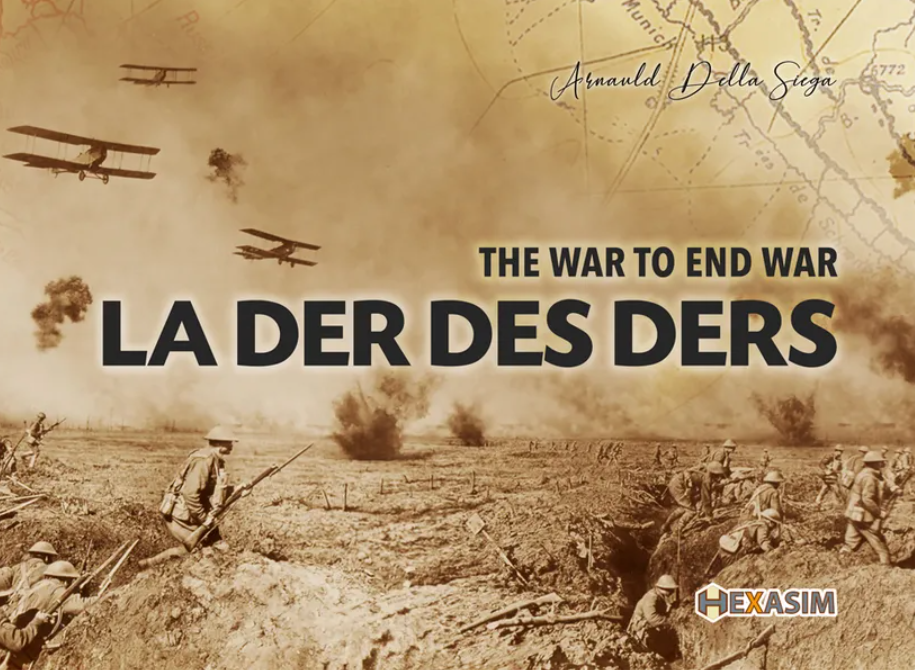
Hexasim has really been stepping up their game recently with some great looking wargames. Late last year, they announced their newest game called La Der des Ders – The War to End War, which focuses on World War I and is designed by Arnauld Della Siega. We reached out to Arnauld and he was more than willing to provide us some insight into the design.
Grant: Arnauld welcome to our blog. First off please tell us a little about yourself. What are your hobbies? What’s your day job?
Arnauld: Hello, everyone. Despite my Italian-sounding name, I am French. My hobbies? Gaming, of course. Formula 1. American football and flag football – I am assistant coach for my youngest son’s team. Oh, and I play badminton. And when I had a little more time, astronomy. Add Motörhead and Lovecraft to that, and I think you’ll have a pretty good idea of who I am. My real job? I’ve been working for Hexasim for three years. I mainly handle communication and game development (clarity of the rules, layout of the rulebook, some of the graphics).
Grant: What motivated you to break into game design? What have you enjoyed most about the experience thus far?
Arnauld: I think this is true of many designers, but my brain is constantly buzzing, whether I’m writing stories or inventing game systems. I wanted to create something to give shape to the ideas swirling around in my head. Then, and perhaps most importantly, to leave something behind for my descendants. Creating is more frustrating than rewarding, but seeing your game released is a bit like the birth of a child. A culmination.
Grant: What is your upcoming game La Der des Ders about?
Arnauld: La Der des Ders is the story of the First World War in its entirety, from the early stages to 11 November (and even a little beyond). It follows the timeline of the war and focuses on technological developments. La Der des Ders is a grand-strategy game in which you control sectors. You decide how to allocate your resources between recruiting new soldiers to rebuild your forces, technological research and preparing offensives. La Der des Ders is a revised and corrected version, with greatly improved artworks, ergonomics and rules, published in VaeVictis Magazine #145.
A look at the game found originally in VaeVictis Magazine #145.
Grant: What is the translation of this French phrase La Der de Ders?
Arnauld: La Der des Ders means « the last of the last ». You may translate it by « The War to End War ». I asked my testers and Boardgame Geek whether to use a French or English title. The players unanimously opted for a French one.
Grant: Why was this a subject you wanted to create a game on?
Arnauld: After creating No Man’s Land – Trench Warfare1914-1918 from Ludifolie Editions, I had acquired a good amount of knowledge about the First World War at a tactical level. I thought it would be a good idea to take a step back and look at the First World War from a different angle. That’s how La Der des Ders came about.
Grant: What are the unique features with the system used for the game?
Arnauald: It depends on what we mean by ‘unique’. Are there any truly unique games? When it was released in 2019, La Der des Ders was, to my knowledge, the only solo game covering the entire First World War. What makes it unique is its focus on technology (the game includes 41 levels of technology). It is also this abstraction, which facilitates the narrative without distorting it. This is particularly evident in the Collapse Tracks (which will be discussed later), which manage the erosion of the belligerents.
Grant: What is your design goal with the game?
Arnauld: What I look for above all else in a game is elegance. I like it when a lot of thought has gone into it, both in terms of the ergonomics and the gameplay. For La Der des Ders, I wanted to create a game that was easy to learn, designed for solo play, and with engaging mechanics. A game made to be played and able to learn more about the historical WW1.
Grant: What unique elements from WWI did you feel important to model in the game?
Arnauld: I think that sometimes a game is less about ‘what is important to model’ than ‘what the designer wants to model’. I like the ‘technical’ side of conflict. For this reason, 1914 interests me much less than 1918. I love all the technologies that abound. It was the shape of those funny steampunk-style tanks that made me love WW1 (basically, I’m more into Francis I, the Assyrians and the like).
Grant: As a Strategic Level wargame, what economic or political elements are included?
Arnauld: The entry of neutral countries into the war is managed by events. I did not want countries to be able to adopt a stance different from their historical one. That would have had too much of an impact on historicity. Neutral countries will therefore certainly enter the war in the same year as historically, but players do not really know on which turn (1 turn = 4 months).
The economy is managed by Resource Points awarded each turn. These Resource Points are the heart of the system, as they act somewhat like Action Points. Each sector contributes to the overall amount of Resource Points. The British and American navies also contribute an ever-increasing number of resources. The Naval Control Table simulates the war between merchant ships and U-boats.
Grant: How does the Collapse Track work?
Arnauld: The Collapse Track represents both a sector’s willingness to fight and its military potential. With each loss, a cube moves to the right, towards surrender. These losses also reduce the number of Attack dice a sector can roll during an offensive. Spending resources allows you to counteract this slow erosion and regain power.
Grant: What technologies can be developed?
Arnauld: There are six categories of Technology (Attack, Defense, Artillery, Air, Naval and Raid). Each category is divided into several levels, specific to each side.
Once unlocked, Technology levels grant bonuses in attack or defense, Artillery dice, rerolls, bonuses during the Naval Control Phase (which reduces the number of Resource Points available to the opponent), or the ability to cancel some events.
Grant: How does the game use cards?
Arnauld: There are two types of cards. Cornflower Cards are used to manage the solitaire bot.
The other cards are Events. Three are drawn at the beginning of each turn, and the effects are applied. Events are classified by year, and one card remains at the end of each year when the new year’s deck is brought into play. This adds variety to the game without sacrificing historical timeline.
What I am most proud of with these cards are the top banners. I made sure to copy the headlines from newspapers of the time, even going so far as to put a credible date and, above all, a number that, unless I am mistaken, should be correct. Yes, I had a lot of fun.
Grant: What different types of cards are included? Can you provide a few examples?
Arnauld: There are several types of Event Cards. Blue cards, such as the Schlieffen Plan, are only available in 1914. Red cards are Pivotal Cards that cannot be cancelled. These include cards that bring countries into the war, such as Lusitania and Zimmermann Telegram. Finally, green cards, which are the most numerous, allow players to obtain Resource Points, additional bonuses by attacking a particular country, but sometimes penalties. I looked for the most important events of the conflict, thought about their impact on the course of the war, and then translated that into game terms. A little tip: each color has a specific design, which means that color-blind players are not at a disadvantage.
Grant: How does combat work?
Arnauld: Combat is referred to as ‘offensives’. A single sector can only launch one offensive per turn, and a single sector can be attacked by multiple sectors. The player chooses the attacking sector and designates its target. They spend a number of Resource Points equal to the number of dice they wish to roll. This number cannot exceed the current Operational Value of the attacking sector (indicated by the position of the cube on the Collapse Track). To inflict a loss on the enemy, the player must obtain a certain value (often 5+). However, the dice roll is modified according to the technologies unlocked by the attacker or defender.
Artillery technology is important, as it allows black dice to be rolled that will not be modified. This highlights the power of artillery during conflict.
Grant: How are historical events handled?
Arnauld: By drawing three cards at the beginning of each turn. The cards do not go into the players’ hands. They are applied during the current turn. Some are applied immediately, others during offensives, and a few during the Resource Collection Phase. Some cards remain in play for several turns, such as Von Lettow, which allows the Germans to launch free offensives in Africa until the end of the war.
Grant: What variants are included?
Arnauld: The Fast Play variant speeds up games by bringing this version closer to the original version published in VaeVictis, removing the two new Technology categories and not charging sectors for implementing unlocked technology levels. I don’t really like it when a designer offers variants. It makes me think that they haven’t taken responsibility and are leaving it up to the player to figure it out.
You know what? I’m going to offer your fellow readers a great variant. This variant is for use in 1 vs 1 games, if you find it too difficult to win with the Entente.
Here it is:
Countries that are still neutral do not pay to implement an unlocked technology. Once the sector is at war, they must pay as normal.
You can consider this variant official. It has been tested.
Grant: How does the solitaire mode work? How are the Cornflower Cards used?
Arnauld: For each phase (Reinforcements, Technological Research, Offensives), the player draws a card and refers to what is indicated on the card.
It’s very simple to set up and effective. No need for endless dice rolls, referring to multiple tables, or having to make decisions for your opponent. Everything is indicated on the card. It’s elegant. Players seem to love this simplicity and the relevance of the decisions made by the bot.
Grant: How is victory achieved?
Arnauld: Victory can be achieved in several ways. Either by forcing France or Germany to surrender, or by earning 6 Victory points (obtained by forcing the enemy sectors to surrender), or at the end of the game (triggered when the Peace Negotiations Card is drawn) when the side with the most Prestige Points (calculated according to the position of the cubes on each of the Collapse Tracks).
Grant: What do you feel the game models well?
Arnauld: You can really feel the Entente gaining strength, with more and more resources at their disposal thanks to British and American support, and Germany’s obligation to finish the war as quickly as possible before the task becomes insurmountable.
But I also particularly like the story that the game tells, which is very close to the actual historical timeline.
Grant: What are you most pleased about with the design?
Arnauld: I like the fact that it is both simple and interesting. I like the fact that Dad can play with Junior. I like that players learn things while playing. I like the way it looks. And I like the price: we decided to make this game as affordable as possible so that more people could enjoy it. Games should not be a luxury item.
Grant: What other designs are you contemplating or already working on?
Arnauld: I have several projects in mind, mostly solo games. Some are well advanced, but I feel like I’m at a crossroads. I mean… there are too many games coming out. Designers need to learn to restrain themselves and, rather than flooding the market with games that are sometimes barely finished, take the time to polish them as much as possible and perfect the rulebook (which is often really awful). Given the price of games, I believe we should respect players and offer them flawless products. Fewer games, but higher quality. And that’s good, because that’s exactly Hexasim’s credo. If sales of La Der des Ders are fantastic, we can plan a sequel, perhaps World War II, to please as many people as possible, and/or fantasy. The ratings received on Boardgame Geek will decide.
Der polnische Verlag Board&Dice ist seit vielen Jahren besonders für Eurogame-Fans sehr spannend, denn er erscheinen dort viele anspruchsvolle Neuheiten. Deshalb habe ich mich sehr darüber gefreut mit Karolina von Board&Dice über aktuelle Neuheiten, spannende Entwicklung und mehr News zu sprechend. Board&Dice Neuheiten, aktuelle Entwicklung, Pläne und das Thema KI Karolina vom Verlag Board&Dice stand […]
Wharf Rat Games is a new publisher recently started by the dynamic duo of Ryan Heilman and Wes Crawford. I have interviewed both of these guys a few times for their own designed games and also hung out with them quite a bit at conventions including Buckeye Game Fest in April 2024 and the World Boardgaming Championships in August 2024. I am really happy for them that they have taken this plunge and created their own publishing company. I know they know games. Have been in the industry for a while now and also have great connections with many designers and would be designers and I am sure that they will bring many quality offerings to our tables over the next decade plus.
Wharf Rat Games is a Baltimore-based board game publishing company whose mission is to produce high-quality, light-to-medium-weight board games with engaging themes in historical, science fiction, and fantasy genres. With gameplay designed to last under 90 minutes, their games aim to captivate both casual and experienced players. But there is more than just their introduction here as they have signed their first game and it is from a designer we all know and love – Hermann Luttmann. A Forlorn Hope places solo players or up to three cooperative players in command of a battalion charging across No Man’s Land to capture enemy trenches during World War I. Success requires careful balancing of bold advances and timely retreats to avoid casualties, maintain cohesion, and keep troops from becoming pinned under relentless enemy fire. Over a decade ago, Hermann pitched a groundbreaking design to Alan Emrich at Victory Point Games—a push-your-luck mechanic within a wargame framework, originally set in the WWI trenches. While the concept was well-received, Alan suggested a Civil War theme instead, leading to the creation of In Magnificent Style, based on Pickett’s Charge at Gettysburg. This game went on to be published by Victory Point Games and later by Worthington Publishing.
They are now gearing up to launch this interesting game on Backerkit and I reached out to Hermann to get some more information and understanding of the game.
Grant: What is your upcoming game A Forlorn Hope about?
Hermann: A Forlorn Hope is an abstract simulation of six different World War I trench warfare battlefields, using a push-your-luck system that allows the player to experience the tension, frustration, and futility of these trench assaults across No Man’s Land. Players will try to push their battalions to victory in six different scenarios – Neuve Chapelle, 1st & 2nd Ypres, Verdun, The Somme, Passchendaele, and the Meuse-Argonne (The Lost Battalion). Each scenario is quite different, with unique elements, mechanics, terrain features, events, and victory conditions.
Grant: What is the meaning of the title? What did you hope to convey about the game to the players?
Hermann: The dictionary definition of forlorn hope is “A persistent or desperate hope that is unlikely to be fulfilled”. There is hardly a better way to describe the madness of the four years of trench warfare during the First World War. Interestingly, a “Forlorn Hope” is also a military term for a group of soldiers who are assigned the riskiest (and potentially most suicidal) mission, often involving infiltration, ambushes, or scouting missions. For the players, we felt the title was perfectly descriptive of what to expect in the game play. These are tough, grueling scenarios that will require the player to grind out their assaults to their best ability. And yes, the friction of war in this game is a cruel, un-welcomed participant.
Grant: Who is this new publisher and how did you come to do their first game?
Hermann: The publisher is a brand new company called Wharf Rat Games. It was founded by Ryan Heilman and Wes Crawford, both fellow game designers who also became good friends of mine as we worked on other projects together and just hung out at conventions. That I was honored with the opportunity to design their first published game and it was honestly totally by accident! They were interviewing me for their Rat Chat video series and somehow my In Magnificent Style design came up in conversation. I happened to mention that the original idea for the unique push-your-luck mechanism I came up with for that game was actually a World War I trench warfare game. Victory Point Games, who published the original IMS, thought that subject matter was not an easily marketed subject for a wargame, so we changed it to Pickett’s Charge. Well Ryan and Wes asked me if I would like to fulfill my original dream for the mechanism because they really liked the idea of covering trench battles. And here you have it!
Grant: Why was this a subject that drew your interest?
Hermann: I’ve always found a particular interest in World War I, maybe because it was a subject about which I knew few details, but every time I explored it deeper, it became more fascinating. There are just so many interesting aspects to the various nations involved in the conflict and the widespread fronts where such vicious fighting occurred. It just captivated me and then even more so when I discovered there were relatively few wargames covering the war, at least in the early days of wargaming. When I got into actually designing wargames, I wanted to challenge myself to do unusual games and when looking for relatively under-gamed and obscure topics, trench warfare loomed large. So, I set out to figure a way to make trench warfare entertaining for a game player. A tough task, to be sure, but I stumbled upon the idea of doing it as a solo design with an “against the wind” type of push-your-luck approach.
Grant: What is your design goal with the game?
Hermann: Well, as with any of my game designs, my #1 goal is to make an entertaining game experience that players will want to come back to constantly. I want players primarily to have fun, but also to have some challenging decision-making to ponder, topped off with some genuine surprises. In this game design, I want players to explore the various types of historical trench assault situations, which can be quite varied. Each scenario is unique and highlights a different aspect of attacking across No Man’s Land. At the same time, I hope players learn a little something about each of these battles and then perhaps will be interested enough to want to explore a bit deeper into these fascinating engagements.
Grant: What from trench warfare during WWI was important to model?
Hermann: Actually, the near helplessness of your troops crossing No Man’s Land and the fact that you are left to fate! You can direct your men to a certain degree…pointing them in the right direction and gauging when they should “hunker down” and take shelter…but otherwise it’s “dancing through raindrops”. What I did with this design is that you do have control of the order in which you move your units and how far (unless the enemy interferes with your plans, of course). I also added the “Wave” mechanic where you want your men to remain in as long a connected line across the battlefield as possible. Not only is this realistic, but a successful wave will earn you additional Tactics Chits, which will increase your units’ abilities and help mitigate against bad luck. So, you as the player are trying to advance against the enemy’s “wall of fire” as quickly as you can, but also trying to maintain order- two opposite forces pulling you apart, and something that a commander on the Western Front had to deal with. Yes, that can be frustrating but it’s also quite fun. You cannot know or control where the enemy artillery will fall – and that’s about as realistic as you can get. You pray and hope and push…and that’s the WWI tension I want to model.
Grant: What sources did you consult about the details of the history? What one must read source would you recommend?
Hermann: Oh, boy – honestly, there is no one book I used as these scenarios cover multiple battles. I researched each battle from the various books I own, on the internet, and I watched one or more documentaries on You Tube for each of the battles. My main source to get a framework for most of the early- to mid-war battles was The Western Front 1914-1916 by Michael Neiberg. Otherwise, there are numerous books covering each of the Western Front trench battles in greater detail.
Grant: What other games did you draw inspiration from?
Hermann: None actually…other than my own. This game is closely related to In Magnificent Style, Crowbar! The Rangers at Point du Hoc, and the upcoming Kill All Fermitians! (formerly Volters Lead the Way! and is being re-published by Flying Pig Games). Some of the games that I did play in the past, and which gave me hope that I could make a decently entertaining trench game, were Landships (Clash of Arms) and Trenchfoot (GDW).
Grant: How does the game use press your luck?
Hermann: Essentially there are two aspects to the push-your-luck mechanic in this game. One is that you want to get your units to voluntarily Hunker Down before the last Cohesion Cube is lost – this is called a Catastrophic Cohesion Loss. Units that are not Hunkered Down when this happens will be made Pinned, and that makes it harder for them to activate in the next turn (as they start that turn as Shaken units). Hunkering Down in time means the unit has huddled, taken cover, and is regrouping safely. It will begin the next turn without penalty. So, the player pushes their luck by gauging how far to move a unit before Hunkering Down and ending its current turn but thereby being in good shape to start the next turn. The other aspect is that the player will be compelled to keep units in a Wave – a chain of adjacency to each other – to gain the greatest number of new Tactics Chits. Therefore, the player needs to determine how long to keep units active in order to maneuver them into a Wave, but then risking being caught in the open and thereby Pinned when cohesion is lost.
Grant: What type of experience does this create? What are the toughest decisions forced on the players?
Hermann: Well hopefully, as with all my push-your-luck game designs, a sense of constant tension and discomfort! Because of the nature of the Activation and Event Cards, you never know when things will get really rough, really fast. Artillery barrages can land directly on your units – or just miss them. These can cause units to be forced to become Pinned, ending their turn immediately and making it tough to get them going next turn. Therefore, with each decision by the player whether to push another turn or not, there is never a comfort zone where you think “all is well”. The game system will keep you on your toes and always second guessing yourself – and that’s the experience I want to see players having as they attempt to navigate No Man’s Land in WWI.
Grant: What different player counts does the game handle?
Hermann: I suspect most players will be interested in this as a solitaire game, but in fact it does accommodate two or three players as well. In these counts, players will each control one Battalion and work cooperatively with the other player(s). In the case of the 2-player game, players will alternate control of the second (middle) Battalion. Scoring remains the same, with players sharing in the victory or defeat.
Grant: How does the solitaire game function? How does the AI prioritize its decisions?
Hermann: The player draws a hand of Activation Cards each step. Every card has a theme…either Suppressed, Slog, Advance, or Rush…and a set of matching results for cohesion loss, movement, and casualties inflicted on the unit. The player assigns each card to a unit and that unit must then abide by the directions and effects on that card. Usually, the player has some agency in how that assignment can occur. But if one or more “Draw Event Card” cards is drawn, the player must immediately draw an Event Card and apply its effects before continuing on with the activation. This also has the reciprocal detrimental effect of reducing the player’s hand size for this step’s assignment. If you have fewer cards than units, then you must draw the top Activation Card and blindly assign it a unit. There are a number of ways to help mitigate bad draws and results…the player has Tactics Chits to apply if needed and Officer Cards that can be used for certain special abilities. The AI is the deck of Activation and Event Cards, and the player needs to become familiar with what the Activation deck has to offer to make better calculated decisions. In the case of the Event deck, it is mostly random effects (such as for artillery bombardments and machinegun fire) but does prioritize counterattacks and other events against the most advanced player units. There are also Scenario Event Cards in most scenarios that create events specifically tailored to the battle you are currently simulating.
Grant: What has been your most challenging design obstacle to overcome with the game? How did you solve the problem?
Hermann: Honestly, the hardest thing we struggled with was not mechanical or procedural or thematical…it was making sure that the game was balanced for the player. In other words, that the player in every scenario was sufficiently challenged with a competitive, but not impossible, game. That means gauging how severe the Event and Activation Cards are, how many Tactics Chits to allow, how many Officer cards to be made available and how strong their powers are, and how variable and deadly the combat system is. Oh yeah – and how many Victory Points to award and penalize for each victory condition. And after you’ve taken your best starting estimate of where and how these factors should fall, the only way of getting them right is through trial and error, and tons of testing and demoing. And there’s really no magic formula to solving that issue, other than to hammer through the game and constantly bend, spindle, tweak, fudge, and edit.
Grant: What is the layout of the game board?
Hermann: Gamers familiar with In Magnificent Style and Crowbar will recognize the game board immediately. On the player side is the first row, representing the home trench. Then there are a series of nine more rows extending to the far side of the map, ending in a final row representing the enemy trench. There are also nine columns, each of which is occupied by one of the nine player units. In addition, the board is segmented into three No Man’s Land Zones of rows…green (the closest to the player), blue (in the middle), and red (closest to the enemy side of the board). These zones have a number of important effects on game play. Finally, there are three Battalion Zones of columns – 1st Battalion (left side), 2nd Battalion (middle), and 3rd Battalion (right side)…into which is deployed the three units of each of the three Battalions.
Grant: What is the anatomy of the counters?
Hermann: Well, there are no unit counters used in this game! Each of the player’s nine units is represented by a unique wooden piece, showing hand-drawn artwork highlighting the typical soldiers deployed by each nation in the game (there are four armies included – German, British, American, and French). There is no other information on the standees as it is not required for gameplay. There are other numerous cardboard markers used to track information or to be used by the player to perform certain game functions.
Grant: What different type of units are available?
Hermann: There is only one type of unit, technically speaking. The unit pieces represent the generic units fielded by the army you are controlling. Some scenarios will designate if the units represent a unique type of unit. If so, the scenario instructions tell you what your units can do differently during this scenario than the typical unit.
Grant: How does combat work in the design?
Hermann: Combat is pretty straightforward and fun, using custom combat dice. There are two types of combat…Event Combat (generated by an Event Card) and Assault Combat (generated when you move a unit into the same space with an Enemy Unit or vice versa). The dice handle both types of combat resolution. Each face of the die has a letter code that is utilized when resolving Event Combat. This letter tells the player if any Hits are scored on the affected Battalion, if the unit must retreat, and if it must Hunker Down. In the case of Assault Combat, each face of the die has a number value. Both sides in an Assault Combat will roll a number of dice, depending on the value of the enemy unit (shown on its counter) or, for the player’s unit, the use of Tactics Chits, Officer abilities, and the presence of supporting friendly units. All dice are rolled at once and the number values for each side added together into an Assault Combat total. This will yield a victory for either side or a stalemate result.
Grant: How does the game use cards? Can you share a few examples of cards and explain their use?
Hermann: Activation Cards are used to move and fight with your units while Event Cards are random events that will affect your units in various ways (or not, if you get lucky). Each step, you draw a number of Activation Cards equal to the number of available activated units, plus one.
For example, you draw three cards when you have two eligible units to activate (there are only two available units in this example because the third unit is finished for the phase, due to it being Hunkered Down or Pinned). You look at the three cards and if one or more is a “Draw Event Card” card, you draw an Event Card immediately and resolve it.
If it’s the Event Card shown above, the enemy machineguns are issuing sweeping fire across your advancing forces. You check areas “A” and “B” to see which of your units are located in those areas (there could be up to six units in both areas!). You then roll one die against each such eligible unit and apply the letter result rolled on that unit.
Then you discard the “Draw Event Card” Activation Card and you now only have two Activation Cards to choose from. One card is assigned to each of the two units you have left to activate, and its instructions are applied to each unit.
For example, the above “Advance” Activation Card is read from top to bottom as follows:
The top (yellow) entry is the possible loss of cohesion. Because there is a “1” shown in the icon, this means that one Cohesion Cube (the scenario will tell you how many you start with) is discarded. If this is the last cube in your supply, there is an immediate Catastrophic Cohesion Loss and any of your units that are not Hunkered Down or already Pinned are made Pinned. This ends the turn – you count victory points earned, reset all the markers and Officer Cards, and begin a new turn, but starting with a fewer number of cohesion cubes to use.
The middle (red) entry is the number of Hits this unit’s Battalion takes. Hits are recorded by Battalion, not by unit, using a Battalion Hit Infliction Track. In this case, because there is a “2” in this icon, there are 2 Hits inflicted on the Battalion and this is immediately recorded by the player.
The bottom entry is the Movement allowance for the unit. The color of this icon and the graphic of the soldier’s posture indicate the maximum number of spaces the unit can move forward (towards the enemy only) and the manner of the move (Normal, Cautious, or Crawl). Normal is a standard move forward with no impediments; Cautious is a Normal move but only if the unit is not moving from one Zone to another (like from the Blue zone to the Red zone); Crawl is used to move a unit that is Shaken (removing the Shaken marker) and/or moving from a Shellhole. On the example card, there is a “3” in the Movement Allowance icon so the unit move up to 3 spaces using Normal movement procedures.
Grant: How is victory achieved?
Hermann: The player scores, and loses, Victory Points (VP) throughout gameplay, and at the conclusion of the scenario. Each scenario lays out exactly what conditions are needed for the player to score, and lose, VP. This is normally a combination of how much progress each of your units makes toward the enemy trenches, capturing enemy trench spaces, and the occurrence of Catastrophic Casualties (that’s when a Battalion accumulates more than 10 Hits). Each scenario may also have entirely unique ways to gain and lose VP, depending on the historical battle situation being depicted. The player totals their VP and compares that total to the narrative table that provides the level of victory or defeat and what would have happened in the battle at your level of achievement.
Grant: What type of experience does the game create for the players?
Hermann: Well, this kind of design attempts to give the players an appreciation for the frustration, sacrifice, and difficulty of conducting trench assaults during the First World War. Obviously, I can’t honestly replicate the true horror of these events, but I think playing through a tough game like this at least gives a glimpse into the absolutely brutal experience these men faced on the trench lines. Rather than focus on that death and destruction, the game abstractly attempts to give the player the feeling of commanding these troops and leading them on an almost insurmountable mission, under dire circumstances, and against nearly impossible odds. The scenarios included in this game were chosen for the drama, strategy, and historical significance offered by the battles they represent. And by boiling all these factors down to a simple push-your-luck mechanic, with the requisite amount of thematic bells-and-whistles to create the narrative, I think players will at least be challenged, intrigued, and curious about not only exploring all the scenarios and situations, but perhaps even researching the actual details of the horrific experiences of these soldiers. To that end, we’ve also included on every Activation Card an actual quote from a soldier, officer, or author who lived through these battles and hopefully conveys the horrors of trench warfare.
Grant: What are you most pleased about with the design?
Hermann: One thing I’m very pleased with is the amount of narrative detail and variety we managed to get into this design. There are six scenarios contained in this first effort, but two of the scenarios actually contain multiple games to be played, kind of mini-campaigns. And each scenario feels so different than the others. Secondly, I am so pleased by the development and production support from Wharf Rat Games … specifically, Ryan and Wes. They are not only terrific designers and developers in their own right, but they’re beginning a company here that cares about providing high-grade production quality and customer service. This entire game package will be an attractive, well-produced, comprehensive, accessible, and highly replayable product and I am very appreciative and proud of that.
Go sign up for the game’s prelaunch at Backerkit and check out the art, news, and upcoming interviews at https://www.backerkit.com/call_to_action/12a5e9bc-4ce6-4667-8f62-b2df3ccbf9fd/landing and get a free downloadable print-and-play game called A Summer in Sarajevo designed by Ryan Heilman. Can you save Franz Ferdinand from his assassins?
Grant: What other situations could this system be used in?
Hermann: This style of game play is designed for any era…even fictional ones…where one side is primarily static, on defense, and tough. The basic idea is that the player is pushing their luck against a tough defending opponent and their “wall of fire”. However, that defensive enemy is still capable of launching localized attacks of their own, so that even though a static line is being faced, the enemy can still jump out and sting the player. Any situation that fits that set of criteria can work in this system. I have ideas for more World War I battles that will fit in this series, but we’ll first see how well it is received. But I am open to suggestions as to how to convert this framework to almost any other historical era or fictional setting that will work.
Grant: What other designs are you currently working on?
Hermann: Oh boy…every time you ask me this, the list gets longer! OK…here’s what’s cooking:
GMT Games – A Hell So Terrible: Verdun 1916 (on the GMT P500 right now). Also, the More of a Bad Thing expansion for The Plum Island Horror is now out and available. I will also be working on a post-apocalyptic design called Heavy Metal Thunder that is sort of an “express” version of the Plum Island Horror engine. It is designed to give players the same kind of narrative and cooperative experience as Plum Island Horror, but in about half the time and even more accessible as far as rules weight.
Blue Panther – Dawn of the Zeds: Designer Edition. Yes – a brand new edition of the Zeds franchise with some new and better mechanics. Also, I need to work on the next Tattered Flags game (Antietam’s Cornfield) and the next Napoleonic solo game (probably on Borodino).
Revolution Games – They March Against Us: Leipzig 1813 (the first of the Bonaparte’s Swords Series…which will be Napoleonic Blind Swords).
Flying Pig Games – Kill All Fermitians! (formerly Volters Lead the Way!, a science fiction push-your-luck game). And we are beginning work on A Wild Primitive Madness, the next Black Swan Series game covering The Battle of Antietam.
Jackl Games – More Brains! (a zombie push-your-luck game).
Unknown Publisher – White Mud (a tactical wargame on the Battle of Tuyuti, fought during the War of the Triple Alliance and bloodiest battle ever fought in South America. This was called the “Waterloo of South America” and is such an interesting engagement).
Unknown Publisher – Miracle Along the Marne (a Black Swan style of wargame covering the Battle of the Marne in 1914).
You asked!
Thanks again for letting me do this! I really appreciate your support and kindness.
As always it was a pleasure speaking with you Hermann. I am very excited about this one as it sounds very interesting and is also a unique gaming subject. I have played your Press Your Luck designs (In Magnificent Style and Crowbar!) and loved them both. Great games with very tough decisions.
In an effort to keep our content varied and most importantly interesting, we have in the past reached out to Graphic Design Artists to provide them an opportunity to talk about their craft and their works. I for one love a good looking game as much as a well designed game and feel that the visual element to wargames can make them successful or hold them back. Prior interviews with Graphic Design Artists that have appeared on our blog have included Antonio Pinar Peña, Nicolás Eskubi, Ilya Kudriashov, Ania Ziolkowska, Matt White and Iván Cáceres. In this interview, we talk to an up and coming artist who has actually done a lot of really great looking graphics for several wargames over the recent years in Wouter Schoutteten.
Grant: First off Wouter, please tell us a little about yourself. Where do you live? What are your hobbies and interests? What types of games do you enjoy playing?
Wouter: I’m Wouter Schoutteten, I live in Belgium, I’m married with 2 kids. I have many interests and hobbies! Gardening, reading, grilling, walking, baking sourdough bread, drawing and being creative all around, collecting music… But my main interest is playing board games. I play all kinds: I play a lot of wargames obviously, but I also play Euro games and last year I really got into TTRPG’s as well. I play a lot solo too – almost every evening, something I enjoy a lot.
I really appreciate games that are very tight, that have limited mechanics. Games where every decision just is really important. The White Castle is one I like a lot.
As for wargames, ironically I have more affinity with history before WWII. Though I play WWII games too, and mostly on a tactical scale.
I’m now diving a bit into the ACW and one game that really stood out for me is Mark Herman’s Rebel Fury. What a clever game, one that I’m blessed to play with my 8-year old.
Grant: What is your full time profession? How did you get into wargame graphic design?
Wouter: I work as a graphic designer and illustrator. I do a lot of illustration in the field of branding and marketing. I’ve been working independent close to 10 years now.
One day during holiday, I was reflecting on my career as an artist and about the kind of jobs I did so far.
I always feel like an artist should set his own goals and should create something he wants to create. You know, something you as an artist would like to put into the world. And it dawned on me I could probably involve my hobby in my profession. I mean, I loved spending time tinkering with boardgames, making my own stuff, laying out little playaids I shared on BGG… But is there such a thing as an artist working in the wargame niche? I felt it would enable me to create something myself and at the same time give something back to the hobby.
So I first created the art for Corvette Command, got in touch with Allen Eagle (the designer) next and presented the art to a couple of publishers and that got the ball rolling!
Grant:What is your favorite part about the graphic design/art process? Conversely, what do you struggle with or find to be the greatest challenge?
Wouter: My favorite part about it is really pretty early on in the process. Reading up, doing the research and spending a couple of days diving into the topic, looking for documentaries, listening to podcasts and get some understanding of what the topic is about. Something I did with Volko Ruhnke when we were starting on Coast Watchers – We sat together and played a single turn of the game, just so I got an understanding of the basic ideas and hearing from the designer what he is trying to convey, what he thinks the ideal experience for the player should be like.
So what is my greatest challenge? In 2025 I started taking on more and more commissions, which was very exciting. I did a lot more work in the war game space than I ever did before. Then I learned that mapping the workload and working out my schedule really is a nightmare! These games can take a long time to develop. There’s a lot of going back and forth and to get everybody on the same line, that could mean a lot of iterations. So working on my planning skills this year!
Grant: If you are given strict design parameters for a specific game, does this stifle your creativity?
Wouter: Not really! As long as the parameters aren’t really about the look and feel of the game, I’m okay with that. Usually being creative is easier within constraints. Starting from a blank canvas, that’s often a bit paralyzing. It’s nice to have some parameters like “we are looking to bring this kind of a feeling” or “this one should really feel like 1600”. These kinds of parameters work really well to spark creativity.
Grant: How long does it usually take to fully design the graphics for a wargame? What is the starting point for the whole process?
Wouter: The starting point really is doing research, reading up on the topic, talking with the designer about his vision, what he’s trying to convey, what the players should experience while playing the game. Once I have that, I start with mood boarding, looking for inspirational or similar graphics that I like. Also digging into the whole BGG catalog, looking for other games on the same topic, taking inspiration out of that. Then usually I design a couple of components to get a general look and feel. Then I hope to get the green light from both publisher and designer. Once we have that, I work out everything and usually there’s a couple of iterations that are going back and forth between me, the publisher and the designer.
Grant: Where do you obtain information from to ensure the accuracy of your subjects, whether it be uniforms, insignia, equipment, maps, terrain, etc.?
Wouter: So when I say mood boarding it’s more than just finding an esthetic. It’s also about collecting reference images from the appropriate period, so that I will be working on the right uniform, the right insignia and things like that. I like to have at least a couple of different sources. Online groups with miniature painters for exemple are excellent for this, these guys are experts. Also museums, books, documentaries,…
Wargamers can be really picky about details. And rightly so. I remember a talk from Adrian Goldsworthy, the historian, on historical accuracy in movies. But the same applies to games as well: We create these visuals as a representation of history and they are passed from generation to generation and we expect them to be accurate. Now there’s a big risk in that if we make something inaccurate, not many people will be able to tell. So it’s important for us to try and tell the history as accurately as possible. I like to think of wargames as another form of education, a way of studying history. But also as a way of preserving stories and keeping them alive.
1920: Nest of Eagles from PHALANX.
Grant: What role does a good map play in a proper wargame? How does it help tell the narrative of the battle depicted?
Wouter: One of the things a map does is conveying the feeling of the era. It can also tell a part of the story in itself. Like the board I did for 1812: Napoleon’s Fateful March from VUCA Simulations, if you look to the right top corner, where Moscow is, you will see the colors there are paler and they’re almost white, as opposed to the lower left, where the colors are more green-ish. This is because the French invasion started from these countries with a more mild climate. And as the French marched on toward Moscow, winter was setting in. Once they retreated from Moscow, they had to do so in terrible conditions, freezing severely. For this game, we couldn’t create two maps just for the sake of the narrative. So I worked with this color gradient so the French player would feel, the more he’s moving towards Moscow, the harsher the terrain is, the harsher the conditions are becoming.
Another one is the map for the upcoming Merville Battery from Dan Verssen Games that I am working on. For the raid on that French coast battery during D-Day, British paratroopers were dropped very early in the morning. By the time they attacked the battery, the sun was almost coming up, so the sun would have created these very long shadows. I visited the site of the battery in person to see how the site looked, but also what kind of colors we have there. I also checked with photo’s from tourists there that were taken early dawn, to really simulate those colors. In my first designs I tried dark blue tones to give it that night ambiance, but we settled for a version with a lot of dark greens with some pastel-like hues, some pink and soft purple. A peculiar color scheme, but one that gives that sense of early dawn on the map.
Grant: How does the design process for counters compare to the process for maps? What is your goal with the look of counters?
Wouter: Oh I enjoy drawing counters! I make illustrations based on reference images like photos from miniatures. Counters are drawn by hand. Usually I do a couple of tests to see if they work well when printed small. They have to be clear when used so very tiny. One thing I like about counters when placed on the map is when they really pop out. That’s something I keep in mind, to keep the colors of the map rather subdued and work with brighter colors for the counters.
Personally, I like if the counters are a bit of a narrative as well. I’m not a fan of NATO symbols because I feel they are too abstract and I lose that emotional connection with the people that were involved in the action.
Nightfighter Command from War Diary Publications.
Grant: What wargame companies have you worked with in the past? What games have you been involved with?
Wouter: I’ve been blessed to work with a very wide roster of publishers in such a short time. Lately I’ve been working with GMT, with VUCA Simulations and with Sound of Drums. But I also work with DVG, Nuts! Publishing and have worked for PHALANX, Fort Circle and War Diary Publications.
Grant: What games have you been involved with?
Wouter: 1812: Napoleon’s Fateful March, 1920: Nest of Eagles, Assault Red Horizon 41: Revised Edition and Primosole Bridge Expansion, Corvette Command, Nightfighter Command, Merville Battery, Coast Watchers: Allied Field Intelligence in the South Pacific, 1942-1943 (to be released), The Far Seas (to be released), 1813: Napoleon’s Struggle for Germany (to be released), A House Divided: Designer Edition (to be released) and my own Dreaded Flags: Naval Conflict in the Age of Piracy 1568-1720.
Grant: How would you classify or describe your distinct graphics style?
Wouter: I try to inject little bits of innovation in my art, something a bit different at least for the wargame scene. I like clear iconography, clear typography. I’m not a big fan of a lot of drop shadows and special effects. So I think you would classify it more as a bold, flat, very graphic style with some elements of the Franco-Belge comic, DIY and print techniques such as screenprinting, copier effects and lithography. I think these are some common elements you’ll find with other European artists as well. Is there something as a European wargame look?
Grant: What game’s graphics are you most proud of? Is there one game that you would like another crack at to improve or simply do differently?
Wouter: I really like the whole package of 1812 and how everything in that box works together. I’m also pretty proud at the humble Corvette Command. It’s published by War Diary Publications and it’s a game by Alan Eagle and more of a narrative-style game in the line of B-17: Queen of the Skies. Usually in these games, you haven’t many visual components in front of you. So for this type of game, I really wanted to create something different, something new, a strong visual game. I like the box art of Corvette Command. I tried a couple of new techniques in there.
Grant: What graphic designers/artists out there have influenced your style? Do you spend a lot of time studying other’s work?
Wouter: No, I try not to look too much to other artists. I’m a bit of a perfectionist, prone to tinkering with my own art. And, like many artists, I struggle with the infamous ‘imposter syndrome’. Nothing is ever good enough, especially if you compare it to work made by people who are way more experienced than me. “Comparison is the thief of joy” is a mantra I need daily. Of course, there are artists I admire a lot and if I buy a game, usually it’s because I like the look of it! Work by Nils Johansson, Marc Von Martial, Iván Cáceres, Roland MacDonald, Donal Hegarty, Rick Barber, Albert Monteys, Javi de Castro… Sure, I’m now forgetting many… So many talented artists.
Grant: What games are you currently working on?
Wouter: We have the Kickstarter running for Merville Battery by Vince Cooper for DVG. I’m also finishing up Coast Watchers with GMT Games before I start working on A House Divided. I’m also working on 1813 which is the follow-up on 1812, and the next volume in that series. There is this big rework of The Far Seas I’m finishing for Vuca. With Sound of Drums I’m working on their ‘Assault’ line and with Nuts! on a game on the Battle of Borodino. And some other as well, but that’s too early to say anything about!
Grant: Where do you see your wargaming graphic design career in 5 years?
Wouter: Difficult question because honestly I didn’t think there was such a thing as an artist career in wargames, because it’s so niche. Something I started to realize is that working in a niche industry is incredibly valuable. It’s very powerful for an artist to find a niche, one where you feel welcome and validated. It gives you focus in your artistic choices and it gives your work longevity. But that being said, I’m incredibly grateful for being able to work in this space and I didn’t expect it to go that fast. Something I really like to do in the future is to be able to work on a medieval or ancients game, because it would be so different to work on. And perhaps break in the TTRPG scene because there are a lot of illustrations used there.
Grant: What type of software and hardware do you use for design?
Wouter: Part of my work is deliberately done analog, pen and paper style. Most of the work however is done on computer in Photoshop, Illustrator and some InDesign. Drawings I do analog and a lot on iPad as well. At the moment I’m trying a couple of new things. I’m trying to introduce my scanner and my analog work back into the digital space, combining it with photobashing, which is a very exciting technique to create fast but unique visuals that sit somewhere between photograhpy and illustration.
Thank you Grant, for taking the time to listen to me. And thanks a lot to you and Alexander for doing The Players’ Aid these past 10 years or so. I think it’s one of the pillars of the hobby and of this wonderful community. I’ve been following the blog for as long as I can remember. It’s how I have been staying in touch with new games, how I discovered a lot of games and the joy of solo gaming too. The blog and YouTube channel has given me so much joy in this hobby. Thank you!
Thanks for your time Wouter. I know that you are busy working on several new projects but appreciate that you were willing to share your story and give us a little bit of insight into the life of a graphic designer. You have a very impressive list of games that you have done graphics for and I look forward to enjoying your work for years to come.
Several years ago, we posted an interview with Matt White, who is a very talented graphic artist and budding game designer, that focused on his artistic talents and love of tanks. He has since designed several very interesting small scale wargames, with his most recent series being a World War II tactical wargame series for 1-2 players pitting the British Airborne versus the German Wehrmacht called Until the Bitter End. He then designed the next entry in that series called Until the Bitter End – US Airborne followed by Until the Bitter End – Tanks. He has also done a few others including Would Be Aces,Operation Biting and Today Another Battle that have done very well. Recently, a new game appeared on Kickstarter from Matt called Saving Angels WWII Solitaire Wargame Print and Play, which is a wargame based on the American and guerrilla raid of the Japanese held Los Baños prison camp in World War II. We reached out to Matt and he was more than willing to share on the project.
Matt: My new Solitaire game is called Saving Angels and it covers the bold US Airborne and allies, raid of the Japanese held Los Baños prison camp during WWII.
Grant: What was your inspiration for the name? What do you want it to convey about the design?
Matt: I came across the history of this subject, whilst researching the Operation Biting game (which is also an Airborne raid, only British) and the name refers to the US 11th Airborne Division, as they were described by the prisoners, who they rescued.
The main element of the design is that you command the paratroopers and guerrillas on this daring rescue mission. With most wargames, the mission is often defeat the enemy or hold a point, etc., but with this design the rescuing of the prisoners is your objective.
Grant: What about this historical event made you want to create this game?
Matt: The main inspiration really was the story, but from the prisoners point of view. They had been treated terribly, for the most part, from their captors. The prisoners were from all walks of life, civilians rather than soldiers who had been captured. I felt it was important to cover this story from WWII, which has not really been covered before.
Grant: What research did you do on the subject?
Matt: I read a lot of history subject books so naturally I read as much as I could on the subject. There are also a few really good videos on YouTube that are also well worth watching.
Grant: Is this the start of a new series of games?
Matt: This is my third game in my Raid Series – the other games covering the British paratroopers, with this one being the first game in that series featuring US forces and where the main objective is the rescue.
Grant: What games have inspired your design?
Matt: To be honest, the biggest inspiration really is the history side rather than other wargames. I think also the first two games in the series was a natural source.
Grant: I know the design is a Print and Play offering. Why do you feel this model is best suited for your designs?
Matt: I like making print and play games as it forces you, as the designer, to make every component count and making the most of the physical space on a sheet of paper. I find that challenge one of the most interesting parts of the creative process.
Grant: I know you are not only the designer but you do the art as well. Please show us a few examples of your great art.
Matt: Here are several different pieces from the game.
Grant: How do you create your art? What is the process and what graphics tools do you use?
Matt: I use a variety of tools such as Sketchbook and Photoshop. I pretty much draw in a traditional method, just using a Wacom pen and laptop.
Grant: What difficult decisions do players have to make in the game?
Matt: The player must try and maximize their units to the best of the counter’s abilities. Each unit will have strengths and weaknesses so coordinating your units is crucial for success.
Grant: What dangers and threats meet the players with their airborne and amphibious landings?
Matt: As the player pushes towards the prison they may encounter Japanese enemy threat but also the risks associated with such landings.
Grant: What objectives does the player have to accomplish?
Matt: The player’s goal is to get to the camp, free the prisoners and then escort them back to the pick-up zone to make good their escape. This was a daring mission as the Japanese defended the area and the player will have to fend off Japanese reinforcements as the player makes good on their escape.
Grant: What is the purpose of the 2 different maps?
Matt: The game comes complete with 2 maps. The first map is for the approach to the Prison Camp and features both Airborne and amphibious landings. The second map is the Prison Camp itself where the player must locate and rescue the prisoners before escaping back across the first map.
Approach map.
Prison camp map.
Grant: How do players control these units and give commands?
Matt: During the game’s turn the player controls movement of their Units whilst the game’s AI will control the enemy Japanese.
Grant: What is the goal of the game? How is victory obtained?
Matt: Get to the camp, rescue the prisoners and escape, whilst fending off the Japanese enemy. It will take co-ordination of the player’s units, using them to the best of their abilities and a bit of luck!
Grant: What are you most pleased about with the design?
Matt: I really wanted to create the strong narrative experience, that’s quite tense, of having multiple objectives (with rescuing all the prisoners) whilst dealing with an unrelenting enemy.
Grant: What kind of an experience does the game create?
Matt: For me, the game creates the idea that sometimes you have to be bold, push your luck and try and achieve success by utilizing the resources you have to the best of their abilities.
Grant: What other designs are you currently working on?
Matt: I have a plate of other games I am working on, mostly WWII! I’d like to cover more of these historical daring raids whether they are land, sea or air.
Thanks to Matt for his time in answering our questions and for his great little print and play games. I love it when one of these new games is brought to light as I get to oodle over the art and see what new things he has created!
Schmidt Spiele ist bekannt für Brettspiel-Klassiker und Familienspiele. In den letzten Jahren erschienen aber auch ein paar anspruchsvollere Spiele. Mit der Produktmanager Anatol Dündar spreche ich über aktuelle Neuheiten, spannende News, die Spiele-Entwicklung ein mehr. Schmidt Spiele News, Spiele-Entwicklung, KI und mehr mit Anatol Interessante Einblicke und aktuelle News erfahrt ihr im Folgenden. Hallo Anatol. […]
Shem Phillips kennen sicher viele von Garphill Games, aber inzwischen ist er auch beim Verlag Arkus Games aktiv. Ich habe mit ihm über seine Arbeit bei Arkus Games gesprochen, gehe auf aktuelle Neuheiten ein, schaue ein wenig in die Zukunft und einiges mehr. Arkus Games Neuheiten, kreative Ideen, KI, Pläne und mehr News Shem ist […]
Mit Weird City Games hat Tim Eisner einen kleiner aber sehr spannenden Brettspiel-Verlag gegründet und einige spannende Spiele veröffentlicht. Er berichtet über seinen Weg zum Spieledesigner, besondere Herausforderungen, kreative Ideen und was er sonst noch so macht. Weird City Games Neuheiten, Tim Eisner, Idee, Herausforderungen und mehr Tim gibt im Folgenden sehr spannende Einblicke in […]
Mit dem aus London stammenden Gründer von Play Monkey Games spreche ich unter anderem über sein erstes veröffentlichtes Brettspiel. Zudem geht es um seinen Einstieg ins Hobby, Herausforderungen beim Spieledesign, keative Ideen und vieles mehr. Play Monkey Games Neuheit, Spieledesign, Ideen, Pläne und mehr Spencer gibt im Folgenden wirklich viele sehr interessante Einblicke in seinen […]
Mit DMZ Games gibt es einen kleinen spannenden Verlag aus Barcelona, der vor allem mit Leidenschaft und Liebe zum Brettspiel-Hobby geführt wird. Ich konnte mit dem Inhaber über seinen Weg ins Hobby, die aktuelle Situation in der Brettspiel-Welt und natürlich seine aktuelle Neuheit Urban Sketchers sprechen. DMZ Games Neuheit, Spieleentwicklung, Anspruch, Professionalisierung … Im Folgenden […]
Mit Phantom Epoch hat sich Tysen von Doteira Games einen großen Traum erfüllt und seine Karriere als Spieleautor geatartet. Im Folgenden erfahrt ihr, wie es dazu kam, welche Herausforderungen er meistern musste und vieles mehr. Doteira Games Neuheit, Herausforderungen, Spiele-Entwicklung und mehr Tyson gibt spannende Einblicke in seinen jungen Verlag. Hallo Tyson. Bitte stell dich […]
dlp games bringt zur diesjährigen SPIEL wieder ein paar interessante Neuheiten mit. Unter anderem eine Erweiterung für Pirates of Maracaibo. Im Folgenden erfahrt ihr, welche Neuheiten es sind, wie die Zukunft von dlp games aussieht und einiges mehr. dlp games Neuheiten, Zukunftsplanungen, Jubiläen, Partner und mehr News Anja gibt spannende Einblicke und interessante Infos zur […]
Auch in den Niederlanden werden fließig neue Brettspiele entwickelt, unter anderem bei Wulfhorn Games. Welche Neuheiten es da in diesem Jahr gibt, an welchen Projekten gearbeitet wird, wie neue Ideen für Brettspiele entstehen und vieles mehr erfährst du heute. Wulfhorn Games Neuheiten, Spiele-Design, Ideen-Findung und mehr News Ruud berichtet über seine Arbeit als Spiele–Autor und […]
Der PD-Verlag hat schon ein paar Klassiker veröffentlicht und bringt nun immer mehr spannende Neuheiten auf deutsch heraus. Im Folgenden geht es unter anderem um interessante Spiele-Neuheiten, heiße Concordia News, die Ausrichtung auf Expertenspiele und einige mehr. PD-Verlag Neuheiten, Concorida News, Expertenspiele und mehr Im Gespräch mit Jan Philip gibt es wirklich sehr interessante und […]

 Anmelden


 Play to Z ist ein kleiner Brettspiel-Verlag, der aber von einem Veteran gegründet wurde. Ich spreche mit Zev über seinen Werdegang, über die Entstehung seines Verlages, aktuelle Neuheiten und mehr. Play to Z Neuheiten, Einblicke, Pläne und mehr News Spannende Einblicke in den kleinen Verlag erhalten ihr im Folgenden Interview. Hallo Zev. Bitte stell dich […]