Normale Ansicht

Gathering of Friends ’26 Recap

26. April 2026 um 23:52

Games Played and quick notes (on new-to-me games)

  • 1846 x3
  • Dark Pact x3 — I finally got my copy just prior to the Gathering and played several games. I will have a review soon.
  • Tricktaker’s Guide to the Galaxy x3 — I would definitely buy this if it were easily available. You deal out your hand, play a game of “No Thanks” to get rules (which give you +5 points if you fulfill them and -20 if you don’t) and then play the hand out. Nice fast filler.
  • Bomb Busters x2
  • The Gang (Deluxe Edition) x2 — Has rules for up to 10 players. Surprisingly … they work.
  • Quartermaster General WW2 (2nd Edition) x2 — Really wanted to try the second edition. But didn’t have the expansion. I hear 2nd edition cleaned things up, but …. there were obvious mistakes on the box (2-5 players? Seriously?) and downgrades on the board (no SOP), so I wonder how carefully they cleaned up the cards.
  • Scout x2
  • Sides x2 — Cooperative password-ish game where you have to use clues starting with specific letters. Perfectly fine.
  • 1822MX — Note to self, do not try to play using PNW rules for the first hour.
  • 18EU (Minor Powers Variant) — I don’t know if the variant has been published, but it makes it similar to Railways of the Lost Atlas.
  • Azure — Surprisingly good abstract filler that I’m still thinking about. Might buy, even though I dislike abstracts.
  • Dice Realms
  • Dune
  • Fast Sloths — Cute enough, probably has good replay value with all the different animals you can put in the game (who carry around the sloths).
  • Got Five! — Reasonable deduction game.
  • High Frontier 4 All — Decided to splurge and upgrade my set. Played a 3 hour teaching game, not the 10+ hour game.
  • Liar’s Dice
  • Lord of the Rings: Fate of the Fellowship — Very clever improvement to the Pandemic system, and you can feel the theme. Not a purchase for me, but I’d play again. This was getting constant play
  • Magical Athlete — Fun but stupid game-adjacent activity. “Bunco for Gamers” as Mrs. Tao might say.
  • Meister Makatsu — Another Reiner card game filler, so … it works. Would play again.
  • My Book Nook: Cozy Word Building Game — Good idea, mildly infuriating execution in that you score based on word length, but the hard letters give trivial bonuses (instead of saying “Count word as longer” or something). But do we hold cozy games to the same standards? (I do).
  • Oath
  • Petiquette — A clever party game idea (you get a sequence of animals with hats of various colors, with a ? and the judge decides which animal/hat/color combination should go there, and everyone tries to guess). But it got old way too fast. Avoid.
  • Santa Fe
  • Soothsayers — Maybe I got a bad rules explanation, but avoid and play Glory to Rome or any game in that family instead.
  • Time Agent
  • Titan
  • & Two Unpublished Prototypes of which I will not speak. I also saw several other prototypes that I didn’t feel the need to play, because I mostly don’t play prototypes and they seemed like “I will not like this” or the occasional “I will simply buy this when it shows up1).

So … most of the new games2 are fine (nothing set my world on fire), whereas many of the older games had spectators and onlookers going “Wow, I haven’t seen that in ages.”

Part of me wants to do some stats on my games played by year (or counting by “hours played” instead of “plays,” which should shove the date several years back further) but I am tired right now. Perhaps later, unless there is a tool that already exists to do this?

Also, there was a nice memorial to Bill Cleary, who died last summer.

UpdatePut a few stories on BGG.

  1. More Mage Knight ↩
  2. “That I played,” and I had a pretty high standard (the new game shelf covered a wall) although sometimes I just agreed to a blind game for the company. There were many new games that were obvious avoids if you share my tastes … point salads, etc. ↩

Isaac Childres steps down as Cephalofair CEO to focus on game design, promotes Price Johnson to role, hires Julie Ahern as COO

26. April 2026 um 17:38

Isaac Childres, the founder of Cephalofair Games and designer of its runaway successes Gloomhaven and Frosthaven, is stepping down from his role as CEO to focus exclusively on game design at the company.

Cephalofair’s long-time chief operating officer Price Johnson has been promoted to CEO at the publisher, while industry veteran Julie Ahern has been hired from Van Ryder Games as its new COO.

Childres founded Cephalofair in 2014 to self-publish his first game, Forge War, and struck huge success with his follow-up design, fantasy co-op campaign design Gloomhaven, which raised about $4m for its second printing on Kickstarter in 2017.

Three years later the company broke the Kickstarter funding record for a tabletop game with Childres’ successor design Frosthaven, which pulled in almost $13m from more than 83,000 backers.

Standees from Frosthaven

Childres has led the company since inception, seeing it growing from a one-person operation to overseeing a team handling design, development, writing, art direction, promotion, publishing and fulfillment.

New CEO Johnson, who joined Cephalofair in a business development role in 2017, oversaw strategic initiatives such as mass market placement of Jaws of the Lion, as well as managing marketing and production of Frosthaven as the heavily-delayed project navigated the huge disruption caused by the Covid-19 pandemic.

He has also been a high-profile voice in campaigning against US tariffs imposed by President Donald Trump over the last year, and aiming to highlight the heavy financial burden it has placed on tabletop game publishers – many of which rely on Chinese manufacturing for their titles.

Johnson will continuing to oversee strategic initiatives, business development, sales and marketing, and catalogue growth at the company following his promotion to CEO.

He said, “Working with Isaac since the early release days of Gloomhaven to grow both Cephalofair and our community has been an absolute privilege and highlight of my career.

“We have come a long way since the early days of indie game design and crowdfunding, while learning a lot about ourselves and this industry in the process.

“I can’t wait to share the exciting plans we have creatively and organizationally in this next chapter with our fans, but that starts by putting in the hard work alongside our amazing team, whom I thank for their trust and support.

“With confidence, there is no place I’d rather be… epic strategy awaits!”

A statement from Cephalofair said Childres would now focus solely on his role as lead game designer at the publisher, overseeing design and development on its entire line of games.

Julie Ahern, who replaces Johnson as COO, most recently spent almost four years as senior director of operations at Van Ryder Games, which is best known for solo horror game series Final Girl and murder mystery title Detective: City of Angels.

Titles from the Final Girl range, from Van Ryder Games

She previously spent almost 12 years at Greenbriar Games as COO and vice president, overseeing day-to-day of business operations and game development while contributing to the Folklore: The Afflication and Zpocalypse product lines.

Childres said, “Julie is my absolute favorite person in the board game industry (sorry Price!), and I could not be happier to welcome her to the team.

“I think she is the perfect fit for a needed role in this transition that allows me to focus on my core passion: designing epic, strategic games. Thanks Julie!”

Johnson added, “Growing as an organization means surrounding ourselves with professionals who not only compliment our core strengths, but exceed many of our own.

“Julie Ahern is one of those professionals I’ve long admired as a leader, innovator, and tabletop enthusiast. From coffees at conventions to shared manufacturing trips in China, I’m thrilled to finally have the opportunity to work directly alongside her as Cephalofair enters its next chapter.”

Ahern said, ““I have known and respected Isaac and Price for many years. While I loved my time at Van Ryder Games, it is a genuine pleasure to start this new adventure.

“I am thrilled to delve into the Gloomhaven universe with all its deep lore and challenging campaigns.”

Cephalofair’s most recent crowdfund saw it raise more than $5m on BackerKit for Gloomhaven Grand Festival – one of the highest-profile campaigns on the crowdfunding site to date – which included a second printing of Frosthaven, second edition of Gloomhaven and several other designs such as small-box release Gloomhaven: Buttons and Bugs.

That campaign has suffered heavy delays compared to its original timeline, however, due to both production delays and the volatility caused by US tariff policy.

The new edition of Gloomhaven, for example, only began fulfilling in May last year, despite initial estimates that it would begin fulfillment in March of 2024.

Cephalofair is currently on Wave 4 of production for the project, working on the Gloomhaven RPG, which it originally estimated would be fulfilled in July 2024.

The post Isaac Childres steps down as Cephalofair CEO to focus on game design, promotes Price Johnson to role, hires Julie Ahern as COO first appeared on .

Designer Diary: Inkwell

by Jasper Beatrix


Game design is a journey, and one without a clear path, nor a clear end. Everything you imagine at the beginning is full of passion and hope, but so much in flux. What you will make is an unknown distance in time and space from where you are now: in theme, in mechanics, in style. We sometimes feel that we have changed as much as the game.

Inkwell, for example, goes back to a long car ride during the muted holiday season of 2020. Who were you back then? Who were we? And what was this game?


2020

Julia & I, having previously worked together on Sacred Rites, had a chat during my long ride up from NYC to Syracuse, New York, primarily because I am terrible at long solo drives. The topic was, primarily, a game that was about turning pages.

The brainstorm phase is like fishing about for infinite fish. Would it be a game with actual books? Folded boards? Large cards that flip off a deck? We discussed word puzzles, roll-and-writes, worker placement, token placement, dice management, hand management. But there was this focus on the verb of play that helped guide us: Turning the page. But that brought so many questions of its own. Does the page turn permanently? Can it turn back? Does a player know what is coming? Can they travel a book as they would a player board? Or is it a one-way trip? Do they choose future pages? Or choose to stick with what they have?

But in the end we called our shots; after three hours I had reached my destination, and in the end, the game was not built from a hundred ideas. It was built from a few, whichever ones we felt like pursuing, even if it led to disaster. It isn’t the right phase to be right; it was the opportunity to be wrong. We were stumbling in the dark, and as usual, enjoying it.


2021

After the holidays I looked back at our notes and prepared a first shot at what we called ‘CODICES’, which was about old books and rolling dice, and we liked the clever feeling of sneaking the word ‘dice’ into the title.

The idea was straightforward, at least at the time: Two sets of dice would be rolled, with one representing the ink color, and the other a numerical value. Each player would be limited to playing their numerical value on a space of the chosen color or filling pre-designated color spaces. There were other mechanics around pleasing patrons with bonus scoring for certain numbers and collecting gold leaf to decorate the pages. And, at each player’s leisure, they could turn pages back and forth to score in different parts of their book.

This left us in that most cursed of playtesting situations, once we got others to play: The game was interesting but not fun. This is a drag, to acknowledge that it felt fresh, and unfortunately, not special. We had a string of such designs around this time, grasping at creativity in the wake of so much going on in the world around us.

We tried to iterate in large amounts in different directions. This meant trying a version where the board was only a grid and was filled in to build patterns from pattern cards, as if to form illustrations. We tried word puzzles and drawing games. We tried returning to numbers again and moving from collective dice use to dice gathering done privately by turn, with each player gathering dice and exchanging them as if to gather their supplies. We also messed with applying force on the players, either through the action of another player, or through some sort of counter that players could affect, like a flexible game timer.

What was disheartening about this, as it often is, is that each attempt felt, somehow, worse. The passion was replaced by a grind of ideas and attempts. Band-aids on band-aids. Its journey almost ended.


2022

The game languished here, and that is important to acknowledge. We felt like we were done making games, and there was this process of ‘putting it all away’ that was quite sad. Turning the page, as it were. We recycled a lot of boxes, papers, bits. More than we probably should have. Of this project, all that was left, perhaps accidentally, was the bag of ink dice, and a single printed page. Fossilized, like many projects end up.


2023

The spark that helped us form DVC is for another time, but in that came two lovely things: Restrictions, and passion. We wanted to get back to making things. New designs abounded, but two old cartons of prototypes were dug up and rehomed. In all that was that little fossil, the dice and the page, and it was like a bolt of lightning. Who was that? The person that made this? And there was a surprise: Likely falling from another prototype, we also found a single real metal cube, a gold one, in the box with what was left of the game. Huh. It got repackaged and placed on a shelf.


2024

With a baby on the way, there was a sense of urgency for our little crew of friends and family. A whirlwind of work. Old designs found in that same process, repackaged the year before, were all the rage. Here Lies. Karnak. Rosetta. And a mess of others that have not surfaced quite yet. I began to make myself a little package of projects to work on later, as a promise. I dug up old files and put them in the cloud.

It was about this time we also got a chance to play a prototype by Lewis Graye, who has used paint cubes to represent the gathering and mixing of colors. There was even a touch of the colors 'matching’ the paintings they were paid for, and the cubes were taken from available inkwells to use.


2025

About two weeks after our little one was born, I was up all night keeping an eye on him and digging through those old files I had set aside, squinting at my phone. I hadn’t really designed anything in months, I was so nervous about being a parent. Game design felt so small, so unimportant.

But, in that chair, something clicked. Or really, everything clicked.

Lewis was onto something.

Inkwell ultimately became a drafting game, but designing it was also a drafting game, as the process of making something is often a game itself.


I got together with Lewis, as well as long-time collaborator Joey Palluconi, who had some thoughts about asymmetrical inkwells after discussing the old design. We began writing on cards, and quickly had arrays of cube spaces opposite pages of abilities. Then a central mat of abilities and cubes mixed together. Then a reset timer controlled by player choices. There was a debate of the abilities themselves, and the desire to let them combine and build engines pleased players more than punished. Joey, Lewis, and many of us had recently liked cozy games, ones that let us converse while we ‘did the fun thing’. That, maybe, was the drive in the end. Meditation, reward, beauty, straightforwardness. Younger me would have scoffed. But now, all of us in our struggles, me as a new parent? Inkwell playtests became a safe space of quiet, even as a designer. The three of us held clandestine little meetings at larger game nights, sheltering in the project as the world swirled around us.

You see, I am used to some common questions about game design. Where do ideas come from? How long does it take? How do you know what works?


Inkwell was built on work by quite a few people, but more specifically, it drafted many of its ideas from itself over the course of years. The segments of this diary in bold show where parts of the final design first surfaced, even if ignored. It took time to realize which fit where, what matched, what did well. Each iteration was like a turn of the page, where we would get a score and try again.

This game, as a design, was a comfort to us after a long journey. We hope you can make some tea, play some lo-fi music, place cubes, and hopefully breathe with us and think of how incredible it is for anything to get to its destination: here and now.

With love,
Jono Naito-Tetro
DVC co-founder

Ticket to Ride: Europe Game Review

When Ticket to Ride was released in 2004, it became popular the world over. That year, it was nominated for numerous international awards, even winning the prestigious Spiel de Jahres award. Capitalizing on the exposure, the following year designer Alan R. Moon released Ticket to Ride: Europe. By changing the map from the US to that of Europe—and introducing small but meaningful changes—Moon showed how the game’s concept could be expanded in challenging ways while still being familiar to anyone who had played the original.

As with my review of Ticket to Ride: Northern Lights,  I’m going to skip the How to Play section of my usual reviews. If you haven’t played Ticket to Ride before, check out my colleague Kevin Brantley’s great review of Ticket to Ride: Refresh to learn how.

What’s New?

The first thing my TTR-playing friends ask when they see a new version of the game hit the table is, “What’s new?!”

Ticket to Ride: Europe introduces several new elements, both physical (new pieces given to each player) and on the board (new route requirements).

Train Stations

Ticket to Ride: Europe introduces Train Stations. Ever wish you could use another player’s route to get to a city that is blocked off? With Train Stations, you can.

[caption id="attachment_330109" align="aligncenter"…

The post Ticket to Ride: Europe Game Review appeared first on Meeple Mountain.

RAW Video: Fields of Fire Deluxe Edition from GMT Games

Von: Grant
26. April 2026 um 14:00

Fields of Fire is a solitaire game of commanding a rifle company between World War II and the Present Day. The game is different from many tactical games in that it is diceless and card based. There are two decks used to play. The Terrain Deck is based on a specific region and is used to build a map for the various missions your company must perform. The Action deck serves many purposes in controlling combat, command and control, and various activity attempts. The units of the company are counters representing headquarters elements, squads, weapons teams, forward observers, individual vehicles or helicopters. A single game is a mission and several missions from a historical campaign are strung together for the player to manage experience and replacements. A mission can be played in about 1 – 4 hours.

The Deluxe Edition includes a rewritten series rulebook, with a rewritten third edition ruleset, packed with examples, diagrams and clarifying notes while maintaining continuity with the second edition rules, a Starter Guide, a Full Starter Mission, which is a stand-alone mission tailored towards easing new company commanders into the full game, 4 fully Redesigned Mission Books, Normandy, Heartbreak Ridge, Naktong River and Vietnam campaigns are presented in a clarified and expanded manner, over 200 updated counters plus various additional reference markers and new units, new elevation cards to enhance the Heartbreak Ridge campaign and a completely new set of redesigned player aids including new charts and air assault planning cards.

-Grant

Designer Diary: OUTFOX the FOX

by Jeff Grisenthwaite


There’s something magical about a good pub trivia night. You and your crew huddle together, heartily debate the answers, and marvel at each other’s unexpected pockets of deep knowledge. You groan together when you’re wrong and send up a loud cheer when that answer that you pulled out of your @$$ turns out to be right.

These are the feelings that I aimed to capture and bring home with OUTFOX the FOX.

My Brother is My Target Audience
I made this game for my brother, Mike.

Growing up, he was the popular jock, and I, as you might surmise, was the nerd.

When it comes to games, he certainly enjoys them but he doesn’t want a bunch of rules to get in the way of a good time. The games he plays are easy to learn, promote strong interaction among all the players, and set the stage for dramatic or hilarious moments. And his whole family really likes trivia.

I wanted to make a game that Mike would love. If I could make a trivia party game that BOTH of us loved, I knew it could be a hit.

Hold Your Horses
My first prototype was horse-racing themed and featured top 10 lists, such as:
• Countries with the largest populations
• Movies with the highest ratings on IMDb
• The most popular sports in the world

The game provided three of the ten answers in random order and asked each player to come up with an answer and write it on a mini-whiteboard. Then players could place horse-racing style bets for which of those answers would be highest in the top 10 list.

Early prototype that featured horse-race style betting that was far too complicated.

Players would get points for both:
• Winning their bet.
• Getting other players to bet on their written answer.

This initial prototype (like nearly all initial prototypes) had some big problems:
• It didn’t feel anything like pub trivia night due to the lack of teamwork.
• Betting was way too complicated.
• Each player struggled to individually come up with answers and place bets for questions that were outside their area of expertise.

But there were some seeds of fun in that problematic first prototype. If I could solve those problems, there could be a great game on the other side.

Get Foxy
My goals for my next iteration were:
1. Infuse a lot more teamwork
2. Make the trivia easier
3. Simplify the rules

I restructured the game into a one-vs-many format, in which each round pits the current question reader vs. everyone else.

I shrunk the question from top 10 lists to top five lists and provided all five answers. The question reader gets to pick from three different questions to give them a chance to pick a familiar subject. They secretly look at the top five answers on the back of the card and think up a fake answer.

All six answers (five real + one fake) are read aloud in a random order and written on mini-whiteboards. Then everyone else gets to team up to guess the order of the top five list and which of the answers is fake.

Letting everyone team up to answer the question accomplished two things quite well:
• It made tricky trivia questions easier by leveraging the wisdom of the crowd.
• It recreated the collaborative, sometimes raucous, atmosphere of a great pub trivia night.

For the theme, I swapped out horses for a fox to lean into the sly feeling that you get when you fool everyone else with your fake answer (now referred to as “The Fox”).

I ran a number of playtests at Break My Game, Protospiel Chicago, the Chicagoland Boardgame Designers and Playtesters Meetup, and with friends and extended family, including, of course, my brother. As I iterated and improved upon the game, I was finding that players were loving the lively team debates to rank the top five lists, and they found particular joy in coming up with fake answers that tricked all their friends.

My niece, Chloe, was totally right about this one. We should have listened to her!

It was time to start showing my prototype to the world.

Contest Winner
I entered the game in a design contest from The Board Game Workshop. At the time, it was called Fox Five. Here’s my sell sheet and pitch video:

The sell sheet for my design contest submission.
Youtube VideoMy 2-minute overview video for the design contest submission.

Happily, my game won first place for the light game category. Even better, the prize for the winning entries was the chance to speed pitch in front of several publishers, including Curt Covert, the owner of Smirk & Dagger.

Curt immediately saw potential for the game, and we started discussing what would need to be true for it to be published by Smirk & Dagger.

Working with Smirk & Dagger
Curt’s biggest piece of feedback was that we should replace many of the questions that are more “things you learn in school” with questions that are more likely to incite amusing debates and hilarious moments for the players. This led to questions like:
• Gross things that the most people admit to doing in public
• Funniest English words according to a scientific study
• The most boring things in life

Additionally, we collaborated to expand the number of questions to 250, so that you could play many, many games with fresh questions each time. Finally, we refined the scoring to simplify the rules and ensure that everyone has a chance to come back from behind.

The published components of OUTFOX the FOX are great. It packs a lot of fun into a small box!

By my reckoning, the last great trivia game we had was Wits & Wagers by Dominic Crapuchettes, released over 20 years ago. We’re way past due for a new trivia game to test our knowledge and provide the kind of atmosphere to make us cheer, groan and laugh with our friends.

My hope is that OUTFOX the FOX can be this game for the world. I want everyone to be able to experience the joy of a great pub trivia night in the comfort of their own homes.

And I want to thank my brother for being the inspiration to make that happen!

Winnie the Pooh: Serious Detective Game Review

Yes…this is a review of a game called Winnie the Pooh: Serious Detective.

As almost anyone who remembers Winnie the Pooh books as a kid will tell you, there ain’t nothin’ serious about Winnie the Pooh. Nothing resembling detective work. Usually, the only “crime” that needed solving was on what page Winnie would be found sitting in the Hundred Acre Wood with a pot full of honey. Rabbit, Piglet, Eeyore, Owl, Kanga, Roo, and of course, Christopher Robin…check, check, check.

In other words, there shouldn’t be any mysteries at all. But when I saw that the folks at CrowD were releasing a Winnie the Pooh game FOR ADULTS, I set my sights on grabbing a copy at SPIEL Essen last fall. Because I only approached publishers for review copies on the Sunday of that show, I came up empty in Germany because CrowD had sold all copies of the game earlier that weekend. A few months later, I reached out to get a copy by mail, and one arrived a few weeks ago.

My wife and I have played—which means I have written about—dozens of “one shot” mystery/escape room-style games, so I consider myself a bit of an expert in the category. Winnie the Pooh: Serious Detective’s description lined up with my interests: three cases, each of…

The post Winnie the Pooh: Serious Detective Game Review appeared first on Meeple Mountain.

Unboxing Video: Close Quarter Battles: Waterloo from Lock ‘n Load Publishing

Von: Grant
25. April 2026 um 14:00

Close Quarter Battles: Waterloo is a game of tactical combat set in the Napoleonic era. With this game, players will be able to recreate the famous assaults on the farms of La Haye Sainte and Hougoumont during the Battle of Waterloo on June 18, 1815. It hopes to demonstrate how ferocious the fighting was around these iconic locations that even today bear the scars of that famous day.

Indeed, the capture of these two farms became an obsession for the French, and thousands of Napoleon’s men would become casualties trying to wrest control of them from the smaller Anglo-Allied garrisons. The fighting was intense, often involving hand-to-hand combat, and raged for hours through woods, orchards, and finally into the farms. Both the attackers and defenders demonstrated incredible bravery and their efforts helped in no small way to determine the outcome of the battle.

-Grant

Snow White 2nd edition

The second edition of Snow White and the Eleven Dwarfs has been out for a while, last year in fact, but I have not yet mentioned it. This is a game I struggled with a bit, on whether to do a second printing. The first edition did not sell particularly fast. Partly it is because this is a game with a minimum player count of 7. I was running out of stock, and I still had enquiries, so I

A 2-Player Trick-Taking Journey to Middle-earth

24. April 2026 um 21:10

By Kaysee and Max

The Lord of the Rings The Fellowship of the Ring Trick-Taking Game
“But you cannot trust us to let you face trouble alone, and go off without a word.” -Meriadoc Brandybuck, The Fellowship of the Ring, J.R.R. Tolkien

Disclosure: played more than 20 times, completed all the chapters and beat the game in endless mode

We’re both fans of The Lord of the Rings. Kaysee has seen the movies twice, has read the trilogy, and tried to learn the Elven language and their writing system. Max has seen the extended edition countless of times and has read the books even more, so it’s not surprising that we got very excited when we found out that there’s a cooperative trick-taking game based on The Fellowship of the Ring.


The box is really eye-catching. We really like its stained-glass look. It’s just so pretty that you wouldn’t hesitate to display it in your living room. And, like many other trick-taking games, it is compact (4 cm x 10.4 cm x 21.9 cm). It has three compartments inside, each has a ribbon to keep track of the chapters that you’ve finished. The components are as beautiful as the box. It only has cards, including the chapter cards, the main deck cards, the character cards, and the reference cards, and five wooden tokens.

The components of The Lord of the Rings: The Fellowship of the Ring - Trick-Taking Game
The Components

The first setup was easy. Players only need the first chapter card, four character cards, two star tokens, the main deck, and the One Ring token. The chapter cards contain flavor texts related to the story and the chapter-specific rules players need to follow. The character cards contain character specific objectives that players need to fulfill, some chapters can modify or add objectives. There are short chapters and long chapters. Short chapters last one round, while long chapters take multiple rounds to complete. The star tokens are initially used to help players identify which characters are necessary in order to finish the chapter. For two players, three characters are selected. The deck should then be distributed as if there were three players. The hand of the “ghost player” should then be arranged in a pyramid form.

pyramid character
The Pyramid for two players

The player who gets the one ring card gets Frodo, the ring token and gets to choose and control the character for the pyramid. The second player chooses another card, but all starred characters must be chosen. It is not allowed for the second player to mention which character they would want to choose before the first player has chosen their second character(s). Talking about what suits you have is not allowed, but the advantage of having a pyramid character is that both players can partially see its hand. We like this mechanism, but we can imagine a scenario being impossible to complete if a specific character is the pyramid.


Frodo is the one who leads the first trick. To lead a trick means to choose any card to play, but the ring cards cannot be chosen to lead in the beginning. The next character, the one on Frodo’s left should match the suit played. If they don’t have any matching suit, they can play any card, even a ring card. After a ring card is played in this manner, the One Ring token gets flipped to its other side, indicating that ring cards may now lead tricks. Whoever plays the highest matching suit takes the trick unless the one ring card is played. The One Ring is the most powerful card in the game, as whoever plays it gets to choose whether to take the trick or not. Taking into consideration who takes the trick is crucial most of the time to complete the objectives and the chapter. We would suggest having three 6-sided dice to keep track of the number of tricks won. If neither of the players have D6s, a paper and pen would do. Take note that not all characters need to win a trick (as in the case of Pippin).

Every chapter and character has a different set of rules and objectives. Some chapters may take longer to finish than others. This is really good, as the different varieties make the game more exciting. That said, Kaysee finds the later chapters to be less exciting than the earlier and middle ones since there was tension that builds up in the middle chapters due to how the difficulty increases, but as one reaches the later chapters, there seems to be a drop in difficulty that can affect the excitement formed by the anticipation for something much more difficult.


Another thing that we both like is how the mechanics are connected to the theme. But there were a few times where some characters that could reasonably be expected to be available based on the story are in fact not. We assume it has something to do with the balancing of the game, so it’s not a huge deal for us. We also like the endless mode where the objectives may vary for each game.


The game is optimized for more than two players. To allow for a two-player game, the pyramid character was added. It works really well, but one player controlling two characters is something that we’ve both found mentally taxing at times as the decision making for the pyramid character is not shared.

Schmeeples in Shire

Our Final Thoughts:
The Fellowship of the Ring is a beautiful co-op trick-taking game. The narrative and the theme were well integrated in the mechanics, and that’s really fun for those who like trick-taking games and The Lord of the Rings. People who aren’t fans of LotR may still like it due to the interesting changes of the mechanics in every chapter, but maybe not as much.


Although the decision making process is not equally shared for two players, we would still recommend it to two players who just want to play something less heavy and have some more relaxed evenings, especially if they are LotR fans and want to complain about how blond Legolas is in the movies and in this game.

What we like:

  • art style
  • campaign progression
  • connection between theme and mechanics
  • production quality

What we do not like:

  • extra cognitive load for one player
  • more optimized for more than two players

What Kaysee also doesn’t like:

  • less exciting in later chapters

What Max also doesn’t like:

  • the pyramid can sometimes make victory impossible

Kaysee’s rating: 4/5
Max’s rating: 4/5

Combined rating: 4/5
4

Reference:
Tolkien, J. R. R.(1991). The Fellowship of the Ring. HarperCollins.
The Lord of the Rings: The Fellowship of the Ring – Trick Taking Game[Rulebook]. (2025). Office Dog.

Title: The Lord of the Rings: The Fellowship of the Ring – Trick-Taking Game
Game Design: Bryan Bornmueller
Illustration: Elain Ryan, Samuel Shimota
Publisher: Office Dog

Photos and non-board game illustrations by Kaysee

The post A 2-Player Trick-Taking Journey to Middle-earth appeared first on Schmeeples.

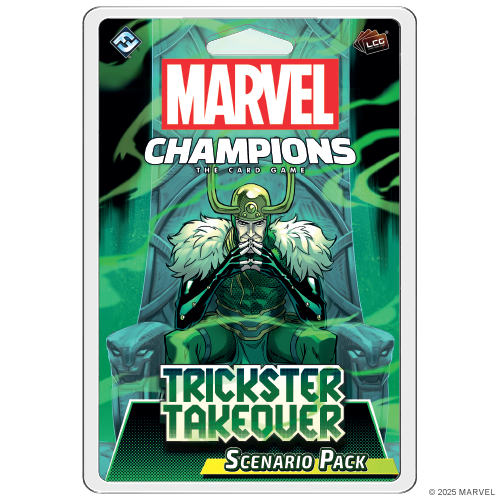
Marvel Champions Trickster Takeover

24. April 2026 um 16:36

The Trickster or Loki as he is also known heads up an evil team with The Enchantress and they mess with the minds of the Heroes. This gives a fight that the Heroes are fighting inside their minds as well as other with other heroes while not knowing who or what they can trust. from the graphic novels he was known as Loki Laufeyson and he was the Trickster God of MischiefEvil, and Lies, a member of the monstrous Frost Giants of Jotunheim that was adopted and raised among the Asgardians, a group of humanoid beings from the pocket dimension of Asgard, the Realm Eternal. Born smaller than the rest of his race and rejected by his father Laufey, he was adopted by the All-Father; Odin following the war. He was taken back to Asgard to be raised alongside his adopted brother Thor. He was worshiped by the humans known as Vikings and became part of Norse Mythology. Loki grew jealous of his brother after learning his true origin and schemed against him and Asgard. His later cosmic meddling led to the formation of the Avengers, “Earth’s Mightiest Heroes”. He has the ability to call his wolf Fenris to him amongst many other of his baddies.  The Enchantress is a being from Thors realm and in fact she has the hots for Thor and is usually wound up by Loki into attacking Thor. 

So how do these work in the game.  First of all you have to take on the Enchantress, wh will hit you with a hypnotic gaze.  There are five different hypnotic gaze cards each with a different enchantment on the opposite side, get too many charm counters and the card gets flipped to its unique “trance” side and gives you the Enthralled trait which has an immediate effect and also causes you to take a forced action.  For example you might be confused or take damage and also forced to draw a card and play it.  Also being enthralled will make side schemes nastier to deal with.

Then you have to deal with Loki, but things are never simple with Loki and you have to first deal with his Avator’s who are spread out.  This is where you get to play the new “Epic Mupltiplayer Mode”  as each player group has to deal with their own batch of the four avators facing off against a randomly-chosen avator that gets swapped out for another each time one is defeated.  Each time you defeat one, you Shatter the Illusion that allows you to actually damage the real Loki.  But of course Loki is going to just sit there and take damage, once he gets down to half heath, his focus intensifys and his avators get powered up making it even more difficult.


However, there are also some Enthralled Minions, who if you manage to knock back to their senses then they will actually team up with you to help take down the villains, which could well swing the battle back in your favour.  

These scenarios are a lot of fun and you can order this pack at: https://www.bgextras.co.uk/marvel-champions/marvel-champions-scenario-packs/marvel-champions-the-card-game-trickster-takeover-scenario-pack


The post Marvel Champions Trickster Takeover first appeared on Board Game Extras.

Top 10 Paints For Miniature Painting

24. April 2026 um 15:14
DetailsAre you a new painter? The world of miniature painting can be a daunting one to step into. Where do you start? What brands do you buy? What even is a contrast paint? Below, I have compiled a list of what I consider essential buys for you to think about the next time you whip […]

Source

Dark Pact Game Review

About a month ago, I received a text out of the blue from a friend I hadn’t heard from in nearly two years:

“Have you played Dark Pact by Tom Lehmann? I’ve played it twice and I think it might be the greatest deck-builder.”

A grain of salt must accompany these words as they travel down your gullet. The sender of that text is an avid Lehmann-head. He loves Winter Court, a novel sentence in the English language. He is constantly trying to bust out New Frontiers at parties. He carries a complete set of Dice Realms at all times, just in case the mood strikes.

I get it. I will never play another game as much as I have already played Race for the Galaxy. It would be untrue to deny that Lehmann’s spell has won me over from time to time. I would not go so far as to call myself a disciple, though. I find most of Lehmann’s games too dry. They are mathematically precise in a way that suggests an awe-inspiring understanding of the numbers behind the fun, but they are often that at the expense of, well, the fun. It has never before occurred to me that Lehmann and Reiner Knizia can be thought of as opposite sides of the same…

The post Dark Pact Game Review appeared first on Meeple Mountain.

CMON to invest $2.1m in NFT video game maker, says digital shift needed to expand revenue, remain ‘relevant’

24. April 2026 um 14:34

Financially-troubled board game publisher CMON is pinning its future on a push into video game development and blockchain-based projects, beginning with a $2.1m investment in NFT game maker Blissful Link.

CMON’s board said it planned to transition its titles such as Massive Darkness and Super Fantasy Brawl Reborn into “high-quality digital assets”, adding that it believed integrating its board games with digital and Web3 technologies “would enhance the long-term commercial value of the group’s portfolio”.

The company has kicked off that shift by agreeing to acquire a 2.2% stake in Blissful Link, which operates Capverse, a play-to-earn video game built on blockchain technology in which players buy NFT ‘Sumer’ characters to battle with online.

CMON’s investment values British Virgin Islands-incorporated Blissful Link at more than $95m. Blissful Link made a loss of about $197,000 in 2024, on revenues of just over $408,000, and had net liabilities of about $889,000, according to unaudited figures provided by CMON. It did not include finances for 2025.

A statement from CMON’s board supplied to the Hong Kong stock exchange, where the board game publisher is listed, said, “Over the years, traditional board and other table top games have merged with digital ones providing digital convenience, offering online multiplayers, automated rules and apps that enhance physical play.

“The company believes that in order to continue to be relevant in the games industry and to expand the group’s revenue stream, the group would need to conduct digital transitioning and venture into video game development and Web3 projects.

“Digital transitioning would have the benefits of enhanced visual effects, have apps that handle scoring, timing etc, would enable a diversified number of players and are more accommodating to players not within the same vicinity.

“Added to this, entering into Web3 projects often emphasise social responsibility and ethical practices such as transparency and fairness on decision marking. By participating in Web3 projects, the company can demonstrate its commitment to social responsibility and sustainability.

“However, the group would continue to supplement this digital transformation as physical games would still offer a ‘screen break’ for individuals as well as foster direct face to face interaction.”

Non-fungible tokens, or NFTs, are digital assets which represent specific items – such as an illustration, trading card or piece of music – each with an individual signature stored via blockchain technology, which includes information such as who created it, who owns it, who sold it and for how much.

NFTs, which emerged out of cryptocurrency technology such as Bitcoin, exploded into the public eye in 2021 thanks to big-money speculative purchases – such as an NFT of Twitter founder Jack Dorsey’s first tweet selling for $2.9m.

That speculative bubble had already burst a year later, however with many of the digital assets involved losing more than 90% of their peak value. The Dorsey tweet NFT, for example, received a high bid of $6,800 when it was put back on the market in April 2022.

Other board games that have pushed into NFTs are few and far between, with one of the highest profile examples being SolForge Fusion, which allows players to mint decks as digital assets in addition to playing the game in physical form.

Two years ago CCG project Wonders of the First had to pull a $1.4m campaign from Kickstarter after falling foul of the crowdfunding platform’s ban on NFTs. The game went on to raise about $1.2m after relaunching without NFT content.

CMON, a long-time heavyweight in board game crowdfunding thanks to games such as Zombicide, Blood Rage and Cthulhu: Death May Die, slumped to a loss of more than $3m in 2024 due to falling sales for its crowdfunding campaigns.

That loss was almost double CMON’s total profits from the prior three years – but the figure was dwarfed by the $19.9m annual loss the company announced in its 2025 financial results.

CMON’s $23m losses across 2024 and 2025 are now almost 5.5-times larger than its profits from the preceding nine years combined, and have pressed the company into a string of asset sales as it attempts to fulfill more than $14.3m of as-yet-undelivered crowdfunding campaigns.

Those IP sales included parting with its most famous and profitable title Zombicide – which has raised more than $40m on Kickstarter since its 2012 launch – to Asmodee, as well as Blood Rage, Rising Sun and Ankh to Tycoon Games.

It followed those by selling the IP for former Mythic Games titles Anastyr and Hel: The Last Saga to Don’t Panic Games in September, and parting with the lucrative Cthulhu: Death May Die IP to Asmodee a month later – the latter a series which has raised almost $10m from backers to date.

Last month an independent auditor hired by the company questioned whether it CMON had the resources to stay in business for the foreseeable future, saying the publisher’s $19.9m annual loss, its net liabilities of more than $3.5m and contract liabilities of over $7.5m “indicate a material uncertainty which may cast significant doubt about the group’s ability to continue as a going concern.”

CMON’s directors had a different view, however, saying in the company’s 2025 financial report that it “should be able to continue as a going concern” thanks to a trio of factors.

They include financial support from some of the directors “sufficient to finance CMON’s working capital requirements”, the roughly $2.4m proceeds from selling its Singapore office that it received in January, and about $1.25m of gross proceeds from a successful share sale in February.

CMON’s hefty liabilities are largely due to its eight undelivered crowdfunding campaigns, which are not recognised as revenue on the company’s books until they are fulfilled to backers.

They include DC Super Heroes United, which raised more than $4.4m, and DCeased, which brought in over $2.5m. Both campaigns were initially due to be delivered last year, but are now expected to be delivered in Q4 of 2026, according to CMON’s latest estimates.

CMON also has several undelivered pre-order campaigns on its books, including Dune Desert War and the Assassin’s Creed Role Playing Game.

The company pulled the plug on crowdfunding launches and new game development just over 12 months ago, citing the economic uncertainty created by US tariff hikes – which at the time had reached 145% for China, where the vast majority of hobby board games are manufactured.

But CMON announced last month that it plans to relaunch its halted crowdfunding operations later this year.

The post CMON to invest $2.1m in NFT video game maker, says digital shift needed to expand revenue, remain ‘relevant’ first appeared on .

February 2026 Monthly Debrief Video – Twilight Struggle Family Tree

Von: Grant
24. April 2026 um 14:00

The February 2026 Monthly Debrief Video, which is the 2nd episode in Season 6 of this series, saw us discussing the Twilight Struggle Family Tree, which covers games that have spawned from or followed closely the tenets of the Card Driven Game system used in Twilight Struggle from GMT Games. We both love the Card Driven Game mechanic and also very much love TS.

Also, as usual, we covered the games we played in February, as well as the games we plan to play in March.

We will remind you here that we are fortunate to be continuing our relationship with Noble Knight Games as the sponsor for our Monthly Debrief Video series. In case you don’t know, Noble Knight Games specializes in hard to find games but also carry all the new releases. But what makes them truly unique is that you can find some of the rarest games, long out of print games, hand made games, imported games from overseas, etc. Thanks to them for their sponsorship and we hope that you will consider them first when looking for the games we cover.

-Grant

Return to the Reichbusting! Reichbusters: Reloaded Rundown

24. April 2026 um 12:18

We should have gone to the beach like I told you

Peter unboxes and talks about the new Reichbusters: Reloaded – and showcases his fully painted set!

Let’s have a good look at the new Reichbusters: Reloaded upgrade set, my painted miniatures from the original set, and explore the million-dollar question – is it better than the original game now?

Making high quality tabletop gaming content at the EOG takes time and money. Please consider becoming a Patreon supporter or making a donation so I can continue this work! Thankyou!

Deck-Build with the Devil

23. April 2026 um 17:54

Every time I write about a game with a "demonic theme," somebody comes along to tell me why they won't play games with demons in them. Look, we know why. Because you're a goofball. We get it. It's fine. But that doesn't mean I care to hear about it.

I don’t know what I expected Tom Lehmann to design next, but Dominion on Adderall wasn’t on the list. That’s as short a summary as I can muster for Dark Pact, and it’s a surprisingly apt comparison, right down to the action limits and buy phase that marked Donald X. Vaccarino’s genre-defining title. Like the version of Dominion you’d get if a moody teenager popped a double dose and spent six hours scribbling demons in their spiral-bound notebook.

Is it good? Yeah, it’s good. Is it great? Hm. It sits somewhere near Res Arcana in Lehmann’s ludography, sans that game’s brevity, plus a bit of Justin Gary’s Ascension in its flowing market and excessive tallying. Great might be a stretch. Perhaps it would be fairest to say that it contains moments of greatness.

I think I get especially eye-rolly about the "no demons in games" thing because my mother insisted that face cards were demonic. This was written directly into a doctrinal book that was important to Mormonism, despite it not being canon at any point. This had very little impact on my upbringing except to prevent me from playing trick-takers until I was an adult.

An old-fashioned (but not that old-fashioned) card market.

At a setting level, Dark Pact is about striking a bargain with a demon. I don’t have any experience in such a discipline, but it seems as close to otherworldly binding as Dominion was to Medieval villages. There’s a moment in the game, usually about five minutes into a session, when I can still appreciate Dug Nation’s woodblock-styled illustrations. Five minutes after that, those illustrations have faded from view, along with the remainder of the game’s trappings. All that remains is the machine I’m hopefully streamlining into something aerodynamic enough to drag two dozen cards into motion.

If you’ve played Dominion, you can play Dark Pact. By now the five-card hand has become industry standard, but even a few of Dominion’s other hallmarks return intact. By default you only receive a single action. That’s one card played to the table to activate its effect. Often that card will provide another action. Then its followup provides another two actions and some draws. Then the next card lets you retrieve something from your discard pile and, baby, you’ve got a stew going.

Also returning is Vaccarino’s market phase. After your actions are done, you’re allowed to play as much treasure as you can and purchase new cards. There are a few wrinkles this time around. For one thing, there are none of Dominion’s limited buys. If you want to split up your gold to purchase five cards, well, go nuts. For another, the market is now an ever-shifting offer rather than Dominion’s static display. What you see this turn may well disappear into your opponent’s deck before you get another stab at it.

Except, in Mormonism at least, it turned out that the entire cards-are-demonic thing came from a church leader's desire to stop women from getting together to play bridge — to prevent them from developing a third space that was out of reach of the church's male-dominated structure. There was an element of preventing gambling as well, but the earliest crackdowns and sermons mostly focused on bridge clubs.

Turns eventually spool into madness. Seems fitting.

Unsurprisingly, this is where Lehmann dives in with full gusto. There are cards aplenty to grab, with heaps of effects, and all of them are useful for one objective or another. But there are two in particular that transform Dark Pact from spooky-art Dominion into something that feels distinctly Lehmann-esque.

The first is the pacts. The dark pacts. Of Dark Pact fame. There are thirteen in all, all of them shuffled into the deck, and all offering a game-winning condition that initially sounds impossible. You might, in the course of your demonic experimentation, uncover a dark pact called Diverse Learning that will let you win if you have 15 unique cards in play. Or perhaps you’ll pursue Secular Power, the card that wins if you enter the market phase with 40 unspent coins. Or Great Potential. That one wins if you have 19 cards in hand.

For Lehmann-heads, dark pacts aren’t far off from the monuments and places of power in Res Arcana. It’s just that they’re hidden in the deck like your average demon-summoning ritual or cursed ring, get shuffled into your deck, and present conditions that let you win outright rather than offering spills of points. If their targets sound intimidating, that’s deliberate. When the game opens, most dark pacts are well out of reach. Especially, remember, because you only get one action per turn, five cards per draw phase, the usual limitations.

That’s where the second special card comes in: multipliers. They’re… multipliers. No spooky gauze this time. Just a simple 2x or 3x. These also circulate through your deck, and can be attached to any card to amplify the effects of its printed numerals. Gold coin? Now it’s worth two or three times more. Summoning circle? Now you can nab a card worth 16 or 24 coins rather than a measly eight. Generous spirit? Enjoy your six extra actions and nearly your entire discard pile popping back into your hand.

Things really get bonkers when you discover that multipliers multiply multipliers. Before long, some turns are transformed into those obnoxious order-of-operations social media tests. (“Only one in thirty people can solve this equation!”) The effects can be staggering. Thanks to multiple 3x cards stacked atop some silver, I once generated something like 70-ish coins in a turn. I wasn’t even holding the pact that let me win from having so many coins. It was so much that I could have bought out the entire market. I didn’t do it, of course. Winnowing is every bit as worthwhile in Dark Pact as any other deck-builder. It’s possible to over-stuff your card pool, so I reined myself in. But I considered grabbing all ten cards on offer for the lifetime accomplishment award.

This emphasis on niche issues like playing cards or "demonic themes" thus presents an ethical inversion for a faith community. The boundary marker becomes something easy for rank-and-file members of the group to accomplish ("Don't play card games") while the harder tasks ("Feed the poor, clothe the naked, visit the prisoner," etc.) become idealized rather than concrete. It allows the disengaged to feel like they're doing something active, while ignoring the imperatives that were actually requested of them by the faith community's founders and core texts.

Another day at the office.

At its best, these cards result in a deck-builder that’s incredibly familiar, to such a degree that it feels like a throwback to 2008, while also chucking everybody down a slip-n-slide to see who can break the game the fastest. In those moments, Dark Pact is Lehmann in top form. All the broken combos of Res Arcana. All the busted dice-assembling of Dice Realms. All the recursive triggers of Race for the Galaxy. All of it and more, wrapped in a tidy package that barely asks deck-building veterans to learn anything new. Truly, it’s impressive how smoothly the game riffs on the genre’s basics. When I say you can play Dark Pact if you’ve played Dominion, I mean it.

At the same time, Dark Pact sometimes feels one or two elements shy of a summoning ritual.

The biggest issue is duration. Basically, it’s often too slow for its own good. Turns are anything but simple, with one power begetting another, often after drawing from the deck, retrieving from the discard pile, and refreshing a segment of the market, all of which make it difficult to plan during one’s off-turn. It might sound like the exception to have a dozen cards trigger in sequence, but that’s the goal of Dark Pact, which makes turns sprawl more often than not. Even with only two players, the downtime and duration can be formidable. At three or four, they grow interminable. I would play the heck out of this game via an asynchronous app; on the table, it needs optimal conditions to thrive.

Meanwhile, I’m sure much will be made of the card balance. Multipliers are powerful, that goes without saying, and the early game often feels like a race to secure an economic engine that will springboard your longer-term plans. Fortunately, Lehmann offers a few solutions to sidestep the usual deck-building snares. Purchased cards go straight to your hand rather than first cycling through your discard and deck, and everybody begins with a few cards in their own private grimoire that can be purchased at their leisure, including, crucially, a deck’s second 2x multiplier. It’s a clever move that eases the whims of the flowing market without totally erasing what makes it interesting.

Personally, I’m more interested in the dark pacts. These don’t need to be balanced. I would go so far as to say they oughtn’t be. For all I know, they’ve been painstakingly playtested and algorithmically tuned. But some of them feel like a breeze compared to some others. Is this a problem? Only insofar as you make it one. It’s an open bar. If somebody nabs a pact that’s more reasonably completed than one you’ve taken, maybe it’s time to run interference. But there are some, maybe two, that feel so comparatively easy that I’m always going to give them priority. In a game this muscular, even the slightest flab seems especially visible, like a world-class bodybuilder with one sagging boob.

This is relatively common in faith communities over time. Nitpicky "side rules" become emphasized while core tenets atrophy, allowing easier boundary maintenance at the cost of shedding the same identity that is being maintained. BUT ANYWAY card games are cool huh? Play demonic games.

When nobody is sure which pact to buy, the market tends to clog with them.

Sagging boob or no, Dark Pact is fascinating for how Lehmann has taken a familiar formula and made it new again. This is Dominion, but rather than coming across as goofy when the optimal deck consists of seven sentries and four throne rooms, Dark Pact’s flowing market and sheer busted nature make the process feel vibrant and alive. It’s funny to get excited about trashing a card after all this time.

Which is to say, yeah, there are downsides. Some cards feel mistuned. The downtime is considerable. Four players? Forget about it. But Dark Pact once again showcases Lehmann as a master at work. In his hands, cards become more than cardstock. They’re components in a machine, one that sputters to life with every shuffle, draw, purchase, and winnow. The game is its own demon, and whatever dark pact Lehmann has struck to summon so many bangers in one lifetime, let’s hope the price never comes due.


(If what I’m doing at Space-Biff! is valuable to you in some way, please consider dropping by my Patreon campaign or Ko-fi. Right now, supporters can read my first-quarter update of 2026: the best board games, movies, books, and more!)

❌