 Anmelden
Mechs vs. Minions Is Returning to Print
07. April 2026 um 16:25
Riot Games is partnering with Incredible Dream for a 10th anniversary edition

Riot Games is partnering with Incredible Dream for a 10th anniversary edition
 Angel’s Share refers to the portion of a spirit lost to evaporation as it ages. Set in Scotland, players will be purchasing and storing barrels, trying to time the market for maximum profits. But throughout the years, the quality of each distillery will change, the supply will fluctuate, and fees will have to be paid. […]
In Elizabeth Hargrave’s latest game, Sanibel, players take turns walking down the beach and stopping to collect a variety of shells and shark teeth. You’ll score points by dropping these treasures into your bag so they ‘fall’ in alignment with other items already there. Have the most points at the end of the walk, and you win the game.
To start, unfold and line up the three sections of the board. On the left, place the section with the beach chairs; to the right, place the section with the lighthouse. The section without a special area at either end goes in between these two.
Players then take a token of their chosen color and the corresponding board with a bag printed on it. You’ll place everyone’s tokens in random order in the upper left corner of the central board on the right, just above the beach chairs. Place the Wave token to the far left of the player tokens.
Shuffle the zig-zag-shaped pieces and deal two to each player. These are your Lighthouse tiles and will offer additional scoring opportunities once you reach the Lighthouse midway through the game. Read these carefully, as they may help you determine which shells you want to concentrate on.
Above the shoreline…
The post Sanibel Game Review appeared first on Meeple Mountain.
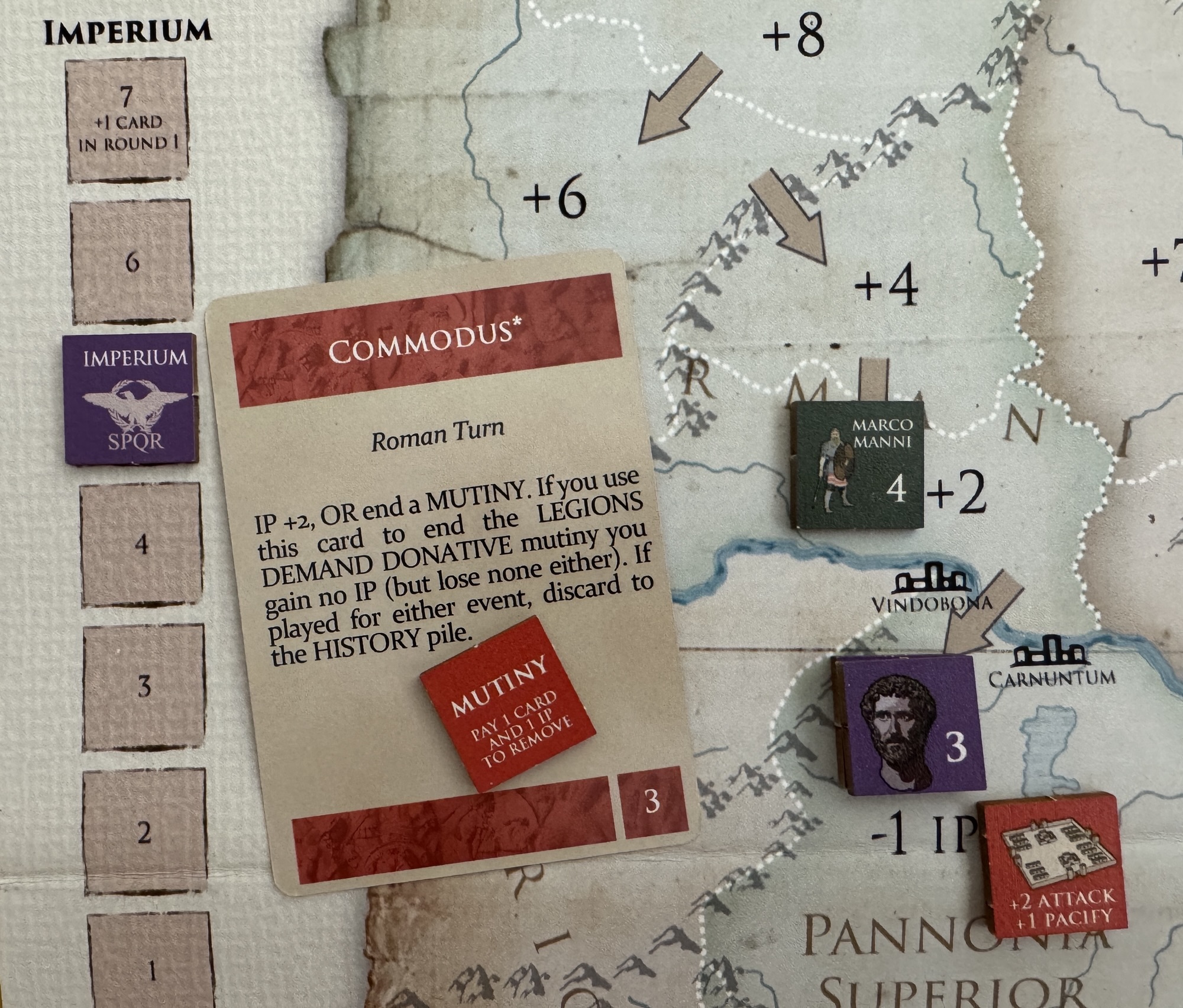


With this My Favorite Wargame Cards Series, I hope to take a look at a specific card from the various wargames that I have played and share how it is used in the game. I am not a strategist and frankly I am not that good at games but I do understand how things should work and be used in games. With that being said, here is the next entry in this series.
The Wars of Marcus Aurelius: Rome 170-180CE is a solitaire only game that uses cards similarly to a CDG to simulate the strategic level struggle of the Romans led by Marcus Aurelius to stave off the invasions of Germanic tribes and Sarmatian raiders as they encroach on Roman territory across the Danube River. That’s the history. And it is really well integrated. The game play is very fun, strategic, with lots of decision points about what to do and what cards to use, and it is really challenging.
In the game, the Roman player has a deck of Roman Cards that can be used for the printed events for various effects or that can be discarded to take any number of actions such as attack a Barbarian army or Off-Map Conflict enemy, advance the marker on the Imperium Track, add two Level 1 Forts to any eligible map spaces, flip one Level 1 Fort to a Level 2 Fort among several other actions. Sometimes the printed events in the game are just more powerful than discarding a card for just 1 action so you have to pay attention to this economy and make sure you get the most out of your cards. Now, keep in mind, sometimes discarding a good card whose ability is not right for the current situation you find yourself in is part of the game but you have to use these cards wisely to do well in the game.
The game uses two separate decks of cards including the Barbarian Deck (Green) and The Roman Deck (Red). Both of the decks are made up of 50 cards each but each have very different purposes. The Barbarian Deck is used to determine the actions of the invading Germanic tribes as well as events that effect the war effort including mutinies, plague and the will of the people. While the Roman Deck provides the resources and events that are used by the Roman player to mount a defense against the invasions and to fight back each of the different barbarian tribes. There are unique cards called Late War Cards in the deck that will be held out until the start of the 175CE turn at which time they will be mixed in with the cards to form a new Late War Deck. There are also special cards that are marked with an asterisk that if played for the event will be discarded from the game to form what is called a History Pile.
In this entry, we will focus on the Roman Card Commodus, which provides some opportunity to shore up your failing Imperium Points or even cancel an ongoing Mutiny of your troops on the board. In my first 5 or 6 plays of the game, the most common way that I lost was by allowing the Imperium Point Track to reach zero, which results in Marcus Aurelius being usurped and the player immediately losing the game. I was confounded and very frustrated about why I couldn’t prevent this from happening! I could see the end coming but struggled with keeping that Track above water. There are a few cards included in the Roman Deck that provide increases to the Imperium Track and I highly recommend you take these type of events when they come into your hand rather than discarding these cards to take another action, that might seem important at the time, but in the end these events are just too efficient to pass on. Commodus will provide you an option. This option is taking the +2 IP or another type of action such as ending a Mutiny (very important as it usually takes you discarding a card and losing an IP) or drawing two cards to add to your hand (imagine if you can only draw that Local Guides card you have been looking for or the Ambush that you need to take on the Quadi in their Home space). It becomes a choice of “either/or” and I am here to tell you the only reason the “or option” is provided is to lure you away from the real prize in that of gaining the +2 IP. Please listen to my advice and take the +2 IP. You will thank me in the end! Remember, that the concept of Imperium Points (IP) represent the Emperor’s overall political authority and stability in Rome. If the IP track ever reaches zero, the player immediately loses due to usurpation. Points are lost from specific card events, barbarian surges, and certain combat results, requiring players to prioritize special events to gain them back
Commodus was Roman emperor from 177 to 192AD, first serving as nominal co-emperor under his father Marcus Aurelius and then ruling alone from 180AD. Commodus’s sole reign is commonly thought to mark the end of the Pax Romana, a golden age of peace and prosperity in the history of the Roman Empire.
Commodus accompanied his father during the Marcomannic Wars in 172AD and on a tour of the Eastern provinces in 176AD. The following year, he became the youngest emperor and consul up to that point, at the age of 16. His solo reign saw less military conflict than that of Marcus Aurelius, but internal intrigues and conspiracies abounded, goading Commodus to an increasingly dictatorial style of leadership. This culminated in his creating a deific personality cult, including his performances as a gladiator in the Colosseum. Throughout his reign, Commodus entrusted the management of daily routine affairs to his palace chamberlain and praetorian prefects, namely Saoterus, Perennis, and Cleander. Roman soldiers and the general populace generally liked Commodus during his reign, largely because he was popular with the masses and focused on lavish spending rather than costly foreign wars. He was adored for presenting himself as a masculine, gladiatorial Hercules, though the Senate despised him
Commodus was assassinated by the wrestler Narcissus in 192AD, ending the Nerva–Antonine dynasty. He was succeeded by Pertinax, the first claimant in the tumultuous Year of the Five Emperors.
I shot a playthrough video for the game and you can watch that at the following link:
I also followed that up with a full video review sharing my thoughts:
In the next entry in this series, we will take a look at Russian Leader Tsar Alexander I from Congress of Vienna from GMT Games.
-Grant
On the Game overview screen an extra statistics section has now been added to the Stats Segment: Score margins!

The Score Margins sections shows the win and loss margins for plays of a game. Details about Score Margins can be found here: Score Margins.
For all relevant bar charts it is now possible to tap on it to view the related play(s). You can recognise these lines by the > at the end. This option is available with the Power expansion.
Tap the name of the Stats Segment to access the drop-down menu and quickly switch between sections.

More information about all these stats sections can be found here: Game page – Stats segment.

French board game publisher Fentasy Games has launched a new platform aimed at providing publishers with a more affordable way to get their higher complexity titles into the hands of retailers and gamers.
Company founder and CEO Florian Gigot told BoardGameWire Fentasy had scored several successes since launching towards the end of 2024, including localisations of complex titles El Burro and Stephens – but said its major challenge in that time had been “the structural reality of the traditional distribution model”.
He said, “We realised that for a small publisher, a ‘critical success’ doesn’t always translate to a ‘financial success’ once the middlemen take their cut. The same applies to many of my partners around the world.
“…between squeezed margins, production costs, and trade discounts, even a popular game can become a financial failure. For an independent publisher, this means increasing difficulty in funding subsequent projects – and ultimately, a real risk of going out of business.
“In this context, profitability is no longer a secondary objective, but a condition for survival.”
He added, “This might seem counterintuitive, especially at a time when a game like [Brass: Pittsburgh] is thriving on Gamefound. But that is the exception. So many other expert ‘hidden gems’ deserve a chance to exist.”
Gigot hopes newly launched platform BoardGameCommerce will give publishers of higher complexity games with smaller print runs – of between 500 and 1,000 units – a more sustainable financial option than the traditional board game industry distribution model.
He described BGC as an ‘evolution’ of the P500 scheme successfully employed by wargame and strategy game specialist GMT for more than 20 years, which allows gamers to pre-order still-in-development titles, which then begin final art and development once they reach 500 orders.
Gigot said BGC differs, however, in that Fentasy commits to producing the game the moment it goes onto the platform, saying, “We don’t ask the community to carry the industrial risk – we carry it ourselves because we believe in the project.”
He said that model helps Fentasy and other publishers measure real demand for their titles, as well as giving visibility to game makers that might not be possible amid the plethora of new games battling it out through traditional distribution.
Gigot added that BGC also offers retailers “a professional interface to secure limited stock with high margins of up to 55%”, with no payment required until the game is ready to ship.
He told BoardGameWire, “I absolutely see this growing. In fact, BGC is designed to be an agnostic platform. We are already in talks with other small publishers who face the same ‘strangulation’ within traditional distribution.
“We want to offer them the same resilience we built for ourselves – bringing everyone together on a single, global platform. It makes it much easier for gamers and retailers to find exactly what they are looking for in one place.
“The icing on the cake is that all publishers using the BGC platform have access to a shared licensing ecosystem. For example, if Publisher A adds a game to BGC and is looking for a partner to localise it, Publisher B can check the available licenses for their country and initiate a business discussion immediately.
“BGC takes 0% commission on these deals – the goal is simply to be stronger together.”
Gigot said Fentasy aims to release between three and five titles each year, with about half going through BGC and half, such as its localisation of Animal Rescue Team and upcoming strategy title Microlonies, through traditional distribution.
The publisher’s first release through BGC is Iron Games’ Mesopotamia-themed territory builder Papyria, with future titles set to arrive on the platform before the end of next year including Martin Wallace space exploration design Casus Belli and Masaki Suga’s chocolate industry strategy title Bean to Bar.
Other Iron Games releases available through BGC include Discordia and its Magna expansion, Pandoria and Ploc, while Fentasy’s French localisation of Uwe Rosenberg design Kanal – previously Oranienburger Kanal – is also present on the platform.
But Gigot added, “Titles like Animal Rescue Team and Microlonies will still follow the traditional distribution model. We aren’t abandoning big distribution – we are simply choosing the right tool for the right game.
“There is no ‘hostility’ toward the traditional model – it just isn’t built to sustain niche titles effectively.”
Gigot said Fentasy’s biggest successes since its late 2024 launch have included Kikai – Bricolage Heads, which he said moved more than 4,000 copies “in a short window for a game of its complexity”.
He added that 2026 release Microlonies “is following the same successful path. It proved that a hungry audience exists for deep, high-production-value games”.
Fentasy’s success to date has persuaded Gigot – who runs the company as “a small, agile core team of one person” – to expand its scope internationally, with him telling BoardGameWire the business is moving towards a 60% international / 40% France split.
He said, “We are always looking for new partners to localize our games in their countries and to localise their games into French.
“Our goal for 2027 is to achieve a synchronized BGC launch for our expert line across Europe (Germany, Poland, Italy, Spain) and Canada, China, allowing local publishers / retailers to bypass the heavy costs of international imports.”
The post Fentasy Games looks to help complex game publishers avoid ‘strangulation’ of trad distribution with P500-style platform launch first appeared on .
Also, keep your threads organized and your crabs enraged

I like weird games (derogatory) almost as much as I like weird games (complimentary).
Belinda’s Big Bonus is a weird game (weird).
Having your game designed by Amabel Holland sets certain expectations, despite any difficulties in pinning her down to a single genre or register. Similarly, basing a game on an erotic novel series, in this case Belinda Blinked by Rocky Flintstone, also sets certain expectations. Yet Belinda’s Big Bonus isn’t especially erotic. I wouldn’t call it funny, either, although it’s possible I’m just not in on the joke. Neither does it strike me as “so bad it’s good.” Mostly, it’s twice as complicated as one would expect from a licensed game. It reminds me of nothing so much as one of those business guys whose entire life is conducted through Google Calendar invites.
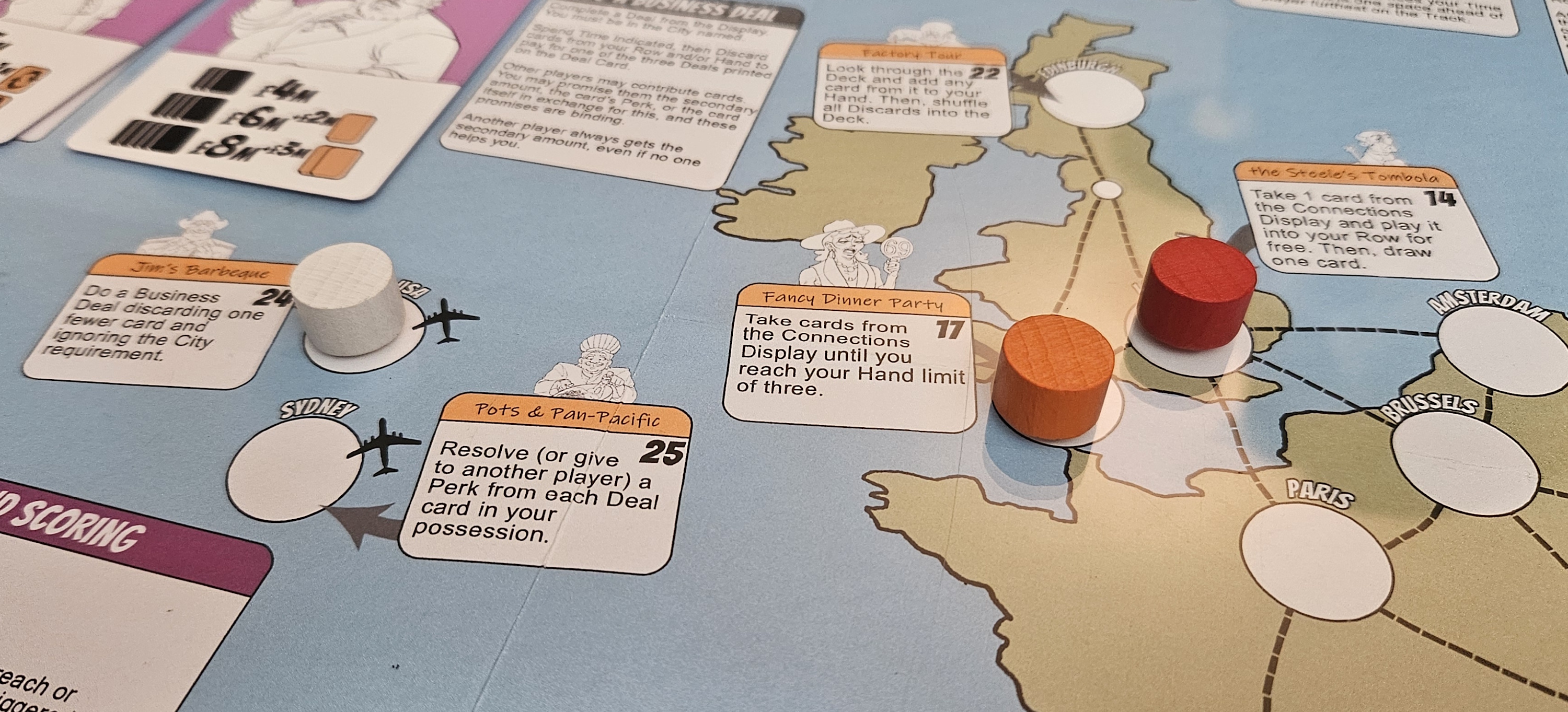
There is travel, but this is not a travel game.
First of all, we should open with a disclaimer. I know very little about Belinda Blinked. I considered reading the first one as research for this review — “research,” I say — but decided against it. Sometimes knowing less is knowing more. That’s our motto here in the United States. It’s written on our dollars and everything. While scant few people are going to play this thing sans foreknowledge, I happen to be one of them, and if there’s any one quality a critic requires, it’s the resolute belief that one’s experiences are valid no matter how uninformed. Here I stand.
Which is to say, perhaps Belinda Blinked is about managing one’s schedule, suffering from jet-lag, and mixing up which actions cost which payment. Maybe. In which case, may I offer my deepest apologies to Holland, Flintstone, and Belinda herself. Forgive this prude, for he knows not what he do.
At the game’s outset, players step into the not-yet-broken-in business shoes of interns at Steele’s Pots and Pans. Their task is to earn some millions of pounds for the company. They do this by…
Look, this is the first problem with Belinda’s Big Bonus, and it’s a doozy. As any gaming evangelical knows, it’s hard enough describing a board game to newcomers, and Belinda’s Big Bonus is no board game for newcomers. There are mechanisms aplenty in this trunk, packed together like someone mixed the first-aid kit with the snack bag. There’s a calendar timekeeping system, the kind popularized by Martin Wallace titles, and cards that may exist either in a market, your hand, or a tableau, with interactions dependent on their current source — except sometimes they can be spent from two of those places, and the rulebook is conversational and, although it’s amusing, this doesn’t lend itself to learning the damn thing.
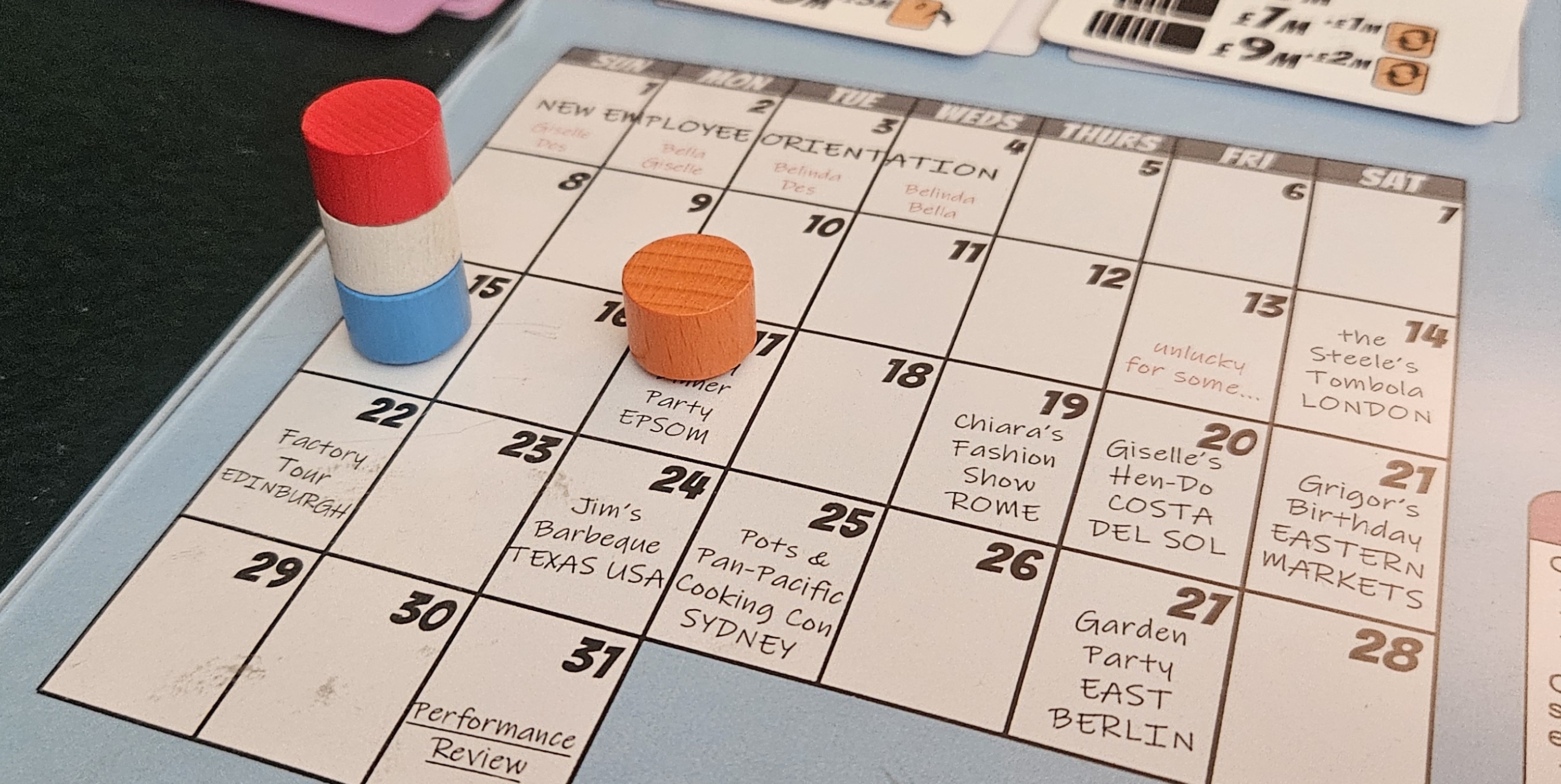
Scheduling, but this is not a scheduling game.
Here’s the short version. Turns are variable, conducted by whomever is farthest back on the calendar. On those turns, you spend some amount of time to make connections — which is to say, put cards into your tableau from either the market or your hand — do spy stuff — gain cards into your hand, from the deck this time — rest to refresh the cards in your tableau, make a business deal by throwing away the cards you painstakingly contacted or spied upon — and, in the process, try to persuade your fellow players to spend some of their cards instead, because these business deals are often collaborative and dole out benefits to multiple players — or perhaps visit a calendar event on the appointed date to gain some advantage.
If that sounds confusing, try teaching it. I’m no stranger to Holland’s more tangled designs, but this one found the most uncomfortable spot on the seesaw between complexity and anticipation: the fulcrum. Belinda’s Big Bonus feels like it should be a light game, looks like a light game, has that licensed light-game air to it, and then, kapow, but a kapow more like a punch to the schnoz than something erotic, it smacks you with a clutter of ideas.
For all that, there is an interesting game in here. The gist is that you need to build out your tableau and hand in order to spend those same cards to make business deals. Along the way, your characters provide something like an engine.
There’s even a narrative to the whole thing. Sir James Godwin makes it easier to attract Bella Ridley to your work group. Meanwhile, James Spooner, the Laird of Gretna Green, brings Cosmo Macaroon into the fold through some act of espionage. Later, your connections to Bella and Cosmo will help you make a deal in Texas, USA for nine million pounds sterling. Unfortunately, that same deal enriches a rival intern by five million pounds, so you try to squeeze some contribution from so-and-so at the table rather than merely handing the commission to whichever competitor is sitting in last place.
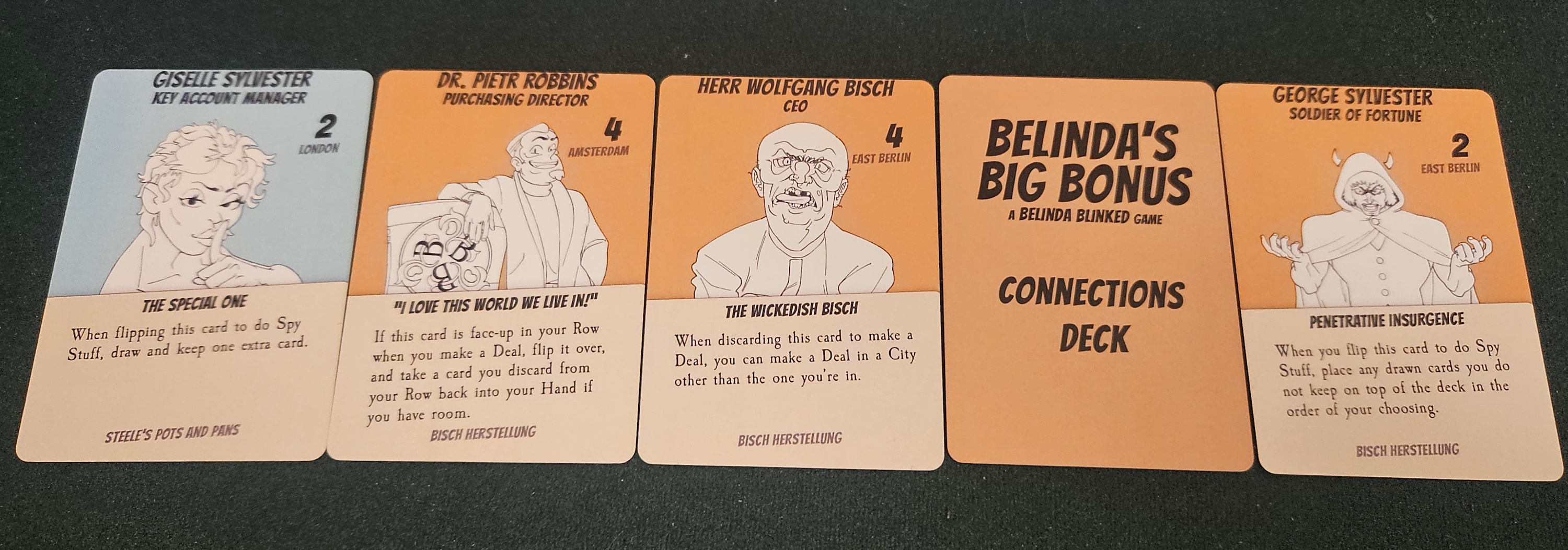
Odd people, but this is not an odd people game… well, scratch that. It’s an odd people game.
Those are genuine dramatic and narrative beats! Along the way, though, Belinda’s Big Bonus is burdened by bloated bits. It’s easy to paint oneself into a corner, for instance, by spending too many cards on an eager deal. This can leave one player sitting around with very little to do but play catch-up. And, hey, that’s their fault, right? If we were playing one of Holland’s cube-rail games, such a possibility would act as evidence of the game’s forthrightness. But here, the possibility comes across less like an honest appraisal of the perils of betting everything on some bad stock tips, and more like an unexpected heel-turn on the game’s part.
Here’s another example. Belinda’s Big Bonus includes the possibility of a traitor moment. When the game concludes, the player in last place might reveal that they now hold the majority of connections to Steele’s rival firm, Bisch Herstellung. This turns them into “the special one” and wins the game in a sudden coup. Cool!
Except, like everything else in Belinda’s Big Bonus, the rules governing the reveal are so text-heavy that it doesn’t feel like an amusing capstone. It’s closer to checking a technical manual to see if you’ve successfully told a joke. It isn’t hard, exactly. Nothing in the game is hard. But it’s less fluid than it ought to be, keeping everybody’s attention on these mismatched processes rather than on the parade of characters and situations strutting across the table.
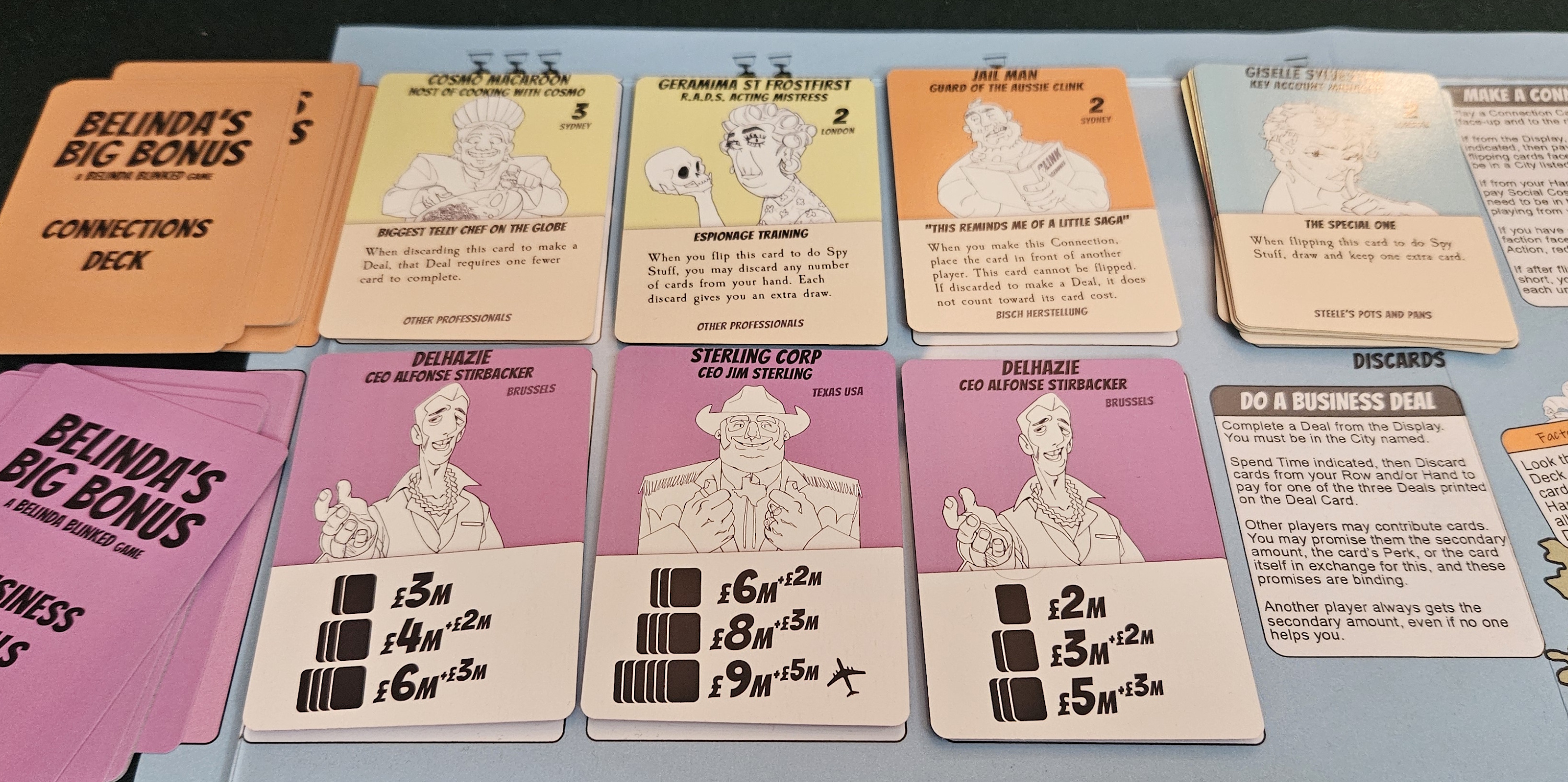
Buncha great hangs.
Then again, maybe I’m not in on the joke. Maybe a Belinda Blinked game should be more complicated than most licensed titles. Maybe it should buck common sense by being an erotic game with no eroticism, a business game with no head for business, a whimsy with lots of rules printed on the board. Maybe it should be a big meta-joke at my expense. Maybe this game doesn’t exist for anyone but me, and it was sent to me solely so that everybody could point and laugh and say, ha ha, you took our prank earnestly, you big stupid fool, you moron, you lame-o.
That would be okay. I don’t mind. In the game’s cast of characters, I feel most like the guy anxiously cleaning a stain from his tie. I don’t need to get everything. Sometimes, I even revel in how little I understand. For example, I’ve had a lovely time not understanding Belinda’s Big Bonus. Maybe you’ll have a lovely time not understanding it as well. Just don’t say I didn’t warn you.
A complimentary copy of Belinda’s Big Bonus was provided by the publisher.
(If what I’m doing at Space-Biff! is valuable to you in some way, please consider dropping by my Patreon campaign or Ko-fi. Right now, supporters can read about which films I watched in 2025, including some brief thoughts on each. That’s 44 movies! That’s a lot, unless you see, like, 45 or more movies in a year!)
A friend recently mentioned a statistic (that I’ve since verified according to multiple studies) that most people–over 80%–who have purchased a bottle of wine have made their decision largely based on the label. Not taste or research, just a label that spoke to them.
Have you ever purchased something based on its packaging? I absolutely have. Wine, games, books, chocolate, coffee, disc golf discs…sometimes the packaging draws me in and inspires me to learn more, but sometimes it’s almost the entire decision (i.e., I want this because of how it looks).
I mentioned this topic on a recent livecast, and viewers had even more examples: beer, hot sauce, restaurants, cereal boxes, and more. It also came up on a recent podcast episode of Unit Economics about how Byte’m brownies focused their packaging on a delicious-looking brownie instead of on their high-quality ingredients.
In the tabletop game space, box covers have a huge impact. It isn’t just about their marketing appeal; publishers try to make boxes that people are proud to display, that are compelling both at a game store and in an online thumbnail, and that function from different angles.
For all those reasons, at Stonemaier Games we pay far more for the box illustration than any other individual piece of art in the game (only a detailed game board comes close). I often look to other games for inspiration (thank you, BoardGameGeek!), and I always like to get at least 3 concept sketches from the artist before pursuing one of them in detail.
Then there’s another set of decisions to make about the labeling on the box: The size and position of the game name, the names of the designer(s) and artist(s), and the inclusion of key information like player count and playing time on all 6 sides.
There’s also the presentation on the back of the box, where we’ve traditionally placed a 3D setup image. We’re starting to pair that with 1/2/3-style explanation speech bubbles so a potential customer can quickly grasp what the game is about.
It’s always a work in progress, and I’m always learning from other publishers–it feels like every week there’s a new game announced with a truly stunning, evocative box. Whenever I go to a local game store, I try to pay close attention to which boxes grab my attention; I also recently went to Barnes & Noble for this specific purpose.
Have you ever bought a product based on its box, label, or cover? What would you like game publishers to learn from your experience?
***
If you gain value from the 100 articles Jamey publishes on this blog each year, please consider championing this content! You can also listen to posts like this in the audio version of the blog.

The German branch of high IQ society Mensa has unveiled its full slate of nominees for this year’s MinD Spielepreis.
Mensa in Deutschland has run the awards contest since 2009, and has operated a ‘shorter games’ category for more than a decade and lighter two-player games prize since 2019.
This year’s ‘shorter games’ category will be fought over by titles including 2025 Spiel des Jahres nominee Krakel Orakel, as well as Grégory Grard and Mathieu Roussel’s design Zenith and Take Time from Alexi Piovesan and Julien Prothière.
Word chaining game Next by Verena Wiechens and Lukas Setzke is also up for the shorter game prize – which focuses on titles that play in well under an hour – as is Maldón’s design El Camarero (published in Germany as Chaosteria), and Wilmot’s Warehouse from David King, Ricky Haggett and Richard Hogg.
In the two-player games category, Bruno Cathala’s design Kamon is up against Niwashi, from Gautier de Cottreau and Baptiste Laurent, Junghee Choi’s Orapa and Tobias Tesar’s Perfect Murder.
Playball, designed by David Florsch, will also compete in that category, as will Strategeti by Ignasi Ferré and Suna Valo, designed by Andreas Odendahl (who goes by ode.).
Mensa Deutschland revealed in January that it was changing up the ‘complex games’ category of the awards to focus entirely on expert-level titles, in order to fill what the organisers saw as a gap in the industry.
Jochen Tierbach, who has been organising the MinD Game Award for 16 years, said at the time, “There are already various awards and prizes for family and connoisseur games.
“But for expert games, the really tough ones, there is no such thing in Germany yet. And we feel that the industry wants it.”
The long list of more than 20 expert-level titles was whittled down to six challengers for the complex games award this year: Galactic Cruise, Luthier, Shackleton Base, Speakeasy, Thebai and Thesauros, all of which have been released in Germany since Spiel Essen last October.
Last year’s MinD award for complex games saw Tomáš Holek’s space exploration eurogame SETI add to its array of prizes, while Simone Luciani and Dávid Turczi’s Nucleum triumphed in 2024.
The most recent holder of the MinD shorter game award was 2025 Spiel des Jahres winner Bomb Busters, while 2024 SdJ champion Sky Team was last year’s winner of the best two-player game prize.
The post German Mensa unveils full slate of nominees for this year’s MinD Spielepreis first appeared on .
Welcome to this week’s batch of crowdfunding campaigns. We have a variety of offerings here, so we hope you will find something that catches your eye. Also, if you want to chat with the BGQ team, join our Discord Server where we talk about games, movies, sports, and other fun stuff. Or, if Facebook is […]
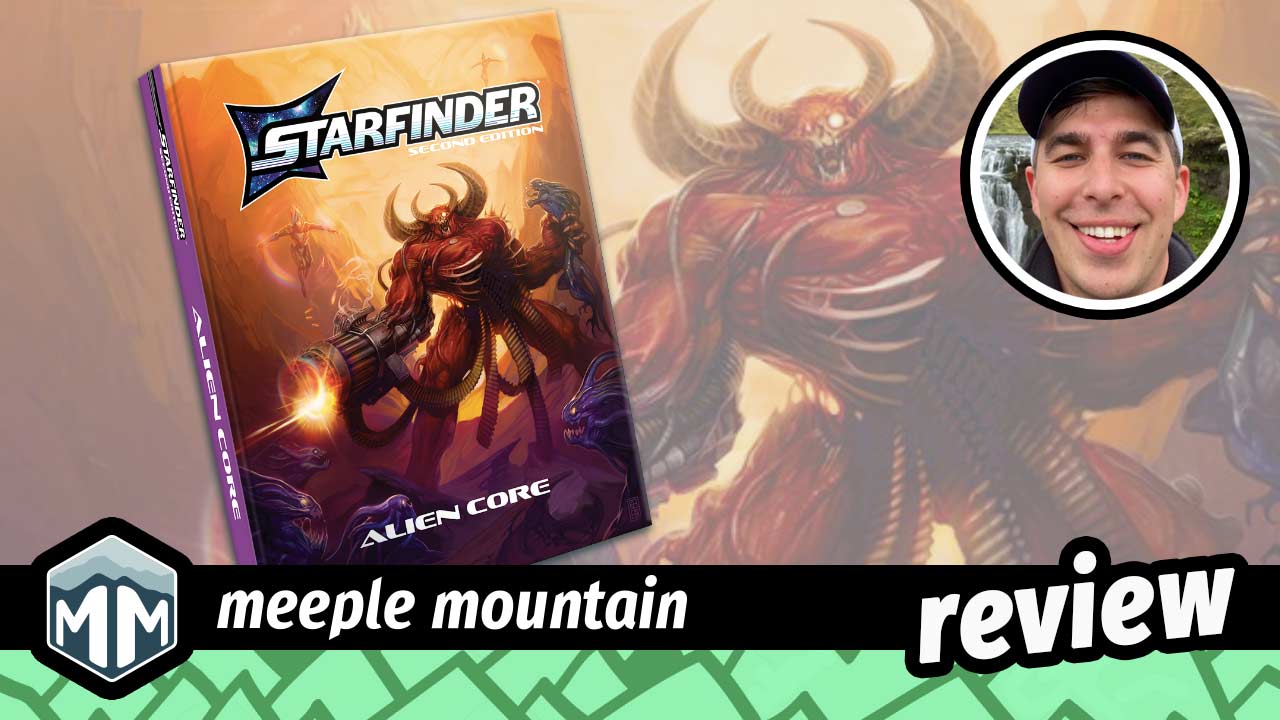
If you're a Gamemaster running Starfinder Second Edition, the Starfinder Alien Core is your de facto manual of monsters. It promises pages upon pages of strange creatures that would feel at home in any sci-fi world. Some are geared more towards horror, others are more techy, and some are there as classics to hit you with a nostalgia bomb. Let's take some time to run through the highlights of the book.
Right off the jump you are greeted with the full alphabetized table of contents for every creature featured in Starfinder Alien Core, including visual breaks for each set of letters to prevent the usual wall-of-text layout. Directly afterward is a brief section that describes the different aspects of a creature's statblock, how to play creatures, and making adjustments. I was quite surprised looking back at the Starfinder GM Core that this information was never included. There is more in-depth guidance into custom creature creation, but nothing that lays out the aspects of the statblock as succinctly as this.
Then it's time to dive right into the 200 pages of creatures, typically featuring one on each page. The general flow of information starts with a brief snippet of lore about the creature to set the scene, followed by the creature's statblock. The sidebar also always features…
The post Starfinder Alien Core Review appeared first on Meeple Mountain.
A few years ago, I came across a new designer named Wolfgang Klein (no relation to Alexander Klein) and his new company Assault Games. They create fantastic tactical level wargames and we have played several fo them and also got a chance to meet both Wolfgang and his friend and partner Erich Rankl. They are currently working on a new edition of their first game called Assault – Red Horizon ’41: Revised Edition and they readying it for a Gamefound campaign yet this spring. I reached out to Wolfgang to get some information about the revisions and changes to the game and he was more than willing to provide a lot of great information.
Grant: Wolfgang welcome back to the blog. It is good to have you on again and I wanted to thank you and Erich for playing Primosole Bridge with us last fall at SPIEL Essen. How has Assault – Red Horizon ’41 evolved over the past few years since its original release in 2021?
Wolfgang: Over the past 5 years, Red Horizon ’41 has evolved significantly through continuous development, community feedback, and extensive gameplay experience. What began with Rulebook 1.0 has gradually been refined into a much more mature and developed system. The new revised edition incorporates years of player feedback, integrates content from various expansions, and improves clarity, balance, and presentation across the entire game.
Over the past 5 years, RH41 has developed considerably, both in terms of the Assault System rules and its graphical presentation. In particular, with Sicily ’43 – Gela Beachhead (Rulebook version 2.0) and its expansion Primosole Bridge, we feel that we gained valuable experience that directly influenced the design of this revised edition and that will assist us in future volumes as well to improve the player experience and simulation value of the game.
Most of all, however, we are grateful for the intensive exchange we have had with our Assault fans over many years. We have remained very active in our forums on BoardGameGeek, and it is there that we have gathered, discussed, and evaluated a huge amount of positive and constructive feedback. With all the great ideas and contributions from our players, we have continued refining the rules step by step.
As far as version 2.5 is concerned, the door for feedback will remain open until the end of the upcoming Gamefound campaign.
In concrete terms, rules have been refined, adjusted, expanded, or removed. All texts have been revised to make them easier and more efficient to read. We have also made a clear step forward in wording and terminology. However, we have not changed the core gameplay mechanics. So players familiar with version 1.0 should still find it easy to get back into the system.
A detailed overview of the changes made to the system can be found on our website at the following link:
https://assault-games.com/assault-living-rules/
Grant: What is the upcoming new edition of the game? How has it changed?
Wolfgang: The upcoming version is referred to as a Revised Edition of Assault: Red Horizon ’41. It is not simply a reprint, but a comprehensive refinement of the system.
Major changes to the game and the Assault System include the following:
Overall, the revised edition reflects everything we have learned about the system from our players and through continual play on our end since the original release. I do believe that the system will continue to evolve as other rule clarifications or needed changes come to light.
Grant: How did this opportunity for a new edition arise?
Wolfgang: After the original edition sold out, interest in the game continued to grow. At the same time, years of development, playtesting, and community feedback had accumulated.
In addition, RH41 is something like the core game for the Eastern Front within the Assault System. Our plan is to design an entire series of modules focused on the Eastern Front, and Red Horizon ’41 is the natural foundation for that planned series.
This created the perfect opportunity to bring the game back in a fully refined and improved edition rather than simply reprinting the original version.
Grant: How has the process of working with Sound of Drums been?
Wolfgang: I would describe it as a very special journey. We have now been working in cooperation with Sound of Drums for 3 years.
What makes this collaboration different from the traditional designer–publisher model is that we at Assault Games work with Sound of Drums on equal footing while maintaining our own independence.
The goal of this cooperation was to free ourselves from the typical publishing tasks such as production, logistics, and distribution, so that we could focus more fully on developing the Assault System and expanding into future opportunites. In many respects, this has worked very well. In other areas, there are still things that can be improved.
Sound of Drums, and Uwe Walentin in particular, has worked very hard to keep our backs free for designing by carrying the responsibility for taking care of the worldwide distribution network, logistics, and shipping. From my point of view, that works very well. Uwe is also a highly knowledgeable and perceptive figure when it comes to wargame design, and he has become an important advisor for us. His experience in the games industry helps us do things the right way — and focus on the right things.
One area of the cooperation where we have made major progress is in the structuring and preparation of our print files. I would especially like to thank Marc von Martial (Art Director at Sound of Drums) on this point. Thanks to his templates, we are now able to turn our designs into print-ready files in a much shorter time. That has been a tremendous help for Sicily 43, Primosole Bridge, and now also RH41 Revised Edition.
In the end, I would say that our journey is not over yet. Sound of Drums, like us, is still a young company, so there are new challenges every day. But as the saying goes: “Everything will be fine at the end of the road. If it is not fine yet, then the road is not over.”
Grant: Why have you wanted to amend or revise these various items in the game?
Wolfgang: We started the Assault System a long time ago as a new tactical game system, and from the very beginning it was clear that both the rules and the content would continue to evolve over time. Other systems refer to their rulebooks as “Living Rules,” and that is very much how we see the Assault System rules and the game as a whole.
At the same time, it is important to us that we do not do this alone. We want to actively involve our player base in the further development of the system so that it can become the best game system possible. Standing still is simply not an option for us.
Many of the changes were driven by years of gameplay feedback from the community and by our own experience with the system. Over time, we identified:
The goal was always to improve clarity, usability, and gameplay flow without changing the core identity of the system.
Grant: How has the graphic design specifically evolved? Who is the artist?
Wolfgang: The most visible aspect of the game’s development is undoubtedly the graphical redesign and the addition of new visual features. Michael Grillenberger, supported by Marc from Martial, once again did outstanding work, just as they did on Sicily ’43 and Primosole Bridge. I would like to thank them both once again for that work.
The map artwork in particular will immediately catch the eye. We have raised it to the same high standard seen in Sicily ’43 and Primosole Bridge, which creates an even greater sense of immersion.
Overall, the graphic design has been significantly refined compared to the first edition. Maps, symbols, counters, and other visual elements have been redesigned to improve readability and consistency. Vehicle artwork has also been updated, and the game’s entire visual language has been unified to create a stronger overall identity.
Grant: How does the artist’s style fit with your vision for the system?
Wolfgang: The visual style supports the core philosophy of the system: clarity, immersion, and functionality.
The artwork strikes a balance between historical authenticity and tabletop readability, which is essential in a tactical wargame where players need to process information quickly. In that sense, the artwork helps reduce the players’ workload so they can focus fully on the game and on the tactical situation on the battlefield.
Wolfgang: One major improvement is the integration of visual symbols directly onto the maps. Last year, we conducted a survey among our players because it was important for us to understand what they thought about the idea of including symbols on the map boards. The result was extremely close.
Many players were concerned that such symbols might reduce immersion. Because we take those concerns seriously, we decided on a more subtle compromise. Elevation levels and some terrain rules are now represented with discreet graphical indicators, allowing players to understand the battlefield layout more quickly without constantly consulting the rulebook.
That, in turn, makes things much easier for the players.
Grant: How have those changes made the game even better?
Wolfgang: Quite simply, these changes make the Assault System much more accessible and easier to play. The need to search for information is reduced, and the overall handling of the game becomes smoother.
In particular, readability, gameplay flow, and ease of learning have all improved. Players can now interpret terrain and elevation at a glance, which speeds up play and reduces rule lookups.
Grant: How have the graphics for the vehicles changed?
Wolfgang: The vehicle illustrations have been updated and refined, providing clearer identification and a more consistent visual style across all units. I think Michael also worked on them simply because he really enjoyed doing so.
These changes enhance both the historical feel and the table presence of the game.
Grant: Can you show us some examples of the new graphics as compared with the old?
Wolfgang: Certainly — here are a few examples:
These updates create a much more cohesive and modern visual presentation compared with the first edition.
Grant: What new terrain features have you included in the system? Why were these important to include?
Wolfgang: The revised edition introduces several new terrain types:
These elements are closely tied to the historical landscape of the Eastern Front, particularly the region around Białystok in the summer of 1941. Large expanses of wheat and crop fields dominated the countryside and often influenced visibility and movement for advancing troops. During the opening phase of Operation Barbarossa, German and Soviet forces frequently fought across agricultural land where tall grain could provide concealment but also limit observation.
Steep slopes and covered trails reflect the natural terrain features of the area, which included rolling ground, wooded ridges, and narrow rural tracks. Such features often shaped the movement of infantry and vehicles, creating opportunities for ambushes or concealed manoeuvres.
Including these terrain types allows the game to better represent the tactical realities soldiers faced during the early battles around Białystok, while also expanding the range of strategic options available to players.
Grant: What are the new Fortifications & obstacle elements? Can you share examples of these counters?
Wolfgang: The system now includes additional fortifications and obstacle elements, allowing players to represent defensive battlefield preparations more realistically. These counters reflect the kinds of improvised and field-built defenses commonly used by Soviet forces in the border regions during the first days of Operation Barbarossa.
In June 1941, Soviet units attempted to delay the rapid German advance by establishing temporary defensive lines, often using field entrenchments, tank barricades, and hastily constructed obstacles. Barricaded roads and reinforced firing positions were typical features in defensive positions around key crossroads and villages. Although many of these defences were incomplete because of the speed of the German attack, they nevertheless influenced the course of local engagements.
By incorporating such fortifications and obstacles, the game is able to reflect the defensive measures historically present on the battlefield. These new counters expand the tactical possibilities in scenarios and campaigns, while also helping to recreate the atmosphere of the chaotic and desperate fighting that characterised the opening days of the campaign around Białystok.
Grant: How will the box be changed for this revised edition?
Wolfgang: The revised edition features an improved box design, including:
These changes were made to improve both storage and usability for players. Many players prefer to sleeve their cards to protect them during repeated play, particularly in games with frequent handling such as card-driven tactical systems. The redesigned inlay ensures that sleeved cards fit comfortably inside the box without bending or compressing them, allowing players to keep their components protected while still maintaining a compact storage solution.
The transparent lid also helps players organise and identify the different components more easily. Counters, cards, and markers can be seen at a glance, which speeds up setup and makes it easier to keep the game organised during play. For a system that may include multiple scenarios and campaign elements, quick access to components is especially useful.
Overall, the improved box design reflects feedback from players of the original edition. By making the storage solution more practical and user-friendly, the new edition aims to make preparation, transport, and long-term storage of the game more convenient.
Grant: I know that you have covered this concept but I would like a bit more detail? Specifically, how have the overall rules for the game changed?
Wolfgang: The rules have evolved from Rulebook 1.0 to version 2.5, and possibly eventually to 3.0.
Key changes include:
Since the release of the original rulebook, the system has gradually developed through playtesting, player feedback, and the addition of expansion material. Earlier supplements introduced new mechanics and scenario elements that are now fully integrated into the core rules, allowing players to access the complete system without needing to consult multiple documents.
Another important goal of the revision was to clarify rules that had previously caused questions during play. Certain mechanics have been rewritten with clearer wording and additional examples, making it easier for players to understand how the system works in practice. This also reduces ambiguity during gameplay and allows players to focus more on tactical decision-making rather than rule interpretation.
The revised rulebook also streamlines several mechanics. While the core gameplay remains unchanged, some procedures have been simplified to maintain the fast-paced flow of the system. The intention was not to make the game less detailed, but rather to ensure that its mechanics remain intuitive and efficient during play.
Finally, the overall structure of the rulebook has been improved. Sections are now organized more logically, making it easier to locate specific rules during a game. Together, these changes reflect the natural evolution of the system and aim to provide both new and experienced players with a clearer and more accessible ruleset.
Grant: How have these changes improved the gameplay?
Wolfgang: The revised rules make the game:
Over the years, extensive playtesting and feedback from players helped identify areas where the original rules could be improved. Ambiguities in certain mechanics were clarified, and procedures that occasionally slowed down gameplay were simplified. As a result, the revised rulebook presents the system in a more accessible and consistent way, allowing new players to learn the game more quickly while still preserving the depth that experienced players expect.
The streamlined mechanics also improve the overall flow of play. Turns progress more smoothly, and players can focus more on tactical decisions rather than consulting the rulebook. This is particularly important in a fast-moving tactical system set during the opening stages of Operation Barbarossa, where battlefield situations changed rapidly and decisions had to be made under pressure.
In addition, the revisions helped refine the balance of the system. Through years of scenario testing and community feedback, certain interactions between units, terrain, and combat mechanics were adjusted to ensure that engagements feel both challenging and historically plausible. Together, these improvements create a more polished and engaging gameplay experience while remaining faithful to the original design of the system.
Grant: What is the timeline on the release of this new revised edition?
Wolfgang: The revised edition is currently in active preparation, and our immediate next step is the upcoming Gamefound campaign which is planned to start in May 2026. The campaign preview page is up and you can see that at the following link: https://gamefound.com/en/projects/sound-of-drums-gmbh/assault-red-horizon-41-rev-edition
As mentioned before, feedback on Rulebook version 2.5 will remain open until the end of that campaign.
Our goal is to use this period to gather final community input, complete the last refinements, and move the project into production in the best possible shape. A more precise release timeline will be shared as soon as the campaign and production planning are finalised.
Grant: Last but not least, what is currently in the design kitchen for Assault Games?
Wolfgang: Well, I think Assault Games might become a never-ending story. We will keep working on it as long as we continue to enjoy it—and that could still take a very long time.
Joking aside, we are very active when it comes to new ideas. I actually talked about some of this in our most recent SITREP (a bit of self-promotion here):
We have started publishing a development roadmap so that everyone can see what we are currently working on and what might be coming in the future. Of course, the roadmap only shows the official topics we want to share publicly—and yes, there are also a few unofficial ideas we are exploring behind the scenes.
To give you a small glimpse of what might be ahead, you can already see a draft cover for our upcoming Normandy journey. And that’s not all—there are several other things in development.
Thank you so much for your time in answering our questions Wolfgang and I look forward to future games from Assault Games and Sound of Drums.
If you are interested in learning more about Assault – Red Horizon ’41 Revised Edition, you can visit the Gamefound previews page at the following link: https://gamefound.com/en/projects/sound-of-drums-gmbh/assault-red-horizon-41-rev-edition
-Grant
Here's another half-dozen games from Japanese creators
by Justin Bell
The ongoing “is it AI art or not?” conversations in tabletop are important...and, exhausting. It feels like every day, there’s a fresh round of discussion that I have to work through online, as supersleuths real and imagined attempt to navigate whether an upcoming game’s illustrations were drawn by hand, built by a mix of human and artificial means, or generated purely through AI tools. I get why it's a thing...and it's also why I'm excited to focus on a different lane.Will you take control of a country — or dominate the neighborhood?

/pic9464361.jpg)


/pic9507324.jpg)