Normale Ansicht

Kings of War (4th edition) v1

25. März 2026 um 23:24

But it is not this day! This day we fight!

Be victorious on the battlefield with your Kings of War rules & reference!

I’ve been covering a lot of Mantic Games lately (especially since a certain other company decided they didn’t want the support of content creators), and I’ve been very pleasantly surprised by their offerings. The new Epic Warpath is a great system with a wide range of classic scifi factions to play with, and Halo: Flashpoint is coming into its own as the range of available models increases. But the one game of theirs I haven’t explored yet is Kings of War. It’s perfect timing then, because the new 4th edition has just been released!

Kings of War is a classic ‘rank and flank’ fantasy tabletop miniatures game, in the tradition of the old Warhammer Fantasy Battle (now Warhammer: The Old World). It’s been interesting to see these old regimental games enjoy a resurgence of popularity – Hobgoblin and Conquest: Last Argument of Kings are two others – and there’s certainly something very satisfying about pushing around trays of warriors in neat rectangular formations. Kings of War commits completely to the concept because you actually model the miniatures attached to the base, rather than have them individually standing on it. It may mean a lot more modelling – building and painting 10 miniatures to make a single unit is a big job – but it certainly looks spectacular when you have a full army on the field.

As for the rules themselves, they’ve been cleaned up from previous editions. I haven’t played yet (I’ve been busy painting, which is now all done – watch out for a tips video), but will film a game when I do so you can see how it goes; but Mantic have a habit of making very solid rules systems, so I have high hopes. The new starter set Claws in the Sand is a good introduction box for new players and features two unusual small armies – the aquatic Trident Kingdom and the Medieval Japanese-syled dogmen of the Xirkaali Kingdom.

In the meantime, here’s my rules and reference to make your games easier and smoother – and of course you can also find it in my rules app Tabletop Codex!

Burned Notice

25. März 2026 um 20:04

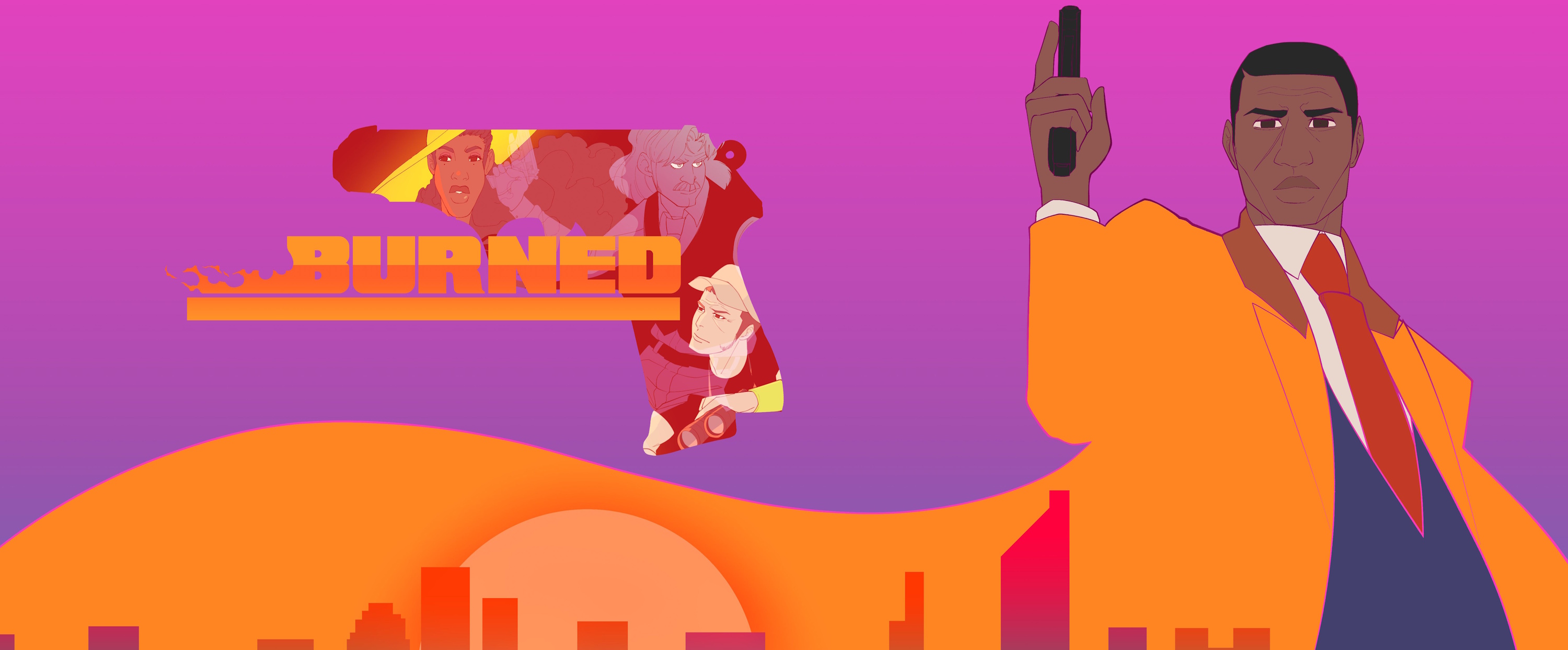
My name is Hot Secret Agent Man In An Improbable Orange Jacket, and I used to be a spy.

There’s a problem with most hidden movement games, and I say that as the mechanism’s greatest devotee. Namely, they’re slow. So slow. Maybe it would be kinder to call them “deliberate,” but even that doesn’t quite transform the ding into a compliment. Stealth, in theory, can be deliberate. Stick insects are deliberate. But it can also be harried, adrenal, instinctual. Like a panther. Like an owl. Like me ducking out of a Super Bowl party before the uncles start complaining about the halftime show.

Burned occupies the untapped middle ground between those two poles. Designed by Jon Moffat, who gave us last year’s top game about poop carts, Burned is neither Mind MGMT nor Captain Sonar. Instead, it’s the closest a board game has ever gotten to making me feel like a highly-trained secret agent picking off mooks in broad daylight. Usually right before they tackle me to the ground and stomp me to death.

"... and not in a Heated Rivalry kind of way. Get out of there, Hot Secret Agent Man In An Improbable Orange Jacket!"

“You have thirty seconds before they’re on top of you…”

Picture with me, if you will, the moment in any spy thriller when the baddies are stomping up the stairs. Go ahead, close your eyes and picture it. Close them. Now open them. This ain’t no radio drama. You, the secret agent, can hear them coming. They’ll be on you in seconds. Not minutes. Certainly not hours. Seconds. They’re at the door. The wood is splintering. They sweep into the room, and you’re

gone.

Burned is about those split seconds. A session takes ten minutes, maybe fifteen at most, and comes across as no longer then five.

Which makes it all the more impressive that it isn’t real-time. Nothing explicitly hurries you along. The Burned Asset takes his turn. Then the Agency pursues him. Back and forth it goes, back and forth, until one side or the other has been planted.

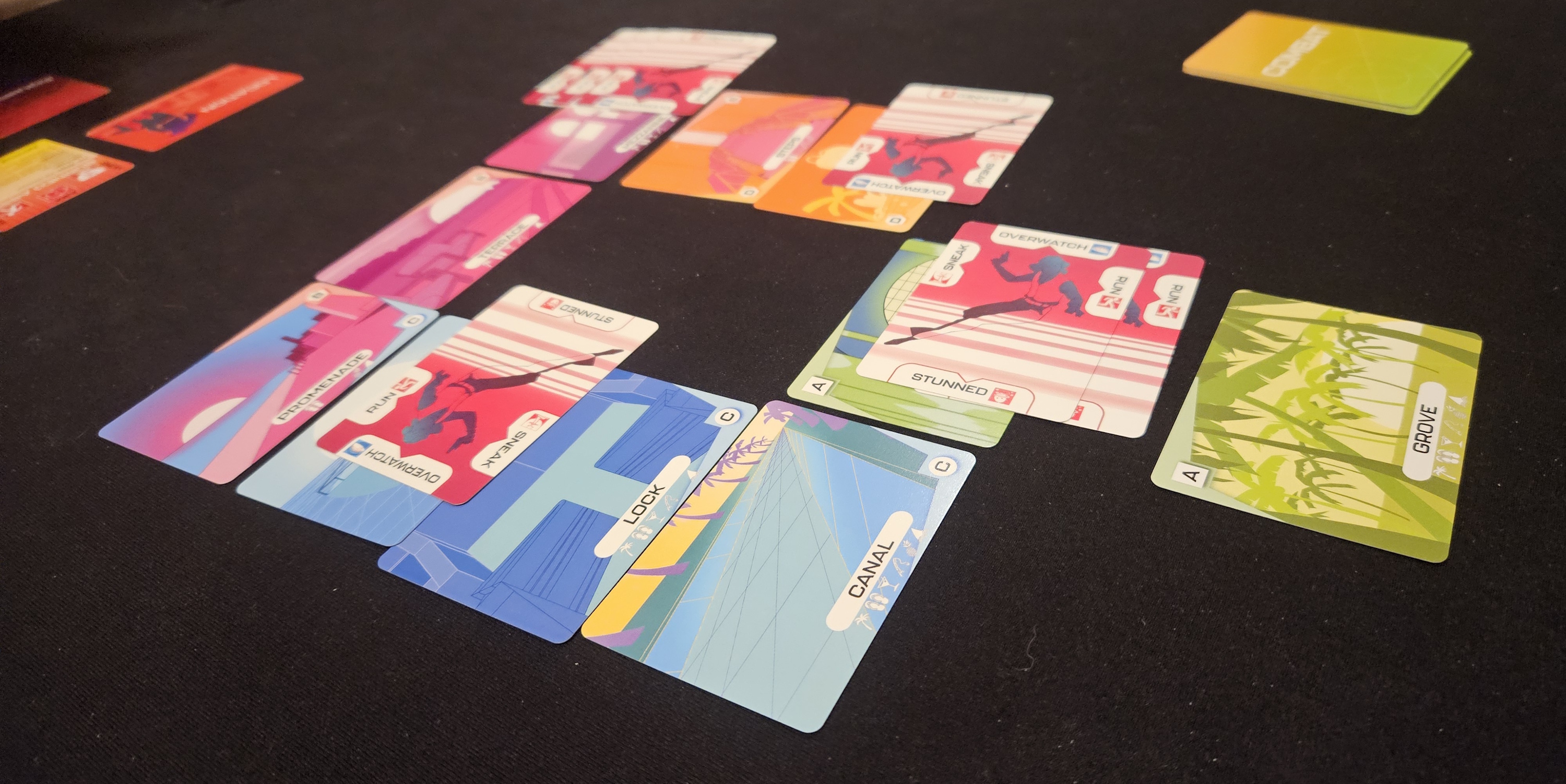
Along the way, Moffat deploys considerable tricks to sell the illusion that the entire encounter is measured in heartbeats. For example, there’s the map. Unlike many other hidden movement games, which deploy geography in the most literal sense, the space in Burned is more impressionistic. Depending on the layout, the entire area might be confined to the square footage of a hotel. And not an especially large hotel. One card will be a courtyard; another, a terrace. One space is just “steps.” Another is a fountain. Stealth, then, is a matter of ducking out of sight, not putting miles between pursued and pursuer.

This sensation of proximity extends well beyond card titles. Both sides move the same way, either walking or running from one card to another. Walking means moving to a card that matches the color of the one you’re standing on; running means moving anywhere — literally anywhere at all — but incurring a penalty, whether announcing the color of the destination if you’re the Burned Asset, or putting your mooks at risk if you’re the Agency. Meanwhile, some cards show multiple colors. These are crossroads, spots one might pass between colors without having to tip their hand.

rawrf

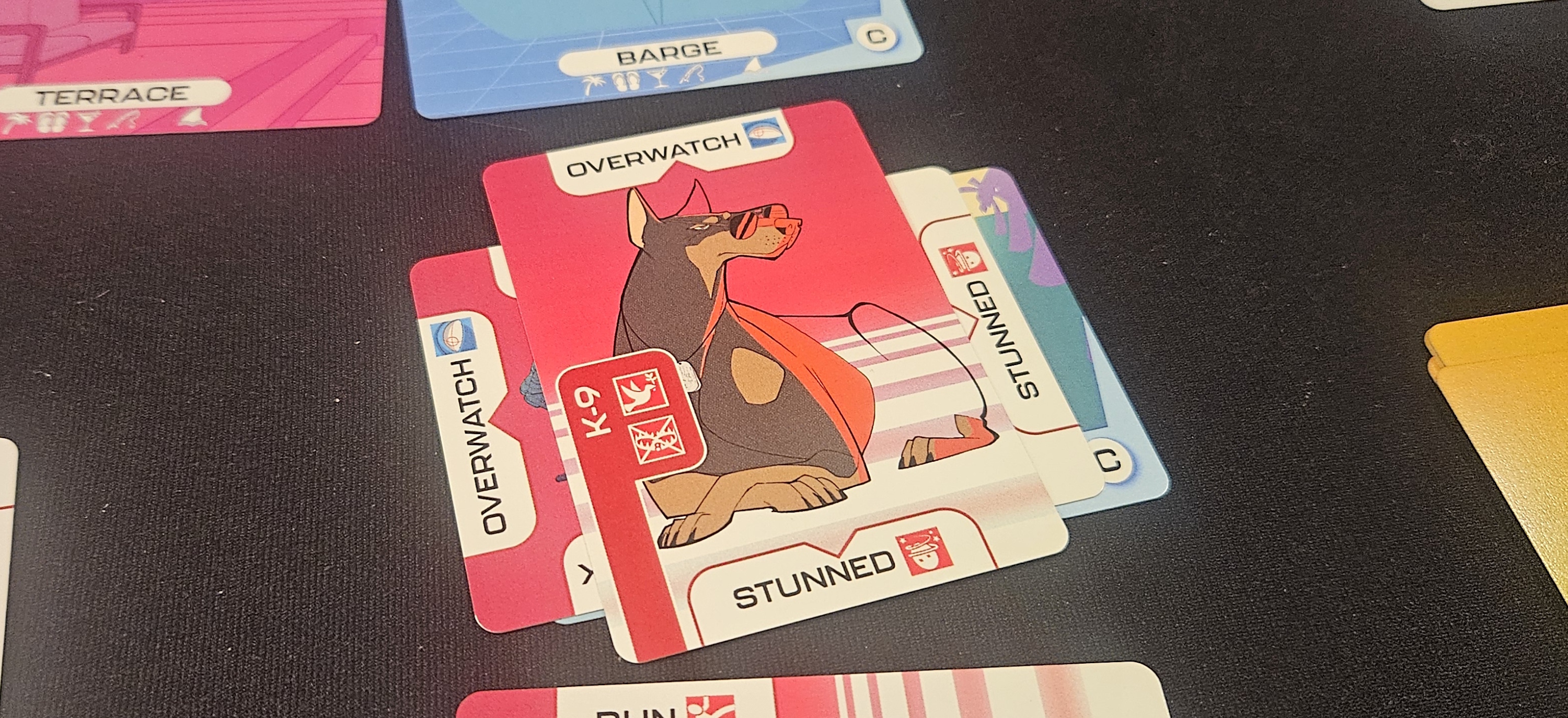
That is one cool pup.

The effect is thrilling. Because every spot on the map is within reach of every other spot, there’s no such thing as outrunning your opponent. You can buy time, sure. You can duck away from a fight that’s getting too hot. But Burned is a chase scene in a confined space, not an entire cat-and-mouse flick. It’s like that moment in A History of Violence where one character outfoxes another by shutting a door in their face, or the single-take fight scene from Atomic Blonde that rolls through a single apartment block, or every other scene in a Bourne movie.

Of course, this wouldn’t work without Burned’s unusually high body count. Most hidden movement games offer a certain asymmetry of vulnerability, where the one being pursued is in danger of losing their life while the greatest risk to the pursuer is the loss of some time. I’m thinking of the Hunters from Specter Ops, who can be stunned but never put down for good, or even the shark from Kelp, for whom failure means missing out on dinner.

Here, nothing could be further from the truth. The Burned Asset is uniquely vulnerable because he’s alone. But the Agency, despite being the better-staffed half of this equation, is almost assured to suffer the greater casualties. When the scene opens, they have seven agents. Most of these will probably be run-of-the-mill operatives. Mooks, in other words, there to chase the Burned Asset and, in all likelihood, give their lives in the attempt. One or two might be spotters, relatively peaceful mooks who are better avoided than assaulted directly, or even canine units that are experts at sniffing out traps.

But the Agency isn’t untouchable. Their principal aim is to kill the Burned Asset, but they’re playing a double game. This entire shebang began as an ambush. So the big guy is here, the Director of the whole rotten apple pie, along with his body double. If the Burned Asset takes down the Director — and possibly the body double as well, depending on the order things shake out — then it’s curtains for the Agency.

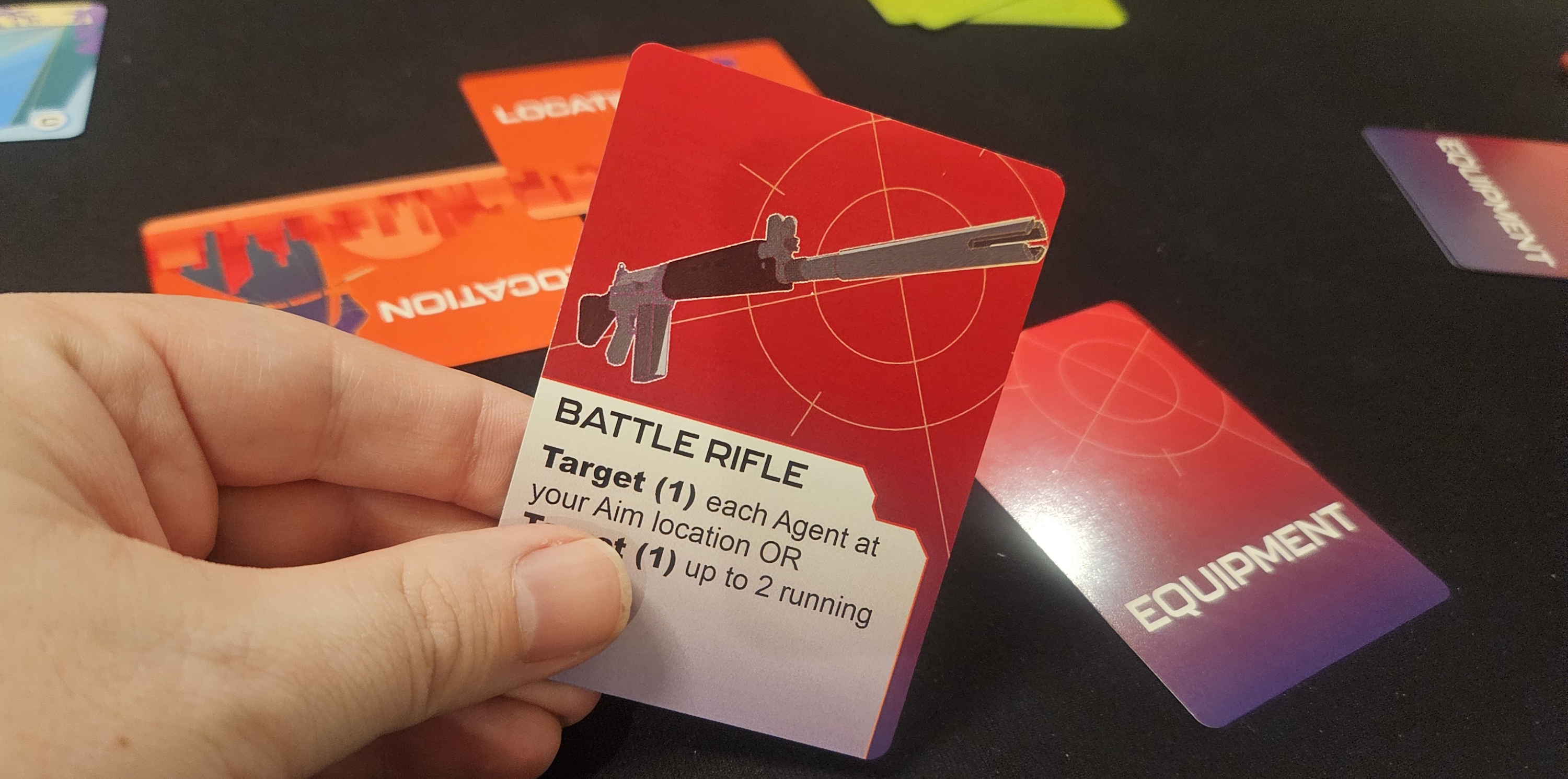
The result is a chase in both directions. A highly lopsided chase, to be sure. A chase where one side is doing the bulk of the chasing and the other is usually the chasee. But it’s also a chase where the hunted can very rapidly turn the tables and become the hunter. With the application of a few bullets, a grenade, maybe a bear trap, anything is possible.

The game allows you to choose from a number of kits, and even build your own. Already I have my favorites.

Blammo.

I suppose it bears mentioning that the Burned Asset is the harder role to play. Manpower counts for a lot, and seven to one makes for formidable odds.

In a game this kinetic, this cinematic, and this brief, however, it’s hard to consider that a shortcoming. I have complicated thoughts about balance in the first place — foremost that it’s overrated — and it strikes me as fitting that a contest between one man, no matter how well trained and outfitted, against seven other killers, should be a little tipsy on the scales.

More than that, though, many of my favorite moments in Burned were those that saw me failing to accomplish my objective. One instance in particular stands out. After setting up the map, I positioned myself at an intersection, an obvious hiding place with ready access to two major areas. Right away, the Agency zeroed in on my position. Within a single action, I had been injured. We’re talking twenty seconds into the game here.

But I had planned for this. All according to plan. I popped some tear gas, a single-use tool that stunned every agent at locations of my color. This just so happened to be every single agent in the game. And while two agents had fanned out to secure the area, the rest were clustered atop a single mezzanine.

That gave me a free move, completely unharassed, to do whatever I wanted. That’s an eternity in Burned. So I chose my next move carefully. I took careful aim at the mezzanine. Five agents in my crosshairs. And then I sprayed lead.

Hits in Burned resolve according to a simple deck draw. One by one, we went through the agents. The first one, an operative: DEAD. The next, the body double: DEAD. Third, another operative: MISSED. Who cares, my target is the big bastard. And there he was. The Director. It was entirely plausible that I might win the match within one minute of completing setup. We flipped the next card, and

MISSED.

Dammit. The other agent got away, too. I’ll type it out for consistency’s sake: MISSED. But, hey, that was fine. With so much of its manpower already bleeding out, the Agency was in a bind. I ran. Hid. Tried to regroup.

It didn’t pan out. A little while later, another agent found me and inflicted my second wound. I killed him back, but the exchange left me on death’s door. On the next turn, I shot the wrong guy. He turned out to be a spotter. Which meant whatever sniper was covering his location popped me next. Blammo. Lights out for the Burned Asset.

But the takeaway from this anecdote isn’t that I failed. It’s that Burned produces moments of effortless kino. Every duel feels close. Every shot, every flipped card, every knife duel, every booby trap, every reveal. Sure, the outcome was more The American than John Wick. Sometimes, that’s how the cookie crumbles. When I missed the Director after shooting his body double, I shouted. Yelped, more like. Woke up my friend’s dog. That’s how invested we were in that moment.

As the Burned Asset you can, in theory, double back to where you've been shot. It's always a bad idea. Instead of hiding, you mope around in the open, surely traumatized by the gunshot wound, which inevitably draws too much attention.

Injuries and overwatch both restrict the Burned Asset’s movements.

This isn’t the first time I’ve been excited about a tiny stealth game. I’m thinking about Fugitive, another box that can squeeze into your average jeans pocket. (Or slip comfortably into a cargo pocket, if you happen to be a person of high fashion and leisure.)

But what makes Burned remarkable is not only its size, not only its duration. It’s the way the game conveys cinematic action rather than deductive logic. This is one of those rare hidden movement games that’s about motion instead of movement ranges. At no point does anyone count spaces. There’s no fretting over doubling-back rules. In place of the mechanism’s usual trappings, one finds pure animation, pure punch, pure heft. Which is to say, it evokes feeling more than analysis, a rare strength in such an analytical medium.

In more straightforward terms, it handles like a weapon. It feels heavy and dangerous in my hand. It incites to deeds of make-believe violence. I missed my shot at the Director this time. Next time, and the next, and the time after that, the bastard is going all the way down.


A complimentary copy of Burned was provided by the designer.

(If what I’m doing at Space-Biff! is valuable to you in some way, please consider dropping by my Patreon campaign or Ko-fi. Right now, supporters can read about which films I watched in 2025, including some brief thoughts on each. That’s 44 movies! That’s a lot, unless you see, like, 45 or more movies in a year!)

Shiny New Editions of Fan Favorites

by Steph Hodge

I have been playing and hearing about a bunch of new editions for games getting reprinted with new artwork. This excites me because I love it when a game gets a boost, as it often means new gamers can discover and play it.

▪️ Floodgate Games just released a remastered version of Sagrada along with plans to release expansions as well.

Sagrada is a cozy, puzzley dice-drafting game where you build a stained glass window by placing colorful translucent dice on your board. The rules take about 5 minutes to learn, but every game gives you a completely different puzzle to solve.


The first expansion to be released is Sagrada: Panorama, which will include playing with up to 6 players as well as other new content:

Lightboards: New personal boards that offer long-term planning and strategic opportunities.
Panorama Shared Objectives: A new cooperative-style scoring mechanism where artisans must work with their immediate neighbors to score points.
Focal Point Private Objectives: Private goals that reward players for placing specific dice in designated spaces within their window.
New Tools: Includes 6 additional tool cards to manipulate dice and navigate placement restrictions.

I got permission to share this early.


▪️ CrowD Games had a very successful Kickstarter back in May 2025 for the highly anticipated Nippon: Zaibatsu. Nippon designed by Nuno Bizarro Sentieiro and Paulo Soledade, has been on my shelf since it was released, but it is also an example of a game that was very hard to get. Gamers are looking for this type of game revival. A hot, hard-to-find game with gorgeous presentation and streamlined mechanics.

Nippon: Zaibatsu is a fast-paced, highly competitive area-majority worker-placement game where actions can’t be blocked. It is set in a Meiji-era Japan, when rapid industrialization was transforming the life of the entire country.

In the game, players invest in new industries, build factories and railroads, and produce goods to saturate local markets and fulfill contracts — all to grow their influence and power and to become rulers of the new modernized country.

Nippon: Zaibatsu is an enhanced and reimagined anniversary edition of Nippon (2015), which was well-acclaimed and popular around the world.

[imageid=8820600 medium rep]

Nuno Bizarro Sentieiro and Paulo Soledade with Nippon: Zaibatsu pre-production copy at LeiriaCon - [user=deerstop][/user]


▪️ Allplay has been releasing a bunch of smaller boxed games each year, and there are always a handful of games being revived with a fresh new look. I am always in awe of all the games they are able to create each year. Here are just a few.

Piñatas by Reiner Knizia has been reimaged a few times before. Originally, it was known as Voodoo Prince , then later as Marshmallow Test. Piñatas has that burst of color that fits right in line with the other Allplay titles. This is part of the Allplay "Tricky Card Game" series, as it is a trick-taking game.

Another Knizia card game of interest might be High Society which has been through many iterations. The game was originally released in 1995 and has been a staple in many collections throughout the years. I am all in favor of bringing back classic auction and bidding games, as they are mechanics I highly enjoy and would always love to see more of. About High Society:
Bid to acquire number and multiplier cards, trying to avoid the pitfalls of wealth (negative and divisor cards). Careful—the player with the least money can’t win!


Container is a game that is always looking for more editions because it is so well-loved. This is an all-new edition releasing in Q4. Container first released in 2007 and then later in 2018 as Container: 10th Anniversary Jumbo Edition!. This is a highly sought-after game, so it is great for Allplay to make the game more accessible now.

Build factories, produce containers, set prices, negotiate with your rivals, and sail across the sea to trade. Obviously, buy low, sell high. But can you make it happen?
It's the definitive Container experience. With modern production, beautiful components, and delightful artwork that a game of this caliber deserves, it's poised to become your favorite game (before you've ever even played it).

Awaken Realms vows “no AI art” for Concordia: Special Edition after BGG review bombing

25. März 2026 um 16:10

Board game publisher Awaken Realms has responded to a wave of anti-AI art review bombing for its upcoming crowdfund, Concordia: Special Edition, by saying no AI-generated imagery will be used in the finished game.

The title is the latest seminal eurogame to be re-released in a spruced-up, premium edition by Awaken Realms – and also the latest to see the publisher come under fire for embracing generative AI software such as Midjourney in developing some of its games.

Awaken Realms is one of highest-profile tabletop publishers to confirm it uses AI image generators, with other notable adopters of the technology including Stronghold Games – which attracted significant ire for its use of AI art in its $2.2m More Terraforming Mars! crowdfunding campaign.

The technology has been widely criticised by artists angry that the models are built upon their work without licensing or recompense, in addition to outcry over its environmental costs and threats to jobs in the creative and other industries.

Almost all of the first few dozen ratings for Concordia: Special Edition posted by BoardGameGeek users gave the title ‘1’ – the lowest possible score – following its unveiling at the end of February, with the vast majority of those citing AI art as their rationale.

That was followed by a spate of users scoring the game the maximum ’10’ in an attempt to counteract the low scores – but the ongoing tussle has left it with an average of just 4.7, the lowest current rating of any Awaken Realms full game, and well below the 8-plus ratings enjoyed by many of the publisher’s prior releases.

BoardGameGeek’s suggested ratings guidelines say a ‘1’ review “Defies description of a game. You won’t catch me dead playing this. Clearly broken.”, while a ’10’ is suggested as “Outstanding. Always want to play and expect this will never change”.

BGG’s current policy is that “users are allowed to rate games however they wish, as long as each person only rates a given game once.”

The original edition of Concordia, released by German publisher PD-Verlag in 2013, has a BGG rating of 8.1 from more than 45,000 users, and is ranked 29th out of the tens of thousands of titles listed on the site’s database.

Awaken Realms is yet to unveil many details about the upcoming special edition, with the Gamefound preview page currently only showing a box cover – which it has since described as a work in progress – and examples of two plastic miniatures set to be included in the game.

The company dedicated most of its first update on the Gamefound page to discussing its use of AI generated imagery, saying that it did not address the situation sooner because “we find this whole conversation extremely draining”.

Box cover design for Concordia: Special Edition, which Awaken Realms says is a “work in progress”

It said, “We feel that the current situation is really not respectful toward our artists, who are really working hard on each project, and Concordia will be no different. They will be doing their best to pay tribute to this classic and elevate it to new heights.

“So, first things first – in this project, in the final game, there will be no AI art. Human artists will be involved in everything. This has also been clearly stated from the beginning in our contract with PD-Verlag.

“However, we do use some AI tools during prototyping, mock-ups, and various initial phases of concept work (and honestly, it is really hard not to, as eg, Photoshop alone, which is our artists’ main tool, has already tons of built-in AI features).

“This makes it easier to test the game visually, iterate, find the best solutions and compositions, and, from there, start working on the final assets.

“In different projects, we might have different rules and approaches. For example, you can see our other project – Grimcoven. There, we also had an update on the topic, as well as a chance to see the final result of how the game looks as it is produced and delivered to backers ;).”

Update March 27, 2026: Jan Philip Sommerlade, an editor at Concordia publisher and licensor PD-Verlag, wrote on BoardGameGeek: “In the games published by PD-Verlag, neither the graphics nor the text were created using artificial intelligence. We consider this to be problematic from a copyright perspective, at least when the AI models are based on artwork created by artists.

“It was therefore very important to us that artificial intelligence will not be used in the Concordia Special Edition either. In December, we paid Awaken Realms an extensive visit and discussed the details of the Special Edition at length. Awaken Realms has a large team dedicated to developing content, graphics, and illustrations, and we are confident that this collaboration will result in a very high-quality product. We have stipulated in our contract that the final product will not be created using artificial intelligence in any form.

“However, this does not apply to the use of AI for brainstorming and concept development, nor to the internal use of AI for creating prototypes. In the course of ongoing discussions, we have realized that this distinction may not be as clear-cut as we initially thought. Nevertheless, the fact remains: All graphics and text in the final product are created by real people.”

Other Campaigns

Grimcoven raised more than $5.1m across its 2024 Gamefound campaign and late pledges, and has so far avoided the heavy review bombing that has taken place for Concordia SE. Awaken Realms put out a similar pre-campaign update about its AI use for that title, calling it at the time “a ‘hot topic’ generating a lot of emotions”.

The publisher had come under fire online earlier that year for using AI in creating promotional images for its Puerto Rico 1897: Special Edition crowdfunding campaign – images it subsequently pulled from the crowdfunding page after being contacted by the game’s licensor, Ravensburger.

Despite online pushback against Awaken Realms for its decision to embrace AI generated imagery, its use of the technology has had little apparent negative impact on the success of its crowdfunding campaigns to date.

The publisher’s six most recent campaigns which it says made use of AI image making tools have raised almost €39m between them across their crowdfunds and late pledges, with Lands of Evershade the standout at more than $12.5m.

Awaken Realms Board GameTotal raised across crowdfunding, late pledges
Dragon Eclipse: The Grand Quest€3,321,287
BELOW: The Asylum€4,038,955
Agricola: Special Edition€7,326,500
This War of Mine Second Edition€3,730,079
Lands of Evershade$12,576,991
Grimcoven$5,136,331
Grand total~€38,900,000

But some of those have also begun to feel the impact of anti-AI sentiment on their BGG ratings. Agricola: Special Edition is currently rated at 6.2, with more than a third of its 309 ratings scored as ‘1’, while the yet-to-launch Agricola: Dead Harvest campaign is rated 5.9, with almost 90% of its 104 ratings so far either ‘1’s or ’10’s.

The six most recent campaigns using AI imagery – which also include BELOW: The Asylum, This War of Mine: Second Edition and Grimcoven – all included a statement acknowledging that usage in the FAQ section of their respective Gamefound campaigns.

The stipulation to transparently disclose the use of AI in Gamefound campaigns was implemented by the crowdfunding site in March last year, and codified in an update to its terms of service at the end of last month.

Awaken Realms’ AI art statement in its Agricola: Special Edition campaign FAQ states, “We are using different technologies, including AI tools, to various degrees – from built-in Photoshop capabilities (intelligent brushes, advanced texturing, and some AI tools), Internal Stable Diffusion models, MJ[Midjourney] models, pixel correction, scaling solutions and so on. Everything we use is screened and accepted by our legal team as fully legal to use.

“Those are different tools that we use NOT to decrease cost and DEFINITELY NOT to replace artists but to bring better quality to our customers and enhance creativity by allowing faster prototyping and iteration.

Pre-campaign card art for Agricola: Special Edition, which Awaken Realms described as “Work in Progress”

“We are constantly growing our art team (in the last 12 months, we have hired six new artists), as well as yearly increasing wages and sharing profits by yearly bonuses. We really care about our team and are extremely proud of their work.

“We deeply believe that in any creative endeavor, human involvement is absolutely essential, and instead of just ‘talking the talk’, we have actually walked the walk and increased our artist count and wages every year.

“This is our statement on the topic and we are fully dedicated to supporting and growing our art team, as well as bringing the best quality to our backers. We believe that this approach is better than making big PR statements and then firing people with a week’s notice, as, unfortunately, can be observed all around the industry.”

It is not immediately clear which board game publishers Awaken Realms is referring to with the final part of that statement.

The Agricola Special Edition statement is very different to the AI art section of the FAQ for Awaken Realms’ most recent crowdfund, Labyrinth Chronicles – which, like Puerto Rico Special Edition, is published by Gamefound investor Ravensburger.

That statement said, “We also noticed a few questions regarding the creative process behind Labyrinth Chronicles and whether any AI-generated artwork was used in the game.

“We would like to clearly state that no AI-generated art was used in the final product. Every illustration, graphic element, and 3D model was created by our talented team of artists who worked on this project.”

That statement then goes on to list 24 artists, graphic designers, illustrators and 3d modellers who it said worked on the title.

Awaken Realms has taken great pains recently to highlight the extent of its art and design team – which it said in the Concordia: Special Edition Gamefound update now comprises 32 people across art, 2D layout, 3D sculpture and desktop publishing, out of a board games division of more than 100 people.

Gamefound was launched in 2015 as a Kickstarter pledge manager by Awaken Realms co-founder Marcin Świerkot, who is CEO of both businesses. The company transitioned into a full crowdfunding site in 2022, with Świerkot setting his sights on beating Kickstarter at its own game in the tabletop sector.

Awaken Realms, meanwhile, began life as a miniature painting studio in 2014, before expanding into board game publishing a couple of years later.

The company garnered early success with a Kickstarter for This War of Mine: The Board Game in 2016, before the £3m Nemesis Kickstarter campaign in 2018 formed a springboard for the company to begin creating ever more intricate and expansive miniatures-focused tabletop projects.

Awaken Realms raised more than $12.1m for its Nemesis Retaliation Gamefound campaign at the end of 2024, making it one of the biggest board game crowdfunding campaign of all time alongside Frosthaven ($12.9m) and Kingdom Death Monster 1.5 ($12.39m).

The post Awaken Realms vows “no AI art” for Concordia: Special Edition after BGG review bombing first appeared on .

Point Galaxy Review

25. März 2026 um 14:01
Point GalaxyFirst, there was a Point Salad. But after a Freak Accident, that salad became Point City. Tragically, a Frique Axident occurred while attempting to revert the aforementioned Freak Accident, and that City has become a Galaxy. Cue that last scene from Men in Black with Inception Music. Point Galaxy, from Molly Johnson, Robert Melvin, and […]

Source

Dino Dynasty Game Review

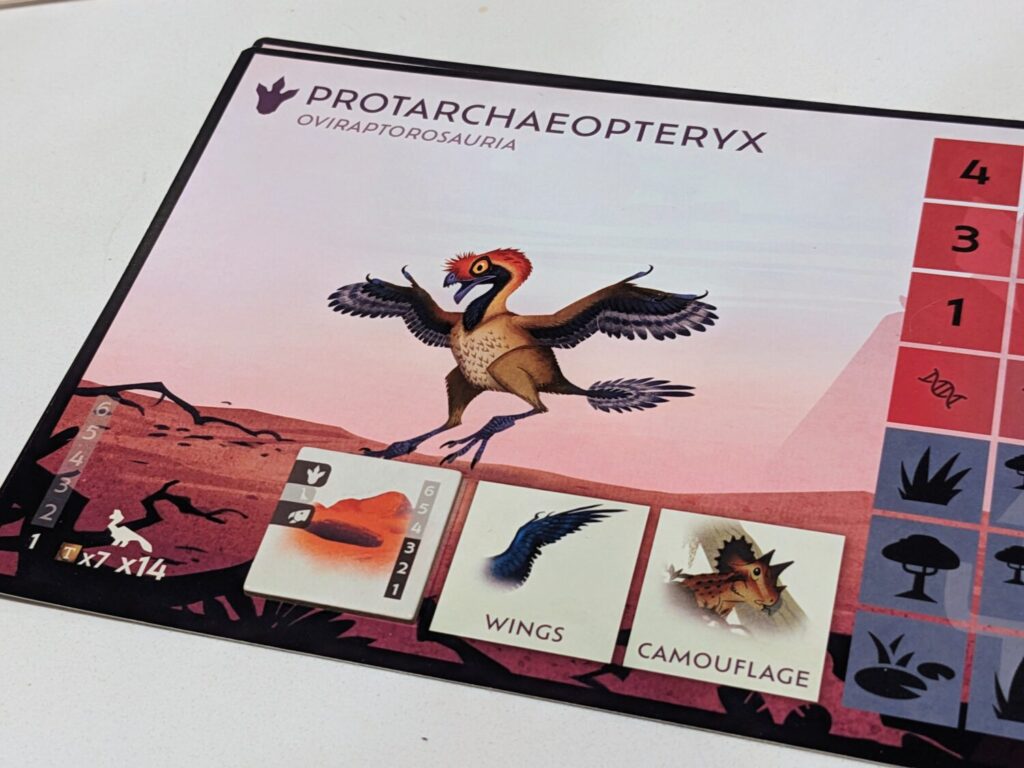
I didn’t know there was a market for players looking for a dinosaurus skirmish game rich with history…but then the team at Ion Game Design handed me a copy of Dino Dynasty, their 2025 release designed by Ion’s Chief Creative Officer, Jon Manker. About a year prior, Manker had led a small group of media members through a demo of the game, and the most striking part about that walkthrough was the stunning dino art from artist Johan Egerkrans.

The work of Egerkrans, the author/illustrator of the book Dinosaur Dynasties, is the real star and reason to give the game Dino Dynasty a look. The game is an impressively streamlined version of more complex skirmish games, especially compared to some of the more rules-dense wargames I cover here on the site.

But the real question for me is the audience—while we had fun with our plays here, I can’t for the life of me figure out who the target audience is for the product.

This Biome Isn’t Big Enough for the Both of Us

Dino Dynasty is a very snappy “troops on a map” game for 1-6 players. The game’s incredible level of customization starts with the setup: there are more than 20 different playable dinosaur clans, 30 double-sided…

The post Dino Dynasty Game Review appeared first on Meeple Mountain.

Best 3 Games with…Despair!

Von: Grant
25. März 2026 um 13:00

Recently, I have been playing a lot of Paths of Glory: The First World War, 1914-1918 from GMT Games on the fabulous Rally the Troops! and these gaming sessions have got me thinking. Thinking about the uselessness of war and conflict and the ultimate negative effects of it all. But not just the loss of life, maiming and disfigurement that comes with war but also the emotional scars. And this got me thinking about despair and hopelessness. Despair! A word that evokes very dark and scary feelings in all of us because it gives the impression of a lack of tomorrow. The dictionary definition of Despair is “the complete loss or absence of hope”. In my opinion, this is a word that can be used to describe many historic battles and wars as they have spiraled into pointless affairs with no end in sight. World War I comes to mind for me and the years of bloody and brutal trench warfare, bombardment and use of deadly chemical weapons such as mustard gas. In this post in the Best 3 Games with… series, I want to share with you games that have despair as a main focus.

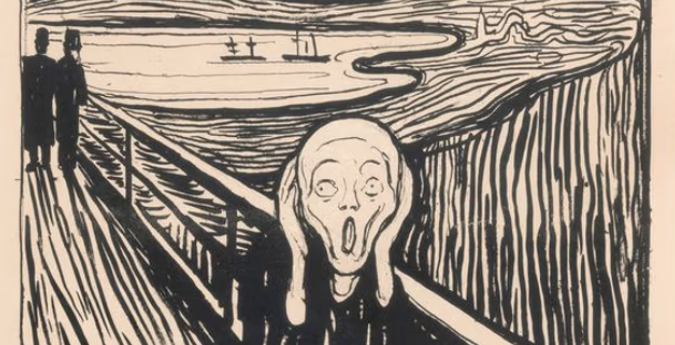
*As my Featured Image for this post, I used the painting The Scream by Edvard Munch (1895). He said about the piece that it felt like a “scream through nature,” and the painting features a distorted figure covering its ears, reacting to, rather than making, a sound.

3. Verdun from Dragon Dawn Productions

Verdun is a card game that is focused on the famous siege of Verdun during World War I. As player’s hands dwindle down as they play 2 cards per round but only draw 1, players will also have to play cards that help the other side, timing it strategically to minimize their own casualties. The teams alternate being the Attacker, and each card played leads to more and more deaths. You are fighting over positive victory points from trying to win several positions through over the top attacks that are worth a set amount of VP but that are hidden from view until they are taken so you never know if you are going for the high VP area or the low ones until you blow the whistle to initiate the attack.

A game of Verdun lasts about 16 rounds as players start with 12 cards, which they then play in a series of 12 tricks. When you win the trick, you gain the VP for the position but the winner will lose their lowest valued cards while the loser will lose their highest value cards to the dead pile representing mounting casualties. Low cards have fewer skulls on them representing deaths while higher cards have more. So even in victory you will be accumulating negative VP’s and this is one of the key aspects of the game…managing those deaths! Just like the high command.

In the end, the player with the highest score will win and this number will be very low or can even be negative. In our play of the game, my French defeated Alexander’s Germans by a final score of 3 VP to -14 VP. What a great little trick taking game! The really interesting part about the late game is that your hand has dwindled to being full of your worst cards as you have most likely used the good cards earlier to win tricks or cause losses to your opponent. The last few card plays just seem brutal and you are just hoping to not have to take a lot of skulls. This felt very fruitless and mimics the despair of commanders as they had to issue orders that they knew were not going to result in any positive gains but only the loss of life.

The game is also gorgeous with fantastic original period art used on the cards and amazing graphical layout and design. The images are very gritty and involve the feelings of the battle and create a very thematic portal for the players to experience the difficulties in the battle. Just a very slick little thematic game.

Here is a link to our video review of the game:

2. Paths of Glory: The First World War, 1914-1918 from GMT Games

Paths of Glory is widely thought to be a masterpiece on WWI and after just a few plays of the game, both in person and online on the fabulous Rally the Troops!, I can definitely see why people feel that way. Even though we are novices, the game is just that good and really tells the story of the fruitless efforts of both the Entente and Central Powers as they bashed their heads against each other over control of Europe. The game is long and you generally are going to have to play this one over a long weekend to get it all in and enjoy it properly but it is just such as great tool to understand the complexities of the struggles of trench warfare, supply and the balance of attacking versus taking a breath and regrouping. I really enjoyed the mix of historical events and the choices that I had to wage the war in a way that I felt was appropriate. But, my message to everyone who plays this game is beware of supply. Even in our few plays, supply has been an issue and we have had to make sure we didn’t make a few fatal mistakes that would get us in trouble. I want it to be clear here. I am not good at this game…at all and the nuances of supply and how to play have just eluded me as I continue to make the same errors game after game. But it is really good and I look forward to each new play with enthusiasm and am excited about the chance to get to learn more about this fascinating war that was so very fruitless.

With that being said, generally in every single game the Central Powers will start out by playing their Guns of August card. Guns of August is a crucial, high-stakes opening event for the Central Powers on Turn 1, enabling an immediate, powerful and historical offensive against France and Belgium. It kicks off the continual back and forth of trench warfare and frankly seems to never really generate a good outcome. Each attack is bloody, with both sides being brutalized by having to reduce units and the trenches make attacking more and more difficult as they evolve and grow to Level 2. Paths of Glory in a large part is about resource management and the constant pressure to continue offensive momentum and rebuild troops through the use of Replacement Points and events to bring on additional troops is a major problem for both sides. You can only attack for so long before you will burn yourself out and will have to spend time to recover and get ready for the next turn’s offensives. This process of back and forth will ultimately rarely see fruits on the Western Front and will devolve into stalemate as each side strengthens their defense and the Entente begin to bring in reinforcements from England to shore up the lines and nullify the early German advantage. But the real despair in this game are the decisions about how to play your cards. You can use them for their Ops Points to fuel attacks and movement on the board, use them for the printed event or play them for the Reinforcement Points located at the bottom of the card. This is the real key to the game and managing this process of maneuver, attack, shoring up defenses, buying replacement points and protecting supply lines is where the players lose their minds. You simply cannot continue a full out frontal assault round after round. If you do, you will grind your men to dust and dig their own graves as you will be unable to prepare for the next turn. This is a long game and this process wears on turn after turn and the first person that makes a mistake typically is the one that loses.

Here is a link to our initial impressions video of the game:

1. The Grizzled from CMON Games

The Grizzled is a special game. Not a big game. Not a complex game. And not a game for every one as it is different, focused on the friendship and bonds of a group of French soldiers caught in the trenches of World War I. The game is a cooperative card game set during The Great War, also known as “the war that no one in the U.S. really understands because we only ever learn about World War II”. Ironically, playing The Grizzled is somewhat of a rather peaceful affair, but our plays have found it to be quite challenging, sometimes unwinnable in fact, and that is where the despair comes in. No matter how well you play the cards you are dealt and no matter how hard you work together to overcome challenges, failure is a part of the game and winning is truly at a premium.

The cards represent threats to all of the men’s safety or a hard knock which impacts the player or their compatriots in some way. The goal of the game is to play through all of the Trials cards to find peace (literally a Peace card). A standard game starts with 25 Trial cards on the peace deck and the remaining 34 Trial cards are placed in a separate morale deck (a draw pile). Cards move from the Morale deck to the Trial deck at the end of a mission. The Morale deck sits on a card picturing a monument commemorating the sacrifices made in war. But if you ever see this Monument card, you’ve lost the game.

The goal of each mission is the same to play as many cards as you can before withdrawing from battle. Cards are played in one of two ways; placing a threat in No Man’s Land or placing a hard knock card next to your soldier. Every time you play a card, the group is one step closer to victory, but if there are ever 3 of the same threats showing on the table at any one time, the mission is lost but the game will continue.

Beyond playing a card, there are 2 other actions but they are rarely available. On each player’s character there is a Lucky Charm showing one of the 6 threats in the game. Playing the Lucky Charm as an action allows that player to remove a matching threat from No Man’s Land, making the mission a bit easier to continue. After you use your Lucky charm you flip your character card over and no longer have access to that action. The other action is to make a speech. There are a very limited number of Speech Tokens in the game – the mission leader will receive one after each mission until all the tokens have been distributed. When giving a speech as an action, you have to have the token and you have to choose one of the 6 threats. The OTHER players still active in the mission then remove ONE card from their hand that matches the declared threat. These can be useful but are not guaranteed to have an impact. Once played, a speech token is removed from the game. But, one of my favorite mechanic is when you withdraw and add a support token to your character. The token is, very thematically a cup of coffee. When the round ends, you will pass this coffee to a teammate as support. The teammate that gets the most support at the end of the round can remove two hard-knocks or recover their lucky charm.

While we love the game, and I find it to be supremely interesting, we have never won in over 20 plays. We simply seem to run the same course over and over again and never seem to gain much ground. And I really think that this is the point of the game. And where the despair comes into play. One of the other things that I love about the game is the tag line that appears on the front cover. It reads: Can friendship be stronger than war? This statement gives some pause and causes a lot of discussion in our group particularly with the concepts of the exhaustion of characters (using their Lucky Charm and turning them over), the speeches (removing a threat from the battlefield that you cannot get rid of because no one has the matching cards) and the cups of coffee (support). As if a cup of coffee can overcome anything…but you can always give it a go.

Now there are many games that could be included on this list but the games I have chosen perfectly evoke the level of despair that I was going for in this piece. I have played many other games that convey despair but feel that these 3 best demonstrate the level of hopelessness that I was thinking of. What are your favorite games that evoke despair?

-Grant

BGI 412 The One About Crowdfunding Campaign Analysis

25. März 2026 um 07:29

BGI 412 The One About Crowdfunding Campaign Analysis

Board Games InsiderJoin our Guild on Board Game Geek Guild | Like us on FB

Social media:

Ignacy Trzewiczek / Portal Games: website | FB | Twitter | Youtube

Corey Thompson / Above Board TV:  website | Youtube

Stephen Buonocore / “The Podfather Of Gaming”: website | FB | Twitter | Youtube

Intro Music: Happy Rock – Bensound.com

💾

Artist Diary: Skybridge

24. März 2026 um 15:00

by Fat Francis


Michael Rieneck
Franz Vohwinkel
Deep Print Games

Editor's Note - Michael Rieneck and Franz Vohwinkel wrote a designers' diary about the development of Skybridge, published on Feb 3rd, 2026. This diary is a compliment to that piece, but from the perspective of developing the artwork.

Artist Diary: Skybridge

There are moments in life when paths open up that you didn’t know existed at first.
15 years ago I surprisingly received an unusual assignment: design three fantasy puzzles, including a box design, for a new jigsaw puzzle series. Unknowingly, I had embarked on a long journey that has not yet come to an end.

September 2010


When I made this sketch for the first of a series of puzzles, I had no idea that I would write about it today. At that time the drakhes were still dragons, there were still visible sunbeams in Thraen (at that time simply called “Downworld”) and apart from the Queen, Adlem and the inhabitants of the “Skyworld”, Thraen, and Beeledhans Eye were still completely unknown to me.

Although I have discovered so much in Thraen since then, those three original illustrations laid the foundation for what Skybridge turned into today.

From my current point of view, the first puzzle was certainly the most important of the three, because it already contains all the essential elements of the story: the dry, hollow world on the outside, the lush and heavenly world inside, and the tower that will become a bridge, connecting both worlds.

The motif of the construction site from the second puzzle can be seen as “standing” or “hanging” depending on how one wants to view it. Here, the idea of weightlessness is displayed for the first time: In the hollow world, gravity pulls outwards (for us “down”), while the gravity of the central world pulls inward towards its center (for us “up”). In the middle between both worlds, the two gravitational forces cancel each other out.

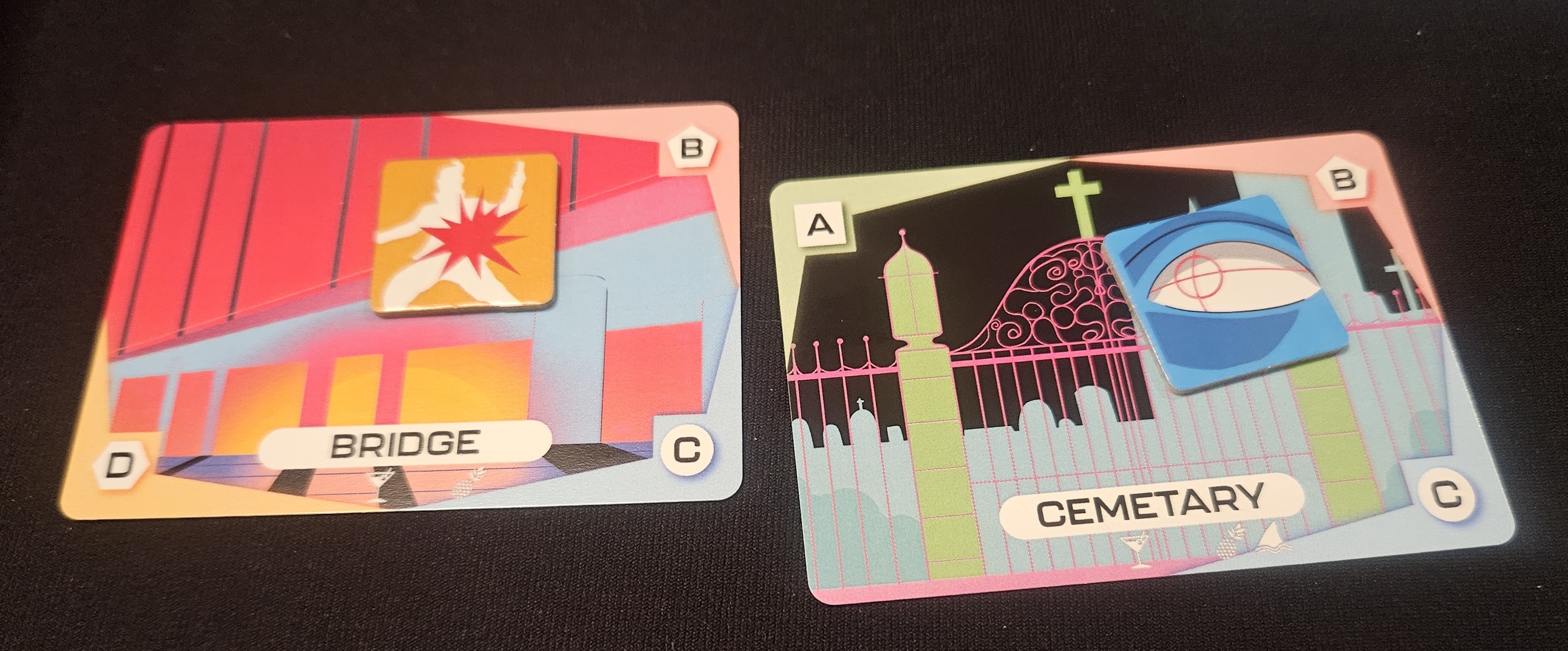
A heavily revised version of the first puzzle became the cover of the prototype and a reduced version of the second puzzle can still be seen on the cards “Bridge”.


Only the third puzzle has fallen out of the storyline over time. Too much has changed, or looks completely different today: A peaceful encounter of characters from both worlds in a central room of the Skybridge is now completely impossible.

The Work on the Board Game Started

One of the first tasks was to completely revise the cover to match the current state of the worlds. The Skybridge now gleams in hopeful white and Beeledhans Eye is much more visible. The whole image seems much lighter, almost like a vision. The publisher contributed some good ideas like the slightly slanted point of view and the drakhe flying towards the viewer in the foreground.


The Five Main Characters

In addition to the cover, I first developed the five main characters, as they are important for the visual representation of the five ethnic groups on the player boards and the starting cards. Some of the maps of Skybridge were originally created in 2017, as well as this version of Queen Urcela, who always triggered the comment “She looks like Tilda Swinton”.

True. I think Tilda Swinton’s face is wonderful.

To avoid this similarity, I made a new illustration of the queen, which was quite challenging for me as I liked the original illustration so much.


In the new illustration Urcela is now seen wearing the Crown of Agony, which in the meantime had become an important detail of the story.

- In a first step, I revised the original sketch and drew a new face.
- Parts of the background and dress from the original illustration were preserved during the revision.
- Underneath the layer with the sketch I colored and modeled the face.
- Then I worked the sketch into the background with various blending brushes and added textures and details layer by layer afterwards. Finally, light color corrections completed the image.


I must admit that I like the new "Guinn" better than the original version.

While the game mechanics were still being developed feverishly, the illustration of the Skybridge was created. The bridge would no longer appear on its own game board, but was to be designed as a series of large individual cardboard tiles, laid out next to the game board.
This original sketch dates back to 2017. At that time, the bridge still consisted of 12 parts.


The player boards were more complex, because the elements on them changed several times in the course of further development. The background illustrations of the player boards had to be adapted accordingly. At this point, the illustrations of the five main characters were already finished.


In addition, I had to make sure that there were not too many contrasting details behind the game elements. The areas behind the text and at the bottom would be faded later on, but in this case, less was more.

The game board was a challenge as well, as it consists of many individual parts that had to be combined to form a whole. While I was already working on the illustration, a completely new area of the game board was created, which would not have existed without Moritz Bornkast and Peter Eggert of Deep Print Games: the desert map, where rebels and legions move towards each other. However, before we got to this point, we had to overcome a whole series of more or less usable versions, none of which fit particularly well into the board.


In order to keep the game producible and affordable while reducing the amount of different “game-locations”, the actual game board was brought to the format of a double-folded board the size of the box. The original game board for the Skybridge was scrapped and the desert map was merged with the game board.


The idea of depicting a part of the desert of the Sea of Winds was the breakthrough. In the story, rebels gather in Salthras Deen and try to make their way to the Skybridge, while the legions protecting the construction site move to meet them. At the same time, a storage area for the game components on the board was reintroduced. One space for a discard pile was removed and the other two were rotated to make room. The illustration of the game board consisted of individual parts that were illustrated and assembled largely independently of each other: the illustrations of the symbols for the game components, the map of Thraen, the desert map and the forts.

(By the way, the small skull that marks the discard pile represents the Realm of the Dead, the “Unseth”. All cards - countries, cities and characters, that end up here never come back. And so Thraen dies a little more each round.)

Most of the work on Skybridge was, of course, the many cards that really bring both worlds to life. The story of the Skybridge takes place in a fantastic world, completely impossible by our laws of nature. How can gravity in Thraen act outwards in all directions, while at the same time acting inward on Beeledhans Eye? Why is every day seemingly arbitrarily different in length? Where does the light come from? It’s magic! Of course, this is not entirely true: The people in Thraen believe godhs have created the world according to their wishes.

There is no magic in Thraen. There are no spellcasting wizards, just as there are no magic swords or heroes. Even the Drakhes are not magical beings, but animals that are captured by humans, tamed and used for their purposes.


The inhabitants of Thraen are simply humans, with all their faults and shortcomings. What would humanity do, if it could see paradise in the sky at any time? What if, in addition, life became more difficult to bear with each passing day?


Unfortunately, it was not possible to keep the short text passages from our prototype cards. The additional effort for production and translation would have been too high.

In order to be able to convey the worlds of Skybridge as originally designed in the prototype, I wanted to create the cards with a range of different realistic styles. It was important to me to show as many details as possible to make the peoples and their stories seem believable.

A little trick that provides increased detail is the size of the illustration. I created the card illustrations with the required resolution more than doubled. For printing, I then built the illustrations into the card frames scaled down considerably. Of course, some details are lost in the process, but the viewer still “feels” that they were there: Everything seems finer, more real, than in “regular” resolution. A pleasant side effect of this approach is also that the illustrations can later be displayed in larger formats as well.

Here are a few examples:

Vinad


In this important scene, Vinad, architect of the Utreng and Adlems main supporter, discovers that the construction of the Skybridge has been sabotaged.


Painting in Corel Painter, I used some of my own texture brushes, which I use to draw any kind of detailed patterned textiles with ease. I created a whole collection of them over the years, which I mix and paint over as needed. I affectionately call them my “wallpaper” brushes.

Min Vallesk


When a Serath greets someone with the word “Min” followed by his name, that person knows that the remainder of his life has just changed irrevocably.


Another type of textile details can be found in this image. Of course, each nation speaks its own language and thus also uses its own characters. On Min Vallesk’s headgear, two characters of the Selessem are recognizable in the pattern.

Usehet Tuin


Only the nomads of the Great Plains know of Usehet Tuin, the hidden valley in the Sea of Winds, where the ghosts of their ancestors are at home.
The Enebe Ghres only dare to come here when the situation is desperate and hopeless enough, to justify a plea for the help of the spirits.


The camp at the foot of the bridge


A key moment happens when the rebels find the camp of the workers at the foot of the Skybridge. The high price that ordinary folks have paid for the construction of the bridge is revealed.


The concept for the artwork of the Godh cards differs from the other cards in one essential point: They represent art that contains information about the different cultures of Thraens inhabitants. This is another, deeper level behind the obvious motif.

“The medium is the message” means here that different peoples also depict their Godhs using different mediums and styles. The Utreng for example like to carve their sacred images in wood, because wood is difficult to obtain in the high mountains of the Salthras and is therefore considered to be a valuable material. The Selessem also paint their naive art on wood, but only because they are a poor fishing people. They simply can afford no other surface to paint on.

In the enormous rock cliff on the edge of the Lhaedineer lowlands, the Lhaedineeri have found the ideal place for monumental depictions of their Godhs. The Tarrans, on the other hand, have perfected the fine art of sculpture. The work with precious stone has a tradition in the Reich that goes back to the first people of the White Sea.


In order to portrait this variety of styles convincingly, objects and materials need to be presented as realistically as possible. Only through the contrast of the respective art style and the medium on which it is created, it becomes clear that what looks like a drawing on parchment is also meant as to be seen as a “drawing on parchment”.

Valendha


The cultural contexts of the Godhs shown on the cards also become clearer because, unlike the other cards, almost every depiction of a Godh also shows writing in the respective language. Inscriptions, names and descriptions support the impression that the priests of Valendha want to say something about their Godhess in this carving.


Ephalu


The depictions of the Godhs on the cards are only intended as examples. There are certainly a variety of representations of every Godh in Thraen, some similar, some different, depending on which temple you are visiting.


Although mainly Tarrans believe in Ephalu, there are believers among the Enebe Ghres and the Unshackled People as well.
These peoples would certainly represent the blind Godhess of hope in different styles and mediums than the Tarrans. This is a field of the cultures in Thraen that I would like to explore more deeply in the future.

The worlds of Skybridge, initially described only in writing, now come to life in the illustrations for the game. Working with my own creation as a reference was a strange experience. It was often just as exciting and surprising for me as it was for Michael, who could hardly wait to see more every week. Holding the finished game in my hands now, after such a long time and all the ups and downs we’ve been through, still feels unreal to me.
I am looking forward to seeing Skybridge on the gaming tables and hope that lots of people will enjoy playing our game.

If you would like to see more of the art of Skybridge, you can explore it in greater detail on the website: theskybridge.de. (Currently available in German only, but eventually it will be available in English.)

I will also be posting information about further developments there.

Mini Rogue Review

24. März 2026 um 14:14
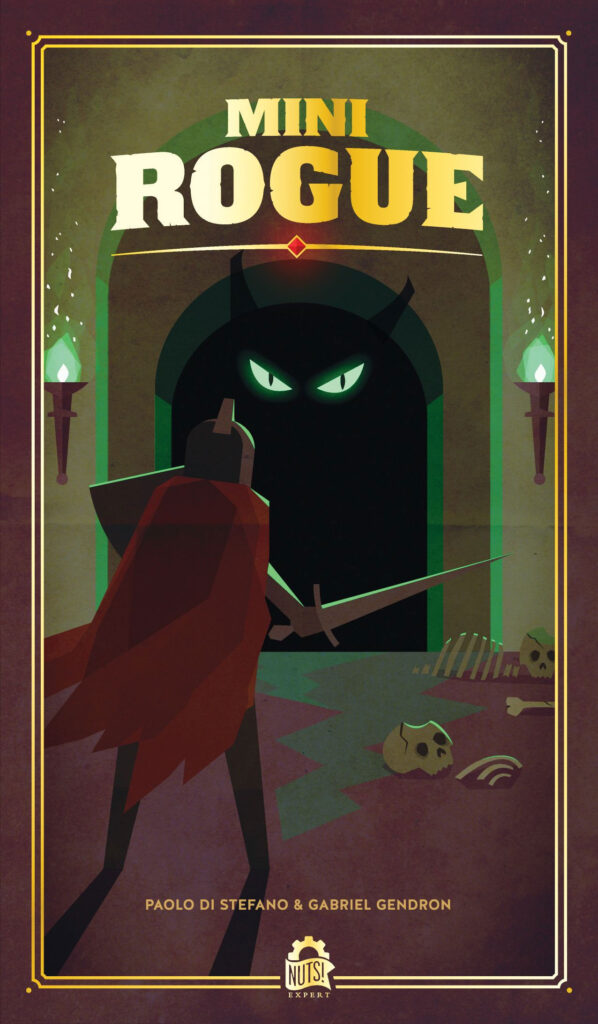
Mini RogueIn a world where Kickstarters routinely hit pledge levels at half a grand or more, it’s always nice to lay your hands on a game that runs in the opposite direction. To be fair, there is absolutely a place at my table for sprawling dungeon crawlers with loads of minis, massive amounts of character customization, […]

Source

Muster: Raise the Banners Game Review

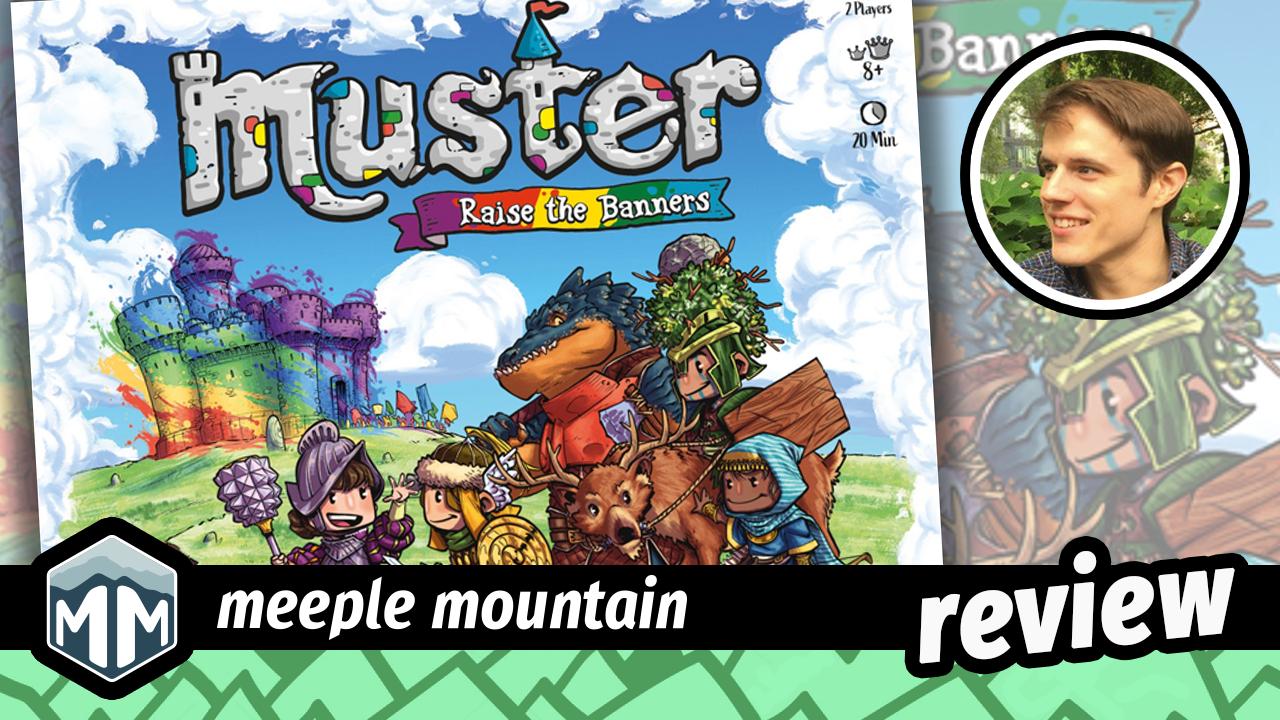
Muster: Raise the Banners, from designer Spencer Lloyd Thomas and with vibrant art from Pedro R. M. Andreo, is a quick little two-player lane battler. Each turn, you play a single card to its matching lane, or discard a card onto one of the central spaces, then draw a card. The catch is that the cards have to be played in ascending order. If I play the mighty green six early in the game, I can’t play any more cards to green.

This may sound familiar to some of you. It certainly did to me. Muster draws a whole heap of inspiration from Reiner Knizia’s 1999 masterpiece Lost Cities, one of the greatest two-player games ever published. I don’t knock Muster for that, and you shouldn’t either. It adds some flair of its own, like the two-sided wild cards that can be played in conjunction with other cards, and the Rainbow cards, which can be discarded to any center slot to open up that particular lane to cards of any color.

The board, a few turns into a game. Four cards sit to the south of the board, three sit above it.

This is a great idea. It means that you never quite know when a lane is done. I…

The post Muster: Raise the Banners Game Review appeared first on Meeple Mountain.

My Favorite Wargame Cards – A Look at Individual Cards from My Favorite Games – Card #70: Mohawks from Wilderness War: The French & Indian War, 1755-1760 from GMT Games

Von: Grant
24. März 2026 um 13:00

With this My Favorite Wargame Cards Series, I hope to take a look at a specific card from the various wargames that I have played and share how it is used in the game. I am not a strategist and frankly I am not that good at games but I do understand how things should work and be used in games. With that being said, here is the next entry in this series.

#70: Mohawks from Wilderness War: The French & Indian War, 1755-1760 from GMT Games

One of my fondest memories of our wargaming journey was our initial experience with the full campaign game of Wilderness War from GMT Games. We were 2 very inexperienced wargamers and we slogged through a 9-hour marathon play over a few days that ended in a 0-0 tie of all things. That’s right, the game ended in a tie, even though we both had a card in hand, but I was unable to use mine to activate Levis, which was my only potential Victory Point scoring force, and Alexander’s forces were in too tenuous a position or too wounded to risk an open battle for VP’s. You would think that this would have turned us off to the game but on the contrary it made me fall in love with asymmetric wargames and the Card Driven Game mechanic with its use of Action Points and events to wage war on the North American continent. The end score of our game really followed the tension of the game, and the blunders on the side of the British that counter balanced their various successes.

All in all, this game was excellent to play and we both highly recommend it. The two factions play extremely differently which leads to many intricate and reactive strategic decisions. The British have many powerful forces with their Highlanders and cannon while the French have access to better leaders and mobile troops and Indian allies who can run around the frontier raiding and burning settlements for VP’s. Laying siege and assaulting really feels like it should, and avoiding battle until you are ready is something that is integral to maintaining a strong presence on the board. You cannot always get into every possible fight as you will not survive the attrition of these battles. The deck plays really well, and as you don’t have to worry about the opponents events in your hand going off, the management aspect is much simpler yet very engaging as there are always reaction cards you can play or cards that you want to hold onto for that perfect moment.

In previous posts in this series, we have discussed the importance of the players of both sides gaining the trust and services of the indigenous Indian denizens of North America in the fight. The French and British can both use the Indian recruitment cards, including cards such as Iroquois Alliance, Northern Indian Alliance and Western Indian Alliance, to recruit, restore, and move native allies to gain victory points through raids and controlling of territory. The French hold a significant advantage with more access to a greater number of Indian auxiliaries, and will be using these cards to launch early raids, while the British can recruit specialized units like their Mohawk or Cherokee allies. 

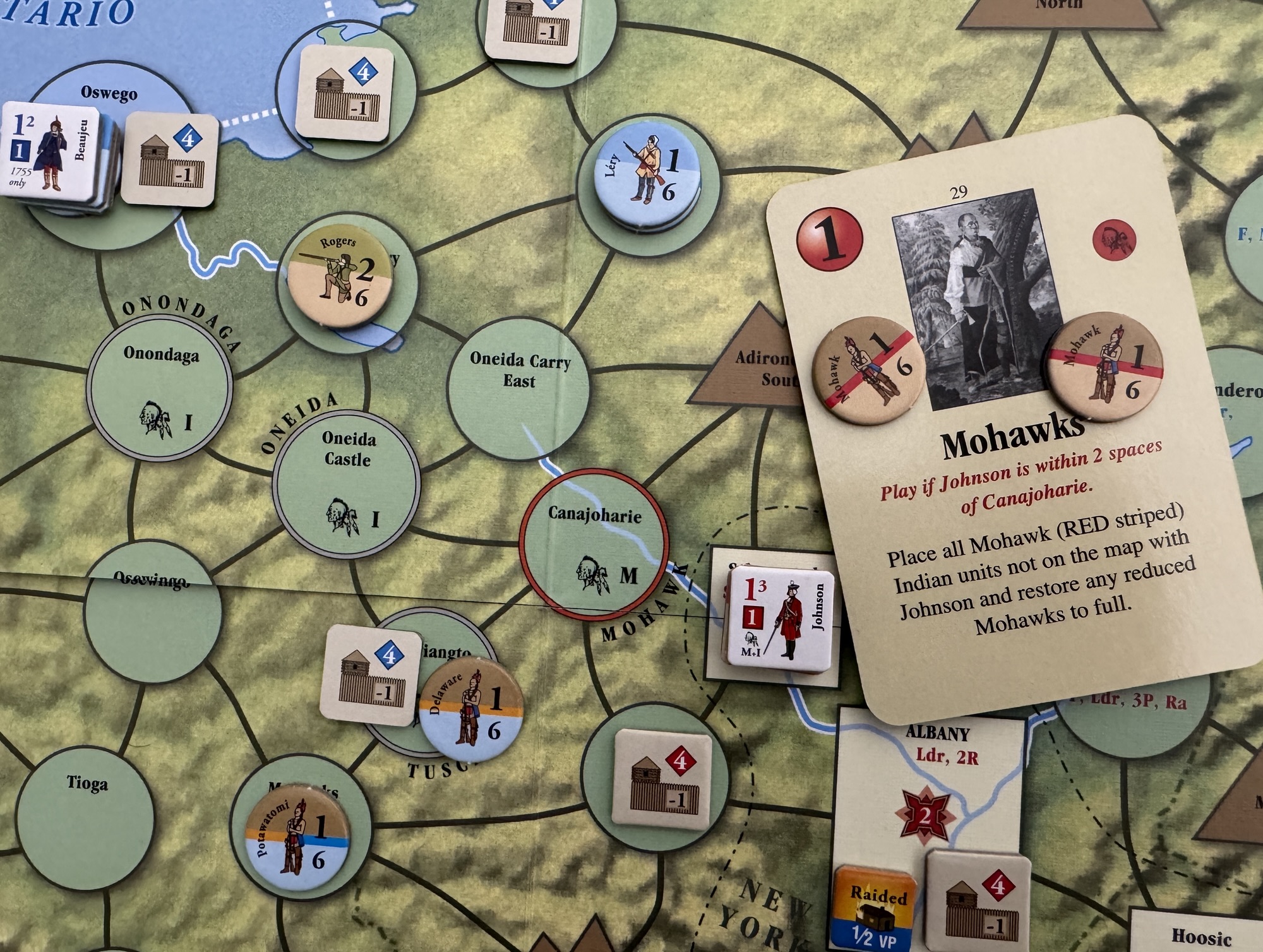
In this entry, we will take a look at the British card Mohawks. Mohawks is one of those cards that has a pre-requisite qualifying condition to play the card. In this case, the qualifier is that the leader Johnson must be located on the board within 2 spaces of Canajoharie, which was a Mohawk village located in upstate New York. As long as he is within the required 2 spaces, the card can be played to bring out onto the board the Red striped Mohawk Indian units. These must be placed with Johnson and the other added benefit is that any reduced Mohawks on the board can be flipped to their full side. These pro-British units can only be recruited by the British player and their arrival in New York can be a huge boon to the British as the French and their Indian allies will be raiding the villages and settlements up and down the frontier regularly during the game as one of their most dependable sources of Victory Points. These Mohawk allies can spread out around the area and intercept incoming raids before they can occur. Remember that Indian allies in Wilderness War are not powerful combat units and are best used to raid and prevent other tribes from raiding.

I very much love the thematic connection here as in order to attract the Mohawk Indians as your allies you must have someone that they trust in the area and this is Johnson. Sir William Johnson was a pivotal British superintendent of Indian Affairs whose deep integration into Mohawk society secured the crucial Mohawk Nation alliance for the British during the French and Indian War. By living among them, learning their language, and marrying Mohawk women, he maintained the Iroquois Covenant Chain and led Mohawk warriors in key victories. This is one of the great things about these Card Driven Games and their use of the cards to deliver the bits and bobs of history to enlighten our understanding and to expand our knowledge of the period.

As a young man, Johnson moved to the Province of New York to manage an estate purchased by his uncle, Royal Navy officer Peter Warren, which was located in territory of the Mohawk, one of the Six Nations of the Iroquois League. Johnson learned the Mohawk language and Iroquois customs, and was appointed the British agent to the Iroquois. Johnson commanded Iroquois and colonial militia forces against the French and their allies during the war and was later commissioned a major-general for his role in the British victory at the Battle of Lake George in 1755. His capture of Fort Niagara from the French in 1759 brought him additional renown. Throughout his career as a British official among the Iroquois, Johnson combined personal business with official diplomacy, acquiring tens of thousands of acres of Native land and becoming very wealthy.

In the next entry in this series, we will take a look at The Wartburg from Here I Stand: Wars of the Reformation, 1517-1555 from GMT Games.

-Grant

HWC Coffee Card Game

HWC Coffee is a Malaysian specialty coffee chain. They made a card game which was given away for free if you bought coffee (and other stuff) worth more than a certain amount within a single transaction. It is encouraging to see this. I would love to have my game designs used in such projects. Zus Coffee had something like this just last year, a Sembang Raya card game. Something that promotes

Imposter Syndrome

23. März 2026 um 23:12

The box art sold me on the game. I never judge a book by its cover. But a box by its lid? Always.

The Imposter Kings reminds me of a game I created as a kid. That probably sounds like a slam. Kids of six and a half aren’t known for making the deepest games.

But it isn’t that. It’s the way the game loops in on itself.

In my game, there were cards numbered one to ten. On your turn, you played a card on top of your dad’s card; on your dad’s turn, he played a card on top of yours. No matter who played, the card had to be higher than the one under it. If ever you couldn’t play a card, you lost and your opponent won. Halfway into our first play, I realized that high cards were infinitely better than low cards. So I made up a new rule on the fly. You could play a one on top of a ten, looping back around to the start of the sequence.

There’s more to The Imposter Kings. Lots more. The game’s designer, Sina Yeganeh, was too sharp to think that numbered cards would be interesting enough on their own. So this is one of those games with plenty of special abilities and triggers and the occasional reaction that plays out of sequence. At core, though, it’s a game about playing the right card so that your opponent can’t follow it up with something better, about knowing when to double down with a high card and when to loop back to the beginning. Exactly like my own game. Just, you know, interesting. I’ve played it more than once, for example.

"KISS!" I shout at the card I play over the other card, consternating my fellow players. They play another card, thinking, "Surely he will not shout 'KISS' this time." I play a card atop their card. "KISS!"

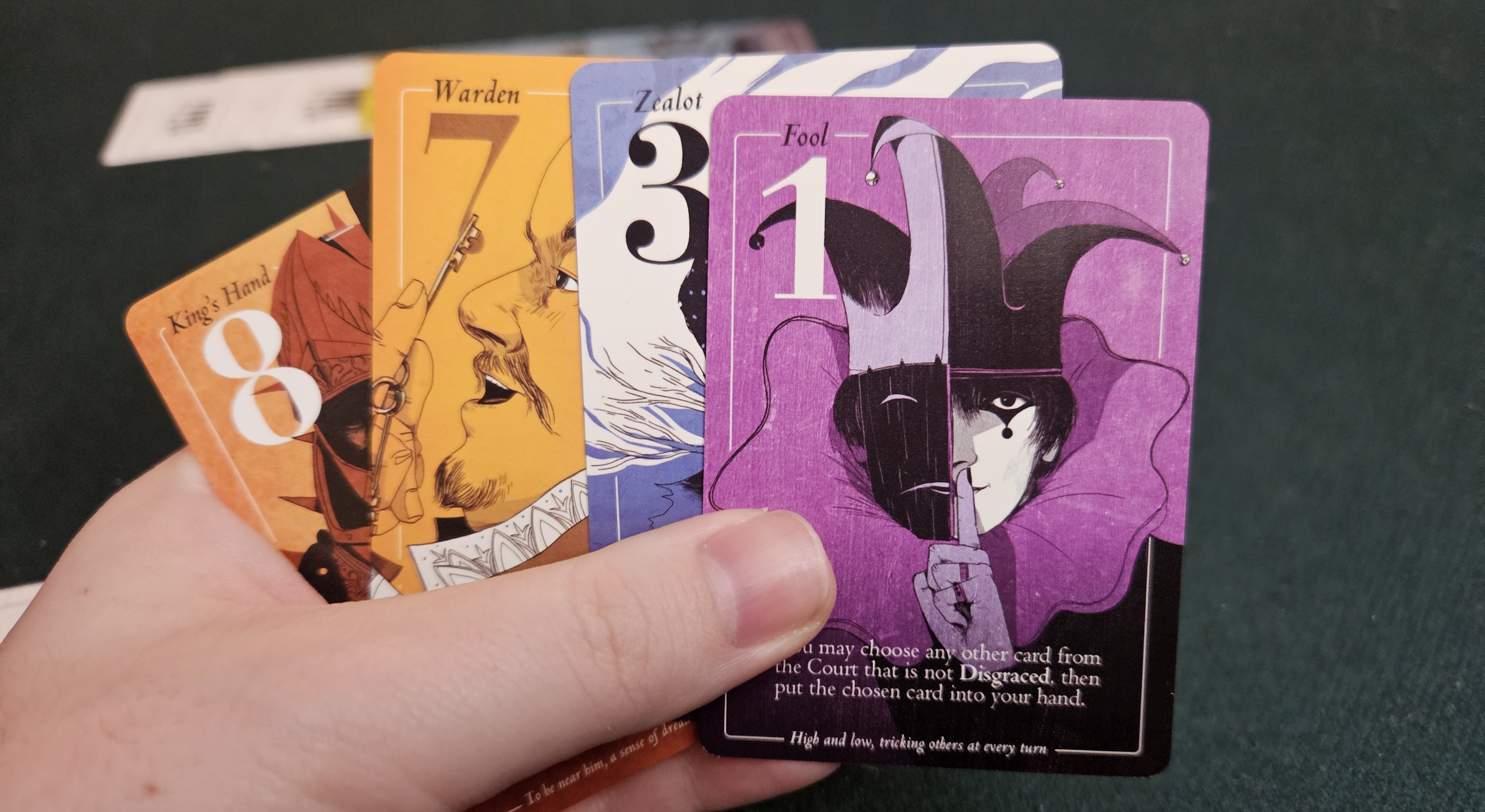
Just a few of the game’s many nasty cards.

On the whole, though, The Imposter Kings always comes back to that one central idea. Either you play a card or you lose. Very quickly, this becomes much harder than it might first seem.

Here’s the obvious conundrum. Let’s say you’re holding a nine. The highest rank. The number of royalty. If you were a six-year-old Dan, that would be the best card in the entire game.

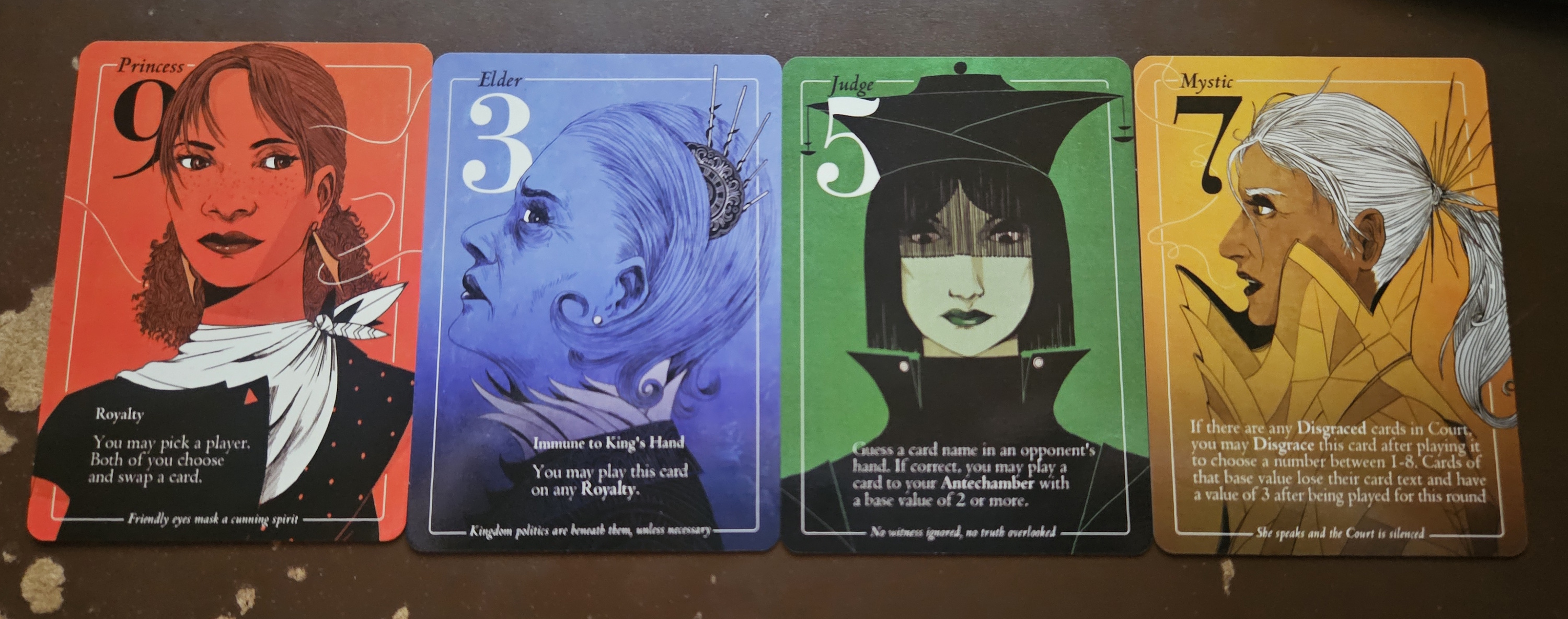
But playing a nine is a fraught proposition. First of all, there are two nines. In The Imposter Kings, you can play any card that’s higher than the one currently seated on the throne. Higher or equal to. So a nine can beat a nine. The Princess comes along and deposes the Queen. The Queen puts that upstart brat Princess in her place. Whoops.

But even if that happens, other cards specialize in deposing royalty. The Elder, for instance, is a lowly three, but loves to swoop in and rap those royals on the knuckles. Or there’s the Oathbound, a bandaged character who can flip an enthroned royal face-down — a trick called “disgracing” — to take the seat and then follow it up with another card of any value. Spending two cards at once decreases the longevity of your hand, especially in a game about being the last person to play a card, but maybe your follow-up will hold the throne for good.

But there’s the question of everybody’s King. When the game begins, everyone is dealt a King. They then choose a card from their hand to place face-down next to the big guy. This is their successor. Once per game, you can flip your King and take your successor into your hand. Oh, and the card currently on the throne? Disgraced. Face-down. Value one. Boop de boop.

But flipping your King is dangerous, too, thanks to the Assassin. This is one of the game’s few reaction cards, and it kills a King the instant they’re flipped. So much for that once-per-game bonus.

But there are ways to out any would-be Assassins. The Judge and the Soldier both excel at revealing whether an opponent is currently holding a card, and both earn a tidy bonus if they’re right. Or there’s the King’s Hand, another reaction card, good for blocking an ability. Or you might make use of the Executioner and Inquisitor, both capable of stripping a card from somebody’s hand outright.

But you might need those abilities for something else. Or perhaps the Assassin is lurking as your rival’s successor, which would mean they could pick them up after you’ve spent the very courtier who could get rid of them.

But… well, there are answers to such a possibility as well, but I think we’ve drawn out this particular strand to its maximum elasticity. The point is that every decision in The Imposter Kings is unusually burdened, unusually dangerous. It isn’t unusual to spend a minute examining your hand. Even when — maybe especially because — there are only a half-dozen cards available at any given moment.

That's a lot of kissing.

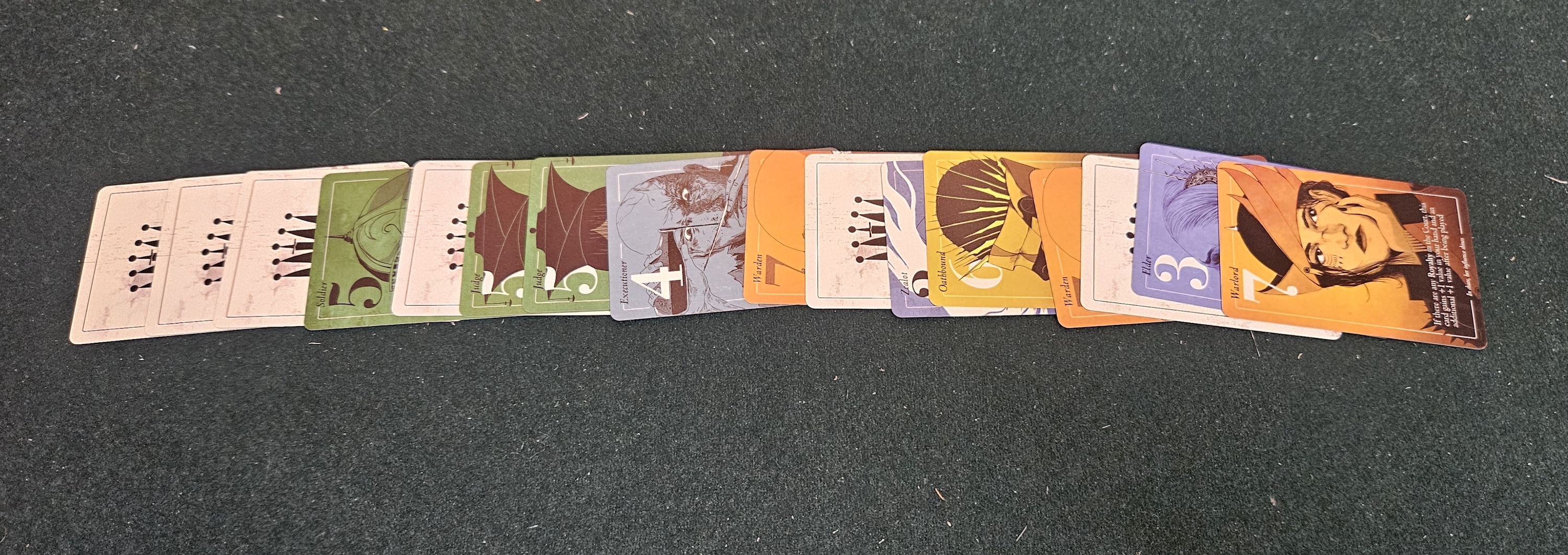
A late-game court, full of disgraced or displaced notables.

At best, these decisions feel like little masterstokes. There are elements of deduction, not to mention memory, not to mention yomi, not to mention hoping like hell your rival makes a big dumb mistake. That’s a lot of punch for such a little game. And make no mistake, The Imposter Kings is very little. With two players, you only use eighteen cards at a time. Adding a third or fourth player ups the amount, as well as injects some extra variety, but not by as much as you might expect.

At the same time, the entire process feels algorithmic. Like you’re playing through a flowchart. The Imposter Kings comes across as the sort of game a computer would excel at, its digital spreadsheet mapping the best possible option five, six, a dozen moves out, all those counters and counter-counters charted in advance. Depending on the player count, Yeganeh assuages his game’s near-perfect information sphere, sometimes by keeping a card or three hidden off to the side, sometimes by sheer dint of seating too many players to leave you certain about what anybody is holding.

But like six-year-old Dan deciding that ones can beat tens, these gestures still sometimes come across as patches. Even at the best of times, The Imposer Kings asks a lot of one’s short-term memory. What you’re holding, what you’ve seen played to the court and then disgraced, which cards you threw away when the round began. The player aids are helpful, listing every possible card at the table, but they stumble by not revealing which cards have a duplicate in the deck. Not that it takes a long time to recognize which singles are actually doubles. One benefit of only using eighteen to twenty-something cards is that there isn’t that much to hold in your head.

The bigger mitigating factor is that The Imposter Kings isn’t meant to be played once. Like card games of olde, it’s intended as a many-handed experience, players doing what they can to secure not just one win, but many wins of variable strength. Defeating a foe with cards still in their hand, or while your King is still hidden, or both, is better than eking out a victory through the barest margin. This ablates the luck of the draw, at least to some degree.

It’s also exhausting, requiring one hard-fought win after another to finally scratch out a full victory. In our experience, reaching the necessary seven points takes more time and energy than its slender exterior would indicate. Especially as players grow cannier to one another’s tricks, these sessions can sprawl outward in duration and bitterness — but also in how deviously they permit players to act.

It is me reviewing this game.

Ah, the fool. It is me. It is I.

Here’s the bottom line. Like the game’s cardplay, my feelings on The Imposter Kings are nested and complex, but ultimately they return to a few simple ideas. One, this is a handsome game that’s easy to play but devilishly hard to master. Two, in its efforts to overcome certain inbuilt limitations, it comes across as patchy and overstays its welcome. Three, even slightly different play counts produce radically distinct sensations. Where the two-player game is tight, sometimes even too constricted, and the four-player game devolves into an awkward team-building exercise, the three-player game is utterly perfect, cluttering the game’s headspace just enough to keep everybody guessing, but not robbing it of any of its devious excitement.

Until it falls apart, that is. Because, again, like the cardplay, The Imposter Kings isn’t only one thing. It’s an exercise in high cards trumping everything else, except for the low cards that beat them. Critically speaking, it’s a game where the good outweighs the bad until the bad outweighs the good. Back and forth it goes, never quite settling in one place.

And I’m afraid that’s as definitive as I can be. In the end, The Imposter Kings makes an imposter of me, too. With it on the table, I feel like a kid discovering cards for the first time. The highs. The lows. And everything in between.


A complimentary copy of The Imposter Kings was provided by the designer.

(If what I’m doing at Space-Biff! is valuable to you in some way, please consider dropping by my Patreon campaign or Ko-fi. Right now, supporters can read about which films I watched in 2025, including some brief thoughts on each. That’s 44 movies! That’s a lot, unless you see, like, 45 or more movies in a year!)

❌