Normale Ansicht
In Memory of Penelope
Our dear cat Penelope has died. Thus, the history today is personal.
Penelope’s early life is shrouded in mystery. She lived on the streets, but we do not know for how long and if she had been in a human household before. In 2016, she was found and taken to an animal shelter. For the next three years, nobody wanted to adopt her… until we came there and found her to be a somewhat reserved, but very sweet middle-aged lady.
She integrated into the family immediately: One day after her adoption, she already strategized how to blunt the Prussian invasion of Bohemia.

From then on, she was our constant companion. She read with us…

…celebrated Halloween…

and Christmas with us…

…rid our place of provocative ribbons…

…tested all boxes for their sitting qualities…

…and had secret admirers who sent her bouquets.

She even found the time to adopt a secret second identity as quirky nanny Purry Poppins.

Her love for board games remained undiminished. Sometimes we suspected that she considered herself to be a board game.

The only thing she could not abide was me going for business trips. Big-eyed protests were staged on my suitcase.

Yet when I came back and played a game with her, everything was forgiven.

While she certainly enjoyed the games…

…the most important part to her was spending quality time with her family – for example, sitting on my lap while I sorted counters into trays.

Penelope was with us during tumultuous years. No matter if Covid forced us to stay at home or Putin threatened to cut off our energy supply, it was always a comfort to have a furry, affectionate companion with us.
As Penelope aged, her health deteriorated. She succumbed to a lung edema on March 11. She will be greatly missed.

Designer Diary: Flip Pick Towers
by Adam Porter
Following the huge success of Voyages, many designers were keen to replicate Postmark Games’s model of crowdfunded, print-and-play, roll-and-write games. In early 2022, I was approached by an illustrator and graphic designer. He was unknown to me, but clearly talented, and he asked whether I’d like to collaborate on such a project. The arrangement was simple: I would design the rules, he would handle illustration and crowdfunding. There was no contract or firm commitment, but it felt worth exploring.
I immediately knew I wanted to create a flip-and-write game using a standard deck of playing cards. My favourite titles in this genre are Cartographers, Avenue, and Welcome to, so these served as my inspiration. I pulled together a few initial concepts and approached my good friend and frequent collaborator Rob Fisher (co-designer on Qwuzzle, Kompromat,Happy Hoppers, and Emberheart). As often happens, Rob wasn’t keen on my early implementations, but he liked the core idea. He took it away, and a few days later came back with a clear vision: a tower-building game.
That immediately connected with something from our past. Five years earlier, Rob and I had worked on a trick-taking card game about building totem poles. After each trick, players would pick a card and stack it into their own display, forming totem poles. The game was called Trick Pick Totem, describing the sequence of play. We never finished the design. We were uneasy with the theme, and the card play never quite clicked. But one mechanism stayed with us: when stacking numbered cards, values had to descend from bottom to top, while special cards bent the rules and opened up new scoring possibilities. That idea became the foundation of our new design.
We started referring to the new game as Flip Pick Towers – an evolution of Trick Pick Totem – once again a literal description of the turn structure: flip cards, pick one, draw towers.
Rob’s starting point for our flip-and-write was inspired. With an illustrator already attached, he imagined a game that became more beautiful as you played. Many roll-and-writes have clever systems but unattractive interfaces, like spreadsheets. Others begin with an appealing illustrated sheet that steadily degrades as players cross things out. From the very beginning, we set a guiding principle: the sheet should start relatively plain (framed by a nicely illustrated surround) and become richer and more ornate over the course of play. Players should be able to express themselves through their drawings – but without that being a requirement. Boxes, numbers, letters, or stick figures should work just as well, if players preferred.
I’m a strong believer in identifying a hook early in development. For Flip Pick Towers, it was simple and clear: ‘a flip-and-write game where your player sheet gets more beautiful as you play’.
Two other pillars quickly followed:
1. The game could use only a deck of cards and a sheet of paper.
2. It should be playable virtually, by any number of players (very much a product of our COVID-era mindset).
The earliest version used the numerical cards from a standard deck of playing cards. As in Welcome to, three cards were flipped; and all players chose one to utilise. Numbers represented floors in a growing tower, while suits allowed you to mark spaces in a small grid on your sheet. Completing lines in the grid unlocked decorations – banners, windows, treasure, beanstalks – each scoring in different ways.
Early Sketch. 18th May 2022. At this point, Royal Cards represented different types of roof.
The next step was to find roles for the royal cards. The solution was obvious and intuitive – they would live in the towers. Kings scored if placed in the highest room; Queens scored if royals were grouped together; Jacks scored for the number of banners on their tower.
We pieced together rules for the remaining cards, to maximise the use of a traditional deck. Selecting an Ace granted you a special ability which would allow you to break the tower-building rules in some manner (similar to our special cards in Trick Pick Totem). But what about Jokers? Well… they attracted dragons – fun to draw but they cost you points. What do dragons love? Gold. So we allowed players to discard one of their previously drawn treasures to persuade a dragon to fly on by, avoiding the penalty.
We imagined that players might like to colour and elaborate on their illustrations and share their finished towers online, much as they did with the wonderful map-building game, Cartographers.
21st May 2022. Royals now occupied the towers.
A couple of weeks had passed since the initial proposal by the illustrator, so I dropped him a message to let him know we had a game to show him. And… nothing. No response. Repeated messages went unanswered. And I felt a little deflated. Rob and I were left with a fun little print-and-play game but no collaborator and no obvious route to market. Neither of us was keen to run a crowdfunding campaign ourselves. And I had fallen completely in love with the game. I played it solo over and over. This was some of our best work, and we felt it deserved a full production, with a box and fully-illustrated, dedicated deck of cards.
26th May 2022. First prototype with printed sheets.
As development continued, the limitations of a traditional deck became more obvious. We had clever ideas for roofs and bridges between towers, but they cried out for bespoke cards to make them intuitive. More importantly – inspired by the variable objectives in Cartographers – we could see huge potential in how Kings, Queens, and Jacks might score, but realising that variety required a separate deck of scoring cards.
4th June 2022. Rules continue to develop. In this version, Royals could occupy bridges and roofs and they had fixed scoring, rather than variable objectives.
So we made a pivotal decision: abandon standard playing cards and create a dedicated deck. This allowed us to fine-tune card distribution, deepen thematic immersion, and introduce new options. Jacks became Princesses. Aces became Wizards.
We designed a deck of 30 different scoring objectives. At the start of each game, one objective is assigned to each royal – Queen, King, and Princess – creating an enormous number of possible combinations and dramatically increasing replayability. Queens might score for being adjacent to beanstalks, for each dragon in the same row as them, or for occupying your tallest tower. Kings might score for bridges in the same row, or treasure in the same column, or being adjacent to an empty room. Princesses might score for being above or below windows, or other princesses. I got more and more hooked on solitaire play, and started to think about how to approach the ‘win’ condition when playing alone. I wanted something more engaging than ‘beat your high score’. I’d enjoyed the system in Button Shy’s Sprawlopolis, where multiple objectives each have a target score that combine into a single goal. I borrowed that idea, but added difficulty levels: each objective in Flip Pick Towers has an easy, medium, and hard target. Your chosen difficulty determines your overall target score for the session.
7th June 2022. Rob imagining what a player sheet might look like with a professional illustrator
involved
Osprey Gameswere always our first-choice publisher. I’d pitched to them several times at UK Games Expo without success, but Rob and I admired their catalogue and the care they put into presentation – particularly with the Undaunted series by my friends Trevor Benjamin and David Thompson. I knew my original contact at Osprey had moved on, so I asked David who handled submissions now. His answer was Rhys ap Gwyn, and by sheer coincidence, Rob and I already knew him well. Years earlier, when Rhys was living in Cardiff, he was a regular at our weekly design group. We had playtested many of his prototypes and he’d playtested many of ours. So, our fears of needing to build new bridges with Osprey were unfounded. We just needed to drop Rhys a quick note on Facebook!
11th February 2023. Moving away from traditional deck. Now with icons for different resources, and special cards for roofs and bridges.
I showed Flip Pick Towers to Rhys at UK Games Expo in June 2023. In September, he told us Osprey wanted to publish it, but not until 2026. Because of the long timeline, he generously encouraged me to show the game to other publishers.
At SPIEL Essen that October, I pitched several designs, but two stood out: a worker placement game which would go on to be released as Emberheart, and Flip Pick Towers. Both games got a reaction unlike any games I had pitched before. Multiple companies were interested in one, or both, games. One publisher phoned me a few hours after I pitched Flip Pick Towers to him, and told me he wanted to publish it. I said, “But you haven’t played it yet”. He said, “That doesn’t matter. If there are elements which need to change, we can change them. But I don’t want you to show the game to anyone else.” The pressure spooked us, and Rob and I declined.
On the flight home, I was sat across the aisle from some other SPIEL Essen convention-goers. I could hear from their conversation that they worked for Osprey. I introduced myself and it turned out they had all played the Flip Pick Towers prototype and loved it. After weighing our options, despite the wait, Rob and I agreed that Osprey still felt like the right home. Enthusiasm counts for a lot. We signed the contract.
A couple of months later, Rhys sent us a selection of images from a handful of different illustrators, and asked our opinion about which might be suitable for the game. Hungarian artist, Beatrix Papp, was our preference because of the simple sketchy appearance of her drawings – they didn’t feel a million miles from the type of drawings players might create on their own sheets. Over the following months, Rhys involved us in every aspect of the visual development of the game, regularly checking in with us with each new batch of images from Beatrix.
We were hugely impressed with the attention to detail in the artist’s brief written for Beatrix, which extended to many pages. Here is an extract:
“Whimsical fantasy. This is aimed at casual gamers and families and will be marked as 14+. However, we are not aiming for elements to be too cute. It would be great to give it a little edge, which is why we’re really excited to have you as an illustrator. Elements need to be simple, to encourage people to draw, rather than intimidate them. As such, we don’t need detailed backgrounds or anything, just little touches to indicate the situations / environment, as with the art that drew us to you. We also love the limited palette.”
Sosban the witch, Welsh for ‘saucepan’.
A challenge at this stage was calibrating complexity. Flip Pick Towers isn’t difficult to learn, but it introduces several unfamiliar systems. Each feature we added increased strategic depth but risked accessibility. We included stars on the player sheets with bonuses if you reached them with your towers. We tried reducing the number of columns. We removed bridges and roofs for a basic introductory game. But all of these changes diminished the game somewhat. Eventually, we accepted that the game needed to be presented in its best, complete form, and trusted players to meet it halfway.
Tall towers look tasty to Mellt the dragon, searching for a nest! Mellt - Welsh for ‘lightning’.
One pivotal design decision was formalising the behaviour of dragons. In the earliest versions of the game, they simply deducted points. In the final version, they arrive unannounced and perch atop your towers, preventing you from building any higher unless you feed them gold. Flip Pick Towers is intentionally low on player interaction. Aside from a few competitive elements – such as rewarding the first player to place roofs, or those with more windows than their opponents – most of the game unfolds independently. This choice ties directly to one of our core design pillars: Flip Pick Towers supports any number of players. However, we also wanted to offer a more interactive variant. Once again, we looked to Cartographers for inspiration, particularly its handling of monster attacks. In Flip Pick Towers’s competitive variant, when a dragon appears, an opponent chooses which of your towers it occupies, adding a sharper edge of player interaction for groups that want it.
At some point in this process, Rhys suggested weaving Welsh references into the game’s backstory. It seemed logical – castles and dragons are a huge part of the Welsh identity. ‘Y Ddraig Goch’, the red dragon, symbolises the country and appears on our national flag. Rob and I have both lived in Wales throughout our entire adult lives, and both of us have children who are Welsh. Rhys is Welsh – his surname ‘ap Gwyn’ means ‘son of Gwyn’ in Welsh, with Gwyn meaning ‘white or fair’). My design-focused YouTube channel is called Adam in Wales. This Welsh connection was a wonderful development, and it helped to make the project feel deeply personal. Wales has a rich history of myths, passed down orally by druids, and recorded in medieval manuscripts.
King Llew, Welsh for ‘lion’.
Our King is called Llew after a hero of Welsh mythology, and the Queen is named Blodwen, a name common in Welsh legends. The dragons carry the names Fflam and Mellt – Welsh for flame and lightning, and featuring the familiar Welsh double-letters. The wizards are now magical creatures: Bwca, the Welsh hobgoblin; Mab, the Queen of the fairies, made famous in Shakespeare’s Romeo and Juliet. We also opted for some more whimsical titles: a centaur named Ji-Ji, a name inspired by a Welsh nursery rhyme about a horse; a witch called Sosban, the Welsh word for Saucepan… just because it amused us! The rules explain that the winner of the game must jump up and down and shout ‘Bendigedig!’ meaning fantastic or marvellous! The rule book contains a guide to the origins (and pronunciation) of these names.
We explored many possible titles for the game, but they all felt generic. We’d grown attached to Flip Pick Towers, and we were delighted when Osprey agreed to keep it.
With artwork complete, the first half of 2025 was spent refining rules and polishing the rulebook, ensuring clarity without losing the sense of fun and whimsy. Rhys showed me a near-final prototype at UK Games Expo in June 2025. At SPIEL Essen, four months later, a full production copy was available for demo. I loved teaching the game. It’s ideal for learning as you play because, in that first game, every new card flipped introduces a new character – a princess, an imp, a witch, a dragon – or a building feature – a bridge, a roof – and players are always excited to learn what each new element means.
Flip Pick Towers is my twelfth or thirteenth published game (depending on how you count them…) and my fifth co-design with Rob. It is the game where we have had the most direct input at every stage of production, and that has been a real joy, making the project deeply personal for Rob and myself. We hope you love it as much as we do.

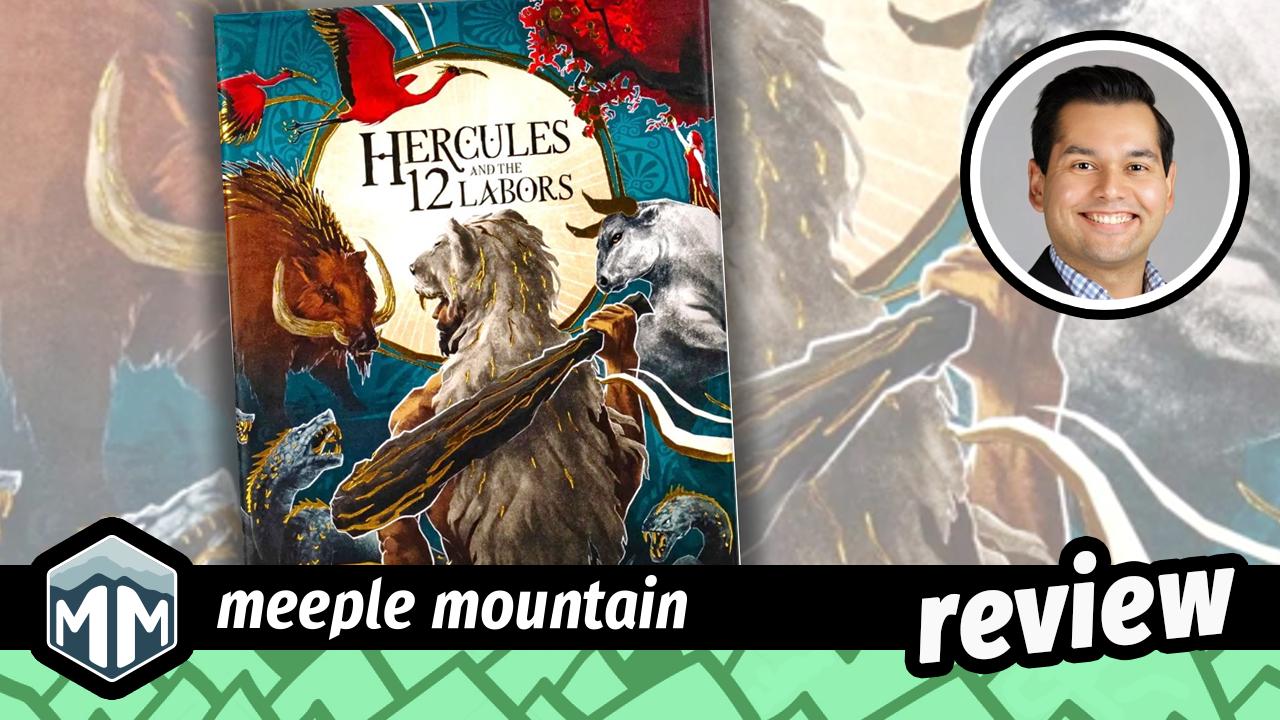
Hercules and the 12 Labors Game Review
Wonder Boy, Hercules
I’m a fan of mythology in general. There’s a childlike wonder that comes from reading stories of epic heroism, self-sacrifice, memorable characters wrapped up in the hero’s journey formula. I remember when Disney’s Hercules came out in 1997, I was engrossed in the mania of toys, picture books, and even the promotional plates in partnership with McDonald’s (yes, back then McDonald’s had tableware!).
![]()
Fast forward to today, and while I don’t have kids of my own, the inner kid is always drawn to mythological stories. Though the actual story of Hercules and the 12 Labors is vastly different from the children’s cartoon, complete with graphic violence and other adult themes.
I was excited to link up with Mathue Ryann from Envy Born games last year, both over our mutual Friendsgiving of bourbon and board games, and at PAX U, where Hercules and the 12 Labors debuted. This title, with all the gold foiling and pizzazz, follows a format of grinding through a deck of cards in the similar vein of Kinfire Delve, One Deck Dungeon, and Witchcraft!
![]()
On a nice Sunday afternoon, I find myself playing solo games with a cuppa tea, and this…
The post Hercules and the 12 Labors Game Review appeared first on Meeple Mountain.
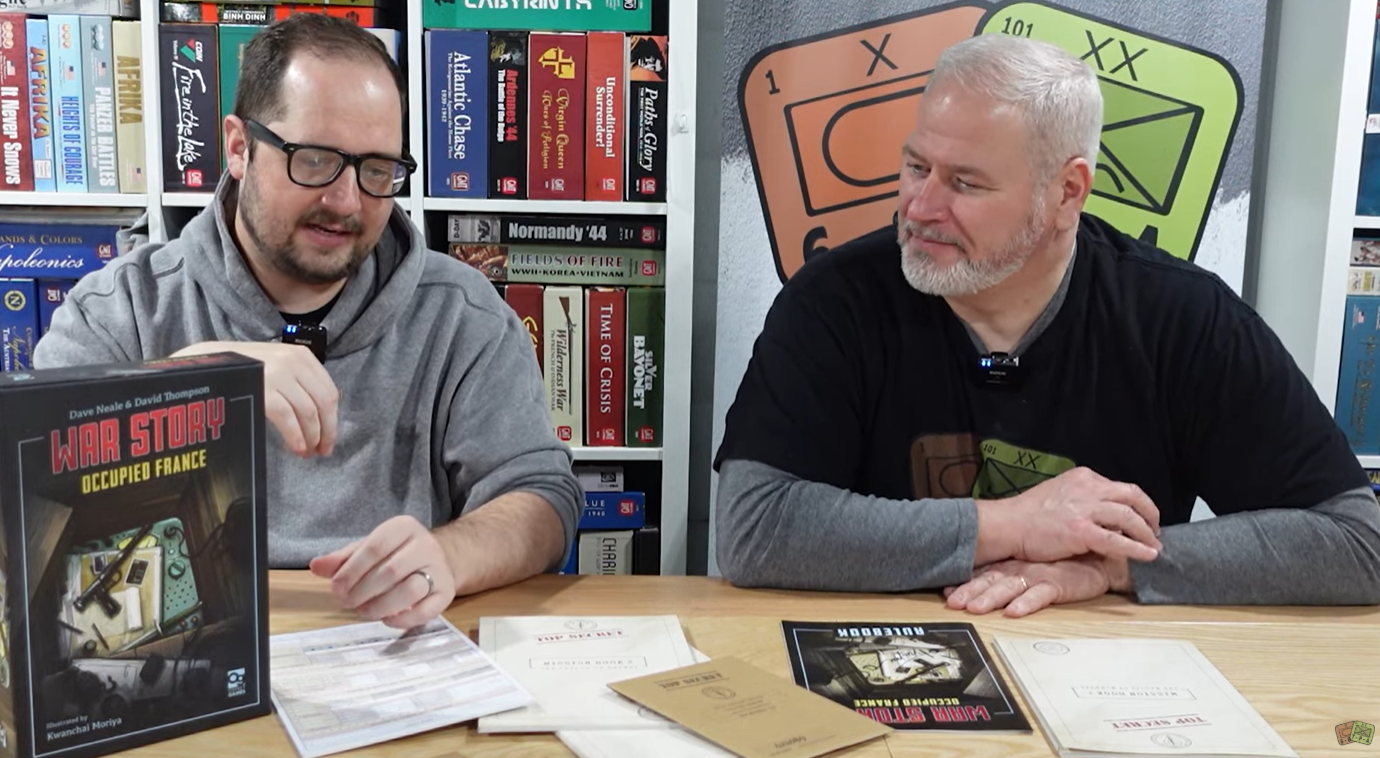
Video Review: War Story: Occupied France from Osprey Games
War Story: Occupied France is a co-operative narrative game for one to six players set in World War II occupied France that captures the stakes and tension of espionage and resistance warfare. Your team of covert operatives is all that stands between the infamous German officer Heidenreich and the systematic destruction of French Resistance forces in Morette.
Through three replayable story missions, you must exploit the specialties of your chosen agents to uncover information, enlist allies, and obtain weaponry. Engage occupying forces on tactical encounter maps where careless positioning could cost your agents’ lives. Remember, no plan survives contact with the enemy…and time is running out.
I wrote a fairly in-depth First Impression post and you can read that on the blog at the following link: https://theplayersaid.com/2024/10/22/first-impressions-war-story-occupied-france-from-osprey-games/
-Grant

Dale Yu: Preview of The Color Monster Travel Edition
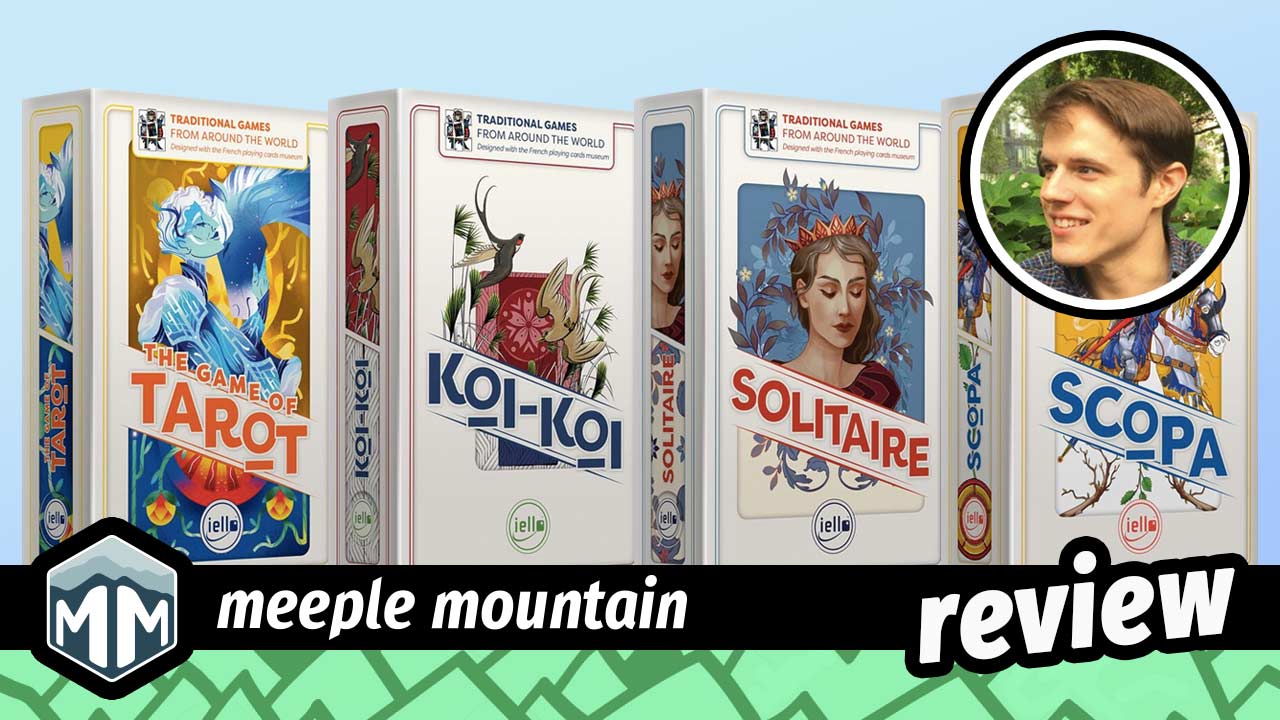
Iello’s Traditional Games Line Game Review
Concerning Formatting
Before we begin, we should discuss formatting. Meeple Mountain’s house style is to italicize the names of games. Arcs, Catan, Kabuto Sumo: Sakura Slam. This is not contentious. They are, after all, titles of authored works, and deserve the grammatical demarcations befitting their status. When it comes to classic, authorless games such as chess and checkers, there is a schism within the church of Meeple Mountain. Some believe they should be capitalized too, but this has (as evidenced just now by my flagrant disregard for the house style) never sat well with me. Chess has no single author. “Chess” is a name, but it is not a title, and the dominant English convention is to neither italicize nor capitalize it.
The same is true of most traditional games, a number of which will be discussed in the article that follows. Cribbage, oh hell, solitaire, koi-koi, and canasta will come up, but they will only be capitalized if they happen to begin a sentence, and they will only be italicized for the purposes of emphasis. This would not be worth explaining if this article did not also cover French Tarot and scopa.
You see the issue.
“French Tarot” is generally capitalized in English in order to separate the card game (French Tarot) from the deck with which that card…
The post Iello’s Traditional Games Line Game Review appeared first on Meeple Mountain.
-
The Players' Aid

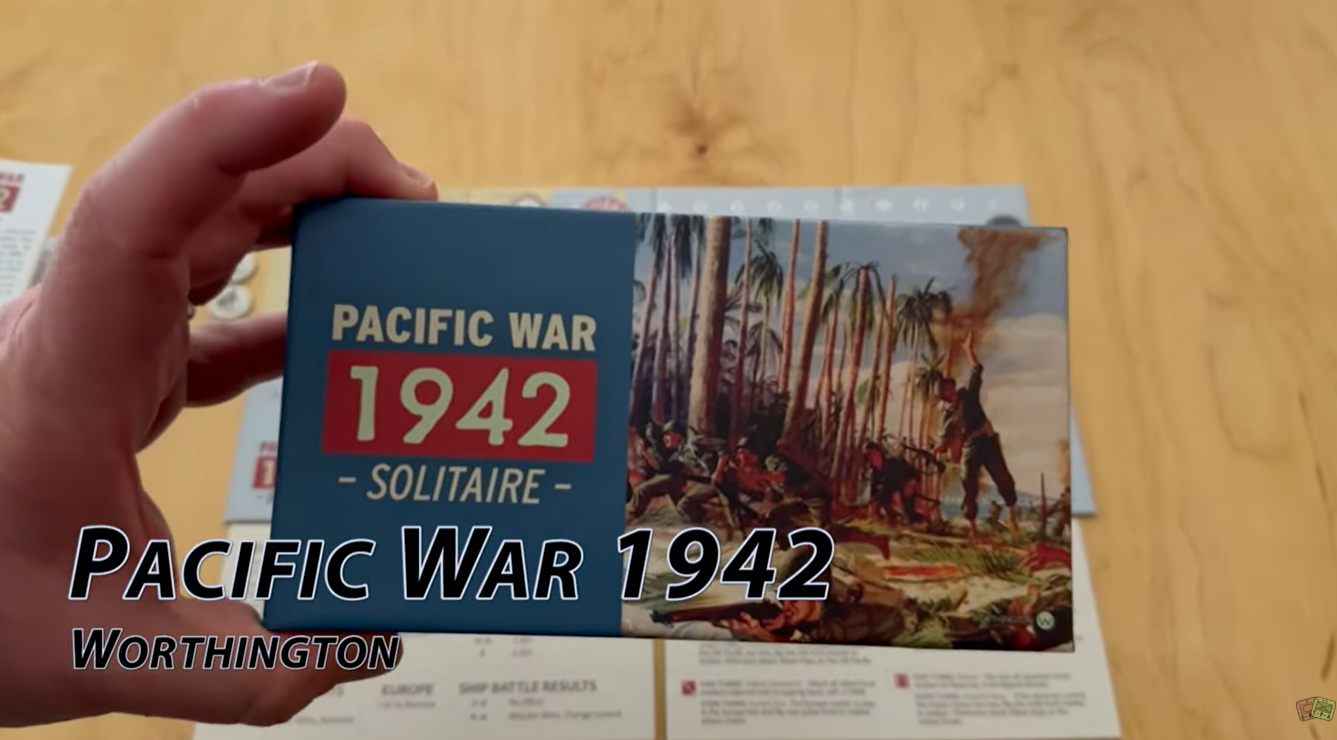
- Solitaire Video Review: Pacific War 1942 Solitaire Travel Game from Worthington Publishing
Solitaire Video Review: Pacific War 1942 Solitaire Travel Game from Worthington Publishing
In early 2024, Worthington Publishing announced a unique 2-pack of games on Kickstarter that were marketed as easy to play travel friendly solitaire games. And you know that I love a good solitaire wargame! And when I heard that these games were small, even portable, then I was even more interested. One of the games covered the Pacific Theater of WWII called Pacific War 1942 Solitaire and the other covers the War of 1812 called (you guessed it) War of 1812 Solitaire. These games are designed by Mike and Grant Wylie and each game has 4 pages of rules, a beautiful mounted board and double sided counters. I played both and really very much enjoyed the experience.
I wrote a fairly in-depth First Impression post and you can read that on the blog at the following link: https://theplayersaid.com/2024/08/20/first-impressions-pacific-war-1942-solitaire-travel-game-from-worthington-publishing/
-Grant

Space Empires 4X (aka Space Imperia) Demo Thoughts
The computer version of Space Empires 4x (Space Imperia) has a steam demo and I took some time away from Slaying the Spire to try it.
This is a faithful implementation, nothing else. Right now the demo is against a (poor) AI only and with only parts of the tech-tree available but it was good enough for a demo. The full game promises multiplayer support. Given that Space Empires 4x is all about fog of war, feints and the balance of terror, multiplayer support is required (IMO) and a computer implementation would be a Very Good Thing as it would replace all the fumbling for chips and accounting errors.
A good AI would be a “nice to have” bonus feature, but I get it. It’s perfectly reasonable to learn the game. (I would hope that the full game would implement one of the solitaire variants/scenarios, but who knows?)
But what is it with GMT and computer implementations? Look, I get that programs have bugs (I submitted a few bug reports), but there is just a basic level of …. I don’t want to say incompetence, but maybe “I ain’t got time for that” on the developer’s side. (I rarely worked with graphics engines, but I’ve designed plenty of Graphical User Interfaces in my day). From what I saw:
- I’ve played SE4x multiple times (the last a few years ago) and even then sometimes I couldn’t do anything and would have to try and figure out why. It was usually correct, but the game never said “This vessel can’t explore” or anything useful.
- No Undo button for a misclick. I get that there are certain points you can’t undo, but there are many you should be able to.
- Frequently windows pop up over other windows, some buttons are hard to see against the background. (I thought the game had locked up but nope, some clear-bordered modal buttons were lurking.)
- When firing in combat, sometimes you must click multiple times to select a ship+target before the “fire” button appears.
- If there’s only one class of target, you still have to select it and fire for each ship instead of just having a “go ahead and just keep on that one class” (maybe just once/round, and then you can have your retreat/screen options).
- No way to speed up combat, or turn off the “yes, commander” when you select a ship (or the random blather they say when firing, just a few options and they got old very quickly) Yes, I could adjust the volume, but the one time they have some effects they are just annoying.
- If there was a way to combine stacks (that have the same exact stacks) I didn’t see it. I did see how to split stacks.
- The board would zoom into combat (fine) and zoom out, but then often back to a weird view. Honestly it feels like whenever they want to try to do something cool, it just makes it more confusing.
Also, because this is a computer game, I hope there are options like “No countermix limit.” The countermix limit existed in the board game because, well, yeah, there are limited counters. Maybe that makes the board game better. Maybe not.
Despite liking the board game, I doubt I will be purchasing the computer game.

Bebop
UK Games Expo and Game Market Spring 2026 Preview List Are LIVE
by Beth Heile
The Preview lists for both UK Games Expo and Game Market Spring 2026 are now live.
Haven't heard of a Preview list yet? Don't worry! There are so many features on BGG it's hard to keep track of them all.
A Preview serves as a list of new and upcoming games that will be available at a specific convention, either for sale or as a demo. Users attending those conventions are able to search, filter, sort, and save information from this list to help them target games they want to try or buy. Users visiting BGG can view this list to see which new titles are popular and getting a lot of buzz before a large event.
Currently BGG is offering Preview lists for the following conventions:
- Spielwarenmesse - list goes live in December
- Festival International des Jeux (FIJ) - list goes live in early January
- GAMA Expo - list goes live in early January
- UK Games Expo - list goes live in March
- Game Market Spring - Previously known as Tokyo Game Market, list goes live in March
- Origins - list goes live in April
- Gen Con - list goes live in early June
- SPIEL Essen - list goes live in July
- PAX Unplugged - list goes live in October
Please do not contact BGG to suggest other conventions to add to this list. We do not have plans to expand our preview lists at this time.
You can find all active and past Preview lists by clicking on "Browse" in the top menu of BGG and then choosing "Previews".
If you are a publisher, the process to submit games for a Preview list has been overhauled in the last few months. Please email news@boardgamegeek.com for a full tutorial or if you are running into any problems.
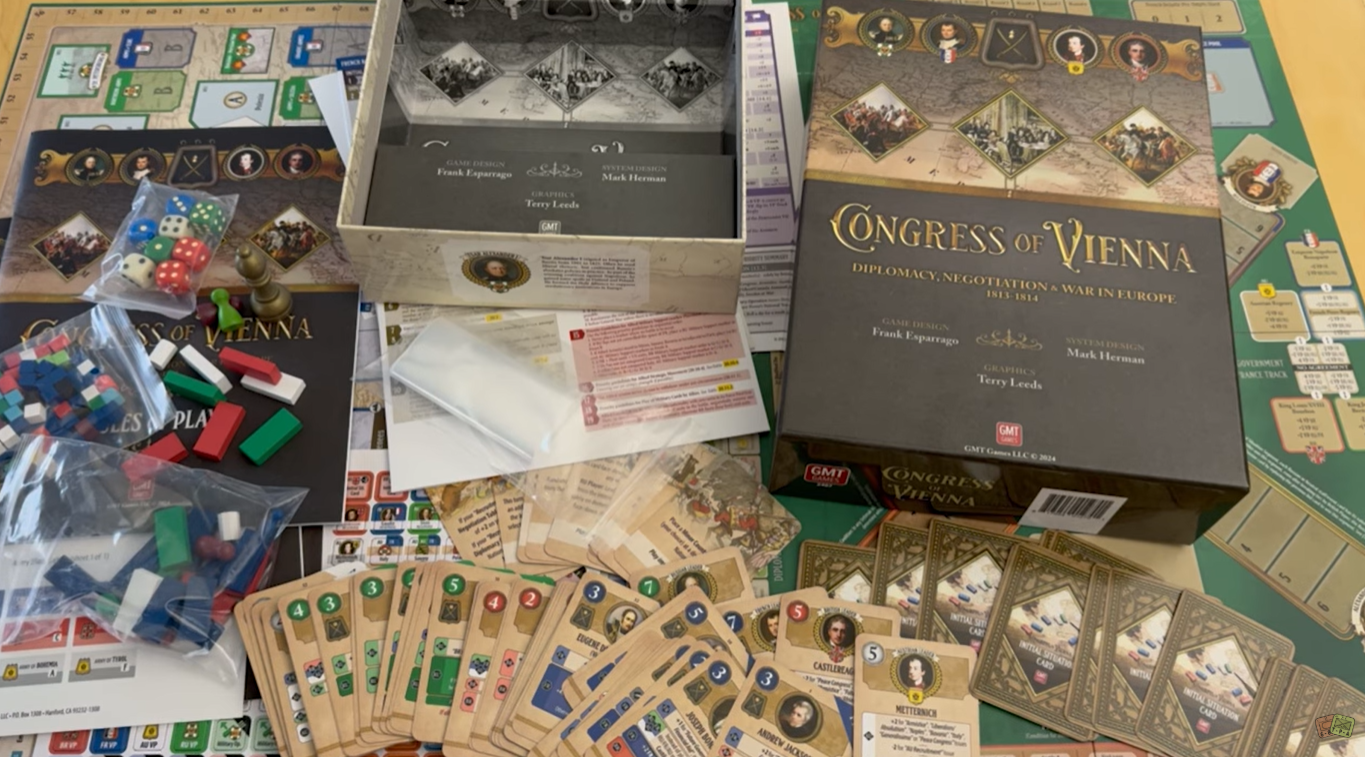
Unboxing Video: Congress of Vienna from GMT Games
A few years ago, after playing all of the games in the Great Statesmen Series, we heard of a new game in the series from a designer not named Mark Herman and I was immediately interested and intrigued as we have had so much fun with Churchill, Pericles and Versailles 1919. Congress of Vienna from GMT Games is a diplomatic card driven wargame based on Churchill and is the 4th game in the Great Statesmen Series. The game is set during the years of 1813-1814 and sees players take on the role of the main characters of the struggle between the Napoleonic Empire and the coalition of Russia, Austria, and Great Britain with their Prussian, Spanish, Portuguese, and Swedish allies. We played the game recently while attending Buckeye Game Fest and then played a full campaign again while attending the World Boardgaming Championships and absolutely were amazed at the changes and innovations to the system introduced by the designer Frank Esparrago.
I posted a fairly in-depth overview of the game in my First Impression post and you can read that at the following link: https://theplayersaid.com/2025/08/06/first-impressions-congress-of-vienna-from-gmt-games/
-Grant

-
Meeple Mountain | The summit of board gaming

- Quick Peaks – Windmill Valley: Blooming Sails, Aeon’s End: War Eternal, Rise of Babel, The Pirate Republic: Africa Gambit, Golem Run
Quick Peaks – Windmill Valley: Blooming Sails, Aeon’s End: War Eternal, Rise of Babel, The Pirate Republic: Africa Gambit, Golem Run
Windmill Valley: Blooming Sails - Justin Bell
On my way out of my meetings with Board&Dice at last year’s SPIEL Essen 2025, our marketing contact asked if I wanted a copy of the new Windmill Valley expansion, Blooming Sails. I thought the base game was fine, certainly not at the top echelon of Board&Dice’s other, better, more combotastic Euros such as Tiletum, Nucleum, or even recent hits like Reef Project and Tianxia. Still, I love games, and one player from my review group really enjoyed Windmill Valley, so I agreed to bring a copy home.
The expansion addresses what most players I know agree to be the weak link in the base game’s design: the Foreign Trade action, where players would drop a tulip bulb to get two meager bonuses—maybe a tool, a point, maybe another tulip bulb—or take all the bulbs on a card to get a lot of bulbs at once. I’m not a Windmill Valley expert, but it was always the action I would cover with another action tile first because I used Foreign Trade so infrequently. The expansion blows that portion of the game up, using a new side board, new Crate bonuses, and a separate boat token used to…
The post Quick Peaks – Windmill Valley: Blooming Sails, Aeon’s End: War Eternal, Rise of Babel, The Pirate Republic: Africa Gambit, Golem Run appeared first on Meeple Mountain.
Top 10 Solo Board Games for Every Kind of Gamer
Asmodee Acquires Japon Brand from CMON
Nekuma is asmodee's new studio for games from Asian designers
-
https://boardgamewire.com/

- Asmodee makes Asia expansion push by buying CMON’s Japon Brand, launching new studio Nekuma
Asmodee makes Asia expansion push by buying CMON’s Japon Brand, launching new studio Nekuma
Asmodee has ramped up its reignited acquisition strategy by buying Japon Brand from CMON, anchoring the board game giant’s push into a “currently untapped market” for the company.
Japon Brand was instrumental in bringing Japanese designs such as Love Letter and Machi Koro to international markets, after being inspired by the surge in novel games from home-grown designers in the early 2000s.
The company will form the cornerstone of Asmodee’s new Japanese design studio, Nekuma, which will look to find games from local designers that it can release globally, as well as helping Asmodee bring its existing titles to Japanese players.
Asmodee CEO Thomas Koegler said, “Japan is one of the most creative and culturally influential markets in the world. With Nekuma and the integration of Japon Brand, we are building a long-term platform that connects Japanese creators with players globally.

“True to Asmodee’s entrepreneurial and bold DNA, this capital-light and agile initiative allows us to invest where creativity is thriving while positioning Asmodee for sustainable growth in Asia.”
Asmodee has grown into a board game publishing and distribution giant thanks to the heavy expansion the business undertook after being bought by private equity firm Eurazeo in 2014.
But the vast bulk of the company’s revenue comes from its operations in Europe, which accounted for more than 76% of its €1.6bn net sales in 2025.
The United States contributed about 13.1% of 2025 net sales, while the company’s entire ‘rest of the world’ net sales – covering every country outside of Europe or the Americas – made up less than 5%.
Asmodee currently has offices in South Korea, China and Taiwan following an expansion to the continent in 2021, with those teams having developed and published localised titles including Splendor Pokémon, Love Letter Cookie Run, Pokémon Chips, and Love Letter Fox Spirit, as well as making use of crowdfunding platforms across the region.
The company said Nekuma would “integrate and expand” that activity under interim head of studio Frederic Nugeron, Asmodee’s current global senior vice president – route to market for the Asia Pacific region.
It said Nekuma would lead game sourcing “to identify and support the most promising Japanese and Asian tabletop game designers”, while Asia-focused publishing will be managed by the company’s existing Korea team.
Nugeron said, “Our ambition with Nekuma is very concrete: be present on the ground, listen to designers, understand cultural nuances, and build trusted relationships within the Japanese ecosystem.
“By combining local expertise with Asmodee’s global reach, we can support creators more closely and bring distinctive Asian games to a worldwide audience.”
Asmodee said Japon Brand would continue to operate with its existing expertise and relationships, with “no impact” on current partnerships or contracts.
CMON Divestments Continue
The buyout comes less than two years after board game crowdfunding major CMON acquired Japon Brand, with a plan to keep it as an independent division that would use CMON’s infrastructure and reach to help it introduce games to the global market.
That investment followed a strong 2023 for CMON, in which its net profit jumped more than 35% amid a hefty drop in its sales-associated costs.
But the company has faced a punishing financial situation since, posting losses of $3m across 2024 and nearly $7m for the first half of 2025 – figures which dwarf the overall $4.2m profit it had managed to make over the previous nine years combined.
As well as laying off staff and halting new game development and campaign launches, CMON has been attempting to recover by selling a string of its most lucrative IPs – including its most famous and profitable title, Zombicide, and Cthulhu: Death May Die, both of which were bought by Asmodee.
Asmodee continued its acquisitions of CMON games last month by picking up bluffing and set collection game Sheriff of Nottingham, which CMON had previously bought from Brazilian publisher Galapagos Jogos in 2016.

The board game giant announced in November 2024 that it was preparing to “reignite” its strategy of buying up smaller board game publishers and distributors, saying at the time that it had a pipeline of more than 20 acquisition opportunities.
But the revived M&A process is yet to fully mirror Asmodee’s private equity-fuelled buying spree from the latter half of the 2010s, during which it acquired more than 40 companies and IPs.
That heavy expansion included the company adding more than 20 game studios, including Days of Wonder, Fantasy Flight Games, Lookout Games, Catan Studio and Z-Man Games.
Asmodee CEO Thomas Koegler was asked during the company’s quarterly results presentation last month whether the company was ready to make “more meaningful” acquisitions rather than small bolt-on deals.
He said in response, “Without being specific, the activity in the pipeline is in accordance with our plan. The smaller acquisitions are faster. IP acquisitions and asset deals are faster to execute. I’m satisfied.”
Other expansion activity since Asmodee announced its M&A plan has included the company launching a new party games studio, Moodbox Games, as part of a push into the US mass market.
It also recently launched a dedicated kids-focused brand, Asmodee Kids, in preparation for releasing a slate of re-worked, simpler and shorter versions of some of its most popular titles.
Asmodee posted record sales of €524m during the last quarter of 2025 despite a slump in its US performance, with trading card game earnings in Europe acting as a driving force for the business.
The board game giant’s overall net sales jumped 22.2% across October to December 2025 compared to the same period a year earlier, with the performance of products it distributes for other companies surging more than 50%.
Net sales for games published by Asmodee itself fell almost 13% year-on-year in the quarter, however, weighed down by US net sales slumping 23% to €70.4m.
That drop saw the US fall behind both France and the UK in Q3 in terms of the company’s highest-performing countries for net sales, with France surging 47% year-on-year to over €111m, and the UK growing 41% to €82.7m.
The post Asmodee makes Asia expansion push by buying CMON’s Japon Brand, launching new studio Nekuma first appeared on .
Selamat Hari Raya
Dale Yu: Review of Fantastic Trails
A Study in Personal Pickiness
I adore Martin Wallace’s A Study in Emerald. The first edition most of all, although even the second edition, with its overly pruned foliage, will do in a pinch. I’ve talked about these games, and their spiritual sequel, multiple times. In some ways, the original Study was one of my first glimpses into the strength of board gaming as fable, as serious historical examination made easier to stomach thanks to its drapery. Like clothes over a mannequin; like speculative fiction describing theory of mind.
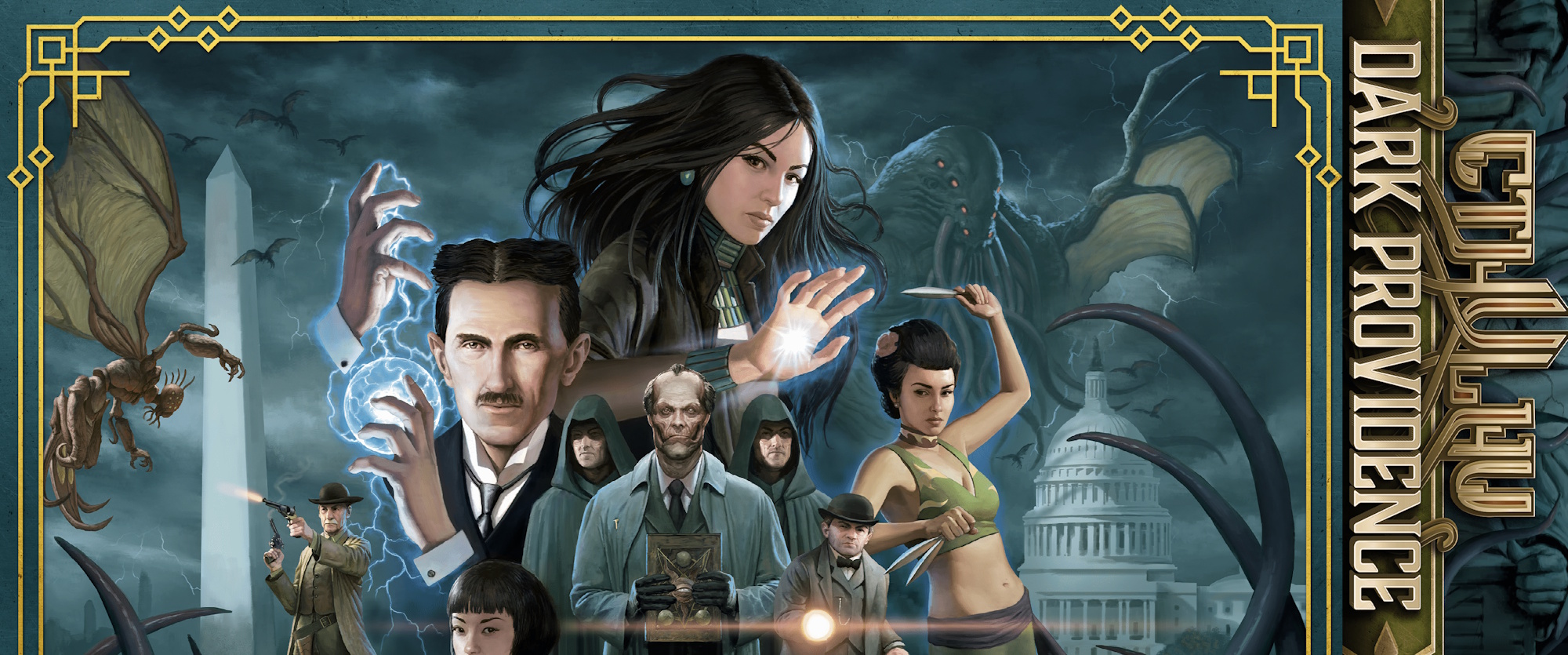
Cthulhu: Dark Providence, co-designed by Wallace and Travis R. Chance, is a remake of Study’s first edition. It’s a very good game. An excellent game. As a design artifact, it improves upon Study in fascinating and crucial ways. I’d be happy to introduce it to anyone who wants a glimpse into what board games can accomplish.
And yet, I can’t help but miss the original. There’s some rosy nostalgia at play. Of course there is. But I’m also longing for that original game’s fangs. And no, I’m not talking about how this edition swaps out the vampires for red-eyed knockoffs.
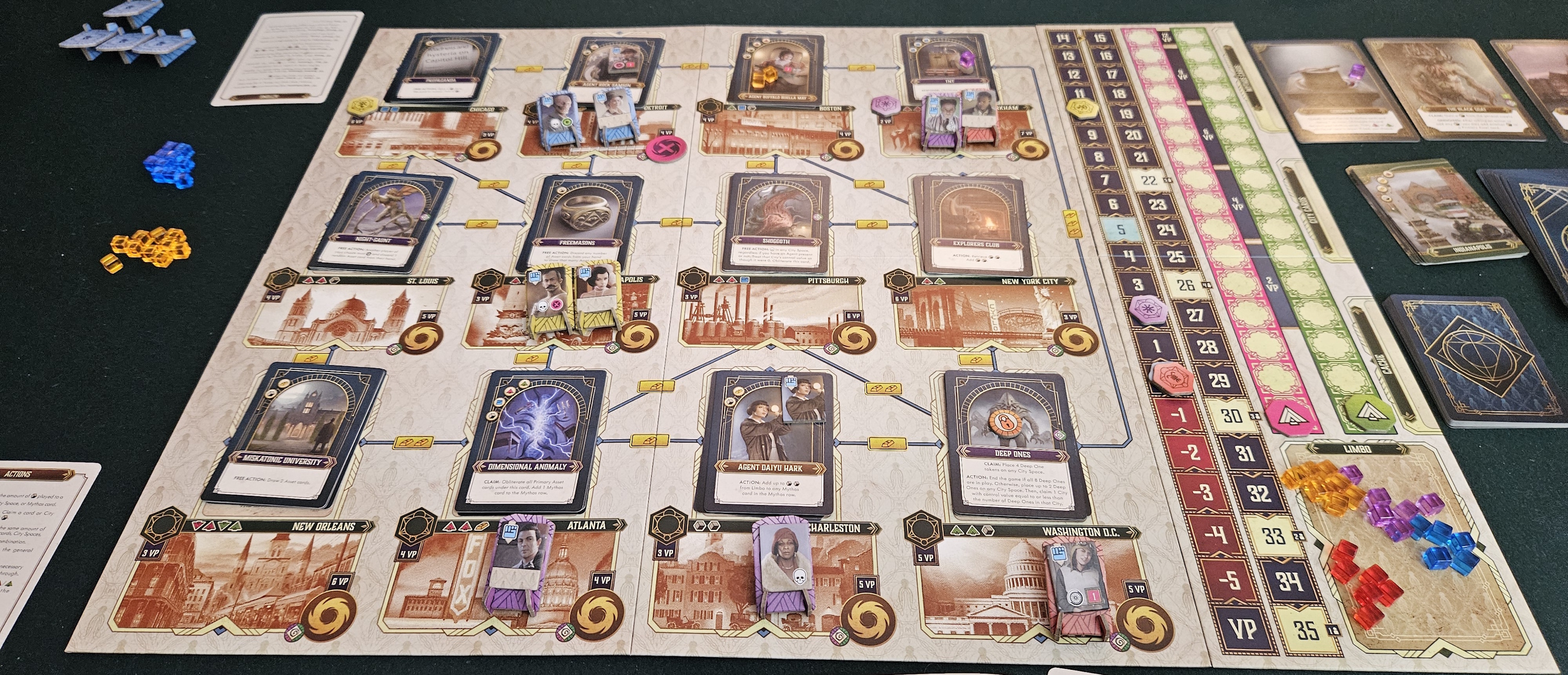
Let’s begin with the basics. Cthulhu: Dark Providence is set across the eastern portion of the United States during the Great Depression. People are hungry. Jobs are scarce. Ancient monsters rule the country. Literal monsters, not the nativist politicians who historically used people’s poverty and fear to drum up power. And those monsters are doing their best to pry open portals to otherworldly dimensions.
There’s a certain madness to American politics, always has been, so the idea that overly-tentacled beings that are simultaneously phallic and yonic would prey upon that unique American desperation to bring about an emerald-hued apocalypse is, if not exactly realistic, not the most far-fetched piece of horror fiction out there. This segmented reality informs the design itself. Put another way, Cthulhu: Dark Providence is hard to sum up. It’s a deck-builder. It’s an auction. It’s a social deduction game. It’s about revolution. It’s about trying to go insane on purpose. It’s about concealing yourself from the world. It’s about becoming your fullest self.
In gameplay terms, it’s about taking two actions per turn and clawing desperately at any sense of progress. When Dark Providence opens, everybody receives a role. Broadly speaking, there are two sides: the investigators, who hope to shut the monsters out of our world, and the cultists, who labor to bring humanity into their sticky embrace. These roles are hidden, but not quite as social-deduction-y as newcomers might expect. Concealment is a useful tool, but not a crucial one. There’s a good chance that everybody at the table will understand the broad strokes of everyone else’s objectives within the first half-hour. Still, that uncertainty is helpful. It staves off direct action. If nobody knows which side you support in the “Should we welcome the ancient god who promises to have us sprout penises from our eye sockets?” debate, nobody is likely to have you assassinated.
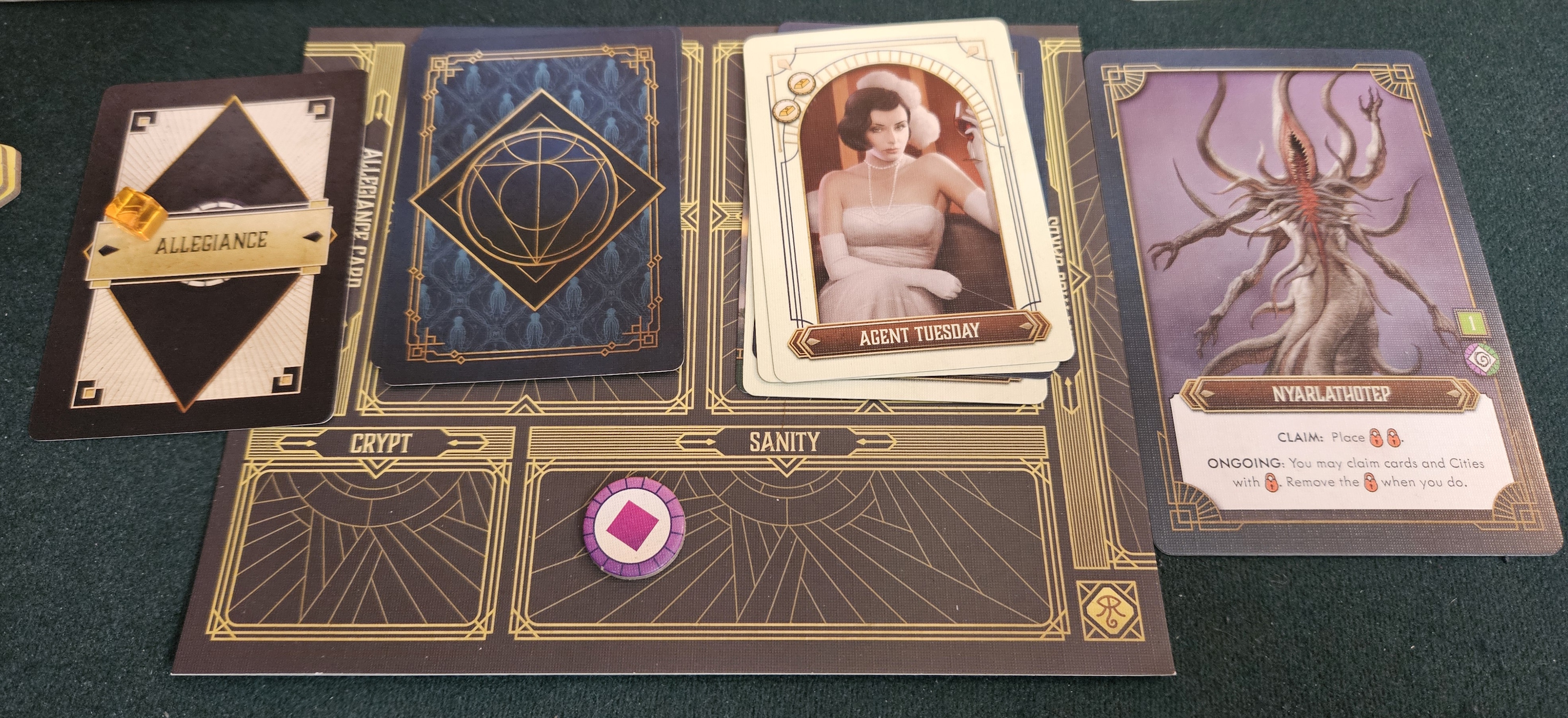
Much of the time, this produces a multi-act structure. In the game’s early stages, everybody’s motions are tentative, exploratory. Your agent — the avatar of yourself — travels from city to city, spreading influence and gradually picking up cards. Maybe you expand your network of agents. Maybe you tuck St. Louis into your back pocket. Maybe you join the Freemasons or conduct experiments with electricity or come into possession of a book with strange runes stamped into the leather binding. These are added to your deck, albeit slowly.
From there, little vignettes begin to form. Sometimes these are explicit, drawn via the game’s abundant actions. Somebody closes a portal for good, signaling their intention to rid the world of outside influence. Someone else starts appointing fish-people to local school boards, tipping their hand that they listen to dodgy podcasts. At other times, the developments are more subtle, such as when somebody’s network of spies and anarchists includes labor reformers and undead magicians. Other times, the changes are structural, the fabric of our reality coming unstitched as the cult moves up a shared track that will award points to everybody on their team.
Team. That’s a funny word in Dark Providence. You’re on a team, always, but also not on a team. I mentioned investigators and cultists. It’s true that there are people who share your worldview and objectives, but this is an individualist’s paradise. Only one player will win in the end. That said, nobody can fully ignore the demands of their faction. Mechanically, the concept is simple enough. When the final tally is reached, the lowest-scoring player forces everybody on their team to lose, no matter how high their score. So while you’re always racing against your comrades, you’re also working to ensure they’re better-off than the peons of the opposing team. As in the original game, it’s deviously clever, forcing players to constantly evaluate their social standing in the absence of clear data.
But this rubric is even more tangled than it first seems. There are also dissidents out there, one of the game’s few additions to the original Study’s formula. Dissidents still occupy a team — they’re dissident investigators or dissident cultists, not true independents, sort of like how libertarians are conservatives who like to look at themselves in the mirror — but their scoring is slightly orthogonal to their faction. The main takeaway is that they lose or win on their own, ignoring the usual rah-rah teamwork portion of the game, but are also uniquely vulnerable to exposure.
These complicating factors make Dark Providence a bear to teach and an even grizzlier bear to learn. In that respect, it’s much like the original. Not that Dark Providence hasn’t undergone development. A few nips and tucks make it simpler, on the whole. For example, both games feature quite the cast of potential recruits, but where A Study in Emerald also included an entire pile of duplicates to fuel a double-cross system that was dramatic but also sometimes frustrating to trigger properly, Dark Providence just ditches the whole idea. Once you own an agent, they’re on your side. That is, unless somebody drafts the right card to switch an agent’s allegiance, but that’s a visible threat rather than the lingering face-down tokens of the original game.
On the whole, then, Dark Providence is more akin to a second edition than the actual second edition of A Study in Emerald ever was. Its cardplay is intact, with that trademark Wallace gumminess where cards stick around rather than cycling easily in and out of hand. Its social questions are intact, and indeed are even denser than before, requiring teamwork and competition and backstabbing all at once. The networks of agents and ruffians are back.
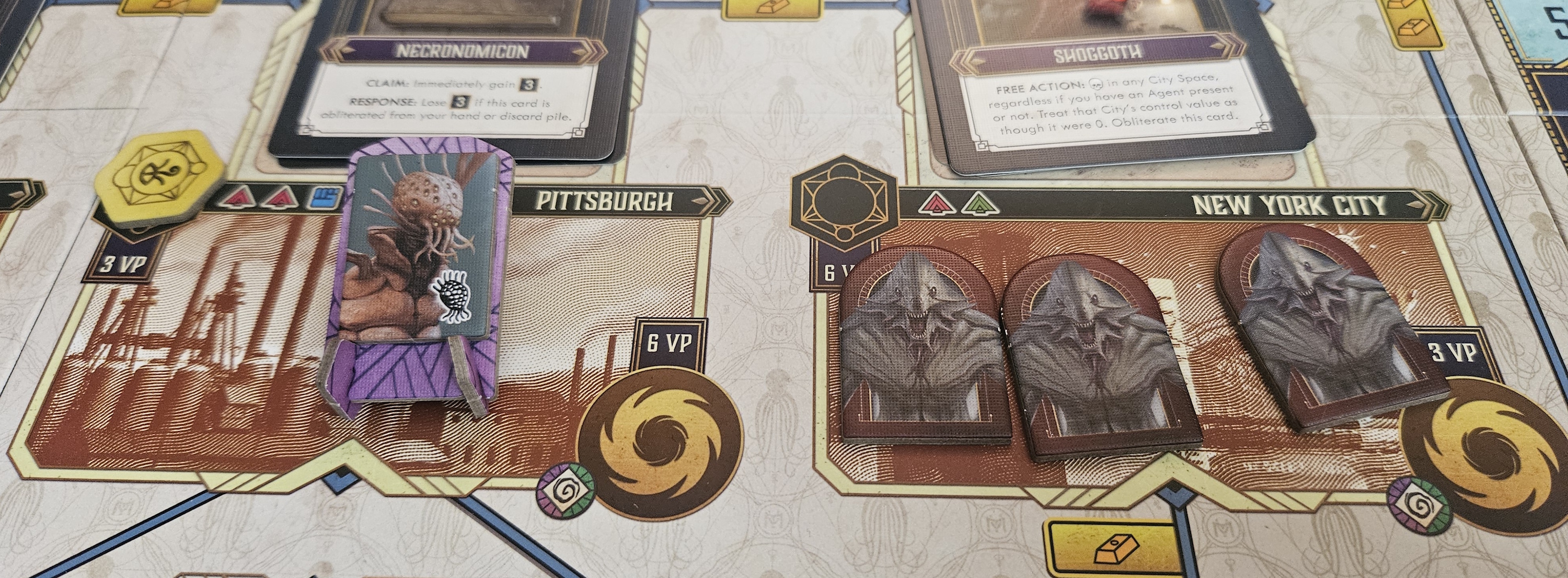
Even the original game’s surprising detours with zombies and vampires return, albeit with a fresh coat of paint. Still, the effect is the same. While you’re playing one game, merrily conquering cities and scrounging for points, suddenly the proceedings take on a dark turn as fish-folk begin conquering New York City or your best agents transform into red-eyed phantoms. Just as the original Study was playful and unexpected, so too is Dark Providence. You’re never sure how a session will shape up.
On its own, these strengths mark Dark Providence as a worthwhile successor to A Study in Emerald, especially given that game’s long absence from print, not to mention the, ah, squickier aspects of its provenance. While Neil Gaiman’s short story was an excellent companion piece to the original game, I doubt anyone is going to miss his name on the cover.
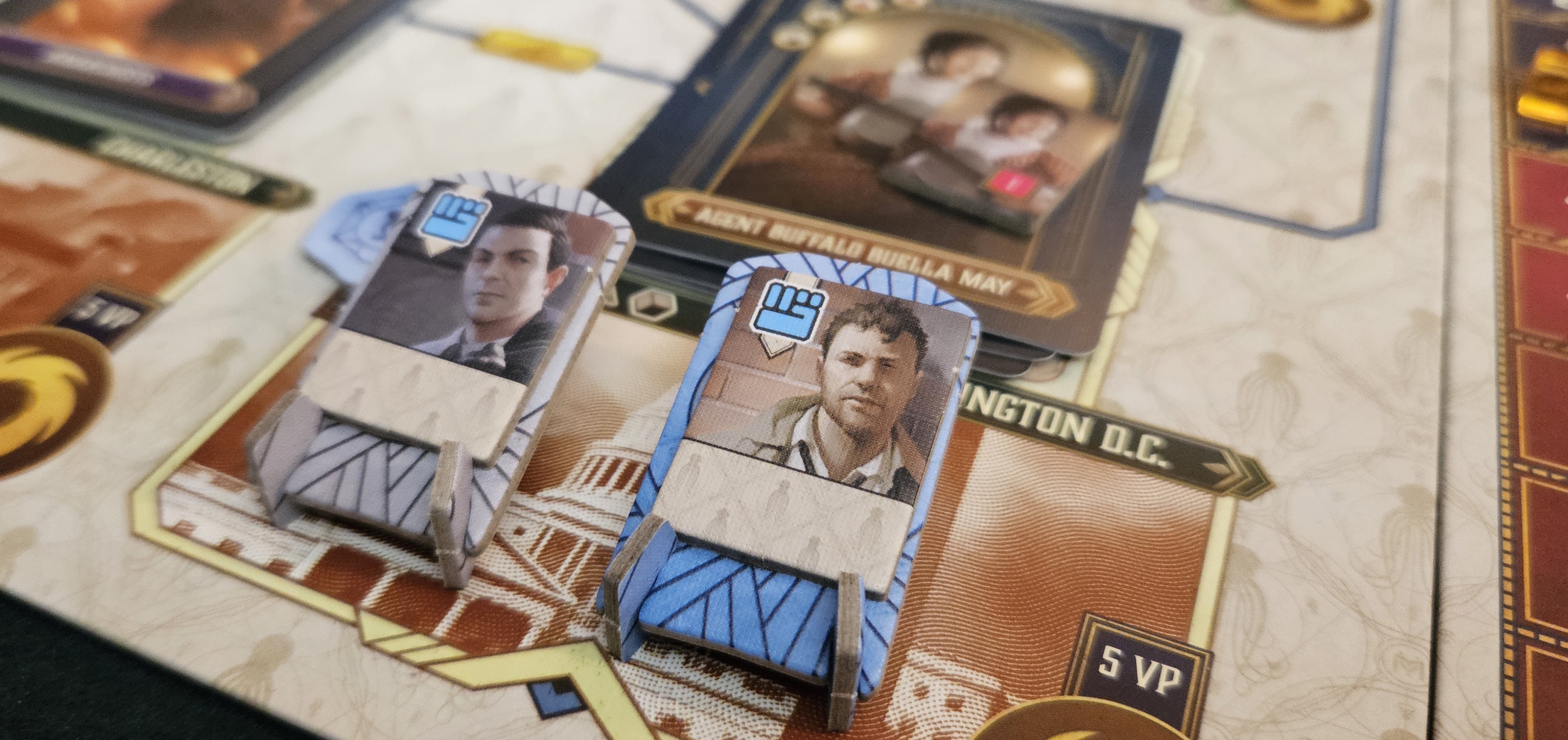
This isn’t to say it’s an entirely perfect production. The standees for holding the agent tokens are duller in color than they should have been, flimsy enough that I had to glue them together, and while their canted angle might be nice for a solitaire game, they’re hard to visualize from any direction but head-on.
As for the more structural changes to the factions… time will tell. The short version is that I’m eager to keep exploring what Dark Providence has to offer. Dissidents may well improve the game’s deduction, encouraging players to unmask one another more often. I have my doubts, as the penalty for being revealed as a dissident feels like a slap on the wrist, but with experienced players Study often featured rather slender scoring margins. Maybe it will prove enough of an incentive to shake up the original game’s dynamics. Either way, this is a (mostly) handsome and (largely) faithful recreation of the original.
Where it steps amiss for me — and maybe only for me, such is the pocket nature of this complaint — is in the game’s handling of its subject matter. A Study in Emerald arose from Wallace’s interest in anti-monarchical bomb-throwers, the anarchists and revolutionaries who took it upon themselves to punctuate the divine right of kings with sticks of dynamite. Smartly for the 2010s, Wallace reasoned that a game about blowing up the continent’s royalty might be considered in poor taste, hence the veneer of emerald paint. The game’s heroes weren’t trying to blow up Queen Victoria; their target was Gloriana, a god from beyond the stars. The pontiff of Rome was not the Pope, but Rhogog. Cairo had no shah, but rather, duh, the resurrected pharaoh Nyarlathotep.
Despite this veneer, A Study in Emerald played like a who’s who of 19th- to 20th-century social theory. One minute you’d recruit Emma Goldman and Élisée Reclus; the next you might watch as Leon Czolgosz assassinated an eldritch spider rather than President William McKinley; eventually, Peter Rachkovsky would lead the Okhrana in a crackdown against a revolutionary cell headed by Prince Kropotkin. That these historical figures rubbed shoulders with Sherlock Holmes and Professor Moriarty only deepened the sense of place, giving the game the hue of allegory.
By contrast, the Great Depression of Dark Providence is thinly drawn. What few historical touchstones it levies are mostly limited to gangsters (Arnold Rothstein, a misspelled Stephanie St. Clair), lawmen (J. Edgar Hoover, Eliot Ness, Wyatt Earp), or entertainers (Harry Houdini and Lillian La France, also misspelled), among a few scattered others. Unlike the historical figures of A Study in Emerald, which were united by the dueling social movements of the time, Dark Providence instead leans into the tropes that often accompany Lovecraftian fiction.
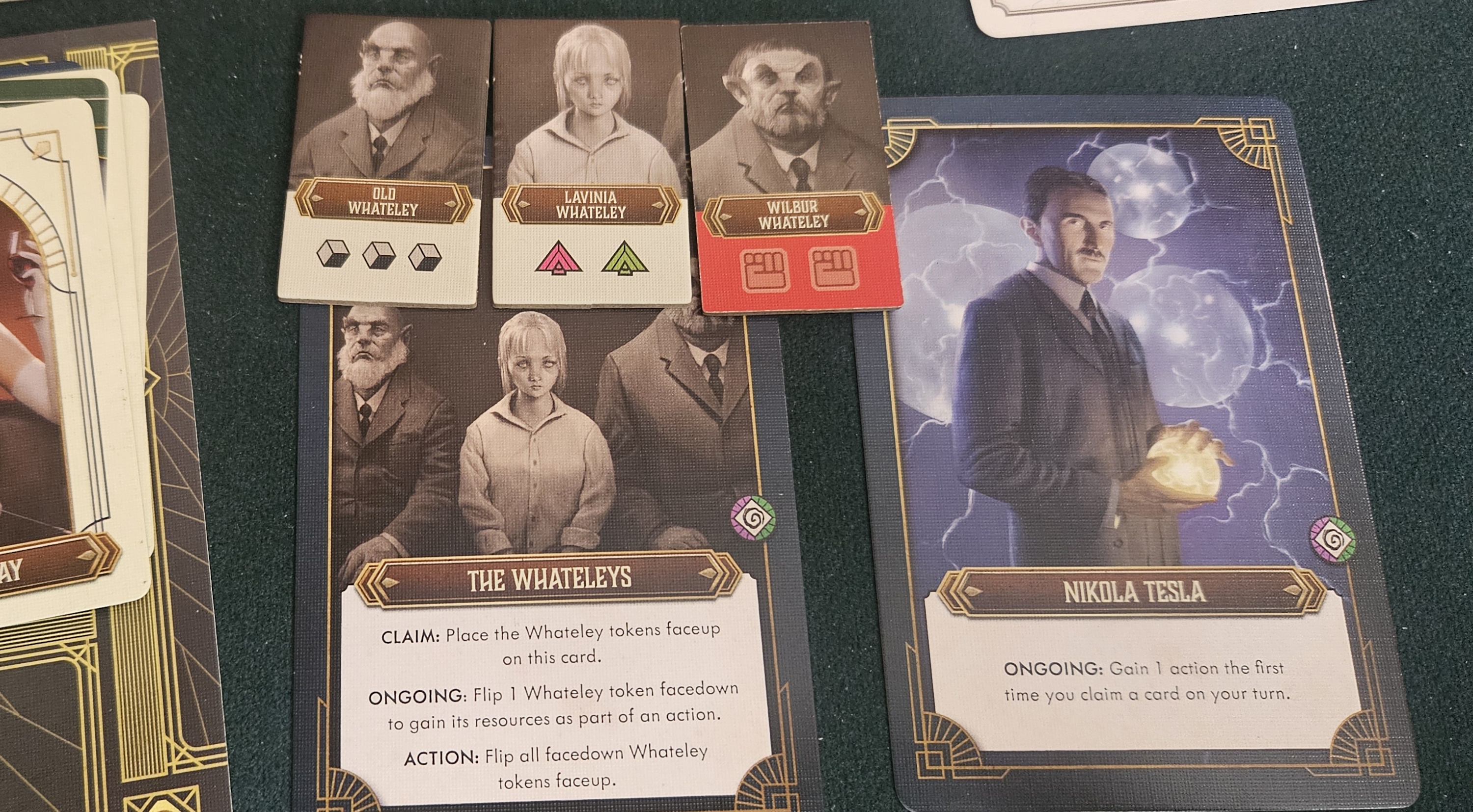
There are references, but most of them are confined to the Cthulhu Mythos. Every slouching shoggoth and brain-stealing mi-go is present, of course, but so are figures like Herbert West, Henry Armitage, and the Whateleys. When it comes to the Great Depression in the United States, even as a fictionalized depiction the game is sanitized of, well, everything. There are no labor movements. There are no suffrage movements. There are no Italian immigrants becoming enthusiastic Galleanisti. There is no Harlem Renaissance. There are no veterans’ organizations massing into the Bonus Army. There are no businessmen flirting with fascism by forming the Business Plot. Even the Prohibition stuff is thinly drawn, absent the original game’s clever inversions, putting figures like Eliot Ness on the side of resistance. (Yeah. Sure.)
The effect is to withdraw Dark Providence from the realm of historical fiction and slip it into the same category as most Lovecraftian board games, where figures like Nikola Tesla might wander into the frame, but not with any sense for their lived perspectives or accomplishments. It would feel right at home alongside any number of Fantasy Flight’s Arkham Horror titles or their many derivatives, full of tommy guns and long overcoats and men whose cigarettes dangle precipitously from their lips, but also sharing those same titles’ disinterest in what those characters or symbols stood for. It’s like setting Shakespeare in 1920s gangland Chicago. Fine for community theater, but disappointing as a sequel to a historical drama.
Again, it’s fine. No, really. Dark Providence is still a heck of a game. It’s just that, sans any broader context, the entire thing feels less grounded than its granddaddy. The irony is that, given how the hobby has advanced in the intervening thirteen years, it would be possible to design a game about anarchism without the veil of allegory Wallace draped over A Study in Emerald. Dark Providence flees the other direction, dulling its teeth for the sake of… I couldn’t tell you. To make the game less political, maybe. To lean into the Lovecraft thing. Unfortunately, the main side effect is that the setting feels generic.
To be clear, however, even a blunted version of A Study in Emerald is sharper than any number of other Lovecraftian outings, and Cthulhu: Dark Providence is a formidable remake. It’s cleaner around the edges while still retaining the original game’s weirdness. In some ways I even consider it the better-rounded experience, especially where the deduction is concerned. The result is many things: a game out of time, a color out of space, an experience that still has yet to be emulated as widely as it deserves.
(If what I’m doing at Space-Biff! is valuable to you in some way, please consider dropping by my Patreon campaign or Ko-fi. Right now, supporters can read about which films I watched in 2025, including some brief thoughts on each. That’s 44 movies! That’s a lot, unless you see, like, 45 or more movies in a year!)

Peter and Will Play SPACE GITS
This is stupid. We should be f***ing and drinking by now.
Peter and Will play the hilarious drunk-ass orcs game, Space Gits!
Mike Hutchinson is one of the great independent creators who is putting the fun back into tabletop miniatures games, and giving us all alternatives to staid, old, boring, clunky games like those released by certain huge corporate companies that will go unnamed. Cough. Space Gits is a fast (gasp!), fun, hilarious game about drunk-ass space orcs grabbing caps on a planet when all the competent orcs are away, and it brilliantly combines tabletop miniatures and dexterity game rules! I was lucky enough to be sent an example of the new scenarios Mike is concocting for his new Kickstarter campaign, which expands the base game (and allows you to grab a copy of the original game if you missed out the first time). But enough of my lacking, watch the video, then go back the Space Gits: here Come The Bastards Kickstarter. You won’t regret it!

/pic9133445.jpg)


/pic9480388.png)