CMON has found a route to getting one of its delayed projects into customers’ hands without having to fund the remaining costs itself, as the financially-troubled publisher continues its attempt to recover from almost $23m of losses across 2024 and 2025.
Long-time CMON manufacturing partner Top Games has agreed to take ownership of The Adventurers in exchange for covering the remaining production and fulfilment costs for the pre-order title, with CMON continuing to “provide support”, a joint statement from the pair said.
They added that production of The Adventurers had now been completed, with finished games packed at the factory and ready for shipment.
Copies of The Adventurers ready for shipment || Photo Credit: CMON / Top Games
CMON said in January that IP sales and licensing deals were among the routes it was pursuing to secure fulfilment of its large backlog of outstanding projects, as part of its efforts to stabilise its finances.
But the publisher received a major financial boost last month by completing a $19m capital raise – having entered August with just $368,000 in bank and cash balances.
That new funding is needed for far more than clearing its project backlog, however. About 40% has been earmarked for “working capital” over the coming 12 months, including staff costs, royalties, shipping and distribution, while another 20% is set to go towards repaying borrowings and other liabilities.
Another 25% of the new money is slated for expansion in existing and new markets, while 15% will go towards potential acquisitions as part of a push into digital gaming.
Its team has worked in tabletop manufacturing since 2009, and the Chinese company established its own plastics manufacturing facility in Dongguan in 2018.
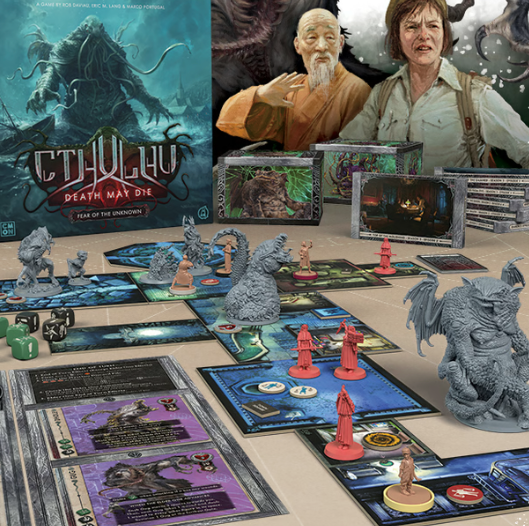
Cthulhu: Death May Die – Fear of the Unknown || Kickstarter image
Top Games stressed in the announcement that manufacturing will remain the foundation of its business, and said its involvement with The Adventurers had the specific goal of getting the project completed and delivered to customers.
The Adventurers is CMON’s revival of the adventure game series from Guillaume Blossier and Frédéric Henry, which began with The Adventurers: The Temple of Chac in 2009 – originally published by AEG and Dust Games. That title was followed by followed by Dust Games and Fantasy Flight Games’ The Adventurers: The Pyramid of Horus in 2011.
CMON launched a Gamefound pre-order in March 2025 featuring new editions of both games alongside a new entry in the series, The Adventurers: Tomb of the Pirate Queen, with delivery of the project estimated for December that year.
Those losses are almost 5.5-times the company’s profits from the preceding nine years combined – although the company’s recent restructuring efforts have seen its losses for the first half of 2026 narrow sharply, to just over $2m.
CMON’s revenue has fallen dramatically from its pandemic-era highs, dropping to $9.9m in 2025 from between $37m and $45m in each of the previous four years.
The company has blamed that decline on factors including a slowdown in crowdfunding, weaker consumer demand and disruption from US tariffs, leaving it trying to cut costs and reshape a business built around significantly higher sales.
Its 2026 releases continue that trend via Renier Knizia design KumoKumo Park and Atrah from Jérémy Ducret and Johannes Goupy, while the company has also highlighted Grow Sky as another release it says is ‘coming soon’.
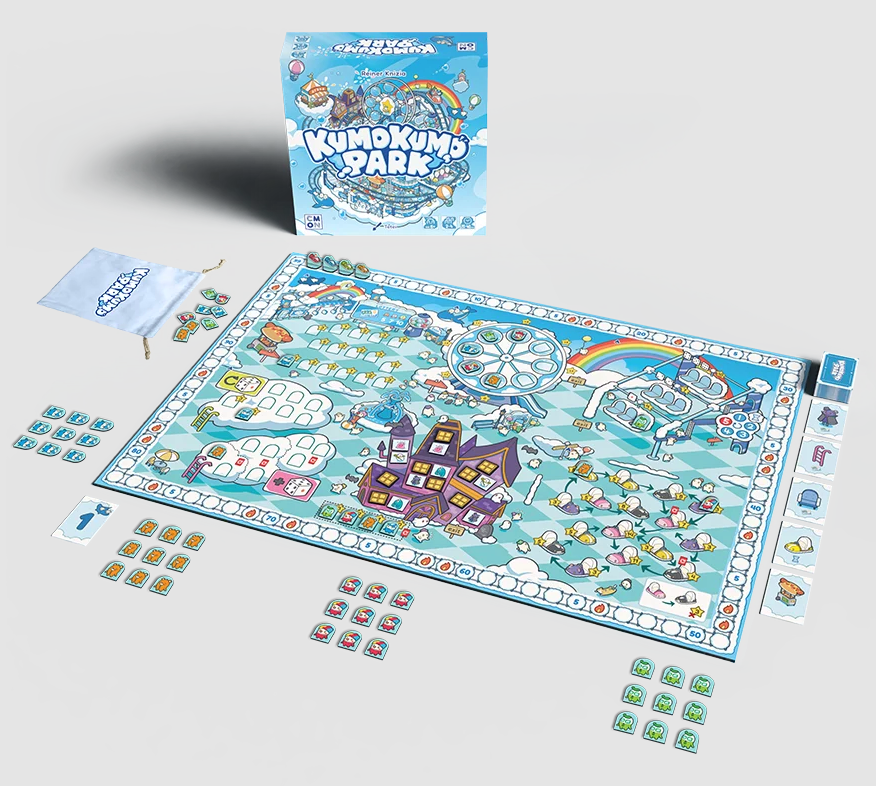
KumoKumo Park, designed by Reiner Knizia || Photo Credit: CMON
The company has not completed fulfillment of a crowdfunding project since Zombicide: White Death in mid-2025, but did manage to deliver pre-orders for Cthulhu: Dark Providence, Marvel United: Witching Hour and Dune: Desert War in the first half of this year.
CMON said in March that it planned to resume crowdfunding in the second half of 2026 – although its latest financial report stopped short of repeating that commitment, saying instead that new titles would be launched selectively depending on market conditions, available financial resources and project readiness.
Maestro Media is opening up the publishing, licensing, manufacturing and retail infrastructure behind its own games to outside designers and publishers, including companies looking for a North American publishing partner.
Maestro founder and CEO Javon Frazier said, “The hardest part of this industry has never been the ideas. It is everything after them. Getting your design in front of a publisher, funding the development, entering distribution, landing it on a shelf.
“We built a machine to do that for our own titles alongside some of the largest licensors in the world. Overture by Maestro Media opens that machine to everybody else.”
Maestro says Overture will allow other companies to use its existing operations for areas including development and licensing, production, manufacturing, crowdfunding, direct-to-consumer sales and retail distribution.
The company has already struck several deals along those lines, including announcing in the summer that it would publish a new North American edition of Zoch Verlag’s Ghost Blitz from January 2027.
Frazier said of the Ghost Blitz deal ahead of unveiling the game at this year’s Gen Con, “Ghost Blitz has sold more than one million copies in 20-plus languages over 15 years. Most North American families have never seen it on a shelf. That’s not a demand problem. It’s a distribution problem.
“That’s the gap we built Maestro Media to close. Crowdfunding, direct-to-consumer, and retail working as one engine, with distribution partners already in place across North America.”
Peterson Rodrigues, CEO of D20 Culture, said, “We’re excited to work with Maestro because we see the same opportunity they do: great games shouldn’t be limited by borders.
“Bringing these titles to players around the world, in their own languages and through partners who understand their markets, is exactly the kind of collaboration we want to be part of.”
Game designers will get their first opportunity to pitch original tabletop games via the new operation through a month-long submission window running from January 1 to 30 next year.
The company says it has worked with more than 40 licensed properties to date, and shipped more than 400,000 products, while Frazier has raised more than $16m across 16 crowdfunding campaigns – although almost 60% of that total comprises the two Binding of Isaac projects.
The company added that Ryan Lumax has been promoted to vice president and head of games at the company, having joined last year after almost eight years at Canadian distributor Lion Rampant Imports.
Lion Rampant was acquired by Asmodee in 2019, when Lumax was working as head purchaser. He became a purchasing manager at the business in 2023.
Lumax said, “I spent eight years on the buying side, and the games that didn’t make it were almost never the bad ones.
“They were good games whose creators ran out of road somewhere between the prototype and the pallet. That is the gap Overture by Maestro Media closes.”
Back to the history of New York City! We have begun with the city’s origin before the founding of the United States and left off in the 1880s in the last post – when New York was undeniably the economic and cultural center of the United States. Today, we are covering New York in its most iconic form as a moloch of steel, concrete, and millions of people. A chronological narrative will not help us here. Instead, we adopt a thematic approach and look the economy, construction, infrastructure, and culture which made New York from the late 19th to the mid-20th century the model city of high modernity.
If you want to read more posts like this – for example, the next instalment in the New York series – I strongly recommend you subscribe to the blog: All new posts in your inbox right when they go live!
New York had been America’s most dynamic hub for trade and manufacturing for decades. Yet the city’s riches had been shared unequally, just like the risks in producing them. In the late 19th and early 20th century, New York’s working class grew more assertive and found more political support to improve their lives: For example, the three Tenement House Acts of 1867, 1879, and 1901 mandated such luxuries as windows in every apartment and toilets in every building.
The 1909/1910 textile worker strikes led to improved pay and shorter hours. Just one year later, the Triangle Shirtwaist Factory in Lower Manhattan burned down and 146 garment workers died – many of them unable to escape through the staircase because management kept the doors locked during shifts. The fire catastrophe led to a public outcry against such practices and New York state introduced better workplace and fire safety regulations.
The garment workers were in some ways emblematic for the New York working class – most of them were young immigrants (especially Jewish and Italian). In another, they represented a shift – almost all of them were women, and their struggle for better working conditions mirrored the force of the American women’s movement in the political arena.
In one way, however, they represented New York’s present, but not its future: The industrialization of the 19th century had turned New York into the largest manufacturing hub of the world. Yet manufacturing, the physical production of goods, ran out of steam when the improved productivity provided most people in the United States with most of their basic needs. Eager customers were thus not to be taken for granted anymore. Instead, they had to be wooed and their desires – for items of whose existence they had recently been still ignorant – awakened. New York became a hotbed for the growing advertisement industry (with which Madison Avenue is synonymous until today) as well as for shopping (here, Fifth Avenue is the symbolic street). Our age of trends, shopping as a leisure activity, and overconsumption cannot be imagined without New York.
In the 19th century, foreign capital had funded the expansion into the American West, but now the capital flows reversed: American capital was instrumental in financing the Allies’ Great War effort. At the end of the Great War, America was for the first time a net creditor nation. Its role in the international financial system expanded after the war as American loans enabled defeated Germany to pay its reparations to the Allies (who, in turn, paid off their American war loans). At the same time as New York took London’s place as the premier finance hub in the world, America at large withdrew from the world under a renewed isolationism and the xenophobia which came with the Red Scare after the Bolshevik Revolution.
Political upheaval did not stop the investment craze of the 1920s: When a bomb exploded in Wall Street in 1920 and killed 30 people, stock trading resumed normally the next day – much in contrast to 1920 Wall Street (Perepau Llistosella, Looping Games), where the bombing marks the end of the game (and players hope to have made all their profits by then).
The New York-based financial system was robust enough to withstand such external shocks, but it collapsed under its own contradictions: The stock market boom of the 1920 led to ever more capital pouring into the New York Stock Exchange (at the expense of all other forms of investments, for example the American overseas loans on which the global financial system was now based). The spectacular gains fueled a debt-based speculation bubble which burst in October 1929. The inadequate response by central banks which did nothing to combat the contraction of the monetary supply led to an extended, global economic crisis – the Great Depression.
Unemployment and poverty plagued New York much like the rest of the world in the 1930s. The city bounced back through ambitious public works initiated by the energetic new mayor Fiorello LaGuardia (many of them funded by New Deal funds in a cross-party cooperation between the Republican LaGuardia and the Democratic president Franklin D. Roosevelt). Still, New York’s economy only recovered when demand for manufactured goods skyrocketed because of World War II: The industrial giant rose one last time. One example of New York’s awesome productive capacity may suffice: From 1941 to 1945, the New York Navy Yard built more warships than all of Japan combined. The United States won World War II because of their industrial productivity, and New York was the beating heart of it.
Construction: Upwards
New York had always grown. From the 1880s on, the city grew in a heretofore barely used dimension – upwards. The twin innovations of the elevator and steel frame construction allowed for building heights which had been considered impractical, if not impossible, before. While New York was not the pioneer of these technologies – that merit belongs to Chicago – they were accepted in Manhattan on a scale not known before. Ever more “skyscrapers”, as the tall buildings were soon to be known, sprang up between the Hudson and the East River, giving the city a characteristic look from far away. New York’s skyline has been continually changing, but since then, it has always been dominated by skyscrapers – as has been the image of the city in the public imagination.
Board games are no exception. No theme is as prevalent in games about New York as the construction of skyscrapers. Some are specific, like Flatiron (Isra C./Shei S., Ludonova) which has players build the eponymous Flatiron Building together, but many could be set in any city with tall buildings – but as they are about tall buildings, their designers and publishers think they fit best for a New York setting: Manhattan (Karl-Heinz Koch, Fagus) is a variant of Acquire (Sid Sackson, Avalon Hill) to which the third dimension is added. New York City (Stefan Feld, Queen Games) is a remake of Rialto (Stefan Feld, TMG) – just that the struggle for majorities in Venetian districts of the original, fought with councilmembers, has been replaced by a struggle for majorities in New York boroughs, fought with – you guessed it – skyscrapers.
The skyscrapers got ever taller: The first steel frame buildings in the 1880s and 1890s were well below 100 meters. In 1909, the Singer Building (187m) was the first structure in New York to exceed the height of Europe’s church spires – the first time that the world’s tallest building stood in New York. The city would retain that honor until the 1970s with a succession of ever taller skyscrapers.
The most iconic one was the Empire State Building whose construction was begun in October 1929 – just weeks before the stock market crash. It became the most visible sign of the economic crisis: Even five years after its completion in 1931, half of the Empire State Building’s office space remained empty. Like the rest of New York, it recovered by the 1940s. It would remain the world’s tallest building until it was overtaken by another New York icon in 1973 – the twin towers of the World Trade Center.
Infrastructure: Transport and Leisure
New York did not only grow vertically. Originally, the city had been confined to Manhattan Island and gradually expanded into what became the Bronx. In 1898, New York merged with its neighbor Brooklyn (itself America’s third-largest city at the time) as well Queens county and Staten Island to become a massive metropolis of more than three million inhabitants.
This sprawling moloch, however, was initially still centered on Manhattan, as most people worked there and thus couldn’t live too far away: In 1900, more than half of New Yorkers lived in Manhattan. That changed with the construction of the New York subway from 1900 on. New York was late to embark on such a project (London had started in the 1860s), but it was undertaken with the characteristic boldness of the city and soon became the largest in the world.
Thus, the geography of the city changed: New Yorkers could work in Manhattan, but commute every day from one of the other boroughs. As land there was a lot cheaper, a residential construction boom set in, and by the 1920s, Brooklyn had become the most populous borough of New York.
The growth of the city required its transport and leisure infrastructure to keep up. One man would become synonymous with it from the 1920s on: Robert Moses, starting out on the Long Island State Park Commission in 1924, became responsible for all kinds of parks, beaches, roads, bridges, and tunnels for both the state and the city of New York over the next decades.
These projects shaped the face of New York: The parks, both in the center and on the outskirts, provided very real benefits in one of the largest, most densely settled cities in the world. And the transport projects took inspiration from the new trend of motorized individual transport – and reinforced it.
Large-scale engineering projects like these go beyond the mere technical aspects. Moses’s creations were shaped by his ideas about how society should look like. For example, already his very first project – Jones Beach State Park on Long Island – outlined his ideal: It provided New Yorkers with a beautifully designed leisure park on the seashore. They arrived there after a pleasurable drive on the new parkways through lush greenery – by car, as no train or subway station was built in Jones Beach, and the bridges crossing the parkway were too low for buses to pass through. This lack of public transport meant that Jones Beach was exclusively accessible for the middle classes.
An even more striking example is Riverside Park in Manhattan along the Hudson River. Around a third of the park is in the predominantly Black neighborhood of Harlem, two thirds in the predominantly White Morningside Heights and the Upper West Side. These southern two thirds were liberally sprinkled with dozens and dozens of playgrounds, the third in Harlem only received one – and here, the iron lattice at the toilets was “decorated” with little ape sculptures.
As you can see, Robert Moses was not quite a nice guy. We’ll see more of him in the next post in this series!
Culture: Roaring Twenties
America’s new, more assertive role in the world after World War I also increased global interest in the country’s cultural output. American literature developed a new confidence, and American jazz became the hottest new music around the world. New York as America’s cultural center both attracted established artists (like the jazz musicians Duke Ellington and Louis Armstrong who both made the city their home in 1923) and produced its own original creations (like the Harlem Renaissance, which marked the first time that a movement of Black American writers and visual artists left their imprint on the wider American cultural consciousness).
One of the institutions of the 1920s New York cultural scene has gotten its own board game: 1923 Cotton Club (Pau Carles, Looping Games). The historical Cotton Club was founded in Harlem in 1923 and soon became the venue to see many of the finest jazz musicians – an attraction not only for regular New Yorkers, but also for the celebrities of the time. That, in turn, made the club even more attractive… well, not for everyone. While the performers on stage were Black, the club would not admit Black patrons (except for the rare Black celebrity). That is not explicitly addressed by the board game, but attentive players will notice that the almost all of the artists which can perform at the players’ clubs are Black, almost all of the celebrities which may attend the club (and are the chief source of points) are White – as are the gangsters.
“Gangsters?” you may ask. “In a game about running a nightclub?” Yes, as we are in the age of the prohibition of alcohol in the United States. This fleeting episode (1920 to 1933), and the massive expansion of organized crime which came with it, is almost as irresistible to board game designers as the construction of skyscrapers. Sometimes, it is only the corollary to another activity (like in 1923 Cotton Club).
Of course, all these mafia games could be set elsewhere. After all, alcohol was prohibited everywhere in the United States. New York, however, is irresistible as the biggest city, where presumably also the biggest crimes are committed. It is no coincidence that both Superman and Batman, those heroes of the Golden Age of Comics, fight their mastermind criminal enemies in fictionalized versions of New York (Metropolis and Gotham, respectively). Apropos: Age of Comics: The Golden Years (Giacomo Cimini/Sónia Gonçalves, Lirius Games) allows players to run a comic book publisher, develop ideas, print, and sell comic books… and of course, they do so in New York.
For a concise introduction, especially focused on local politics, see Lankevich, George J.: New York City. A Short History, New York University Press, New York City, NY/London 1998.
If you want a treatment which is both more in-depth and more journalistic (and lavishly illustrated) and don’t mind its history practically ending around 1970, see the book version of the 17-hour PBS documentary from 1999: Burns, Ric/Sanders, James/Ades, Lisa: New York. An Illustrated History, Knopf, New York City, NY 2001.
An academic conference exploring everything from publishers’ environmental claims and sustainable manufacturing to Pokémon card investing and onboarding new players is set to kick off tomorrow, as researchers examine the many interpretations of this year’s theme ‘Green’.
While many of this year’s presentations explore environmental issues, the conference’s broad ‘Green’ theme also encompasses topics including newcomer experiences, representation, identity, game history and design philosophy.
All of the talks are set to be recorded and made publicly available after the event, which takes place on July 15 and 16.
Example sessions include Plastic Dystopia: Ideas towards More Sustainable Miniaturing Practices, which aims to propose new ways of minimising the ecological footprint of the hobby, and How Green Is Green Play? Gamewashing in Analog Board Games, examines what the researchers describe as “gamewashing” – where environmental themes or sustainability messaging may not be reflected by a game’s actual mechanisms or player experience.
Several sessions examine how environmental themes are represented in commercial games, while Daybreak co-designer Matteo Menapace will be providing a keynote speech discussing the Kennerspiel des Jahres-winning title and how its realistic and utopian theme can be an antidote to capitalist realism.
Elsewhere, researchers from the University of York analyse five published climate change board games, arguing that many reinforce solutions rooted in existing economic assumptions rather than encouraging players to foster deeper engagement with the colonial and capitalist roots of the climate crisis, while another presentation explores how the relations between humans and animals are depicted in Uwe Rosenberg’s design Atiwa.
The full schedule for the conference is available here, and anyone interested in registering to view the panels and keynotes can do so here.

 Anmelden