Letztens bin ich gefragt worden, ob ich mir vorstellen könnte, an einem „Tag der Demokratie“ mitzuwirken. Und zwar explizit unter dem Label „als brettspielender Mensch“. Was könnte man so tun an einem Tag der Demokratie mit dem Medium Brettspiel? Ein Vortrag wäre da wohl unspannend, eine Ausstellung für einen Tag nicht sinnvoll. Also dachte ich: wir könnten ja Brettspiele spielen, die eine Wirkung auf unser Zusammenleben und dessen Reflexion haben. Und dann habe ich mir mal Gedanken dazu gemacht.
Brettspiele sind für uns als Medienschaffende eine sehr umfassende und vielfältige Freizeitbeschäftigung. Und eine tolle: sie bringen Menschen an einen Tisch, schaffen Begegnungen zwischen unterschiedlichen Generationen, fördern Kommunikation und ermöglichen gemeinsame Erfahrungen und noch so vieles mehr. In einer Zeit, in der gesellschaftliche Debatten häufig digital, polarisierend und beschleunigt stattfinden, bieten Brettspiele einen analogen Raum für Austausch, Reflexion und in meinem Fall Kooperation (warum sollte ich Map Masters oder Endeavor kompetitiv spielen, wenn es eine kooperative Version/Variante gibt?). Gerade deshalb eignen sie sich in besonderer Weise für die Demokratie-Förderung. Sie können vielleicht sogar demokratische Prozesse erfahrbar machen, politische Zusammenhänge verständlich vermitteln und zentrale demokratische Kompetenzen fördern. Thematische Spiele wie Weimar oder Dindex zeigen beispielhaft, wie Brettspiele historische, politische und gesellschaftliche Themen aufgreifen und spielerisch zugänglich machen können.
Demokratie-Bildung verfolgt das Ziel, Menschen dazu zu befähigen, demokratische Werte zu verstehen, demokratische Verfahren anzuwenden und sich aktiv an gesellschaftlichen Prozessen zu beteiligen. Dabei geht es nicht allein um die Vermittlung von Wissen über politische Institutionen oder historische Ereignisse. Ebenso wichtig sind die Entwicklung von Urteilsfähigkeit, Empathie, Kompromissbereitschaft, Perspektivwechsel und die Fähigkeit zur konstruktiven Konfliktlösung. Genau an dieser Stelle besitzen Brettspiele meines Erachtens ein großes Potenzial.
Die Regeln als Basis des geordneten Zusammenlebens
In Brettspielen müssen natürlich Regeln eingehalten werden, damit sich alle Spielenden einbezogen führen, Entscheidungen gemeinsam getroffen und unterschiedliche Interessen ausgeglichen werden. Die Spielenden erleben, dass ein geordnetes Zusammenleben nur funktioniert, wenn sich alle an gemeinsam akzeptierte Regeln halten. Gleichzeitig erkennt man mitunter, dass Regeln diskutiert, interpretiert und gegebenenfalls verändert werden können. Damit spiegeln Brettspiele grundlegende Mechanismen demokratischer Gesellschaften wider.
Demokratie lebt vom Austausch unterschiedlicher Meinungen. In vielen Brettspielen müssen Spielende miteinander sprechen, verhandeln, argumentieren und Entscheidungen begründen. Wir lernen dabei, anderen zuzuhören und deren Sichtweisen zu berücksichtigen. Diese Fähigkeiten sind für demokratische Beteiligung unverzichtbar.
Ein praktisches Beispiel: Das Spiel Weimar beschäftigt sich mit der Geschichte der Weimarer Republik. Die Spielenden setzen sich mit den politischen Spannungen, den gesellschaftlichen Konflikten und den Herausforderungen auseinander, die letztlich zum Scheitern der Weimarer Republik führten. Anders als in einem Schulbuch werden historische Entwicklungen hier nicht nur gelesen, sondern in einem Modell erprobt. Entscheidungen, Machtverschiebungen und politische Dynamiken werden nachvollziehbarer. Die Spielenden erkennen, wie fragil demokratische Systeme sein können und welche Faktoren zu ihrer Stabilisierung oder Gefährdung beitragen. Und ich habe noch nie eine Partie Weimar erlebt, bei der die Nachbesprechung dessen, was gerade am Spieltisch passiert ist, nicht elementarer Bestandteil des Spielerlebnisses war.
Doch warum überhaupt ein „Tag der Demokratie“? Demokratie erscheint vielen Menschen als selbstverständlich. Ausgewählte, kuratierte (ggfs. historische) Spiele können verdeutlichen, dass demokratische Errungenschaften stets geschützt und weiterentwickelt werden müssen. Durch die aktive Beteiligung am Spiel entsteht häufig eine stärkere emotionale Verbindung zum Thema als durch reine Wissensvermittlung.
Und was machen wir nun? Im Moment ist der Gedanke, dass wir Spielrunden mit ausgewählten Spielen anbieten und anschließend vielleicht die „Nachbesprechung“ als Podcast aufzeichnen. Mal sehen – es ist noch ein Jahr, und vielleicht kommen noch ein paar Ideen hinzu.
Aufnahme: 09.02.2026 Sendedatum: 15.03.2026 Themen 00:00:00 Intro & Begrüßung 00:00:57 Zur Person 00:01:46 Was sind Wargames? 00:07:56 Jans Weg ins Wargaming 00:13:40 Vorteile von Spielen gegenüber anderen Medien 00:24:43 Selbstständigkeit […]
Shownotes
Redebedarf. Das Podcastformat ohne Format. Manchmal gibt es einfach Anlässe, Erfahrungen und Beobachtungen zur Spielszene die nur in einem kurzen Podcast untergebracht werden können. Das tun Georgios Panagiotidis und Peer Sylvester mit Redebedarf.
Before we dive into the content of the playlist, some general observations:
All of the songs in the playlist were popular during the Weimar Republic (1918—1933). Yet as music recording was still in its infancy at that time, many of the songs in the playlist are later recordings (and some rare ones were recorded even before 1918!).
As the playlist is only 2:21 hours long, your Weimar game will probably last longer (if you don’t crash the republic on the first or second round), but there’s no reason not to listen to these songs two or three times – they’re fascinating historical documents.
The playlist is thematically sorted. That helps you find similar songs, but makes for somewhat monotonous listening (until you come to the next group of songs). I therefore recommend you turn shuffle on.
Now, what awaits you in the playlist?
#1: The National Anthem
It seems like a no-brainer to include the German national anthem of the time, yet it’s not so simple: The Lied der Deutschen (Song of the Germans) had been written in 1841, but had since then only been a patriotic song among many – until the first president of the republic, Friedrich Ebert, declared it the national anthem in 1922. The song’s three stanzas were variedly popular: Ebert favored the third stanza with its liberal ideals of unity, justice, and freedom, his right-wing opponents preferred the “Deutschland über alles” (Germany Above Everything) first stanza. I have included an instrumental version. If you feel patriotic, you can sing along.
The Weimar Republic did not come into existence in a vacuum. It inherited German cultural traditions like folk songs (“Wem Gott will rechte Gunst erweisen” (Whom God Wants to Favor), song #2).
And, of course, the Weimar Republic succeeded the German Empire with its national feeling (“Die Wacht am Rhein” (The Guard on the Rhine), song #2), dominant Protestantism (Martin Luther’s classic “Ein feste Burg ist unser Gott” (A Mighty Fortress Is Our God), song #5), and monarchy (“Heil dir im Siegerkranz” (Hail to Thee In the Victor’s Crown), song #7 – the quasi-anthem of the German Empire).
The republic’s midwife was the First World War – whose experience shaped its veterans and provided the cultural context even for those who had not been adults during the war yet (“Wildgänse rauschen durch die Nacht” (Wild Geese Rush Through the Night), song #8, written in 1916, was immensely popular among the Weimar Republic youth movement). The war also cast its shadow over Weimar Germany as many had lost their husbands, sons, fathers, brothers, and friends in the war (“Ich hatt’ einen Kameraden” (I Had a Comrade), song #9, the traditional German soldiers’ lament).
The liberal republic proved fertile ground for satirical treatments of the new developments: Otto Reutter made fun of the big and small war profiteers with “Seh’n Sie, darum ist es schade, dass der Krieg zu Ende ist” (See, that’s why it’s a pity that the war is over, song #10), and Claire Waldoff called for replacing the men in power with women in “Raus mit den Männern aus dem Reichstag” (Kick the Men Out of Parliament, song #11), playing on masculine anxieties after the introduction of women’s suffrage.
Even in a time and place as politically charged as the Weimar Republic, not everything was politics. The average Hans and Gretel may have cared less about their preferred ideology and more about how to have good time on a Saturday night… and the new cultural scene, especially in the big cities like Berlin, provided ample opportunities.
The more sophisticated artists like the Comedian Harmonists succeeded with witty wordplay and erudite vocal harmonies. Others played on the classics – alcohol (“Wir versaufen unser Oma ihr klein’ Häuschen“ (We Blow Grandma’s Little House on Booze, song #19) and sexual innuendo („Fräulein, Woll’n Sie nicht ein Kind von mir“ (Miss, Don’t You Want a Child By Me, song #22). There was even the equivalent of a (generalized) diss track: “Du bist als Kind zu heiß gebadet worden” (You Have Been Bathed Too Hot As a Child, song #23) indicates that this neglect of bath safety led to lasting brain damage in the interlocutor.
#26-33: Film, Theater, and Opera Music
The Weimar Republic’s vibrant cultural scene led to cross-pollination between diverse forms of artistic expression. The new medium of film was pioneered in Germany, and once it had left its silent infancy behind, movie songs became hits. Marlene Dietrich, starring in The Blue Angel, enticed with “Ich bin von Kopf bis Fuß auf Liebe eingestellt (I’m Set to Love From Head to Heel, song #26), but warned “Nimm dich in Acht vor blonden Frau’n“ (Beware of Blonde Women, song #27).
More traditional art forms like the theater also adapted. Die Dreigroschenoper (The Threepenny Opera)’s acerbic critique of capitalism would not have been as successful without its catchy songs, the most famous of which is the “Moritat of Mackie Messer” (Ballad of Mack the Knife, song #31).
Even the most classic and highbrow form of entertainment modernized: “Jonny spielt auf” (Jonny Plays It Big, song #33) introduced jazz into the world of the opera… which brings us to our next category.
#34-41: Jazz and Blues
Traditionally, the United States had received and emulated European fashions, not the other way around. Yet by the early 20th century, America had become the largest economy in the world, its war entry in 1917 tipped the scales of the war further in favor of the Allies, and the increased presence of Americans in Europe meant that the United States turned from an importer to an exporter of culture. Jazz took Europe by storm – both in the form of American (and nascent European) bands and by the new medium of the music record. The Weimar Republic was no exception. Jazz fueled the parties in any larger city of 1920s Germany.
Of course, not everyone loved jazz, and the controversy over its unorthodox dissonances, the more expressive, individualistic, and eroticized dancing style accompanying the music, and, of course, the race of its performers entered the contemporary culture wars – exemplified by Weimar’s double use of Louis Armstrong, illustrating both the SPD’s “The New Rhythm” and the DNVP’s “Nicht Deutsch” (“Not German”) event cards.
The “Tiger Rag” (song #41) is also used in The Tin Drum, German writer Günter Grass’s epic about the rise, fall, and persistence of Nazism: The youthful protagonist Oskar Matzerath who always carries his eponymous tin drum plays the Tiger Rag at a NSDAP rally in his hometown Danzig. The mesmerizing rhythm has the audience sway and dance, exposing the Nazis to ridicule.
#42-47: Workers’ Songs
The aggressive ethno-nationalism of Nazism was one of the two most dynamic political movements of the Weimar Republic (at least once the 1929 crash had plunged vast parts of the German population into a crisis of material and identity). The other was the workers’ movement, both in its reformist Social Democratic and its revolutionary Communist form. As the workers had been traditionally excluded from the public in imperial Germany, dominated by aristocracy and bourgeoisie, they created their own political parties (SPD, later USPD and KPD), economic associations (the trade unions), and social and cultural associations – from workers’ sport clubs to workers’ singing societies. Their milieu was bound together not only by their shared economic experience, but also by this cultural connection, of which the workers’ songs formed an important part.
Classics from imperial times like “Die Internationale” (The Internationale, song #42) remained important, but the movement also adopted new songs written by the numerous socialist poets and composers like Bertolt Brecht, Hanns Eisler, or Ernst Busch. Whereas some of these became new classics (like the “Solidaritätslied” (Solidarity Song, song #46), others aged badly: “Der Marsch ins Dritte Reich” (The March to the Third Reich, song #47) poked fun at the alleged inability of the Nazis to take power after their electoral setback at the Reichstag election of November 1932. First recorded in December 1932, the song was horribly overtaken by events just a month later when Hitler was elected chancellor in January 1933.
Thus, we conclude our playlist. It contains the traditional and the modern, entertainment and politics, left and right – except for the very right, but I don’t want to listen to Nazi songs while playing board games, and I’m sure that neither do you.
Do you like to play music in the background while playing board games? What’s your favorite song from this playlist? Let me know in the comments!
Mit Weimar bringen Skellig Games und Spielworxx in Kooperation einen Politik-Kracher von Matthias Cramer auf den Markt und buhlen um einen Platz in eurem Spieleregal. Mit Doublelayer-Board und viel bedrucktem Holzmaterial möchte das Spiel sein historisches Thema in Szene setzen. Doch es gibt einen Haken: Mit Ausnahme des Solo-Modus ist das Spiel nur mit genau 4 Spielern spielbar. Ob das gut geht?
Die Quadratur des Gleichgewichts des Schreckens
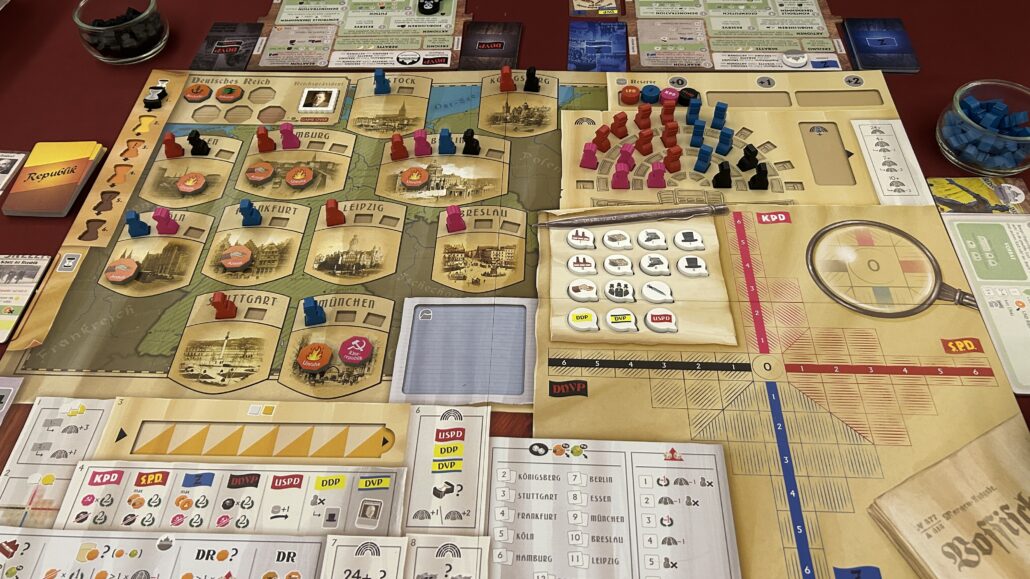
Starten wir erstmal ganz sacht: Thematisch spielen wir die Entwicklung der Weimarer Republik nach. Das Spiel gliedert diese Zeit von 1918-1932 in 3 Phasen mit je 2 Runden. Die Spieler übernehmen dabei die Führung je einer Partei. Zur Auswahl stehen die SPD, die KPD, die Zentrumspartei und die DNVP.
Mechanisch gesehen spielen wir dabei ein Spiel, das quasi die Evolution der Evolution von Twilight Struggle / Gleichgewicht des Schreckens ist. Gesteuert über Handkarten, sowohl allgemeiner Republikkarten als auch eigener Parteikarten, beeinflussen wir politische Debatten oder unsere Aktivitäten in einer von 11 Städten. Alternativ dazu können wir auch die Effekte der einzelnen Karten spielen. Alles soweit bekannt vom Urvater der kartengetriebenen Konfliktspiele.
Allerdings kommt hier noch der Mechanismus der Aktionen mit hinzu – einer Ebene, die im Vergleich gänzlich neu ist. Und eine ganz neue Stufe an Interaktion ermöglicht: Zwar sind die Grundaktionen identisch bei allen Parteien. Es gibt aber auch Ausnahmen. Diese finden sich entweder in den Details, oder aber in der direkten Reaktion auf bestimmte Vorkommnisse auf dem Spielplan. So bekommt jede Partei eigene Ziele, Möglichkeiten und Einheiten spendiert. Dadurch erkennt man schnell, dass das Spiel nicht funktionieren würde, wenn nicht in Vollbesetzung gespielt werden würde.
Zugleich zwingt einem das Spiel dadurch auch einen Weg auf, der natürlich dem realistischen Verlauf nachempfunden ist: Die SPD und die Zentrumspartei haben zum Beispiel nur die Möglichkeit eines „Gegenputsches“ als Standard-Aktion. Eine Aktion, die nur dann möglich ist, wenn sie sich in der Regierung befinden. In umgekehrter Art und Weise gilt das für die DNVP und die KPD für die Standard-Aktion „Putsch“. Schafft man es also nicht nach dem realistischen Vorbild zu spielen, schrumpfen die Möglichkeiten und damit der eigene Einfluss.
Alternativ zu diesen Aktionen kann ich Aktionspunkte auch als maximal 2 „Reservepunkte“ aufsparen. Diese Punkte verfallen erst, wenn ich sie einsetze. Das ist nicht nur praktisch, sondern durch eine kleine Detailregel auch politisch unglaublich mächtig: Die parteispezifischen Reaktions-Aktionen kann ich einzig mit Aktionspunkten aus meiner Reserve bezahlen und aktivieren. Da die Anzahl der verfügbaren Reservepunkte stets offenkundig ist, können alle Mitspielenden auch einschätzen, wie Reaktionsfreudig ich gerade vermag zu spielen. Das kommt teilweise schon einer militärischen Abschreckung gleich und erlaubt mir auch mein Timing für bestimmte Aktionen besser zu bestimmen. Etwas Verständnis für diese Mechanik vorausgesetzt ist das hochspannend!
Wie eine Fackel im dunklen Wald
Ein historisches Thema setzt meist auch genaue Kenntnisse voraus, um Spannung und Motive herauszuarbeiten. Ich muss zugeben, dass mein historisches Wissen der Zeit vor 1932 gerne etwas Auffrischung vertragen hat. Ich sage es vorab: Weimar macht sehr vieles richtig! Beginnen wir bei der Anleitung. Die ist sauber strukturiert und gesetzt, klar geschrieben, sehr sehr übersichtlich und geht sparsam mit Bildern und Hinweisen um. Ich hatte zu keiner Zeit das Gefühl hier nicht durchzublicken.
Das Spielfeld und das gesamte Material helfen dabei, das Spiel schnell zu lernen. Das Doublelayer-Spielbrett hilft ungemein, die (optionalen!) Spielhilfen auf den Spielertableaus sind klasse und die einheitliche Symbolik sowie hilfreiches Grafikdesign gestalten den Einstieg zu einem Kinderspiel – zumindest für so ein Schwergewicht. Pro Spieler gibt es eine ganze A4-Seite an Symbolen und Erklärungen – ich habe sie nicht ein einziges Mal benötigt.
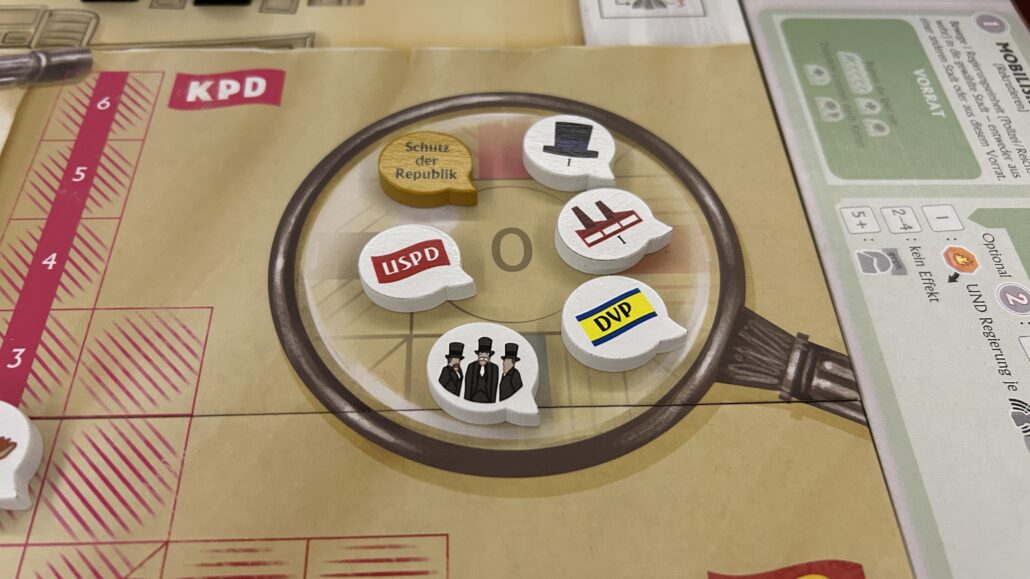
So könnte es aussehen……doch das vergrößerte „0-Feld“ macht alle Token lesbar. Super!
Was sich hingegen einschleifen muss, ist das jeweilige Spielziel. Natürlich sind Spielende-Bedingungen klar kommuniziert und es ist auch verständlich, wie man Aktionen und Ereignisse ausspielt. Aber das „warum?“ war mir anfangs nicht immer klar. Geholfen hat dann letztendlich die Übersicht der Siegpunkt-Quellen am Rundenende, um einen groben Plan zu haben, was gut für meine jeweilige Partei ist und was eben nicht.
Darüber hinaus debattiert man mehrere Runden über Themen im Parlament und weiß: Je weiter ein Thema „bei mir“ ist, desto besser. Aber wozu mache ich das? Das erschließt sich dann auch erst am Ende der Runde. Zum einen erhalte ich durch gut platzierte Themen Einfluss im Parlament (und so mit Sitze). Aber all diese Debatten haben letztendlich auch einen Effekt, den ich abhandeln muss: ich werde Startspieler (noch vor dem Kanzler), kann Armut bekämpfen, für Sicherheit sorgen… oder das Gegenteil davon tun.
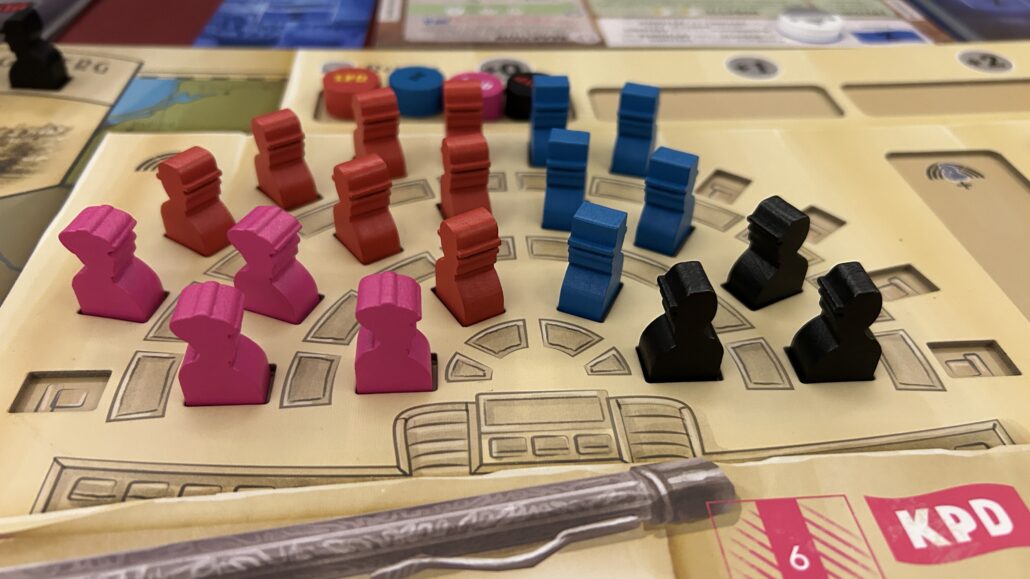
Das Parlament……und unsere Debatten.
Zwischen zwei Welten
Was mir Weimar nicht leicht macht, ist die Einordnung: Der sehr hohe Anspruch steht einer hervorragenden redaktionellen Arbeit gegenüber. Weimar ist ein hoch komplexes Spiel, aber kein kompliziertes. Ich habe es als sehr angenehm empfunden nahezu niemals darüber nachdenken zu müssen wie etwas nochmal funktioniert. Die Frage war eher wozu ich etwas mache – was der beste Weg ist und wohin die Reise gehen soll.
Um diese Frage zu klären benötigt man wohl mindestens 1-3 Partien in derselben Gruppe, damit auch die Langzeit-Entwicklung der Republik über die 3 Phasen hinweg bekannt sind und die Decks der einzelnen Parteien eingeschätzt werden können. Von den je 2 optionalen Erweiterungsdecks mit je 5 Karten, die jede Partei innerhalb der Partie noch dazu gewinnen kann, ganz zu schweigen.
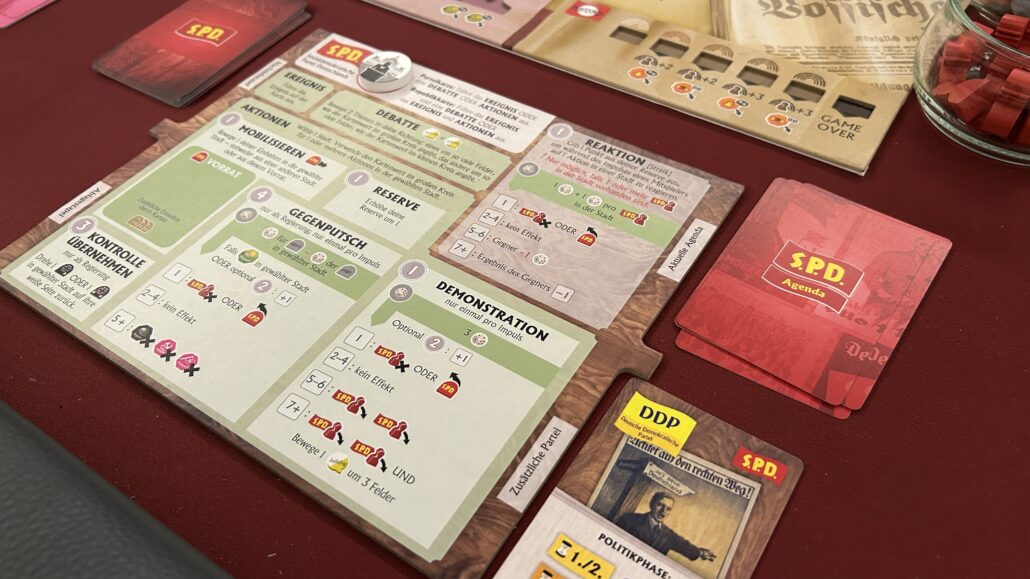
Republik- und Parteikarten der SPD.
Und diese Hürde muss man dann doch überwinden wollen und vor allem können. Weimar macht einem den Einstieg so leicht wie irgend möglich, was jedoch nicht bedeutet, dass er auch zwingend leichtfällt. Vielmehr muss man das System des Spiels kennen lernen, um es effektiv und zielgerichtet zu spielen. Natürlich kommt man auch in der Erstpartie über die Runden, aber um strategisch statt nur taktisch planen zu können, um sinnvoll agieren statt nur auf seine Kartenhand reagieren zu können muss man einfach sehr viel Wissen aufbauen. Dass das Spiel (mit Ausnahme des Solo-Szenarios) nur zu viert spielbar ist und wohl mit denselben Spielenden mehrfach gespielt werden sollte, macht es nicht gerade einfacher, diese Hürde auch zu nehmen.
Fazit zu Weimar – Der Kampf um die Demokratie
Weimar hat mich nachhaltig beeindruckt. Nicht nur, aber vor allem im Vergleich mit anderen kartengetriebenen Konfliktspielen, die in ihrer Präsentation meist doch eher bieder und zweckdienlich daher kommen. Da ist Weimar anders: Dieses Spiel ist ausgesprochen gut produziert. Das fängt beim üppigen Spielmaterial an und hört beim zugänglichen Grafikdesign noch lang nicht auf. Als Kirsche gibt es dazu noch ein stabiles Papp-Insert, das seinen Namen auch verdient.
Einziger Wermutstropfen ist die benötigte Spieleranzahl von genau vier Spielern und die thematische Komplexität. Hier benötigt man entweder viel Erfahrung im Bereich solcher Spiele, oder aber etwas Sitzfleisch – dann kommt das Hintergrundwissen ganz von allein.
Weimar braucht sich hinter seinen Artgenossen auf keinen Fall zu verstecken, setzt mit dem Aktionsmechanismus sogar noch eine spannende Mechanik oben auf. Die hervorragende Anleitung könnte kaum besser sein und „genretypisch“ gibt es noch ein Begleitheft mit Szenarien, der thematischen Erklärung der Ereigniskarten sowie einer toll geschriebenen und bebilderten Beispielrunde.
Auch wenn ich befürchte keine Spielgruppe für dieses Werk zu haben, hat mich Weimar auf ganzer Linie beeindruckt. Nicht nur als spannendes Spiel, sondern vor allem auch als sehr rundes Gesamtprodukt. Ich ziehe meinen Hut!
Kein Spiel ist für Jedermann. Ob Weimar etwas für euch ist, entscheidet allein ihr.
Die thematische Einbettung ist die Stärke dieser Spiele und auch hier fühlt sich alles hoch thematisch an. Das Beilagen-Material erklärt es auch noch bis ins Detail. Besser geht es nicht – Lehrauftrag erfüllt!
2. Material
Karten, Doublelayer-Spielbrett, bedruckte Holzteile in Hülle und Fülle, dazu noch ein gutes Insert? Dieses Spiel braucht sich hinter keiner EGG-Deluxe-Produktion zu verstecken.
3. Optik
Im Vergleich zu seinen Genrevertretern sehr ansprechend und hochwertig. Allerdings auch klassisch. Sepia ist hier vorherrschend. Was mir persönlich nie gut gefällt sind Fotos auf Spielmaterial. Auch wenn es sich hier um echte Fotos historischer Personen oder Ereignisse handelt, finde ich Zeichnungen einfach schöner. Die Gestaltung ist ansonsten zweckdienlich bis hochwertig.
4. Setup
Wie nicht anders zu erwarten ein Brocken. Hier kommt aber erschwerend hinzu, dass das ansonsten hervorragende Insert nur eine große Wanne für alle Holzteile bietet. Mit etwas 3D-Druck ist da sicherlich schnell Abhilfe geschaffen, aber nicht jeder hat so ein Gerät zuhause.
5. Spieleranzahl
Weimar ist nur mit genau 4 Spielern spielbar und das ist schwierig zu bewerten. Natürlich funktioniert es in dieser Spielerzahl sehr gut, jedoch muss man diese Gruppe auch erstmal formen und fördern, damit das Spiel seine Spannung auch vermitteln kann.
6. Zugänglichkeit
Die Anleitung macht den Job (fast) so gut wie möglich. Eine kleinere Hilfe zu Beginn was die parteispezifischen Ziele sind und worauf man bei Rundenende zu achten hat, hätte etwas Unklarheit während der Erstpartie verhindert. Dennoch macht vor allem das Material hier viel aus, beispielsweise die Vergrößerung des 0-Feldes bei den Debatten.
7. Spieltiefe
Die Spieltiefe ist natürlich überwältigend groß, jedoch kann ich nach meinen Gehversuchen noch nicht abschätzen, wie „gespielt“ man sich später fühlt. Genrevertreter wie Twilight Struggle / Gleichgewicht des Schreckens ziehen ihre Faszination auch aus der Frage, wann ich meinem Gegenüber ein Ereignis erlaube und welche Möglichkeiten er aufgrund des Spielfortschritts bereits/noch hat. Für meinen Teil fühlt sich das etwas „wie auf Schienen“ an. Das ist auch bei Weimar letztendlich der Fall, jedoch durch die 3 statt nur 1 Gegenspieler in kleinerem Maßstab. Die Aktionsmöglichkeiten setzen darüber hinaus noch eine Ebene auf, auch wenn ich hier – je nach Partei – wieder auf bestimmte Aktionen beschränkt bin.
8. Spieldauer
Die Spieldauer ist mit 360 Minuten angegeben. 6 Stunden für ein Spiel, das einen dauernd fordert. Ich persönlich mag lange Spiele, weil sie eine gewisse Entwicklung innerhalb einer Partie überhaupt erst möglich machen. Allerdings spielt dann wieder die benötigte Spieleranzahl nicht gerade in die Karten.
9. Downtime
Da sich die politische Landschaft und das Geschehen in den Städten stetig verändern, kommt hier keine Langeweile auf. Die Züge sind in der Regel zügig abgehandelt. Einzig die Reaktionen per Reserveaktion bzw. Ereigniskarte stoppen manchmal den Spielfluss – auch wenn sie spannend sind.
10. Preis
129,00 € UVP sind beileibe nicht wenig, aber man bekommt auch eine Menge dafür! Eine Menge Spiel, eine Menge Material und vor allem eine Menge redaktioneller Qualität. Wer mit dem Thema etwas anzufangen weiß und eine passende Spielgruppe hat, der wird sicherlich nicht enttäuscht sein.
Ergebnis
Mit 39/50 Punkten erreicht Weimar – Der Kampf um die Demokratie die Bewertung „Empfehlenswert“!
We’ve been assessing the merits of political leaders in (more or less) democratic countries on this blog for a few years now – UK prime ministers, US presidents, German chancellors. Today, we’re returning to German presidents, looking at Friedrich Ebert. And which game could be more appropriate for him than Weimar (Matthias Cramer, Capstone Games/Skellig Games/Spielworxx)?
The Rating System
Some caveats ahead: The presidents will be rated by the knowledge of their time. If they or their contemporaries could not have known about the effects of something, I will not use my hindsight to mark it as a mistake of theirs. The assessment is focused on their conduct as president.
Now, to the system itself: There are three policy field categories (foreign, domestic, and economic policy) and three more general ones (vision, pragmatism, integrity). A president can earn from one to five stars in each category (for a total sum of up to 30). In detail, the president is assessed as follows:
Foreign policy: Did the president increase German influence in the world and the security of Germans at home? Did the president wield German power responsibly and with positive results for the regions affected?
Domestic policy: Did the president increase the liberty of Germans to express themselves and to participate in the political process? Did the president promote domestic security and shape the framework for fair justice dealing with offenses?
Economic policy: Did the president facilitate the prosperity and economic security of Germans (including in the mid- and long-term)? Was the president’s economic policy based on mutual benefit of those involved or did it unduly burden one side?
Vision: Did the president have an idea of what Germany and Europe (the latter counting for more in times of German influence being great) should look like beyond the immediate future? Did the president’s policies steer Germany (and, if applicable, Europe) in this direction?
Pragmatism: Did the president succeed in seeing their policy through from inception to completion? How well did the president manage the support from parliament, society, the administration, the media?
Integrity: Did the president understand the office as a means to benefit themselves, special interest groups, the entire country, or another community? Did the president respect the boundaries of the office?
Note: If you have read my UK prime minister or US president ratings, you will remember that I rated them on the global impacts of their vision as well. As the rating system is only really applicable to democratic leaders and no democratic German leader ever had the chance to conduct a truly global policy, I only assess their vision on national and European grounds.
In all other ratings (UK prime ministers, US presidents, German chancellors) the subject’s life after holding the office is also assessed (for they are still seen as ex-office holders, but as a secondary consideration). This does not apply here, as – spoiler! – both Weimar Republic presidents died in office.
In Ebert’s special case, I will not only assess his conduct as president, but also as chancellor before, as he held the post at a time when Germany did not have a head of state.
Ebert’s Life
From Saddler to Chancellor
Friedrich Ebert was born on February 4, 1871, as the son of a tailor. He learned the trade of a saddler and became involved with the workers’ movement during his journeyman years. In 1891, he settled down in Bremen, where he ran a pub while working for the trade union. Ebert’s political work in the trade union and the Social Democratic Party (Sozialdemokratische Partei Deutschlands, SPD) assumed ever more importance. He was elected to the Bremen city council (1899) and became a full-time trade union secretary. In the following years, Ebert rose to national prominence: He was elected to the SPD national party committee (1905) and to the Reichstag, the national parliament of Germany (1912). One year later, he became one of the leading Social Democrats in Germany when he was elected co-chairman of the SPD.
The Social Democrats faced their crucible at the outbreak of World War I. Ebert successfully advocated supporting the government’s war efforts (instead of attempting to forge an international workers’ coalition against the war). In the later years of the war, more and more Social Democrats took up a strict anti-war stance, forming up as Independent Social Democrats (Unabhängige Sozialdemokratische Partei Deutschlands, USPD). Ebert maintained his previous stance and kept most of his allies within the party (now known as Majority Social Democrats (Mehrheitssozialdemokratische Partei Deutschlands, MSPD), yet tried to mediate between workers protesting and striking against the war and the government (notably during the January Strike of 1918).
When the military situation looked grim for Germany in fall 1918, de facto military dictator Erich von Ludendorff resigned and pushed for a new government to assume responsibility for the impending defeat. Ebert joined a parliamentary government and became its interim chancellor on the day that emperor William II was forced to abdicate. Two days later, Germany and the Allies agreed on the Armistice which ended the fighting on the Western Front.
Many socialists, especially from the USPD, now pressed for a full-scale political and social revolution based on the workers’ and soldiers’ councils sprouting up everywhere. Ebert, who abhorred the Russian Revolution, wanted to bring about gradual change which would transform Germany into a democracy by parliamentary means. The sweep of revolution brought MSPD and USPD together in an uneasy government alliance. The opposition between moderate and radical socialists provides the basis for the SPD and KPD (Kommunistische Partei Deutschlands – Communist Party of Germany) players’ relationship in Weimar (all forms of radical socialism are subsumed under the umbrella of the KPD (which was historically only founded in January 1919) in the game). The USPD is a minor party in the game which can be aligned with either SPD or KPD (starting in the latter’s camp) and which provides more gumption for actions in the street and sizable parliamentary bonuses in the early game.
The USPD gives additional seats in parliament in the first four rounds of the game as well as a bonus point in the reserve each round (on the board to the left of the card). If the SPD can wrest the party away from KPD control early, that usually results in a large democratic majority under SPD leadership.
In the heady first days of the revolution, MSPD co-chairman Philipp Scheidemann proclaimed the German Republic (Ebert had opposed it and wanted Germany to become a parliamentary monarchy). The new government also proclaimed wide-ranging individual liberties and promised sweeping economic and social reforms (ranging from the eight-hour work day over housing programs to social security) as well as democratic elections in which both men and women would have the right to vote – here Ebert and the USPD agreed in substance, yet not in process: The USPD regarded the consent of the workers’ and soldiers’ councils as enough legitimation; Ebert insisted to carry out the reforms through a parliamentary process. Ebert outfoxed the USPD by having the Reich Councils’ Congress agree to hold parliamentary elections at the earliest possible date.
While Ebert outmaneuvered his rivals on the left, he also secured his right flank. Millions of German soldiers streamed back from the frontlines after the armistice. They needed to be demobilized in an orderly fashion, and, most of all, the threat of a military coup against the nascent republic needed to be warded off. Ebert thus struck a bargain with the army’s conservative leadership: The army would not act against the republic. In return, the new government would forgo the democratization of army structures. The deal already paid off for Ebert by December 1918: When the conflict of the government with the left-leaning People’s Naval Division over outstanding pay and the choosing of its commander escalated, Ebert had the Division dissolved by armed force. The same fate awaited the singularly ill-prepared Spartacus Uprising of January 1919.
A revolution makes for strange bedfellows: Social Democrat Ebert is inspecting German troops in the illustration of the “Pact with the Old Powers” event card. The event is extremely powerful under the right circumstances. Note that the SPD player could also use it to suppress a right-wing insurgency!
When the National Assembly had been elected in January 1919, Ebert’s MSPD was by far the strongest party. Its allies, the Catholic Zentrum (Center), and the progressive-liberal DDP (Deutsche Demokratische Partei, German Democratic Party) also fared well at the ballot box. Due to the armed unrest in Berlin, the National Assembly was convened in the quiet provincial town of Weimar, thus providing the common name for the first German republic (and, consequently, also for the alliance of SPD, Zentrum, and DDP – the “Weimar Coalition”). The Assembly elected Ebert the first president on February 11, 1919.
The Parliamentary President
The National Assembly established wide-ranging rights for the president in the constitution. Yet Ebert interpreted these as powers to be used in emergencies. In his view, the president was a steward whose role was to guard the constitution and integrate the nation. Thus, Ebert only rarely got involved in the day-to-day business of the cabinet, now headed by Philipp Scheidemann – for example, when the Allies presented Germany with the Treaty of Versailles, Ebert remained publicly non-committal.
Even when the republic as such was threatened, the president was not always the first to respond: The right-wing power grab by Wolfgang Kapp and Walther von Lüttwitz was stopped by a general strike. While Ebert’s name appeared on the pamphlet calling for the strike, it is likely that he was in fact not involved in the move. Ebert’s main contribution to the failure of the coup was of a different kind: When the coup leaders occupied Berlin, the federal civil service refused to do their bidding. Even though most of the civil servants had been hired under the emperor and felt attached to the monarchy, they had come to respect Ebert and would not enable the coup against his lawful government.
The 1920 parliamentary elections dealt the (M)SPD and its allies a heavy blow. They lost their parliamentary majority. Ebert advocated for a “grand coalition” which would include not only the parties of the Weimar Coalition, but also the pro-business, national liberal DVP (Deutsche Volkspartei, German People’s Party). His counsel was not heeded. Instead, Zentrum and DDP formed a bourgeois minority government.
Ebert was the most imposing political figure of the early Weimar Republic. While his integrative approach did much to wed the more moderate workers to the Republic (they would remain its most steadfast defenders till the very end), his suppression of revolutionary activities also alienated the more radical workers… thus the “Red Emperor” event card (showing Ebert at his presidential desk) can cut both ways, placing either an SPD- or a KPD-aligned worker marker on the society track.
As the government had no parliamentary majority, the president might have assumed a greater role. Ebert, however, maintained his interpretation of the presidency as a stewardship, detached from party politics and the day-to-day decisions of the cabinet. In economic and social matters, Ebert retained his representative role, mediating at times in collective bargaining struggles. In foreign policy, the president’s constitutional role was larger, and while Ebert generally supported the general foreign policy of the bourgeois minority governments, he was left out of the actual decision-making. In the meantime, Ebert tirelessly lobbied for cooperation among all democratic parties. It took a plunge into catastrophe for the young republic to heed his counsel.
When Germany reduced the reparation payments to the Allies in January 1923, France occupied the industrial heartland on the Ruhr. The German government called on the workers of the Ruhr not to collaborate with the occupation force in extracting the reparations in kind (“passive resistance”). That required the government to pay out ersatz wages to millions of people, accelerating inflation to a ludicrous degree. By August 1923, prices compared to January had multiplied by 100 (!), and France was still occupying the Ruhr. With Ebert’s support, all democratic parties from the SPD to the DVP formed a grand coalition under chancellor Gustav Stresemann.
Stresemann ended the ruinous passive resistance. While economically sound, this blow to German national sentiment caused backlash: The Bavarian state government declared a state of emergency, aiming to build a new authoritarian system in Bavaria (equivalent to the establishment of a right-wing regime in Weimar) and then exporting it to the Reich as a whole. In response, SPD-KPD state governments formed in Saxony and Thuringia (both in the path for a “March on Berlin” from Munich).
Once more, Ebert suppressing a leftist challenge to the republic. The Reichsexekution placed Saxony and Thuringia under federal control.
Ebert used the constitutional emergency powers granted to the president to depose the Saxon and Thuringian state governments. Federal troops quelled the unrest there before any uprising had even materialized. Yet while the army would march against leftist challenges to the republic, it was notoriously unwilling to confront right-wing movements (as Ebert knew from the Kapp-Lüttwitz coup). Thus, while Ebert formally put the army’s commander Hans von Seeckt in charge of Bavaria, he did not order any concrete action. In the end, the authoritarian government of Bavaria was overthrown from the fringe of the right-wing movement – Germany’s erstwhile military dictator Ludendorff and an ambitious demagogue named Adolf Hitler took the key government players captive and called for a march on Berlin. It was stopped within its first kilometer by 130 policemen. After that, the authoritarian government collapsed. The republic had been saved.
Lots to deal with: The Weimar Republic was close to collapse in 1923 – in game terms, approaching its seventh threat marker in the Deutsches Reich box.
While the Weimar Republic stabilized, Ebert fought for the dignity of his office. He had been smeared by enemies of the republic from the beginning of his term. When Ebert had visited a beach town in 1919, a local photographer had snapped a picture of him in swimming trunks. The monarchists bought that picture and kept circulating it, often contrasting the half-naked president with one of the emperors of the old Germany in full regalia.
The nationalist DNVP begins the game as the weakest of the four parties. One strategy for them is to erode the democratic majority – for example, by attacking the SPD’s parliamentary standing with the President in Swimming Trunks event.
Ebert’s detractors also attacked his conduct. Most famously, they attacked him for his role in the January Strike in 1918. A court found those calling Ebert a “traitor to his country” for his participation in the strike guilty of defamation, but added that they were factually correct – symptomatic for the monarchist leanings of the Weimar courts, still staffed with jurists from the ancien régime. The court’s ruling was only overturned in 1931. Ebert would not live to see it. He had put off surgery for appendicitis due to the trial and died of the resulting peritonitis on February 28, 1925. He was only 53 years old.
Ebert’s death is a watershed moment in a Weimar game. As long as the Ebert token occupies the Reichspräsident spot, the presidency is neutral, and nobody gains any benefits from it. When Ebert dies, an election is held in which the parties’ popularity with the voters is measured. Each party fields a candidate. The two candidates with the most votes advance to the second round, in which the two parties whose candidates have been eliminated can pledge their votes to any of the remaining candidates. That is a crucial moment to make deals, to forge alliances, to exact promises in return for the votes, and, more often than not, to pivot away from an ally who has become too strong. (I have seen my Social Democratic candidate defeated by a very grand coalition of the other three parties – Nationalists, Conservatives, and Communists.) From then on, the party holding the presidency can play a card both for the event/actions and for a debate once per round, effectively giving the party one more party card (which, as you typically only draw three of them per round, is huge). This less restrained approach to the presidency reflects the presidential activism of Ebert’s successor Paul von Hindenburg.
Even though foreign policy was the area in which the president’s role was constitutionally confirmed, Ebert followed rather than led. While he – much like his head of government Philipp Scheidemann – personally found the terms of the Versailles Treaty unacceptable, he stayed on when Scheidemann resigned, displaying a keen sense of duty and order. Ebert supported the various governments in their unpopular, but necessary fulfilment of the stipulations of the Versailles Treaty and their orientation toward the western powers. At times, he was entirely sidelined, as when chancellor Joseph Wirth and foreign minister Walther Rathenau forged the Treaty of Rapallo with the Soviet Union.
Ebert’s achievements in this realm lie during his tenure as chancellor. His Proclamation (Nov 12, 1918) ushered in an unprecedented era of personal liberty and social equity, exemplified in the commitment to freedom of the press and women’s suffrage. Ebert’s integration of the army into the new republic avoided a civil war. Later, his uneven use of force dealing with the uprisings of 1923 was pragmatically understandable, but failed to conciliate the political right with the republic or make the army more accountable to the political leadership.
The Proclamation of November 12, 1918 laid the foundation for the eight-hour work day, a milestone for the working population of Germany. An overlooked contribution of Ebert’s to economic development is his advocacy for the “grand coalition” – only this broad alliance could bring about the far-reaching currency reform which ended hyperinflation in 1923. That Ebert’s calls to alleviate the social hardships which came as a side effect to the currency reform went unheeded by the bourgeois minority government which followed the grand coalition is symptomatic for the limited power of the presidency in the realm of economic and social policy.
Ebert has often been criticized from the left as too cautious, not able or not willing to dream big. And indeed, in hindsight his thought and practice seems much less imaginative than his critics’ utopias of socialist republics based on grassroots councils. Yet in 1918, the thought of a liberal, parliamentary Germany – the realization of the dream of 1848 – was revolutionary, and, most importantly, it was achievable. Ebert helped to bring about the German democracy and guided it into calmer waters during his tenure.
Rating: 5 out of 5.
If Ebert (pictured in the background of the election poster) played Weimar, he’d select this agenda card every round.
Pragmatism
Ebert made it possible for the bourgeois politicians, the army, and the civil service to get along with a Social Democratic government. While this was an impressive feat in itself, his pleas for cooperation were often not heeded – neither from his own party nor from those he sought as allies. His natural inclination to compromise veils his deft handling of his political opponents: The USPD joined the provisional government on equal footing in November, yet ended up entirely outmaneuvered by January – its moderates falling in with Ebert’s call for elections as soon as possible, its radicals reduced to a singularly ill-advised attempt at armed uprising.
Ebert is the rare politician who, presented with the opportunity to make wide-reaching decisions with a free hand, refused it. His belief that a freely elected parliament must make the important choices guided him during the revolution. Later, Ebert understood himself as a steward of the republic, a president of all Germans, and was unwilling to use his office for the gain of particular individuals or groups. He used the wide-ranging emergency powers assigned to the president in the constitution only when presented with a grave crisis. His thoughtful wielding of power becomes ever more apparent in comparison with his successor’s liberal use of the emergency powers which contributed to the fall of the republic.
Friedrich Ebert took on the highest duty in tumultuous times. He wielded power responsibly, with the best of intentions, and remarkable success. His restraint and willingness to compromise were admirable in themselves, but sometimes emboldened the enemies of the republic he had helped to create.
How would you rate Ebert? Let me know in the comments!
Further Reading
For a short introduction to Ebert (and all other German chancellors in history), see: Sternburg, Wilhelm von (ed.): Die deutschen Kanzler. Von Bismarck bis Merkel [The German Chancellors. From Bismarck to Merkel], Aufbau, Berlin 2007, pp. 187—210 [in German].
The standard scholarly biography remains Mühlhausen, Walter: Friedrich Ebert. 1871—1925. Reichspräsident der Weimarer Republik [Friedrich Ebert. 1871—1925. Reichspräsident of the Weimar Republic], Dietz, Bonn 2007 [in German].
For the broader context, see: Herbert, Ulrich: A History of Twentieth-Century Germany, Oxford University Press, Oxford 2019.

 Anmelden


 Shownotes
Redebedarf. Das Podcastformat ohne Format. Manchmal gibt es einfach Anlässe, Erfahrungen und Beobachtungen zur Spielszene die nur in einem kurzen Podcast untergebracht werden können. Das tun Georgios Panagiotidis und Peer Sylvester mit Redebedarf.