Poop! Spies! What do they have in common? Both are featured in board games designed by Jon Teixeira Moffat, naturally. On today’s Space-Cast!, we’re joined by Jon to discuss the long development of both Night Soil and Burned, the hidden cost of labor, and cinematic hidden movement games.
Listen here or download here. Timestamps can be found after the jump.
TIMESTAMPS
00:36 — introducing Jon Teixeira Moffat
4:06 — Stone Circle Games
7:00 — Night Soil
21:08 — portraying labor
33:15 — Burned
(If what I’m doing at Space-Biff! is valuable to you in some way, please consider dropping by my Patreon campaign or Ko-fi. Right now, supporters can read my first-quarter update of 2026: the best board games, movies, books, and more!)
Almost a year of uncertainty over the future of board game publisher Greater than Games has been partially resolved, with Flat River Group selling the brand name, and the rights for the Sentinels of the Multiverse titles, to Handelabra Games.
Video game developer Handelabra has a long history with the comics-themed cooperative card game, having spent more than a decade creating digital versions of the title and its expansions – as well as for Greater than Games’ best known release, Spirit Island.
Spirit Island is not part of Handelabra’s deal, however, which the company said only covers the Sentinels of the Multiverse games, the Sentinel Tactics range, the Sentinel Comics RPG, Sentinels miniatures and the cooperative deck-builder Galactic Strike Force.
The distribution and e-commerce specialist was bought six years ago by private equity investor Guardian Capital Partners, which provided capital for a string of tabletop industry acquisitions.
They included an expansion into board game publishing in 2021 with the buyout of Greater than Games, which it followed a year later with deals for Canadian publisher Synapses Games and hobby game distributor Luma Imports.
A statement from Handelabra president and CEO Jaye Handel said the company had made the GtG and Sentinels deal to protect its ability to make digital games in that IP, adding that it was “not interested in becoming a tabletop publisher”.
But the statement added, “But lucky for us, we know a lot of good people who are good at exactly that type of business…”
That is believed to refer to Greater than Games trio Christopher Badell, Paul Bender and Adam Rebottaro, who founded the company in 2011 and were the last remaining employees following Flat River’s downsizing of GtG last year.
Handelabra CEO Handel told BoardGameWire he was unable to share further details, but said that his company was “very excited about the future of Sentinel Comics on digital and analog tabletops and beyond”.
He added, “Handelabra Games’ and Flat River Group’s relationship with regards to Spirit Island has not changed.”
The company’s recent statement from Handel indicated it would be able to provide more information about Greater than Games’ future by April 28, which is National Super Hero Day in the US.
It said, “For your ongoing support and excitement, we remain eternally grateful. We just ask for a little more patience over the coming weeks as we have lots to share, and we can’t wait to embark on the next phase of this journey with you!”
Flat River did not respond to BoardGameWire’s request for comment on the future of Spirit Island or other former Greater than Games-published titles.
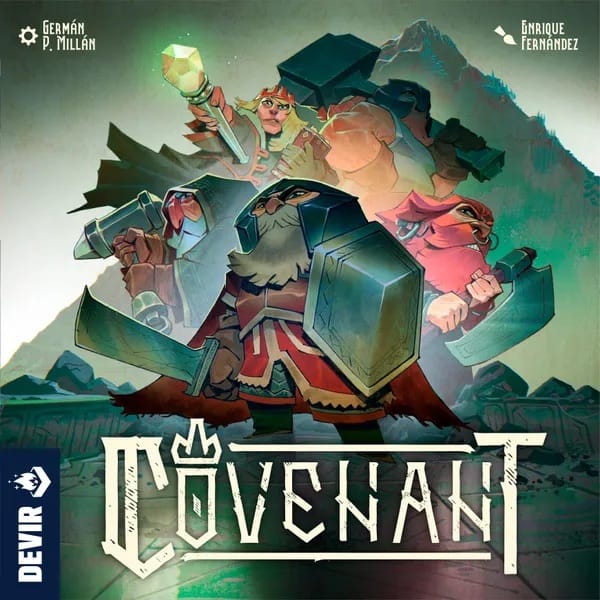
Strohmann Games bringt das Expertenspiel Covenant in der zweiten Jahreshälfte 2026 auf Deutsch heraus. Das Spiel des spanischen Autors Germán Palomar Millán, der unter anderem für „Bitoku" und „Men Nefer" bekannt ist, wurde ursprünglich beim Verlag Devir veröffentlicht. Mit einem Komplexitätswert von 3,71 auf der BGG-Skala richtet es sich an erfahrene Brettspieler, die thematische Tiefe mit anspruchsvollen Mechaniken schätzen. Geeignet ist es für 1 bis 4 Personen ab 14 Jahren bei einer Spielzeit von rund 90 bis 100 Minuten.
Zwerge, Dunkelheit und ein heiliger Berg
In Covenant übernehmen die Spieler die Rolle von Anführern verschiedener Zwergen-Clans. Der König hat alle Clans aufgerufen, den heiligen Berg Karrak-cüm-Kazar zurückzuerobern. Seit Urzeiten die Heimat der Zwerge, wird der Berg schon zu lange vom Dunklen Fürsten und seinen Kreaturen besetzt. Es ist höchste Zeit, dass die Zwerge zurückkehren.
Über drei Runden hinweg weisen die Spieler ihren Zwergen unterschiedliche Aufgaben zu. Sie erkunden die alten Hallen, bekämpfen Feinde und errichten Gebäude, um die legendäre Zwergenstadt wieder zum Leben zu erwecken. Die Spielmechaniken verbinden Worker Placement mit Action Points und Set Collection. Mit Token und Werkzeugen graben sich die Zwerge tiefer in den Berg hinein.
Wer am Ende den meisten Ruhm angesammelt hat, gewinnt nicht nur das Spiel, sondern auch die Anerkennung des Königs. Laut der BGG-Community entfaltet Covenant seine Stärken besonders zu zweit oder zu dritt. Das Spiel hat auf BoardGameGeek eine durchschnittliche Bewertung von 7,74 und liegt im Strategy Game Ranking auf Platz 872.
Erscheinung und offene Fragen
Das Design stammt von Enrique Fernández Peláez, der unter anderem an „B-Sieged" und „Monster Lands" mitgewirkt hat. Der genaue Erscheinungstermin und der deutsche Titel stehen noch nicht fest. Strohmann Games hat bislang nur die zweite Jahreshälfte 2026 als Zeitraum genannt.
Covenant ist bereits in der Originalfassung von Devir erhältlich und kann auf Tabletopia digital ausprobiert werden. Ob die deutsche Ausgabe zusätzliches Material oder Anpassungen enthält, ist derzeit nicht bekannt.
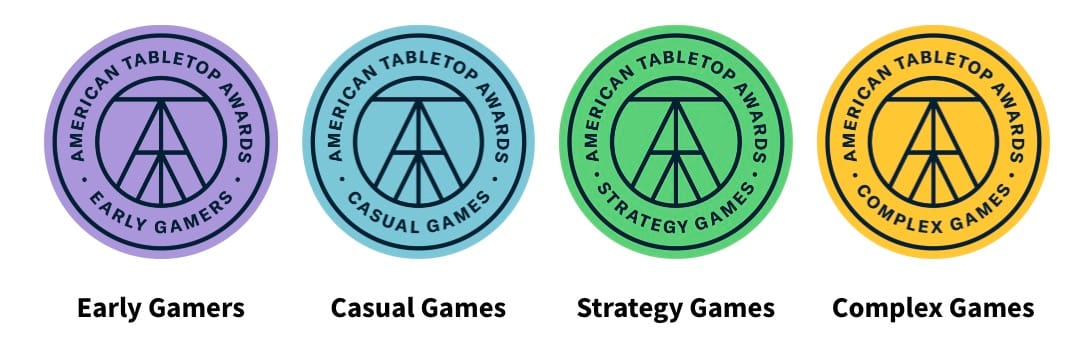
Seit 2019 vergibt eine zehnköpfige Jury in den USA die American Tabletop Awards (ATTA) für herausragende Brettspiele. Die Auszeichnungen decken vier Kategorien ab, von leichten Einstiegsspielen bis hin zu komplexen Strategietiteln. Jetzt stehen die Sieger des Jahrgangs 2026 fest.
Die vier Gewinner im Überblick
In der Kategorie „Early Gamers", die sich an jüngere und neue Spieler richtet, setzt sich Magical Athlete von Richard Garfield und Takashi Ishida (CMYK Games) durch. Das chaotische Rennspiel für 2–6 Personen ab 6 Jahren bietet Partien von rund 30 Minuten. Vor jedem Rennen draften die Spieler Athleten mit unterschiedlichen Fähigkeiten, die das Spielgeschehen gehörig durcheinanderbringen können. Auf BoardGameGeek erreicht der Titel eine durchschnittliche Bewertung von 7,9.
Die Kategorie „Casual Games" geht an Hot Streak von Jon Perry, ebenfalls bei CMYK Games erschienen. Hier wetten 2–8 Spieler auf Maskottchen in einem unberechenbaren Rennen, das in etwa 20 Minuten gespielt ist. Über ein Drafting-System platzieren die Spieler Wetten und beeinflussen gleichzeitig verdeckt den Rennverlauf. Damit sichert sich CMYK Games gleich zwei der vier Auszeichnungen.
Den Preis für das beste „Strategy Game" erhält The Lord of the Rings: Fate of the Fellowship von Matt Leacock (Z-Man Games / Asmodee). In dem kooperativen Spiel für 1–5 Personen steuert jeder Spieler zwei Charaktere, um Frodo auf seinem Weg zu beschützen und den Einen Ring zu vernichten. Mit einer Spielzeit von 60–150 Minuten und einer Komplexitätswertung von 3,1 auf BGG richtet sich der Titel an erfahrene Spieler. Der Pandemic-Erfinder Leacock liefert hier eine thematische Neuinterpretation seiner kooperativen Spielmechaniken.
In der Königskategorie „Complex Games" gewinnt Molly House von Jo Kelly und Cole Wehrle (Wehrlegig Games). Das Spiel versetzt 1–5 Spieler in das London des frühen 18. Jahrhunderts, wo sie als sogenannte Mollies rauschende Feste veranstalten und gleichzeitig den moralistischen Ordnungshütern ausweichen müssen. Mit einer Komplexitätswertung von 3,7 auf BGG und Mechaniken wie Verhandlung, Bluffen und einem Verräterelement zählt Molly House zu den anspruchsvolleren Titeln des Jahrgangs. Die Spielzeit liegt bei 60–120 Minuten.
Nominierungen und Empfehlungen
Neben den Gewinnern vergab die Jury in jeder Kategorie jeweils zwei Nominierungen und zwei Empfehlungen. In der Kategorie „Early Gamers" waren The Sandcastles of Burgundy von Stefan und Susanne Feld (Ravensburger) sowie Splendor Kids von Marc und Catherine André (Space Cowboys / Asmodee) nominiert. Als empfohlen gelten Cascadia Junior von Fertessa Allyse und Randy Flynn (Flatout Games) sowie Duck & Cover von Oussama Khelifati (Captain Games).
In der Kategorie „Strategy Games" nominierten die Jurymitglieder Critter Kitchen von Alex Cutler und Peter C. Hayward (Cardboard Alchemy) sowie Kinfire Council von Kevin Wilson (Incredible Dream). Knitting Circle von Emily Vincent (Flatout Games) und Moon Colony Bloodbath von Donald X. Vaccarino (Rio Grande Games) erhielten eine Empfehlung.
Bei den „Complex Games" gingen die Nominierungen an Tidal Blades 2: Rise of the Unfolders von Tim und Ben Eisner (Druid City Games) sowie Covenant von Germán P. Millán (Devir). Empfohlen wurden Above and Below: Haunted von Ryan Laukat (Red Raven Games) und Galactic Cruise von TK King, Dennis Northcott und Koltin Thompson (Kinson Key Games).
Auffällig in diesem Jahrgang: CMYK Games dominiert die leichteren Kategorien mit zwei Siegen, während Asmodee-Labels sowohl bei den Casual als auch bei den Strategy Games stark vertreten sind. Alle Details zu den ATTA Awards 2026 findest du auf der offiziellen Website.
I played a lot of games in 2023. The best of those games, by a sizable margin, was Hegemony: Lead Your Class to Victory, designed by Vangelis Bagiartakis and Varnavas Timotheou and released by the two men under the Hegemonic Project Games banner. A bold effort in almost every way, Hegemony did an excellent job of simulating a real-world environment and mixing that with a number of different gaming systems. The end result now resides on BoardGameGeek’s top 50 all-time games and has hit my table for nearly a dozen plays; as an event game, it’s tough to beat.
Those accolades put a big target on the back of Hegemonic Project Games’ second design, World Order. Varnavas and Vangelis were kind enough to send a review copy in advance of the game’s full release, and it was pretty easy to get the members of my review crew to line up for plays.
I tempered expectations a bit here. I thought Hegemony was a classic example of “lightning in a bottle”, an asymmetric negotiation game that really did play differently from faction to faction, which landed in a January dead zone after working through a big pile of games from the year before. Could Hegemonic Project Games do it again with World Order? My main hope was that…
With this My Favorite Wargame Cards Series, I hope to take a look at a specific card from the various wargames that I have played and share how it is used in the game. I am not a strategist and frankly I am not that good at games but I do understand how things should work and be used in games. With that being said, here is the next entry in this series.
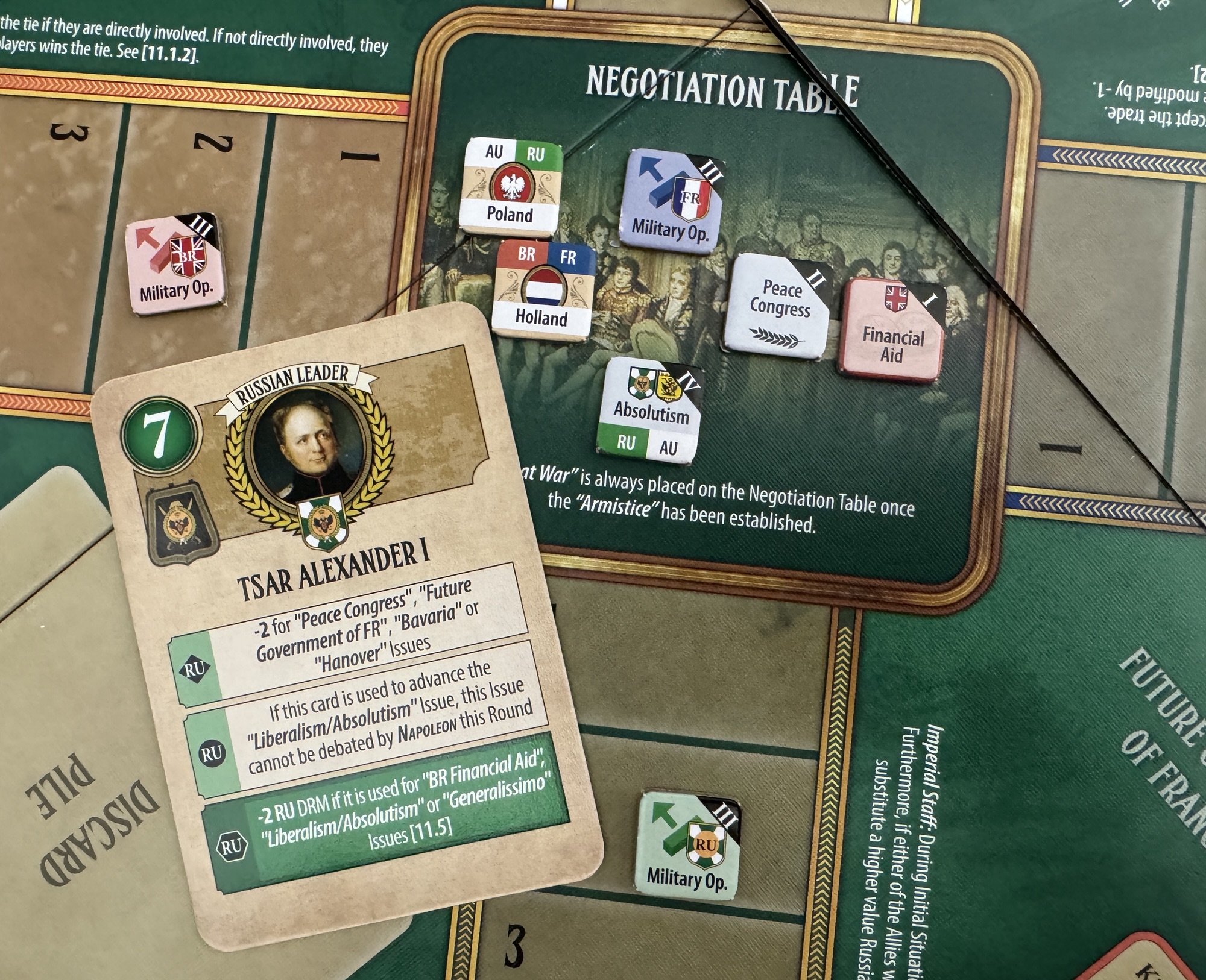
#73: Russian Leader Tsar Alexander I from Congress of Vienna from GMT Games
Congress of Vienna from GMT Games is a diplomatic card driven wargame based on Churchill and is the 4th game in the Great Statesmen Series. The game is set during the years of 1813-1814 and sees players take on the role of the main characters of the struggle between the Napoleonic Empire and the coalition of Russia, Austria, and Great Britain with their Prussian, Spanish, Portuguese, and Swedish allies. Congress of Vienna has two different but related phases including the conference table where players first debate over the control of issues germane to the factions and the period of the war and second these issues are then used on the battlefield to recruit units, attack and take overall command of battles. The players will be playing cards from their hands to “debate” over the various issues that were placed on the table, which include all types of things such as Military Operations, Recruitment, who will lead the combined Coalition forces (Generalissimo), Future of French Government, British Financial Aid, Liberalism vs. Absolutism, Austrian Neutrality and several other issues, and then later the players will use their accumulated Resources gained from the issues to enact action on the Military Map and do things like mobilize troops, place Military Support Markers and the ultimately to conduct warfare.
The game relies on cards and cards can be used to negotiate, i.e. move an issue to your National Track. Cards can provide a particular issue with positive and negative DRM’s depending on which nation plays them and can also be traded with another player during the Diplomacy Phase. Certain cards are better than others for debating an issue moved by another player; and finally, if they are saved for the War Phase, staff cards can be used to modify dice rolling in battles. These are very versatile cards and the players will have to learn them and their benefits in order to be effective at the game.
In this entry, we are going to take a look at the Russian Leader Tsar Alexander I card. The fist thing that you may notice about this Leader Card is that is that it has no benefit for military operations, meaning that Tsar Alexander is watching the war from the sidelines and not directly involved like Napoleon, but does have a potential negative effect if used on certain Issues. But his power lies in the ability to utilize his 7 value to influence issues significantly on the Negotiating table. Particularly, Tsar Alexander I is an ardent believer in the philosophy of Absolutism and wants to retain his crown as the leader of Russia. This concept is played out in the game between the great powers of the time, including Russia and Austria for Absolutism, and the more democratic players including Britain and France for Liberalism. On the board appears this Liberalism/Absolutism Track, which provides the players an opportunity to debate over the Liberalism/Absolutism Issue and gain various advantages and Victory Points from the track. On this Liberalism/Absolutism Track, Europe’s post-war governing philosophy is fought over. This is a double track in green and red with a common At Start area for the use of 2 pawns. Tracks for Liberalism (red: Britain/France) and Absolutism (green: Russia/Austria) each have four boxes and an assigned total Victory Point amount. In order to score the VP from this track though, the player scoring must have their philosophical leaning portion of the track occupying a space at least 1 box ahead of their opponent. Also, if they want to score the maximum Victory Points listed at the top, they have to occupy the top box and their opponent cannot occupy theirs. For the Russia player, this should be a huge part of their strategy as 5VP is nothing to sneeze at in this game. But, in order to do that they will most likely have to try to go first and use Tsar Alexander and his 7 value to try and move that Issue up the track to end under their control. If an Issue every reaches a Track’s Seat, meaning the 7th space, or more after any declared debate is calculated in, then that Issue is considered to be secured and can no longer be moved through negotiation during future rounds. This reminds me a bit of the way that I always plan to use Joseph Stalin in Churchill, to go first and then bring the hammer down on the A-Bomb Research Issue. Getting control of this Absolutism/Liberalism Issue at least 4 times is very important for the Russian player and they will need to utilize this ability as much as possible. But remember that there is a penalty called the “Meddling Tsar” Rule where if Tsar Alexander is used for the negotiation of the British Financial Aid, Liberalism/Absolutism or the Generalissimo Issues, it will inflict a -2 DRM on all battles involving 1 or more Russian units during the upcoming War Phase. This is quite a cost and the player should carefully consider if and when they use the ability throughout the game. If the turn is expected to contain little to no combat for Russian units, then it is safe to use but if France is being aggressive and pushing on Poland and Prussia you might want to consider not going after the Liberalism/Absolutism Issue this turn and instead focus on Recruitment and Military Operation Issues.
The other part of this ability is that if Tsar Alexander I is used to move the Liberalism/Absolutism Issue then Napoleon cannot be used to Debate that movement. I would say that this is not an issue though as typically the France player will be using Napoleon on the battlefield for his DRM abilities.
I also like the historical and personality connection between this card and the game. At the top of the card you will notice that if you use Tsar Alexander I to negotiate the Peace Congress, Future Government of France, Bavaria or Poland Issues, that you will gain a -2 on his value bringing it from a 7 down to a 5. I think that this ability really highlights the philosophy and view of the Tsar regarding the time. He doesn’t believe that France should get to continue to exist as a main player in the power structure of the time and definitely doesn’t want to see France become more democratic. But, he also has a feeling that Bavaria and Poland are Russian vassals and should not be allowed to be turned to any other side’s allegiance. If he has to be used in this manner to defend or negotiate these issues I feel like the -2 Value penalty really shows that leaning in his thinking and probably causes him to be more brunt and less diplomatic thereby losing some of his influence in the court of opinion. Ultimately, Tsar Alexander I thought that monarchy is a noble and viable alternative to the crude and materialistic mob mentality of republicanism and the abilities of his Leader Card definitely cement that view.
After playing now a few times, I am here to say that Congress of Vienna is probably my favorite game in the Great Statesmen Series. I believe that this game has matured the system and made it something that is more than where it started. Congress of Vienna is very much more like a true wargame and was extremely interesting. We are still learning and need to keep playing this one but I did enjoy what it was that we were doing.
Alexander I, nicknamed “the Blessed”, was Emperor of Russia from 1801, the first King of Congress Poland from 1815, and the Grand Duke of Finland from 1809 to his death in 1825. He ruled Russia during the chaotic period of the Napoleonic Wars.
The eldest son of Emperor Paul I and Sophie Dorothea of Württemberg, Alexander succeeded to the throne after his father was murdered. As prince and during the early years of his reign, he often used liberal rhetoric but continued Russia’s absolutist policies in practice. In the first years of his reign, he initiated some minor social reforms and in 1803–04 major liberal educational reforms, such as building more universities. Alexander appointed Mikhail Speransky, the son of a village priest, as one of his closest advisors. The over-centralized Collegium ministries were abolished and replaced by the Committee of Ministers, State Council, and Supreme Court to improve the legal system. Plans were made, but never consummated, to set up a parliament and sign a constitution. In contrast to his westernizing predecessors such as Peter the Great, Alexander was a Russian nationalist and Slavophile who wanted Russia to develop on the basis of Russian rather than European culture.
In foreign policy, he changed Russia’s position towards France four times between 1804 and 1812, shifting among neutrality, opposition, and alliance. In 1805 he joined Britain in the War of the Third Coalition against Napoleon, but after suffering massive defeats at the battles of Austerlitz and Friedland, he switched sides and formed an alliance with Napoleon in the Treaty of Tilsit and joined Napoleon’s Continental System. He fought a small-scale naval war against Britain between 1807 and 1812 and took Finland from Sweden in 1809 after Sweden’s refusal to join the Continental System. Alexander and Napoleon hardly agreed, especially regarding Poland, and the alliance collapsed by 1810. Alexander’s greatest triumph came in 1812 when Napoleon’s invasion of Russia descended into a catastrophe for the French. As part of the winning coalition against Napoleon, he gained territory in Poland. He formed the Holy Alliance to suppress the revolutionary movements in Europe, which he saw as immoral threats to legitimate Christian monarchs.
During the second half of his reign, Alexander became increasingly arbitrary, reactionary, and fearful of plots against him; as a result, he ended many of the reforms he had made earlier on in his reign. He purged schools of foreign teachers, as education became more religiously driven as well as politically conservative. Speransky was replaced as advisor with the strict artillery inspector Aleksey Arakcheyev, who oversaw the creation of military settlements. Alexander died of typhus in December 1825 while on a trip to southern Russia. He left no legitimate children, as his two daughters died in childhood. Neither of his brothers wanted to become emperor. After a period of great confusion (that presaged the failed Decembrist revolt of liberal army officers in the weeks after his death), he was succeeded by his younger brother, Nicholas I.
We have done 2 videos on this game including the following RAW Video after out 1st play at Buckeye Game Fest in May 2025:
We then did the following full Review Video after our 2nd play at WBC last July:
In the next entry in this series, we will take a look at Open Borders from 2024: An American Insurgency from Compass Games.
Board Game Arena hat in der vergangenen Woche zwei neue Titel ins Programm aufgenommen. Mit The Massive-Verse Fighting Card Game kommt ein schnelles Zwei-Personen-Duell mit Superhelden-Thema auf die Plattform. Please Don't Burn My Village! bringt ein Kartenspiel mit Bluff- und Bietmechanismen aus dem Castle-Panic-Universum an den digitalen Tisch.
The Massive-Verse Fighting Card Game – Superhelden-Duell in fünf Minuten
The Massive-Verse Fighting Card Game stammt von Designer Brian McKay und erscheint bei Solis Game Studio. Das Kartenspiel ist ausschließlich für zwei Personen konzipiert und dauert laut BoardGameGeek zwischen 5 und 10 Minuten. Auf Board Game Arena liegt der Durchschnitt bei etwa 5 Minuten.
Im Kern dreht sich alles um das gleichzeitige Ausspielen von Fähigkeitskarten. Beide Spielenden wählen verdeckt eine Karte aus ihrer Hand und decken sie dann gleichzeitig auf. Die Auflösung hängt von der richtigen Einschätzung des Gegenübers ab. Mechanisch verbindet das Spiel Handmanagement, simultane Aktionswahl und Schere-Stein-Papier-Elemente mit variablen Charakterfähigkeiten.
Acht verschiedene Helden aus dem Massive-Verse-Universum stehen zur Wahl. Neben dem Standardmodus mit einem Helden pro Seite bieten der Legacy- und der Conquest-Modus jeweils Teams aus drei Helden. Auf BoardGameGeek erreicht der Titel eine Bewertung von 6,85 aus 10 Punkten bei 124 abgegebenen Stimmen. Das Komplexitätsgewicht liegt bei 1,67 von 5. Das Spiel lässt sich ohne Premium-Abo spielen.
Please Don't Burn My Village! – Drachen bestechen im Castle-Panic-Universum
Please Don't Burn My Village! von Designer Simon Weinberg erscheint bei Fireside Games und ist im Universum von Castle Panic angesiedelt. Das Kartenspiel für 2–5 Personen dauert laut BoardGameGeek 20–30 Minuten. Auf Board Game Arena liegt die durchschnittliche Partiedauer bei 15 Minuten.
Ein Drache bedroht sämtliche Dörfer im Königreich. Durch geschicktes Bieten mit Schatzkarten versuchen die Spielenden, den Drachen gnädig zu stimmen und das eigene Dorf vor der Zerstörung zu bewahren. Drei Aktionen stehen pro Zug zur Wahl: den Drachen bestechen, auf dem Schwarzmarkt einkaufen oder eine Karte nachziehen. Jede Bestechung verändert den Wert der jeweiligen Schätze in der Gunst des Drachen.
Die Mechaniken umfassen Marktspekulation, Push Your Luck und wirtschaftliches Taktieren. Auf BoardGameGeek erreicht der Titel eine Bewertung von 6,58 aus 10 Punkten bei 214 abgegebenen Stimmen. Das Komplexitätsgewicht liegt bei 1,50 von 5. Für die Illustrationen zeichnet Tad Lambert verantwortlich. Das Spiel lässt sich ohne Premium-Abo spielen.
Die postapokalyptische Wiederbesiedlung ist im Brettspielsektor mittlerweile so überlaufen wie die A40 im Berufsverkehr; nach REVIVE und REBIRTH und einigen anderen folgt nun der nächste Versuch einer zivilisatorischen Reanimation. In DAS PHÖNIX-PROJEKT ist eine Nuklearkatastrophe am Untergang der Erde schuld. Wer sich an das Videospiel FALLOUT oder die zugehörige Serien-Adaption erinnert fühlt…
Peter and Will are back with their most famous style of battle report – a War of the Ring one! Beer, laughs and banter ensue.
One day, when the Esoteric Order of Gamers finally comes to its natural end and all about it and concerning it is forgotten, one thing may be remembered – the battle report videos documenting games of War of the Ring between myself and my old gaming buddy, Will. It‘s been quite a while since I’ve had the opportunity to film one, but the day has finally arrived! So grab yourself your beverage of choice, get comfortable someplace where you won’t be interrupted by any non-gamer who just might not understand, relax, and enjoy this hugely fun new session of my favourite board game, War of the Ring!
Making high quality tabletop gaming content at the EOG takes time and money. Please consider becoming a Patreon supporter or making a donation so I can continue this work! Thankyou!

 Anmelden