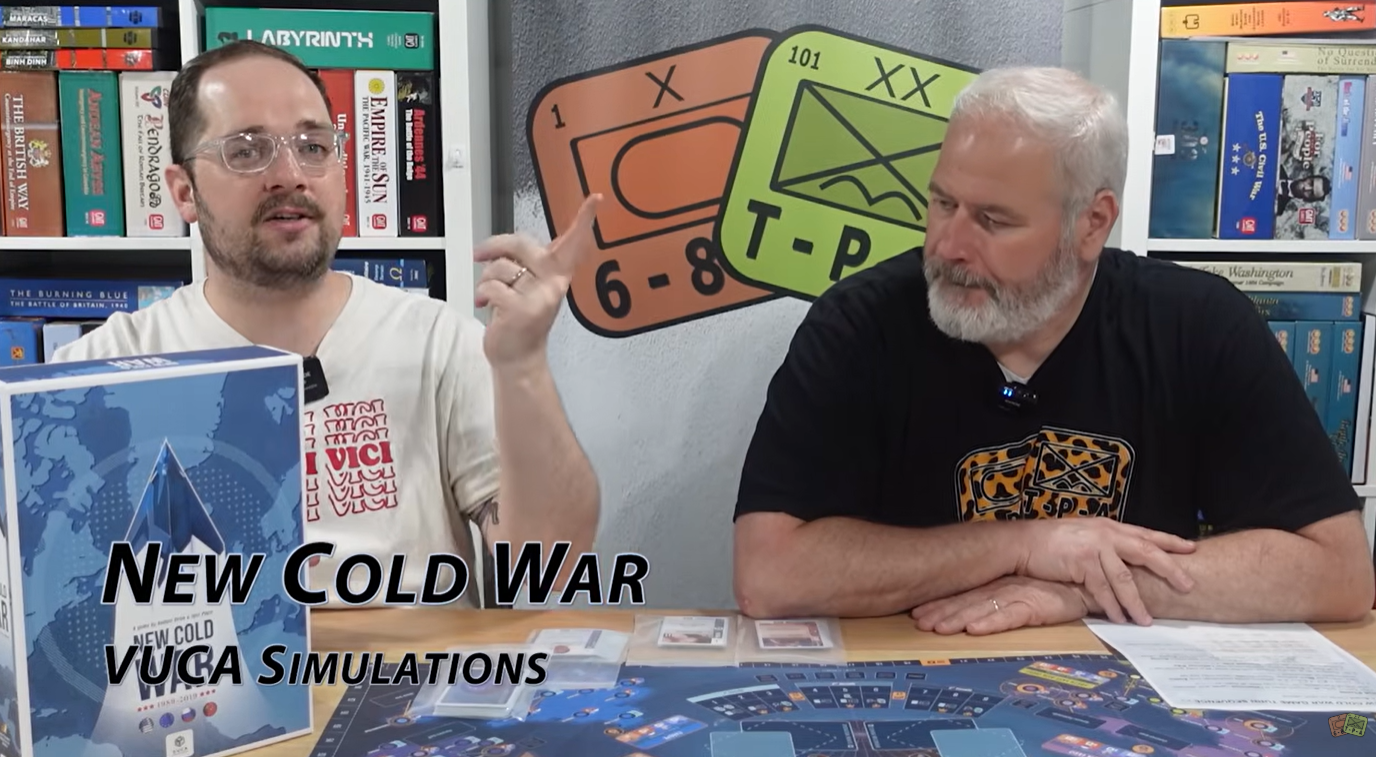
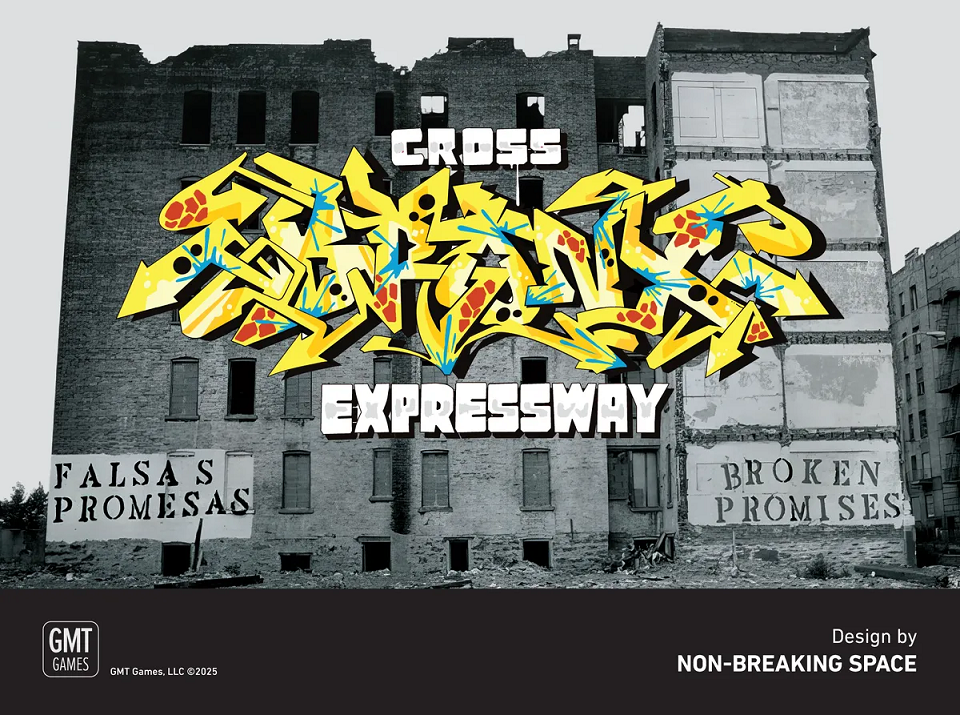
New Cold War: 1989-2019 is a Card-Driven Game based in the most important geopolitical events from 1989 to 2019. Players lead one of the four great powers (Russia, China, US, EU) in their fight for the new world order. Initially, the confrontation is between the red bloc, consisting of Russia and China and the blue bloc, comprising the United States and the European Union. However, each player must also prioritize their own strategy, as only one power can emerge victorious at the end of the game. Therefore, this game starts with cooperation between allied powers in the early stages but becomes entirely competitive as the moment of final victory approaches.
New Cold War utilizes a Card-Driven game mechanic. Players strive to attain victory by gaining international prestige, dominating the media and increasing their control of countries and different regions of the world. Other key factors to manage include military force and United Nations Security Council vetoes. Players’ strategies are determined by a series of hidden objectives they must pursue to achieve victory.
The game accommodates three or two-player versions and includes a solitaire mode through a system of bots.
Recently, while attending Buckeye Game Fest in Columbus, Ohio, we were able to coordinate a 6-player game of Imperial Elegy: The Road to the Great War 1850-1920 from VUCA Simulations. Imperial Elegy is a card driven game that blends diplomacy, warfare, and statecraft and feels a bit akin to games like Here I Stand and Virgin Queen from GMT Games. Grand scale sweeping epics that play multiplayers and take a day to play. Players play as 1 of 6 unique major powers in the game including Germany/Prussia, the United Kingdom, France, Austria-Hungary, Russia and the Ottoman Empire. In this First Impressions post, I want to share a very brief overview of the game and the experience that we had with it.
Imperial Elegy is a fantastically themed game that takes place over 7 turns, with each of the turns representing approximately a decade. If the Great War breaks out due to the World Tension Track reaching a certain level, the game can be extended by an additional 6 shorter turns. A turn in the game consists of player impulses that is driven by the play of action cards for their Command Points or for the printed events. Players will use CP and events to take actions like colonize, conduct diplomacy with minor nations, fight wars, as well as hinder their opponents by playing events that take away their actions or resources. A turn will end once all players have consecutively passed or when all players run out of cards.
The game is somewhat of a sandbox style game as you have so many options and choices about what to do during the course of the game. Obviously, your faction has some direction about what you should be doing but really it is up the player to spend their resources how they will to accomplish their ultimate goals and score Victory Points. I truly love that aspect about this game and as we played we saw that sandbox and the asymmetry between the various factions. Particularly at the start, each country has some specific goals that they have drawn from the National Goals Deck that are a source of Victory Points, in fact a major source of Victory Points, and players will need to prioritize these cards and decide which ones to attempt to go after from the start. With only 7 turns, they will have to make progress on these National Goals if they have any hope of actually achieving them.
I actually thought that the National Goals was a really great part of the design and really sets it apart from the other games that have been used for inspiration such as Here I Stand and Virgin Queen. I partly feel this because of the options for replayability but also it forces players to change and adjust their strategy throughout the game keeping things fresh and interesting. It also causes players to have to think outside of the box and sometimes do things that their nation might not have prioritized but has been given an opportunity that they must capitalize on in order to earn their victory. Every 2 turns the players will draw 3 of these secret National Goal Cards and decide to keep just 1 of them, so their strategy must change and evolve with the board state and conditions found in the game at that time. This very key element of the design seems truly simple but it really has the benefit of rewarding those players who are extremely flexible and who can adjust on the fly, take some chances, change the course of their general overall strategy and adapt. I say this because I do feel that sometimes in games like Here I Stand or Virgin Queen, the same strategies and series of actions will generally be taken by each of the factions with just a modicum of variation. As you can see in the picture below, these National Goals are pretty variable and include things like preventing the outbreak of The Great War, gaining colonies in various parts or regions of the board and a focus on various alliances and diplomatic conditions.
The other aspect that I very much enjoyed was the Flashpoints, which represent key regions of competition amongst the great powers of the period including Italy, the Suez Canal, the Balkans, Qing China and more. Dominating flashpoints is sometimes one of the conditions to achieve and complete some of the National Goals but also provide players with certain benefits, including gaining additional cards each turn or even DRM’s. The specific Flashpoint that I thought was very interesting was the Power Projection Flashpoint which is a projection of the total naval supremacy across the globe through control of ports and naval bases in the various seas and oceans. The only downside here though is that this is an added part of record keeping that players will need to keep a handle on. Not overly burdensome but something that maybe should have been better represented on the player boards or the board itself.
Each of the represented nations in the game have their own special player board that contains various tracks that keep various information readily available to the players. Here is a look at the German player board. I very much enjoyed that they have gone to a great deal of effort to make these player boards and also that they gave each of the nation’s Stability, which decides whether various actions like war can be taken or if there are various positive or negative modifiers, the available Manpower that will determine how many armies can be built, Industry that tells how many action pointed you will have to spend during war to maneuver units, attack and replace losses. The focus of the game is about the control of territories both in Europe as well as colonies abroad and there is an automatic victory if a certain target number is met, in the case of Germany 15.
Here is a quick look at the Russia player board for comparison’s sake as each faction is unique and has various starting levels and abilities. These are very well laid out and assist tremendously in playing the game.
As we played, I started to realize that the key focus of the overall world stability and things like the Domestic Stability Tracks, which are focused of both the internal and external pressures faced by the powers. I really very much liked this thematic inclusion as no one wants to start a major global conflagration and there are steps that players have to take to skirt the inevitable troubles that result in their own actions and how they are seen by the other players in the game. But in our limited play, I never really felt threatened by this concept. Either our group was super skilled at avoiding the inevitable increase in tension or due to our short play we didn’t really experience some of the events that would have tipped this over the edge. I think that we say small increases in our full turn play but nothing that seemed unmanageable and we actually had an event that lowered it so it never became an issue. The game is about spending your resources wisely, in the form of your cards and your aspects like Stability, and to use your cards to do the events that could increase tension didn’t seem to be in our best interest, at least not in the 1st decade of the game. But maybe that will come later.
Keep in mind here that we only played the first full turn and it took us about 90 minutes including an hour of setup and rules overview and discussion as only one of us at the table had player previously (John Lapham). But we very much enjoyed the experience and found lots to like. We have scheduled a full count play of the game in mid June and I will have more to report on at that time but suffice it to stay everyone at the table was impressed with the design and everyone had a good time with it.
Thank you so much for following along and I hope that I was able to show off Imperial Elegy a bit and give it the justice it deserves because it really is something and I look forward to playing more in the future.
May is here and the grass is growing, birds and bees are out busily going about their lives and summer is just around the corner. And with all of this change, there are tons of new games that are appearing on both pre-order and as new releases that I am looking forward to getting on my table. Now, if I could only have more time or discover a time manipulation method! This month for the Wargame Watch, I was able to find 25 games (including the 5 games from our sponsor Sound of Drums). I was also able to find 4 games being offered on Crowdfunding through Kickstarter.
This month we have a sponsor for the Wargame Watch feature in Sound of Drums who has made some really great games over the past few years including their History of the Ancient Seas Trilogy (HOTAS: HELLAS, HOTAS: DIES IRAE and HOTAS: MARE NOSTRUM), 1793: Patriots & Traitors, Eylau 1807 and a few others. Sound of Drums really has a great approach to game design and they also are committed to high quality production with great components, fantastic art and really sharp graphic design. They are definitely a publisher to keep an eye on and you should give their games a try!
Most recently, they released the first volume in their Napoleonic Wars tactical level Battle Commander Series designed by Card Paradis called Battle Commander Volume I – Napoleon’s Italian Campaigns. The Battle Commander Series recreates historical 18th-19th century battles and features a fresh framework focused on providing two key aspects: command decision and maximum playability. In Volume I, the player takes on the role of an Army Commander in a series of six dramatic Battles fought during Napoleon’s two Italian campaigns. Volume II will cover engagements of the Second and Third Coalitions, including the Battle of Austerlitz and the Battle of the Pyramids.
In Carl’s own words, here is what the game is focused on and attempting to model:
The system is at Brigade/Division scale, is very playable, with no downtime or complex computations or mechanics. I am a game component maniac, so the package will be super-deluxe, using a very large box, allowing the 2-sided mounted maps to be folded only once (think of the 70’s Avalon Hill flatboxes maps), game pieces will be painted-on wood blocks of different shapes, so no annoying stickers to apply, you’ll have a couple dozen blocks per side in a game, often less. Also, no dice, almost no markers, the emphasis is on the gameplay!
The crux of the game engine will be ( 1 ) the deck of event cards, that will also take care of all the combat results and other dice functions, and ( 2 ), the cube-pull mechanism, that will manage player unit activations, but also turn end, when combat and rally happens, and other similar game happenstances. It’s all a very granular affair. The whole package has a definite “Kriegspiel” look, with all the graphics done in a contemporary Napoleonic style, with a very different way of maneuvering units on the field of battle compared to other Napoleonic games.
They also recently released the Assault Sicily ’43 – Primosole BridgeExpansion for the Assault Sicily ’43 base game. We got a chance to play a scenario from this one with the designers Wolfgang Klein and Erich Rankl while attending Essen Spiel last fall and we had a great time with the new innovations and mechanics as well as the beautiful new production of the expansion.
The big new game that Sound of Drums is offering on pre-order at this time is the Designer Edition of No Retreat! The Russian Front 1941-1945 from designer Carl Paradis.
I am very much looking froward to this one as we have played the Deluxe Edition from GMT Games several years ago and very much enjoyed the system and its narrative on this titanic confrontation on the Eastern Front of World War II. I am interested to see what they change, both mechanically and graphically, and how the final product turns out. The cover though is simply amazing and shows off the skill of their graphic designer Marc von Martial and new artist Wouter Schoutteten.
From the Sound of Drums website, we read the following:
No Retreat! The Russian Front – Designer’s Edition is the definitive evolution of Carl Paradis’ acclaimed Eastern Front wargame.
Building upon the original 2008 release and its later Deluxe editions, this new version refines gameplay, streamlines core systems, expands the Event Card deck to a full 70 cards, enhances solitaire play, and introduces upgraded visuals by renowned artists Marc von Martial and Wouter Schoutteten.
With dual maps, optional historical-symbol counters, dual layered Army Mats, and deluxe player aids, the Designer’s Edition represents Paradis’ final, authoritative vision for his landmark design.
This isn’t just a reprint. It’s the version the designer always dreamed of — crafted after 45 years of studying the Russian Front.
They also have lots of games in the oven and we got a look at a few of them at Essen Spiel including Operation Valkyrie, which is a solitaire game that simulates the events immediately after the attempt to assassinate Hitler on July 20, 1944 and The Great Escape, which is a cooperative game about the escape attempt from the infamous Stalag Luft III POW Camp during WWII. Both look amazing and there are preview pages already published on Gamefound so I would expect them to kickoff sometime in the near future.
As you can see, Uwe Wallentin and his team at Sound of Drums are busy working on some great projects and I cannot wait to see where they go and what they attempt to tackle in the future.
But now onto the games for May!
Pre-Order
1. Foxes and Lions: Renaissance City-States in the Age of Machiavelli from GMT Games
We have played all of the games in the series designed by Ed Beach, including Here I Stand (multiple times), Virgin Queen (multiple times but not as many as HIS) and Tanto Monta (once) with our most recent play being a full 5-player game in March while attending Buckeye Game Fest, and the series is just special. The card driven mechanic simply makes the series and it really is a bit of a sandbox as you can win in various and sundry ways. Recently, GMT announced the fourth entry in the series called Foxes and Lions:Renaissance City-States in the Age of Machiavelli designed by the duo of Paul Wright and Liz Davidson. This one looks to be epic and is set during the Italian Wars. I am very keen on a new addition to the series and look forward to diving in and learning more about the game over the next year or so.
From the game page, we read the following:
Foxes and Lions: Renaissance City-States in the Age of Machiavelli is the next game in the series that includes Here I Stand, Virgin Queen, and Tanto Monta. Focused on the warring city-states and dominions of Renaissance Italy during the era known as the “Italian Wars” (specifically, the period from 1494 to 1527), this game zooms in on the Italian peninsula. Unlike many other games on the Italian Wars, Foxes and Lions puts the focus on Italian experiences of this era of enormous upheaval, which also saw some of the greatest cultural splendors that we now associate with the period known (not without controversy) as the Renaissance. The game depicts the political, military, economic, religious, and cultural affairs of five key Italian powers brought to life by players (Florence, Milan, Naples, the Papacy, and Venice).
Players will struggle to create political legitimacy for themselves while contending with both Italian rivals and external great powers intent on conquest of their own objectives in Italy (France, Spain, the Holy Roman Empire, and the Ottoman Empire). For those who have played other series games, much will be familiar mechanically, but there are many new concepts and mechanics to enjoy, including experimenting with different government types, managing local sentiment, and gathering precious florins to pay for mercenaries and their fickle condottieri captains.
Furthermore, players will be faced with the possibility of collective defeat to the great powers. Players will individually pursue Virtù Points, drawing on Machiavelli’s famously pliable conception of political ability and military strength, while at the same time striving to avoid collective defeat by loss of Italian Virtù. Dwindling Italian Virtù embodies Machiavelli’s abiding fear of great power domination of Italy. Players will each attempt to win without Italy falling into the subjection that was historically its fate, and should they fail to prevent that, the game ascribes blame to the specific players viewed as the scourge of Italy and the new lapdog of the great powers. Can you thread the needle between your Italian rivals’ ambitions and the threat posed by the great powers of Europe?
In case you thought that maybe they are squishing a square peg into a round hole or just copying the tried and true system then you will be glad to find out there is lots of new to explore in the design.
Concepts and Features New to the Series
Political traditions—These are the governments (current and past) that define the political character of any given space in the game (featuring merchant republics, feudal aristocracies, princedoms, theocracies, tribute states, and vassals). In keeping with Machiavelli’s respect for founders of institutions, lawgiving will be an available action that permits you to attempt to alter governments in your dominion. Each space under your control may have a very different political arrangement, which affects its prosperity, unit construction capability, and many other things. Your central government (that of your capital) may also change over time.
Sentiment—This captures the current attitude of the local population to the government overseeing it. The scale of sentiment reflects Machiavelli’s own terminology, ranging from “Hated” to “Feared,” to “Feared and Loved” (the latter an ideal Machiavelli thought hard to achieve, opting instead for being “Feared” whenever a choice between fear and love was unavoidable).
New unit types—Regulars are split into citizen militia and feudal levies, alongside a more detailed look at mercenaries (with elite variants including the Swiss reisläufer and the Imperial landsknechte).
Condottieri captains—Twenty of the colorful, talented, and sometimes treacherous mercenary captains of the era will be available to players in competitive blind bidding for their services, with each captain reflecting unique battlefield abilities, vulnerabilities, and other surprising game impacts. Captains are essential to success in the game, and if not properly paid and retained, will go up for auction again; they may even be suborned and taken from you by nefarious rival actions. Among the captains are the infamous Cesare Borgia, Fabrizio Colonna, Giovanni delle Bande Nere, and “El Gran Capitán” himself, Gonzalo Fernández de Córdoba.
Money economy—Alongside the high-level political capital of command points (CP) already familiar to CDG players, Foxes and Lions features the cold, hard cash that mercenaries and dominions crave. Florins are collected by a trade action connected to the prosperity of the various governments in one’s dominion. The florin economy will be necessary not only to pay or bribe mercenaries and captains, but also for espionage, government maintenance, and more. Player treasuries are hidden behind a screen, so no one is ever quite sure of a rival’s wealth. Should you run out of florins for a required or desired expenditure, the banks will be available to lend to you at exorbitant interest rates, and failure to repay may cost you dearly.
Espionage available from turn one—Nefarious measures are available to players from the outset of the game, including familiar operations from Virgin Queen like Gain Intel and Assassination, now supplemented with Pacification, Foment Rebellion, Sabotage Fortifications, and Suborning others’ employed condottieri to your cause.
New patronage systems and figures—For those familiar with Virgin Queen, patronage now features three tracks (artists, scientists, and humanists) with 10 figures of each type. Patronage targets may now be selected rather than randomly drawn, and each affords unique game effects. Among the 30 patronage subjects are figures such as Michelangelo, Da Vinci, Botticelli, Copernicus, Pacioli, Paracelsus, Machiavelli, Manutius, and even a prying poet-courtesan, Tullia d’Aragona.
New ruler dynamics—Each player will have an often-volatile lineup of rulers who will transition based on circumstances in the game (26 rulers in total across five player powers). In the case of the Papal States, a conclave procedure involving all five players will determine the next pope whenever the current pope dies (however mysteriously).
Variable impulse order—Players may bid their florins to change the impulse order for a given turn, creating dynamic opportunities for surprising your enemies—or lying in deadly wait for them.
More opportunities to declare war mid-action phase—No game about Machiavelli’s era would be complete without the temptations and risks of back-stabbing rivals, even erstwhile allies, including in the middle of a turn. Great coalitions (like the historical “Holy League”) may form, but no alliance is ever truly safe.
2. Chariots of the Gods: A Module for the Great Battles of History Chariots of Fire Game from GMT Games
My experience with the Great Battles of History Series is not very deep. I own SPQR Deluxe Edition and have played it and enjoyed it and it is a beautiful monster with around 6 full counter sheets and 6 double sided maps with 19 scenarios. There is a lot of game here in each of the volumes in the series! The series is really very deep and there are a lots of rules and exceptions based on the different units that are included in each scenario. The game system really emphasizes the important role of command on the ancients battlefield. Leaders are the most important counters in the game and consequently without leader’s order, the player will find that their very powerful and important phalanx and legions will not be able to take any actions, even moving closer to the enemy. There is a new expansion module that was recently announced that deals with Ancient India covering the period of 1700 to 1800 BCE called Chariots of the Gods.
From the game page, we read the following:
Chariots of the Gods (CG) simulates tactical-level combat in the period of India’s ancient Vedic era. Covering a period extending from roughly 1700 to 800 BCE, the age of Vedic India was one of sweeping battles between great kingdoms for supremacy over northern India. This was the age of the chariot-knight, whose prowess with the compound bow from his speeding war-car inspired legends. Often the bravery of the charioteer, whose skill in commanding the vehicle safely through the chaos and danger of the ancient battlefield was no less legendary.
Given the heroic nature of the age, the Chariots of Fire Heroes rules have been expanded to portray the fighting styles in the Vedic poems. All scenarios feature Heros and Heroic Challenges. Rather than Heroes engaging in personal combat only on foot, the Vedic heroes duel each other from a moving chariot wielding their bows. The Hero counter represents not only the Hero, but his Charioteer, and his Chattra (banner) all of which may be hit by his opponent.
CG introduces three new unit types:
Javelin Infantry: Javelin/light spear armed troops with no armor and no missile capability, fighting in loose formations. These units provide the shock power for most of the tribes.
Dismounted Chariots: Noted on the reverse side of the CH-2 counter, these are the knights on foot rather than in their chariots. This mode is mostly useful for traversing rivers and other non-chariot favorable terrain.
Lance Armed Cavalry: Early light cavalry armed with lances with limited Shock capability.
There are special rules for river crossings, strongholds, and given the coalition type armies in the larger battles, rules for Tribal Flight.
Battles included in the Module
Hariyupiya River (ca. 1660), the Anu vs. the Vrcivans
Invasion of the Purus (ca. 1540), the Puru-Bharata vs. the Turvasha-Yadu
Battle of the Dasyus (ca. 1500), the Puru-Bharata vs. the Dasyus
Khandava Expedition (ca. 1415) the Bharata vs. the Kikatas
Parushni River (ca. 1400), Tritsu and Bharata vs. the Kings of the Puru Confederation
Yamuna River (ca. 1400), Tritsu and Bharata vs. the Kings of the Puru Confederation
The typical tribal army consists of mixture of Chariots, bow armed infantry, and javelin armed infantry with minimal shock capability. The Vrcivans, Dasyu, and Kikatas are infantry armies composed of Shock or Barbarian infantry along with bow armed infantry. The battles against the Daysu and Kikatas play out on rough terrain which tends to neutralize the Chariots mobility. The Vrcivans, on the other hand, need to force their way across a river and then contest the chariots in open terrain. The other three battles are set piece affairs occurring on mostly chariot friendly terrain showcasing the full capabilities of that weapons system and the dueling Heroes of legend.
If you are interested in Chariots of the Gods: A Module for the Great Battles of History Chariots of Fire Game, you can pre-order a copy for $37.00 from the GMT Games website at the following link: https://www.gmtgames.com/p-1230-chariots-of-the-gods.aspx
3. Liberty! A Military History Survey of the American Revolution from GMT Games
In our travels to several gaming conventions over the years we have made some great friends, which include gamers, designers, publishers, other content creators, etc. While attending the World Boardgaming Championships a few years ago, we had the chance to interview Mark Miklos who is the creator of the Battles of the American Revolution (BoAR) Series. We also have interviewed Mark several times for new volumes in the BoAR Series, including for Volume XI: The Battle of Green Spring: Prelude to Yorktown, July 6, 1781, Vol. X Battle of White Plains as well as play several of the games in the series at WBC and SDHistCon including Savannah and Germantown. Mark is a very enthusiastic student of the American Revolution and has now taken all of that knowledge and written a book on the subject that was offered up for pre-order by GMT Games this past month called Liberty! A Military History Survey of the American Revolution.
From the page, we read the following:
War has been defined in many ways; as a continuation of politics by other means, as the locomotive of history, and as Hell. Whatever your definition, war is undeniably a spectacle. And in all the spectacle of war, the conflict variously known as the American Revolution, the Revolutionary War, or the War of American Independence has seldom been equaled for its cosmopolitan nature or for the allure it has on the popular imagination.
Here the Ancient Regime, the New World, and the world of the indigenous First Nations collided across oceans and in forest depths, in urban centers and on the frontier, atop mountains, on fertile plains, and across great rivers. Faith and great doctrines were tested. This was the Age of Reason which saw a reexamination of politics, economics and science and, with the vigor of a fledgling leaving its nest, took umbrage against the constraints of a still-enduring older social order.
What began as an assertion of the rights of Englishmen transformed into a movement for independence that ultimately led to a second world war in as many decades. An erudite debate that included statements such as, “Those who would give up essential liberty, to purchase a little temporary safety, deserve neither liberty nor safety,” or, “If this be treason, make the most of it,” led to a sanguine test of arms and yet fully one third of the people in the American colonies simply asked to be left alone to live a common life as it had commonly been led.
Just in time to help celebrate the 250th anniversary of American Independence, Mark Miklos, in his new book, Liberty! A Military History Survey of the American Revolution presents us with the arc of this epic story, a story of the quest for Liberty. Alternating between a 20,000-foot overview and comprehensive detailed analysis, this book informs what you may not know and refreshes what you may already know about the military perspective of the American Revolution.
Anchored on the original essays that appeared in his Battles of the American Revolution Series by GMT Games, Mark has expanded upon his original work to include new chapters, summaries, and transitions which present a compelling and cogent story. Mark has researched the most comprehensive chronological listing of over 600 battles, sieges, engagements, skirmishes, raids, ambush and sanguine quarrels across the nine-year duration of the war which provide context for the primary chapters.
The book features a foreword by Harold Buchanan, designer of GMT Games’ Liberty or Death and the creative force behind the SDHistCon franchise, as well as appendices, comprehensive endnotes, a bibliography, twenty four maps and dozens of illustrations.
As Mark writes, “The dawn of the American Revolution was a period much like others in human history. There was famine and plenty, avarice and charity, misery and joy. Yet something else unique and profound was manifesting, the spark of Liberty.”
Follow that journey in quest of Liberty. Revisit the great battlefields. Renew your acquaintance with heroes, villains and scoundrels along the way, and enjoy the story as Mark takes you on the journey in Liberty! A Military History Survey of the American Revolution.
4. Cuba Libre: Castro’s Insurgency, 1957-1958 5th Printing from GMT Games
Any time a game is on its 5th Printing that should tell you something right there. The game is interesting. The game is fun to play. The game teaches some really great history. Well, in the case of Cuba Libre, all of the before are true and then some. The 2nd game in the COIN Series, Cuba Libre is the smallest of the series in map spaces although All Bridges Burning comes close. This game is usually put forward as a good starting point for the series for new players and we would wholeheartedly agree with that, although I would say even above that is that you should have a passion and interest in the history first and foremost.
From the game page, we read the following:
Following up on GMT Games’ Andean Abyss, the COIN Series next volume, Cuba Libre, takes 1 to 4 players into the Cuban Revolution. Castro’s Marxist “26 July Movement” must expand from its bases in the Sierra Maestra mountains to fight its way to Havana. Meanwhile, anti-communist student groups, urban guerrillas, and ex-patriots try to de-stabilize the Batista regime from inside and out, while trying not to pave the way for a new dictatorship under Castro. Batista’s Government must maintain steam to counter the twin insurgency, while managing two benefactors: its fragile US Alliance and its corrupting Syndicate skim. And in the midst of the turmoil, Meyer Lansky and his Syndicate bosses will jockey to keep their Cuban gangster paradise alive. Cuba Libre will be easy to learn for Andean Abyss players—both volumes share the same innovative COIN system. Like Volume I, Cuba Libre is equally playable solitaire or by multiple players up to 4—and with a shorter time to completion than Andean Abyss. But Cuba Libre’s situation and strategic challenges will be new.
Here is a link to our most recent COIN Series Ranking Video:
5. Panzer: The Game of Small Unit Actions and Combined Arms on the Eastern Front 4th Printing from GMT Games
Panzer is a well regarded system that I have personally never played even though I like tactical games and combined arms is always fun because you get to use tanks. That is sad but one day I will get to it. GMT recently announced a new 4th Printing of the game and maybe this is my chance.
From the game page, we read the following:
Panzer is a complete game system designed for small unit actions from platoon to battalion-sized formations in World War II. The primary focus is Armored Warfare simulation, but Leg (Infantry) and Towed units are also part of the game. Each 7/8” double-sided counter represents a single vehicle, towed gun or aircraft. The 5/8″ double-sided leg unit counters represent squads, half-squads and sections, including their attached weapons.
It’s a modular rules system with Basic, Advanced and Optional rules, which the players can mix and match according to taste – you can keep it simple or make it as complex as desired. All Unit data is included on the full-color Data Cards. The streamlined chit-based command system moves the action along at a brisk pace.
The base game comes with 10 Scenarios, some of which are aimed at new players and use only the Basic rules.
Note on 4th Printing: This will be a straight reprint of the previous printing, with any known errata corrected.
If you are interested in Panzer: The Game of Small Unit Actions and Combined Arms on the Eastern Front 4th Printing, you can pre-order a copy on the GMT Games P500 game page for $65.00 at the following link: https://www.gmtgames.com/p-1228-panzer-4th-printing.aspx
6. Combat! Blitzkrieg from Compass Games
Compass has been churning out new volumes for the Combat! Series over the past few months with volumes focused on Crete, Arnhem and the Eastern Front. I love that there is such a variety in the topics and settings of these solitaire tactical level wargames and look forward to seeing how the system branches out to involve other historical conflicts but also to see how they innovative and make each volume feel like it belongs to the period with new mechanics and unit types. This month, they announced the newest volume in the series called Combat! Blitzkrieg. This volume focuses on squads of Polish, French, or early-war German soldiers and the fighting ranges from the open fields of Poland to the snowy woods of Norway, to the villages and cities of Belgium and France. The game comes with 11 scenarios, 6 bonus Armor scenarios, a competitive 2-player mode, a comprehensive Random Scenario Generator which is always a good innovation to add variety to any game, a Campaign Game and the ability to combine with other 2nd-generation Combat! Series volumes.
From the game page, we read the following:
Combat! Blitzkrieg is a stand-alone solitaire game of man-to-man combat in World War II. This game depicts the countless squad-level actions that were fought as part of the first campaigns of the war, with the player commanding a squad of Polish, French, or early-war German soldiers in those engagements.
In the 11 scenarios, the fighting rages from the open fields of Poland to the snowy woods of Norway, to the villages and cities of Belgium and France. It is bursting with value, whether enjoyed on its own or combined with other games in the series, such as Combat! Eastern Front, Combat! Tunisia & Sicily, or Combat! Crete. The comprehensive Random Scenario Generator (and Campaign Game) further expands your gaming possibilities. With this tool, players can generate a limitless supply of unique scenarios for Combat! Blitzkrieg.
Combat! Blitzkrieg also includes new easy-to-use Armor rules, along with 6 extra Armor scenarios. Tanks, anti-tank guns, and infantry anti-tank weapons are included for the French, Poles, and Germans, as well as the Italians, British, Soviets, and Americans, for use with previous series games.
One of the things that I do like about this system and the various volumes is that it is not just cookie cutter churning out new games but each game has their own unique elements modeled into the game play as special rules or changes to account for the history of the setting. Here is a look at the changes in this new volume:
Other new features in Combat! Blitzkrieg include:
New Terrain types, including a Steeple, Graveyard, Fence, and Barricades.
Flamethrowers for use against enemy defenses.
Competitive Play rules for head-to-head battles!
Combined rulebook containing the special rules from previous Combat! volumes.
Plus, you get rules for air support, fortifications, city fighting, light mortars, weather, fire, and much more, making this the most comprehensive Combat!volume yet published!
7. Iberian Tide: The Spanish Civil War from Compass Games
Recently, we have been playing a lot games on the Spanish Civil War. It is a fascinating period of history leading up to the start of World War II and we have really played some great games on the subject including most recently Crusade & Revolution from Compass Games and The Republic’s Struggle from NAC Wargames. The Tide Series is the brain child of Gregory M. Smith and he is now working with a newer designer in Michael Vitale to tell the story of the Spanish Civil War in a Card Driven Game with the newest volume in the series called Iberian Tide: The Spanish Civil War.
From the game page, we read the following:
Iberian Tide is a 2-player operational-level game that places you in command of either the Nationalists (Franco and his German/Italian support) or the Republicans (Government troops and their Soviet/International support) during the Spanish Civil War. Many would point to this conflict as a ‘warm-up’ for World War II.
Starting with “Viva La Muerte” in 1936, the Nationalists try to quickly knock out the Government by attempting to capture Madrid, all while each side tries to organize amidst the chaos of the Coup.
Each turn, or ‘Block’ is about 3-6 months long, during which multiple card plays occur. These give the players movement, combats, ‘Dug-In’ positions, units and other actions or items. At the end of each Block, players must make critical decisions on which cards to re-buy in an attempt to win the game. Iberian Tide is based on the popular, action-packed “Tide” system of card-driven games (Pacific Tide, Imperial Tide, Rebel Tide, Desert Tide), with many combat and strategic decisions to challenge players in just a single evening’s game.
While the game is probably best as a 2-player game, there is a dedicated solitaire mode.
While Iberian Tide is designed as a 2-player experience, an additional option for solitaire play is provided by the inclusion of a Solitaire Bot. This “Bot” creates action priorities for the non-human player, and has the advantage of being simple enough to implement without spending an inordinate amount of time as the non-player
8. To Kyiv! The Russian Invasion of Ukraine from Compass Games
I know that many designers and publishers have a strict “no current ongoing war designs allowed” policy. I also understand that not all games are for all gamers and that is fine. With that being said, with the events in Ukraine over the past 4+ years, it is just a matter of time before we get several of these designs (this being the 3rd I am aware of with the other 2 games being 2022: Ukrainefrom Conflict Simulations Limited and Defiance: 2nd Russo-Ukrainian War 2022-? from GMT Games). The situation in Ukraine is a study in modern warfare and I for one am glad that this game is coming to light. The newest game to tackle this ongoing conflict is To Kyiv! The Russian Invasion of Ukraine from Compass Games designed by Ivan Notario.
From the game page, we read the following:
A Card-Driven Wargame of the 2022 Russian Invasion of Ukraine. On February 24, 2022, the Russian Federation launched a full-scale invasion of Ukraine, aiming to rapidly seize Kyiv and replace the country’s government. The campaign soon stalled in the face of determined Ukrainian resistance, exposing deep flaws in Russian planning and logistics.
To Kyiv! simulates this modern conflict at the brigade level, covering the chaotic early months of the invasion and the prolonged struggle that followed. Players alternate playing event and action cards that drive military, political, and logistical developments across the theater of war.
The game features variable turn lengths, reflecting the fluctuating tempo of operations, from rapid breakthroughs to extended periods of stalemate. Success requires balancing offensive ambition with the hard realities of supply, morale, and international support.
Designed as a serious historical simulation, To Kyiv! seeks to model the strategic and operational dynamics of the war as faithfully and respectfully as possible. It does not glorify or justify the conflict, but rather aims to help players better understand its complexity and consequences.
I am very much looking forward to this design and to see how it explores a conflict that has so recently been, and continues to be, in the headlines! I also love a good CDG and this one looks very promising.
I normally don’t highlight non-wargames in this Wargame Watch but this next game is just too juicy looking to not share. Do you love a good pirate game? With broadsides, walking the plank, scurvy, boarding parties and booty? Well, you are not alone and there will soon be another great game on the market to quench that thirst for mayhem and adventure with Pirate Hunter: 1718 designed by Joe Carter. I think that the best part about this game is that it is a solitaire game and Joe Carter is a very good designer who is doing a lot of them great titles.
I do own the first game in this series called Golden Age of Piracy: 1718 but have not had a chance to get it played yet as it sits atop my very high and ever growing pile of “to be played” games. A shame really as it looks amazing!
From the game page, we read the following:
Pirate Hunter: 1718 is a solitaire, tactical-level, open-ended sandbox game—being part wargame, part adventure game, and part RPG. As captain of a Royal Navy ship during the year 1718, you are tasked with hunting down and defeating pirates, with your ultimate goal being to attack and shut down the notorious pirate town of Nassau!
Ship-to-ship combat, boarding parties, and the search for buried treasure are to name but a few of the adventures that await you on your patrols across the high seas. But beware of lurking dangers such as the destructive Kraken or the haunting Ghost Ship, all the while you sail the crystal blue waters in pursuit of marauding pirates, fame, and fortune.
10. Rebel Tide: The U.S. Civil War, 1861-1865 from Compass Game Currently on Kickstarter
There is no secret that we really enjoy Gregory M. Smith designs and we also count him as a close friend so take that for what it is worth. He is a great designer and has put together some of our favorite narrative-driven solitaire wargames, such as Silent Victory, The Hunters and The Hunted, but also has done some great 2-player strategic level games on various historical periods including Imperial Tide, covering WWI, and Pacific Tide, taking on the Pacific Theater of WWII. His new game in the Tide Series deals with the American Civil War and is called Rebel Tide.
From the game page, we read the following:
Rebel Tide: The U.S. Civil War, 1861-1865 is a two-player strategic level game that places you in command of either the USA (Union) or CSA (Confederacy) during the Civil War. Each turn consists of a year, during which multiple card plays occur. These give the players movement, combats, entrenchments, and other actions. At the end of each year, players must make critical decisions on which cards to re-buy in an attempt to win the war outright or to win by placing the other side in a disadvantageous position by 1865. Rebel Tide is based on the popular, action-packed Imperial Tide/Pacific Tidegame system by Gregory M. Smith, with many combat and strategic decisions to challenge players in just a single evening’s game.
The core of the game is the unique card re-buy system, in which players take their annual production (adjusted for blockades and blockade runners) and decide which cards they need for the upcoming year. Cards not only provide for reinforcements, but allow for movement, combat, and entrenchment. Which cards to rebuy is without question one of the key decisions the player must make to prepare for next year’s operations.
The game has infantry units for all of the major participants, cavalry, and artillery units. Naval operations are mainly abstracted, although the Confederate player must worry about Farragut invading a port from the sea. Besides the focus on card play, the game features a small footprint (one standard map) and also is designed to be played in just a single evening – estimated at 3 hours for experienced players to fight the entire war.
But don’t worry because the game is not just a reskin of the same system used in those other two games, although the system is really interesting, but instead attempts to create new mechanics and elements to tell the proper story of the struggle for the soul of the country in the 1860’s.
One new mechanic in Rebel Tide is the Political Track, which is an abstract measure of the support of England and/or France to the Confederacy. If this track reaches the maximum early in the war, it can trigger an early CSA victory.
Another new key mechanic in the game system is the addition of historical Leaders, who range in ability from excellent (5) to poor (2). Bad leaders may be “sacked” and removed from the game and randomly replaced by the expenditure of a movement action. Leaders are vital in advancing after combat and also can add strength to an attack’s total combat power.
While attending WBC a few summers ago, we had a chance to sit down with Gregory M. Smith to cover a few of his upcoming designs and Rebel Tide was included in that discussion. Here is a look at our video interview with Greg:
As of May 1st, the Kickstarter campaign has funded and raised $9,098 toward its $2,500 funding goal with 101 backers. The campaign will conclude on Monday, May 4, 2026 at 10:00am EDT.
11. Battle Box – Age of Sail from Feral Wizard Currently on Kickstarter
Small and unique wargames are a rare commodity in our hobby of large and bloated 1,000 counter and multiple map monster games. Nothing wrong with bloated but sometimes it is nice to have a simple and quick to set-up game that is interesting and fun to play. Well, I found this offering on Kickstarter called Battle Box – Age of Sail and it simply looks amazing. It fits into a mint tin and seems to have a lot of flexibility and interest.
From the game page, we read the following:
Battle Box – Age of Sail is a complete naval wargame within a small tin box that fits in your pocket, perfect for a quick game on the go or even full naval campaigns.
The game in full display.
Battle Box – Age of Sail includes ships, battle mat, dice, scenarios, and cards for in-game effects such as critical hits and special ship rules.
4 ships and tracking tokens in different colors.
3 double-sided sections of a hexagonal grid battle mat; with open sea on one side and terrain features such as coastline, island and shoals on the other side.
4 dice and 1 set of rules to play in under 30 minutes while capturing the tactics and flavour of age of sail warfare.
18 cards with ship status tracking, critical effects, ship upgrades, narrative scenarios based on real events, a wind rose (plus wind token), and advanced rules for frigate duels.
And all of it fits within a small and neat tin box!
The set of 4 ships, each of a different colour, are used to represent generic men-of-war and merchant ships. The status, crew quality, ship upgrades, and critical hits on each ship are tracked by means of cards and a token matching the ship’s colour.
Ship Cards – Track ships status and bonuses/penalties deriving from it, such as an eager crew aboard a frigate, or a merchant ship so damaged that can’t sail effectively.
Upgrade Cards – Special rules that can be assigned to each ship for special scenarios, such as a fighting captain or a weatherly ship.
Critical Effect Cards – Attached to a ship as reminder of the critical conditions she is suffering, such as a raging fire or a mast going down.
As of May 1st, the Kickstarter campaign has funded and raised $10,175 toward its $270 funding goal with 230 backers. The campaign will conclude on Thursday, May 21, 2026 at 9:01am EDT.
12. Old School Tactical Volumes II and III: The Pacific and WestReprint from Flying Pig Games
Old School Tactical from Flying Pig Games is a tactical combat system that focuses on World War II to date. The game focuses on the simulation of small unit combined arms engagements where historical units, weapons, armor and vehicles will duke it out on a beautifully crafted board full of hexes. During a turn, players will go back and forth using an Impulse Point System to activate units to either Move, Assault Move or Fire. The players will play through a predetermined amount of rounds and at the end, victory points and casualty points will determine which side is the victor.
The first volume in the series was Old School Tactical Volume 1 Eastern Front 1941/1942 and focused on battles between the Russians and Germans. Old School Tactical Volume 2 West Front 1944/1945 was a follow-up effort and focused on the titanic struggle in Europe following the D-Day landings in 1944 with battles between the Americans and Germans. Then came Old School Tactical Volume 3 Pacific 1942/1945 which includes battles between the Japanese and their Special Naval Landing Force and the American Marine Corps. Since that time they have done Volume 4: The Italian Theater and Volume 5 German invasion of France during 1940. But, they are now doing a reprint campaign for Volumes II and III and it is currently on Kickstarter.
From the game page, we read the following:
War is often remembered in sweeping movements across maps and history books, but it is decided in far smaller moments—when a single squad holds the line, when a machine gun nest refuses to fall, or when a bold maneuver turns confusion into opportunity. Old School Tactical is built to capture those moments. It is a squad-level system that places you in direct command of infantry, leaders, heavy weapons, and armored support, where every decision carries weight and every action can alter the course of a battle.
This Kickstarter brings together four outstanding entries in the acclaimed Old School TacticalSeries: two core games and two expansions that span the European and Pacific Theaters of World War II. Together, they offer a complete and deeply immersive tactical experience built on a system known for its accessibility, tension, and replayability.
At the heart of Old School Tactical is a design philosophy focused on clarity and engagement. The rules are streamlined without sacrificing meaningful decision-making, allowing players to quickly grasp the system while still exploring its tactical depth. Each turn is driven by an impulse-based structure that keeps both players involved, eliminating downtime and ensuring that every moment at the table feels active and consequential. The system emphasizes maneuver, firepower, leadership, and timing—core elements of battlefield command—while remaining intuitive and fast-playing.
This reprint Kickstarter offers four different games including Vol. III: Pacific War 1942–1945, Hell Bent Expansion, Vol. II: West Front 1944–1945 and Ghost Front Expansion.
Here are links to some of our content on these 2 fine games.
Video: So What is Old School Tactical? – A Look at the Old School Tactical System from Flying Pig Games:
Video Review: Old School Tactical Volume II with Airborne Expansion:
For my part, I think that Old School Tactical is one of the finest tactical systems out there. Its ability to generate the gory details of close quarters squad level combat while keeping the game rules relatively lite and intuitive is quite miraculous. We love it and I would definitely highly recommend the system to anyone that hasnt tried it.
As of May 1st, the Kickstarter campaign has funded and raised $62,668 toward its $12,000 funding goal with 280 backers. The campaign will conclude on Tuesday, May 5, 2026 at 12:00 noon EDT.
13. Blitz Creed – The Card Game from Blitzcreed Currently on Kickstarter
I love a good card based wargame. They are definitely a change of pace and a lot of the times are really great experiences. This past week, I found a new and interesting looking card based wargame called Blitz Creed – The Card Game on Kickstarter and wanted to make sure to share it with you.
From the game page, we read the following:
In the wake of global conflict, powerful countries fight for supremacy. Territories shift hands, alliances crumble and soldiers await their commands. Enter Blitz Creed where players engage in intense battles and use their wits to emerge victorious in this world of relentless warfare.
Blitz Creed is a fast-paced, military-themed card game where players battle for global dominance. Set in a world of strategic warfare, players control countries and deploy soldiers to engage in battles and conquer regions. The game combines elements of military strategy, outsmarting opponents and anticipating the moves of others in a contest of wits and power.
In Blitz Creed, you use a deck of 110 cards that include countries, soldiers, dispute cards and reinforcements. You’ll strategically play your cards to deploy soldiers, attack other countries while protecting your regions. Each country has a strength which determines it’s ability to win or lose a battle. There are also special cards like Regional Strike, which let you unleash powerful attacks on your enemies.
The goal is simple: conquer and secure 3 regions by collecting the required number of countries. The first player to secure 3 regions becomes world leader & wins the game.
As of May 1st, the Kickstarter campaign has funded and raised $4,346 toward its $2,625 funding goal with 75 backers. The campaign will conclude on Thursday, May 21, 2026 at 6:54am EDT.
14. Cry Havoc– Medieval Man to Man Combat from Footsore Miniatures & Games Currently on Kickstarter
Nostalgia is a real thing and we have it for many of the things from our childhood. Sometimes that nostalgia is kind of like fool’s gold, meaning that we see something differently than it really was and have a favorable memory of it because it might have been one of our first tries of something that we love. But, nostalgia doesn’t always mean that those feelings are not real and true. Well, I recently came across one of these “nostalgia grab” wargame Kickstarters for a game that originally published in 1981 called Cry Havoc – Medieval Man to Man Combat from Footsore Miniatures & Games. I have looked into this one, even though I didn’t play it during my formative years, and have jumped on the bandwagon and backed the project. Word of warning though. The Kickstarter page is quite sparse and you really cannot get a good feel for what the game is other than a few beautiful pictures of what appears to be lovingly hand drawn boards and art.
From the game page, we read the following:
The original game of medieval combat returns in a fantastic remastered edition, featuring new art from Gary Chalk. Time to bring dramatic clashes of mail-armored knights to your tabletop.
The original 1981 edition of Cry Havoc
In 1981, Gary Chalk and Standard Games collaborated to create Cry Havoc!, combining simple rules with gorgeous hand-drawn art and compelling narrative scenarios. The game became the introduction to wargaming for many gamers worldwide, and the original version can still be found on many tabletops, a testament to the game’s quality and presentation.
Fast forward to 2026, and Gary has collaborated with his friend Mark Farr at Footsore Miniatures to clean up and remaster the original game with new artwork, maps and tokens. The game remains the same classic wargaming experience, and is completely compatible with the original 1981 version (if you’ve still got one on your shelf or tucked away in an attic).
I love the look of this one and even if the game is lacking having the beautiful boards and art in my possession will be worth the $80 I will pay for the game.
As of May 1st, the Kickstarter campaign has funded and raised $50,162 toward its $20,267 funding goal with 624 backers. The campaign will conclude on Sunday, May 3, 2026 at 1:14pm EDT.
New Release
1. A Mad Endeavor: The Fight for Stoney Point, July 16, 1779 from High Flying Dice Games
With this year being the 250th Anniversary of the Declaration of Independence and the start of the American Revolutionary War here in America, I would expect to see a bunch of Am Rev focused wargames being released and to date this year we have seen 3 new ones (Trying Men’s Souls from Against the Odds Magazine and Battle of Pensecola 1781 from Strategy & Tactics Magazine) with the most recent of the bunch being A Mad Endeavor: The Fight for Stoney Point from High Flying Dice Games. I ordered a copy of this one and it arrived last week and looks to be a pretty good little game. Paul Rohrbaugh specializes in these little known and smaller scale battles throughout history and he uses an interesting card activation system that adds some of the unknown to the game and keeps it lite and interesting.
From the game page, we read the following:
The British outpost at Stony Point along the Hudson River prevented any movement by the Americans along this crucial waterway. It also allowed the British nearly unfettered transit that could cut off the New England colonies from the rest of United States. Such a position had to be taken and reduced. To that end, General Washington ordered General “Mad” Anthony Wayne to assemble a strike force to take Stoney Point by assault. What ensued was one of the most daring assaults in the Revolutionary War.
Can you as the British player hold off the Rebel’s attack at Stony Point? Will you as the Americans take the Loyalist stronghold to help secure New England’s position in the revolution? Learn and enjoy!
If you are interested in A Mad Endeavor: The Fight for Stoney Point, July 16, 1779, you can order a copy for $18.95 from High Flying Dice Games website at the following link: https://www.hfdgames.com/stoney.html
2. Cuius Regio: The Thirty Years War 1618-1648 from GMT Games
We have been collaborating with Francisco Gradaille a bit over the past few years as we have posted interviews for his first published design Plantagenet: Cousins War for England, 1459-1485, Onoda from Salt & Pepper Games as well as some other more generic game design and scenario articles. He now has a new game being fulfilled at the end of May called Cuius Regio: The Thirty Years War 1618-1648.
From the game page, we read the following:
Cuius Regio explores the operational military aspects of the pivotal period in European history called The Thirty Years War and focuses on the maneuvers and battles that shook Europe for three decades.
The Thirty Years War unfolded in four main phases: the Bohemian Revolt from 1618 to 1625, the Danish intervention from 1625 to 1630, the Swedish intervention from 1630 to 1635, and the French intervention from 1635 to 1648. It concluded with the Peace of Westphalia in 1648, which finally established a new status quo in Europe, the concept of the sovereignty of states, and shifted the focus of continental politics from southern Europe to the northern states.
The game is an operational scale game and contains all the grandeur you would expect on such an interesting and compelling conflict.
For two players, Cuius Regio is played on an operational-strategic scale. Each turn covers one year, and each hex is approximately nine miles across. Infantry and Cavalry strength points represent approximately 1000 men each, and an Artillery strength point is approximately five guns. Each leader has a Leadership Rating that affects how many troops he can lead and his effectiveness as a leader. Players maneuver their leaders and their armies around Central Europe, conquering cities, engaging in battles, gathering supplies, and preparing armies for yearly campaigns to gain control of the cities of the Holy Roman Empire.
The game includes scenarios covering the Bohemian Revolt, the Danish intervention, the Swedish intervention, the French intervention, and a Thirty Years War campaign of 31 turns lasting from 1618 to 1648. Each scenario has a unique character, and the game can be played in as little as an hour and a half (for a short scenario) or can be a multi-session game for the full campaign.
The turns are divided into two seasons (summer and winter), and each turn has a variable duration that depends on the number of armies activated. In addition, armies can conduct operations several times but become less effective as they accumulate fatigue during each action.
Combat is an integrated system for field battles and sieges and is resolved by a die roll, modified by each army’s leadership, composition, and condition, on a simple Battle Results Table.
If you are interested in Cuius Regio: The Thirty Years War 1618-1648, you can order a copy for $71.00 ($45.00 if you order quickly before they are shipped near the end of May) from the GMT Games website at the following link: https://www.gmtgames.com/p-971-cuius-regio-the-thirty-years-war.aspx
3. Empire of the Sun, 5th Printing from GMT Games
If you have followed us for long you know that we really love Empire of the Sun and have played it several times. The game is simply fantastic and really implements the CDG mechanic perfectly with the events of the Pacific Campaign of World War II. Furthermore, if a game is on its 5th Printing now especially with the 4th Printing having been announced at the end of 2020, that says something about it.
From the game page we read the following:
Empire of the Sun is Mark Herman’s third card driven design since he introduced the system to the hobby in We The People. EotS is a strategic level look at the entire War in the Pacific from the attack on Pearl Harbor until the surrender of Japan. EotS is the first card driven game (CDG) to move the system closer to a classic hexagon wargame, while retaining all of the tension and uncertainty people have come to expect from a CDG. Players are cast in the role of MacArthur, Yamamoto, Nimitz, and Mountbatten as you direct your forces across the breadth of the globe from India to Hawaii and from Alaska to Australia. This is represented on a single map based on a 1942 equal area projection of the entire theater of conflict.
As in other games using the CDG system, players try to maximize the impact of their cards even as they hide their intentions and traps from their opponent. The player is faced with a wide set of clear strategic choices. The focus of EotS is on directing major offensive axes of advance. The Japanese early in the game are challenged to achieve their historical expansion as Allied forces battle the clock to react with their in-place forces trying to achieve maximum damage to the hard-to-replace Japanese veteran units.
If you don’t have this one, you need to get it now. Not only is the price right but the game is simply amazing. And it will be in a near perfect form with the 5th Printing.
We have lots of content on our blog and channel for you to choose from but here are a few of those pieces.
Empire of the Sun – Basic Training Episode 1 – Card Anatomy Video:
Empire of the Sun – Basic Training Episode 2 – Counter Anatomy Video:
If you are interested in Empire of the Sun: The Pacific War, 1941-1945, 5th Printing, you can order a copy for $88.00 ($56.00 if you order quickly before they are shipped near the end of May) from the GMT Games website at the following link: https://www.gmtgames.com/p-1114-empire-of-the-sun-5th-printing.aspx
4. The British Way: Counterinsurgency at the End of Empire 2nd Printing from GMT Games
I have said it before but Stephen Rangazas is a rockstar! Plain and simple. He has done some yeomen’s work over the past few years with games like Fall of Saigon: A Fire in the Lake Expansion, Sovereign of Discord: A Fire in the Lake Expansion and the recently released The British Way. The British Way is a really clean and quick playing 2-player COIN in a quad pack and we just love it. And it is now getting a 2nd Printing.
The British Way: Counterinsurgency at the End of Empire covers four British counterinsurgency campaigns during the process of decolonization immediately following World War II. These include campaigns against larger insurgencies that sought to contest territory and topple colonial rule through armed conflict, such as in Kenya and Malaya, but also smaller more clandestine armed groups that sought to wear down British prestige to force a withdrawal as in Cyprus and Palestine.
From the game page, we read the following:
The British Way: Counterinsurgency at the End of Empire is the first of several COINSeries Multipacks, containing four separate games exploring a series of thematically related insurgencies. Between 1945 and 1960, the British fought four major “emergencies,” as they referred to their counterinsurgency campaigns, each trying to manage their retreat from empire. The four games in this pack focus on exploring British counterinsurgent responses to a variety of different opponents, including communist insurgents in Malaya, militant nationalists in Kenya, and smaller and more clandestine terrorist organizations in Palestine and Cyprus. The games adjust the core COIN Series mechanics to provide a compelling new way of handling two-player conflicts, while also streamlining several mechanics to quicken gameplay. The British Way offers an approachable introduction to the COIN Series for new players, while presenting experienced players with four mechanically distinct games to explore and compare.
The four games in one box is a tried and true method as in the old SPI Quads and recently has had somewhat of a return with not only this new COIN Series Multipack format but with other publishers such as Compass Games and Brief Border Wars I, Brief Border Wars II and Brothers at War: 1862.
The British Way and the COIN Series Multipack has the following highlights:
Four full games in one box: Explore four different conflicts set during the twilight of the British Empire in the 1940’s and 1950’s. Each game uses a unique ruleset building on the same general mechanical structure, ensuring that they are easy to pick up while still offering a distinctive experience.
A new adaptation of the classic COIN system: Improved two-player sequence of play and a versatile Political Will track for determining victory.
Unique mechanisms reflecting the British approach to each conflict: New Villages in Malaya, the ‘Pipeline’ in Kenya, Curfews in Cyprus, and Mass Detention in Palestine.
Small board footprint with quick-but-deep gameplay: Each game plays in under 90 minutes and takes place on a single 17×22” board.
An “End of Empire” Campaign: A campaign scenario allowing players to play the four games in a linked series with a cumulative scoring system, random ‘external’ events relating to British decolonization, and new mechanics to integrate each game into the campaign.
As you know, I love the COIN Series, and this new multi-pack format is very exciting as it provides us more access to smaller, lesser gamed subjects that are fast playing. It also provides to us as players a comparable view at different types of conflict and how they affect the populace and the overall success of these efforts. I think this type of approach won’t work with every conflict and many conflicts will be better served in the framework of the larger COIN Series as their own standalone games. In speaking with Stephen on this very subject, he has shared that his “…hope is that a series of multipacks might provide new ways for wargamers to think about conflict and help cover some topics that would be difficult to design or sell as standalone products”.
5. The British Way: Enemy of My Enemy from GMT Games
In April 2024, we got the announcement that the first entry in the COIN Series Multi-PackThe British Way got a new expansion called The British Way: Enemy of My Enemy and more than that there were to be variants for the existing conflicts covered in the game.
From the game page, we read the following:
The British Way: Enemy of My Enemy is an expansion for The British Way, including two entirely new games on “prequel” conflicts using the Malaya and Palestine maps and expanding the base game experience with new variants for all four conflicts originally covered. The British Way: Japanese Occupation puts the British and the Malayan Communist Party (MCP) on the same side in their efforts to resist the Japanese occupation of Malaya during World War II. The British Way: Arab Revolt allows players to explore the brutal suppression of the Arab Revolt (1936-1939) that preceded the Jewish insurgency covered by the original Palestine game. The two new games involve entirely new mechanics to capture the unique features of each conflict and can each be linked to the original Palestine and Malaya games, which also allows them to feed into the “End of Empire” Campaign Scenario. The two new games in the expansion allow players to explore how British attempts to combat earlier threats to colonial rule involved collaborating with local armed groups that they would later end up fighting against (Jewish paramilitary groups in Palestine and the MCP in Malaya), ironically strengthening and preparing these groups for two of the conflicts featured in the The British Way.
So 2 new games in The British Way: Japanese Occupation and The British Way: Arab Revolt that use 2 of the existing boards. But there is more. The variants to me seem like the most interesting part as they add new elements to all of the 4 base games. For Palestine, they are adding a free functioning Lehi insurgency that does some neat looking things (I am not sure if these are a type of Bot or if it is controlled by the player). In Malaya, they add additional Jungle bases for the insurgents that make them harder to get to and the British get SAS units that can do that job, plus an additional 4 new Event Cards. In Kenya, we get a new British Detention Deck and the Mau Mau get a few leaders. And finally in Cyprus, are added some new Turkish group cell pieces to hinder the British. These expanded elements look very interesting and I think continue the focus of the game on studying the types and form of insurgency/counterinsurgency at the end of the British Empire across the world. Just fantastic!
If you are interested in The British Way: Enemy of My Enemy Expansion, you can order a copy for $67.00 ($42.00 if you order quickly before they are shipped near the end of May) from the GMT Games website at the following link: https://www.gmtgames.com/p-1107-the-british-way-enemy-of-my-enemy.aspx
6. Air & Armor: V Corps, Tactical Armored Warfare in Europe from Compass Games
Another Cold War Gone Hot game. A look at 1985. This topic always makes for a fantastic wargame as there is lots of armor, aircraft and support technologies that pits the United States and NATO against Russia and the Warsaw Pact powers in the late Cold War period in 1985. It seems there have been lots of these games come out in the last few years or so and I always welcome a new one. Air & Armor: V Corps, Tactical Armored Warfare in Europe is an entry in the Operational Air & Armor Series that specifically focuses in on the the famed U.S. V Corps.
From the game page, we read the following:
Air & Armor is a highly realistic game system designed to simulate modern warfare at a grand tactical level. In the Cold War Series, set in 1986, players simulate a hypothetical Soviet attack on NATO forces in West Germany. V Corps depicts the collision of two Soviet armies, the 28th Army and the 1st Guards Tank Army, with the famed U.S. V Corps in ferocious battles from Fulda to Frankfurt. The U.S. 3rd Armored and 8th Infantry Divisions, covered by the 11th Armored Cavalry Regiment, attempt to halt the advance of four Warsaw Pact motor rifle divisions and five tank divisions in a titanic struggle for the approaches to Frankfurt.
Air & Armor employs a highly interactive game system with asymmetric rules, modeling each alliance’s different command-and-control capabilities. The game simulates all major aspects of modern warfare, including reconnaissance, combined arms operations, air, helicopter, and artillery strikes, chemical and electronic warfare, and combat engineering. Multiple levels of hidden intelligence produce a true “fog of war” experience and provide plenty of opportunities for deception, surprise, and ambush. Play this game to experience what it would have been like to command a Cold War division in battle.
V Corps includes 12 scenarios, each depicting a unique battle situation, most of which are playable in a single sitting. Players can choose to play the game in Open Mode or Hidden Mode. In Open Mode, each player knows his own unit strengths but cannot see his opponent’s. In Hidden Mode, unit strengths remain a mystery to both players until the moment of contact. Hidden Mode makes for highly entertaining solitaire play.
As usual, thanks so much for reading along and sticking with me this month as I navigated through the many websites and game pages looking for new and interesting games to share.
Finally, thanks once again to this month’s sponsor Sound of Drums!
This is a board game blog. Board games are a medium which can help us understand – for example, they can provide a uniquely active perspective on history. Yet which other medium can provide a fresh perspective on board games? – This is where novels come in handy. Today, we’re going to look at The Third Reich (Roberto Bolaño), a study in obsession as well as gaming and history.
Spain in the 1980s. Udo Berger, a young German, has just arrived in a small seaside town for a vacation with his girlfriend Ingeborg. Yet Udo’s mind is not on the beach. He has just won the national championship at the wargame The Third Reich (clearly based on Rise and Decline of the Third Reich (Don Greenwood/John Prados, Avalon Hill)) and plans to use his vacation to write an article on his new strategy for the Axis. Ingeborg, however, has more traditional vacation activities in mind, and so they spend some of their swimming, tanning, and partying, through which they befriend another German couple, some locals, and the enigmatic paddleboat renter who is only known as El Quemado (The Burned One) for the burn marks which cover his body. When the vacation comes to an end, Udo remains in Spain, supposedly to help in the case of an acquaintance lost at sea windsurfing… yet the real reason is the game of Third Reich which he plays against El Quemado.
Chilean novelist Roberto Bolaño wrote the novel in 1989. Since he turned his hand-written first draft into a typoscript (and later typed the first 20% into his first computer), it is assumed that he wanted to eventually publish it, but he didn’t do so before his death in 2003. When the novel was found among his papers, it was posthumously published in 2010. In addition to the original Spanish (El Tercer Reich), the book has been widely translated. I read the German translation.
Warning: Spoilers for the plot of The Third Reich ahead – but frankly, this is not a book you read for plot, you read it for the vibes.
Obsession: Conquest, Validation, Control
Udo Berger is wargame-obsessed, but the book is not a study of how an outsider has outsider fixations. On the one hand, Berger’s obsession with conquest and domination sets him by no means apart from his peers – just that they usually direct their respective urges to amorous exploits. On the other, our protagonist does not only want to conquer in the game either. In addition to his girlfriend, he also pursues the hotel manager Frau Else (who has been his crush when he was vacationing in Spain as a teen), and the underage chambermaid Clarita. And maybe most of all, Berger is fixated on being respected by his wargame peers, which he can only imagine obtaining by finding strategies (and publishing articles about them) which will obliterate all conventional wisdoms about the game.
As Berger is acutely aware of his lack of linguistic sophistication, he decides to practice by writing a diary during his vacation (which is what we read in the novel). The development of this diary reflects the changes in the writer: Originally, his daily entries are very structured (one per day, headlined by the date), and mostly concerned with banal reports on what he did, what he ate, and what he has in mind for the game/article). As Berger is drawn more and more into his duel with El Quemado, the diary gets more confused: He jumps from one level of narration to another within the same paragraph, extensive passages are solely dedicated to what’s happening in the game (down to which counters are placed on which individual hex numbers on the board), and the chapters are not only named after the dates, but also entitled “With El Lobo and El Cordero [his Spanish acquaintances]”, “Spring 1942” or “My Favorite Generals”.
Berger’s inability to focus also dooms his conquests (ludic and erotic): He sets out to prove that opening a second front early is not a liability, but an asset, and enthusiastically reports early in the game to a friend at home that it’s “Blitzkrieg on all fronts”. Yet as he conducts an amphibious assault of Britain at the same time as he invades the Soviet Union, his forces are overstretched and his Axis collapses before the historical date. And broadcasting his erotic attention over Ingeborg, Frau Else, and Clarita, does not further his relationship with either of them.
As things slide out of his grip, his attitude to control changes: Initially, Berger is fixated on the superior strategy. He notes down the exact moves – which corps need to occupy which hex in which turn to win. This chess-like approach collapses after the turning point of the game: Once El Quemado begins his counter-attack, Berger mentions for the first times that there are die rolls in the game (and how they favor his opponent) – not unlike many board gamers I have seen.
Gaming and History
Besides the main theme of obsession, the novel also offers many glimpses on gaming, history, and the relation between the two.
Berger arrives in Spain with his life compartmentalized between the gaming and the “normal” part – his girlfriend and the office job. This compartmentalization is already eroding with his plan to write the strategy article (which immediately chafes against the confines of a conventional vacation – the hotel employees are bewildered by his request for a large table to be set up in his room, and Ingeborg demands he come to the beach) and fully collapses over the course of the book, when he even unilaterally extends his vacation to play the game (and gets fired for it).
The shadow of history hangs over Berger. Our protagonist does not only play games about World War II, he also reads “patriotic” literature of the era, knows about the lives and deeds of the German generals (especially those of the SS), and the only of his wargamer friends for whom he has a certain reverence is a veteran of World War II. Despite this clear fascination for the history of Nazi Germany, Berger twice disavows being a Nazi himself (having been asked by El Quemado and Clarita). Once he even calls himself an “opponent of the Nazis”, but does not expound on it. His personal politics do not factor into the novel – Berger, having been born around 1960 in democratic, liberal, prosperous post-war Germany enjoys the luxury of only engaging with history at his leisure. He thus remains at the surface of it…
…unlike his gaming opponent. El Quemado comes from South America, and it is rumored among his Spanish acquaintances that the scars he bears are the result of torture (by one of the many right-wing regimes which took power in the 1970s). History has thus seeped into his body and gives him the strength to withstand the ludic assault of the experienced player Berger.
Bolaño himself was arrested after the 1973 coup in Chile and, to his own wonder, was released after eight days without having been tortured (he ascribed it to two of the detectives having attended school with him). He then emigrated to Spain where he worked odd jobs in the tourism industry like El Quemado.
Another allusion to Chile is made in a much-misunderstood scene: On September 11, everyone is out at the beach to celebrate the Catalan national holiday. Yet when a plane flies overhead, an eerie sense of dread overcomes the spectators. Many reviewers see this as a revision which Bolaño must have made after the September 11, 2001 terrorist attacks (or, as an odd coincidence) – but I think the likeliest reason for the scene is that the coup in Chile began on September 11, 1973 with the rebelling air force bombarding the presidential palace in Santiago.
Verdict
Roberto Bolaño’s The Third Reich starts with the innocent concept of a beach vacation. As it grows darker, the novel develops a hypnotic pull. The author’s own deep knowledge of wargames allows him to paint a vivid picture of the game itself – and of the hold it can have over its players.
Zurmat is a small Pashtun district south of Kabul. In 2007, It was a tense region with a fragile sense of order. The Taliban moved throughout the villages and roads at night, issuing threats to dissuade cooperation with the Afghan government. Zurmat is also a wargame. Some soldiers write about their experience. Tim Densham designs.…
I find it hard to believe the Company of Heroes board game is five years old. This splendid adaptation of the popular real-time strategy PC game was a story in 2021. My review contained a healthy amount of enthusiasm, and it occupied a key position in my top 10 of the year. A lot has…
The opening sequence of Martin Scorsese’s Taxi Driver depicts a New York with enough grit that you can feel it on your teeth. It’s a feral hour of the night. DeNiro’s sedan is cruising down a street awash in the radiant soul of the city. There’s a shot of the vehicle’s quarter panel. Beads of…
Lese Zeit: 6MinutenMinis Malen zur Entspannung Wie schon im August habe ich mir auch in diesem Monat wieder die Miniatur des Monats geholt, um sie für den Malwettbewerb beim Warhammer Shop am Wiener Westbahnhof für den monatlichen Malwettbewerb einzureichen. Mein Ziel: Gewinnen […]

 Anmelden