Normale Ansicht

My Favorite Wargame Cards – A Look at Individual Cards from My Favorite Games – Card #75: The Second Funnel from The Hunt from Salt & Pepper Games

Von: Grant
28. April 2026 um 14:00

With this My Favorite Wargame Cards Series, I hope to take a look at a specific card from the various wargames that I have played and share how it is used in the game. I am not a strategist and frankly I am not that good at games but I do understand how things should work and be used in games. With that being said, here is the next entry in this series.

#75: The Second Funnel from The Hunt from Salt & Pepper Games

I have played several hidden movement games over the years and enjoyed them all. Some of these titles have included wargames such as They Come Unseen from Osprey GamesSniper Elite: The Board Game from Rebellion Unplugged and Bomber Command from GMT Games as well as a few board games including Hunt for the Ring from Ares Games. The concept of moving cautiously, attempting to evade pursuers, all while trying to locate and acquire or destroy objectives makes for a very interesting gaming experience. These situations can make for some really tense games that cause your head to ache and your wits to be tested. But they rely on some bluffing as well. Trying to force your opponent to anticipate where they think you should be and then trying not to be there. A really great mechanic in board games but not always easy to pull off and make for a very playable and interesting game. In 2022, we played a new design from Matthias Cramer and Engin Kunter that took this hidden movement concept and put it into a historically based game about the struggle over control of the South Atlantic between the British Royal Navy and the German Kriegsmarine during the early years of World War II called The Hunt from Salt & Pepper Games.

The Hunt is a Card Driven Game where the German player has to attempt to stay hidden while trying to sink merchant shipping as the Royal Navy hunts for them throughout the South Atlantic. The players each have asymmetric actions to use to accomplish their missions and each has a tough time doing what they have to do. But, if they manage their cards wisely, using them as effectively as possible, they can successfully either evade their pursuer or catch their prey.

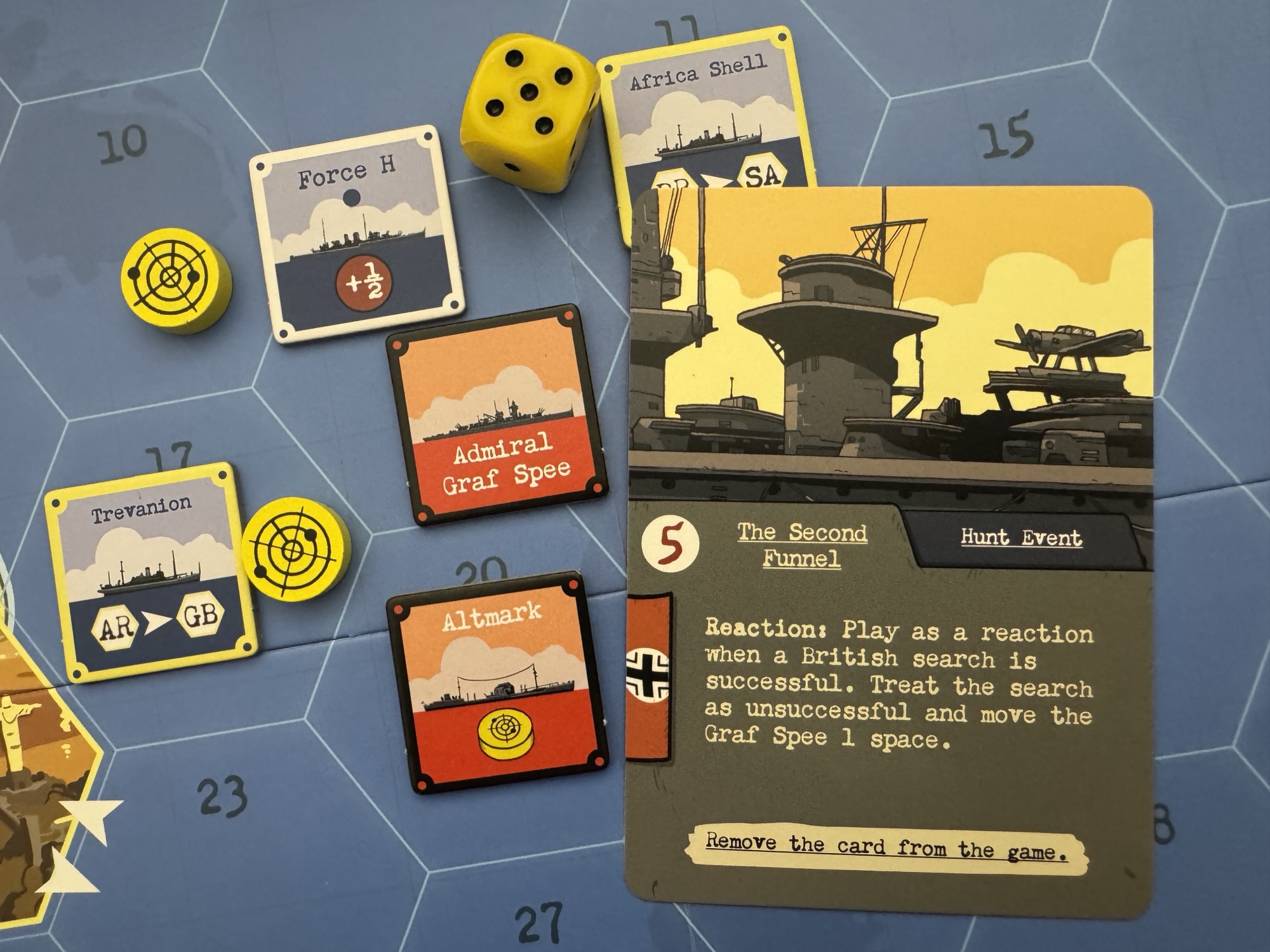
In today’s post, we will take a look at the very useful The Second Funnel. The Second Funnel is a 5 Ops card, which makes it a very important card in the German deck as it allows for the taking of 2-3 actions in a single turn, but for which there is an even more important use as an interrupt to foil a successful British Search by playing it as a Reaction. If the British player ever searches for the Admiral Graf Spee, and The Second Funnel is played as a reaction, the British successful Search will be treated as unsuccessful and the German player will get to move the Graf Spee 1 space away from the space where the Search action was taken. This movement can be into any adjacent space so could be used to also reposition the Graf Spee into a space where a Freighter is located. Such a tasty surprise card for the German player! I know that when I play as the British, I have to always keep in the back of my mind that this card exists and that my efforts might be futile. But, as the British, I would rather that the German play this as the event. These Reaction cards are one of the elements that makes this game so good.

Picture of the Graf Spee taken in 1939 shows the second funnel mounted behind the aircraft catapult at the rear of the ship.

The “second funnel” on the Admiral Graf Spee was a fake structure installed by the crew in late November 1939, during its 1939 Atlantic raid, to alter the ship’s silhouette and disguise its true identity. The dummy funnel, along with a fake gun turret on the bridge, was constructed behind the aircraft catapult to make the German “pocket battleship” look more like a different ship, specifically a British or French warship, to Allied merchant ships. By appearing as a different vessel, the Graf Spee hoped to create confusion and avoid immediate detection and engagement by Allied naval forces while it targeted merchant shipping. The disguise was removed before the Battle of the River Plate in December 1939, so it would not interfere with the ship’s combat operations. The ship’s crew, under the leadership of Captain Hans Langsdorff, often undertook such modifications during its patrol in the southern Atlantic to maintain the surprise of their commerce-raiding mission.

Here is a link to our full video review of the game:

We also published an interview on the blog with the designers Matthias Cramer and Engin Kunter and you can read that at the following link: https://theplayersaid.com/2023/03/13/interview-with-matthias-cramer-and-engin-kunter-designers-of-the-hunt-from-salt-pepper-games-coming-to-gamefound-march-15th/

In the next entry in this series, we will take a look at Military Uprising from The Republic’s Struggle: Battle for the Republic, Spain 1931-1939 from NAC Wargames.

-Grant
My Favorite Wargame Cards – A Look at Individual Cards from My Favorite Games – Card #74: Open Borders from 2040: An American Insurgency from Compass Games

Von: Grant
22. April 2026 um 14:00

With this My Favorite Wargame Cards Series, I hope to take a look at a specific card from the various wargames that I have played and share how it is used in the game. I am not a strategist and frankly I am not that good at games but I do understand how things should work and be used in games. With that being said, here is the next entry in this series.

#74: Open Borders from 2040: An American Insurgency from Compass Games

2040: An American Insurgency is a card driven game that attempts to simulate a near future US civil war in the 21st century. In this 2-player game that plays in less than 3 hours, the blue team is the Federals representing agents of the government in Washington. The red team are the Rebels including militia groups trying to seize control of states, highways, and cities. The conflict spreads across the entire continental US, from Miami to Seattle and from Los Angeles to New York.

This game is not perfect and it has some issues and the graphics are not that great frankly. As I played the game, I actually felt like it was a pretty decent game, with some very interesting mechanics covering an interesting topic. I know it isn’t perfect and in some ways the designer was so careful not to offend anyone in the game that he really didn’t get to say anything about the situation and its causes, and the game somewhat suffers from that. But it was interesting and I believe that we are about the only ones who played the game.

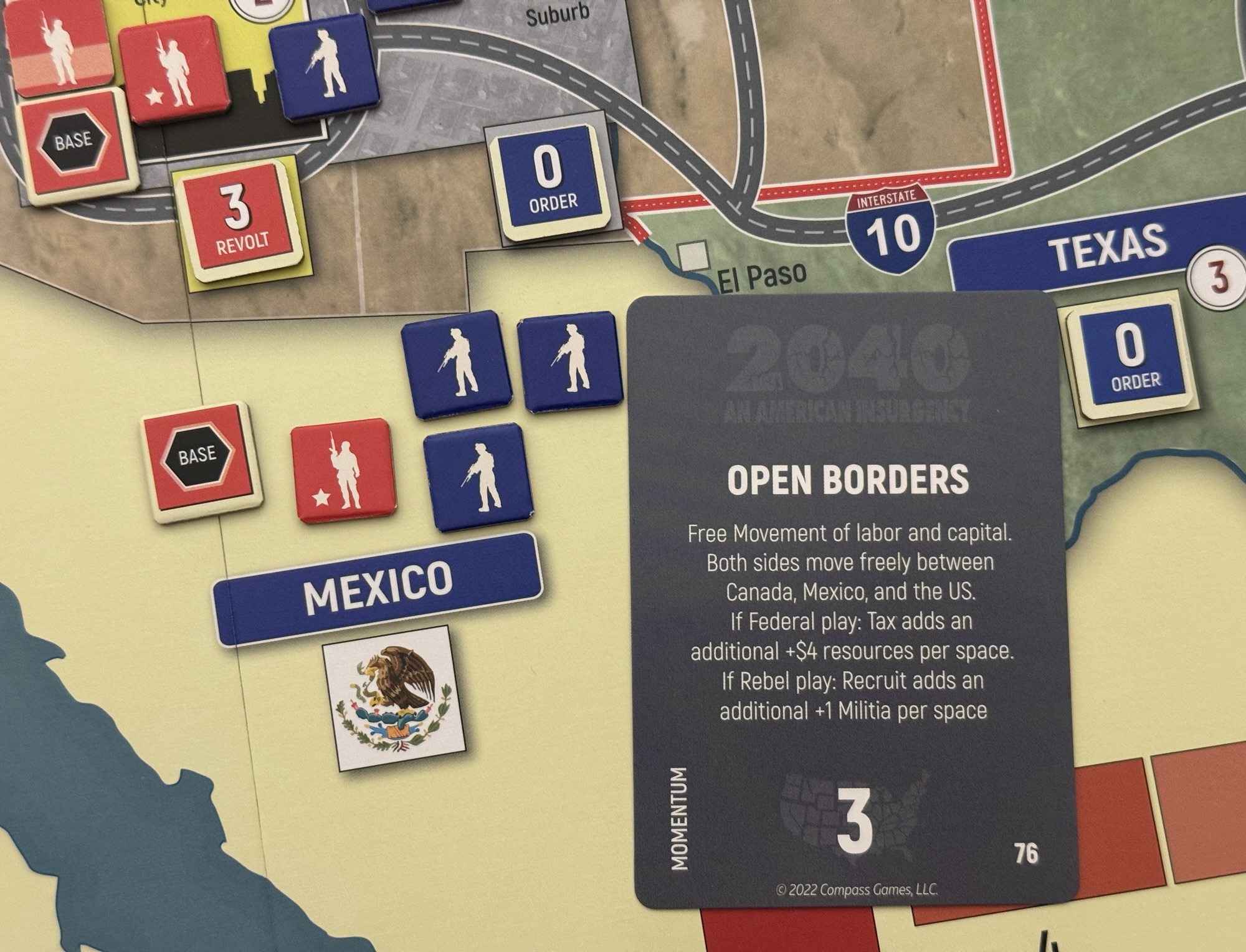
In this post, I will be taking a look at a Neutral Card called Open Borders. Remember, that each event is either friendly, enemy, or neutral. Friendly events help you; enemy events help your enemy while Neutral events can help either player. Gray cards such as Open Borders have no identifying side’s markings in the bottom right corner and when you play a Neutral Card, you may choose to do the Ops or the Event. Open Borders is a very good Neutral Card because it is a 3 Ops card and can be used to take various standard operations, such as raising
troops, fundraising and attacking. The card also is identified as a Momentum Card, which means that if played as the event, the effect will persist until a time specified in the text of the Event or, if none, until the end of the game. With Open Borders, the spaces of Mexico and Canada become playable areas on the board. These areas typically become a way for the Rebels to build and develop bases from which they recruit fresh insurgent units and then cross over the Open Borders to attack those States that border these areas eroding their Order and creating chaos and Revolt. The Open Borders Card allows this but also allows the Federal player to respond by crossing over the border and attempting to squash these recruiting centers.

The other effects of the Event provides both sides with a bonus when they take certain actions such as Tax for the Federals and Recruit for the Rebels. When the card has been played and is in effect, the Federal Tax Action will provide an additional $4 worth of income from the action. This is an effect of open borders and the unrestricted use of free trade and cross border commerce creating new jobs, providing additional sources of income and employing workers who ultimately pay income taxes on those improved wages. The Rebel Recruit Action will gain an additional Militia unit per space where taken. This reflects the stoking of anger at home as illegals and other bad actors are able to pour across the borders unfettered. I very much like this card for its game effect but also for the questions and concerns that it raises in this debate. Such an interesting economic spin on this issue through the game and I think is a very well done part of the design.

The concept of open borders highlights a fundamental tension between national security, economic openness, and civil liberties. Post-9/11, critics argue that porous or “open” borders allow terrorists to exploit security gaps, while proponents of open borders emphasize that excessive restrictions hurt economic freedom and that security should be managed through intelligence rather than isolation. The biggest concern regarding open borders is that unvetted, irregular migration through porous borders can be exploited by extremists to enter countries and perform acts of terrorism, sedition or general mayhem. To manage the tension between security and economic openness, many nations have turned to the concept of biometric borders. This involves using risk profiling and digital identity such as fingerprints and facial recognition to separate “civilized” business travelers from “illegitimate” and bad actors. This use of these high tech instruments in surveillance, data tracking and technology to distinguish between legitimate travel and potential threats has raised more concerns with civil liberty and privacy. This debate often pits “secure borders” against “open doors,” with officials grappling with protecting citizens without sacrificing the democratic principles of open societies. In one of the most famous quotes from history about privacy, Benjamin Franklin stated “Those who would give up essential liberty, to purchase a little temporary safety, deserve neither liberty nor safety“. Where do you land on this issue of Open Borders?

Here is a link to our unboxing video showing the components:

Here also is a link to our full video review:

I also posted an interview with the designer Edward Castronova on the blog and you can read that at the following link: https://theplayersaid.com/2023/04/04/interview-with-edward-castronova-designer-of-2040-an-american-insurgency-from-compass-games-currently-on-kickstarter/

In the next entry in this series, we will take a look at The Second Funnel from The Hunt from Salt & Pepper Games.

-Grant

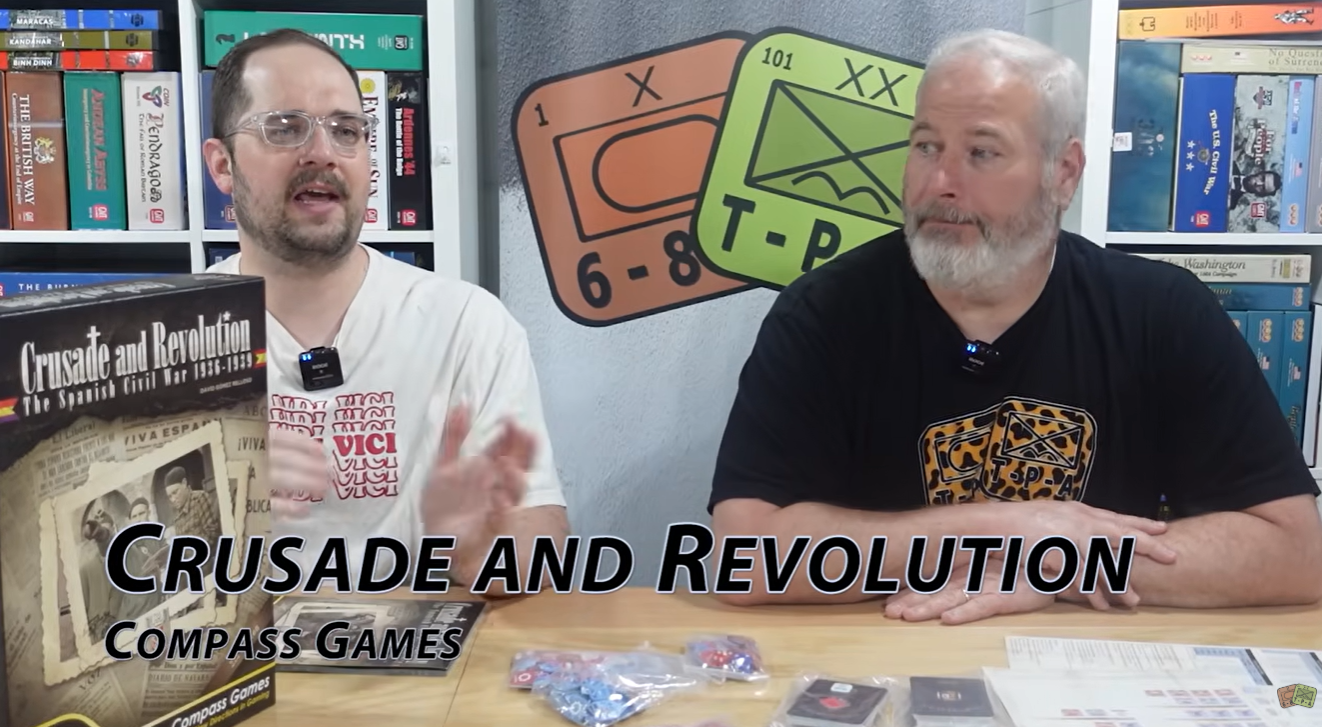
Video Review: Crusade and Revolution: The Spanish Civil War 1936-1939 Deluxe 2nd Edition from Compass Games

Von: Grant
17. April 2026 um 14:00

Crusade and Revolution: The Spanish Civil War 1936-1939 Deluxe 2nd Edition is a card-driven point-to-point movement strategic-operational wargame that covers all the Spanish Civil War (1936-1939). Its rules are based on Ted Raicer’s Paths of Glory. Each player takes command of one of the sides (Nationalist or Republican), and looks after all the aspects that involve a war including mobilization, recruitment, movement of troops, offensives and construction of defenses. There are also historical events that must be taken into consideration, thinks such as foreign military aid, international policy, change of Republican Government, etc.

-Grant

The Love/Hate Relationship: Card Driven Games

Von: Grant
09. April 2026 um 14:00

I very much enjoy Card Driven Games (CDGs’) and I think that many players also generally like them for many reasons including their strategic depth and replayability, as well as the tough choices players face each turn with the management of their hand of cards. However, this depth can come with some drawbacks and in this edition of The Love/Hate Relationship, I want to share what I love and hate about the CDG mechanic. Some of the first wargames that I experienced were Card Driven Games! Due to this fact, and because I really enjoy the mechanic, CDG’s hold a special place in my heart. So what is a Card Driven Game? It is more than just a game having cards or using cards. The CDG attempts to focus the players’ actions, and what they can ultimately do in the game, on the cards in their hand. Typically, performing some form of an action will use a single card and these cards will often be multi-purpose. This means they can be used for an action or to take the printed event on the card to do an action that typically either is more powerful but somewhat circumstantial. The medium also allows for historical events to be implemented in the game and allows various rules overhead or special instructions to be printed on the cards making the game a bit easier to play. Cards are simply fantastic and I have played many CDG’s. In fact, my first wargame was Twilight Struggle (yes I see it as a wargame!) followed by classics such as Wilderness WarEmpire of the SunWashington’s War and others.

Love

The main focus of the Card Driven Game mechanic, and probably the aspect that I most love about it, is the constant, agonizing choices about how best to use your hand of cards. Do I use a card for its powerful unique event or for its Operation Points? You simply never have enough resources to do everything you want, forcing you to prioritize the use of your cards and the actions you take but also to force a decision upon you about when or if to take calculated risks. This makes every turn feel like a high-stakes puzzle and each time I draw a new set of cards to start a round, and as I thumb through them, formulating my strategy, I get either a sinking feeling in my stomach or a sudden burst of excitement. CDG’s are generally praised for their strategic depth and replayability, which stems from the tough choices players are faced with each turn and that will change from game to game as the cards come out differently.

Also, unlike generic strategy games, CDG’s use cards to inject real-world flavor and historical events into the gameplay. Typically, in order to add these bits of chrome from history would require additional rules, exceptions or a whole new process being being added to the game. This tends to bog a game down and makes the almost unplayable. But, with CDG’s, each card represents a specific historical event that provides in-game benefits or difficulty for the players based on that history. These cards create a narrative as you play, where the sequence of cards can tell a unique or alternate version of history every time the game hits the table. This variety in outcomes and the way history in the game unfolds is one of my favorite parts!

There also is a real Fog of War aspect to CDG’s that I love as I just don’t know what type of hand my opponent has drawn. As players keep their hands hidden in the game, you and your opponent will be uncertain about the specific events and strategies available to the player based on their card draws. This really fosters a dynamic, back and forth, reactive gameplay that adds to the tense feeling of these games. I very much enjoy this aspect of the unknown and the process of trying to deduce what your opponent is trying to do based upon their card plays. When you are playing these CDG’s, you will have to think quickly and efficiently as a turn usually lasts 5-7 card plays and you will not have time to dawdle or you may find that you are in a real pickle.

But I think that my favorite part of CDG’s is the planning of a turn and how best to use your hand of cards. As you first start to examine your hand of newly drawn cards each round, you should first ask yourself “What do I need to accomplish this turn? and “What would I like to accomplish this turn?”. Then simply peruse your cards identifying those that can help you in both of those identified goals. I like to then look at the opponent Event cards in my hand and determine which ones don’t have their conditions to set off the Event met on the board at the moment. If the condition could possibly change, I prioritize that card to play first as I don’t want that Event to go off for my opponent. I also then make sure I don’t have any of my events that have conditions that could change as well and I will prioritize those to play next, after I have culled the negative opponent events. To hemp with this process, I literally line the cards up in my hand according to an approved play order, from right to left, so that I don’t get distracted or sidetracked.  If there is anything that can happen in this game, you will get distracted by what the other player is doing and sometimes quickly react without thinking, ruining your carefully laid plan. This approach has kept me organized, on task and most importantly in a position where I am able to minimize the negative damage from my opponent’s Events while simultaneously maximizing my own benefit.

Hate

Now that you see what I love about these CDG’s, let’s take a look at what I hate. Hate is such a strong word for me but there are many things that I don’t like about the mechanic. 

As with any new game or system, there is a learning curve with CDG’s. To play a CDG effectively, players often need to be familiar with and generally know all of the cards in the deck to be able to plan long-term strategies and mitigate potential risks and traps. This can be daunting for new or casual players of a CDG as the true strategy of the game will not be revealed for the first few plays but is something that needs to be developed through experience with the deck over several plays. An example of this is the Fidel Card found in Twilight Struggle. As I have played Twilight Struggle as the USA player, I have had to keep in the back of my mind the fact that this Fidel card is in the deck as it allows the Russian player to remove all US Influenced and directly place Influence into Cuba. Too much commitment in the early part of the game can be a waste of resources as it can all be removed with the play of this card and you must keep that in mind. Any card that allows for the placement of Influence into an area you cannot is worth its weight in gold.

Probably my most hated part with CDG’s is the “luck of the draw”. When you are dealing with a card based game where a deck is shuffled and randomized, you are bound to run into a bad hand now and again. While part of the fun with this mechanic is the concept of trying to do the best you can with the cards you are dealt, a bad opening hand or a streak of poor draws can sometimes feel game-breaking or frustrating, diminishing the sense of strategy and skill that the genre holds important. Nothing worse than looking at your hand and you have 2 – 1 OPs value cards, 2 – 2 Ops value cards and each event is that of your opponent. Just not a good way to start a turn.

The final thing that I dislike is that the mechanic does sometimes lead to a less realistic simulation and even a totally ahistorical outcome or timeline of events. To some wargamers, abstraction provided by cards lessens the game’s simulation value compared to more detailed and traditional systems, such as hex and counter games. The feeling of being unable to perform basic actions without a specific card can break immersion.

In summary, I personally love the CDG mechanic. It is a great method of design to ensure that you are injecting the history of the situation into the game while also creating a very stimulating and interesting play experience. What do you love and hate about CDG’s?

-Grant

❌