Normale Ansicht

La Der des Ders – The War to End War from Hexasim – Action Point 4

Von: Grant
26. März 2026 um 13:00

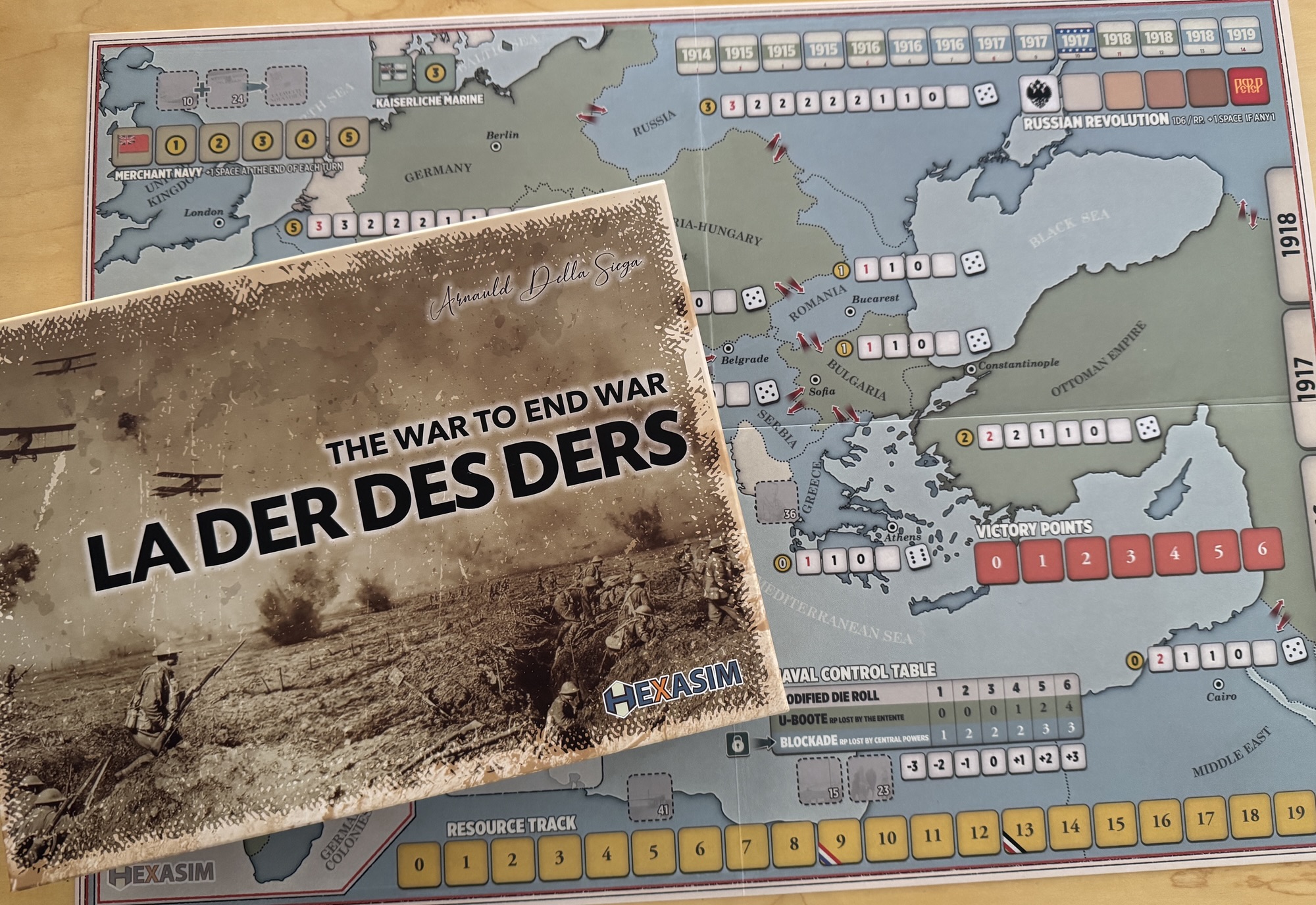
La Der des Ders – The War to End War from Hexasim is a 1-2 player slightly abstracted strategic level look at World War I. The game allows the players to relive the First World War at a strategic level, with each player controlling one of the 2 sides either the Entente, consisting of France, England, Russia, Serbia and other minor nations or the Central Powers including Germany, Austria-Hungary, the Ottoman Empire and a few minors. La Der des Ders can also be played solo, with a dedicated solitaire bot called “Athena” who utilizes special Cornflower Cards to make decisions about what technologies to invest in, where to undertake offensives and how to utilize limited resources and reinforcements. Each turn, players gain an amount of Resource Points dependent on what nations are in the war, which they can allocate to different areas to guide their overall strategy. Victory is achieved by launching offensives that drain the morale of enemy nations, forcing them out of the conflict through collapse.

In Action Point 1, we looked at the Game Board, discussing the Collapse Tracks, Trade Tracks, Russian Revolution Track and Naval Control Table and other various on-board tables and offensive spaces. In Action Point 2, we covered the Technology Phase and the Technology Tree and Technological Improvement Boards. In Action Point 3, we examined the Event Cards and how they inject the historical narrative into the gameplay and also alter the conditions of the game. In this Action Point, we will walk through an example of an Offensive and take a look at the combat procedure.

Offensives

As we discussed in Action Point 1, shown on the board are the Offensive Arrows that will remind the players about what Offensives they can undertake, meaning what Sectors may be attacked, and what Sectors have already taken their one Offensive against that adjacent Sector per turn. These are identified by red arrows connecting adjacent Sectors and will be covered up by the appropriate Offensive Marker when undertaken. In the below picture, we will take a look at Serbia as an example. You can see that Serbia is surrounded by Central Power countries including Austria-Hungary and Bulgaria (Neutral at the start of the war). They also have a few of their Allied nations adjacent including Romania (Neutral at the start of the war) and Greece (Neutral at the start of the war). From each of the adjacent Sectors there are 2 Offensive Arrows represented meaning that this Sector can both be attacked and can attack the adjacent Sector.

The process of taking Offensives is really pretty simple as players take turns to activate one of their sectors that has not yet been activated this turn. The sector chosen will then be activated and must launch an Offensive against an adjacent enemy sector. There is a cost to the launching of Offensives though as the player will have to pay the appropriate cost by first choosing the size of their Offensive, which in game turns means the number of dice they will pay to roll in the Offensive. The size of the Offensive must be at least 1 and can be up to the current Operational Value of the attacking sector. The player launching the offensive then spends as many Resource Points as the size of the Offensive.

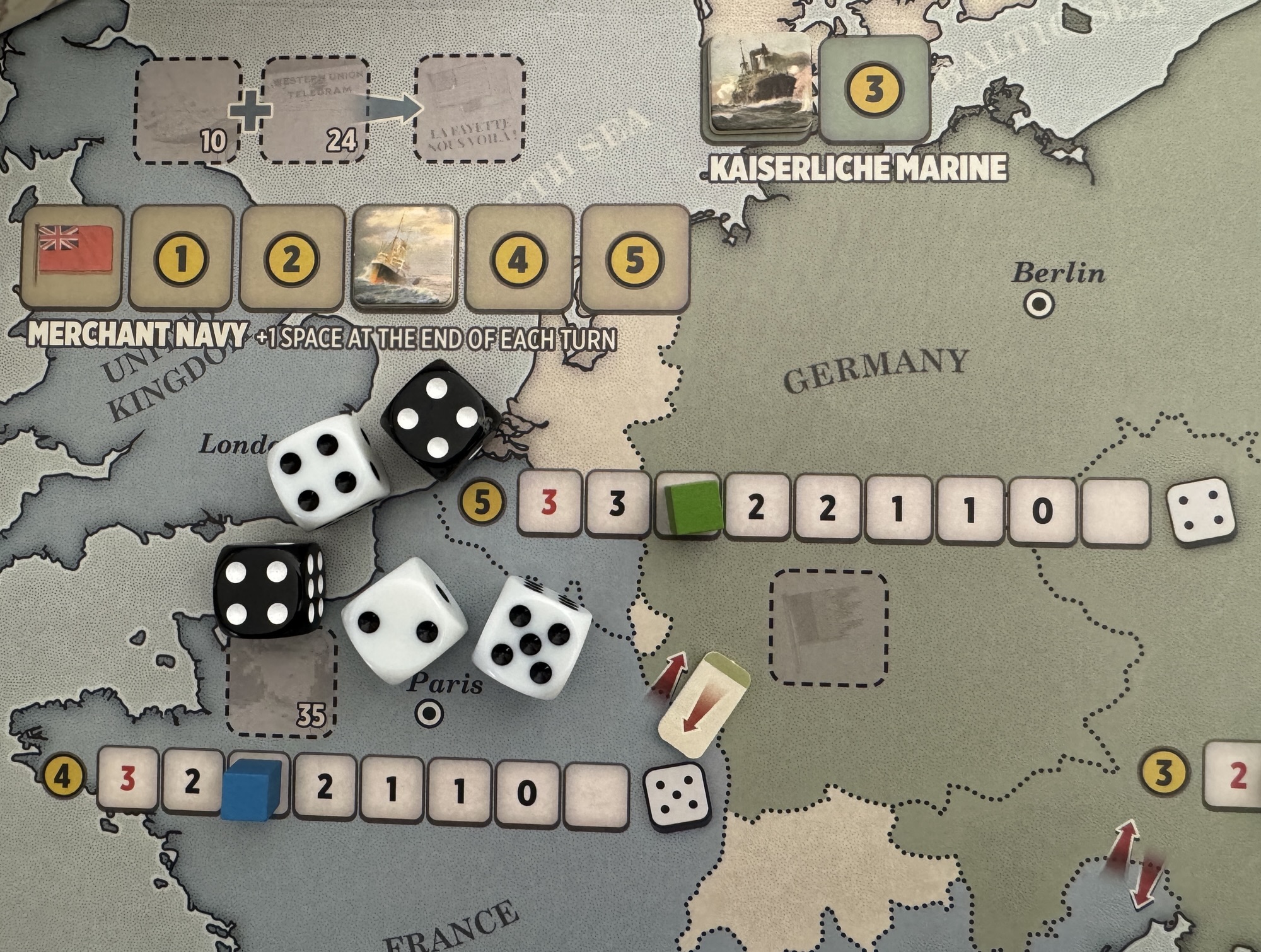
For example, The Entente player decides to attack Austria-Hungary from Russia. If Russia’s Operational Value is currently 2, the size of the Offensive must be between 1 and 2. If the Entente player chooses a size 2 Offensive they will have to spend 2 Resource Points. This would allow Russia to roll 2D6 along with any black dice for their Artillery Technology.

Once both of the players have activated a sector, each player may then continue with Offensives by choosing to activate a new sector until no new sectors can be activated. Each of the sectors can make but a single Offensive per turn. I really like this restriction as it reflects the logistical and material difficulties in planning, funding and executing these large Offensives. A player may always decide to pass rather than activate a sector but once you do pass the Resource Spending phase ends for them. The other player can continue to activate the sectors they want and are able to until they decide to pass on their turn or are no longer able to activate a sector.

Now let’s cover the mechanics of how the Offensive resolves with dice. The player will roll as many white dice as the size of the Offensive they funded. These dice are called Attack Dice and it is important to remember that some technologies allow modifiers to be added to Attack Dice or will grant additional dice to be rolled, usually in the form of Artillery Dice. Each level of Attack Technology implemented in the attacking sector grants a DRM (Die Roll Modifier) of +1 to each Attack Die roll. Each level of Defense Technology implemented in the targeted sector inflicts a Die Roll Modifier of -1 to each Attack Die roll. Each level of Artillery Technology implemented in the attacking sector allows the Attacker to roll 1 black Artillery Die. These dice are not subject to the bonuses/penalties conferred by either Attack or Defense Technologies. Also, keep in mind that the number of Artillery dice cannot exceed the size of the Offensive. This is a mistake that I have made many times in my plays of the game and wish there was a better way to remember this. In the case of Artillery Dice, if the player has developed the Aviation Technology, the attacker may re-roll as many Artillery Dice that failed to inflict a loss as the difference between their Aviation Level and the defender’s Aviation Level.

Each result greater than or equal to the attacking player’s Attack Value inflicts one loss on the defender. The Attack Value of a sector is represented by the die depicted at the end of the Collapse Track. Germany has the best value at a 4 while all other countries, with the exception of Greece who is a 6, have a 5. For each loss suffered in an Offensive, the defender moves the cube on the attacked sector’s Collapse Track by one space to the right. If a cube needs to be moved forward on the Collapse Track, but is already on the right-most space and can’t be moved forward, that country immediately surrenders. The Offensives process is really very simple, and it just fits with the chosen format and scale of the game. Nice and easy but fun with lots of dice rolling.

Counter Attacks

One more thing that I need to share about these Offensives is the concept of a Counter Attack. If at least one of the Attack Dice rolled comes up a natural 1, the attacker will suffer one loss and the cube in their own sector is moved forward one space on the Collapse Track. This is not one loss per 1 result but only 1 such loss with an Offensive. With my luck, I could lose my whole army and have to surrender! Also, remember that Artillery Dice are not affected by the Counter Attack rule.

The process of Offensives in La Der des Ders is very simple and straightforward but works very well in the framework of the game to create many tough choices about how to spend your limited Resource Points and who to attack and from where. As the Central Powers, attacking with Germany each turn makes the most sense as they have the best odds of scoring hits and causing losses to France and Russia but they will have to gauge where they stand and who else might be closer to Collapse and surrender. As the Entente, France and Russia should put a heavy focus on Germany and Austria-Hungary and force the Central Powers player to have to replace losses rather than spending on Technology upgrades and replacements. Continually attacking them will lead to results over the course of the game.

In Action Point 5, we will simply review the Victory Conditions.

-Grant
La Der des Ders – The War to End War from Hexasim – Action Point 3

Von: Grant
26. Februar 2026 um 14:00

La Der des Ders – The War to End War from Hexasim is a 1-2 player slightly abstracted strategic level look at World War I. The game allows the players to relive the First World War at a strategic level, with each player controlling one of the 2 sides either the Entente, consisting of France, England, Russia, Serbia and other minor nations or the Central Powers including Germany, Austria-Hungary, the Ottoman Empire and a few minors. La Der des Ders can also be played solo, with a dedicated solitaire bot called “Athena” who utilizes special Cornflower Cards to make decisions about what technologies to invest in, where to undertake offensives and how to utilize limited resources and reinforcements. Each turn, players gain an amount of Resource Points dependent on what nations are in the war, which they can allocate to different areas to guide their overall strategy. Victory is achieved by launching offensives that drain the morale of enemy nations, forcing them out of the conflict through collapse.

In Action Point 1, we looked at the Game Board, discussing the Collapse Tracks, Trade Tracks, Russian Revolution Track and Naval Control Table and other various on-board tables and offensive spaces. In Action Point 2, we covered the Technology Phase and the Technology Tree and Technological Improvement Boards. In this Action Point, we will take a look at the Event Cards and how they inject the historical narrative into the gameplay and also alter the conditions of the game.

Event Cards

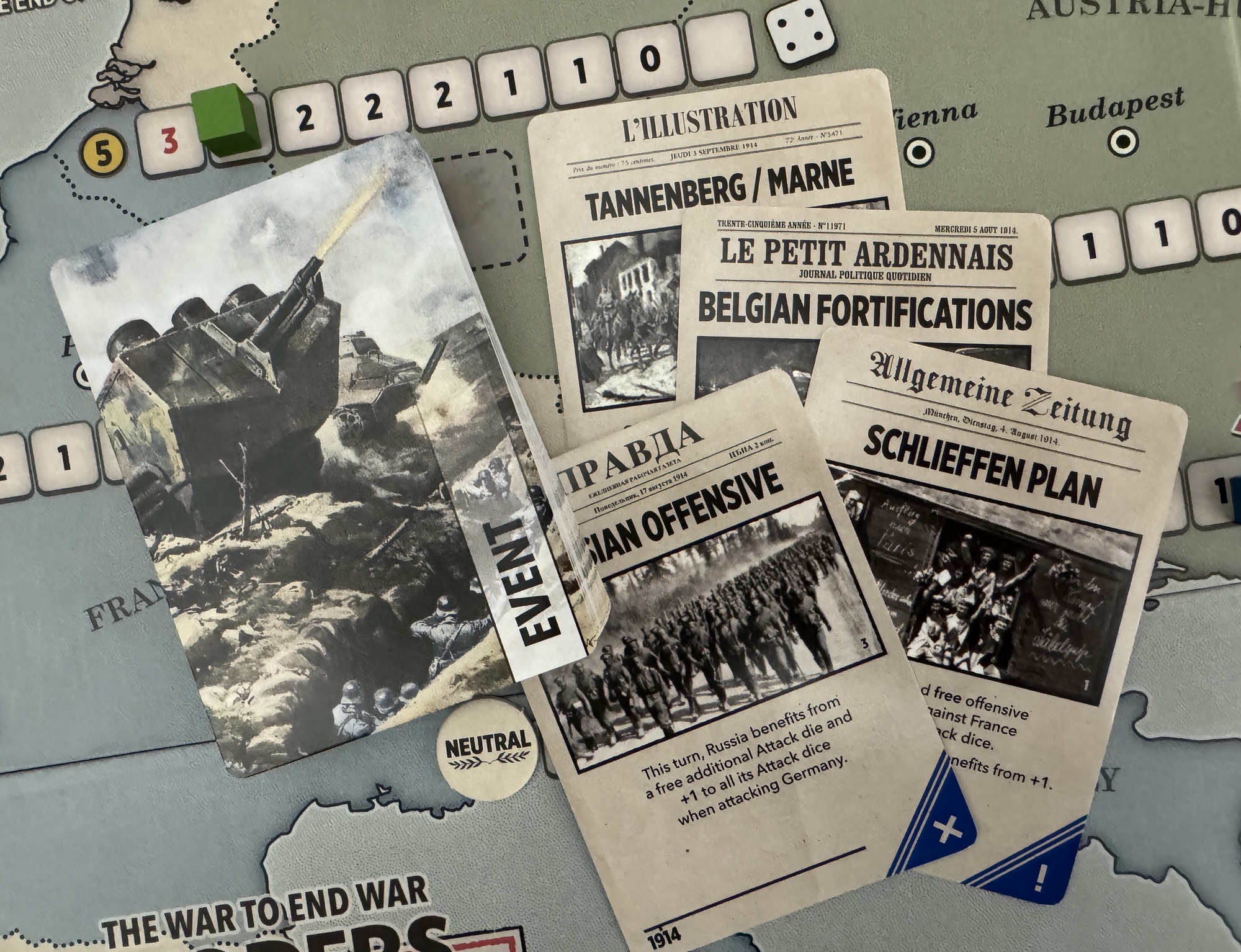
La Der des Ders has used the vehicle of Event Cards to inject the historical events and happenings of World War I into the game. This choice makes a lot of sense and plays into some of the game’s mechanics such as the Air Raid Technology that we discussed in the last post. At the outset of each turn, the players will be instructed to draw 3 Event Cards from the Event Deck. These are the 3 cards that will be in effect for this portion of the year as each of the years are divided into 3 separate turns representing roughly 4 months, with the exception of 1914 which represents the period of August through end of December that year. At setup, the player will divide the Event Cards by year to make 5 piles (1914, 1915, 1916, 1917 and 1918). Then they will take the 1914 Deck, shuffle it and
place it on the game board, in its dedicated box. Place the other decks on the right of the game board, near their
respective boxes on the Turn Track.

The 4 Event Cards for 1914.

Some of the Events are applied immediately when drawn, while others take effect later in the turn. This is all typically based upon the color of the symbols found on the cards in the bottom right hand corner and the symbol that coincides with a specific phase, such as the Resource Phase or Offensives Phase. In the picture below, you can see different examples of these cards and their color and symbols. These are Event Cards from 1914 on the left all the way through 1918. Also, some of the Events are only applicable in 1914. These Events will be marked with a blue corner. In the picture above you can see the 4 different 1914 Event Cards and their blue corners. Some Events have effects that apply until the end of the game, while others until they are cancelled. The text found on the cards is generally self-explanatory and I only found maybe 1 instance where I had to really think over what the card was trying to tell me to do. If you need additional information about the meaning of the cards and to find a bit of clarity, you can refer to the Events List in the rule book for more information.

Blue corners mean that the effect is no longer applicable after the year 1914. Red corners mean that this card can never be cancelled by using the Air Raid Technology. I found that this was the thing that I missed the most in my plays. Green corners mean this card may be cancelled with the Air Raid Technology but only under certain
conditions. Most of the Event Cards do things like allow for additional Offensives that turn at no cost, add a +1 DRM to Offensive rolls, or make Offensives cause more losses (but at a cost as that Offensive will cause you to lose troops as well) and the like. They are not game breaking but do inject some very interesting bonuses into the mix that will cause you to think about your plan for the use of of your Resource Points for that turn.

One final thing that I want to point out about some of the Event Cards. Some of the Events will instruct the player to place out a marker onto the board. On the board, there are several dashed boxes with small white numbers printed in them in specific locations. These are the Event Boxes and act as a reminder of the effects of various Event Cards when they are pulled. When Event Cards happen, some will provide the players with a counter that should be placed in these boxes to remind them of the effects of the historical events. These act as an mnemonic device and are very helpful.

These include the introduction of specific characters from history, special Events that occurred that changed the course of the war or had an effect on countries and their allegiance or that simply allow one of the many minor nations on the board, such as Italy, Romania, Bulgaria and Greece, to join either the Entente or the Central Powers. Here is a list of those special Events:

•  #6 – Von Lettow in Africa
• #10 – The Lusitania Torpedoed
• #15 – Major German Defeat (Battle of Jutland)
• #16 – Wilson Intervenes!
• #23 – Unrestricted Submarine Warfare
• #24 – Zimmermann Telegram
• #35 – Unified Command
• #36 – Louis Franchet d’Espèrey
• #41 – Pariser Kanonen

I mentioned the characters that are introduced by Event Cards and one of my favorite is the Von Lettow in Africa Event Card. This card refers to Paul von Lettow-Vorbeck who was a German General who commanded the Schutztruppe (colonial forces) in East Africa. Leading a small force of 3,000 Germans and 11,000 African Askari, he fought a brilliant guerrilla campaign against superior Allied forces (up to 300,000 men), never losing a battle and surrendering only after the 1918 armistice. The effects of this Event are that any Offensives by the Central Powers undertaken in Africa will not cost any Resource Points. This card will not appear until 1915 but can be a real boon to the CP player as they can continue hammering on the African Entente trying to get them to Collapse and no longer contribute their Production Value to the Entente war effort.

One of the major events that are covered by the Event Cards include the likes of the sinking of the Lusitania by the German U-Boats. On May 7, 1915, a German U-Boat torpedoed and sank the British ocean liner RMS Lusitania off the Irish coast. The ship sank in just 18–20 minutes, killing 1,198 of the 1,959 people on board, including 128 Americans. The attack spurred international outrage and shifted U.S. public opinion against Germany, contributing to the eventual American entry into the war. The effects of the is card include the placement of the Lafayette Marker above the Merchant Navy Track and indicates the number of additional Resource Points awarded to the Entente for the current turn. This support was basically from the United States of America as their citizens were killed in the tragedy and can be a very tough pill to swallow for the Central Powers as it is a death knell due to additional resources to bring more troops and focus more attention on Technology and the launching of Offensives.

The Event Cards are a key part of the game and really make it different from play to play as events might come out in a different order giving the player new opportunities to exploit or new dilemmas to plan for and deal with.

In Action Point 4, we will go through an example of an Offensive and take a closer look at the combat procedure.

-Grant

La Der des Ders – The War to End War from Hexasim – Action Point 2

Von: Grant
20. Februar 2026 um 14:00

La Der des Ders – The War to End War from Hexasim is a 1-2 player slightly abstracted strategic level look at World War I. The game allows the players to relive the First World War at a strategic level, with each player controlling one of the 2 sides either the Entente, consisting of France, England, Russia, Serbia and other minor nations or the Central Powers including Germany, Austria-Hungary, the Ottoman Empire and a few minors. La Der des Ders can also be played solo, with a dedicated solitaire bot called “Athena” who utilizes special Cornflower Cards to make decisions about what technologies to invest in, where to undertake offensives and how to utilize limited resources and reinforcements. Each turn, players gain an amount of Resource Points dependent on what nations are in the war, which they can allocate to different areas to guide their overall strategy. Victory is achieved by launching offensives that drain the morale of enemy nations, forcing them out of the conflict through collapse.

In Action Point 1, we looked at the Game Board, discussing the Collapse Tracks, Trade Tracks, Russian Revolution Track and Naval Control Table and other various on-board tables and offensive spaces. In this Action Point, we will cover the Technology Phase and the Technology Tree and Technological Improvement Boards.

Technology Phase

One of the best parts of La Der de Ders, and typically the best part of any strategic level wargame, is the Technology Phase and the player’s ability to spend their limited resources on various types of technologies to improve their performance on the battlefield and in the economic war. But, keep in mind that there is a risk here as resources are limited and you have to pay to develop these technologies and there is no guarantee of success as it is up to dice roll, albeit a modified one at that. Each of the players has their own Technology Tree board that is used to track their technological progress over the course of the game. There are a total of 6 different Technologies that can be researched including Attack, Defence, Artillery, Aviation, Naval, and Air Raid.

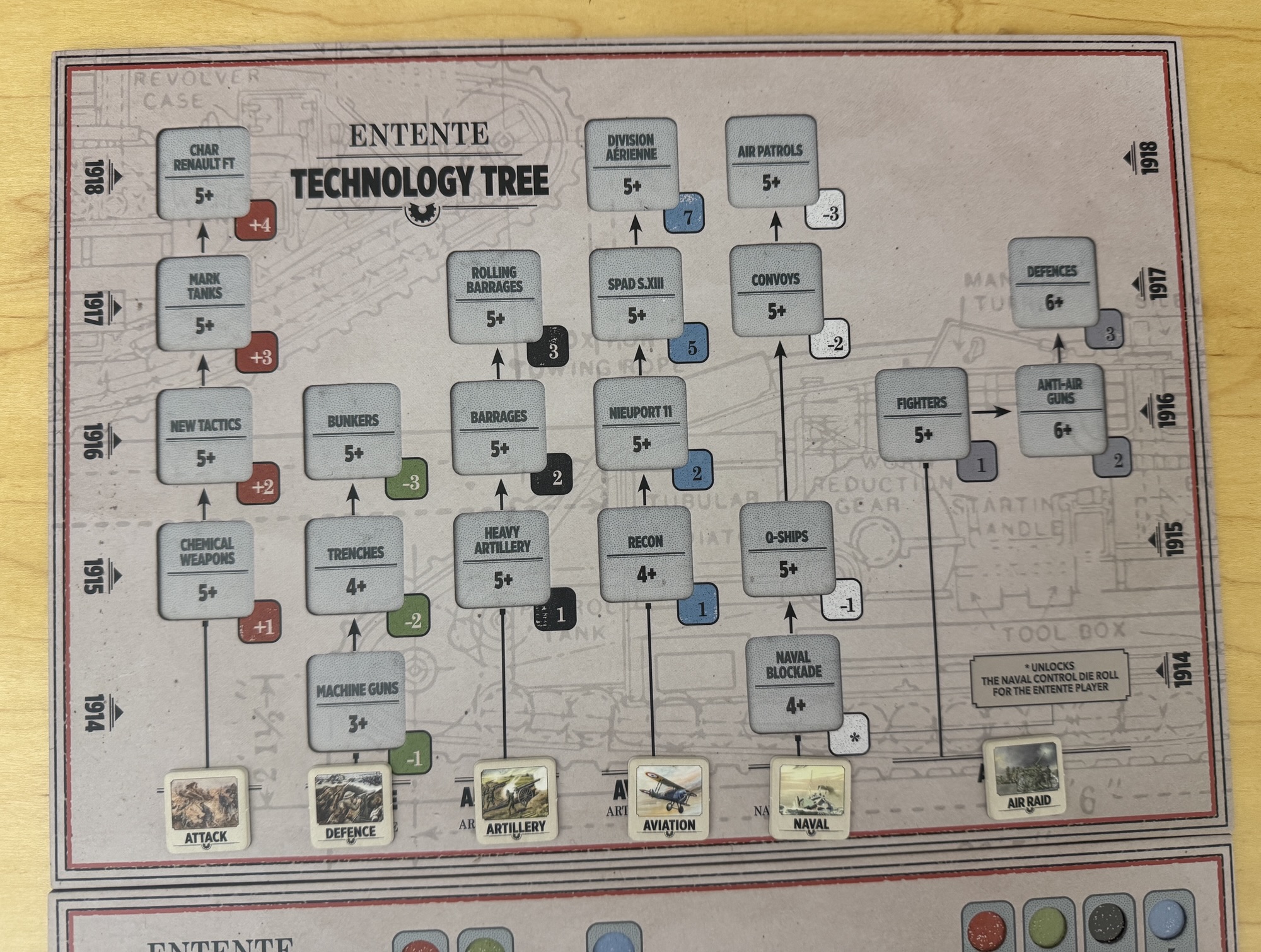
The Entente Technology Tree.

Each of the different technologies are important and the failure to develop them can lead to a quick and ignominious defeat. I also really like the concept of keeping up with your enemy as sometimes you are simply investing not to gain ground but just not to lose it! This is particularly the case with the Attack and Defence Technologies as if one side gets too far ahead that +1 or -1 difference can make a huge impact on attacks and can lead to significant losses which creates a whole new problem and a sink for those scarce resources.

The Central Powers Technology Tree.

As you look at the Technology Trees you will see that each box on the Tree represents a level of technology. Each level contains important information about its name, the available date when the technology can be researched, the target number needed to unlock it denoted as a number with a + that means equal to or greater than the number and the bonus that is granted when it is discovered. Each time a level of technology is unlocked, the player will move their Technology marker to the box corresponding to that level. Each level of technology provides a specific bonus which only applies to sectors that have implemented that level. Implemented means having paid for the implementation as you actually pay first to discover the technology and then must spend resources to grant its ability to your different nations.

In addition to the Technology Tree Boards, each player has a board with Improvement Tracks that indicate which sectors or nations belong to their side. For each sector, the tracks correspond to Attack, Defence, Artillery, and Aviation technologies. When a level of Technology is unlocked on the Technology Tree, the relevant side can implement it in the sectors of its choice so that these sectors can benefit from the bonuses this level provides. This will require the expenditure of Resource Points and then the Technological Improvement cylinder on the Improvement Track is then moved accordingly.

Keep in mind that it is possible to attempt to unlock a level of technology only if the year shown on that technology’s row has been reached. The dates that each of the Technologies is available is shown on the outer edges of the level of Technology in large black letters. It can be overlooked from time to time so check during each of the Technology Phases to makes sure you can spend resources on the tech you desire. Also, an attempt to unlock the Technology may only be attempted if the previous level of Technology has been unlocked during a previous turn’s Technology Phase. And finally, keep in mind that for each of the various Technology types, only one level can be unlocked per turn.

Now let’s take a look at ways to improve your chances when rolling the dice to unlock the Technologies. The cost for each attempt at unlocking a Technology is 1 Resource Point. But there is a key decision point at this time as before rolling the die to unlock a level of Technology, the player may decide to spend additional Resource Points. Each additional 1 Resource Point spent provides a +1 bonus for this attempt. This can be very important during the game as it can be the difference between getting the Technology needed to push you over the top for the turn or not and this decision is very important. The more Resource Points you spend on Technology, the fewer you will have to move forward with Offensives to weaken your opponent and break them or even the less Reinforcements you will be able to afford to shore up your defenses.

Machine Guns are unlocked by the Entente in 1914 with a die roll of 4. The Machine Guns grant a -1 DRM to enemy Attack rolls.

If the attempt is failed, the player receives a Technological Research Cube which they will place in the box of the level they just tried to unlock. On future attempts this white cube will grant a +1 DRM to die roll per cube accumulated through failed rolls. Ultimately, you will unlock these Technology levels, either through blind luck, your persistence or due to the over expenditure and over commitment of Resource Points. But that is what makes this part of the game so good as it is all about choices and the management of risk along with your resources. You cannot do everything that you wish to each turn and you will have to manage these things as best as you can to taste victory.

The Technological Research Cubes grant a +1 DRM per cube to an unlock attempt. In this case, a die roll of 3 would normally fail to unlock the Heavy Artillery advancement for the Artillery Technology but the +2 DRM makes it a 5 which is a success.

In my opinion, the 3 most important Technologies are the first 3 listed on the Technology Tree being Attack, Defence and Artillery. This game is mostly about the planning and execution of Offensives to weaken and ultimately break the will of your opponent by causing their nations to reach collapse on their Collapse Track. Attack gives a positive modifier to each of the attack dice rolled. Typically a nation must roll a 4 (Germany), 5 (France, Russia, the Ottoman Empire, Middle East, Romania, Bulgaria, Africa both sides and Serbia) or a 6 (Greece) and this +1-+3 for attacks will make a huge. A lot of the times though having a good Attack modifier will be lessened our counteracted due to a good Defence value but this is where keeping up the pace with the enemy is a key decision. The Artillery dice are a special animal. For each level of the Artillery Technology, typically each nation will gain an additional Artillery Die (black) to roll along with their Attack Dice (white). These Artillery Dice are not modified by the Attack Technology but are an additional free chance to score a hit. These dice can also be rerolled through the Aviation Technology which will allow for an Artillery Die reroll per level shown on the Technology Tree.

The Naval Technology and Air Raid Technology represent these 2 important miliary advancements in the struggle for the economic aspect of the war. The Naval Technology will for the Central Powers moves the Naval Control Cube one space to the right on its track. With the exception of Level 1, each level of Technology unlocked by the Entente moves the Naval Control Cube one space to the left. As mentioned in Action Point 1, the Naval Control Table is used to represent the efforts of the German U-Boat attacks on commerce and mimic the associated receipt of foreign support by the Entente from the United States of America. At the outset of each turn, a die is rolled and the table referred to in order to determine a possible number of lost Resource Points. There are 2 rows on the table, 1 being the U-Boat for the Central Powers and the other the effects of the Blockade for the Entente.

The Table located under the Naval Control Table indicates the modifier that will be applied to the Central Powers’ Naval Control die rolls. It takes into account the Naval Technology levels of the Central Powers and that of the Entente. At the start of the game, only the Central Powers can carry out a Naval Control die roll. You may notice the small gray box with a lock linked to the Naval Control Table that indicates that the Entente cannot carry out a Naval Control die roll yet. Only once it has unlocked Naval Technology Level 1, can the Entente perform Naval Control die rolls.

And finally, the Air Raid Technology allows the Central Powers player (and them alone) to influence the course of Events, depending on the difference with the Entente’s level of Air Raid Technology. This advantage will allow the CP to cancel an event or more that is beneficial to their enemy or that will harm their efforts.

The Air Raid Technology is based on the difference between the Technology level of the CP as compared to the level of the Entente.

I feel that the inclusion of the Technology Advancement in La Der de Ders was a stroke of genius and I very much like how the designer Arnauld Della Siega made it have a Press Your Luck aspect to it. This forces some very critical decision points on the players but also keeps the game a game and gives it a really nice feel of hope.

We recently published an interview on the blog with the designer Arnauld Della Siega and you can read that at the following link: https://theplayersaid.com/2026/02/09/interview-with-arnauld-della-siega-designer-of-la-der-des-ders-the-war-to-end-war-from-hexasim/

In Action Point 3, we will take a look at the Event Cards and how they inject the historical narrative into the gameplay and also alter the conditions of the game.

-Grant

La Der des Ders – The War to End War from Hexasim – Action Point 1

Von: Grant
12. Februar 2026 um 14:00

La Der des Ders – The War to End War from Hexasim is a 1-2 player slightly abstracted strategic level look at World War I. The game allows the players to relive the First World War at a strategic level, with each player controlling one of the 2 sides either the Entente, consisting of France, England, Russia, Serbia and other minor nations or the Central Powers including Germany, Austria-Hungary, the Ottoman Empire and a few minors. La Der des Ders can also be played solo, with a dedicated solitaire bot called “Athena” who utilizes special Cornflower Cards to make decisions about what technologies to invest in, where to undertake offensives and how to utilize limited resources and reinforcements. Each turn, players gain an amount of Resource Points dependent on what nations are in the war, which they can allocate to different areas to guide their overall strategy. Victory is achieved by launching offensives that drain the morale of enemy nations, forcing them out of the conflict through collapse.

In this series of Action Points, we will first take a look at the Game Board, discussing the Collapse Tracks, Trade Tracks, Russian Revolution Track and Naval Control Table and other various on-board tables and offensive spaces, cover the Technology Phase and the Technology Tree and Technological Improvement Boards, take a look at the Event Cards and how they alter the game, go through an example of an Offensive and the combat procedure, review the Victory Conditions and give an overview of the “Athena” solitaire bot and how it works.

Game Board

The Game Board used in La Der des Ders covers the entirety of the European and Eastern portions of World War I and is a simplified geographical representation of the major players involved in the war. You will not find anything more than simple borders of countries and then not all of each country is represented in its entirety such as the Ottoman Empire of the vastness of the Russian steppes. There is also an inset map in the bottom left hand corner that covers the war in Africa. The Game Board is divided up into what are called Sectors representing both the major and minor powers involved in World War I. These Sector representations are illustrative of the main countries that took part in the war and one Sector can actually represent multiple countries. For example, in the case of France, you will notice that England really has no specific direct playable area or a Collapse Track of its own on the Game Board other than the graphical representation of their island nation. The British troops, along with those of Belgium, are abstracted into those of France for simplicities sake and to meet the design goals of the game. To further differentiate these Sectors from each other and to make playing visually simpler, the Sectors are shaded blue if they belong to the Entente and then green if they are part of the Central Powers.

The Collapse Tracks

Let’s take a closer look at the various information that is contained in these Sectors. Above is a picture focused on Germany with France (lower left), Austria-Hungary (on the right) and Russia (upper right) also included. You will first notice a line of small boxes with numbers listed in each box numbered from 3 on the far left descending to 0 and a blank box on the far right. These numbers are referred to as the Operational Value. This Track is referred to as the Collapse Track and represents the morale, fighting spirit, economic stability, martial resources and preparation of each of the countries for war in the game. On the left end of the Collapse Track is the country’s Production Value printed in a yellow circle. The Production Value corresponds to the number of Resource Points (RP) that will be generated by this sector at the start of each turn, if it is at war. If this Production Value number is printed in black, this means that this Sector is at war at the start of the game. If the Production Value is printed in white, the Sector is not at war at the start of the game but will enter the war through the appropriate Event Card being drawn. If a Sector is not at war but is Neutral, for purposes of the game this means that it does not generate any Resource Points.

At the start of the game, a wooden cube is placed in the space to the right of the box containing the red value. As losses are inflicted in this Sector due to Offensives or Event Cards, the cube will be moved to the right on the Collapse Track. When the Sector receives reinforcements, the cube will be moved moved to the left. The cube will never be placed on the space with the red value and the player must read the number in the box to the left of the cube to ascertain the current Operational Value. The numbers indicate the maximum amount of Resource Points that can be allocated to this Sector during an Offensive, which will also determine the size and number of dice that are used for the Offensive. This Operational Value will change throughout the game due to losses in Offensives or due to specific Event Cards. If the cube ever reaches the end of the Collapse Track, and another reduction must be made, the country will surrender and fall to their enemies.

The other important piece of information found on the far right side of the Collapse Track is the Attack Value. The Attack Value is used for Offensives and is how players determine whether they score hits or not with their troops and artillery. This Attack Value is represented by a die face that shows the number needed to hit. If the rolled Attack Dice are equal to or greater than the printed Attack Value a hit will be scored and losses will be taken by the defender by moving the cube down on the Collapse Track. This Attack Value can be modified through the advancement of technologies including on Attack and on Defense. The player will simply add up all applicable modifiers from these Technologies or from Event Cards and then reduce or increase that target Attack Value accordingly.

Offensive Arrows

Shown on the board are the Offensive Arrows that will remind the players about what Offensives they can undertake, meaning what Sectors may be attacked, and what Sectors have already taken their one Offensive against that adjacent Sector per turn. These are identified by red arrows connecting adjacent Sectors and will be covered up by the appropriate Offensive Marker when undertaken. In the below picture, we will take a look at Serbia as an example. You can see that Serbia is surrounded by Central Power countries including Austria-Hungary and Bulgaria (Neutral at the start of the war). They also have a few of their Allied nations adjacent including Romania (Neutral at the start of the war) and Greece (Neutral at the start of the war). From each of the adjacent Sectors there are 2 Offensive Arrows represented meaning that this Sector can both be attacked and can attack the adjacent Sector.

It is important to remember that an individual Sector can only launch one Offensive per turn, and that is always against an enemy sector adjacent to it. During the same turn, a sector may be attacked by several adjacent enemy sectors, but each Offensive is resolved separately.

Trade Tracks

There are two Trade Tracks shown on the Game Board, both of which are located in the top left hand corner of the board, 1 for the Entente (Merchant Navy) and the other for the Central Powers (Kaiserliche Marine). These 2 tracks provide additional Resource Points to both sides at the beginning of a turn when they are collecting income. Naval Control die rolls can modify the number of RP’s received at the beginning of a turn. It is important to remember that the Merchant Navy Marker is moved forward 1 space at the end of each turn, which will result in advancing the Production Marker of the Entente. If the Lafayette Marker is on this track, it is also moved forward 1 space. These markers are never moved to the left. Once the end of the track has been reached, the markers will no longer need to be moved.

Russian Revolution Track

The Russian Revolution Track indicates the advance of the Russian people towards their ultimate Revolution, which historically broke out in March 1917. The Russian Revolution Marker will begin the game in the white
space. This marker may be moved to the right each time Russia obtains reinforcements. It is never moved to the left. When this marker reaches the last space, Revolution breaks out and Russia will no longer produce resources and can no longer receive reinforcements.

Naval Control Table and Track

The Naval Control Table is used to represent the efforts of the German U-Boat attacks on commerce and mimic the associated receipt of foreign support by the Entente from the United States of America. At the outset of each turn, a die is rolled and the table referred to in order to determine a possible number of lost Resource Points. There are 2 rows on the table, 1 being the U-Boat for the Central Powers and the other the effects of the Blockade for the Entente.

The track located under the Naval Control Table indicates the modifier that will be applied to the Central Powers’ Naval Control die rolls. It takes into account the Naval Technology levels of the Central Powers and that of the Entente. At the start of the game, only the Central Powers can carry out a Naval Control die roll. You may notice the small gray box with a lock linked to the Naval Control Table that indicates that the Entente cannot carry out a Naval Control die roll yet. Only once it has unlocked Naval Technology Level 1, can the Entente perform Naval Control die rolls.

There are also several administrative tracks on the Game Board including the Resource Track, used to track the current Resource Points of both the Entente and the Central Powers, the Turn Track and the Victory Point Track. You will also notice lots of dashed boxes with small white numbers printed in them all over the board. These are the Event Boxes and act as a reminder of the effects of various Event Cards when they are pulled. When Event Cards happen, some will provide the players with a counter that should be placed in these boxes to remind them of the effects of the historical events.

One final comment on the Game Board. Marc von Martial is the artist and he has done an excellent job with this game board as it is truly functional and aids play but also is very attractive and has a very clean and pleasing aesthetic. I enjoy the choice of colors, even though these old eyes are starting to have trouble differentiating gray and green when they are both light, that work well together and the tracks and information found on the board are all crisp and clean and easily read. I just like the overall appearance of the game board and wanted to congratulate him on his exemplary graphic design work.

In Action Point 2, we will cover what I would consider one of the better parts of the game in the Technology Phase and the Technology Tree and Technological Improvement Boards.

-Grant

Interview with Arnauld Della Siega Designer of La Der des Ders – The War to End War from Hexasim

Von: Grant
09. Februar 2026 um 14:00

Hexasim has really been stepping up their game recently with some great looking wargames. Late last year, they announced their newest game called La Der des Ders – The War to End War, which focuses on World War I and is designed by Arnauld Della Siega. We reached out to Arnauld and he was more than willing to provide us some insight into the design.

Grant: Arnauld welcome to our blog. First off please tell us a little about yourself. What are your hobbies? What’s your day job?

Arnauld: Hello, everyone. Despite my Italian-sounding name, I am French. My hobbies? Gaming, of course. Formula 1. American football and flag football – I am assistant coach for my youngest son’s team. Oh, and I play badminton. And when I had a little more time, astronomy. Add Motörhead and Lovecraft to that, and I think you’ll have a pretty good idea of who I am. My real job? I’ve been working for Hexasim for three years. I mainly handle communication and game development (clarity of the rules, layout of the rulebook, some of the graphics).

Grant: What motivated you to break into game design? What have you enjoyed most about the experience thus far?

Arnauld: I think this is true of many designers, but my brain is constantly buzzing, whether I’m writing stories or inventing game systems. I wanted to create something to give shape to the ideas swirling around in my head. Then, and perhaps most importantly, to leave something behind for my descendants. Creating is more frustrating than rewarding, but seeing your game released is a bit like the birth of a child. A culmination.

Grant: What is your upcoming game La Der des Ders about?

Arnauld: La Der des Ders is the story of the First World War in its entirety, from the early stages to 11 November (and even a little beyond). It follows the timeline of the war and focuses on technological developments. La Der des Ders is a grand-strategy game in which you control sectors. You decide how to allocate your resources between recruiting new soldiers to rebuild your forces, technological research and preparing offensives. La Der des Ders is a revised and corrected version, with greatly improved artworks, ergonomics and rules, published in VaeVictis Magazine #145.

A look at the game found originally in VaeVictis Magazine #145.

Grant: What is the translation of this French phrase La Der de Ders?

Arnauld: La Der des Ders means « the last of the last ». You may translate it by « The War to End War ». I asked my testers and Boardgame Geek whether to use a French or English title. The players unanimously opted for a French one.

Grant: Why was this a subject you wanted to create a game on?

Arnauld: After creating No Man’s Land – Trench Warfare 1914-1918 from Ludifolie Editions, I had acquired a good amount of knowledge about the First World War at a tactical level. I thought it would be a good idea to take a step back and look at the First World War from a different angle. That’s how La Der des Ders came about.

Grant: What are the unique features with the system used for the game?

Arnauald: It depends on what we mean by ‘unique’. Are there any truly unique games? When it was released in 2019, La Der des Ders was, to my knowledge, the only solo game covering the entire First World War. What makes it unique is its focus on technology (the game includes 41 levels of technology). It is also this abstraction, which facilitates the narrative without distorting it. This is particularly evident in the Collapse Tracks (which will be discussed later), which manage the erosion of the belligerents.

Grant: What is your design goal with the game?

Arnauld: What I look for above all else in a game is elegance. I like it when a lot of thought has gone into it, both in terms of the ergonomics and the gameplay. For La Der des Ders, I wanted to create a game that was easy to learn, designed for solo play, and with engaging mechanics. A game made to be played and able to learn more about the historical WW1.

Grant: What unique elements from WWI did you feel important to model in the game?

Arnauld: I think that sometimes a game is less about ‘what is important to model’ than ‘what the designer wants to model’. I like the ‘technical’ side of conflict. For this reason, 1914 interests me much less than 1918. I love all the technologies that abound. It was the shape of those funny steampunk-style tanks that made me love WW1 (basically, I’m more into Francis I, the Assyrians and the like).

Grant: As a Strategic Level wargame, what economic or political elements are included?

Arnauld: The entry of neutral countries into the war is managed by events. I did not want countries to be able to adopt a stance different from their historical one. That would have had too much of an impact on historicity. Neutral countries will therefore certainly enter the war in the same year as historically, but players do not really know on which turn (1 turn = 4 months).

The economy is managed by Resource Points awarded each turn. These Resource Points are the heart of the system, as they act somewhat like Action Points. Each sector contributes to the overall amount of Resource Points. The British and American navies also contribute an ever-increasing number of resources. The Naval Control Table simulates the war between merchant ships and U-boats.

Grant: How does the Collapse Track work?

Arnauld: The Collapse Track represents both a sector’s willingness to fight and its military potential. With each loss, a cube moves to the right, towards surrender. These losses also reduce the number of Attack dice a sector can roll during an offensive. Spending resources allows you to counteract this slow erosion and regain power.

Grant: What technologies can be developed?

Arnauld: There are six categories of Technology (Attack, Defense, Artillery, Air, Naval and Raid). Each category is divided into several levels, specific to each side.

Once unlocked, Technology levels grant bonuses in attack or defense, Artillery dice, rerolls, bonuses during the Naval Control Phase (which reduces the number of Resource Points available to the opponent), or the ability to cancel some events.

Grant: How does the game use cards?

Arnauld: There are two types of cards. Cornflower Cards are used to manage the solitaire bot.

The other cards are Events. Three are drawn at the beginning of each turn, and the effects are applied. Events are classified by year, and one card remains at the end of each year when the new year’s deck is brought into play. This adds variety to the game without sacrificing historical timeline.

What I am most proud of with these cards are the top banners. I made sure to copy the headlines from newspapers of the time, even going so far as to put a credible date and, above all, a number that, unless I am mistaken, should be correct. Yes, I had a lot of fun.

Grant: What different types of cards are included? Can you provide a few examples?

Arnauld: There are several types of Event Cards. Blue cards, such as the Schlieffen Plan, are only available in 1914. Red cards are Pivotal Cards that cannot be cancelled. These include cards that bring countries into the war, such as Lusitania and Zimmermann Telegram. Finally, green cards, which are the most numerous, allow players to obtain Resource Points, additional bonuses by attacking a particular country, but sometimes penalties. I looked for the most important events of the conflict, thought about their impact on the course of the war, and then translated that into game terms. A little tip: each color has a specific design, which means that color-blind players are not at a disadvantage.

Grant: How does combat work?

Arnauld: Combat is referred to as ‘offensives’. A single sector can only launch one offensive per turn, and a single sector can be attacked by multiple sectors. The player chooses the attacking sector and designates its target. They spend a number of Resource Points equal to the number of dice they wish to roll. This number cannot exceed the current Operational Value of the attacking sector (indicated by the position of the cube on the Collapse Track). To inflict a loss on the enemy, the player must obtain a certain value (often 5+). However, the dice roll is modified according to the technologies unlocked by the attacker or defender.

Artillery technology is important, as it allows black dice to be rolled that will not be modified. This highlights the power of artillery during conflict.

Grant: How are historical events handled?

Arnauld: By drawing three cards at the beginning of each turn. The cards do not go into the players’ hands. They are applied during the current turn. Some are applied immediately, others during offensives, and a few during the Resource Collection Phase. Some cards remain in play for several turns, such as Von Lettow, which allows the Germans to launch free offensives in Africa until the end of the war.

Grant: What variants are included?

Arnauld: The Fast Play variant speeds up games by bringing this version closer to the original version published in VaeVictis, removing the two new Technology categories and not charging sectors for implementing unlocked technology levels. I don’t really like it when a designer offers variants. It makes me think that they haven’t taken responsibility and are leaving it up to the player to figure it out.

You know what? I’m going to offer your fellow readers a great variant. This variant is for use in 1 vs 1 games, if you find it too difficult to win with the Entente.

Here it is:

Countries that are still neutral do not pay to implement an unlocked technology. Once the sector is at war, they must pay as normal.

You can consider this variant official. It has been tested.

Grant: How does the solitaire mode work? How are the Cornflower Cards used?

Arnauld: For each phase (Reinforcements, Technological Research, Offensives), the player draws a card and refers to what is indicated on the card.

It’s very simple to set up and effective. No need for endless dice rolls, referring to multiple tables, or having to make decisions for your opponent. Everything is indicated on the card. It’s elegant. Players seem to love this simplicity and the relevance of the decisions made by the bot.

Grant: How is victory achieved?

Arnauld: Victory can be achieved in several ways. Either by forcing France or Germany to surrender, or by earning 6 Victory points (obtained by forcing the enemy sectors to surrender), or at the end of the game (triggered when the Peace Negotiations Card is drawn) when the side with the most Prestige Points (calculated according to the position of the cubes on each of the Collapse Tracks).

Grant: What do you feel the game models well?

Arnauld: You can really feel the Entente gaining strength, with more and more resources at their disposal thanks to British and American support, and Germany’s obligation to finish the war as quickly as possible before the task becomes insurmountable.

But I also particularly like the story that the game tells, which is very close to the actual historical timeline.

Grant: What are you most pleased about with the design?

Arnauld: I like the fact that it is both simple and interesting. I like the fact that Dad can play with Junior. I like that players learn things while playing. I like the way it looks. And I like the price: we decided to make this game as affordable as possible so that more people could enjoy it. Games should not be a luxury item.

Grant: What other designs are you contemplating or already working on?

Arnauld: I have several projects in mind, mostly solo games. Some are well advanced, but I feel like I’m at a crossroads. I mean… there are too many games coming out. Designers need to learn to restrain themselves and, rather than flooding the market with games that are sometimes barely finished, take the time to polish them as much as possible and perfect the rulebook (which is often really awful). Given the price of games, I believe we should respect players and offer them flawless products. Fewer games, but higher quality. And that’s good, because that’s exactly Hexasim’s credo. If sales of La Der des Ders are fantastic, we can plan a sequel, perhaps World War II, to please as many people as possible, and/or fantasy. The ratings received on Boardgame Geek will decide.

If you are interested in La Der des Ders – The War to End War, you can order a copy for 49.90 € ($57.52 in US Dollars) from the Hexasim website at the following link: https://www.hexasim.com/en/4165-La-Der-des-Ders-The-War-to-End-War.html

-Grant

❌