The Tabletop Game Designers Association has begun scoring and comparing the standard contracts board game publishers offer to designers, with the aim of improving how game creators are treated and paid.
TTGDA’s inaugural review of contracts from more than 50 board game publishers found “several critical areas where many standard publishing agreements fall short of fair practices”, such as 75% of publishers retaining rights to a game’s name after publication agreements end, and 40% able to develop expansions without consulting the original designer.
TTGDA – a professional organisation launched in 2024 to advocate for tabletop game creators in North America – has spent the last year creating what it calls its Contract Scoring Rubric, which assesses publisher contracts against 110 criteria covering advances, royalties, intellectual property, expansion rights and financial transparency.
While individual scores are available only to TTGDA members, the organisation has published industry-wide findings and identified its five highest-scoring publishers – adding that the benchmarking exercise had already prompted changes from publishers who scored less well.
TTGDA said several publishers have revised their standard contracts after receiving feedback during the review process, with some improving their scores by more than 20 points prior to the report being published.
The professional organisation identified 25th Century Games, Fireside Games, Lunarpunk Games, Plaid Hat Games and UP Games as the highest-scoring publishers (in alphabetical order) in its review – adding that the benchmark was intended to help designers negotiate stronger agreements rather than discourage them from working with particular companies.
TTGDA’s inaugural Tabletop Market Contract Analysis report stated, “There is still a wide disparity from publishing contract to publishing contract, and key clauses we believe should be standard are not included in many of them.
“Unfortunately, many first-time game designers are so excited to receive an offer they accept terms that may cause them serious creative and financial issues in the future.
“We encourage all designers, even those signing a game publishing agreement for the first time, to negotiate confidently for their contracts to guarantee fair payment, a formal say in the final presentation of their work, solid protection of intellectual property rights, and control of their names and likenesses in publication and marketing.”
TTGDA pointed to five key takeaways in the report, alongside commentary about why the findings are important to designers. They were:
Only two-thirds of publishers offer a baseline advance above the TTGDA-recommended minimum of $1,000. 20% don’t offer any advance at all TTGDA said, “The publisher should have some “skin in the game” at the start of the project. We have seen situations where the publisher doesn’t pay an advance and then doesn’t start on development or artwork on the game for years. An advance incentivizes the publisher to move toward publication. At least part of the advance should be non-returnable and can be considered minimum payment for the agreement, compensating the creator for tying up the work, even if the publisher ends up canceling the project.
● 40% of publishers can make expansions without consulting the designer TTGDA: “The game concept is the designer’s intellectual property. The designer had a vision for the game and should have the opportunity to design any expansions or sequels, both for creative and financial reasons.
● 10% of publishers have unusual deductions to revenue before calculating revenue, such as manufacturing or marketing expenses. TTGDA: “These types of deductions are very difficult for designers to predict, track, and audit. They leave too much room for the publisher to manipulate figures and unfairly reduce royalties paid.
● One third of publishers do not allow designers to audit their books. TTGDA: “Audits are rare, but they’re an important protection. Without the right to an accounting review of the publisher’s records, the designer has little recourse if they believe they are being underpaid, other than resorting to a lawsuit, which can be lengthy and costly.”
● 75% of publishers hold onto the rights to the game name, even after the licensing agreement ends. TTGDA: “If the game gains any level of popularity, the designer being able to pitch the work to a new publisher under the same name will make it a much easier sale. Authors do not give up the titles to their books when they publish them, even if the publisher helped them retitle. The same should be true with game designs.”
The analysis also suggests designers often have limited approvals on the final product which bears their name.
None of the publisher contracts reviewed gave designers final approval over artwork or graphic design, while just 38% guaranteed designers the right to review production-ready files before manufacturing.
Only 10% allowed designers to remove their name from a game if they disagreed with creative decisions made during development.
TTGDA’s scoring rubric project was initiated over a year ago by its contract and grievance committee, consisting of industry veterans Geoff Engelstein, Elizabeth Hargrave, Matt Leacock, and James Lowder.
TTGDA co-founder and president Geoff Engelstein
Engelstein, president and co-founder of TTGDA, said, “These results are not a call to avoid specific publishers. Rather they are a tool for designers to negotiate terms that include fair payment, intellectual property protection, and a meaningful role in the final product.”
TTGDA vice president Sen-Foong Lim added, “Our intention is to shine a light on these industry practices and lead to more equitable standards.”
The organisation added that it would be releasing model contracts which adhere to the criteria established in its scoring rubric, to help designers and publishers work towards more equitable deals.
It also plans to release semi-annual updates to the Tabletop Market Contract Analysis as more contracts are reviewed and publishers revise their standard agreements.
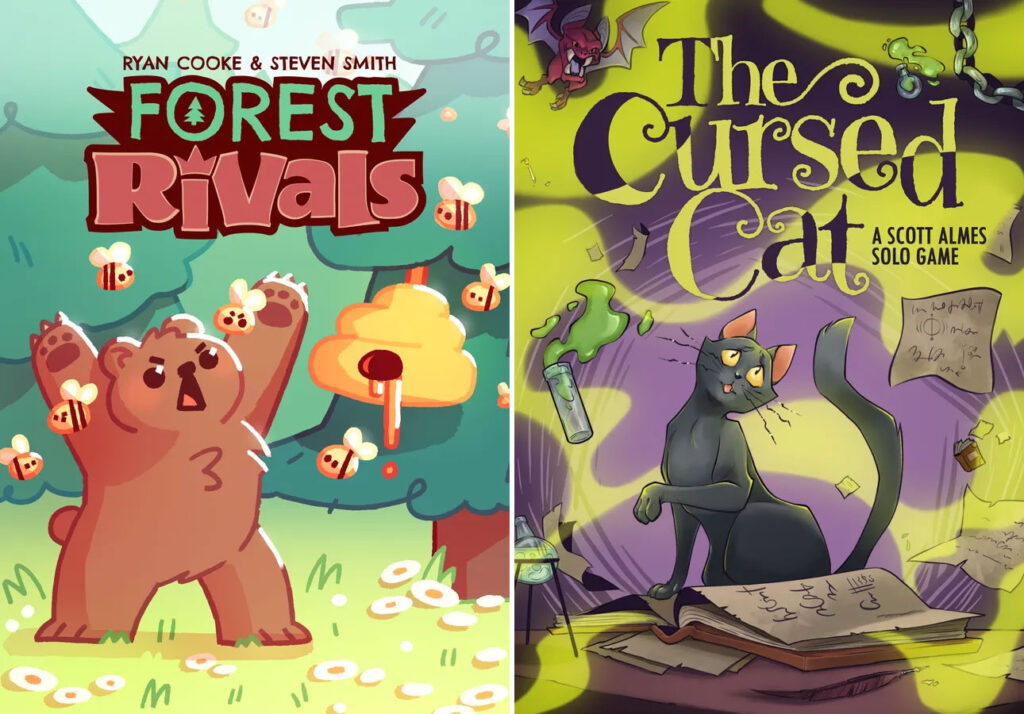
What’s a better way to spice up your summer travel plans than packing new micro-games from Button Shy’s Summer 2026 collection. I’ll be giving a preview of two of the new titles, Forest Rivals (for 2-players), and The Cursed Cast (for solo play), both consisting of 18 cards and playing in around 10 minutes. Forest […]
Dragon’s Roll is a game that combines three things I love: monsters, dice, and cooperative games.
I’ve already made a game where you play as the monsters trying to catch humans (Monster! Monster! Which is inspired by a book of rhymes I’ve written), so this time I wanted to flip the script. And while I quickly found what has been the backbone of the game since the beginning, developing Dragon's Roll has been a matter of constant tweaking to get the balance and game feel just right.
In Dragon’s Roll you have to protect your town from a boss dragon and its minions. They attack in three short lanes and gradually move towards your town. Every turn you roll your dice and then place some of them on dragons in order to defeat them. Specifically you can only use dice showing one number (so all threes or all ones etc). I got this mechanism from the very excellent Roll For Adventure, and I think it does a great job of limiting the player’s options while still allowing for some tough choices. You want to play a lot of dice, but sometimes just using that one six is the right play. In early versions I had rules for how you could reroll and thus reactivate your dice, but in the end I felt like it created a lot of overhead without adding extra excitement. Instead I settled on simply rolling those of your dice not currently on monsters each turn. This also adds the excitement of hoping for a specific roll which for me is a core part of dice based games. I know I can’t control the roll, but if I think really hard of the two ones I need, then maybe I can.
Testing one of the very early prototypes with my then almost 7-years-old. Yes, I bribed him with candy.
I also tried several different ways of spawning new enemies and moving the ones in play. At first, every time you rerolled your dice, you moved a token on a track which spawned and activated monsters. But it became too predictable and boring, so in the end the solution was simple: an evil dice that can move enemies and spawn new ones. And by giving the enemies different numbers and allowing them to push other enemies forward, suddenly different lanes would behave differently depending on the monsters spawned in them.
Bossing Around
At first the game didn’t have a boss – they are called master dragons in the final game. Instead you just had to clear the lanes in front of the town. It kinda worked, but it felt anticlimactic – especially since you could potentially win if the last monster in the grid attacked the village and then left the grid empty. Also, bosses are fun, but how to incorporate them?
The first boss was placed at the bottom of the monster deck. You had to grind through monsters and then finally defeat it. It was okay, but it felt like you were just going through the motions in the first half of the game. And if the boss moved just like other monsters, it could risk only being in the grid for a few turns.
The solution was to place the boss outside the grid and to give it a special abiilty that is always in danger of activating depending on the roll of the evil dice. That way you can attack it on any turn so you feel you progress towards victory, and you get the sense that you are actually pitted against the boss. And because bosses are tough, you have to defeat it twice to win the game.
The prototype I pitched to HABA. Note the character on the right hand side with abilities that needed to be activated with dice before use.
It’s the Number of Rules, Stupid!
When I pitched the game to HABA, they liked it, but felt like the game had too many rules. Basically each monster not only had a combination of dice needed to defeat it, a lot of them also had special abilities. They asked me to make a simpler version without all the special rules, and it led to a much more streamlined game where reading the board state is easy, and with a tighter focus on the core game play loop.
Another thing we simplified was the help you could get. In the game I pitched, you could use your dice to build structures or activate personal character abilities. It added depth and extra choices too the game, but it also made the board state a bit cluttered. And when playing with young and new players, they would often forget about activating their cards with dice. Instead HABA came up with the idea of one time-use magic scrolls the players share. It’s a very small change, really, but it had a big impact. It made balancing the difficulty easier, it made it easier for new players to understand their options (I can use this card vs. I can spend dice on this card and then use it later), and it also opened a new conversation between players about when to use the abilities. Of course you could also dicuss whether or not to use a personal ability, but if the abilities are shared, you have to. For me one of the core joys of playing coop games is discussing options and asking my kids if they think we should do a given thing like, for instance, use a scroll to defeat a pesky dragon.
A New Theme
HABA suggested making the game a part of the world introduced in King of the Dice and I happily agreed. As a relatively new designer, being able to piggyback on an established game is a great opportunity. And when I saw all the dragons that would make up the enemies, it became even better.
Render of the final cards. One of the village cards has been flipped to the burning side, so if two more dragons attack, the game is lost. And with dragons at the bottom of all three lanes and no dice placed, it looks pretty bleak.
From there on out it was a lot of back and forth on minor tweaks. Maybe spawns should happen on 5-6 instead of 4-6, maybe the order should be first spawn and then move, and so on. And since it was a co-op game, I could test a lot of the stuff concerning balance and game feel myself in my kitchen and then involve testers to make sure.
Finally HABA had an idea for a campaign, so the final step was to fine tune it. In the campaign you have to defeat the master dragons in a set order with each victory unlocking scrolls for the next fight. We had to make sure the bosses were in the right order, and that it was actually winnable. The campaign is very simple, but it adds a puzzly aspect to the game and just a hint of an evolving story which I’m quite happy with. And yes, I have won it, eventually.
I started designing Dragon's Roll more than three years ago, and I’ve played it regularly ever since - both alone and with lots of other players. I’m still looking forward to rolling dice in my next game, and I hope you’ll like it as much as I do.
My initial thought was that FlipToons was an inoffensive filler that I had an unfortunately bad experience with. Having played a second time, I am revising my opinion.
It offends.
Rating — Avoid.
FlipToons 2 sucked the joy out of my life when the first card I bought (the only one I could afford) I randomly lost on the next flip, meaning my purchasing power was roughly half of everyone else for the next several turns. Towards the end of the game, when I randomly got one good turn, the best card I could buy was ranked #3 (from #21-#1 with higher being generally better). The person before me had bought a #15 …. leaving 1/1/1/2/3 after replacement.
This might have been humorous at 15 minutes1 with the right crowd. But at 40 minutes?
Can I blame the game for the crowd? Yes. Yes. I can.
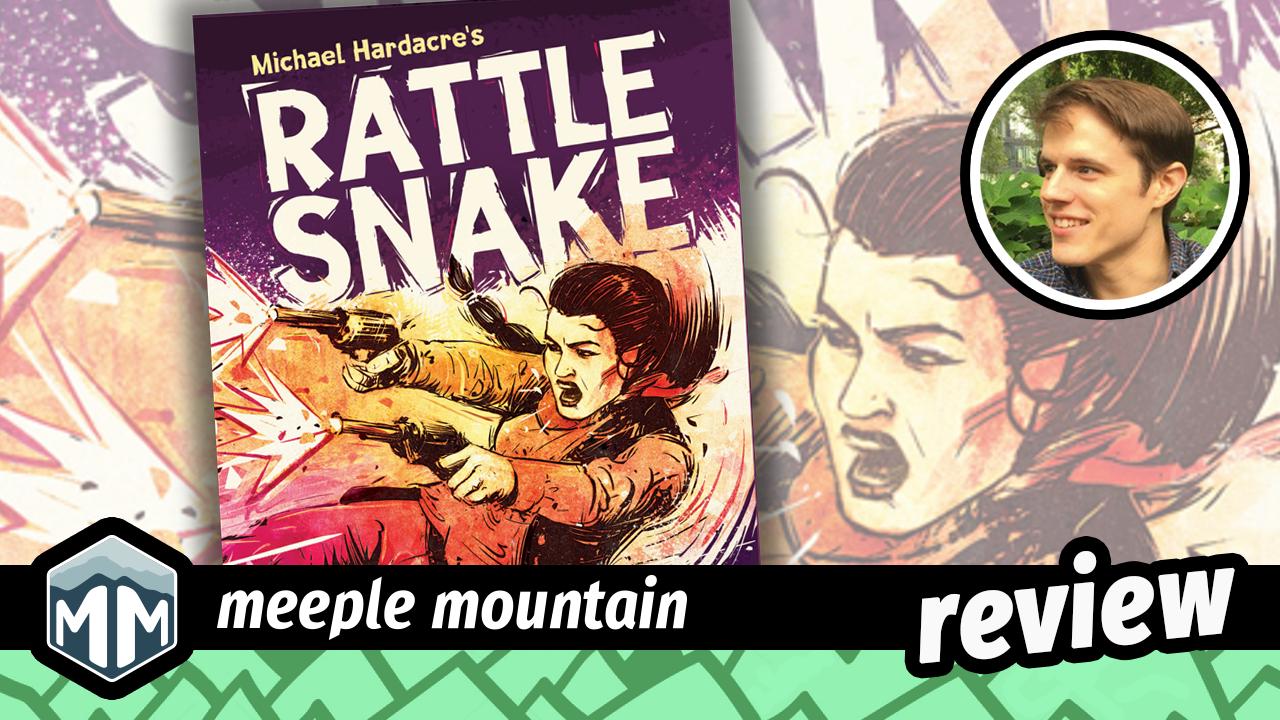
Michael Hardacre’s Rattlesnake, a two-player card game about a gun fight in the wicky-wicky-wild Wild West, is a fabulous marriage of setting and mechanisms. This thing is lean, mean, and jumpy. More sting than a scorpion and more bite than a…well, you know. It is tense enough that the components list should include brow sweat. And it’s so small! For form factor, this no-frills set of cards—with a gun token for flavor—is my favorite thing to come along sinceHigh Tide. There’s nothing quite like a big game in a small box.
The goal of the game is simple enough: kill your opponent. Well, I shouldn’t say “kill.” Pokémon has taught us that death isn’t always the end result of [checks notes] running out of health. Strictly speaking, your goal is to hit your opponent four times. Death is not the dictated outcome. Maybe all those hits grazed you. Maybe they missed organs. Maybe your opponent rushes you off to a hospital, where the gangrene can do its slow, ante-antibacterial work. I’m not a historian.
With this My Favorite Wargame Cards Series, I hope to take a look at a specific card from the various wargames that I have played and share how it is used in the game. I am not a strategist and frankly I am not that good at games but I do understand how things should work and be used in games. With that being said, here is the next entry in this series.
#89: Frederick Douglas from For the People 25th Anniversary Edition from GMT Games
For the People is a strategic level Card-Driven wargame about the whole 4+ years of the American Civil War covering the conflict from Texas to Pennsylvania, from the firing on Fort Sumter to the end of the war at Appomattox Court House. Players take on the role of either President Abraham Lincoln or President Jefferson Davis and command armies, promote and relieve generals, conduct amphibious assaults, dispatch cavalry raids, and even battle incompetency and political intrigue among members of your own cabinet.
As a Card Driven Game, For the People includes a deck of strategy cards that are used for conducting campaigns and incorporating the many events and personalities of the war. The Confederate player can build ironclads, naval mines (torpedoes), submarines, conduct overseas purchases and work towards foreign intervention. The Union player can build up his naval blockade, his ironclad fleet, fight draft riots, secure the Border States and issue the Emancipation Proclamation. The cards are used in the classic sense of a CDG for either the Operations Points to fuel various actions or for the printed event. According to the designer Mark Herman, “The cards are designed to present the player with his political and operational options. The use of Strategy Cards as political instruments will slow the operational tempo of military operations. The converse is also true. Both sides spent the first year of the war, 1861, mobilizing and organizing their war efforts.
The game is extremely interesting and I recently had my first experience with it and very much enjoyed what it was that I was doing even though I really had little idea about my proper strategy for the Union and what it is that I should be focused on in the game.
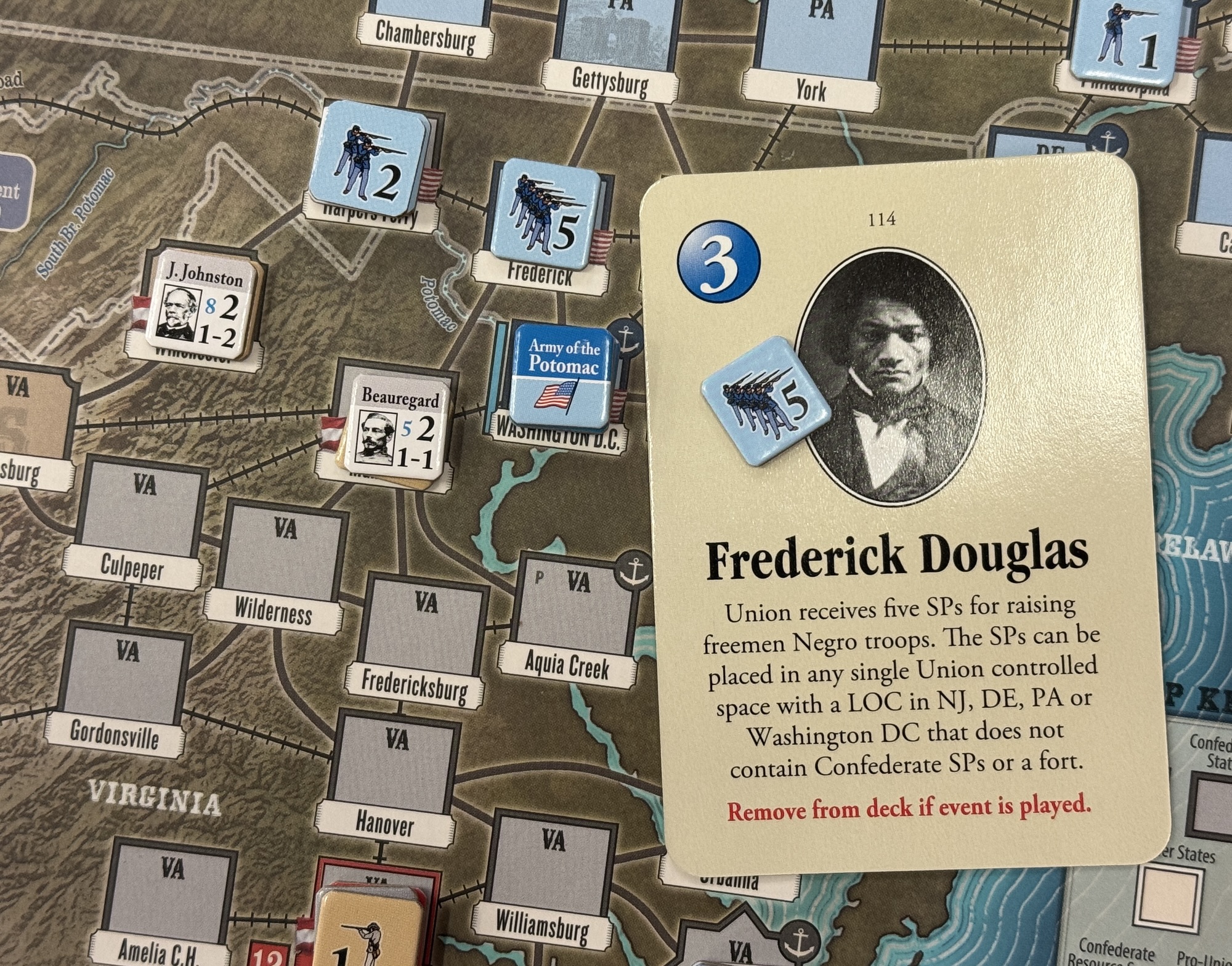
The Frederick Douglas card from For the People really is a bit misnamed. While Frederick Douglas was a major influence for abolitionist activities as well as progressive thinking amongst the politicians of the North, the card really should have been named for the Negro soldiers who gave so much, their lives, their backs and their families, to volunteer and fight on the side of the Union during the American Civil War. The card’s text reads “Union receives five SP’s for raising freemen Negro troops. The SP’s can be placed in any single Union controlled space with an LOC in NJ, DE, PA or Washington, D.C. that does not contain Confederate SP’s or a fort”. This card gives a huge boost to the Union side especially if it comes up early in the game as Union SP’s on the board are spread out and defense of Washington is not as stout as it needs to be. In my recent play, I got this card in my opening hand and was able to place the 5 SP into Frederick, Maryland to add to the already existing 5 SP there. Along with the Army of the Potomac and its SP stationed in Washington, D.C. this effectively discouraged the CSA from invading the North and attempting to go for a capture of the capital. You will notice that the card is a 3 OP’s card, which is very valuable in and of itself, as most of the Union Generals at the start of the game, with the exception of Burnside, have a 3 Strategy Rating and require a 3 OP’s card to activate.
The issues of emancipation and military service were intertwined from the onset of the Civil War. News from Fort Sumter set off a rush by free black men to enlist in U.S. military units. They were turned away, however, because a Federal law dating from 1792 barred Negroes from bearing arms for the U.S. army (although they had served in the American Revolution and in the War of 1812). In Boston disappointed would-be volunteers met and passed a resolution requesting that the Government modify its laws to permit their enlistment.
The Lincoln administration wrestled with the idea of authorizing the recruitment of black troops, concerned that such a move would prompt the border states to secede. When Gen. John C. Frémont in Missouri and Gen. David Hunter in South Carolina issued proclamations that emancipated slaves in their military regions and permitted them to enlist, their superiors sternly revoked their orders. By mid-1862, however, the escalating number of former slaves, the declining number of white volunteers, and the increasingly pressing personnel needs of the Union Army pushed the Government into reconsidering the ban.
As a result, on July 17, 1862, Congress passed the Second Confiscation and Militia Act, freeing slaves who had masters in the Confederate Army. Two days later, slavery was abolished in the territories of the United States, and on July 22nd President Lincoln presented the preliminary draft of the Emancipation Proclamation to his Cabinet. After the Union Army turned back Lee’s first invasion of the North at Antietam, MD, and the Emancipation Proclamation was subsequently announced, black recruitment was pursued in earnest. Volunteers from South Carolina, Tennessee, and Massachusetts filled the first authorized black regiments. Recruitment was slow until black leaders such as Frederick Douglass encouraged black men to become soldiers to ensure eventual full citizenship. Volunteers began to respond, and in May 1863 the Government established the Bureau of Colored Troops to manage the burgeoning numbers of black soldiers.
By the end of the Civil War, roughly 179,000 black men (10% of the Union Army) served as soldiers in the U.S. Army and another 19,000 served in the Navy. Nearly 40,000 black soldiers died over the course of the war. Black soldiers served in artillery and infantry and performed all noncombat support functions that sustain an army, as well. Black carpenters, chaplains, cooks, guards, laborers, nurses, scouts, spies, steamboat pilots, surgeons, and teamsters also contributed to the war cause. There were nearly 80 black commissioned officers. Black women, who could not formally join the Army, nonetheless served as nurses, spies, and scouts, the most famous being Harriet Tubman, who scouted for the 2nd South Carolina Volunteers.
Imagine playing your very first indoor bowls game, but there is no jack. Everyone simply rolls a bowl towards an imaginary target. Somehow, your experienced opponent seems remarkably confident, while you try to copy what they do and hope for the best. At the end of the first end, someone reveals where the jack had been all along and awards the points accordingly. Then the second end goes in the same fashion, with a target that no one can see. Every end, you know how well you've done, but you never have any hope of getting better. Learning to bowl that way would feel practically impossible because every bowl would be complete guesswork. Surprisingly, some board games seem to want us to learn them in very much the same way.
The blue tables of Thames & Kosmos were busy with folks clamoring for more of what they like. The newest title in The Crew line, Journey to the Ends of the Earth and the deluxe version of The Gang were … Continue reading →
Omens Designer: Maxime Rambourg Publisher: Spiral Editions Players: 4-6 Age: 14+ Time: 30 minutes Played with review copy provided by publisher You’ve found a mysterious box filled with strange cards. As you try to decipher their meaning, you soon … Continue reading →
There was a run there, between the aughts and the teens of the current century, when Victory Point Games published multiple of the best solitaire board games ever. Banger after banger. Then it was sold and chopped up for parts.
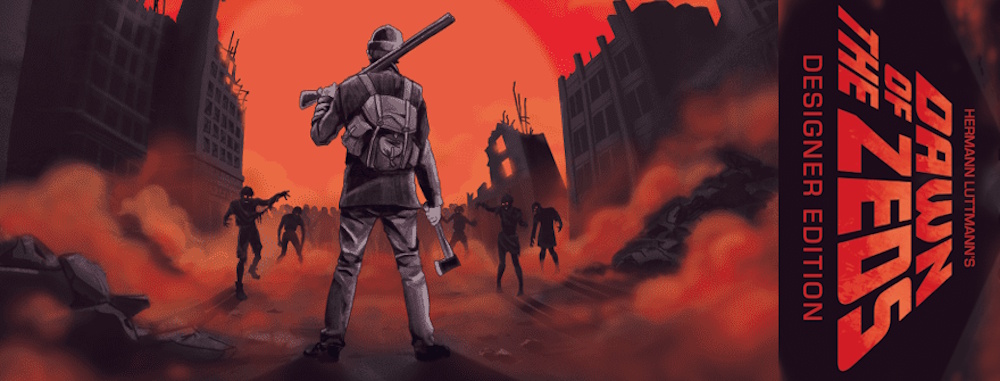
Perhaps the best title to emerge from that golden age was Hermann Luttmann’s Dawn of the Zeds. This baby merged the strategic considerations of the States of Siege line with some cinematic flair. So much cinematic flair that its overstuffed third edition aped not only the dramatic beats of cinema but also the notion that it was a movie being directed by the player. A tonal mismatch if ever there was one.
Here’s the good news: Hermann Luttmann is back with a new version of Dawn of the Zeds. Dubbed the Designer Edition, and divorced from the vultures who gobbled up Victory Point, it’s a revamp of the system from top to bottom. It isn’t as good as I remember. It’s better.
The heroes we need. And deserve. And got. Cool.
Unlike any number of internet specialists, I have no idea what a “real” zombie apocalypse would look like. But the scenario presented by Dawn of the Zeds feels real enough, at least in the moment. It begins on the periphery, slowly, Farmingdale’s outlying communities stubbornly refusing to listen to reason. Then the levy breaks and the tidal wave comes all at once. Defenders panicking over the radio. Refugees crowded on the interstate. Infections concealed among the survivors, ready to bloom into a fresh horde of killers. It isn’t long before the bodies are piling against the barricades.
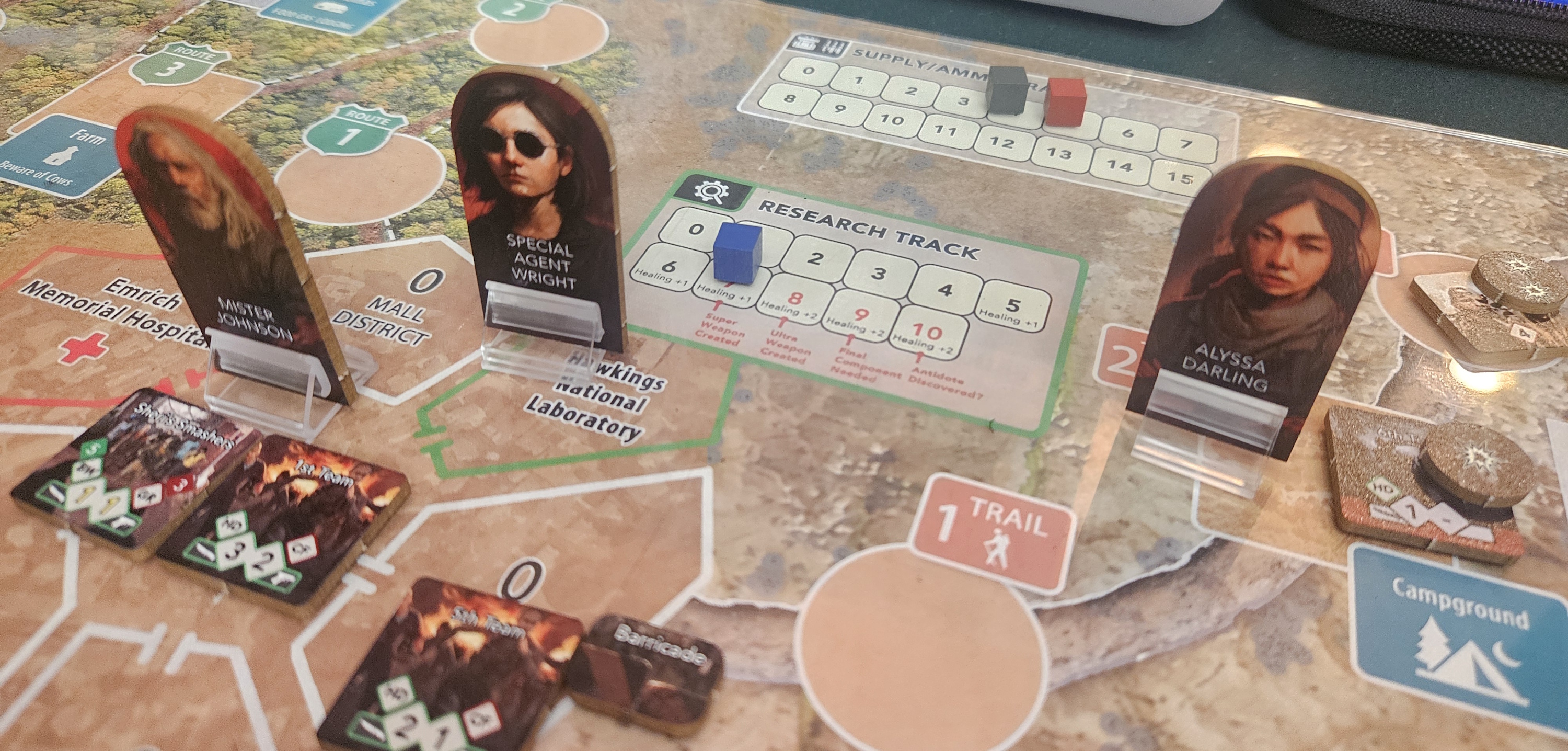
Drawing on its lineage from the States of Siege system, Dawn of the Zeds offers a bird’s eye perspective that lends it a certain credence. At a tangible level, you play as a specific group of survivors. There’s some wiggle room there, including a multiplayer mode, but the classic setup is four heroes selected at random from a generous pool. These heroes, to put it bluntly, are not created equal. One session might provide Professor Agee, already on the cusp of inventing an antidote, and Captain Piazza, the sniper whose ranged attacks and booby traps make her a force of nature at any range. Then the next will give you Pickles the dog. Poor dumb Pickles. He’s the best boy. Just not, you know, the best at zombie invasions.
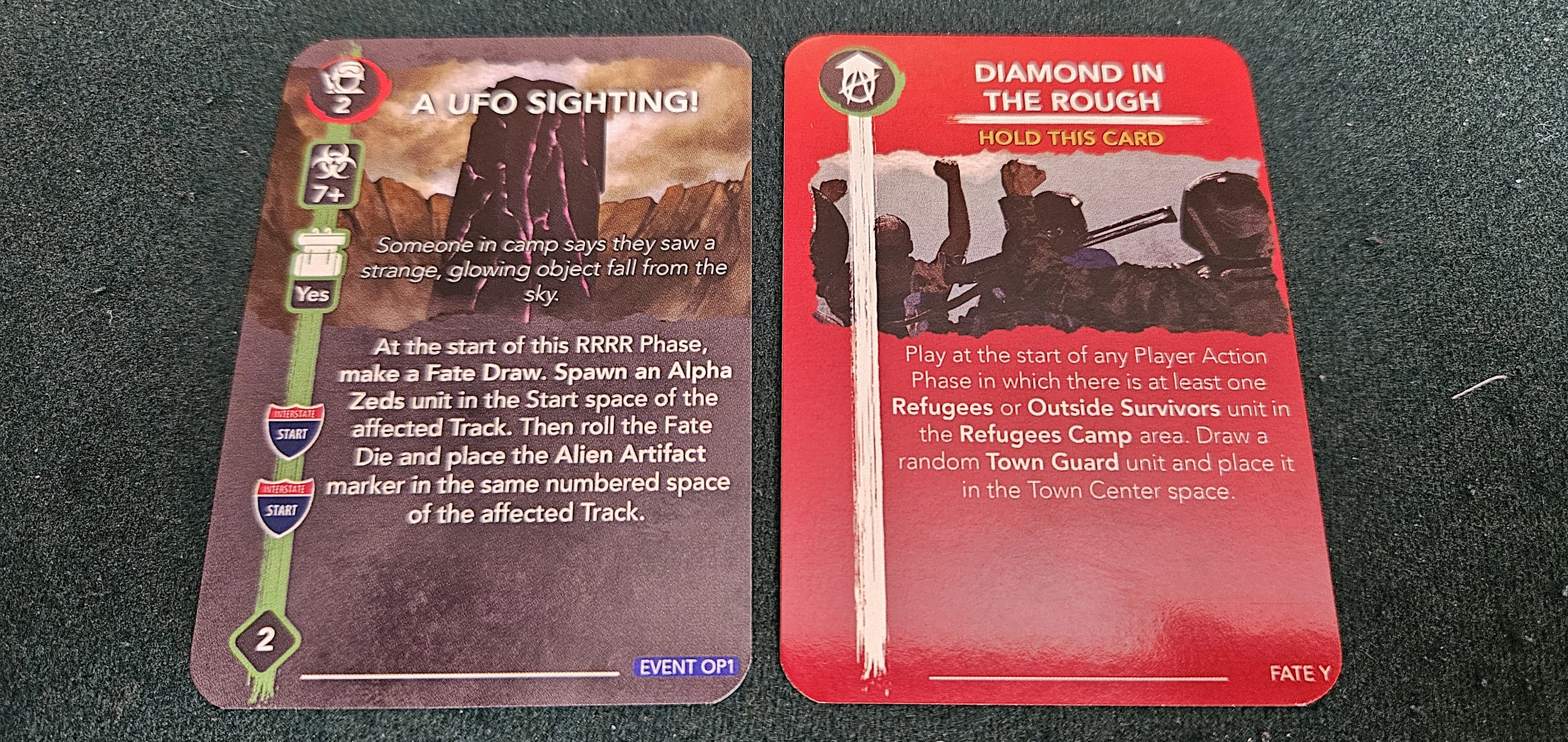
But these inequalities — some might call them “imbalances” — are not only to be expected from Dawn of the Zeds; they’re the whole reason it works. Better get used to it, in any case. Every round begins with an event card that dictates not one but four phases. One of them, the RRRR phase, is really four phases folded into one, letting you usher refugees to safety, shove raiders across the countryside, and invite any passing Army Rangers to help your community. There’s a fourth R in there, but I’ll be damned if I can remember what it stands for. Compared to that, the actual action phase, which usually sees your characters taking a measly one action each, is often brisk. Certainly you’ll wish you had more time. What do you mean Emily Orozco, golf pro, can drive balls into an oncoming horde or shuttle defenders around in her golf cart, but not both?
The sense that you’re drowning in a rickety submarine, four new leaks springing each turn while you only have enough hands to patch three, has been the default state of solitaire and cooperative gameplay ever since Matt Leacock standardized it in Pandemic. But where Dawn of the Zeds excels is at making that formula feel more natural than elsewhere. Flipping an event card doesn’t merely present a problem; it hits you with a full-spectrum crisis. Whether refugees can retreat. The threshold for yet another outbreak that will bring new zombies onto the board. How far you can stretch your tins of beans. Whether your heroes can muster some extra oomph today, that little bit of extra effort to earn a more generous action allotment.
There’s nothing quite like an event deck.
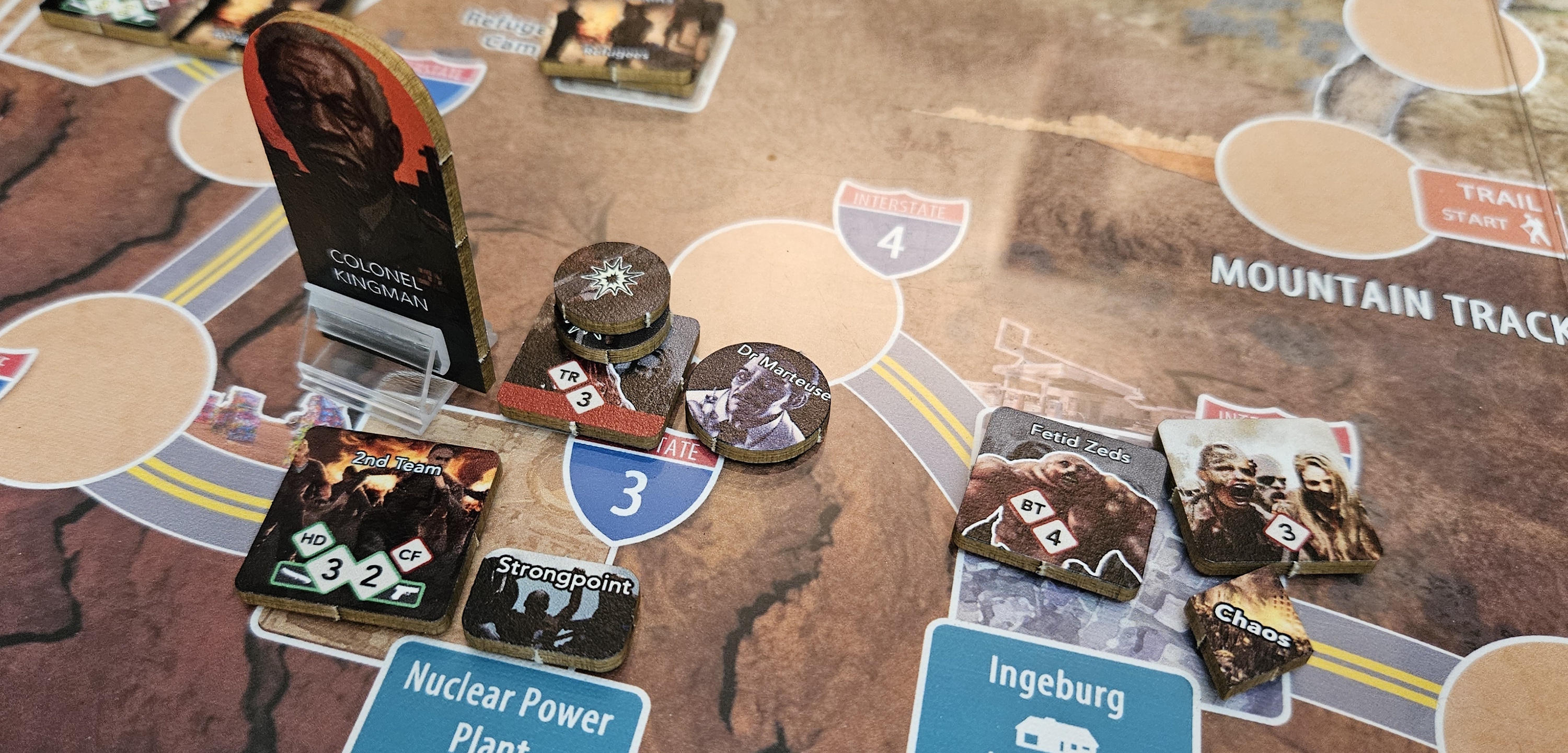
Not least of all, which lanes will come under assault today. This being a glorified States of Siege game, the entire map is divided into four lanes that spiral around and eventually terminate at Farmingdale. If any zeds reach the town, it’s game over.
So you play football. Or tug of war. Some calorie-burning metaphor is appropriate. Each lane has its own tendencies, not to mention spaces that are crucial to your survival but which will very quickly succumb to the horde. The suburbs are defensible but populated with noncombatants who must be protected lest they turn into zombie chow. The interstate is mostly open but for the town’s nuclear plant. The mountains and farmlands both feature zones where food and ammunition can be harvested more readily, if only you can hold them. It doesn’t help that zombie territory must be painstakingly reclaimed lest any future zeds spawn that much closer to your town center.
For the most part, this turns Dawn of the Zeds into a game of fire response. One of your outlying settlements’ defenders falls too soon, so you send loony old Mister Johnson and his shotgun to help bushwhack the zeds back a few steps. Supplies are dwindling, so it’s time for Big Wheels Carter to plow through the crowd with his big rig to bring a few crates back home. Injuries are piling up, so Agent Carter retreats from the front lines to help out in the hospital. Too many zombies are at the gates, so Pickles runs out and ignores the zombies, but also doesn’t really help behind the lines either. Good job, Pickles. Who’s the best boy?
Fortunately, there are plenty of tools to aid in these efforts. Barricades can be erected. Refugees can be rearmed and turned into zed-killing professionals. Antidotes and super-weapons can be manufactured. Indeed, it’s now pretty rare to not leave at least one hero back in town, at least for the first half of the session, just to keep a handle on the hospital and laboratory.
The Designer Edition’s biggest change… dice.
In the meantime, the underlying logic has changed somewhat from the game’s previous incarnations. Since its earliest days, Dawn of the Zeds betrayed its wargaming roots by employing old-school combat results tables. The dreaded CRTs. Anytime zeds entered a space with humans, you would compare their relative values, then check those values against a table that would tell you the outcome. It was a question of sums. My defenders have two strength, plus one for defending a named location, plus another for that supporting unit, plus two for Colonel Kingman’s enhanced barricade… against the combined zed strength of three plus four… now check the table… and that means we inflict two hits and the zeds retreat one space, but we take two hits in return. Wait, since Deputy Schmidt is on the scene, we get a positive shift on the table. Even better. Except, wait, we were looking at the ranged table when we were in hand-to-hand combat.
In other words, the combat system was functional, but not always very exciting.
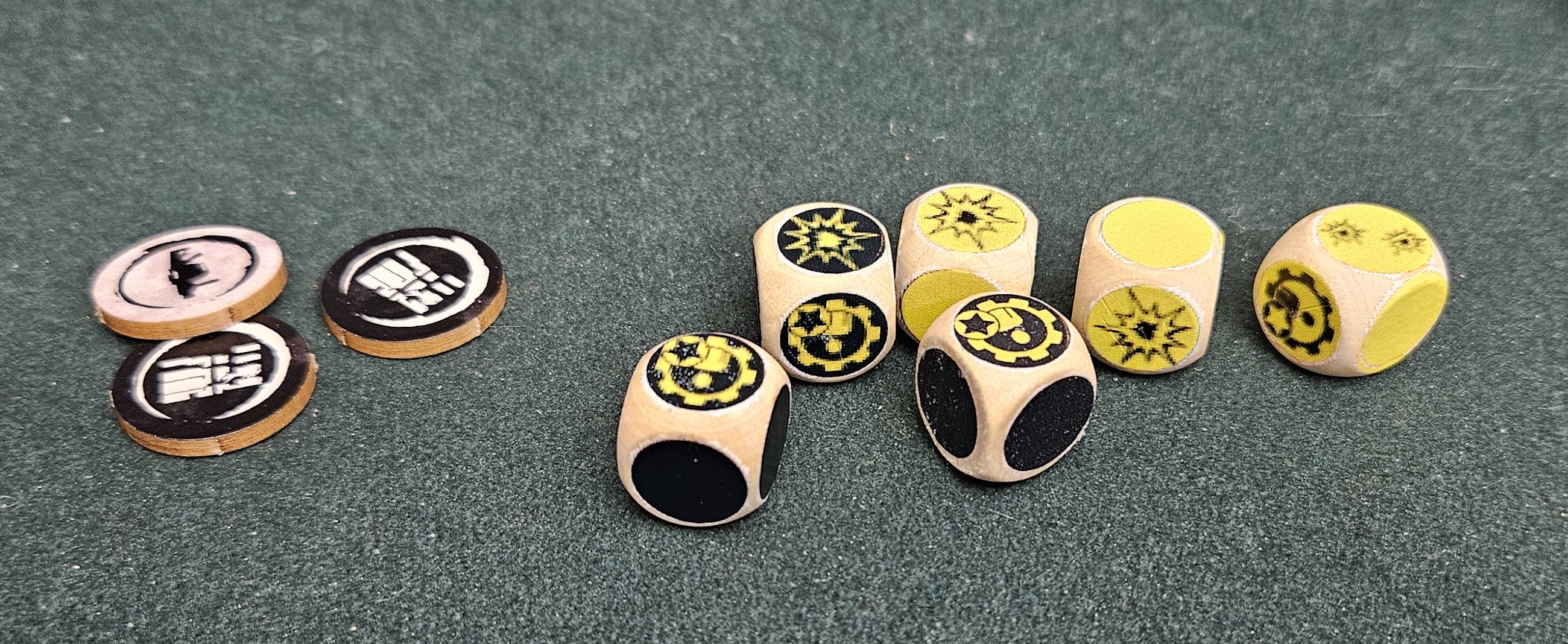
It seems Luttmann has learned a few tricks in the years since the third edition, perhaps courtesy of experiments like The Plum Island Horror. The CRTs are out. And I mean all the way out. Nowhere to be seen. Instead, zeds now deal a static attack value — usually two to five — that can be blocked with shields, while human forces roll dice to inflict injuries or trigger special abilities.
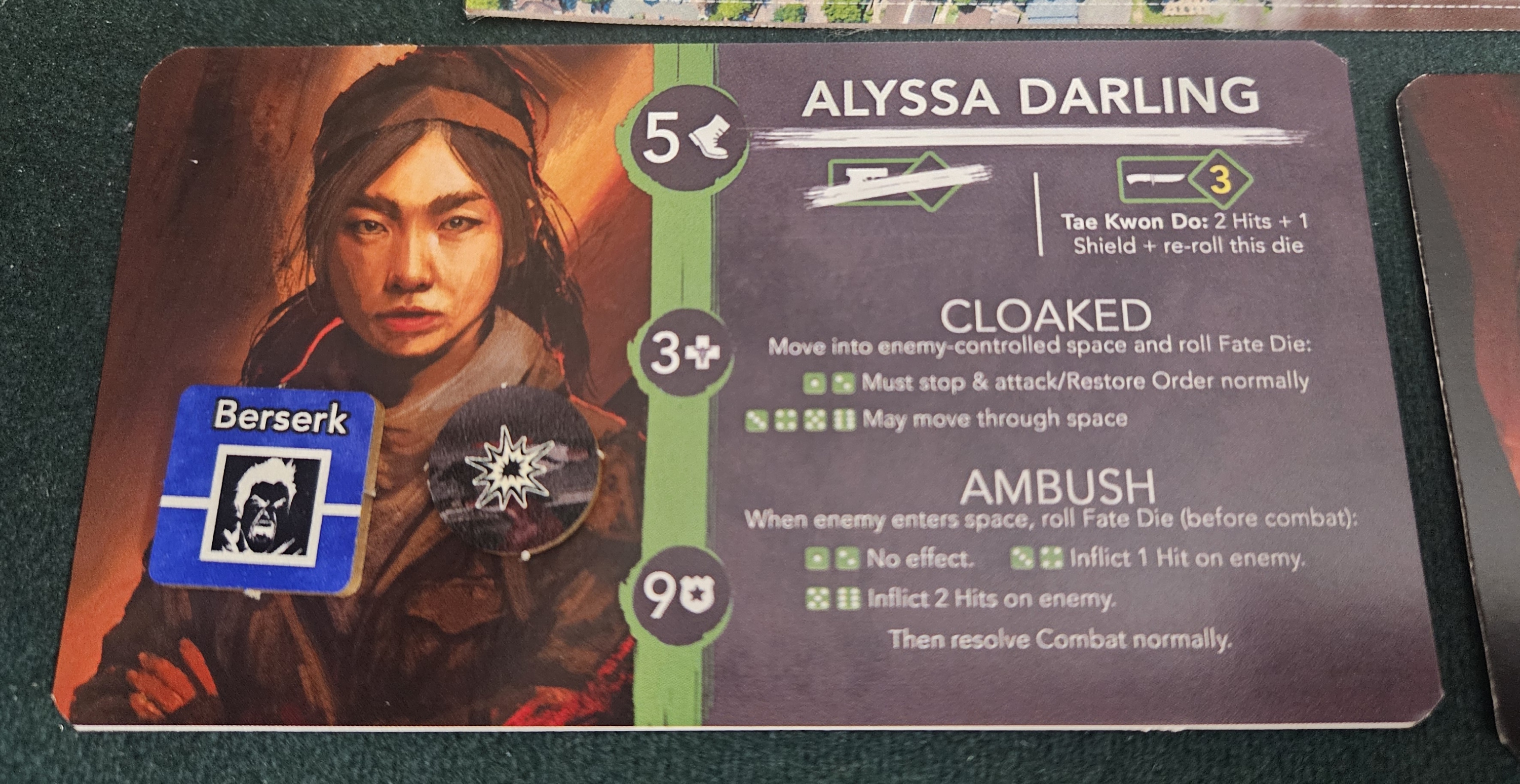
The consequences are far-reaching. First of all, hero abilities are more manageable. In the third edition, heroes had half a dozen abilities each, all written in long-form text, all necessary for using them to their fullest capacity. Now heroes have two passive abilities plus perks that trigger when they get the right results on their dice. It’s tidy by comparison, preventing those obnoxious “oh shoot, I forgot to do this one thing” moments that were so common in previous editions, but also ensuring everybody feels like their own member of the team.
More importantly, combat is no longer something that can be summed out in advance. No longer can you park the right cluster of heroes and town defenders on a space and trust the CRT to provide. Sometimes you’ll roll five dice and flub the whole set. Other times Pickles will pounce on a pair of chits and somehow obliterate the entire stack with his lone yellow die. This can be frustrating, and there’s a whole optional reroll system in there for those who are, like me, little brats about bad tumbles. But this also pushes the game in a direction that’s more organic, more freewheeling, with unexpected twists and turns. It feels more like a series of triumphs and catastrophes and less like we’re pausing every thirty seconds to look at another dang chart.
It helps, too, that combat now includes little moments of player agency, especially where retreats are concerned. Previously, the CRT was everything. Injuries, retreats, the CRT might as well be God handing down tablets from Mount Sinai. Now it’s up to you whether to retreat from a space to ignore an injury or suck it up and hold your ground. This still won’t save a squad from a total overrun, but it’s a nice decision to leave in the player’s hands. Will you absorb a few extra losses to hold onto that important district, or cut your losses and hopefully outrun the zeds? It’s a toughie.
Want to ambush a zombie horde?
To be clear, Dawn of the Zeds is still a cluttered design in some ways. There are still tables, just not combat results tables. You check separate rubrics to see if your hero succeeded at foraging, healing, or researching the zombie virus. Chits still show little letter codes that designate their special abilities. Above all, there are still absolute heaps of special modifiers that might be applied to units. What’s the difference between flaming zeds, smelly zeds, and beta zeds? That isn’t the start of a joke. Those are actual traits that might be added to a chit to modify the threat it poses to Farmingdale’s defenders.
For the most part, though, the beauty of the Designer Edition is that it hits the sweet spot between complexity and ease of entry. It’s a little easier than before, both complexity- and difficulty-wise. But for all its streamlining, there’s still texture here. Flaming zeds are incredibly dangerous, but they’re also self-damaging. Smelly zeds repel your defenders if they share a space after combat. Beta zeds move faster and hit harder. Now that you know those ones, what about infected vermin, dirty zeds, smart zeds? Most of these traits won’t appear in a single session. But the beauty of this system is that they might. This is still a kitchen sink design, but it’s a kitchen sink design by a kitchen sink designer who’s come to really know his kitchen sinks.
And what a kitchen sink it is. After all these years, I had some trepidation going back into Dawn of the Zeds. Like its comrades in the old Victory Point Games catalog, it was a product of its time. That second edition, arguably the high-water mark for the old versions, shipped in a folio-sized ziplock. Its cutouts smelled of wood smoke from the workshop laser cutter. The rules were scattered and frenetic, a little homebrew. Opening the box for this edition, I wasn’t exactly thrilled to discover that that’s apparently how Luttmann’s brain functions.
But even after all this time, Dawn of the Zeds feels fresh. Fresher, actually, now that the States of Siege titles are a thing of the past rather than regular attendees of the alternative wargaming scene. The closest comparison from the past few years is The Plum Island Horror, but while that game has left a few visible fingerprints on this one, the two are more like cousins than siblings. All in all, this has the hallmarks of the same game Luttmann designed fifteen years ago. It’s still weathered and wild-eyed, the buttons of its overcoat still loose, but it’s every bit as indomitable as ever.
“You’re under arrest, Dr. Mabuse!”
At least I hope it is. Some part of me wonders if Dawn of the Zeds has grown too far out of step with the modern hobby scene. It’s challenging and woolly and random. Even more random thanks to the dice combat.
But it’s also one of the most exciting and interesting solitaire games of its age. Once a week over the past month or so, I’ve sat with it in the evening, watching my defenders fail or rally, my heroes dart from one peril to the next. And it was perhaps the most relaxed I’d been in as much time. It felt like coming home. Not to the janky and over-stuffed version that I’d grappled with when I reopened the third edition last year. Instead, a version that was still expansive in what could happen, but more manageable and vivid in the moment. The past as I remember it rather than the past as it was.
Even when Pickles showed up only to promptly hurl himself into an unwinnable fight. Especially then. Good boy, Pickles. Good game, Dawn of the Zeds.
A complimentary copy of Dawn of the Zeds: Designer Edition was provided by the publisher.
(If what I’m doing at Space-Biff! is valuable to you in some way, please consider dropping by my Patreon campaign or Ko-fi. Right now, supporters can read the next installment in my series Talking About Games, this time tackling the topic of what makes a good list! Naturally, the piece includes a list.)

 Anmelden


/pic9701951.png)