 Anmelden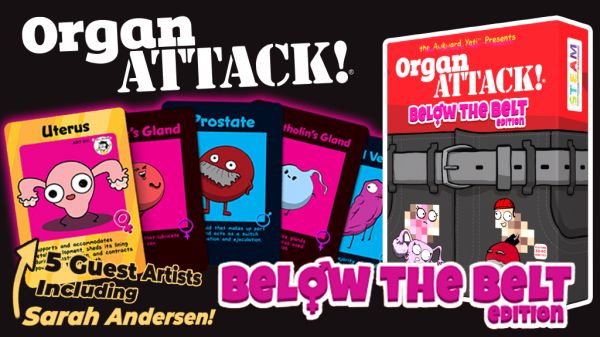
Preview: Protect Your Innards in OrganATTACK: Below the Belt Edition
24. August 2026 um 23:09

Protect your organs and learn a thing or two in this lightweight and informative (but irreverent) card game.

Protect your organs and learn a thing or two in this lightweight and informative (but irreverent) card game.
As part of my piece meal approach to learning Module 4, I set out a solitaire game using M4’s Solitaire Political Assembly & Contracts. (I originally started to add the new colonists deck, augmentations and the exodus stuff, but then changed my mind). I did in fact play an earlier game with just the Solitaire Political Assembly, and I quite liked that.
My last few solo games had used the “You only see half of each patent deck” and “You start with a faction privilege, but don’t get home Bernal income until you have both a Bernal and a Factory” variants, and I rather liked that, but you could get hosed with some wildly inappropriate die rolls (and patent decks), so I’m using the Mod4 “You start with full patent decks” but keeping the faction privilege. I’m not playing any particular Solitaire game … I’ll just score normally.
I get ROSCOSMOS as the unit, so I start with delegates in Authority and Centrism. Authority is nice (with Regime Change1), because you can lobby when it’s inactive and the spent delegate counts for both lobbying and Regime Change. So you can cancel a budget cut/flare/pad explosion AND cycle the patents, or keep a really juicy patent on top. Yes, you spend time fundraising, but it’s a good trade.

T1.1 (Solar Cycle.Year) — The Initial Patent Deck is … to put it mildly … not great. I fundraise (10 Aq) and put a delegate into Equality and (since it’s tied) make Research Grants2 the active law. Research Grants is quite powerful. I’ve already run a solitaire game (using just the M4 solitaire assembly) and between Research Grants and Regime Change I was able to do quite a bit more3 than I usually do in a 7-Cycle Game. (Some decent early patents and claim rolls also helped).
T1.2 — I roll the anarchy event and so I lobby to invoke Regime Change (9 Aq and lose the Authority Delegate) and let’s see what other patents are available…

These are also not great, but a smidge of a plan is starting to take hold. Since Research Grants are still active I take the Pulsed Inductive Thruster and Radio Isotope Stirling Generator (for free).
T1.3 There are now the Hall Effect Thruster and Flywheel Compulsator cards on top of their decks. I take those, too.
T1.4 Budget cuts, and I can’t over-ride it. Oh well, goodbye Radio Isotope Stirling. But that also means that the contracts haven’t rotated. I fundraise and put a delegate into Individuality (10Aqua) and make Launch Contracts the active law. Not because I love it (Boosting as a free action instead of an operation is … OK), but because that lets me take the “Hubris” contract. I get 8 more aqua but have to deliver some guy and let him be the first to set foot on a site in an unexplored region4.
T1.5 Boosting is a free action, but it still costs 8 Aqua to boost the trillionaire, Pulsed Inductive thruster and Flywheel Compulsator into LEO, load up six fuel tanks (so I’m down to 4 Aqua) and send the rocket from LEO to the cycler. (My stuff could make it through the radiation belt, but the trillionaire might not, so I’ll use the crew thruster next turn). I still have an action, so Fundraise to a) put a delegate in Authority and b) switch the law back to Research Grants (and get an aqua, so 5 Aqua).

T1.6 — The event is Budget Cuts, so spend an aqua (4Aq) and lobby Regime Change to switch that to Inspiration.

That Solar Sail would have been lovely a turn or two earlier (although the Trillionaire has 2 mass, so maybe not). I move the rocket into the rad belt (with the crew thruster, so that no roll can hurt my cargo/client). Since I have the Flywheel, that Robonaut and Refinery are both useful. Sure, neither is great, but Beggars can’t be Spacemen. I take the Neutral Beam + Optoelectrick Nuclear Battery.
T1.7 — Rocket take the red path (stopping at the Hohman). I don’t really want a solar flare, so I fundraise back into Authority. (5Aq). (I’m beginning to think that Regime Change is too good, maybe it should just cancel an inspiration or add inspiration to the existing event … not cancel it as well. How do you Regime Change a Coronal Mass Ejection?)5
T1.8 — The event is Pad Explosion, so … nothing. The rocket reaches Deimos, so I drop off the trillionaire (you’d think he’d want a return trip), grab the glory chit. I take the Froth Filtration refinery + the In-core Thermionic Generator (which was revealed after T1.6).
T1.9 — The rocket starts the return trip and I sell the In-core … (8Aq)
T1.10 — Inspiration roll, and I sell the Optoelectrick Nuke (11 Aq). Rocket still heads back.
T1.11 — I boost the Robonaut and Refinery (6Aq) as the Rocket returns to LEO, and I get a ticker tape parade.
T1.12 — I fuel up the new rocket (-5 Aqua, leaving 1Aq)6 and send it out to (where else?) Hertha.

Yes, it’s heavy (and I’ll need to use the crew thruster to land). Yes, if I don’t bust Hertha7 I’ll have to deconstruct every thing and re-boost. But perhaps there will be better patents available by then.
I take the Monatomic Plug Nozzle thruster and D-T Fusion Tokamok reactor. Man those research grants have saved me a ton of money. (If I don’t bust Hertha, I can start trying to ET produce a rocket with the Plug Nozzle …. and if I do, I can sell it).

End of Cycle — By the rules of M4, I can move the seniority disk to where I please, but it seems to me that the best VP will always be the “1 per claim disk” (since all the others are 1VP/something else, which is usually harder to get). I think I’m going to just roll a die and let it get placed randomly, but those VP seem like an area to tinker with.
It’s solitaire, after all.
So — how did the M4 help? Quite a bit. I’ve got 5VP (2 from Hubris, 2 from the Mars Glory Chit. and the rocket on the board). I’ve boosted a much heavier rocket than would be possible without Research Grants and the 8 Aq from the contract. Granted, most of those 8 Aqua went towards fuel tanks, but a) not all of them and b) I’m also immune to Budget Cuts for the rest of the game. (And if I were playing with augmentations, I’d have a chit to implant).
Is the Solitaire Assembly too good? It might be. But I had a fair number of earlier solitaire games where I’d simply get murdered in the first cycle by a bad roll (budget cuts if I didn’t boost, pad explosion if I did) and those are frustrating. It feels like it might be a bit too much control. One option would be to put in an NPC delegate (via d7 roll) on a non-event turn, so the active law wouldn’t be totally under the player’s control. But for now this game, I’ll just leave it.
Second Cycle, coming soon….
︎︎︎︎︎︎︎
Explore familiar worlds from Jack Vance, Sarah Maas, and others on your tabletop
By Kaysee and Max
Disclosure: Bought the game, survived all the scenarios (see the combinations of scenarios and socities that we’ve tried so far here)
The heatwave in Germany was about to arrive, when we discovered and bought a game called Frostpunk: The Board Game. We were looking for a cooperative game with a complexity rating higher than Spirit Island to play at home, because going out in the scorching heat and getting grilled by the sun wasn’t something we wanted to experience. We wanted to get our minds off of the reality and escape the heat. No better way to do that than to play a highly complex board game about surviving an apocalyptic winter.
Frostpunk: The Board Game is based on the video game Frostpunk, which was inspired by the Polish novel Ice by Jacek Dukaj. Neither of us has read the novel nor played the video game, but we do like stories that are dystopian or post apocalyptic. Frostpunk is not post apocalyptic, though, as players get to experience shaping a society during the apocalypse. It’s a survival game, and the initial setup itself was already a test of our survival skills even before starting the game.
The setup, the societies, and the scenarios
It took more than 4 hours for us to do the initial set up, which included reading the rulebook (and breaks and some showers). The heat wave didn’t just slow us down physically but also mentally. It was weird for us to flip tiles depicting snow and see the snowy white expedition cards, characters wearing winter coats, and the frozen meeple trees while sweating heavily. We were both somewhat confused and immersiveness seemed to be off the table. And the game was actually off the table, as it requires more space than our table has, so we decided to play on the carpeted floor. The confusion and questioning of choices didn’t stop after setting up the game; they continued and evolved as we entered and played the game. The immersion was there, but instead of the cold setting, it was triggered by the moral choices we had to make along the way.
The game has nine scenarios, three of which are significantly more difficult than the others. Each scenario offers different conditions to determine whether our society has survived the apocalypse. Surviving also means surviving each round. A round represents a day. There are nine phases each day from the Dawn Phase to the Nighttime Phase.
The society we chose also determined how difficult it was to survive. There are six different societies to choose from which can either be played in normal or in hard difficulty. These also determine how many citizens and resources we have in the beginning. A society in this game consists of three types of citizens: children, engineers, and workers. Some societies can have an automaton, a gigantic robot, which is not considered a citizen. While a citizen meeple is equivalent to 1-4 or 1-10 citizens of its type depending on how many citizens of the corresponding type there are, an automaton meeple is equivalent to one automaton. Automatons are very strong and it is apparent that the game gives high value to technology.
As we tried different scenarios and societies, we noticed that some societies are more compatible with some scenarios than others. You may check out our record of combinations of societies and scenarios here. We also noticed that it was more difficult for us to adapt to a new society than it was to a new scenario.
Resource management: humans vs automatons
The basic resources for every society in this game are coal, wood, food, and steam cores. Some resources are easier to get than others. Civilians require plenty of resources to keep them safe. Wood is required to build shelters and other buildings. Coal keeps the generator heated. In the beginning it doesn’t take much, but over time more coal will be needed to keep everyone warm, especially after a storm hits. But heating up the generator causes stress. Having too much generator stress may cause it to break down or even blow up, which leads to a game over.
Automatons require a steam core to be built, but they don’t require much resources to use and no resources are required to maintain them as they are apparently quite sturdy, would never malfunction, and would never rebel and kill humans. We noticed that in every society in the game, it is more efficient to have more automatons than groups of civilians as they don’t require food and they don’t get sick. But we often times ended up having more civilian meeples, as we still like humans and it’s difficult to get a steam core. But mechanically we prefer automatons as they are more efficient.
Civilians lose their agency as we gain ours
We had to take turns using the available meeples to gather resources, remove snow from the vicinity, use buildings, or send a group of civilians to an expedition in the first round of the game, the Action phase. Building actions include passing a law, increasing Hope or decreasing Discontent, obtaining additional resources, removing stress from the generator, or developing new technologies.
This phase has a simple worker mechanic where only one meeple can use a building or a space to perform an action such as collecting resources and passing a law. Because there were always more actions that we wanted to do than meeples available, we had to be careful in terms of which actions to perform and tried to avoid performing cold actions as much as possible. Most of the communication between us happens in this phase. We also sometimes had to make sure not to think too much in advance as we wanted to avoid losing track as to whose turn it is.
A cold action causes an adult citizen or a child to get sick. As the number of sick civilians increases, the chance of citizens dying also increases. If the corpse marker reaches 10, we lose the game. Adding coal to the generator helps heat up the tiles and buildings so that the actions of the citizens are heated. It’s also possible to send a worker to an expedition which is not a cold action. This struck us as not very intuitive, since removing snow to reveal a tile is always a cold action yet expeditions are not. We thought maybe the group of people on the expedition has some additional equipment to help them survive, but it still leaves the question why removing snow is colder than going on an expedition far from the generator.
Michael Plower and his gang
Child meeples cannot be typically used to perform actions unless some conditions are met such as having a child citizen card, passing a specific law, and some other spoilery thing. We did our best not to pass that law. Every session we did our best to keep the children safe and comfortable. For one, the mechanics of the game are in favor of taking care of them and we also think that a good society has healthy kids. But sometimes a group of children in the game, specifically a group lead by a child named Michael Plower, who thinks he is an adult, wants to go out, help out, and look for areas with resources even after knowing full well that one of them would get sick. We couldn’t stop them.
The advisors
Each society has advisors – the role of the players. Since there’s only two of us in our game sessions, our societies had only two advisors. Each advisor has a specific ability that can only be used if a corresponding Hope is active. The game includes responsibility sheets for each advisor, which are supposed to serve as a guide for each phase and make it easier for the players to keep track of the rules by dividing and assigning responsibilities to each advisor. We didn’t find them very useful and decided to not to use them and just refer to the rulebook.
One of us mostly used the Foreman Advisor and the other advisor was chosen depending on the scenario and starting Hope we have. Each player gets an advisor card and five citizen cards. Some of the citizens are children and some of them are workers or engineers. The citizens cards each of us get to have are partially random as we draw six citizens and then choose five of them to keep.
Hope and Discontent
While Frostpunk seems to be a grimdark game, it is not, as hope is important narratively and mechanically represented as Hope. In the game, Hope is very much defined by what tendencies the society can have and what can be activated with it. The three concepts that can be active are Justice, Care, and Motivation. If the society has Motivation, the citizens are more likely to be able to work and perform actions. Having Care means people are more likely to recover when they’re sick. And having Justice may deter people from harming others or causing instability in the society. Losing all the Hope tokens on the board is another way to lose the game. Having Hope as a mechanism in this way means it represents a very distinct interpretation of what hope means.
The flipside of the coin is Discontent, which also has three concepts that can be active, representing a societies darker impulses. Roughly speaking, Greed is the mechanical reverse of Justice, Anger that of Care, and Apathy that of Motivation. Filling the Discontent track predictably also causes a gameover.
The system behind Hope
We find the mechanisms behind Hope to be very interesting and think that it has a very intriguing complexity. There’s a mixture of randomness and choice behind it. Adding Hope means either drawing a Hope token from a bag or activating a Hope token on the board. While the Hope tokens that you get are generally random, the type of Hope token that gets activated is mostly determined by choice. Hope sometimes serves as a resource to spend, as you can get opportunities to exhaust an active hope in order to cure someone, motivate someone to work again, or keep the society content or in-check. There is a degree of ludo-narrative dissonance here, as in reality hope isn’t something that you lose when you do something that has a positive consequence. Hope can also delay or stop things from spiraling out of control. For example, it may decrease the number of sick citizens and prevent them from dying, which would lead to an additional loss of Hope.
There’s plenty more to say about Hope. For instance how its disambiguation or restrictiveness leads to one of the thing it activates being questionable in context of some Morning Cards and some spoilery things. But this (the review) is not just about Hope, it is also about the hopelessness we felt despite having plenty of Hope tokens on the boards, but still not being able to finish a scenario objective. It is also about the suspense of the Morning Phase.
Morning to Dusk
During the Morning Phase we have to draw a card. The suspense comes from the possibility of drawing cards wherein no matter what you choose there’s a negative consequence. The differences between the choices are that some of the consequence may happen during the Dusk phase and some of them may happen soon, and some of them have more negative effects than the others. Not all Morning cards are like that, but it’s our least favorite phase of the day. It is mechanically interesting but practically stressful. We were just looking forward to end that phase and be able to control convince the citizens to be more productive and prevent them from being a danger to themselves.
We also find many of the laws interesting. There are two consequences for each Law and only one of them can randomly be added to the Dusk deck. We find some law consequences to be inconsistent with some possible actions in the game. Without spoiling and giving too much detail, one example is passing a specific law and building a fighting arena where citizens and even automatons were allowed to fight. We only sent automatons to the arena, but neither of the consequences of the law is aligned to what we were trying to do.
We also like the suspense from drawing a card from the Dusk deck especially after prioritizing short term gains during the Morning, knowing that the there’s a possibility that our society is going to get screwed. There are ways to set the Dusk deck in such a way that negative consequences are less likely to happen. Again, without spoiling, we’re just going to say that choices matter a lot in the game, and it gets a bit easier once you know what the consequences of your choices are.
Interaction between theme and mechanics
Despite some possible thematic inconsistencies mentioned earlier, in a game where the theme is well integrated into the mechanics, the rules of the game are still consistent as far as we’ve experienced. The concepts and how they function in the game are clear, so that the players can learn how to use them and what the potential outcomes of their choices are. This allows them to survive in a game in which there are multiple ways to lose. The goal is to survive. The theme can only go so far in terms of how it is integrated into the mechanics of the game and we think that it’s ok in this type of game; the thematic inconsistencies don’t take anything away from the excellent gameplay.
Our Final Thoughts
The heatwave is over in Germany as of this writing. We lost multiple times before we won the first time. Sadly, our first win wasn’t legitimate. We thought at first that if a citizen becomes a victim of a murder and dies, we could also decrease the number of sick citizens. Our reasoning was that maybe the killer was some psycho who kills sick people because they think they’re useless (coincidently at that time there was a news in Germany about a doctor who was found guilty of killing sick people). The game does not allow that.
We were able to have a real win. There’s a high level of satisfaction knowing that we survived all the scenarios despite having to deal with the heat and intensity of the game while consistently trying to keep the children safe. We wanted to be more critical about the game, but the annoying part is that the things that we didn’t like in the early scenarios were resolved in the advanced scenarios as if the designer, Adam Kwapiński, already knew what we wouldn’t like and also what we would like because some of the things that we did like were changed. We think that it’s a way to challenge the players’ playstyle and maybe their belief system.
We are looking forward to playing this game again in the dark cold winter of Germany and see how immersive it’s going to be.
What we both like:
What we both don’t like:
What Kaysee also likes:
What Kaysee doesn’t like:
What Max also likes:
What Max doesn’t like:
Kaysee’s rating: 4.5/5
Max’s rating: 4.5/5
Combined rating: 4.5/5
Title: Frostpunk: The Board Game (2022)
Game Design: Adam Kwapiński
Artist: Agnieszka Dabrowiecka
Rulebook: Paul Grogan
Story: Jakub Wiśniewski
Publisher: Glass Cannon Unplugged
Photos by Kaysee
The post Frostpunk: The Boardgame (2-player review) appeared first on Schmeeples.
A huge part of my job at Stonemaier Games is communicating information via this website, our newsletters, Facebook groups, the weekly YouTube livecast, etc. I’ve tried to hone my communication skills through lots of practice, plus the consumption of other creators’ newsletters, crowdfunding updates, videos, and more.
I’m always fascinated by how someone handles communication when things don’t go as planned, and we had a few such situations arise during our recent Iceland trip. Here’s what happened, how the communication was handled, and what I learned from it as a creator.
Please Get Off the Plane
We boarded the plane for our Baltimore to Reykjavik flight late in the evening, and then we sat on the plane for around an hour while mechanics came and went. The captain kept us informed during this time that there was a minor mechanical issue that would be fixed soon. When the issue was resolved, the plane continued to sit at the gate for around 20 minutes before the pilot shared that the airport runways were now undergoing scheduled maintenance, and we would need to get off the plane and wait until the next day at 2:00 to reboard.
It was a rough way to start the trip, because we missed an entire day in Iceland as a result. In this case, I think the communication between the plane and the passengers was fine, but I have to think that better communication between the airline and the airport could have gotten us out of Baltimore without disrupting the runway maintenance.
In publishing, communication about timing in the short-term can have big implications. For example, we have a game we’re trying to launch on our webstore right before Essen Spiel (and then have copies at the convention), but to make that possible, we needed to work with our manufacturer to split the print run into two halves.
The Eclipse Is Cancelled
A small part of the reason we chose this particular week to go to Iceland is that they were in the path of totality for a solar eclipse due to happen on August 12. The weather was sunny and clear the entire trip…until the afternoon of the eclipse, when the boat was surrounded by a thick layer of fog.
Throughout the day, the communications officer on board gave updates and set expectations for the eclipse viewing. She told us that the captain was doing his best to find a clear area, but the chances of finding one were increasingly low. While I’m sure some people were disappointed that they missed a clear view of the sun, these updates ensured that no one was completely caught off guard by the lack of visibility.
I appreciate this approach to crowdfunding updates. Even if things aren’t going as planned, I’d rather know (and to hear what the creator is working on) than be kept in the dark.
We Now Live on This Bus
After a fun visit to an Icelandic horse ranch, our excursion bus struggled to pull out of a steep driveway. The driver kept trying, time after time, and each time the bus drifted a little further down the hill. This went on for around 20 minutes without a word of communication from the driver or tour guide.
Did we need progress updates? I don’t think so. We could all hear what was happening, and we knew the driver was doing his best. No one complained, and when the driver finally got it to work, we all cheered.
However, I think there was probably an opportunity for one update 10 minutes in to ease any future concerns. Something along the lines of, “If we’re still here in 20 minutes, we’ll call for a backup bus and everyone can wander around the ranch in the meantime.”
Sometimes people just need to hear that everything will be okay (and how it will be okay). It’s why we send a shipping update and post in a game’s Facebook group about a week into the shipping process–we want to assure people that it’s normal for some orders to have shipped but not others, and that we’ll take care of them if their order doesn’t arrive exactly as they’d hoped.
There Is No Line (Until There’s a Line)
We went on a few excursions, and we found the lack of signage at port to be a bit bewildering. For example, when we arrived to go see puffins in the wild, there were several lines, but the only guidance anyone had from the excursion coordinator was to either wait in a specific line (as directed by her) or to wait literally anywhere else until further instructions were provided. It was confusing for the hundreds of people who had excursions at different times, and probably frustrating for the coordinator to get the same questions over and over.
Similarly, for any future product, I think it’s helpful for customers to have a place to “wait” (i.e., a prelaunch signup page or a game-specific launch notification newsletter). That way they don’t have to wonder if they’ll miss out–they’ll get a notification when the product launches.
Have you learned anything about communication recently from travels, crowdfunding, or other experiences?
If you gain value from the 100 articles Jamey publishes on this blog each year, please consider championing this content! You can also listen to posts like this in the audio version of the blog.
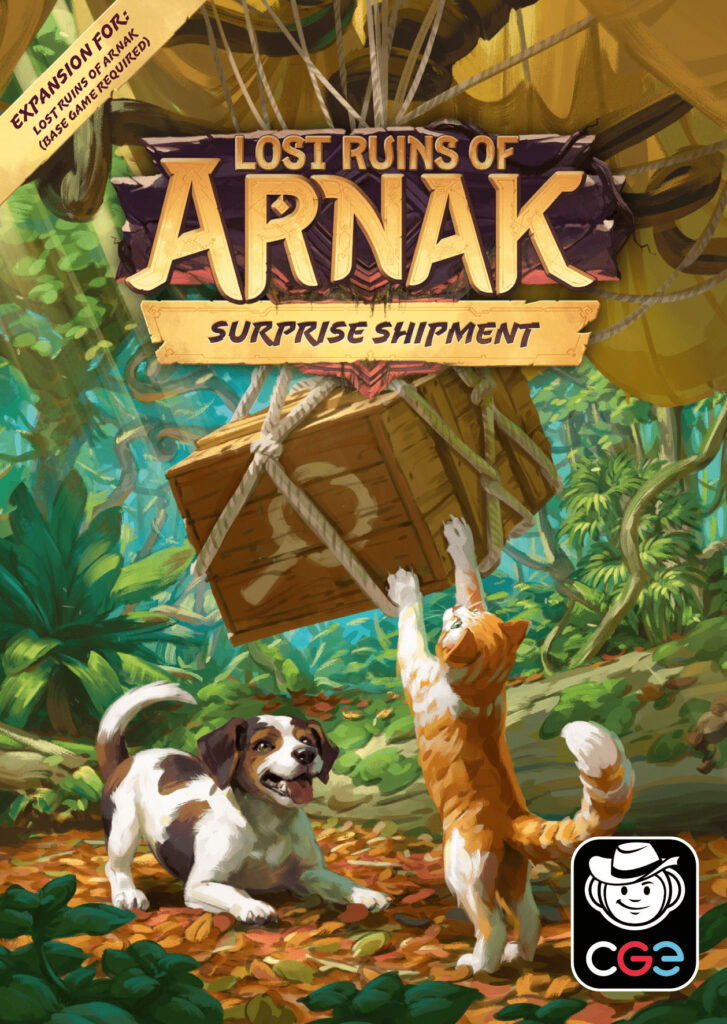
I’m a huge fan of Lost Ruins of Arnak, even though I was a late adopter. I loved the Indiana Jones theme right away, and the artwork is just fantastic. After a few plays of the base game, it was a keeper for me and started buying the expansions as they came out. Expedition Leaders […]

Say it with me: The wheel has turned once more.
2023 feels like a zillion years ago. That’s what I get for having the brain of an old-growth redwood. According to tradition, New Year, Old Year is how I revisit the titles that I declared to be the “best” in any given year. Best Week 2023 featured thirty titles over five days. Let’s see how they stack up today.
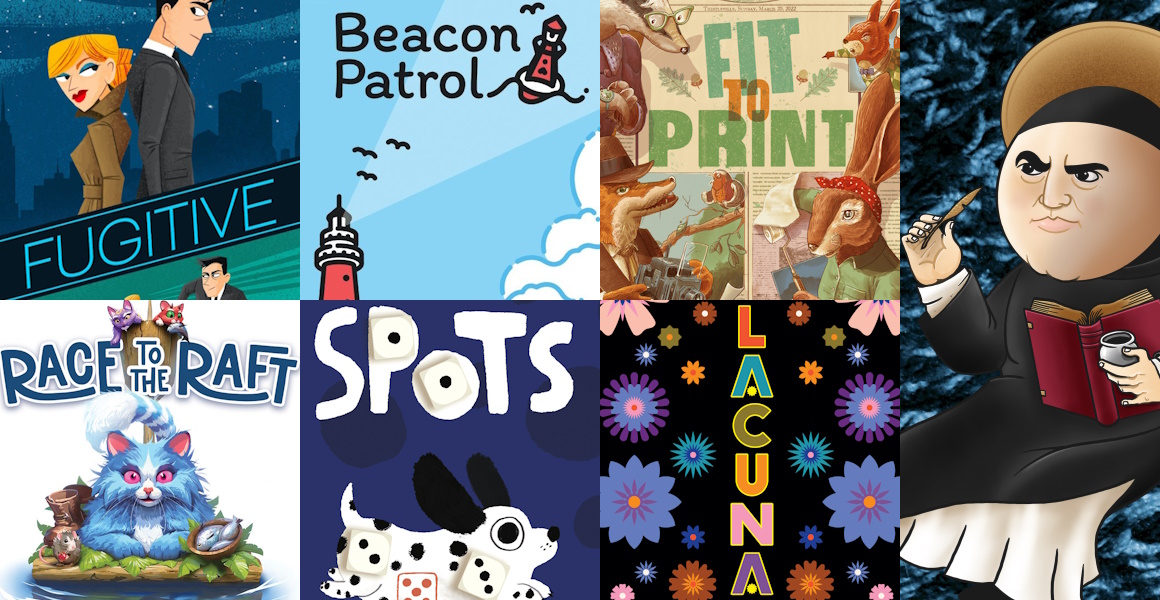
Aw. The first day of Best Week 2023 is a snapshot of a slightly younger family. These are all games I played with my kids, then aged four and nine, and it’s interesting to see which have survived the intervening two years and change.
In terms of family play, the big losers of the bunch are Fugitive and Race to the Raft, although not so much because the games aren’t good as because they’re too heady. I’d still be happy to play either of them, but their absence from my daily life is rather pronounced.
Somewhere in the middle, I would put Beacon Patrol and Lacuna. I’m actually pretty regretful that I passed along the former. Given how smitten with Blorp! my children are, despite being grossed out by its overabundance of orifices, I think they would appreciate Beacon Patrol’s gentler setting and more interesting placement puzzle. Lacuna, on the other hand, is still sitting on Cate’s shelf. She always gives it a place of priority when she rearranges her games, and insists she isn’t too old for it. I think it might be time to pull it down to see how it fares between her and her little sister. For whatever reason, though, it’s been cemented in her head as a game that’s worthwhile, something to be treasured, even if we haven’t played it in a good long while.
That leaves two titles. Fit to Print is such a banger. I wouldn’t say it’s appeared much at family time, but I tabled it again earlier this year to show some friends what could be accomplished with that Galaxy Trucker formula, and it was a hit all over again. This is another good candidate for reintroduction. (How’s that for a phrase that makes me sound like a mad scientist?) I think even the younger kiddo could now grasp the basics.
The undisputed leader of the pack is none other than Spots. Honestly, I’m not sure why I didn’t give it the number one position. Contrarianism, most likely. Cate recently introduced it to a group of friends at one of the game days she’s been hosting, and it warmed my heart to see yet another pack of children giggling over the cow that thinks it’s a dog. What a perfect game.
Next up, some slightly more serious titles.
Welcome to this week’s batch of crowdfunding campaigns. We have a variety of offerings here, so we hope you will find something that catches your eye. Also, if you want to chat with the BGQ team, join our Discord Server where we talk about games, movies, sports, and other fun stuff. Check it out and […]
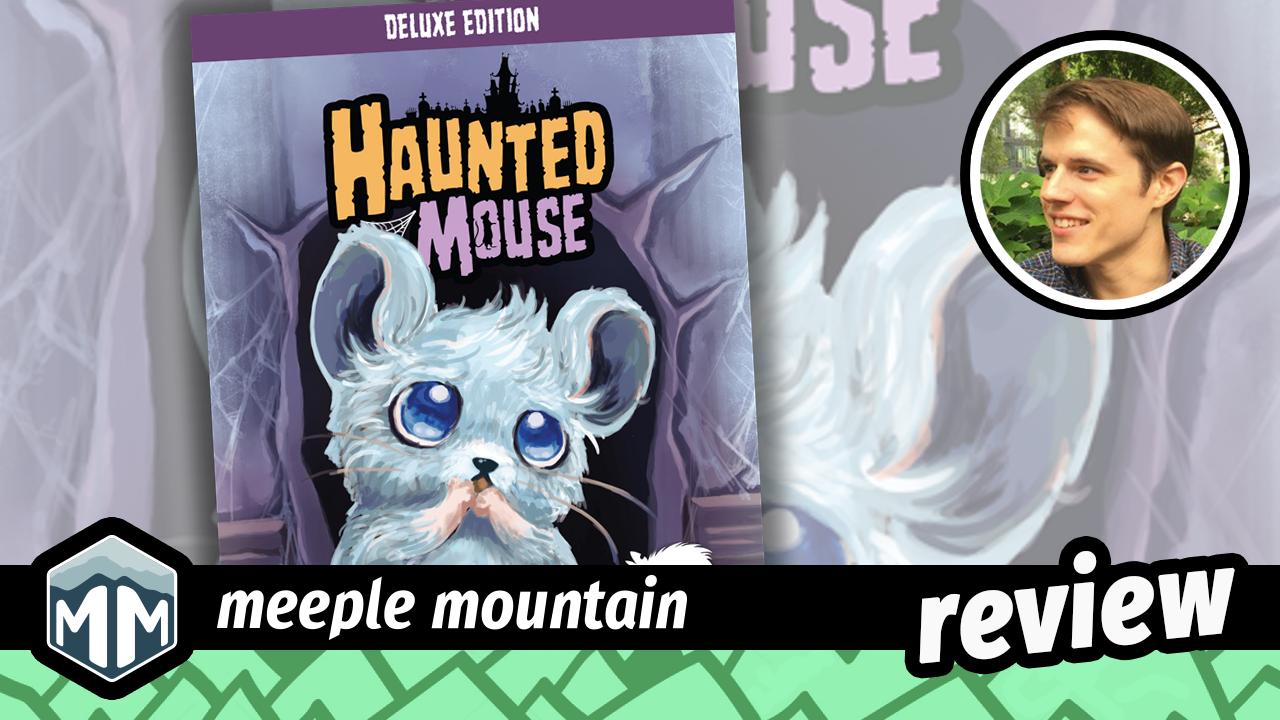
Haunted Mouse is a hard game to write about, because it falls perfectly into the gap between the good, about which there is much to say, and the bad, about which there is often even more to say. Jonathan Cox’s shedding game, a reimplementation of his own Spring Cleaning, is a perfectly alright time at the table. People talk about their days, the weather, the latest gossip. The game goes on quietly around this, undemanding and unobtrusive.
The goal of the game is to empty your hand by playing sets of increasing size and strength. Every trick-taking and shedding game has its gimmick(s), and Haunted Mouse is no exception. It joins the rapidly expanding field of shedding games in which you cannot rearrange the cards in your hand, and are forced to make sets out of adjacent cards. This has been used to marvelous effect in Scout, Jungo, and dnup, and works just fine in Haunted Mouse.
A common mechanic between these games, though it works differently in each, is the ability to add cards to your hand, putting them anywhere you want. In Haunted Mouse, this idea is combined with allowing players to shed troublesome singletons from their hands to make…
The post Haunted Mouse Game Review appeared first on Meeple Mountain.
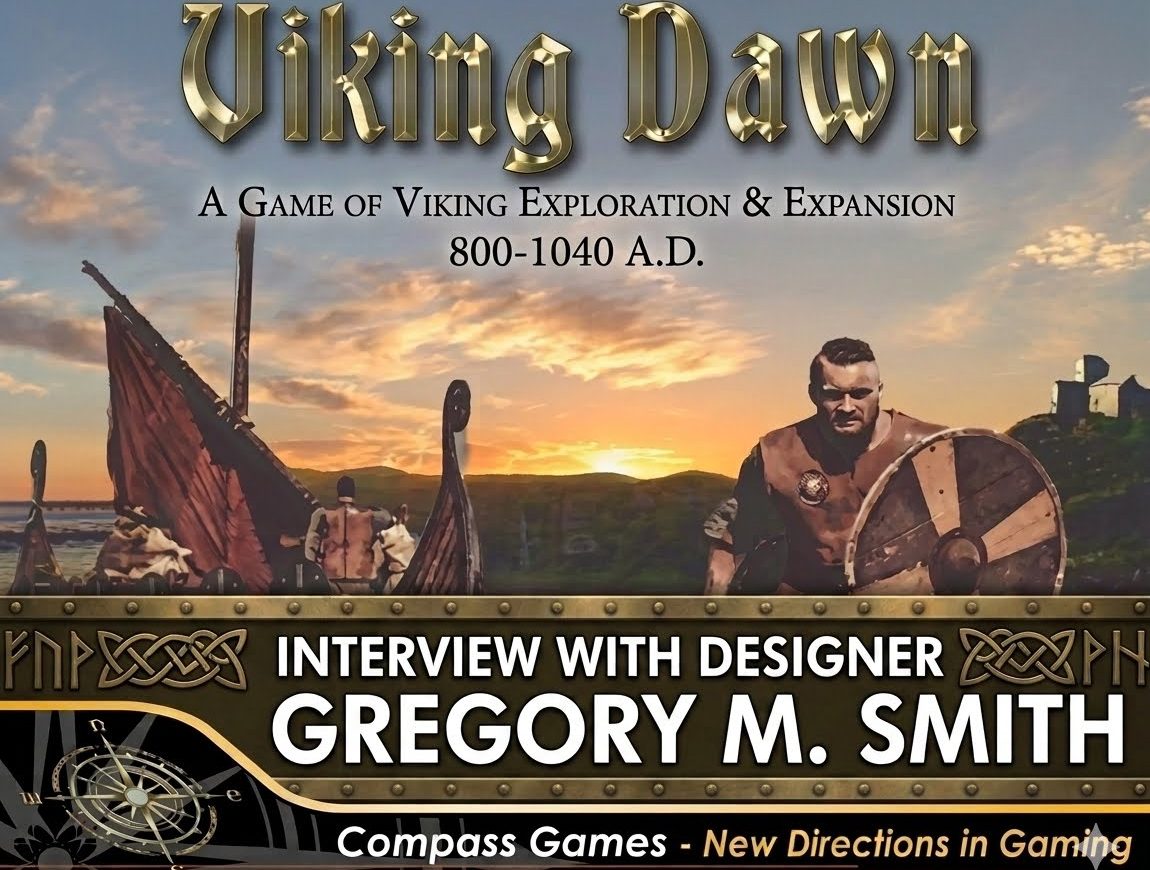


Our friend Gregory M. Smith is a solitaire game designing genius and has done many of these solo, narrative driven style wargames that we have all enjoyed for hours on end while we have been unable to find an opponent or just because we want to play a game on our timeline. We have interviewed him many times for his games such as Zeppelin Raider, Interceptor Ace, The Hunted, Western Front Ace, Amerika Bomber, Defending America, American Tank Ace, British Tank Ace, Rebel Tide, Sinking Yamato and most recently for a magazine wargame called B-52D Linebacker II. But Greg is a versatile designer and also has done many great 2-player games as well. He always has something cooking in his game design kitchen and recently we spoke with him about his new design with Kevin McPartland called Viking Dawn: A Game of Viking Exploration & Expansion 800-1040 A.D. from Compass Games. I was able to play this 1-4 player game while at the World Boardgaming Championships last month and you can read about my experience at the following link: https://theplayersaid.com/2026/07/27/world-boardgaming-championships-2026-daily-debrief-series-day-3/
I reached out to Greg recently to get a bit more information about the design to share with you and he was more than willing to talk with me about this new game.
Grant: Greg welcome back to the blog. What is your new upcoming game Viking Dawn about?
Greg: Hey Grant, a pleasure as always. I still think back to the first few of these interviews we did many years ago and laugh. Good times! [Editor’s note: When I reach out to Greg about doing one of these interviews, he is always willing to respond but often adds “don’t get medieval on my ass!” meaning he hopes that my questions are reasonable in number. He has a separate life to game design evidently.]
But, to business – Viking Dawn is an operational/strategic level look at the Viking raids and explorations in Europe, the New World and even into the Mediterranean and North Africa from roughly 800 to 1,000 A.D. 1-4 players will attempt to build a legacy for their faction, including the Swedes, Danes, Norwegians or Geats, by amassing Victory Points through wealth acquisition, exploration, area control, founding and growth of colonies and elaborate Leader burials. The game is playable in 4-5 hours with each of its 8 turns spanning a period of 20-40 years.
Grant: Why did you feel inspired to make this game?
Greg: One of my favorite games in college was Conquistador: The Age of Exploration 1425-1600 from Strategy & Tactics Press and one evening I was watching Vikings (the recent series from the History Channel) and I thought, hey, I should make a Viking version of Conquistador. There’s nothing quite as dramatic as a game that covers 200+ years.
Grant: What sources did you consult to get the historical details correct?
Greg: As you might imagine, there was NO shortage of research materials, which is great on one hand, but on the other, can be daunting. I thought the most scholarly and overall excellent of the bunch was Johannes Brøndsted’s The Vikings. Another great overall look was Robert Ferguson’s The Vikings. Another similar book was Jonathan Clements’ The Vikings. (Nobody hesitates to use that name, you might notice.) The best resource with pictures of artifacts, drawings, and maps included was a book by Richard Hall titled The World of The Vikings.
Grant: I understand you have a design partner in Kevin McPartland. How did this partnership come about?
Greg: It was quite hilarious actually. Kevin is an accomplished designer in his own right, but a couple years back I brought the first prototype of Viking Dawn to the Compass Con and explained how the idea originated. The light bulbs went on in his head, because he ALSO loved Conquistador back in the day and was upset he hadn’t thought of this first! We laughed, then after playing the prototype, he was making nonstop suggestions (and historical corrections and additions). He so improved the prototype I felt I had to have him as co-designer, to which he graciously agreed.
Grant: What was the division of labor between you two?
Greg: Well, I did most of the initial design work, but every time we got together he had some fixes, tweaks, historical corrections, and additions. I’d say he almost acted more as a developer, but he came up with enough mechanics I think co-designer is probably more accurate.
Grant: What other games inspired your design approach?
Greg: As mentioned, Conquistador was the primary inspiration for the overall theme of raiding and exploration, with leaders that last a turn or two before dying (typically of old age, with 20 year turns).
Grant: What is the players goal in the game?
Greg: As with many games, the goal is to amass the most Victory Points, which will determine the winner. Unlike many games, this is achieved through exploration, pillaging, looting, building settlements, and my favorite element through lavish burials for your deceased Leaders. They may have accomplished great deeds in life but if you don’t bury them with gold they aren’t really truly memorable.
Grant: What does a victory look like in the game?
Greg: That is a bit hard to define, as there are many paths to victory, but the most likely path to victory involves settlement income, exploration Victory Points and burial income. If you don’t develop your network of settlements and establish your economy, you will not be able to generate the needed funds to pursue further exploration and settlement and will also not be able to afford to keep your empire going at the end of each turn as you have to pay upkeep on Warbands and Longships.
Grant; What was important to include or model about Vikings in the game?
Greg: Despite the operational/strategic nature of the game, we had to have pillaging and looting or it wouldn’t really be a game about Vikings as this was one of things they are best known for historically and the reason that they were greatly feared in Europe. Just as important (in my mind) was to model the exploration aspects of their seafaring, and this is encouraged by getting Victory Points by being the first to explore various far reaching corners of the map including Russia, Constantinople, Persia and the New World.
Grant: What was your greatest design challenge to overcome?
Greg: The game was too long in its initial versions, and it took some creative editing to chop it down to a more manageable eight turns. It was fun at 12 turns, but just took an inordinate amount of time (6+ hours). I really dislike games that take too long.
Grant: What is the time scale of the game? Why was this important?
Greg: Unlike games about more recent conflicts, the Viking heyday was several hundred years. This was a serious design challenge, but we finally decided on the first two turns being 40 years each <!> and the rest of the turns 20 years each. This sounds crazy, but it actually works, and allowed us to cover the main historical time frame in a playable system.
Grant: What are the different Viking factions in the game?
Greg: You can have 1-4 players, with the Danes, Norse, Swedes and Geats, an offshoot of the Swedes. Think of the Geats as the Portuguese from Conquistador.
Grant: How do factions gain new Leaders? How historical are these Leaders represented?
Greg: The Leaders in the game are mainly the more famous/notorious of the Viking faction they represent. They arrive on the Turn Track via their historical arrival dates, and depart via the same (most last only a single turn, some survive for two turns.) However, each player may spend silver and purchase temporary Leaders and Explorers if they don’t have one arriving for awhile. Leaders give a bonus in combat, and Explorers give a bonus in seafaring, so they can be significant. Part of the asymmetrical build of the game is map location, but also Leader arrival times. The Danes have early advantage, but the Swedes and Norse are stronger later in the game.
Grant: Can you share a few examples of these leaders with us?
Greg: For example, these are the Norse Leaders. They have arrival/departure turns (which is sometimes the same turn) and the specialized Explorers have the circular symbol denoting that status.
Grant: What is the general Sequence of Play?
Greg: In general, you receive income, buy units, send out expeditions in turn order, pillage, establish settlements, return home with exploration VP’s, and bury your dead Leaders. There’s more to it than that, but that’s the basic gist of things.
Grant: What different units types are available to each side?
Greg: The basic combat unit is the Warband. The basic transport is the Longship. The basic “civilian” unit is a Settler.
Grant: How does combat and raiding work? How is it Press Your Luck?
Greg: Combat is mainly a combination of how many Warbands you have, modified by Leaders and/or Berserker chits. There isn’t much of a Press Your Luck aspect to combat (exploration, yes, trading, yes, but combat, no.) However, there is a CRT so you have to know your odds. Trying to pillage with only a 50/50 chance of success is risky and should be avoided.
Grant: What actions does each player have access to?
Greg: Players have almost complete freedom in what they want to do – but should obviously focus on doing things that earn Victory Points (making silver, or being the first to explore an area and return home to tell about it). Basically, the actions are external trade, exploration, creating settlements, pillaging, raiding, even demanding ransom. Players can send out multiple expeditions even, with the caveat they have to be able to afford it.
Grant: What is the layout of the board? Who is your artist?
Greg: Here’s the map, being basically most of the places the Vikings went (which was a challenge to show!) Nadir Elfarra, my favorite artist, did the work.
Fun story about the map, I showed an earlier version to my wife, Cindy, and the first thing out of her mouth was “Where are the Sea Monsters???” So we corrected that
Grant: How does trade work?
Greg: Internal trade happens automatically with your settlements, assuming you’ve paid for their upkeep. External trade, on the other hand, is a decision the player makes via the External Trade Chart. It requires you to risk a silver and a Longship, and you decide which column to use.
Grant: How are colonies established and how do they grow?
Greg: If you have successfully pillaged a green (habitable area suitable to be settled) you can drop off Settler(s) if you brought any. Each area has a Growth/Attrition number and also a Size Cap. At the end of each turn, you roll to see if the settlement grows (up to the size cap) or suffers attrition. Obviously, England has less attrition and a larger size cap than, say, Greenland. One fun problem is that when areas reach their size cap, they roll to break away and become independent from the homeland.
Grant: How does Longship travel work? What dangers are involved?
Greg: You may travel a maximum of three legs (each leg being six areas or fraction thereof). This makes the theoretical maximum 18 areas. However, the further you go, the more likely you are to lose Longships and/or your entire expedition. Explorers can mitigate these risks, but there are very few explorers in the game. So there is definitely risk in exploration.
Grant: What type of experience does the game create for players?
Greg; I would like to think of Viking Dawn as a “historical Euro” for lack of a better term. It’s certainly more of a game than an attempt at perfecting simulating all the historical events of the time. Kevin’s fantastic knowledge really helped to make it better historically, and I think it does a really good job of doing a “broad brush” rendering of the Viking age.
Grant: What are you most pleased about with the design?
Greg: I really thought the turn order mechanic made it very tense. Everybody secretly purchases Warbands and Longships, but turn order (a huge advantage to go first early in the game) is determined by who has the most silver remaining after purchases. If you buy a lot, you can do a lot, BUT you’re probably low on silver and going last in the turn. So determining turn order by remaining silver turned out to be a great mechanic.
Grant: What has been the feedback of your playtesters?
Greg: Anybody who knows me knows that I’m my own biggest cheerleader, BUT seriously, we had a great time playing this the last several years at Compass Con. It’s just fun multiplayer, especially when bad things happen. I am very happy with the design, and especially since Kevin McPartland made it ten times better with his involvement.
Grant: When can we expect to see the game released?
Greg: I refuse to answer this question on the grounds I’m never right but if pressed, I’d have to say early 2027. It’s done and at the printers.
Grant: What other designs are you currently working on?
Greg: I’ve got a few irons in the fire. Solo Banner (Burning Banners dungeon crawler), Western Desert Ace (North Africa WW2 version of Western Front Ace), Soviet Tank Ace, B-52D Linebacker II (magazine game), Gotha Raiders (magazine game), Project Z (Japanese hypothetical heavy bombers 1947), Ground Attack Ace (Stukas and Sturmoviks), Korean Tide (1950-53 Tide Series), Star-Spangled Tide (War of 1812 with Kevin McPartland again), a B-36 game, and a few others. Trust me I’m staying busy!
Thanks as always, enjoyed chatting.
If you are interested in Viking Dawn: A Game of Viking Exploration & Expansion 800-1040 A.D., you can pre-order a copy for $54.00 from the Compass Games website at the following link: https://www.compassgames.com/product/viking-dawn-pay-later/
-Grant

Road to Essen, a competition designed to showcase Vietnam’s burgeoning tabletop design scene at the world’s biggest board game fair, has returned for its second year – with organisers changing things up in the hope of helping turn publisher interest into commercial deals.
The contest was launched last year by Vietnamese board game publisher Everjoy Publishing and its global arm Everjoy Global, in an attempt to help designs from Vietnamese creators break out internationally.
Entrants receive access to workshops and playtesting, while later-stage contestants receive mentoring and jury feedback, with selected games ultimately presented to the international industry at the giant Spiel Essen board game fair in Germany.
Thinh LeHuu’s co-operative card game July, themed around Vietnam’s seventh lunar month and its Hungry Ghost festival, was named the inaugural champion last year from about 160 entries – winning over a judging panel that included Cascadia designer Randy Flynn with its “clever gameplay, polished design and cultural message”.
The 2026 competition is now under way with a theme of ‘Vietnamese Culture’, encouraging designers to draw on areas including the country’s history, legends, beliefs, festivals, folk arts, cuisine, crafts and architecture.
But there is a significant change to the timetable this time around: rather than taking the winner to Spiel just weeks after the competition concludes, organisers have scheduled their next international showcase for Spiel Essen 2027.
Claire Ton, head of the organising committee for Road to Essen 2026, told BoardGameWire, “It’s a deliberate decision to give the work its best possible shot.
“A winner chosen in late 2026 can’t have a polished, publisher‑ready game on the Essen floor a few weeks later – and a rushed debut serves the designer least of all.
“Aiming this edition at SPIEL 2027 gives the winning team close to a full year to develop the game, act on the judges’ feedback, line up a publishing or distribution partner, and arrive ready to actually do business.
“It also lets us plan the Vietnamese presence at the fair properly. Getting a Vietnamese game to Essen was never really the goal – getting it there ready to sell is.”
The extra development period addresses one of the main barriers Road to Essen was created to tackle: getting games from Vietnam’s rapidly-growing community of local designers into a form that can be presented effectively to publishers and distributors outside the country.
Everjoy Global co-founder and CEO Ionah Nguyen told BoardGameWire in 2025 that Vietnam had experienced a roughly 400% increase in locally-designed games entering its market in just two years – but said designers continued to face a lack of international publishing and distribution connections, language differences, unfamiliarity with global supply chains and the cost of attending overseas shows.
Almost a year later, Ton told BoardGameWire, “The first edition did exactly what a first edition should: it put Vietnamese design in front of the world and proved there’s real appetite for it.
“We brought the games to SPIEL Essen 2025 and the response was genuinely exciting – our winning title, July, drew particular attention.
“That interest is now powering the next stage. Most of our finalists are deep in development, sharpening their games with everything they took from our international judges and from the fair floor.
“We’re building deliberately for lasting outcomes rather than quick headlines – the first publishing deals to come out of Road to Essen should be the right ones, and we’d rather bring a title to market ready to succeed than rush it out early.
“There’s a lot moving beneath the surface, and the next year is where it starts to show.”
Ton added, “We’re in the relationship‑building phase, and it’s an encouraging one. A lot of conversations were sparked at Essen – publishers wanting to understand the scene, see what’s emerging from Vietnam, and stay close to what comes next.
“What’s promising is that this feels less like one‑off interest in a single title and more like the early groundwork of lasting partnerships, which is exactly what a young design ecosystem needs to grow.
“The titles generating the most conversation share a clear profile: culturally distinctive, visually striking, and easy to pick up and play. Our focus this year is turning that momentum into concrete meetings and, ultimately, deals.”
That intermediary role directly addresses one of the problems Nguyen identified when Road to Essen launched: many Vietnamese designers lacked direct connections to international publishers and distributors.
She told BoardGameWire last year, “There’s no shortage of creativity in Vietnam. What we lack are bridges.”
But there are signs outside the competition that Vietnamese designers are beginning to find international publishing routes.
Vietnamese designer Huy Pham’s Yotei has been picked up by Rebirth publisher Mighty Boards, which launched a Kickstarter for the game in April before demoing it at Gen Con this summer.
Meanwhile Bunny 100 – designed by Hoang Vo and originally published by Everjoy Publishing – has secured a European release through Italian publisher DV Games.
Those developments come as designers elsewhere in Asia have had a striking 12 months in achieving recognition in the European market.
Japanese designer Hisashi Hayashi’s Bomb Busters won the Spiel des Jahres in 2025, while Indonesian designer Martin Ang’s JinxO – published as Dito! in Germany by Game Factory – scooped the award this year, becoming the first Southeast Asian-designed game to win the prize.
Ton said Vietnamese games’ biggest sales numbers nevertheless remain overwhelmingly driven by the country’s domestic market rather than exports, telling BoardGameWire research suggested Vietnam’s board game market reached about $100m last year at a roughly 10% growth rate.
She said, “Importantly, more of that is original Vietnamese design rather than imports, supported by a fast‑growing creator community and better retail distribution.”
Several Vietnamese-designed games are now reporting sales in the tens or hundreds of thousands of copies – like Bunny 100, Zodiac Rush and Galactic Super Beasts – thanks to the snowballing domestic market.
Ton told BoardGameWire, “The vast majority of those numbers come from Vietnam itself – and I’d argue that’s the most important part of the story, not a limitation.
“It proves there’s a large, real domestic market here: a home audience big enough to make original Vietnamese design commercially viable on its own. That’s the foundation everything else is built on.
“Export is the newer chapter – Bunny 100 into Europe through DV Games and across several Asian markets – and it’s growing, but the headline sales figures today are a signal of domestic strength first.”
This year’s contest will have an overall prize pool of about 500 million Vietnamese Dong – roughly $20,000 – split between the winner and a set of other award finalists.
They include awards for fan favourite board game, best visual design, most innovative board games, the game with most commercial potential, and best cultural representation – as well as categories for best junior creator (aged six to 15) and outstanding teen designer (ages 15 to 18).
The submission period for this year’s awards end on November 15, with the grand prize winner receiving full sponsorship to attend Spiel Essen 2027, along with an exclusive publishing opportunity with Everjoy Publishing.
The post Vietnam’s Road to Essen board game design contest back for second year, with longer runway aimed at turning publisher interest into deals first appeared on .
A copy of Salamandra was kindly provided by Hachette Boardgames UK. Thoughts & opinions are my own. Salamandra is a worker-placement game with a twist, and that twist is just the sort of thing that might make you take a second look if you’re feeling overrun with worker-placement games. The added change of workers being stuck in place once they’re on the board adds a new layer of planning…
by Justin Bell
Oink Games reveals its line-up for SPIEL Essen 26, PAXU, and Game Market
Welcome back New York in history and board games! We’ve seen the city’s humble beginnings, its rise to America’s first city, and its glory days as the epitome of the modern metropolis. Today, we wrap up by covering the city’s crisis and nadir in the second half of the 20th century as well as the New York of our time – as always, with board games. Let’s go!
If you want to read more posts like this history & board games long read, I strongly recommend you subscribe to the blog: All new posts in your inbox right when they go live!
New York had replaced London as the financial center of the world after the Great War. In the following years, the city complemented its financial with cultural heft, helped by an influx of refugees from Nazi tyranny in Europe. With Paris under German occupation, New York became the art capital of the world, a primacy the city would not relinquish after the war.
Where money and art met, power would follow: When the newly founded United Nations needed a headquarters, New York was the obvious choice. The UN building, a sleek colossus of glass and steel, embodied the new age. Symbolically, New York was the capital of the world now.
New York’s glory moment as the epitome of modernity was not to last – by a good deal because modernity undermined itself. New York’s transformation from manufacturing to services had made the city richer and provided well-paying white-collar jobs for the old and new middle classes, but it also meant that demand for unskilled laborers dried up. At the same time, both domestic and foreign migration to New York increased: Black Americans from the South arrived as well as Puerto Ricans in large numbers. When the federal limits on immigration from non-European countries were lifted in the 1960s, many Latin Americans and Asians followed. The migration of ethnic minorities to New York City was complemented by the white flight to the suburbs. Since 1990s, New York is a majority-minority city – that is, a majority of New Yorkers belong to an ethnic minority.

As in many American cities, the individual ethnicities typically cluster in separate neighborhoods. Manhattan’s Chinatown, first a center of Chinese immigration in the mid-1800s, grew after 1965 and became a vibrant part of Lower Manhattan. Today, it is also popular with tourists and New Yorkers from other neighborhoods, especially for its varied food. A small part of Manhattan’s Chinatown between Canal Street and Worth Street forms the map for Chinatown (Karsten Hartwig, Alea), a game about negotiation and business development.
New York’s demographic changes posed economic challenges. The new immigrants often didn’t have the skills required for the service and knowledge economy, and the skilled middle classes emigrating to the counties around New York also paid their taxes there. Sometimes, their employers left the city as well, now that they could find the workforce further from the center (and would pay lower taxes than in New York), and even if they didn’t, the threat alone was usually enough to receive a tax rebate from municipal administration.
The tragedy of this decentralization which sapped the economic strength of New York is that the city helped to bring it on itself. The subways of the early 20th century had decentralized the city, but they had also brought quality of life. The transport policy which the city in the person of Robert Moses (remember him from last time?) enacted had all of the decentralization and none of the quality of life. To summarize it in two words: Road Rage.
Moses led a crusade against public transport. The subways remained, but all the elevated trains and trolleys which had serviced every corner of New York in the first half of the 20th century were phased out by 1957. This development was not limited to Moses: The Pennsylvania Railroad demolished Penn Station, the heart of New York’s long-distance rail system and an architectural landmark of the old New York. Instead of rails, expressways cut through New York, attracting an ever larger avalanche of cars for which they never had enough lanes.
The expressways exemplified Moses’s astounding powers: He had the authority to appropriate land for their construction, evict the inhabitants and destroy their buildings. The expressways cut through neighborhoods or dispersed them completely. The construction of the Cross Bronx Expressway required relocating 60,000 people and pierced the heart of the South Bronx, even though a less destructive path for it could have been built just one block further south – but Moses preferred the optimal trajectory of the road, regardless of the human cost.

The tension between city development and human cost is the central theme of Cross Bronx Expressway (Non-Breaking Space, GMT Game). Three players – the city, the local communities, and private enterprise – want to shape the South Bronx according to their vision, but if they play too selfishly, neglecting the overall state of the neighborhood (or the needs of the other players), incarceration and bankruptcy ruin the South Bronx and everyone loses. There are many city-building games, but barely any with a vision as bold as Cross-Bronx Expressway.
The people of the South Bronx were poor in economic and cultural capital. Any resistance to the construction of the Cross Bronx Expressway was bound to be shrugged off as the complaints of people who didn’t know any better about the requirements of modern city planning. The same could not be said about the Manhattanites. When Moses planned for the Lower Manhattan Expressway to cut through the island, demolishing dozens of residential blocks and disposing of Washington Square Park altogether, resistance formed. Jane Jacobs, an assistant editor at the magazine Architectural Forum, both organized the community on the ground and published the bible of anti-Moses urban planning: The Death and Life of Great American Cities, an argument for putting the needs of residents first.
As Moses’s vision of the modern city as a sprawling, motorized metropolis lost its shine, his hold over the city weakened. The planned expressways through Lower and Midtown Manhattan were never built. By 1968, Robert Moses had been removed from the last of his many municipal and state posts. Yet as infrastructure spending has dried up since the late 1960s, contemporary New York is still very much Moses’s creation.
Above, I noted the two losing conditions for Cross Bronx Expressway: Debt (both municipal and on the community level) and crime (or, rather incarceration levels among the population). That’s the historical outcome – the New York’s crisis in the last third of the 20th century.
The debt crisis had two origins: On the one hand, New York’s tax base was eroded by the suburbanization described above. On the other, the city’s budget massively expanded in the mid-20th century. By the late 1960s, it was the second-largest public budget of the United States, right after the federal budget. New York City attempted to provide what state and federal governments would not – chiefly free higher education and the best, most comprehensive health care in the nation. That promise rested precariously on federal support. When federal spending on municipal programs was sharply cut in the early 1970s, New York’s financial structure came crashing down. By 1975, the city was practically bankrupt. The state legislature created oversight bodies which rendered the mayor unable to do anything but implement radical spending cuts. In the end, a federal loan saved the city from defaulting.

The cuts to municipal expenditure ended the New York’s experiment as an all-providing city. They also made New Yorkers poorer, sicker, and less safe. In the 1980s, drugs, AIDS, and crime rocked the city. The crime epidemic ebbed off in the 1980s, in parallel to the nation-wide development. The exact reasons are still debated.
The city’s debt remained high through the 1990s – Democratic mayor David Dinkins expanded spending again, while Republican mayor Rudy Giuliani cut taxes. The newly dynamic economy, however, made more than up for that. New York seemed to have a bright future ahead.
Instead, New York suffered calamity at the dawn of the new century: On September 11, 2001, Islamist terrorists hijacked four planes in the Eastern United States. One crashed, one hit the Pentagon. The other two were piloted into the twin towers of the World Trade Center in Lower Manhattan. The impact, fire, and collapse of the towers killed almost 2,800 people in New York – the largest terrorist attack in history.
Mayor Giuliani’s energetic, but measured response rallied the city (and briefly made him America’s most popular politician) as an immense wave of national and international solidarity flowed to New York. While the immediate damage was soon taken care of and plans for new buildings to replace the old World Trade Center were made, the shadow of the 9/11 attacks continues to hang over New York: The dust from the collapsing buildings contained asbestos, heavy metals, and toxic chemicals. Until now, around 7,000 additional lives have been claimed by the attacks, especially among the firefighters and the volunteers who helped search for survivors (and often found corpses) and clear the rubble.

The attacks did not only change New York, but also the world. The US government, aided by many of its allies around the world, embarked on a global “war on terror” in response, beginning with the invasion of Afghanistan in October 2001.
Today, New York remains a city of many facets. It is still the center of global capitalism as well as a hotbed for anti-capitalist activism (like the Occupy Wall Street protests) – and its new mayor Zohran Mamdani is a socialist.

New York remains not only an economic, but also a cultural center, the place where aspiring young artists of all fields go to make it big – photographers, musicians, monsters… Yes, monsters. King of New York (Richard Garfield, IELLO) is a remake of King of Tokyo with a twist: A good deal of the victory points come from your monster becoming a superstar and enjoying its fifteen minutes of fame.

Sometimes, culture and economy go together: The Broadway Game (Ernie Parmentier, Tactical Studies Rules), eagerly played by generations of actors, directors, and playwrights, started out as a Monopoly variant.
Most of all, however, New York always changes. The city reinvents itself permanently. To many Americans, it seems foreign because of that – and to many foreigners, quintessentially American.
Chinatown (Karsten Hartwig, Alea)
Cross Bronx Expressway (Non-Breaking Space, GMT Games)
N.Y. Chase (Projekt Team III, Ravensburger)
Labyrinth: The War on Terror, 2001-? (Volko Ruhnke, GMT Games)
King of New York (Richard Garfield, IELLO)
The Broadway Game (Ernie Parmentier, Tactical Studies Rules)
For a concise introduction, especially focused on local politics, see Lankevich, George J.: New York City. A Short History, New York University Press, New York City, NY/London 1998.
If you want a treatment which is both more in-depth and more journalistic (and lavishly illustrated) and don’t mind its history practically ending around 1970, see the book version of the 17-hour PBS documentary from 1999: Burns, Ric/Sanders, James/Ades, Lisa: New York. An Illustrated History, Knopf, New York City, NY 2001.
The magisterial biography of Robert Moses is Caro, Robert A.: The Power Broker. Robert Moses and the Fall of New York, Knopf, New York City, NY 1974.
Played another game of HF4A (with M012 and the Promo Crew Packs). According to BGG, this was my 11th game of HF4A (not counting solitaire) and I have two dozen games of 3rd edition, so I’m not exactly a newbie, but as always there were a few rules questions and outright mistakes. I’m not comfortable with the politics module (M0) at all, but mostly I messed up by not noticing that one of my supports gave a -2 thrust to my rocket1. Since I (mostly) used a crew rocket to land/take off the real issue was that I was getting to and from my destinations 1-2 turns faster each time, which probably compounded my achievements nicely.
(I also forgot that Factory Assists require a hazard roll, unless you have a colonist, and didn’t wake up to that until about the halfway point of the game).
But mostly I actually kept my nose in the rulebook when it wasn’t my turn, so I think I got most of the (fairly tiny) rules correctly, or at least noticed them after the fact.
I’ve been slowly upping my rating on HF4A. It has a learning curve (and … if you only play every few months, a “forgetting curve”). It’s rules are complex … maybe not “Magic Realm” complex, but enough that you can’t just jump in. And yet … it really does capture something great. I think it’s another point in favor of the argument that you cannot compress great games. I don’t think the rules are perfect …. after my last game I think I’m ditching the rule that makes start player use a cube, but overall it’s a great sandbox.
and I’ve finally gone ahead and rated it a ’10.’ Hopefully my next dozen games won’t take a half-decade. (And I still have to learn the M4 rules, but I might never play with them. I doubt I’ll use M3). And I think I’m going to try and play at least one solitaire game a month just to keep the rules fresh in my mind.
Still, I did manage to:
Update — And I should mention that one other play built the Uranus Aerostat — Cordelia Space Elevator. (I “almost” did that in a solo game a few months back, before I realized the freighter couldn’t get to Cordelia except as cargo)….
︎︎
by Jakov J



/pic9764304.jpg)


/pic9693199.png)
