Anmelden
Old Games Made New
26. Juli 2026 um 23:00
The past returns in Star Trek: Space Hunt, TworDuel, Golfie, and Risky Mixes

The past returns in Star Trek: Space Hunt, TworDuel, Golfie, and Risky Mixes
by Roger IELLO

We’ve been assessing the merits of political leaders in (more or less) democratic countries on this blog for a few years now. Today, we’re looking at the longest-serving chancellor of the Weimar Republic, Germany’s first attempt at parliamentary government – Wilhelm Marx. And which game could be more appropriate for him than Weimar (Matthias Cramer, Capstone Games/Skellig Games/Spielworxx)?
If you want to read more ratings of historical leaders like this, I strongly recommend you subscribe to the blog – all new posts in your inbox right when they go live!
Some caveats ahead: The chancellors will be rated by the knowledge of their time. If they or their contemporaries could not have known about the effects of something, I will not use my hindsight to mark it as a mistake of theirs. The assessment is focused on their conduct as chancellor.
Now, to the system itself: There are three policy field categories (foreign, domestic, and economic policy) and three more general ones (vision, pragmatism, integrity). A chancellor can earn from one to five stars in each category (for a total sum of up to 30). In detail, the chancellor is assessed as follows:
Foreign policy: Did the chancellor increase German influence in the world and the security of Germans at home? Did the chancellor wield German power responsibly and with positive results for the regions affected?
Domestic policy: Did the chancellor increase the liberty of Germans to express themselves and to participate in the political process? Did the chancellor promote domestic security and shape the framework for fair justice dealing with offenses?
Economic policy: Did the chancellor facilitate the prosperity and economic security of Germans (including in the mid- and long-term)? Was the chancellor’s economic policy based on mutual benefit of those involved or did it unduly burden one side?
Vision: Did the chancellor have an idea of what Germany and Europe (the latter counting for more in times of German influence being great) should look like beyond the immediate future? Did the chancellor’s policies steer Germany (and, if applicable, Europe) in this direction?
Pragmatism: Did the chancellor succeed in seeing their policy through from inception to completion? How well did the chancellor manage the support from parliament, society, the administration, the media?
Integrity: Did the chancellor understand the office as a means to benefit themselves, special interest groups, the entire country, or another community? Did the chancellor respect the boundaries of the office?
Note: If you have read my UK prime minister or US president ratings, you will remember that I rated them on the global impacts of their vision as well. As the rating system is only really applicable to democratic leaders and no democratic German leader ever had the chance to conduct a truly global policy, I only assess their vision on national and European grounds.
Wilhelm Marx was born in 1863 in Cologne, then a part of the Rhine Province of the Kingdom of Prussia, soon to be part of the united Germany. No one could have foreseen in his boyhood that he would rise to the chancellorship – he was the son of a mere schoolteacher, and a part of the Catholic minority which was always suspected of possibly disloyalty by the Protestant Prussian state. The young Wilhelm Marx was one of many who set out to prove that he could be just as patriotic as any Protestant: He studied law and entered public service. His Catholic faith, however, would always be the guiding star in his life.
He was first elected to the Prussian parliament in 1899 on the ticket of the Catholic Zentrum (Center) party – one of the four player factions in Weimar. By the time Marx was elected, he had been active for nine years in the Volksverein für das katholische Deutschland (People’s Association for Catholic Germany), an organization dedicated to improving the social conditions especially of the poorer Catholics. Social and cultural issues, especially the expansion of Catholic schooling, would remain close to his heart: In 1910, he founded the Katholische Schulorganisation (Catholic School Organization), a grassroots lobbying organization dedicated to the matter.
The same year, he was elected to the German parliament – his first electoral success on the national level after two campaigns in hopeless districts with very few organized Catholics which he had only undertaken out of duty to the party. In parliament as well as in his electoral campaigns, he aimed to form an alliance with the Protestant bourgeois parties against the burgeoning SPD (Sozialdemokratische Partei Deutschlands, Social Democratic Party of Germany), the second player faction of Weimar. However, this strategy failed when cross-confessional bourgeois solidarity eroded in the more confrontational cultural climate from 1911 on.
These divisions faded into the background with the beginning of World War I. Despite the pre-eminence of military and diplomatic action then, Marx’s political activity remained limited to domestic issues. From his papers, we cannot discern if he even formed an opinion on many of the pressing issues in those other realms (say, unrestricted u-boat warfare). He did, however, change his mind about cooperation with the SPD, with whom the Zentrum (and the liberal parties) partnered from 1917 on in their quest to place the imperial government on a more parliamentary basis.

The revolution of 1918/1919 took Marx by surprise. Once more, he placed his powers at the disposal of his party, and was elected to both the Prussian and the German constitutional assemblies. The National Assembly in Weimar developed a constitution which included many long-held dreams of his, as the Catholic church, Catholic associations, and individual Catholics finally had their rights guaranteed. The short period of cooperation with the Social Democrats (and, to a lesser degree, the progressive liberals of the DDP (Deutsche Demokratische Partei, German Democratic Party) had achieved what years of negotiation with the Protestant conservatives of the Empire had not. This early alliance between Zentrum and SPD is the starting point of any Weimar game.
Yet the new German republic was unpopular with the numerous conservative, monarchist Zentrum members, and cooperation with the Social Democrats doubly so. Marx thus spent much of his political energy advocating for the constitution among his fellow Catholics.
At the time, Marx considered leaving politics altogether in favor of focusing on social work: From 1919 to 1921, he acted as director for the Volksverein (but proved unsuited to implement the sweeping changes necessary to improve the Volksverein’s faltering popularity in the Catholic milieu).

Yet once more duty called: As many of the old Zentrum parliamentary leaders died, Marx was one of the most experienced politicians his party could field. And his conciliatory, even-handed manner was just what the Zentrum needed when the party was so deeply divided against itself on the question of supporting the republic or restoring the monarchy as well as if to cooperate with the Social Democrats or the Protestant nationalists of the DNVP (Deutschnationale Volkspartei, German Nationalist People’s Party), the third Weimar player faction.
Marx was thus called on to hold the diverging wings together: He was elected head of the parliamentary group of the Zentrum and then also party chairman in late 1921. As the Zentrum’s governing partner SPD merged with the more left-leaning USPD (Unabhängige Sozialdemokratische Partei Deutschlands, Independent Social Democratic Party of Germany), Marx advanced a closer cooperation with the two liberal parties DDP (in government) and DVP (Deutsche Volkspartei, German People’s Party, in opposition) – the two minor parties which the Zentrum can control in Weimar. Yet Chancellor Joseph Wirth’s attempt to entice the DVP into a government of all democratic parties (a Grand Coalition) failed in late 1922. As a consequence, the SPD left the government as well. The parliamentary basis for the government shrunk.
The following year, Germany was shaken by the French occupation of the Ruhr which exacerbated the already galloping inflation. Under these circumstances, the Grand Coalition of all democratic parties became reality, led by DVP chancellor Gustav Stresemann. While it tackled these huge tasks rather successfully, the government could not maintain its internal cohesion: The right wing of the DVP (under its parliamentary leader Ernst Scholz) wanted to use the crisis to abolish the eight-hour workday and expand the government to the right by including the DNVP. The SPD refused and left the government. Marx’s conciliating manner helped with bringing both of them back to the negotiating table and a new Grand Coalition was formed.
This one was even shorter-lived: When federal forces broke up the socialist state governments of Saxony and Bavaria, but (doubting the loyalty of the army) refused to act against the right-wing coup in Bavaria, the SPD once more went into opposition. Without a parliamentary majority, Stresemann was soon unseated as chancellor. As the SPD’s appetite for government responsibility was sated, a bourgeois minority cabinet would be formed. That would be straight-up impossible in Weimar – unlike left-wing or right-wing coalitions, the Weimar Coalition (with SPD and Zentrum as the player factions and the DDP as a minor party which is always attached to one of the two) cannot refuse to govern, and so SPD and Zentrum are often stuck with each other if they want it or not. Historically, the SPD was not quite as keen on governing as the party is in Weimar.
To get anything done without a parliamentary majority would require special skills at winning friends and not making enemies. Marx, the skilled mediator, was just the right man for the time. He was elected chancellor on November 30, 1923. The weighty issues facing him were Bavaria’s continued insurrection, the implementation of the measures against hyperinflation, and an agreement with the Allies on the reparations issue which had set off the entire crisis of 1923.

Marx’s cabinet nominations sent a signal to Bavaria that he was willing to improve the relationship between the fractious state and the Reich: He made the Bavarian Eduard Hamm (DDP) Minister for the Economy, and, for the first time in the history of the republic, included a member of the BVP (Bayerische Volkspartei, Bavarian People’s Party) whose more radical members had been behind the coup in Bavaria (Erich Emminger as Minister of Justice). His discreet negotiations with the Bavarian coupists would come to fruition in spring 1924: They resigned and opened the way for parliamentary government again. Bavaria, however, would retain some special privileges and be exempt from federal oversight.

Both the reparations negotiations with the Allies and the massive financial and economic reform package which would solidify the end of inflation required Marx to gather parliamentary support far beyond his minority coalition’s meager base. As there were constitutional changes involved (for example, in merging the various state railway companies into a federal railway), he even needed a two-thirds majority. Marx’s parliamentary skills and his reputation as an honest broker who would not abuse his power came together in securing an Enabling Act which would allow his government to gain the respective legislative powers despite their parliamentary minority. Equipped with such power, Marx set out to do the necessary, but unpopular steps forward. The cuts to public expenses which were to flank the currency reform massively reduced the number and salary of public employees and all but expropriated most pensioners.
The bitter taste of Marx’s domestic reforms was lessened by the negotiations with the Allies. Not even France had the stomach to force another confrontation after the chaos of 1923. They were thus inclined to negotiate a payment schedule which suited both sides. American bankers were to provide the loans with which Germany would cover a large part of the payments.
The electorate, however, was unimpressed. In the May 1924 parliamentary elections, Marx’s Zentrum held firm, but his DDP and DVP partners collapsed, as did the SPD. The right-wing parties were triumphant. Yet with no viable alternative to the bourgeois minority coalition, Marx was soon confirmed for his second chancellorship.

In the second tenure, he concluded the negotiations with the Allies. The final agreement would become known as the Dawes Plan after the chief Allied negotiator, American banker Charles G. Dawes. Once more, Marx needed a broad parliamentary majority. In addition to his government coalition, the SPD was sure to support the plan. The DNVP publicly railed against the Dawes Plan (which confirmed the infamous war guilt clause of the Treaty of Versailles), but DNVP chairman Oskar Hergt offered his support in return for policy concessions and the DNVP’s inclusion in government. Otherwise, he threatened that the Dawes Plan would fail in parliament. Marx, however, knew that the DNVP was internally divided on the matter and that a large number of DNVP members of parliament either saw the necessity of the plan for German economic revival or at least did not want to take the blame for the failure. Thus, he called the parliamentary vote without giving in to Hergt’s demands. The motion passed, as most DNVP members abstained.
Marx’s policy successes had not broadened his parliamentary base. As he kept refusing the DNVP’s inclusion in government in favor of a more centrist approach, new elections were called for December 1924. These did not change the parliamentary balance of power much. Marx resigned and was succeeded by Hans Luther, who formed a technocratic government based on the centrist and right-wing parties including the DNVP.

Marx could not enjoy being relieved of his duties for long. When the Prussian DVP, as much a loose cannon as its federal counterpart, forced the end of the Grand Coalition in Prussia, Germany’s largest state, and demanded a right-wing government including the DNVP like in the Reich, Marx was called on to solve the government crisis. He was elected Prussian Prime Minister with the votes of the Weimar Coalition (SPD, Zentrum, DDP) on February 18, 1925, yet just two days after was toppled when renegades in his own party refused to support him in a parliamentary vote of confidence. Marx resigned, his appetite for politics lessened and his trust in the party damaged.

Still, Marx was one of the few Zentrum politicians who were well-known and had a good enough reputation to field in national elections. When President Friedrich Ebert (SPD) died, he was thus the natural candidate for the next presidential elections. The death of Ebert is a turning point in many Weimar games: The office allows its holder to play one card per round for two uses instead of just one. So, it is in essence a one-card bonus. As you normally only hold five cards, this is a huge boon. The presidential elections will thus be hotly contested and usually also serve as a check on who seems to be in the lead and must be reined in… sometimes in surprising coalitions.
In the first round, Marx gained 14% of the vote, the third-best showing after Duisburg mayor Karl Jarres (DVP, 39%) and the new Prussian prime minister Otto Braun (SPD, 29%). Now the coalition-building began. The SPD withdrew Braun, knowing that bourgeois voters almost never supported a working-class candidate in runoff elections. Instead, Marx was nominated as the joint candidate of the Weimar Coalition parties (People’s Bloc). Together, their candidates had received 49% of the vote in the first round. The right-leaning parties knew that Jarres, a man with no national standing, stood no chance in the second round. However, it was legal to field a candidate in the second round who had not stood in the first. They produced the old imperial field marshal Paul von Hindenburg – the “Victor of Tannenberg”.

Marx might have been a more attractive candidate for centrist and bourgeois voters than Braun, but he still failed to attract votes beyond the Weimar Coalition. Conservative Protestants did not vote for him, and even his more conservative Catholic brothers and sisters in faith deserted him in favor of Hindenburg. Despite their Catholic fundament and Bavarian particularism, the BVP supported the Protestant Prussian marshal. Hindenburg was elected on April 26, 1925, with 48% of the vote (Marx carried 45%).
The centrifugal forces within the Zentrum intensified. The party’s right wing blamed the defeat at the presidential election on Marx’s refusal as chancellor to form a coalition with the DNVP. The existing coalition under Luther fell apart when the DNVP refused to consider an agreement with the Allies which would confirm the post-Versailles borders in Western Europe. In December 1925, Luther formed a bourgeois minority coalition supported by Zentrum, DVP, DDP, and BVP in which Marx headed both the Ministry of Justice and the Ministry for the Occupied Territories.
The next inevitable call of duty came when Chancellor Luther resigned in May 1926. When the Zentrum once more turned to Marx to fill the post, he wrote to his wife, “Now they’ve found their idiot again”. Like the first two times, Marx’s cabinet based on Zentrum, DVP, DDP, and BVP had no parliamentary majority, so he had to look for outside support. While the SPD bumbled in the Princes’ Expropriation campaign, it could be relied upon to continue the foreign policy of rapprochement with the Allies, and thus Marx was able to negotiate the admittance of Germany into the League of Nations in 1926 – in Weimar, one of the most difficult, but also most valuable foreign policy successes of a government.

Marx’s government was toppled by a vote of no confidence over the military’s secret cooperation with the Soviet Union in February 1927. By now, the right wing of the Zentrum was clearly ascendant, and the party pushed for a coalition with the DNVP. Marx opposed the notion, but felt compelled to give in to his party’s wishes. Thus, his fourth cabinet included DNVP ministers for the first time – no fewer than four of them. Despite this new right-wing bent, the new government implemented a major piece of social security with the introduction of unemployment insurance.

However, infighting increased both in the Zentrum (between its republican and its conservative wings) and the government coalition at large. Marx attempted to pacify the former by pushing for legislation which would please both by appealing to their shared Catholicism – and which was dear to his own heart: A federal school law should codify the equality of confessional schools (with religious instruction only in the corresponding faith) with “simultaneous schools” (with both Protestant and Catholic religious instruction on offer). While that improved cohesion in the Zentrum, it put a strain on the coalition: The liberal parties DVP and DDP opposed the measure. Marx was unable to find a compromise. As the coalition disintegrated and the Zentrum’s right-wing gained ever more traction, the subsequent electoral defeat of May 1928 was almost a relief for Marx. A new Grand Coalition, led by chancellor Hermann Müller (SPD), was formed.
After the election, Marx withdrew from politics. His centrist course was abandoned by his ever more right-leaning party which ended the Grand Coalition in 1930, operated a minority cabinet without parliamentary support strictly via presidential emergency decrees, and finally even voted in favor of the Enabling Act of 1933 which transferred the legislative power on the freshly elected Nazi government.
Marx himself limited his public activities to umbrella organization of Catholic student associations which he chaired. When the organization was to be Nazified in 1933, he let himself be pushed aside without a fight.
Marx’s old acquaintances shunned him after the Nazi takeover, as nobody wanted to be perceived to be close to an exponent of the democratic system. He lived a private life on very limited means and was fortunate to be left alone by the Nazis. When the post-war political system was formed in Germany, Marx joined the CDU (Christlich-Demokratische Union, Christian Democratic Union), the new cross-confessional Christian party. Soon after, Wilhelm Marx died on August 5, 1946.

Foreign Policy
Marx’s foreign policy was neither original – Hermann Müller had outlined it as foreign minister and chancellor in the early 1920s – nor entirely his own – Gustav Stresemann, who served as foreign minister in all of Marx’s cabinets, carried out a good deal of it. It was, however, successful, as both the Dawes Plan and the admittance to the League of Nations show. Sometimes, the soft-spoken, conciliatory Marx also enjoyed advantages over the brash Stresemann – tough talk would not have finalized the Dawes Plan.
Domestic Policy
Marx had been reared to champion the cause of Catholic cultural equality from his early years on. His tragedy is that most of the disadvantages Catholics faced in the Protestant German Empire were removed by the Weimar Constitution, and those which remained – for example, that Catholic civil servants were less likely to be promoted – had no simple legislative solutions. Yet such solutions Marx kept pursuing, as with his ill-fated school law (despite the fact that 85% of Catholic schoolchildren already attended Catholic confessional schools). This practical non-issue has not even made it into the Weimar game – neither as an event card nor as a debate issue. Marx squandered political capital in the pursuit of an object which was neither useful nor attainable.
Economic Policy
The ambitious anti-inflation reforms of 1923 and 1924 had been initiated by Stresemann, a friend of decisive action. Yet their actual implementation fell to the more measured Marx – probably a lucky stroke. Neither of them attempted to curtail the social effects of the reforms, and thus many pensioners and former as well as current civil servants fell into poverty, often alienating them from the republic.

Similarly, the introduction of unemployment insurance was a great step forward for social security – but it was underfunded in the relatively prosperous years of the beginning, and when unemployment and thus costs exploded after the crash of 1929, the system proved to be both a burden on the national budget and insufficient to alleviate the hardship of the many.
Vision
Marx was content to be placed wherever his party or the country needed him and do what he thought was required of him. He did not shape politics as much as answer to calls of duty.
Pragmatism
Considerable parliamentary skill and his negotiation as an honest broker allowed Marx to gain him the majorities for his Enabling Act (1923) as well as the ratification of the Dawes Plan (1924). His mastery in that mere year contrasts unfavorably with his constant inability (despite his best attentions and efforts) to control the direction of his party (or at least keep the renegades under control), most markedly in the Prussian fiasco of 1925. His willingness to go along with any situation and answer any call of duty weakened his negotiating power, and forced him to repeatedly carry out political operations with whose premises he did not agree.

Integrity
Marx was personally incorruptible. He managed to be both a committed party man, but govern with all of his country in mind. However, the Enabling Act set a dangerous precedent for the erosion of the constitution.
Overall
In his first and second chancellorship, Wilhelm Marx rose to the challenge of implementing the solutions to the great crisis of the republic. In his later tenures, he performed markedly worse despite the much-improved situation. His biggest successes are holding the course in foreign and economic policy in 1924, his biggest failure his inability to develop and implement a long-term plan for his party and the republic.
How would you rate Marx? Let me know in the comments!
For short overview essays on all German chancellors from Bismarck on, see Sternburg, Wilhelm von: Die deutschen Kanzler. Von Bismarck bis Merkel [The German Chancellors. From Bismarck to Merkel], Aufbau-Verlag, Berlin 2006 (in German).
The only full-length biography of Marx is Hehl, Ulrich von Wilhelm Marx: 1863—1946. Eine politische Biographie [Wilhelm Marx: 1863—1946. A Political Biography], Matthias-Grünewald-Verlag, Mainz 1987. Its somewhat dry style is made up for by its detailed, source-rich research.
For the broader context, see: Herbert, Ulrich: A History of Twentieth-Century Germany, Oxford University Press, Oxford 2019.
I love games. That statement should be an obvious truth, given that I regularly write for Meeple Mountain. Some of the games that I love have, over time, lost their luster. It is not that my tastes have shifted, or that I have joined the cult of the new. It is that, to some degree, the game has been solved, in the sense that they have a single dominant or obviously correct strategy.
If you were around in the first couple of months after Machi Koro came out, there were several people on the innerwebs (especially on BoardGameGeek) discussing the order in which you should purchase the properties. A couple of games after reading those articles and it was rather obvious they were right. Machi Koro has had some expansions over the years and managed some attempts to fix the issue (such as no longer showing all cards in the market). This created a slew of other issues. To their credit, Machi Koro 2 did move forward some.
If you enjoy the game Gizmos and you spend any time on Board Game Arena playing the people who are rated with a 300+ ELO, you will quickly find that there exists one and only one strategy employed by high-rated players. If you aren’t constantly focusing…
The post The Board Game Soapbox: House Rules? We Can Fix It! appeared first on Meeple Mountain.
My Gathering comments on Azure — “Surprisingly good abstract filler that I’m still thinking about. Might buy, even though I dislike abstracts.”
And now it is bought, and after playing another game I ordered the expansion. “Filler” is always a crowded category, but most of my fillers are card games (R4TG used to be a filler, before Counterstrike). Azure reminds me of Marrakesh (the Joli Kansil backgammon-esque trick taker. Or trick-taking backgammon game). It takes a classic game and then restricts your moves based on cards. In Azure, each space has one or more benefits …. typically points, but also cards and playing on a space requires one card of the suit for each boon on it ….
…. less one card for every piece on it’s row or column.
First to 25 points wins, except that if you have to play a piece and can’t you lose (and there are limited pieces). Also there are mountains, which block connectivity across their space, and the first person to have two “influence1” on the mountain gets the benefit, but it can be lost if the other player gets more influence.
It’s a little brain burney, but because you start with random cards you can’t calculate everything in theory. (And the second player gets an extra card, so it’s not clear if the first or second player has an advantage, at least to me).
I’ve recently downsized my game bag2., but I’ll bring this for a while. I guess I like abstracts that have a bit of card-driven chance.
Rating — Suggest
Update — Clarified how to influence the mountain pieces, as per the comment below.
︎︎
I was supposed to wake up at 6:50am this morning but due to the fact that I was so excited to get going I actually woke up at 5:15 and was unable to get back to sleep. So I just got up and got ready early and was able to leave my house at 7:15, which was about 45 minutes earlier than I expected. Ultimately this was a good thing as it allowed me to drive a bit more leisurely and stop to go to the restroom and get more soda to keep me going. I drove 5 1/2 hours to the Pittsburgh Airport to pick up my friend Mike Heckman who had flown in from St. Louis. His flight left about 20 minutes later than scheduled but they must have made up some time as they arrived only 10 minutes past his scheduled arrival time.
It’s a bit lonely driving by myself but I had some good tunes and the time went quickly. It was nice though to have Mike in the car to chat and that made the final 90 miles to Seven Springs fly by. We arrived at the resort at around 3:30 and got checked in and unloaded the car and were in the room getting organized pretty quickly. We then tried to decide what game to start the convention with and I had brought For the People from GMT Games so we made our choice and headed down to the main gaming area.
It took us about 30 minutes to setup and get the rules overview done and we jumped right into it with the campaign game.
I own the 25th Anniversary Edition which is absolutely gorgeous with beautiful cover art done by Donal Hagerty and a double sided mounted map board with the original on one side and a redesigned map by Terry Leeds on the other.
If you don’t know, For the People is a Strategic level Card-Driven board-wargame covering the whole 4+ years of the American Civil War. We played 5 full turns in about 4 hours which included dinner, talking with several people and chatting about our experience with the game.
My initial opinion is that there is a lot to like here but the game is fairly rules-heavy and complex. I didn’t find the players aid all that helpful and we just seemed to bounce off of the rules. I also found that the strategy is very challenging, as would be expected with my first play of the game, and I had a great deal of trouble getting the required 3 Ops cards to activate my generals. In fact, in 5 turns I was only able to activate about 5 times. I just kept drawing a lot of 1 and 2 Ops cards.
This truly felt like the Union generals, especially McClellan, were afraid to be aggressive and this element is demonstrated by this friction and lack of lower activation Generals. Burnsides and Pope were my only early Generals with a 2 and they were able to do a bit more until Pope was killed in battle (of course). Through the game and its mechanics, I can see why Lincoln would get frustrated with their lack of aggression and ultimately would make leadership changes. Is this a prime example of design for effect? I think it actually felt historically well done but from a playability perspective makes it tough. Would reserve points be a good addition to this like in games such as Labyrinth where you can play a 1 Ops card to then later add to a 2 Ops card to get to 3? Just a thought I had that kept rolling through my head. I liked what I was doing but I didn’t like it while I was doing it. Does that make sense?
I will also say that the CSA generals are comparably much, much better and typically activate on 2’s which makes it much easier to do anything with them. I think that I just had bad luck but once the CSA got Lee and the Army of Northern Virginia was created he was literally a demolition crew annihilating my Union armies. In fact outside of 3 victorious battles, I lost about 7-8 times and was really getting rocked. The only real saving grace for me was that I drew the Frederick Douglas card in my first hand that gave me 5 Strength points of troops to place out to protect Washington from attacks. Had that card not been drawn I think that Washington might have fallen.
I very much enjoy the political control markers and the initial battle for control of the Border States of Kentucky, West Virginia and Missouri. This was a nice part of the game and I can see the connection between other games from Mark Herman such as Washington’s War.
Overall I want to explore the game more. I have some issues but I think that a few more plays will change my opinion as I learn the strategy. Overall a good intro to the game and I am intrigued.
Well that’s it for day 1. Short and sweet with a lot of travel. And I am simply exhausted. Got up very early. And now it’s late. I’m going to sleep well…I hope. Tomorrow we will be in a major game of Grand Tactical Series The Devil’s Cauldron: The Battles for Arnhem and Nijmegen and Where Eagles Dare: The Battle for Hell’s Highway from Multi-Man Publishing. I’m very much looking forward to it.
-Grant
New sets include Homeworlds, Legacy of Skywalker, System Overload, and Galaxy at War
by Joseph Chen
When I reviewed Nine Men’s Morris a few years ago, I noted it is one of the oldest recorded games, with boards having been found “etched into ancient roof tiles and still exists in a temple from the 9th-10th Century AD in Karnataka, India.” Since then, I’ve also learned that a blogger had discovered the board “scratched onto the side of Charlemagne’s throne in Aachen [and] at Canterbury Cathedral, Salisbury Cathedral, and Westminster Abbey in England.”
Given the historical popularity of this three-in-a-row game, it’s not surprising that there have been many variations over the years—or that variations have continued into modern times. One such variation is Gigamic’s Qomet.
The board is based on the Twelve Men’s Morris board, where the corners of the three squares are connected by a diagonal line. Designer Fabrice Puleo added a central space to give Qomet its unique design.
Next, he changed the number of pieces per player from 12 (or 9) to 7 and created a unique winning condition: the first player to form a square takes the game.
On your turn, you can either place one of your 7 wooden stars on any open space on the board or you can move one of your stars along the…
The post Qomet Game Review appeared first on Meeple Mountain.
Good morning faithful readers and wargaming enthusiasts! At the time this post uploads to the blog at 8:00am on Saturday morning, July 25th, I will already be on the way to the World Boardgaming Championships held at the beautiful Seven Springs Mountain Resort in Seven Springs, Pennsylvania. This year, unfortunately, Alexander will not be with me as he is visiting family in the south of France for a reunion. This is now the 2nd time in the past 3 years that I have flown solo to WBC but this time I am more prepared and more ready to take on the convention and its coverage. I will miss my friend and partner Alexander but will have a blast anyway. I am leaving earlier than I have ever left before for the convention and plan to make a pit stop in Pittsburgh, PA to pick up a friend Mike from the airport on Saturday afternoon to travel down together. We should arrive at WBC around 3:00pm on Saturday, July 25th and I plan to be at the convention for a total of 6 1/2 days leaving on Saturday, August 1st to come back home.
I already have a lot of plans laid out and will have 6 1/2 days filled with gaming, designer interviews, looks at new prototypes, visiting with friends, publishers and designers.
Here are my scheduled games as of today:
Sunday-Monday – Grand Tactical Series The Devil’s Cauldron: The Battles for Arnhem and Nijmegen and Where Eagles Dare: The Battle for Hell’s Highway from Multi-Man Publishing. I will be playing this one with Mike Heckman and a few others. I am very much looking forward to my first exposure to the Grand Tactical Series.
Monday – sit down with designer Gregory M. Smith and maybe a play of his Viking Dawn and a look at a new surprise Burning Banners offering (I won’t talk….yet!). But what I can say is that you will be able to play tactical battles in Kalar. We will also discuss his other in-process designs.
Tuesday – World Order from Hegemonic Games Project taught by our friend Tom and Coalitions: Realpolitik from PHALANX taught by Ric Manns from Southern Indiana.
Wednesday – The Emperor’s Choice and The Emperor’s Voice coming from Worthington Publishing designed by Wes Crawford and Maurice Suckling. I am very much excited about seeing these games and getting to play them.
Thursday – Imperial Elegy from VUCA Simulations. This will be my 3rd play and is sure to be epic!
Friday – Here I Stand from GMT Games. Our standard play of one of the best games in the hobby. Always look forward to this.
Plus I am trying to schedule a game of Small BoaR: The Battle of Cowpens from GMT Games with designer Bruno Sinigaglio, A Forlorn Hope from Wharf Rat Games, Above the Trenches: The Fokker Scourge 1915-1917 from Flying Pig Games with designer Bob Tkach and a sit down with Uwe Wallentin to get a look at Sound of Drums upcoming games. Already a full schedule and that isn’t even accounting for the opportunities that will present themselves. Should be an exhausting blast!
This year will be my 8th trip to WBC (2018, 2019, 2021, 2022, 2023, 2024 and 2025) and this is by far the best of all the different conventions that we attend! WBC is an event put on by the Boardgame Player’s Association (BPA), which is a non-profit corporation established to support the shared interests of board game players everywhere. This is a membership organization and I have been a member since 2019.
At the end of each day, I will be putting together a short summary of what I was able to do that day at the convention. I would like to keep this to just a few paragraphs with several pictures to give you an idea of the games I played that day, designers I was able to speak with and other activities I found my way to participate in. I am still planning on doing some videos that will be released on the YouTube Channel over the next few months but this written coverage will supplement the videos and be a real-time look at my time at the convention. This summary will most likely not be posted until after 11:30pm EST each night, if not a bit later, so you might be checking it out the next morning which is fine.
If you might be interested in attending WBC in the future, here is a look at their schedule for the next few years.
Finally, if you are at WBC please feel free to find me and say hello. I love to meet people, discuss gaming and catch up so don’t hesitate. I will also have plenty of TPA buttons and stickers to give away so just ask. I also would like to take a picture with you so I can document it in our writings. As is usual at our convention attendance, I will be looking to get in some bigger multi-player games so hit me up if you are interested. Thank you and here is to a successful trip to WBC!
-Grant
You put down a bowl of soft food, and moments later, you hear the jingle of her collar. Here she comes! First, she pauses at the conservatory door and watches you for a while. You eagerly point at the wonderfully fresh food, enticing her to come in and eat. She turns away to look out into her domain, our back garden. Eventually, she strolls over - in her own time. Of course, whether she's ready for her lunch, when she eats, or indeed, where she eats, is all her own choice. As her pet dad, you just Take Cat by Gareth Edwards from Gibsons with art by Juliana Eigner.
The post Take Cat (Saturday Review) appeared first on Tabletop Games Blog.

Paper! Despite the meddling of the internet, it’s still everywhere. There’s a good chance you have some in your very own home. In fact, it’s probably within arm’s reach right now. Coming for you. Fluttering closer. Ready to give you a stingy cut on the fingertip.
But for all its sins, paper is good for a few things. Making board games happens to be one of them. And today, I’m going to talk about three paper games I’ve been playing this week.

A crane chick.
Rock Paper Crane bills itself as the world’s first-ever origami card game. True to its word, its construction requires you to craft the first couple of steps for making an origami crane.
Okay, so that’s the first problem. I dabbled in origami once. But I also happened to be six years old. Also, my little sister ruined my collection of nice origami papers, so I decided to spite her by never going back to the hobby or informing her or really imposing even the slightest imposition on her in any way. Which is to say, I finally fumbled together those first few steps. But the magic is in the fingers, not the voice, so as I labored to instruct my wife in how to shape her crane, I may have uttered the phrase, “You need to tuck in that piece, you’ve got it all popped out and flabby,” to which she replied, with a rather elevated voice, “You’re all popped out and flabby!”
So. Um. Be careful who you play Rock Paper Crane with.
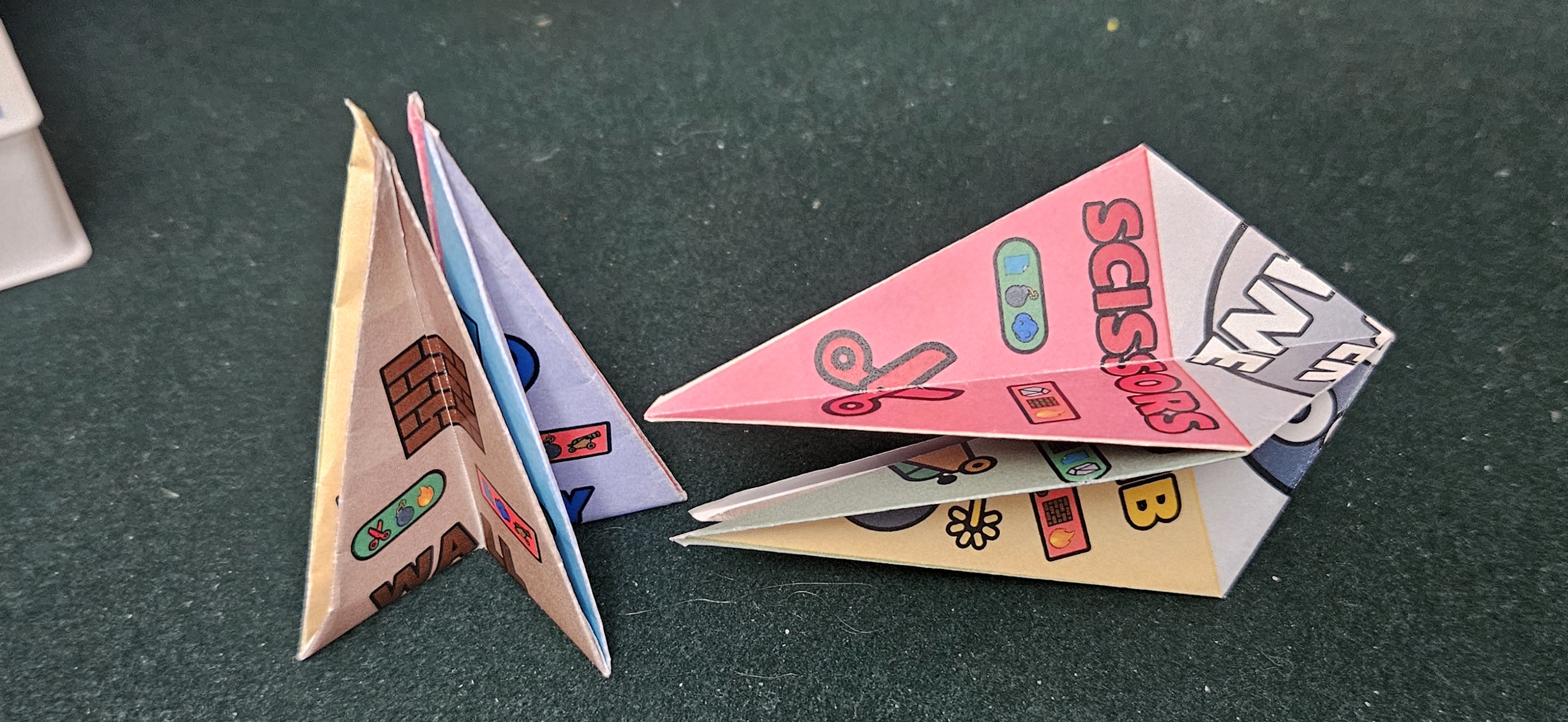
Crane, interrupted.
Once assembled, Rock Paper Crane is Rock Paper Scissors with extra steps. For one thing, there’s an extra piece, the bomb. For another, winning a throw means you upgrade one of your sides. (Pause for origami.) Rock becomes wall. Paper becomes clay. Scissors become fire. That sort of thing.
Your objective, ultimately, is to win four throws, which will bring you one step closer to a finished crane. More importantly, you will have won the game. Or lost it, which is just as good, because, like I said, Rock Paper Crane is Rock Paper Scissors with extra steps.
Did I finish my crane? Nope. I couldn’t remember past those first two steps. Honestly, it’s pretty amazing that I got this far at all. Maybe I could have looked up the next instructions. But I swore an oath to never finish an origami ever again, and I’m true to my word. Take that, Mary.
Putting coins on paper.
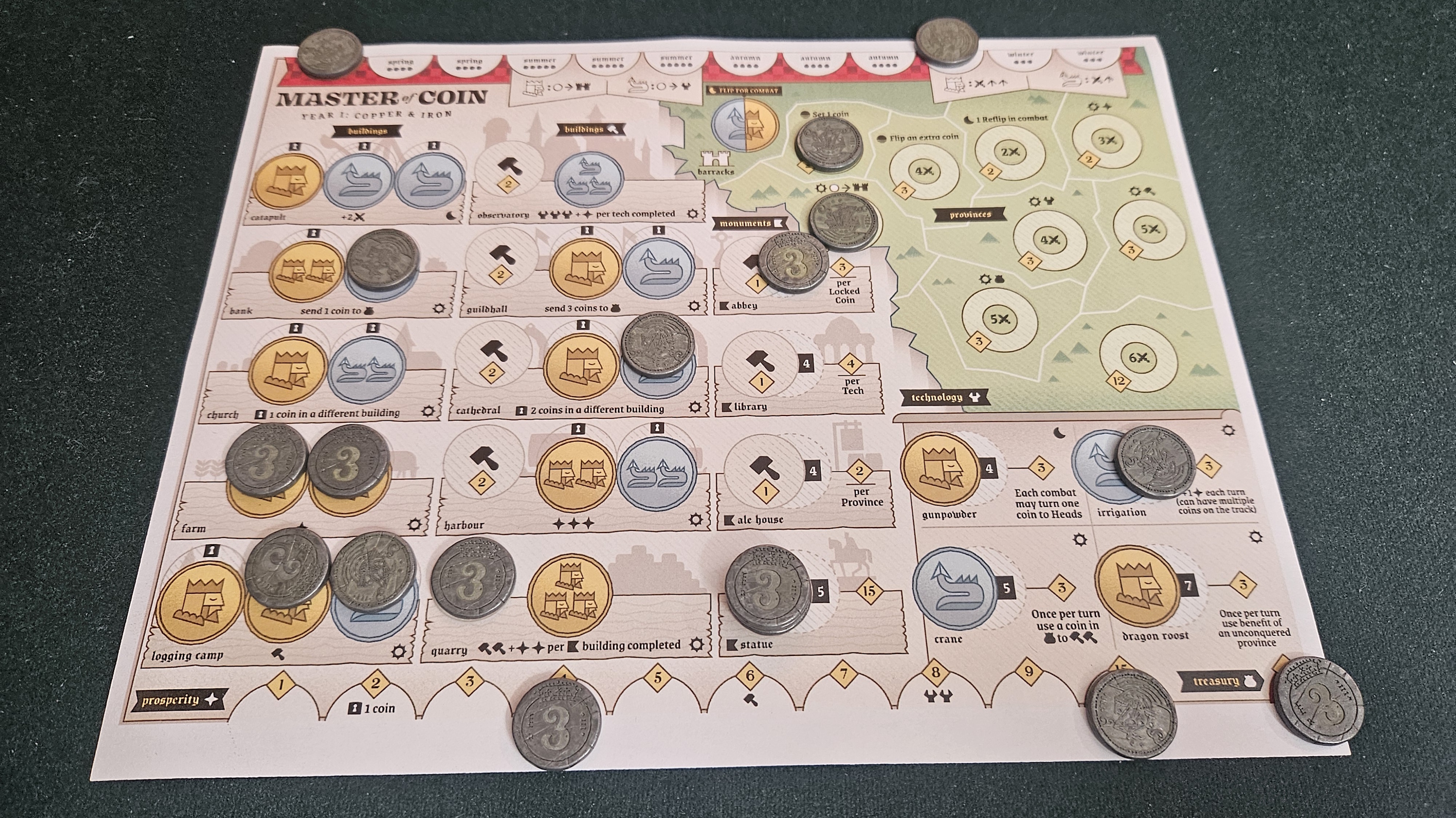
Master of Coin is the eighth title from Postmark Games that I’ve played, and this time Rory Muldoon and Matthew Dunstan are ditching the dice and the cards. Their replacement? Coins, of course. It’s right there the title.
As you might expect, Master of Coin makes good on its conceit by requiring you to flip so many coins that your fingers will start to smell rather pockety indeed. Covering a single year in the history of a small kingdom, you begin each month by picking up some number of coins — the exact quantity varies by season — and flipping them to determine how many heads and tails you have to work with.
Early on, your options are finite. A few basic buildings, some technologies, and any leftover orphans packed off to the army. But it isn’t long before the gameplay begins to accelerate. Once completed, you can clear a building of its coins to activate its ability, whether to unlock better structures, develop your nation’s economic infrastructure, obtain perks in war and peace, or maybe construct monuments that unlock better scoring benefits. Crucially, some abilities let you “lock” coins, sliding them a few millimeters upward on your sheet. From that point on, when you clear the corresponding structure, any locked coins stay in place.
As a concept, Master of Coin is solid. Consider the army. When it’s time to march on neighboring provinces, you pick up all the coins in your army and give them a flip. Heads become indicators of conquest, while tails are failures. But there are so many ways to massage the odds. Certain buildings, like the catapult, can be cleared to produce guaranteed successes in battle. Or there are techs, like gunpowder, that let you shift a coin from tails to heads, saving you in the nick of time. All this is to say that there are ample ways to get ahead. Even if you, as happened to our group, happen to play a session with novelty coins that always flip heads.
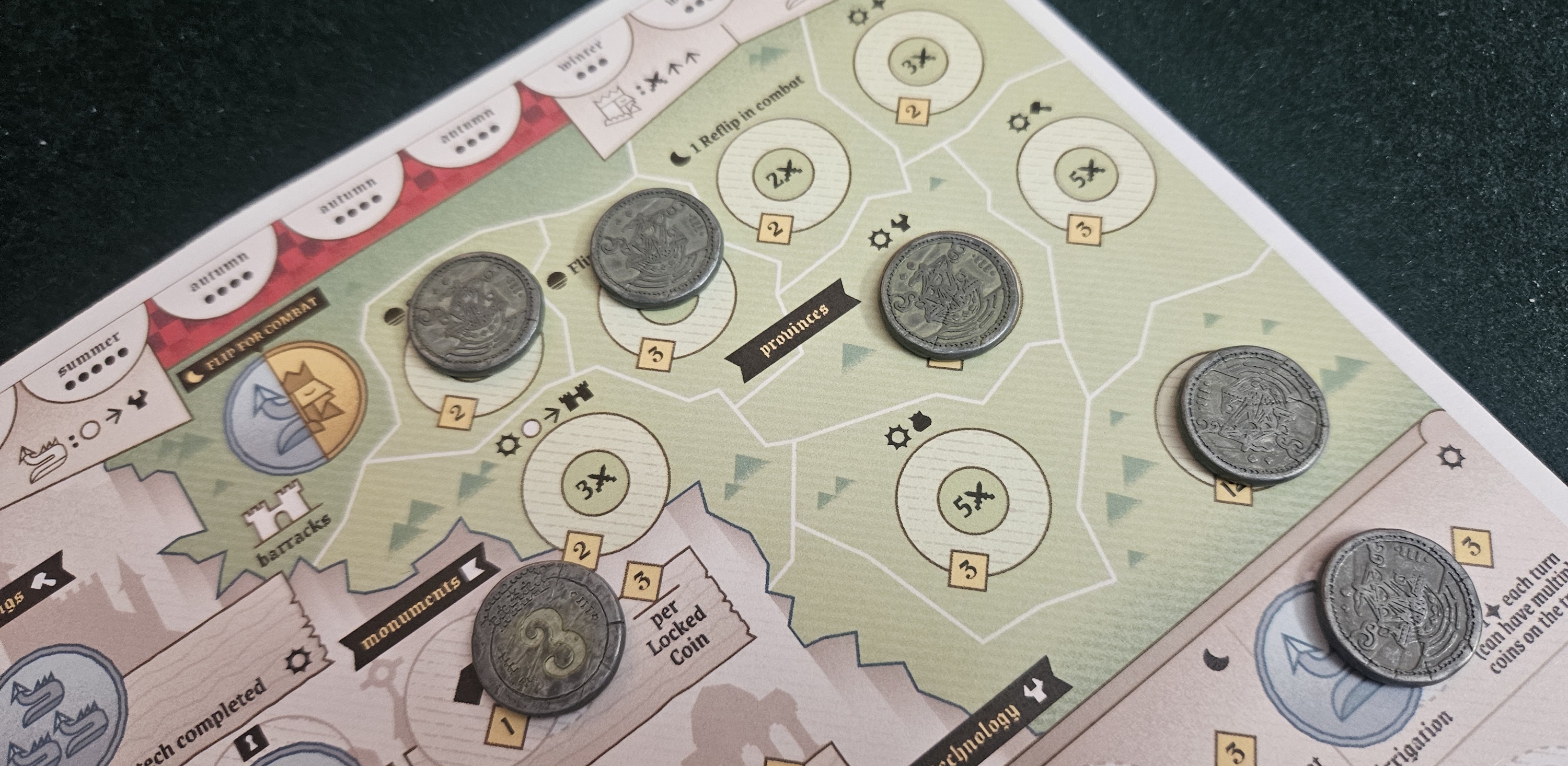
Money is great for conquering distant nations.
Of course, there’s more to be seen. As with previous Postmark titles, Master of Coin isn’t limited to a single map. The game is on Kickstarter right now, and according to the campaign there will be five scenarios in all, each adding a year to the story of this wealthy kingdom and its unfortunate neighbors.
Unlike those previous Postmark titles, however, I’ve only tried the first scenario, so I’m unable to furnish a full review at this time. The good news is that what I’ve played has been exemplary. Very quickly, I was surprised that my kingdom’s main limitation didn’t lie with having too little money, but rather in keeping too many coins tied up in other projects. The kingdom only has access to twenty coins, you see, and two of those are reserved for tracking the month and any possible events. It isn’t long before you’ll need to make some tough decisions, forsaking certain appendages of your financial project altogether to double down on whatever has become most important.
Anyway. After not being all that enthralled with Postmark’s playing card games, Master of Coin feels like a return to form, capturing some of the tight but expressive playspace of titles like Voyages and Waypoints. I’m excited to see how this one develops.

I love little fingers.
When’s the last time you colored by numbers? Being a parent to a recent kindergartner means it hasn’t been as long as it might have been otherwise, but this still isn’t a regular occurrence of my daily life.
Until Color Jam. Designed by Gene Koo and Joe Kell, and illustrated by Erin Laue, Color Jam is about coloring by numbers. And contrary to my expectations going in, it’s wonderful.
But first, a note. Color Jam is being published by Lunarpunk Games, the indie imprint operated by Xoe Allred and Matthew Hocker. If you’re elbows-deep in the indie scene, this might already tell you something about the game. Foremost, Color Jam doesn’t have the usual victory conditions. Nor does it really have goals, at least not goals of the foreordained variety. You’re here to make your own fun, set your own benchmarks, and, hopefully, come away charmed.

I am inordinately proud of my art.
The basic idea is as simple as it gets. You take a picture and six crayons. Then you color in two of the spaces with stars in them. There are always four options, giving you some range to where you begin on the page.
From that humble beginning, you start to color in the entire thing. But there are limitations. Beautiful, expansive limitations. For one thing, you can only color a cell next to something you’ve already filled in. More importantly, those six crayons? You put them in order, numbered one to six. When you color a space, you use the corresponding crayon. Then — and this is where the game starts to breathe — you take that crayon and shift it to the last place.
Now, this might not sound like much. But it transforms Color Jam from an elementary school project into something unexpected. You might want consistency. The wings of a butterfly to align, perhaps. But the right crayon might not be available. Or, when the right crayon comes up again, maybe you’ll want it for something else.
What do you do? Well, you get creative. Maybe this butterfly is prismatic, like a jeweled brooch, its colors vibrant but mismatched. The colors can become revelatory, streaks of the unexpected in what might have otherwise been an ordinary picture. Or maybe you start to plan ahead, counting the crayons down until the right one is ready for another scribble, transforming the page into a low-stakes logic puzzle. Or perhaps you get artistic. You can do a lot with shading, with the strokes of a crayon, with the application of a smudge or a smear. Two spaces that both use orange don’t need to look the same. This isn’t the paint bucket in an image editor. You can do whatever you like.

The artists.
More than that, Color Jam is flexible. It’s possible to play solitaire, one person making every decision. But it’s also possible to play as a group. I played with both of my daughters, and everybody got a say in the creation of our picture. Over which crayons we pulled from the bucket. Over the turn order. Eventually, over how to account for colors that wouldn’t quite fit where we wanted them.
The most unsurprising thing about Color Jam, but which bears repeating, is that it’s simply delightful. It’s soothing to play, but thinkier than one might expect from a distance. We played together, and then we all played apart. And then Summer came home and wanted to play as well, so we did that, too. In each case, we came away having crafted something wonderful, whether in collaboration or on our own, whether according to strict logic and long-term thinking or creative storytelling, and felt all the richer for it.
Color Jam will be on Kickstarter sometime in the next month or so.
Access to the files and/or complimentary copies of Rock Paper Crane, Master of Coin, and Paper Jam were provided by the designers.
(If what I’m doing at Space-Biff! is valuable to you in some way, please consider dropping by my Patreon campaign or Ko-fi. Right now, supporters can read the next installment in my series Talking About Games, this time tackling the topic of what makes a good list! Naturally, the piece includes a list.)
A review copy of Inkwell was kindly provided by Zatu Trade. Thoughts & opinions are my own. Inkwell is one of those games that makes you want to touch it. The soft closing of the magnetic clasp on the box. The cloth playmat. The satisfying heft of the little golden cubes. It’s a lovely thing. As far as draft and set-collection games go, it’s pretty decent. There’s a lot here to like…
We’ve all been there. You see a game, love the art, hear the hype, and think: “This is the one. We are going to grow old together.” But then the cardboard hits the table, you play it, and the spark just isn’t there. Not because they’re bad games, but because they just weren’t the right […]
Part of the fun of engaging with a system built around different characters, classes, species, or any other mode of substantive differentiation, is finding the build that’s right for you. Everyone who likes Root has a favorite faction, everyone who plays Magic has a favorite color, and the wonderful thing is that these preferences are almost always deeper than mechanics. If you’re lucky, if everything clicks, your chosen avatar feels like an extension of yourself. There is something about playing as the Lizard Cult that elicits a deeper joy for me. Am I going to win? Probably not, but boy I’m going to have a great time. Blue may leave me with no friends, but I’m enjoying myself.
Leviathan Wilds has been my favorite cooperative game for a while now, and while I was equally fulsome in my praise of the first expansion, it is only now with second expansion Shattered Peak that I can say I have found the Class for me. The Geomancer, one of three new Classes that join three new Climbers and eleven new Leviathans in this box, feels like home. All the builds in Leviathan Wilds are about running around and smashing infectious crystals, but the Geomancer is the first to mess with those troublesome fungal blooms. He can manipulate their values…
The post Leviathan Wilds: Shattered Peak Expansion Review appeared first on Meeple Mountain.



I stand by my 2024 review of the Pirates of Maracaibo base game: I think it is designer Alexander Pfister’s best work, a co-design with Ralph Bienert and Ryan Hendrickson based on Pfister’s 2019 release Maracaibo that completely eliminated the older original from my collection. It’s a race that shears off all the loose ends of Maracaibo, with better card play (the entire map is actually a series of cards), simpler combat, a more comprehensive use of the Exploration board, and a shorter playtime. It was one of the top 10 games I played that year, and I’ve played it more than 15 times in person and more than 100 times on Board Game Arena.
Pirates of Maracaibo: Commanders has a “raison d’etre”: Euro players like to have their asymmetric powers, so Commanders very much as a reason to exist. Pirates of Maracaibo: Bermuda Triangle is the latest expansion, but it is very much a mini expansion. There is a small deck of cards that can be integrated into the decks of the base game, there’s a single solo card, and there’s a single location card (the Kraken) that may or may not add a little flair…
The post Quick Peaks – Pirates of Maracaibo: Bermuda Triangle, Kittens in Space, Haunted Mouse, Trans-Siberian Railroad, Dirt & Dust appeared first on Meeple Mountain.
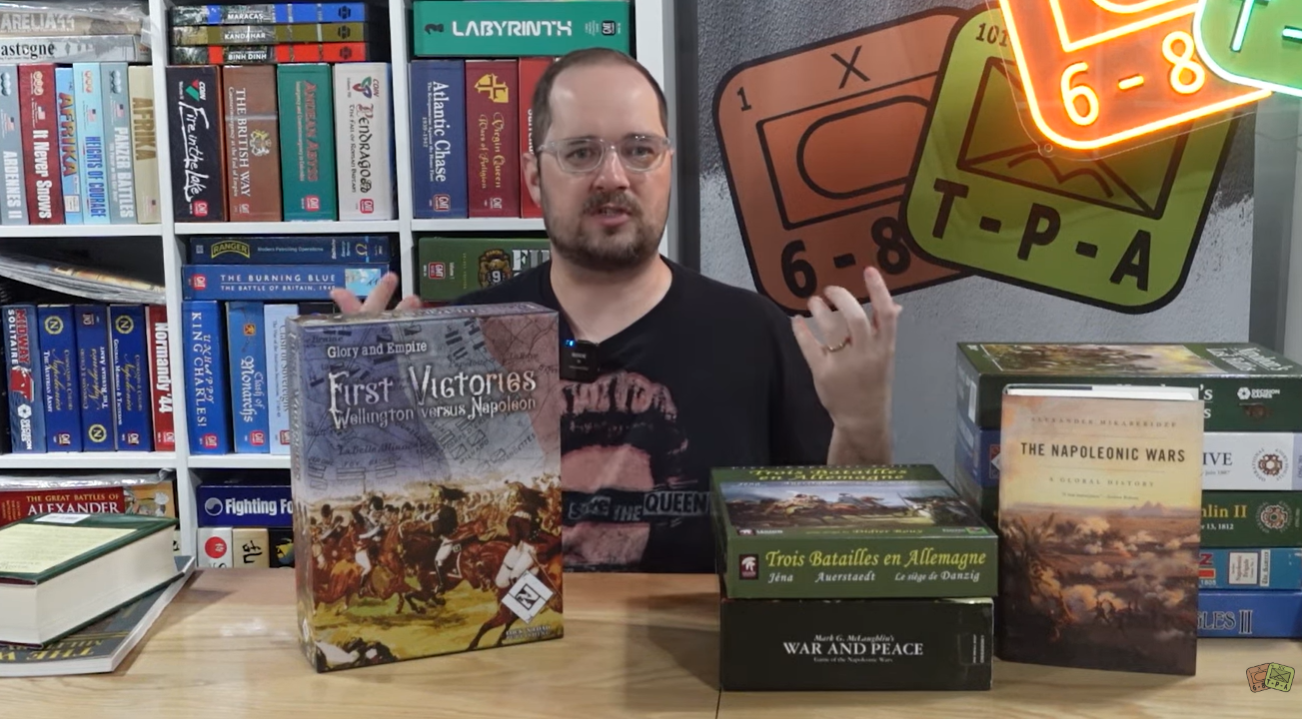
We have an ongoing video series on our YouTube Channel called From Cover to Cover where we read a book on a subject and then pair that with a discussion of the book while covering a few games also on the subject. In this 14th entry in the series, Alexander takes a look at The Napoleonic Wars: A Global History by Alexander Mikaberidze. He then discusses a few games on the subject including Congress of Vienna from GMT Games, Imperial Struggle from GMT Games, Alliance from Columbia Games, Commands & Colors: Napoleonics from GMT Games and The Napoleonic Wars from GMT Games. amongst many others
-Grant

/pic9390673.png)



/pic9225195.png)