Normale Ansicht

Solar Funk

17. Juni 2026 um 20:34

Nice laser. Or are you just happy to see me?

Remember those bad years when every other board game was a deck-builder? Solar Titans reminds me of that.

It’s not that Solar Titans is bad. Just that it’s perfunctory. This is a deck-builder the same way everything back then was a deck-builder. Its identity as a deck-builder makes zero sense. Its deck-builder systems run contrary to its fiction. It even commits the capital sin of deck-builders by letting each hand’s composition matter so much that everything else becomes secondary.

But let’s back up. Solar Titans. What’s it about, eh?
Bonk bonk bonk. That's the noise I imagine a solar titan making in space. Like a bumblebee knocking against a flower. Bonk bonk bonk.

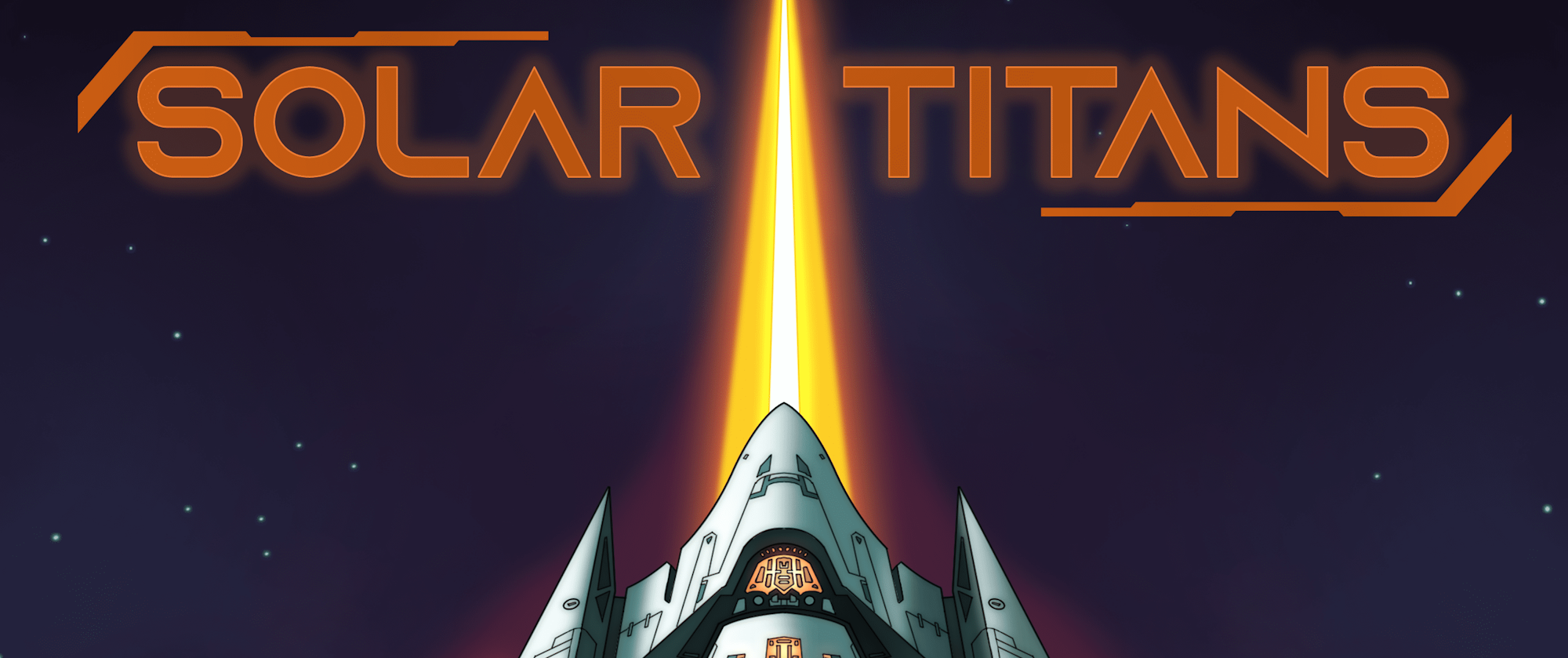
That’s a solar titan there. Yep.

On paper, Solar Titans ought to be my jam. My site is called Space-Biff!, for heaven’s sake, named for gigantic spaceships lasering and rocketing and otherwise exposing one another’s pressurized interiors to the hard vacuum beyond their eggshell hulls. So when Solar Titans claims to be about building and then ripping apart spaceships, I’m down to wrassle in the mud.

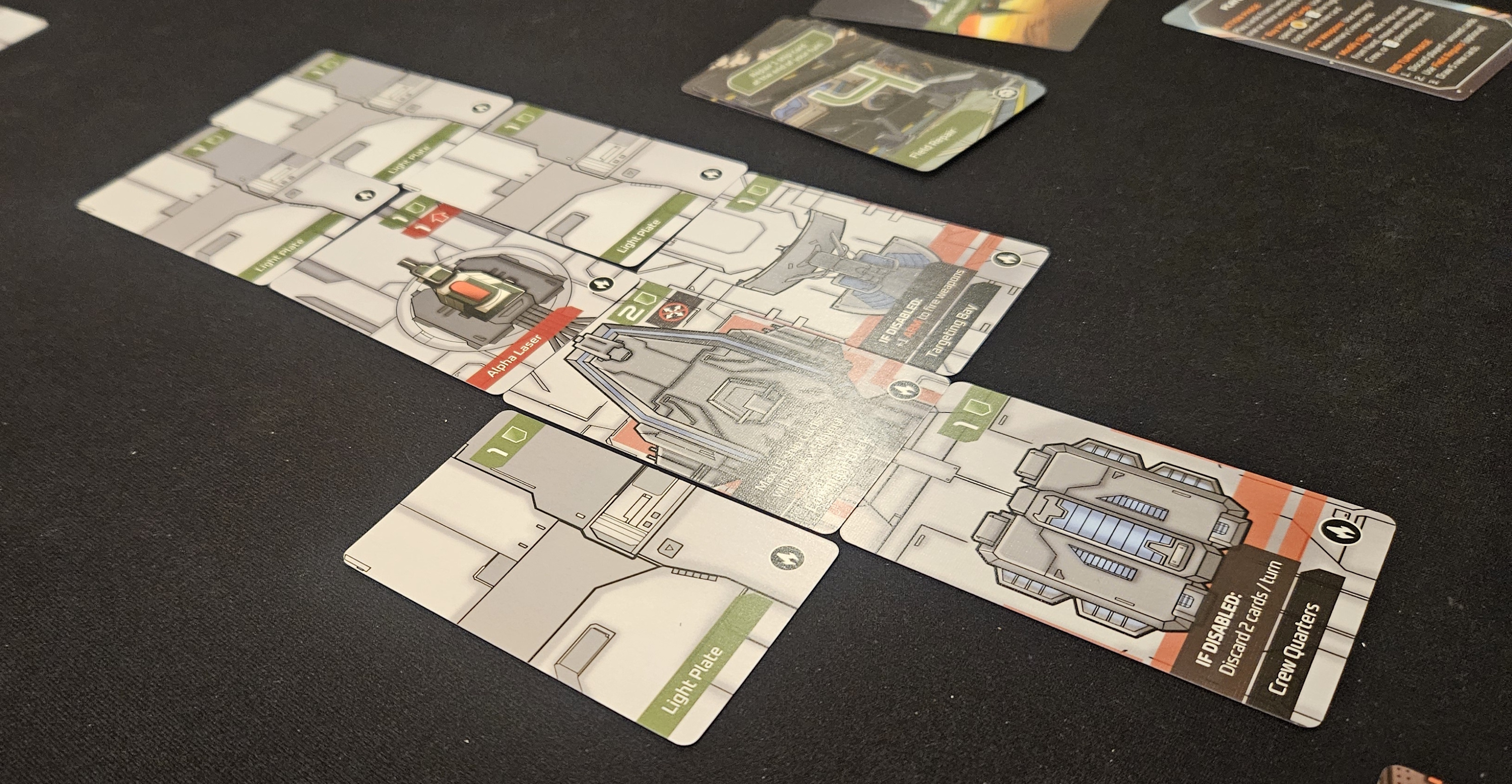
When the game opens, there’s nothing amiss. Players begin with a basic ship that includes the bare minimum systems to keep flying. There’s your command deck; sacrifice that and it’s curtains for your entire vessel. Crew Quarters, mostly there to keep your hand at a healthy size. The Targeting Bay, a really bad thing to lose if you want to continue pelting any enemy ship(s). One Alpha Laser, a basic weapon that will soon be more useful as armor. Finally, a few segments of light plating, the thin line between your squishy interior and the instant death beyond.

Cue the actual space-biffing. Procedurally, Solar Titans has a comfortable familiarity to it. Turns consist of playing cards. Early on, this takes two main forms. Arming Crew heats up your weapons, thus discharging your vessel’s arsenal at the opposing ship and flipping some portion of it face-down. Cargo Crew give you cash. Cash that you then spend on a variety of other ship components.

Those components make up the bulk of your decision space, and the marketplace that sells them is really two slightly separate offerings. The first is a static pool of reliable standbys, mercenaries for firing your lasers more often and better crewmembers that wield greater purchasing power. The second is more dynamic, a river of ever-changing cannons and armors that can be bolted onto your ship to improve its abilities mid-battle. By attaching the best katana beams, jammer plates, salvage crews, and other greebles to your ship, the odds that you’ll emerge victorious grow steadily greater.
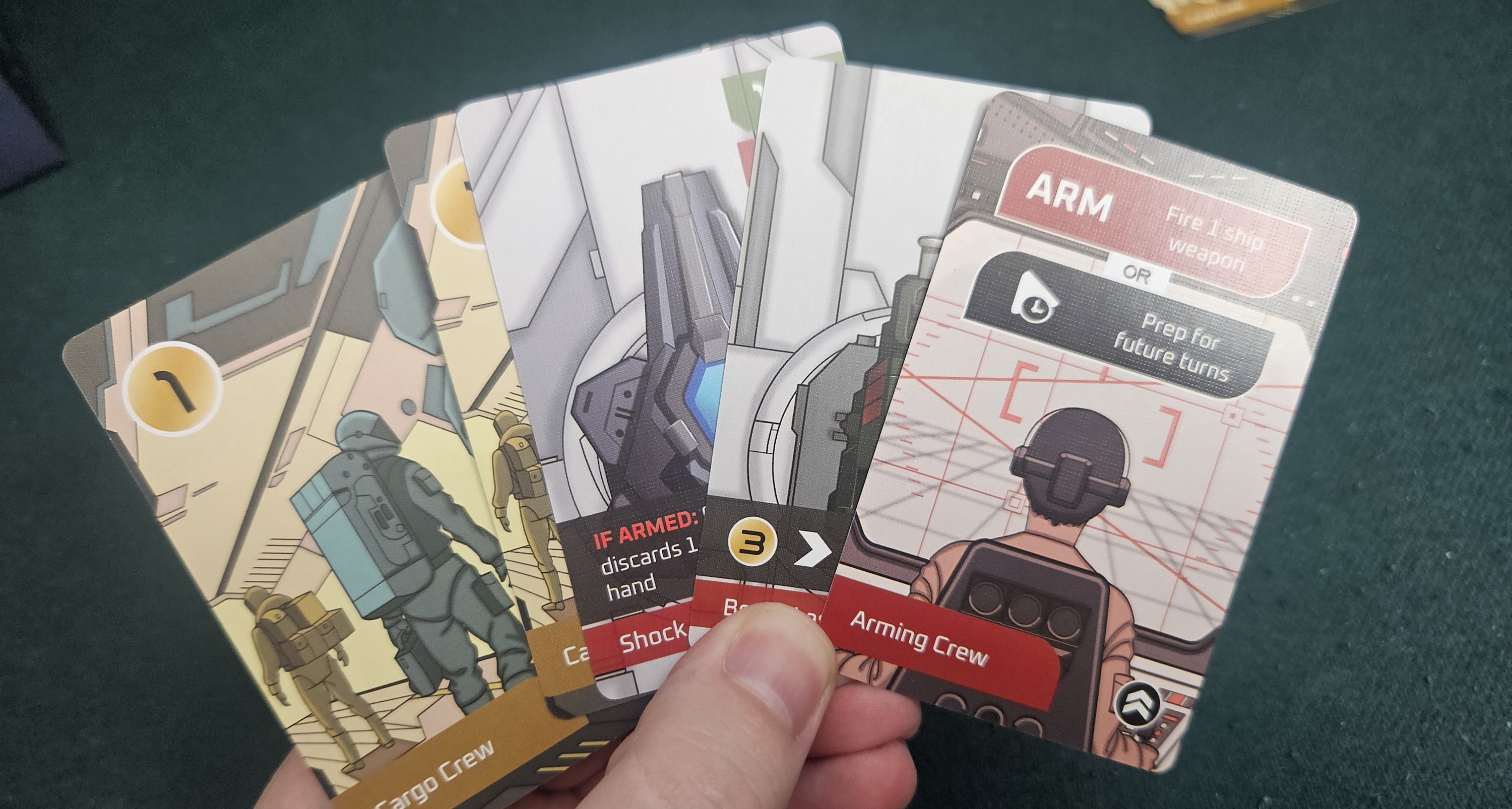
Solar Snooze Buttons, more like. Whammo!

This is an unusually exciting hand for Solar Titans.

As a game, Solar Titans works well enough. The deck-building and -cycling are functional, if not inspiring. There are no big ruptures in its fuel lines. But it still carries layered issues that prevent it from making that crucial jump to light speed.

Perhaps most superficially, I prefer to know what we’re doing in a game, to see the ways the actions on the player aids are reflected in the fiction and vice versa. So when our ships sprout entire missile pods mid-duel, there’s a part of me that recoils. It isn’t as though the HMS Surprise sprouted a fresh deck of cannons right before a broadside at the Acheron. Then again, this is the future. Maybe it’s nano-something. Quantum-whatever. Fine. I can live with that.

But making peace with the game’s fictive tempo doesn’t alleviate its drumbeat on the table. Buying a card means adding it to your discard pile. Only then will it eventually cycle through your deck to your hand, at which point it may bud onto your vessel like a spring blossom. This is the norm for almost everything in Solar Titans, but when it comes to ship components, it transfers the sum of your player agency to the whims of the deck. Will your phase cannon come online in time? Can you armor that essential section before it crumbles under enemy fire? Will your crew aim your whatever-beam before the enemy’s such-and-such plate grows to block the shot you’ve lined up? These are questions of which side draws the proper card in time.

Which might be palatable if only the game bothered to provide interesting verbs. Here, though, those verbs are limited to shooting and buying. Sure, there are varieties of cannons. Some smack the enemy vessel head-on. Others snake in from the side. Some are delayed. Others unleash pronged attacks that hit two sections of armor at the same time. But for the most part, damage is damage is damage. There’s none of the cleverness that marks space combat in fiction or other games. You’ll never reposition your ship. You’ll never set life support aflame. You’ll never deplete a vessel’s reactor. There are cards that gesture at such occurrences. Boarding pods. Energy beams. Nano-whatevers. But their results are damage, countered with repairs, back and forth until one side or the other chances upon the right combination of market cards and deck draws to carry the day.
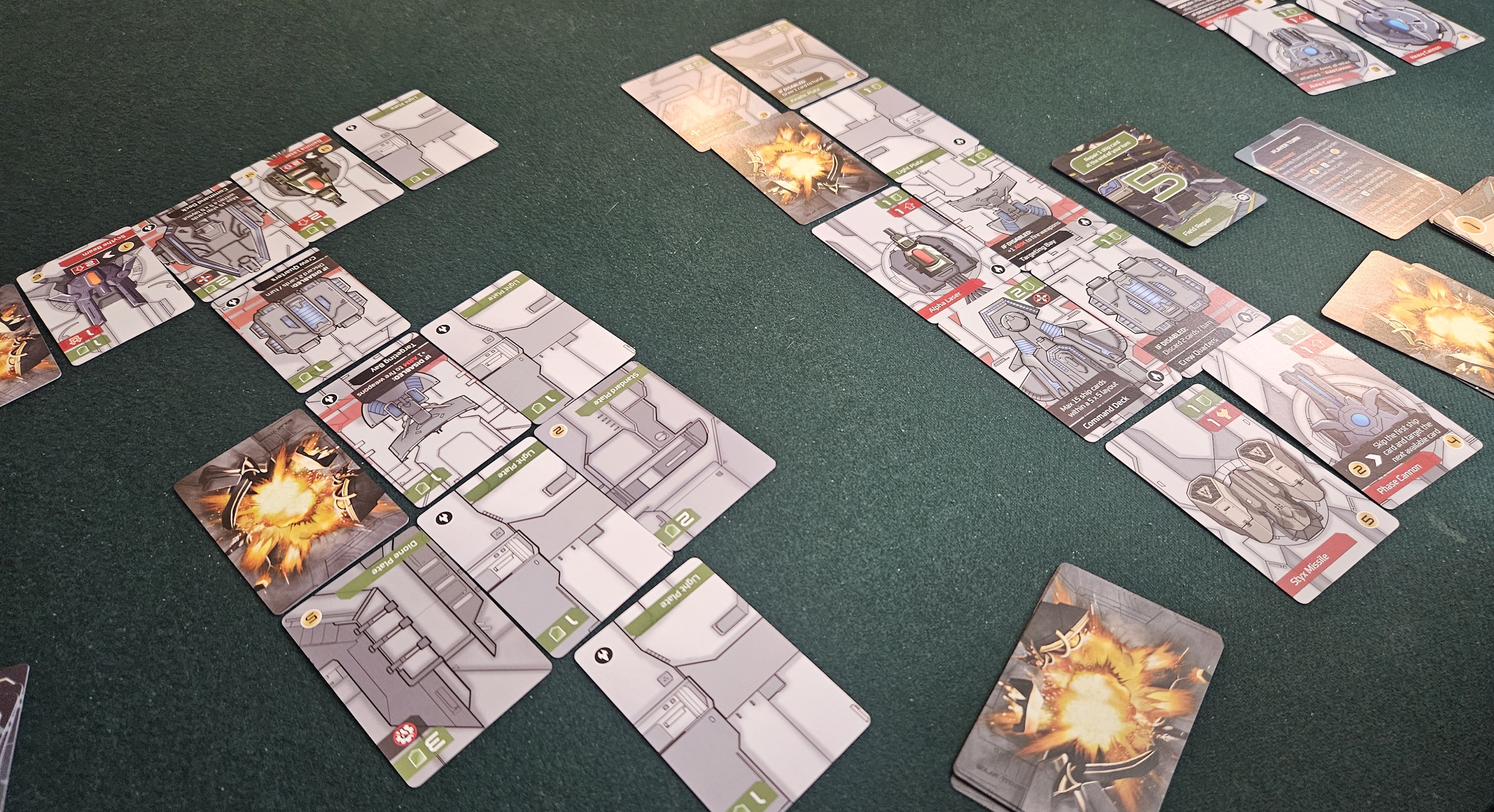
I think I would turn my ship away from enemy fire. But that's why I'm a once-a-generation space admiral. It's not my fault I was born into the wrong century.

Two solar titans really pounding each other.

It’s a shame. There’s a great deal of creativity on display here, including different play modes that see partnerships ganging up on mega-vessels. But it’s all funneled through such a filter that the result is an evolutionary dead end. This is no space-biff. Maybe a space-paff. And nobody’s going to name their website Space-Paff.


A complimentary copy of Solar Titans was provided by the designer/publisher.

(If what I’m doing at Space-Biff! is valuable to you in some way, please consider dropping by my Patreon campaign or Ko-fi. Right now, supporters can read the next installment in my series Talking About Games, this time tackling the topic of what makes a good list! Naturally, the piece includes a list.)

Party Crashers? No Worry! These New Games Handle 6+ Players!

by Steph Hodge

How about some games that will play with a higher player count? Here are a whole bunch of releases coming soon that will handle 6 or more players!

[imageid=9389228 medium rep]▪️ Synapses Games announced Medium: The Hand of Fate to be released Q3 2026. This will be able to combine with any previous Medium game you currently have. This game handles 2-8 players and is designed by Danielle Deley (Medium, That Old Wallpaper) and Nathan Thornton (Green Team Wins, Medium, That Old Wallpaper). This is a new standalone title.

From the announcement:
In Medium: The Hand of Fate, players team up in rotating pairs, each playing a word card and then attempting to say the exact same connecting word out loud, together, at the same time. Two optional modules — ESP cards and the new Prediction system — add layers of strategy, while a dedicated 2-player cooperative mode pits players against the mysterious Madame Fortuna. The game is also fully compatible with all other Medium titles.


▪️ Pandasaurus Games just announced Moustache. Originally published by Lumberjacks Studio in 2025. Now Pandasaurus is bringing us this team-based trick-taking game for 3-6 players. Look for this game at the end of August 2026.

From the newsletter:
In Moustache, you and your fellow players are a cast of gloriously mustachioed animals competing across four chaotic rounds of shifting alliances and evolving rules. Each round, fate assigns your teammates and introduces a new twist to the game. The result is a game that's equal parts charming and cutthroat, with enough chaos to keep everyone at the table guessing.

Moustache is a team-based trick-taking game for 3–6 players that plays in about 20 minutes. Players follow suit to win tricks, with card strength determined first by color (green → pink → orange → blue) and then by value. But nothing stays simple for long! Each round, a new rule card is revealed and stacks onto the previous ones, reshaping how tricks are won and scored. Cards valued at 2 automatically win their trick. Joker cards (the unicorn, monkey, and pigeon) let smaller teams punch above their weight. After 4 rounds, the player with the most points on their trophy tokens wins! And since those tokens are drawn randomly and kept face down, the final score is a surprise right up to the end.


▪️ Gigamic announced a new edition of Panic Lab is set to be released at the end of June 2026. This game was originally released in 2012 and has seen many iterations over the years. It's real-time chaos is back and will host 2-10 players in about a 30-minute playtime!

From the newsletter:
The amoebas have escaped, and it's up to you to catch them! Track them down by rolling the four dice to determine which amoeba you are looking for, and which lab they escaped from.

That sounds easy, but they might change their patterns or colors if they pass through a mutation device. Amoebas can also escape through the air vents as they run away, popping up through the next air vent in the circle!

The first player to lay their hand on the correct amoeba card collects a token, and the first player to collect five tokens wins!

Can you match the correct amoeba before your opponents? Panic Lab is a must-have for people with cool heads, sharp eyes, and fast hands!


▪️ Shapely is a new party game from R&R Games for 3-6 players! Your goal is to arrange your shapes so that other players can guess your word. You can play in just 30 minutes. I believe it is already available.

From the newsletter:
In SHAPELY, players use abstract shapes to create fun images.

To Play: Each player begins with 4 random abstract shapes. The goal is to arrange them as a clue to your secret item.

Then everyone tries to guess the items from the images. (Don't fret... Players do not guess items out of thin air. They only need to pick items from a line-up)


▪️ Finally, we have Who's Next? from Don't Panic Games. A new musical party game for 3-7 players. This is a hand management card game.

From the newsletter:
in Who's Next, everyone takes on the role of a musician in a band trying to hold it together through a concert. Players pass the spotlight around the table by playing Musician cards in the right order, at the right time — while an oral countdown ticks down. Miss your cue, play out of turn, or freeze under pressure, and you earn a Wrong Note. The player with the fewest wrong notes when the music stops wins. What makes Who's Next? stand out is its progressive level system: the base game is learnable in minutes, but six escalating rule layers keep the challenge growing as players get comfortable. It works equally well with kids on a Friday night or with competitive adults who think they have great reflexes. Spoiler: they don't.

Party Crashers? No Worry! These New Games Handle Up To 6+ Players!

by Steph Hodge

How about some games that will play with a higher player count? Here are a whole bunch of releases coming soon that will handle up to 6 or more players!

[imageid=9389228 medium rep]▪️ Synapses Games announced Medium: The Hand of Fate to be released Q3 2026. This will be able to combine with any previous Medium game you currently have. This game handles 2-8 players and is designed by Danielle Deley (Medium, That Old Wallpaper) and Nathan Thornton (Green Team Wins, Medium, That Old Wallpaper). This is a new standalone title.

From the announcement:
In Medium: The Hand of Fate, players team up in rotating pairs, each playing a word card and then attempting to say the exact same connecting word out loud, together, at the same time. Two optional modules — ESP cards and the new Prediction system — add layers of strategy, while a dedicated 2-player cooperative mode pits players against the mysterious Madame Fortuna. The game is also fully compatible with all other Medium titles.


▪️ Pandasaurus Games just announced Moustache. Originally published by Lumberjacks Studio in 2025. Now Pandasaurus is bringing us this team-based trick-taking game for 3-6 players. Look for this game at the end of August 2026.

From the newsletter:
In Moustache, you and your fellow players are a cast of gloriously mustachioed animals competing across four chaotic rounds of shifting alliances and evolving rules. Each round, fate assigns your teammates and introduces a new twist to the game. The result is a game that's equal parts charming and cutthroat, with enough chaos to keep everyone at the table guessing.

Moustache is a team-based trick-taking game for 3–6 players that plays in about 20 minutes. Players follow suit to win tricks, with card strength determined first by color (green → pink → orange → blue) and then by value. But nothing stays simple for long! Each round, a new rule card is revealed and stacks onto the previous ones, reshaping how tricks are won and scored. Cards valued at 2 automatically win their trick. Joker cards (the unicorn, monkey, and pigeon) let smaller teams punch above their weight. After 4 rounds, the player with the most points on their trophy tokens wins! And since those tokens are drawn randomly and kept face down, the final score is a surprise right up to the end.


▪️ Gigamic announced a new edition of Panic Lab is set to be released at the end of June 2026. This game was originally released in 2012 and has seen many iterations over the years. It's real-time chaos is back and will host 2-10 players in about a 30-minute playtime!

From the newsletter:
The amoebas have escaped, and it's up to you to catch them! Track them down by rolling the four dice to determine which amoeba you are looking for, and which lab they escaped from.

That sounds easy, but they might change their patterns or colors if they pass through a mutation device. Amoebas can also escape through the air vents as they run away, popping up through the next air vent in the circle!

The first player to lay their hand on the correct amoeba card collects a token, and the first player to collect five tokens wins!

Can you match the correct amoeba before your opponents? Panic Lab is a must-have for people with cool heads, sharp eyes, and fast hands!


▪️ Shapely is a new party game from R&R Games for 3-6 players! Your goal is to arrange your shapes so that other players can guess your word. You can play in just 30 minutes. I believe it is already available.

From the newsletter:
In SHAPELY, players use abstract shapes to create fun images.

To Play: Each player begins with 4 random abstract shapes. The goal is to arrange them as a clue to your secret item.

Then everyone tries to guess the items from the images. (Don't fret... Players do not guess items out of thin air. They only need to pick items from a line-up)


▪️ Finally, we have Who's Next? from Don't Panic Games. A new musical party game for 3-7 players. This is a hand management card game.

From the newsletter:
in Who's Next, everyone takes on the role of a musician in a band trying to hold it together through a concert. Players pass the spotlight around the table by playing Musician cards in the right order, at the right time — while an oral countdown ticks down. Miss your cue, play out of turn, or freeze under pressure, and you earn a Wrong Note. The player with the fewest wrong notes when the music stops wins. What makes Who's Next? stand out is its progressive level system: the base game is learnable in minutes, but six escalating rule layers keep the challenge growing as players get comfortable. It works equally well with kids on a Friday night or with competitive adults who think they have great reflexes. Spoiler: they don't.

Designer Diary: boop. Shuffle

Von: ia2ca
17. Juni 2026 um 17:50

by Scott Brady

Three years later and I am no better at keeping ongoing notes about my design journey than I was when I penned the Designer Diary for boop. I usually become so focused on my projects that I’ve never found space to step back and write down what works and what doesn’t. Sadly, many of those processes will never be known and I know I’m the one to blame.

I am immensely proud of what we (Smirk & Dagger and I) have accomplished with the release of boop.and its subsequent releases, Boooop. and boop the Halls! With each new edition I wanted to make sure to give the consumers something more than just a cool skin. Each game needed to offer something new and different. Making changes to the tight, elegant gameplay of the original proved much harder than I anticipated. In the end, the right solution for both versions was to introduce unique rule-changing characters and items that supplemented gameplay and didn’t change the core.

Progression of the Brand

We have been discussing the future of the boop. line for some time, wondering if it should ever expand beyond being a true combinatorial abstract game. So far, we had followed the same pattern and still have one more unannounced entry coming in 2027! Don’t worry, it’s not another holiday-themed version. And the gameplay is my personal favorite of the series! I cannot wait to tell the world more!

Conception

In the meantime, I began thinking about how the boop. experience might be utilized in other game types, either by theme or mechanic. I’ve often heard stories about how people made bags for their copies of boop. to make it more portable. I began playing around with the idea of playing cards and what I would need to do to make an official travel version.


It would have been easy enough to just make a 1:1 conversion of boop. into cards with no rule changes. Basically, just a component twist. This would have been the exact opposite of my philosophy above where I wanted it to be more than just a reskin. The game needed to stand on its own with something unique. That’s when the idea hit me – you could play each other’s felines!

How the Game Grew

The cool thing about using cards is you get to shuffle a deck. No longer do you have a choice of what to play, you must play the card drawn. Not only did this mean you didn’t know if you were going to play a cat or kitten, because all the cards are shuffled into one deck (instead of player decks), it meant you could end up playing a cat or kitten of your opponent’s!

Hence the final name – boop. Shuffle!

Talk about an instant strategy change! The mechanics remained the same, but the thought of leaving behind one of your opponent’s cards instead of your own changed the game quite a bit. I also envisioned the bed to be virtual, allowing for play on any surface.


The edges of the bed would shift as the play area filled with cats. I felt this simple change with the deck of cards and virtual bed was the right thing to show to Smirk & Dagger for consideration.

They liked it…kinda…

Rejection?

They agreed it was a great interpretation of the original game, but they wanted more. Their vision of a card game version was less focused towards a classic abstract, but one that had more surprises and thematic elements. I admitted I could see that too.


As any great partner, they came up with several ideas which we ended up working together on implementing. There are wild cards that can be used by either player. Actions on certain kittens and cats you might recognize from boop the Halls! And then there was the blankie…

In what I will call the cutest mechanic to ever be in a board game, boop. Shuffle includes a blanket card. When drawn, you place it on top of any kitten or cat on the bed. While napping under the blankie, they don’t exist in the playfield. In order to count them towards a 3-in-a-row they must be uncovered! The blanket can be booped like any other item. When they are booped onto another cat, they now nap! If they are booped into an open space, the blankie is removed from the board and put into the discard pile.

Cutbacks

All of a sudden we have a lot more chaos happening with the blanket, action cards, wild cats and a virtual bed. Maybe a little too much overhead for the market we’re targeting, so we elected to remove the virtual bed, relegating those rules to an “advanced version” in the back of the rulebook.


Instead, we include neoprene bed skirts to define the board edges. These also roll up nice and tight to remain portable without adding too much cost to the product. In the end we were able to offer this new boop. experience for half of the retail price of the original game!

Release

boop. Shuffle had an official release date in the US of May 1 and you can already find it on the shelves at your favorite local game store and Barnes & Noble. Smirk & Dagger offers it directly on their website and will have copies available at Origins Game Fair, Gen Con and PAX Unplugged. I’ll be in attendance as well if you would like me to teach it to you myself!

Scott Brady

Toy Battle Review

17. Juni 2026 um 15:09
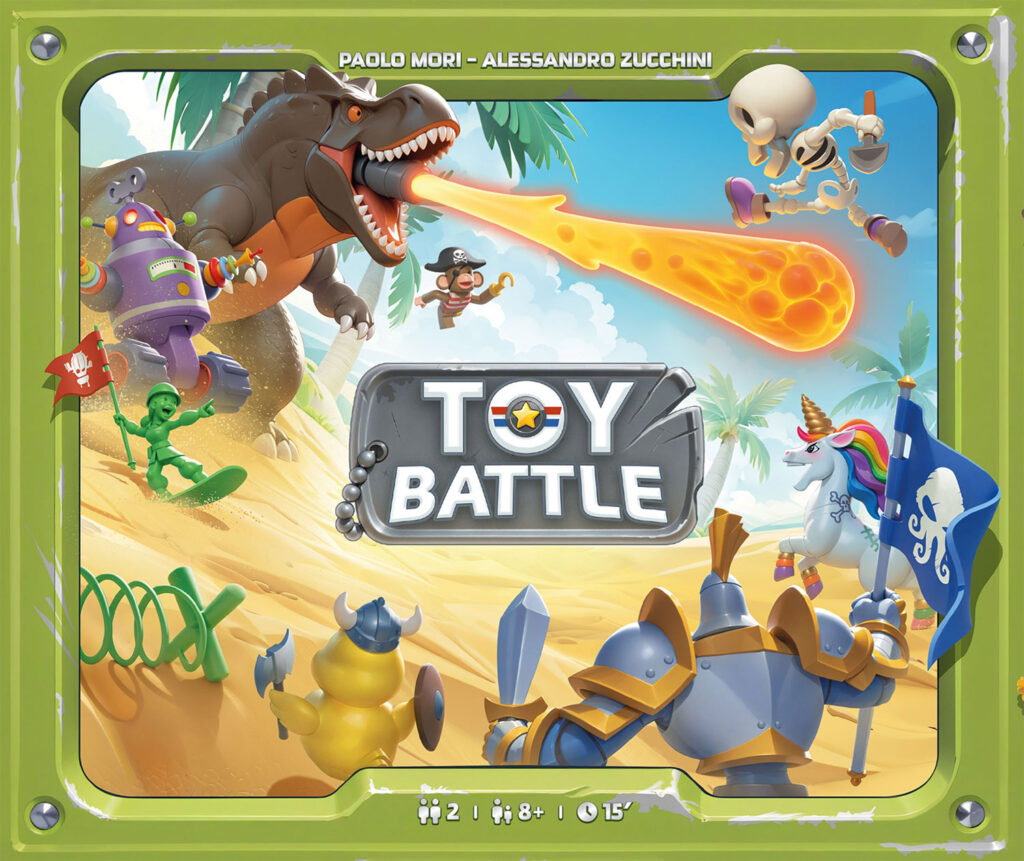
Toy BattleThis is a guest post from Ivhan Rusli If the mobile video game Clash Royale and the Disney movie series Toy Story had a board game baby, you’d have Toy Battle! Similar to Clash Royale, Toy Battle is a quick, two-player tactical game where you’re aiming to secure objectives by placing troops and using their […]

Source

Spokes Game Review

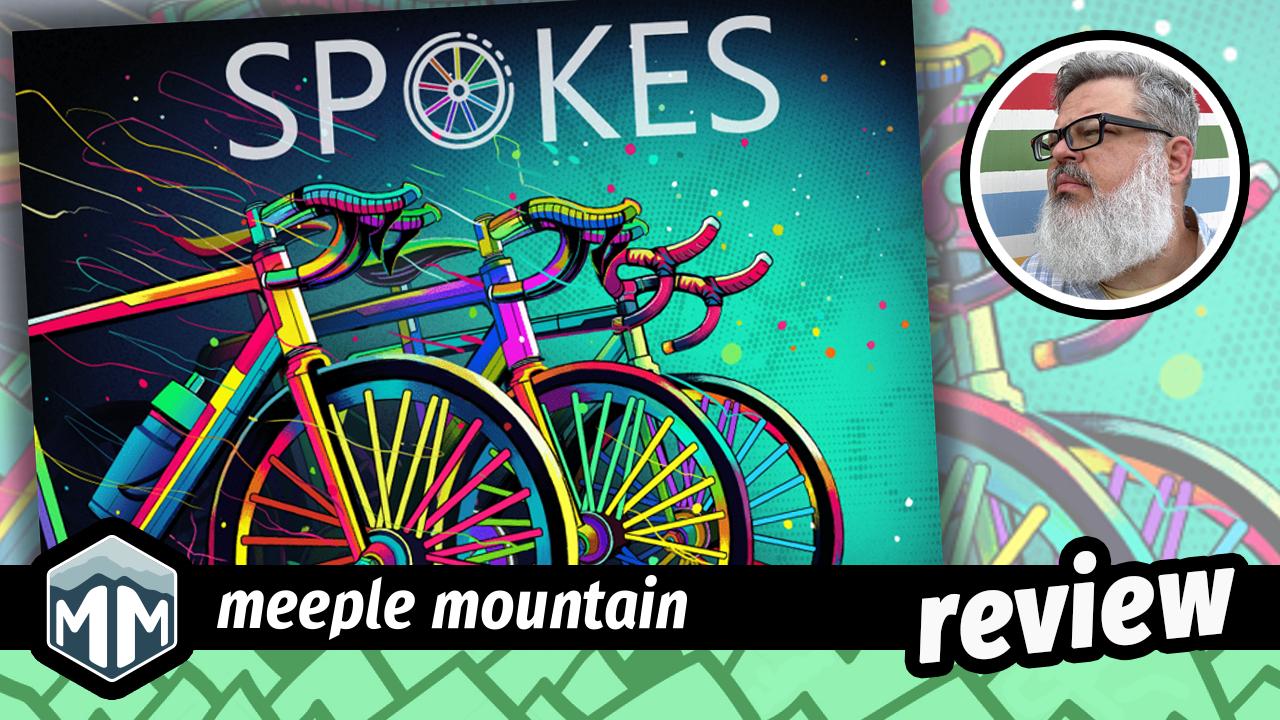
Full disclosure: I know nothing about the world of velodrome racing (aka indoor cycling); other than they ride bicycles, really fast, at angles that would make a mountain goat sweat. But the brightly colored artwork for Spokes, the new release from Radical 8 Games, drew me in. And while you might not be able to judge the game by its cover, you can guarantee that it will get my attention.

I don’t know anything more about the sport after several plays of Spokes, but I can tell you that I had a lot of fun. Let me tell you about it!

The track is calling. Are you ready?

In Spokes, 1-6 players speed around an oval track, trying to be the first to complete 3 laps. You accomplish this by moving along routes, composed of colored bars (spokes), initially placed randomly on the track. Move as far as you can on a single color, before ending your turn.

Each player has a personal board that guides and restricts your movement for a turn. On your turn, you move the spoke marker cube on your player board one, two, or three places clockwise.

The post Spokes Game Review appeared first on Meeple Mountain.

BGI 424

Von: admin
17. Juni 2026 um 10:08

BGI 424 The One About Game Industry Restructuring and Layoffs 

Board Games InsiderJoin our Guild on Board Game Geek Guild | Like us on FB

Social media:

Ignacy Trzewiczek / Portal Games: website | FB | Twitter | Youtube

Corey Thompson / Above Board TV:  website | Youtube

Stephen Buonocore / “The Podfather Of Gaming”: website | FB | Twitter | Youtube

Intro Music: Happy Rock – Bensound.com

💾

Kings of War Fantasy Battlefield Set Review

17. Juni 2026 um 00:05

I do not traffic in colloquialisms.

Peter paints and reviews a box full of tabletop terrain for Mantic’s Kings of War!

If you’re new to fantasy tabletop miniatures games, you might be daunted by the prospect of assembling a tabletop’s worth of appropriate terrain. Mantic have you covered twith this new Kings of War Fantasy Battlefield Set however! I’ve painted up the whole set and share my thoughts on it in this video. Enjoy!

By the way, don’t forget to download my rules & reference for Kings of War – you’ll find it in Tabletop Codex too!

Making high quality tabletop gaming content at the EOG takes time and money. Please consider becoming a Patreon supporter or making a donation so I can continue this work! Thankyou!

Making Games Shine on BoardGameArena (BGA)

by Jeff Grisenthwaite

I’ve been playing games on BGA since 2014, but it wasn’t until this past year that I made the leap to developing games on BGA.

My goal is to start a discussion about what I’ve learned about making gameplay feel just right within the unique environment of BGA, using examples from a couple of my games, Soothsayers and Positano.

Simulating that Board Game Feeling

BGA is weird.

It’s a huge collection of online games that bear little resemblance to the experience of console, PC, or mobile games. Instead, BGA strives to replicate the feeling of playing board games together in real life for all those times when we can’t actually be gaming together.

And they connect players with the whole world. One of the tenets of BGA development is to stick to pretty basic, vanilla code, in order to make the games widely accessible, regardless of players’ hardware or browsers.
For Positano, the big challenge was to capture the 3D look and feel that people love about the game but to do so in the 2D non-dynamic world of BGA.

Side-by-side images of Positano in real life and Positano on BGA

The solution was to simulate the 3D hillside and buildings simply by layering images at a fixed angle. It retains the beauty of the physical game, while keeping the technical approach as basic and widely accessible as possible.

Teach Through Play

I don’t know about you, but I try to use BGA as a shortcut to avoid reading rulebooks. The tutorials are great (shoutout to Nekonyancer!), but what can be even better is when the BGA adaptation teaches players as they play.

Here are a few techniques that help to teach the game to new players:

Tooltips: When players hover over a card or other component, showing a zoomed-in display of that component, along with explanatory text, helps players to access additional information when needed.

In Soothsayers, players can hover over any card to view detailed information about it.

Title Bar Text & Buttons: BGA’s standard convention is to present the choices available to a player on a given turn as buttons in the title bar. To help players learn the game, dynamically update the text in the title bar and the text and icons on the buttons to best inform players of their options.

In Soothsayers, buttons explain the costs and effects of each action.

Player Panels: Summarizing key information within player panels, particularly scoring, reinforces for players the important metrics to pay attention to.

In Positano, the player panels help players to understand how each building they construct affects not just their overall scores, but provides detailed scoring for sea views, gelato, and three different public goals.

Animation: Using animation in key places can help players understand the effects of their actions and notice changes in the game state. For example, in Soothsayers, when you use the Judgement tarot to steal a Fate token, the Fate token flies from the rival’s card to yours.

How To Play Rules: Because BGA automates the setup and administrative steps between turns and enforces the rules during play, the text of the How to Play tab below the game can likely be 90% shorter than the full rulebook.

Undo

Before I started development, I asked game communities within Discord and on Bluesky what are their biggest points of frustration with games on BGA. The most common complaint was when games don’t provide the ability to undo your last action or reset your turn.

There are two main reasons for providing the ability to undo at key points:

1. New players are learning the game. After seeing the consequences of their actions, they may need to retry a few turns.

2. Errant clicks. BGA is trying to simulate the tabletop game feeling with as high of fidelity as possible, which is why it feels so bad to have your turn ruined by accidentally clicking or tapping on something and having no recourse.

Not every single action needs an undo, though. Providing too many can slow down games, and players should never be able to undo an action after hidden information is revealed.

In Soothsayers, after completing your turn, a Confirm button displays with a 5 second countdown before it auto-confirms. If you’re not satisfied with your turn, you can choose to reset.


Layout Considerations

The second biggest player complaint is when BGA games require too much vertical scrolling to understand the game state, so here are a few techniques to reduce the need to scroll:

Robust Player Panels: By displaying all the key information within player panels, players often can bypass needing to view opponents’ tableaus or auxiliary boards.

In Soothsayers, the player panels display the levels of all 8 cards in each player’s tableau, who holds the Fate tokens, coins, and the number of cards in each player’s hand.

Floating Hands: Many games demand that you play a card or tile from a hand to a tableau or place on the board. By anchoring the hands to the bottom of the screen and allowing them to float over everything else, players can always view the cards in hand when making the decision for where to play them.

Responsive Design: To accommodate players on tiny mobile screens, on ultra-wide monitors, and everywhere in between, responsive design techniques should be employed to make the best use of every screen size.

In Positano, the goal cards are displayed below the beach board on mobile, but when on a larger monitor, they're displayed to the left of the hillside.

Player Preferences: We’re all different people. BGA games should reflect that by providing ample player preferences to tailor the game experience to your needs.

Soothsayers player preferences include options to change the card size, remove pulsing animations, and more.

Turn-Based Play

Some games work really well in BGA’s turn-based (asynchronous) play mode. These tend to be games with chunky turns, in which you’re making big moves each turn, as opposed to micro-decisions interrupted by other players. Turn-based play on BGA lets you luxuriate in over-analyzing your strategy without worrying about holding up the game.

A few techniques for making turn-based play go a bit smoother include:

Automate Non-Choices: By identifying the spots in the game in which players don’t have an actual choice to make, you can save everyone a lot of time by automating those decisions.

Provide a Robust Log: Sometimes days pass between turns, and other times players are playing multiple turn-based instances of the same game at once, so it’s important to provide a detailed, easy-to-scan log that players can use to catch up on the most recent turns.

In Soothsayers, the log provides small renditions of the cards drafted or played to make it easier to scan.

Simultaneous Decisions: BGA offers a mode in which players can all take their turns at the same time, which can massively reduce the amount of time it takes to complete a turn-based game.

Developing on BGA

Programming games on BGA is not easy. It takes a long time, and the documentation could be more robust. The upside is that BGA connects your game with a global audience who can compete at the highest levels.

My hope with this article is to share what I’ve learned as I strive to provide an ideal BGA experience for my own games.

I’m also hoping to start a conversation! What else can developers do to provide better BGA experiences?

Jeff Grisenthwaite is the designer of Positano and Soothsayers, both available in stores and on BoardGameArena.

My Shelfie Game Review

Buy My Shelfie from Amazon.com

While I consider myself an avid board gamer, I also feel like that label is a bit of a conundrum. I prefer medium-weight (based on BoardGameGeek’s complexity rating scale) games, but my collection primarily consists of light to medium light-weight games. Many of those in my collection fall into the party category with simple player actions, and minimal scoring complexity.

This odd contrast between preference and reality stems from the groups that I typically game with, as they prefer lighter experiences. Unintentionally, this has led me to being somewhat of a gateway game connoisseur.

My Shelfie checks a few important boxes for what makes a great gateway game: connection to a well-known classic game, easy-to-understand mechanics, and a relatively short playtime. The big question is, does the rest of the game hold up, or does it teeter off the shelf and fall apart?

A Classic Connection

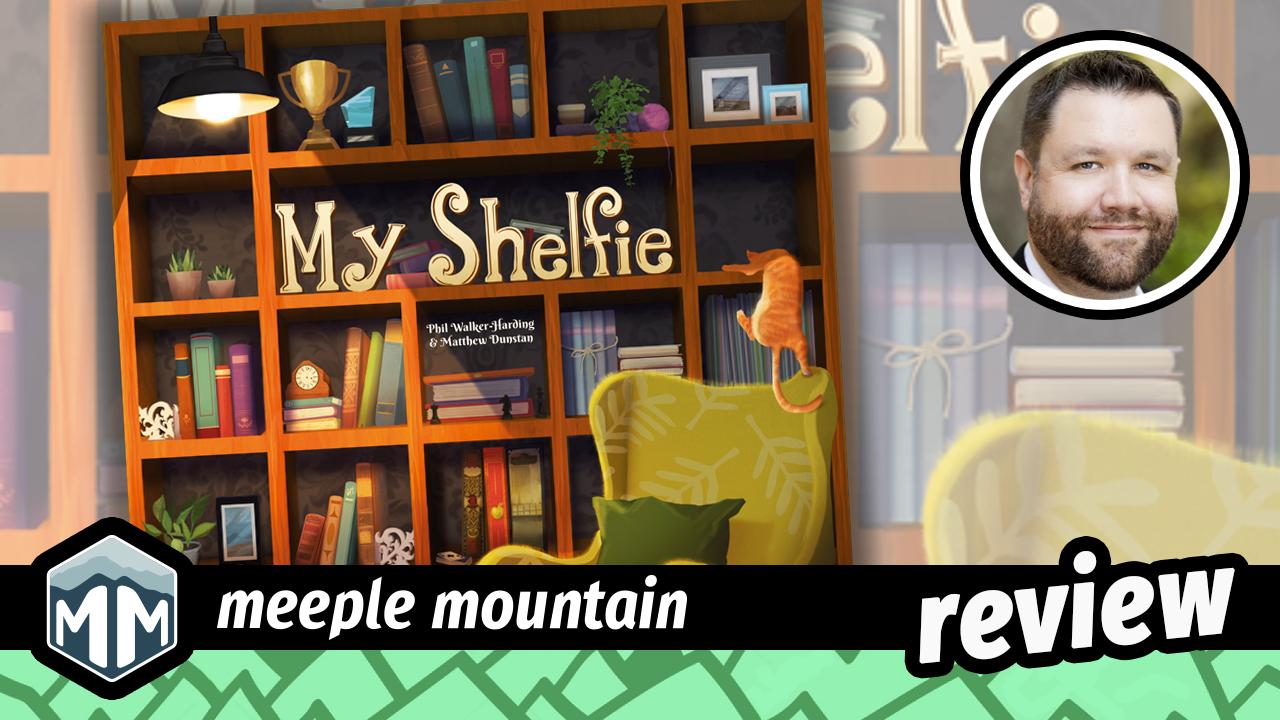
In My Shelfie, players compete to earn the most points by filling their ‘bookshelf’ with ‘items’. Each player's bookshelf is a vertically displayed grid that holds up to 30 items. After seeing the bookshelf setup, some players will already see the connection to the well-known classic game Connect Four. While the bookshelf holds square items instead of…

The post My Shelfie Game Review appeared first on Meeple Mountain.

My Favorite Wargame Cards – A Look at Individual Cards from My Favorite Games – Card #82: Good Omens from The Wars of Marcus Aurelius: Rome 170-180CE from Hollandspiele

Von: Grant
16. Juni 2026 um 14:00

With this My Favorite Wargame Cards Series, I hope to take a look at a specific card from the various wargames that I have played and share how it is used in the game. I am not a strategist and frankly I am not that good at games but I do understand how things should work and be used in games. With that being said, here is the next entry in this series.

#82: Good Omens from The Wars of Marcus Aurelius: Rome 170-180CE from Hollandspiele

The Wars of Marcus Aurelius: Rome 170-180CE is a solitaire only game that uses cards similarly to a CDG to simulate the strategic level struggle of the Romans led by Marcus Aurelius to stave off the invasions of Germanic tribes and Sarmatian raiders as they encroach on Roman territory across the Danube River. That’s the history. And it is really well integrated. The game play is very fun, strategic, with lots of decision points about what to do and what cards to use, and it is really challenging.

In the game, the Roman player has a deck of Roman Cards that can be used for the printed events for various effects or that can be discarded to take any number of actions such as attack a Barbarian army or Off-Map Conflict enemy, advance the marker on the Imperium Track, add two Level 1 Forts to any eligible map spaces, flip one Level 1 Fort to a Level 2 Fort among several other actions. Sometimes the printed events in the game are just more powerful than discarding a card for just 1 action so you have to pay attention to this economy and make sure you get the most out of your cards. Now, keep in mind, sometimes discarding a good card whose ability is not right for the current situation you find yourself in is part of the game but you have to use these cards wisely to do well in the game.

The game uses two separate decks of cards including the Barbarian Deck (Green) and The Roman Deck (Red). Both of the decks are made up of 50 cards each but each have very different purposes. The Barbarian Deck is used to determine the actions of the invading Germanic tribes as well as events that effect the war effort including mutinies, plague and the will of the people. While the Roman Deck provides the resources and events that are used by the Roman player to mount a defense against the invasions and to fight back each of the different barbarian tribes. There are unique cards called Late War Cards in the deck that will be held out until the start of the 175CE turn at which time they will be mixed in with the cards to form a new Late War Deck. There are also special cards that are marked with an asterisk that if played for the event will be discarded from the game to form what is called a History Pile.

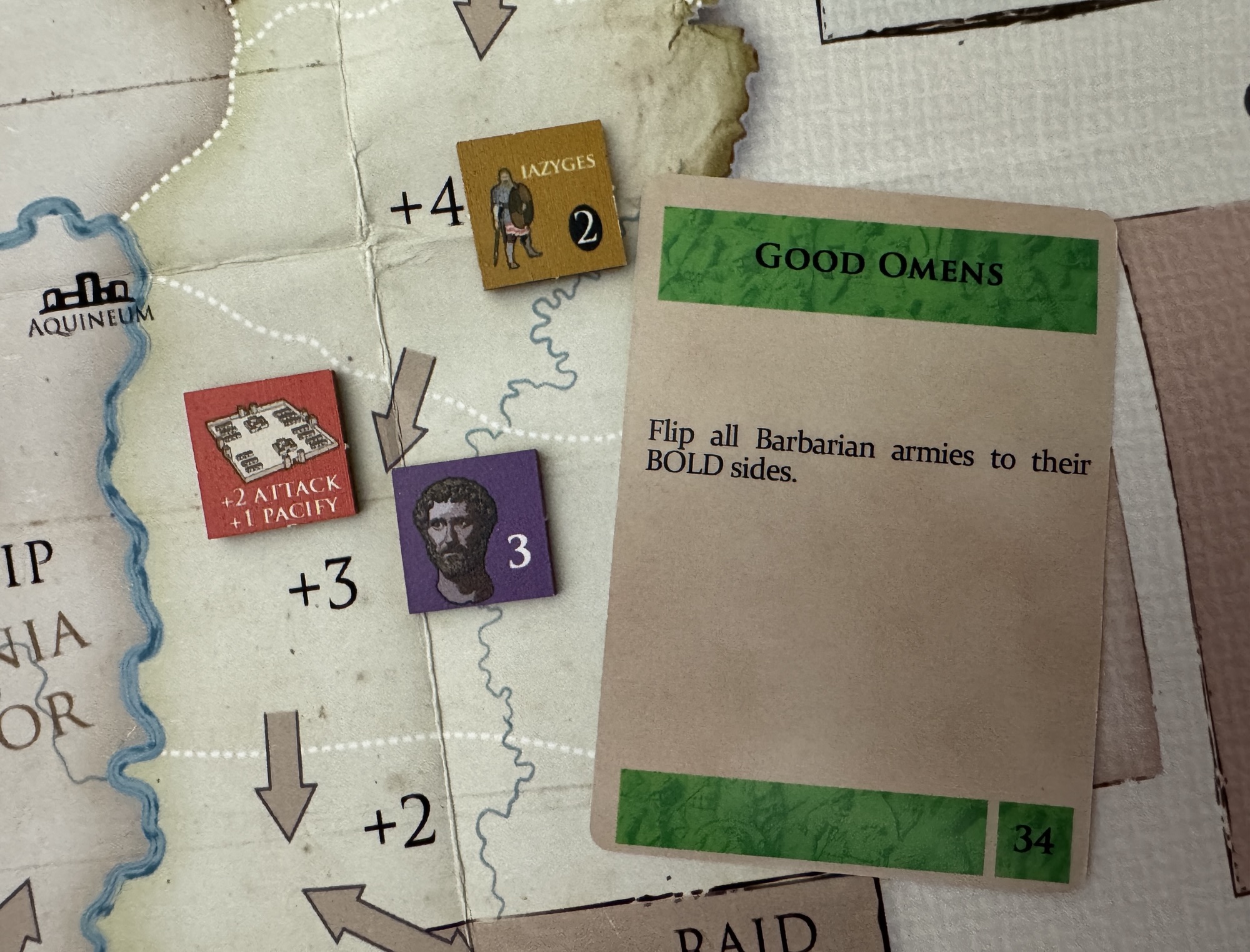
In this entry, we will focus on our first Barbarian Card from the game, as almost all of these cards are really bad for the player, called Good Omens. The “Good” portion of the card’s name doesn’t refer to the Romans but is a benefit for the Barbarians. This card can undo the hard fought victories of Marcus Aurelius and his commanders as its effect is immediate and cannot be cancelled like a Barbarian Surge effect can be by discarding a card. The Good Omens Barbarian Card will immediately cause the player to flip all of the Barbarian armies to their Bold side. Well that doesn’t sound so bad you say? Well, remember that each of the Barbarian army counters is double sided with one side being their Bold side and the other their Demoralized side. On their Bold side, the army is at its strongest with its Combat Value being higher than on the Demoralized side. In our pictures, you can see that the Iazyges army counter has a 4 Combat Value on its Bold side while the Combat Value on the Demoralized side is 2 less at just 2 Combat Value. During combat, or even due to some of the events on the Roman Cards, if a Roman army defeats a Barbarian army, their counter will be flipped from their Bold side to their Demoralized side and they will also have to retreat backward 1 space. I know that the difference here is only 2 but that is in essence gaining a +2 to the Barbarians Combat Value and in a game where the differences between the 2 armies can be just 1 or 2 or even no difference at all, this makes a huge difference and can sometimes feel like you are having to climb a mountain to overcome these Barbarian foes.

Ancient peoples believed deeply in their gods and traditions and would watch for signs in the heavens or from other sources when making key decisions about many things including military campaigns. Good omens would be seen positively as they believed that their decision was favored by the gods and that they would have a good outcome. The Romans believed these things as well but unlike the highly structured Romans, who read omens by sacrificing animals or watching birds fly, barbarian armies like the Germans and Celts relied on signs from nature or even from dreams. These signs when seen would boost morale and gave tribes the psychological edge they needed to fight the powerful armies of the Romans. Germanic tribes believed sacred groves and rivers were portals to their gods and if they were fighting near these places they would take greater strength. Weather was also seen as a major sign and roaring winds, dark storms or rivers that suddenly flooded were viewed as the gods fighting on their side.

The most famous “omen” came from the Battle of the Teutoburg Forest in 9 AD, which occurred over 100 years before the events of the game. A fierce storm, combined with the clever planning of the Germanic leader Arminius, allowed Germanic tribes to completely trap and wipe out 3 Roman legions. The Romans viewed the loss of their legionary eagles and this devastating defeat as a terrible omen for their empire’s future.

Hermann (Arminius) at the Battle of the Teutoburg Forest in 9 AD by Peter Janssen.

I shot a playthrough video for the game and you can watch that at the following link:

I also followed that up with a full video review sharing my thoughts:

In the next entry in this series, we will take a look at British Leader Wellington from Congress of Vienna from GMT Games.

-Grant

INX Incountry Review

16. Juni 2026 um 13:31
IncountryEvery year, I make a trip up to Milwaukee for Adepticon. It’s a game convention focused on war games and miniatures. My main goal in going, other than taking some painting classes, is to wander the dealer hall and look for new games to try out. Last year, I stumbled across Hametsu and absolutely loved […]

Source

Spiel des Jahres – how the jury chooses games (Topic Discussion)

16. Juni 2026 um 12:43

Every year, the announcement of the Spiel des Jahres nominations leads to a lot of discussion across our hobby. Some people agree with the choices, others question why certain games were not included, and many try to predict the eventual winners. What most people don't realise when they discuss the nominations is that the jury does not gather for a single weekend to decide the best game of the year. No, jurors spend many months playing hundreds of new releases several times with different groups of people. It is a lot of work that often goes unnoticed, but that explains why the award continues to carry such influence nearly fifty years after it began. In the second article of the series, I look at this in more detail.

The post Spiel des Jahres – how the jury chooses games (Topic Discussion) appeared first on Tabletop Games Blog.

boardgaming in photos: playtesting

Choon Ean and I were at Kinokuniya bookstore (Pavilion Damansara Heights) demoing our games over the weekend of 30-31 May 2026. This time our tables were occupied more, compared to two weeks earlier when I was there by myself. There were people who stayed to play for quite long. It feels great to see people enjoy my games and want to play again and again. That weekend I think I sold out all

❌