A little after 9am on Thursday, I boarded my first train of a journey that has become increasingly familiar over the years. It was my sixth visit to the convention, having first attended in 2019 before COVID forced a break, but I returned in 2022. It was also my fourth time making the journey by train. The first leg carried me from the South Coast to London Victoria, followed by a tube trip to London Euston and a welcome lunch break before the faster train north. By around 4pm, I was walking through the NEC halls once again, ready for another weekend at UK Games Expo 2026.
La Famiglia is a little unusual. It is a game for exactly four players (like mahjong!), and it is played in teams of two. You are mafia families in Sicily, and you compete to control the most regions. You win immediately when you control 5 regions, or your team controls 6 regions. If no one achieves this after four rounds, the team controlling more regions wins.
Every region on
“Stonemaier Games does not, has not, and will not use any form of AI to replace or augment creative work. If we’re creating something, we want it built from the ground up by talented people from different backgrounds, perspectives, and cultures, not an algorithm.”
I wrote this in April 2024, and after 2 more years of the generative AI onslaught, I thought I’d revisit the topic to see what, if anything, has changed between now and then.
Thanks to most of the science fiction I’ve read and watched over my life, leading up to the modern era I actually had an optimistic view of AI as something that could solve the problems that humans are unable to solve (or would otherwise take hundreds of years). Cure cancer, invent teleportation, end world hunger, and so on.
Maybe that’s where it’ll eventually lead–I’ll hold onto that optimism. In the meantime, instead of achieving the impossible, generative AI seems has become an output device to replace creative endeavors that are already quite possible. Enter a prompt, and the machine spits out an article or image.
Now, if you’re passionate about AI, I’m truly not here to shame you. I try to keep an open mind as the world changes, which is why I’m revisiting this topic today.
There are even elements of AI that aren’t as bad as I thought: For example, check out this episode of Science Vs about the water consumption from data centers. I’ve personally found AI summaries to be unavoidable when searching on Google, though I always try to look at the sources. Also, as much as I loathe the idea of AI replacing humans in any capacity, that’s somewhat inherent to technological advances (e.g., the excellent movie Hidden Figures shows how humans literally were computers until machine computational capacity improved).
In fact, I’ll admit that I accidentally used a logo for our podcast that was generated by AI (not by me). I didn’t realize it at first, then I realized it and wasn’t comfortable saying something, and finally I just decided to pay a graphic designer to create a new logo. I feel much better about it now.
Here’s my truth: I continue to not be interested in generative AI. The process of creativity is key to me as a person. I want to write these articles and film my videos from scratch. I want to come up with my own game ideas and put in the work to bring them to life. I want to read, research, think critically, and seek out sources, not rely on AI summaries. I want to embrace the process. I want to learn from my mistakes and share those lessons with you.
Likewise, I’m more passionate than ever about working with creative people and paying for their time and talent. The only difference now is that it’s in our contracts for artists, designers, third-party accessory creators, and digital developers that we don’t permit the use of generative AI. Similarly, we’ve added “human made: no generative AI” to the back of our game boxes, as we seem to have reached a tipping point when people are unabashedly quick to assume you are using AI unless you specifically indicate otherwise.
Last, I support creators and companies that pay my fellow humans for creative work. I’m only interested in games (and other media) that were designed by people, written by people, and illustrated by people. At the same time, I’m not going to spend my time, energy, or social currency shaming or bashing people who use generative AI. I choose to elevate, not denigrate.
I know that this is a sensitive topic, so while I genuinely want to hear your thoughts in the comments, I ask that you approach the conversation with an open mind and respect for your fellow humans. Let’s be good to each other. If you have hot take, please support it with a specific example or evidence. Thank you!
UPDATE: I realized after writing this article that even though I talked about being open-minded, I didn’t actually revisit the 2024 quote to see if it has changed in mid-2026. While I’m not interested in generative AI, it is possible that there will be uses of ethical AI in the future as related to Stonemaier Games that do interest me–we’ll see!
Stonemaier Games does not use, has not used, and does not plan to knowingly use generative AI for creative work (text, art, videos, etc). If we’re creating something, we want it built from the ground up by talented people from different backgrounds, perspectives, and cultures. We believe that the process is integral to our output, and it allows human creativity to shine. We do not actively use other forms of AI in our workflow either, but it is becoming so engrained in common technology that we acknowledge its passive use may become unavoidable.
Dewan in Malay means "hall", and the boardgame Dewan has nothing to do with any hall. It's just the name of the game world. But I'm stuck with thinking "what the hall" whenever I say the name of the game. Dewan is a clean civ game. I am tempted to call it 4X, but it doesn't have all four X's, just eXpand and a bit of eXploit. No eXplore or eXterminate. You start with a little settlement, and
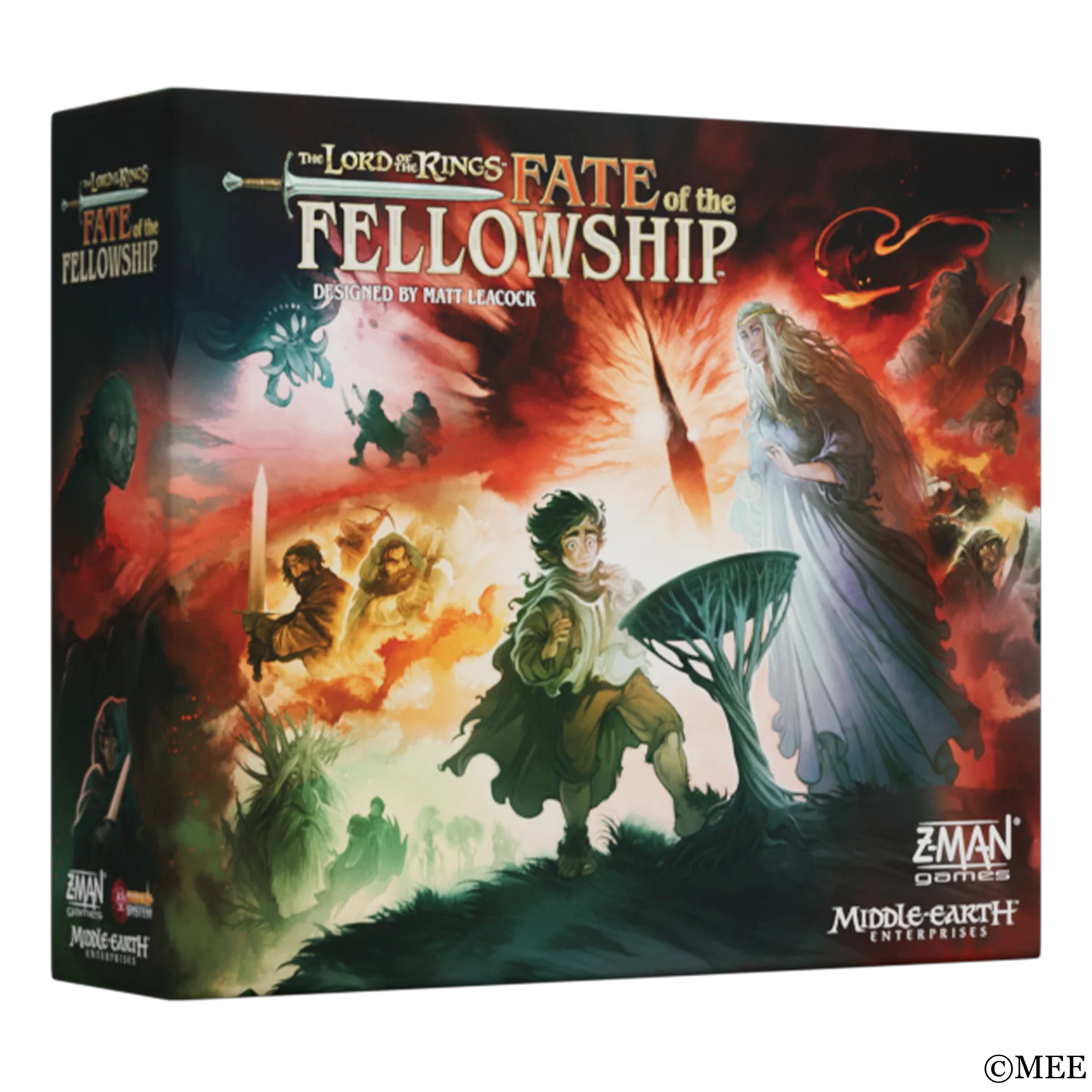
This is a new game from the wonderful people who bought us Pandemic. Once again they bring us a game that while using some of the Pandemic mechanics, feels like a different game. It does feel very much like a Lord of the Rings experience and not just a rebadge of the original game. This is a co-operative game where you can explore , do objectives and then finally destroy the ring.
You each play as a set of 2 characters which include Frodo and Sam, who of course must finally destroy the ring. On your turn you can do 4 actions with one character and 1 action with the other Middle-Earth has been divided up into twelve areas and you start in different positions across the board. Sauron isn’t going to just let you sit back, his forces are controlled by an interesting card mechanic with different troops ready to move along different lines depending on cards drawn at the end of each round and these forces intensify at various points in the game.
While some co-operative games can suffer from an alpha player take over, the nice thing is that with the objectives you can split up and do the objectives near your area without one player telling everyone what to do. Then team up for the final objective which is of course destroy the ring.
I’ve been hoping for some time now to get my hands on this extra stuff for S.T.A.L.K.E.R. The Board Game, and the wonderful people at Awaken Realms were kind enough to send me the goodies I didn’t get the first time around. So here’s an unboxing of the miniatures packs, terrain pack, stretch goals and expansions for this excellent game of survival in the irradiated Zone!
Making high quality tabletop gaming content at the EOG takes time and money. Please consider becoming a Patreon supporter or making a donation so I can continue this work! Thankyou!
I’m slightly less enamored of Leafy Poultice, particularly on Necrobinder (with her low Max HP dropping it further means rests have limited value). Similarly I’m experimenting more with Precarious Sheers, particularly if the Act I map has an early rest, because that cancels the current HP loss and removing two starters is a big deal …. long term.
I feel like I’ve been over-valuing gold. Card removes are more expensive in StS 2. It’s true you have less shot at a Pandora’s Box (which removes all your strikes and defends); but many Ancient Rewards / Artifacts effectively let you remove big chunks of your deck (or improve them enough to be worthwhile), which counterfeits the store’s “remove a card” option. Because of that, I’ve started looking at Cursed Pearl with a much more jaundiced eye. Yes, it might let you snowball, but if it doesn’t …
Stone Humidifier (“Gain 5 Max HP when you rest”) is also downgraded, because it does nothing for the early fights. You really need to have an extra rest prior to your elite and hope that the Max HP helps. I had a string of runs where I took this and was not quite strong enough to deal with my first elite, even with delaying it.
Nutritious Oyster (“Gain 11 Max HP”) provides the Max HP now, so is probably a better choice unless you have a rest-heavy first act.
This does confirm that Neow’s Talisman (upgrade a strike and defend) is actually good, which was my guess. It probably saves at least ~3-6 HP in every fight up for most of Act I. (And putting Spiral on an upgraded defend in that early event is a big deal)
I didn’t mention Phial Holster in the last article (as it was new and I’d only picked it a few times). It gives you two potions and an extra potion slot. This is generally solid, it lets you burn an early potion or two and might let you high-roll into a much earlier elite fight, and the extra slot will likely be useful all game (particularly if you must hang onto a potion or two to deal with a hard elite/boss … now you can still gain and play other potions).
(Many of the examples/explanations below are simplified and not dealing with corner cases.)
Understanding Scaling — Kinetic vs Potential Scaling
I won my low ascension Regent runs grabbing Furnace, a power that gives 4 Forge1 a turn. It seemed comparable to Noxious Fumes, a power that adds 2 poison a turn. But that was shallow thinking, and at higher ascensions it failed hard. It took me a while to unpack why, but there are multiple reasons.
The first is that Noxious Fumes is “Play and Forget.” It does 2 damage, then, 3, 4, 5, 6 etc2. With Forge you also have to play the Sovereign Blade to do any damage. Your sword will be worth 14, 18, 22, etc … but attacking with it costs two mana per attack; then you have to wait and get it back, which also means one less other card in your deck. It costs time and card draw.
Noxious Fumes is active from next turn it’s played … doing damage each turn (but starting smaller). Furnace enbiggens your sword, damage requires further costs. I’ll talk more about Forge below, but the point is that Furnace is passive scaling … If you got a second Noxious Fumes, your numbers and damage would go up, but a second Furnace just makes your potential damage go up.
I don’t love this passive/active terminology, perhaps Poison is “complete” and Forge is Incremental? Or “Potential” vs “Kinetic” is best? Kinetic scaling does actual damage. Potential Scaling might do damage down the line.
But that’s not the only issue
Understanding Scaling — Linear vs Geometric Scaling
Consider Inflame. +2 Strength, once. All attacks do (at least) two more3. It’s a perfectly find card, and may help through early elites and bosses. In theory its potential scaling, but in practice it activates pretty fast. Ironclad is usually playing attacks, so boom. Three attacks a turn (say), means six extra damage a turn. That’s OK. But it doesn’t grow. Noxious Fumes starts off small but gets bigger over time.
But if you double something, it gets bigger much faster. Voltaic channels a lightning Orb for every Lightning Orb already channeled. Play it 5 times (even without any other lightning) and you channel 1,2,4,8,16. A geometric progression. If you have even another orb or two played each time through the deck (like Zap) the number can get ridiculous fast (depending on card order). Voltaic can cause 500 damage on it’s own. Inflame requires 250 attacks. A linear progression. If you added a second inflame your deck would be more reliable. A second voltaic would be a grotesque win.
(Again, I don’t love the terms; perhaps “Additive vs Multiplicative” scaling might be better).
Any card that doubles (or halves) deserves a close look. Colossus blocks, but also halves the damage vulnerable opponents inflict.
There are some other types of geometric scaling built into the game:
All out Attack
Any enchantment (etc) that adds “Replay” to a card is literally doubling (or tripling) the card. Hidden Gem can be a great purchase, even though replay is being applied to a random card. It’s just that strong and as your deck gets stronger cards it will proportionally scale.
Back to Furnace, and Scaling vs Big Impact Now
Putting it all together, I was treating Furnace like a scaling card, but it’s the worst kind of scaling — linear (+4 to the swords damage …), and potential ( … when you play the sword). Its much closer to Inflame than Noxious Fumes. It has a place, but that place is providing a bit of extra damage when you are low, against not-particularly fast opponents. It absolutely can make the difference in the Act I boss fight … linear scaling is usually enough.
It just won’t win the game, and the opportunity cost of having it take up a valuable card draw (and mana if you play it) may outweigh that in many fights. And often the damage output it does provide is completely inferior to many other options.
Compare Furnace to Wrought in War4. If you play Furnace, next turn you can play your sword for 14. If you play Wrought in War, you can play your sword this turn for 17, plus the 7 you already did. WiW converts 3 mana into 24 damage, a respectable first damage card. That’s its role, with a smidge of linear scaling each further time through the deck. Now granted, if you play Furnace and wait 5 turns, you’ll do more damage, but that’s an eternity in a hallway fight (unless you can consistently block for huge numbers each turn). If you play The Smith (“Forge 30”) and then your sword, you do 40 damage now (for 3 mana and some stars).
The Big Number is much better than scaling in almost all fights. But … you can make The Smith multiplicative by playing it via Decisions Decisions, which plays a skill three times. Now on the turn you play them, your sword hits for a hundred, which would take Furnace 23 turns! (Or you can play it each time it comes through the deck, and if you play your sword each time, it’s a bit multiplicative).
Yes, those cards require a star economy, and are rare, etc. But the point is that the numbers matter, not just the type of growth.
Comparing Forge to Vigor
So I’m not particularly happy to take Furnace. It’s a “I need more damage and haven’t seen great cards” pick. But I’m pleased to grab a Prep Time (“4 Vigor at the start of your turn”) as Regent. Why? Because Vigor can be multiplicative; Regent has lots of targets for multiplication. If you sit and block, you can get 8, 12 or more vigor built up; Build up stars, a card like Stardust (which is an X cost attack, but X is stars, not mana) or Heavenly Drill can quickly grow. Furnace is +4 damage a turn, but even a moderate growth in star economy can turn each point of vigor into 10 or 20 hits, and both numbers can grow each turn …. Geometric, not linear.
You can totally win a Regent run by playing only a single attack. Play two powers Prep Time (+4 Vigor a turn) and Genesis (+2 stars a turn), through out block, and wait for a Stardust to do something like 5 (base damage) + 12 (3 turns vigor) times 20 (stars). As a bonus, you can enchant it to do double damage (or +8 vigor first time played). Prep Time gives you a corner stone you can latch onto; and with a few more pieces (and a lot of block) you have your scaling.
Furnace comes nowhere close.
Redeeming Forge
But Forging can. Summon Forth forges 8 (a reasonable number) …. and puts the sword back in your hand. If your deck was only Summon Forths, you could attack in the following pattern. 18, 26, 34, 42. You gain damage faster and play it more often. Not quite geometric, but much faster linear damage. If you play the Parry power (or two), you now suddenly get damage and block each time you play your sovereign blade. You aren’t multiplying damage exactly, but you are doing two important things (damage and block) each time you play your sword.
Bulwark is a perfectly fine “Block 13 for 2 mana” card … that also forges (10!). I grab it as an early block card, but the damage boost is nice.
The point: Don’t grab a Furnace; get a scaling engine via the following path (or something similar):
On an early floor I grab a Wrought in War, if no better damage card is offered (“How Will I Attack?“). As mentioned above, it is “24 damage for 3 mana.”
Grab Bulwark for block (“How will I block?”); but it also forges. Now if I play it and Wrought in War, my Sovereign Blade hits for 27 and I can hold it until it ends the fight (or I have a turn I’m not being attacked).
At this point, I might get Summon Forth or Parry or Seeking Edge as a multiplier … to (play your sword more often, block as well as attack, or hit all enemies, respectively). All are multipliers in a way, and Seeking Edge answers “How will I handle multiple enemies?“.
Now there are actual multipliers … Sword Sage makes the sword hit twice (but raises its cost). Conqueror only forges three, but doubles damage that turn. And don’t forget artifact multipliers like Pen Nib5.
Ideally I’ll also grab a Charge or Begone … to trim the mediocre cards (like basic strikes) out of my deck so that I can play the better cards multiple times (if necessary). (The Chapel strategy from Dominion). Multiplication by division.
Each card answers at least one question other than scaling in the first few steps, attack or block. The initial forge on the cards isnt’t the focus of the card, but a “Yes, and …” The forge provides a path for scaling that comes later. (Similar to how an early silent poison may be meant to handle the first boss, but can also provide the entry way for further scaling).
I’m attacking and blocking; a card or two big enough to handle early hallway fights (or mid-game hallway minions) while incidentally building a linear scaling engine via Forge. Then I’ll only need a card or two (hopefully) to make that a geometric engine … or a big enough linear engine to compensate. Furnace doesn’t do any of that.
Now, I’m not saying Furnace is pointless. If I’ve only seen block cards (or am worried about Lagavulin Matriarch, or know I’ll need to scale while paying for Soul Fysh’s beckons), I might pick a Furnace … as a specific use for a fight. Not for scaling. Sometimes you just don’t get great choices and have to make do … but having taken a Furnace I now now that there might be some synergy with more Forge cards … if they appear.
Writing these as I think I have things interesting to say … so part III whenever.
Update — I realized that the above questions are also missing “How can I make my deck set up faster?” (Sometimes also called ‘Velocity’) and I need to ask that question more often to myself.
A quick Primer on ‘Forge’ and ‘Vigor’ — Forge X works as follows. If you don’t have a Sovereign Blade, it creates it (in your hand). The blade costs 2 to play, and is retained between turns. The blade’s damage starts at 10 prior to the first forge and is increased (for this combat) by X. (Once you have a sword, Forge X simply increases the swords damage but does not return it to your hand). Vigor X means your next attack (only) does +x damage (per hit), and then the Vigor is spent. ︎
Poison automatically decreases at the end of each turn so +2 means net +1 each turn once the enemy is poisoned. ︎
With multi-attacks or X-cost attacks (like Sword Boomerang / Whirlwind) the bonus may apply multiple times per attack. ︎
Hi, it’s Joe Slack here. Oliver was kind enough to allow me to write another guest blog. In this article, I thought it would be interesting to discuss board games for two and the gaming experience for two people (especially couples).
Charge & Spark is a 2 player microgame from Jelly Jelly Games, Japan. I have just played another game that sounds just like this, Bahamut Dispute. Both are about reducing your opponent’s health from 4 to 0, but here the execution is a little different. Humankind is extinct. You are robots competing for supremacy. You win by destroying your opponent or by reaching the centre of
My friend Dylan enjoys the Legendary Encounters games, and a while back created this summary for me for The X-Files version (after previously creating the Aliens one). After sitting in my ‘to do’ pile for far too long, I gave it an editing pass and the layout treatment and here it is!
In this incarnation, players play through three seasons of the iconic TV show, working together generate leads and uncover evidence in a bid to defeat enemies and conspiracies. I can’t imagine the amount of work it took to make a coherent game out of a couple of hundred episodes (the game covers the first 9 seasons), but according to reviews, the game is very thematic and replayable, and particularly popular with solo gamers. Enjoy!
Pandemic (2008) – one of the most popular co-op board games
Cooperative card and board games are the kind of card and board games I like to play with my partner. I enjoy working through puzzles together with him and discussing strategies to beat a game. Even when there are communication limits, winning as a team feels satisfying. The immersive feel of some co‑op card and board games (much like a GMless RPG, but with tokens, a more structured storyline, and less dice rolling) keeps us wanting more. Still, after trying many co‑op card and board games, I realized we live in a bubble, in Germany, where there is a huge variety of board games, so co‑op titles are easy to find not only in game stores but also in bookstores and some discount supermarkets. Abroad, however, we often struggle to find them in random bookstores even when other board games are available.
What co-op
Some of the characters in Fate of the Fellowship (2025)
Co‑op board games are games in which two or more players do not compete against each other; instead, they work together to achieve a common objective or reach the same final goal. Co‑op games are less common than competitive ones; only 12.74% of the board games listed on BGG are co‑op[1]. One could wonder why there are so many fewer of them compared with competitive games.
Co-op in board games seems to be a fairly new mechanic. If you ask someone who doesn’t play board games what they know about board games in general, chances are they would imagine and describe a game where two or more players are competing against each other. And if you tell them that there are board games where players don’t compete, they would react as if it was something really new. Even I thought that co-op is a new thing as I associated co-op games with Pandemic[2], which was only released in 2008. Yet there were co-op board games that were released even before that. Reiner Knizia’s The Lord of the Rings, a co-op game released in 2000, is one of the games that influenced Pandemic[3]. And even earlier than that, Wikipedia[4] claims that The Landlord’s Game by Elizabeth Magie, patented in 1903[5], can be played in co-op mode. But after reading the rulebook[6], I don’t think it can be played co-op in the non-monopoly mode. It’s still much more interesting mechanically and thematically than Monopoly though.
In the 70s some co-op games were developed by a company in Canada called Family Pastimes. They only produced co-op games, as the founders claim that children can gain sociological benefits for playing co-op games[7]. Even though they said that they received orders from countries outside Canada and some interests from teachers and the United Nations[8], the company is still small and doesn’t have a scope as wide as Parker Brothers. Family Pastimes to this day is still a relatively small company. Even in Germany the first game that won Spiel des Jahres was a competitive one. The earliest year where a co-op game became popular was in 1981, when Sherlock Holmes Consulting Detective was released, which was also the first co-op game that won the SdJ in 1985[9]. The thing about this game is that it has some similarities to the tabletop RPG Call of Cthulhu. It’s possible that its popularity has something to do with the fascination for TTRPGs such as Dungeons & Dragons at that time, which are typically co-op, and not about wanting to play co-op games in general. Much like how co-op video games such as MMOs, many of which were influenced by D&D[10], are more widespread and popular than co-op board games.
What I view as the scarcity of co-op board games today may be attributed to the long culture of competitive board games worldwide. Unlike video games, war games and other board games such as chess, Go, and shogi have been existing for hundreds of years. They were invented during times where people were more likely to compete for resources to survive or use them to practice for war. They are still very popular to this day, not just because they are fun to play (I find them fun to play I admit), but also because there are pro tournaments[11], which further increase their popularity. Not to mention, wargames have been widely popular for decades (moreso in the US than in Europe after the wars)[12]. On top of that, the mass production of Monopoly and having a version of Monoply of every IP that I could probably think of might have fortified the idea that board games can only be played competitively. The long tradition and nostalgia[13], mass production, and marketing of competitive board games also resulted to having a huge demand for competitive board games[14]. Given how competitive games are more widespread, it wouldn’t surprise me if many people believe that the default mechanic for a board game is competitive and that many of those who play board games are more used to playing competitive board games so much so that changing how they play board games could be a challenge in and of itself.
Why co-op
Spirit Island (2017)
There’s something about having those shared moments whenever my partner and I play co-op games regardless of the result of the game. But I noticed that playing co-op games can be a bit more intimate than competitive games; it may involve trusting other players in your group, having confidence in them and hope that they could equally trust you with your decisions without adding pressure to them and to yourself, and making sure that it is a safe space to lose and that it’s fine if your group were not able to beat the game.
Playing co-op games involves cooperation- a certain mindset. Not being used to having a specific mindset when playing co-op games may lead to some undesirable outcome in a gaming session. Playing co-op games does not necessarilly eliminate possible social conflicts within a group. This can be seen from the reports of players experiencing quarterbacking (or alpha gaming[15]). The conflict that players might have in co-op games is different from the type of conflict that players have in competitive games; it’s much more personal and undesirable in the former whereas in the latter the conflict is just part of the game and may be desired and agreed upon[16]. Staying inside the gaming space[17], the space where one steps in and agrees with all the rules that are within it, is one thing but behaving in such a way that wasn’t agreed upon by others is another.
Playing co-op board games seems to require so much of players, but one very fascinating thing I noticed is that playing co-op games has lead some groups to have their own systems to prevent alpha gaming which involves learning how to respect others and giving chance for others to express what they think[18]. I don’t know if getting used to doing this will extend outside board gaming, but I still think it’s a good thing to be able to come up with creative ways of preventing conflicts and exercising a form of respect that is different from the form of respect practiced when playing competitive games[19].
But it also doesn’t mean that people who aren’t used to cooperating when playing co-op board games are incapable of cooperating outside of playing co-op board games. There is also a sense of cooperation that is present in some competitive board games, but this is dependent on the mechanism of the board game and is still different from the type of cooperation that is possible or expected in a co-op board game[20].
Playing co-op board games also allows players to have more fun experiences even in sessions where they didn’t win[21]. While there can still be shared experiences when playing competitive games, the feeling of losing and winning is not shared. With co-op games, especially the narrative ones, losing doesn’t feel as bad since the experience is shared. One example is when my partner and I played Fate of the Fellowship; even if the result didn’t feel so rewarding, we still had fun during the game. We also had fun in some games where we lost. Having that shared experiences, which include joint decision-making and imagining some scenarios together, are for me some of the many things why I love co-op games so much.
Now and Finality
While co-op games are still not as widespread as competitive games, co-op games are gaining more recognition and it seems that the demand for them is also increasing. Co-op games such as Gloomhaven and Spirit Island are some of the highly rated games on BGG. The most recent Spiel des Jahres and Kennerspiel des Jahres games are co-op[22]. That said, I don’t think that it will replace competitive games in terms of popularity any time soon. And I also don’t think that noone should play competitive games or that they shouldn’t exist anymore[23], but playing co-op games exposes people to a different type of bonding experience where losing and winning are shared, where the metagame and the social interaction, the form of respect, are different from what one experiences and exercises in a competitive game. And maybe some day when the general public think of board games, they wouldn’t just think of competitive games but games that could be enjoyed by a group of people (or a single person) without having to compete against each other.
[1] This is based on the number of board games categorized as cooperative out of all the board games listed on BoardGameGeek on 18.05.2026. It is even less than that as I noticed that some of the games on the list were wrongly categorized as co-op.
[2] Matt Leacock’s Pandemic (2008)
[3] On his blog post, Matt Leacock mentions that Pandemic was influenced by Reiner Knizia’s The Lord of the Rings.
[4] See Wikipedia – Cooperative board game
[5] There’s an article and a book written by Mary Pilon that provide more details.
[6] See Landlords Game Rules
[7] In this interview with Jim Deacove, one of the founders of Family Pastimes, they also claim that they were contacted by the United Nations, psychiatrists and teachers regarding the possible effects of playing co-op games. Whether a cooperative board game can improve children’s social behavior incomparison to competitive games is still debatable based on the article The behavioral effects of cooperative and competitive board games in preschoolers by Malin Eriksson, Ben Keward, Leo Poom, and Stenberg (2021).
[8] See this interview in 1978
[9] Spiel des Jahres winner in 1985
[10] See The Board Game As a Narrative by Pawel Bornstedt (2024).
[11] There’s the Fide World Championship and a long list of chess tournaments worlwide. There’s also a huge shogi tournament in Japan called Osho.
[12] See Pawel Bornstedt (2024)
[13] In Nostalgic bonding: exploring the role of nostalgia in the consumption experience by Holbrook and Shindler (2006) discuss the effect of nostalgia in terms of consumer behavior.
[14] Market.us report says that the demand for board games is increasing, but the industry is still lead by companies that produce Monopoly and other traditional board games.
[15] See Roleplaying as a Solution to the Quarterbacking Problem of Cooperative and Educational Games by Josh Aaron Miller (2021)
[16]This isn’t to say that social conflict doesn’t happen in competitive games. It does happen especially for some players who have difficulties accepting defeat.
[17] I don’t believe that we can all be completely in what is called a Magic Circle, where we have a certain way of thinking and behave in a certain way that is allowed in the game world and is completely untouched by the real or actual world. It is a term coined by Huizinga, Johan (1938) in his book Homo Ludens: a Study of the Play-Element in Culture. I believe that there’s an aspect of us that affects the game world and vice versa.
[18] Reddit may not always be the best source of information, but some Redditors on r/boardgames have shared some interesting solutions to prevent alpha gaming in a respectful way without resorting to conflict.
[19] Respect that players give to their opponents in a competitive game (e.g. accepting defeat) is different from the type of respect that players give to each other in a co-op board game setting.
[20] See Cooperating to Compete: the Mutuality of Cooperation and Competition in Boardgame Play by Melissa J. Rogerson, Martin R. Gibbs, and Wally Smith (2018)
[21] See The Allure of Struggle and Failure in Cooperative Board Games by Douglas Maynard and Joanna Herron (2016)
[22] Spiel des Jahres’ Game Archive
[23] See Melissa J. Rogerson, Martin R. Gibbs, Wally Smith (2018)
If you have a missing or damaged component inside your English-language Stonemaier Games product–no matter where or when you bought it or how long you’ve been playing it–you can fill out this form and we’ll send you what you need.* We use software called Jira to manage this process, as we have 7 replacement parts helpers in 5 different regions around the world.
Serving our customers this way is incredibly important to us, but we can serve them even better if replacement parts (and replacement parts requests) aren’t needed in the first place. Recently I talked to a few people connected to this process at Stonemaier Games, and we compiled a list of product design mistakes that resulted in quite a few replacement parts.
We learned these lessons the hard way, so I’m hoping this will help you avoid these mistakes from the start. Some of these are as simple as packing components in a way that makes them easy for the customer to identify.
Meeples and Minis with Protrusions: Some of our most common requests are for broken meeples or mechs where we got a little too detailed, and those little details snapped off in transit or gameplay. Whenever I get sample meeples or mechs, I try to snap off any protrusion–if I can, I either remove it from the design or bulk up its connection point.
Missing Tokens and Clasps: It is common when we’re including either a lot of the same type of token–50 glass beads or clasps for dials–that 1 is missing in production or 1 goes missing later. So we often include an extra token, but we list the lower quantity: We make 51 tokens but say that there are 50. So even if 1 is missing, you still have the “correct” amount (though, honestly, for these types of tokens, it’s incredibly rare in gameplay that the full quantity is needed).
Matching the Insert: In Libertalia–a 6-player game where each player has their own deck of cards–the cards are packed in 5 card bricks. When opening a new game, you see 5 bricks of cards in 5 of 6 slots in the insert, and 5 of the 6 player colors happen to be visible in each brick. This leads to assumptions that the entire green deck is missing before opening the cards. Something similar happens in Scythe, a game that can only ever feature combat between 2 players, so we only included 2 combat dials–players assume the other 3 are missing (partially because the 2 included dials have specific faction colors).
Matching the Trays: The first few printings of Wingspan included 4 clamshell trays (2 for an assortment of eggs and 2 for an assortment of food). There’s no need for each type of food token to be kept in a separate compartment, but we soon learned that many people assumed that the trays were only for food and that a tray was missing (there are 5 types of food in the core game and only 4 trays).
Packing Choices: We hear from customers that they think they’re missing the action cubes in Wingspan Asia, as those cubes are packed in the same bags as larger tokens of the same color. Similarly, some customers struggle to find the gray temporary worker in Viticulture, as it’s packed in the same bag as some of the player tokens (it previously came in a separate bag with the first player token).
“Missing” Cards: In the solo mode for Libertalia and Scythe: The Wind Gambit, there are “missing” cards that aren’t actually missing. For example, there is no Automa card 37 in Libertalia for design reasons. This is explained in the rules, but when looking through the cards, it’s a common mistake for people to see cards 36 and 38 and assume they’re missing card 37.
“Missing” Components: In Scythe: The Rise of Fenris, there’s a big warning label when you open the box that tells people not to look inside the spoiler tuckboxes. However, it happens all the time! One of the tuckboxes has a “missing” component that’s actually in one of the other tuckboxes–oddly, people seem to open that tuckbox but not the others; if they did, they would find that “missing” component.
Dents in Boards and Mats: I learned early on with Viticulture that if sharper components (like meeples) are packed next to a board or mat, they might press into the cardboard over time, leaving lots of little dings and dents. Instead, we now pack them elsewhere in the box or we fold the mats inward, with the gameplay elements on the inside. However, this also leads to the occasional confusion from customers who don’t know the mats are folded–they see the faux leather illustration on the outside of a Wingspan or Wyrmspan mat and think they received a misprint.
Card Sorting: It’s inevitable that customers will lose or damage cards over time if they play a game frequently, and we’re here to help. With Wingspan, we originally didn’t have any type of card sorting system, so if a customer requested a Peregrine Falcon, our replacement parts helpers had to look through every card to find it. In reprints we alphabetized the cards, which significantly sped up this process. In games where cards don’t have a name, we number the cards and sort them as such.
Publisher Assumption: When we were working on the Pie in the Sky expansion for My Little Scythe, I didn’t go through the component list with the right mindset, and it resulted in me never asking our manufacturer to include faction-specific tokens for the 2 new factions (everything else was there, including the minis). This was before we sent pre-production copies first to the designer and to my coworker, so no one caught the mistake until everything was printed and shipped. We tried to fix it after the fact by making a pack of the missing tokens for our webstore, retailers, and distributors, but we still hear from customers all the time who buy the expansion from a retailer and don’t get the tokens. It was an important wake-up call for me to never assume anything and to add as many checks-and-balances as possible during the pre-production process.
Hopefully this list will help you avoid the same mistakes; there are even some we still need to address better at Stonemaier Games. If you have any insights about replacement part requests, please let me know in the comments!
*Box Dings and Dents: If you ordered a game from Stonemaier Games and the box arrived with dings and dents, we’re truly sorry. You paid for a mint-condition product, and we didn’t deliver. That’s on us. For some people, a dented corner won’t impact the fun they have playing the game. For others, it will. A replacement box for a dented corner is actually a replacement for the entire game, a process that involves having you send your game to a reviewer of our choice–we provide the label–and we send you another copy of the game. If you would like to go through that process for a game ordered from our webstore, please email your order number to contact@stonemaier.com. Photos of the packaging and damage help us share feedback with our fulfillment centers.

 Anmelden