Anmelden
A First Look at Morty Sorty Magic Shop
20. Mai 2026 um 23:30
An overview of this 2026 Spiel des Jahres nominee

An overview of this 2026 Spiel des Jahres nominee

This is the second part of my three-part series on getting back into board gaming after a long absence. In Part One, I looked at ways to rebuild your gaming muscles. (If you want to skip ahead, you can go to Part Three (Coming Soon!) to read about the games that brought me back into gaming.) As with any hobby, a long time away can result in skill loss. Your ability to strategize and quickly learn rules can atrophy. The good news is, it's pretty easy to get those skills back with a little practice.
What's not as easy to regain is a lost group of board gaming buddies. My five-year layoff from gaming began with Covid and continued through a cascading series of family issues. By the time everything was somewhat back to normal, I'd lost all of my gamer friends. Covid destroyed my gaming groups, and caregiving for my parents left no time for games. When I looked around several years later, all of my gaming friends had moved on, either to new places, new hobbies, or new responsibilities.
Not being an extrovert, it's not easy for me to find new people to play with. However, I know that if I want to keep board gaming as a hobby, I have to gather my courage and get out…
The post Top Six Ways to Rebuild Your Gaming Tribe appeared first on Meeple Mountain.
BGI 420 The One About Time Being Up
Board Games Insider – Join our Guild on Board Game Geek Guild | Like us on FB
Social media:
Ignacy Trzewiczek / Portal Games: website | FB | Twitter | Youtube
Corey Thompson / Above Board TV: website | Youtube
Stephen Buonocore / “The Podfather Of Gaming”: website | FB | Twitter | Youtube
Intro Music: Happy Rock – Bensound.com


Boss Fighters QR, Moon Colony Bloodbath, and Rebirth are nominated for the 2026 Kennerspiel des Jahres
‘Twas elegantly done — ignoring the fact that the cards are a downgrade from tiles — but were the graphic designers for the new AllPlay edition were trying to convey colorblindness to the rest of us? The five colors of money cards are “brown,” “beige,” “orangeish brown/beige” “purpleish brown” and “I’m not sure what it is … let’s call it … cocoa?”
Honestly, I’m not sure what the colors were, except all very similar. Seriously. Game looks beautiful, but ugh.
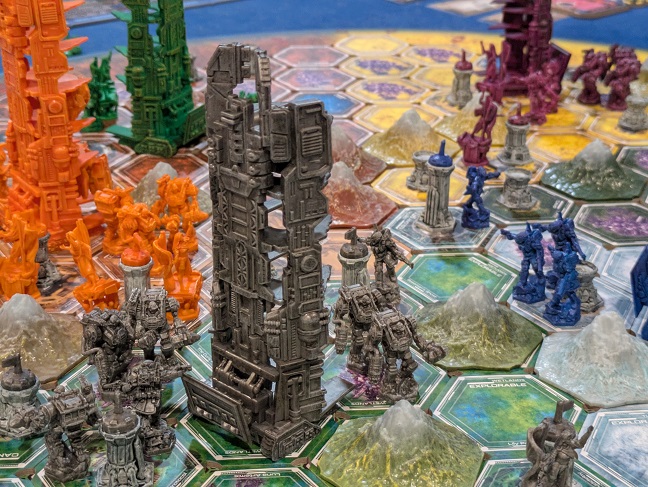
Played StarDriven: Gateway last night. First of all, let’s get this out of the way.
The horrific trend in the last two decades of putting a colon (or dash, or em-dash) in a book’s title and then giving it a subtitle is a terrible development and should not be extended into games. It is only allowed if the game is in fact a sequel. We have to be able to tell all the Race for the Galaxy expansions and arcs apart. Adding a “Legacy” to Pandemic (etc) is fine … they are related but different games. Apparently there is a StarDriven: Saga coming out (out?) from the same company, and they want to note they are related … but I’m watching you, Rock Manor Games. Cut it out.
(It’s been so long since I reviewed a game that was relatively new, I’m actually going to describe it a bit).
SDG is a knock off Star Trek episode, or perhaps season, and is actually a pretty nice idea. Each player has a ship, and you roll dice (of various colors). You can use red dice for fighting, blue dice to run warp drive1 and sensors. Green dice are impulse and engineering. Some of the stations can also accept any die. Also, each station has an energy cost. (Usually 0-3 energy, but some stations gain you energy equal to the die roll).When you place a die you get one very useful thing (no matter the die value) and then use the die value to get other things.
For example, the “command” station will accept a red die (for one energy), a red die (costing two energy) and any die (three energy). When you place a die there you get an experience marker (which lets you buy/improve your crew) and then the better the die the better the attack.
Crew are a certain species, have specialties (although they can all operate any station) and can be regular or promoted. You can only take an action on a station that has a crew member, but one of your actions is “place a crew member into a station.” Each crew member also has a “Tap to due special thing” as a free action.
At some point you can give up an action to remove and reroll all your dice (and untap some of your crew).
Combat is clever … each die rolled is a hit against a section (you have six sections, after all) but you can roll your shields and if you roll a matching number you block the hit (but your shields are weakened). If you don’t match numbers, you take the hit, the spot is blocked, and your shields are still strong. (You can spend engineering actions bumping up your weapons or shields).
The owner described SDG is “kind of a 2.5X game, not quite a 4x” … at least in the early “episodes” (we played “episode 1”) combat is enough to keep you honest, but minimal. Players are not expected to fight each other, but there are a few nuisance ships out there. Presumably in other episodes there could be harder enemies or PVP. But the board has only the major planets revealed at the beginning and you fly around, encounter “anomalies” and explore the map, and finish missions. When you finish a mission you must tap a promoted crew, or discard a crew from a station back to crew quarters (where you need actions to ready them again) or lose them entirely (from your hand?). Finishing missions gets you reputation (on the nearest major planet).
After a round the last player makes a few decisions for the enemy’s attack (breaking ties only, but usually there are ties). When one player gets 9 reputation the game ends after another round or two (at least for the scenario we played).
Then there is a slightly-too-point-salady scoring for my taste (you get points for reputation, a bonus for having most reputation on each major planet, points for anomalies, negatives for combats, bonus VP that you can acquire during game etc).
Individually, the ideas work. I like the theme (and can appreciate that the license is too expensive, so I don’t mind it’s had the serial numbers filed off). The game looks nice, (the map tiles are functionally kind of hexes divided into three, but have a different look). Each ship has a slightly different coloration of dice … my ship had only one red (“Command”) die, so fighting and promoting is more difficult. Each ship also has a set of unique abilities (six perhaps) of which you pick two. You manage dice and energy and crew. I mean, the game is overproduced Kick Starter bait with a box too big, but also does give off the “labor of love” with an appreciation of the genre.
BUT ….
But those are just peeves, compared to the fundamental flaw.
The turns are too long. This is a fixed fun game; on your turn you get two actions (plus any free actions, which includes finishing a misson! or using some special abilities). It isn’t a problem that each turn takes 2 minutes (annoying, but not a deal breaker). The turns are too long because each player gets too many actions on a turn. Yes you only get two actions, but there are enough free actions that there’s no point in planning … any mission might be gone by the time it gets back to you. Players can warp around the board, after all, so even though each mission is tied to a planet type, none are too far away.
SDG feels like it would have been more engaging if it used a worker placement (or Eclipse’s) structure of “one action around the table until everyone is forced to pass and reset” … on your turn place a die (tap a crew, let’s make that not a free action, except maybe for promoted crew) and take an action. And don’t replenish a mission until the round is over, so they are definitely being fought over. Once everyone is out of actions then the round is done, the enemies move, and you do the next round. Now each player still only takes 25% of the time, but its a race against time, and isn’t that the real pressure in all the of the schlocky TV shows we love?
Can you get to that mission before the other ship shows up? One action at a time makes it tight (particularly if finishing the mission is an action, maybe not taking dice). Now it would feel more interactive …. instead of just “maximize the board state on your turn, then wander away for five minutes.”
I’ve played six (or even eight!) player games of Eclipse where my turn-to-turn engagement was much higher than my four player game of this.
I’d try this again, but would like to try it with one (or two) less players and perhaps a later scenario. But I’m not chomping at the bit.
Rating — Indifferent.
Update — I got a note from the designer indicating that my concern in footnote 2 was misunderstanding the rules … if all three die slots in a section are damaged they are automatically repaired, but create a hull breach (which is -VP and enough hull breaches will destroy your ship). But that does mean you will always have at least one die slot in each section.
︎︎
Many of us play board games because they offer us some certainty. There are rules, objectives, specific actions, and so on that define how a game is played. These things provide a clear, well-defined framework. We know what is possible, what is not allowed and what we are trying to achieve. At the same time, board games also contain uncertainty. It is uncertainty that creates tension, excitement and a range of other emotions. In many cases, this uncertainty is exactly why we look forward to playing them. Inspired by Bez from Stuff by Bez, in this article, I want to explore why uncertainty in board games matters.
The post Clearly Uncertain – the role of uncertainty in board games (Topic Discussion) appeared first on Tabletop Games Blog.
Peter unboxes the top pledge of Lands of Evershade, the new hybrid RPG/board game from Awaken Realms!
I’ve been very lucky to be the recipient of the generosity of Awaken Realms lately, who have sent me some amazing stuff to cover on the channel. Recently ten years in the business, the company is going from strength to strength, churning out some really great games with absolutely peak production values.
Case in point – the PRG-meets-board game Lands of Evershade, which not only looks gorgeous, but has been receiving rave reviews. And the design isn’t just about pretty pictures and extravagant bits; they’re some very clever component design here, especially in the character board designs and cases that preserve your character from session to session. Check it all out in this comprehensive unboxing video!
Stayed tuned for more folks – a rules & reference is of course in th works, and they’ll be a video review a bit later down the pipe!
Any guesses as to what might be nominated?
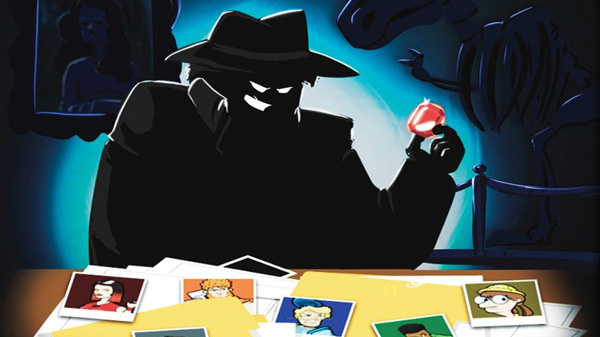
Get in, get treasure, and get out. How many thieves will you bring on your crew? Choose wisely, because the larger the group, the more treasure you can nab, but the slower you go. Go too slow, and all the treasure might be gone before you even get there.
I spent the last 4 days at Geekway to the West, an absolutely incredible game convention in St. Louis. Today I’ll share some of my highlights and observations through three lenses: Jamey as a publisher, designer, and gamer.
Publisher Jamey
Stonemaier Games participates in a few ways at Geekway: We donate a lot of games to their play-and-win section, which has proven year after year to be a great way to share our games with people who haven’t tried them.
We also have a booth in their vendor hall (Geekway primarily focuses on casual gaming, but they do have vendor space too) run by my coworker Dave and staffed by an amazingly generous demo team. Our main intent at the booth is simply for people to have fun and learn about our games, and it’s a nice bonus if we sell some games too (this year it looks like our booth revenue was around $16k, and people could also place orders on our webstore and pick up their order at Geekway since our warehouse is located in St. Louis).
I like that Geekway provides publishers a lot of different options. You can have a booth if you want, but you could also have a demo table through Double Exposure, you could just put games in play-and-win, or you can just wander around and connect with people (or scout games to potentially publish).
I’ll also add that having several years of t-shirt and hoodie sales provides a really nice way for me to look around any room at Geekway and identify people who know Stonemaier Games. The warm hoodies were particularly helpful, as the main hall at Geekway was quite cold this year.
Designer Jamey
There are two sides to Designer Jamey at conventions: past and future. For games I’ve already designed, it’s immensely gratifying to see people playing them. I don’t think I’m alone, as I saw other designers checking in on people playing their games (this happened to me while playing the card game Oopsy Poopsy). I taught and played Euphoria Essential and Origin Story, and I had a great time learning the game Dark Heists from the designer, Moe Poplar.
Then there are the games I have yet to to design. I love playing a variety of published games at Geekway to learn from them. This year I played 14 new-to-me games and 6 games I already knew (it’s nice to revisit games to look at them from a fresh perspective).
Geekway provides several opportunities for designers to get feedback about unpublished games, including the clever Playtest to Win area.
Last, I’m so grateful for everyone who either played a game with me or just came up to me to say hi. Those moments and that time means the world to me. As someone who has social anxiety about approaching people, seeing others do it to me gives me the courage to do the same for others. Thank you for the inspiration!
Gamer Jamey
While Geekway is part work for me, it’s also part play. I love playing games with delightful people, and Geekway is full of them. In total I played 20 different games at Geekway (plus a round of disc golf) with around 60 people. I spent most of my time in a smaller ballroom in the first floor of the connected hotel–it was a much quieter in there (and warmer) than the main convention hall. Thanks to everyone who took the time to play with me!
I appreciate play-and-win as a gamer too, as it helps me narrow down which games to play out of so many options (though I did also check out both Blood Rage and The King Is Dead from the main library to revisit them). Without play-and-win, I wouldn’t have discovered the delightful game 3 Chapters, experienced the whimsy of the cat game Oopsy Poopsy, or delved into the strategic cleverness of Galileo Galilei.
While Geekway does have a few events people can sign up for, the vast majority of the convention is casual gaming. This, I’ve found, is my preferred structure for a convention, as I like the fluid nature of going from game to game at my own pace, remaining flexible as to what I play and how long I play. I’m grateful to Geekway for embracing this format, and I’m always open to suggestions for other similar conventions!
***
If you were at Geekway to the West this weekend (or you’ve attended a gaming event in 2026), I’d love to hear a few of your highlights!
***
If you gain value from the 100 articles Jamey publishes on this blog each year, please consider championing this content! You can also listen to posts like this in the audio version of the blog.
“We're going to need more Birds.” - The Simpson's Movie Tell... “We're going to need more Birds.” - The Simpson's Movie Tell... “We're going to need more Birds.” - The Simpson's Movie Tell... “We're going to need more Birds.” - The Simpson's Movie Tell...We’ve been assessing the merits of political leaders in (more or less) democratic countries on this blog for a few years now. Today, we’re returning to German chancellors… but not the way you know it. After a few chancellors from the Federal Republic of Germany (founded in 1949), we’re assessing for the first time a chancellor from the Weimar Republic, Germany’s first attempt at parliamentary government – Hermann Müller. And which game could be more appropriate for him than Weimar (Matthias Cramer, Capstone Games/Skellig Games/Spielworxx)?
Some caveats ahead: The chancellors will be rated by the knowledge of their time. If they or their contemporaries could not have known about the effects of something, I will not use my hindsight to mark it as a mistake of theirs. The assessment is focused on their conduct as chancellor.
Now, to the system itself: There are three policy field categories (foreign, domestic, and economic policy) and three more general ones (vision, pragmatism, integrity). A chancellor can earn from one to five stars in each category (for a total sum of up to 30). In detail, the chancellor is assessed as follows:
Foreign policy: Did the chancellor increase German influence in the world and the security of Germans at home? Did the chancellor wield German power responsibly and with positive results for the regions affected?
Domestic policy: Did the chancellor increase the liberty of Germans to express themselves and to participate in the political process? Did the chancellor promote domestic security and shape the framework for fair justice dealing with offenses?
Economic policy: Did the chancellor facilitate the prosperity and economic security of Germans (including in the mid- and long-term)? Was the chancellor’s economic policy based on mutual benefit of those involved or did it unduly burden one side?
Vision: Did the chancellor have an idea of what Germany and Europe (the latter counting for more in times of German influence being great) should look like beyond the immediate future? Did the chancellor’s policies steer Germany (and, if applicable, Europe) in this direction?
Pragmatism: Did the chancellor succeed in seeing their policy through from inception to completion? How well did the chancellor manage the support from parliament, society, the administration, the media?
Integrity: Did the chancellor understand the office as a means to benefit themselves, special interest groups, the entire country, or another community? Did the chancellor respect the boundaries of the office?
Note: If you have read my UK prime minister or US president ratings, you will remember that I rated them on the global impacts of their vision as well. As the rating system is only really applicable to democratic leaders and no democratic German leader ever had the chance to conduct a truly global policy, I only assess their vision on national and European grounds.
Hermann Müller was born in Mannheim (in the southwest of Germany) on May 18, 1876. His father ran a small sparkling wine company, but died when Hermann was still a teenager. Thus, instead of taking over the company or going to university, the young Hermann Müller trained to become a clerk. He soon became involved with the socialist movement and joined the Social Democratic Party of Germany (SPD) in 1893. After some years working for social democratic newspapers, he was elected to the leadership board of the SPD in 1906. Müller was often charged with liaisons to other socialist parties in Europe – including a doomed trip to Paris in July 1914, trying to negotiate a joint refusal of French and German socialists to support their respective countries’ impending war with each other.
Müller was elected to Imperial Germany’s parliament in a by-election in 1916. Soon after, the German Social Democrats split between the Majority Social Democrats (MSPD, including Müller) who supported the war effort, and the Independent Social Democrats (USPD), who did not. When the war was lost in November 1918 and the monarchy swept away by revolutionary soldiers and workers, the MSPD soon took control of the revolution and steered a moderate course towards parliamentary democracy.

The revolution of 1918/1919 transformed the (M)SPD from the pariah party of Imperial Germany to the most important pillar of the new republic. As the Social Democrats were no longer barred from the positions of power, they needed scores of cadres to fill them. The general upswing also brought a promotion for Müller, who was elected co-chairman of the MSPD in 1919. Government came with its own challenges: The lost war, the ongoing Allied naval blockade, and the weak position of the new government made it imperative to conclude a peace treaty with the Allied powers. The provisions of the Treaty of Versailles, with which the Allies presented Germany, seemed unacceptable to most Germans – including many Social Democrats. Chancellor Philipp Scheidemann resigned rather than take responsibility for the treaty. He was succeeded by Gustav Bauer (also SPD) whose new administration Müller joined as foreign minister in June 1919. In this role, it fell to him to sign the treaty. From there, Müller sketched the outlines of a new foreign policy – one in which Germany would cooperate with the Allies, use its economic and cultural rather than its military strength to influence world events, and thus overturn the harsh provisions of the Treaty of Versailles.

The Bauer administration resigned after the Kapp-Lüttwitz coup of March 1920. Müller took over the chancellorship as a caretaker – elections were scheduled for June 1920. He was unable to tackle most of the many challenges which beset Germany (chiefly the agreement with the Allies on the details of the German reparations, the tensions over the German-Polish border, and the threat of right-wing terrorism and insurgency (as in the Kahr coup in Bavaria)). The only crisis which was dispelled during his time in office was the dissolution of the Red Ruhr Army, a left-wing militia which had formed in opposition to the Kapp-Lüttwitz coup and, after its failure, had continued their struggle for a council republic on the Ruhr. Their uprising was put down by army and Freikorps units and over a thousand workers (with more or less connection to the uprising) summarily executed.

The first one and a half years of democratic government in Germany had proven a disappointment for many voters, including those who generally were in favor of the new republic. The three government parties (the SPD, the Catholic Center (Zentrum), and the liberal German Democratic Party (DDP)) all suffered heavy losses in the 1920 election. The SPD was particularly hard hit, as its handling of the Kapp-Lüttwitz coup and the Ruhr Uprising disenchanted many left-leaning workers. Both the USPD and the pro-business, conservative-liberal German People’s Party (DVP) gained a lot of votes.
With the majority for the government coalition lost, Müller attempted to broaden the government by including the USPD. Due to his handling of the aftermath of the Kapp-Lüttwitz coup, he was brusquely rebuffed. As he did not see potential to cooperate with the DVP, he led the SPD into opposition.

Müller’s own inclination was to return to government responsibility, but he prioritized first the reunification of the SPD with the USPD (concluded in 1922) and then the prevention of another rupture. However, the SPD supported the bourgeois minority government (Zentrum, DDP, and DVP) in matters of foreign policy, which was conducted by the guidelines which Müller had laid out as foreign minister and chancellor in 1919 and 1920.
The reparations issue, however, remained unresolved. As tensions over it with the Allies heated up, France occupied the Ruhr again, to which the government responded with encouraging the population of the Ruhr to cease cooperation with the occupiers. This “passive resistance” relied on the national government funding the livelihood of millions of people and thus fueled inflation. As these interconnected crises escalated, it became clear that the government did not have the parliamentary and public support to deal with them. Government needed to rest on a broad basis. The first “Grand Coalition”, led by DVP chancellor Gustav Stresemann and including SPD, Zentrum, DDP, and DVP was inaugurated in August 1923. Four Social Democrats became ministers. Hermann Müller, however, was none of them as he was deemed indispensable to maintain control of the fractious SPD parliamentary group (whose vote to join the government had been on the narrowest of margins).

While the Stresemann government successfully ended both the passive resistance (and French occupation) and the inflation crisis, the way there was rocky. It included challenges from both the left wing in Saxony and Thuringia (which were put down by the armed forces once the Communist Party entered a parliamentary government) and the right wing (a nationalist power grab in Bavaria was left unanswered as the loyalty of the army to the republic seemed suspect; an attempt to radicalize Bavaria even further led by a young demagogue named Adolf Hitler collapsed when it met resistance by the nationalist authorities). This uneven treatment convinced the SPD to leave government after only three months. Stresemann, thus without a majority, soon was toppled as chancellor, but remained foreign minister.
The SPD, despite being the largest party in parliament (and being confirmed in this status in 1924), would spend the next five years in opposition. Attempts to form another Grand Coalition failed in 1924 and 1925 (because the DVP preferred to cooperate with the nationalist DNVP and the new, monarchist, president Paul von Hindenburg), and in 1926, because Müller’s SPD engaged in the fool’s quest of pursuing a plebiscite to expropriate the former princes – the plebiscite failed to meet the quorum as expected, but it set the SPD on a path of confrontation with the bourgeois parties which ruled out any cooperation with them.

That did not mean that cooperation was impossible: The SPD continued to back the cooperative-revisionist foreign policy of the government, and also supported budget compromises. Thus, the party agreed to a budget for the year 1928 which included a first payment for new armored cruisers to modernize the navy. It then campaigned for the March 1928 elections on the slogan “Meals for Children instead of the Armored Cruiser”. The electorate returned the SPD with its best showing since 1919. Müller was able to form a government (once more including Zentrum, DDP, and DVP) and was elected chancellor for the second time.

The contradiction between parliamentary action and campaign promises immediately backfired for Müller. The budget for the new fiscal year was due, and as agreed, included funds for the naval modernization. Müller belatedly realized that the decision had been made already, that the SPD had agreed to it, and that his government partners would expect the SPD to stick to its previous course. While Müller and the SPD ministers voted in favor of the budget in cabinet, the SPD parliamentary group revolted against the budget and forced them to vote against it in parliament. It did the rebels no good, as they could not find another majority for an alternative budget, but the revolt was a catastrophe for Müller’s authority.

The economic situation was similarly unpromising: When the trade unions of the Ruhr heavy industry proposed a pay raise by 15 pennies per hour, the employers responded by pre-emptively handing hundreds of thousands of workers their notice. Unions and employers then agreed on mediation, but when the employers did not like the result, they backtracked and disputed the legality of the process. Thus, 240,000 iron workers were laid off. Müller had a second mediator make a new proposal, which was suitably employer-friendly (with pay raises ranging from one to six pennies per hour). The employers contentedly saw that playing hardball paid off. Their confrontational stance would increase with the growing unemployment after the 1929 stock market crash.

For the time being, Müller enjoyed the greatest success of his tenure: He negotiated a new reparations agreement (without Stresemann, who died in October 1929), the Young Plan (named after Owen D. Young, who represented the American side). The negotiations were a great step forward for Germany (as the reparations were much reduced and payment put on a realistic basis), but a mixed blessing for Müller: On the one hand, the agreement was very unpopular (as it stipulated German payments for the next 58 years) and thus maligned by the right wing (which campaigned against it on the slogan “Enslaved for three generations). On the other, the combination of the undoubted necessity of the negotiations and their unpopularity meant that the moderate right-wing parties held off their assault on Müller for the moment, as they wanted him to take the blame.

It was only a short reprieve. By January 1930, the Young Plan negotiations were concluded. The same month, the DVP, not being held back by the pro-government Stresemann anymore, had secretly decided to break the coalition if the SPD did not agree to radical pro-business reforms. The party had received encouragement from president Hindenburg, who also intimated to Zentrum leader Heinrich Brüning that he would support a Brüning-led bourgeois minority cabinet with presidential executive orders.

The showdown came in March 1930 over the reform of unemployment insurance. Müller had negotiated a compromise with Paul Moldenhauer (DVP), the minister of finance. However, the DVP parliamentary group refused to accept the compromise. Müller then tasked Brüning to work out another proposal which would be acceptable to all parties in government. Brüning’s suggestion – which would have postponed the issue by another year without solving it – found agreement in the DVP, Zentrum, and DDP parliamentary groups, but, despite Müller’s urging, not that of the SPD. The second Müller administration thus ended on March 27, 1930.

Müller had hoped that president Hindenburg would support an SPD-led minority government with executive orders. Instead, Hindenburg turned to Brüning whose chancellorship began the slide into government not backed by parliamentary majorities. The SPD, however, supported Brüning on key issues of economic and foreign policy lest the president find excuses to turn even more authoritarian. It was to no avail: Hindenburg and his camarilla got tired of Brüning in 1932 and replaced him in turn with Franz von Papen and Kurt von Schleicher who enjoyed even less parliamentary support, before it seemed like a smart move to them to ally their nationalist elites to the popular movement of the Nazis in January 1933, ending German democracy altogether. Müller did not live to see his democratic republic destroyed: He had never been of strong health, had campaigned and governed against the advice of his doctors who counselled rest, and died on March 20, 1931.
Foreign policy
Müller developed Weimar’s foreign policy in his first term in government (as foreign minister and chancellor), which aimed at proving to the Allies by faithful cooperation that Germany was willing to do its part in reconciliation (but had economic limits in what it could do) and would thus be re-admitted on an equal footing to the international community, which would allow the country to revise key portions of the Treaty of Versailles. While the theory was sound, its application ran into practical problems – for Müller as well as the other chancellors and foreign ministers of the Weimar Republic: French revisionism of the Treaty (France felt short-changed in the matters of annexations and would have liked to incorporate the entire left bank of the Rhine as under Napoleon), and the constant charges from the German right that international cooperation under the Treaty of Versailles was akin to betrayal of the nation.

Domestic policy
Müller never gave much attention to the existing inequities during his two terms as chancellor. That he was aware of them is proven by his record as foreign minister, in which he massively overworked the diplomatic service (which had been almost exclusively staffed by nobles heretofore), opening it for applicants from all backgrounds. Similar reforms of the judiciary or the military, two other institutions still personally and mentally clinging to Imperial Germany, did not make it to Müller’s chancellor agenda, even though the atrocities committed on the Ruhr in 1920 while the army could not be used to deal with the Bavarian regime at all showed the necessity of these institutional changes.
Economic policy
Müller’s handling of economic policy was incremental and cooperative – a bad fit to deal with his counterparts in business and the government (DVP) who wanted radical changes through confrontation. Müller’s stance may have been the more reasonable. But Müller lost.
Vision
Müller’s vision of a Germany based on constructive parliamentary debate and government compromise, cooperating with other countries on an equal footing, is compelling. However, Müller was not always successful in advancing these goals, as he prioritized party unity over compromise with others at times.

Pragmatism
Müller failed to see most of his policy initiatives through. He kept neither his coalition nor his own parliamentary group in check. However, Müller prevented another rupture of his party, and as a skilled electoral campaigner, achieved the first place for the SPD in every national election with him at the helm of the party.

Integrity
Müller was fair and even-handed in his conduct as a chancellor. As a Social Democrat, he considered the workers his natural constituency, but was always willing to include the interests of other groups in the compromises he forged. His only fault was to hope for the a-parliamentary executive order minority government which, in the end, was given not to him, but Brüning.
Overall
Hermann Müller’s chancellorship is traditionally considered a failure based on the collapse of the Weimar Republic soon after. Yet the Republic did not end with his tenure, and it was destroyed not by his actions, but by those of others. Müller’s most enduring contribution was the invention of the Weimar formula of foreign policy, his biggest weakness his inability to impose authority on his friends, partners, rivals, and foes. He failed because he was a middling chancellor in a hostile world.
How would you rate Müller? Let me know in the comments!
For short overview essays on all German chancellors from Bismarck on, see Sternburg, Wilhelm von: Die deutschen Kanzler. Von Bismarck bis Merkel [The German Chancellors. From Bismarck to Merkel], Aufbau-Verlag, Berlin 2006 (in German).
The only full-length biography of Müller is Reichel, Peter: Der tragische Kanzler [The Tragic Chancellor], dtv, Munich 2018 (in German). Unfortunately, the book suffers from the author’s misguided attempt to assign blame for the end of the republic on the SPD for an alleged lack of willingness to compromise, which runs through the entire book.
A revisionist, but insightful short treatment of Müller is Behring, Rainer: Hermann Müller (1876—1931) und die Chancen der Weimarer Republik [Hermann Müller (1876—1931] and the Chances of the Weimar Republic], in: Brandt, Peter/Lehnert, Detlef: Sozialdemokratische Regierungschefs in Deutschland und Österreich. 1918—1983, Dietz, Bonn 2017 (in German).
For the broader context, see: Herbert, Ulrich: A History of Twentieth-Century Germany, Oxford University Press, Oxford 2019.
Yes, it's that time of year again when everyone starts to panic, because the biggest UK board game event is just around the corner. There is a scramble for train tickets, hotel rooms (mind you, you're probably too late, if you haven't booked one yet), on-site parking, visitor passes, water bottles, comfortable shoes and lots of other bits and pieces that you need to attend UK Games Expo 2026.
The post UK Games Expo 2026 (Preview) appeared first on Tabletop Games Blog.