Normale Ansicht

Toy Battle triumphs in 2026 As d’Or, Civolution collects expert game prize

27. Februar 2026 um 17:06

France’s highest-profile board game prize, the As d’Or, has unveiled Paolo Mori and Alessandro Zucchini’s Toy Battle as the winner of its main award for 2026.

The family weight, toy-themed wargame fought off competition from Flip 7 and Rebirth to scoop this year’s prize, while Stefan Feld design Civolution won out against Arcs and Ants to win the expert game award.

Zenith, from Grégory Grard and Mathieu Roussel, picked up the intermediate award ahead of First Rat and Take Time, while the children’s category was won by Florian Sirieix design Mooki Island in a contest with Archeo and The Twisted Spooky Night.

This year’s As d’Or saw a significant change to its rules, with organisers requiring entries to name artists on the game boxes for first time.

Paul Mafayon was the artist for Toy Battle, while Civolution was illustrated by Dennis Lohausen, Zenith by Xavier Gueniffey Durin and Mooki Island by Mélanie Bardin, also known as Seppyo.

The award, which traces its history back to 1988, has required entries to show designer names on their game boxes for several years, in addition to requirements for the game to be published in French and available in the French market during the preceding year.

A statement from Philippe Mouret and Julia Marcelin, both heads of studio at Toy Battle publisher Asmodee, said “Tonight’s recognition first belongs to the authors and illustrator whose talent and vision brought Toy Battle to life.

“We also want to thank all the teams involved for their dedication, as well as the Festival’s jury for this distinction. This award is a wonderful acknowledgment of the creativity and vitality of today’s tabletop industry.”

French board game website Ludovox noted in January that a long-held belief around the As d’Or was that two-player games could not be nominated – a premise which crumbled this year with the nomination of three such games.

It added, “It also reflects the current trend: playing games as a couple, and smaller-format games are appealing to the public, and publishers are offering more and more of them.”

Viking-themed card shedding game Odin won last year’s As d’Or, while city-building eurogame Kutná Hora triumphed in the Expert Game category at the 2025 awards, Operation Noisettes won the children’s game prize, and Behind scooped the “Initié” award – which targets regular board game players ready for more challenging mechanisms.

The As d’Or was launched 38 years ago to highlight the best games available at France’s Festival International des Jeux in Cannes. The award was merged with the Jeu de l’Année in 2005.

More than 100,000 people attended this year’s FIJ between February 25 and March 1, down on the record 110,000 admissions across the five-day event last year.

The 2026 As d’Or Awards

As d’Or

Winner: Toy Battle, designed by Alessandro Zucchini and Paolo Mori, published by Repos (Asmodee)
Flip 7, Eric Olsen – Catch Up Games
Rebirth, Reiner Knizia – Lucky Duck Games and Mighty Boards

As d’Or-Jeu de l’Année – Enfant / Children

Winner: Mooki Island, Florian Sirieix – Le Scorpion Masqué
Archeo, Thomas Favrelière, Adrien Pédron – Gigamic
The Twisted Spooky Night, Wolfgang Dirscherl, Wolfgang Lehmann – Drei Magier Spiele

As d’Or-Jeu de l’Année – Initié / Intermediate

Winner: Zenith, Grégory Grard, Mathieu Roussel – PlayPunk
First Rat, Gabriele Ausiello, Virginio Gigli – Pegasus Spiele
Take Time Alexi Piovesan, Julien Prothière – Libellud

As d’Or-Jeu de l’Année – Expert / Expert Game

The supreme discipline for all strategists and frequent players.

Winner: Civolution, Stefan Feld Grail Games, Deep Print Games
Arcs, Cole Wehrle – Leder Games
Ants, Renato Ciervo, Andrea Robbiani – Cranio Creations and Intrafin

The post Toy Battle triumphs in 2026 As d’Or, Civolution collects expert game prize first appeared on .

Let’s Build a Magic Deck – Chapter Four: And We’re Off

Here’s a quick recap of Chapters One, Two, and Three:

Someone introduced me to Magic. Someone taught me how to play the wrong way. I sucked. Someone taught me the right rules and how to build a deck. I got good. I went broke. I got out. Then, Commander arrived. I got inspired by a Commander deck my wife bought me for Christmas and decided to build a deck of my own. I identified a potential commander amongst my plethora of cards. I made a few suppositions about what types of cards I might need in my deck. I realized the state of my card collection was in total disarray. So, I decided to get organized, and I did.

With my organizational woes out of the way, I can finally turn my attention to actually creating my deck.

But first, some ground rules.

Magic, as I’ve stated in previous articles in this series, is an absurdly expensive hobby. My intention with this deck is to only use whatever I already have at hand. I feel that, over the course of three decades, I have donated enough to the Magic coffers that I never want to spend another cent on this game ever again. That’s why I’m excited to build this deck. With access to over 8,000…

The post Let’s Build a Magic Deck – Chapter Four: And We’re Off appeared first on Meeple Mountain.

Knitting Circle Review

27. Februar 2026 um 14:45
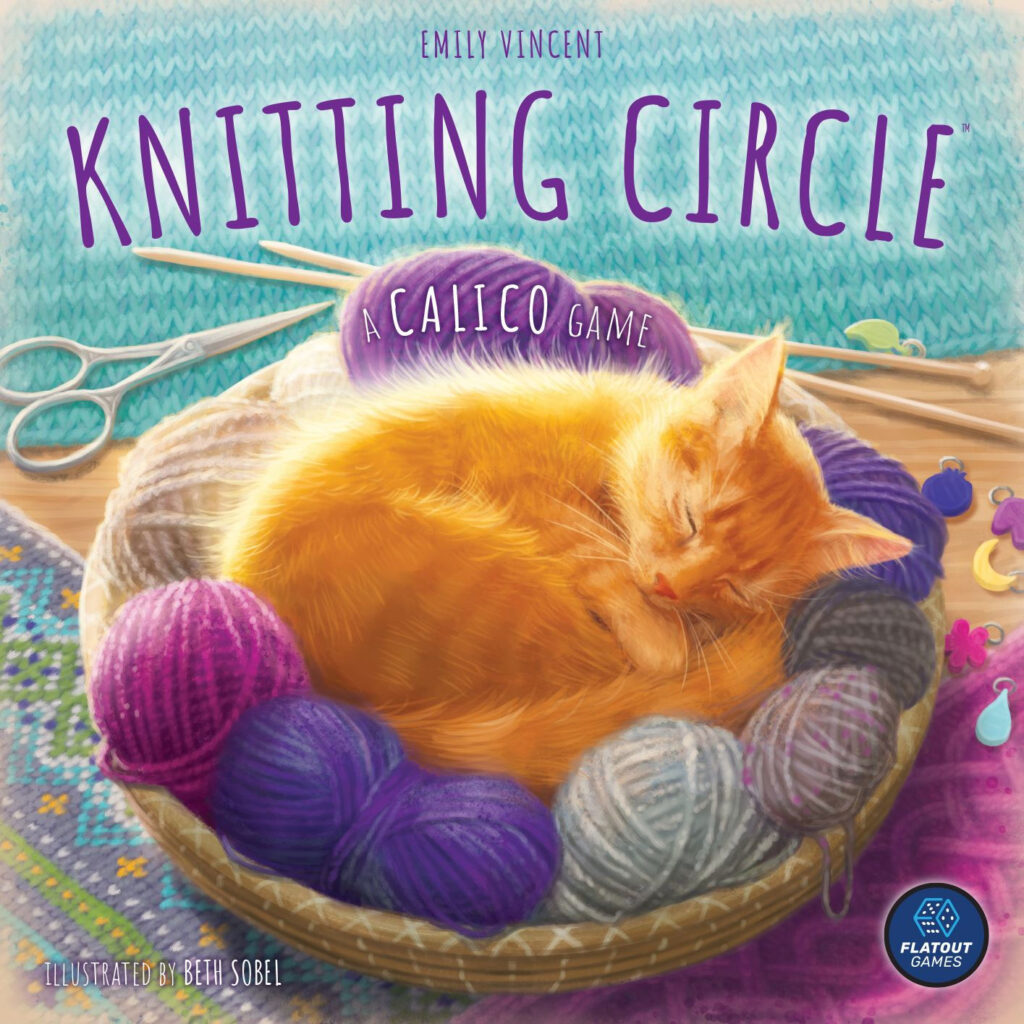
Knitting CircleCalico is a game that looks deceptively cute and cuddly, possessing an adorably floofy kitten on the cover atop a pastel quilted backdrop. Inside the gameplay, however, is a brutal brain-burner of a puzzle where players are challenged to optimize among 36 unique tile types within a slew of overlapping scoring opportunities that all seem […]

Source

Designer Diary: The Ground Between

27. Februar 2026 um 08:00

by Felix Sonne


I have been hearing that wargamers are getting “extinct” because nobody has the time to spend half a day playing games anymore and no one wants to play on a sad looking paper map. The thing is, it does not need to be that way. Wargames can be engaging, deep, fun, and yet modern-looking and quick. So I took it as my mission to make a free PnP hex-and-counter wargame that looks decent enough for non-wargamers to try, and simple enough for them to craft and try out.

This undertaking brought us into The Ground Between. It is a free, low complexity, Print and Play (PnP) wargame on the Western Front of World War 1 (WW1). Now that it is done, I can share that it was harder than I expect it to be. It is a whole circus act. I am juggling between fun factor, aesthetics, and educational value, while balancing on simplification and realism.


Cut, Cut, Cut Until There Is No Fat In the Meat
It is easy to do more: do more work, spend more money, use more components, create more rules. But I disagree with this approach because it creates bloat. My principle in design (and perhaps in life) is “to do more in less,” by cutting unnecessary parts and emphasizing what is really important.

1) PnP? Make it easy to craft. I learned this from the Designer Diary of David Thompson (Tactic Skirmish Apocalypse, Warchest, Undaunted). PnP games should be easy to craft ideally, and it has stuck in my head ever since when I designed games intended for PnP. I have crafted a PnP wargame from other designers that has a hundred small size, two-sided counters. I enjoy half of process, but the other half of it just feels like chores, and I do not want to impose this to players. While the game is designed with WW1 theme top-down, it is also designed bottoms-up from component consideration. Since D1 it has been set that the game shall only have large, 15 counters per faction, which can fit in one sheet of paper (actually half).


2) Cards? KISS it! You may have heard of it, it stands for “Keep it Simple and Short.” I had a tendency to make my initial design with a deck of 54 cards, since it fits nicely with a deck of playing cards, it seems to be the “industry standard”, and it takes exactly 6 sheets of paper to make. During the development I managed to halve it, with one sheet of paper per faction (which includes Tactic Cards for Advanced Mode and Solo Mode as well). I tried to eliminate the Command Cards completely, but I ended up keeping it because it gives a better reflection of the battle where each side is trying to maintain a balance between firing and maneuvering.

3) Where are the war machines? Not here! WW1 was the advent for Tanks and Aircraft, they are game changing (pun intended) and may seem like a “must have” in a WW1-themed game. However, sticking to the original intention of making a low complexity introductory WW1 wargame, it is refocused to the 1914-1915 period, where the tanks were still on drawing board, and planes were still mainly used for reconnaissance (machine guns were only equipped into airplanes on the later part of the war). So no killing machines, just good old shooting and hand-to-hand combat, which delivers the extra grit as intended.

Reduce, Reduce, Reduce Until It Is Streamlined
Streamlining is slightly different from cutting. It is about reducing exceptions, steps, and variants with the intention to make the game “flows” better and faster. There is no sane reason to move 20 different pieces 10 times (move active player marker, move turn tracker, play a card, move a piece, spend resources, flip a piece, tap a card, etc.) if we can get the same enjoyment by moving two pieces one time.

1) Secret Deployment. Realistically, on a battlefield you would not be able to tell exactly what Unit your opponent has 5 miles behind the bush. In the original Advanced Mode, Units were supposed to be deployed secretly face down. As much as it raises the excitement and realism, it also raises the fiddliness. So in one stroke to maintain the fidelity to simplicity and suppress the fiddlyness, the secret deployment is secretly deployed to the bin.


2) Blocks variant. As you can guess from the previous point, my absolute favorite games are block wargames where you can keep some fog of war without the fiddliness. Naturally I tried to make an option to play the game with blocks. In such case, it is inevitable to have exceptions and variants, which adds to one page in the rule, which may intimidate some people. So there goes the block rules to the chopping block.

3) Morale Checksss. For those who are unfamiliar, ‘morale check’ is a mechanic to determine the effectiveness of a Unit in some conditions (e.g. retreating, being barraged, etc.). I actually like the concept because it adds realism to the game, but some popular games take morale checks for a lot of things. I shall not name the game, but IFKYK. I adopted the same morale check system, but after a series of playtesting with non-wargamers, the morale checks are reduced to only when you are taking casualty. Works like magic.

True To the Theme
1) Translation. To facilitate immersion, originally the Units are named according to their native names. There were Mortier, Médical, Flammernwerfer, and so on. This looks and feels nice, but apparently it confuses some playtesters and it creates distance to players who do not speak the language. As such, I scaled back the local names only for the Advanced Units and Tactic Cards where they are unique to the country, whereas everything else is reset to English for functionality consideration. Worked like a charm.

2) (Mostly) Symmetrical. Some gamers are obsessed with symmetry, emphasizing for equal chance of winning, and some others are asymmetric who want something uniquely theirs or have different ways to play. This is not the the time to talk about it, but if you look at all the conflicts in the world, you would see that none of them are symmetrical. If everything is in perfect symmetry, there is no reason to start a conflict.

3) Variable Player (Country) Power. The majority of conflicts are won before it started, and in an armed conflict, arms race hold a pivotal role. Before the USA and USSR started their nuclear race, the arms race in WW1 was about machine guns (before tanks and airplanes). This is reflected in the game with a token difference between the German Machine Gunner Unit. The French had a lead in the machine guns race, which ironically causes the German to work harder and surpass the French machine gun development both in quantity and quality. Again, to keep things streamlined, the variable power of Flamethrower and Mortar is cancelled. For those who likes unique units, there are unique Units in Advanced Mode, just like in reality. The Germans were experimenting with Shock Troops, while the French is bringing their Foreign Legion to make up for numerical advantage.


Ready, Cut, Shoot!
New to wargames? You could try this. Just one hour to craft the component, 4 paper for maps, 2 paper for cards, card stock for counter, 2 dice and some tokens from your existing games.

The latest version (v1.2) is just uploaded recently in its BGG file page.

Designer Diary: Hnefatafl: Valhalla

27. Februar 2026 um 08:00

by Roman Zadorozhnyy


Some games begin with mechanics.
Some begin with prototypes.
And some begin with a place.
For Hnefatafl: Valhalla, everything started with a journey.

Norway, Gods, and a Feeling That Never Left

A few years ago, my wife and I traveled to Norway. Like many people, I had always loved Viking stories: the gods, the sagas, the ships, the battles. But reading about a culture and experiencing it are two very different things. We spent a wonderful week in Oslo. We walked the city, visited the Viking Ship Museum, took a water trip on an old ship, and simply absorbed the atmosphere. Everything felt heavy with history—but alive at the same time.

Yet the moment that truly changed something inside me was our visit to Oslo City Hall. If you’ve ever been there, you know what I mean. The walls, the sculptures, the murals—so many of them depicting Nordic gods and mythological scenes, carved and painted in a way that feels ancient, powerful, and deeply human. Standing there, surrounded by these images, I felt something click. Not excitement. Not inspiration in the usual sense. Something deeper. I bought Viking-themed souvenirs, books, and small artifacts. During the long flight back to the U.S., I couldn’t stop thinking. About Vikings. About gods. About games. And then, somewhere above the Atlantic, I had a clear Eureka moment. I didn’t want to create a new Viking game. I wanted to add new meaning to an old one.

Why Hnefatafl?
Hnefatafl is one of those games that feels eternal. Simple rules. Deep strategy. Easy to learn, hard to master. An abstract game that survived centuries. And that’s exactly why it felt right. The question wasn’t “How do I redesign it?” The question was “How do I respect it and still add something new?”

Exploring the Paths Forward
At first, I explored several possible directions. One idea was to create a solo mode, similar to scenarios in chess puzzle books where players solve positions with specific goals. Interesting? Yes. Exciting? I wasn’t sure. Another idea was to introduce clans, each with special rules or capture conditions. But that approach felt… limiting. Too rigid. Too mechanical. Then I realized something important.

I didn’t want factions. I wanted blessings. Not gods fighting instead of Vikings. But gods guiding, influencing, and rewarding them. And suddenly everything aligned.

Valhalla as a Mechanic
I dove deep into Norse mythology: stories, legends, and symbolism. And that’s when Valhalla revealed itself not just as a theme, but as a mechanic. Valhalla is the place where fallen warriors go after dying in battle: to feast, to celebrate, to stand among the gods. And that solved the entire design puzzle. What if fallen pieces weren’t just removed from the board? What if they became a resource? Captured warriors could now grant blessings from the gods. Loss became opportunity. Sacrifice became strategy. Suddenly, the abstract battlefield gained emotional and tactical depth without breaking its core identity.

Designing the Blessings
I experimented a lot. Hidden cards? One-card-per-turn effects? Triggered abilities when the King moves? I created dozens of effects and began playtesting relentlessly. Some were too strong. Some felt thematic but broke balance. Others were clever but unnecessary. And then another realization hit me. This expansion must stay small. Not a massive deck. Not a bloated system. But something elegant. Minimal. Almost invisible until you feel it. That’s when I decided these should be promo-style cards rather than a huge expansion box.


Small Changes. Big Impact.
A year on the shelf… Until IGNM
The expansion was finished. Balanced. Tested. And then… it waited. Like many prototypes, Hnefatafl: Valhalla spent nearly a year quietly sitting on a shelf. Until this year when it was selected for Indie Game Night Market at PAX Unplugged. That opportunity changed everything. I realized that bringing only an expansion wouldn’t work. Most players wouldn’t already own Hnefatafl. So I made a bold decision: I created Canvas and Postcard editions of the base game, so anyone could jump in immediately. Now the expansion had a proper home.

Art, Collaboration, and Pride
While preparing for IGNM, I was also writing an article about ancient games for Casual Game Insider. I casually asked the team, “What if we also add an expansion for Hnefatafl?” Their response was immediate, “That would be awesome". That was the final push. I contacted my friends Max and Angelita, and they created stunning artwork for the gods. Art that felt ancient, powerful, and respectful — exactly what the game needed. Seeing the final product was one of those rare moments of pure pride.

An Old Game, A New Layer
What makes me happiest about Hnefatafl: Valhalla is not sales or attention. It’s the feeling that we added a new layer to a cultural artifact without damaging it. The rules remain simple. The strategy remains deep. But now, every capture carries weight. Every loss has meaning. It’s still Hnefatafl. Just… alive in a new way.

Maybe I’ll finally publish my book about ancient games. Maybe I’ll add new gods as promos. Maybe I’ll finish my long-planned chess expansion. Whatever comes next, one thing is certain: I want more people to discover how powerful, elegant, and relevant ancient games still are today. Because sometimes the best design work isn’t about inventing something new. It’s about listening to the past and continuing its story.

(C) Roman Zadorozhnyy

Flip-and-Curse-That-Stupid-Dragon

27. Februar 2026 um 06:40

The two-tone color scheme is striking, but it also leads to a few problems. My friend Adam, for instance, cannot tell the difference between the gold coins and the gold magic beans.

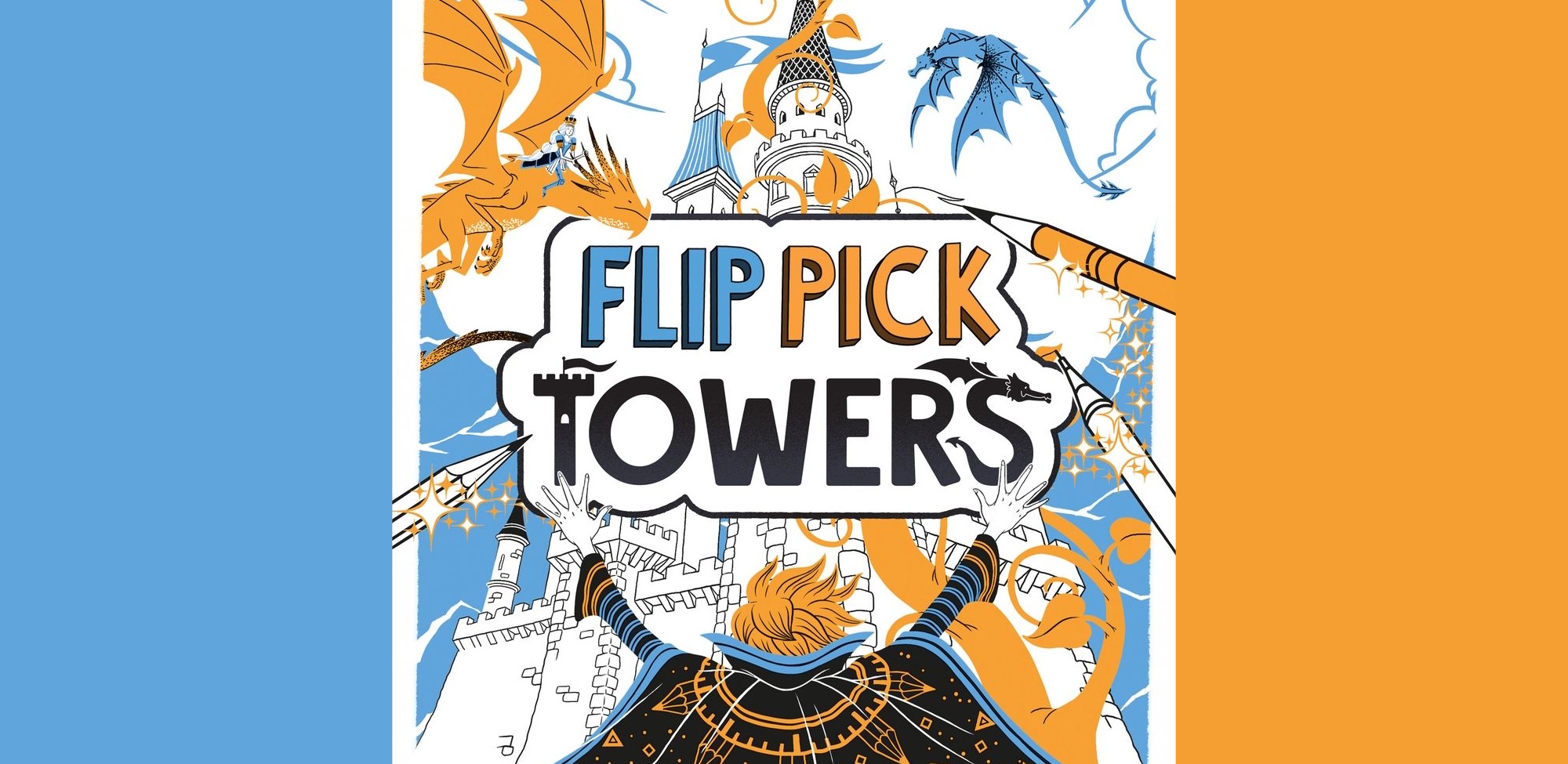
Remember when every other game was a roll-and-write? That was living proof that even golden ages come with cloudy linings. Flip Pick Towers, designed by Rob Fisher and Adam Porter, benefits from its release a few years after the slew of samey writing games. It’s an unrepentant flip-and-write, is what I’m saying, more in the vein of Cartographers than the form’s more mathy alternatives. Some artistic talent won’t go amiss.

For those of us who can’t even sketch a convincing stick figure, however, it’s still charming, albeit not perhaps as compelling as some of the options out there.

Nice ivies, dudes and dudettes!

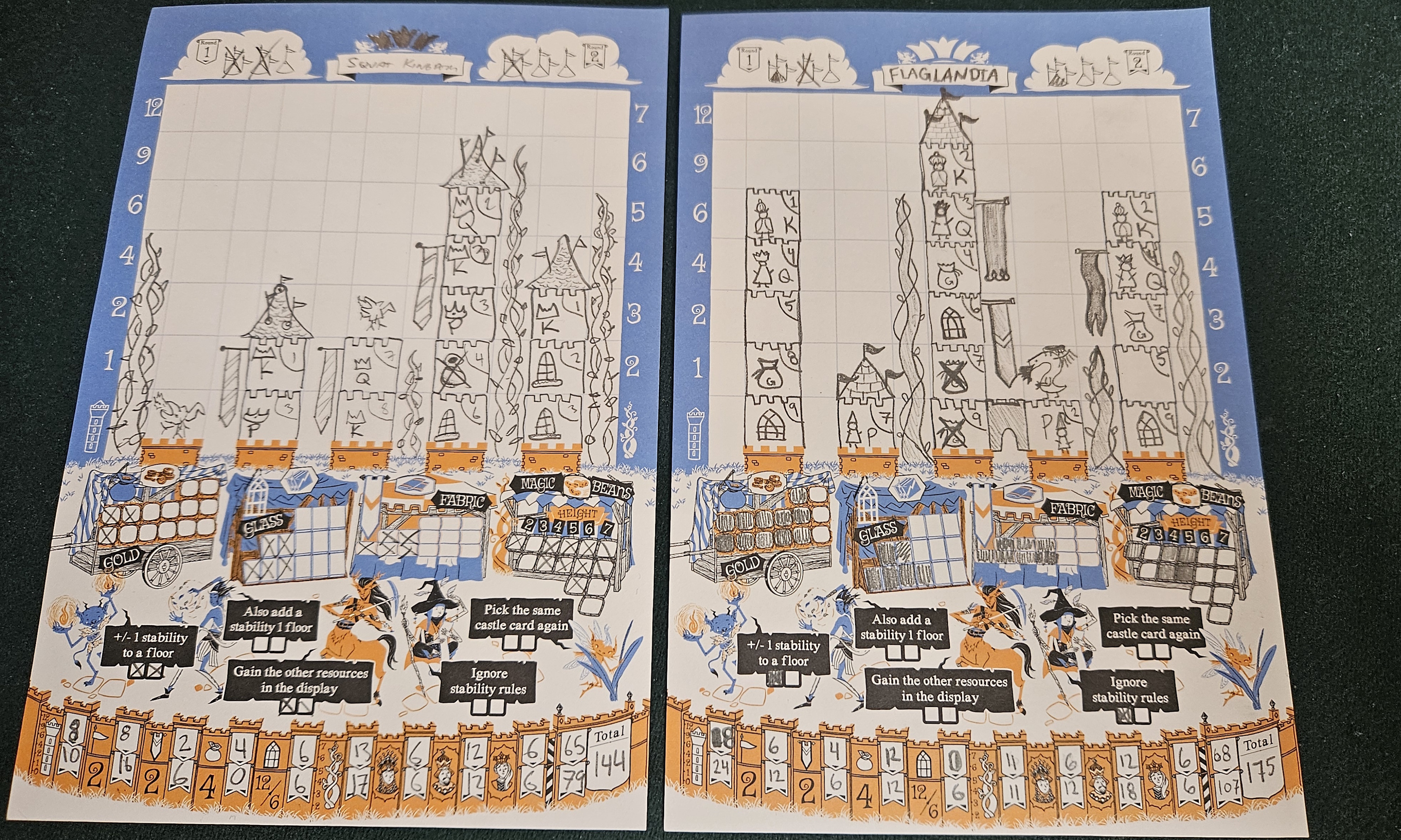
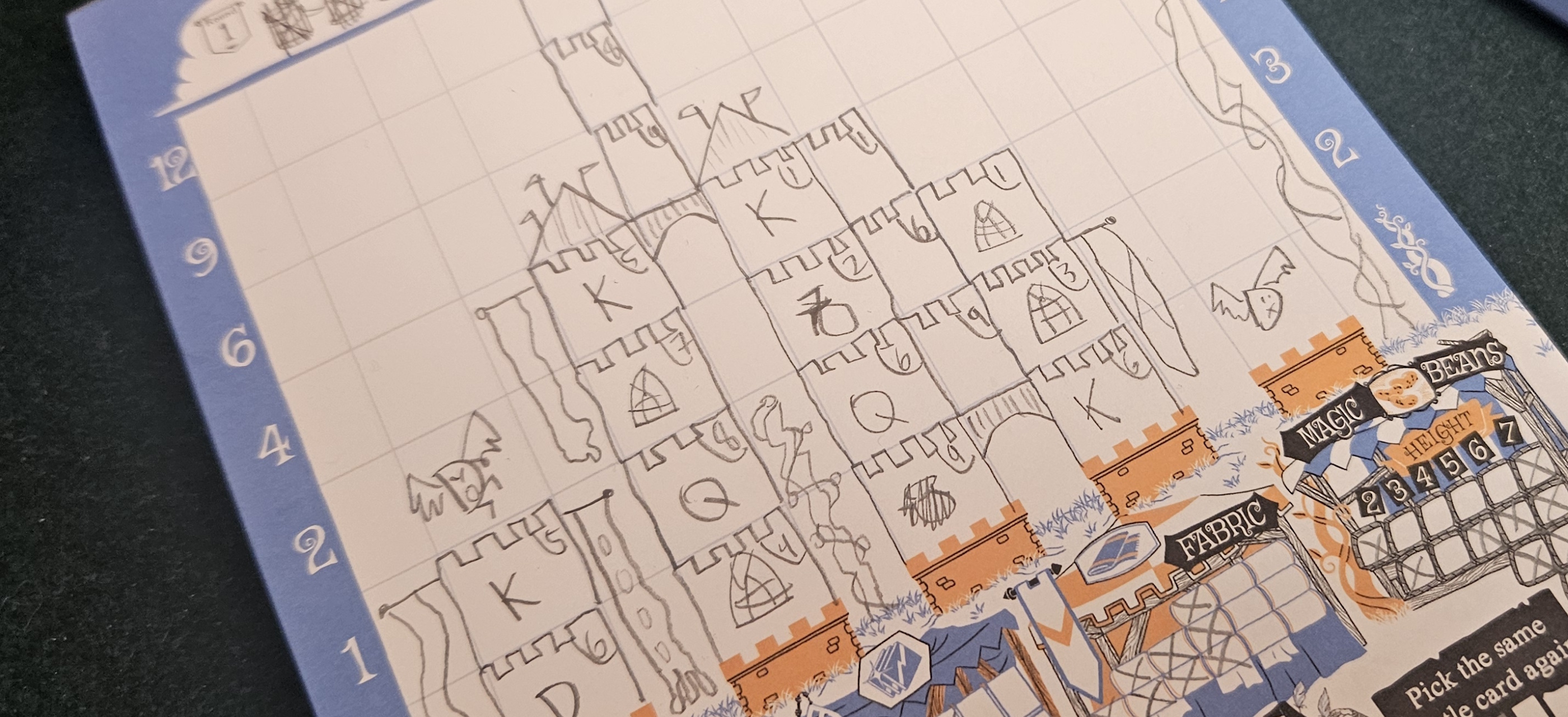
Two very nice towers. (Not mine. Obviously.)

Stop me if you’ve heard this one before. Every round, three cards are flipped. Everybody at the table picks one — different ones, the same one, it doesn’t matter — and pens it onto their personal sheet of paper. Once the deck is out, it’s time to score.

There are a few little distinctions that set Flip Pick Towers apart from its peers, and no, I’m not talking about how the game’s title is a literal description of its phases. For one thing, the game cleverly triggers its scoring phase twice. This potentially pushes you through the deck twice, which is nice for those who are still learning its composition, but also encourages players to hustle toward scoring goals early rather than waiting for them to come together at the last moment. It helps, too, that it’s entirely possible for somebody’s failed castle to end the game a few rounds early. So much for that last tower you were hoping to stretch heavenward.

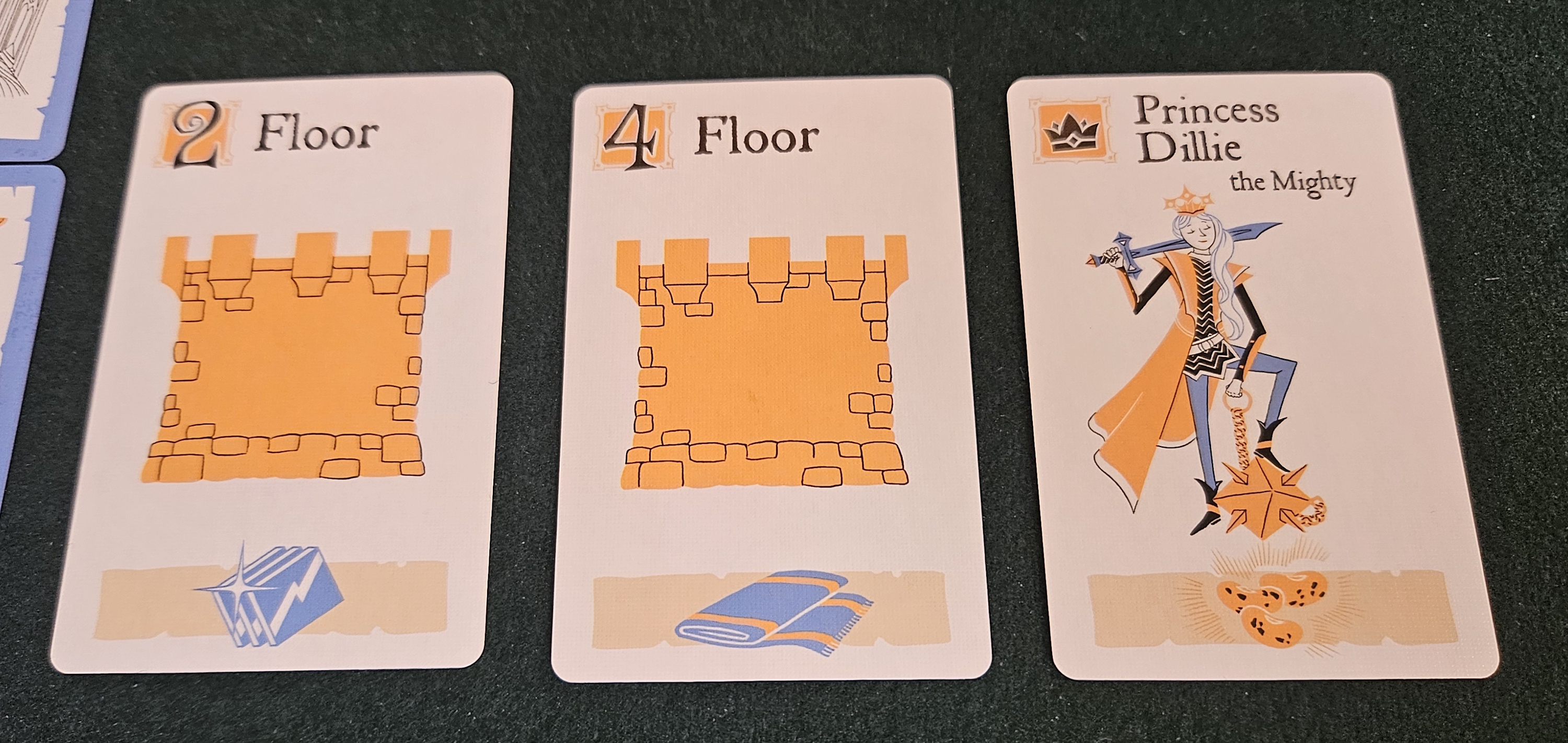
The constituent parts of your castle are simple enough. Most cards represent floors. These you stack like LEGO blocks, always keeping an eye on their stability number, which must tick downward with each successive level. Eventually bridges can span the gap between floors, providing foundations for further building and bypassing the usual stability rule for a moment. Look, it’s basic architecture. If you lean two crumbling minarets against one another, you can pile another few hundred tons of hewn blocks between them. Everybody knows that.

There are also magical creatures who provide special abilities — like, say, ignoring a floor’s stability, easily the most potent ability in the game — rooftops that can earn a few points but conclude a tower’s upward trajectory, and royalty who occupy all those empty rooms to score points. More on their majesties in a moment.

not shown: a good example of the game's diversity, but a great example of what most decisions actually look like

Every turn, you select from three cards.

Finally, every card also provides a material of one kind or another. The format for these is simple enough, adding new features to your castle whenever you complete a material’s column. Hence glass introduces windows to your castle, bags of gold eventually fill entire floors, and banners hang from on high while magic beanstalks creep up from below. In fine flip-and-write fashion, these soon jostle for space. There’s room for planning, but remaining inflexible is a surefire way to get nothing done at all.

The last type of card is a dragon. Argh, the dragon. There are two of these in the deck, meaning you might see four of the winged pests in a sitting, and they’re as unwelcome as it gets. Whenever one of the sky-rodents appears, you either place it atop one of your towers — blocking further construction, which can be a real nuisance if they appear in the game’s early stages — or scrawling out one of your hard-earned bags of gold to buy them off. Thankfully, they are not sexist dragons, and no sacrificial princesses are required.

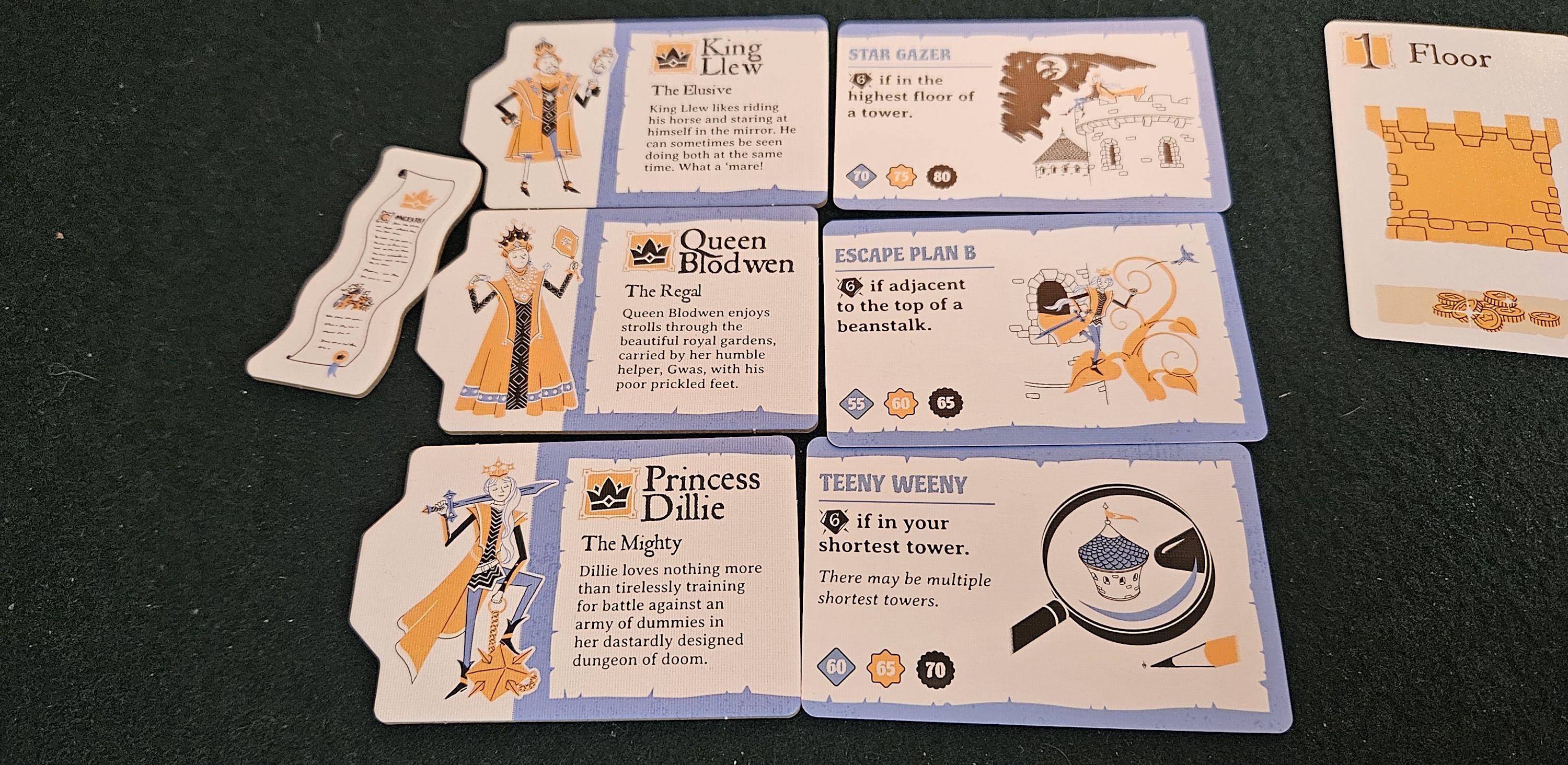
Speaking of princesses, the most interesting offering by far are the royalty cards. Each session assigns an objective to your queen, king, and princess. As their chambers are added to your towers, their points tend to compound. And compound. And compound. It isn’t uncommon for a single royal member to score as much in the endgame as a player earned at the midpoint tally.

King: "3 points per crushed orphan." Queen: "6 points for retracting privileges from the artisans." Princess: "8 points for telling them to eat cake."

The needs of your petty royalty.

In the best of instances, these transform the game’s sometimes obnoxious placements into significant opportunities. Remember those dragons? Well, if your king prefers occupying towers with dragons perched on them, now you can keep your gold and take care of the old man at the same time. All the better if you manage to erect a single tower with a single dragon atop it, then fill the place with four or five stacked kingly quarters. The same goes for the other elements. One session might feature a queen who yearns for escape, encouraging you to place those magical beanstalks next to her chambers rather than doing the normal thing by squirreling them off. Or, heck, a princess who just really likes living near bridges. Don’t we all appreciate a nice bridge?

Not every objective is similarly worthwhile. For every goal that enlivens the game’s placements, there’s another that’s plain uninteresting. After a couple plays, our group reached the point where we would keep drawing through the deck until we found something that felt sufficiently energetic.

Even then, the overarching puzzle doesn’t change much from one session to the next. On the whole, there’s enough to keep everybody engaged, at least for a session or two. But the gameplay is simple enough that, barring the pleasure of scrawling a little castle, with little banners that look like banners and not whatever my castle’s banners look like, there probably isn’t much to keep anyone coming back time and time again.

It is, in other words, a flip-and-write. A very good flip-and-write, a charming flip-and-write, a flip-and-write with plenty of little considerations to account for. But it doesn’t stand up there with the finest of them.

Those are banners hanging from the side of my castle, not shed snake-skins and spent condoms.

Fine. Here’s my garbage tower.

Maybe it doesn’t need to. I’ll admit I’ve enjoyed looking at my friends’ creations, and even letting them laugh at mine. To go with my perfect face for radio and outstanding voice for text, I have excellent penmanship for a keyboard. Once, I wasn’t even sure whether a room’s occupant was a Q, for the queen, or a bag of gold with a little knot cinching it closed.

Anyway. Flip Pick Towers. It’s cute stuff. I’ve had a nice time with it. I suspect I’ll strain to remember it by year’s end.


A complimentary copy of Flip Pick Towers was provided by the publisher.

(If what I’m doing at Space-Biff! is valuable to you in some way, please consider dropping by my Patreon campaign or Ko-fi. Right now, supporters can read about which films I watched in 2025, including some brief thoughts on each. That’s 44 movies! That’s a lot, unless you see, like, 45 or more movies in a year!)

Designer Diary: The Four Doors

26. Februar 2026 um 20:36

by Matt Leacock


Matt Leacock: The design of The Four Doors followed a long, meandering route. It was the result of four different designers working alongside four different publishers to produce no fewer than five different games. I thought it’d be fun and enlightening to show just how much time, energy, and iteration can go into what (on the surface) might look like a fairly straightforward card game.

Please welcome one of the game’s co-designers, Matt Riddle (Matt R). Matt R will join me as we describe these five games below. Each iteration had its own strengths and each successive game improved on the former, until we were able to pull everything together into the final product, The Four Doors.

Believe it or not, our story starts with Matt Riddle and Ben Pinchback’s The Goonies: Adventure Card Game (2016).

Matt Riddle: After we made The Goonies, things did not go as planned (more on this below). I remember saying to Ben, “Now, I understand everyone's stuff is emotional right now. But I've got a Three Point Plan that's going to fix EVERYTHING.

Step 1. We’ve got this guy, Matt Leacock.

Step 2. ???

Step 3. He is going to fix EVERYTHING.”

So really, more of a two-point plan… Goofy movie quotes and false humility aside, I reached out to Matt about the possibility of working together with no expectations. Ben and I aren’t nobody, but still, Matt could have completely ignored me, and I would not have thought any less of him. Turns out, he is actually super cool and was willing to take a look at our design idea that we wanted to squeeze into his world, more on that soon. I did not expect it to be the circuitous journey that it was, but I could not be happier with where it ended up. 

And so, it all started with…

The Goonies: Adventure Card Game

Key dates
• Design started: Early 2015
• Published: 2016

Matt R: Designing games on spec is HARD. “On spec” means that a publisher asked us to work on a game with a specific set of requirements, or to a specification. As engineers (Ben and I are both engineers IRL) we deal with specs all the time. I am pretty sure Ben’s real-life job is to take the spec from the customers and take them down to the engineers. He is a people person. Designing Goonies was hard and easy at the same time. Mechanically, we knew it had to be a co-op, and the spec said it had to be a card game. That was easy, let's just be inspired by the best co-op game on the planet, Pandemic! I mean this, this is not made up, we literally designed a card game based on Pandemic over 10 years ago and then tried to convince Matt L that it should indeed BE Pandemic: The Card Game later on. Life is crazy.

Matt asked me to explain how Goonies works, and I will, I promise. Eventually. We very quickly had the structure of moving between locations and clearing obstacles (cards) using cards from your hand while holding off the Fratellis (threat meter and events). That was the “easy” part. The hard part was making it a Goonies game. We learned a lot when we designed a Back to the Future game that was, well, a game. Again, a card game, mechanically solid, but it did not FEEL like Back to the Future. It didn't deliver the feeling of BTTF that people expected when playing. On Goonies, we worked really hard to remedy that through characters and shared team turns and a general sense of adventure. As much as we could with 100ish cards (again, that pesky spec).


The locations from The Goonies: Adventure Card Game

Fast forward a few years, and Goonies has sold pretty well, but we had yet to receive payment for said project. It happens more than you think. The publisher hit hard times, and the check was in the mail for YEARS. This is a hobby for Ben and me, so it was annoying, not harmful, but it still suuuucckkkeeddd. That all led to the above two to three point plan. I knew we would make DOZENS of dollars to split three ways with Matt L., and they might even put our names on the box under his… but prolly in MUCH smaller letters. 


Pandemic: The Card Game (Pitch)
Matt R & Ben’s Initial Submission

Key dates
• Matt Riddle first emailed Matt Leacock on: 9 November 2018
• Prototype Submitted: 22 January 2019

What elements did you change in The Goonies in order to make it feel more like Pandemic for your pitch?

Matt R: Most of the original Goonies core design elements – locations with accumulating threats that need to be kept under control, the team turn, the card management – made it into the Pandemic redo. 

We changed the way Fratellis (escalation events) worked as many of them made a lot less since in the context of Pandemic, mechanically and thematically. Our design efforts were more around tweaking balance and incorporating any consistent feedback that Goonies received, which we felt could help that game.


The four cards that made up the board in Matt R and Ben’s initial submission.


Matt L: I took their original submission apart, put it back together with input from them, and iterated on it for two years until it was…

Pandemic: The Card Game

Key dates
• First design journal entry: 8 March 2019
• Last design journal entry: 28 January 2020

What from the originally submitted prototype stayed the same?

Matt L: Many of the fundamentals of the original submission carried over into the final version of Pandemic: The Card Game. Players took actions using multifaceted cards to move, treat disease, and meld cards to cure diseases. The same deck of cards was used for both player actions and to track the disease as it spread in the world. Players each had a role-specific power. Disease accumulated in specific regions, and once they passed a threshold, an outbreak occurred. You won the game if you discovered four cures, and you lost the game if you had too many outbreaks.

What changed in the developed version?

Matt R: It was fun going back and forth with Matt and watching our game turn into Pandemic while still seeing the core parts of the Goonies design. I wanted to say one of the hardest things in game design is killing your darlings. You will see in the next section that Matt helped us do that when we moved from a single pawn and “group turn” to individual pawns and turns. While the former could accentuate the master gamer problem, we did our best to design around that. Also, don’t be that guy. All that said, the game was BETTER after the change, it just took some time to get there. No one has ever accused me of lacking confidence, and I do not suffer from imposter syndrome. Neither should you BTW, do that thing you have been thinking about, the world needs your voice too, I promise. BUT still, I couldn’t help but think, why does Matt need us on a Pandemic game? He could totally move on and do it himself, but he did not because he is a good guy. And also, we are pretty dang good at making card games, look ’em up. 

Matt L: In order to increase player agency, I gave each player their own pawn and turn (instead of having the players play collective turns with pooled actions). To simplify things, I also decoupled “Move the team and cure a patient” into two separate actions, Fly and Treat. Giving each player their own pawn also meant they could meet to share cards, leading to the introduction of the Share Knowledge action and the need to coordinate in order to discover cures.

Matt R and Ben had four cards that had “specialist” abilities on them that could be played for a special effect and then removed from the deck. These added a lot of strategic depth, so we developed them into a larger set of event cards. Because these cards were removed from the deck (and not discarded) when used, this opened up a new loss condition: if the draw and discard deck ever ran out when you needed a card, you lost the game.

I removed the Rest option – where you took fewer than the allocated actions in order to draw additional cards. This seemed to reward inaction which felt against the spirit of needing to take urgent action. Instead, I introduced the Research action which simply lets you draw 1 card for an action.

To increase tension, I introduced an infection rate. Each time you reshuffle the deck, you advance a token along a track. At certain thresholds, advancing this token increases the number of cards you need to draw during the Infect step. This led to the third loss condition: if the infection rate marker ever reaches the end of the track, you lose the game.


The four locations from the developed version of Pandemic: The Card Game.


Other Changes

• One of the earliest tasks was renaming most of the nouns and verbs in the game to be consistent with the Pandemic board game. Patients became disease, epidemics became outbreaks, curing became treating, escalate became infect, specialist became event and so on.

• I removed the requirement that forced you to treat all the disease in a given location before you could discover a cure since it felt grindy, didn’t fit the theme particularly well, and wasn’t how the board game worked.

• I removed the idea that when you tried to discover a cure, you’d have a 50% chance of success (a holdover from The Goonies) since that just felt random to me.

• I simplified the way treating became more effective once a cure was discovered.

• I changed discarding so it was carried out as part of each action that required it, rather than a discrete step in the order of play.

Abandoned Ideas

Matt, Ben, and I briefly explored a zombie theme and a realtime version of the game, but quickly abandoned both ideas. Pandemic has always been about “science not violence” so zombies were out and the real time version didn’t feel like a Pandemic game.


Why was the game abandoned?

Matt L: While Z-man was open to the idea of the game, I was really uncertain about how it’d fit into the product line. We already had Pandemic: The Cure (the dice version of the game) and Pandemic: Hot Zone – North America was already planned as a simpler, more portable, entry product. It wasn’t clear that there was enough room for another simplified Pandemic game. As such, we kept kicking it down the road when it came to planning a release.

Matt R: If the game had not ended up being as awesome as it became as The Four Doors, I think I would have flown to Matt’s house and pulled a Say Anything to try and change his mind and get Pandemic the card game in the hopper. Luckily, I didn’t resort to that, and it all worked out in the end. Though Matt and his family missed out on me scream singing IN YOUR EYES THE LIGHT AND THE HEAT. Their loss, really. 

Matt L: A real shame.

Instead of being serenaded, time passed, until one day, I had an idea. If there wasn’t much need for a simplified version of Pandemic anymore, perhaps a simplified version of a more complex game (such as Pandemic Legacy) would work. I pitched the idea to Rob Daviau and Z-Man and they were both excited about the potential and decided to come on board. This could open up a new category of game!

We tentatively called the resulting project…

The Clockwork Initiative
(a Pandemic Legacy Card Game)

Key dates
• First design journal entry: 21 January 2021
• Last design journal entry: 27 June 2022

What changed in this new version?

Matt L: We took Pandemic: The Card Game wholesale and developed a story and campaign to layer on top of it.

Matt R: I have never suffered from imposter syndrome a day in my life. My Midwest white guy confidence is off the charts, my parents did TOO good a job with my self-esteem. That said, I spent months on calls with Matt and Rob, barely contributing. Ben and I would test an iteration and give feedback here and here, but it was Matt’s show. Ben and I are slow, we meet once a week, generally and pick away. By the time Ben and I would test, Matt L likely had fixed anything we found AND made a new build. He was very gracious about that lol.

Matt L: We worked with Rob to craft a story of agents tracking down enemy threats, avoiding toxic vermin, as well as prying locals in a six-chapter genre thriller set in the ’70s. Players basically played Pandemic: The Card Game, but their abilities, equipment, and objectives changed from chapter-to-chapter as the story unfolded.

This led us to explore the design space even more, which increased the number of events in the game.


The Clockwork Initiative was set in a gritty 70s townscape.

Matt R: The Four Doors? More like the four designers, amirite? This part was really cool for me. We were already working with Matt L, and now Rob Daviau as well. Especially because I am not a storyteller. I like theme and I want it to make sense in games, but I don’t read flavor text. I don’t read the paragraph at the front of a rulebook telling me some lore about being a farmer, or ship’s captain, or monster hunter, or post-apocalyptic delivery driver. I want theme in as much as it does not get in the way of rules and my understanding of the game. So to watch Rob develop this whole story system and adjust mechanics and actions to account for that was really, really exciting as a game designer. 


Why was the game abandoned?

Matt L: The game was a lot of work… and we simply weren’t having much fun doing it. We took a hard look at the numbers. Since it was a card game, it would have a fairly low price point and we’d be splitting the design royalty four ways. It would be a really heavy lift for a fairly modest reward. Ultimately, we were happy to put our tools down and move on to other projects.

Rob D: Hi, just wandered in to note that I spent a year of my life on this and then Matt kicked me out of the band. “Creative differences” he said. “Going in a new direction,” he said. There was also murmuring of me “bringing everyone down to my level.”  If you know Matt, or Mr. Leacock as he demands I call him, you know he’s a cruel vindictive person full of spite and I should’ve seen this coming. (Actually, this was fun to work on for a bit, until it wasn’t. It was never going to be a great game in this iteration so I bowed out and wished everyone luck, including Mr. Leacock.)

Matt L: <coughs> The project then lay fallow for some time, until one of the good folks from Gamewright (who had tried the game out at a conference) wondered if it might make a good Forbidden card game.

I took a look. It would. The result became…

The Forbidden Island Card Game

Key dates
• First design journal entry: 15 February 2023
• Last design journal entry: 4 September 2023

What changed in this new version?


I made the game’s card square and arranged them into a 2x2 grid to form the island. Each location had two different “shores” that could be threatened.

Matt L: In order to make the “island” for the game, I removed one of the game’s locations (reducing the number of locations from 5 to 4), made the cards square, and arranged them into a 2x2 grid. Since it didn’t make a lot of sense to Fly around the island (the board was much more compact), I dropped the Fly action and let players simply move to adjacent locations for an action, like they could in the Forbidden Island board game.

Instead of having an improved Treat ability when each cure was discovered, players would find treasures that unlocked a new power for the adventurers who held them.

Matt R: You will notice less and less of my witty repartee in these sections, and that is because, as I mentioned before, Matt L could have dropped us at any time, and we wouldn’t have complained or thought less of him. Sure, the DNA of Goonies has survived and evolved and improved throughout this process, but Matt L’s effort had far outstripped ours at this point. If that game had suddenly been released as Forbidden Island: The Card Game I would not have blinked twice. (I know Matt L. never considered it; he is a man of integrity, honor, justice, and the like, but just saying.) 


Why Was The Game Abandoned?

Matt L: I developed the game fully to spec, turned it in, and eagerly looked forward to its production and release. Then, after reevaluating their plans, Gamewright decided to cancel the game. So it goes. (Remember fellow designers: always be sure you get an advance upfront.)

I put the game into File 13. Perhaps something would come of it someday.

The Four Doors

Key Dates
• First design diary entry: 3 September 2023
• Last design diary entry: 23 March 2025
• Published: August 2025 (Gen Con)

Matt L: I was fortunate that Jason Schneider of Happy Camper (who had originally commissioned the game when he was at Gamewright) remembered the game and asked what had become of it. I was happy to tell him that it was still available. We got to work!

What changed in this new version?

Matt L: Jason suggested a treatment early on: “In the clearing of an overgrown forest stand four mysterious doors. Behind each door lies fantastic treasure, but also imminent peril!”


This cover composition prompted The Four Doors’ setting, threats, and goals.

I ran with it. The shadowy threats could be dispelled by illuminating them. The doors could contain the treasures the adventures needed – but they could be closed off if the players weren't careful. I experimented with the door card layouts and came up with the idea of stacking them into a tower. That opened up the idea of a lighthouse with a magical beacon on top. This in turn led me to change the treasures into the relics needed to light the beacon to dispel the shadows forever.


I stacked the four doors to form a lighthouse. The beacon card (on top) came soon after.

Most of the work in this version was spent trying to make the game as accessible as possible. One of the biggest development tasks was making it abundantly clear where each card goes on the table, how to stack and overlap them, and how to understand them in each of these states. I also spent additional time on all the phrasing of the spell effects and adventurer powers.

Another task was refining the solitaire version. I found the recent work I did on the solo mode for The Lord of the Rings: Fate of the Fellowship rewarding and applied some of that same energy to The Four Doors. I wanted to make sure that the solo mode wasn’t just a patch or afterthought and worked to ensure that every card was usable and balanced when you played the game on your own.


At Last!

Matt L: The game premiered at Gen Con in 2025 and I couldn’t be happier with the final result. The mechanisms were refined over the five different incarnations and the product design really came together in this latest version. If you haven’t seen the shimmer on the lit beacon and the relic cards, you really should check them out – they’re nearly blinding!

So happy that Matt R and Ben patiently came along all the twists and turns. The game is better for it.


The published game, in progress. Photo courtesy of [user=kovray]Ilya Ushakov[/user].


Bonus Material

Some additional odds-and-ends that illustrate the game’s development.


Player card evolution. Left-to-right: The Goonies: Adventure Card Game, Ben and Matt’s initial submission, Pandemic: The Card Game,The Clockwork Initiative, Forbidden Island: The Card Game, The Four Doors , prototype and early proof.


Reference card evolution. Left-to-right: Ben and Matt R’s initial submission (typeset by me), Pandemic: The Card Game, The Clockwork Initiative, The Forbidden Island Card Game, The Four Doors


A relic card (left) and the final reference card (right) from the finished game. Image, courtesy of Board Gaming Crew


A big top with four doors. I briefly considered setting the game in some sort of a building or tent with a door in each corner.

5 Japanese Ideologies I’m Trying to Follow

26. Februar 2026 um 18:52

Recently an Instagram post about Japanese ideologies appeared in my feed, and I keep returning to it, so I thought I’d share my ruminations with you today.

Kaizen: Improve by 1% every day instead of chasing perfection.

I think about this in two ways: One, I try to acknowledge that Stonemaier Games (and myself) can always improve, and real improvement takes time. Two, big projects are completed only when we make progress in small, incremental steps (a lesson I took to heart when designing Vantage–even if I only found time to design 1 new location on a certain day, that was infinitely better than not making any progress at all).

Shoshin: Keep a beginner’s mind; curiosity makes learning endless.

I love learning about other people, games, companies, etc. You may notice that nearly every article, video, or post I make ends with a question, as I’m genuinely curious about other perspectives. I also love to see people approach a variety of topics–from light to serious–with  real questions grounded in curiosity (not loaded questions).

Ikigai: Find the reason you wake up, as purpose fuels happiness.

This is a tough one. It’s truly amazing to understand your “why”, but what if your purpose is distant from your daily responsibilities? That said, I have found it incredibly helpful to have a clear, guiding principle: To bring joy to tabletops worldwide by serving you. That is the lighthouse for every boat I try to steer ashore.

Nemawashi: Prepare quietly before decisions; success comes from groundwork.

I’m working on this, but it doesn’t come naturally to me. Specifically, when there is a decision to be made, my instinct is to make it and move forward. I think this comes from a previous job when decisions would be deliberated ad nauseum; also, for a long time it was just me at Stonemaier. It’s really nice that I can make decisions without going through bureaucratic stopgaps, but now I’ve found so much value in involving different coworkers when I’m deliberating something.

Oubaitori: Never compare yourself to others–everyone blooms in their own season.

One of the most unhealthy things I’ve done (and sometimes still do) is compare myself, my games, and Stonemaier Games to others. It’s an insecurity, plain and simple. I don’t need to judge myself in relation to someone else, nor is it productive to judge someone else in comparison to me. Rather, I try to learn about others with an open heart and appreciate what they’ve created.

***

Which of these ideologies resonates the most with you? Which one do you struggle with the most?

***

If you gain value from the 100 articles Jamey publishes on this blog each year, please consider championing this content! You can also listen to posts like this in the audio version of the blog.

Grand Central Skyport Review

26. Februar 2026 um 15:15
Grand Central SkyportWhen I play a board game, I like to pair it with a playlist. Forest Shuffle? There’s a playlist for that (bless you, whoever made it). But, Grand Central Skyport? I’m stumped. Do I go full retro-futuristic? Throw on some Around the World in 80 Days vibes? Still figuring it out. And, honestly, that ambivalence […]

Source

Competitive Warhammer 40,000 – What Is It, and Should I Try It?

Like many people, my first game of Warhammer 40,000 (40K) was played at a local game store. It wasn’t particularly organized. Armies weren’t optimized, rules were misunderstood or misremembered, and “take-backs” were given freely and without hesitation. The atmosphere was relaxed, social, and forgiving.

Games stretched on for hours and were rarely uninterrupted. Curious onlookers stopped by to watch or chat, breaks were taken for food and drinks, and plenty of conversation had nothing to do with the game itself. Most games didn’t even finish, and no one cared. Those hours were filled with laughter, questionable decisions, and learning. That casual environment is where I fell in love with Warhammer and the hobby as a whole.

Among my group of friends, armies were built around what people enjoyed playing or painting, not what was considered optimal. Some of us played to win, but nothing was on the line. The outcome mattered far less than the experience and the stories the games created.

Fast forward several years, and I found myself stepping into a very different environment - competitive Warhammer 40,000. Instead of a local store table, I was now under bright convention lights, surrounded by rows of identical tables laid out with carefully planned, symmetrical terrain. Don’t get me wrong, this environment is still incredibly enjoyable. The people are welcoming…

The post Competitive Warhammer 40,000 – What Is It, and Should I Try It? appeared first on Meeple Mountain.

Ziggurat Game Review

My wife and I are always desperate to find things to do during the ridiculously-long stretch over the holidays when the kids are out of school for the Christmas-to-New-Year’s period. Recently, that stretch lasted 17 days.

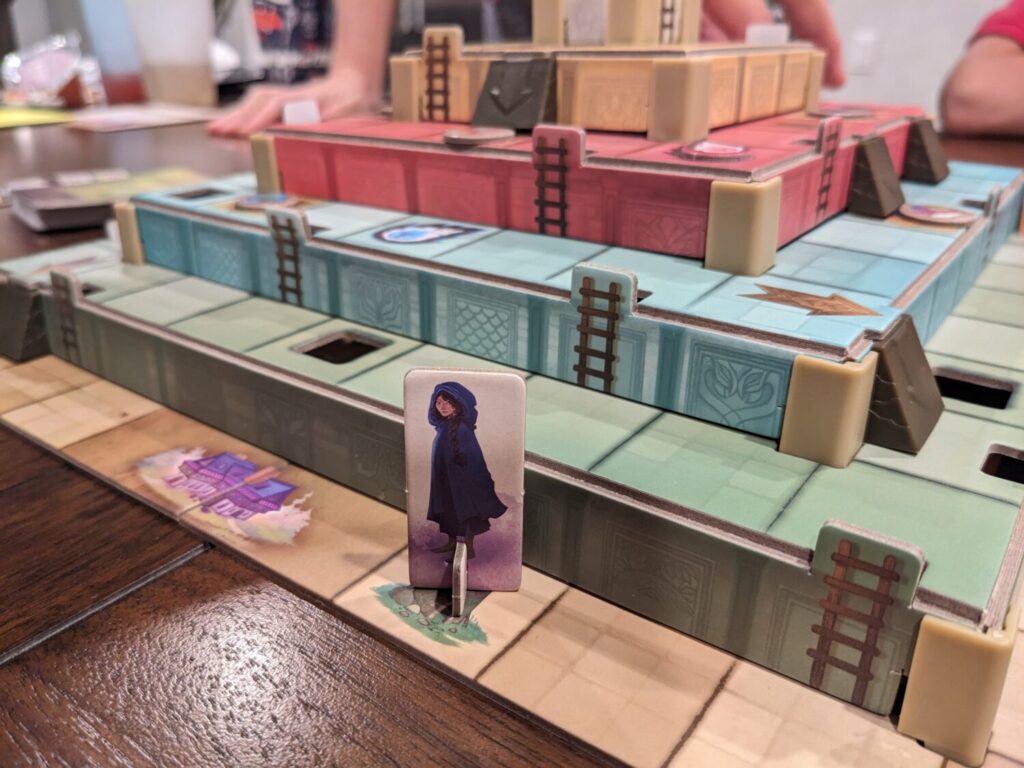
So, my wife often buys 2-3 activities—art projects, workbooks, LEGO installations, board games—to help pave the way in-between all the TV watching, tablet gaming, meals, and sleep. (Sadly, that is often all my kids do during that time if we are at home!) One of the activities she picked up this year was the cooperative legacy board game Ziggurat, published by one of our family’s favorite activity makers, the puzzle company Mindware.

At first, I rolled my eyes at this one. Do I not bring in enough board games for this family to play every year? But then I noticed the names on the box: Rob Daviau and Matt Leacock, two of the legends of the genre and the creators of the greatest legacy game of them all, Pandemic: Legacy Season 1. Then I flipped the box over and fell even harder in love with the concept—Ziggurat is a six-chapter legacy game and looked like a great time for the kids.

I was mostly right.

Stick Rule D Here After Completing Chapter…

The post Ziggurat Game Review appeared first on Meeple Mountain.

Corps of Discovery Duo Game Review

I enjoyed my time with Corps of Discovery Duo, Joy Cormier and Sen-Foong Lim’s two-player version of Corps of Discovery. Or, at least, I would have told you I enjoyed it. I certainly had a nice time playing this cooperative deduction game for two. But when it came time to write this review, I found I didn’t have much positive to say at all.

It feels unfair, but it also feels right. Prior to writing about Corps, I had been having an excellent day, so I know I wasn’t moody. I even re-read this draft after taking a nice walk. I gave myself a little treat. I hydrated. I took a nap. When I returned, I found that I couldn’t argue with anything I’d written. Corps of Discovery Duo did not work for me in any meaningful sense.

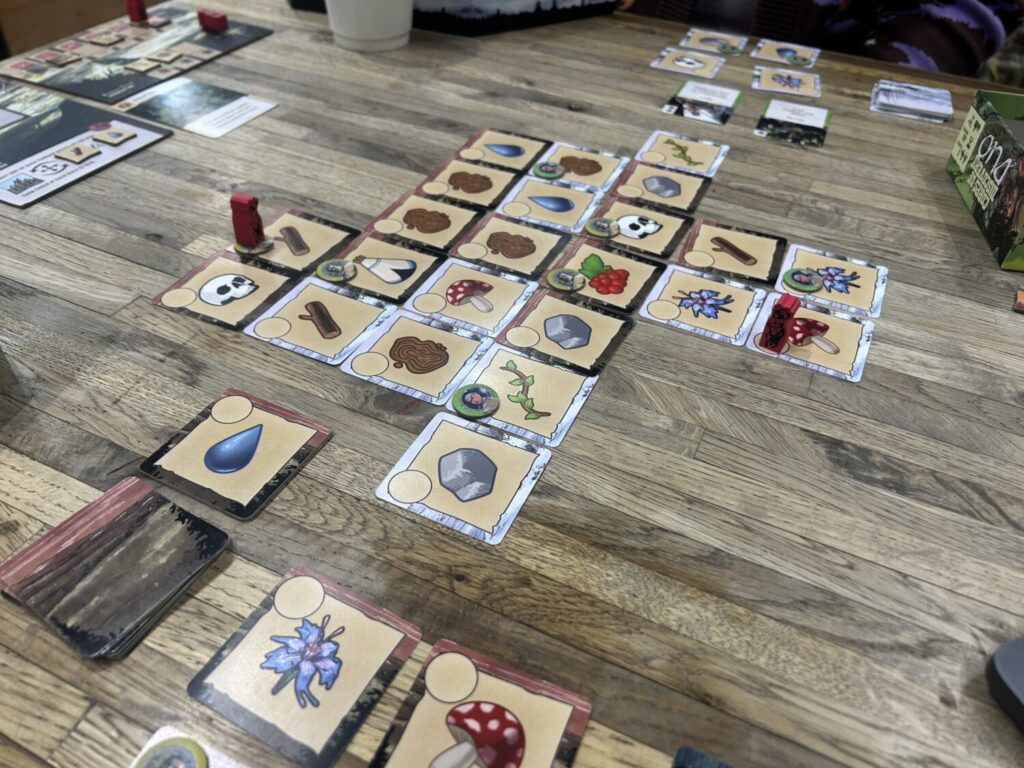
As Lewis, Clark, Sacagawea, or York, two players have to work together to map their way west. In practical terms, this is done by playing cards with one of ten different items on them out onto the table, following both public and hidden rules for each item while doing so.

A large collection of cards in a grid.

Here we hit our first bump. Why are we arranging items? Why aren’t…

The post Corps of Discovery Duo Game Review appeared first on Meeple Mountain.

Universal Distribution signs exclusive distribution deal with long-time crowdfunding success Dice Throne

26. Februar 2026 um 13:54

Board game, TCG and comics distribution major Universal Distribution has agreed an exclusive deal with Dice Throne to become the sole distributor of the company’s products in the US and Canada.

Dice Throne games and add-on packs have previously been distributed by companies including Universal and ACD Distribution, as well as Alliance Game Distributors, which Universal acquired in May last year.

The dice and card-focused combat game has become a crowdfunding heavyweight following its original $180,000 Kickstarter project from Mind Bottling Games in 2018, going on to raise almost $13m across a string of subsequent campaigns.

Those crowdfunds have included lucrative Marvel tie-ins, with the company raising $2.1m for its first Marvel Dice Throne campaign in 2021 and almost $4.3m for an X-Men, Deadpool and co-op experience Kickstarter in 2023.

Marvel Dice Throne X-Men || Kickstarter image

Universal said the exclusive distribution deal “marks a significant step in supporting Dice Throne’s expanding presence in retail stores, especially as the brand continues to grow its Organized Play program and introduce new product formats designed to increase accessibility and drive community engagement”.

Dice Throne’s Organized Play program is designed to help stores build consistent communities and host recurring events, with kits on offer including promo items, prize support and products needed to run casual or competitive play.

The publisher has also recently introduced a new single hero pack format, with the aim of offering a lower entry point for new players and flexibility for collectors and Organized Play participants.

Dice Throne CEO Casey Sershon, who took on the top role at the company at the start of last year, said, “We are excited to partner with Universal Distribution as our exclusive distributor in the US and Canada.

“Their expertise and strong retail network will help bring Dice Throne to even more players across North America.”

The post Universal Distribution signs exclusive distribution deal with long-time crowdfunding success Dice Throne first appeared on .

BGI 408 The one from Australia

26. Februar 2026 um 09:55

BGI 408 The one from Australia

Board Games InsiderJoin our Guild on Board Game Geek Guild | Like us on FB

Social media:

Ignacy Trzewiczek / Portal Games: website | FB | Twitter | Youtube

Corey Thompson / Above Board TV:  website | Youtube

Stephen Buonocore / “The Podfather Of Gaming”: website | FB | Twitter | Youtube

Intro Music: Happy Rock – Bensound.com

💾

boardgaming in photos: Race for the Galaxy, El Grande, Nippon

I have been playing some Race for the Galaxy (just the base game) on BGA with Jon and Yasmin. This is the game I have the highest play count for, at 2200+ games. Most of these were played against bots on the iPad. However I did play many 2-player games with my wife Michelle, many years ago. It's nice to be playing a stretch with humans again. I find that I am more careful and

“It’s crazy how it has grown globally”: unpublished designs award Cardboard Edison unveils new finalists as entries more than double since 2020

25. Februar 2026 um 16:22

The long-running Cardboard Edison Award, which aims to celebrate the best in unpublished board game designs, has revealed its latest finalists after whittling them down from a record-breaking 396 entries.

This year’s 20 finalists include a magnet-based vertical castle-building game, a medium-weight strategy title centred around wedding planning, and a Persian folklore-themed action selection design which sees players use astrolabes to read stars and hunt demons.

Cardboard Edison’s annual entry numbers have soared since the first competition attracted 109 designs in 2016 – almost doubling to 192 within the next two years, and more than doubling between the pandemic year of 2020 and this year’s contest.

Part of that growth has been down to the competition’s growing pedigree of winners that have gone on to be published by well-known studios.

They include Winter, published by Devir, Castell from Renegade Game Studios and Umbra Via from Pandasaurus Games, as well as 2023 champion Diatoms, which followed a successful Kickstarter campaign with retail publication by 25th Century Games in partnership with Ludoliminal.

Still from the pitch video for StrongHolds by Nelson de Castro, one of this year’s Cardboard Edison Award finalists

The rising numbers of entries has also been boosted by the international growth of the award, which attracted submissions from designers in 34 different countries this year.

Just over half of the submissions were from the US, about 8% from Australia, 6% from Canada and 4% from the UK, with “a decent number” from Germany, Spain, New Zealand and The Netherlands.

Cardboard Edison was launched in 2012 as a board game design studio and hub, which has since expanded from a well-read industry blog into a vast repository of information for board game designers.

Suzanne Zinsli, who created the award a decade ago with the help of fellow Cardboard Edison founder Chris Zinsli, told BoardGameWire it was “crazy” how it had grown globally, adding that she was “humbled that people from so many different countries trust us with their games and want our feedback”.

She said one of the major challenges around the award’s rapid growth was bringing in enough judges to properly assess the rising numbers of entries.

More than 80 judges took part in this year’s award process, including The Search for Planet X and Fromage designer Ben Rosset, Elysium and Next Station: London creator Matthew Dunstan and High Tide designer and Diana Jones Emerging Designer award winner Marceline Leiman.

Zinsli said, “Honestly, finding enough people to judge all the entries has probably been the toughest part of running the Cardboard Edison Award every year.

Cardboard Edison co-founder Suzanne Zinsli

“It’s a big ask, and we’re very particular about who we invite. We want judges we can trust to be objective, provide great feedback, and who have the experience to back it up.

“That was our biggest hurdle this year, but it actually worked out great. We had enough judges, they were almost all able to hit their targets, and it ended up being one of our smoother years overall.”

When asked if any particular trends or themes were noticeable among this year’s cohort of entries, Zinsli told BoardGameWire, “I definitely noticed a few! For mechanisms, I saw several trick-taking legacy games, which is so cool. I love trick-taking and I like legacy games, so seeing them paired together felt brilliant.

“I was excited when I saw the first one, then I saw a second, and then a third! It’s something I haven’t really seen in the past, and now suddenly there were at least three entries, and there might have been more, since I only personally judged about 60 games. I love it – I’m totally here for it.

“As for themes, I wouldn’t say there was one ‘big’ topic, but I saw a lot of games that felt very personal, things based on the designers’ own lives or lifestyles.

“It felt like more games than ever had a message to send or a story to tell. It was really nice to get a glimpse into the designers’ lives and see what’s important to them through their work.”

The 2026 Cardboard Edison Award is its second since the organiser revealed it was changing its judging process, after a backlash over a colonisation-themed winner from 2024.

Suzanne and Chris Zinsli said it “became clear there was a blind spot in our judging process” after the response to the prize being given to Crowded Frontier, which was themed around the rush to colonise the American West.

Speaking to BoardGameWire this week about the impact of those changes, Suzanne Zinsli said, “I’m going to cautiously say I think the changes have helped, since we didn’t see any similar issues last year.

“As for the future, I’m sure things will continue to evolve. There’s nothing on the books right now, but as the industry and society change, we want to keep up.

“I’m also realistic, and I’m sure we’ll mess something up again at some point. But when we do, we’ll course-correct. We’re ready to change as needed.”

Still from the pitch video for Braggin’ Wranglers by Luke Wolyncewicz, one of this year’s Cardboard Edison Award finalists

In terms of advice for potential future applicants, Zinsli told BoardGameWire, “If I had to pick one thing to focus on: have your game blind (or unguided) playtested.

“Every year, I read rulebooks where I simply can’t figure out how to play. That really hurts your chances! You might have a fantastic game, but if I can’t play it without you there to teach me, I’ll never know how good it is.

“On the flip side, the biggest thing to avoid is ignoring the three-minute video limit. We ask for three minutes, but we often get videos that are seven, 10, or even 20 minutes long. Also, don’t send us a video from five years ago.

“If the video hasn’t changed in five years, it makes me think the game hasn’t made any progress either. We want to see the current version of your work!”

This year’s finalists will now enter a second round of judging in order to crown the winner, with a champion usually announced in May of each year.

Last year’s award was won by Dot Com, an economic strategy game which uses an app to run players’ money supplies down in real time.

The game, designed by former Ravensburger game development intern Sammy Salkind, puts players in the shoes of startup founders battling to build their internet startups during the dot-com bubble of the late 1990s.

Cardboard Edison finalists 2026:

Astrolabe by Yasaman Farazan
2-5 players
45-90 minutes
Players are exorcists in a Persian folklore world, using astrolabes to read the stars, hunt
demons, and bind them into artifacts. Each round, players secretly rotate their astrolabe to
choose an action, a number, and a time of day, then reveal and resolve actions in ascending
order.
Pitch video

Black Ruth of Dogtown by Keith DeViere Donaldson
1-4 players
30 minutes
Black Ruth of Dogtown is a procedural oracle system driven by a circular mancala drafting
mechanism, where players construct a three-by-three grid to optimize set collection and
speculative scoring in service of a final narrative divination resolution.
Pitch video

Braggin’ Wranglers by Luke Wolyncewicz
2-8 players
15 minutes
Braggin’ Wranglers sees players catching animals to score points using a unique adjustable
lasso—but there’s a twist! Turn order is decided by your lasso size, which you secretly set at the
start of each round!
Pitch video

Catacombes de Paris by Nicholas Henning
2-5 players
70-110 minutes
In Catacombes de Paris, players take on the solemn duty of transporting the remains of millions
through the bustling streets of 18th-century Paris to build their personal ossuary in the famed
Catacombs. This highly thematic experience combines a strategic pick-up-and-deliver system
with an engaging polyomino mini-game for building out your ossuary board.
Pitch video

Deductive Seasoning by Eric Ledger
2-5 players
20-40 minutes
Deductive Seasoning is a family-friendly deduction card game where you are a food scientist
who has concocted a dish using a secret ingredient from the Periodic Table of Flavor. You must
figure out other players’ secret ingredient through careful play and observation.
Pitch video

Goa Kranti by Andy Desa
2-4 players
60-90 minutes
A cooperative game about an overlooked chapter in history: Goa’s struggle for independence
from Portugal (1932-1961). Players embody historical freedom fighters choosing between
violent resistance and peaceful satyagraha. Core mechanisms include push-your-luck resource
gathering, deck improvement, and bag-building for a pivotal mid-game check when India gains
independence.
Pitch video

Hatchlings by Alan Leduc
2-5 players
30 minutes
You’re a Nature Spirit with one job. Get your baby sea turtles out of their comfortable nest,
across the beach, and into the water where they belong, thus earning praise from Mother
Nature. It would be easy if it weren’t for the relentless bully Steven Seagull and the other Spirits
competing for glory.
Pitch video

Hybrid Hijinks by Jena Keesee
3-5 players
60 minutes
A competitive game, creating hybrid creatures and utilizing variable, configurable player powers
to impress visitors and earn the most approval for shifting prowess.
Pitch video

Ladybugs by Michael Posada
1-4 players
30 minutes
Push your luck by rolling dice that represent a colony of ladybugs flying over a field of flowers.
Your rolls determine which flowers you add to your garden, which scoring conditions you unlock,
and how many points you earn.
Pitch video

Limelight by Cameron Fleming
3-6 players
45 minutes
Limelight is a push-your-luck deckbuilder about staging a Broadway show. Over three Acts,
you’ll audition talent, hire crew, and rehearse your show, trying to achieve the perfect mix of
cards on Opening Night.
Pitch video

Match Patch by Jack Rosen
3-5 players
20 minutes
Match Patch is a game about the benefits of farming using companion planting methods.
Mechanically, it is a card-matching race game where players try to diversify their harvested
crops.
Pitch video

Midnight Spawn by Jayson Farrell
1-4 players
60 minutes
Midnight Spawn is a game about the mysterious and incredible deep sea. In this game you’re a
researcher in your deep-submergence vehicle, or DSV. You’ll discover strange creatures and
observe them eat or move other creatures, manipulating the shared board. You can also
upgrade your DSV with tech cards or boost your score with research cards.
Pitch video

Moonforge by Pawel Owsianka
1-4 players
90 minutes
In Moonforge, players command large space facilities capable of capturing asteroids, extracting
valuable resources (energy, metal and minerals), and upgrading their operations with new
modules and functions. Resources can be sold for currency points, while depleted asteroids
contribute material toward the creation of a new moon.
Pitch video

PiramiDuel by Guillermo Viciano
2 players
20-30 minutes
A game for two players where you will explore Ancient Egypt, fighting to claim the most
influential pyramids.
Pitch video

Possessions by Dan Nichols
2-4 players
60-90 minutes
Possessions is a competitive strategy game where you play as ghosts with one hour to finish
your unfinished business and fulfill your final wishes. As the clock ticks down, strive to get the
most value from your secret ambitions by possessing your family’s last living heirs.
Pitch video

StrongHolds by Nelson de Castro
2 players
40-60 minutes
StrongHolds is a competitive castle-building game featuring magnetic tiles that allow players to
build vertically unlike any other game. Harness your creativity and vision as a Medieval
Architect, while sabotaging your opponent by tossing and sliding siege tiles to topple their
progress.
Pitch video

The Leftovers by Larry Ted McBride
2-4 players
25 minutes
The Leftovers is a cooperative trick-taking game of community deck-building, resource
management, strategy, and story. With your party of magical foodfolk, you will work together to
complete objectives and avoid vicious food fiends as you explore the abandoned halls of the
Enchanted Ladle.
Pitch video

The Roots of All Evil by Dean Burry
2-4 players
15-20 minutes
Be the first animal cultist to summon the tree demon Blackthorn by creating ever-expanding
rings of root cards in which to place your sacred offerings.
Pitch video

The Wedding Planner by Jose Lema
2-4 players
60-90 minutes
You just got engaged! Now you have 12 months to plan the wedding of your dreams. The
Wedding Planner is a medium-weight strategy game that captures the authentic pressure of the
process: an overwhelming workload, finite resources, and the constant tension between vision
and reality.
Pitch video

Wunderkammer by Rosco Schock
2-4 players
45 minutes
Wunderkammer is a set collection style game with a unique simultaneous silent auction
acquisition mechanism. Each curiosity that you collect also has two attributes so the scoring of
your collection is scored in each dimension.
Pitch video

The post “It’s crazy how it has grown globally”: unpublished designs award Cardboard Edison unveils new finalists as entries more than double since 2020 first appeared on .

MicroMacro: The Home Game Jigsaw Puzzle Review

25. Februar 2026 um 15:11
MicroMacro: The Home GameI am not a huge fan of puzzles. If I have time to myself, I prefer to play video games or a solo board game. Sarah (my wife) LOVES puzzles and would rather work on a puzzle during her downtime. When not watching movies or Netflix, we play about one board game a week together, […]

Source

❌