Normale Ansicht

Mar-Apr ’26 Media

29. April 2026 um 22:07

Recommended

Lying about Money (Book by Dan Davies) — This book on financial fraud is great (assuming you want to read about that). Found this from an article on “Bits about Money.” It’s more about institutional aspects than con men (although con men make plenty of appearances). Here’s a “Today I learned” style tidbit/quote.

As far back as the early 2000s, the left-wing economist Doug Henwood coined a monetary policy rule that “any time Donald Trump is able to borrow money or build anything, interest rates are probably too low.” (in ‘Ch 3: The Long Firm1‘, p 65 in the hard back)

Men without Women — This collection of Hiraki Murakami’s short stories caught my eye at the library, so I decided to try it, as he is one of the most famous novelists in the world. Excellent. After that I started another collection of short stories (“First Person Singular“) and also like what I’ve read. I am less enamored of 1Q84, which is a doorstopper I couldn’t get into.

Sicario — Well done movie about an ugly subject. Nice cinematography. Dennis Villeneuve directs.

Maybe

Ad Astra — “Direct to Streaming Inception” visually quite nice (I thought the Mars indoors cinematography particularly good), some interesting scenes; but deeply, deeply stupid about space. They did at least get the Earth-Neptune distance correct (looking at you, Prometheus).

Bohemian Rhapsody — Didn’t do anything groundbreaking … understood the assignment.

Last One Laughing (Amazon) — Funny but awkward show. 10 (UK) Comedians tasked to spend 6 hours together and make each other laugh, but since they are all trying not to laugh, it’s cringe and makes it hard (for me) to enjoy. But there seems to be on exceptionally funny moment every 30 minute episode, often from the bizarre mind of Sam Campbell.

Project Hail Mary — The first time I’ve seen a theater mostly full. Even Dune (1 and 2) weren’t as crowded. Didn’t see this opening weekend because tickets were all sold out at 11am. That being said, this movie is the epitome of “did the thing” or “understood the assignment” more than “excellent movie.” It’s just that the bar has been so low for so long that everyone is praising it to the heavens. This is like Independence Day in the 90s, a great popcorn flick. To be fair, this is the best of all the maybes. (And, a few weeks after I wrote this, I think I might have been too harsh).

Weapons — I liked this horror movie for the vibe and feeling, but honestly this felt like a good idea for a X-files episode stretched out to two hours (minus Mulder and Scully). And the reveal is not nearly as interesting as the setup (a typical problem in Horror). If you’d let Vince Gilligan punch up this script (back in the 90s), he’d have made this a Top 10 episode, probably by not trying to explain anything.

Maybe Not

Born a Champion — An explicitly right-wing sports/fighting movie (Brazilian Ju-Jitsu). What’s weirder is that the main character is explicitly the favorite (overdog?) in every fight and the only issues are his age, injuries, and morals (in a sometimes immoral sport). I liked it, but its an odd movie.

War Machine (Netflix) — A “Direct to Streaming” Predator knockoff that I assume had significant DoD funding/help (like Top Gun did) due to the pro-US Army Ranger slant. It doesn’t understand what made Predator such a big hit (and also … its 40 years later, we’ve seen it before) so not great, but an OK popcorn flick. Checks the required boxes. A few of the touches are nice. Alan Ritchson is going full Reacher, but that works for something like this.

Nope

Sunshine — This 2007 movies cast was mostly unknown (or has been) in 2007. In 2026 it’s a murderer’s row of well know names. Cillian Murphy, Chris Evans, Michelle Yeoh, Benedict Wong, Rose Byrne … but it’s a terrible, deeply stupid movie.

  1. Bonus Quote — “Etymologically, a ‘long firm’ has little to do with either length or firms. It first appears in printed English in dictionaries of slang and thieves’ cant, and both words are used in archaic senses. “Long” has a meaning from the Anglo-Saxon gelang meaning “fraudulent” and referring to fault or failure, while “firm” (like the Italian firma) referred to a signature …. so a “long firm” is a “gelang firma,” one Saxon word and one Latin, and refers to the crime of signing a fraudulent bill of goods. And if you understand the long firm, you arguably understand a lot more than most professional economists about the way that business is really done.” p28 ↩

On-The-Go with the New Releases from Hachette Boardgames USA

by Steph Hodge


▪️ Hachette Boardgames USA has been on it with announcing new games! Today, I will highlight some of the smaller games coming out in the next several months.

[imageid=8969959 medium Rep]▪️ Canal Houses just released this April and should already be hitting the stores. From the Gigamic catalog, Canal Houses is a 20-minute game where you build up the beautiful streets of Amsterdam. The colorful houses and charming artwork are used for scoring at the end of the game. From the newsletter:

Each round, players pick a card from their hand and build it simultaneously, then pass the remaining cards to the next player. Refresh your hand by drawing a new card type—base, floor, or roof, and keep crafting your architectural masterpiece.

To complete a house, you’ll need to build from the ground up: start with a base, stack any number of floors, and top it off with a roof. Simple to learn and quick to play, Canal Houses is the perfect mix of strategy and charm.


▪️ Another new release from Gigamic is Pirate King! this June! Pirate King is a push-your-luck card game for 2-5 players and will play in about 15 minutes. Pick your captain and build your deck, but don't be too greedy, or you just might bust out.

Every round, players will reveal cards simultaneously, one by one, from their own deck. Revealed swords lets players gain creatures with special powers. Revealing gold allows players to draft treasures into their decks. Be careful though, reveal 3 skulls and you bust!

With its wacky effects, unpredictable treasures, and monsters to battle, Pirate King offers a dynamic experience blending tactics, luck, and dirty tricks. Ideal for groups looking for a fast-paced, fun, and slightly chaotic game.


▪️ Leaf It! is a new dexterity game from Edition Spielwiese releasing this June. Leaf It plays 2-4 players and takes about 10-20 minutes. There is a mix of memory and dexterity as you have to assemble the canopy and then dismantle it, collecting the most valuable animals as you do.

From the newsletter:
Leaf It! requires a mix of steady hands, a good memory, and a little bit of luck. When it's your turn, you must place a card onto the growing canopy, making sure it doesn't collapse.

The Rule: You must always cover the animal on the previous card.
The Strategy: Try to remember exactly where you (and your opponents) placed the cards with the most valuable animals!

After all cards have been placed it's time to Dismantle the Tree!

Players take turns carefully drawing cards back out of the treetop.
Grab the cards you remember having the most points.
Be careful: the canopy is highly unstable. If you cause it to collapse, you will be penalized!


▪️ HUCH! is a new partner with Hachette, and they just announced 3 mini games releasing this May! All of the games support 2-5 players and can be played in about 15 minutes.

In Blue Penguin, each player tries to attract the cutest penguins—the smaller they are, the cuter they are! The problem is that penguins always follow the bigger ones.

On their turn, each player places a “penguin” card and draws a new one.
The player who plays the card with the highest number collects all the cards played that round and becomes the first player for the next turn.

The game ends once all cards have been played, and scores are calculated based on colors, not numbers.


In Meteo, players try to pick the best weather conditions for a last-minute vacation. At the start of the game, six visible “weather” cards are randomly paired with hidden “sky” cards of different colors, and each player gets to secretly look at one.

The “sky” cards are revealed one by one. At any moment, a player can interrupt the process by saying “I’m going!” to stop the reveals and claim the cards they think will earn them the most points.


In Wool Street, players buy and sell cards representing woolen garments in six different types, hoping to collect those that score points while selling off those that bring penalties.

On their turn, players draw a card and must place it on a pile of the same garment type (e.g., sweaters with sweaters). Then, they can choose to sell a garment card by placing it in the center of the table or buy one from the center. The first pile to reach 7 cards scores 2 points per card of that type for players who bought them; the second pile scores 1 point, but the fourth and fifth piles result in point losses!


If you are on the go or are looking for some quicker games for the collection, these seem like they would fit the bill.

The Love/Hate Relationship: Tactical Level Wargames

Von: Grant
29. April 2026 um 17:09

The Tactical level wargame is a staple in my collection and in our hobby. I have played a lot of the various offerings out there over the past 10 years including Advanced Squad Leader from The Avalon Hill Game Company, Lock ‘n Load Tactical from Lock ‘n Load Publishing, Combat Commander from GMT Games, Fields of Fire from GMT Games, Conflict of Heroes from Academy Games, Old School Tactical from Flying Pig Games, Assault from Assault Games, Fighting Formations from GMT Games, Combat Infantry from Columbia Games, Valiant Defense Series from Dan Verssen Games, 2GM Tactics from Draco Ideas and Squad Battles from Flying Pig Games to name just a few. Tactical level wargames are just so gritty, action packed, bloody and in your face and I love that about them. But, there are some things that I don’t love, as with all games. In this edition of The Love/Hate Relationship, I want to share what I love and hate about Tactical level wargames. 

Love

I love tactical squad level combat. I will say that I am partial to World War II tactical games but am always open and willing to play other time periods. There is just something about the strategy, the tension and fear inherent in the game that really draws me in. What is going to happen when I run my squad out from their comfortable and relatively safe building to cross an open field, offering little to no cover, in order to get into position to eliminate the enemy? I don’t know but whatever it is it will be fun!

I love that tactical level games focus on individual units, which can range from vehicles and squads all the way up to platoons or companies. These units are assigned rating factors based on what types of individual weaponry the units carry, reflected in firepower, range and usually movement. Tactical games are usually designed so that a rudimentary knowledge of military tactics will facilitate good gameplay. But this personal vantage point, as you control an individual soldier or small squad of soldiers, really feels personal to me. As opposed to larger Operational or Strategic level games where I am making decisions about 1,000’s of men and machines and it feels more generic and removed from the action, in the Tactical level game I get to put myself in the shoes of a soldier named “Joe”.

One of my first experiences with Tactical level games was Combat Commander. I remember sitting down and doing the Example of Play scenario laid out in the playbook where I was paying as the Russians going up against the Germans. The Russians had the initiative and immediately began taking shots at the Germans using an infantry gun controlled by a Weapons team. The first shot was a miss and I was disappointed. I wanted to see their aim be true and do some damage to the Germans but it wasn’t meant to be. I will say that it was amazing to see the range of the gun, which showed me the power of this type of ordinance. The Russians then finished their first turn by moving forces north from the orchard through the forest on a path to be within striking distance of the Germans holed up in the buildings. I saw the power in leaders as well as by activating a single leader, you can control the actions of the units within their command radius.

A Russian squad in Combat Commander: Europe from GMT Games designed by the late Chad Jensen.

I remember feeling the angst and weight of the role of Sergeant Kaminsky who was desperately trying to inspire his men to move up on the buildings to engage the enemy and knock them out of that fortification. I also experienced the disappointment of the German leader Sergeant Ganz as his troops were forced to retreat to the north to try to repel the Russians who were threatening the German troops in the buildings. I felt the disgust in my unit’s performance when the very powerful infantry gun continued to miss its targets! I was relieved when the random event put a blaze marker in between my troops and the German forces in the woods obscuring their line of sight and not allowing them to effectively fire. I love this aspect of Tactical level games because it is personal.

Another favorite part for me is the narrative that is told as the battles unfold! As I have played Tactical level games such as Combat Commander, I imagine that I can feel what the squads felt in combat. The narrative is always the best part and allows my mind to participate in the battle, even though I am not there. It is a similar feeling to a well written book that forces you to take the role of characters and experience their feelings as you read the story as it unfolds on the written pages. If a game can do all that, it is definitely good!

I do love the strategy and tactics at play when playing a Tactical level wargame! Scoot and shoot, fire from cover, suppressing fire, using smoke to obscure movement, group fire, flanking, use of off-board artillery and fire support and all of the various elements of this level of fighting. I am in control of the game and have the tools and abilities of my troops at my disposal to try and best solve the tactical puzzle laid out before me and to plan how best to go about reaching my goal. Sometimes in these tactical games there are unit abilities that can be called upon. An example of this is found in the Squad Battles Series from Flying Pig Games. Special abilities or “Powers” that different types of units and Leaders have can be activated by playing the right type of card (see below pictured card with the word POWER shown) and really pay off when you can get them played. This element really adds some variety to the game play and always has me really thinking about how I need to effectively build my squads.

20170510_213605
A Power found on a card in ’65: Squad Level Combat in the Jungles of Vietnam from Flying Pig Games.

Finally, I really like the granularity and realism of some of the Tactical systems out there. One of the best games in regards to this aspect is Advanced Squad Leader. Admittedly, I have only played the Advanced Squad Leader Starter Kit #4, but got a real taste for the gritty minutiae that the system demonstrates. I have asked many people what the appeal is for them with Advanced Squad Leader. They typically all refer to many aspects of the game, including things like its depth, rules complexity (not I am just joking with this one!), granularity and realism as well as the thought that anything worth playing should be hard to learn. But, I would agree that the granularity of the game and its focus on realism are two of its greatest advantages.

A Banzai Charge in the Advanced Squad Leader Starter Kit #4 The Pacific Theater from Multi-Man Publishing.

But I think that the systems used in ASL and the rules that prop them up are really quite realistic and provide you the player with a good understanding of the factors involved in these small tactical engagements and their pitfalls. I do really think that the system mimics the process and actions of soldiers in many ways. Does it do this perfectly? Probably not but I am unsure that I can’t definitively say at this time in my journey but I want to learn more and understand the answers to those questions. And hopefully I can play it again to get a better feel and understanding. I also think that people really enjoy the bits and pieces of chrome that are injected into the system. I bring this up as I experienced the chrome of banzai charges as we played ASLSK#4 The Pacific Theater of Operations.

Hate

Hate is such a strong word for me but there are things that are very displeasing about the medium of Tactical level wargames. First off, sometimes a Tactical level game can feel pretty generic, meaning that we have just thrown a scenario together that isn’t necessarily realistic or tied to a specific historical event. As a player of historical games, and an admitted lover of history, I really like playing games that are rooted in the events of the time portrayed. If I am just covering a generic run across an open field or an assault on a fortified line of trenches, I am not necessarily as interested or vested in this situation. But if you throw a name to it, such as the Marine defense at Alligator Creek, the British defense at Rorke’s Drift or the chaotic Battle of Castle Itter, then I sit up, take it a bit more seriously and can dive into the details of the fight. I just wish that more of the systems out there did a better job of integrating the actual small scale battles into their scenarios.

Castle Itter: The Strangest Battle of WWII from Dan Verssen Games designed by David Thompson.

Sometimes Tactical level games are not necessarily realistic as they are games and they always have some gamey elements such as the activation system, dice or the use of cards to determine results. Now before you blow me out of the water, my use of realism here isn’t to say that these Tactical games are simulations. Sometimes systems, such as ASL, gives the players a sort of God’s eye view of the whole battlefield and the omnipotent understanding of the situation and of what can and will happen. This allows for the players to somewhat plan around any difficulties or traps and make the best of a situation. And I think that any battlefield commander will tell you that this is not the case as you never know exactly who you are fighting, their makeup, their numbers and capabilities nor their support. But, keep in mind that one of the keys to any battles is the use of reconnaissance and scouting of the terrain and battlefield before committing so maybe there is more to this than I think.

Well, in summary, I love Tactical level wargames. They are the best and I love them for many reasons including those I have listed above but also because they are fun and exciting to play. Part of the reason that I play games is to be stimulated and to have to exercise my brain to come up with a workable plan and then to execute that plan in the face of adversity and poor dice rolling. Tactical level games give me this and I will always want to play them.

What do you love and hate about Tactical level wargames? What are your thoughts on my observations? Please share.

-Grant

Innovation Ultimate Review

29. April 2026 um 15:12
Innovation UltimateInnovation debuted in 2010, accomplishing the impressive feat of packing an entire interactive civilization game into a mere 105 cards. Its popularity has led to subsequent printings of three other editions, each with slight tweaks to card balance and artwork. Additionally, there have been four expansions that add to and alter the existing gameplay in […]

Source

Buy The Same Token Gaming Upgrades Review

Disney Lorcana Master Token Set and Token Set for Pokémon TCG - Andrew Holmes

I’m not much of a player of collectable card games, living or otherwise. I like the boards of board games too much, I guess. Recently, however, this has been changing thanks to the interests of two of my frequent gaming partners: my wife enjoys basking in the nostalgic art of Disney Lorcana, whilst my 8 year old son keeps evolving his creatures to defeat me in Pokémon TCG. Both are fun, I can see the appeal even if I can’t always see the card text.

For our first forays into the two games, we got the starter sets: Disney Lorcana: Gateway and Pokémon TCG: Battle Academy. They’re both well put together, easing us as a family into the bottomless waters of duelling card games. I doubt we’ll swim all that much deeper but these are enjoyable boxes with everything you might need to get started, including tokens for tracking health.

The tokens are a mixed bag though, especially for a board gamer who enjoys the luxury of a wooden resource or a stack of Iron Clays. Tabletop games tickle the senses, and tactility is important. In fairness the Lorcana tokens from the Gateway box are perfectly fine, but the Battle Academy ones are little more…

The post Buy The Same Token Gaming Upgrades Review appeared first on Meeple Mountain.

BGI 417 The One with a lot of updates

29. April 2026 um 10:53

BGI 417 The one with a lot of updates

Board Games InsiderJoin our Guild on Board Game Geek Guild | Like us on FB

Social media:

Ignacy Trzewiczek / Portal Games: website | FB | Twitter | Youtube

Corey Thompson / Above Board TV:  website | Youtube

Stephen Buonocore / “The Podfather Of Gaming”: website | FB | Twitter | Youtube

Intro Music: Happy Rock – Bensound.com

💾

The New Dystopian Wars Starter Set – Dominion of the Dragon!

28. April 2026 um 23:31

I’ll rest easier when I know they’ve reached shore

Peter checks out the packed new starter set for Dystopian WarsDominion of the Dragon!

Warcradle keeps hitting it out of the park with their releases and they’ve followed up the recent complete revamp of the Dystopian Wars rules with a brand new starter set packed with goodies – everything you need for two players to start playing this exceptional game of steampunk naval combat. Let’s check it out!

Making high quality tabletop gaming content at the EOG takes time and money. Please consider becoming a Patreon supporter or making a donation so I can continue this work! Thankyou!

Dark Pact

28. April 2026 um 21:50

So, in late Jan/Early Feb I heard Dark Pact was coming out soon and asked my FLGS to get a copy. One month later they were sure it was coming into their distributorship “soon” and a month after that it was sold out at the distributorship and they never got a copy. It is things like this that make me wonder if they are money-laundering front for … someone1. (Despite that they have a pretty good selection of games). So I got it from Amazon.

I don’t like Ascension, the game Dark Pact is closest to (IMO). Looking at my archives2, I never really get into it, but there are a few things that jump out at me.

  • The random nature of what’s available at any given moment means that often the game is decided by “Oh, he bought a great card, a terrible card showed up. I bought the best thing available … and the next person got a great card.” At least, it feels like that. (Or you can get combat points when you want money points and vice-versa).
  • It’s a snowball, but it takes a long time to roll downhill.

OK, two things.

Since Dark Pact is by Tom Lehmann, I naturally assumed he’d address both of those problems and they are … mitigated. (It is probably impossible to eliminate them).

First — each player has a grimoire of a few staple cards that they can buy if they don’t like what’s on the offer.

Second — what counts as a victory point depends on which Dark Pact(s) you purchase. For Player A it may be curse cards, for Player B it may be treasures, Player C might want Insight Points, etc. “One mans trash is another’s treasure” means that you might be fighting over cards, but you might not.

On the other hand, you need a Dark Pact to win3 and it’s possible that the only ones you see are terrible. But in my five games so far that hasn’t been an issue. (I did play with the “everyone starts with a reasonable Dark Pact” variant once).

Dark Pact still has flaws. I’ve seen people complain that they played their turn and then flipped up Gold/Multiplier cards (which are usually good) for the next player (the first flaw above), and that when it’s not your turn sometimes another player is taking a 2-3 minute turn of play a card, draw some cards, play a card, etc and running through their deck and that you have nothing to do.

That’s true, but it’s also common for the genre. Dominion can (depending on the setup) have that in spades. But for Dark Pact, it is usually a sign that the game is about to end … that player’s engine is up and running …. whereas in Ascension/Dominion you have to wait for the supply (of cards or points) to empty. But Dark Pact has sudden death4 … when a player draws their entire deck, the game is usually over on their turn (or perhaps a turn or two later if they’ve figured out which card their engine is missing).

It’s not totally flawless … setup and teardown take longer than Ascension (or a game of Dominion with just a set or two) unless you always play with the same # of players, but any other flaws are pretty much built into the game’s DNA (unless you object to the art or the theme, I suppose).

Dark Pact is admittedly tedious if you are playing with someone struggling to build an engine, who takes too long on their turns. But that’s always true. I don’t think that Dark Pact is going to be one of Tom’s games that easily flies to 50+ plays,5 but a few dozen plays seem likely.

RatingSuggest

  1. Occam’s Razor suggests I’m overthinking things. ↩
  2. Most of the searches for “Ascension” turn up Slay the Spire stuff, since I am referring to Ascension levels there…. ↩
  3. Probably ↩
  4. Or Sudden Enlightenment ↩
  5. I expected Dice Realms to make fifty, and it didn’t, but he’s got more than any other designer (for me). ↩

Designer Diary: President

by Nicolas Cardona


Hi, I’m Nico Cardona, a board game designer and publisher based in Barcelona, where I also run my small label, Too Bad Games. Today I want to share the design journey behind President, which is probably my first larger design outside the filler space, after titles like Rudolph, Mala Suerte and Panots. More than just telling the story of where the idea came from, I want to focus on the design problems behind it, the systems that failed, and the decisions that finally made the game click.

The Initial Spark

The first seed of President came from a somewhat unusual place: my master’s degree in organizational engineering.

One of the topics that stayed with me the most was game theory. I think it is fascinating for any designer, because at its core it is about incentives, prediction, trust, and decision-making under uncertainty. I was also very interested in graph structures, and at some point those two ideas clicked together in my head.

I started imagining a hierarchy represented almost like a graph or an organizational chart, where your position in that structure would determine how much power you had, and therefore how strong or relevant your actions would be. That was the first real idea behind President. I knew very early that I wanted a game with three levels of hierarchy. Everything else was still unclear.

What I did know from the beginning was the type of experience I wanted. I wanted a game for many players, one where trust mattered, where people had to negotiate, whisper in each other’s ears, make promises, read intentions, and sometimes betray each other. The political theme came later as the perfect frame for those dynamics, but the real starting point was not theme, it was structure and interaction.

The Core Design Problem

The real design challenge was this: how do you make a game for large groups that feels socially alive and interactive, but still has enough weight to feel like a proper game?

I love social games, but many games for large groups tend to fall into one of two extremes. Either they become hidden role games, where the entire experience depends on secret identities, or they become very broad party games, where the interaction is loud and fun but mechanically light. I wanted something in between.

I wanted a game that could handle a big player count, but where the interaction came from timing, hierarchy, negotiation, reading people, and managing risk, not just from shouting or acting.

That ambition created a lot of problems immediately. Early versions were much bigger, with more systems, more layers, more moving parts. In theory, some of those ideas were interesting. In practice, players got lost. The more I added, the more the game drifted away from the fast, readable, socially sharp experience I was actually trying to build.

At some point I had to be honest with myself. If I wanted President to work for a broader audience, and if I wanted the emotions to be immediate, fast, and easy to read at the table, I had to cut aggressively.

That became the real design process of the game: not adding the right things, but removing the wrong ones.

The Versions That Had to Die


One of the earliest versions looked nothing like the final game. At that stage, I was still exploring hierarchy in a much more literal and structural way.

President went through a huge number of prototypes. Some ideas lasted much longer than they should have, simply because I liked them too much.

One of the earliest concepts was that there would be two sides, blue and red, and at some point players could switch allegiances. The idea was that you would push for your side in order to earn bonuses, but maybe change camps when it became convenient. On paper, it sounded politically rich and full of tension. In practice, it was too much. It added another strategic layer, but not the kind of layer the game actually needed. It made the system heavier without making the experience sharper.

There was also an early version where players did not all have the same card set. Instead, cards were drawn, and your position in the hierarchy influenced whether you got stronger or weaker options. Again, this sounded exciting in theory. Higher status could give access to better tools, and the game could reflect power in a more literal way. But it quickly created too much volatility, too much information to track, and too much friction for a game that needed to stay readable, especially at high player counts.

Another difficult thing to abandon was the idea that being President should simply give better rewards than being Vice President or Secretary. At first, that was the direct logic: the higher your office, the bigger your reward. But this created all kinds of problems. It made the hierarchy too obviously dominant, flattened some of the interesting decision-making, and pushed the game toward a more static reward structure.

What finally worked was not giving the top position a directly better reward, but creating situations where being higher in the hierarchy became advantageous depending on what everyone else had played. That shift was crucial. The hierarchy stopped being a blunt reward ladder and became something much more interesting: a system of timing, initiative, leverage, and opportunity.

I also explored versions with more modules, more accumulation systems, and more phases. Some of them were individually fun. But the more I tested, the more I understood that President did not need more content. It needed more precision.

The Breakthrough


At this stage, the game was already much closer to its final identity, but I was still testing which actions deserved to stay and which ones had to disappear.

The real turning point came when I found a cleaner hand system.

Once I moved toward the idea that everyone should share the same set of cards, the whole game began to make sense. From there, I iterated many times, around twenty or thirty meaningful iterations, just to find the final seven cards. I was looking for a very specific combination: cards that worked mechanically, fit the theme, were easy enough to understand, and most importantly created strong interaction, replayability, tension, and memorable moments.

The other big breakthrough was the retrieval structure. Players use cards and lose access to them temporarily, then recover them through specific effects. That gave the system rhythm. It made timing matter. It made players pay attention not only to what others were doing now, but also to what options they might regain later.

At that point, I also realized something essential: if I wanted the game to scale to very high player counts, it could not be turn-by-turn in the traditional sense. The game needed simultaneous action selection. That was one of the decisions that truly made large groups possible.

But I did not want pure simultaneous chaos either. So the solution was subtle: players choose actions simultaneously, but they do not all resolve simultaneously. Resolution unfolds in order, shaped by the hierarchy. That gave the game speed without losing tension. It also made the hierarchy feel meaningful, because it effectively became a shifting initiative system.

That was when the game stopped feeling like a collection of ideas and started feeling like an actual design.

Defamation and the Social Engine

If there is one mechanism that made the whole design click, it was Defame.

Defame allows you to predict another player’s action, either in the current turn or even the next one. If you are right, you steal a victory point from them.

That may sound simple, but in play it changed everything.

The moment this mechanic entered the game, negotiation, promises, and public table talk became much more dangerous and much more interesting. Suddenly you could not afford to become too predictable. If you openly signaled your intentions, someone could exploit that. If you lied too often, people would learn to read you differently. Every deal, every bluff, every political speech at the table became part of the real game state.

In other words, Defame did not just create a fun effect. It connected the social layer to the scoring layer.

That mattered a lot. Many social games have plenty of table talk, but the conversation exists somewhat outside the formal system. Here I wanted the opposite. I wanted the game to reward reading people, misdirecting them, and choosing when to be transparent and when to manipulate. Defame was the mechanism that turned all of that into something tangible.

It is probably the hardest card to explain in the game. I know that. But I made a conscious design decision to keep it anyway. Sometimes you remove complexity because it is unnecessary. Sometimes you keep a little complexity because the payoff is worth it. For me, Defame was absolutely worth it.

Simplifying Without Hollowing It Out

One of the hardest lessons of President was learning that “simpler” does not automatically mean “better”, but it often means “clearer”, and clarity is essential when you want a socially dense game to work with many people.

There were moments when I tried to make the game deeper in a more conventional, gamer-friendly sense. More sub-actions, more differentiation, more layered effects. At one point, even with a smaller set of cards, each card could contain multiple sub-actions depending on hierarchy and context. The result was exactly what you would expect: too much information to retain for a game that was meant to sit somewhere between family game and social strategy game.

The issue was not that players could not understand it eventually. The issue was that every extra rule took energy away from the real experience: reading the table, making alliances, lying convincingly, spotting opportunities, and reacting quickly.

That became my filter for every design decision: does this rule improve the social engine of the game, or does it merely make the system denser?

If it only made the system denser, it had to go.

Scaling to Ten Players

From the beginning, I wanted a game that could work in big groups. Part of that came from watching large groups play games like Secret Hitler and thinking: I want that social energy, but I do not want to rely entirely on hidden roles.

Getting there was not easy. A game that works at eight, nine, or ten players can easily become too flat at three or four. The reverse is also true. Many systems that feel rich at smaller counts become painfully slow or unreadable at larger counts.

What made President viable at ten was not one single trick, but a combination of constraints. Simultaneous action selection reduced downtime. Shared card sets reduced rules overhead. Ordered resolution kept tension and readability. And then the “day cards” added just enough variety to keep the table alive from round to round.

Those day cards were another area where I learned the value of cutting. Early on, I had more than twenty. Eventually I realized that I did not need that much variety. What I needed were six or seven that were truly excellent, cards that created conversation, forced commitment, or encouraged bluffing in a clean and memorable way.

One of my favorites asks players to declare at the start of the round which action they will play. They may lie, of course, but if they actually do what they said, they recover a card. It is a tiny rule, but it creates exactly the kind of moment I wanted from the beginning: table talk with real consequences.

What the Game Taught Me

More than anything else, President taught me how games are really designed.

Theory matters. Studying systems matters. Understanding incentives matters. But at some point you are no longer dealing with theory. You are dealing with a living system that resists you. A prototype is not an idea. It is an argument with reality.

This game forced me to learn through repetition, through failed versions, through mechanics I loved and had to cut, through moments where I thought I was close and then realized I was still too far away.

It also reinforced something I believe very strongly as a designer: interaction is not decoration. It is not just a bonus layer you hope players bring themselves. If you want a game to be socially memorable, you have to build that social energy into the mechanics themselves.

For me, the best moments in games often come from looking at another player and thinking: what are you about to do, and can I trust you? That tension is alive. It creates stories. It creates laughter. It creates the kinds of memories that survive long after the rules are forgotten.

That is what I was chasing with President.

Looking Back


After all the cuts, failed systems, and repeated testing, this was the final form the game took.

People sometimes ask what I would do differently today. The honest answer is complicated.

Of course there are always details one could revisit. Every design contains a thousand possible alternative paths. But in a deeper sense, I would not undo the mistakes, because those mistakes are exactly how I learned what this game needed to be.

I am the designer of President, but I also handled the art direction and published it myself together with Zacatrus, a well-established publisher in Spain that supported the project. By the time the game was already quite advanced, I also showed it to other publishers and saw strong interest there too. That was reassuring, but more importantly, it confirmed something I had started to feel during testing: the long process of cutting, refining, and insisting on the core idea had paid off.

To this day, President is the game of mine I feel strongest about. Not only because of the final product, but because of what it demanded from me as a designer.

It taught me that when a game is trying to do something unusual, especially for large groups, you cannot afford to protect every idea you love. You have to protect the experience instead.

And sometimes, if you keep doing that for long enough, the game finally starts telling you what it wants to be.

Cytress Game Review

The toughest games to review are the ones that are right on the line. They are generally not bad, maybe even a hair better than that, and don’t really stand out. Often, games like this end with one or more players being asked what they thought, and those players doing an exaggerated shoulder shrug, as if to say “yeah, it was…good? Well, I mean, it was…alright? I’d play it again, but only if you wanted to. What are we playing next?”

Cytress, designed by Sean Lee and published in 2025 by Good Games, broadly fits this description. Cytress is a cyberpunk-themed, engine-building worker placement game. You’ll build an engine using cards that can be purchased at one of four locations to increase your income or make trading deals progressively sexier. You’ll place a worker—either a Leader token or one of your three cute, futuristic-looking cardboard car tokens—on a space to trigger an effect. With the car spaces, any other player can also use the action, so there’s no worry or tension tied to opponents blocking the space you want.

When players buy cards and add those to the engine, they also place a crew member on a mini-map, representing the area below the great city of Stratos. This placement…

The post Cytress Game Review appeared first on Meeple Mountain.

My Favorite Wargame Cards – A Look at Individual Cards from My Favorite Games – Card #75: The Second Funnel from The Hunt from Salt & Pepper Games

Von: Grant
28. April 2026 um 14:00

With this My Favorite Wargame Cards Series, I hope to take a look at a specific card from the various wargames that I have played and share how it is used in the game. I am not a strategist and frankly I am not that good at games but I do understand how things should work and be used in games. With that being said, here is the next entry in this series.

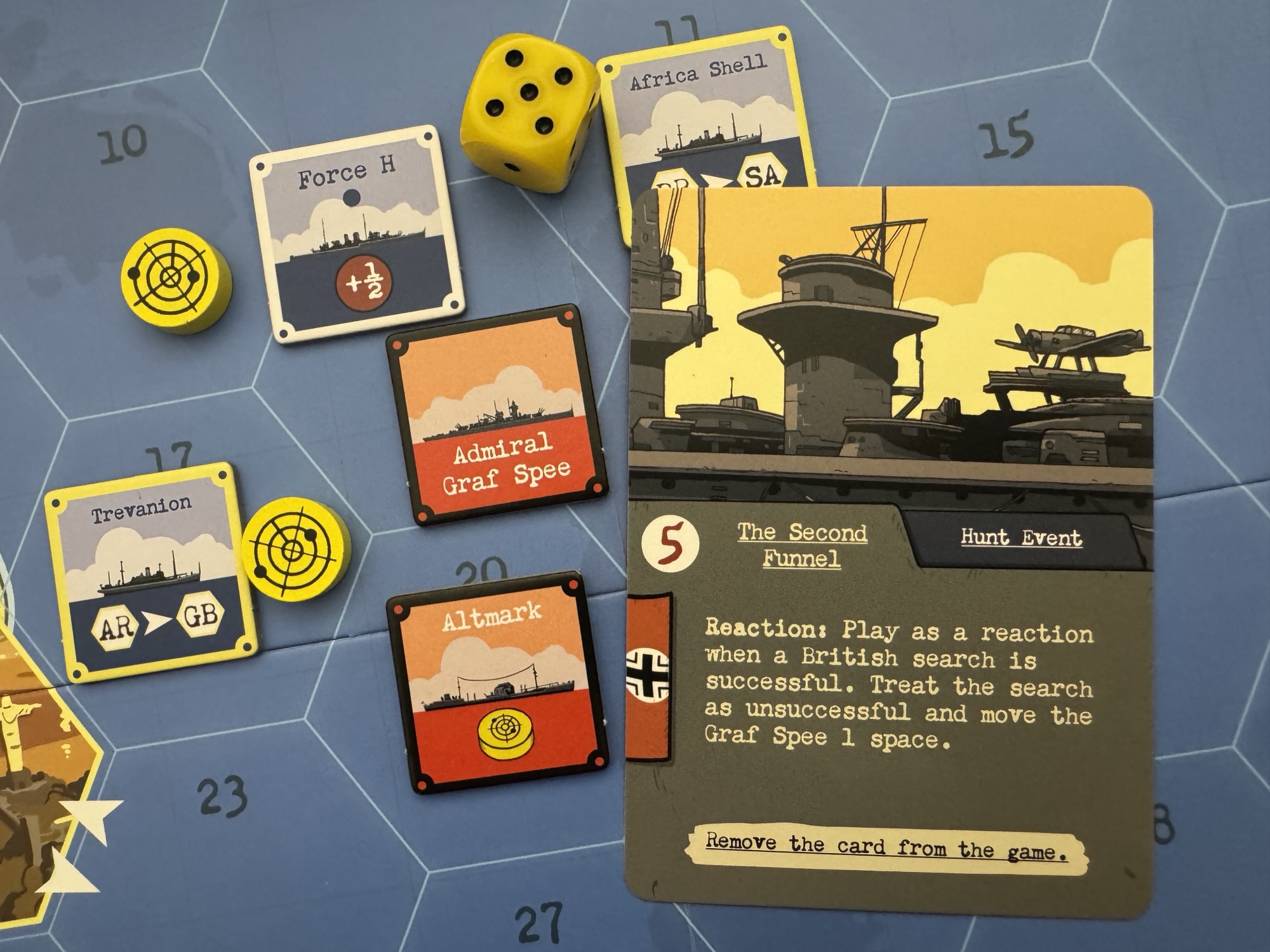
#75: The Second Funnel from The Hunt from Salt & Pepper Games

I have played several hidden movement games over the years and enjoyed them all. Some of these titles have included wargames such as They Come Unseen from Osprey GamesSniper Elite: The Board Game from Rebellion Unplugged and Bomber Command from GMT Games as well as a few board games including Hunt for the Ring from Ares Games. The concept of moving cautiously, attempting to evade pursuers, all while trying to locate and acquire or destroy objectives makes for a very interesting gaming experience. These situations can make for some really tense games that cause your head to ache and your wits to be tested. But they rely on some bluffing as well. Trying to force your opponent to anticipate where they think you should be and then trying not to be there. A really great mechanic in board games but not always easy to pull off and make for a very playable and interesting game. In 2022, we played a new design from Matthias Cramer and Engin Kunter that took this hidden movement concept and put it into a historically based game about the struggle over control of the South Atlantic between the British Royal Navy and the German Kriegsmarine during the early years of World War II called The Hunt from Salt & Pepper Games.

The Hunt is a Card Driven Game where the German player has to attempt to stay hidden while trying to sink merchant shipping as the Royal Navy hunts for them throughout the South Atlantic. The players each have asymmetric actions to use to accomplish their missions and each has a tough time doing what they have to do. But, if they manage their cards wisely, using them as effectively as possible, they can successfully either evade their pursuer or catch their prey.

In today’s post, we will take a look at the very useful The Second Funnel. The Second Funnel is a 5 Ops card, which makes it a very important card in the German deck as it allows for the taking of 2-3 actions in a single turn, but for which there is an even more important use as an interrupt to foil a successful British Search by playing it as a Reaction. If the British player ever searches for the Admiral Graf Spee, and The Second Funnel is played as a reaction, the British successful Search will be treated as unsuccessful and the German player will get to move the Graf Spee 1 space away from the space where the Search action was taken. This movement can be into any adjacent space so could be used to also reposition the Graf Spee into a space where a Freighter is located. Such a tasty surprise card for the German player! I know that when I play as the British, I have to always keep in the back of my mind that this card exists and that my efforts might be futile. But, as the British, I would rather that the German play this as the event. These Reaction cards are one of the elements that makes this game so good.

Picture of the Graf Spee taken in 1939 shows the second funnel mounted behind the aircraft catapult at the rear of the ship.

The “second funnel” on the Admiral Graf Spee was a fake structure installed by the crew in late November 1939, during its 1939 Atlantic raid, to alter the ship’s silhouette and disguise its true identity. The dummy funnel, along with a fake gun turret on the bridge, was constructed behind the aircraft catapult to make the German “pocket battleship” look more like a different ship, specifically a British or French warship, to Allied merchant ships. By appearing as a different vessel, the Graf Spee hoped to create confusion and avoid immediate detection and engagement by Allied naval forces while it targeted merchant shipping. The disguise was removed before the Battle of the River Plate in December 1939, so it would not interfere with the ship’s combat operations. The ship’s crew, under the leadership of Captain Hans Langsdorff, often undertook such modifications during its patrol in the southern Atlantic to maintain the surprise of their commerce-raiding mission.

Here is a link to our full video review of the game:

We also published an interview on the blog with the designers Matthias Cramer and Engin Kunter and you can read that at the following link: https://theplayersaid.com/2023/03/13/interview-with-matthias-cramer-and-engin-kunter-designers-of-the-hunt-from-salt-pepper-games-coming-to-gamefound-march-15th/

In the next entry in this series, we will take a look at Military Uprising from The Republic’s Struggle: Battle for the Republic, Spain 1931-1939 from NAC Wargames.

-Grant

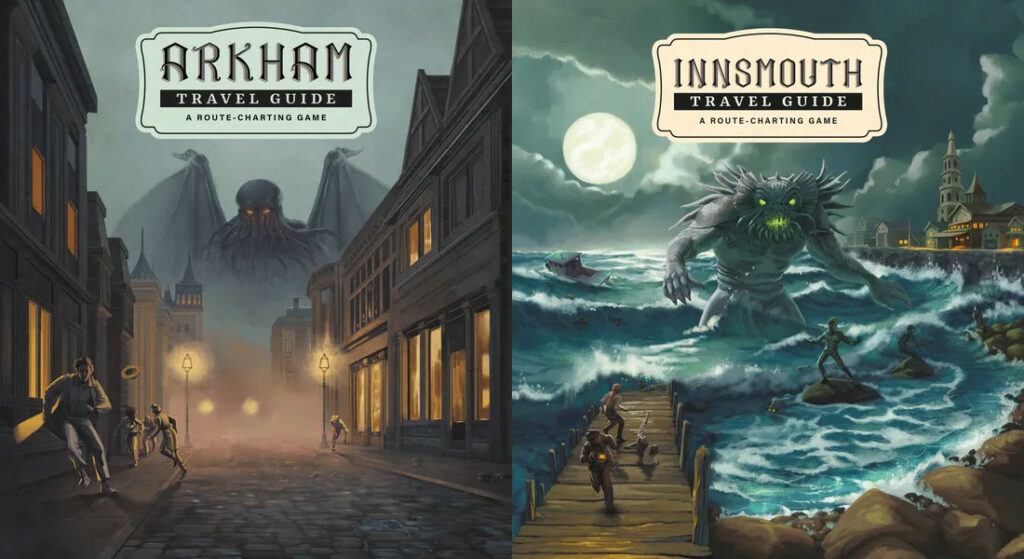
Arkham & Innsmouth Travel Guides Reviews

28. April 2026 um 13:31
Arkham & Innsmouth Travel GuidesHave you ever traveled to a destination city and gone on a city tour like a true tourist? I have when I first visited Philadelphia, Seattle, and Las Vegas. All included landmarks and the city’s history, which was interesting and even shocking. My most memorable travel tour was a Chicago one where my group realized […]

Source

Dream of the Red Chamber - first prototype

The game I am publishing this year under Cili Padi Games is Pilgrim Poker, and it uses the theme of Journey to the West (西游记). I also have another game which will be published by Specky Studio - Rebels of the Three Kingdoms, which, of course, is based on Romance of the Three Kingdoms (三国演义). The advantage of using a topic or theme which many people are already familiar with is the

Matt Carlson: Review of 20 Strong – Tanglewoods

28. April 2026 um 03:31
In 20 Strong Tanglewoods, one takes on the role of their favorite fairytale protagonist in this solo dice-rolling game of adventure. Gamers looking for a card-based, solo, lightweight dungeon crawling experience should check it out. 20 Strong is a series … Continue reading
❌