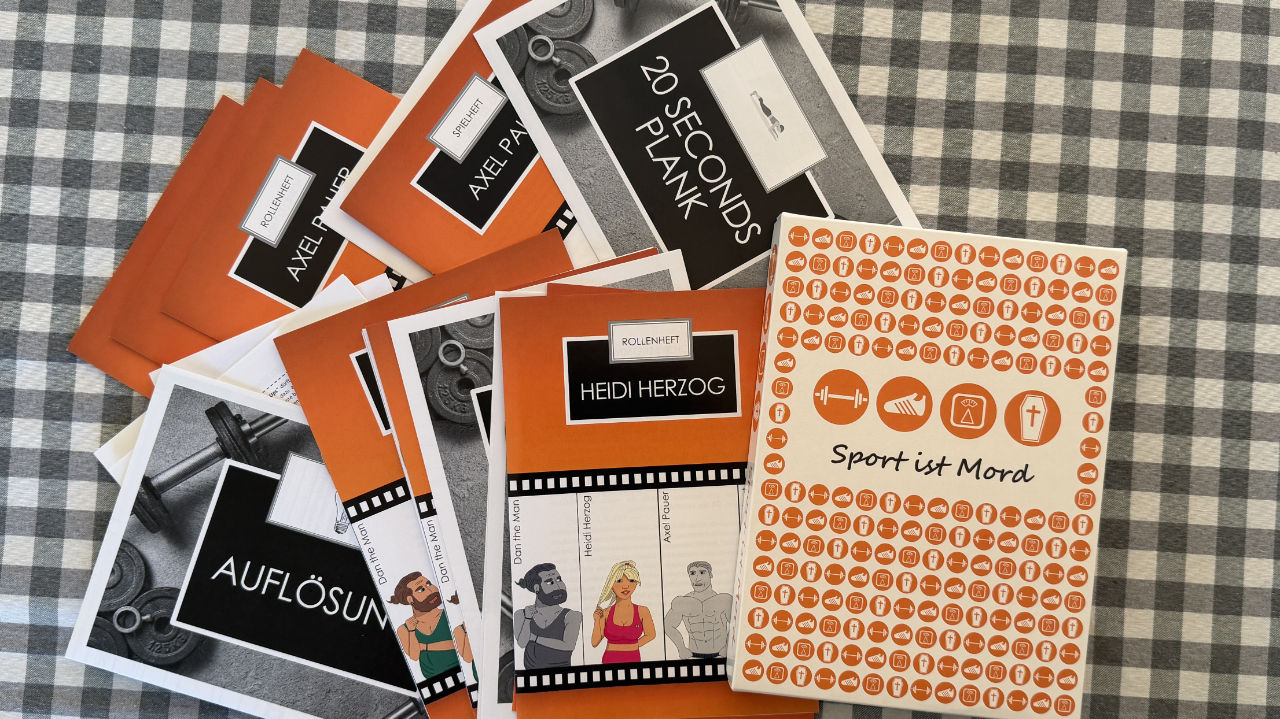
Zwei Fitnessclubbesitzer und zwei fitnessbegeisterte Frauen sind mordverdächtig in diesem 4-Personen-Krimidinner. Nachdem wir unser Rollenheft erhalten und wenige Informationen über uns und die anderen gelesen haben, startete die Vorbereitung auf den Abend. Unser Outfit war nun nicht so schwierig zu beschaffen, da wir alle von Natur aus sportlich sind.
Das Spielmaterial
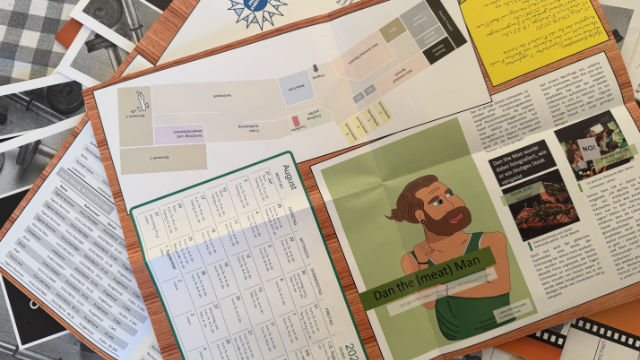
Den Mordfall an Betty, die in beiden Clubs tätig war, lösen wir in sechs Runden. In jeder Runde lesen wir in unserem Spielheft einen Abschnitt, erfahren hierbei Geheimnisse über uns, wichtige Informationen und Regieanweisungen. Die Anweisungen können z.B. das Abspielen einer Audiodatei (alternativ vorlesen) sein oder Aufdecken eines Hinweises. Für einige Hinweise müssen auch erst Bedingungen erfüllt werden, damit man sie lesen darf.
In Runde sechs beginnt dann die heiße Diskussion. Alle sind verdächtig, doch wer was es?
Bei den insgesamt neun Hinweisen gibt es teilweise viel zu lesenSportbegeistert vor dem Spiel. Noch wusste man nicht, ob man Mörder/in ist.
Fazit:
Der Muskelkater beim „ersten Krimidinner mit Muskelkatergefahr“ scheiterte bei uns leider daran, dass die Anweisungen für die Fitnessübungen von uns ignoriert wurden. Aber eine nette Idee, die zeigt, dass auch in diesem Fall die Charaktere, Story und das Drumherum gut aufeinander abgestimmt sind.
Die Krimifälle für 4 Personen von Parameter-B funktionieren sowieso ausgesprochen gut. Denn wenn man selber nicht der Mörder ist, gibt es ja nur drei Verdächtige. Aber irgendwie kann es jede Person gewesen sein und die Alibis müssen sorgfältig geprüft werden. Einig waren wir uns auch bei diesem Fall nicht. Und in den drei Stunden Krimifall haben wir viel besprochen, erfahren und Vermutungen geäußert. Gut war auch, dass einige Hinweise uns in die Irre führen sollten.
Außerdem gefallen hat uns, dass wir erst am Spielabend im Spielheft erfahren haben, dass man Mörder/in oder nicht Mörder/in ist. So konnte man sich nicht im Vorfeld verplappern oder war ungewohnt aufgeregt. Wie immer spricht man auch in den Folgetagen noch in seiner Rolle, immer wieder ein tolles Erlebnis und wir freuen uns auf den nächsten Fall …
Ein Gran Fondo ist eine große Radveranstaltung über eine lange Strecke, an der Hobby- und Amateurfahrer teilnehmen und bedeutet so viel wie „große Fahrt“ oder „große Ausdauer“. Unzweifelhaft ein geeigneter…
If you want to read more posts like this history & board games long read, I strongly recommend you subscribe to the blog: All new posts in your inbox right when they go live!
New York had replaced London as the financial center of the world after the Great War. In the following years, the city complemented its financial with cultural heft, helped by an influx of refugees from Nazi tyranny in Europe. With Paris under German occupation, New York became the art capital of the world, a primacy the city would not relinquish after the war.
Where money and art met, power would follow: When the newly founded United Nations needed a headquarters, New York was the obvious choice. The UN building, a sleek colossus of glass and steel, embodied the new age. Symbolically, New York was the capital of the world now.
New York’s glory moment as the epitome of modernity was not to last – by a good deal because modernity undermined itself. New York’s transformation from manufacturing to services had made the city richer and provided well-paying white-collar jobs for the old and new middle classes, but it also meant that demand for unskilled laborers dried up. At the same time, both domestic and foreign migration to New York increased: Black Americans from the South arrived as well as Puerto Ricans in large numbers. When the federal limits on immigration from non-European countries were lifted in the 1960s, many Latin Americans and Asians followed. The migration of ethnic minorities to New York City was complemented by the white flight to the suburbs. Since 1990s, New York is a majority-minority city – that is, a majority of New Yorkers belong to an ethnic minority.
Chinatown at the end of a game with many developed businesses. Photo taken by BoardGameGeek user EndersGame, used with permission.
As in many American cities, the individual ethnicities typically cluster in separate neighborhoods. Manhattan’s Chinatown, first a center of Chinese immigration in the mid-1800s, grew after 1965 and became a vibrant part of Lower Manhattan. Today, it is also popular with tourists and New Yorkers from other neighborhoods, especially for its varied food. A small part of Manhattan’s Chinatown between Canal Street and Worth Street forms the map for Chinatown (Karsten Hartwig, Alea), a game about negotiation and business development.
New York’s demographic changes posed economic challenges. The new immigrants often didn’t have the skills required for the service and knowledge economy, and the skilled middle classes emigrating to the counties around New York also paid their taxes there. Sometimes, their employers left the city as well, now that they could find the workforce further from the center (and would pay lower taxes than in New York), and even if they didn’t, the threat alone was usually enough to receive a tax rebate from municipal administration.
The tragedy of this decentralization which sapped the economic strength of New York is that the city helped to bring it on itself. The subways of the early 20th century had decentralized the city, but they had also brought quality of life. The transport policy which the city in the person of Robert Moses (remember him from last time?) enacted had all of the decentralization and none of the quality of life. To summarize it in two words: Road Rage.
Moses led a crusade against public transport. The subways remained, but all the elevated trains and trolleys which had serviced every corner of New York in the first half of the 20th century were phased out by 1957. This development was not limited to Moses: The Pennsylvania Railroad demolished Penn Station, the heart of New York’s long-distance rail system and an architectural landmark of the old New York. Instead of rails, expressways cut through New York, attracting an ever larger avalanche of cars for which they never had enough lanes.
The expressways exemplified Moses’s astounding powers: He had the authority to appropriate land for their construction, evict the inhabitants and destroy their buildings. The expressways cut through neighborhoods or dispersed them completely. The construction of the Cross Bronx Expressway required relocating 60,000 people and pierced the heart of the South Bronx, even though a less destructive path for it could have been built just one block further south – but Moses preferred the optimal trajectory of the road, regardless of the human cost.
The tension between city development and human cost is the central theme of Cross Bronx Expressway (Non-Breaking Space, GMT Game). Three players – the city, the local communities, and private enterprise – want to shape the South Bronx according to their vision, but if they play too selfishly, neglecting the overall state of the neighborhood (or the needs of the other players), incarceration and bankruptcy ruin the South Bronx and everyone loses. There are many city-building games, but barely any with a vision as bold as Cross-Bronx Expressway.
The people of the South Bronx were poor in economic and cultural capital. Any resistance to the construction of the Cross Bronx Expressway was bound to be shrugged off as the complaints of people who didn’t know any better about the requirements of modern city planning. The same could not be said about the Manhattanites. When Moses planned for the Lower Manhattan Expressway to cut through the island, demolishing dozens of residential blocks and disposing of Washington Square Park altogether, resistance formed. Jane Jacobs, an assistant editor at the magazine Architectural Forum, both organized the community on the ground and published the bible of anti-Moses urban planning: The Death and Life of Great American Cities, an argument for putting the needs of residents first.
As Moses’s vision of the modern city as a sprawling, motorized metropolis lost its shine, his hold over the city weakened. The planned expressways through Lower and Midtown Manhattan were never built. By 1968, Robert Moses had been removed from the last of his many municipal and state posts. Yet as infrastructure spending has dried up since the late 1960s, contemporary New York is still very much Moses’s creation.
Debt and Crime
Above, I noted the two losing conditions for Cross Bronx Expressway: Debt (both municipal and on the community level) and crime (or, rather incarceration levels among the population). That’s the historical outcome – the New York’s crisis in the last third of the 20th century.
The debt crisis had two origins: On the one hand, New York’s tax base was eroded by the suburbanization described above. On the other, the city’s budget massively expanded in the mid-20th century. By the late 1960s, it was the second-largest public budget of the United States, right after the federal budget. New York City attempted to provide what state and federal governments would not – chiefly free higher education and the best, most comprehensive health care in the nation. That promise rested precariously on federal support. When federal spending on municipal programs was sharply cut in the early 1970s, New York’s financial structure came crashing down. By 1975, the city was practically bankrupt. The state legislature created oversight bodies which rendered the mayor unable to do anything but implement radical spending cuts. In the end, a federal loan saved the city from defaulting.
The cuts to municipal expenditure ended the New York’s experiment as an all-providing city. They also made New Yorkers poorer, sicker, and less safe. In the 1980s, drugs, AIDS, and crime rocked the city. The crime epidemic ebbed off in the 1980s, in parallel to the nation-wide development. The exact reasons are still debated.
The city’s debt remained high through the 1990s – Democratic mayor David Dinkins expanded spending again, while Republican mayor Rudy Giuliani cut taxes. The newly dynamic economy, however, made more than up for that. New York seemed to have a bright future ahead.
The 21st Century
Instead, New York suffered calamity at the dawn of the new century: On September 11, 2001, Islamist terrorists hijacked four planes in the Eastern United States. One crashed, one hit the Pentagon. The other two were piloted into the twin towers of the World Trade Center in Lower Manhattan. The impact, fire, and collapse of the towers killed almost 2,800 people in New York – the largest terrorist attack in history.
Mayor Giuliani’s energetic, but measured response rallied the city (and briefly made him America’s most popular politician) as an immense wave of national and international solidarity flowed to New York. While the immediate damage was soon taken care of and plans for new buildings to replace the old World Trade Center were made, the shadow of the 9/11 attacks continues to hang over New York: The dust from the collapsing buildings contained asbestos, heavy metals, and toxic chemicals. Until now, around 7,000 additional lives have been claimed by the attacks, especially among the firefighters and the volunteers who helped search for survivors (and often found corpses) and clear the rubble.
The attacks did not only change New York, but also the world. The US government, aided by many of its allies around the world, embarked on a global “war on terror” in response, beginning with the invasion of Afghanistan in October 2001.
Today, New York remains a city of many facets. It is still the center of global capitalism as well as a hotbed for anti-capitalist activism (like the Occupy Wall Street protests) – and its new mayor Zohran Mamdani is a socialist.
Forget that Mamdani dude, mutated T-Rex is the new ruler of New York! From King of New York.
New York remains not only an economic, but also a cultural center, the place where aspiring young artists of all fields go to make it big – photographers, musicians, monsters… Yes, monsters. King of New York (Richard Garfield, IELLO) is a remake of King of Tokyo with a twist: A good deal of the victory points come from your monster becoming a superstar and enjoying its fifteen minutes of fame.
Most of all, however, New York always changes. The city reinvents itself permanently. To many Americans, it seems foreign because of that – and to many foreigners, quintessentially American.
For a concise introduction, especially focused on local politics, see Lankevich, George J.: New York City. A Short History, New York University Press, New York City, NY/London 1998.
If you want a treatment which is both more in-depth and more journalistic (and lavishly illustrated) and don’t mind its history practically ending around 1970, see the book version of the 17-hour PBS documentary from 1999: Burns, Ric/Sanders, James/Ades, Lisa: New York. An Illustrated History, Knopf, New York City, NY 2001.
The magisterial biography of Robert Moses is Caro, Robert A.: The Power Broker. Robert Moses and the Fall of New York, Knopf, New York City, NY 1974.
Langsam ein- und ausatmen. Ein. Aus. Puls regulieren. Das eine Auge zugedrückt, das andere Auge sanft an das Okular des Zielfernrohrs geschmiegt. Der Zeigefinger krümmt sich bis zum Druckpunkt. Atmen anhalten. Abzug durchziehen.
Die Winterolympiade 2026 ist vorbei, Norwegen hat den besten Medaillenspiegel abgeräumt und das Gastgebende Land Italien hat sich noch vor Deutschland eingereiht. Und ich habe gerade meine erste echte Partie Biathlon Blast bei voller Besetzung mit sechs Spielenden hinter mich gebracht. Ich bin sonst nicht so der Wintersport-Fan, aber Biathlon strahlt immer so eine beruhigende Wirkung aus und schaue ich mir gern an im Fernsehen an. Das Spiel habe ich auf Boardgamegeek auf der Geeklist zur Spiel 25 entdeckt. Die Crowdfunding-Kampagne war bereits abgeschlossen und daher konnte ich bereits das Regelwerk herunterladen. Bei dem Vergleich der deutschen und englischen Anleitung sind mir zwei Fehler aufgefallen, die ich Carl und Lars vom carlMax Verlag zugeschickt habe. Die beiden Dänen hatten sich bei mir direkt bedankt und nach ein paar weiteren Formulierungsvorschlägen für das deutsche Regelwerk hatte ich dann dankenswerter Weise eine eigene Kopie im Briefkasten – natürlich mit den richtigen englischen Regeln (das Spiel ist übrigens sprachneutral).
Ob Biathlon auch fernab der Winterolympiade und für Sportmuffel geeignet ist, habe ich mir einen Ersteindruck erarbeitet. Seid gespannt.
Steckbrief
Spiel
Biathlon Blast
Verlag
carlMax
Veröffentlichung
2025
Idee
Lars Max Jensen, Carl Tenland
Illustration
Damien Mammoliti, Alex Tantraz
Rating (BGG)
8.3
Komplexität
2.00 (Familienspiel)
Spielweise
kooperativ
Mechaniken
Racing, Deckbuilding
Eindruck von der Bühne
Klar muss sich ein Rennspiel mit solchen Titeln wie Heat oder Flamme Rouge messen. Ich habe beide mehrmals gespielt – allerdings immer nur in der Grundversion. Biathlon Blast trumpft damit, dass jedes der Felder bereits in unterschiedliche Schwierigkeiten eingestuft ist. Da gibt es schwarze Felder (bergauf), gelbe Felder (gerade aus) und grüne Felder (bergab). In eurer Runde spielt ihr eine Karte aus, die eine Kombination aus den drei Farben mit einer dazugehörigen Zahl haben. Eine Karte mit einer „schwarzen drei“ erlaubt euch beispielsweise in dieser Runde drei schwarze Felder weit zu gehen. Wobei bergauf auf anstrengendsten ist. Daher darf mit einer schwarzen Karte auch gelbe und grüne Felder betreten werden und mit einer gelben zusätzlich noch grüne Felder. Das macht das Ausspielen und Vorausberechnen der Karten bereits zu einem echten Mehrwert. Natürlich blockieren andere Spielende Felder, so dass ihr sie zwar überholen, aber nicht auf demselben Feld enden dürft.
Hier kann man schön die unterschiedlich farbigen Streckenschilder erkennen.
Nach eurer Bewegung wird der Puls verändert. Wir spielen schließlich Biathlon. Auf dem eigenen Spieltableau wird dieser festgehalten. Er darf zu keinem Zeitpunkt über zehn Punkte kommen. Dann wäre das Spiel vorbei. Zur Reduktion des Pulses könnt ihr Rückenwind (es gibt auch Windrichtungen) oder den Windschatten der gegnerischen Person ausnutzen.
Kurz vor der Start-/Ziellinie kommt ihr an dem Schießstand an. Dort versucht ihr mit fünf Würfeln einen Wert auf eurem Spieltableau zu überwürfeln. Jetzt wird der Puls auch wieder wichtiger. Je höher euer Puls ist, desto höher müsst ihr würfeln. Statt zu schießen, habt ihr aber auch die Möglichkeit abzuwarten und euren Puls um zwei Schritte zu reduzieren. Nach dem Schuß aka Würfeln wird geschaut, wie viele Treffer ihr habt. Es gibt keine Strafzeiten oder ähnliches. Stattdessen werden die Treffer direkt in schwarze Schritte umgewandelt, die man weitergehen kann.
Von allen verfügbaren Karten wird immer eine für die nächste Runde ausgesucht.
Es gibt keinen Aufholmechanismus wie bei Heat oder Flamme Rouge. Trotzdem gelang es bis zur vorletzten Runde doch ein relativ dichtes Feld zu haben. Klar waren wir unterschiedlich weit voneinander abgeschlagen im Laufe des Spiels. Aber irgendwie schafft man es dann doch immer aufzuholen.
Was bleibt hängen? Das Spiel hat erstaunlich taktische Tiefe. Welche Karte wähle ich, wie hoch treibe ich meinen Puls, warte ich am Schießstand noch eine Runde, wie kann ich den Wind ausnutzen. Was ich alles noch gar nicht erwähnt habe: Seitenwind, verschlechtert die Trefferquote beim Schießstand. Alle Charaktere sind asymmetrisch aufgebaut. Sei es in Hinblick auf ihre Treffgenauigkeit, im Deckaufbau oder auch bei den Sonderfähigkeiten. Die Charaktere haben noch unterschiedliche farbige Holzzylinder. Das sind Bonusaktionen, die sie einsetzen können. Die Person mit dem blauen Charakter darf in etwa durch Abgabe eines blauen Zylinders den Puls reduzieren. Der schwarze Charakter kann mit der Abgabe eines schwarzen Holzteils einen weiteren „schwarzen“ Schritt gehen.
Groupie auf Tour
Die Runde zu sechst war schon sehr geil. Das etwas witzige Karten-Artwork nimmt etwas die Schärfe aus dem knallharten Rennsport. Die Regeln sind schnell und gut erklärbar. Die bereits erwähnte taktische Tiefe machen das Spiel zu deutlich mehr als einem simplen Kartenauslage-los-geht-es-Spiel. Den Puls im Auge zu behalten ist stark von den Charakteren abhängig. Die Asymmetrie macht sich angenehm bemerkbar ohne dass man denkt, dass hätte ich auch gerne.
Auf dem persönlichen Tableau lässt sich jederzeit der eigene Puls und daraus resultierende Mindestwürfel-Wurf für den Schießstand sehen.
Ich habe lange überlegt, ob ich mir Heat oder Flamme Rouge zu legen sollte, weil ich beide wirklich gut finde. Mit Biahtlon Blast habe ich den Eindruck gewonnen das bessere Rennspiel in den Händen zu halten. Na gut es gibt nur zwei Strecken (respektive vier Strecken – je noch eine kurze Variante).
In jedem Fall bleibt das Spiel im Regal und ich freue mich auf eine nächste Runde. Hoffentlich hookt das Thema noch andere Mitspielende.
Für das nächste Mal: Ich bin gespannt, wie sich das eisige Rennen bei weniger als sechs Mitspielenden verhält.
Momentane Bewertung: Rennspiele sind immer so eine Sache. Man benötigt eben ein paar Personen an dem Tisch. Das macht sie immer zu special-interest-Spielen wie in etwa auch Feed the Kraken. Trotzdem gehört Biathlon Blast bereits jetzt in mein Regal. Damit würde ich aktuell zu einem goldenen Rock-Meeple tendieren. Sollte es sich abzeichnen, dass es nur mit sechs Spielenden zündet, würde es auf silber herunterrutschen. Ich werde hoffentlich berichten.
Datum der Aufnahme: 27.02.2025 Online seit: 15.04.2025 Themen 00:00 Intro & Begrüßung 00:43 Vorstellung der Person 02:22 Spiele im Sportunterricht: Fit mit Catan 10:19 Hohe Schüleraktivierung durch Spiele 15:22 Ziel: […]

 Anmelden