Pandasaurus Games has heavily downsized its Spiel Essen booth this year, after finding it can still sell similar numbers of its hit games through Asmodee arm EPN while slashing its overheads and logistical workload.
The US publisher has shifted to using European Player Network, Asmodee‘s specialist English-language sales and distribution operation in the region, to handle its stock and sales at the giant German show – removing the need for Pandasaurus to transport and store hundreds of games, staff its own retail operation and devote much of its booth to selling them.
Pandasaurus had run substantial booths at Spiel – the world’s biggest board game fair – for several years following the Covid-19 pandemic, but told BoardGameWire its experience using EPN last year persuaded it to heavily scale back its own footprint for the 2026 show in October.
CEO Nathan McNair said Pandasaurus previously spent more than €50,000 ($57,000) attending Spiel with its larger setup, compared to between $20,000 and $25,000 under its current model.
He said games Pandasaurus expects to be hits still sell similar numbers of copies – typically 300 to 500 – under the new setup – although added that Pandasaurus now receives roughly half as much revenue per sale.
“The revenue is lower because obviously EPN will get a portion of the proceeds, but our cost is so much lower that the overall cost to revenue ratio is very similar,” McNair said.
This year EPN will handle the company’s stock and sales operation and host three Pandasaurus demo tables within its booth, while the publisher’s own, smaller stand will be focused largely on meeting space and additional demos of upcoming games.
Titles being shown off by Pandasaurus this year include Alex Cutler design Sandcastles, Machi Koro: Life from Masao Suganuma and embroidery-focused card game Fadenfroh from Jordy Adan and Alexander Pfister.
Pandasaurus’ previous large booth at Spiel Essen
McNair said, “The show is very expensive to get to and logistically trying to run a large booth half a world away is a lot. Running a show like GenCon is already a lot – but finding booth staff for the show when we need to staff 20 or more demo tables, stock games, sell games, figure out how to legally import/pay VAT/collect cash/deposit the cash in the US bank or get a correct license to take credit cards in Europe is a logistical nightmare.
“So, what we found is a way to more economically attend the show, get some marketing done, sell games to players, make sure we are demoing games and getting the meetings we need without having to spend €50,000 or more on the show itself.
“Our cost to attend with this model is roughly 1/3rd as much overhead, and while we make less per order when a game is sold our sales are actually just as strong, so players are still getting the games they want – we come close enough to ‘breaking even’ and it’s just a lot less work for us.”
McNair said US publishers “typically have a smaller footprint in continental Europe than we like to think”, and questioned the need for some English-language publishers to operate such large stands at Spiel.
“A lot of us run booths but I find it a bit strange given our limited sales in the region that so many have large booths,” he said.
“Some of course do sell and distribute in German (or other languages) themselves so that makes more sense – but for English only US publishers continental Europe isn’t our core market.
“If you look at US trade shows for the most part the only European companies with booths tend to be those that sell themselves in the US.”
He added, “I don’t want to tell other folks how to run their business and I’m a big believer that the folks with larger booths probably know more about their situation than me – so they may have found that this is really effective for them.
“I would absolutely prefer this model – it’s just a lot less work – besides the money difference I mentioned has taken the workload of prep and running the show to a fraction of what it was to try and run a larger booth in Germany.”
Part of the European Player Network booth and demo space at Spiel Essen
Pandasaurus’ decision to cut back on the size of its booth comes as Spiel itself continues to move in the opposite direction – with an expansion into all eight main halls at the Messe Essen exhibition centre for the first time expected to see the event challenge its record 220,000 attendance set last year.
Merz Verlag said demand for the additional space was coming both from existing exhibitors wanting significantly larger stands and an unusually high number of first-time exhibitors, with all available stands booked before the April 30 registration deadline.
And Pandasaurus’ smaller presence does not mean it sees less value in attending, according to McNair.
He said, “For me I really like to focus on meetings, seeing friends, trying to check out some games and building awareness of the new titles at the show – and I think the setup we have works really well for just that at a much lower lift,” he said.
“Essen is a much more international show in a lot of ways than most other board game conventions, so we know there are fans there who want to check out our new games really badly and I want to make sure they can – but if I can do it in a way that is less work and less risk for us I prefer that strongly.”
Spiel Essen 2026 takes place at Messe Essen from October 22 to 25.
Die Geheimgesellschaft Candela Obscura sucht Dich! Werde okkulte*r Agent*in im Kampf gegen das Übernatürliche. Dokumentiere furchteinflößende Magie, erkunde magieverseuchte, uralte Ruinen und vernichte Kreaturen aus der jenseitigen Welt. In diesem stimmungsvollen Horror-Rollenspiel schlüpfen die SC in die Rollen okkulter Ermittler*innen einer paranormalen Geheimgesellschaft, die die Welt vor magischen Phänomenen beschützt.
Back to the history and board games of New York City! Last time, we’ve looked at the city’s humble beginnings all the way to the destruction wrought on the city by the Revolutionary War. Today, we’ll cover the first century of New York City as a city in the United States – how it established its primacy in the country, how it was at the same time very attractive and a horrible place to live in, and how it took shape as a modern metropolis. As always, board games will guide us.
American Capital
When Britain had recognized American independence in 1783, the young country gave itself a constitution – the Articles of Confederation. The United States were organized on strictly confederative principles. New York City became the capital. The advocates of broad independence for the states and minimal federal government, however, lost ground over the next few years as the United States struggled to deal with the post-war challenges, chiefly the states’ tremendous debt. Thus, over ferocious public debate, a new constitution was adopted in 1787, and according to it, a strong chief magistrate elected – George Washington, the first president, who was inaugurated in 1789 at City Hall, New York.
One of the fiercest proponents of a strong federal government was New Yorker Alexander Hamilton who became the nation’s first secretary of the treasury. In this role, Hamilton advocated for further government centralization, especially in regards to financial and economic affairs, based on his experience in the commercial hub New York. Hamilton succeeded in having the federal government take over the remaining states’ debts, but his opponents – chiefly rural southerners – demanded a price: The federal capital would move away from New York. Philadelphia would fill the role temporarily, before a new capital to be constructed in a southern swamp would be ready – the future Washington, D.C.
Even though New York City ceased to be America’s capital, it was still the prime center of American capital. In 1792, the New York Stock Exchange was founded. Its location – Wall Street – is synonymous with finance until today. The city’s booming harbor also attracted more and more commerce. By 1804, New York City had overtaken Philadelphia as the largest city in the United States at around 70,000 inhabitants. As growth did not slow down, the city’s leadership embarked on a scheme which must have seemed megalomaniac at the time: In 1811, they adopted a development plan which laid a regular grid of avenues and perpendicular streets over Manhattan Island, encompassing areas large enough to house a million people at the contemporary population density. That was the blueprint for modern New York City.
New York’s growth, however, was not pre-ordained. It relied chiefly on the city’s status the nation’s premier port. Yet as the United States grew westward, New York lay farther and farther away from many of the new towns and states. Goods could only flow to or from the Great Lakes or the Great Plains by arduous land journeys – or down the Mississippi. New Orleans, located at the mouth of the great stream, seemed poised to take over New York’s role as America’s port. That’s when the governor of New York state, DeWitt Clinton, proposed an ambitious engineering scheme: Nature might not have connected New York City with the great inland waterways of America. But men could. The 350-mile Erie Canal, completed in 1825, connected the Hudson River with Lake Erie and thus allowed uninterrupted ship transport from New York all the way to the western frontier states.
Packet Row (Åse Berg/Henrik Berg, White Goblin Games) is set in the bustling port of New York in the 1840s. Players need to find the right combination of trade goods (so, supply), contracts (demand), and ships to grow rich as merchants. Money alone will not be enough for victory: The game embodies the ethos of the magnates of the 19th century, which held that wealth came with responsibility for the community. Thus, the money earned in Packet Row needs to be spent on projects which benefit the city (say, the university) for victory points.
When the Erie Canal was completed in 1825, 89% of New Yorkers had been born in the United States. By 1860 that number had fallen to less than half. Let’s take a look at this great social and political transformation.
Immigration, Death, and Politics
New York’s status as America’s port made it incredibly attractive for immigrants: Its booming trade hungered for willing workers, and even if immigrants had different dreams – say, farming on the wide prairie – they would probably arrive by ship in New York. In the mid-19th century, an astounding 70% of all European immigrants to the United States entered the country through New York. The absolute numbers are even more breath-taking: In the decade after the Great Famine, a million Irish alone arrived in New York, along with German, English, and Scottish immigrants.
Despite this massive population influx, New York City had only around 800,000 inhabitants by 1860. That was partly because many immigrants moved on further inland, but also because of the astonishing mortality: For example, during the year 1856, 4% of all adults and 20% of all children in New York City died. The cramped living quarters in which most immigrants found themselves and the inadequate medical infrastructure made New York a fertile breeding ground for all kinds of epidemics, while the high cost of living forced the immigrants into long working hours at often dangerous jobs.
Under these circumstances, it is no surprise that the immigrants turned to anyone who promised them a helping a hand. And as they were so many (and usually gained citizenship after two years of residence), courting them became a viable electoral strategy. Fernando Wood became the first New York mayor whose election had been largely achieved by his success with Irish-American and German-American voters. His recipe for success – mobilizing various immigrant communities – would be copied for decades by his successors in Tammany Hall, the local Democratic Party’s political machine which traded patronage for votes.
Tammany Hall (Doug Eckhart, Pandasaurus) is centered on this political strategy: The basic move which players take is to select one immigrant token (Irish, German, English, or – inspired by the later 19th century – Italian) and place it in one of the wards of New York. That gives the player both some influence with the respective immigrant community and some potential strength on the ground in that ward, come the next election. Whichever player wins most wards in an election round becomes mayor of New York and thus gets to dole out City Hall jobs to their allies.
Tammany’s success in the 1850s was based on organizing various disparate communities. The Civil War brought ruptures to this alliance: Mayor Wood called for New York City to secede from the Union and become a “free city” in order to maintain trade relations with the treasonous southern states. The majority of Tammany Democrats, however, were staunchly in favor of the Union, but less enthusiastic about the cause of abolitionism. Thus, many of the German immigrants (often veterans of the 1848/49 revolution) abandoned the party in favor of the Republicans, and the German-Irish voting bloc split (although it would remain firmly united in its opposition to the temperance movement).
The split caused a Republican-led fusion ticket to win the mayoral election of 1862. It would be a short break from Tammany rule, as the new mayor faced growing racial tensions: On July 13 1863, protests against the continued draft erupted in violence. For the next three days, a mob (mostly consisting of Irish-Americans from the Lower Manhattan slums) rampaged through the city, targeting Black neighborhoods. The Draft Riots would only be put down once regiments returning from Gettysburg reached the city. Many Black New Yorkers left the city afterward, so that they amounted to barely over one percent of New York City’s population in 1865.
Tammany rule was restored in the 1864 mayoral election… not that it mattered much who exactly the mayor was, as long as he was a loyal follower of the Tammany machine. The unbridled access to power allowed the Tammany leader William “Boss” Tweed to become one of the richest men in New York – and public money also lined the pockets of many public servants and private contractors (especially in the construction business). The most outrageous example of this corruption was the construction of the County Courthouse. Tweed himself bought a quarry to supply the marble for the project at egregious prices, and the subcontractors had a field day, too, billing amounts like $360,000 for one carpenter’s month of labor or $7,500 per individual thermometer. The Courthouse’s final cost ran up to $13 million – almost twice the price of the contemporary Alaska Purchase!
Tweed, however had cranked the levers one too many times. Even New York Democrats (at least those set aside by him) distanced themselves from him. A court found Tweed guilty of embezzlement and sentenced him to a year in prison. He escaped and made his way to Spain, but was discovered and extradited to the United States, where he would die in prison. Tammany would rule New York politics for almost another century due to the machine’s continued ability to organize new immigrants (Italians and Eastern European Jews in the late 19th and early 20th centuries), but the worst excesses of its corruption ended with Boss Tweed. Indeed, for a 20th century New Yorker, it would be almost impossible to imagine how political office could be mostly sought to enrich a few powerful individuals and their willing helpers.
The Dawn of the Modern Age
New York City in the mid-19th century was squalor and corruption, but it was also the place where the innovations of the modern metropolis first took shape. The explosive population growth and the crowded living conditions were countered with a massive park development – Central Park, until today New York’s finest place to breathe fresh air and surround yourself with the peace of grass and trees. Construction lasted from 1857 to 1876.
New technology also sprung from New York – literally and figuratively. When Thomas Edison looked for the first city in which to broadly distribute electricity, New York was the obvious choice. And the transformational impact of the railroad on America would not have been possible without the finance hub New York raising and directing the capital for the investments. So, all of you 18XX gamers, you can thank New York!
Finally, in 1886, New York City received its most iconic landmark: The people of France gifted the United States a large statue, symbolizing liberty, the chief value of the American Revolution. Once the Americans had succeeded at funding the pedestal for the statue – encouraged by campaigns of the New York newspapers – the Statue of Liberty was proudly displayed in New York harbor, welcoming newcomers and promising them a free life. In the words of Emma Lazarus, whose poem adorns the a plaque inside the pedestal of the statue:
Not like the brazen giant of Greek fame,
With conquering limbs astride from land to land;
Here at our sea-washed, sunset gates shall stand
A mighty woman with a torch, whose flame
Is the imprisoned lightning, and her name
Mother of Exiles. From her beacon-hand
Glows world-wide welcome; her mild eyes command
The air-bridged harbor that twin cities frame.
“Keep, ancient lands, your storied pomp!” cries she
In the years after the Statue of Liberty was erected, New York shape-shifted… upwards. The age of the skyscraper began, and nowhere more so than in Manhattan. But that’s a story for next time!
For a concise introduction, especially focused on local politics, see Lankevich, George J.: New York City. A Short History, New York University Press, New York City, NY/London 1998.
If you want a treatment which is both more in-depth and more journalistic (and lavishly illustrated) and don’t mind its history practically ending around 1970, see the book version of the 17-hour PBS documentary from 1999: Burns, Ric/Sanders, James/Ades, Lisa: New York. An Illustrated History, Knopf, New York City, NY 2001.
Vier Spiele in jeweils vier Sätzen: Dieses Mal geht es im Mini-Quartett im weitesten Sinn um Urlaub, Ferien und Reisen. Die Titelbild-Collage zeigt Cover-Ausschnitte von „Pan Am“, „Zug um Zug: Legacy“, „Wanderlust“ und „Word Traveler“ (von links oben nach rechts unten).
Pan Am
Dieses nostalgisch gestaltete Taktikspiel erinnert an die besten Zeiten einer der bekanntesten Fluggesellschaften des 20. Jahrhunderts. Wir konkurrieren um lukrative Flugrouten, indem wir Jets und Landerechte erwerben und neue Flughäfen bauen. Im Kern erweist sich „Pan Am“ dabei als Wirtschaftssimulation, weil wir unser Geld einerseits benötigen, um Auktionen zu gewinnen, andererseits aber auch, um Aktien zu kaufen. Denn am Ende gewinnt in diesem so elegant wie die Business-Klasse designten Spiel, wer die meisten Pan-Am-Anteile besitzt.
Pan Am | Funko Games | Prospero Hall | 2 bis 4 Spieler | ab 12 Jahren | 60 Minuten | Zielgruppe: Kenner | Meine Bewertung: ★★★★☆ (stark)
Word Traveler
Paris, London, New York, Tokio – in einer dieser Metropolen planen wir Besichtigungstouren zu Sehenswürdigkeiten. Den Weg, den ich auf dem Stadtplan nehmen möchte, teile ich den anderen mit, indem ich die einzelnen Stationen mit Wortkarten und Richtungspfeilen beschreibe. Je besser wir uns gegenseitig durch die Stadt lotsen, desto besser punkten wir in diesem kooperativen Kommunikationsspiel. Ärgerlich: Verfransen wir uns früh, gleicht das Sightseeing schnell einer Irrfahrt..
Word Traveler | Office Dog | Thomas Dagenais-Lespérance | 2 bis 5 Spieler | ab 10 Jahren | 30 bis 45 Minuten | Zielgruppe: alle | Meine Bewertung: ★☆☆☆☆ (mäßig)
Zug um Zug: Legacy – Legenden des Westens
Die Legacy-Variante des mehr als 20 Jahre alten Spieleklassikers trägt uns zurück in die zweite Hälfte des 19. Jahrhunderts. Über zwölf Partien erschließen wir das Gebiet der heutigen USA und stellen durch das Ausspielen von Karten Bahnverbindungen zwischen Städten her. Zu Beginn der Kampagne besteht die Karte nur aus der Ostküste, doch es kommen in weiteren Partien immer mehr Kartenteile hinzu und mit jeder neuen Region halten neue Spielideen Einzug. Bereits nach Partie eins gibt es einen Wow-Effekt.
Zug um Zug: Legacy – Legenden des Westens | Days of Wonder | Alan R. Moon, Rob Daviau und Matt Leacock | 2 bis 5 Spieler | ab 10 Jahren | 20 bis 90 Minuten | Zielgruppe: Kenner | Meine Bewertung: ★★★★☆ (stark)
Wanderlust
Mit einem seit “Dominion” bekannten Deckbau-Machenismus entführt “Wanderlust” in ein friedvolles Sommercamp. Kochen, Gruppenspiele, Wassersport – aus sieben thematischen Kartensets wählen wir drei aus, die unterschiedliche taktische Möglichkeiten eröffnen. Wir stellen nach und nach unsere Karten zusammen, um letztlich unsere Abenteurer auf ihren Wanderpfaden ins Ziel zu bringen. Das Prinzip ist nicht innovativ, bricht den Deckbau jedoch auf eine familienfreundliche Leichtigkeit herunter.
Wanderlust | Game Factory | Phil Walker-Harding | 2 bis 4 Spieler | ab 10 Jahren | 40 Minuten | Zielgruppe: alle | Meine Bewertung: ★★☆☆☆ (ordentlich)
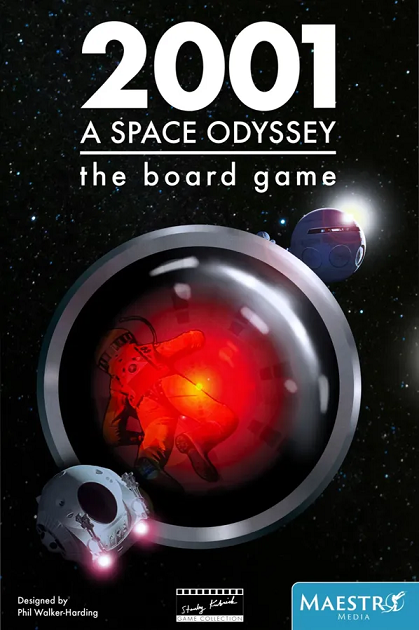
Prospero Hall is back. I’m sorry, that’s a lie. 2001: A Space Odyssey the Board Game is not a Prospero Hall title. It’s a Phil Walker-Harding design courtesy of Maestro Media. This fits right alongside quirky board game cuts like The Warriors, Fast & the Furious: Highway Heist, and Rear Window. I almost don’t trust…

 Anmelden