Anmelden
Hit the Pedal to Matchy Match Your Speed
09. Juni 2026 um 22:00
Also, make stripes liberally to succeed in Operation Zebra

Also, make stripes liberally to succeed in Operation Zebra
By Kaysee and Max

Disclosure: finished the campaign
Earthborne Rangers was one of the games that had been on our radar for quite a while. Many campaign games are also legacy games, which are often not replayable and happen to have many components that aren’t compostable. The components of EBR are compostable, but it’s also a replayable campaign game. For some time we’d wanted to play GMless RPGs with just the two of us; we tried, but it was difficult and we felt we needed more guidance. It seemed that EBR could scratch that itch, giving us some structure without being so restrictive that we couldn’t create our own narrative. Additionally, the art style is beautiful and captures the ecopunk vibe that we like (and we both love green). So we were very excited when we were able to get our hands on it.
Earthborne Rangers is a deck-building/construction game that relies on cards for the world building. Most of the game consists of cards. While there is a map that shows the location, there’s no board to place your character, and having minis isn’t necessary. It is quite similar to a tabletop RPG. But unlike many TTRPGs, players don’t have to rely on the GM to decide whether an action is permissible. The rules are all set up in the game. While TTRPGs offer more flexibility in terms of what a player can do, in EBR, players get to choose the personality and the aspects or the stats of their character and don’t have to rely on dice to randomly generate the stats.
The prologue got us hooked very quickly. During the prologue each player first chooses a number of personality cards, followed by cards representing their ranger’s background and specialty. One of us chose a Forager-Shaper and the other chose an Artisan-Artificer. While we weren’t able to update them regularly during the game, you can check our character sheets here and here. The resulting ranger deck slowly changes over the course of the campaign, as there are opportunities to engage in some further deck building.
The prologue also walks players through the setup process that repeats at the beginning of each day/session. First, players set up their individual areas and draw a starting hand of six cards. This is followed by shuffling the challenge deck, the function of which we’ll explain later. Next come the location, weather and mission cards. We really like these cards as they really help with the immersion (we’d recommend checking out the soundtrack if you want your game session to be more immersive). These are determined by the current state of the campaign, which is noted down on a campaign tracker. If you’re curious, check out our campaign tracker, but be warned: it contains plenty of spoilers.
Then comes the potentially most consequential part, building the path deck, which contains the flora and fauna, the beings, the people, and some structures/ruins. This will include cards based on the path that was used to arrive at the current location, specific or general cards based on that location and sometimes additional cards related to a mission or the weather. What we like about the path deck is that it makes the world come alive and it gives more variety to the game as who/whatever you encounter when you draw a path card is random even though its construction is determined by the factors mentioned earlier. Finally, there are arrival setup instructions on the back of the location card, which shape the initial conditions the rangers find themselves in.
After setup, rangers take turns until everyone has decided to rest for the round. On their turn, each ranger can either play a card from their hand, perform a test or decide to rest. The test or the card that a ranger can perform or play is dependent on the available energy, the type and the amount of which is determined by the aspect, in their energy pool and the path card that they want to interact with. In the first few sessions we were trying to use all the energy in the energy pool effectively, but it gets tricky as the campaign and the days progress; we asked ourselves (and each other) whether we should use them all before we rest or just rest even if there are some left in the pool. We really like this mechanism since while at the beginning it seems that being efficient with your resources means using most of them before resting, eventually we would have to consider whether not using them all and drawing a ranger card during the refresh stage (the stage after resting) might be the better option. But this also means having to draw another path card, which could bring more risks and might have to be dealt with.
When a ranger performs a test, they have to draw a challenge card, which contains a challenge icon (mountain, crest, or sun). Some path cards, weather cards, mission cards, and location cards contain challenge effects, which are triggered if the challenge card drawn has the corresponding challenge icon. The challenge card also determines if the effort used is deducted, added, or stays the same. We feel that the challenge cards are the ones that create the tension as you don’t know whether it’s going to trigger some negative or postive effects. Depending on the location, weather, path card and the mission cards in play, drawing a challenge card may speed up fatigue. Fatigue is when a ranger sets aside a card facedown from the ranger deck without using it. If the ranger is forced to fatigue a card but they don’t have any cards left in the ranger deck, they need to end the day. We haven’t played all the specialties and backgrounds yet, but we think that Shapers have a huge advantage when it comes to decreasing randomness and mitigating fatigue since they have more options not to perform tests during their turn; they could, instead, play a card, which doesn’t require drawing a challenge card to clear or help clear a path.
Clearing a path card is one of the most important things to do in the game because it unlocks and helps progress some missions. But a ranger doesn’t have to clear every path card in play. How to clear a path card depends on the type of path card and the conditions written on the card to clear it. If the card is a being, a flora, or a fauna, it can either be cleared by harm or progress. We would always try our best to clear using progress if it’s a being. We were talking about the choice of using the term “harm” and what it means in the game. This is the part of the narrative that we wanted to be very much our own. We sometimes just define “harm” as disturbance. Sometimes we say that the fruits were harvested and the plants were disturbed, which what harm means in the context of flora. Sometimes when a companion causes a harm to the prey, it just means that they “shooed” it. We interpret the term depending on which context it was done. The narrative and the system are not too restrictive so that there is some space for us to add our own spin on things.
The results of our choices also didn’t feel punishing mechanically and let us freely choose based on what we think is the right thing to do. Without going into too much detail, there was a mission where we needed some prey. One of the preys happened to be not a living prey. When we read the entry after clearing the mission, we were so relieved that we got it. When we finally cleared the mission, the reward wasn’t something we found valuable, but we enjoyed curating the narrative based on which preys we got. We’re being vague here, but you’ll know once you’ve chosen and completed that mission. What we also find very interesting and really love is that clearing a being with harm may seem to require less resources than clearing it with progress, but every ranger has some Spirit (the aspect that provides energy needed to clear with progress) and is capable of compassion, but not every ranger has the means (cards) to cause harm.
Our Final Thoughts:
Earthborne Rangers is the type of game that we were looking for when we were looking for a more structured GMless RPG. It’s not a TTRPG, but it is also not a typical card game. There were times during the campaign where we hoped to not encounter Quisi (one of the characters of the Valley who is endearingly fatiguing) anymore, but we still enjoyed the journey a lot. The art style, the interaction between the mechanics and the theme, the balance between randomness and choice, and most especially having the space to create a world that is uniquely our own, are the things that make EBR one of the best games we’ve played together.
What we like:
What we do not like:
What Kaysee also likes:
What Max also likes:
What Max also doesn’t like:
Kaysee’s rating: 4.5/5
Max’s rating: 4.0/5
Combined rating: 4.5/5
Reference:
Earthborne Rangers[Rulebook].(2023). Earthborne Games.
Title: Earthborne Rangers (2023)
Game Design: Andrew Fischer, Brooks Flugaur-Leavitt, Andrew Navaro, Adam Sadler, Brady Sadler
Illustration: Joe Banner (II), Evan Simonet
Publisher: Earthborne Games
Photos by Kaysee
The post Earthborne Rangers (2-player review) appeared first on Schmeeples.
by Michael
The world is now more inter-connected than ever. While this may sound like a good thing, it also means that a butterfly flapping its wings over the Straight of Hormuz can cause a cascading disruption to global supply chains, which you can doomscroll and read all about on any of your 3+ internet-connected personal devices. […]
Games heavily centered around “take that” mechanics live in a weird space for me. While I don’t have a problem with them, if I’m playing these games with one or more uber competitive, sore-loser types, the experience can be miserable.
With that understood, I approached Mantis with some hesitation. Luckily, my preconceived worries were unfounded, and the game turned out to be a hit with friends and family… even the ones who are typically sore losers.
Mantis accommodates 2-6 players and clocks in at a lightning-fast 10-15 minutes playtime.
Turns are snappy and consist of players choosing to steal or score before drawing the top card from a shared deck.
When attempting to steal, the active player draws the top card into a chosen opponent's Tank (personal play area). If the card matches the color of an existing mantis card in the opposing player's Tank, the steal is successful, and the active player moves all cards of the chosen color from the opponents Tank to their own.
In a two-player game, a successful steal additionally grants the active player another turn.
However—and this is a major point—if a steal isn’t successful, the targeted player gets to keep the card that the active player…
The post MANTIS Game Review appeared first on Meeple Mountain.
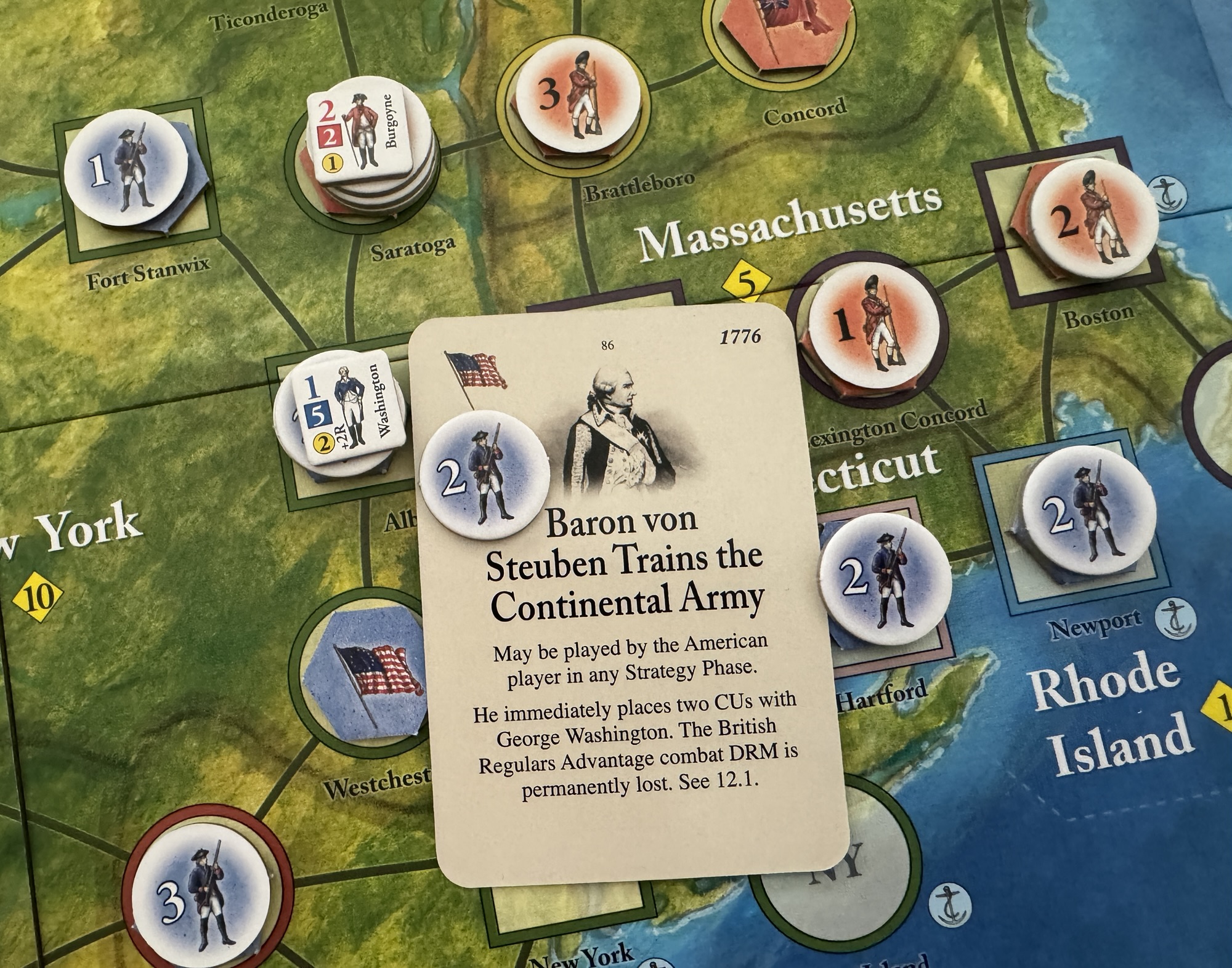


With this My Favorite Wargame Cards Series, I hope to take a look at a specific card from the various wargames that I have played and share how it is used in the game. I am not a strategist and frankly I am not that good at games but I do understand how things should work and be used in games. With that being said, here is the next entry in this series.
Washington’s War is a war game, make no mistake about that. But, it is virtually impossible to win the game by focusing only on the field of battle. For that to happen, the Patriots need to completely drive the British forces out of the 13 colonies or the British need to wipe the American forces off the map. Both are extremely difficult and I would be surprised if any more than 1 out of 30 games ended in such a way. Rather, the ultimate goal of the game is to have political control of the colonies. If at the end of the game the Patriots control 7 colonies, while holding the British to control of less than 5, they win. If not, the British win. Simple as that. So, you can see that battle is not the main goal but control is. And more importantly political control.
I really like this about the design and feel that the real core of the American Revolution was the groundswell of patriotism and the desire to live free from the shackles of an overseas monarch who cared little for the American way of life. This desire led great men of the time to sacrifice themselves, their livelihood and their families to further the true cause of liberty and build a truly free and democratic nation where individual liberty and freedom was prioritized over anything else. And yes, I realize that this nation was not perfect, not without contradiction but the concept of liberty helped to form a country that would lead to the ultimate freedom of all people.
Washington’s War is a Card Driven Game, and as such, relies on cards to provide to players the actions needed to play the game. The cards contain OPS Points which can be used to drive various actions, including such things as activating leaders, who in turn will then move with forces to attack, and also contain written text in the form of events. These events can be played only by the side they are intended for and if drawn and played by the opposing side, they can only be thrown away while granting a few possible actions, such as placing or removing Political Control markers.
In today’s entry, I have chosen this card to showcase one of my favorite events from the history of the American Revolution. The card for today is called Baron von Steuben Trains the Continental Army and has a dual focus. It will add Combat Units or CU’s to go along with General Washington but most importantly changes the balance of the game for battles. The card text reads “May be played by the American player in any Strategy Phase. He immediately places two CU’s with George Washington. The British Regulars’ Advantage combat DRM is permanently lost”. Now don’t get me wrong, gaining a free injection of 2 CU’s worth of fighting forces is a nice bonus for the Patriots but the real benefit of the card is that it changes the game. At the start of the game, the British receive a +1 Dice Roll Modifier (DRM) in all battles until what is called the British Regulars’ Advantage is lost. The British Regulars’ Advantage will be lost immediately if the British lose 3 or more CU’s in a single battle and of course, the British may also lose the British Regulars’ Advantage as a result of the play of this card. I very much like this card and it is very important for the hopes of the rebellion. I have found that the +1 DRM is really difficult to overcome for the Patriots and I found that my hopes in combat at the beginning of the game are almost always a 50/50 proposition. But once this card is played, that changes and I feel like the Patriots can better go on the offensive and openly hunt down and attack the British with confidence.
I have always been impressed with the Patriot effort to bring in professional soldiers from Europe to assist them in training and leading the Continental forces. Names like Marquis de Lafayette (France), Baron von Steuben (Prussia), Casimir Pulaski (Poland), Tadeusz Kościuszko (Poland) and Baron de Kalb (Bavaria) to name just a few. These European Generals had experience and knowledge, which were commodities that the Patriots didn’t have a lot of.
Friedrich Wilhelm August Heinrich Ferdinand Fresher von Steuben was a Prussian-born army officer who played a leading role in the American Revolutionary War by reforming the Continental Army into a disciplined and professional fighting force. His contributions marked a significant improvement in the performance of Patriot troops and he is consequently regarded as one of the fathers of the United States Army.
Born into a military family, Steuben was exposed to war from an early age; at 14 years old, he observed his father directing Prussian engineers in the 1742 siege of Prague. At age 16 or 17, he enlisted in the Prussian Army, which was considered the most professional and disciplined in Europe. During his 17 years of military service, Steuben took part in several battles in the Seven Years’ War, rose to the rank of captain, and became aide-de-camp to King Frederick II of Prussia, who was renowned for his military prowess and strategy. Steuben’s career culminated in his attendance at Frederick’s elite school for young military officers, after which he was abruptly discharged from the army in 1763, allegedly by the machinations of a rival.
In 1775, as the American Revolution had begun, Steuben saw a reduction in his salary and sought some form of military work; unable to find employment in peacetime Europe, he joined the Patriot war effort through mutual French contacts with American diplomats, most notably ambassadors to France being Silas Deane and Benjamin Franklin. Due to his military exploits in Europe, and his willingness to serve the Americans without compensation, Steuben made a positive impression on both Congress and General George Washington, who appointed him as temporary Inspector General of the Continental Army.
Appalled by the state of Continental forces, Steuben took the lead in teaching soldiers the essentials of military drills, tactics, and discipline based on Prussian techniques. He wrote Regulations for the Order and Discipline of the Troops of the United States, which remained the army’s drill manual for decades, and continues to influence modern U.S. army manuals. Steuben also addressed widespread administrative waste and graft, helping save desperately needed supplies and funds. As these reforms began bearing fruit on the battlefield, in 1778, on Washington’s recommendation, Congress commissioned Steuben to the position of Inspector General with the rank of major general. He served the remainder of the war as Washington’s chief of staff and one of his most trusted advisors.
According to Peter Stephen Du Ponceau, Steuben’s personal secretary and interpreter, “The Baron loved to speak of…his sans culottes (radical partisans, urban laborers, and common people of the lower classes during the French Revolution), as he called us. Thus the denomination was first invented in America…when, it could not be foreseen, that the name which honoured the followers of Washington would afterwards be assumed by the satellites of a Marat and a Robespierre”.
After the war, Steuben was made a U.S. citizen and granted a large estate in New York in reward for his service. In 1780, he was elected a member of the American Philosophical Society, a learned society that included many of the nation’s most prominent Founding Fathers.
Here is a link to our full video review of the game:
In the next entry in this series, we will take a look at Good Omens from The Wars of Marcus Aurelius: Rome 170-180CE from Hollandspiele.
-Grant
For many board gamers, Spiel des Jahres is simply the little red pawn on a game box. Spotting it on a shelf often suggests that a game is worth paying attention to. That's not only true in the German-speaking board game world, but also in many other countries, including the UK. Over the years, winners such as The Settlers of Catan, Carcassonne, and Ticket to Ride have helped establish the award as one of the most influential honours in tabletop gaming. Yet, there is a lot more to this story. According to its own history and mission statements, the annual prize was never intended to be the end goal. Instead, it was created as a tool to encourage people to play games, to promote games as a cultural asset, and to help the wider public discover the value of gathering around a table. In the first in a series of articles, I want to look at this further.
The post Spiel des Jahres – the award that was never really about awards (Topic Discussion) appeared first on Tabletop Games Blog.

All I play anymore is trick-takers.
I don’t play as many trick-takers as I used to.
For the most part, that’s fine by me. Sometimes, too much of a good thing makes for a real tummy ache, and while it’s a rare week that doesn’t see me tackling at least one of the hobby’s elder statesmen, nothing makes a board game quite like a board. I will admit, though, there’s always the siren call of the latest pure tricker. “Come back to the table,” it sings, except in, I dunno, Greek. Calling me. Haunting me.
Dead Channels, for example. This is the latest title by Daniel Newman, whose designs we’ve tussled with once or twice.
Test signals.
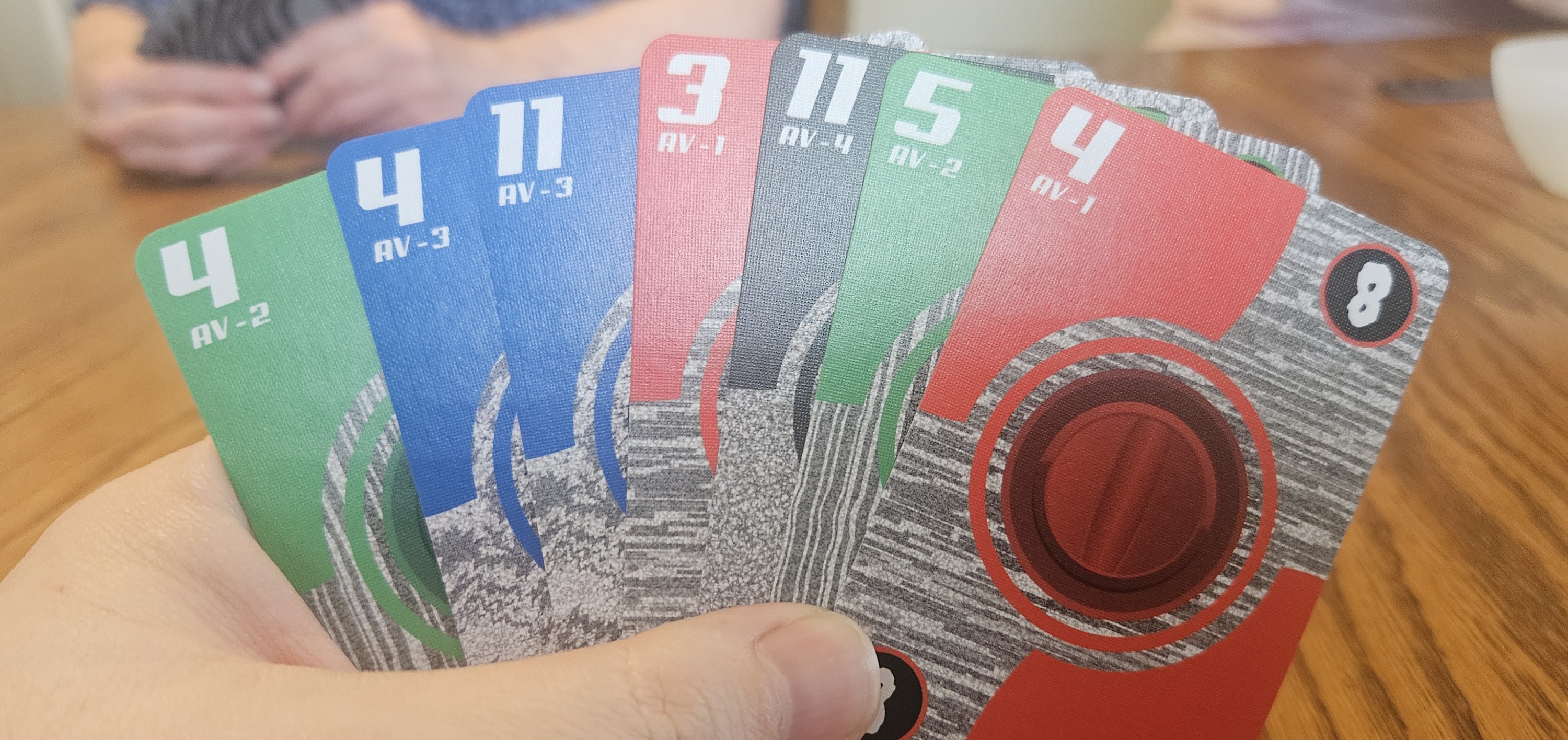
In the fashion of elder trick-takers — modern ones still do this, but older ones too — this is one of those trickers where the designer mines untapped veins from the minutest of changes. The idea is that every card shows two states. One of those states is colorful, like the tuning image you’d get on an old television. The other is fuzzed gray with static. As you play, these states flip back and forth, informing everything about how the hand is played.
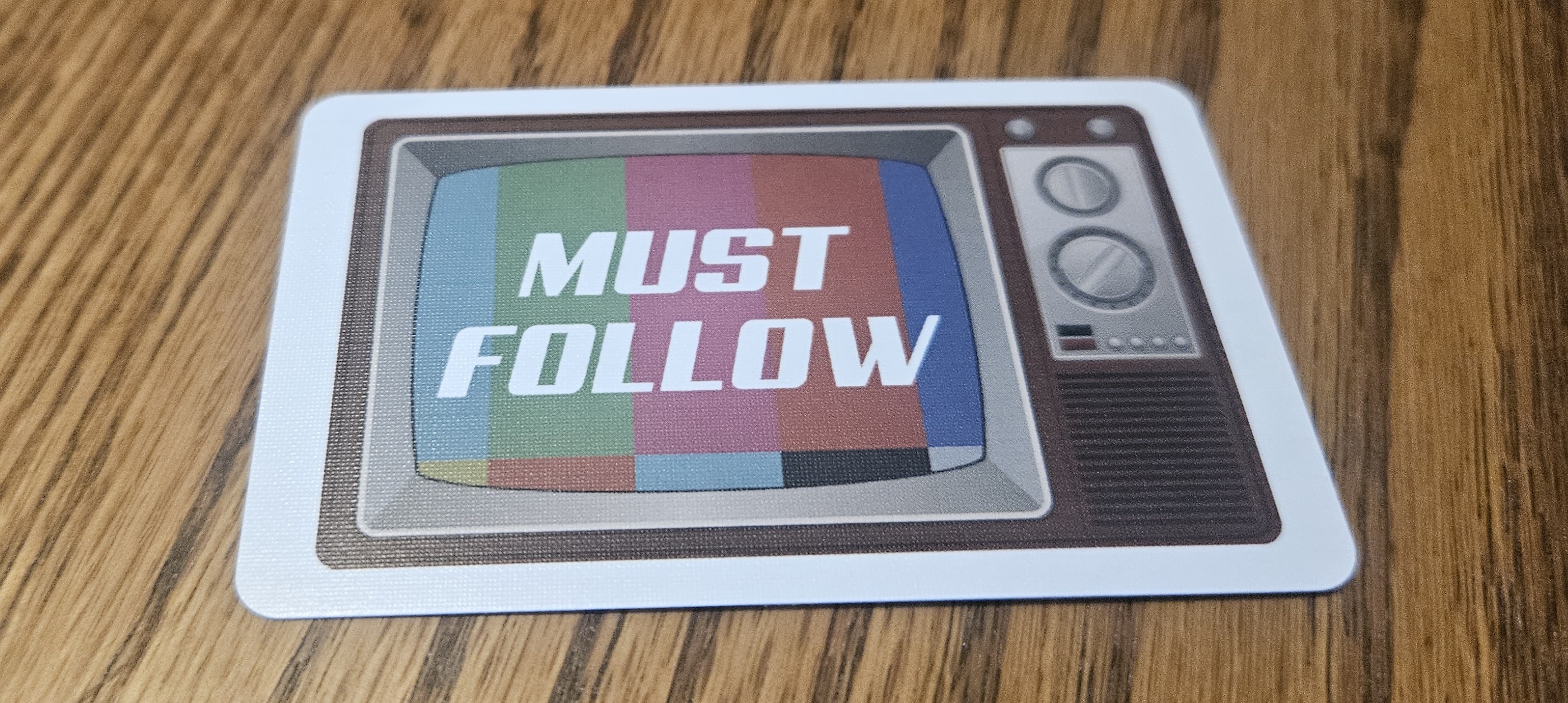
This isn’t the first time we’ve seen a trick-taker alternate hand functions. But what sets apart Dead Channels is the way your cards flip from one state to the other. When the channel is tuning, this is an ordinary must-follow trick-taker. If I play red, you have to play red if at all possible. The highest card in the led suit wins. Normal stuff.
But when someone plays off-suit, the game changes. Now everybody splays their cards the other direction and begins playing a must-not-follow game. If I play red, you better not touch the stuff. Only the high card among those that are eligible — as in, non-following — are permitted to win.
Of course, this might also become impossible before too long, forcing us to flip the channel back to tuning, then back to static, and so on until the hand concludes. Flip. Flip. Flip.
Like some of Newman’s games, Dead Channels feels haunted.
That’s simple enough, but what makes Dead Channels fascinating is that you’re always wrestling against your hand. It would have been easy to overclutter this one, but instead Newman sticks to a simple rubric. You want two tricks. That’s it. Two per player. Naturally, more tricks than that will be awarded, making this a razor-edged proposition. But that’s the idea. If you earn two tricks, you net zero points. For every trick you’re off, whether up or down, you earn a point. Points are bad.
What’s noteworthy about Dead Channels is the way this produces such a well-rounded experience with very little in the way of overhead. I’ll be the first to tell you that trick-takers are a fraught proposition. Between the card counting, goofball terminology (sloughing? really?), and the damoclean threat of contract bidding, this has always been a dense genre, one that’s simple enough on the surface but sharp with gravel once you go more than two inches deep. Dead Channels relies on a little bit of foreknowledge. Like plenty of other trickers, you can explain the rules to veterans with a flurry of jargon. But for the most part it’s as accessible as these things get, devoid of the extra bells and whistles that have been normalized in past years.
Is it the next great thing? The next Schadenfreude? I doubt it has such pretensions. But it’s nice to come back now and then, to see how clever designers are still adjusting the format in small ways that only seem obvious in retrospect. By embracing both must-follow and must-not-follow, Dead Channels effectively becomes two trick-takers in one — although, of course, the challenge lies in how you navigate that liminal space between them, flipping between one mode and the other.
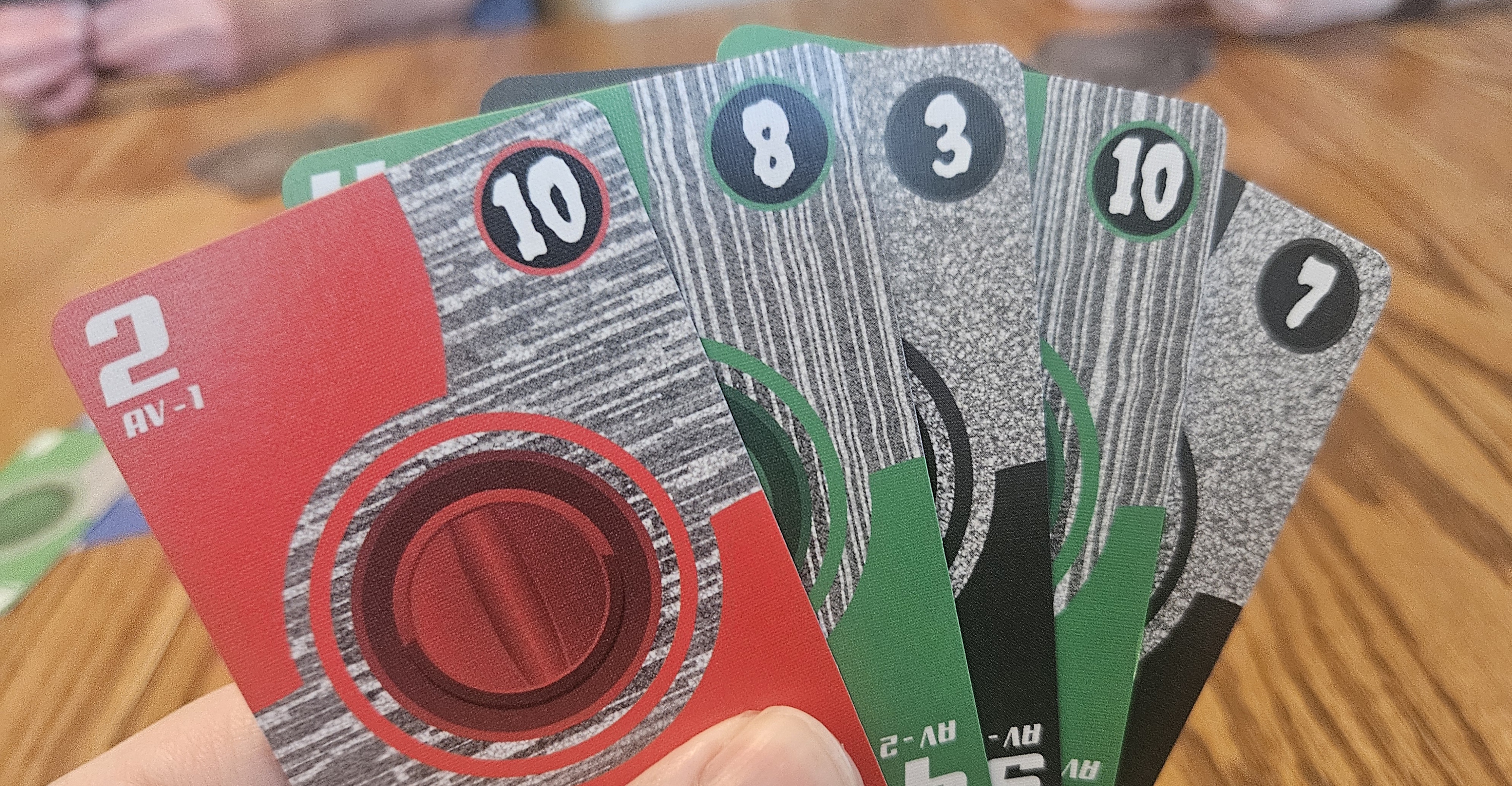
Static still corresponds to suits. Don’t you see the fuzz lines?
I don’t play nothing but trick-takers these days. But like I say, it’s nice to circle back for a visit. In that sense, Dead Channels feels like coming home for a reunion only to make a new pal instead. Could have gone worse.
A complimentary copy of Dead Channels was provided by the designer/publisher.
(If what I’m doing at Space-Biff! is valuable to you in some way, please consider dropping by my Patreon campaign or Ko-fi. Right now, supporters can read my first-quarter update of 2026: the best board games, movies, books, and more!)
For years I’ve written a cautionary tale about the pros and cons of being the face of a brand or company. Yet it wasn’t really until this year that we started to act on the potential perils–more on that in a minute.
This topic came to mind because I recently received an email from Emily in marketing at Alkem Gear (which I mentioned in this article). A lot of what Emily shared was centered around Tim, the founder and creator of Alkem, yet I saw very little of Tim on Alkem’s website or the Kickstarter project. So I asked this:
“How does Tim remain closely connected to the campaign despite partnering with others–like you–for public-facing roles?“
Tim himself wrote back with a detailed answer; here are the two key quotes:
“One thing I believe is really important as a founder is understanding my own limitations. My background is in engineering and product development, not marketing, so I’ve always believed the best way to build something meaningful is to surround yourself with people who are genuinely better than you in certain areas. My role is to help set the vision, establish the values behind the brand, and make sure every decision stays aligned with the kind of community we want to build.
At the same time, I’m intentional about not making the brand revolve around me personally. I’m happy to do interviews, demos, podcasts, or community discussions, but my goal isn’t to become the face of the brand. I want Alkem to have its own identity, one built around service, humility, quality, and community. I want something that can outgrow any one individual.”
This is a really solid answer. I’ve talked in past articles about the power and appeal of a creator sharing themselves with backers during a crowdfunding campaign (opposed to outsourcing to other people or marketing services); see links at the end of this article. However, as someone with 7 coworkers, I also understand the value of delegating to people who are far better at their jobs than I am (or was, as I once wore nearly every hat here). I admire Tim for wanting Alkem to have its own identity.
Despite that, it’s still me (Jamey) writing these articles, replying to questions on social media and email, posting on Instagram, writing newsletters, recording the podcast, running the livecast, and recording YouTube videos. There’s plenty of upside to this personal touch, but the downside is that if you don’t like Jamey, if Jamey is hit by a bus, or if Jamey is no longer part of Stonemaier Games, it would be an abrupt transition to suddenly see someone else appear in my place on social media.
So a few months ago I talked to my coworker, Erica, to see if she would be interested in joining me on some YouTube videos. Not only does it put another face to Stonemaier Games, but you also get to hear from someone else who cares passionately about the tabletop hobby. Our latest video just posted yesterday, and it delves into a subject that was dear to Erica when she worked at a local game store.
Also, I would be remiss to point out that I’m far from the only face or name you’ll see if you have different experiences with Stonemaier Games. If you attend a convention, you’ll probably see Dave or Alex. If you’re a retailer, you’ve probably talked to Susannah. If you’ve had a customer service request, you’ve likely corresponded with Joe. And if you’ve submitted a game to us, you may have heard back from Alan. There’s also Christine (graphic design), but that’s truly a behind-the scenes role.
There’s still room for more versatility, but I really appreciate Erica for joining me as another friendly face on the YouTube channel. She’s also very active in the comments of our shared videos. She and Susannah have also stepped up for the livecast when I’ve traveled (I think Alex may have been on one of those too).
What are your thoughts about the delicate balance between making a company approachable, personable, and relatable without putting all your eggs in the same face?
Also read:
If you gain value from the 100 articles Jamey publishes on this blog each year, please consider championing this content! You can also listen to posts like this in the audio version of the blog.
An ennead of minimal game announcements
Hello readers! Mike Didymus-True here, the editor of BoardGameWire.
I wanted to post a quick message to apologise for an upcoming week or two quiet patch for the site – I’m being unexpectedly admitted for surgery tomorrow, and will likely be out of action for at least 7 to 14 days while I recover. And as BoardGameWire remains a one-person operation, which I squeeze into my spare time around my day job and my two kids, unfortunately that means a very brief hiatus for the site!
Please do continue to email me with your news and such in the mean time, and I’ll do my best to get reporting again as soon as possible! I’m on mike@boardgamewire.com
If this hiatus makes you think “Hmm, I wonder where I’ll get my board game industry news from now”, might I recommend the excellent W Eric Martin over at Board Game Beat, who sometimes has crossover with the kind of things I tend to cover here.
And if this hiatus has also made you think “Hmm, I really do find BoardGameWire and its reporting useful, that Mike really does do a pretty good job covering things that don’t get written about elsewhere – I would very much like to support that kind of thing financially” – that would be lovely! You can pledge a variety of amounts through the BoardGameWire Patreon, or by choosing a paid subscription to our regular newsletter.
Thank you, see you soon!
Mike
The post BoardGameWire is on a very brief hiatus – back mid-June! first appeared on .
The land of Fruit Island, as the name implies, is ripe with delicious fruit: bananas, pomegranates, and mangoes. On this island lives a tribe of monkeys. Over the years, they have built a thriving fruit industry, gathering fruit from the surrounding jungle and delivering it to the trading post for maximum profit. However, all is not well. Living on the island as well is a giant gorilla and, wouldn’t you know it, he also has a penchant for fruit. But, this gorilla prefers to let others do the hard work, using his size to bully, and steal from, the hard-working monkeys.
In Fruit Island, the players take on the role of the monkeys, working to gather fruit and deliver it to the trading post before they’re caught out by the gorilla and have their fruit stolen from them. Fruit Island is a press-your-luck, mess-with-your-opponents game. Equal parts prayer and risk assessment, it’ll have you asking yourself just how long you think you can hold out before making a beeline for safety.
Which monkey will be the most successful? Only time will tell.
At the start of a game of Fruit Island, each player chooses a monkey and places it onto the trading post in the middle of the game board. The gorilla is placed on the…
The post Fruit Island Game Review appeared first on Meeple Mountain.
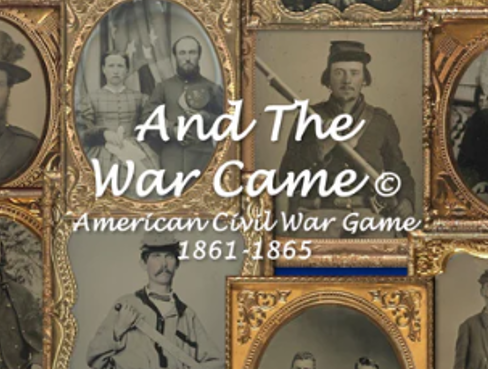
While attending Buckeye Game Fest this spring, we were gifted a copy of a newly published game called And the War Came: American Civil War 1861-1865 from Pinkerton Games, which is published by Blue Panther LLC and Steve Jones. The designer and owner of Pinkerton Games Larry Pinkerton had been their earlier but had to leave due to some other pressing business and we were unable to meet but were very grateful for the game. Upon returning home, I reached out to Larry to see if he would give us a bit of an inside look at the design and he was more than willing to discuss the game.
Grant: Larry welcome to our blog. First off please tell us a little about yourself. What are your hobbies? What’s your day job?
Larry: Grant and Alex, first, thanks for the opportunity to tell you about myself, and my game, And The War Came. I’m a lifelong resident of southwest Ohio, from the Dayton area. I’ve got three great adult kids, each working on their families and/or careers. I’m now retired from both my civilian job, and my almost 34 years as a traditional Ohio National Guard member-last duty assignment as an Air Defense Brigade Commander-so now more time for hobbies.
Now that And The War Came is finally done, I enjoy hanging with my kids, playing music, and traveling. I still do part time contract work in support of US Army training events, which I enjoy as well. And I hope to find more time for playing other wargames too!
Grant: What motivated you to break into game design? What have you enjoyed most about the experience thus far?
Larry: I’ve always been interested in the American Civil War, and many years ago it came to me that a block style game and a strategic level treatment of that war would make a great game-one that didn’t really seem to be available, at least for what I was looking for. I’ve really enjoyed developing the game, adopting, changing or dropping processes, seeking to get at the right balance of playability, workable mechanics and good history. It took a while, but I’m happy with the results.
Grant: What is your upcoming game And the War Came about?
Larry: And the War Came is a strategic level American Civil War game, focused on the southeastern United States. It started life as a block game, but when I decided to self-publish, I switched to rotatable counters due to cost. But play is similar-it’s area movement and card driven, so those familiar with Columbia style block games will recognize some of the mechanics.
Grant: What does the title mean in relation to the history of the American Civil War?
Larry: I bounced so many title ideas and finally settled on And The War Came, which is a sentence in Lincoln’s 2nd inaugural address (March 4, 1865). I felt that line summarized how the United States stumbled and staggered into civil war. And the wonderful Carte de Visite Collection images from the US Library of Congress I chose for the game box spotlight who the actual participants really were.
Grant: What games gave you inspiration for your design?
Larry: Columbia Game’s Hammer of the Scots and Victory Game’s The Civil War 1861-1865 were by far the strongest influences.
Grant: What is important to model or include in a game about the American Civil War?
Larry: Above all, I think it is leaders and leadership at the corps and army level. Any discussion of ACW campaigns seems to hit on the “what ifs” of senior leaders. There were simply so many generals I could have chosen to model in the game, but I finally settled on 22 Union and 19 Confederate leaders that did or could have risen to army or independent command. The formations on both sides were so similar, in my opinion it was the leadership that was truly decisive.
Grant: What challenges did you encounter in the design? How have you overcome them?
Larry: Wow, there were a lot; game flow, simple but historically accurate mechanics, relative strength and play balance, rail and naval capacity, re-playability, map scale-all had to be refined through trial and error, playtesting and compromise. And countless rulebook edits! Rules concepts I thought made perfect sense in my head and on the page drew several questions when reviewed by others. But I think it’s a pretty good final product.
Grant: What is the scale of the game? Force structure of units?
Larry: Regional area movement, and seasonal turns, representing three months. The map is bounded by eastern Kansas to eastern Texas on the western edge, New Jersey to northern Florida along the Atlantic Coast, lower Midwest on the northern edge, and Gulf of Mexico on the southern. Most states contain 4 to 10 areas-states with better road networks tend to have less areas. But there is more territory than units to control it. Fortress cities (i.e. Washington, D.C.), major railroads, navigable rivers, and mountains and swamp areas are also portrayed on the map. Rail and naval support capacity change each year.
Units represent infantry or cavalry corps, with a strength of from 1 to 4 divisions, or forts representing 1 to 4 installations. Unit count is: Union-33 Infantry counters, 10 Cavalry counters, 5 Fort counters, Confederate-26 Infantry counters, 8 Cavalry counters, 8 Fort counters.
Grant: What is the counter anatomy?
Larry: Very straightforward if familiar with Columbia style block wargames-a mechanic I have always admired for simple and clean fog of war, step reduction, and ranged or initiative combat. \Counters are square with strength point symbols (divisions) arrayed along each edge, plus movement and combat ratings. Infantry has a combat value of C2 with a move allowance of 1. Cavalry has a combat value of B1 with a move allowance of 3. Forts have a combat value of A1 with a move allowance of 0-they are stationary. There are also corps insignia (Union) or battle flags (Confederate) just to add historical flavor, and the branch insignia of the period for infantry, cavalry or forts. Ultimately, I chose to give similar units of both sides the same combat or movement ratings (since both Union and Confederate formations grew from the same organizational foundations and traditions), but those ratings can be modified by the leaders who command them, both at corps and army levels, and/or the battlefield terrain.
Grant: What does it mean the “game is We Go turn based”?
Larry: Most functions are conducted by both players at the same time. For example, in the Administration Step, both players recruit (buy) their new units/strength points, enter new or recovered from wounds generals, or administratively move/transfer generals already on the map to new assignments/commands. When both players are done, they go to the next step, (Operations), with Action Phases where each plays a card to determine who moves first, they complete their moves and then resolve any battles that result from movement. The Logistics Step and Victory check complete a turn.
Grant: What type of experience does this approach create?
Larry: It minimizes down time for one. Actions in the Administration Step, Operations Step, Logistics Step happen simultaneously. Only in the Operations Steps’ Action Phase (or depending on the season, phases) does movement happen sequentially. This limits the action/reaction dynamic to operations, where maneuver happens in small chunks due to the seasonal card play. Neither side is able to make big sweeping moves, while the other side can only watch-the mechanic enables campaigns like Gettysburg or Vicksburg, although they may not necessarily occur during the course of play.
Grant: How does the game use cards?
Larry: Cards list the number of “orders” you can issue to units in order to conduct movement or other actions. There are also cards with both events and orders where players must choose which to use. And most cards have a bonus action (improved combat, movement, or leader promotion) to spice things up. The season determines the number of cards each player receives that turn. The Winter season/turn, each player receives only one card-in the single Action Phase, each player compares their card to the other player’s to determine who moves first (initiative), then second, then resolve any combats. This makes for a short turn. In both Spring and Fall seasonal turns, players receive two cards each, then play their cards against each other in each of the two Actions Phases, conducting moves and combat. In the Summer seasonal turn, three cards are dealt to each player-thus there are three Action Phases that turn.
Grant: What type of cards are included? Can you share a few examples?
Larry: There are 30 cards in the common game deck (there are not separate unique decks for Union or Confederate players). The deck includes 22 orders cards, each card with a value of 1, 2, 3, 4 or 5 orders. The orders determine how many units (corps) or commands (see Leaders below) can be moved with that card-a card with only one order allows the movement of only one unit, etc. Orders can also be used to promote generals or repair rail roads, etc. Again, most, but not all of these 22 cards also have a bonus that improves movement, or combat for a unit, or gives a free general promotion.
There are also 8 cards that include a combination of orders and events such as blockade impacts, partisan activities, native uprisings, surprise attacks, diplomatic incidents, immigrant or native recruits, or spy activity-each event with favorable impacts for themselves, or negative impacts for the opposing player. I chose for the event cards to be generic in nature and usable for both sides, verses specific events (i.e. Trent Affair) scripted events. For these 8 cards, players have the option to play the event and still have two orders to move other units, or not play the event at all, and have all three orders for movement.
The entire deck is reshuffled at the start of a new year. Since each player only receives 8 cards in a four season/turn year, only 16 of the 30 cards are played each year-some cards may not get played during the entire war, while others may reappear several times.
Grant: How does combat work?
Larry: Again, similar to other Columbia style block games.
Paraphrased from the rulebook:
Units Fire or Retreat in a combat round. The sequence of combat is A class units fire/retreat first, before B class units, followed by C class units which fire/retreat last. If both sides units are the same class, the defender has the advantage, and fire/retreat before attacking units of the same class. A general’s initiative rating may change who has the first shot advantage. To Fire, roll as many dice as the unit’s current strength points (SP). A hit occurs for each die roll equal to, or less than the unit’s combat number rating. Hits on the enemy take effect as they happen, each hit immediately reducing the enemy unit strength point count by one. Say a 3 division (SP) infantry corps has a combat rating of C2-that corps rolls 3D6 dice and every “1” or “2” rolled is a hit, reducing enemy strength and effectiveness when returning fire. In a battle between a B1 cavalry unit and a C2 infantry unit, the B1 rolls first, but only scores a hit for each 1 rolled. The C2 rolls second and scores a hit for each 1 or 2 rolled. One round of combat is complete when each unit fires or retreats.
Some unit strength may be recovered at the end of combat if the unit is not destroyed-with this recovery rule I’m trying to account for after the battle return to duty wounded, stragglers, local prisoner exchanges, etc. I was aiming for about 20% casualty rates in combat.
Grant: How do Leaders work? How are they killed or wounded?
Larry: Leaders are used to command corps or armies (units under the command of a general are actually called “commands”, i.e. Sherman’s command). A leader imparts his initiative (A, B, or C class) and tactical ratings to the unit or units he commands. In Sherman’s case, he changes a C2 infantry corps under his command to a B2. A leader’s initiative and tactical ratings may change at different ranks. And I’ve added optional rules to randomize when leaders enter the game, and their ratings.
Leader counters also rotate-they all enter the game as a one star general. They may be promoted to two or three star rank. Grant and Sherman can even be promoted to four star (GEN) rank as they historically became army group commanders. A one star general (BG) controls one corps counter; a two star (MG) may command one or two corps.
The only way a leader can be promoted to three stars (LTG) rank is to take command of one of the 5 named armies: Potomac, Cumberland, and Tennessee for the Union; Northern Virginia and Tennessee for the Confederacy. Named armies may contain four or more corps, depending on the army. And only named armies may have subordinates of one or two star rank. If a three star army commander is relieved of command, there is a political cost, and the leader reverts to one or two star rank.
Leaders also represent staffs and logistics trains, so commanded units may engage in two rounds of combat, whereas corps without a commander may only initiate one round of combat-so even lower quality leaders can be beneficial since they allow you to fight an additional round. Most leaders also increase the movement allowance for infantry to 2 instead of the base 1.
And yes, leaders may be wounded, killed or captured. At the end of each combat which involved leaders, a leader casualty assessment is rolled-lower ranked leaders are more likely to be casualties. If assessed as a casualty, another D6 is rolled for severity of wound. Rolls of 1 through 5 indicate the leader is out for that many turns. A roll of 6 means the leader is killed. And if a commanded unit is destroyed but the leader is not killed or wounded, the leader is captured. Captured leaders may be exchanged as prisoners.
Grant: How does the design create fog of war and uncertainty?
Larry: The counter covers hide counter information until opposing units engage in combat. Of course, leader losses will occur, which adds to uncertainty. The cards also provide for a lot of variability in maneuver. And the strength replacement recruiting is a combination of fixed values for the year, plus a die roll for variable recruits each season. Recruitment strengths diminish for both sides over the course of the game. There’re several optional rules that address the Emancipation Proclamation, Drafts, Leader randomization, etc. to add historical flavor or variability to the game.
Grant: Who is the artist for the game?
Larry: I did the artwork…in MS PowerPoint. Whew, not the easiest thing to do! But I’m happy with the results. I used public domain art and was able to generate nice graphic quality with the tools available. And I found you can only go so far in development before you have to start addressing production concerns. And the War Came is definitely a game on a budget!
Grant: How is victory achieved?
Larry: Quite simply, players must accomplish more than their historical counterparts in the same period, for example the 1862 scenario, when the Border States, most of Tennessee and New Orleans were in Union hands by year’s end. So, victory usually means holding more territory, but there are also war weariness and political factors that contribute to, or detract from, victory. Examples are the midterm elections of 1862, Presidential elections of 1864, and weariness of the northern population.
Grant: What do you feel the game models well?
Larry: The overall ebb and flow of the conflict-using corps formations on a large area map just works well. And although there are abstracted naval and logistics rules that function well, I chose to focus on the senior commanders and Lincoln’s and Davis’s struggles to find effective military leadership for their troops at corps and army levels. And I think I’ve got the right level of political factors that contributed to the War’s outcome factored in. It’s hard for the CSA to win, but if the USA sits on it’s hands to build strength and perfect its leadership, the USA will lose. The USA must take the fight south early and often-and that’s a lot of territory to cover.
Grant: What are you most pleased about with the design?
Larry: There’s so many classic ACW titles out there that cover the entire scope of the war in great detail, and yet I think And the War Came fills a niche. For those familiar with board wargames, it’s not overly complex and it plays fairly quickly. I like the unknowns and fog of war, and think the re-playability is there. The historical framework is solid. I tried to not model for effect, so historical campaigns and outcomes are certainly possible, but not preordained. I wanted an interesting beer and pretzels game, one that both those familiar and unfamiliar with the ACW could enjoy. Again, I’m satisfied with the results.
Grant: What other designs are you contemplating or already working on?
Larry: I think if there’s another one in me, it’ll be a strategic treatment of the American Revolution-but to model that conflict will take some work, initially just to get the scope right, and factor in the interrelationship with the wider Anglo-French conflict.
Oh, and I must add a hearty thanks to Blue Panther Games, for their great production and distribution support! I just couldn’t nail down a publisher-but after consulting with Steve Jones (BPG) I realized I could partner with Blue Panther and do it myself! I would recommend them to any aspiring designer who’s interested in self-publishing.
If you are interested in And the War Came: American Civil War 1861-1865 from Pinkerton Games, you can order a copy for $65.00 from the Blue Panther LLC website at the following link: https://www.bluepantherllc.com/products/and-the-war-came
-Grant
Welcome to this week’s batch of crowdfunding campaigns. We have a variety of offerings here, so we hope you will find something that catches your eye. Also, if you want to chat with the BGQ team, join our Discord Server where we talk about games, movies, sports, and other fun stuff. Check it out and […]
by Justin Bell
I stumbled across Pirate Borg back at Gen Con a few years ago, impressed by publisher Limithron's booth setup and the overall presentation of the swashbuckling RPG book. Fast forward to the present, where the newly minted Down Among the Dead and Cabin Fever supplements are sitting on my desk alongside the Pirate Borg Starter Set and it's high tide time that I provide an in-depth review of everything Pirate Borg.
Built on the 3rd party license for Mörk Borg, Pirate Borg mixes the apocalyptic setting from its namesake with its own spin on pirates and the undead. The game takes place in an alternate history of our world right around 1692 in an analogous region to the Caribbean known as the—wait for it—Dark Caribbean. Catchy, no?
As with any of the Borg games, the focus is on player agency and not so much on the minutiae of maintaining an extensive character sheet. Creating a new character is lightning fast and can be generated completely randomly, if desired, using any of the six core classes. Because of the inclusion of undead and fantastical creatures in this world, there are also options to play as an undead or a tall tale such as a merfolk, aquatic person, or sentient animal. Whether you want to sling…
The post Pirate Borg Game Review appeared first on Meeple Mountain.


/pic9160486.jpg)





/pic9625777.jpg)