When you were little, did you enjoy playing with magnets? Now you get to
play with magnets under the guise of a strategic boardgame.
Upside Town is designed by Singaporean designer Quentin Quek and
published by PlayByDesign. Quentin comes from a product design background,
and it shows in how well put together Upside Town is. This is not a
game with a gimmick. The
The results of the 2026 International Gamers Awards (IGA) have just been announced. In the Multiplayer category, the winner is Railway Boom, designed by Hisashi Hayashi. In the Best 2-Player Experience category, Duel for Cardia was the winner; the designers … Continue reading →
BABA IS YOU is one of the most mind-bending puzzle video games of recent memory. Now, thanks to Peter C. Hayward, it’s also a board game. On today’s Space-Cast!, we discuss the peculiar adaptation of Arvi Teikari’s video game, from its inception in That Time You Killed Me and sickbed time-wasting to its gradual development and Hayward’s long-term plans to become a screenwriter.
Listen here or download here. Timestamps can be found after the jump.
TIMESTAMPS
00:15 — obligatory compliments
17:11 — Peter’s artistic journey
40:40 — from That Time You Killed Me to Baba Is You
45:54 — Baba Is You (the video game)
54:00 — making the board game
1:04:50 — the shape of Baba Is You (the board game)
(If what I’m doing at Space-Biff! is valuable to you in some way, please consider dropping by my Patreon campaign or Ko-fi. Right now, supporters can read the next installment in my series Talking About Games, this time tackling the topic of what makes a good list! Naturally, the piece includes a list.)
I enjoy the Tiny Epic line of games published by Gamelyn games. Now owned by Tycoon Games, I was excited to see more of my favorite in the line, Tiny Epic Dungeons. Tiny Epic Dungeons Adventures keeps the same lightweight … Continue reading →
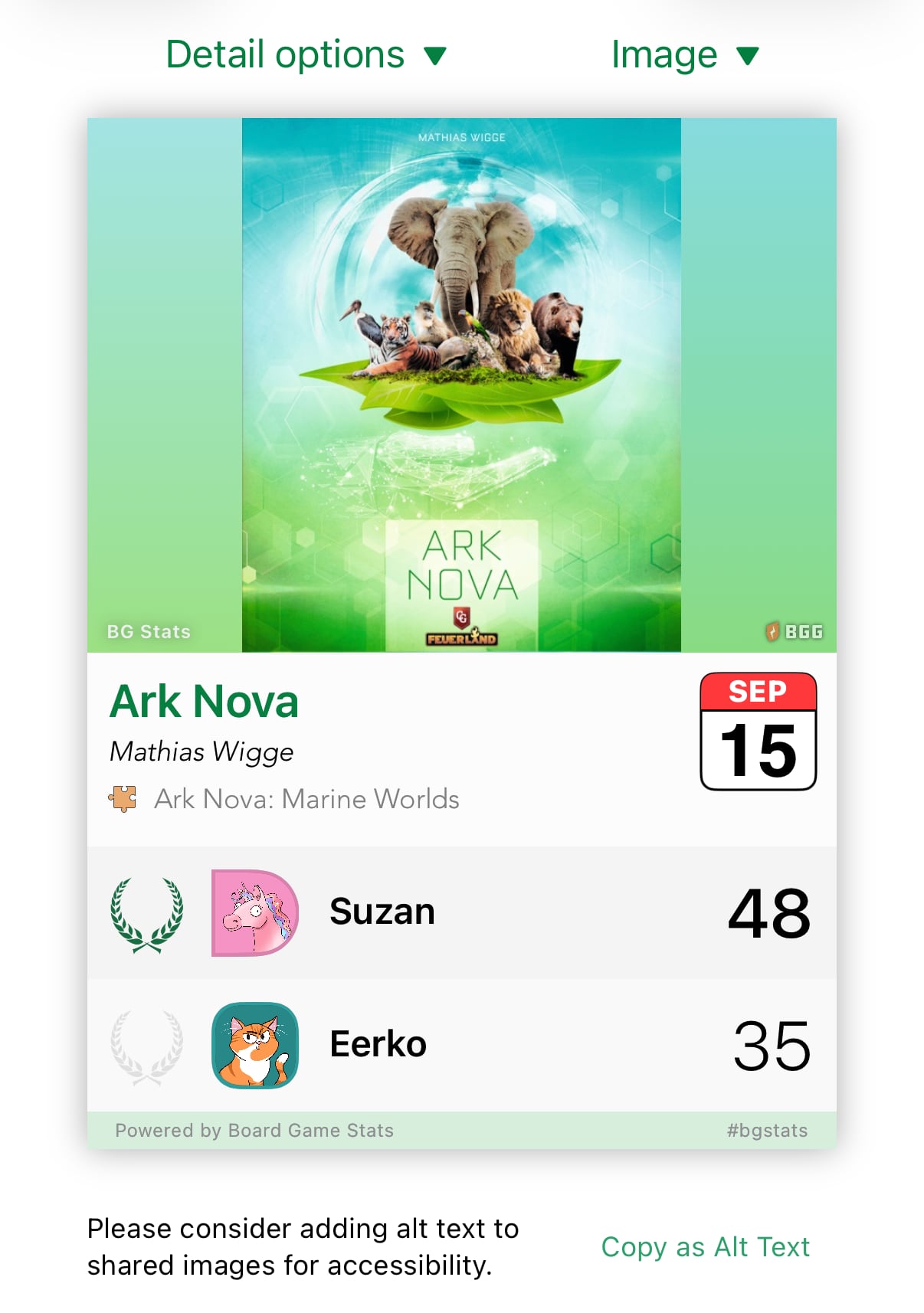
This version introduces a Play Overview Image, to share all your play details in one nice overview. Perfect for sharing via social media! The image can include played expansions, board/variants, players with roles and scores, and more. You chose!
It also contains an update of the 3×3 Image creator. You can now customize the layout with 1 to 12 columns or rows, set a border color, and choose a color for custom items yourself.
The Play Overview Image
To access the Play Overview Image, tap the Share button on a play’s overview screen.
We’ve cleaned up the menu that appears from this button, to offer clear choices for sharing to socials, and exporting the play. We’ve also made all sharing options work better with a wider range of apps.
Choose Play Overview Image from this menu to open the new view.
The old sharing option (previously called “Social Share…“) is now available via the Text and Image, Image only and Text only choices. When selecting Image only the sharing text is copied to the clipboard automatically.
Play Overview Image options
The Play Overview Image displays the image for the game, or one of your own play images of your choice. You can choose from two different styles of backgrounds.
Next to the game name, the date of play is displayed. All other data is optional: Designers, Expansions, Boards/Variants and Play duration can all be added to the view.
The bottom optionally list all players, or a summary of the number of players and best score. When listing the players, you can choose to show or hide the player names, avatars, and roles.
Configure the view to your liking with the Detail options and Image dropdowns. Settings are remembered for your next share!
You can read all details about this new screen on our new explanation page.
The updated 3×3 Image
We’ve updated the 3×3 Image screen with a cleaned-up layout and new options.
At the top you’ll find options to set the number of Columns and Rows for the grid, from 1 to 12. Next to that you’ll find the Badge dropdown.
At the bottom you’ll find other options. New, next to the Border size, is the Border color. This dropdown lets you choose between black, white, a random color, and a color you select yourself from the color picker.
Custom items you add to the grid and games without images have a new option as well: you can now select their background color from the color picker too!
You can read all about the 3×3 Image screen on our updated explanation page.
... or: How to Spend Almost Six Years Developing a Game When All You Wanted Was to Improve a Prototype
Hi, I'd like to give you a little glimpse into how Sixty Below came to life. In the second half of the 2010s, Alex Pfister established a group of Vienna-based game designers that met weekly at Café Sperlhof, a traditional gaming café in Vienna's 2nd district. Ideas were born there, prototypes were tested, games were torn apart, and sometimes even improved.
Cafe Sperlhof in 2019
Then came March 15, 2020.
With Austria's first nationwide COVID lockdown, the café closed its doors. And, as it later turned out, forever. So we had to improvise. Alex Pfister, Wolfgang Warsch, Tino Jokic, and I quickly decided to move our regular meetings to my basement. For about two years, week after week, we tested, debated, discarded, improved, and started over again.
During that time, we created or completed, among other things, Cloud Age (the first game published by Tino's new company nanox.games), Wolfgang's The Same Game and Quacks Dash, my own Comet, Alex's Boonlake, and numerous other projects. Some of them may eventually be published. Others will probably never see the light of day.
Wolfgang and Alex playtesting in my basement
Tino and me during a playtesting break playing something else
At some point during those basement sessions, I asked Alex whether he'd be interested in taking a space-themed prototype we'd already tested a few times, one that worked "well enough," and turning it into a good game. A really good game. An exceptionally good game. What followed turned out to be a journey that lasted longer than originally planned. Much longer. Although, to be fair... we never really had a plan.
Early Prototype
Another Early Prototype
79 Versions Later In autumn 2024, after four and a half years of development and a total of 79 versions, we were convinced:
Sixty Below was finished. All that remained was the final balancing. For those of you who don't know: The phrase "all that remains is balancing" belongs in roughly the same category as "I'll only need five more minutes" when you're packing up an entire apartment for a move. In other words: the finish line was close, but somehow never got any closer. What did get closer was SPIEL 2025. And then, seemingly without warning, autumn 2025 arrived and we still weren't completely satisfied. So we kept working. And working. And then a little more. Sometime in February or March of 2026...
Done !!!!!
The final change. At least for the time being. SPIEL 2026, here we come.
From the Basement to a Hotel, and from Paper to a Computer
The first two years of development took place almost entirely in my basement. Every month brought two or three new versions. For each of them, new cards, new tiles, and new rulebooks had to be printed.
The same four testers. Sometimes only three. Sometimes only two. But always the same discussions. And pizza. Lots and lots of pizza.
After the COVID years ended, we found a new home in the lobby of a Vienna hotel. At the same time, Alex revived the Vienna game designer gatherings, which finally allowed us to test the prototype with people outside our regular group. Suddenly publishers, fellow designers, heavy gamers, and many other wonderful people were sitting at the table. That brought countless new perspectives. And at least as many new problems to light.
By that point, my printer had probably produced well over 1,000 pages for this prototype alone.
Alex playtesting a later version at Hotel Bassena
Eventually, at Alex's suggestion, we switched development to Tabletop Simulator. We still created a few printed versions until we were certain the game worked properly on a real table, but from then on the development process became almost entirely digital. My printer was very grateful, and I suspect Alex's printer was too.
A Thematic World Tour The game's theme also went on a remarkable journey. It started in space … then it moved to Earth … then into the future … then into the desert. And finally into the past, or more precisely, Antarctica. From the outside, that may sound somewhat chaotic. From the inside, it looked exactly the same. In fact, almost everything changed during development.
The Sole Survivor Mechanically speaking, there is only one major element that survived the entire development process: The Expedition Track as it exists today. In earlier versions it was called the Research Track, later the Technology Track, and probably a few other names we no longer remember. At its core, however, it always remained the same thing. Everything else was eventually replaced, improved, simplified, or reinvented entirely.
The Key Elements If you asked me today which three elements define Sixty Below, I'd probably answer: The simultaneous action system combines deckbuilding with tactical decisions about how many cards to play each round, while keeping luck to a minimum. The fact that workers (which we call Explorers) remain on the spaces where they are placed until the end of the game, continuing to serve a function and permanently shaping the landscape of the board.
The fact that, despite having 240 cards, the game contains no hand of cards. New cards can only be purchased from a personal, open Project Display. Although... there is also the connection between buying cards and discovering new terrain … and the fact that deckbuilding works in only six rounds because new cards are always purchased directly onto your draw pile … and the limitation of only five additional workers for the entire game, which prevents an "extra worker strategy" from dominating … and the fact that, despite being a central part of the experience, the game doesn't make building large numbers of stations particularly easy ...
Okay, that was definitely more than three. So what …
The Publisher Shortly before Christmas 2023, we still had no idea where this prototype's journey would eventually lead. At exactly that moment, Tino offered to publish the game through nanox.games. The decision was made remarkably quickly.
On one hand, we've been friends for years. On the other hand, we knew that in this setup the three of us would be able to accompany the entire editorial and development process together until completion.
Looking back, it was probably one of the easiest decisions of the whole project.
The Artist As the illustrator, Tino once again teamed up with Martin Mottet, with whom he created the outstanding Evenfall in 2023. The artwork for Sixty Below speaks for itself.
Some card design drafts
3D Rendering of final game
3D Rendering of final cards
3D Rendering of player board including rewood meeples
Today Today, nearly six years separate the first space prototype in my basement from the finished version of Sixty Below. Those years contained countless playtests, 79 versions, well over a thousand printed pages, probably hundreds of hours of discussion, and a very large number of phone calls between Alex and me. And the result is a game. Just a game. A game. Game, game, game... And if these six years have proven one thing yet again, it's this: A game is only truly finished when absolutely nobody can think of another improvement. Which is usually about two weeks after publication. Coincidentally, in this particular case, that would fall almost exactly on my birthday
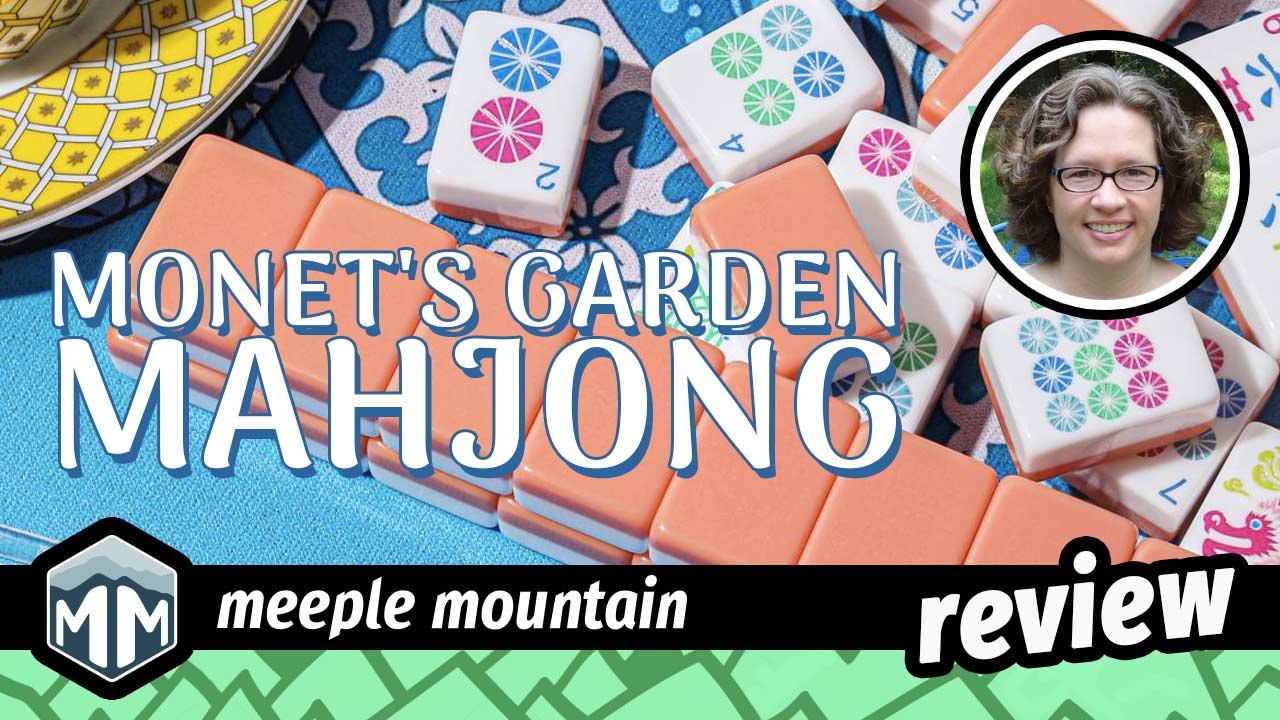
(Note that this tile set is for American mahjong, not Chinese mahjong. While the games are similar and share the same roots, the tile sets required to play each are slightly different.)
Editor: Please read to the bottom for a discount code on Monet's Garden Mahjong set.
The Mahjong Moment
Mahjong is a traditional game that’s having a modern moment. Like chess, it’s a game that has long had its followers but has never quite become part of the mainstream hobby scene. Now both games are experiencing renewed popularity.
In the tabletop world, we saw a big boom in gaming during and after Covid. The need for entertainment and escape, coupled with a need to engage in-person after being isolated drove renewed interest in modern board games. The same is true of role-playing games, chess, and, yes, mahjong.
Suddenly mahjong is everywhere. Social media is bursting with pictures and meetups. I don’t even live in a major city and I see flyers advertising mahjong classes, playgroups, and tournaments all over town. Hallmark even made a mahjong movie and matching Christmas ornament!
With all of this interest comes a flood of products designed to capture every possible dollar. Mats, racks, lamps, tile sets, tables, carrying bags and more are all…
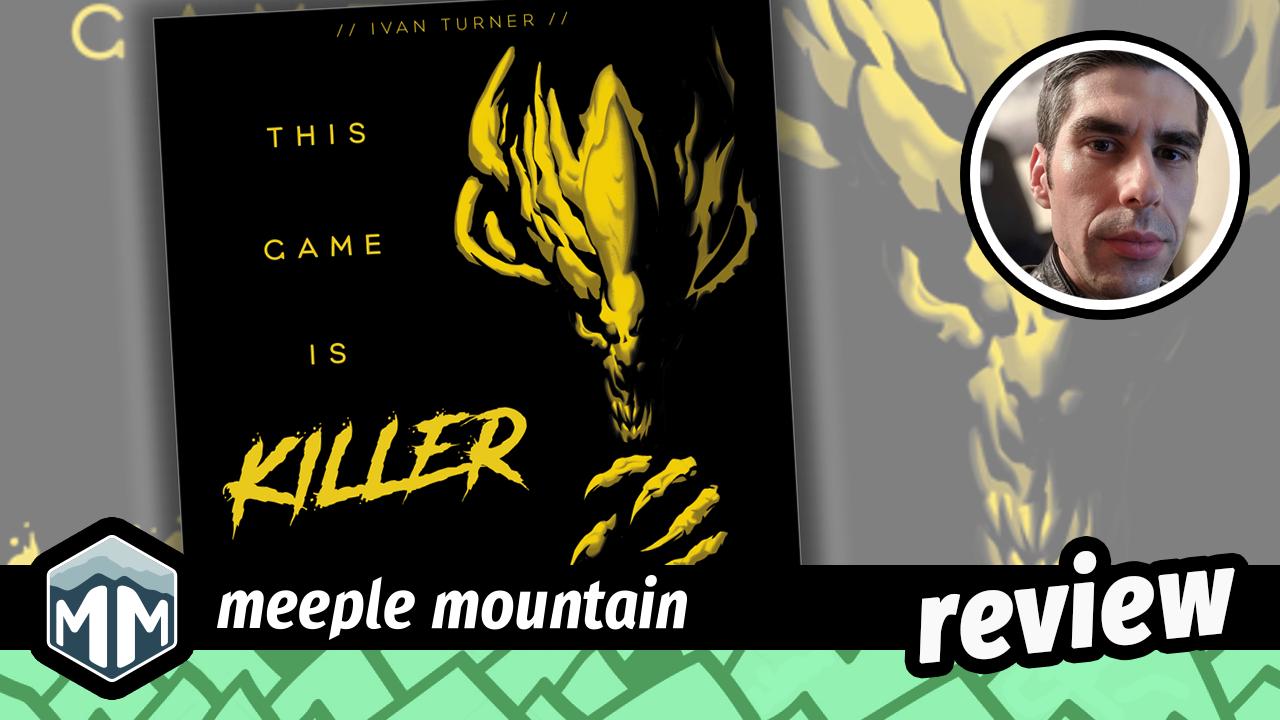
If you asked me many moons ago whether the horror genre would be a good fit for a party game, my answer would have been a straight-up no. Sure, Murdery Mystery party games exist, but horror is on another level. Horror has a body count, and it ain’t no lead pipe in the library nonsense here. The corpses, more often than not, don't remain particularly intact.
Yet three years ago, I did take a look at the Scream board game by the now-defunct Funko Games. It was a surprisingly fun game that somehow made a real-time set-collecting card game with an app work. Not exactly the best game I'd ever played, but it was different, and more importantly, it was good enough to hit the table quite a few times at my local game meetups.
So when I heard about This Game is Killer (great name!), which could handle up to 10 players, lasted around 15 minutes, and used the Aliens franchise as its setting, curiosity got the better of me. And since I'm no cat, I wasn't too worried about where that curiosity might lead.
Wake From Cryosleep
The premise of the game is pretty simple: there is an alien on board causing problems, as aliens tend to do,…
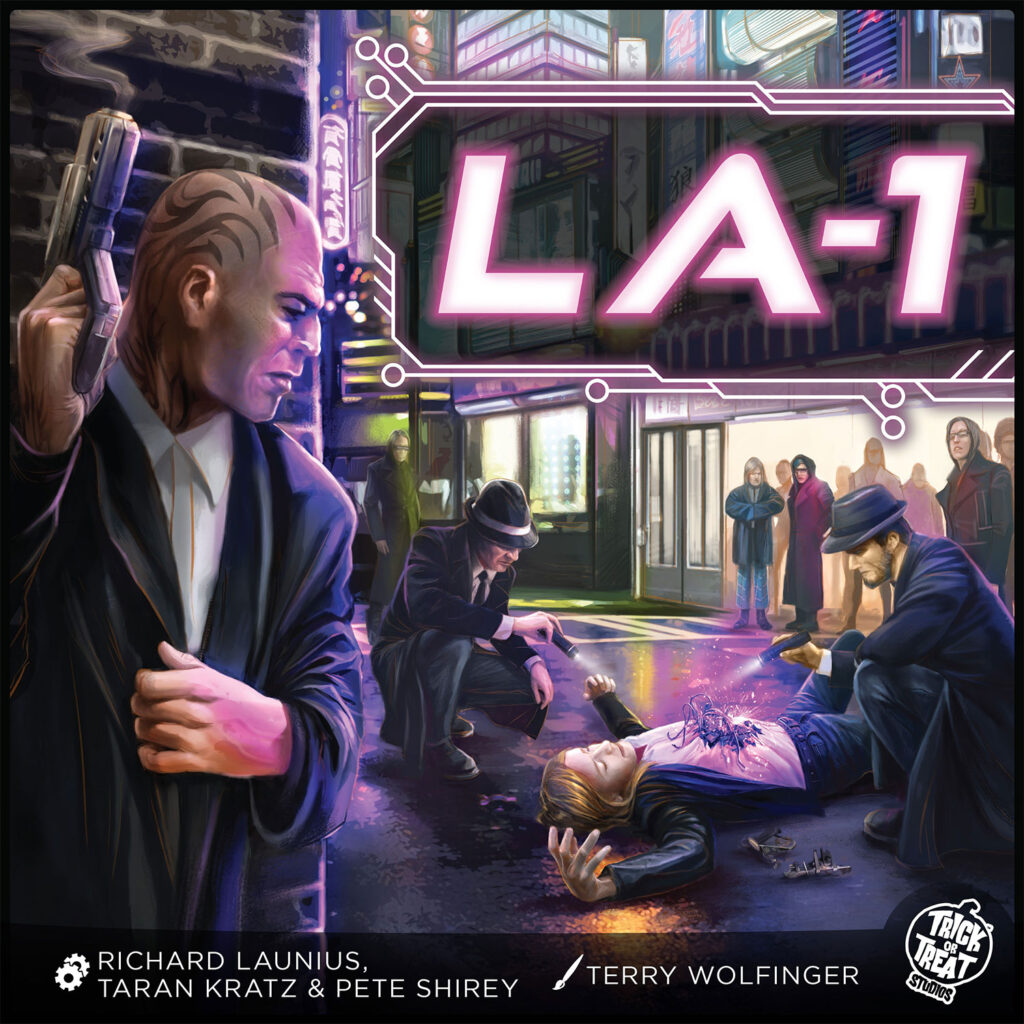
When Trick or Treat Studios (Nightmare Productions) decided to tap veteran game designer Richard Launius to codesign (along with Taran Lewis Kratz and Pete Shirey) their new cooperative adventure game, I was intrigued. I have many fond memories of playing his Arkham Horror board games, and then once I found out it was set in […]
With this My Favorite Wargame Cards Series, I hope to take a look at a specific card from the various wargames that I have played and share how it is used in the game. I am not a strategist and frankly I am not that good at games but I do understand how things should work and be used in games. With that being said, here is the next entry in this series.
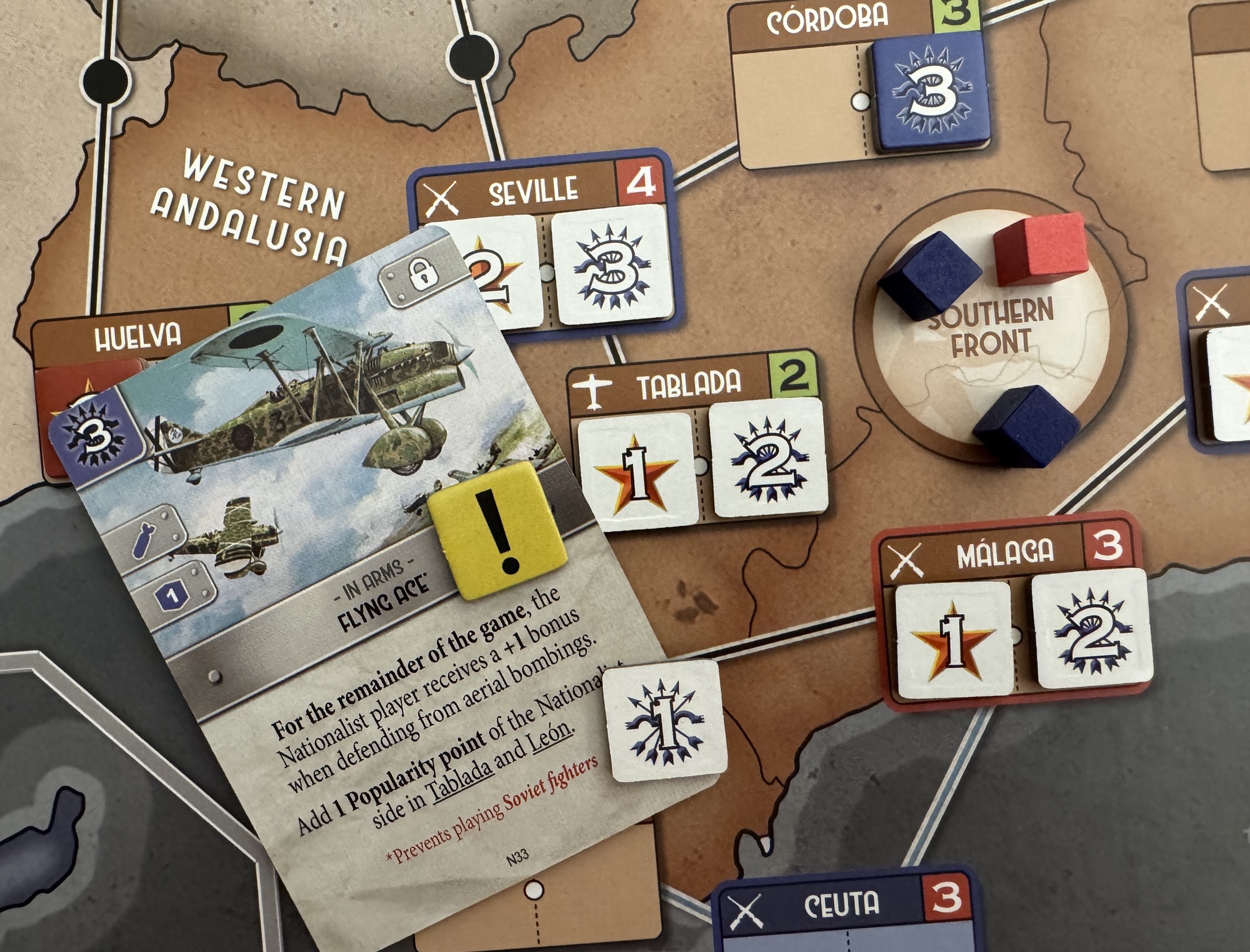
#95: Flying Ace from The Republic’s Struggle: Battle for the Republic, Spain 1931-1939 from NAC Wargames
The Republic’s Struggle is a thematic Card Driven Game that tells the story of the historical events that took place in Spain after the resignation to the throne of King Alfonso XIII, and the proclamation of the II Spanish Republic in 1931. With the creation of the new regime, the struggle for power between the different social, political and ideological sectors increased, which gave rise to continuous changes of political power, alterations of public order, armed uprisings and violent acts, carried out by the numerous ideological factions of the moment; which culminated in 1936, in a failed military uprising. The failure of this coup d’état was the origin for the Spanish Civil War.
The Republic’s Struggle is based on Twilight Struggle from GMT Games and uses the same concepts of area control while adding in some actual combat with units represented on the board. During the game, the Republican player and the National player, will be able to recreate events of the period to increase their popularity in the localities by carrying out political propaganda, recruiting troops or militias, generating revolts or assaults, establishing diplomatic relations or carrying out bombardments. All this will be done by playing their hand of cards in an alternative way, either by using the events or by playing the action points or icons to perform any of the other actions available to the players.
As you probably know, the Spanish Civil War was a bloody and vicious affair. With the advent of air planes and advancement of other weapons technology there was no army that couldn’t be touched. In The Republic’s Struggle players can use their cards and Operation Points to perform an aerial bombing on enemy units that are found on the various fronts. The Bombardment Process is executed by spending the Operation Points (OP’s) of a card, provided the card features a special bomb icon in the upper left hand corner near the Op Points. If a card displays both a bomb icon and a combatant cube icon, you may only choose to execute one of the options and not both. These Bombings target combatants located in specific Fronts, which are represented by circular spaces where army cubes may be placed through card play. In order to perform an aerial bombing, the player must have control of n Air Base Location on the Front that they wish to attack. The attacking player will add the Operation Points of the card played and adds a D6 while the defender will also roll a D6 but will add in the Defense Value that was determined at the outset of the turn by the play of a card and +1 for each of their cubes in the Front. If they have played a card such as Flying Ace, they will get to add a +1 to this total and then results are compared and a winner is determined and losses are the difference between the Attack and Defense Value.
That is the real power in the Flying Ace card as this +1 can be a huge boon in these aerial bombings and allow them to put up a stiffer defense and hold onto more of their units on these Fronts. The game instructs players to utilize the Exclamation Point markers to remind themselves of these type of benefits as the player should place the played card in front of them with the marker to be able to remember the benefit later in that turn.
But the Flying Ace Card provides another smaller but important benefit as it allows the Nationalist player to place 1 Popularity Point in Tablada and León to continue to build their influence and control of these key regions for scoring purposes. And finally, another benefit is that the play of the Flying Ace Card will prevent the Republican player from being able to play their Soviet Fighters Card which has a similar benefit. The thinking here is that the first player to get this card out controls the skies and has air superiority.
Aerial bombing during the Spanish Civil War marked a dark turning point in military history, serving as a lethal testing ground for the aerial terror tactics later unleashed in World War II. An estimated 15,000 people died from air raids during the conflict, with the vast majority of victims being civilians targeted by Nationalist forces backed by Nazi Germany and Fascist Italy. One of these horrific events was that of the Bombing of Guernica on April 26, 1937. Carried out by Nazi Germany’s Condor Legion and Fascist Italy’s Aviazione Legionaria, this raid destroyed a massive portion of the Basque town and killed hundreds of civilians. It became the ultimate global symbol of the brutality of war, immortalized by Pablo Picasso’s famous painting Guernica.
In the next entry in this series, we will take a look at Henry Knox Continental Artillery Commander from Washington’s War from GMT Games.
I participated in a mid autumn festival event on Sat 19 Sep 2026. This was not a boardgame specific event, but several Malaysian game designers and retailers were invited to showcase and sell their games. The event was in Pandamaran, Klang, which is an hour drive west of Kuala Lumpur. The event was 5pm to 10pm, and we were asked to come set up booth by 3pm. I had something else on that day which
As we all know, there are a good number of board games that haven't aged well, if I may put it like that. In the past, games happily made colonialism their central setting and gameplay, gave women little or no place in their worlds, or treated cultures through the eyes of the oppressor. Yet, these games remain in people's collections and come back to the table. In this article, rather than asking whether we should still play these problematic games, I explore why we don't just choose different games from the large swathe of new releases.
Gunsen: The Battle for Toshi Ranbo Designers: Ben Rosset and Matthew O’Malley1 Publisher: OfficeDog Players: Age: Time: Amazon affiliate link: https://amzn.to/4wvg7rB Played with review copy provided by publisher In Gunsen: The Battle for Toshi Ranbo, Rokugan teeters on … Continue reading →
Teh Tarik Game by Ray Tan was the winner of the 2025 Malaysia Design & Play game design competition, of which I was one of the judges. The winner's prize was either a publishing deal, or a cash prize. Ray decided to take the cash prize and publish the game himself. He did all the planning and the art. The game was released this year. I got myself a copy. I was part of this game's journey,
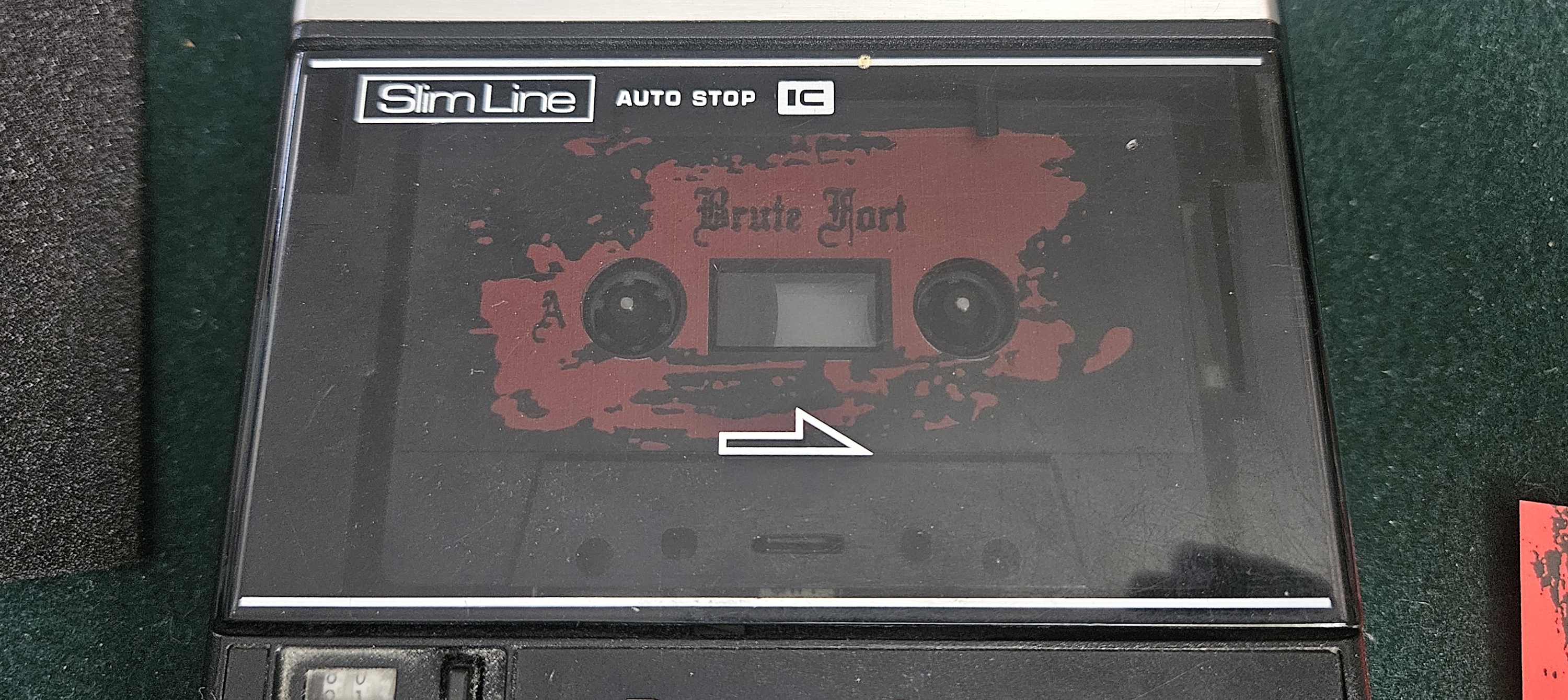
For its size, I would classify Brute Fort as maximalist. Which perhaps sounds contradictory, given it’s a microgame that runs on only 18 cards and comes in a plastic cassette case. But each of those details unfurls into something more. The cassette case is double-wide, necessary for holding the synth soundtrack alongside the cards. And the included dice, concealed under the tuckbox, can be used to generate the rooms of a haunted fort in a TTRPG.
What’s more, the microgame within is hand-drawn in garish inkstrokes that wouldn’t be out of place in a game like Cave Evil or The Restless. This is my first attempt at a game by Alfred Vale, but it’s solid enough to make me sit at attention and consider the other entries in his catalog. Maybe, for instance, the solitaire zine that requires you to spin a coin while you complete drawing minigames.
But for now, I’m contenting myself with Brute Fort. This thing doesn’t quite fit the Button Shy model. It’s way too metal.
You stand at the foot of a shrouded fort…
Brute Fort is about sacrifice.
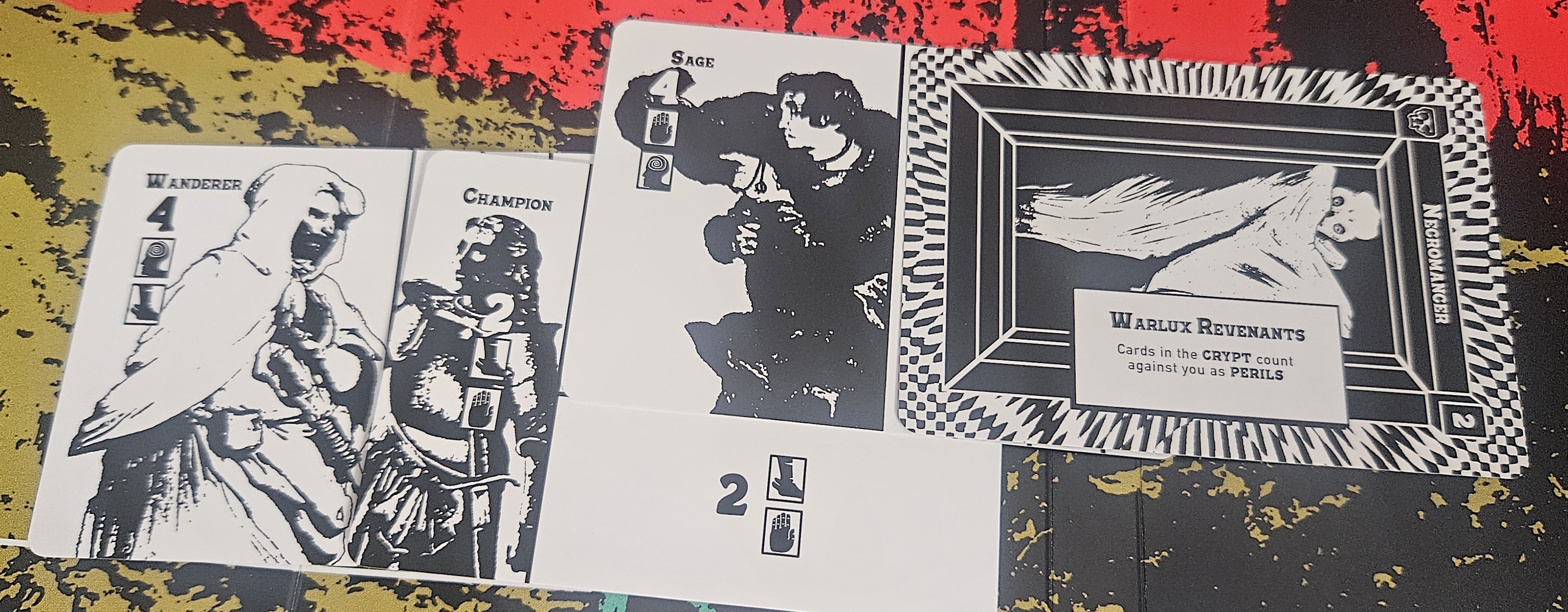
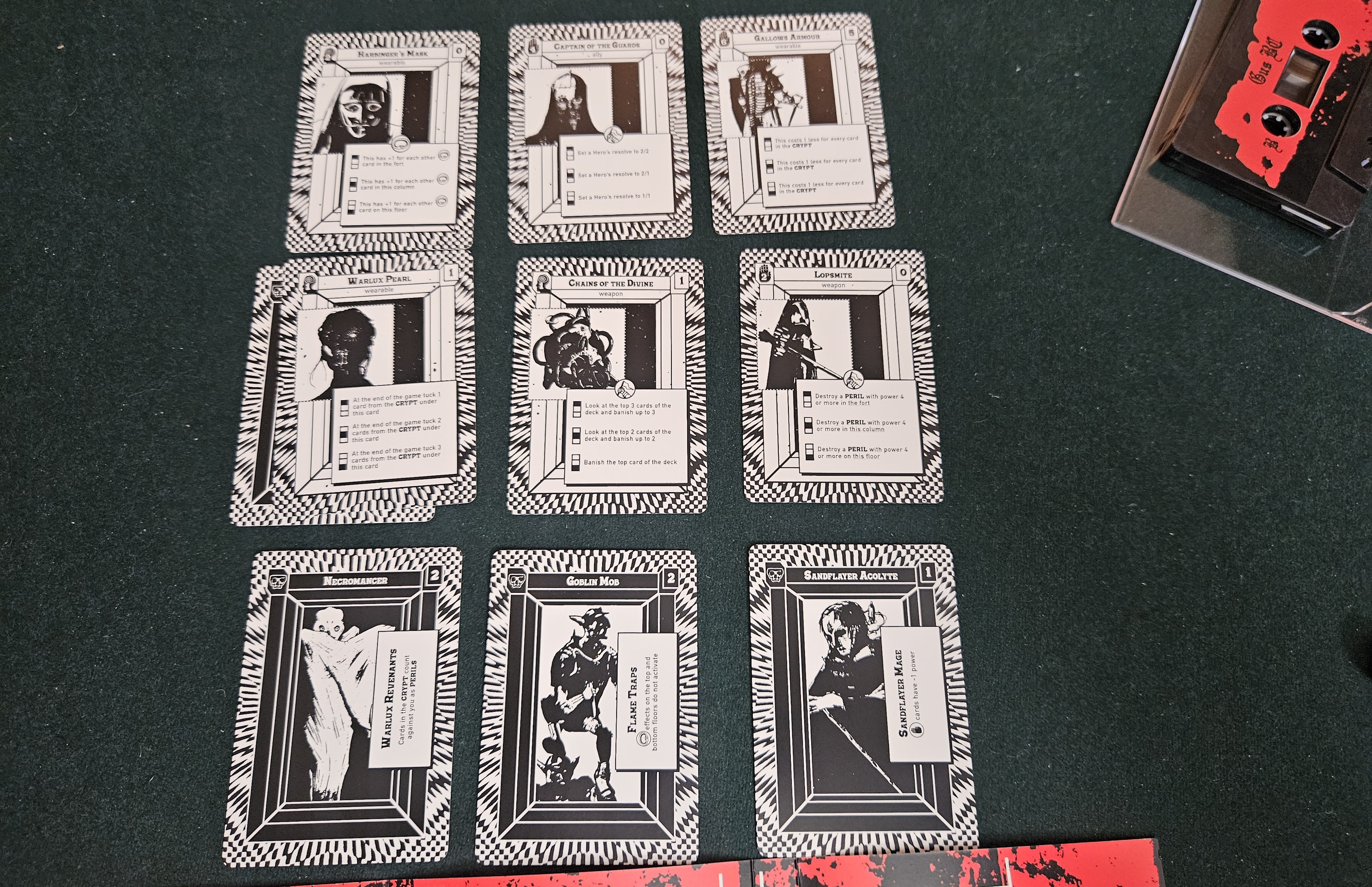
When the game begins, you have three heroes: the Wanderer, the Champion, and the Sage. Each hero is arranged so that it partially covers the one next to it. A fourth card, drawn at random from the main deck, covers the last hero, and in the process also imposes some penalty on your session. The Gloomswiller destroys artifacts the instant they’re played. The Demon Imp threatens to flip more cards against you. The Warlux Revenant transforms any dead cards in the crypt into your enemies.
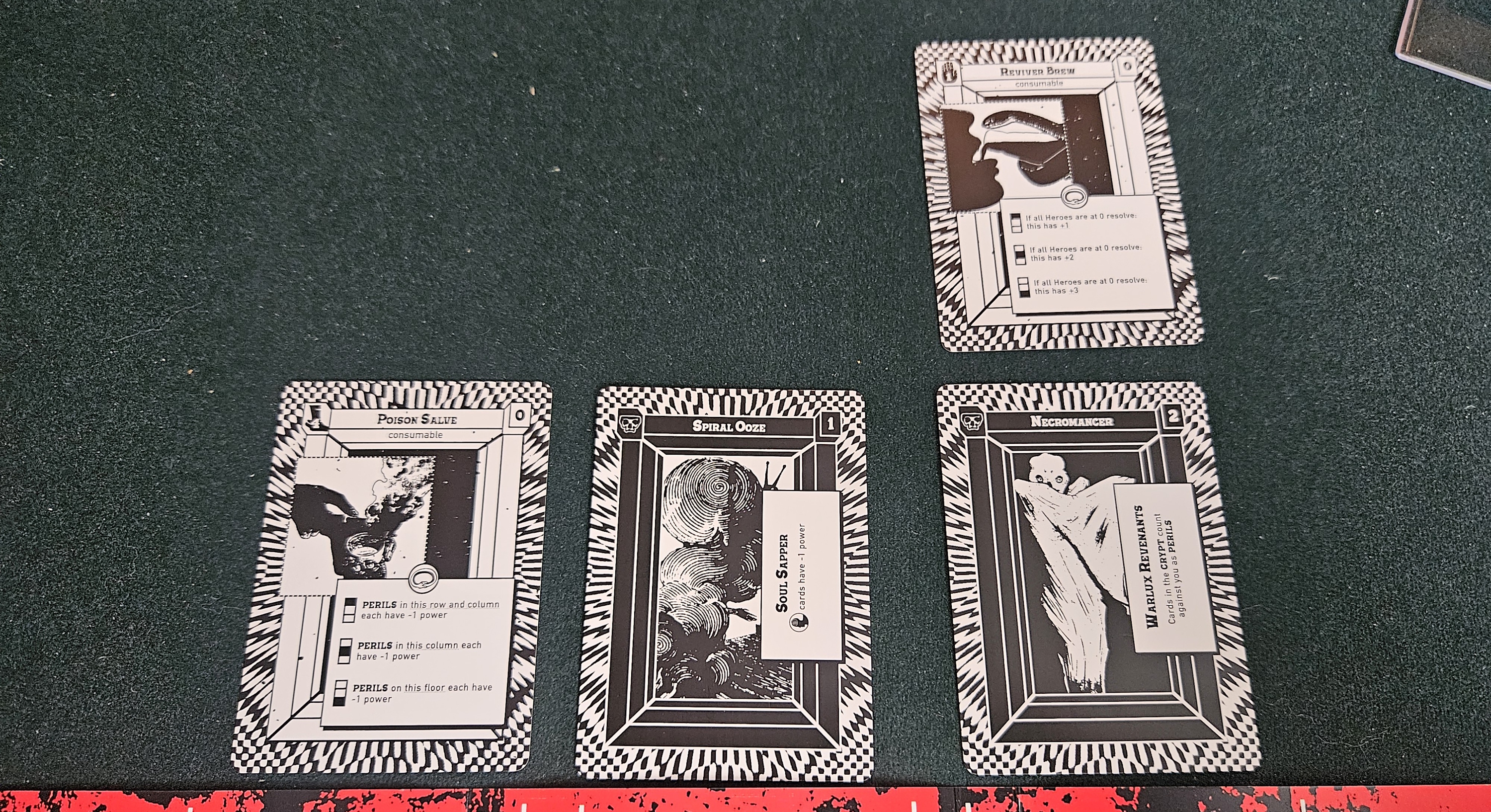
But it’s the heroes who are the important part, at least right at first. Each hero begins fresh with four points ready to be spent. You draw a trio of cards from the deck. Each one costs some amount of those points. You might, for example, be holding a Poison Salve (poisons enemies — not quite a salve, but fine), a Harbinger’s Mask (grows stronger near specific other items), and a Cursed Banner (also makes you stronger when placed near certain items). All useful in their own way.
Except most of these items don’t cost four points. In fact, only one of them does. The Poison Salve, in case you were wondering. But the Harbinger’s Mask costs two and the Cursed Banner costs one.
Now, normally this wouldn’t be a problem. But in Brute Fort, your heroes don’t give change. If you spend any of the Sage’s four points, the remainder is gone. All that effort, spent to place a single card. What’s an adventuring party to do?
Heroes can be spent for resources, or divided to stretch those resources a little further.
In this case, you divide your attention. By adding one of the cards from your hand to the fort, but doing so in the fort’s favor — flipping it over to its evil side — you’re allowed to divide a hero’s resources in half. Now instead of your Sage having four points, he has two bundles of two points. Only, uh oh, the Harbinger’s Mask has transformed into an Infernal Seer. Now it will be even harder to overcome the fort.
Later, you might make another sacrifice. More time, another baddie, to divide your points yet again. Now your Sage’s two and two becomes two and one and one, the latter half halved again. Now you can play that Cursed Banner without losing out on any points. The only problem is that between the Infernal Seer and the Iron Talon Raptor you just added, the fort is starting to look rather tough indeed.
Brute Fort continues like this. One sacrifice after another. Cards transforming into monsters. Resources rationed and dwindling. At the right moments, your own cards — items and allies and artifacts, all that stuff — coming into play to slowly raise your own score to hopefully trounce that of the fort. In the end, it’s a simple tally. Your strength versus the fort’s strength. Only nine cards in the fort itself, plus some tucked cards maybe for a bonus here or there.
The sacrifices I make to review board games.
It’s all very microgame-like, although it doesn’t feel anything like the fare you’d get from Button Shy. I don’t mean that as an insult. It’s just that Brute Fort is a little darker than the titles in that catalog. There’s the art, obviously, which is a far cry from the cartoonier style that usually fills those wallets. But also in the sense that Brute Fort feels a little wilder, a little less ultra-tuned. Some cards offer obvious combos. Others require more massaging. There are some I’m not sure can be made to work, not for any shortage of trying.
As for the feel of the game, it’s tradeoffs all the way down. Every card feels like a tangible sacrifice to the dark gods that inhabit this place. Even the ones you actually purchase might wind up in the wrong spot, with each one offering slightly different abilities depending on where in the fort they get placed. This is the remedy to the danger of Brute Fort growing rote: since cards are more powerful lower in the fort, you’re encouraged to make at least one or two purchases at suboptimal exchange rates, sacrificing a hero’s strength before parceling it all the way down to its constituent fragments.
And then there’s that soundtrack. I even had my mother scrounge a cassette player from some undusted corner of her castle so I could listen while I played. I’ll confess I don’t understand the return to tape, despite being a fervent advocate for physical media in this age of rented art. But as the deck scraped to life, some part of me was taken back to an earlier time. To listening to books on tape on long car trips, only to abscond with the rest of the set when our time on the road didn’t quite conclude the latest Tony Hillerman or Michael Crichton novel. Listening to them in my bedroom, in the dark, on the boom box I owned mostly for Green Day CDs, but which included a tape deck because there were still a fair few cassettes floating around in those days. The scratch and whine complemented the narrator’s voice the way the rotating spindles complemented John Darnielle’s early albums, and I’ll be damned if the crackle didn’t evoke a sputtering torch here.
A completed tableau full of both good and evil cards.
It isn’t often that I play a game that feels quite this complete. Brute Fort works, and it works because it has such a zine sensibility, merging art and media and even disparate types of play without seeming like it’s even thinking about how it’s crossing boundaries. I have a little corner of my collection for microgames. Most of them inhabit plastic wallets. I’m delighted to now have a double-wide cassette case misfitted among them.
A complimentary copy of Brute Fort was provided by the designer/publisher.
(If what I’m doing at Space-Biff! is valuable to you in some way, please consider dropping by my Patreon campaign or Ko-fi. Right now, supporters can read the next installment in my series Talking About Games, this time tackling the topic of what makes a good list! Naturally, the piece includes a list.)
On Wednesday we will reveal our final new game for 2026, a big Euro game called Braided Skies. We’ll share information about the game with people who already follow Stonemaier Games, but that’s a fraction of the people who could potentially enjoy this game. So starting soon after the reveal, we will run some ads on Facebook and Instagram to invite people to sign up for a notification when the ready-to-ship game launches on our webstore in mid-October.
This is a common practice among crowdfunders, though from recent reports they are spending exponentially more than I would expect: Some publishers are investing $20,000-$40,000 on prelaunch ads (compared to our prelaunch ad spend of $1,000, which is augmented by organic reach from our YouTube channel, Instagram, Facebook, newsletter, Bluesky, etc).
It seems to me that spending $20-$40k prelaunch can dig creators into a deep hole, shifting the focus from serving backers to getting enough backers (that you at least break even). I talked to Tamas at Lemery Games about this topic, and he shared that he spent less than $3,000 on a recent prelaunch campaign for Caravanserai.
Cleverly, Tamas uses these ads to evaluate the market for the game using click per lead (CPL) as the key metric. If the CPL climbs too quickly into the ad campaign without generating a significant quantity of signups, that’s a sign that (a) the game or its presentation isn’t ready, (b) the format of the project isn’t resonating with people, or (c) the timing of the campaign isn’t ideal. This is an opportunity to step back and make key adjustments, not push through with another $20,000 in ad spend.
That’s the first step. If the ads are resonating with people, I think it’s reasonable to spend up to $5,000 (or maybe $10,000 for a much bigger project) on prelaunch ads, with the goal of reaching those who are genuinely interested in the product. I think it’s fine to have an extra hook (e.g., Tamas offered an expansion with a miniature to anyone who signed up for Caravanserai in advance and ended up backing a core pledge), but I personally think that pairing the right game with the right person is what matters most.
Tamas provided some data: “For Caravanserai, 695 people signed up on a dedicated pre-campaign landing page, and 1 week into the campaign 16% of them pledged. For a game with a higher entry point (rewards range from $45 to $89), the average CPL was $2.60, which is still a good number at 695 sign-ups.”
Maciej at Gamefound recently shared some related data with me as well. Their average CPL via AdFound is $3.10, and they’re seeing a 22.6% conversion rate (these are prelaunch followers who become backers).
Again, I think it’s really important to keep Tamas’ observation in mind: The math isn’t linear, and nothing is guaranteed. $3,000 spent on ads with a consistently low CPL is a good sign that you’ll see around a 20% conversation rate after the project launches. But $30,000 spent on a swiftly increasing CPL is money you may never make back.
For other creators, what is your total prelaunch ad spend, and what have you learned from running those ads?
In this card and dexerity game by Alley Cat Games, build up the penguin tower and be careful not to knock it down, as you strive to be the last penguin standing!
Chip Theory Games has hired eight-year Keymaster Games veteran Jennifer Graham-Macht to lead its lighter-games imprint Neon Knight, after discovering that building the business means developing a new audience – as well as rethinking some of the approaches behind its prior success.
The Too Many Bones publisher told BoardGameWire it is very happy with Neon Knight’s progress since it began building the studio two years ago, but has acknowledged being “maybe naive” about how many of its existing fans would follow it into lighter games.
Chip Theory chief marketing officer Josh Wielgus said, “We had hoped there would be a very high percentage of ‘omni-gamers’ in the Chip Theory audience who would gladly come along for the Neon Knight ride. That hasn’t been as true as we had initially hoped for, and thus we’re learning that we really need to put the effort into building that audience and brand.
“That has meant on the Chip Theory side investing more resources into the building of Neon Knight than we first anticipated. Obviously the biggest move we’ve made to that end is bringing in an experienced pro’s pro like Jen.”
Chip Theory Games’ hugely successful title Too Many Bones, designed by company co-founders Josh and Adam Carlson
Chip Theory has spent more than a decade building a hugely successful business around expensive, lavishly produced games aimed at a devoted audience of heavier and solo-focused hobby gamers – with standout hits including Too Many Bones, Cloudspire and The Elder Scrolls: Betrayal of the Second Era.
But the publisher looked to expand the breadth of its offering in April 2024 by bringing in Dice Throne co-creator Manny Trembley’s recently-launched studio Good Knight Games, which it rebranded to Neon Knight.
That move was designed to give Chip Theory a dedicated route to more retail friendly and affordable lines of games, while drawing on its longstanding operations, customer support, fulfillment and marketing experience.
Wielgus told BoardGameWire, “We’re very happy with the direction things are going, even if thus far there hasn’t been a ‘megahit’ to speak of.
“We’re really proud of the titles that have been released thus far and are learning a ton about a market – the light/medium/mass market side of board games – that we have historically been absent from on the Chip Theory side.
“We fully understand that this basically needs to be treated as building a new business. Chip Theory proper didn’t really find its footing until after Too Many Bones released, which was almost five years into the company’s existence.”
But he said one assumption the company had got wrong with Neon Knight was expecting the tastes of Chip Theory’s staff – who enjoy games across a range of weights and genres – to be mirrored across its customer base.
“I think we were maybe naive about the number of traditional Chip Theory fans who would be excited about this direction,” he said.
“Chip Theory caters primarily to a heavy and solo-forward audience, but all of us here in the building love most types/genres/weights of games. We presumed that much of our audience was likely the same.
“That hasn’t turned out to be as true as we maybe hoped, and so it didn’t take long to realize we needed someone who didn’t have their mind in Chip Theory world at all to help us really reach what has turned out to be a very new audience.”
Theory Into Practice
New Neon Knight lead and managing director Jennifer Graham-Macht previously spent about eight years at Parks publisher Keymaster Games, initially as community manager before taking on roles in production, project management and ultimately being named Games Director.
She has also recently returned to board game retail as co-owner of New Jersey-based retailer The Player Agency, having previously run Satellite Comics and Games in the mid-2010s.
Graham-Macht told BoardGameWire that moving into full studio leadership felt like a natural next step after a long spell at Keymaster, and described Neon Knight as having “equal parts amazing pedigree and plenty of room to keep improving”.
Her new role sees her responsible for the “health and growth” of the studio as well as leading its operations, with Trembley remaining creative director with responsibility for game design and art direction.
She said, “I’ve spent the first couple of months getting clear with Manny what the vision is for the imprint. We first want to make that clear internally and then use it to start shaping how we grow our catalog and talk to our audience.
“In every aspect of studio work, I’m focused on making sure we are walking well before we run. That includes how we say yes to projects, how we work with external partners, developing a sustainable omni-channel strategy, and much more.”
Part of Graham-Macht’s role will be helping determine which lessons from Chip Theory’s existing business are useful for Neon Knight – and which do not fit a company targeting a different market.
Wielgus told BoardGameWire, “The lesson we’re learning is that not every lesson we’ve learned with Chip Theory is applicable on the Neon Knight side of the business.
“Jen’s here to really help us gauge what bits of our experience are helpful and what bits of our experience are perhaps holding us back from doing mass market well.
“Our penchant for ‘overproduction’, a laser focus on making games solo-friendly, and a crowdfunding-first mindset don’t necessarily benefit us here.
“Jen has been helping us shed those tendencies where we need to and really think about Neon Knight stuff as its own distinct creature with very distinctly different needs.”
He cited Fight 5, Neon Knight’s reimagining of classic card game War, as a prime example, saying, “We were very proud of our box for Fight 5. It’s sleek and sexy and we kind of modeled it after the Compile box (which is also sleek and sexy).
Fight 5, designed by Aaron Hein and Manny Trembley, published by Neon Knight
“Post-release, we learned that for the type of game Fight 5 is, we did a horrible job of making it a retail-friendly box. It doesn’t tell you what the game is at all and is far too abstract to sell itself.
“We’re also learning that the direct to consumer marketing we rely on so heavily for our big Chip Theory stuff isn’t a silver bullet for retail/distribution/mass market audience acquisition.
“While the games and the mechanics can be great (and we believe they are), you need to stop and consider a whole lot more things when you don’t have the luxury of literally speaking to your audience directly the way we can on our big Chip Theory crowdfunding campaigns.”
Future Plans
Graham-Macht said her experience at Keymaster had taught her about connecting with customers through different sales channels, adding that it was “exciting to apply that knowledge to a different vision”.
She added, “I think the biggest challenge for any new brand right now is discoverability. There is a lot of competition for how a person chooses to spend a weeknight hour with friends, family, a spouse.
“Most customers won’t know that Neon Knight is an imprint of another brand let alone what that brand stands for. The products themselves need to shine.
“And that being said, a premium experience can look and feel like a lot of things. More than component materials, I think thoughtful product design and attention in all the right places goes a long way to building customer trust and loyalty. That’s the mark we’re striving for.”
She added, “Any amount of that community engagement we can foster at Neon Knight will be a big win for the studio.”
Crowdfunding is another area where Chip Theory is reconsidering whether its established approach is the right one for Neon Knight.
Wielgus said its debut Neon Knight title, Neon Reign, had launched with almost no pre-marketing, as the agreement to bring the studio into Chip Theory was signed just two days before its campaign.
Neon Reign, designed by Aaron Hein and Manny Trembley, published by Neon Knight
He said, “That one I would chalk up as simply an experiment. Jump Masters I think we hoped would do a bit better than it did, but again so much of that I think is that we were relying on CTG’s existing Gamefound audience to show up for a lighter game that has no solo mode.
“As we look at the possibility of future campaigns, we’re having a lot of conversations about how to go about generating a unique audience and brand for Neon Knight, as well as things like moving Neon Knight campaigns back over to Kickstarter which seems to be a better fit for more accessible fare. “
Crowdfunding will not necessarily be the default route for future Neon Knight releases either, with Wielgus saying the company expects to use it occasionally, but will assess each game individually to decide whether a campaign is necessary or beneficial.
Graham-Macht added that while for now Neon Knight would rely on internally-developed designs, putting out games from other creators was “something we see in our future”.
“We’ve honed in that our games are inspired by/re-imagined modern classics, and that’s where we’re excited to explore”, she said. “Manny has a lot of ideas in this vein, but as we continue to grow and get our sea legs, there will be room for other designers’ work as well.”
Chip Theory is also hoping to staff up Neon Knight further following Graham-Macht’s hire, with the company gearing up to make two more hires that will split their time between the two arms of the business.
Wielgus told BoardGameWire he hopes the business will expand “in a huge way” across its release slate, staff numbers and amount of investment, but added that time – and sales – would tell if the business is able to achieve that.
He said, “I may be crazy, and I know a lot of folks consider Chip Theory one of the most successful board game companies of the last decade (I don’t have a way to measure that really, maybe they’re right. We certainly feel like we’ve been very successful!) – but I think Neon Knight can absolutely grow to match Chip Theory’s success.
“That can look a lot of different ways financially (sales quantity vs actual profits is always a bit of a moving target), but ultimately we’re excited enough about this brand that we really want to give it the full send.
“If Covid and tariffs have taught us anything, it’s that having a lot of irons in the fire and a strong diversification of our portfolio is the best way to shield ourselves from catastrophe.”
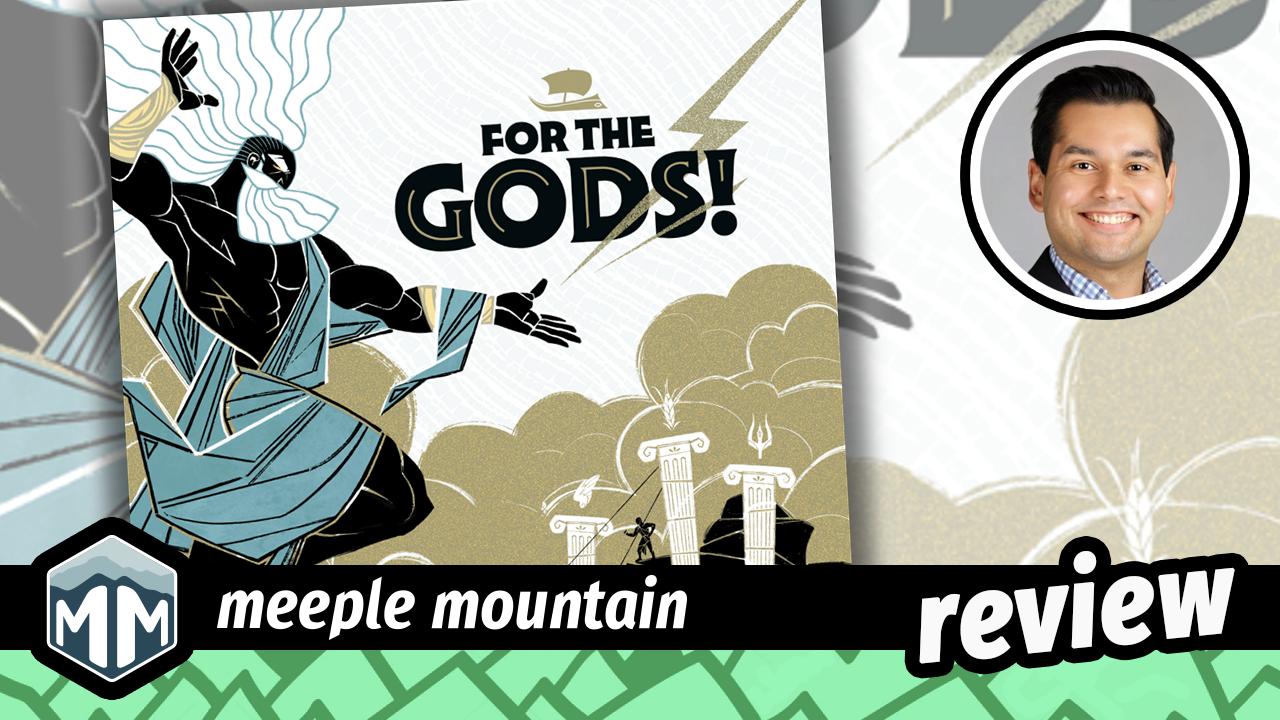
They talk about iconic dynamic duos: Batman and Robin, peanut butter and jelly, Mary-Kate and Ashley Olsen, and now Trevor Benjamin and David Thompson. But hold the phone! They’re back with a third, Brett J. Gilbert, evolving their design-duo superpowers into a full-fledged trio.
Many will recognize Benjamin and Thompson from modern classics such as the Undaunted series, War Chest, and Resist!. Factor in the euro-y talents of Gilbert, whose credits include Mandala and The Guild of Merchant Explorers, and For the Gods! couldn’t hit the table fast enough.
I’ll admit, as much as I love the idea of wargames and “dudes on a map,” I’m often quite bad at them and, as a result, tend to admire them from afar.
For the Gods! is a dudes-on-a-map game, yes, but scratch beneath the surface and there’s a clever bag-building and hand-management game driving the entire experience.
After Mighty Boards blew past its crowdfunding goal by more than tenfold, I was curious to see whether all those ingredients would come together into something worthy of Olympus.
Zeus himself would approve.
For the Gods! is an area-majority game where players sail around ancient Greece, building towering temples dedicated to the gods. Each player begins with the…

 Anmelden






/pic9678597.png)