❌

Normale Ansicht

The Grizzled : Armistice Edition (2-player review)

20. November 2026 um 22:21

By Kaysee and Max

The Grizzled Armisitice Edition
“Without having any idea of the hell in which they’ll be plunged, they promise each other that they’ll arrive and come back together no matter what happens.” – The Grizzled: Armistice edition Rulebook

Disclosure: finished the campaign

Last week, on November 11, we saw plenty of ads and spam-emails about Singles’ Day and even Black Friday. WDR, our main source of news in NRW, Germany, had articles about the start of the Carneval season in this region. But we didn’t see any mention of Armistice Day, the day the Great War or World War 1 ended. Unsurprisingly, it is considered a holiday in France, in stark contrast with Germany. And so it is also no surprise that there is a cooperative card game from France about a group of friends who became soldiers in the French army during the Great War. This is The Grizzled, a game that immerses players in the dangers and trials faced by those soldiers.

We specifically played the Armistice Edition of the game, which takes the basic gameplay of The Grizzled and turns it into a campaign that spans WW1 from start to finish. While there is no mechanical representation of death in the game, we were strongly affected by the theme. We really cared for our group of poilus and wanted to do our best to guide them safely through the onslaught of danger. The attachment we formed was very much influenced by the gorgeous hand painted miniatures included in this edition of the game, which are great three dimensional interpretations of the original artwork by Tignous (please look him up and be prepared to be even more emotionally affected).

The troops
It’s interesting how young they look just a couple of months before the war.

The campaign begins with a trip to boot camp, a.k.a. the tutorial, followed by nine chapters that are mostly named after famous battles that the French army fought, such as Verdun. Each chapter begins with some bits of relevant historical information about the situation in France and Belgium. Then there’s a briefing that tells players how to set up the chapter. The briefings also introduce new mechanics over the course of the campaign, reflecting the changing circumstances at different points in the war. Then, players embark on a series of missions to try and win the chapter. Win or lose, after the chapter is finished, players move on to the next chapter. If they’ve managed to win, there are some rewards that help in later chapters and contribute to the overall score of the campaign. A loss means the ability to ban one Trials card for the rest of the campaign at the cost of some score.

The main mechanic of The Grizzled is very simple. Players need to empty the Trials Deck by playing cards before a second deck, the Morale Reserve, runs out. What happens when you play a card depends on which of the two types of Trials cards it is. Threats are played to the central area called No Man’s Land. They show between one and six (most commonly two) different types of threats faced by soldiers in the war. If there are ever three cards representing the same threat in play, the mission is over. This means that at some point the Grizzled need to withdraw.

Trial Cards
Trial cards

Another condition for our Grizzled to make it through is to not accumulate four Hard Knocks cards. These cards represent the mental and physical state of the troops in the trenches such as being panicked or wounded. They are played to each character’s personal area, but they can still affect other players. In the beginning of the campaign they simply add another threat symbol, but later they have increasingly difficult effects and can restrict players in different ways. However, as soon as a character withdraws, the Hard Knocks in their area stop affecting the other players. This can make the timing of who withdraws when quite tricky. We find this aspect very thematic as withdrawing them keeps them and the others safer.

Hard Knocks
Hard Knocks

Over the course of the campaign other mechanics are added. The most important of these is the Order of the Day mechanic. At the beginning of the round, the mission leader has to choose between two possible Order of the Day cards. These affect the rest of the mission or potentially even future missions. Some few of them have beneficial effects, but most make the soldiers lives more miserable. Dealing with some of the more dangerous ones certainly added to the challenge and stress level. They also determine the minimum number of cards that players receive for the mission. This can be problematic, because having a combined total of 13 cards in hand at the end of a mission means losing the chapter.

We really like the way the game introduces the mechanics over time. It gives a real sense of progression to the war as conditions on the battlefield shift. For instance, at some point the Grizzled are reinforced by fresh recruits that they then have to train. In a later chapter, players have to avoid being considered mutineers. Another chapter sees them rescue a downed British pilot. One of our favorite moments came early in the campaign, when the poilus (and we) got a short reprieve from the fighting during the Christmas truce. Near the end of the campaign morale is at first boosted by news of the Russian revolution, only to be crushed by the arrival of German troops from the eastern front.

Peace
Peace

Our final thoughts

Playing The Grizzled: Armistice edition on Armistice day was a good decision for us. We learned some information about the Great War that we never knew before playing the game. And while the core mechanic was simple, the art and the theme made it feel like we are somehow in the trenches with the Grizzled and it became even more intense as the campaign progressed.

One issue that we have with the two-player mode of the game is that while each player controls two Grizzled, many of the rules and cards only refer to players, which doesn’t make sense in some situations. Take for example one Helping Hand card, which allows the player who has it to always assign a Support tile to a specific player. But then it is the Grizzled who receive Support tiles and not players. The unclear wording of these rules lead to many ambiguous situations, which could seriously impact the balance of the game. We generally interpreted them to favor our Grizzled but this might have made the game easier than it would’ve otherwise been.

It was interesting how much losing affected us. The Grizzled is a punishing game, and it makes sense thematically. But we both felt really bad (even a bit painful sometimes for either of us) whenever we lost. It’s different for us from other games with grim themes such as Frostpunk: The Board Game, where losing didn’t leave us with a heavy feeling. It’s probably because Frostpunk is fictional while some of the characters in The Grizzled are based on real life and the Great War was a real life event.

But this also made us realize that while we felt bad whenever we lose in the game, it is nothing compared to what real life soldiers have experienced and are experiencing in wars.

What we both like:

  • historical theme
  • realistic depiction of war
  • the progression of the campaign
  • the poilus
  • integration of the mechanics with the theme
  • the beautiful components
  • art style

What we both don’t like:

  • lack of precision in the rules for two-player mode

What Max doesn’t like:

  • losing because of Hard Knocks

Kaysee’s rating: 4.0/5
Max’s rating: 3.5/5

Combined rating: 4.0/5
4

Title: The Grizzled: Armistice edition
Edition: English edition
Game Design: Fabien Riffaud, Juan Rodriguez
Illustration: Tignous
Publisher: CMON Global Limited

Photos by Kaysee

The post The Grizzled : Armistice Edition (2-player review) appeared first on Schmeeples.
Chicago ’68 wins 2026 Summit Award, Dan Thurot’s Space-Biff! takes Bobby Nunes Memorial prize

11. November 2026 um 16:28

A board game exploring the violent protests surrounding the 1968 Democratic National Convention in Chicago has won this year’s Summit Award, which celebrates historical designs that have helped broaden the hobby – while veteran board game critic Dan Thurot has been recognised for his writing and podcast work with the Bobby Nunes Memorial Award.

Yoni Goldstein’s Chicago ’68 triumphed in the fifth edition of the Summit Award after judges praised its approachability, unusual historical subject and portrayal of the conflict between anti-war demonstrators and the city’s political establishment and police.

Thurot, meanwhile, was honoured for his work on long-running board game criticism site Space-Biff! through the third annual Bobby Nunes Memorial Award, created to recognise historical gaming’s most exceptional culture writers, podcasters and video essay makers.

The judges lauded Thurot “for bringing consistently interesting and thought-provoking discussion on both individual games and wider issues in gaming” – and specifically highlighted a widely praised essay on Jo Kelly and Cole Wehrle’s Molly House, a game which explores the lives of queer communities in early 18th-century London.

Both awards were announced at the SDHistCon Summit convention in San Diego, organised by the San Diego Historical Games Convention (SDHist) – which aims to expand the historical gaming hobby by encouraging new voices, subjects and perspectives.

Chicago ’68 was the most-selected game during the Summit Award’s public nomination process earlier this year, before being chosen as the winner by members of SDHist’s board and advisory board.

Chicago ’68 || Photo Credit: Yoni Goldstein

The game divides players between the establishment and demonstrators during the tumultuous 1968 Democratic National Convention, when anti-Vietnam War protests in Chicago were met with a violent police response.

Each side is split into two factions with different powers and objectives, with the mayor’s office and Chicago Police Department facing off against the Yippies and the National Mobilization Committee to End the War in Vietnam.

The asymmetric design uses area control and card activation, with players able to deploy political manoeuvres, street theatre and direct confrontation as they compete to influence the outcome of the protests.

Judges described Chicago ’68 as “a compelling design about a politically relevant subject” and “a thoughtful portrayal of an undercovered conflict”, while also praising its ease of teaching and play.

The award continues a run of victories for historical games tackling subjects and perspectives beyond individual battles or solely military strategy, following Fred Serval’s Red Flag Over Paris in 2022, Tory Brown’s Votes for Women in 2023, Alex Knight’s Land and Freedom in 2024 and Dave Neale and David Thompson’s War Story: Occupied France last year.

Chicago ’68 saw off competition from three other finalists: Paolo Mori and Alessandro Zucchini’s Battlefields of the Napoleonic Wars, Jo Kelly and Cole Wehrle’s Molly House, and Francisco “Pako” Gradaille’s Onoda.

Honourable mentions went to Petr Mojžíš’ The Bell of Treason: 1938 Munich Crisis in Czechoslovakia and Will Thompson’s Winter Rabbit, which draws on Cherokee traditions and values.

Bobby Nunes plays Combat Commander in 2021 || Photo Credit: Harold Buchanan

Dan Thurot’s Bobby Nunes award victory recognised the range of his work across written reviews, essays, interviews and the Space-Biff! Space Cast podcast.

His work from across 2025 which earned praise from judges included his April 2025 review of Purple Haze, his September 2025 “Anti-Fun” written essay, his September 2025 review of Magical Athlete and his October 2025 interview with Amabel Holland about her design City of the Six Moons.

Thurot launched Space-Biff! as a personal blog in 2011, before shifting its focus to board games over the next couple of years. He has since written more than 1,000 reviews alongside essays exploring game design, history, and the philosophy, art and culture of the hobby.

The Bobby Nunes award was launched in 2024 in memory of Robert “Bobby Factor” Nunes, a historical gaming writer and editor who died that March, and aims to celebrate exceptional media coverage which reflects his interest in discussing important cultural issues within historical gaming. Thurot was previously shortlisted for the award in its inaugural year.

Last year’s Bobby Nunes prize went to Amabel Holland, whose video essay on Kurt Vonnegut’s long-lost board game GHQ explored the game’s history, cultural relevance and the wider importance of preserving and contextualising historical designs. The inaugural award went to Liz Davidson’s Beyond Solitaire interviews podcast in 2024.

This year’s other finalists were designer Trevor Bender for a video essay exploring counterfactual history, the We Intend To Move On Your Works podcast, which critically examines American Civil War games and their treatment of Lost Cause narratives, and Non-Breaking Space’s Endnotes podcast episode exploring the history and development of Cross-Bronx Expressway.

The latter received the most public nominations for this year’s Bobby Nunes award, while judges also gave an honourable mention to GMT Games’ monthly newsletter for its detailed coverage of game development and the people involved in bringing historical designs to publication.

BoardGameWire noted in 2024 and reiterated last year that the award was a welcome addition to a board game industry which, understandably, largely sees its awards focused on celebrating outstanding game designs, designers and successful publishers.

The work of writers and audiovisual creators – many of whom are producing perceptive, considered investigations of the culture in and around game design – still remains very poorly recognised, with the Diana Jones Award the only real major prize to acknowledge excellence outside of design work or general game popularity.

Both SDHist awards are set to return in 2027, with public nominations expected to open in the spring or summer. More information can be found on the Summit Award page on the SDHistCon website.

The post Chicago ’68 wins 2026 Summit Award, Dan Thurot’s Space-Biff! takes Bobby Nunes Memorial prize first appeared on .

From 1968 Chicago protests to queer life in Georgian London: Summit Award continues to celebrate designs that broaden historical gaming

08. September 2026 um 15:17

Games tackling subjects ranging from the 1968 Democratic National Convention protests to the 30-year holdout of Japanese WW2 soldier Hiroo Onoda have been named as finalists in this year’s Summit Award, which aims to recognise historical game designs which have attracted new players or introduced new subjects or perspectives to the hobby.

Battlefields of the Napoleonic Wars, Chicago ‘68, Molly House and Onoda will compete for the fifth edition of the award, which is run by the San Diego Historical Games Convention – an organisation which aims to create a diverse and supportive gaming community dedicated to playing, discussing, designing, and promoting historically-based board games.

Molly House’s nomination continues an extensive awards run for the Jo Kelly and Cole Wehrle design, which won the Complex Games category at this year’s American Tabletop Awards and was also shortlisted for the Diana Jones Award for Excellence in Gaming and best heavy strategy game at this year’s Origins Awards.

The game puts players in the roles of the gender-defying mollies of early 18th century London, attempting to build community and joy while facing persecution by the Society for the Reformation of Manners.

Chicago ‘68, designed by Yoni Goldstein and published by the Dietz Foundation, was the most-selected title during the Summit Award’s public nomination process this summer.

Chicago ’68, designed by Yoni Goldstein || Photo Credit: Yoni Goldstein

The game explores the protests and police response surrounding the 1968 Democratic National Convention, dividing players between Establishment and Demonstrator factions including the mayor’s office, Chicago Police Department, Yippies and National Mobilization Committee To End The War In Vietnam.

Battlefields of the Napoleonic Wars, designed by Paolo Mori and Alessandro Zucchini and published by Ingenioso Hidalgo, uses four different battlefield maps to recreate engagements from the Napoleonic Wars in sessions lasting between 60 and 120 minutes.

The fourth finalist is Francisco “Pako” Gradaille’s Onoda, a 25-minute solo game published by Salt & Pepper Games which explores the experiences of Japanese soldier Hiroo Onoda, who continued guerrilla warfare on the Philippine island of Lubang until 1974. Judges praised the unusual subject and the way the game asks players to engage with Onoda’s story and decisions.

SDHist also named two honourable mentions in this year’s awards: GMT Games’ The Bell of Treason: 1938 Munich Crisis in Czechoslovakia, designed by Petr Mojžíš, and Absurdist Productions’ Winter Rabbit, designed by William Thompson.

Onoda, designed by Francisco Gradaille || Photo Credit: Salt & Pepper Games

Winter Rabbit, which draws on traditional Cherokee animal stories and was created as a counterpoint to common colonial themes in games, was runner-up in the 2021 Zenobia Award and won the Light Strategy category at this year’s Origins Awards.

The Summit Award considers games across five criteria – ease of teaching, ease of play, uniqueness of topic, novelty of approach and effectiveness as a historical game.

Its previous winners were Fred Serval’s Red Flag Over Paris in 2022, Tory Brown’s Votes for Women in 2023, Alex Knight’s Land and Freedom in 2024 and Dave Neale and David Thompson’s War Story: Occupied France last year.

SDHist, which was launched mainly as a local wargaming group in 2015, is led by wargaming experts including Liberty or Death: The American Insurrection designer Harold Buchanan.

The organisation’s board and board of advisors selected three of this year’s finalists following the public nomination process, which put Chicago ‘68 on the shortlist.

The same groups will select the winner, which is set to be announced at the SDHist Summit convention in San Diego in November.

The post From 1968 Chicago protests to queer life in Georgian London: Summit Award continues to celebrate designs that broaden historical gaming first appeared on .

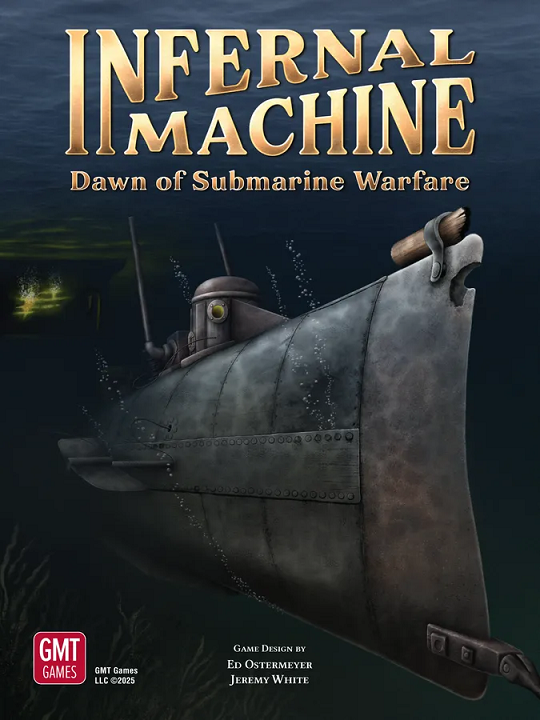
Holey Diver – An Infernal Machine: Dawn of Submarine Warfare Review

30. Juni 2026 um 22:48
War is morally questionable, at best a compromise between inaction and horrific aggression. The societal and human costs are often extreme. There are benefits, however. Achieving independence. Ending tyranny. Freeing an enslaved population. Often, violence is the only remaining option. Rapid technological advancement is another benefit. One typically overlooked due to its insignificance in contrast…

Read more →

❌