Lese-Ansicht

Hat-wearing animal game Petiquette wins latest Golden Box Awards, voted on by members of Japan’s board game industry
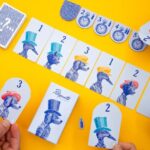
Petiquette, Thomas Sellner’s card game of picking out patterns among hat-wearing animals, has been named game of the year at this year’s Golden Box Awards.

The Oink Games-published design fought off competition from 2025 winner Isao Mukai, who was nominated for Banana Governance – a card-based drafting and bidding game which sees players attempt to satisfy the needs of hungry monkeys better than their opponents.

A comment from the selection committee about Petiquette called the title “a brilliant and sharp work typical of Oink”.
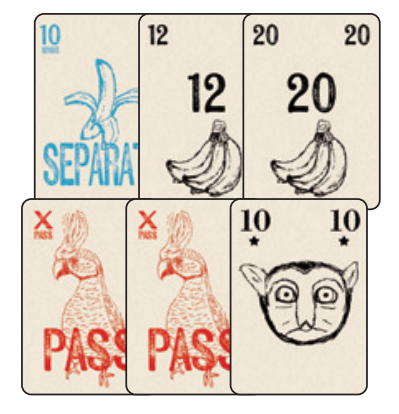
Cards from Banana Governance, designed and published by Isao Mukai

It said, “I’ll never forget the shock I felt the first time I played it. The rules are simple: just give the answer that fits in the single ‘?’ on the cards laid out.

“But… the eyes of those who give the same answer feel friendly. The mouths of those who give a different answer seem to twist. The loneliness of desperately trying to explain when you’re the only one who gives a different answer.

“A mix of various emotions. The unique experience of this game really stands out.”

The annual Golden Box contest was launched four years ago, modelled on the American film industry’s Academy Awards. More than 40 industry professionals from within the Japanese board game sphere voted on this year’s award.

In addition to ‘Best Picture’ for the overall game of the year, the awards also celebrate the best in game design, art, graphic design, production and rulebook work through individual awards.
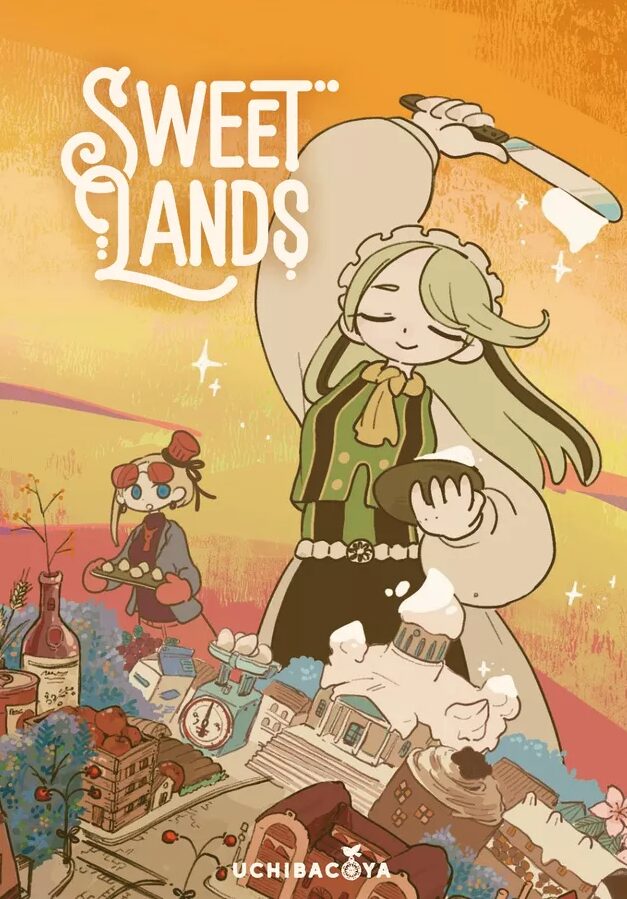
Cover art for Sweet Lands

Eve Inc-designed Nusutto Cat – also known as Meow Heist – triumphed in this year’s Game Design Award, while best art went to Totsuca Chuo’s Sweet Lands, which was illustrated by Tatsuki Asano and Broni120.

Moyuki Adisawa’s animal jet ski racing game Tornado Splash picked up the Graphic Design Award thanks to the work of iD Creative Co, while the Production Award went to National Economy and Toshinori Iwai.

The selection committee said of the Production Award win: “It’s great when a great game is revived. It’s even better when a great game is revived in the best possible form.

“This new edition not only makes the seemingly impossible revival of this masterpiece a reality, but also reinterprets it in a more refined way.

“The ‘box within a box’ structure, combining the three parts, is exciting even before you start playing, and the ‘household budget’ mechanism that characterizes this game is implemented clearly and beautifully as a ‘safe’.

“This masterpiece hasn’t lost its appeal even after ten years, and this new edition will be loved for even longer.”

The Rulebook Award, meanwhile, was bestowed upon ForGames-published Down Down Dungeon – a reimplementation of Reiner Knizia’s Cucina Curiosa/Mysterious Dungeons.

Yoshihiko Koriyama worked on the rulebook for that title, with proofreading from Shota Okano and DTP work from Makoto Takami. The selection committee said, “The fact that you can essentially understand the game rules by reading just one page is excellent.” 
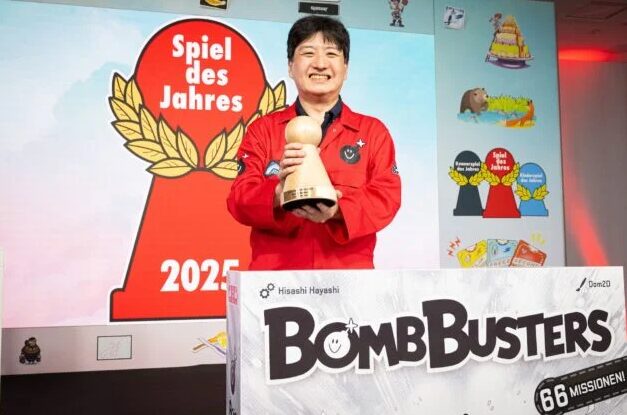
Bomb Busters designer Hishashi Hayashi collecting his Spiel des Jahres award

A special award was also presented this year to Hisashi Hayashi, after his co-operative bomb disposal game Bomb Busters won last year’s Spiel des Jahres – beating the much-fancied push-your-luck card game Flip 7 to the high-profile award.

The win marked the first Spiel des Jahres triumph for an Asian designer in the prize’s 46-year history, and underscored the huge rise in tabletop designs making their way across from Asia to Europe and North America in the past decade.

Each winner will receive a golden board game box as a trophy.

Last year’s Golden Box Award game of the year prize was won by Isao Mukai and Napopora’s design Umataka, a worker placement game centred around hunter-gatherers making traditional pottery in ancient Japan.

The 2025 Golden Box Board Game Awards in full:

Best Picture

Winner: Petiquette, designed by Thomas Sellner (Published by Oink Games)
Banana Governance, Mukai (Mukai)
The Match Girl Millionaire (Hey!)

Outstanding Game Design

Winner: Nusutto Cat, Eve Inc (Ibuink)
Storm in a Teacup, Kyashi/Ikumo Tasaka (Gomi Kokusai/Waste International)
Switch To: mor! (Yontousei)

Art Award

Winner: Sweet Lands, Totsuca Chuo (Uchibacoya) – art by Tatsuki Asano and Broni120
A Boar, Crab, Dung Beatle, Takuya Iwamura (Kyuhachi Dog) – art by Takuya Iwamura
Ghost Lift, Onegear (Engames) – art by Sai Beppu

Graphic Design Award

Winner: Tornado Splash, Moyuki Adisawa (ArcLight Games) – graphic design by iD Creative
Vidro, Keita Kasagi (Bamboo Games) – graphic design by Kakuzato
Shady Lady, Kaya Miyano (Mob+) – graphic design by Sai Beppu

Best Production

Winner: National Economy, Hiroshi Nishimura (Korokorodou)
Down Down Dungeon, Reiner Knizia (ForGames)
Pose Mania!, Suitashi (Avignon Games)

Best Rulebook

Winner: Down Down Dungeon, Reiner Knizia (ForGames)
Electra Select (The Society for Appreciating Swaying Buds)
Snowp, Eisuke Fujinawa, Kazunori Hori (SzpiLAB)

The post Hat-wearing animal game Petiquette wins latest Golden Box Awards, voted on by members of Japan’s board game industry first appeared on .
  •  

The Only Game You Play

I attended a fundraising trivia night over the weekend where every table had a theme chosen by the attendees. Our table was Wingspan & bird themed: Most of us wore bird shirts, there were dessert nests with candy eggs, we had two huge owl statues, and I brought a random Wingspan Americas bird card for each of the 10 of us.

The fundraiser was entirely unrelated to tabletop games–it was for the St. Louis roller derby team–but several people stopped by to say how much they loved Wingspan. One comment stood out: “I love Wingspan. It’s the only game I play.”

You might glance at your vast collection of games as you read this and wonder why this person hasn’t tried other great games, but think back to when you got into modern gaming. For me, Catan was the only game I played for a few years, followed by Agricola. The mentality was, “Why would we play something else when we already know–and enjoy–this game?”

Eventually I started exploring other games (Fresco, Dominion, Stone Age, etc), but I would bet that a not-insignificant number of people are “lifestyle gamers”–they pick a game, and that’s the only game they play. They might go deep into a modern game like Wingspan, a classic game like chess, or a trading/living card game like Magic.

I love when someone finds a game that they want to play over and over again. As a publisher, I want to support the things that bring people joy. Here are a few ways I try to support those who choose to play a specific Stonemaier game over and over:

  • community support: If I go deep into a game, I like to talk about the game on online forums (especially BoardGameGeek and Facebook). I try to help people feel welcome when they venture into the comments for our games, as it can be intimidating to show up in a group of 20,000 people and not know how your first question/comment will be received. Part of community support also includes supporting and encouraging fan creations (e.g., Wingspan’s bird promo packs or expansions like Scythe: The Wind Gambit).
  • content creators: Here’s a little secret about why we send so many games to reviewers (all games in our catalog, not just the new hotness): It’s just as much to get people excited about the games they already play/own as it is about informing people who don’t already have the game.
  • digital versions: The tabletop experience is awesome, but it isn’t always an option. We work with developers to bring our games to life digitally so the person who plays Wingspan once a month in person but wants to play every day in between online can do that.
  • accessories/expansions/promos/merch: For the two games I played over and over for several years (Catan and Agricola), we literally had one copy of the game among us. At a certain point, those of us who didn’t own the game felt the desire to contribute. We bought expansions, upgraded tokens, and promos; we might even have bought Agricola t-shirts if we had thought of it.
  • spinoffs/sequels: There are certainly many people who just want more Wingspan or more Scythe. But there are some who want different-Wingspan or different-Scythe; hence Wyrmspan, Finspan, and Expeditions.
  • gift giving: My first few games after Catan and Agricola were all gifts. I’m sure I would have eventually started buying other games myself, but I’m so grateful that people gave me that nudge by giving me Dominion, Stone Age, and Fresco. We have a gift guide at Stonemaier Games, but as I write this, I think it might be helpful to bridge the gap between popular non-Stonemaier games and our games. For example, if someone you know loves Carcassonne, they might also enjoy Between Two Castles. That sort of thing.

Did you–or do you still–have a game that you play over and over? In what ways has the publisher supported your passion for that game?

***

Also read or watch:

If you gain value from the 100 articles Jamey publishes on this blog each year, please consider championing this content! You can also listen to posts like this in the audio version of the blog.

  •  

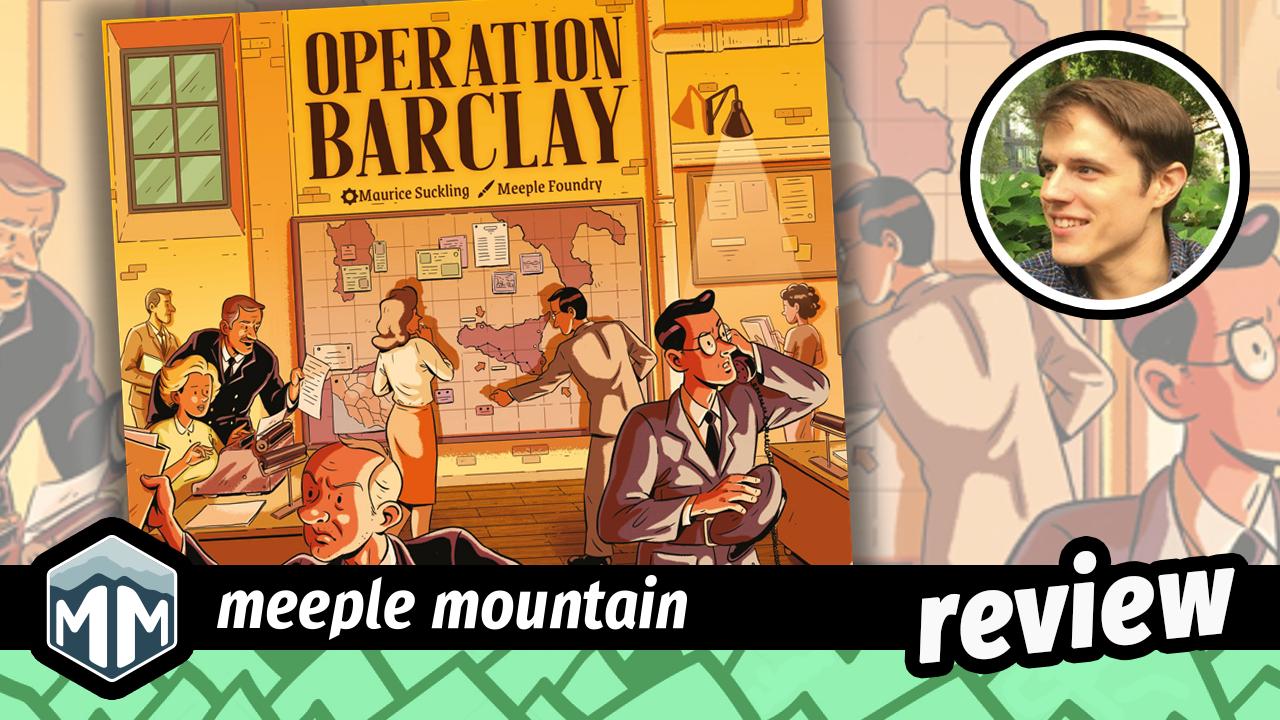
Operation Barclay Game Review

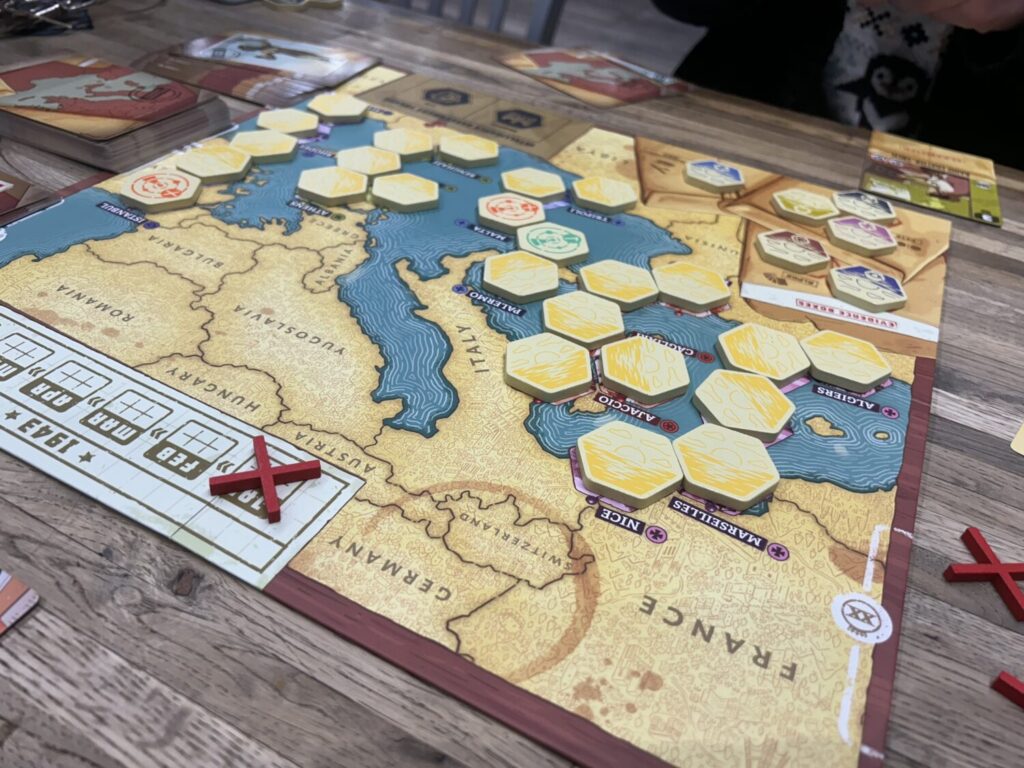
Operation Barclay is one of the most inspired marriages of setting and mechanic that I’ve ever had the pleasure of experiencing. How did designer Maurice Suckling get the idea to pair the story of Operation Barclay, the Allied plan to feed the Axis false information about an upcoming Mediterranean invasion, with poker and a shell game? It’s such a remarkable idea, such a perfect idea. Most game designers would sacrifice body parts in exchange for an idea this good.

While the real Operation Barclay was about convincing the Axis that the Allies would invade Greece when they were in fact planning to invade Sicily, Operation Barclay the game gives us a bit more ambiguity than that. There are five possible areas of attack, stretching from Morocco-to-France and Egypt-to-Turkey. The Allied player places wooden Intelligence tokens into each of them. One lane, whichever the Allied player decides to make the Primary Offensive Sector, gets four positive Intelligence tokens and one negative. The Secondary Offensive Sector gets three of the first and two of the second, and the other three Sectors, red herrings all, get two and three.

[caption id="attachment_329516" align="alignnone" width="1024"]A board imprinted with a map of the Mediterranean, with many wooden hexes going across the Mediterranean sea from Africa to Europe. Most of the tiles…</p>
<p>The post <a href=Operation Barclay Game Review appeared first on Meeple Mountain.
  •  

Arkwright: Anniversary Edition Game Review

About five years ago, I had the chance to play a friend’s copy of the game Arkwright (originally published in 2015 by Spielworxx.) My buddy Jason was a huge fan and wanted to show off his copy to our strategy gaming group, so we got a three-player game rolling at my place. About four hours later, we came up for air to talk through our thoughts: mostly positive, a bit too long, a lifestyle game that really needed to be played often to be truly fulfilling.

My favorite game of all time—then, and now—is City of the Big Shoulders, now known as Chicago 1875: City of the Big Shoulders. “City BS”, as it is known in my circles, is a special game for a lot of reasons. Its focus is on the city of Chicago, in a period where a somewhat shocking number of famous companies were born there: Oscar Mayer, Quaker Oats, Kraft, Florsheim Shoes, Schwinn, Swift & Co., and many more. It’s the only game I’ve ever played that successfully combined the stock manipulation mechanics of popular gaming systems (such as incremental capitalization of 18xx games) with a straightforward worker placement mechanic that drives the middle phases of each round. It’s also a knife fight, a game that has epic swings and great competition, in…

The post Arkwright: Anniversary Edition Game Review appeared first on Meeple Mountain.

  •  

Crowdfunding Campaigns of the Week – 3/30/26

Crowdfunding Campaigns of the WeekWelcome to this week’s batch of crowdfunding campaigns. We have a variety of offerings here, so we hope you will find something that catches your eye. Also, if you want to chat with the BGQ team, join our Discord Server where we talk about games, movies, sports, and other fun stuff. Or, if Facebook is […]
Source

  •  

French publisher Don’t Panic Games to bring more titles to North America, launches US office

French board game publisher Don’t Panic Games has continued its expansion into the North American market, telling BoardGameWire the success of several recent titles had reinforced its confidence in the strategy.

The company has made a name for itself providing French localisations of games including Final Girl, Champions of Midgard and Fantasy Realms since it was co-founded by current director Cédric Littardi in 2013.

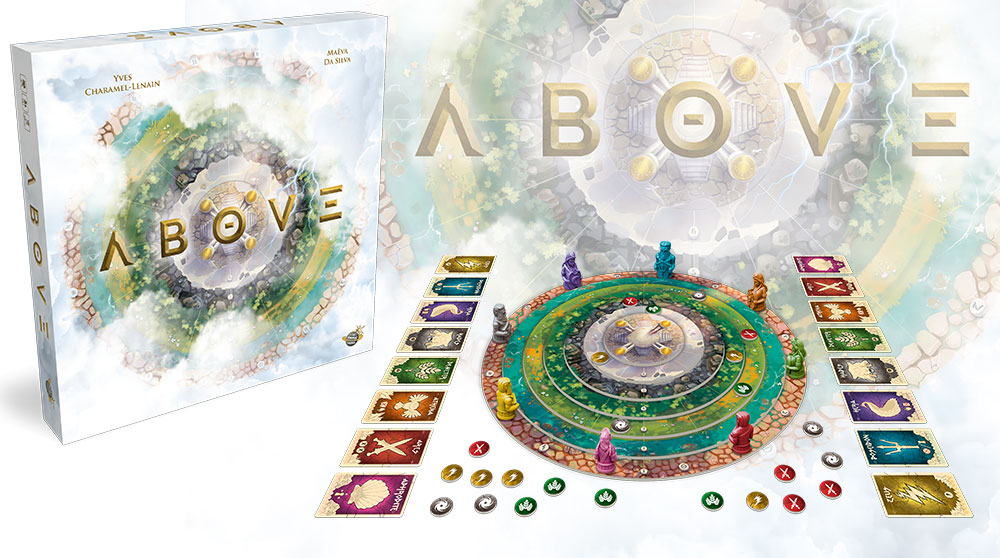
But Don’t Panic has also found success publishing its own titles such as Chess-like abstract game Above – and said the performance of that, and several other recent games, had persuaded it to bring more of its titles to North America.

Emma Recher, who will head up a three-person team at Don’t Panic’s new US office in California, told BoardGameWire, “Several recent titles have reinforced our confidence in expanding more directly into the US market.

“Games such as Don’t Wake Up Cthulhu!, Red Panda, Luminis, Maiko, and Above have been especially encouraging for us, and the early response to Spyworld has also been very promising.

“That is one of the reasons we are beginning this US expansion with titles such as Spyworld, Luminis, Above, and Maiko, which are also the titles highlighted in our North American launch announcement.

“We also have additional releases planned each quarter this year, including Don’t Drop the Soap! toward the end of the year.”

Above, designed by Yves Charamel-Lenain, from Don’t Panic Games

Recher also works with Japanime Games, which has distributed licensed Don’t Panic titles such as Attack on Titan: The Last Stand and Cowboy Bebop: Space Serenade into North America.

Don’t Panic said those licensed titles would continue to be distributed by Japanime, while the French company’s historical and war line, including Fighters of the Pacific and Fighters of Europe, will continue to be distributed by Ares Games in the US.

Recher said, “What the new US office changes is that Don’t Panic can now directly support additional English-language titles that were not previously represented in the market in the same way.

“For retailers, that means broader access to the catalog, closer communication, more direct follow-up, and stronger on-the-ground marketing support.”

Don’t Panic added that it would be supported in the US by Double Exposure, which will represent the company at both major and smaller conventions – adding that it had a “robust demo schedule” planned over the next few months.

When asked about Don’t Panic’s decision to expand further in the US despite ongoing uncertainty over the country’s tariffs policy – and its effect on board game publishers working in the country – Recher said, “Like many publishers in tabletop gaming, we are watching the tariff situation very carefully. It creates uncertainty across the supply chain, from manufacturing and freight planning to wholesale pricing and retailer margins.

“Our approach is to stay flexible: planning conservatively, reviewing sourcing and logistics options on an ongoing basis, and working closely with our partners to protect continuity of supply as much as possible.

“The current environment is challenging for everyone in the industry, but we believe the best response is to remain pragmatic, adaptable, and transparent with our partners.”

Last summer Don’t Panic bought the IP for Anastyr and Hel: The Last Saga from board game crowdfunding major CMON, which has been selling off its portfolio of games as part of a fightback against heavy losses.

That deal came just 18 months after CMON had itself acquired the pair of titles from financially-devastated board game crowdfunding specialist Mythic Games, which gave up on fulfilling the two Kickstarter campaigns worth a combined $3.2m.

Don’t Panic has offered backers of Mythic’s Anastyr crowdfund “preferential pricing” on pre-orders of its own version of the game, Anastyr Chronicles, and said in a comment shared on Mythic’s Hel: The Last Sage Kickstarter page that it would make a similar offer when it releases its version of that title.

The post French publisher Don’t Panic Games to bring more titles to North America, launches US office first appeared on .

  •  

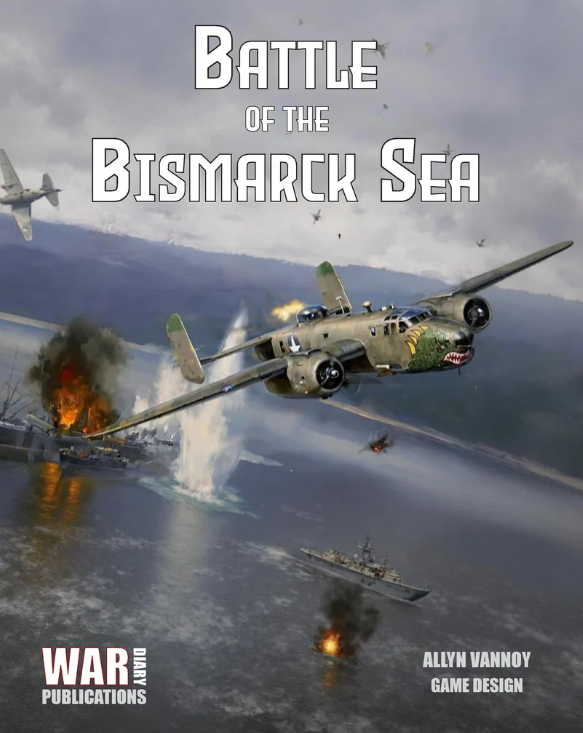
Interview with Allyn Vannoy Designer of Battle of the Bismarck Sea from War Diary Publications

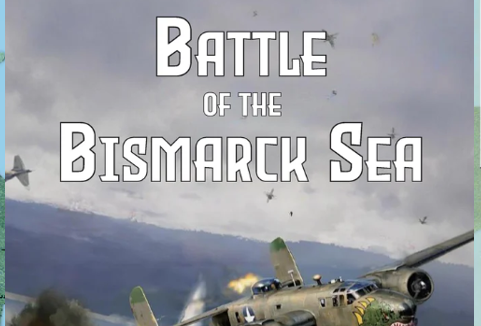
Last month, as I was trolling the internet, I came across a new solitaire game from the guys over at War Diary Publications called Battle of the Bismarck Sea designed by Allyn Vannoy. Battle of the Bismarck Sea is a solitaire wargame that uses individual ships and flights/squadrons of aircraft. The Player assumes the role of General George Kenney, Commander of the 5th U.S. Army Air Force, with the mission of intercepting the Japanese effort to reinforce its ground forces on the island of New Guinea. I am always into a good Pacific Theater of Operations game and I reached out to Allyn to get some inside information about the design.

Grant: Allyn welcome to our blog. First off please tell us a little about yourself. What are your hobbies? What’s your day job?

Allyn: I’m retired, having worked 18 years for Intel as a program manager. Presently, I work for a minor league baseball team in the summer, an affiliate of the Arizona Diamond Backs, and volunteer two days a week at the Evergreen Aviation and Space Museum in McMinnville, Oregon, both in the Archives and giving tours of Howard Hughes’ Spruce Goose; I also write (freelance) for a number of military history and gaming magazines.

Grant: What motivated you to break into game design? What have you enjoyed most about the experience thus far?

Allyn: During Covid, I started getting back into gaming, having become interested in Avalon Hill games in the 60’s and as an early subscriber to S&T Magazine. I enjoy the challenge of trying to turn history into a game—a teaching tool—in the process I learn more and hopefully, understand more.

Grant: What is your new game Battle of the Bismarck Sea about?

Allyn: The Battle of the Bismarck Sea, 1943, was the 5th Air Force’s attempt to interrupt the Japanese effort to reinforce its ground forces on the island of New Guinea. The Player must utilize the limited resources available and determine their application over the 10-week period that operations are conducted. The results of these efforts will be borne out in the effectiveness of air operations.

Grant: What games gave you used for inspiration for your design?

Allyn: I hadn’t seen anything like this design; I wanted to make something new and hopefully unique.

Grant: What is important to model or include in a game about the Air Naval combat in the Pacific during WWII?

Allyn: The most important thing to understand is how to organize and implement an air strike force to accomplish the mission given.

Grant: What type of research did you do to get the historical details correct? What one must read source would you recommend?

Allyn: I tried to locate good and detailed sources:

Arbon, J. and Christensen, Chris. The Bismarck Sea Ran Red; Walsworth Press, Marceline, MO, 1979.

Birdsall, Steve. Flying Buccaneers: The Illustrated Story of Kenney’s Fifth Air Force; Doubleday, NY, 1977.

Henebry, John P. The Grim Reapers at Work in the Pacific Theater: The Third Attack Group of the U.S. Fifth Air Force; Pictorial Histories Publishing Company, Missoula, MT, 2002.

Jablonski, Edward. Outraged Skies; Doubleday and Co., Inc., Garden City, NY. 1971.

McAulay, Lex. Battle of the Bismarck Sea; St. Martin’s Press, NY, 1991.

Recommendation: McAulay’s book, Battle of the Bismarck Sea.

Grant: What challenges did the subject cause for the design? How have you overcome them?

Allyn: The design initially focused just on the single action that occurred on March 2-4, 1943, but there was a larger struggle that began in January 1943—that Allied commanders realized they needed to adapt and change their forces and tactics if they were to meet the challenge they faced. Once the design was expanded to a 10-week time frame it became more complex, but also more interesting. This also required more research into the changes that took place within the 5th Air Force.

Grant: What is the scale of the game?

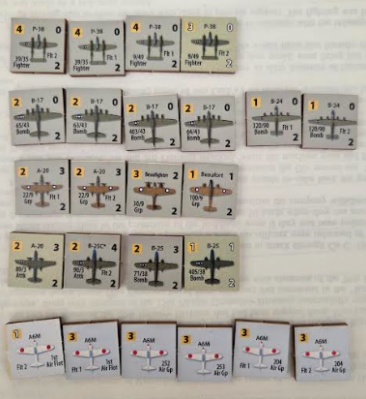
Allyn: Unit scale: single ships and flights (3-10 planes) of aircraft.

Time scale: 10 Command/Support turns, each of one week; 13 Operational turns, over a two day period.

Ground units represent 200-300 personnel.

Grant: What are the different units that the player has control over?

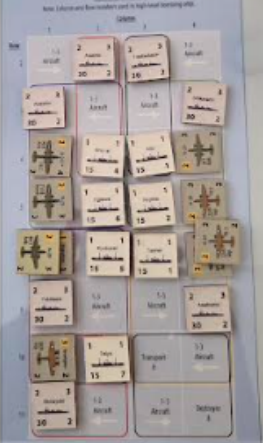
Allyn: The Japanese units include transport ships, destroyers, ground units (presenting the troops and equipment carried on the transports), and fighter aircraft. These are controlled by the Bot. The player controls the Allied units: a mix of aircraft—reconnaissance, heavy bombers, medium bombers, and fighters, and also PT boats.

Grant: What does the concept of Endurance mean for the player? What does this model from the 1943 campaign?

Allyn: Endurance is the amount of time that aircraft can remain airborne. This models the range of aircraft from their bases to the target area. In the initial design, a series of range arcs were used for the individual aircraft types. It was quickly realized this would make for a very complex game. To address playability, aircraft range was changed to consolidate to a single arc (a line on the map) for medium bombers and P-38 fighters, and set Operational turns to 3-hour periods.

Grant: What decisions do they have to make about their assets use and management over the campaign?

Allyn: The game is conducted in two parts: a Command/Support Sequence and an Operational Turn Sequence.

The Command/Support Sequence is a one week period that allows the Allies to receive resource points and reinforcements, then decide how to apply the resource points—rebuilding units, modifying tactics, and determining how to find a convoy at sea.

The Operational Turn Sequence is a two day period where the convoy is moving along convoy routes as the Allies attempt to identify it and then determine the organization of strike forces in an effort to sink it and prevent Japanese forces from reaching Lae, New Guinea.

Grant: As a solitaire wargame how does the Bot behave? What are its priorities and decision points?

Allyn: The Convoy, when dispatched from Rabaul, advances towards its destination (Lae), with random events impacting its progress. The rules introduce the Fog of War that the player must overcome in order to first find the Convoy and then disrupt and attempt to destroy it.

As for decision points, there are several. How are resource points to be spent? When and how to go after a convoy? What assets to use in a given sortie?

Grant: What type of an experience does the Bot create? 

Allyn: Designing a solitaire versus a 2-player game presents a whole different set of challenges. Can you design a Bot that will maintain the player’s interest and also challenge them? It should create variety; i.e., when and where will a convoy attempt to make a run; as well as a certain level of anxiety as certain elements are unknown until they can be revealed.

Grant: What are Resource Points and what do they represent?

Allyn: Resource points are the player’s currency and represent personnel, equipment (aircraft), and training.

Grant: What are Resource Points used for?

Allyn: The Resource Points are used by the player to improve tactics, provide replacements for losses, strengthen forces with personnel and equipment, and to launch air attacks. They are the real currency of the game and the player has to use them wisely to do well.

Grant: What is the layout of the board?

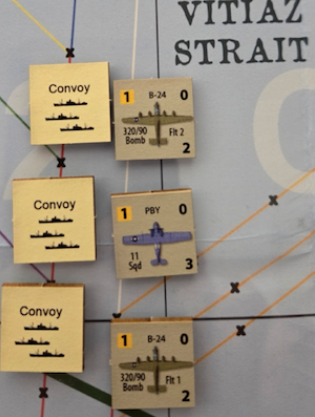
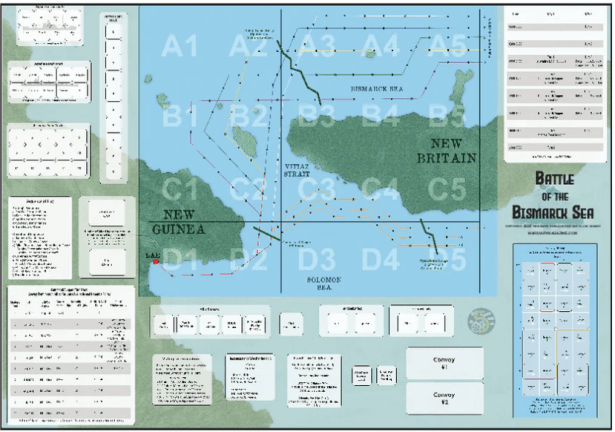
Allyn: The board includes the map (the area between New Britain and New Guinea); the turns tracks (for both Command/Support and Operational Turns); the Convoy Display (for air-sea combat); displays for the ships (transports and destroyers) and for tracking victory points and resource points. 

Grant: How does combat work?

Allyn: Combat is based on the attack strength of the units for air combat, air-to-surface, and surface combat. The result of a die roll is compared to a unit’s combat strength, and if it’s equal to less than that number (combat strength), a hit is made on the opposing force.

Grant: How are bombers and fighters used in combat?

Allyn: Bombers are used to try and sink the ships of the Convoy. Heavy bombers operate separately from medium bombers, as they drop their bomb loads from altitude, with limited chance of success, while medium bombers engage Japanese ships at low altitude (mast-high approach). Fighters are used to engage the Combat Air Patrol aircraft that the Japanese dispatched to provide air cover for the Convoy.

Grant: How is victory obtained in the game?

Allyn: Victory is based on the number of Japanese troops that fail to reach Lae—by sinking the ships and their cargo of personnel and equipment, they are removed from participation in combat operations on New Guinea.

Grant: What do you feel the game models well?

Allyn: The fog of war; the challenge to figure out how to build and prepare the needed forces, and then how to employ them to accomplish the mission (sink the enemy shipping).

Grant: What has been the experience of your playtesters?

Allyn: Comments led to a major change in design—moving from a single mission to a 10-week campaign and all the elements associated with that larger picture/time frame.

Grant: What are you most pleased about with the design?

Allyn: That it offers two layers to the player experience – organizing and building forces, then utilizing them to execute missions.

Grant: What other designs are you contemplating or already working on?

Allyn: Operation Tidal Wave, the USAAF Ninth Air Force strike on Ploesti, Romania, August 1, 1943.

If you are interested in Battle of the Bismarck Sea, you can order a copy for $30.00 from the War Diary Publications website at the following link: https://wardiarymagazine.com/products/battle-of-the-bismarck-sea

-Grant

  •  

Dream Dice Day

by Justin Bell


Some friends recently hosted an all-day gaming session; sadly, a work trip forced me to miss out. The theme for the session was loosely inspired by dice drafting games, but it then stretched to include dice chuckers, roll-and-writes, worker placement with dice workers, and games that I am going to include even though I can’t quite place the specific way they use dice. I just know that dice were factored into the equation.

On the flight home, I spent some time dreaming up a perfect day of games based on a variety of dice mechanics. (This is one of my favorite things to explore in BGG’s database: looking up games by family or mechanic.) For my Dream Dice Day, all the games had to prominently feature dice, ideally with the use of dice drafting and/or dice placement mechanics. As long as dice were involved, I made the case to include the game for Dream Dice Day. My dream, my rules!

I used the timeframe that my friends used for their dice game day, about eight hours, give or take. With that as our frame, let’s check out my perfect day!

Pre-Game Appetizers: Railroad Ink: Deep Blue Edition and En Route

I’m not a big roll-and-write guy. I don’t love playing games alone, but nothing is stranger to me than playing games with friends while also…well, playing the game alone. More often than not, I watch as someone rolls a pool of dice, then regret my decision to play a game where we are sitting together, trying to figure out who can optimize the results of the shared dice in front of us. Usually, the only time someone speaks is when the next dice chucker says something like “everybody good?” before chucking those dice again.

That changes with two games that now serve as my “It’s halftime of an NBA playoff game and need something to play solo” titles, Railroad Ink and En Route. Both offer a fun, compact, quick challenge for the brain as I try to optimize my scores. I have two versions of Railroad Ink—the Deep Blue Edition and the Archipelago boards—so I can mix and match expansions. En Route’s solo challenge system and wide variety of maps work wonders, and while the base game uses a flip-and-write system, the dice variant from my copy of En Route: Special Edition is my preferred move. And the dice featured in En Route have that nice, hefty chunk to them.

If someone shows up late, I can squeeze one or both of these titles in with ease. That person in your playgroup who texts with the inevitable “Justin, you won’t believe this, but I’ll be 20 minutes late” problem? No problem at all, since I’ll keep the appetizers warm with these games until everyone arrives.

Noon: The Red Cathedral

2020’s The Red Cathedral, designed by the duo known as "Llama Dice" (Shei S. and Isra C.) and published by Devir, features a main mechanic that I adore. One of a player’s three options on a turn is to select a die from a central rondel by moving the die in a clockwise direction the number of spaces equal to the pips showing on the die. Then, the active player receives the reward on the space where the die ended up, and the die is re-rolled, giving the next player a fresh set of die selections to choose from.

Moving the die to just the right spot is a crunchy choice I love. The color choice of the die will often trigger a wave of bonuses on the player’s personal board, depending on upgrades made earlier in the game. Finding ways to move a die onto a space with as many as two other dice might triple the bonuses a player can receive. And each quadrant of the rondel offers the active player a different bonus, so figuring out which die to move and to which quadrant is a juicy choice, but one that doesn’t bog down the game with deliberations.

1:30 PM: Tiletum

The same two imaginary players who join me for The Red Cathedral would then take part in a play of Tiletum, a 2022 release from the team at Board&Dice designed by Simone Luciani and Daniele Tascini. The dice drafting here is genius. The color of the die and the visible pips represent the number of resources a player receives. The pips on the die’s opposite face (i.e., NOT showing on the die) grant the player a number of actions equal to the D6 inversion of the resource choice.

Every turn, you are choosing how many resources and how many action points you have from a pool of seven, since the total of every D6’s opposite faces always equals seven. If I want to take a merchant action worth three action points, that means I’m getting four resources of the chosen die color.

Dice are limited, and randomly drawn from a cloth bag to start each of the game’s four rounds…with some colors potentially left out of that round. While one of the game’s resources (gold) allows a player to change a die’s pip value, you might not have enough gold to make changes. That might leave you in a sizable hole with very limited choices. Each round’s scoring goal gives players three turns to maximize their chances at points in a round, giving the dice drafting a very nice blend of tactical and strategic choices.

With three players who play as fast as I typically do, Tiletum plays in about 30 minutes per player. That gives us time to play and grab a quick snack between games.

3:30 PM: The White Castle

The Devir dice double dip wraps with The White Castle, another Llama Dice masterpiece featuring dice drafting on an epic scale but in a very tidy package. In fact, The White Castle might be my favorite dice drafting game of them all, and even at four players, the game wraps in about 75 minutes.

The die drafting choices here are a blast, but they are even more interesting when there are a wide range of die values to begin each of the game’s three rounds. Triggering the lantern bonuses by taking the lowest-value die is one thing, but it’s a whole other thing when the “lowest” value die is a five or a six, almost guaranteeing a player extra coins to go along with the lantern goodies.

I prefer The White Castle at two or four players, so let’s assume another imaginary friend came over to join the first three players for the middle of the day, giving us a four-player playthrough.

4:45: Grand Austria Hotel

I think most regulars who visit BGG know that Grand Austria Hotel is glorious. Most players in my network prefer Grand Austria Hotel with some of the extras from the Let’s Waltz! expansion, but for the purposes of Dream Dice Day, I’m going with the following modules from that expansion: Start Player (so that players go in a clockwise order every turn, not the “snake” order where the first player also goes eighth in a four-player game), Would You Like Some More? (simply, more cards), and Unique Hotels, so that each player has their own asymmetric player power.

That means the game can wrap in about 90 minutes. The module with the dancers, Vienna Ballrooms, is fantastic, but it usually means adding 30-60 minutes of playtime. On Dream Dice Day, I’m focused!!

6:30 PM: Kingsburg

I’m finishing the day with the Dream Dice Day Daddy of ‘Em All: Kingsburg, ideally the first edition board with the expansion To Forge a Realm, specifically Module 5. That’s the module which replaces the die roll during the eighth phase of each round with the reinforcement tokens. These tokens give players a chance to plan around the potential baddie (zombies, goblins, etc.) lurking at the end of the round. Once players have seen Module 5 even once, they never go back to playing the game the old-fashioned way.

If forced, I will play Kingsburg at four players…but, we all know that the best way to play Kingsburg is with five players. In that way, Dream Dice Day has to have a fifth player show up only for the nightcap, but I’m sure I could find someone willing and able to stop by to fill that final seat. That’s because you want Kingsburg to be as tight as possible, and five players is solid gold. Scores are always close, and one wrong move (or one destroyed building) is usually the difference between winning and losing.

The dice placement in Kingsburg is brilliant. It’s full of drama. Cursing at the table is a guarantee, especially when two or three players have not rolled well during a season and are all fighting for scraps at the bottom of the pyramid. The +2 tokens are huge, almost as huge as the Market power that lets a player manipulate a die value +/-1 to snipe a space that you thought you had control of.

Kingsburg is a rich way to wrap things up, but I’d love to hear the lineup you would table instead! Maybe I’ll use your advice to plan my next Dream Dice Day…
  •  
❌