Day 2 dawned early with me getting up at 6:20am due to the sunlight beaming into our window as we had not carefully drawn the blinds together tightly. We got ready and left the room fur breakfast and arrived in the Winterberry Room at 8:30 ready to dive into the Grand Tactical Series.
As we approached the table, I was absolutely blown away by the size and scale of it and the multiple boards laid out on it with plexiglass and secured with binder clips and tape. The boards combined measure 17’ of wargaming good and include The Devil’s Cauldron: The Battles for Arnhem and Nijmegen and Where Eagles Dare: The Battle for Hell’s Highway from Multi-Man Publishing.
The game state is actually a continuation of a game that started at WBC last year. Joe and Matt took pictures of the game board and also of each of the formations and their position from last year’s game and had set it up in that state to play over the next week.
Here is a look at those carefully taken pictures. Such detail and care given to the game. How am I not going to love this experience?
There were a total of 6 of us playing the game and we were loosely assigned a few formations to be in charge of. Actually we were told we were in command and were to make plans and then discuss those with the CIC’s to get approval and then execute that plan. A lot of autonomy and ability to go about it individually.
Over the span of 10 hours we played and finished the 0700 and 0800 turns for September 19th. This system is very fun and crunchy but also involved. When attacks are made there is very structured procedure but that isn’t overly complex. Company bonus checks initiate the action and the player will have to roll less than or equal to their troop quality number to gain a +2 to their combat value. Typically this troop quality ranges from a high of 7 to as low as 2 for artillery. Once completed, this bonus is added to their combat factor and then is reduced for the terrain defensive bonus and any defense shown in the enemy counter. Typically you are targeting following under a 7 for good units and a 2 for lesser units. Sometimes these modifiers make it so only a roll of a 0 on a d10 will hit. A 0 is not a 10 in this game. But there is always a chance. Hits are then referred to the CRT which uses the rolled value to refer to the type of Fire to determine results. Types of Fire include indirect, HE or small arms and results include a Cohesion Hit, with multiple Cohesion Hits leading to step losses, step losses of 1, elimination or suppression. There is also limited opportunity fire and assaults that require a bravery/morale checks. At first it seemed over the top but once I picked it up was really fairly simple.
Activation is chit pull and works very well. A formation activating gets to do something with each unit but then can spend Command Points to take additional moves or attacks. Just a very solid system that reminds me a lot of the Company Scale System also designed by Adam Starkweather. The system focuses heavily on how well division and regimental HQ’s can coordinate their sub-units and handle combat stress. I liked it very much and look forward to playing a few more hours tomorrow before moving into some other games.
I also wanted to show off the ingenuity and commitment of these Grognards and their setup for GTS.
First off the lighting. They have light poles that provide above the board light which makes a huge difference in visibility of the game and its counters.
They also have magnetized the chits and when they are drawn are posted on a board for all to see who has activated and who is up. There are chits drawn early but that are hidden on the board to allow for the next player to begins planning to speed game play.
The table they use is also custom made and is modular to fit the various games in the series. The bases are sturdy and they appear to be solid but are assembled quickly.
They use 1/4” thick plexi that is quite thick and has somewhat of a magnifying effect. It is very well done and made playing the game more enjoyable.
While playing, there was another nearby big in-design East Front wargame being played by Antony Birkett, Chip Saltsman and Curtis Baer. If you didn’t know, all 3 have been involved with, designing and developing several volumes in the Operational Combat Series from MMP. Tony has designed several volumes including The Third Winter, The Forgotten Battles and Crimea.
The system is called the Operational Warfare System and its first game is called After Stalingrad designed by Antony Birkett. Think modern mechanics being brought to the Operational Combat System in Tony’s words.
The system is focused on maneuver and command and control and uses HQ’s with different amounts of Action Points used to activate units. The game play is back and forth and interactive and it was said there is little downtime. They hope to use this system to tell the study of other WWII battles in North Africa, the Mediterranean and Western Fronts, as well as the tried and true East Front.
The fame has been in designer and development over the past 6 months and is being made ready due extensive play testing. They are currently shopping the design to publishers and hope that it is published in 2027.
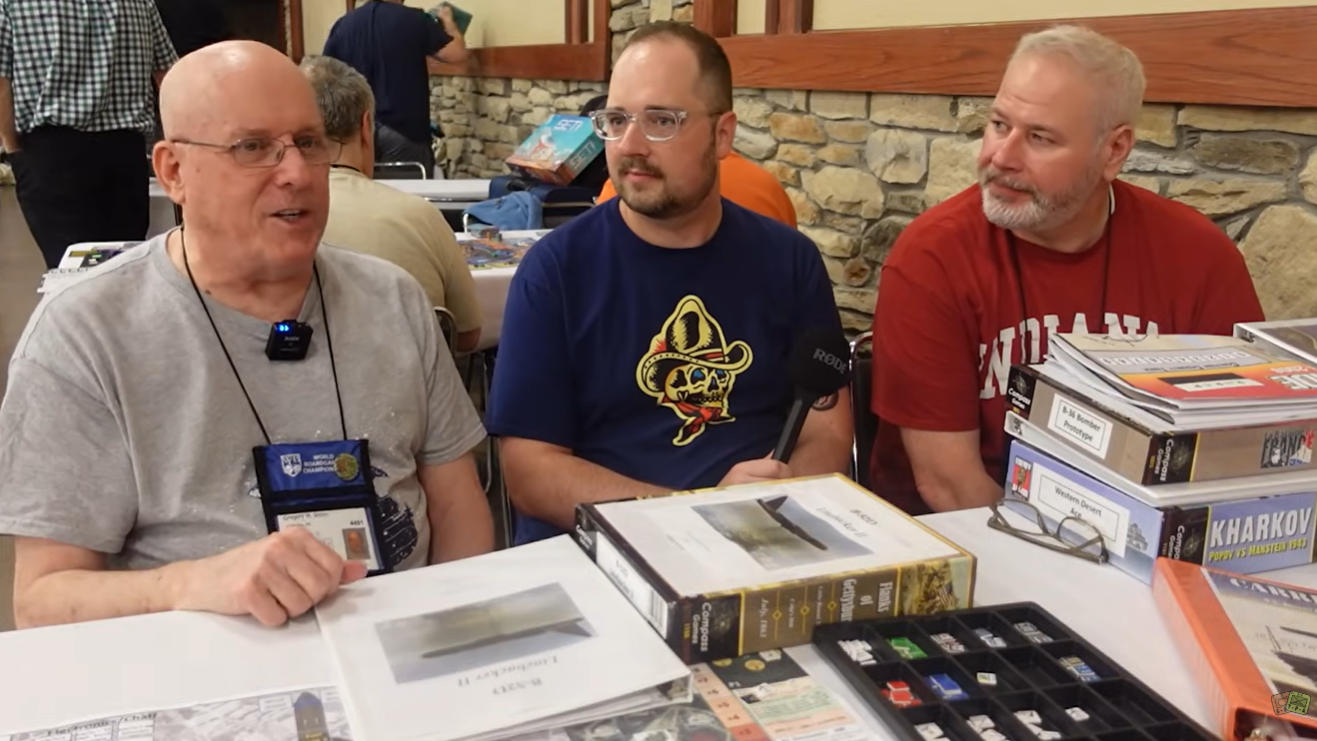
I was able to shoot a 15 minute interview with these guys and had some really good discussions about their goals with the game and the system highlights.
I also met at different times of the day several fans of the channel. I met 2 first time attendees this year who both watch our videos named Jason and Bill who were both class acts.
Jason.
Bill.
This is probably a bit personal but Bill told me that our videos helped during a time when his now deceased wife was sick and he was in a dark place. That was very touching to me and I appreciated that we somehow assisted him through that difficult time.
We met Akar Bharadvaj while attending SDHistCon in 2023 and played his award winning design Tyranny of Blood: India’s Caste System Under British Colonialism, 1750-1947 and very much enjoyed the experience and talking with him about game design. Since that time, he has been working on another designer called Chalice of Poison: The Iran-Iraq War, 1980-1988 from GMT Games, which was announced in March on their P500. Chalice of Poison is the first volume in a new series that models complex conflicts not only as clashes between adversaries in the air, land, and sea, but also as political struggles within the regimes and military forces fighting it. We reached out to Akar and he was more than willing to share.
*Keep in mind that the design is still undergoing playtesting and development and that any details or component pictures shared in this interview are for prototype purposes and will definitely change prior to final publication as they enter the art department.
Grant: Akar welcome to our blog. First off please tell us a little about yourself. What are your hobbies? What’s your day job?
Akar: Thanks, Alex and Grant! It’s great to be here. I live in sunny Arlington, Virginia, just across the river from our nation’s capital. Besides board games, I enjoy travel, museums, graphic design, bad movies, comedy shows, and nice meals. As for my day job, I work as professional wargame designer. I work on teams that make analytic games and tabletop exercises to help policymakers think through challenging issues related to international relations. That said, Chalice of Poison is solely a personal project, and does not reflect my day job or the views of my employer.
Grant: What motivated you to break into game design? What have you enjoyed most about the experience thus far?
Akar: I’ve always enjoyed board games since I was a kid, and have gotten into historical games in the last 15 years or so. I flirted with the idea of designing my own for years, but then I actually decided to design one in 2020 when I heard about the Zenobia Award, which is a competition and mentorship program for historical games on underrepresented topics. I was looking for a good project to distract me from the ongoing pandemic, so I entered the contest on a lark, not expecting it to go anywhere. But Zenobia did a great job of helping me walk gradually through the game design process, and before I knew it, I was hooked. When the award project finished, I learned that I had won first place. But more importantly, I had discovered a new passion.
My two favorite things about game design are the creative process and the people. I find the creative process immensely satisfying. I get to analyze systems, experiment, and iteratively solve problems and improve a process, and there’s few consequences to failing! If I find that a design doesn’t work, I can just move on to another one, and hopefully return at some point in the future. It’s a beautiful process, and one that actually feels a lot like playing a game.
I also love the people I’ve met through game design. I’ve made lots of designer friends through various cons, and it’s always a delight playing games with them, talking about game design, and just chatting. I always leave cons full of inspiration and ideas, and it’s largely due to all the great people in this field.
Grant: What was it like winning the 2021 Zenobia Award for Tyranny of Blood? Where does this game stand at the present time?
Akar: Winning the award was one of the greatest moments of my life. As I mentioned earlier, I started designing the game just to see what it was like, and I didn’t expect it to go anywhere. (If I knew there would eventually be interest, I would’ve designed a simpler game as my first one!) So, I was pleasantly surprised when I learned that I won, and was excited at how much interest it received.
For those who do not know, Tyranny of Blood is about changes to the Indian social structure under British colonialism, through the lens of the caste system. I designed a fully playable game during the Zenobia Award process, but like so many first designs, it had a bit of a “kitchen sink” approach, and had far too many layers placed on top of each other.
I realized that the game had lots of great elements, but it had some flaws at its core, and so I needed to redesign lots of it. The topic is a difficult one, both ethically and in terms of complexity, so I needed to get the game right to do justice to the subject matter and avoid creating something offensive. On top of all that, the rapid prototyping during the Zenobia process left me exhausted (in a good way). So, I decided to take a break from it, and work on other games in the meantime to improve my game design skills before I can return to Tyranny. Now that Chalice is in development, I can return to that project. That said, it’s been a while, so I need to read through my notes and remember all the nuances of the topic.
While attending SDHistCon in November 2023, we played Tyranny of Blood with Akar and had a great time. We shot the following video interview at the time and you can watch that at the following link:
Grant: What is your upcoming game Chalice of Poison about?
Akar: Chalice of Poison is about the Iran-Iraq War, which took place in the 1980’s. The game focuses on the interplay between external conflict and internal regime stability. You play as one of the two countries, and you are trying to improve your military effectiveness so that you can win the war, without making your military so effective that it becomes a threat to your own regime. Players can win the game if they capture certain objectives in the war, or they can lose if their regime collapses due to political challenges.
The actual combat resolution and prosecution of the war is only one part of the game; the other part is managing your regime and ensuring it does not fall to internal threats, whether that be generals who instigate a coup d’etat or dissident groups fighting against your government.
Grant: What should the name convey to players about the history of the Iran-Iraq War?
Akar: The phrase “chalice of poison” comes from a quote from Iran’s then-Supreme Leader Ayatollah Ruhollah Khomeini. When he signed the ceasefire agreement in 1988 that ended the war, without any major concessions despite all the bloodshed, he described it as “more deadly than drinking from a chalice of poison.”
Additionally, I found the evocative phrase to be an appropriate name for a game about accepting risk and making sacrifices to achieve objectives. The game is full of hard decisions that seem enticing at first, but end up doing internal damage.
On a lighter note, ever since Tyranny of Blood, I’ve been trying to give each of my designs a name that sounds like a heavy metal album.
“Taking this decision is more deadly than drinking from a chalice of poison.” ~ Ayatollah Khomeini, on accepting the ceasefire that ended the Iran-Iraq War
Grant: What is the new series called? What type of games might be included?
Akar: I haven’t been able to find that perfect name yet, despite coming up with a long list of ideas. So, the series doesn’t yet have a name. If anyone has an idea, I would love to hear them! Please sound off in the comments.
The system best models historical conflicts where major dynamic changes occurred within the halls of state power and the military command structure, rather than with territorial exchanges on the battlefield. So, future games in the series could model other conflicts where weak states fought each other while dealing with significant internal tensions. There are no shortage of those throughout history, from the modern Middle East to 1960’s Vietnam to Ancient Rome.
Grant: What games have you used as inspiration for your design?
Akar: I tend to prefer historical games that include strong political dynamics over straightforward wargames. So, a major point of inspiration has been the Great Statesmen Series, to include Congress of Vienna, Versailles 1919, and Churchill. Those games do an excellent job of demonstrating the interplay between peace negotiations and warfare, and it inspired a lot of the ideas I had about war being played in two phases, and how the two interact with each other. Instead of the connection between fighting war and negotiating peace, I focused on the connection between fighting war and improving military effectiveness. From a purely user experience perspective, I enjoy the tactile feel of placing cubes on cards that was in Versailles 1919, and the mechanic seemed to work well in this game.
Additionally, the war mechanics are loosely based on the States of Siege Series, though with a lot of complexity added. That system offers a simple push-pull model for combat, which I employed for a 2-player tug-of-war. I needed a fairly simple mechanism at the core, so that I could layer many other mechanics on top of it without overwhelming players.
Lastly, one of the solitaire modes is inspired by Mark Herman’s Peloponnesian War, a genius solitaire game where players face off against a bot, but if they begin to defeat the bot by too much, they then switch sides and have to fight against everything they set up in previous turns.
Grant: How have you used and followed the academic research of Dr. Caitlin Talmadge?
Akar: Dr. Talmadge’s 2015 book The Dictator’s Army explores the question of why some authoritarian regimes, especially so-called “strongman regimes,” are ironically so bad at fighting war. Her research delves deeply into 2 case studies: Iran versus Iraq, and North versus South Vietnam.
Her argument is that the factors that reduce the threat of coups also reduce military effectiveness at fighting adversaries. The ideal military promotes based on merit, trains troops robustly, incentivizes open and honest communication, and empowers junior officers to improvise within reason. Conversely, strongman regimes tend to do the opposite: promoting based on sycophancy, avoiding training, incentivizing lies and secrecy, and making all decisions through an inefficient centralized command structure. These traits help dictators feel more secure, but they make militaries less flexible to deal with changing circumstances.
This argument underpins the core argument of Chalice of Poison. The main thrust of the game is reforming your military to improve each of those four factors, but at a cost to your own political power.
Grant: What is important to model or include in a game about the Iran-Iraq War?
Akar; A game on the Iran-Iraq War needs to provide a very specific incentive structure, by which players feel the hubris of thinking a quick victory is possible, but also a deep sense of desperation when things go poorly. It also requires mechanics for dealing with internal stability within each country, and being able to affect stability in the adversary’s country. Lastly, such a game must afford players the latitude to take a wide variety of actions; the story of the Iran-Iraq War is two countries quickly falling into a stalemate, and then experimenting with a large number of strategies and unsavory steps to break the stalemate and achieve victory.
Grant: What challenges did you encounter in the design? How have you overcome them?
Akar: I had to design the game carefully to reflect some misperceptions that the actual historical figures had. We know now that the Iran-Iraq War was an enormous catastrophe for both countries, but the game had to give players some false hope that the game could end at any turn. As such, I had to implement a variable game length, with victory conditions that contract as the game progresses. I had to pace the game well so that players always feel like they’re on the verge of victory (or collapse), and I think the game is nearly there.
The early iterations for the game were very mathy, with a lot of dice roll modifiers and additions to provide bonuses for military reform. It wound up not being fun; either players would have their eyes glaze over due to the excessive math, or they would try to calculate every little decision and descend into analysis paralysis. Instead, I replaced all the bonuses with card play mechanisms, which thematically worked, because it gave players more flexibility to deal with bad situations. I replaced most of the math with a simple card color-matching system.
The game has a unique action costing system that requires players to push their luck, carefully budgeting their political power or else risk losing it all (and the game). I learned that most players instinctually spend their full action allotment, so if I give them 10 points, they want to spend 10 points! So, I had to add in some “brakes” to stop new players from losing the game immediately.
I had 2 additional in-game challenges that I needed to solve. One was how to depict the more unsavory aspects of the conflict, such as chemical weapons and human wave attacks, which were historical atrocities, but necessary to tell the story of this conflict. Typically, a game would have a penalty or cost for doing such things, but in the actual historical case, neither country actually suffered a penalty for these actions until well after the war. Additionally, I needed to balance the game a bit more, to give the losing side a chance. I quickly realized that both of these challenges could actually solve each other. I created a “Desperate Measures” mechanic that allows the losing side to catch up a bit, but at a moral cost.
Grant: What is the scale of the game? Force structure of units?
Akar: The game plays at the political and strategic level, so it is pretty abstract. It models the conflict along up to six fronts: the air, three or four different ground fronts, and the naval front. Each one has an abstracted military strength represented by zero to six wooden chevrons. Each side has one air force, one navy, and three different ground forces: the elite guard, the regular army, and the paramilitary. Each of these five forces has a commander in charge of it. That is as complex as the game’s force structure gets; it does not model more specific units or officer ranks.
Grant: What is each player’s overall goal in the game? What does this mean?
Akar: Each player is trying to win the war while preserving their regime.
Winning the war means capturing a certain amount of territory. Most spaces on the map contain stars representing the relative importance of that space. A player advances on the War Progress Track one space for each star captured. Additionally, the War Progress Track includes an Objective counter that starts at 10, but decreases as the game goes on, representing war-weariness and a reduction in expectations for what players define as “victory.” If a player’s War Progress meets or exceeds the current Objective, that player wins the war (and the game). Of note, a player can potentially win even with zero points, which reflects what happened in real life.
Preserving the regime means holding onto political power cubes within the Regime pool on the board. If the Regime pool has zero cubes in it, the player’s regime falls and that player loses. Cubes move out of the Regime pool when players reform their military, improve their commanders, face problems with dissidents, or fight against a coup d’etat. The fewer cubes in the Regime pool, the higher the risk of internal problems erupting.
Grant: How do players go about developing a professional army that values competence and skill?
Akar: Players start with a “coup-proof” military that is pretty ineffective at fighting, but they can expend political power, and thereby accepting risk to their regimes, to make reforms.
Grant: What actions are available to players to reform their military?
Akar: Players have four major actions they can take. They can coordinate to allow commanders to communicate openly with each other and their underlings, empower their forces in the field to make decisions for themselves, promote commanders based on competence instead of personal loyalty or family ties, and train existing commanders to be better at fighting. Each of these actions has four different levels; players can upgrade the actions to improve their effectiveness, but at a cost of political power.
Grant: What are the costs of this process? How do players manage these threats?
Akar: The costs of each action comes in political power cubes. Each action starts at level zero, which does not cost anything, but is not very useful. Players can make reforms, which essentially upgrades each of these actions one step at a time, up to level four. Upgrading to a higher level requires placing that number of cubes on that card. Actually taking actions usually has an additional cost in power cubes.
Players need to “push their luck” to best achieve reforms gradually. Doing too much too fast is a recipe for disaster. Players can spend a large number of cubes each turn, but they will not necessarily get them all back at the end of the turn. Reforming too quickly can threaten regime stability. To protect against these threats, players will need to go slow, keeping enough political power behind to stabilize their regimes, but inaction can also be risky if it means losing the war.
Grant: What is the Turn Sequence?
Akar: The game has up to 9 turns, each representing a year from 1980 to 1988. Each turn has 4 phases:
In the Planning Phase, players issue hidden orders for six fronts to carry out this turn.
In the Action Phase, players reform their militaries so that they can improve the likelihood that these orders are successful.
In the Battle Phase, players resolve orders, change territorial control, fight dissident groups, and learn lessons for future battles.
Finally, in the Unrest Phase, players face internal threats, to include popular outcry, dissident groups, and coup attempts.
Grant: How are hidden orders issued?
Akar: Each front has a space for an order tile, which players place face-down during the Planning Phase, so that they are secret from the other player. Each order tile has four options, which are chosen by how players rotate their tile:
Attack allows players to start a battle against the adversary, and to advance into their territory if they have a stronger force after the battle.
Defend allows players to fight against an attacker at an advantage, and to bring in a small amount of reinforcements, but does not permit advancement.
Subjugate (Air and Ground only) allows players to fight a battle against dissidents.
Attack Tankers (Navy only) allows players to threaten the adversary’s political power.
Regroup allows players to bring in a large amount of reinforcements, but not to fight in any battle that occurs.
Air and Naval forces have one order tiles each, but Ground forces have three different order tiles, representing the three different ground forces in the game: the Guard, Regular Army, and Paramilitary. The more elite the ground force, the earlier it gets to execute its order and deal damage, which gives it a slight advantage in combat.
Grant: How is combat handled?
Akar: Combat strength is a function of 3 different factors:
The Order tile, which represents orders from on high, determines whether a battle occurs, and if it does, which order the forces use to deal damage.
The Commander card, which represents high-level military leadership, determines the damage the front will do that turn. Each commander has a hit value for each of three battle suits: Fervor, Discipline, and Leadership.
The Battle card, which represents forces in the field, determines which suit on the Commander is used to deal hits on the opposing force. A new Battle card is drawn during each battle.
For each hit defined in the previous step, players remove one military strength, represented by wooden chevrons, from that front. If an attacking front is stronger than the opposing front, it may advance and capture enemy territory, for some bonuses.
In each battle where one side deals more damage than the other, the active Commander learns a lesson about how to fight, which changes his stats. Of note, not every lesson is a good one; some lessons can actually make the Commanders worse at fighting; for instance, if it makes them complacent or arrogant.
Grant: What elements of unrest confront the players? How do they handle these challenges?
Akar: Unrest comes in 3 forms, during the Unrest phase:
Public outcry occurs if a player does not attack in a given turn. This removes a political power cube from the game.
Dissidents represent groups that threaten the regime’s power. The strongest dissident group on the map each turn has a massive negative effect, the second strongest has a moderate penalty, and the other three have a slight penalty. If left unchecked, the dissident groups can cause major chaos, but any troops dedicated to fighting dissidents are necessarily not fighting the adversary, so balance is important.
Coup attempts may break out if a commander has more political support than the regime. Each commander has a number of cubes on the card, which corresponds to his risk to the regime and typically corresponds with his competence. If a commander (or a group of commanders allowed to coordinate) has more cubes than the regime, a coup attempt may break out, and then the player will have to fight battles against the rebellious commander(s).
Grant: How does the design use cards?
Akar: The game has 4 types of cards:
Action cards allow players to choose from among four different military changes each turn, as listed above. Players can “reform” or upgrade these actions to have more of an effect, at the cost of political power.
Personnel cards represent the major figures involved in the conflict. They are dual use cards:
When horizontal, they are Commander cards, meaning that the person on the card now Commands forces. These Commanders each have different strengths across three suits (discipline, fervor, and leadership), which dictate how much damage they do each turn.
When vertical, they are Battle cards, meaning that they are forces in the field who are actually fighting the enemy. Battle cards dictate which suit on the Commander deals damage in a given fight.
Dissident cards represent the negative penalties from the five dissident groups that are in the game. Each turn, during the Unrest phase, players draw one of these cards, which determines what effect they have. The strongest dissident group this turn has a major penalty, the second-strongest has a moderate penalty, and the other three groups have a small penalty.
Grant: What is the layout of the board? What do the point to point tracks represent?
Akar: The War Map is a point-to-point map, which was a necessary design choice because the terrain along the Iran-Iraq border only allows approaches through specific narrow corridors, to avoid marshes, mountains, and other rough terrain. Additionally, the amount of land that each side managed to capture in the war was miniscule, so having a map to scale made little sense.
The map has different squares representing ground territory and sea locations. Black squares are Iraqi-controlled at game start, and red ones are Iranian-controlled. Each space has icons: stars are Victory Points, representing strategically and symbolically important areas; circles are Economy, representing oil infrastructure and sea lanes, and hexagons show the presence of dissident groups.
Beyond the map is a series of tracks representing the current turn, the strength of each country’s economy, and the current war progress (i.e., the winning side’s victory points and current objective).
Additionally, each side of the board has an area to show each regime’s current political power and active military commanders.
Grant: How is victory achieved?
Akar: The most important spaces on the board have stars on them, which represent victory points. Every time a side captures a starred space, the War Progress counter advances that many spaces. (Of note: this value is zero-sum, so only the War Progress of the winning side is marked; if the winning side flips, the counter flips to show that the other side is winning.)
Additionally, an Objective counter, marked with a dove, represents the current victory condition. The game begins with the Iraqi side having maximalist objectives, but as the game progresses, each side is willing to scale down their goals and definition of “victory.” So, the Objective counter moves left each turn, and additionally moves due to player actions.
If the War Progress counter ever meets or exceeds the Objective marker at the end of the Battle Phase, the game ends and that side is the winner! Of note, a side can even win with zero victory points, which probably was the real-world historical outcome.
Additionally, if a side ever runs out of Political Power cubes from their pool at the end of the Unrest Phase, that regime collapses and loses the game. If the other side still has cubes, then they win the game! If both regimes collapse on the same turn, then both players lose and Henry Kissinger wins the game.
Grant: What do you feel the game models well?
Akar: The game does a great job of building tension, fostering an alternating sense of hubris and desperation, and encouraging experimentation through trying different combinations of actions until one comes out ahead. All of these factors were present in the actual history, so I am excited that the game design reflects these traits.
Grant: What are you most pleased about with the design?
Akar: I am pleased about the game’s originality. I don’t know of another game that shows the competing priorities of internal political stability and external military effectiveness quite in this way. I would be most excited if I (and eventually, other designers) could employ this system to explore other conflicts through history, or perhaps even outside of history.
Grant: What other designs are you contemplating or already working on?
Akar: As I mentioned earlier, I’m hoping to return to Tyranny of Blood, my game about the Indian caste system, and finally finish it. This one is the furthest along, but I have other games that I’m in the early stages of designing.
I’m hoping to adapt the Chalice of Poison system for a 3-4 game about the Vietnam War, tentatively called Riding the Tiger. My idea so far is to add some more asymmetry to the system. The South Vietnam player will likely play similarly to the two sides in Chalice, as an unstable strongman regime prone to coup attempts. The United States player will not face coup attempts, but will have to deal with popular support and an election every four turns. The North Vietnam player will have to manage its politburo, attempting to exert influence over the southern revolutionaries and balance between its Chinese and Soviet patrons (and their competing priorities for Vietnam).
I have another game concept, tentatively called Iron and Cardboard, about intra-alliance dynamics and competition among the Warsaw Pact nations as they rebuild from the destruction of WWII under Soviet domination.
Lastly, I have a concept called Pillars of Fire about competition and conflict among Iran, Iraq, and Saudi Arabia from 1979 to 1991. It will be asymmetrical, based on the 3 different systems of government (revolutionary theocracy, strongman dictatorship, and conservative monarchy), which will vie for dominance of the region. Chalice actually began as the military module of Pillars before it took on a life of its own, but I think the grand strategy of this rivalry is worth exploring in its own game.
While attending Buckeye Game Fest in spring 2024, we met with a new designer named John Lapham. John had with him a new game called A More Perfect Union and we got a chance to play the game and chat about it with him. A More Perfect Union is a 2-player card driven game that simulates the public debate over the ratification of the Constitution that took place across the United States from 1787-1789. The game uses the same system as Twilight Struggle and 1960: The Making of the President but felt very fresh and unique to the situation. Catastrophe Games is planning a Kickstarter campaign in the near future and we reached out to John to see about getting some more insight into the design and he was more than willing to share.
Grant: John welcome to our blog. First off please tell us a little about yourself. What are your hobbies? What’s your day job?
John: Thanks so much for having me, Grant. My main hobbies will surprise no one – gaming and history. I also enjoy hiking, cooking, and theater. As for my day job, that is in the past. I’m retired now. Before that, I had jobs in both the legal and educational professions.
Grant: What motivated you to break into game design? What have you enjoyed most about the experience thus far?
John: I wanted a game on this topic and no one else seemed willing to oblige me—although Jason Matthews and Christian Leonhard came close with Founding Fathers. I enjoyed the beginning and end of the experience. I love historical research and pondering messy interpretive narratives and historical hypotheticals. So, I was not surprised by how much I enjoyed the front end of the design process. What surprised me was how much I enjoyed the collaboration that occurred near the end of the project, and the practical and artistic challenges of turning an idea into an actual, physical game. I had no experience with that process and enjoyed learning about it.
Grant: What is your upcoming game A More Perfect Union about?
John: A More Perfect Union is about the political struggle to ratify the U.S. Constitution in the thirteen states from 1787-1789. The game employs the popular card-driven mechanics of such well-known games as Twilight Struggle and 1960: The Making of the President.
Grant: Why was this a subject that drew your interest?
John: It was the subject of some of my earliest graduate school research in the late 1980’s (yeah, don’t ask, I’ve been around the block more than a few times). As a history educator, I was drawn to less well-known stories, involving people and events that popular and school histories have neglected. This is one such story, and it is an important one that has enduring relevance for understanding much of American history and our current turbulent moment.
Grant: What is your design goal with the game?
John: I had two main goals. I wanted the game to offer a window into the history of that moment and to spark interest in the topic. I also wanted it to be a fun, tense game that could be played in a couple hours but with enough complexity and variability to invite repeated plays.
Grant: What from the Constitutional Convention was most important to model?
John: Ok, that’s a hard one. I cannot give you just one. Several things were important to me.
First, I wanted the game to capture the intense war of words that occurred in the nationwide debate. America was on the leading edge of the first wave of mass media made possible by high literacy rates and the printing press. Americans of the period were highly literate, avid consumers of news, and intensely interested in politics. Ninety different newspapers and hundreds of presses across the country printed thousands of essays, letters, and pamphlets over the course of the debate.
Second, I wanted the game to capture the importance of political strategy in terms of grabbing and holding onto the initiative in the debate through the scheduling of the thirteen state conventions, as well as exploiting the momentum gained from successful outcomes in those conventions.
Third, I wanted to express the tension and uncertainty felt by the delegates during the actual conventions themselves. Delegates often went into these conventions uncertain of their outcomes.
Finally, and perhaps most importantly, I wanted players to come away with an understanding of the immense challenges faced by the new nation to come together and form a strong union that did not threaten the individual liberty that Americans prized at this time. It is in large part the work of the Anti-Federalists that delivered the country its Bill of Rights, a fact that is perhaps too often overlooked or forgotten by modern Americans.
Grant: What sources did you consult about the details of the history? What one must read source would you recommend?
John: Tremendous digital resources are available on the ratification debate thanks to the phenomenal work done by the Center for the Study of the American Constitution at the University of Wisconsin-Madison (https://csac.history.wisc.edu/). I encourage anyone interested in this topic to explore their website and the treasure trove of material available there.
For a more curated collection of primary source material, the Library of America has published an excellent two-volume collection of many of the most important essays, speeches, newspaper articles, pamphlets, and private letters, The Debate on the Constitution, which also includes a detailed chronology and biographical information on the participants in the debates.
For a single, narrative history of the entire series of events, the best choice is Pauline Maier’s Ratification: The People Debate the Constitution, 1787-1788, published in 2010. Reading that book was the last nudge that I needed to start designing the game.
Grant: What is the goal of the game? How do players go about trying to sway States to their way of thinking?
John: Fortunately for me as a designer, the main goal of the game was set out for me in the Constitution itself, which required nine states to ratify it to become binding on those states. Thus, the Federalists win the game immediately if nine states ratify the constitution without recommended amendments, and conversely the Anti-Federalists need five state conventions to reject the Constitution to win immediately. If enough states thread the needle of compromise and ratify the Constitution with recommended amendments, then victory is determined by the weight of the states on each side of the ledger.
The primary tools to convince voters in the states are direct campaign efforts, which involve the use of the campaign points in particular states, and the play of publication events. Publication events address one of three broad sets of issues that animated the debate – commerce, states rights, and individual rights. Each state in turn has a rating that reflects how important each of those sets of issues is to its voters. As a result, the effect of a publication will be more or less, depending on the state in which it appears.
Grant: What is the layout of the board?
John: The board includes several broad features – a map of the thirteen states with a state information and holding box for each state, turn and round tracks, a convention track, a state status track, and a table of information.
Grant: What information is contained in each State Box?
John: Each State Box has a number that reflects the maximum number of combined player cubes that can be present in the state, icons showing if either player starts with cubes in the state, numerical ratings for each of the publication issues, the convention value, and the momentum value of the state, and a spot for the state’s status marker, which shows if the state has scheduled or held its convention. Finally, the state boxes are color coded to show the section of the card deck in which the state’s convention card is seeded.
Grant: What are the 5 different words and corresponding values in these boxes mean? How are these elements connected to the cards?
John: The words “Commerce, States, and Individual” relate to the three publication issues and the numbers (0,1, or 2) next to them reflects the effect that a publication on that issue will have in the state – either adding or removing that number of player cubes in the state. The word “Convention” refers to the convention value of the state and the number next to that is the number of campaign points (CP) a player must expend either to call an early convention in the state or to attempt to take control of the State Status Marker through legislative maneuvering. The word “Momentum” refers to the campaign bonus a player will earn if they win the state’s convention.
The issues ratings connect directly to the publication event cards. The Convention ratings connect to the expenditure of CP gained from card play. The Momentum rating does not connect to the cards but instead relates to the outcome of the convention in the state.
Grant: What is the purpose of the State Factors Table and the State Issues Table?
John: This table summarizes in one place the information contained in the individual State Boxes, and it groups the states by their color codes to show players when they will draw the State Convention Cards over the course of the game.
Grant: What is the Back Room? What role does this play in the game?
John: Each player has a Back Room in which they can place a maximum of two cards. Cards in the Back Room are not part of a player’s hand, cannot be played during a player’s action round, and are not discarded at the end of the turn. Players can access the cards in their Back Room at three times – (1) during the card draw phase of each turn, when they can freely remove or add cards to the Back Room, (2) at the start of any convention, when they can remove, but not add, cards from their Back Room, and (3) during an action phase by playing a card for the sole purpose of adding or removing cards from their Back Room.
The Back Room plays two main roles in the game: (1) it provides a means by which players can hold onto powerful events that are not yet ripe to play – often convention events for conventions that will happen on a future turn, and (2) it provides a way to avoid playing a strong opponent’s event at an inopportune time.
Grant: How does the game use cards?
John: This a classic Card-Driven-Game. Each player is dealt a hand of cards each turn and plays one card each round either to spend the Campaign Points provided by the card or to implement an event described on the card.
Grant: What different types of cards are there? What is the purpose of these different types?
John: There are five different types of cards: State Convention Cards, Publication Events, Convention Events, Reaction Events, and General Events.
Each state in the game has a State Convention Card, which are mandatory events that must be played in the turn in which they are drawn. They grant the player cubes in the state and control of the State Legislature, and they schedule the state’s convention by placing the state’s status marker on the Convention Track.
Publication Events publish and distribute a publication addressing a particular issue in a particular state that and a few of its neighbors. Most of these events will specify the state in which they originate and the issue that they address. A few allow the player to pick the state and/or issue for the publication.
Convention Events can be played for their event only during a convention and will have some effect on the outcome of that convention.
Reaction Events are played in response to some other game effect.
General Events are a catch-all for any other type of event.
Grant: Can you share a few examples of cards and explain their use?
John: Sure, here is an example of a State Convention Card:
Each state has one of these cards and they all work the same way.
These cards trigger the scheduling of State Conventions.
They must be played on the same turn they are drawn and cannot be discarded or placed in a player’s Back Room.
They are seeded in a particular quarter of the draw deck at the start of the game, as indicated by the colored banner in the upper right corner of the card.
When played, you move the indicated state’s Status Marker from the map to Box 1 on the Convention Track and mark it with a cube of your color. This represents that you are in control of the state legislature and can spend CP to call an early convention in this state on a later turn. In addition, you may add or remove 2 cubes in the state.
Here is an example of a Publication Event:
These are the most involved events in the game but like the State Convention Cards they all work the same way. So, once you’ve done it a few times, it becomes straightforward.
The red star identifies this card as an Anti-Federalist Event.
The “3” in the star shows that this card is worth 3 CP.
The newspaper icon under the star shows that this card is a publication event, as do the words in the white banner running along the left side of the card.
When played for the event, publications are distributed in a number of states equal to the CP value of the card. In this case, that means 3 states. The first state the publication must be distributed in is the state identified by the postal code in the title of the card. In this case, it must be distributed in Virginia. In addition, the publication may be distributed in twoadditional states that are adjacent to Virginia for a total of 3 states.
The issue addressed by this publication is individual rights, which is indicated in text at the bottom of the card. The issue controls how many cubes the player will add or remove from each state based on that issue’s value (from 0-2) in each state. The individual rights value in Virginia, Pennsylvania, and North Carolina is 2, but it is only 1 in Maryland. That means that this publication with add or remove 2 cubes in Virginia, Pennsylvania or North Carolina, but will only add or remove only 1 cube in Maryland.
Grant: What happens if you play an opponent’s event? What type of thinking and strategy does this create?
John: Generally, the event triggers, although the player gets to decide whether the event happens before or after they use the card for campaign points. There are two ways to mitigate powerful opponent events. They can be played during the Initiative Phase of the turn to bid for initiative without triggering the event, although doing so often reduces the player’s chance of winning the initiative for the turn, which is costly in its own right. They can also be stored in the player’s Back Room for possible play on a future turn when the event might be less damaging. This too is costly as the Back Room can hold only two cards and those spaces can also be used to save your own events for a future turn when they will be more effective. Thematically, in both instances you are spending time and energy managing a potential problem rather than advancing your own agenda.
Grant: What is the general Sequence of Play?
John: Each turn has the following phases:
Card Draw – Slightly more involved than a standard CDG because each turn you can change the cards in your backroom, which is often a challenging decision.
Initiative Phase – This phase sets the initiative and the first player for the turn.
Action Phase – The heart of the game when players alternate playing cards from their hands.
Convention Phase – State Conventions are resolved or move closer to resolution.
Voter Apathy Phase – Some voters lose interest and players remove some cubes from the map.
Grant: What is a Convention and how does it work? What is the outcome of this process?
John: A Convention is when a state makes its final decision as to whether it will ratify the Constitution. Thematically, this is the moment that elected delegates meet, debate, and vote on the Constitution. To model the drama of these events, players have a final opportunity to play cards that can affect the outcome. After that, the player’s cube totals in the state are compared. If the Federalists have the most cubes, the state ratifies the Constitution. If the Antifederalists have the most, the state does not ratify. If the two factions have an equal number of cubes, the state ratifies with recommended amendments.
Grant: How does Campaigning work?
John: Each state has a set number of voters. This number puts a cap on the number of combined player cubes that may be placed in that state. Players can think of it this way: the voters in each state can have one of three states of mind – undecided, Federalist, or Antifederalist. At the start of the game, most voters are still undecided, which is reflected by the fact that only a few cubes are placed on the board during setup. Campaigning involves the expenditure of Campaign Points (CP) to persuade these votes to change their mind, represented by placing or removing cubes in the states. It costs 1 CP to place a cube in a state. It costs 2 CP to remove a cube from a state. If a state is already at its cube limit, the player will first have to spend points to remove an opponent’s cube before they can place their own cube. Thus, to replace an opponent’s cube with one of your own costs 3 CP. Cards range in CP from 1-4. So many cards will not grant the player enough CP to replace an opponent’s cube with one of their own.
Grant: How is victory achieved?
John: The Federalists gain an immediate victory if nine states ratify the Constitution without amendments. Conversely, the Antifederalists win if five states reject the Constitution. If neither player achieves these conditions before the end of the final turn of the game, at least one state has ratified the Constitution with recommended amendments. Victory at that point is determined by comparing the values of the states in each section of the State Status Track. Each state has a value that represents its political and economic importance – the larger the state the more it is worth. Each player gets full credit for each of the states in their column and the Antifederalists get partial credit (the Convention value) for each state that ratified with recommended amendments. Thematically, this represents a compromise situation, where the Constitution is ratified but with amendments. The stronger the opposition to the original Constitution, the more impactful those amendments will be. Strong amendments represent a partial victory for the Antifederalists. Historically, the Antifederalists efforts resulted in the adoption of the first ten amendments to the Constitution, including the Bill of Rights.
Grant: Which side has the tougher challenge to meet their goal?
John: The challenges faced by the two sides are different, but I hope they are roughly equal in difficulty.
Grant: What are some basic strategies the Federalist and the Anti-Federalist players?
John: The Federalists need to strive to win states quickly and build on that early momentum. They may need to consider making aggressive moves early in the game to take states off the board. They also must stay competitive is as many states as possible. They can only afford to lose four states, and the deck is stacked against them in two states – North Carolina and Rhode Island. The Antifederalist player has a wider range of strategic choices. They can focus on winning outright victory in one or two of the early states in an effort to reach the five states they need for an automatic victory, or they can build up their strength in several of the more valuable states that hold their conventions later in the game and improve their chances of winning the game on the basis of points at the end of the game. They cannot afford to compete with the Federalists in every state. They need to pick their battles carefully.
Grant: What type of an experience does the game create?
John: My hope is that it offers players challenging strategic and tactical decisions and creates dramatic moments of high tension where careful planning or bold action can alter the course of the game.
Grant: What are you most pleased about with the design?
John: Overall, I am pleased with the way it models the challenges and choices faced by the historical actors. With respect to the game play, I particularly like the Initiative, Back Room, and Convention mechanisms.
Grant: What other designs are you working on?
John: I’m working on a four-player game about the labor movement in Chicago, during the late 19th-century, and a solitaire game about the Civil War in which the player takes on the role of Lincoln and has to prosecute the war as commander-in-chief, while also navigating the challenges of domestic policy and political campaigning.
While attending Buckeye Game Fest in spring 2024, we met John Lapham and shot a video interview discussing the game and its mechanics:
Over the past several years, we have done interviews with Matt White, publicized his games and played a few of them as well and he always has something cooking. Recently, I came across his newest offering on Kickstarter called Spearhead: Hell on Wheels – Tank Battles in Normandy. This game is a solitaire or 2-player print and play tactical game that allows players to take command of US tanks in German occupied France. I reached out to Matt and as always he was more than willing to share on the design.
Grant: What is your new project on Kickstarter called Spearhead: Hell on Wheels?
Matt: This is a brand new solitaire and co-op World War II print and play tactical wargame. In this game you are in command of a group of 3 US tanks in brutal and intense tank combat in enemy-occupied territory.
The players must lead their tanks, through unforgiving terrain, finding and then engaging the enemy in fierce fire fights. They must defeat any encountered enemy tanks and forces, whilst meeting the objectives as they move across the map.
Grant: What was your inspiration for the name? What do you want it to convey about the design?
Matt: My biggest inspiration was reading accounts from various US armored units. Keeping your tank crews alive and positioning your tanks whilst dealing with unexpected enemy positions is key to survival and success and truly seemed to be “Hell on Wheels”.
Grant: What about the battles during Normandy inspired you to make this game?
Matt: Basically I wanted to focus on and show the difficulties with the survivability of the armored crews and their vehicles during the D-Day invasion and the days after as the Allies broke out into France. That was the biggest point I wanted to make.
An American M10 Tank Destroyer.
Grant: What research did you do on the subject?
Matt: As with all my games, in trying to get the historical aspects correct both in the mechanics of the game as well as the look and feel of the art, I basically try to do lots and lots of reading! I read as much as I can on the subject, from various authors and viewpoints, and when I am not spending time playing games or making them, I basically read! This knowledge is part of the inspiration for my games as I draw upon things that I have rad and then translate them to the page.
Grant: As a tactical level wargame, what are the most important areas of focus for the design?
Matt: The positioning of your tanks in relation to where the enemy could be, and not only the tank hull but also the turret. Keeping your tank crews alive and positioning your tanks whilst dealing with unexpected enemy positions is key to survival and success. This game is point-to-point based where you must place your tank orientation and can aim the turret separately. Being able to keep the front of the hull forward towards the enemy tanks whilst hopefully being able to fire on their flank is critical.
Grant: How does the game differ in its 2 modes including solitaire and cooperative?
Matt: In the game you are in command of a number of US tanks – these can be split between players if you wish. Its quite unlike a number of solitaire WW2 tank games where you are in command of one tank. In this game you have a number which makes it really suitable for co-op play.
Grant: I know the design is a Print and Play offering. Why do you feel this model is best suited for your designs?
Matt: I like making print and play games as it forces you, as the designer, to make every component count and making the most of the physical space on a sheet of paper. I find that challenge one of the most interesting parts of the creative process. I also like the print and play model because it is very affordable for all parties, both me and the players, and allows the game to be available to anyone at anytime and on their terms.
Grant: I see that the board has a point-to-point movement layout. Why was this your chosen method of conveying information about the battlefield?
Matt: As much as I love traditional hex based games (and continue to play a lot of them), I also like point-to-point too. I like the way you can combine not only line of sight but also information about the environment in the game.
Grant: What is the meaning of the different symbols that appear on the board?
Matt: Movement is from point-to-point and where you move from a Position Point (the rectangle points) to an Observation Point (the circle points) where you will test for observation and perform the majority of combat. If combat is successful then you will be able to move to the next position point.
As you can see from the map there are multiple paths from Position Points to Observation Points and then onto other Position Points. Plus there are a variety of pros and cons to various paths to allow for a variety of terrain types and observation challenges. These paths are illustrated on the map in the shape of lines which are known as Movement & Observation Lines.
For each Movement & Observation Line there is a symbol at one end. The most common symbol is a black arrow, which denotes normal terrain and normal observation. There are other symbols which mean more difficult terrain or harder observation. These are:
Black Arrow – Normal Movement – Normal Observation
White Arrow – Normal Movement – Hard Observation
White Square – No Movement – Normal Observation
Black Circle – Difficult Movement – Normal Observation
White Circle – Difficult Movement – Hard Observation
Grant: What difficult decisions do players have to make in the game?
Matt: You will have to deal with enemies and you discover them but you don’t know where they are and so you must make some decisions based on information you do and don’t have. The player will also have several simultaneous objectives that must be obtained and will have to contend with both the German forces defending them that you know about and those that you do not.
“Lady luck” plays a part, as with any military operation, but your decisions and tactics are crucial, especially in how you position your tanks on the map when facing enemies as you cautiously roll through the environment.
A German Panther.
Grant: What dangers and threats meet the players on the battlefield?
Matt: There are a variety of dangers but not only the enemy forces as tank obstacles and mines can be a serious threat, combined with the environment itself.
Grant: What objectives does the player have to accomplish?
Matt: For each game session the objectives are randomly generated with Objective markers provided. All you have to do is safely get your tanks to those Objective markers, all the whilst dealing with the enemy!
Grant: How are hidden German units handled?
Matt: Every time you move your tanks you will need to check what they can observe and into which other points then can see. At this time you will roll on a couple of charts to see if you can see enemy units. However, just because you can’t see any doesn’t mean that they are not there.
Grant: What is the makeup of the Tank Cards? What information do they contain?
Matt: Using the Tank Cards you record the status of the major components of your tank such as the engine and tracks plus any gun jams. You also record the status of the various tank crew, all of which can have an impact in the game. Counters are provided to record all the status of both the tank and the crew.
Grant: What different types of tanks are included on both sides?
Matt: There are variety of tanks in the game with each tank having its own unique gameplay – for example the M10 tank destroyer has no hull machine gun (but does have a better anti-tank weapon). There are also Stuart M5A1 Tanks, StuG’s, Panzer IV’s, and many more.
Grant: How does combat work?
Matt: In the combat phase, you determine the order in which both your tanks and the enemy tanks fire. This is crucial to how the combat plays out as in real life WW2 tank combat, the results will favor the tank crew who can fire first on their target.
You will roll a few dice, depending on your tank positioning and other factors, and retain the highest number. You can increase your number of rolled dice by certain criteria – the more dice you roll the better! For example, if your tank turret is facing the enemy, the terrain type, the health of both the tank and the crew and if the enemy have been observed all are major factors. The enemy tanks will be doing the same, so factors such as successful enemy observation in the previous phase are crucial!
Grant: What is the goal of the game? How is victory obtained?
Matt: Your goal is to reach your various objectives on the map, whilst trying to keep your tanks and crew alive.
For each game session the objectives are randomly generated with Objective markers provided. All you have to do is safely get your tanks to those Objective markers, all whilst dealing with the enemy!
Grant: What are you most pleased about with the design?
Matt: I am most pleased to be coming to the end of the design and getting it ready for people to play! Finishing or coming close to it, is the hardest part of the development. In terms of the actual game, I really enjoy being able to get a game that has depth and is engaging that can be printed on just a few sheets of paper.
Grant: What kind of an experience does the game create?
Matt: I hope that the game creates a thoughtful representation of actual tank combat and how decisive it can be!
But that is not all. The game is modular and has several options included. As well as the map shown above, the game will also come complete with another map, additional counters and a rulebook which allows for you to create your own unique scenarios.
This map has the same points but where you will roll on tables to determine the various Movement & Observation Lines from each Position Point and Observation Point. There will be counters that you can place between the Position and Observation Points as an aid. You will be using various charts and tables to procedurally generate your map as you play, determining those gameplay elements as you progress. This type of game session will present you with a new challenge as you really have to deal with more unknown elements as you progress your tanks across the map.
Grant: What other designs are you currently working on?
Matt: I have a few games I am working on – currently working on something involving WW2 Mosquito aircraft!
For a YouTube video overview of the game, please check out Matt’s overview video here:
Thanks to Matt for his time in answering our questions and for his great little print and play games. I love it when one of these new games is brought to light as I get to oodle over the art and see what new things he has created!
Grant: Javier welcome back to the blog. What is your new game Battle of Pensacola 1781?
Javier: Thanks for having me again. Pensacola 1781 is a simulation of the American Revolution in the southeast region, stretching from the Mississippi River basin to the Floridas, from the Spanish entry in the war in 1779 to 1782. I must say that the title is a bit deceptive in its scope and included battles.
Grant: What was your inspiration for this game? Why did you feel drawn to the subject?
Javier: The Spanish participation in the American Revolution has recently attracted much interest in Spain. It was, so to speak, the swansong of the empire in the Americas. There aren’t any games that cover the entire campaign. There is only a wargame on the siege of Pensacola from GMT Games which is a part of their Battles of the American Revolution Series, which is a detailed and interesting situation. But I wanted an operational level game showing the big picture, from New Orleans to Mobile, Pensacola and St. Augustine. The game highlights the operations of Bernardo de Gálvez, who led one of the most brilliant campaigns in that theatre, clearing the Mississippi basin of English outposts as well as taking Mobile and Pensacola fighting against all odds. Against the advice of his subordinates, who deemed impossible defending Louisiana without reinforcements from Cuba, Gálvez declared that he preferred “having to answer charges of recklessness, than other type of charges” and took the offensive against the British in the lower Mississippi.
Grant: What was your design goal with the game?
Javier: My goal was to show a “multi domain” 18th century campaign, including amphibious operations, sieges, Indian warfare and diplomacy. The design puts the focus on leadership quality, Indian warfare and chaos. The campaign in Louisiana, modern day Alabama and the Floridas was a bit of a sideshow in a worldwide conflict fought from Canada to the Mediterranean, the 13 colonies, the British channel, Gibraltar or India. The design reflects this in several ways. In this game, reinforcements arrive at the beginning of each year and their arrival depend upon a number of factors, such as victories in earlier turns (thus gaining the favor of their respective courts in London and Madrid) as well as events elsewhere. Fleet squadrons come and go because this is an oceanic war being fought out across the seven seas, and the Caribbean was just only one more front.
Grant: What type of research did you do to get the details correct? What one must-read source wouldyou recommend?
Javier: There are plenty of Spanish sources on the campaigns of Bernardo de Gálvez in the Americas, many of them published in recent times. There are recent English language sources that recognize the major role of Spain in arming and supporting the American Revolution. For instance, the book by Larrie D. Ferreiro Brothers at Arms: American Independence and the Men of France and Spain Who Saved It. Another interesting source in English is the work by Joshua Provan Every Hazard and Fatigue: the Siege of Pensacola, 1781 published by Helion Books. This book provides solid evidence of “the true military consequences of the siege [of Pensacola] on the War of American Independence.”
Grant: What from the American Revolution in the Southeast was most important to model?
Javier: It was important to model that the Mississippi-Floridas campaign was one more theatre in a global war spanning from the Americas to Europe and India. Keeping open the Mississippi River basin to the arms and supplies shipments coming from Spain, France and other nations was a decisive factor in keeping alive the American Revolution. Being just one more theatre, the arrival of reinforcements depends on a number of a factors and events elsewhere. After the first successes of Gálvez, the Spanish decided to reinforce success and provide him with more ships, troops and resources.
Grant: What is the scale of the game? Force structure of units?
Javier: Units are basically regiments and Indian warbands, rated for Indian and Linear warfare. Using one or the other depends on a number of factors, namely leadership quality.
Grant: What area of the Southeast does the map cover?
Javier: The map covers a large area, from the lower Mississippi to Eastern Florida, with off map boxes for outposts in the upper Mississippi and Georgia.
Grant: What off map areas are represented and why are they important?
Javier: There are three: St. Joseph and St. Louis, which are important to keep the Mississippi supply route open, and Georgia, from where the Spanish/Patriot player can launch attacks against East Florida. The 1778 Patriot invasion of East Florida was defeated, but there was the possibility of new offensives in the following years. After the conquest of Pensacola the Allied forces (Spanish, French and Patriots) planned a joint operation against British forces in the Carolinas, but the end of the war cancelled it.
Grant: What key strategic points are contested in the area and what is the geographic goal of the combatants?
Javier: For the Spanish, the first objective is to defend the Mississippi Basin, although Havana is also included in the map so that the Spanish has to keep a sizeable defense there. Historically, the Spanish commander in chief in Havana was extremely reluctant to spare ships and troops for the Floridas. In the words of the chief of the Spanish navy in the island, “This [Cuba] is worth 50 Mobiles or Pensacolas…if the King was here, he would do the same”. The British capture of Havana in 1762 still loomed large.
For the British, the objective is to reach the Mississippi Basin, and, if not possible, to defend West and East Florida. With the arrival of Rodney’s fleet, he can also chance a surprise attack on New Orleans, or even Havana if the Spanish player doesn’t keep there a sizeable force.
Grant: What different unit types does each side have access to?
Javier: There are line infantry, militias, artillery, siege trains, supply trains, Indian warbands, fleets, transport ships, and leaders.
Grant: What is the anatomy of the counters?
Javier: Land units are rated for linear warfare (representing “proper” 18th century warfare) and Indian warfare (irregular tactics, hit and run, pillage, ambushes). Linear infantry and field artillery are better for the first, while militias and Indian warbands are better for the latter. Militias and Indian warbands are also very useful for finding out the makeup and location of the enemy or avoiding interception/ambushes by the enemy force. Leaders are rated for their tactical and diplomatic skills that add modifiers to initiative, combat, diplomacy and other actions. Supply trains are spent to avoid attrition, which can be heavy in the hostile wilderness.
Grant: What is the general Sequence of Play?
Javier: The sequence of play begins with the stratagem markers phase (both players pick at random stratagem markers), followed by reinforcements die rolls at the beginning of the campaign season. Then comes the Indian diplomacy phase, where both players use diplomacy stratagem markers to break or establish alliances with the various Indian tribes. After that both sides can try to recruit Indian warbands among neutral or allied Indian nations. Then comes the recruiting phase, where both sides use accumulated Treasury Points to rebuild destroyed units. Finally, the Spanish operates his naval and land forces in any order he sees fit, followed by the British operations phase. At the end of the turn, both sides roll for attrition, and for the possible withdrawal of Indian bands.
Grant: What type of experience did you want the Sequence of Play to invoke?
Javier: Players can activate their forces in any order they want, so that they can use any combination of land, amphibious and naval operations. The experience I wanted to invoke is that of uncertainty- this is the 18th century warfare in a remote colony. As in many other wars, both sides make plans, but there are many factors that can disrupt them, from hurricanes to unexpected arrival of enemy forces to events elsewhere. There are no communications other than messengers and courier ships, so the possibility of an enemy expedition arriving out of nowhere should make players to be cautious.
Grant: How do the different nations troops coordinate their maneuvers and attacks? What difficulty of command will players experience trying to coordinate French, Spanish and Patriot forces as well as British, Hessian and Loyalist forces?
Javier: In general the troops of different nations can operate together without problem. The Indian forces are a double edged weapon-very useful for reconnaissance and ambush (or to avoid enemy ambushes) but they can leave a force if they decided that they have to return or that they have captured enough loot and captives. Forces can operate any number of units of different nations.
Grant: What role do the Indians of the region play in the game?
Javier: In this game I wanted to emphasize the role of the various Indian nations. Indian warbands are useful for raiding and reconnaissance although they tended to return to their villages after a successful campaign. Historically, the British had a well developed network of Indian agents which gave them advantage in their Indian diplomacy. This is reflected in the “Indian agent” markers, that provide die roll modifiers to the British diplomacy attempts. Historian Josh Provan pointed out in his book on the Pensacola campaign that the Spanish victory was achieved with the assistance of Native American nations, “whom have routinely been dismissed outright for over two hundred years”.
Grant: What are Stratagem markers?
Javier: The Stratagem Marker is a mechanism that I use in many of my designs. These are very useful to simulate things that are beyond the control of players. Represent anything from tropical diseases, campaigns elsewhere in the Americas and in the World, to tactical events such as lucky hit, ambushes or military advantage. The marker “Surprise move” is particularly useful to simulate the uncertainties of 18th century in a remote wilderness such as the old Southeast. Given the right conditions, a surprise move may make a fleet appear out of nowhere and destroy an enemy force. This is the 18th century…there are no communications other than messengers and courier ships. Historically, upon learning about the presence in the Caribbean basin of the squadron of Admiral Rodney, the Spaniards feared that they could catch by surprise the forces besieging Pensacola. Stratagem Markers also simulate the spy networks of both sides. Before the war, Gálvez setup an extensive spy network that was very useful. For instance, his spies got hold of a copy of the secret orders sent to General Campbell at Pensacola, ordering him to organize, if possible, an attack on New Orleans with armed vessels from Jamaica and “as many faithful Indians and the Superintendent could supply”. Gálvez took the initiative and took the British outposts along the lower Mississippi before Campbell could arrange his own offensive.
Grant: What are Treasury Points? How are they gained and lost?
Javier: TP’s represent resources received from their respective metropolis, as well as local contributions used to recruit units. Treasury Points are received from their respective countries during reinforcement turns. Unlike other games, there are no treasury generating regions or cities-everything comes from Havana, Madrid or Britain. Treasury Points are used to rebuild destroyed units.
Grant: What role do Leaders play? What historic personalities are represented?
Javier: Leaders play a key role in diplomacy and combat. The better the leadership, the better chances of gaining initiative in combat, recruiting Indian allies, and so on. Among the historic personalities, the most notable is perhaps Bernardo de Gálvez, the most noted commander in that theatre. After fighting in Europe, North Africa and the Americas (against the Apaches), he was named governor of Louisiana in 1777. In May 1779, a month before Spain declared war on Britain, and three years after the Declaration of Independence, Gálvez assembled a small army with which he attacked the defensive posts the British held along the Mississippi. With a contingent that included free African Americans, Choctaw Indians, Canadians, and American volunteers, Gálvez captured forts such as Manchac, Baton Rouge, and Mobile, and expelled the British from the region. His greatest victory was the conquest of the port city of Pensacola, in northwest Florida in 1781. Galvez’ adversary at Pensacola, Major General John Campbell, a veteran of Culloden in 1746 and the siege of Havana in 1762, is an interesting figure as well.
Grant: How does combat work?
Javier: There are two odds-based Combat Tables-Indian and Linear. Indian represents Indian Warfare-emphasizing mobility, with night attacks, ambushes. Local militias and, of course, Indian warbands are better at them. The other CRT is linear warfare, representing “proper” 18th century linear warfare. In this, Line infantry are artillery are most useful. The choice of CRT is determined by an initiative die roll, modified by the leadership rating of any leaders in the forces, plus the play of Stratagem Markers such as military advantage or ambush.
Grant: What are Military Advantage and Ambush Markers used for?
Javier: They represent tactical opportunities and junior leadership and can be used to modify initiative, interception or operations points die rolls.
Grant: What is the makeup of the CRT?
Javier: As mentioned above, it is odds based. Units add their linear or Indian warfare factors-Linear units add 2 combat factors on the linear CRT, 1 on the Indian CRT. Artillery adds 2 combat factors on the linear CRT, 0 on the Indian CRT. So, a force containing mostly militias and Indian warriors against a force containing line infantry and artillery will chose the Indian CRT. Of course, the system rewards combined arms-it is advisable to combine all types of units in a single force. The Linear CRT is bloodier (more chances of completely destroying an enemy force) the Indian Warfare CRT is more indecisive.
Grant: How do Sieges work?
Javier: In the game there are Fortresses and forts. The first represent stone fortresses such as the ones in Mobile, St. Augustine and Pensacola, while forts represent minor positions made mostly of wood. Players can build siege works to approach the enemy defenses (representing parallel trenches, mining and so on). The force under siege may choose to launch a sortie to destroy the siege works. If the sortie fails, the siege works add a positive modifier to the assault operation against the fortress hex. The player then rolls on the siege table and apply results, which may include Bloody Repulse (Eliminate besieging units equivalent to the number of defending units), Honors of War (with Age of Enlightment chivalry), the defender is given the option to withdraw from the fort or fortress. The defenders are withdrawn and can enter as reinforcements during the next game turn) or Surrender: the fortress is conquered and all defenders are eliminated, including any naval units if it is a coastal fort or fortress.
Grant: How is victory achieved?
Javier: Victory is achieved by taking geographical objectives (Mobile, Pensacola, St. Augustine, New Orleans…) or by preventing the enemy from taking them. The British may win a sudden death victory if they manage to take Havana as in 1762.
Grant: What role do Naval Operations play? Why were they important to include?
Javier: Naval operations were very important because it was the only means to move sizeable forces in this theatre. Overland movement and supply was extremely slow, so the best way to move reinforcements, supplies and to take the fight to the enemy strongholds was by sea.
Grant: What optional rules are included?
Javier: There are four optional rules. In general, these add to the game narrative although it might make game turns somewhat longer. Optional rules are naval infantry. In this one, players can “land” marine infantry from naval ships, which can fight overland in a siege, for instance-if the naval ship is involved in naval combat, it has a negative modifier in combat, representing the missing crew and marines. The other optional rules are Indian supplies (players can purchase supplies to local Indian tribes, like Gálvez did, for instance, during the siege of Pensacola), destroyed forts (players have the option to burn forts, but not fortresses) and valley movement, where players follow river valleys to move faster across the wilderness territory.
Grant: What type of an experience does the game create?
Javier: It creates an experience of uncertainty, in particular with the unexpected arrival of enemy forces from out of nowhere. If this could happen at the tactical level, more so in a strategic game covering all of North America from the Mississippi river basin to Florida. Also, gamers must keep in mind the importance of the human geography-the Indian nations played key roles in the operations of the war, by supplying, providing information and combat troops to the empires at war. Elements such as the “Surprise move” markers, and the arrival of Rodney’s Fleet, provide the game with wild changes of initiative. The British, in particular in the early turns, can try to grab the initiative and attack towards the lower Mississippi or St. Louis.
Grant: What are you most pleased about with the design?
Javier: I think it makes a good work at simulating “multi domain” 18th warfare, covering many aspects, from conventional operations to irregular warfare to diplomacy with a relatively simple set of rules.
Grant: What other designs are you working on?
Javier: I am currently working on several games for SNAFU Design Team, Decision Games, VUCA, Bonsai Games and Compass Games/Paper Wars. S&T will publish in May-June 2026 another of my operational WW2 designs, Forgotten Front: Italy 1944-45. I just turned in to Decision Games the prototype for Ukraine Battles 2. This one covers the early, mobile campaign in Kharkiv in Eastern Ukraine in the spring and summer of 2022. It is an evolution of the system first used in Ukraine Battles 2014-15. Artillery plays a very important role in the system. It is precise and deadly, and can do a number of missions, from interdiction to destroying command posts to supply depots. Plus drones and long range fires, of course.
1942: Battle for the Mediterranean for VUCA Simulations, is, I hope, approaching completion. It is an old project that I first agreed to publish with the company of the late Jack Greene, Quarterdeck International, but later he suggested me to contact VUCA for publication since they did a great job with the new edition of his Bismarck design. 1942: Battle for the Mediterranean is what I would call an operational naval game, with turns representing one month of naval operations. Apart from supplying the war fronts and fighting the enemy at sea, players have to manage their assets and think in the long term. The campaign game covers 10 game turns, from January to October 1942. There are also shorter one turn scenarios simulating the major convoy battles of the 1942 campaign: Second Sirte, Harpoon/Vigorous (Battaglia di Mezzo Giugno, “Battle of Mid June” for the Italians), or Pedestal (Battaglia di Mezzo Agosto, “Battle of Mid August”).
Aragón 38 for SNAFU Team is also in development. Nils Johansson is working on the graphics aspect (map, counters, play aids and cover). It uses an evolution of the Santander ’37 System. While in the Santander campaign we have Brigade-sized units attacking across a mountain range, using speed, firepower and infiltration to overcome the Republican defenses, in Aragon we have a “push” of several Army Corps operating together, with front collapse followed by exploitation, consolidation and conquest of several bridgeheads as bases for future offensive operations. So we had to adapt the system to better simulate that campaign. Bonsai Games from Japan will publish my game Assault on Europe 1943, covering land operations in the Mediterranean Theatre in 1943, from Tunisia to Sicily and Southern Italy. The Allied player can decide whether to land in Corsica and Sardinia before Southern Italy. Rules simulate the painful US Army learning curve (from being called in Tunisia “our Italians” by the British, to a much better performance in Sicily and Southern Italy) and the surrender/collapse of the Italian army (operation Achse). After publishing Red Partisans for Paper Wars, I am working on a small unit game of the fight around Kyiv in February 2022. It is still in a very early design stage.
Thanks for your time Javier in answering our questions as I know you are a busy man and obviously have lots of interesting gaming subjects on your design table. I am very interested in this one, as the American Revolution is one of my favorite gaming topics.
We have interviewed the venerable designer Ty Bomba on numerous occasions over the 10-year life of the blog. In fact, I counted up the interviews and to date we have done 18 total! Wow but the last one we did was in January 2023 and we have just not had him on since. No reason for that other than I have been busy with other games. But recently I saw from War Diary Publications that they were printing one of his What If? style alternative history games called Rommel in Italy, 1943-1944: A Counter-Factual Simulation, which supposes Field Marshal Erwin Rommel had taken command of German forces in Northern Italy rather than being sent to help with the defense of France against the expected Allied invasion. I reached out to Ty and he was more than glad to give me some more information.
Grant: What is your upcoming game Rommel in Italy about?
Ty:Rommel in Italy, 1943-1944: A Counter-Factual Simulation allows 2 players (or one playing 2-hand solitaire) to investigate the strategic and operational potentials that would have been in place across northern Italy from September 1943 through May 1944 if Hitler had left Field Marshal Erwin Rommel in charge there rather than Kesselring. Rommel advocated for immediately pulling back to a shorter, easier to defend, position at the south edge of the Po Valley rather than trying to fight it out farther south, with both the German’s flanks exposed to possible encirclement via Allied amphibious end runs. In effect, it put the Allies into a strategic position that historically they did not achieve until a year later. The question then becomes can they keep up that kind of advance into and across the Alps.
Grant: Why was this a subject that you wanted to design a game around? What assumptions about history did you take into account?
Ty: Historically, we had 2 of Germany’s best field commanders, Rommel and Kesselring at complete odds with each other over theater-level strategy. Kesselring felt confident the Allies would not achieve a level of operational efficiency that would allow them to effectively exploit the supremacy in the seas along both of Italy’s coasts. History showed that he was correct in that assessment, but Rommel’s transfer to France was not a sure thing. Hitler actually tried to send him back to Italy, to take full charge there, shortly after Rommel had gotten on a plane to fly to France. Radio communications temporarily failed, and by the time Hitler’s communications people got that all sorted out, the dictator had again changed his mind and kept Kesselring in place.
Further, the fact Kesselring was shown to have been correct does not mean Rommel was necessarily wrong – and there’s a fun-to-play wargame inherent in that iron.
Grant: What is important from the overall period and setting to model in the game?
Ty: The opening of the campaign, in September 1943, is filled with opportunity – but also fraught with peril – for both sides. At the start of play, there are only a few German garrison units in the far north of Italy, while the 10 (mostly elite) divisions of their Tenth Army start off-map to the south, where they just received Rommel’s order to run north. There are no Allied units setup on the map at all. They enter on the south edge during the first turn, and both players operate using the sequence below.
5.3 Allied Reinforcement & Replacement Phases
During these phases, the Allied player may bring onto the map newly arriving units and reclaim into play units that had been previously eliminated in combat. This phase is skipped on Turn 1.
5.4 German Reinforcement Phases
During these phases, the German player may bring onto the map newly arriving units and reclaim into play units that had been previously eliminated in combat. This phase is skipped on Turn 1.
5.5 Movement & Combat Sequence Determination Phases
In each of these phases, excluding that of Turn 1, the Allied player openly declares whether that turn’s movement phase or combat phase will be taken first. On Turn 1 the sequence is always the movement phase followed by the combat phase.
5.6 Alternating Actions Movement or Combat Phases
Always starting with the Allied player, the two players alternate either launching one attack or moving one unit, depending on whether the present phase is movement or combat. Individual attacks may have more than one attacking unit in them, but moves are always made one unit at a time. The unit(s) committed to those “actions” are, upon their completion, flipped over to show their disrupted sides. If a player does not actually want to make an attack or a move when it is his time to do so, he must flip one unit to its disrupted side, just as if it had moved or launched an attack: no “passing” is allowed.
5.7 Movement or Combat Recovery Phases
A movement or combat phase continues as described above until both players are out of undisrupted units or both agree they want to end the phase. If one player runs out of undisrupted units before the other, the player with remaining undisrupted units may go ahead and complete whatever actions he wants to perform with them within normal strictures, but now uninterrupted by having to pause to allow the opposing player to take an action. When a combat or movement phase is ended, both players should cooperatively turn over all disrupted units on the map so their undisrupted sides are and showing.
5.8 German Supply Check Phases
In each of these phases, both players should cooperatively look over the map to find if there are any German units out of supply. Each such unit is immediately removed to the dead pile.
5.9 Allied Supply Check Phases
In each of these phases, both players should cooperatively look over the map to find if there are any Allied units out of supply. Each such unit is immediately removed to the dead pile.
5.10 Ending & Starting Turns
Each time a Allied Supply Check Phase has been completed, advance the Turn marker one box on the Turn Track printed on the mapsheet and start a new turn with Phase I.
On the first turn, the Allied player has a relatively open front before him. If he can exploit that to get into the Po Valley quickly, he will move the strategic timetable significantly forward of the historic one. However, as he’s moving onto the map, so too it German Tenth Army. Depending on how bold both players are, it is not unusual to see pockets form inside other pockets.
Grant: How has this design changed since its original publication in 2021 in Banzai Magazine under the title Rommel’s Last Stand: Italy 1943-44, What If?
Ty: The new publisher has fixed the (scant) errata from the first (bilingual) Japanese edition from Banzai Magazine. They have also taken all the Japanese off the map and out of the rules, presenting everything fully in English. Other than the removal of those irritants, it is the same game.
Grant: What is the scale and force structure of units used for this design?
Ty: Each hex on the map equals 5 miles (8 km) from side to opposite side. Each full turn represents 2 weeks to 2 months, depending on the time of year. Every ground unit represents a regiment, brigade or division of about 2,500 to 12,000 men and/or 50 to 350 armored fighting vehicles.
Grant: How many maps are used in the game?
Ty: There is 1 large-hex based 34×22” map showing Italy north of the line of the Arno River to Ancona.
Grant: What is the anatomy of the counters?
Ty: The units are standard-classical in their data presentations, except their movement factors are not printed on them. All Allied units have (supplied) MF’s of 16 throughout the game, while the German MF’s are as follows.
German Mechanized Units Turns 1-6 – 16 MF’s
German Non-Mechanized Units Turns 1-6 – 8 MF’s
German Mechanized Units On Turns 7-10 – 12 MF’s
German Non-Mechanized Units On Turns 7-10 – 6 MF’s
Grant: What sources did you consult for the Order of Battle?
Ty: The Armies of Rommel by George Forty was an excellent source for the subtleties in the initial German Order of Battle. Beyond that, I pulled the roughly half-dozen historical Italian campaign games off my shelves and pulled information out of them. This is one of the most thoroughly simulated campaigns in the hobby, going all the way back to Avalon Hill’s Anzio, so I was not looking to find any heretofore undiscovered anomalies in either sides’ OB. The uniqueness in this game’s treatment of it comes from the changed strategic context combined with the tension inherent in the turn sequence, which requires both players to remain alert for sudden danger or fortuitous opportunities all throughout its play
Grant: How does combat work?
Ty: Combat is always voluntary and, when viewed on a battle-by-battle basis, is standard/classical odds ratio using a six-sided die.
Grant: What are the victory conditions?
Ty: Operating in conjunction with the alternating-actions turn sequence, the victory conditions are a further element I used to keep both players on the edges of their seats at all times. See below.
4.1 In General. The Allied player is on the offensive, trying to win by advancing fast enough to cause a major disruption to the historic timeline.
4.2 Allied Victory During 1943 Turns. If Phase 9 of Turn 1 or 2 or 3 or 4 ends with Venice or Milan or Trieste, or any one or more of the four German supply source hexes, occupied by an Allied unit or stack, that game ends at that time in an Allied victory.
4.3 Allied Victory During 1944 Turns. If Phase 9 of Turn 5 or 6 or 7 or 8 or 9 or 10 ends with any one or more of the four German supply source hexes occupied by an Allied unit or stack, that game ends at that time in an Allied victory.
4.4 German 1943 Sudden Death Victory. If any movement or combat phase of a 1943 turn ends with the German player having gained control of the containing the Allied Amphibious Invasion Beachhead marker, the games ends in a German victory at that time.
4.5 German 1944 Sudden Death Victory. If any movement or combat phase of a 1944 turn ends with one or more German units in any hex(es) on the south map edge, that game ends in a German victory at that time.
4.6 German End-Game Victory. If Phase 9 of Turn 10 ends without the Allied player having achieved a victory, the game ends at that time in a German victory.
The “White Dragon Game Designer” dressed as a samurai.
Grant: What are you most pleased with about the design?
Ty: As I mentioned above, the Italian campaign has been one of our hobby’s most thoroughly plowed fields for decades. Despite that, I believe I have offered a new experience with it here. Players will get a new slant on it, one that operates within the broad parameters of the war’s historic decision-making, but that is also tense and entertaining for both commanders.
I also hope its appearance in an easily available all-English edition may lead this and other publishers to look into acquiring the rights to other of my designs that have so far appeared only in East Asia (where I am affectionately known as the “White Dragon Game Designer”). I have done several games that have been well-received there, but are barely known here in the West.
Grant: I know you are a busy man with game design projects as well as editing for various wargame magazines but what other games are you currently working on?
Ty: I am presently working on this alternative history design, which is scheduled to appear in World at War No. 130, called Stalin’s Missed Opportunity: What If He Invaded Romania in May 1940?.
PHALANX does some really great games and they have 2 new games that have recently been placed on pre-order in a 2-pack called Pacific War Games (you can order them separately). This package includes 1943: Race to Rabaul designed by Volko Ruhnke and Tora Tora Tora! designed by Wataru Horiba. I have reached out to Volko Ruhnke to discuss his 1943: Race to Rabaul, which is part of the Keep ‘Em Rolling Series of logistics focused wargames that includes titles such as 1944: Race to the Rhine and 1941: Race to Moscow, and he was more than willing to share.
If you are interested in 1943: Race to Rabaul, or its sister game in the Pacific Wargames package called Tora Tora Tora!, you can pre-order copies on the Gamefound pre-order page at the following link: https://gamefound.com/en/projects/phalanx/pacificwar-games
Grant: Volko welcome back to the blog. What is your new upcoming game 1943: Race to Rabaul?
Volko:1943: Race to Rabaul will be the next volume in Phalanx Games’ “Keep ‘Em Rolling” Series, following up on 1944: Race to the Rhine and 1941: Race to Moscow. Also set in World War II, this time you are supplying forces moving and fighting across the South Pacific–with the twists that players are fighting each other and have to manage sea, air, and land operations.
Grant: You have designed logistics focused games in the past such as the Levy & Campaign Series. How has that experience lead you to the Keep ‘EM Rolling Series?
Volko: I’ve always enjoyed wargames that include placing, moving, consuming, destroying actual supply bits on the map–going back at least to The Gamers’ Standard Combat Series AFRIKA. In Levy & Campaign, I wanted to show that for medieval campaigns, in a simple enough way to be fun rather than tedious. When I later played 1944: Race to the Rhine, I saw that that design accomplished that very well indeed, even made it the focus of play. So I was hooked.
Grant: How did this opportunity come to you?
Volko: Two Septembers ago, I was in Prague for Czech Con hosted by Levy & Campaign Žižka designer Petr Mojžíš, where I got to meet Phalanx co-owner Jaro Andruszkiewicz. He invited me to do a design with his company. I at once knew that it had to be something in their “Race” series. Via my research for Coast Watchers from GMT Games, I already had become fascinated by Japanese logistical challenges and Allied counter-logistics strategy in the South Pacific. So the fit seemed a natural.
Grant: What sources did you consult to get the historical details correct? What one must-read source would you recommend?
Volko: I had already done a lot of reading for Coast Watchers. The source that really laid out the Japanese perspective on their difficulties in reinforcing the front line was Kengoro Tanaka’s Operations of the Imperial Japanese Armed Forces in the Papua New Guinea Theater. I also picked up Breaking the Bismarcks Barrier, an official US Navy history of the campaign. My favorite general Pacific War history source is Ronald Spector’s Eagle Against the Sun (as I briefly had the opportunity to study history under Professor Spector at George Washington University.)
Grant: What is your overall design goal and thesis for Race to Rabaul?
Volko: In the South Pacific of 1943, the Allies were far more savvy than just piling their firepower and men directly against the well-fortified Japanese positions. Instead, they wore them down with air strikes over time, while blockading them by air and sea. The key challenge to the Japanese defense was the inability to get enough supplies and men through the growing Allied air and then sea superiority to reinforce–and even just feed the Japanese forces holding the line. In1943: Race to Rabaul, you manage that logistical and counter-logistical struggle on each side.
Grant: How tough was working within the constraints of an existing system?
Volko: I find it easier overall to start with an existing system that I know works and build from there (as I did with classic-CDG Wilderness War and the scenarios and C3iMagazine campaign that I’ve done within Combat Commander). The key challenges for me in bringing the Phalanx “Race” system to the South Pacific were expanding it to opposed play necessary to capture the critical counter-logistical aspect – and to a maritime environment – sea, air, amphibious and land warfare – all with the eye to adding just a dose of added complexity.
Grant: How does the vastness and remoteness of the pacific affect logistics? How did you model this?
Volko: The environmental problem that the Japanese faced and the Allies exploited in the South Pacific was that nearly all logistics came by sea, so air interdiction ruled. There were land campaigns in New Guinea’s interior. But the jungle and ridge terrain there required air lift or coastal transport to build up. And by 1943, the Allies increasingly dominated the air war. Race to Rabaul requires you to move your troops, ammunition, and food across sea–you can’t just march your corps forward. For the more constrained Japanese, that means launching Convoys that the Allies might detect and strike.
Grant: What was most important to model in the game? What about inter-service rivalry?
Volko: That Japanese challenge moving anything and the Allied effort to stop it is most characteristic of the design. But perhaps its most impactful addition to the “Race” system is opposed combat. Rabaul taps the same principle of counting supply bits to determine combat outcomes. But with 2 opposed players, playing cards to hope to out wit each other, as well as land and amphibious attacks, the combat subsystem in this volume is necessarily more involved. For non-wargamers, that is probably a hindrance. But for wargamers, it may make Rabaul even more up their alley than the earlier games. Inter-service rivalry comes to the fore in Rabaul when you have 3 or 4 players. Each side has two Commander roles, “racing” along either the east or west half of the map. Each represents the Japanese or Allied army or naval dominance of the New Guinea and Solomons campaigns, respectively. Whichever player (not side) reaches its goal first wins the game–so you can choose to cooperate with the other Commander on your side or not!
Grant: How does the logistics support differ between the Allies and the Japanese?
Volko: I’ve mentioned the Japanese use of Convoys and Allied Convoy Strikes above. The Allies have that easier–their abundance of transports is assumed wherever they have Air Cover. The problem is that they must take ground and build Air Bases to extend that Air Cover and Convoy Strike range forward. The Allies also get more abundant Men &Material–generally more bits per action at their Supply Bases than the Japanese get at theirs. But, as in the earlier “Race” games, here the Allies must work their Logistics Level up to add to that capacity. The Japanese also have an advantage stalwart austerity in feeding their troops: the Japanese, unlike the Allies, never lose their last Troops piece in a space due to lack of Food, they garden!
Grant: What was the process of taking a series designed for land based campaigns into one involving amphibious supply and operations?
Volko: I had to add some complication to show the maritime environment. Instead of one type of connection between spaces, Race to Rabaul has Land, Sea, and Straight. Instead of just Trucks (and in Moscow Trains), Rabaul has Japanese Freighters, Destroyers and Barges and Allied Landing Craft. Because you have to transport soldiers not just supplies across water, Rabaul has Troops bits instead of Fuel, and Troops become key to feeding requirements, building Air Bases, fortifying, and, naturally, combat. Allied amphibious landings can be disastrous if defeated with the sea at their backs. And air power looms far larger int he naval environment, with Commanders controlling up to 6 Air tokens instead of Rhine’s 1 each.
Grant: What other challenges does each side face in obtaining their goal?
Volko: The Japanese defenders are essentially playing for time, as each Logistics step that the Allies need to trigger will award Japanese medals for holding the Bismarcks Barrier. But just those Japanese medals probably won’t be enough: the Japanese Commanders need to find openings to strike and cause Allied Troop losses as well. That takes timing and will cost Japanese Men & Material or Air tokens–possibly accelerating the Allied drive that will break the Bismarcks Barrier and stop those medal awards for good. The Allied attackers need to manage the troops, supplies, and cards to take Japanese positions efficiently to reduce the number of enemy medals for those Logistics steps. But rushing too much will result in risky attacks–even a potentially disastrous failed invasion–not to mention exposure to Japanese Banzai counterattacks. Pushing Allied Men & Material forward needs to occur even while the Allies keep up the pressure on Japanese convoys and bomb Japanese positions to counter their defensive buildup and digging in.
Grant: What is the layout of the game board and the purpose of the different boxes?
Volko: The board shows 2 tracks, in effect: MacArthur (green player) is racing up the New Guinea coast on the west half, while Halsey (blue) is racing up the Solomon Island chain on the east. These work like the colored areas in the earlier “Race” games, except that each track has a human opponent trying to stop you: Imamura (gold) against MacArthur, and Kusaka (white) against Halsey. The various boxes serve as pools for each side’s Men & Materiel bits and Fleets of Convoys or Landing Craft. Boxes also track what is just temporarily removed or spent rather than out of play (off the board). An Allied Logistics track works very much like those in the earlier games, showing how much each Allied Commander has developed the logistical infrastructure, affecting how many M&M they get per action, how many Air tokens they have, and how many cards they hold.
1943: Race to Rabaul game board art by Donal Hegarty.
Grant: What is the general Sequence of Play?
Volko: The Sequence of Play is quite basic–first the Japanese take actions, then the Allies do. As in the other games, Commanders each get 2 core actions from a menu, plus Bonus actions from cards, in this case at most 1 of the latter.
But before each Japanese turn, there is a free Delivery step in which Convoys drop off cargo. That wrinkle in the sequence means that (mostly) there will be an Allied turn in between Japanese Convoy Launch (an action) and Delivery, so a chance for the Allied players to strike the Japanese ships. The exception is certain Japanese Bonus action cards representing particularly successful “Tokyo Express” runs and the like. Logistics steps, when (mostly) the Allies trigger them, always occur after Allied actions. There are a couple Japanese cards that can force a Logistics step, representing intervention by Japanese fleet commander Yamamoto. Victory is instantaneous, whenever any Commander takes their 12th medal or–far less likely–a Japanese Supply Base such as Rabaul falls.
Grant: How many players is the game designed for?
Volko: The game handles 2, 3, or 4 players. We always have Japanese and Allied players opposing each other, as both logistics and counter-logistics feature. With 4 players, each takes a Commander: the 2 Commanders on a side can help each other with longer-range strikes and intelligence, or they can withhold help or even sabotage each other if their ally is pulling ahead and getting too close to winning. With3 players, one takes both Commanders on a side and must win with both, facing 2 players each as a single Commander. The single player can be either on the Japanese or Allied side, either works. With 2 players, you can either each command a side–the 2 Japanese Commanders versus the 2 Allied–or you can pick either half of the map–New Guinea alone or the Solomons–and play a shorter game with just 1 Commander each side.
Grant: What different commanders do players have a choice to play as? How do they differ?
Volko: The paired Commanders personify not only the conditions in New Guinea and the Solomons, respectively, but also the bureaucratic friction between Army and Navy on each side.
-MacArthur in New Guinea is also the theater commander so gets say in any internal Allied dispute such as order of actions. As an Army General, he has more land assets such as Artillery cards and a related Special Ability to redraw them, more suitable anyway to the New Guinea “track” that involves some interior fighting. Also, MacArthur alone can use Airdrops to seize jungle airstrips.
-Halsey in the Solomons has more Naval Shelling, Cruisers against Japanese Convoys–also his Special Ability–plus Guerrillas but correspondingly less Artillery and attack Divisions. Halsey late in the campaign needs to be the most careful not to get the last of his Divisions beaten up and withdrawn.
-Facing MacArthur, General Imamura represents the overall Japanese Army’s focus on New Guinea and the overall Japanese priority on that axis over the Solomons chain–so that player is the senior partner on the Japanese side. Imamura has more Troop and Ammo unit cards at his disposal and a Special Ability that can redraw them. He has his own Bonus action cards like Supply Road and Barge Assault.
-Admiral Kusaka facing Halsey has an edge in Carrier Pilots–his Special Ability–naval advantages like Long Lance torpedoes, but also the defensively crafty Army General Sasaki, who held up the Allies bloodily on New Georgia.
Grant: How is victory achieved?
Volko: As in the other “Race” games, capture of a Supply Base–here an Allied Commander advancing to either Rabaul, Madang in New Guinea, or Kavieng in the islands–ends the game immediately in an Allied Commander win. But, as in those games, that rarely will occur: the main way to win is to be the first of the 4 Commanders to gather 12 medals along the way.
Grant: What different scenarios are included?
Volko: The game includes 4 scenarios, each of different length. They all end with capture of a Japanese Supply Base or with a 12th medal. They run different play lengths by starting at later and later points in the South Pacific campaign:
-TheFull Campaignbegins with the Japanese still to make their final push on the Kokoda track and Guadalcanal in late 1942. The Allies must battle their way to Buna in Papau before heading up the New Guinea coast, while throwing the Japanese off Guadalcanal before driving up the Solomons chain.
-CARTWHEEL begins with the Allies preparing their historical 1943 drive to conquer or encircle Rabaul. Buna and Guadalcanal are cleared and serving as Allied bases, but the great Allied offensive has not yet launched.
-POSTERN begins with MacArthur primed for the historical September invasion to capture the Japanese New Guinea base of Lae and Halsey’s forces having just fought across New Georgia in the central Solomons.
-Finally, CHERRY BLOSSOM is a small learning scenario for just 2 players on the Solomons half of the board, representing the moment that Halsey is about to invade the Japanese bastion island of Bougainville.
Grant: What do you feel the game models well?
Volko: Phalanx’s “Race” system does so well highlighting the need to gather and push supplies forward in a mobile mechanized campaign–especially one in which the defender is largely on the run. Race to Rabaul I hope similarly succeeds in showing that the overwhelming Allied logistical edge over the Japanese in the South Pacific by 1943 was alone not enough against tenacious, dug-in defenders. The Allies succeeded as they did by smartly targeting Japanese logistics first, and only then throwing ground forces at the enemy bastions. To me, this design makes that counter-logistics approach vivid. I hope players will agree!
Grant: What are you most pleased about with the design?
Volko: I’m pleased with how the one-sided “Race” concept ported here to a full wargame, force on force, and that some added map features, pieces types, and combat rules brought the Phalanx system to “tri-phibious” warfare. The game is more complicated than either 1944: Race to the Rhine or 1941: Race to Moscow, to be sure, but remains more accessible than my usual design space such as Levy & Campaign or Recon Series. (I think so, anyway.)
Grant: What other designs are you contemplating or already working on?
Volko: Jaro of Phalanx, who commissioned this design from me, and I have chatted back and forth about a wide range of settings for a possible next “Race” volume from me. I have a good idea what that would be, if players end up digging Rabaul. But it would be premature to raise particular expectations as yet.
Thank you for the intriguing questions!
If you are interested in 1943: Race to Rabaul, or its sister game in the Pacific Wargames package called Tora Tora Tora!, you can pre-order copies on the Gamefound pre-order page at the following link: https://gamefound.com/en/projects/phalanx/pacificwar-games
Last year, while attending the World Boardgaming Championships in Pennsylvania, we had the chance to sit down separately with 2 wargaming icons in Gregory M. Smith and Mark Herman and shoot interview videos.
The first is with Greg and covers his ongoing list of in-design games:
The second was with Mark and covered his now recently released Army of the Potomac from GMT Games:
While attending Buckeye Game Fest this spring, we were gifted a copy of a newly published game called And the War Came: American Civil War 1861-1865 from Pinkerton Games, which is published by Blue Panther LLC and Steve Jones. The designer and owner of Pinkerton Games Larry Pinkerton had been their earlier but had to leave due to some other pressing business and we were unable to meet but were very grateful for the game. Upon returning home, I reached out to Larry to see if he would give us a bit of an inside look at the design and he was more than willing to discuss the game.
Grant: Larry welcome to our blog. First off please tell us a little about yourself. What are your hobbies? What’s your day job?
Larry: Grant and Alex, first, thanks for the opportunity to tell you about myself, and my game, And The War Came. I’m a lifelong resident of southwest Ohio, from the Dayton area. I’ve got three great adult kids, each working on their families and/or careers. I’m now retired from both my civilian job, and my almost 34 years as a traditional Ohio National Guard member-last duty assignment as an Air Defense Brigade Commander-so now more time for hobbies.
Now that And The War Came is finally done, I enjoy hanging with my kids, playing music, and traveling. I still do part time contract work in support of US Army training events, which I enjoy as well. And I hope to find more time for playing other wargames too!
Grant: What motivated you to break into game design? What have you enjoyed most about the experience thus far?
Larry: I’ve always been interested in the American Civil War, and many years ago it came to me that a block style game and a strategic level treatment of that war would make a great game-one that didn’t really seem to be available, at least for what I was looking for. I’ve really enjoyed developing the game, adopting, changing or dropping processes, seeking to get at the right balance of playability, workable mechanics and good history. It took a while, but I’m happy with the results.
Grant: What is your upcoming game And the War Came about?
Larry:And the War Came is a strategic level American Civil War game, focused on the southeastern United States. It started life as a block game, but when I decided to self-publish, I switched to rotatable counters due to cost. But play is similar-it’s area movement and card driven, so those familiar with Columbia style block games will recognize some of the mechanics.
Grant: What does the title mean in relation to the history of the American Civil War?
Larry: I bounced so many title ideas and finally settled on And The War Came, which is a sentence in Lincoln’s 2nd inaugural address (March 4, 1865). I felt that line summarized how the United States stumbled and staggered into civil war. And the wonderful Carte de Visite Collection images from the US Library of Congress I chose for the game box spotlight who the actual participants really were.
Grant: What games gave you inspiration for your design?
Larry: Columbia Game’s Hammer of the Scots and Victory Game’s The Civil War 1861-1865 were by far the strongest influences.
Grant: What is important to model or include in a game about the American Civil War?
Larry: Above all, I think it is leaders and leadership at the corps and army level. Any discussion of ACW campaigns seems to hit on the “what ifs” of senior leaders. There were simply so many generals I could have chosen to model in the game, but I finally settled on 22 Union and 19 Confederate leaders that did or could have risen to army or independent command. The formations on both sides were so similar, in my opinion it was the leadership that was truly decisive.
Grant: What challenges did you encounter in the design? How have you overcome them?
Larry: Wow, there were a lot; game flow, simple but historically accurate mechanics, relative strength and play balance, rail and naval capacity, re-playability, map scale-all had to be refined through trial and error, playtesting and compromise. And countless rulebook edits! Rules concepts I thought made perfect sense in my head and on the page drew several questions when reviewed by others. But I think it’s a pretty good final product.
Grant: What is the scale of the game? Force structure of units?
Larry: Regional area movement, and seasonal turns, representing three months. The map is bounded by eastern Kansas to eastern Texas on the western edge, New Jersey to northern Florida along the Atlantic Coast, lower Midwest on the northern edge, and Gulf of Mexico on the southern. Most states contain 4 to 10 areas-states with better road networks tend to have less areas. But there is more territory than units to control it. Fortress cities (i.e. Washington, D.C.), major railroads, navigable rivers, and mountains and swamp areas are also portrayed on the map. Rail and naval support capacity change each year.
Units represent infantry or cavalry corps, with a strength of from 1 to 4 divisions, or forts representing 1 to 4 installations. Unit count is: Union-33 Infantry counters, 10 Cavalry counters, 5 Fort counters, Confederate-26 Infantry counters, 8 Cavalry counters, 8 Fort counters.
Grant: What is the counter anatomy?
Larry: Very straightforward if familiar with Columbia style block wargames-a mechanic I have always admired for simple and clean fog of war, step reduction, and ranged or initiative combat. \Counters are square with strength point symbols (divisions) arrayed along each edge, plus movement and combat ratings. Infantry has a combat value of C2 with a move allowance of 1. Cavalry has a combat value of B1 with a move allowance of 3. Forts have a combat value of A1 with a move allowance of 0-they are stationary. There are also corps insignia (Union) or battle flags (Confederate) just to add historical flavor, and the branch insignia of the period for infantry, cavalry or forts. Ultimately, I chose to give similar units of both sides the same combat or movement ratings (since both Union and Confederate formations grew from the same organizational foundations and traditions), but those ratings can be modified by the leaders who command them, both at corps and army levels, and/or the battlefield terrain.
Grant: What does it mean the “game is We Go turn based”?
Larry: Most functions are conducted by both players at the same time. For example, in the Administration Step, both players recruit (buy) their new units/strength points, enter new or recovered from wounds generals, or administratively move/transfer generals already on the map to new assignments/commands. When both players are done, they go to the next step, (Operations), with Action Phases where each plays a card to determine who moves first, they complete their moves and then resolve any battles that result from movement. The Logistics Step and Victory check complete a turn.
Grant: What type of experience does this approach create?
Larry: It minimizes down time for one. Actions in the Administration Step, Operations Step, Logistics Step happen simultaneously. Only in the Operations Steps’ Action Phase (or depending on the season, phases) does movement happen sequentially. This limits the action/reaction dynamic to operations, where maneuver happens in small chunks due to the seasonal card play. Neither side is able to make big sweeping moves, while the other side can only watch-the mechanic enables campaigns like Gettysburg or Vicksburg, although they may not necessarily occur during the course of play.
Grant: How does the game use cards?
Larry: Cards list the number of “orders” you can issue to units in order to conduct movement or other actions. There are also cards with both events and orders where players must choose which to use. And most cards have a bonus action (improved combat, movement, or leader promotion) to spice things up. The season determines the number of cards each player receives that turn. The Winter season/turn, each player receives only one card-in the single Action Phase, each player compares their card to the other player’s to determine who moves first (initiative), then second, then resolve any combats. This makes for a short turn. In both Spring and Fall seasonal turns, players receive two cards each, then play their cards against each other in each of the two Actions Phases, conducting moves and combat. In the Summer seasonal turn, three cards are dealt to each player-thus there are three Action Phases that turn.
Grant: What type of cards are included? Can you share a few examples?
Larry: There are 30 cards in the common game deck (there are not separate unique decks for Union or Confederate players). The deck includes 22 orders cards, each card with a value of 1, 2, 3, 4 or 5 orders. The orders determine how many units (corps) or commands (see Leaders below) can be moved with that card-a card with only one order allows the movement of only one unit, etc. Orders can also be used to promote generals or repair rail roads, etc. Again, most, but not all of these 22 cards also have a bonus that improves movement, or combat for a unit, or gives a free general promotion.
There are also 8 cards that include a combination of orders and events such as blockade impacts, partisan activities, native uprisings, surprise attacks, diplomatic incidents, immigrant or native recruits, or spy activity-each event with favorable impacts for themselves, or negative impacts for the opposing player. I chose for the event cards to be generic in nature and usable for both sides, verses specific events (i.e. Trent Affair) scripted events. For these 8 cards, players have the option to play the event and still have two orders to move other units, or not play the event at all, and have all three orders for movement.
The entire deck is reshuffled at the start of a new year. Since each player only receives 8 cards in a four season/turn year, only 16 of the 30 cards are played each year-some cards may not get played during the entire war, while others may reappear several times.
Grant: How does combat work?
Larry: Again, similar to other Columbia style block games.
Paraphrased from the rulebook:
Units Fire or Retreat in a combat round. The sequence of combat is A class units fire/retreat first, before B class units, followed by C class units which fire/retreat last. If both sides units are the same class, the defender has the advantage, and fire/retreat before attacking units of the same class. A general’s initiative rating may change who has the first shot advantage. To Fire, roll as many dice as the unit’s current strength points (SP). A hit occurs for each die roll equal to, or less than the unit’s combat number rating. Hits on the enemy take effect as they happen, each hit immediately reducing the enemy unit strength point count by one. Say a 3 division (SP) infantry corps has a combat rating of C2-that corps rolls 3D6 dice and every “1” or “2” rolled is a hit, reducing enemy strength and effectiveness when returning fire. In a battle between a B1 cavalry unit and a C2 infantry unit, the B1 rolls first, but only scores a hit for each 1 rolled. The C2 rolls second and scores a hit for each 1 or 2 rolled. One round of combat is complete when each unit fires or retreats.
Some unit strength may be recovered at the end of combat if the unit is not destroyed-with this recovery rule I’m trying to account for after the battle return to duty wounded, stragglers, local prisoner exchanges, etc. I was aiming for about 20% casualty rates in combat.
Grant: How do Leaders work? How are they killed or wounded?
Larry: Leaders are used to command corps or armies (units under the command of a general are actually called “commands”, i.e. Sherman’s command). A leader imparts his initiative (A, B, or C class) and tactical ratings to the unit or units he commands. In Sherman’s case, he changes a C2 infantry corps under his command to a B2. A leader’s initiative and tactical ratings may change at different ranks. And I’ve added optional rules to randomize when leaders enter the game, and their ratings.
Leader counters also rotate-they all enter the game as a one star general. They may be promoted to two or three star rank. Grant and Sherman can even be promoted to four star (GEN) rank as they historically became army group commanders. A one star general (BG) controls one corps counter; a two star (MG) may command one or two corps.
The only way a leader can be promoted to three stars (LTG) rank is to take command of one of the 5 named armies: Potomac, Cumberland, and Tennessee for the Union; Northern Virginia and Tennessee for the Confederacy. Named armies may contain four or more corps, depending on the army. And only named armies may have subordinates of one or two star rank. If a three star army commander is relieved of command, there is a political cost, and the leader reverts to one or two star rank.
Leaders also represent staffs and logistics trains, so commanded units may engage in two rounds of combat, whereas corps without a commander may only initiate one round of combat-so even lower quality leaders can be beneficial since they allow you to fight an additional round. Most leaders also increase the movement allowance for infantry to 2 instead of the base 1.
And yes, leaders may be wounded, killed or captured. At the end of each combat which involved leaders, a leader casualty assessment is rolled-lower ranked leaders are more likely to be casualties. If assessed as a casualty, another D6 is rolled for severity of wound. Rolls of 1 through 5 indicate the leader is out for that many turns. A roll of 6 means the leader is killed. And if a commanded unit is destroyed but the leader is not killed or wounded, the leader is captured. Captured leaders may be exchanged as prisoners.
Grant: How does the design create fog of war and uncertainty?
Larry: The counter covers hide counter information until opposing units engage in combat. Of course, leader losses will occur, which adds to uncertainty. The cards also provide for a lot of variability in maneuver. And the strength replacement recruiting is a combination of fixed values for the year, plus a die roll for variable recruits each season. Recruitment strengths diminish for both sides over the course of the game. There’re several optional rules that address the Emancipation Proclamation, Drafts, Leader randomization, etc. to add historical flavor or variability to the game.
Grant: Who is the artist for the game?
Larry: I did the artwork…in MS PowerPoint. Whew, not the easiest thing to do! But I’m happy with the results. I used public domain art and was able to generate nice graphic quality with the tools available. And I found you can only go so far in development before you have to start addressing production concerns. And the War Came is definitely a game on a budget!
Grant: How is victory achieved?
Larry: Quite simply, players must accomplish more than their historical counterparts in the same period, for example the 1862 scenario, when the Border States, most of Tennessee and New Orleans were in Union hands by year’s end. So, victory usually means holding more territory, but there are also war weariness and political factors that contribute to, or detract from, victory. Examples are the midterm elections of 1862, Presidential elections of 1864, and weariness of the northern population.
Grant: What do you feel the game models well?
Larry: The overall ebb and flow of the conflict-using corps formations on a large area map just works well. And although there are abstracted naval and logistics rules that function well, I chose to focus on the senior commanders and Lincoln’s and Davis’s struggles to find effective military leadership for their troops at corps and army levels. And I think I’ve got the right level of political factors that contributed to the War’s outcome factored in. It’s hard for the CSA to win, but if the USA sits on it’s hands to build strength and perfect its leadership, the USA will lose. The USA must take the fight south early and often-and that’s a lot of territory to cover.
Grant: What are you most pleased about with the design?
Larry: There’s so many classic ACW titles out there that cover the entire scope of the war in great detail, and yet I think And the War Came fills a niche. For those familiar with board wargames, it’s not overly complex and it plays fairly quickly. I like the unknowns and fog of war, and think the re-playability is there. The historical framework is solid. I tried to not model for effect, so historical campaigns and outcomes are certainly possible, but not preordained. I wanted an interesting beer and pretzels game, one that both those familiar and unfamiliar with the ACW could enjoy. Again, I’m satisfied with the results.
Grant: What other designs are you contemplating or already working on?
Larry: I think if there’s another one in me, it’ll be a strategic treatment of the American Revolution-but to model that conflict will take some work, initially just to get the scope right, and factor in the interrelationship with the wider Anglo-French conflict.
Oh, and I must add a hearty thanks to Blue Panther Games, for their great production and distribution support! I just couldn’t nail down a publisher-but after consulting with Steve Jones (BPG) I realized I could partner with Blue Panther and do it myself! I would recommend them to any aspiring designer who’s interested in self-publishing.
If you are interested in And the War Came: American Civil War1861-1865 from Pinkerton Games, you can order a copy for $65.00 from the Blue Panther LLC website at the following link: https://www.bluepantherllc.com/products/and-the-war-came

 Anmelden