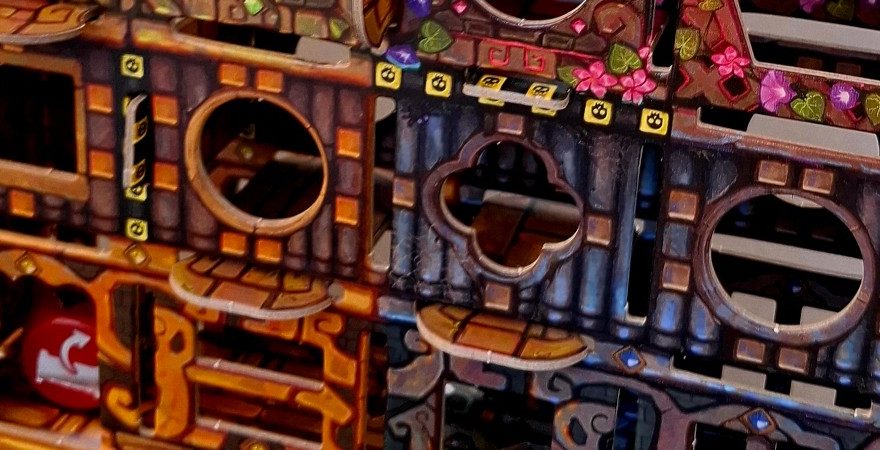
Die nächste Expedition führt uns in den Dschungel. Bei Temple Twist erforschen wir einen alten Tempel und suchen Schätze. Nur bei guter Zusammenarbeit kommen wir mit Drehungen und dem Ein- und Ausbau der Wände ans Ziel. Vor dem ersten Spiel
We’ve been assessing the merits of political leaders in (more or less) democratic countries on this blog for a few years now. Today, we’re looking at the longest-serving chancellor of the Weimar Republic, Germany’s first attempt at parliamentary government – Wilhelm Marx. And which game could be more appropriate for him than Weimar (Matthias Cramer, Capstone Games/Skellig Games/Spielworxx)?
If you want to read more ratings of historical leaders like this, I strongly recommend you subscribe to the blog – all new posts in your inbox right when they go live!
Some caveats ahead: The chancellors will be rated by the knowledge of their time. If they or their contemporaries could not have known about the effects of something, I will not use my hindsight to mark it as a mistake of theirs. The assessment is focused on their conduct as chancellor.
Now, to the system itself: There are three policy field categories (foreign, domestic, and economic policy) and three more general ones (vision, pragmatism, integrity). A chancellor can earn from one to five stars in each category (for a total sum of up to 30). In detail, the chancellor is assessed as follows:
Foreign policy: Did the chancellor increase German influence in the world and the security of Germans at home? Did the chancellor wield German power responsibly and with positive results for the regions affected?
Domestic policy: Did the chancellor increase the liberty of Germans to express themselves and to participate in the political process? Did the chancellor promote domestic security and shape the framework for fair justice dealing with offenses?
Economic policy: Did the chancellor facilitate the prosperity and economic security of Germans (including in the mid- and long-term)? Was the chancellor’s economic policy based on mutual benefit of those involved or did it unduly burden one side?
Vision: Did the chancellor have an idea of what Germany and Europe (the latter counting for more in times of German influence being great) should look like beyond the immediate future? Did the chancellor’s policies steer Germany (and, if applicable, Europe) in this direction?
Pragmatism: Did the chancellor succeed in seeing their policy through from inception to completion? How well did the chancellor manage the support from parliament, society, the administration, the media?
Integrity: Did the chancellor understand the office as a means to benefit themselves, special interest groups, the entire country, or another community? Did the chancellor respect the boundaries of the office?
Note: If you have read my UK prime minister or US president ratings, you will remember that I rated them on the global impacts of their vision as well. As the rating system is only really applicable to democratic leaders and no democratic German leader ever had the chance to conduct a truly global policy, I only assess their vision on national and European grounds.
Early Life: The Catholic Man of Duty
Wilhelm Marx was born in 1863 in Cologne, then a part of the Rhine Province of the Kingdom of Prussia, soon to be part of the united Germany. No one could have foreseen in his boyhood that he would rise to the chancellorship – he was the son of a mere schoolteacher, and a part of the Catholic minority which was always suspected of possibly disloyalty by the Protestant Prussian state. The young Wilhelm Marx was one of many who set out to prove that he could be just as patriotic as any Protestant: He studied law and entered public service. His Catholic faith, however, would always be the guiding star in his life.
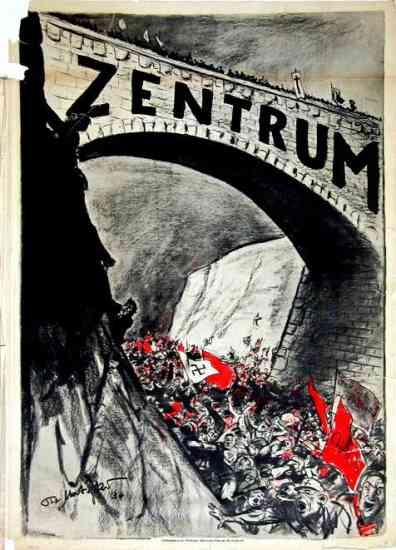
He was first elected to the Prussian parliament in 1899 on the ticket of the Catholic Zentrum (Center) party – one of the four player factions in Weimar. By the time Marx was elected, he had been active for nine years in the Volksverein für das katholische Deutschland (People’s Association for Catholic Germany), an organization dedicated to improving the social conditions especially of the poorer Catholics. Social and cultural issues, especially the expansion of Catholic schooling, would remain close to his heart: In 1910, he founded the Katholische Schulorganisation (Catholic School Organization), a grassroots lobbying organization dedicated to the matter.
The same year, he was elected to the German parliament – his first electoral success on the national level after two campaigns in hopeless districts with very few organized Catholics which he had only undertaken out of duty to the party. In parliament as well as in his electoral campaigns, he aimed to form an alliance with the Protestant bourgeois parties against the burgeoning SPD (Sozialdemokratische Partei Deutschlands, Social Democratic Party of Germany), the second player faction of Weimar. However, this strategy failed when cross-confessional bourgeois solidarity eroded in the more confrontational cultural climate from 1911 on.
World War and Revolution
These divisions faded into the background with the beginning of World War I. Despite the pre-eminence of military and diplomatic action then, Marx’s political activity remained limited to domestic issues. From his papers, we cannot discern if he even formed an opinion on many of the pressing issues in those other realms (say, unrestricted u-boat warfare). He did, however, change his mind about cooperation with the SPD, with whom the Zentrum (and the liberal parties) partnered from 1917 on in their quest to place the imperial government on a more parliamentary basis.
The revolution of 1918/1919 took Marx by surprise. Once more, he placed his powers at the disposal of his party, and was elected to both the Prussian and the German constitutional assemblies. The National Assembly in Weimar developed a constitution which included many long-held dreams of his, as the Catholic church, Catholic associations, and individual Catholics finally had their rights guaranteed. The short period of cooperation with the Social Democrats (and, to a lesser degree, the progressive liberals of the DDP (Deutsche Demokratische Partei, German Democratic Party) had achieved what years of negotiation with the Protestant conservatives of the Empire had not. This early alliance between Zentrum and SPD is the starting point of any Weimar game.
Yet the new German republic was unpopular with the numerous conservative, monarchist Zentrum members, and cooperation with the Social Democrats doubly so. Marx thus spent much of his political energy advocating for the constitution among his fellow Catholics.
At the time, Marx considered leaving politics altogether in favor of focusing on social work: From 1919 to 1921, he acted as director for the Volksverein (but proved unsuited to implement the sweeping changes necessary to improve the Volksverein’s faltering popularity in the Catholic milieu).
Yet once more duty called: As many of the old Zentrum parliamentary leaders died, Marx was one of the most experienced politicians his party could field. And his conciliatory, even-handed manner was just what the Zentrum needed when the party was so deeply divided against itself on the question of supporting the republic or restoring the monarchy as well as if to cooperate with the Social Democrats or the Protestant nationalists of the DNVP (Deutschnationale Volkspartei, German Nationalist People’s Party), the third Weimar player faction.
Marx was thus called on to hold the diverging wings together: He was elected head of the parliamentary group of the Zentrum and then also party chairman in late 1921. As the Zentrum’s governing partner SPD merged with the more left-leaning USPD (Unabhängige Sozialdemokratische Partei Deutschlands, Independent Social Democratic Party of Germany), Marx advanced a closer cooperation with the two liberal parties DDP (in government) and DVP (Deutsche Volkspartei, German People’s Party, in opposition) – the two minor parties which the Zentrum can control in Weimar. Yet Chancellor Joseph Wirth’s attempt to entice the DVP into a government of all democratic parties (a Grand Coalition) failed in late 1922. As a consequence, the SPD left the government as well. The parliamentary basis for the government shrunk.
The following year, Germany was shaken by the French occupation of the Ruhr which exacerbated the already galloping inflation. Under these circumstances, the Grand Coalition of all democratic parties became reality, led by DVP chancellor Gustav Stresemann. While it tackled these huge tasks rather successfully, the government could not maintain its internal cohesion: The right wing of the DVP (under its parliamentary leader Ernst Scholz) wanted to use the crisis to abolish the eight-hour workday and expand the government to the right by including the DNVP. The SPD refused and left the government. Marx’s conciliating manner helped with bringing both of them back to the negotiating table and a new Grand Coalition was formed.
This one was even shorter-lived: When federal forces broke up the socialist state governments of Saxony and Bavaria, but (doubting the loyalty of the army) refused to act against the right-wing coup in Bavaria, the SPD once more went into opposition. Without a parliamentary majority, Stresemann was soon unseated as chancellor. As the SPD’s appetite for government responsibility was sated, a bourgeois minority cabinet would be formed. That would be straight-up impossible in Weimar – unlike left-wing or right-wing coalitions, the Weimar Coalition (with SPD and Zentrum as the player factions and the DDP as a minor party which is always attached to one of the two) cannot refuse to govern, and so SPD and Zentrum are often stuck with each other if they want it or not. Historically, the SPD was not quite as keen on governing as the party is in Weimar.
To get anything done without a parliamentary majority would require special skills at winning friends and not making enemies. Marx, the skilled mediator, was just the right man for the time. He was elected chancellor on November 30, 1923. The weighty issues facing him were Bavaria’s continued insurrection, the implementation of the measures against hyperinflation, and an agreement with the Allies on the reparations issue which had set off the entire crisis of 1923.
A full hand of cards, leading the government (chancellor token in the top left), both liberal minor parties aligned (bottom right) – a comfortable situation for the Zentrum in Weimar, but not so much in history.
The First and Second Chancellorships
Marx’s cabinet nominations sent a signal to Bavaria that he was willing to improve the relationship between the fractious state and the Reich: He made the Bavarian Eduard Hamm (DDP) Minister for the Economy, and, for the first time in the history of the republic, included a member of the BVP (Bayerische Volkspartei, Bavarian People’s Party) whose more radical members had been behind the coup in Bavaria (Erich Emminger as Minister of Justice). His discreet negotiations with the Bavarian coupists would come to fruition in spring 1924: They resigned and opened the way for parliamentary government again. Bavaria, however, would retain some special privileges and be exempt from federal oversight.
The BVP had played an ambiguous role in the anti-republican insurrection in Bavaria. While the party cooperated with the Zentrum in national politics, its leader Gustav von Kahr had also been behind the coup of September 1923. This playtest version of the “Bayerische Volkspartei” card strengthens the Zentrum in parliament, but also allows the DNVP to recruit a dissolved unit – the latter effect was removed in the final version of the game.
Both the reparations negotiations with the Allies and the massive financial and economic reform package which would solidify the end of inflation required Marx to gather parliamentary support far beyond his minority coalition’s meager base. As there were constitutional changes involved (for example, in merging the various state railway companies into a federal railway), he even needed a two-thirds majority. Marx’s parliamentary skills and his reputation as an honest broker who would not abuse his power came together in securing an Enabling Act which would allow his government to gain the respective legislative powers despite their parliamentary minority. Equipped with such power, Marx set out to do the necessary, but unpopular steps forward. The cuts to public expenses which were to flank the currency reform massively reduced the number and salary of public employees and all but expropriated most pensioners.
The bitter taste of Marx’s domestic reforms was lessened by the negotiations with the Allies. Not even France had the stomach to force another confrontation after the chaos of 1923. They were thus inclined to negotiate a payment schedule which suited both sides. American bankers were to provide the loans with which Germany would cover a large part of the payments.
The electorate, however, was unimpressed. In the May 1924 parliamentary elections, Marx’s Zentrum held firm, but his DDP and DVP partners collapsed, as did the SPD. The right-wing parties were triumphant. Yet with no viable alternative to the bourgeois minority coalition, Marx was soon confirmed for his second chancellorship.
In the second tenure, he concluded the negotiations with the Allies. The final agreement would become known as the Dawes Plan after the chief Allied negotiator, American banker Charles G. Dawes. Once more, Marx needed a broad parliamentary majority. In addition to his government coalition, the SPD was sure to support the plan. The DNVP publicly railed against the Dawes Plan (which confirmed the infamous war guilt clause of the Treaty of Versailles), but DNVP chairman Oskar Hergt offered his support in return for policy concessions and the DNVP’s inclusion in government. Otherwise, he threatened that the Dawes Plan would fail in parliament. Marx, however, knew that the DNVP was internally divided on the matter and that a large number of DNVP members of parliament either saw the necessity of the plan for German economic revival or at least did not want to take the blame for the failure. Thus, he called the parliamentary vote without giving in to Hergt’s demands. The motion passed, as most DNVP members abstained.
Marx’s policy successes had not broadened his parliamentary base. As he kept refusing the DNVP’s inclusion in government in favor of a more centrist approach, new elections were called for December 1924. These did not change the parliamentary balance of power much. Marx resigned and was succeeded by Hans Luther, who formed a technocratic government based on the centrist and right-wing parties including the DNVP.
Parliament includes a lot of Zentrum members… but not enough for a majority.
Prussian Intermezzo, Presidential Election
Marx could not enjoy being relieved of his duties for long. When the Prussian DVP, as much a loose cannon as its federal counterpart, forced the end of the Grand Coalition in Prussia, Germany’s largest state, and demanded a right-wing government including the DNVP like in the Reich, Marx was called on to solve the government crisis. He was elected Prussian Prime Minister with the votes of the Weimar Coalition (SPD, Zentrum, DDP) on February 18, 1925, yet just two days after was toppled when renegades in his own party refused to support him in a parliamentary vote of confidence. Marx resigned, his appetite for politics lessened and his trust in the party damaged.
Still, Marx was one of the few Zentrum politicians who were well-known and had a good enough reputation to field in national elections. When President Friedrich Ebert (SPD) died, he was thus the natural candidate for the next presidential elections. The death of Ebert is a turning point in many Weimar games: The office allows its holder to play one card per round for two uses instead of just one. So, it is in essence a one-card bonus. As you normally only hold five cards, this is a huge boon. The presidential elections will thus be hotly contested and usually also serve as a check on who seems to be in the lead and must be reined in… sometimes in surprising coalitions.
In the first round, Marx gained 14% of the vote, the third-best showing after Duisburg mayor Karl Jarres (DVP, 39%) and the new Prussian prime minister Otto Braun (SPD, 29%). Now the coalition-building began. The SPD withdrew Braun, knowing that bourgeois voters almost never supported a working-class candidate in runoff elections. Instead, Marx was nominated as the joint candidate of the Weimar Coalition parties (People’s Bloc). Together, their candidates had received 49% of the vote in the first round. The right-leaning parties knew that Jarres, a man with no national standing, stood no chance in the second round. However, it was legal to field a candidate in the second round who had not stood in the first. They produced the old imperial field marshal Paul von Hindenburg – the “Victor of Tannenberg”.
Now the bickering for support in the second round begins! Unlike in history, parties in Weimar may support candidates which are ideologically opposed to them (usually to prevent a runaway leader or as part of a bigger political deal).
Marx might have been a more attractive candidate for centrist and bourgeois voters than Braun, but he still failed to attract votes beyond the Weimar Coalition. Conservative Protestants did not vote for him, and even his more conservative Catholic brothers and sisters in faith deserted him in favor of Hindenburg. Despite their Catholic fundament and Bavarian particularism, the BVP supported the Protestant Prussian marshal. Hindenburg was elected on April 26, 1925, with 48% of the vote (Marx carried 45%).
The Third and Fourth Chancellorships
The centrifugal forces within the Zentrum intensified. The party’s right wing blamed the defeat at the presidential election on Marx’s refusal as chancellor to form a coalition with the DNVP. The existing coalition under Luther fell apart when the DNVP refused to consider an agreement with the Allies which would confirm the post-Versailles borders in Western Europe. In December 1925, Luther formed a bourgeois minority coalition supported by Zentrum, DVP, DDP, and BVP in which Marx headed both the Ministry of Justice and the Ministry for the Occupied Territories.
The next inevitable call of duty came when Chancellor Luther resigned in May 1926. When the Zentrum once more turned to Marx to fill the post, he wrote to his wife, “Now they’ve found their idiot again”. Like the first two times, Marx’s cabinet based on Zentrum, DVP, DDP, and BVP had no parliamentary majority, so he had to look for outside support. While the SPD bumbled in the Princes’ Expropriation campaign, it could be relied upon to continue the foreign policy of rapprochement with the Allies, and thus Marx was able to negotiate the admittance of Germany into the League of Nations in 1926 – in Weimar, one of the most difficult, but also most valuable foreign policy successes of a government.
Marx’s government was toppled by a vote of no confidence over the military’s secret cooperation with the Soviet Union in February 1927. By now, the right wing of the Zentrum was clearly ascendant, and the party pushed for a coalition with the DNVP. Marx opposed the notion, but felt compelled to give in to his party’s wishes. Thus, his fourth cabinet included DNVP ministers for the first time – no fewer than four of them. Despite this new right-wing bent, the new government implemented a major piece of social security with the introduction of unemployment insurance.
Marx’s special ability in Weimar allows him to swap two issues on the debate track: He might, for example, bring the attractive Unemployment Insurance issue to the Zentrum area of the track – and instead give the SPD the Stab in the Back issue which would have them face the dilemma between either weakening their own position or strengthening the DNVP.
However, infighting increased both in the Zentrum (between its republican and its conservative wings) and the government coalition at large. Marx attempted to pacify the former by pushing for legislation which would please both by appealing to their shared Catholicism – and which was dear to his own heart: A federal school law should codify the equality of confessional schools (with religious instruction only in the corresponding faith) with “simultaneous schools” (with both Protestant and Catholic religious instruction on offer). While that improved cohesion in the Zentrum, it put a strain on the coalition: The liberal parties DVP and DDP opposed the measure. Marx was unable to find a compromise. As the coalition disintegrated and the Zentrum’s right-wing gained ever more traction, the subsequent electoral defeat of May 1928 was almost a relief for Marx. A new Grand Coalition, led by chancellor Hermann Müller (SPD), was formed.
After Politics
After the election, Marx withdrew from politics. His centrist course was abandoned by his ever more right-leaning party which ended the Grand Coalition in 1930, operated a minority cabinet without parliamentary support strictly via presidential emergency decrees, and finally even voted in favor of the Enabling Act of 1933 which transferred the legislative power on the freshly elected Nazi government.
Marx himself limited his public activities to umbrella organization of Catholic student associations which he chaired. When the organization was to be Nazified in 1933, he let himself be pushed aside without a fight.
Marx’s old acquaintances shunned him after the Nazi takeover, as nobody wanted to be perceived to be close to an exponent of the democratic system. He lived a private life on very limited means and was fortunate to be left alone by the Nazis. When the post-war political system was formed in Germany, Marx joined the CDU (Christlich-Demokratische Union, Christian Democratic Union), the new cross-confessional Christian party. Soon after, Wilhelm Marx died on August 5, 1946.
Weimar Germany’s longest-serving chancellor is today all but forgotten.
The Rating
Foreign Policy
Marx’s foreign policy was neither original – Hermann Müller had outlined it as foreign minister and chancellor in the early 1920s – nor entirely his own – Gustav Stresemann, who served as foreign minister in all of Marx’s cabinets, carried out a good deal of it. It was, however, successful, as both the Dawes Plan and the admittance to the League of Nations show. Sometimes, the soft-spoken, conciliatory Marx also enjoyed advantages over the brash Stresemann – tough talk would not have finalized the Dawes Plan.
Rating: 4 out of 5.
Domestic Policy
Marx had been reared to champion the cause of Catholic cultural equality from his early years on. His tragedy is that most of the disadvantages Catholics faced in the Protestant German Empire were removed by the Weimar Constitution, and those which remained – for example, that Catholic civil servants were less likely to be promoted – had no simple legislative solutions. Yet such solutions Marx kept pursuing, as with his ill-fated school law (despite the fact that 85% of Catholic schoolchildren already attended Catholic confessional schools). This practical non-issue has not even made it into the Weimar game – neither as an event card nor as a debate issue. Marx squandered political capital in the pursuit of an object which was neither useful nor attainable.
Rating: 1 out of 5.
Economic Policy
The ambitious anti-inflation reforms of 1923 and 1924 had been initiated by Stresemann, a friend of decisive action. Yet their actual implementation fell to the more measured Marx – probably a lucky stroke. Neither of them attempted to curtail the social effects of the reforms, and thus many pensioners and former as well as current civil servants fell into poverty, often alienating them from the republic.
Similarly, the introduction of unemployment insurance was a great step forward for social security – but it was underfunded in the relatively prosperous years of the beginning, and when unemployment and thus costs exploded after the crash of 1929, the system proved to be both a burden on the national budget and insufficient to alleviate the hardship of the many.
Rating: 4 out of 5.
Vision
Marx was content to be placed wherever his party or the country needed him and do what he thought was required of him. He did not shape politics as much as answer to calls of duty.
Rating: 1 out of 5.
Pragmatism
Considerable parliamentary skill and his negotiation as an honest broker allowed Marx to gain him the majorities for his Enabling Act (1923) as well as the ratification of the Dawes Plan (1924). His mastery in that mere year contrasts unfavorably with his constant inability (despite his best attentions and efforts) to control the direction of his party (or at least keep the renegades under control), most markedly in the Prussian fiasco of 1925. His willingness to go along with any situation and answer any call of duty weakened his negotiating power, and forced him to repeatedly carry out political operations with whose premises he did not agree.
Marx was personally incorruptible. He managed to be both a committed party man, but govern with all of his country in mind. However, the Enabling Act set a dangerous precedent for the erosion of the constitution.
Rating: 4 out of 5.
Overall
In his first and second chancellorship, Wilhelm Marx rose to the challenge of implementing the solutions to the great crisis of the republic. In his later tenures, he performed markedly worse despite the much-improved situation. His biggest successes are holding the course in foreign and economic policy in 1924, his biggest failure his inability to develop and implement a long-term plan for his party and the republic.
How would you rate Marx? Let me know in the comments!
Further Reading
For short overview essays on all German chancellors from Bismarck on, see Sternburg, Wilhelm von: Die deutschen Kanzler.Von Bismarck bis Merkel[The German Chancellors. From Bismarck to Merkel], Aufbau-Verlag, Berlin 2006 (in German).
The only full-length biography of Marx is Hehl, Ulrich von Wilhelm Marx: 1863—1946.Eine politische Biographie [Wilhelm Marx: 1863—1946. A Political Biography], Matthias-Grünewald-Verlag, Mainz 1987. Its somewhat dry style is made up for by its detailed, source-rich research.
For the broader context, see: Herbert, Ulrich: A History of Twentieth-Century Germany, Oxford University Press, Oxford 2019.
Back to the history and board games of New York City! Last time, we’ve looked at the city’s humble beginnings all the way to the destruction wrought on the city by the Revolutionary War. Today, we’ll cover the first century of New York City as a city in the United States – how it established its primacy in the country, how it was at the same time very attractive and a horrible place to live in, and how it took shape as a modern metropolis. As always, board games will guide us.
American Capital
When Britain had recognized American independence in 1783, the young country gave itself a constitution – the Articles of Confederation. The United States were organized on strictly confederative principles. New York City became the capital. The advocates of broad independence for the states and minimal federal government, however, lost ground over the next few years as the United States struggled to deal with the post-war challenges, chiefly the states’ tremendous debt. Thus, over ferocious public debate, a new constitution was adopted in 1787, and according to it, a strong chief magistrate elected – George Washington, the first president, who was inaugurated in 1789 at City Hall, New York.
One of the fiercest proponents of a strong federal government was New Yorker Alexander Hamilton who became the nation’s first secretary of the treasury. In this role, Hamilton advocated for further government centralization, especially in regards to financial and economic affairs, based on his experience in the commercial hub New York. Hamilton succeeded in having the federal government take over the remaining states’ debts, but his opponents – chiefly rural southerners – demanded a price: The federal capital would move away from New York. Philadelphia would fill the role temporarily, before a new capital to be constructed in a southern swamp would be ready – the future Washington, D.C.
Even though New York City ceased to be America’s capital, it was still the prime center of American capital. In 1792, the New York Stock Exchange was founded. Its location – Wall Street – is synonymous with finance until today. The city’s booming harbor also attracted more and more commerce. By 1804, New York City had overtaken Philadelphia as the largest city in the United States at around 70,000 inhabitants. As growth did not slow down, the city’s leadership embarked on a scheme which must have seemed megalomaniac at the time: In 1811, they adopted a development plan which laid a regular grid of avenues and perpendicular streets over Manhattan Island, encompassing areas large enough to house a million people at the contemporary population density. That was the blueprint for modern New York City.
New York’s growth, however, was not pre-ordained. It relied chiefly on the city’s status the nation’s premier port. Yet as the United States grew westward, New York lay farther and farther away from many of the new towns and states. Goods could only flow to or from the Great Lakes or the Great Plains by arduous land journeys – or down the Mississippi. New Orleans, located at the mouth of the great stream, seemed poised to take over New York’s role as America’s port. That’s when the governor of New York state, DeWitt Clinton, proposed an ambitious engineering scheme: Nature might not have connected New York City with the great inland waterways of America. But men could. The 350-mile Erie Canal, completed in 1825, connected the Hudson River with Lake Erie and thus allowed uninterrupted ship transport from New York all the way to the western frontier states.
Packet Row (Åse Berg/Henrik Berg, White Goblin Games) is set in the bustling port of New York in the 1840s. Players need to find the right combination of trade goods (so, supply), contracts (demand), and ships to grow rich as merchants. Money alone will not be enough for victory: The game embodies the ethos of the magnates of the 19th century, which held that wealth came with responsibility for the community. Thus, the money earned in Packet Row needs to be spent on projects which benefit the city (say, the university) for victory points.
When the Erie Canal was completed in 1825, 89% of New Yorkers had been born in the United States. By 1860 that number had fallen to less than half. Let’s take a look at this great social and political transformation.
Immigration, Death, and Politics
New York’s status as America’s port made it incredibly attractive for immigrants: Its booming trade hungered for willing workers, and even if immigrants had different dreams – say, farming on the wide prairie – they would probably arrive by ship in New York. In the mid-19th century, an astounding 70% of all European immigrants to the United States entered the country through New York. The absolute numbers are even more breath-taking: In the decade after the Great Famine, a million Irish alone arrived in New York, along with German, English, and Scottish immigrants.
Despite this massive population influx, New York City had only around 800,000 inhabitants by 1860. That was partly because many immigrants moved on further inland, but also because of the astonishing mortality: For example, during the year 1856, 4% of all adults and 20% of all children in New York City died. The cramped living quarters in which most immigrants found themselves and the inadequate medical infrastructure made New York a fertile breeding ground for all kinds of epidemics, while the high cost of living forced the immigrants into long working hours at often dangerous jobs.
Under these circumstances, it is no surprise that the immigrants turned to anyone who promised them a helping a hand. And as they were so many (and usually gained citizenship after two years of residence), courting them became a viable electoral strategy. Fernando Wood became the first New York mayor whose election had been largely achieved by his success with Irish-American and German-American voters. His recipe for success – mobilizing various immigrant communities – would be copied for decades by his successors in Tammany Hall, the local Democratic Party’s political machine which traded patronage for votes.
Tammany Hall (Doug Eckhart, Pandasaurus) is centered on this political strategy: The basic move which players take is to select one immigrant token (Irish, German, English, or – inspired by the later 19th century – Italian) and place it in one of the wards of New York. That gives the player both some influence with the respective immigrant community and some potential strength on the ground in that ward, come the next election. Whichever player wins most wards in an election round becomes mayor of New York and thus gets to dole out City Hall jobs to their allies.
Tammany’s success in the 1850s was based on organizing various disparate communities. The Civil War brought ruptures to this alliance: Mayor Wood called for New York City to secede from the Union and become a “free city” in order to maintain trade relations with the treasonous southern states. The majority of Tammany Democrats, however, were staunchly in favor of the Union, but less enthusiastic about the cause of abolitionism. Thus, many of the German immigrants (often veterans of the 1848/49 revolution) abandoned the party in favor of the Republicans, and the German-Irish voting bloc split (although it would remain firmly united in its opposition to the temperance movement).
The split caused a Republican-led fusion ticket to win the mayoral election of 1862. It would be a short break from Tammany rule, as the new mayor faced growing racial tensions: On July 13 1863, protests against the continued draft erupted in violence. For the next three days, a mob (mostly consisting of Irish-Americans from the Lower Manhattan slums) rampaged through the city, targeting Black neighborhoods. The Draft Riots would only be put down once regiments returning from Gettysburg reached the city. Many Black New Yorkers left the city afterward, so that they amounted to barely over one percent of New York City’s population in 1865.
Tammany rule was restored in the 1864 mayoral election… not that it mattered much who exactly the mayor was, as long as he was a loyal follower of the Tammany machine. The unbridled access to power allowed the Tammany leader William “Boss” Tweed to become one of the richest men in New York – and public money also lined the pockets of many public servants and private contractors (especially in the construction business). The most outrageous example of this corruption was the construction of the County Courthouse. Tweed himself bought a quarry to supply the marble for the project at egregious prices, and the subcontractors had a field day, too, billing amounts like $360,000 for one carpenter’s month of labor or $7,500 per individual thermometer. The Courthouse’s final cost ran up to $13 million – almost twice the price of the contemporary Alaska Purchase!
Tweed, however had cranked the levers one too many times. Even New York Democrats (at least those set aside by him) distanced themselves from him. A court found Tweed guilty of embezzlement and sentenced him to a year in prison. He escaped and made his way to Spain, but was discovered and extradited to the United States, where he would die in prison. Tammany would rule New York politics for almost another century due to the machine’s continued ability to organize new immigrants (Italians and Eastern European Jews in the late 19th and early 20th centuries), but the worst excesses of its corruption ended with Boss Tweed. Indeed, for a 20th century New Yorker, it would be almost impossible to imagine how political office could be mostly sought to enrich a few powerful individuals and their willing helpers.
The Dawn of the Modern Age
New York City in the mid-19th century was squalor and corruption, but it was also the place where the innovations of the modern metropolis first took shape. The explosive population growth and the crowded living conditions were countered with a massive park development – Central Park, until today New York’s finest place to breathe fresh air and surround yourself with the peace of grass and trees. Construction lasted from 1857 to 1876.
New technology also sprung from New York – literally and figuratively. When Thomas Edison looked for the first city in which to broadly distribute electricity, New York was the obvious choice. And the transformational impact of the railroad on America would not have been possible without the finance hub New York raising and directing the capital for the investments. So, all of you 18XX gamers, you can thank New York!
Finally, in 1886, New York City received its most iconic landmark: The people of France gifted the United States a large statue, symbolizing liberty, the chief value of the American Revolution. Once the Americans had succeeded at funding the pedestal for the statue – encouraged by campaigns of the New York newspapers – the Statue of Liberty was proudly displayed in New York harbor, welcoming newcomers and promising them a free life. In the words of Emma Lazarus, whose poem adorns the a plaque inside the pedestal of the statue:
Not like the brazen giant of Greek fame,
With conquering limbs astride from land to land;
Here at our sea-washed, sunset gates shall stand
A mighty woman with a torch, whose flame
Is the imprisoned lightning, and her name
Mother of Exiles. From her beacon-hand
Glows world-wide welcome; her mild eyes command
The air-bridged harbor that twin cities frame.
“Keep, ancient lands, your storied pomp!” cries she
In the years after the Statue of Liberty was erected, New York shape-shifted… upwards. The age of the skyscraper began, and nowhere more so than in Manhattan. But that’s a story for next time!
For a concise introduction, especially focused on local politics, see Lankevich, George J.: New York City. A Short History, New York University Press, New York City, NY/London 1998.
If you want a treatment which is both more in-depth and more journalistic (and lavishly illustrated) and don’t mind its history practically ending around 1970, see the book version of the 17-hour PBS documentary from 1999: Burns, Ric/Sanders, James/Ades, Lisa: New York. An Illustrated History, Knopf, New York City, NY 2001.
We’ve been assessing the merits of political leaders in (more or less) democratic countries on this blog for a few years now. Today, we’re returning to German chancellors… but not the way you know it. After a few chancellors from the Federal Republic of Germany (founded in 1949), we’re assessing for the first time a chancellor from the Weimar Republic, Germany’s first attempt at parliamentary government – Hermann Müller. And which game could be more appropriate for him than Weimar (Matthias Cramer, Capstone Games/Skellig Games/Spielworxx)?
The Rating System
Some caveats ahead: The chancellors will be rated by the knowledge of their time. If they or their contemporaries could not have known about the effects of something, I will not use my hindsight to mark it as a mistake of theirs. The assessment is focused on their conduct as chancellor.
Now, to the system itself: There are three policy field categories (foreign, domestic, and economic policy) and three more general ones (vision, pragmatism, integrity). A chancellor can earn from one to five stars in each category (for a total sum of up to 30). In detail, the chancellor is assessed as follows:
Foreign policy: Did the chancellor increase German influence in the world and the security of Germans at home? Did the chancellor wield German power responsibly and with positive results for the regions affected?
Domestic policy: Did the chancellor increase the liberty of Germans to express themselves and to participate in the political process? Did the chancellor promote domestic security and shape the framework for fair justice dealing with offenses?
Economic policy: Did the chancellor facilitate the prosperity and economic security of Germans (including in the mid- and long-term)? Was the chancellor’s economic policy based on mutual benefit of those involved or did it unduly burden one side?
Vision: Did the chancellor have an idea of what Germany and Europe (the latter counting for more in times of German influence being great) should look like beyond the immediate future? Did the chancellor’s policies steer Germany (and, if applicable, Europe) in this direction?
Pragmatism: Did the chancellor succeed in seeing their policy through from inception to completion? How well did the chancellor manage the support from parliament, society, the administration, the media?
Integrity: Did the chancellor understand the office as a means to benefit themselves, special interest groups, the entire country, or another community? Did the chancellor respect the boundaries of the office?
Note: If you have read my UK prime minister or US president ratings, you will remember that I rated them on the global impacts of their vision as well. As the rating system is only really applicable to democratic leaders and no democratic German leader ever had the chance to conduct a truly global policy, I only assess their vision on national and European grounds.
Müller’s Early Life
Hermann Müller was born in Mannheim (in the southwest of Germany) on May 18, 1876. His father ran a small sparkling wine company, but died when Hermann was still a teenager. Thus, instead of taking over the company or going to university, the young Hermann Müller trained to become a clerk. He soon became involved with the socialist movement and joined the Social Democratic Party of Germany (SPD) in 1893. After some years working for social democratic newspapers, he was elected to the leadership board of the SPD in 1906. Müller was often charged with liaisons to other socialist parties in Europe – including a doomed trip to Paris in July 1914, trying to negotiate a joint refusal of French and German socialists to support their respective countries’ impending war with each other.
Müller was elected to Imperial Germany’s parliament in a by-election in 1916. Soon after, the German Social Democrats split between the Majority Social Democrats (MSPD, including Müller) who supported the war effort, and the Independent Social Democrats (USPD), who did not. When the war was lost in November 1918 and the monarchy swept away by revolutionary soldiers and workers, the MSPD soon took control of the revolution and steered a moderate course towards parliamentary democracy.
The revolution of 1918/1919 transformed the (M)SPD from the pariah party of Imperial Germany to the most important pillar of the new republic. As the Social Democrats were no longer barred from the positions of power, they needed scores of cadres to fill them. The general upswing also brought a promotion for Müller, who was elected co-chairman of the MSPD in 1919. Government came with its own challenges: The lost war, the ongoing Allied naval blockade, and the weak position of the new government made it imperative to conclude a peace treaty with the Allied powers. The provisions of the Treaty of Versailles, with which the Allies presented Germany, seemed unacceptable to most Germans – including many Social Democrats. Chancellor Philipp Scheidemann resigned rather than take responsibility for the treaty. He was succeeded by Gustav Bauer (also SPD) whose new administration Müller joined as foreign minister in June 1919. In this role, it fell to him to sign the treaty. From there, Müller sketched the outlines of a new foreign policy – one in which Germany would cooperate with the Allies, use its economic and cultural rather than its military strength to influence world events, and thus overturn the harsh provisions of the Treaty of Versailles.
The Bauer administration resigned after the Kapp-Lüttwitz coup of March 1920. Müller took over the chancellorship as a caretaker – elections were scheduled for June 1920. He was unable to tackle most of the many challenges which beset Germany (chiefly the agreement with the Allies on the details of the German reparations, the tensions over the German-Polish border, and the threat of right-wing terrorism and insurgency (as in the Kahr coup in Bavaria)). The only crisis which was dispelled during his time in office was the dissolution of the Red Ruhr Army, a left-wing militia which had formed in opposition to the Kapp-Lüttwitz coup and, after its failure, had continued their struggle for a council republic on the Ruhr. Their uprising was put down by army and Freikorps units and over a thousand workers (with more or less connection to the uprising) summarily executed.
The Red Ruhr Army can give the Communists a powerful push in the game… and make the Republican parties more forgiving of the Nationalists taking over army units (black units in Essen).
The first one and a half years of democratic government in Germany had proven a disappointment for many voters, including those who generally were in favor of the new republic. The three government parties (the SPD, the Catholic Center (Zentrum), and the liberal German Democratic Party (DDP)) all suffered heavy losses in the 1920 election. The SPD was particularly hard hit, as its handling of the Kapp-Lüttwitz coup and the Ruhr Uprising disenchanted many left-leaning workers. Both the USPD and the pro-business, conservative-liberal German People’s Party (DVP) gained a lot of votes.
With the majority for the government coalition lost, Müller attempted to broaden the government by including the USPD. Due to his handling of the aftermath of the Kapp-Lüttwitz coup, he was brusquely rebuffed. As he did not see potential to cooperate with the DVP, he led the SPD into opposition.
The Opposition agenda card in Weimar strengthens the SPD in parliament and allows the party to (re-)gain a minor ally (the USPD or DDP).
Opposition and Return to Government
Müller’s own inclination was to return to government responsibility, but he prioritized first the reunification of the SPD with the USPD (concluded in 1922) and then the prevention of another rupture. However, the SPD supported the bourgeois minority government (Zentrum, DDP, and DVP) in matters of foreign policy, which was conducted by the guidelines which Müller had laid out as foreign minister and chancellor in 1919 and 1920.
The reparations issue, however, remained unresolved. As tensions over it with the Allies heated up, France occupied the Ruhr again, to which the government responded with encouraging the population of the Ruhr to cease cooperation with the occupiers. This “passive resistance” relied on the national government funding the livelihood of millions of people and thus fueled inflation. As these interconnected crises escalated, it became clear that the government did not have the parliamentary and public support to deal with them. Government needed to rest on a broad basis. The first “Grand Coalition”, led by DVP chancellor Gustav Stresemann and including SPD, Zentrum, DDP, and DVP was inaugurated in August 1923. Four Social Democrats became ministers. Hermann Müller, however, was none of them as he was deemed indispensable to maintain control of the fractious SPD parliamentary group (whose vote to join the government had been on the narrowest of margins).
Stresemann’s re-roll ability makes him an excellent ally in any kind of crisis – coups, foreign policy, presidential elections.
While the Stresemann government successfully ended both the passive resistance (and French occupation) and the inflation crisis, the way there was rocky. It included challenges from both the left wing in Saxony and Thuringia (which were put down by the armed forces once the Communist Party entered a parliamentary government) and the right wing (a nationalist power grab in Bavaria was left unanswered as the loyalty of the army to the republic seemed suspect; an attempt to radicalize Bavaria even further led by a young demagogue named Adolf Hitler collapsed when it met resistance by the nationalist authorities). This uneven treatment convinced the SPD to leave government after only three months. Stresemann, thus without a majority, soon was toppled as chancellor, but remained foreign minister.
The SPD, despite being the largest party in parliament (and being confirmed in this status in 1924), would spend the next five years in opposition. Attempts to form another Grand Coalition failed in 1924 and 1925 (because the DVP preferred to cooperate with the nationalist DNVP and the new, monarchist, president Paul von Hindenburg), and in 1926, because Müller’s SPD engaged in the fool’s quest of pursuing a plebiscite to expropriate the former princes – the plebiscite failed to meet the quorum as expected, but it set the SPD on a path of confrontation with the bourgeois parties which ruled out any cooperation with them.
That did not mean that cooperation was impossible: The SPD continued to back the cooperative-revisionist foreign policy of the government, and also supported budget compromises. Thus, the party agreed to a budget for the year 1928 which included a first payment for new armored cruisers to modernize the navy. It then campaigned for the March 1928 elections on the slogan “Meals for Children instead of the Armored Cruiser”. The electorate returned the SPD with its best showing since 1919. Müller was able to form a government (once more including Zentrum, DDP, and DVP) and was elected chancellor for the second time.
Müller at work in his preferred arena – that of parliamentary debate, not of street action. His event often allows the SPD player to shift the issues decisively in their favor.
The Second Chancellorship
The contradiction between parliamentary action and campaign promises immediately backfired for Müller. The budget for the new fiscal year was due, and as agreed, included funds for the naval modernization. Müller belatedly realized that the decision had been made already, that the SPD had agreed to it, and that his government partners would expect the SPD to stick to its previous course. While Müller and the SPD ministers voted in favor of the budget in cabinet, the SPD parliamentary group revolted against the budget and forced them to vote against it in parliament. It did the rebels no good, as they could not find another majority for an alternative budget, but the revolt was a catastrophe for Müller’s authority.
The economic situation was similarly unpromising: When the trade unions of the Ruhr heavy industry proposed a pay raise by 15 pennies per hour, the employers responded by pre-emptively handing hundreds of thousands of workers their notice. Unions and employers then agreed on mediation, but when the employers did not like the result, they backtracked and disputed the legality of the process. Thus, 240,000 iron workers were laid off. Müller had a second mediator make a new proposal, which was suitably employer-friendly (with pay raises ranging from one to six pennies per hour). The employers contentedly saw that playing hardball paid off. Their confrontational stance would increase with the growing unemployment after the 1929 stock market crash.
For the time being, Müller enjoyed the greatest success of his tenure: He negotiated a new reparations agreement (without Stresemann, who died in October 1929), the Young Plan (named after Owen D. Young, who represented the American side). The negotiations were a great step forward for Germany (as the reparations were much reduced and payment put on a realistic basis), but a mixed blessing for Müller: On the one hand, the agreement was very unpopular (as it stipulated German payments for the next 58 years) and thus maligned by the right wing (which campaigned against it on the slogan “Enslaved for three generations). On the other, the combination of the undoubted necessity of the negotiations and their unpopularity meant that the moderate right-wing parties held off their assault on Müller for the moment, as they wanted him to take the blame.
The combo of the Young Plan and the petition against it may place up to three new crisis markers on the board. Müller really threaded the needle by successfully negotiating the reparations agreement and then fending off the referendum against it.
It was only a short reprieve. By January 1930, the Young Plan negotiations were concluded. The same month, the DVP, not being held back by the pro-government Stresemann anymore, had secretly decided to break the coalition if the SPD did not agree to radical pro-business reforms. The party had received encouragement from president Hindenburg, who also intimated to Zentrum leader Heinrich Brüning that he would support a Brüning-led bourgeois minority cabinet with presidential executive orders.
The showdown came in March 1930 over the reform of unemployment insurance. Müller had negotiated a compromise with Paul Moldenhauer (DVP), the minister of finance. However, the DVP parliamentary group refused to accept the compromise. Müller then tasked Brüning to work out another proposal which would be acceptable to all parties in government. Brüning’s suggestion – which would have postponed the issue by another year without solving it – found agreement in the DVP, Zentrum, and DDP parliamentary groups, but, despite Müller’s urging, not that of the SPD. The second Müller administration thus ended on March 27, 1930.
Müller had hoped that president Hindenburg would support an SPD-led minority government with executive orders. Instead, Hindenburg turned to Brüning whose chancellorship began the slide into government not backed by parliamentary majorities. The SPD, however, supported Brüning on key issues of economic and foreign policy lest the president find excuses to turn even more authoritarian. It was to no avail: Hindenburg and his camarilla got tired of Brüning in 1932 and replaced him in turn with Franz von Papen and Kurt von Schleicher who enjoyed even less parliamentary support, before it seemed like a smart move to them to ally their nationalist elites to the popular movement of the Nazis in January 1933, ending German democracy altogether. Müller did not live to see his democratic republic destroyed: He had never been of strong health, had campaigned and governed against the advice of his doctors who counselled rest, and died on March 20, 1931.
The Rating
Foreign policy
Müller developed Weimar’s foreign policy in his first term in government (as foreign minister and chancellor), which aimed at proving to the Allies by faithful cooperation that Germany was willing to do its part in reconciliation (but had economic limits in what it could do) and would thus be re-admitted on an equal footing to the international community, which would allow the country to revise key portions of the Treaty of Versailles. While the theory was sound, its application ran into practical problems – for Müller as well as the other chancellors and foreign ministers of the Weimar Republic: French revisionism of the Treaty (France felt short-changed in the matters of annexations and would have liked to incorporate the entire left bank of the Rhine as under Napoleon), and the constant charges from the German right that international cooperation under the Treaty of Versailles was akin to betrayal of the nation.
Müller never gave much attention to the existing inequities during his two terms as chancellor. That he was aware of them is proven by his record as foreign minister, in which he massively overworked the diplomatic service (which had been almost exclusively staffed by nobles heretofore), opening it for applicants from all backgrounds. Similar reforms of the judiciary or the military, two other institutions still personally and mentally clinging to Imperial Germany, did not make it to Müller’s chancellor agenda, even though the atrocities committed on the Ruhr in 1920 while the army could not be used to deal with the Bavarian regime at all showed the necessity of these institutional changes.
Müller’s handling of economic policy was incremental and cooperative – a bad fit to deal with his counterparts in business and the government (DVP) who wanted radical changes through confrontation. Müller’s stance may have been the more reasonable. But Müller lost.
Rating: 2 out of 5.
Vision
Müller’s vision of a Germany based on constructive parliamentary debate and government compromise, cooperating with other countries on an equal footing, is compelling. However, Müller was not always successful in advancing these goals, as he prioritized party unity over compromise with others at times.
Müller failed to see most of his policy initiatives through. He kept neither his coalition nor his own parliamentary group in check. However, Müller prevented another rupture of his party, and as a skilled electoral campaigner, achieved the first place for the SPD in every national election with him at the helm of the party.
Müller was fair and even-handed in his conduct as a chancellor. As a Social Democrat, he considered the workers his natural constituency, but was always willing to include the interests of other groups in the compromises he forged. His only fault was to hope for the a-parliamentary executive order minority government which, in the end, was given not to him, but Brüning.
Rating: 4 out of 5.
Overall
Hermann Müller’s chancellorship is traditionally considered a failure based on the collapse of the Weimar Republic soon after. Yet the Republic did not end with his tenure, and it was destroyed not by his actions, but by those of others. Müller’s most enduring contribution was the invention of the Weimar formula of foreign policy, his biggest weakness his inability to impose authority on his friends, partners, rivals, and foes. He failed because he was a middling chancellor in a hostile world.
How would you rate Müller? Let me know in the comments!
Further Reading
For short overview essays on all German chancellors from Bismarck on, see Sternburg, Wilhelm von: Die deutschen Kanzler. Von Bismarck bis Merkel[The German Chancellors. From Bismarck to Merkel], Aufbau-Verlag, Berlin 2006 (in German).
The only full-length biography of Müller is Reichel, Peter: Der tragische Kanzler [The Tragic Chancellor], dtv, Munich 2018 (in German). Unfortunately, the book suffers from the author’s misguided attempt to assign blame for the end of the republic on the SPD for an alleged lack of willingness to compromise, which runs through the entire book.
A revisionist, but insightful short treatment of Müller is Behring, Rainer: Hermann Müller (1876—1931) und die Chancen der Weimarer Republik [Hermann Müller (1876—1931] and the Chances of the Weimar Republic], in: Brandt, Peter/Lehnert, Detlef: Sozialdemokratische Regierungschefs in Deutschland und Österreich. 1918—1983, Dietz, Bonn 2017 (in German).
For the broader context, see: Herbert, Ulrich: A History of Twentieth-Century Germany, Oxford University Press, Oxford 2019.
Last year, I have inaugurated a new irregular series on my blog assessing the merits of UK prime ministers (illustrated through the lens of a single board game each). The rating system seemed robust enough to apply it to other countries/leaders (at least if they are more or less democratic). Thus, we branched out to an American president and a German chancellor. Today’s subject is another US president – Harry S. Truman, the first Cold Warrior in the White House. And which game could be more appropriate for him than Twilight Struggle (Ananda Gupta/Jason Matthews, GMT Games)?
The Rating System
Some caveats ahead: The presidents will be rated by the knowledge of their time. If they or their contemporaries could not have known about the effects of something, I will not use my hindsight to mark it as a mistake of theirs. The assessment is focused on their conduct as president, but includes their life after holding the office (in which they will still be regarded in the public eye as (ex-)presidents).
Now, to the system itself: There are three policy field categories (foreign, domestic, and economic policy) and three more general ones (vision, pragmatism, integrity). A president can earn from one to five stars in each category (for a total sum of up to 30). In detail, the president is assessed as follows:
Foreign policy: Did the president increase US influence in the world and the security of Americans at home? Did the president wield US power responsibly and with positive results for the regions affected (the latter counting for a greater deal in times of US power being great)?
Domestic policy: Did the president increase the liberty of Americans to express themselves and to participate in the political process? Did the president promote domestic security and shape the framework for fair justice dealing with offenses?
Economic policy: Did the president facilitate the prosperity and economic security of Americans (including in the mid- and long-term)? Was the president’s economic policy based on mutual benefit of those involved or did it unduly burden one side?
Vision: Did the president have an idea of what the United States and the world (the latter counting for more in times of US influence being great) should look like beyond the immediate future? Did the president’s policies steer the United States (and, if applicable, the world) in this direction?
Pragmatism: Did the president succeed in seeing his policy through from inception to completion? How well did the president manage the support from Congress, society, the administration, the media (the latter counting for more in more recent years)?
Integrity: Did the president understand the office as a means to benefit himself, special interest groups, the entire country, or another community? Did the president respect the boundaries of the office?
Truman’s Life
Harry S. Truman was born on May 8, 1884 as the son of Missouri farmers. He took a few classes at a local business school, but remains the only US president of the 20th and 21st century to not have attended college. After a few years of odd jobs, he returned to help on his parents’ farm. As he had political ambitions, he joined the National Guard in 1905 and volunteered for service during World War I.
Back from the war, Truman opened a haberdashery (which went bankrupt in 1921) and was elected county judge (in 1922). His political career was tied to Tom Pendergast’s political machine. Over the course of the following years, he struggled both economically and politically. His fortunes only improved when he was named Missouri’s director for the Federal Re-Employment program (which got him in touch with important people from Franklin D. Roosevelt’s New Deal programs) in 1933 and was elected senator in 1934.
Truman’s first term in the Senate was unremarkable and he only barely won re-election in 1940. The following year, his career took off when he headed a special committee to investigate inefficiencies in US war production – a crucial task with war ravaging both Europe and the Pacific, which the United States would enter later that year. Truman’s reputation for honesty and efficiency recommended him to president Roosevelt who was looking for a running mate in the 1944 presidential elections. As the favorites of the two wings of the Democratic party – Henry Wallace for the liberals, James F. Byrnes for the conservatives – were anathema to the respective other wing, Roosevelt chose Truman as a non-offending alternative – the “second Missouri compromise”. Roosevelt barely met with Truman either on the campaign trail or after their successful election and kept him in the dark about his political initiatives, particularly regarding foreign policy. When Roosevelt died barely three months after the start of his term, Truman entered the presidency woefully unprepared.
His first task was the victorious conclusion of World War II. Germany surrendered only weeks after Truman’s inauguration. When soon after the first nuclear bombs were successfully tested, the United States dropped them on Japan in order to “shock” the country into surrender – a policy which Truman endorsed, but did not specifically authorize (the bomb was treated like any other weapon at the disposal of the commanders in the theater).
In the meantime, Truman grew more distant to America’s erstwhile Soviet allies. He had wanted the Soviets to join the United Nations and the war against Japan, but once they had done both, Truman took a hard line against what he perceived as Soviet expansionism. The first test of strength was Soviet refusal to leave Iran – in violation of the agreement among the Allies after their invasion of Iran in 1941, which specified that they would leave the country six months after the cessation of hostilities. Truman’s tough stance won the day by spring 1946 – but in a pattern typical for his presidency, he did not receive the credit for it among the American public.
A common sight in the first turn of Twilight Struggle: Iran is a focal point for both players if they want to contest the Middle East and have access to western Asia. …in this case, the US player used their +2 influence boost (according to competitive play standards) in Iran – a luxury which the historical Truman did not have! From the Playdek digital adaptation of Twilight Struggle.
At home, Truman was faced with the transformation of the economy back to peace time. Increased unemployment and inflation dashed the hopes for a beautiful, carefree post-war life for many Americans. Truman’s heavy-handed handling of a railroad strike – he proposed a law that would draft strikers into the army – intimidated the strikers into submission. Yet while it antagonized labor (and questioned Truman’s commitment to constitutional practices), it did not win him support among business or the middle class. Truman’s Democrats were shellacked the 1946 midterm elections.
The electoral defeat freed Truman from his obsession to walk a middle course and please everybody. Instead, he proposed the policies that he thought were right. Domestically, that encompassed a series of ambitious bills to preserve and expand civil and economic rights which he called the “Fair Deal.” Most of them were squarely defeated by a cross-aisle conservative majority in Congress, but Truman’s activity put Congress on the defensive and no further New Deal legislation was rolled back.
Truman’s greatest achievements belong to the realm of foreign policy. Faced with the challenge of possible Soviet inroads into the Eastern Mediterranean (from where the United Kingdom was about to withdraw), Truman countered with the promise of aid to any free nation which resisted subjugation – the Truman Doctrine. He backed this unprecedented American commitment to internationalism up with the European Recovery Program – or, as it was more popularly called, the Marshall Plan. (Truman was wise enough not to attach his own name to it, as his unpopularity in Congress would likely have resulted in a defeat of the proposal.) The ERP did not only help Europe in its recovery from the destruction of World War II, but also provided a welcome stimulus for the American economy on whose goods the money was spent, and it was a major PR success for the United States in the nascent Cold War with the Soviet Union. When the Soviets played hardball in 1948 and blockaded West Berlin, a western-controlled island within the Soviet occupation zone of Germany, Truman found a measured response in supplying West Berlin from the air – steering clear of both abandoning West Berlin and risking war.
Truman’s relationship with both wings of the Democratic Party had been uneasy through his tenure – the liberals disliked him for his handling of labor disputes and his tough stance on real and perceived Communists. As the Cold War developed, a second “Red Scare” swept the country. Truman, who personally did not believe that a large number of Communist spies had infiltrated federal institutions, nonetheless lent this conspiracy theory credence with the vain attempt to ward off more radical legislation on the matter by examining the loyalty of all federal employees – with “reasonable doubts” sufficient to be fired. Even though the past of five million federal employees was scrutinized, not a single Communist spy was found.
On the other hand, the conservatives, particularly those from the Democrats’ southern bastions, warily regarded his Civil Rights stance. Truman created a committee to make proposals for Civil Rights whose recommendations he endorsed. Yet only when the Southern Democrats abandoned him in the election year 1948 (and supported the segregationist Strom Thurmond instead) did he stick out his head and decreed the desegregation of the armed forces and the federal civil service.
Truman took to the campaign trail and vigorously attacked the Republicans for not supporting his domestic reform agenda. Against the predictions of the pollsters, Truman defeated his Republican opponent Thomas E. Dewey soundly, with Thurmond coming in a distant third (and defeated in most southern states as well). Truman’s inauguration in 1949 was the first to which Black Americans were invited as guests.
Truman’s second term was less eventful than his first – and less successful.
When North Korean forces crossed the 38th parallel to unite Korea by force (with Stalin’s approval), Truman faced another Cold War crisis. Truman attached an importance to it that went far beyond Korea – if such a blatant breach of the peace was not checked, it would spell doom for the rules-based peace order embodied in the United Nations. Thus, he sent in US forces to stop the Northern invasion and attained UN approval for the operation. US troops under General Douglas MacArthur blunted the offensive of the North Koreans and landed in their rear – thus throwing the entire invasion force back in disarray. As the coalition forces approached the 38th parallel, Truman disregarded Chinese warnings and authorized a crossing into North Korea. The ensuing Chinese entry into the war now caught the coalition forces off guard and forced them into an ignominious retreat. MacArthur then pressured Truman to extend the war to China – and the use of nuclear bombs. Truman refused, and as MacArthur kept defying presidential authority, relieved him of his command. For the remainder of Truman’s tenure, the Korean War would be a bloody stalemate.
Domestically, Truman did not fare better. His attempt to prevent a full-on Red Scare by the loyalty check program turned out to have failed entirely – instead Representative Joseph McCarthy levelled (unfounded) charges of Communist sympathies and activities at government officials, academics, left-leaning politicians, labor activists, and entertainers (especially in the film industry). The climate of fear which infringed on free speech also damaged the United States’ standing abroad.
Finally, another strike – this time in the steel industry – aroused the president’s anger. He seized the steel mills from their private owners to deal with the strike. This was deemed unconstitutional by the Supreme Court in April 1952. By the time of the Court’s decision, the deeply unpopular Truman had already announced that he would not seek re-election. The Democratic Party instead chose the governor of Illinois, Adlai Stevenson, as their nominee. Stevenson lost in a landslide against the Republican candidate Dwight D. Eisenhower, the general credited with winning World War II in Europe.
Harry S. Truman lived a relatively modest post-presidential life, devoting much of his time to writing his memoirs. He died on December 26, 1972.
The Rating
Foreign policy: Truman shifted from cooperation to confrontation with the Soviet Union with remarkable skill. He found adequate responses to most foreign policy crises – from the first test of strength in Iran over the Greek/Turkish crisis which prompted the Truman Doctrine to the Berlin Blockade and the North Korean invasion of the South. His rare misstep was the foolhardy decision to push further in Korea which drew the Chinese into the war.
Structurally, Truman’s influence is even more profound: Almost the entire modern US security architecture was founded by him – the US Air Force, the Department of Defense, the National Security Council, the Central Intelligence Agency and NATO.
Rating: 5 out of 5.
Domestic policy: Truman’s domestic record is mixed. While he was the first 20th century president to stick his head out for the equal treatment of Black Americans, he only turned to action after the Southern Democrats had abandoned him already. His anti-Communist loyalty checks infringed on the individual liberties of federal employees and did not achieve their goal of pre-empting more radical measures by the anti-Communist conspiracy theorists like Joseph McCarthy (and rather emboldened them). Finally, Truman’s invasive meddling in the economy – both his law to draft strikers and his seizing of the steel mills – show an instinctive preference for a security-based war presidency over individual economic freedoms.
Rating: 2 out of 5.
Economic policy: Truman faced the challenge to transform the US economy back to peace time – for which conservatives/business and liberals/labor had starkly different ideas. Truman initially attempted a middle course, but turned more liberal after his electoral victory in 1948. His Fair Deal legislation (most notably the near-doubling of the minimum wage, the expansion of Social Security to another 10 million Americans, the rural electrification programs, and the building of homes for low-income Americans) contributed to the broad prosperity of the post-war decades.
In the end, it was Truman’s foreign policy that was most influential for the economic development of the US: The Marshall Plan had shown how a further internationalization of American businesses could be profitable for them. Truman’s turn toward the security state after the outset of the Korean War led to a quadrupling of defense spending which would never again fall to the level of the inter-war years. This perpetual state of war-readiness and the resulting military-industrial complex of the United States play a crucial role for the structure of the US economy until today.
Rating: 4 out of 5.
Vision: Nobody regarded Truman as a visionary when he entered the presidency. Yet his policies captured not only the present but also the future: The Truman Doctrine, a sharp break with the American isolationist tradition, was employed for the remainder of the Cold War. Every other Cold War presidential doctrine rested on it (and usually interpreted it for a particular region). Its basic tenet – to aid free nations against attempts to subjugate them – informs US policy until today (say, in Ukraine). In practice, the Truman Doctrine resulted in the “containment” of the Soviet Union and global Communism – another basic principle of US foreign policy for the next 40 years.
Truman’s predecessor Franklin D. Roosevelt, much more a visionary in the public perception, had relied on his own personality to see through all the great breaks with political tradition. Truman, on the other hand, built the institutionalized security state which is until today the foundation of the US presidency. Despite the pivot to “security” as the new main goal of American government activity, Truman maintained the primacy of politics over the military and defeated the specter of Bonapartism when he fired MacArthur over his insubordination.
Rating: 5 out of 5.
Pragmatism: Truman’s early attempts to chart a middle path often antagonized both sides – and sometimes led to contradictions (as when he publicly endorsed both Henry Wallace’s and James F. Byrnes’s foreign policy statements which differed markedly on the matter if the Soviet Union was an ally or an opponent of the United States).
Truman was at best middling at winning public support for his initiatives. While he won the 1948 election, his Congressional allies fared badly both in 1946 and 1950, and Truman had low approval ratings through most of his tenure (excepting the honeymoon period in 1945 and his time of foreign policy glory in 1947), sometimes as low as 23%.
Despite these troubles with both Congress and the wider public, Truman could see some of his key policy initiatives through Congress despite their impulses towards isolationism and a limited role of government.
Rating: 2 out of 5.
Integrity: Truman honestly strove for the interests of the whole nation. Yet he tested the limits of the Constitution with his reaction to strikes and when he did not seek Congressional approval for the war in Korea. His appointments were often based on loyalty rather than merit (and turned out lackluster in these cases more often than not). While Truman never used the presidency to enrich himself personally, his reputation for being extraordinarily honest is rather an artifact of being compared favorably to his morally flexible successors Lyndon B. Johnson and Richard Nixon in the 1960s and 1970s.
Rating: 3 out of 5.
Overall: Despite Truman’s unassuming personality and his low popularity during his tenure, he laid the foundations for American foreign policy for decades. His many moments of foreign policy brilliance are interspersed with a mixed record at home and many individual mistakes in running the office. He was an above-average, but not great president.
How would you rate Truman? Let me know in the comments!
Further Reading
For a short and accessible biography, see Dallek, Robert: Harry S. Truman, St. Martin’s Press, New York City, NY 2008.
As always when it comes to American presidents of the 20th century, see the respective chapter in Leuchtenburg, William E.: The American President. From Teddy Roosevelt to Bill Clinton, Oxford University Press, Oxford 2015, pp. 243—326.

 Anmelden