 Anmelden
High Rise Penguin: Waddle It Take to Reach the Top?
21. September 2026 um 22:14

In this card and dexerity game by Alley Cat Games, build up the penguin tower and be careful not to knock it down, as you strive to be the last penguin standing!

In this card and dexerity game by Alley Cat Games, build up the penguin tower and be careful not to knock it down, as you strive to be the last penguin standing!



Chip Theory Games has hired eight-year Keymaster Games veteran Jennifer Graham-Macht to lead its lighter-games imprint Neon Knight, after discovering that building the business means developing a new audience – as well as rethinking some of the approaches behind its prior success.
The Too Many Bones publisher told BoardGameWire it is very happy with Neon Knight’s progress since it began building the studio two years ago, but has acknowledged being “maybe naive” about how many of its existing fans would follow it into lighter games.
Chip Theory chief marketing officer Josh Wielgus said, “We had hoped there would be a very high percentage of ‘omni-gamers’ in the Chip Theory audience who would gladly come along for the Neon Knight ride. That hasn’t been as true as we had initially hoped for, and thus we’re learning that we really need to put the effort into building that audience and brand.
“That has meant on the Chip Theory side investing more resources into the building of Neon Knight than we first anticipated. Obviously the biggest move we’ve made to that end is bringing in an experienced pro’s pro like Jen.”
Chip Theory has spent more than a decade building a hugely successful business around expensive, lavishly produced games aimed at a devoted audience of heavier and solo-focused hobby gamers – with standout hits including Too Many Bones, Cloudspire and The Elder Scrolls: Betrayal of the Second Era.
But the publisher looked to expand the breadth of its offering in April 2024 by bringing in Dice Throne co-creator Manny Trembley’s recently-launched studio Good Knight Games, which it rebranded to Neon Knight.
That move was designed to give Chip Theory a dedicated route to more retail friendly and affordable lines of games, while drawing on its longstanding operations, customer support, fulfillment and marketing experience.
Wielgus told BoardGameWire, “We’re very happy with the direction things are going, even if thus far there hasn’t been a ‘megahit’ to speak of.
“We’re really proud of the titles that have been released thus far and are learning a ton about a market – the light/medium/mass market side of board games – that we have historically been absent from on the Chip Theory side.
“We fully understand that this basically needs to be treated as building a new business. Chip Theory proper didn’t really find its footing until after Too Many Bones released, which was almost five years into the company’s existence.”
But he said one assumption the company had got wrong with Neon Knight was expecting the tastes of Chip Theory’s staff – who enjoy games across a range of weights and genres – to be mirrored across its customer base.
“I think we were maybe naive about the number of traditional Chip Theory fans who would be excited about this direction,” he said.
“Chip Theory caters primarily to a heavy and solo-forward audience, but all of us here in the building love most types/genres/weights of games. We presumed that much of our audience was likely the same.
“That hasn’t turned out to be as true as we maybe hoped, and so it didn’t take long to realize we needed someone who didn’t have their mind in Chip Theory world at all to help us really reach what has turned out to be a very new audience.”
Theory Into Practice
New Neon Knight lead and managing director Jennifer Graham-Macht previously spent about eight years at Parks publisher Keymaster Games, initially as community manager before taking on roles in production, project management and ultimately being named Games Director.
She has also recently returned to board game retail as co-owner of New Jersey-based retailer The Player Agency, having previously run Satellite Comics and Games in the mid-2010s.
Graham-Macht told BoardGameWire that moving into full studio leadership felt like a natural next step after a long spell at Keymaster, and described Neon Knight as having “equal parts amazing pedigree and plenty of room to keep improving”.
Her new role sees her responsible for the “health and growth” of the studio as well as leading its operations, with Trembley remaining creative director with responsibility for game design and art direction.
She said, “I’ve spent the first couple of months getting clear with Manny what the vision is for the imprint. We first want to make that clear internally and then use it to start shaping how we grow our catalog and talk to our audience.
“In every aspect of studio work, I’m focused on making sure we are walking well before we run. That includes how we say yes to projects, how we work with external partners, developing a sustainable omni-channel strategy, and much more.”
Part of Graham-Macht’s role will be helping determine which lessons from Chip Theory’s existing business are useful for Neon Knight – and which do not fit a company targeting a different market.
Wielgus told BoardGameWire, “The lesson we’re learning is that not every lesson we’ve learned with Chip Theory is applicable on the Neon Knight side of the business.
“Jen’s here to really help us gauge what bits of our experience are helpful and what bits of our experience are perhaps holding us back from doing mass market well.
“Our penchant for ‘overproduction’, a laser focus on making games solo-friendly, and a crowdfunding-first mindset don’t necessarily benefit us here.
“Jen has been helping us shed those tendencies where we need to and really think about Neon Knight stuff as its own distinct creature with very distinctly different needs.”
He cited Fight 5, Neon Knight’s reimagining of classic card game War, as a prime example, saying, “We were very proud of our box for Fight 5. It’s sleek and sexy and we kind of modeled it after the Compile box (which is also sleek and sexy).
“Post-release, we learned that for the type of game Fight 5 is, we did a horrible job of making it a retail-friendly box. It doesn’t tell you what the game is at all and is far too abstract to sell itself.
“We’re also learning that the direct to consumer marketing we rely on so heavily for our big Chip Theory stuff isn’t a silver bullet for retail/distribution/mass market audience acquisition.
“While the games and the mechanics can be great (and we believe they are), you need to stop and consider a whole lot more things when you don’t have the luxury of literally speaking to your audience directly the way we can on our big Chip Theory crowdfunding campaigns.”
Future Plans
Graham-Macht said her experience at Keymaster had taught her about connecting with customers through different sales channels, adding that it was “exciting to apply that knowledge to a different vision”.
She added, “I think the biggest challenge for any new brand right now is discoverability. There is a lot of competition for how a person chooses to spend a weeknight hour with friends, family, a spouse.
“Most customers won’t know that Neon Knight is an imprint of another brand let alone what that brand stands for. The products themselves need to shine.
“And that being said, a premium experience can look and feel like a lot of things. More than component materials, I think thoughtful product design and attention in all the right places goes a long way to building customer trust and loyalty. That’s the mark we’re striving for.”
She added, “Any amount of that community engagement we can foster at Neon Knight will be a big win for the studio.”
Crowdfunding is another area where Chip Theory is reconsidering whether its established approach is the right one for Neon Knight.
Wielgus said its debut Neon Knight title, Neon Reign, had launched with almost no pre-marketing, as the agreement to bring the studio into Chip Theory was signed just two days before its campaign.
He said, “That one I would chalk up as simply an experiment. Jump Masters I think we hoped would do a bit better than it did, but again so much of that I think is that we were relying on CTG’s existing Gamefound audience to show up for a lighter game that has no solo mode.
“As we look at the possibility of future campaigns, we’re having a lot of conversations about how to go about generating a unique audience and brand for Neon Knight, as well as things like moving Neon Knight campaigns back over to Kickstarter which seems to be a better fit for more accessible fare. “
Crowdfunding will not necessarily be the default route for future Neon Knight releases either, with Wielgus saying the company expects to use it occasionally, but will assess each game individually to decide whether a campaign is necessary or beneficial.
Graham-Macht added that while for now Neon Knight would rely on internally-developed designs, putting out games from other creators was “something we see in our future”.
“We’ve honed in that our games are inspired by/re-imagined modern classics, and that’s where we’re excited to explore”, she said. “Manny has a lot of ideas in this vein, but as we continue to grow and get our sea legs, there will be room for other designers’ work as well.”
Chip Theory is also hoping to staff up Neon Knight further following Graham-Macht’s hire, with the company gearing up to make two more hires that will split their time between the two arms of the business.
Wielgus told BoardGameWire he hopes the business will expand “in a huge way” across its release slate, staff numbers and amount of investment, but added that time – and sales – would tell if the business is able to achieve that.
He said, “I may be crazy, and I know a lot of folks consider Chip Theory one of the most successful board game companies of the last decade (I don’t have a way to measure that really, maybe they’re right. We certainly feel like we’ve been very successful!) – but I think Neon Knight can absolutely grow to match Chip Theory’s success.
“That can look a lot of different ways financially (sales quantity vs actual profits is always a bit of a moving target), but ultimately we’re excited enough about this brand that we really want to give it the full send.
“If Covid and tariffs have taught us anything, it’s that having a lot of irons in the fire and a strong diversification of our portfolio is the best way to shield ourselves from catastrophe.”
The post Chip Theory hires Keymaster veteran to grow lighter game imprint Neon Knight, as it learns to build beyond its existing audience first appeared on .
They talk about iconic dynamic duos: Batman and Robin, peanut butter and jelly, Mary-Kate and Ashley Olsen, and now Trevor Benjamin and David Thompson. But hold the phone! They’re back with a third, Brett J. Gilbert, evolving their design-duo superpowers into a full-fledged trio.
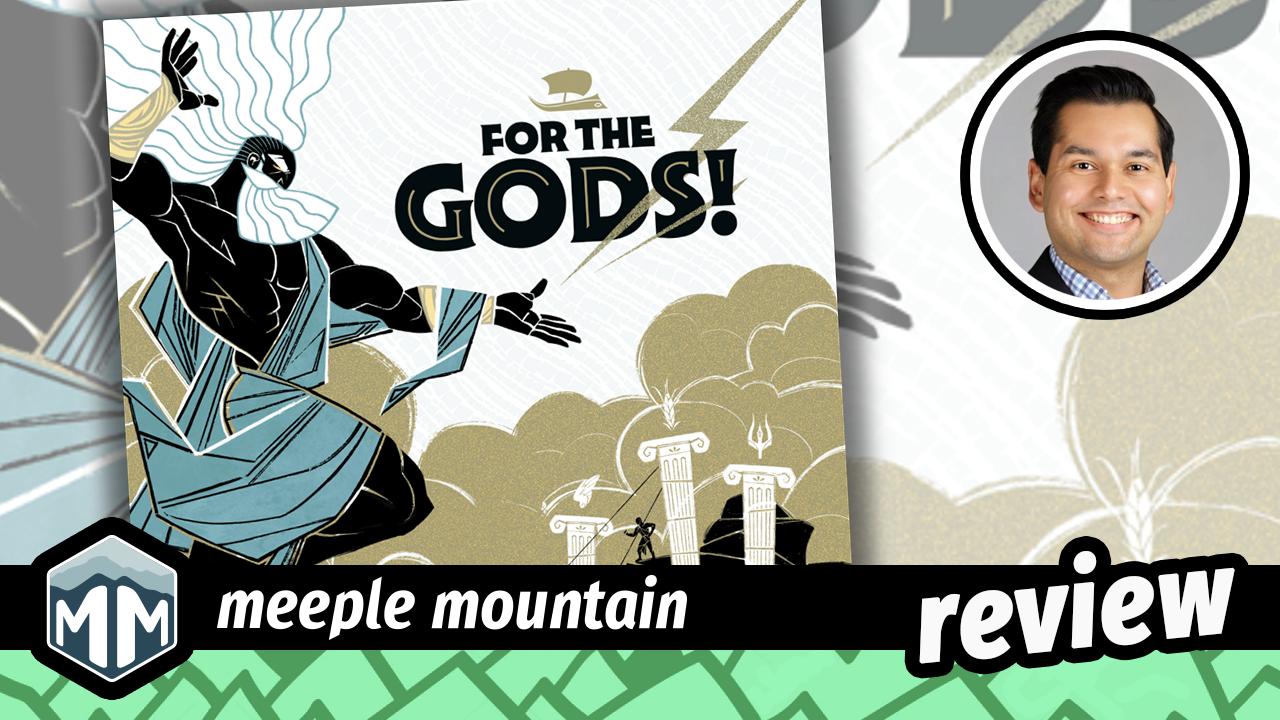
Many will recognize Benjamin and Thompson from modern classics such as the Undaunted series, War Chest, and Resist!. Factor in the euro-y talents of Gilbert, whose credits include Mandala and The Guild of Merchant Explorers, and For the Gods! couldn’t hit the table fast enough.
I’ll admit, as much as I love the idea of wargames and “dudes on a map,” I’m often quite bad at them and, as a result, tend to admire them from afar.
For the Gods! is a dudes-on-a-map game, yes, but scratch beneath the surface and there’s a clever bag-building and hand-management game driving the entire experience.
After Mighty Boards blew past its crowdfunding goal by more than tenfold, I was curious to see whether all those ingredients would come together into something worthy of Olympus.
Zeus himself would approve.
For the Gods! is an area-majority game where players sail around ancient Greece, building towering temples dedicated to the gods. Each player begins with the…
The post For The Gods! Game Review appeared first on Meeple Mountain.
Excelsior, heroes, and welcome to a Meeple Mountain article for Marvel: Crisis Protocol! Today, we’re here to talk about the newest supervillain to join the roster: Onslaught! This big boy boasts his own personal affiliation where anyone you bring is automatically affiliated with him and uses his leadership. The model is cool, but how does it all pan out?
I want to give a quick shoutout to one of my local players, Isaiah Cooper, who excitedly agreed to paint this Onslaught for me when he arrived. I would rather put impressive painting on display for y’all than my mediocre attempts at whipping something up.
Onslaught is a character lifted straight from the comics (and for my money, likely to feature heavily in season 3 of X-Men ‘97.) He’s a fusion of Professor X and Magneto’s consciousnesses after the two of them used their powers on each other. Here in MCP, he’s the first character to carry two alter-ego tags, serving as both Charles Xavier and Max Eisenhardt. This means you can’t run either character with him, but since Onslaught has the “peerless” tag, it means you can’t run him with any other peerless characters anyway, which Magneto has.
The box is just one simple model, but don’t let that fool you. This is one of the…
The post Marvel Crisis Protocol – Onslaught’s Grip Tightens! appeared first on Meeple Mountain.
Welcome to this week’s batch of crowdfunding campaigns. We have a variety of offerings here, so we hope you will find something that catches your eye. Also, if you want to chat with the BGQ team, join our Discord Server where we talk about games, movies, sports, and other fun stuff. Check it out and […]
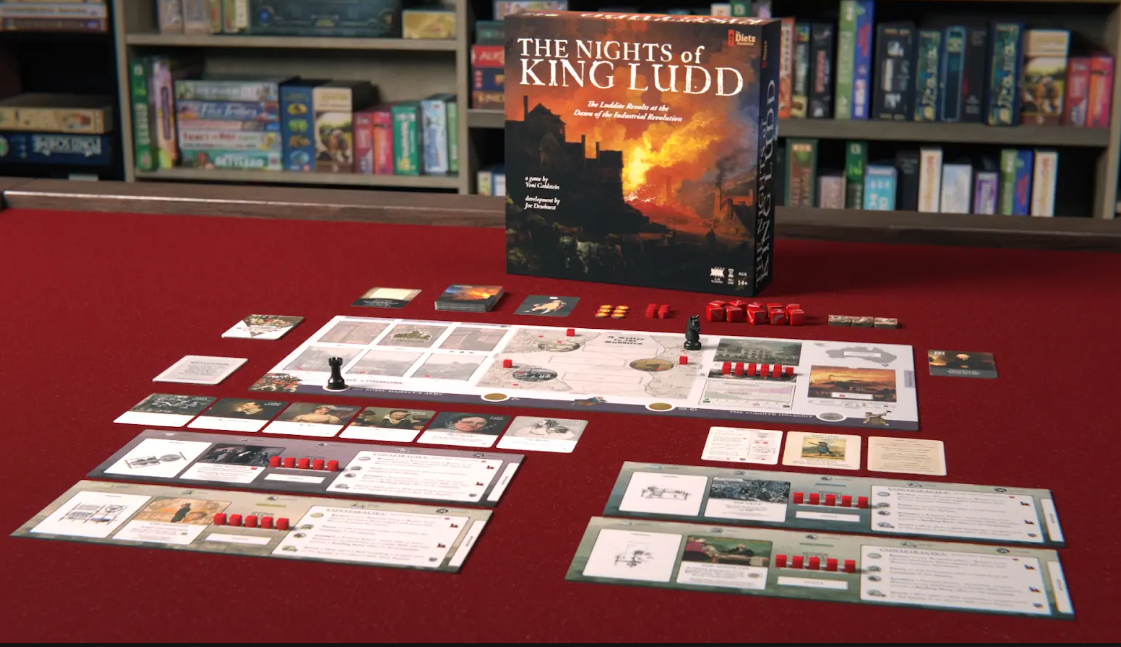
The Dietz Foundation has a new game from Yoni Goldstein on Kickstarter called The Nights of King Ludd: The Luddite War on Industry, 1811-? (the game has already funded). The Nights of King Ludd is a 2-4 player game that deals with direct oath-sworn secret societies of English Luddites at the dawn of the Industrial Revolution in the English Midlands. Working together, players will build a secret network of saboteurs, ferry provisions and weapons on the black market, assemble raiding parties, and if all goes as planned, smash those “dark satanic mills” to cinders. Here is Part II of our interview with Yoni.
If you are interested in The Nights of King Ludd, you can back the project on the Kickstarter page at the following link: https://www.kickstarter.com/projects/dietzfoundation/the-nights-of-king-ludd
Grant: What is the layout of the board and the different locations?
Yoni: The board is divided into three panels. On the left, you will see the two card pools. The top row is where you place the “Regency” Cards, reactionary forces from London sent to quash the Luddite revolts. Below London are three cards representing the “Commons,” a shifting market of dual-use cards helpful to the players.
The central panel features the mills and enclosures. This is where players place their pieces (Weavers sympathizing with the Luddite cause), and the local Militia (the knight piece). The map depicts the “Luddite Triangle:” the West Riding of Yorkshire, Nottinghamshire, and Lancashire.
The right panel holds the Manufacturer’s House (and the current Manufacturer), the pool of Employed Weavers, and the Stocking Market to track wages and productivity in the mills. On the far right panel, is the Australia space for weavers punished by transportation, and the “Saboteur Dice Pool.”
A ribbon at the bottom of the board displays His Royal Majesty’s Army progress toward the Luddite Holdout. This is effectively the round track, if the Luddites are unable to sabotage the three mills by the end of the third round, the game ends in collective defeat.
Grant: How does the game use cards? What different type of cards are included?
Yoni: In The Nights of King Ludd players build a collective card engine by acquiring dual use cards from the “Commons” to upgrade their actions (aka “Conspiracies” – more on those below). The main pool of cards is called “The Commons” which, as the name suggests, represents a mutual aid network of provisions, tactics, and personalities that the Luddites may draw from in the course of their clandestine operations.
“Commons” cards are dual use and drawn from the Draw Deck. They are beneficial in two ways: the top of the card displays a persistent upgrade to any Conspiracy action and is locked into the player board to form a tableau. The bottom of the card displays a “Raiding Party” effect, a one time effect that can be triggered when a Raiding Party is formed and dispatched to a local mill.
The antithesis of the Commons is the “Regency,” a deck of cards reflecting the alignment of the aristocracy in London with an ascendent industrial class against the Luddite cause. They are drawn whenever the Luddites make themselves known in public: fomenting a mob, carrying out an assassination, or setting a factory on fire. When drawn, they set the machines of industry into motion; driving up productivity, plummeting wages, and calling the local constabulary to police the countryside.
Once more than three cards are in the “London” track above the Commons, a nasty event is resolved. These effects will intensify the game’s challenges. Sympathetic weavers will be exiled to Australia, the militia will sweep into the local mill to root out hidden raiders, and the Commons will be parceled off and sold to the highest bidder.
Grant: What is the role of the Persona Cards? Who are these figures?
Yoni: As mentioned in Part I of this interview, each player represents a secret society of Luddites organized around a particular “persona.” These personae introduce a special ability, as well as their their own victory condition, aka a “Motivation”, and a unique “Woe” – a card shuffled into the Draw Deck at setup that will, inevitably, undermine their efforts. There are six persona to choose from.
In clockwise order, they are:
Grant: What is the purpose of the Manufacturer Card?
Yoni: At the beginning of each game, one of the three Manufacturer Cards is selected at random and placed face up in the “Manufacturer’s House” space on the board. The initial effect (tuck 6 cards from the draw deck beneath the manufacturer) represents the nascent industrial class’ emphasis on extracting from the commons, resolving at the start of each round. In practical terms, this prunes away the players’ available card pool over the course of play as well as ambiguates the composition of the draw deck. When a manufacturer is assassinated, all the cards tucked beneath are discarded (and will shuffle back into the Draw Deck) and the Manufacturer Card is flipped to reveal a more reactionary and dangerous side.
Grant: What are Conspiracy Actions?
Yoni: At the beginning of the game, each player has five conspirators (four for Lord Byron) at their command. Spending a conspirator allows the player to activate one of the four following Conspiracy actions (per turn):
Rally Local Weavers: either place a weaver from the supply pool at your presence pawn, or move your pawn and any weavers to another enclosure on the map.
Trade in the Commons: pick up a card from the Commons and tuck into one of the columns on your player board. That card allows for secondary actions whenever that matching Conspiracy is activated.
Assemble a Raiding Party: a two step action, move one or more weavers from an Enclosure (spaces on the map adjacent to Mills) into a Mill. This sets up a future sabotage action. Then, activate one of the Raiding Party effects in the Commons. This is the primary means of building your Saboteur Dice Pool. The more raiders you have at the Mill, the more dice you are permitted to roll during a Sabotage operation.
Lastly, you may Incite a Mob, placing a Mob Tile next to an adjacent Mill. For a sabotage roll to be successful, the die rolls must match an icon depicted on the Mob tile – hammer, gun, or torch.
Grant: What type of secondary effects come from cards tucked into the Column on Player Boards?
Yoni: Once you use a Trade conspiracy to move a card from the Commons to your tableau (your “Secret Society”), you can activate it, along with any other card in that same column on your player board, every time you resolve that conspiracy action. This allows for chaining and sequencing a series of effects that may have significant impact on your objective to destroy the mills.
Grant: Can you show us a few examples and explain their use?
Yoni: For example, let’s say you are George Mellor and you are seeking to assassinate the manufacturer. You resolve the Trade conspiracy to take “Dispatch Delegates to Neighbouring Counties” and place it in your Trade column, meaning it will be available to you immediately after this primary action. In previous turns you’ve already acquired an ongoing ability, “Mellor Takes a Shot at Mr. Horsfall!”, giving you an extra die for Assassination roles (helpful, since these operations are so risky!). You activate “Dispatch Delegates…” to activate a Raiding Party effect (the bottom of the card) in the Commons, which happens to be your partner in crime, “Martha Mellor Defends the Accused.” She allows you to roll for Assassination, but will be removed from play once that effect is resolved.
Grant: How does Sabotage and Assassinations work in the game?
Yoni: At various points in the game, players may elect to roll for Sabotage or Assassination. Of course, certain maneuvers must take place for these brazen attacks to succeed. Sabotages are larger scale events and are aimed at the Mills. You must have assembled a raiding party at the Mill and incited a Mob to spurn them on. As mentioned above, you roll one die per weaver cube at the Mill and attempt results matching the icons on the Mobs you’ve placed. The dice are D6s with the following faces: 3 blanks (a miss), 1 Torch, 1 Gun, and 1 Hammer. So with one Mob tile matching one of those icons, each die you roll has a 1 in 6 chance of hitting. If all three Mobs are in place, the odds climb to 1 in 2 per die.
An assassination is a similar roll, but only one die may be cast and hits are only the gun or hammer. Beware, the Regency will respond with a draw from its deck for both sabotage and assassination rolls!
Grant: What are you most pleased about with the design?
Yoni: As Dan Thurot noted, “The Nights of King Ludd points toward a more experimental direction than Chicago ‘68 and I feel it reflects a degree of growth and maturation as a designer. It’s a game that seeks to capture both the panoramic view of a people’s struggle as well as sketching out the personal incentives that motivate individual participation in (and sometimes sacrifice for) a collective cause”.
Grant: What other games are you currently working on?
Yoni: I am currently working on a commission for an international art exhibition on “sociopolitical freefall.” This will be a smaller box game and will also be developed by Joe Dewhurst. I’m also co-designing a project about Mai ‘68 with Fred Serval. This game is about the French experience of student and labor riots in 1968. While it shares the themes of Chicago ‘68 it’s driven by a completely new system.
If you are interested in The Nights of King Ludd, you can back the project on the Kickstarter page at the following link: https://www.kickstarter.com/projects/dietzfoundation/the-nights-of-king-ludd
-Grant
by Justin Bell

/pic9819243.jpg)
