I’m constantly trying to learn about customer service practices so I can better serve our customers at Stonemaier Games. I spent the last week traveling across Ireland with family, and I thought I’d share some quick notes about customer service (mostly very good).
Tullamore Distillery: We walked in here with only around 30 minutes to spare, which we mentioned to the person working the main desk. Within seconds, she offered us a 30-minute whiskey tasting, and we had a wonderful time learning about Tullamore from her.
Sean’s Bar: The proprietor sat down with us for 5 minutes to share the history of Ireland’s oldest bar and the story of Irish coffee. He later gave a similar speech to a bigger group in the same room, and I noticed he intentionally changed the wording since we were within earshot.
Linnane’s Lobster Bar (Newquay): We got a little messy eating crab, lobster, oysters, and mussels here, and an attentive server–not even our primary server–noticed and offered us a bowl of water with lemon to rinse our fingers.
Oscar’s (Galway): We had a late dinner, and the server was keen to alert us to the exact remaining quantity of a specific dish before it was gone.
Sheridan’s Cheesemongers (Galway): The person behind the counter was incredibly helpful in recommending three made-in-Ireland dishes that complemented each other (two cheeses, one cracker, and chutney).
Midleton Distillery (Midleton): The young tour guide frequently invited questions and called back to previous questions, yet he kept things moving along.
Manna Cafe (Killarney): Each of us ordered a different coffee drink at breakfast here (which was ample and delicious), and to help us tell the difference, each came in a different type of glass with a unique design on the foam.
Table 45 (Dublin): When we arrived fairly late in the evening, the manager warmly let us know that the kitchen was only open for 25 minutes but that we were welcome to sit down and order tapas (which we did).
Sweet Salt (Dublin): When we showed up at this highly rated cafe for 6 coffee orders, multiple members of the team swiftly shifted into barista mode.
Guinness Storehouse (Dublin): This is a superbly designed self-guided tour that consistently moves people from one area to the next (with the one exception at the end of the tour where the free pint of Guinness takes people so long to drink that the room is very, very crowded).
Fish Shop (Dublin): We ended up here after searching for the best fish and chips in Dublin, and despite initially being told that we needed a reservation, the owner invited us back inside after seeing scrambling on our phones to find an alternative.
Gamers World (Dublin): After hearing my American accent, the person working the register discounted the game I bought by 10% (not because I’m American; it’s something related to taxes and duties). Also, it was neat to see them carrying many Stonemaier games, for which I thanked them.
Cafe Nero (Dublin): I ordered a ristretto without knowing what it was, and after seeing us puzzled over meager contents of the cup, the manager offered to give us any other drink. We assured him it was fine–I wanted to try something new, and now I know! (It’s a very condensed shot of espresso.)
Many of these experiences are small, but they can have a big impact on the overall experience. What’s a minor-yet-impactful positive customer service experience you had recently?
I may be a board game collector now, but my collecting predilection started at the age of 7 with seashells. Specifically, I loved collecting the vibrantly colored and variously shaped shells that could be found along Florida’s Gulf of MEXICO coast from Marco Island up through Sanibel Island, the latter also being the home of […]
An unpopular war. Protests in the streets. An authoritarian US leader sending troops to a major American city, employing violence against its own citizens. Obviously, I’m talking about the events of 1968 in Chicago during the Democratic National Convention, which happens to be the theme of Chicago ’68, a game from designer Yoni Goldstein and published by The Dietz Foundation.
Running south on Lake Shore Drive, Heading into town
I hope you’ll spare some time for a little personal context before I get into my review. When I moved to Chicago in the summer of 1998 to attend film school, the only thing I knew about the city was that the Bulls had just won their 6th NBA Championship in the last 8 years (side note: they haven’t been to finals in the 28 years since). It was in one of my classes that we watched Haskell Wexler’s Medium Cool, a movie that takes place (and was partly shot) during the 1968 DNC riots. The film had an enormous impact on me and, along with the book Boss by legendary columnist Mike Royko, was my introduction to the modern history of the city I have called home for nearly 30 years.
The Asian Board Games Festival in the Philippines was held 2 - 3 May 2026 in
Manila. This was the first time I exhibited in the Philippines. I have been to
Manila before at my previous job, and that was 18 years ago.
There were four Malaysian publishers at ABGF PH - Jon (nPips Games), Choon Ean
(LUMA), Chee Kong (Haribol Way) and I (Cili Padi Games). We were
Asmodee has agreed to buy the rights to party game Time’s Up! from R&R Games, continuing an expansion push predicated on social games being the fastest growing category of the board games market.
Time’s Up!, first published by R&R in 1999, is based on classic party game Celebrities, in which players write down names on pieces of paper, which teams then take turns guessing based on a single player’s descriptions.
The game increases in difficulty over two subsequent rounds, with players having to describe the same names using just a single word alongside actions and gestures, while in round three the describer cannot speak at all.
Time’s Up! Family, published by Asmodee studio Repos Production
Celebrities has been reworked into multiple different boxed releases from various companies over the years, with Peter Sarrett’s design Time’s Up! and Monikers from CMYK among the best known versions.
Asmodee has been a publisher of Time’s Up! since its 2020 acquisition of Repos Production, which had been putting out various versions of the game in Europe since 2004 through a licensing agreement with R&R.
Last year the board game giant shifted Time’s Up! to its Zygomatic studio alongside fellow small-box social games such as its bestselling Dobble range, Werewolves of Miller’s Hollow, the Timeline series and Jungle Speed.
Asmodee said the rights purchase cemented Time’s Up!’s presence as once of Zygomatic’s flagship titles, adding that the Zygomatic team would focus on focus on “expanding the IP and further strengthening its global reach particularly in English-speaking territories, where there is a significant growth potential for the brand”.
It added that it would undertake a “rationalisation and modernisation” of the Time’s Up! range in 2027, which will see it “streamline the product line, refresh the brand positioning, and ensure stronger competitiveness and accessibility across markets”.
Asmodee said Time’s Up! Express, which was launched in January, marked the first step in its refreshed strategy for the game – with its faster gameplay and broader accessibility reaching new audiences “while remaining faithful to the core experience that made the game successful”.
Asmodee said at the time that it expects a compound annual growth rate (CAGR) for social games of between 4% and 8% between 2025 and 2030, compared to about 4% for the wider board games market, citing mass market sales research for the US and ‘main European countries’ conducted by Arthur D Little.
Company CEO Thomas Koegler said in the company’s Q2 report last November that Asmodee had seen “good momentum” in its lower price-point products in the US mass market, singling out Exploding Kittens as a particularly strong performer in what he called a “challenging market”.
The ATM deal followed five other acquisitions from the past 12 months – including the buyout of Japon Brand from CMON, anchoring the board game giant’s push into a “currently untapped market” for the company.
Speaking about the Time’s Up! deal to Board Game Beat, R&R Games president Frank DiLorenzo reportedly said multiple companies had reached out over the years to inquire about buying the title or the entire business, but added that “most offers either didn’t align with our valuation or came from partners we felt would not fully honor and support what we’ve built”.
He said of the Asmodee buyout, “We’ve had a longstanding relationship with Asmodee, particularly following their acquisition of our European partner, Repos.
“They have a deep understanding of the game and a clear vision for maintaining its longevity and appeal. Their offer was both attractive and well balanced. We believe this agreement creates meaningful benefits for both companies and for the players who love the game.”
He added that R&R would transition out of publishing the game over the next few months, winding down its remaining stock through direct sales on its website.
Catan on the Road Designer: Benjamin Teuber Publisher: Asmodee Players: 3-4 Age: 10+ Time: 15-30 min Amazon affiliate link: https://amzn.to/47mjaZu Played with review copy provided by publisher In CATAN – On the Road, gameplay is driven by a … Continue reading →
“They don’t all have to be if enough of them are.” -Mother Fox, The Musician and the Fairies, A. J. Abbott
Disclosure: played using the German version, played 6 times, beat the game in level 3, highest score achieved: 37 pts
There are plenty of trick-taking games for two players, but many of them aren’t cooperative. The Fox in the Forest Duet caught our attention at a book shop as it is both co-op and for exactly two players. Its art style reminds us of some fairytales collected by the brothers Grimm from long before. We decided to purchase it and give it a try.
The box is compact (16.5 x 11.4 x 3.2 cm). It has a rulebook, some small cardboard tokens, a small wooden token that represents the players, two reference cards, a deck of 30 cards, and a small cardboard road map. Unfortunately, two cards have some misprints and the quality of the cards in general isn’t ideal. It would have been nice if they had a linen finish.
The components
The setup is simple, and it doesn’t take much space as you only need space for the small board, the trump card, and somewhere to play the cards. The gem tokens have to be placed on top of the small squares on the board. There are symbols in the squares, which indicate the number of red tokens the player should place. The board also indicates where the players should start.
The board with red gems
One of the players shuffles the deck and hands 11 cards to each player and draws one card that determines which suit is the trump suit. The deck has only three suits. Whoever has the highest number of the suit played by the first player or the highest trump card takes the trick. The wooden token should then be moved toward the winner of the trick. The number of steps is the total number of steps at the top left of the cards, with each card having between zero and three steps. If there’s a red gem at the final step, it should be removed from the board. To win the game, there shouldn’t be any red gems left on the board within three rounds. Kaysee likes this mechanism as there’s something satisfying about removing something from a board and being rewarded for it, similar to a crisis-management mechanism in some crunchy games.
Some cards don’t have any movement numbers, but instead they give the player additional abilities like exchanging a card with the other player or letting the winner choose whether to use both cards to move or just one of them. We like this mechanism because it allows us to indirectly communicate something to each other since the game doesn’t allow us to share our strategies or show each other our cards.
The game has three difficulty levels and a scoring system. The highest possible score is 46, which can only be achieved in level 3 without losing a forest path and being able to remove a gem with each and every single movement. Trying to reach the highest score possible may excite some players, but not us, at least not with this game.
The first game wasn’t very exciting for both of us. We did win the first try, but we didn’t find it engaging. We think it’s probably because of it being too abstract for our taste and how the theme isn’t strong enough in this game. But we do like being able to win the game when we exchange cards and get the cards that we exactly need to beat the game. For level 3, we played for a bit more than half an hour.
Our Final Thoughts:
The Fox in the Forest Duet is a decent compact trick-taking game. Like other games that have a strict communication limit, it didn’t allow us to come up with a strategy together, and that’s ok. Communication limits can be fun sometimes, especially if it feels like we can read each others thoughts, but the lack of strong theme and excitement while we play this game didn’t help in terms of us wanting to play it again. We can, however, imagine playing this to kill the time at a boarding gate at an airport while waiting for the plane to arrive. We would also suggest reading the fairytales by Alana Joli Abbott (even though you’re not at an airport), which are much more suited for the modern times than the fairytales from long before.
Title: The Fox in the Forest Duet
Game Design: Joshua Buergel
Illustration: Adrienne Ezell, Jason D. Kingsley, Roanna Peroz, John Shulters
Publisher: Foxtrot Games, Renegade Game Studios
I no longer think of Volko Ruhnke as a man, but as a machine purpose-built for stamping out novel conflict simulations. COIN, Levy & Campaign, that older one where the terrorists have the efficacy of ’90s movie baddies, and now Hunt for Blackbeard, an unexpected romp that’s as much about setting the record straight as it is about blasting pirates with grapeshot. I now know more about Blackbeard than at any point in my life. Which is to say, I know a lot less, given the man’s outsized legend.
Afore ye vast, starboard lubbers!
Almost everything we know about Blackbeard is wrong, or at least embellished from later sources seeking to cash in on the pirate’s notoriety. That he learned his trade under the legendary Captain Hornigold — unconfirmed. That he braided his hair with smoking fuses — not exactly the sort of fire hazard a man who worked with gunpowder would accept. That he murdered a swath across three seas — well, there was some murder, that’s true. But not as much as previously reported. Not when a pirate’s work required most crews to throw down their arms.
If anything, the Edward Thatch we come to know in Hunt for Blackbeard is something of a sad sack, at least when placed alongside his outsized legend. His great vessel has been stripped. His plunder has been sold down to its last few barrels and crates. His crew has been reduced to a couple dozen hands. Even his most infamous companions are on the outs; Stede Bonnet’s surviving crewmen are likely informers rather than allies, and Israel Hands, Blackbeard’s long-time second in command, may soon be sent on a doomed mission to allow the captain to claim his portion of their remaining goods.
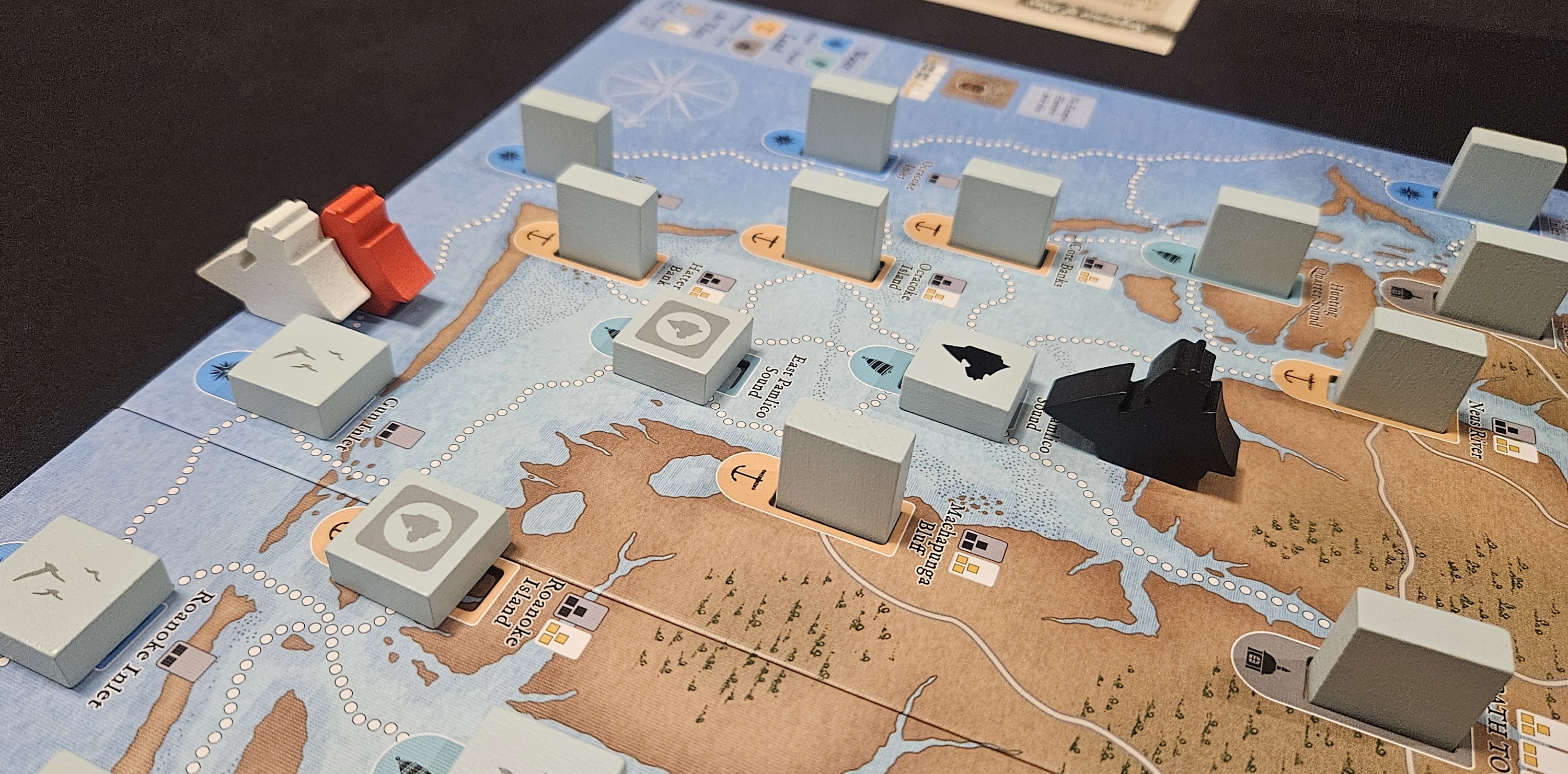
Some of these details are relegated to the historical notes, and this, being a production from Fort Circle Games, provides excellent timelines and essays. But the diminished status of the infamous captain is on display right there on the board as well. For one thing, there’s the scope of the hunt. Confined to the sounds, towns, and islands of North Carolina, this pursuit is leagues away from the Caribbean waters that usually dominate pirate yarns. And then there’s the scale. Blackbeard’s fleet has become one ship, the Adventure, ill-fitted and undercrewed. His pursuers have only two ships, both of them relatively small, plus a band of hunters who travel by land to check the colony’s towns and inlets. These are, in a sense, an invading force, commissioned and outfitted by the governor of Virginia. But as invading forces go, sending bounty hunters from one colony into another isn’t an excursion into foreign territory.
For his part, Thatch behaves more like a cornered rat than a pirate king. Hunt for Blackbeard opens with the pirate standing at an intersection. Rather than expend the resources to hunt down every last offender, the Crown has offered a pardon to all who will renounce the pirate’s life. Most in the colonies have already accepted. Thatch, too, has taken the offer, only to return to the sea to seize some easy plunder. Now the hunters are coming for him, and while he has relative shelter in North Carolina thanks to his largesse with colony officials, the ensuing game of cat and mouse has the mood of a deepening sunset rather than a crescendo.
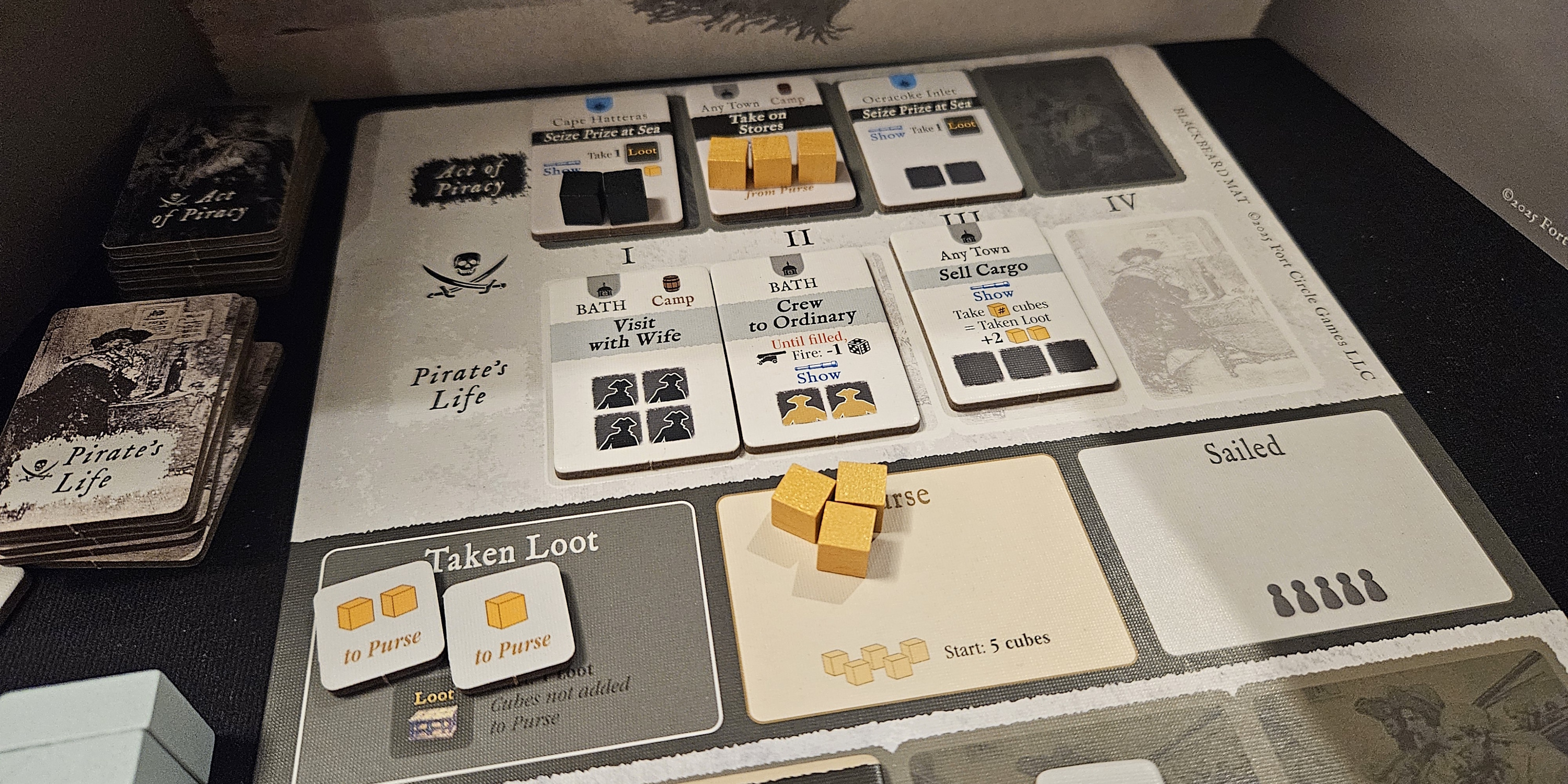
Blackbeard tends to his retirement… or continues his piratical career.
There are two sides in Hunt for Blackbeard, hunter and hunted, but Ruhnke’s virtuosity at game design clutters and blurs those roles.
Both sides, for instance, are gluttonous for information. In the case of the Hunters, that means Blackbeard’s location — whether that of the famed captain, his lieutenant, or the camp he might periodically visit to resupply or lick his wounds. But for Blackbeard, word of his pursuers’ deeds is every bit as precious. The Hunters are always visible on the map, but how far their reach has extended, where their informants have told them to search, or whether they have a particular stretch of the sea under surveillance, those details may be concealed or laid bare depending on context and choice.
The same goes for the question of which side is hunting whom. Nominally, the Hunters are, well, the hunters. As soon as they’ve outfitted their vessels, they depart from Virginia and begin the chase. But all the while, Blackbeard is laying preparations of his own. Looting vessels, preparing the Adventure, buying off witnesses. When the time comes for the spark to touch powder, it’s entirely possible that Blackbeard will sink the competition.
What Ruhnke produces, then, is a double-blind game of entrapment. First there’s the race. Blackbeard hurries to gain or spend his treasure, whether to reestablish himself as a great pirate captain or to secure another pardon. The Hunters hustle to outfit their vessels before the trail goes cold. But then, over the course of the ensuing rounds, the fierce dance between predators.
Perhaps the most surprising thing about Hunt for Blackbeard is its speed. The game only lasts four rounds. And these aren’t the drawn-out bullet-point-ridden rounds of something like Here I Stand. While there are still bullet points to tick off, the phases pass at a brisk pace, bouncing between sides so rapidly that there’s hardly a moment of downtime. First, the Hunters interview informants, giving them a glimpse at Blackbeard’s potential location — a step that requires Blackbeard to avert his gaze, lest he learn what the Hunters have gleaned. Second, Blackbeard spends his time preparing his ship, sailing, and planning any piratical activities. Again someone must close their eyes, although it’s the Hunter player this time. After that, the Hunters take their turn proper, moving their ships and perhaps picking up their quarry’s trail. Only then does Blackbeard actually accomplish any pirating, a step that may well have been interrupted by the arrival of the Hunters.
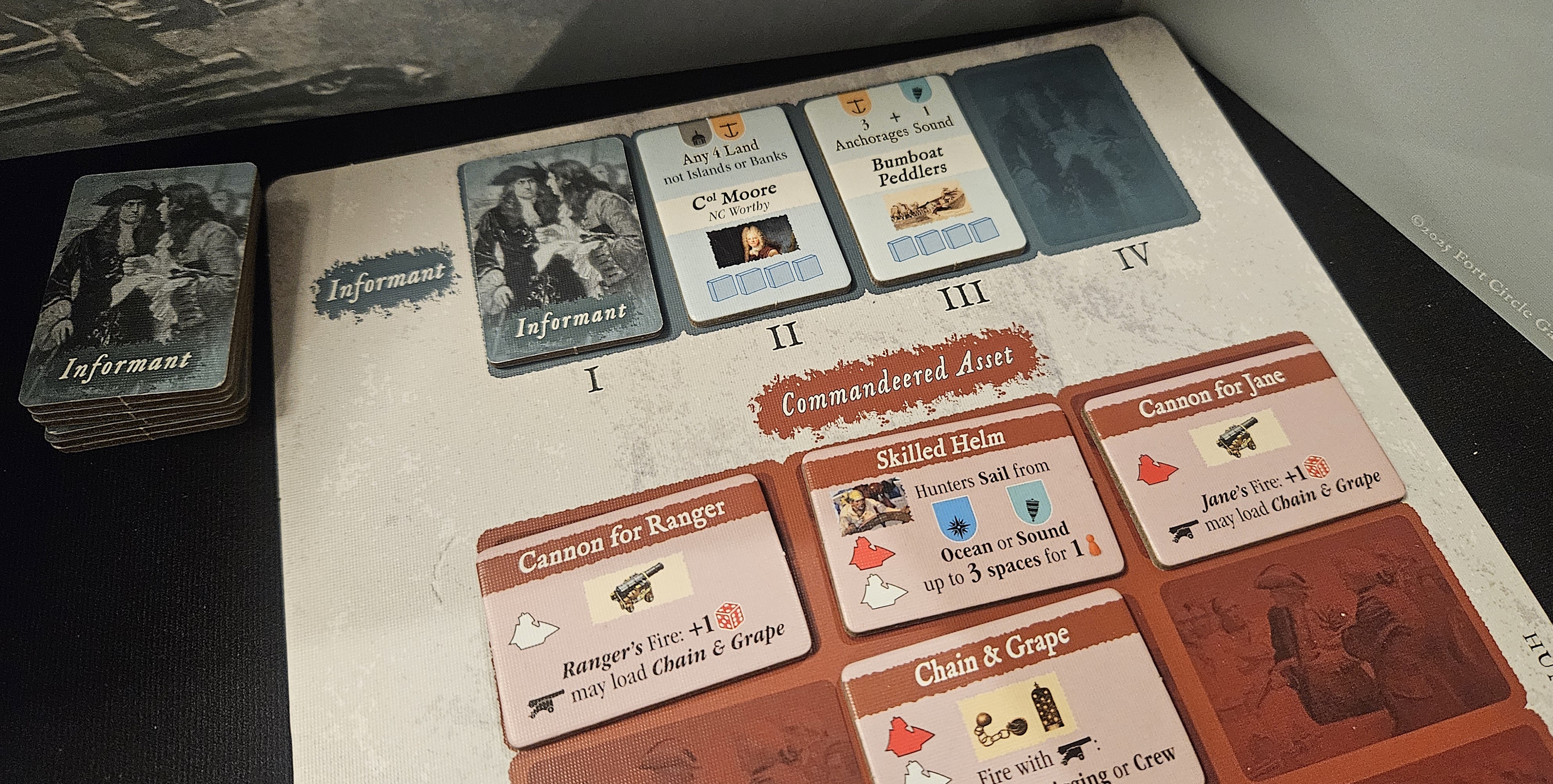
The hunters balance preparation against the need to depart early.
Playing through these steps, a few thoughts spring to mind.
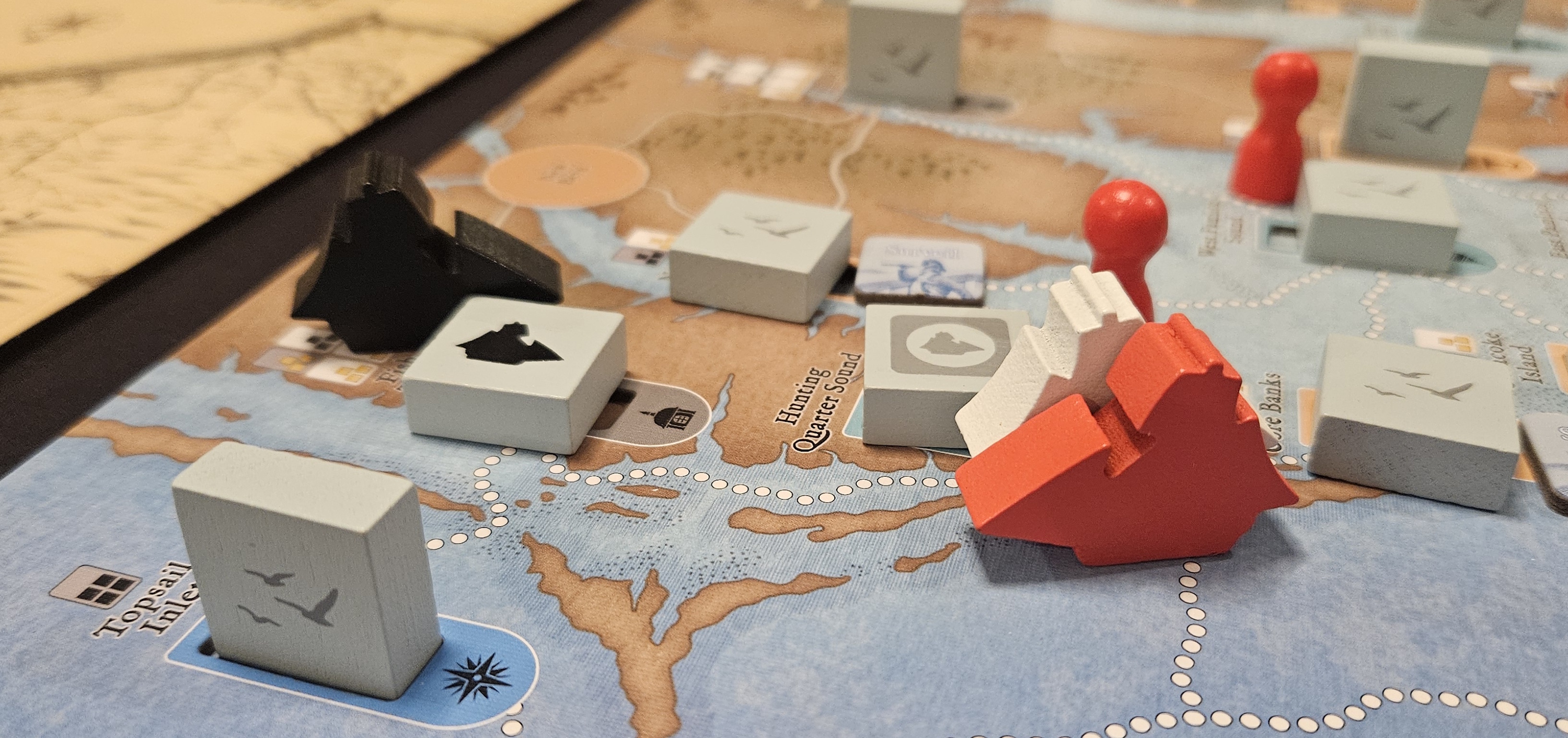
First, there’s an essential tactility to Hunt for Blackbeard. The actions themselves are brief, but the need to physically turn the blocks gives every movement a sense of growing unease. When I played digitally, the entire session took perhaps a third of the duration, but in its haste lost its sense of place. It’s one thing to click an icon; another entirely to hover one’s fingertips over the block, stomach knotted into a fist as you try to deduce whether an earlier clatter had come from here or there, or was perhaps your opponent shifting a few components as a ruse. This process elongates the game, but is necessary: touching the pieces, straining your senses for clues, seeing the shadows cast by those monolithic blocks and wondering whether they conceal a trace of your foe’s passage or a flock of passing gulls, these are as much components in the game’s telling as the rules or the wooden ships.
As much as Ruhnke excels at designing macro-level systems, he still has yet to create a compelling method for resolving combat. Perhaps the game’s biggest disappointment is the moment of battle, when, after all those preparations, both sides roll a couple dice to see who hits the higher number. It’s fitting, I suppose, given the chanciness of naval combat. The historical Blackbeard managed to rake one of his pursuers with grapeshot, effectively removing their ship from the fight, before the trap was sprung and he was overwhelmed during a boarding action. But after all those steps and countersteps — after that dance! — it wouldn’t have gone amiss to put some showmanship into the last struggle. What could have been a wall of thunder instead comes across as a puff of smoke.
Lastly, however, the game leaves me in awe of the way board game excel at representing history. I’ve read about Blackbeard. Not a lot. Just enough to know we don’t know much. But it wasn’t until seeing it rendered this way that I understood some of the words on the page. The intimacy of the space. The smallness of a man whose legend has outgrown him and now nips at his heels. The small invasion of a neighboring colony, one governor determined to rid himself of a pest that his peer next door has decided to indulge. Piracy was always caught up in the history of empires, and nowhere is that clearer than here, with official pardons and corrupt commissioners in the balance, populated by enemies and victims, but also imperial troops crowding into spaces that were once open, with safe havens where an infamous pirate acted as a patron rather than a danger to be cut out with the point of a saber. To play this game is to grasp the history a little more tightly.
The hide-and-seek nature of the game is well done.
Is it disappointing that Hunt for Blackbeard operates better as history than as a plaything? Oh, maybe. A little bit. Especially when the game concludes with a wet fuse rather than a discharged cannon, I can’t help but feel some letdown.
But I’m impressed with the trappings that surround that climactic battle. Once again, Ruhnke has created a system that will hopefully earn emulation; once again, Fort Circle has crafted an enviable representation of American history, one that complicates and deepens its subject matter rather than frocking him in smoking fuses.
A complimentary copy of Hunt for Blackbeard was provided by the publisher.
(If what I’m doing at Space-Biff! is valuable to you in some way, please consider dropping by my Patreon campaign or Ko-fi. Right now, supporters can read my first-quarter update of 2026: the best board games, movies, books, and more!)

 Anmelden



 I may be a board game collector now, but my collecting predilection started at the age of 7 with seashells. Specifically, I loved collecting the vibrantly colored and variously shaped shells that could be found along Florida’s Gulf of MEXICO coast from Marco Island up through Sanibel Island, the latter also being the home of […]