Normale Ansicht

Artist Diary: Skybridge

24. März 2026 um 15:00

by Fat Francis


Michael Rieneck
Franz Vohwinkel
Deep Print Games

Editor's Note - Michael Rieneck and Franz Vohwinkel wrote a designers' diary about the development of Skybridge, published on Feb 3rd, 2026. This diary is a compliment to that piece, but from the perspective of developing the artwork.

Artist Diary: Skybridge

There are moments in life when paths open up that you didn’t know existed at first.
15 years ago I surprisingly received an unusual assignment: design three fantasy puzzles, including a box design, for a new jigsaw puzzle series. Unknowingly, I had embarked on a long journey that has not yet come to an end.

September 2010


When I made this sketch for the first of a series of puzzles, I had no idea that I would write about it today. At that time the drakhes were still dragons, there were still visible sunbeams in Thraen (at that time simply called “Downworld”) and apart from the Queen, Adlem and the inhabitants of the “Skyworld”, Thraen, and Beeledhans Eye were still completely unknown to me.

Although I have discovered so much in Thraen since then, those three original illustrations laid the foundation for what Skybridge turned into today.

From my current point of view, the first puzzle was certainly the most important of the three, because it already contains all the essential elements of the story: the dry, hollow world on the outside, the lush and heavenly world inside, and the tower that will become a bridge, connecting both worlds.

The motif of the construction site from the second puzzle can be seen as “standing” or “hanging” depending on how one wants to view it. Here, the idea of weightlessness is displayed for the first time: In the hollow world, gravity pulls outwards (for us “down”), while the gravity of the central world pulls inward towards its center (for us “up”). In the middle between both worlds, the two gravitational forces cancel each other out.

A heavily revised version of the first puzzle became the cover of the prototype and a reduced version of the second puzzle can still be seen on the cards “Bridge”.


Only the third puzzle has fallen out of the storyline over time. Too much has changed, or looks completely different today: A peaceful encounter of characters from both worlds in a central room of the Skybridge is now completely impossible.

The Work on the Board Game Started

One of the first tasks was to completely revise the cover to match the current state of the worlds. The Skybridge now gleams in hopeful white and Beeledhans Eye is much more visible. The whole image seems much lighter, almost like a vision. The publisher contributed some good ideas like the slightly slanted point of view and the drakhe flying towards the viewer in the foreground.


The Five Main Characters

In addition to the cover, I first developed the five main characters, as they are important for the visual representation of the five ethnic groups on the player boards and the starting cards. Some of the maps of Skybridge were originally created in 2017, as well as this version of Queen Urcela, who always triggered the comment “She looks like Tilda Swinton”.

True. I think Tilda Swinton’s face is wonderful.

To avoid this similarity, I made a new illustration of the queen, which was quite challenging for me as I liked the original illustration so much.


In the new illustration Urcela is now seen wearing the Crown of Agony, which in the meantime had become an important detail of the story.

- In a first step, I revised the original sketch and drew a new face.
- Parts of the background and dress from the original illustration were preserved during the revision.
- Underneath the layer with the sketch I colored and modeled the face.
- Then I worked the sketch into the background with various blending brushes and added textures and details layer by layer afterwards. Finally, light color corrections completed the image.


I must admit that I like the new "Guinn" better than the original version.

While the game mechanics were still being developed feverishly, the illustration of the Skybridge was created. The bridge would no longer appear on its own game board, but was to be designed as a series of large individual cardboard tiles, laid out next to the game board.
This original sketch dates back to 2017. At that time, the bridge still consisted of 12 parts.


The player boards were more complex, because the elements on them changed several times in the course of further development. The background illustrations of the player boards had to be adapted accordingly. At this point, the illustrations of the five main characters were already finished.


In addition, I had to make sure that there were not too many contrasting details behind the game elements. The areas behind the text and at the bottom would be faded later on, but in this case, less was more.

The game board was a challenge as well, as it consists of many individual parts that had to be combined to form a whole. While I was already working on the illustration, a completely new area of the game board was created, which would not have existed without Moritz Bornkast and Peter Eggert of Deep Print Games: the desert map, where rebels and legions move towards each other. However, before we got to this point, we had to overcome a whole series of more or less usable versions, none of which fit particularly well into the board.


In order to keep the game producible and affordable while reducing the amount of different “game-locations”, the actual game board was brought to the format of a double-folded board the size of the box. The original game board for the Skybridge was scrapped and the desert map was merged with the game board.


The idea of depicting a part of the desert of the Sea of Winds was the breakthrough. In the story, rebels gather in Salthras Deen and try to make their way to the Skybridge, while the legions protecting the construction site move to meet them. At the same time, a storage area for the game components on the board was reintroduced. One space for a discard pile was removed and the other two were rotated to make room. The illustration of the game board consisted of individual parts that were illustrated and assembled largely independently of each other: the illustrations of the symbols for the game components, the map of Thraen, the desert map and the forts.

(By the way, the small skull that marks the discard pile represents the Realm of the Dead, the “Unseth”. All cards - countries, cities and characters, that end up here never come back. And so Thraen dies a little more each round.)

Most of the work on Skybridge was, of course, the many cards that really bring both worlds to life. The story of the Skybridge takes place in a fantastic world, completely impossible by our laws of nature. How can gravity in Thraen act outwards in all directions, while at the same time acting inward on Beeledhans Eye? Why is every day seemingly arbitrarily different in length? Where does the light come from? It’s magic! Of course, this is not entirely true: The people in Thraen believe godhs have created the world according to their wishes.

There is no magic in Thraen. There are no spellcasting wizards, just as there are no magic swords or heroes. Even the Drakhes are not magical beings, but animals that are captured by humans, tamed and used for their purposes.


The inhabitants of Thraen are simply humans, with all their faults and shortcomings. What would humanity do, if it could see paradise in the sky at any time? What if, in addition, life became more difficult to bear with each passing day?


Unfortunately, it was not possible to keep the short text passages from our prototype cards. The additional effort for production and translation would have been too high.

In order to be able to convey the worlds of Skybridge as originally designed in the prototype, I wanted to create the cards with a range of different realistic styles. It was important to me to show as many details as possible to make the peoples and their stories seem believable.

A little trick that provides increased detail is the size of the illustration. I created the card illustrations with the required resolution more than doubled. For printing, I then built the illustrations into the card frames scaled down considerably. Of course, some details are lost in the process, but the viewer still “feels” that they were there: Everything seems finer, more real, than in “regular” resolution. A pleasant side effect of this approach is also that the illustrations can later be displayed in larger formats as well.

Here are a few examples:

Vinad


In this important scene, Vinad, architect of the Utreng and Adlems main supporter, discovers that the construction of the Skybridge has been sabotaged.


Painting in Corel Painter, I used some of my own texture brushes, which I use to draw any kind of detailed patterned textiles with ease. I created a whole collection of them over the years, which I mix and paint over as needed. I affectionately call them my “wallpaper” brushes.

Min Vallesk


When a Serath greets someone with the word “Min” followed by his name, that person knows that the remainder of his life has just changed irrevocably.


Another type of textile details can be found in this image. Of course, each nation speaks its own language and thus also uses its own characters. On Min Vallesk’s headgear, two characters of the Selessem are recognizable in the pattern.

Usehet Tuin


Only the nomads of the Great Plains know of Usehet Tuin, the hidden valley in the Sea of Winds, where the ghosts of their ancestors are at home.
The Enebe Ghres only dare to come here when the situation is desperate and hopeless enough, to justify a plea for the help of the spirits.


The camp at the foot of the bridge


A key moment happens when the rebels find the camp of the workers at the foot of the Skybridge. The high price that ordinary folks have paid for the construction of the bridge is revealed.


The concept for the artwork of the Godh cards differs from the other cards in one essential point: They represent art that contains information about the different cultures of Thraens inhabitants. This is another, deeper level behind the obvious motif.

“The medium is the message” means here that different peoples also depict their Godhs using different mediums and styles. The Utreng for example like to carve their sacred images in wood, because wood is difficult to obtain in the high mountains of the Salthras and is therefore considered to be a valuable material. The Selessem also paint their naive art on wood, but only because they are a poor fishing people. They simply can afford no other surface to paint on.

In the enormous rock cliff on the edge of the Lhaedineer lowlands, the Lhaedineeri have found the ideal place for monumental depictions of their Godhs. The Tarrans, on the other hand, have perfected the fine art of sculpture. The work with precious stone has a tradition in the Reich that goes back to the first people of the White Sea.


In order to portrait this variety of styles convincingly, objects and materials need to be presented as realistically as possible. Only through the contrast of the respective art style and the medium on which it is created, it becomes clear that what looks like a drawing on parchment is also meant as to be seen as a “drawing on parchment”.

Valendha


The cultural contexts of the Godhs shown on the cards also become clearer because, unlike the other cards, almost every depiction of a Godh also shows writing in the respective language. Inscriptions, names and descriptions support the impression that the priests of Valendha want to say something about their Godhess in this carving.


Ephalu


The depictions of the Godhs on the cards are only intended as examples. There are certainly a variety of representations of every Godh in Thraen, some similar, some different, depending on which temple you are visiting.


Although mainly Tarrans believe in Ephalu, there are believers among the Enebe Ghres and the Unshackled People as well.
These peoples would certainly represent the blind Godhess of hope in different styles and mediums than the Tarrans. This is a field of the cultures in Thraen that I would like to explore more deeply in the future.

The worlds of Skybridge, initially described only in writing, now come to life in the illustrations for the game. Working with my own creation as a reference was a strange experience. It was often just as exciting and surprising for me as it was for Michael, who could hardly wait to see more every week. Holding the finished game in my hands now, after such a long time and all the ups and downs we’ve been through, still feels unreal to me.
I am looking forward to seeing Skybridge on the gaming tables and hope that lots of people will enjoy playing our game.

If you would like to see more of the art of Skybridge, you can explore it in greater detail on the website: theskybridge.de. (Currently available in German only, but eventually it will be available in English.)

I will also be posting information about further developments there.
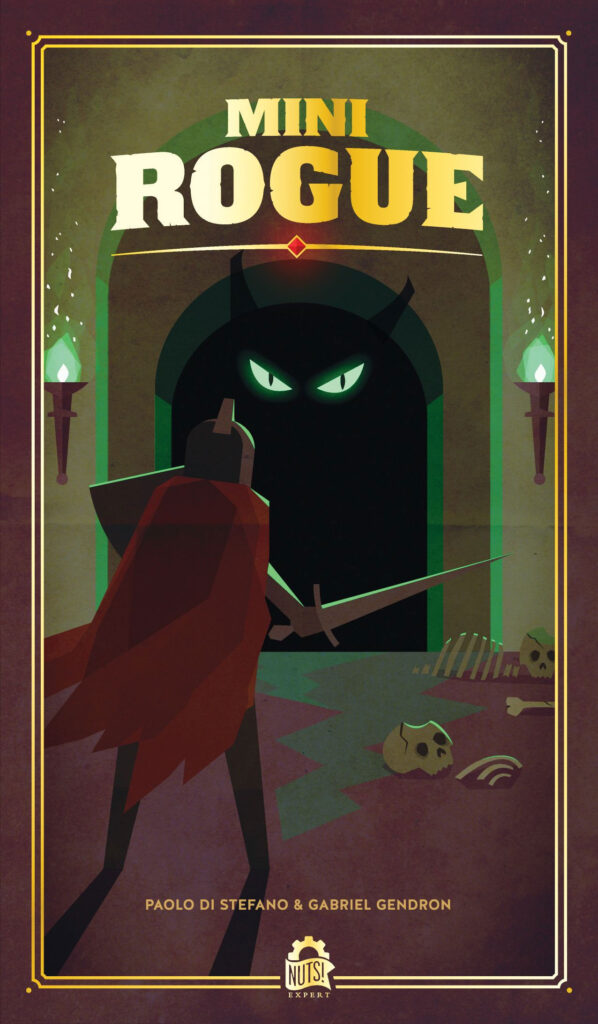
Mini Rogue Review

24. März 2026 um 14:14
Mini RogueIn a world where Kickstarters routinely hit pledge levels at half a grand or more, it’s always nice to lay your hands on a game that runs in the opposite direction. To be fair, there is absolutely a place at my table for sprawling dungeon crawlers with loads of minis, massive amounts of character customization, […]

Source

Muster: Raise the Banners Game Review

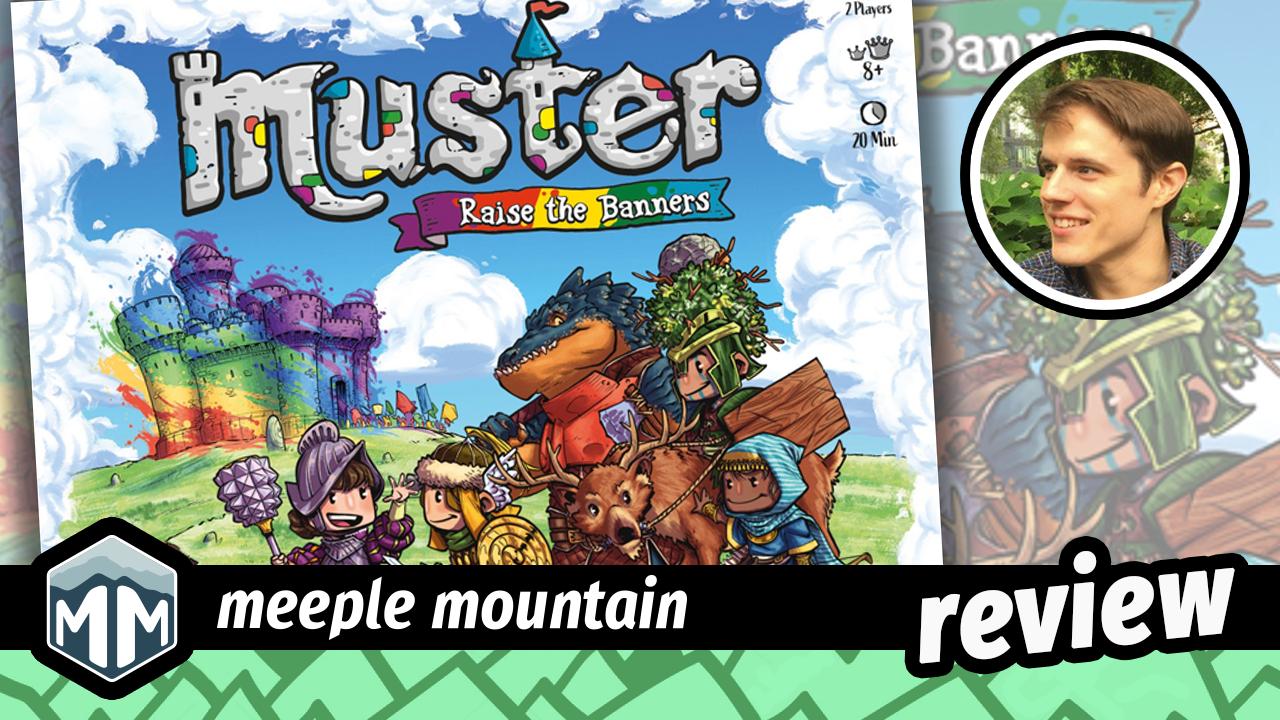
Muster: Raise the Banners, from designer Spencer Lloyd Thomas and with vibrant art from Pedro R. M. Andreo, is a quick little two-player lane battler. Each turn, you play a single card to its matching lane, or discard a card onto one of the central spaces, then draw a card. The catch is that the cards have to be played in ascending order. If I play the mighty green six early in the game, I can’t play any more cards to green.

This may sound familiar to some of you. It certainly did to me. Muster draws a whole heap of inspiration from Reiner Knizia’s 1999 masterpiece Lost Cities, one of the greatest two-player games ever published. I don’t knock Muster for that, and you shouldn’t either. It adds some flair of its own, like the two-sided wild cards that can be played in conjunction with other cards, and the Rainbow cards, which can be discarded to any center slot to open up that particular lane to cards of any color.

The board, a few turns into a game. Four cards sit to the south of the board, three sit above it.

This is a great idea. It means that you never quite know when a lane is done. I…

The post Muster: Raise the Banners Game Review appeared first on Meeple Mountain.

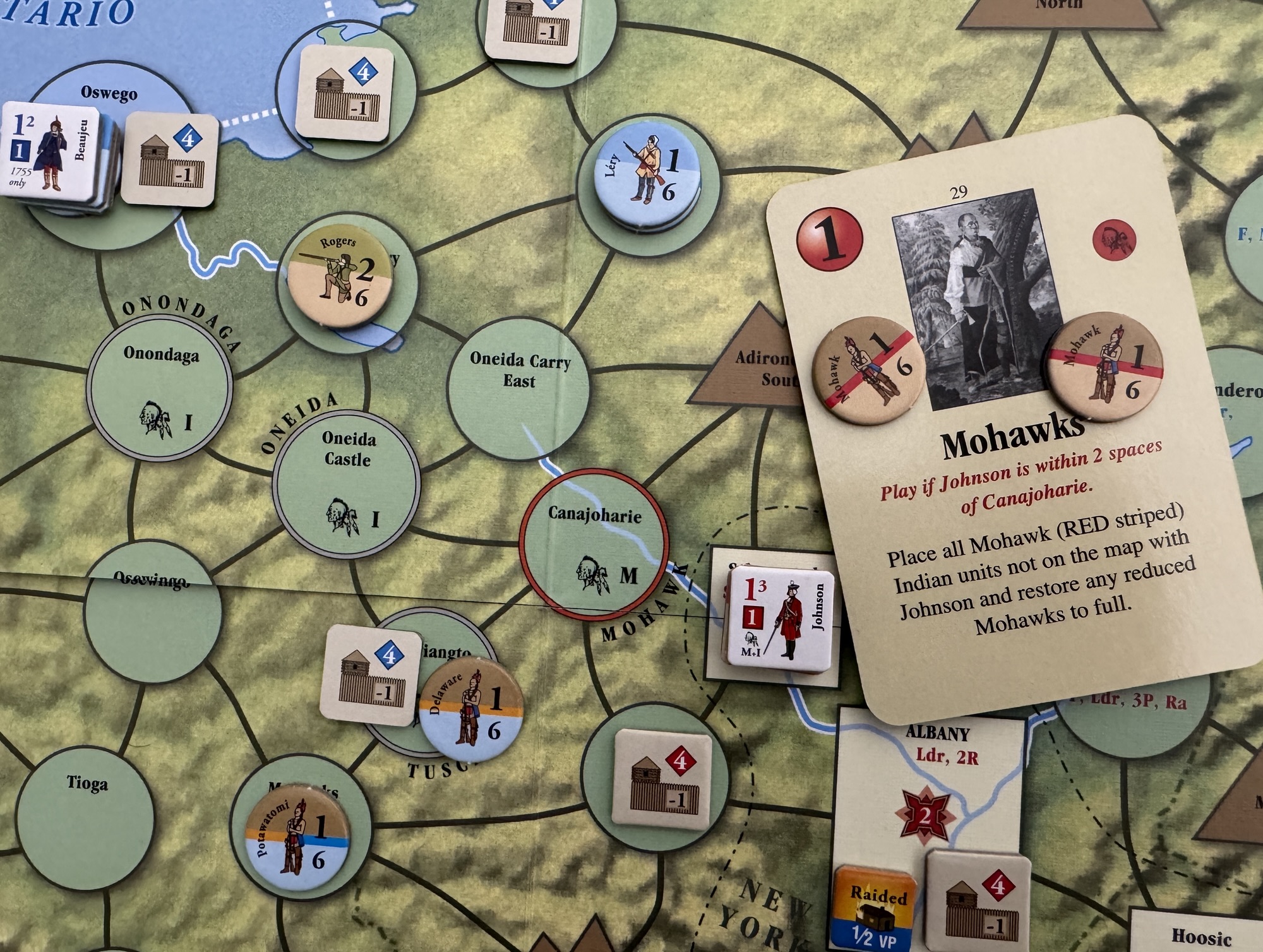
My Favorite Wargame Cards – A Look at Individual Cards from My Favorite Games – Card #70: Mohawks from Wilderness War: The French & Indian War, 1755-1760 from GMT Games

Von: Grant
24. März 2026 um 13:00

With this My Favorite Wargame Cards Series, I hope to take a look at a specific card from the various wargames that I have played and share how it is used in the game. I am not a strategist and frankly I am not that good at games but I do understand how things should work and be used in games. With that being said, here is the next entry in this series.

#70: Mohawks from Wilderness War: The French & Indian War, 1755-1760 from GMT Games

One of my fondest memories of our wargaming journey was our initial experience with the full campaign game of Wilderness War from GMT Games. We were 2 very inexperienced wargamers and we slogged through a 9-hour marathon play over a few days that ended in a 0-0 tie of all things. That’s right, the game ended in a tie, even though we both had a card in hand, but I was unable to use mine to activate Levis, which was my only potential Victory Point scoring force, and Alexander’s forces were in too tenuous a position or too wounded to risk an open battle for VP’s. You would think that this would have turned us off to the game but on the contrary it made me fall in love with asymmetric wargames and the Card Driven Game mechanic with its use of Action Points and events to wage war on the North American continent. The end score of our game really followed the tension of the game, and the blunders on the side of the British that counter balanced their various successes.

All in all, this game was excellent to play and we both highly recommend it. The two factions play extremely differently which leads to many intricate and reactive strategic decisions. The British have many powerful forces with their Highlanders and cannon while the French have access to better leaders and mobile troops and Indian allies who can run around the frontier raiding and burning settlements for VP’s. Laying siege and assaulting really feels like it should, and avoiding battle until you are ready is something that is integral to maintaining a strong presence on the board. You cannot always get into every possible fight as you will not survive the attrition of these battles. The deck plays really well, and as you don’t have to worry about the opponents events in your hand going off, the management aspect is much simpler yet very engaging as there are always reaction cards you can play or cards that you want to hold onto for that perfect moment.

In previous posts in this series, we have discussed the importance of the players of both sides gaining the trust and services of the indigenous Indian denizens of North America in the fight. The French and British can both use the Indian recruitment cards, including cards such as Iroquois Alliance, Northern Indian Alliance and Western Indian Alliance, to recruit, restore, and move native allies to gain victory points through raids and controlling of territory. The French hold a significant advantage with more access to a greater number of Indian auxiliaries, and will be using these cards to launch early raids, while the British can recruit specialized units like their Mohawk or Cherokee allies. 

In this entry, we will take a look at the British card Mohawks. Mohawks is one of those cards that has a pre-requisite qualifying condition to play the card. In this case, the qualifier is that the leader Johnson must be located on the board within 2 spaces of Canajoharie, which was a Mohawk village located in upstate New York. As long as he is within the required 2 spaces, the card can be played to bring out onto the board the Red striped Mohawk Indian units. These must be placed with Johnson and the other added benefit is that any reduced Mohawks on the board can be flipped to their full side. These pro-British units can only be recruited by the British player and their arrival in New York can be a huge boon to the British as the French and their Indian allies will be raiding the villages and settlements up and down the frontier regularly during the game as one of their most dependable sources of Victory Points. These Mohawk allies can spread out around the area and intercept incoming raids before they can occur. Remember that Indian allies in Wilderness War are not powerful combat units and are best used to raid and prevent other tribes from raiding.

I very much love the thematic connection here as in order to attract the Mohawk Indians as your allies you must have someone that they trust in the area and this is Johnson. Sir William Johnson was a pivotal British superintendent of Indian Affairs whose deep integration into Mohawk society secured the crucial Mohawk Nation alliance for the British during the French and Indian War. By living among them, learning their language, and marrying Mohawk women, he maintained the Iroquois Covenant Chain and led Mohawk warriors in key victories. This is one of the great things about these Card Driven Games and their use of the cards to deliver the bits and bobs of history to enlighten our understanding and to expand our knowledge of the period.

As a young man, Johnson moved to the Province of New York to manage an estate purchased by his uncle, Royal Navy officer Peter Warren, which was located in territory of the Mohawk, one of the Six Nations of the Iroquois League. Johnson learned the Mohawk language and Iroquois customs, and was appointed the British agent to the Iroquois. Johnson commanded Iroquois and colonial militia forces against the French and their allies during the war and was later commissioned a major-general for his role in the British victory at the Battle of Lake George in 1755. His capture of Fort Niagara from the French in 1759 brought him additional renown. Throughout his career as a British official among the Iroquois, Johnson combined personal business with official diplomacy, acquiring tens of thousands of acres of Native land and becoming very wealthy.

In the next entry in this series, we will take a look at The Wartburg from Here I Stand: Wars of the Reformation, 1517-1555 from GMT Games.

-Grant

HWC Coffee Card Game

HWC Coffee is a Malaysian specialty coffee chain. They made a card game which was given away for free if you bought coffee (and other stuff) worth more than a certain amount within a single transaction. It is encouraging to see this. I would love to have my game designs used in such projects. Zus Coffee had something like this just last year, a Sembang Raya card game. Something that promotes

Imposter Syndrome

23. März 2026 um 23:12

The box art sold me on the game. I never judge a book by its cover. But a box by its lid? Always.

The Imposter Kings reminds me of a game I created as a kid. That probably sounds like a slam. Kids of six and a half aren’t known for making the deepest games.

But it isn’t that. It’s the way the game loops in on itself.

In my game, there were cards numbered one to ten. On your turn, you played a card on top of your dad’s card; on your dad’s turn, he played a card on top of yours. No matter who played, the card had to be higher than the one under it. If ever you couldn’t play a card, you lost and your opponent won. Halfway into our first play, I realized that high cards were infinitely better than low cards. So I made up a new rule on the fly. You could play a one on top of a ten, looping back around to the start of the sequence.

There’s more to The Imposter Kings. Lots more. The game’s designer, Sina Yeganeh, was too sharp to think that numbered cards would be interesting enough on their own. So this is one of those games with plenty of special abilities and triggers and the occasional reaction that plays out of sequence. At core, though, it’s a game about playing the right card so that your opponent can’t follow it up with something better, about knowing when to double down with a high card and when to loop back to the beginning. Exactly like my own game. Just, you know, interesting. I’ve played it more than once, for example.

"KISS!" I shout at the card I play over the other card, consternating my fellow players. They play another card, thinking, "Surely he will not shout 'KISS' this time." I play a card atop their card. "KISS!"

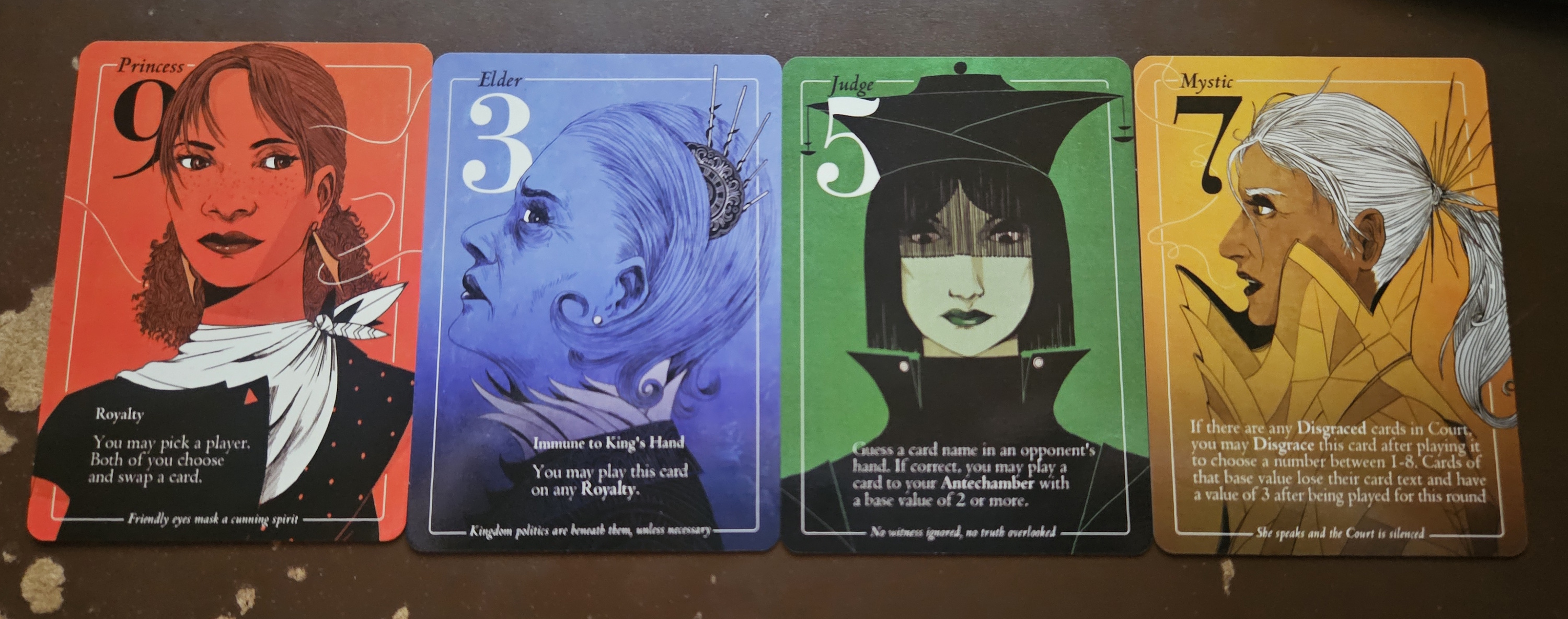
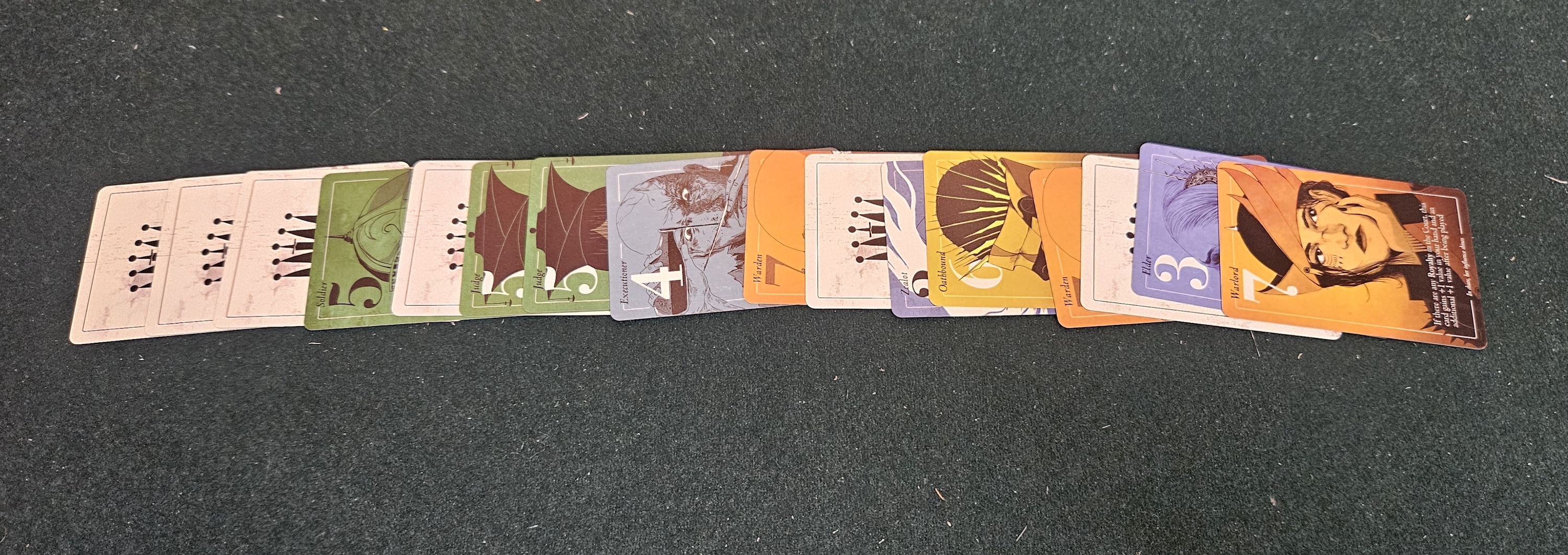
Just a few of the game’s many nasty cards.

On the whole, though, The Imposter Kings always comes back to that one central idea. Either you play a card or you lose. Very quickly, this becomes much harder than it might first seem.

Here’s the obvious conundrum. Let’s say you’re holding a nine. The highest rank. The number of royalty. If you were a six-year-old Dan, that would be the best card in the entire game.

But playing a nine is a fraught proposition. First of all, there are two nines. In The Imposter Kings, you can play any card that’s higher than the one currently seated on the throne. Higher or equal to. So a nine can beat a nine. The Princess comes along and deposes the Queen. The Queen puts that upstart brat Princess in her place. Whoops.

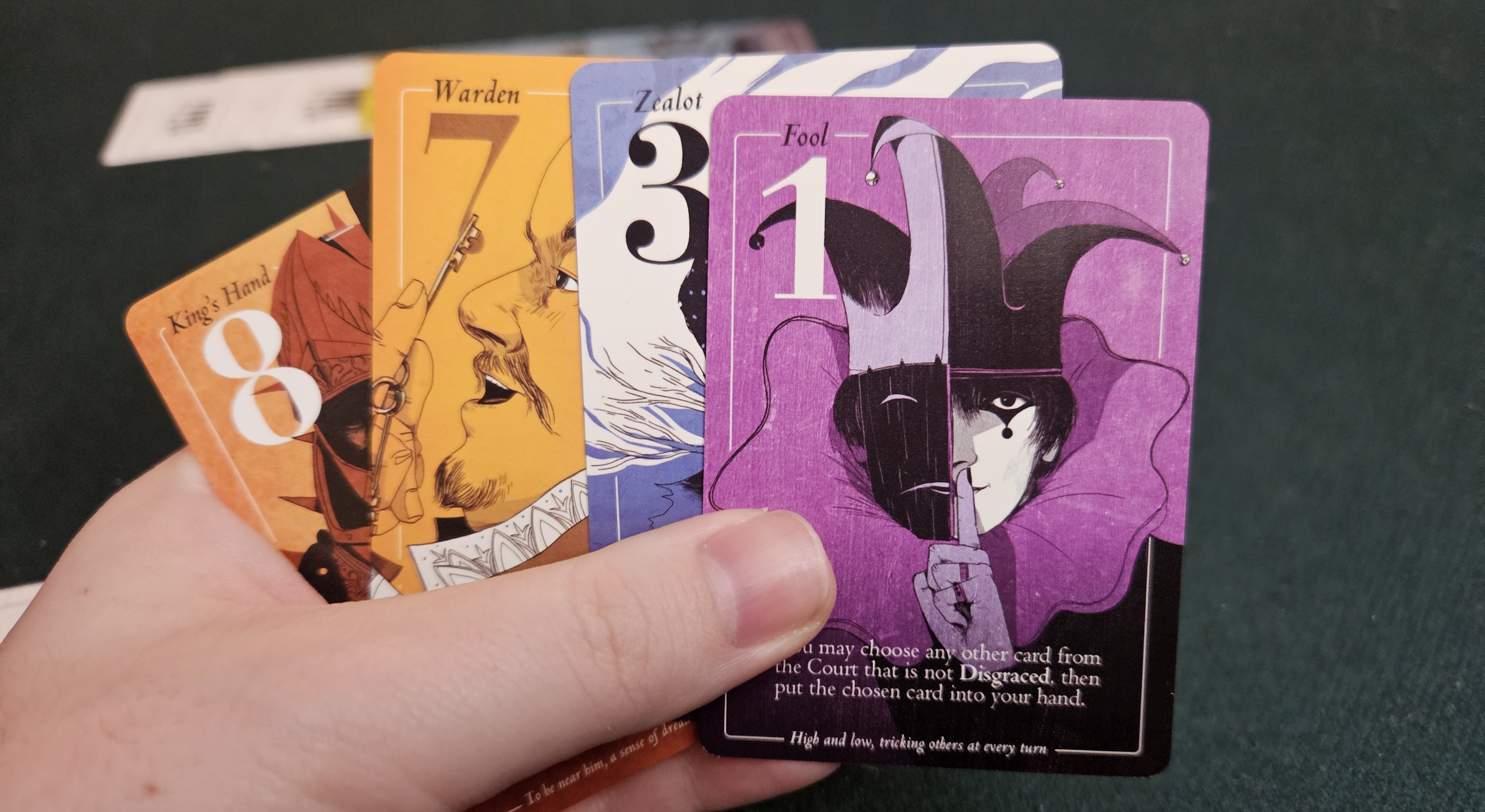
But even if that happens, other cards specialize in deposing royalty. The Elder, for instance, is a lowly three, but loves to swoop in and rap those royals on the knuckles. Or there’s the Oathbound, a bandaged character who can flip an enthroned royal face-down — a trick called “disgracing” — to take the seat and then follow it up with another card of any value. Spending two cards at once decreases the longevity of your hand, especially in a game about being the last person to play a card, but maybe your follow-up will hold the throne for good.

But there’s the question of everybody’s King. When the game begins, everyone is dealt a King. They then choose a card from their hand to place face-down next to the big guy. This is their successor. Once per game, you can flip your King and take your successor into your hand. Oh, and the card currently on the throne? Disgraced. Face-down. Value one. Boop de boop.

But flipping your King is dangerous, too, thanks to the Assassin. This is one of the game’s few reaction cards, and it kills a King the instant they’re flipped. So much for that once-per-game bonus.

But there are ways to out any would-be Assassins. The Judge and the Soldier both excel at revealing whether an opponent is currently holding a card, and both earn a tidy bonus if they’re right. Or there’s the King’s Hand, another reaction card, good for blocking an ability. Or you might make use of the Executioner and Inquisitor, both capable of stripping a card from somebody’s hand outright.

But you might need those abilities for something else. Or perhaps the Assassin is lurking as your rival’s successor, which would mean they could pick them up after you’ve spent the very courtier who could get rid of them.

But… well, there are answers to such a possibility as well, but I think we’ve drawn out this particular strand to its maximum elasticity. The point is that every decision in The Imposter Kings is unusually burdened, unusually dangerous. It isn’t unusual to spend a minute examining your hand. Even when — maybe especially because — there are only a half-dozen cards available at any given moment.

That's a lot of kissing.

A late-game court, full of disgraced or displaced notables.

At best, these decisions feel like little masterstokes. There are elements of deduction, not to mention memory, not to mention yomi, not to mention hoping like hell your rival makes a big dumb mistake. That’s a lot of punch for such a little game. And make no mistake, The Imposter Kings is very little. With two players, you only use eighteen cards at a time. Adding a third or fourth player ups the amount, as well as injects some extra variety, but not by as much as you might expect.

At the same time, the entire process feels algorithmic. Like you’re playing through a flowchart. The Imposter Kings comes across as the sort of game a computer would excel at, its digital spreadsheet mapping the best possible option five, six, a dozen moves out, all those counters and counter-counters charted in advance. Depending on the player count, Yeganeh assuages his game’s near-perfect information sphere, sometimes by keeping a card or three hidden off to the side, sometimes by sheer dint of seating too many players to leave you certain about what anybody is holding.

But like six-year-old Dan deciding that ones can beat tens, these gestures still sometimes come across as patches. Even at the best of times, The Imposer Kings asks a lot of one’s short-term memory. What you’re holding, what you’ve seen played to the court and then disgraced, which cards you threw away when the round began. The player aids are helpful, listing every possible card at the table, but they stumble by not revealing which cards have a duplicate in the deck. Not that it takes a long time to recognize which singles are actually doubles. One benefit of only using eighteen to twenty-something cards is that there isn’t that much to hold in your head.

The bigger mitigating factor is that The Imposter Kings isn’t meant to be played once. Like card games of olde, it’s intended as a many-handed experience, players doing what they can to secure not just one win, but many wins of variable strength. Defeating a foe with cards still in their hand, or while your King is still hidden, or both, is better than eking out a victory through the barest margin. This ablates the luck of the draw, at least to some degree.

It’s also exhausting, requiring one hard-fought win after another to finally scratch out a full victory. In our experience, reaching the necessary seven points takes more time and energy than its slender exterior would indicate. Especially as players grow cannier to one another’s tricks, these sessions can sprawl outward in duration and bitterness — but also in how deviously they permit players to act.

It is me reviewing this game.

Ah, the fool. It is me. It is I.

Here’s the bottom line. Like the game’s cardplay, my feelings on The Imposter Kings are nested and complex, but ultimately they return to a few simple ideas. One, this is a handsome game that’s easy to play but devilishly hard to master. Two, in its efforts to overcome certain inbuilt limitations, it comes across as patchy and overstays its welcome. Three, even slightly different play counts produce radically distinct sensations. Where the two-player game is tight, sometimes even too constricted, and the four-player game devolves into an awkward team-building exercise, the three-player game is utterly perfect, cluttering the game’s headspace just enough to keep everybody guessing, but not robbing it of any of its devious excitement.

Until it falls apart, that is. Because, again, like the cardplay, The Imposter Kings isn’t only one thing. It’s an exercise in high cards trumping everything else, except for the low cards that beat them. Critically speaking, it’s a game where the good outweighs the bad until the bad outweighs the good. Back and forth it goes, never quite settling in one place.

And I’m afraid that’s as definitive as I can be. In the end, The Imposter Kings makes an imposter of me, too. With it on the table, I feel like a kid discovering cards for the first time. The highs. The lows. And everything in between.


A complimentary copy of The Imposter Kings was provided by the designer.

(If what I’m doing at Space-Biff! is valuable to you in some way, please consider dropping by my Patreon campaign or Ko-fi. Right now, supporters can read about which films I watched in 2025, including some brief thoughts on each. That’s 44 movies! That’s a lot, unless you see, like, 45 or more movies in a year!)

Crowdfunding Campaigns of the Week – 3/23/26

23. März 2026 um 14:09
Crowdfunding Campaigns of the WeekWelcome to this week’s batch of crowdfunding campaigns. We have a variety of offerings here, so we hope you will find something that catches your eye. Also, if you want to chat with the BGQ team, join our Discord Server where we talk about games, movies, sports, and other fun stuff. Or, if Facebook is […]

Source

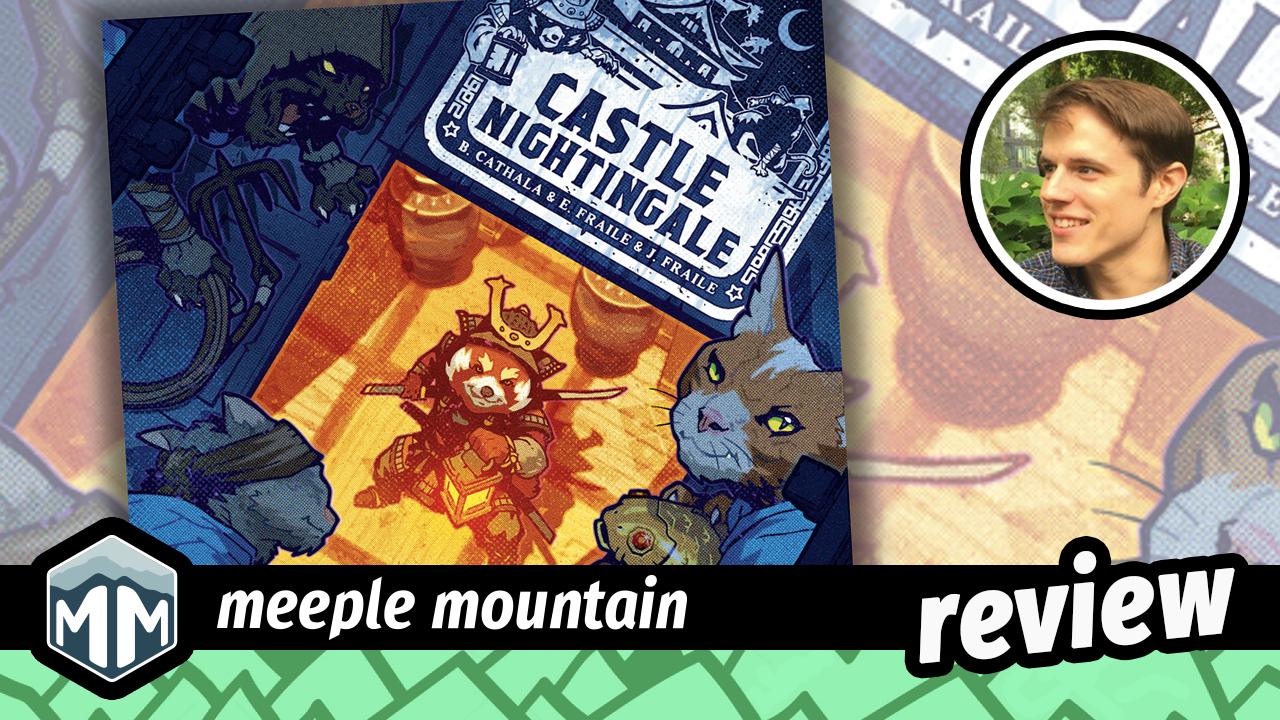
Castle Nightingale Game Review

There’s quite a bit about Castle Nightingale to catch the attention of the discerning gamer. That box, with its palette of dark blue and warm orange, stands out on a shelf. As you get closer, the colors organize into three mangy cat ninjas and a game red panda samurai, all charmingly rendered by Vincent Dutrait. That one cat making eye contact more or less dares you not to be interested. As you pick up the box, which you inevitably will, you might notice the “B. Cathala” listed alongside co-designers Eliette and Jérémy Fraile. Only then might you notice the logo in the lower left corner.

You don’t often get to say, “Sand Castle Games has a new game out.” Prior to Castle Nightingale, you’d have said it twice. There was the 2019 release of Res Arcana, and the 2022 release of First Empires. Three games in eight or so years—I’m including production work on Res—is a slow, considered pace. And to think that people used to marvel at Days of Wonder’s approach of only one title a year.

Even if they only have a 50% hit rate, Sand Castle’s pace suggests that they only release the games they really want to release. It’s clear from their production choices that they pour all of their attention into each…

The post Castle Nightingale Game Review appeared first on Meeple Mountain.

12 Steps to Publish a Tabletop Game

23. März 2026 um 13:32

Every month, I update the progress chart on the News page of our website so anyone can see the current status of any Stonemaier project. There are 12 steps (some overlapping, some sequential) that define the process from design to retail release. If you’re curious about what each step entails, here’s a brief summary, along with the approximate timeframe for each.

  1. Design (6-24 months): Take the game from an idea to something fun and functional. This includes prototyping and local playtesting. If you’re submitting the game to publishers instead of self-publishing, most of your responsibilities end here.
  2. Art (3-6 months): Create the art for all components in the game, including (as needed) cards, tiles, boards, player mats, the box, etc. If there are miniatures, 3D modeling is also necessary.
  3. Development (2-3 months): Make the game even more fun and functional by playing and honing the game. Focus on rules clarity, gameplay intuitiveness, and balance. This overlaps with blind playtesting.
  4. Blind Playtesting (4-8 months): Send the files for the game to paid playtesters who assemble the game, learn it from the rules, and play it several times before reporting their experiences. Use those reports and data to update the game (ideally with support from the designer), then start another wave of blind playtesting.
  5. Solo Design (3-5 months): Solo specialists (e.g., Automa Factory) craft the solo mode for the game based on the final rules/prototype. They also prototype it extensively, sometimes discovering new balance issues to address in the multiplayer game.
  6. Graphic Design (3-4 months): Design the icons, layout, and user interface, then transfer all the content from the prototype into these templates. This also includes the proofreading and oversight process, with the graphic designer updating the files with each new batch of edits. Graphic design culminates in the graphic designer preparing the printer-ready files based on the manufacturer’s specs.
  7. Pre-Production (1 month): The manufacturer reviews the final PDFs and tokens for any issues that might arise during production. Usually there’s some back and forth (digitally and via samples) until the digital proofs and components are approved by both parties. This culminates in the manufacturer sending a PPC (pre-production copy) to the publisher for them to test–this is a single copy of the game printed on its own.
  8. Components (2 months): The manufacturer (and any third-party factories they outsource to) produces the diecuts for tokens and moulds for miniatures, as well as actually making those components at scale. They also prepare for the printing itself–for most printed components, the prep takes longer than the printing. Anything that needs to be glued takes longer (i.e., boards, player mats, and the box), as the paper needs time to dry properly to the cardboard.
  9. Print & Assemble (1 month): Cards and rulebooks are printed en masse. Now, with all the components ready and in one place, they can finally be assembled into the game boxes and placed in cartons (they may also be palletized).
  10. Freight Shipping (1-2 months): From factory to final destinations, the games go by truck to train to ship to train to truck until they arrive at warehouses around the world. This applies no matter where you make products–it’s a global economy. It’s at this time that we typically announce and start to market our products.
  11. Launch & Fulfillment (1 month): This is specific to Stonemaier Games, as we don’t sell products until they have arrived (or are imminently arriving) at our fulfillment centers in the US, Canada, Europe, and Australia. The hardworking folks at these fulfillment centers then pack every order, pair it with the correct label, and send it out with many others via couriers.
  12. Retail Release (1 month): While the webstore launch is in progress, distributors and the publisher gather orders from retailers. This is why it’s super helpful for you to let your store know what you want to buy from them–that way they can ensure they have a copy of the product just for you in time for the retail release day.

Not shown here is the reprint process, which starts a little before step 8 (usually there’s a least a few files in which we make tiny updates before making more of a product).

These are only brief summaries of the steps, but I’m happy to answer questions in the comments.

***

Also read:

If you gain value from the 100 articles Jamey publishes on this blog each year, please consider championing this content! You can also listen to posts like this in the audio version of the blog.

Interview with José Manuel Neva Designer of Peking: 55 Days of Fury from Neva Game Press

Von: Grant
23. März 2026 um 13:00

Neva Game Press (originally called Neva Wargames) is a new publisher who appeared on the scene in the past few years. When I started seeing their posts on Twitter and Facebook, I was immediately impressed with their interesting topic choices for their upcoming games as well as the fact that they are trying to make small footprint wargames that pack a punch. And the art is also very appealing and brings an aesthetically pleasing and attractive look to their games! Recently, they placed their next few games up for pre-order through their Incoming! Pre-Order System including Peking: 55 Days of Fury and I reached out to the owner of the company and design José to see if he could share some information about the design.

If you are interested in Peking: 55 Days of Fury, you can pre-order through the Incoming! Pre-Order System on the Neva Game Press website at the following link: https://nevagamepress.com/product/peking-55-days-of-fury/

Grant: José welcome back to our blog. What is your new upcoming game Peking: 55 Days of Fury about?

José: Thanks, Grant, it’s a pleasure to be here! I’d like to start by mentioning that we’ve recently rebranded from Neva Wargames to Neva Game Press. This change reflects our evolving catalog, as we’re excited to include more thematic games moving forward.

Today, I’m presenting one of my latest designs: Peking: 55 Days of Fury. It’s a 1-2 player game where one side commands the Chinese forces and the other leads the International Legations (an alliance of 8 nations). The game spans 6 turns—representing roughly 9 days each—where players fight to secure the most victory points by the end of the siege.

A full game typically lasts between 2 and 2 1/2 hours, making it perfect for a single session. Please keep in mind that we are still finalizing the artwork and graphic design, so the images shown here are not final.
Also, our second pre-order campaign, featuring both Reformation: Fire and Faith and Peking: 55 Days of Fury launched on March 15th. Don’t miss out on the Early Bird discount!

Grant: What does the subtitle “55 Days of Fury” mean and reference?

José: I imagine many of you have seen the classic film 55 Days at Peking—if not, I highly recommend it! It’s a fantastic movie and a core inspiration for this project. With the subtitle “55 Days of Fury”, I wanted to pay tribute to the original title while carving out its own identity. It reflects the sheer intensity of those 55 days of siege, and I wanted the name to capture that raw energy.

Grant: Why was this a subject you wanted to focus on?

José: I’ve always been fascinated by sieges throughout history, from ancient times to the modern era. Because of this, it’s very likely you’ll see more siege-themed titles from me in the future. I already have several compelling projects in mind, such as the 1453 Siege of Constantinople or the Siege of the Alcázar during the Spanish Civil War. There is so much tactical and human drama in a siege that I’m eager to explore the subject and see how to model the differences in each of the sieges and eras represented.

Grant: What are the unique features with the system used for the game?

José: Sieges are often associated with static gameplay—that’s just the nature of the conflict. However, I wanted to design a system that keeps the action fluid and engaging. To achieve this, the entire besieged area is streamlined into four main zones, allowing for a more dynamic experience.

Each side faces unique strategies and challenges, and that asymmetric touch gives the game immense replayability. At its heart, the cards are the engine of the game. It’s important to note how much depth they offer; your success depends entirely on how you plan and optimize your strategy based on card management.
I’ve also implemented a unique twist on Fog of War. Instead of these being ‘dead’ or useless cards, you’ll have to make tough tactical decisions about how to use the Fog of War cards you draw at the end of each turn. They could be a resource, not a penalty.

Grant: What must you model regarding the history in the design?

José: There is a wealth of historical detail in this design. From the unit stats to the card events and specialized mechanics, my goal was to represent the siege as authentically as possible without sacrificing a manageable playtime.

For example, the Boxer units have much lower Firepower than other factions, but they boast the highest Manpower values. This reflects their limited weaponry while highlighting their superior numbers—they have the strength to build and repair barricades quickly. In contrast, the Imperial Chinese Army units have better Firepower but generally lower Manpower.

On the other side, the International units are better armed but severely outnumbered. To represent this attrition, when a Chinese unit is defeated, it returns to the unit pool to potentially reappear later. However, injured International units are sent to the Infirmary instead.

The Infirmary is a critical mechanic; it honors the men and women who worked tirelessly to save lives during the siege. The International player must manage this correctly, or risk losing their limited forces for good.
Finally, I’ve included Diplomatic Relationships. Based on historical accounts, the International player will face diplomatic tensions between the allied nations. These tensions carry various penalties, forcing the player to balance military action with the need to restore diplomatic stability to avoid major setbacks.

Grant: What is your design goal with the game?

José: My main objective with this design was to prove that sieges don’t have to be limited to solitaire play. I wanted to turn them into a compelling, dynamic head-to-head experience where two players can truly feel the historical pressure and the weight of their consequences.

I want players to experience the unique hardships each side faced during the siege while navigating a system full of fresh ideas and meaningful choices. By providing so many strategic layers and branching paths, I’ve ensured that the game offers deep replayability every time it hits the table.

Grant: What other games did you use as inspiration?

José: While there are other games on the Boxer Rebellion, Peking: 55 Days of Fury offers a completely different perspective. I’ve taken a fresh approach to this fascinating siege, focusing on dynamics and mechanics that haven’t been explored this way before. That’s exactly what makes it so attractive—it fills a gap in the market by providing a unique experience that feels unlike anything else currently available on the subject.

Grant: What sources did you consult about the history?

José: In terms of research, my design was primarily informed by three key works:

The Boxer Rebellion by Diana Preston: This was my main reference—an incredibly comprehensive account full of the historical nuances that allowed me to build the game’s framework.
Peking 1900: The Boxer Rebellion by Peter Harrington (Osprey Publishing).
The Boxer Rebellion by Lynn E. Bodin.

While Preston’s book provided the narrative and thematic depth, the works by Harrington and Bodin were essential for the technical details. They helped me accurately determine the troop sizes for each nation and provided the visual references needed to correctly represent the uniforms and equipment of every soldier type.

Grant: What is the scale of the game? Force structure of units?

José: I’d classify this as a tactical-scale game. Each International military unit represents approximately 8 to 10 soldiers, highlighting the small, elite nature of the legation guards. In contrast, the Chinese units represent much larger groups of combatants. This difference in scale on the board really emphasizes the ‘few against many’ tension that defined the historical siege.

Grant: What are the differences between the playable factions of the Eight Nation Alliance and the Qing army and Boxers?

José: The asymmetry between both sides is woven into every aspect of the game. As a general overview, while the International forces possess superior weaponry, they are heavily outnumbered by the Chinese. Their logistics also differ significantly: the International player must struggle to manage dwindling supplies within the besieged legations, whereas the Chinese side operates under a completely different set of pressures. Key thematic elements like Diplomacy, the construction of Siege lines, repairing Barricades, the looming arrival of the Relief Column, and the management of the Infirmary all work together to ensure that playing each side requires a totally different mindset and strategy.

Grant: How did you differentiate them in their mechanics?

José: To give you a better idea of how this asymmetry translates to the table, here are some key differences in how each side operates:

• Unit Quality vs. Quantity: While International units are superior in combat, the Chinese player must compensate for this by effectively using artillery pieces, surveillance markers, and sheer numbers.
• The Detachment Display: The International player can have a larger detachment of up to 6 units ready for combat, whereas the Chinese side is limited to a smaller detachment of 3, requiring more frequent rotations or reinforcements.
• The Infirmary & Attrition: When International units are injured, they are moved to the Infirmary. If it becomes overcrowded, units will die, awarding Victory Points (VP’s) to the Chinese. Managing this by “installing beds” and healing soldiers is a vital survival sub-game.
• The Relief Column Mini-Map: The Chinese player manages a specific mini-map tracking the progress of the two Relief Columns marching toward Peking. Their goal is to stall this advance; the further they keep the rescuers at bay, the more VP’s they secure.
• Supply Lines: Logistics are a constant struggle for the besieged International side, whereas the Chinese side enjoys much more reliable access to supplies.
• Diplomacy & Defenses: The International player starts with fully built defenses but must navigate precarious diplomatic tensions. Conversely, the Chinese side must actively build and maintain their own barricades throughout the game to score VP’s.
• Unique Action Phases: Both sides have access to a distinct set of special actions and historical Fog of War cards, ensuring that no two turns feel the same.

Grant: How does the game use cards?

José: Cards are the primary engine of the game, and I designed them to be highly versatile. You don’t just ‘play’ a card; you have to decide how to use it across different phases:

• Initiative & Events: Cards can be used during the Initiative phase or played for their Main Event.
• Boosting Mechanics: You can even activate Secondary Events by ‘boosting’ a card with another from your hand, creating powerful combinations.
• Action Points: During the Action phase, cards can be spent for Action Points (AP) to perform essential maneuvers.
• Deck-Building Elements: As the game progresses, you can incorporate common cards into your hand to improve your deck—often depending on how you manage your Fog of War cards.

I deliberately split the card-driven mechanics into two distinct phases. I wanted to ensure that even if you draw a ‘difficult’ hand, you still have the Action Point phase to fall back on. This gives you the flexibility to spend those cards as AP, ensuring you always have agency over the situation. It’s all about hand optimization and adapting your strategy to the shifting tides of the siege.

Grant: Can you show us a few examples of these different type of cards?

José: In the cards you will find Faction cards, Common cards and Fog of War cards:

Faction Cards
Each side has nine Faction cards.

    1) Descriptive image of the event.
    2) AP value.
    3) Support icon – used to execute a Secondary Event during the Event Phase. A card can have a maximum of two different Support icons. Icons can be of the Lion, Heron, or Dragon type.).
    4) Initiative value.
    5) Event title. The color of the title indicates which side the card belongs to (blue = International, red = Chinese).
    6) Description of the Primary Event.
    7) Secondary Event Support icon requirement.
    8) Description of the Secondary Event.
    9) Card number (for identification purposes only; has no effect on the game).

    After a Faction Card is played, it is placed in the playing side’s discard pile. The discard pile is reshuffled to form a new draw deck if the existing deck is exhausted when drawing a new hand at the end of the Turn.

    Common Cards

    1. Side colors: red and blue. 2. Reminder to remove the card when its events are used.

    Fog of War Cards

    1. Fog of War Icon.
    2. Side color (red or blue).
    3. Reminder to remove the card when its events are used.

    Grant: What is the layout of the Board? Who is the artist?

    José: The central part of the board is where the heart of the action takes place. It features a detailed map of the International Legations and their surroundings, strategically divided into four key sectors. Surrounding this central battlefield, you’ll find various common and individual tracks, along with dedicated display areas for each player to manage their resources and units.

    As for the visuals, we are currently in the middle of the creative process. I’m thrilled to be working with a very talented team: David Prieto is handling the Graphic Design, while Germán Pasti and Moreno Paissan are the illustrators bringing the 1900s to life. Although the artwork is still a work-in-progress, we are striving for an immersive and historically evocative look.

    Grant: What is the purpose of the various Outer Zones?

    José: The board is designed for maximum clarity, with dedicated zones for each player. On the International side, the player manages their Morale and Supply tracks, along with the Detachment, Diplomacy, and Infirmary displays.

    The Chinese side also tracks their Morale and Supplies, but their side of the board features the unique Relief Expedition mini-map. This is where the tension builds as the International forces attempt to advance from Taku to Peking, and the Chinese player must do everything in their power to stall them.

    Grant: How is diplomacy and diplomatic relations used in the game? What benefits and detriments does it bring?

    José: After the Supply check, the International side performs a Diplomatic Status check. The International side rolls one die for each Diplomacy marker (in the Diplomacy area of the International section) on its Parchment side. On a roll of 1, the marker is flipped to its Tension side to indicate tensions between nations.

    When Tension occurs, the International side must apply the revealed effect in any Zone where MU of the nation(s) who’s flag is shown are present. If the first Diplomacy box is affected (with flags of Britain and Russia), only Map Zones with both British and Russian MU present are affected.

    Tension effects can be cumulative if multiple effects apply to the same Zone. There are several types of effects such as: Tactical dispute (reduces combat strength), Communication Breakdown (it is not possible to use modifiers), Conflicting Priorities (reduces manpower), Water hoarding (it makes it more difficult to extinguish a fire).

    Grant: What is the anatomy of the counters?

    José: Here is a look at a few of the counters.


    Military Units (MU)
    Each MU marker represents a group of soldiers.

      1) Illustration of the nation’s soldier.
      2) Flag of the nation.
      3) Combat Strength – Ranging from 1 to 3. During combat, the Combat Strength of all MU on each side are added together.
      4) Manpower Factor – Ranging from 0 to 3. Used by the International side to Repair Barricades, and by the Chinese side to Lay or Repair Siege Lines.

      Grant: How are units activated and chosen?

      José: Units are activated through specific actions, and I’ve designed a system that balances tactical planning with the Fog of War. While units are often drawn randomly from a bag, both sides have a dedicated Detachment Area. This acts as a pool of visible, ‘ready-to-deploy’ units that you can plan around. This means you have the flexibility to deploy known forces from your detachment in addition to the tension of drawing new reinforcements directly from the pool.

      Grant: What is the general Sequence of Play?

      José: The sequence of play is the following:

      Initiative
      • Both sides reveal one card from their hand, simultaneously.
      • Tie – the player who had the Initiative in the previous turn wins.
      • Tie on Turn 1 – the Chinese side wins.
      • The Initiative cannot be given away.
      • If Fog of War cards were played, execute the Events (Initiative side first).
      • Played cards are discarded (or removed if a Fog of War Card of the playing side).

      Initial Engagement
      • The Initiative side places their Engagement marker in any Zone. The non-Initiative side then does the same in another Zone.
      • The Initiative side resolves the Engagement in their chosen Zone, acting as the attacker.
      • The non-Initiative side then resolves the Engagement in their chosen Zone, acting as the attacker.
      • Note: If there are no MU present in the Zone, or only MU from one side, the Engagement does not occur.

      Events
      • The Initiative side plays two cards from their hand for their Events. They may play a third Support card to execute Secondary Events.
      • The non-Initiative side repeats the process.

      Maintenance
      • Both sides, starting with the Initiative side, perform two types of Maintenance checks.
      • International:
       Supply Status check (1 die).
       Roll of 1 to 4 – Lose two Supply levels.
       Roll of 5 to 6 – Lose one Supply level.
       Update the Supply Track.
       Any Supply Track effects are applied: MU are moved to the Infirmary.
       Diplomacy Status check (1 die per Diplomacy marker on its Parchment side).
       A result of 1 flips the Diplomacy marker to its Tension side.
       The revealed effect applies unless the marker is flipped back to its Parchment side via a Diplomacy Special

      Action.
      • Chinese:
      • Supply Status check (1 die).
       Roll of 1 to 2 – Lose two Supply levels.
       Roll of 3 to 4 – Lose one Supply level.
       Roll of 5 to 6 – No Supply loss.
       Update the Supply Track.
       Any Supply Track effects are applied: Morale level reduction.
       Relief Expedition roll: 1 die:
       Number of spaces Relief Expedition marker advances on the Relief Map: (1) = 1, (2-4) = 2, (5-6) = 3.

      Action
      • The Initiative side performs Actions with the APs on the remaining card in their hand.
      • The non-Initiative side repeats the process.
      • Two types of Actions:
       Basic: Common to both sides. Cost 1 AP. Can be repeated once per side per Turn.
       Special: Different for each side. Cost 2 action points. Cannot be repeated.

      Command
      • 6.1. Scoring & Victory Check:
       (Turns 3 & 6 only): Chinese side gains or loses VPs based on the position of the Relief Expedition marker on the Relief Map.
       (Turn 6 only): Both sides gain VPs based on their Intact Barricades (International) and Intact Siege Lines (Chinese).
      o Check for Automatic Victory (one side has 15+ VP advantage). If Turn 6, determine the winner of the game.

      Grant: What actions are available to players?

      José: Both players have access to a core set of Basic Actions to manage the conflict:

      • Combat: Including Engagements, Raids, and Artillery Fire.
      • Maneuver: Movement and Surveillance to gain the upper hand.
      • Logistics: Supplying forces and Repairing vital defenses.

      However, the true flavor of the game comes from the Specific Special Actions available to each side, reflecting their unique historical roles:

      • The International Player focuses on survival and rescue: Expanding the Infirmary, healing wounded units, advancing the Relief Expedition, managing Diplomacy, and increasing political Commitment or Morale.
      • The Chinese Player focuses on pressure and persistence: Laying Siege Lines, coordinating Artillery Support, increasing Commitment, and rallying their forces to Raise Morale.

      This structure ensures that while the basic rules are easy to learn, the strategy for each side is completely distinct.

      Grant: How is supply used in the game?

      José: Supply management is a cornerstone of the experience, especially for the International side. During the Maintenance Phase, both players must check their supply status. The consequences of failing to maintain logistics are severe and thematic:

      • The International Side: For the besieged, a lack of resources is devastating. Failing to meet supply requirements can force healthy units directly into the Infirmary due to exhaustion or starvation.
      • The Chinese Side: For the attackers, supply issues represent a loss of momentum and logistical strain, resulting in a direct hit to their Morale.

      This ensures that players cannot just focus on combat; they must spend precious actions and cards on the Supply action to keep their war machine running.

      Grant: How is victory achieved?

        José: To win a game of Peking: 55 Days of Fury you must get more victory points (VP’s) than your opponent. Each side has different ways of doing this:

        International Side

        • For each Chinese MU KIA +1 VP.
        • For each Chinese Artillery Unit Sabotaged: +1 VP.
        • For each Intact Barricade at the end of the game: +1 VP.

        Chinese Side

        • For each International MU KIA +1 VP.
        • For each Destroyed Barricade: +1 VP.
        • For every two (rounded down) Intact Siege Lines at the end of the game: +1 VP.

        If the Relief Expedition marker is held in a +1/+2 VP space on the Relief Map at the end of Turn 3, and again at the end of Turn 6 (it can be scored twice). If the marker is on a –1/-2 VP space, the Chinese sides lose that many VP’s at the end of Turn 3 and Turn 6.

        There is a case when the game can end automatically in the following cases:

        • If any side scores 30 VP’s, they are immediately declared the winner.
        • If at the end of any Turn a side has a 15 VP advantage or more over their opponent, they are declared the winner.

        Grant: What type of experience does the game create for players?

        José: The experience is defined by a shifting sense of pressure that is unique to each side. Since it is an asymmetrical game, the tension evolves differently for each player as the siege progresses. In the first half of the game, the International player often feels they have the situation under control, but as the turns pass, the weight of the siege begins to take its toll, and maintaining their position becomes increasingly desperate. Conversely, the Chinese player starts by testing the defenses, and their momentum builds as they tighten the noose around the legations.

        This ‘cross-fade’ of emotions—from early confidence to late-game survival for one, and from persistence to a final push for the other—ensures that the tension remains high from the very first turn until the final victory point is counted.

        Grant: What are you most pleased about with the design?

        José: I am truly proud of the system I’ve built for this game. My goal was to prove that a siege doesn’t have to feel static or repetitive, and I believe we’ve achieved a dynamic flow that will surprise players.

          If the community enjoys this system (Siege & Storm Series)—which I’m confident they will—I would love to adapt and implement it for other historical sieges in the future. I am always open to feedback and suggestions! Which historic siege would you like to see next? Let me know in the comments.

          Grant: What other games are you working on?

          José: Beyond Peking, I have several other exciting projects in the pipeline. I am currently putting the finishing touches on Spartacus: Rome Under Threat, a 1-2 player game focusing on the Third Servile War. I am also mid-way through the development of Cid Campeador: Warlord, a 1-4 player game. It spans the dramatic 15-year period from 1085 to 1099—a time defined by El Cid’s exile, the expansion of the Christian kingdoms, and the rising shadow of the Almoravids.

          Looking further ahead, I have plenty of ideas in the works, including a new thematic game centered on the Roman Empire and Volume II of our Blind Valor Series, which will utilize the system from Iwo Jima: Hell on Earth. There’s much more to come from Neva Game Press!

            José, thank you so much for your time and effort in responding to our request for this interview and for the great detail that you have given us about this game. I am very much interested in Peking: 55 Days of Fury and cannot wait for it to be available to play!

            If you are interested in Peking: 55 Days of Fury, you can pre-order through the Incoming! Pre-Order System on the Neva Game Press website at the following link: https://nevagamepress.com/product/peking-55-days-of-fury/

            -Grant

            Firing Up the Base (Game)

            by Justin Bell

            60,000 gamers (including me) have been intently following the crowdfunding updates for the Brass: Pittsburgh campaign launching on March 24th. I’m a massive fan of the Brass system, as an owner of Brass (aka Brass: Lancashire) and Age of Industry (along with its first set of expansion maps, Japan and Minnesota). I’m also very happy to play your copy of Brass: Birmingham any time you want, for reasons I described in my Meeple Mountain review a few years ago.

            While Santa’s elves spend the next few months working on the Brass: Pittsburgh production–sexy metal coins aren’t going to make themselves, after all–I’ve still got plenty to do to pass the time. That’s because campaigns for expansions, second editions, reprints, deluxe copies and additional games in the same universe always do the thing I love most–they fire up the base of players who love earlier games in these series, making these titles much easier to get to the table while riding the hype wave.

            ***

            For about eight months in 2024, whenever I went to a game night, I placed my copy of Brass: Lancashire in my gaming “go bag.”

            I tried to have Lancashire ready just in case my ideal scenario popped if we didn’t already have another game lined up. Every week, in every part of Chicagoland, no matter what else had been planned for that game night, I popped Lancashire into the bag. And every week, without fail, I would socialize my bag’s contents, then end with something like “...I’ve also got Brass: Lancashire in the bag, you know, just in case anyone wants to get that to the table.”

            As you have guessed, Lancashire never hit during that window of time. There were always reasons, or excuses, why it never hit—”oh, you’ve got that hot review copy of _____”, “nah, let’s do a bunch of fillers instead”; “we only have about two hours left, and I thought Brass takes longer”—but the reality is that I never structured an entire night around getting Lancashire to the table. (I did play Birmingham twice in that time, ironic because I prefer Lancashire over Birmingham if I had to pick just one of those two titles.)

            One of the other reasons why Lancashire never hit: I insist on playing it with exactly four players. The game is brutal regardless of player count, but it is perfect AND perfectly brutal with four players. A couple of times, Lancashire didn’t come out because we had three players, or a player count higher than four and needed another title to accommodate the group.

            So, I went oh-for-eight-months back in ‘24. But now that we have a new Brass game on the horizon? It’s never been easier to get a game of Brass rolling. Just accidentally cough the word “Brass” while standing in a crowd of gamers right now, and you can probably get it to the table.

            “Sorry, did you say Brass? Funny, I was just thinking we should get a game going.”

            ***

            It’s happening at game nights in my circles and at get-togethers across the Chicagoland area…which tells me this phenomenon is probably happening everywhere.

            I’m seeing Brass titles on the dance card a little more often right now. One of the heavyweight strategy nights in my area has had Lancashire or Birmingham pop up a couple times in the last month. Another friend had the chance to play the Pittsburgh prototype recently, thanks to copies hitting the hands of local influencers who are completing review plays in time for the wide range of coverage hitting the interwebs this week.

            This might be the easiest time to ever get a Brass game to the table. But firing up the base doesn’t stop there, with a number of other titles suddenly getting hot thanks to the news of more expansion goodies hitting shelves soon.

            My love affair with Shackleton Base: A Journey to the Moon means that the game hits my table from time to time. But with the release of the new expansion, Shackleton Base: Below. Within. Above., suddenly everyone else I know is interested in getting games of Shackleton Base rolling, too. It seems like The Old King’s Crown is everywhere right now…and there’s a new campaign active now for the game’s second printing that includes not only an expansion, but another game in the same universe, Annulet.

            Now we’re even getting “games in the same universe” spinoffs! Maybe next year, we’ll get Chicago Annulet, helping NBC/Peacock maintain its stranglehold on Wednesday nights after episodes of Chicago Med, Fire, and PD.

            Regicide’s new campaign is pushing not just one, but two new titles. The new Pirates of Maracaibo expansion Bermuda Triangle has given me yet another excuse to get plays of the base game in, both in person and on Board Game Arena. And Voidfall has an expansion AND a campaign game coming…which drove me to pull my Galactic Box off the shelf to get more solo plays in. (OK, OK, you got me: I only opened the box to slip faction mats into the triple-layer player boards. Don’t lie, Voidfall players–you’ve done the same thing!)

            ***

            I know a number of people who avoid all these expansions, reprints, and deluxifications (it’s a word, trust me); to each their own. I use these opportunities to remember what I loved about the base game in the first place. Will these new goodies make me feel differently about why I fell in love with the initial titles? We’ll see. But any excuse to get some of my favorites to the table is an excuse that is good enough for me.

            Fire it up!

            In Memory of Penelope

            22. März 2026 um 17:14

            Our dear cat Penelope has died. Thus, the history today is personal.

            Penelope’s early life is shrouded in mystery. She lived on the streets, but we do not know for how long and if she had been in a human household before. In 2016, she was found and taken to an animal shelter. For the next three years, nobody wanted to adopt her… until we came there and found her to be a somewhat reserved, but very sweet middle-aged lady.

            She integrated into the family immediately: One day after her adoption, she already strategized how to blunt the Prussian invasion of Bohemia.

            From then on, she was our constant companion. She read with us…

            …celebrated Halloween…

            and Christmas with us…

            …rid our place of provocative ribbons…

            …tested all boxes for their sitting qualities…

            …and had secret admirers who sent her bouquets.

            She even found the time to adopt a secret second identity as quirky nanny Purry Poppins.

            Her love for board games remained undiminished. Sometimes we suspected that she considered herself to be a board game.

            The only thing she could not abide was me going for business trips. Big-eyed protests were staged on my suitcase.

            Yet when I came back and played a game with her, everything was forgiven.

            While she certainly enjoyed the games…

            …the most important part to her was spending quality time with her family – for example, sitting on my lap while I sorted counters into trays.

            Penelope was with us during tumultuous years. No matter if Covid forced us to stay at home or Putin threatened to cut off our energy supply, it was always a comfort to have a furry, affectionate companion with us.

            As Penelope aged, her health deteriorated. She succumbed to a lung edema on March 11. She will be greatly missed.

            Designer Diary: Flip Pick Towers

            Von: Adam78
            22. März 2026 um 15:00

            by Adam Porter


            Following the huge success of Voyages, many designers were keen to replicate Postmark Games’s model of crowdfunded, print-and-play, roll-and-write games. In early 2022, I was approached by an illustrator and graphic designer. He was unknown to me, but clearly talented, and he asked whether I’d like to collaborate on such a project. The arrangement was simple: I would design the rules, he would handle illustration and crowdfunding. There was no contract or firm commitment, but it felt worth exploring.

            I immediately knew I wanted to create a flip-and-write game using a standard deck of playing cards. My favourite titles in this genre are Cartographers, Avenue, and Welcome to, so these served as my inspiration. I pulled together a few initial concepts and approached my good friend and frequent collaborator Rob Fisher (co-designer on Qwuzzle, Kompromat,Happy Hoppers, and Emberheart). As often happens, Rob wasn’t keen on my early implementations, but he liked the core idea. He took it away, and a few days later came back with a clear vision: a tower-building game.

            That immediately connected with something from our past. Five years earlier, Rob and I had worked on a trick-taking card game about building totem poles. After each trick, players would pick a card and stack it into their own display, forming totem poles. The game was called Trick Pick Totem, describing the sequence of play. We never finished the design. We were uneasy with the theme, and the card play never quite clicked. But one mechanism stayed with us: when stacking numbered cards, values had to descend from bottom to top, while special cards bent the rules and opened up new scoring possibilities. That idea became the foundation of our new design.

            We started referring to the new game as Flip Pick Towers – an evolution of Trick Pick Totem – once again a literal description of the turn structure: flip cards, pick one, draw towers.

            Rob’s starting point for our flip-and-write was inspired. With an illustrator already attached, he imagined a game that became more beautiful as you played. Many roll-and-writes have clever systems but unattractive interfaces, like spreadsheets. Others begin with an appealing illustrated sheet that steadily degrades as players cross things out. From the very beginning, we set a guiding principle: the sheet should start relatively plain (framed by a nicely illustrated surround) and become richer and more ornate over the course of play. Players should be able to express themselves through their drawings – but without that being a requirement. Boxes, numbers, letters, or stick figures should work just as well, if players preferred.

            I’m a strong believer in identifying a hook early in development. For Flip Pick Towers, it was simple and clear: ‘a flip-and-write game where your player sheet gets more beautiful as you play’.

            Two other pillars quickly followed:
            1. The game could use only a deck of cards and a sheet of paper.
            2. It should be playable virtually, by any number of players (very much a product of our COVID-era mindset).

            The earliest version used the numerical cards from a standard deck of playing cards. As in Welcome to, three cards were flipped; and all players chose one to utilise. Numbers represented floors in a growing tower, while suits allowed you to mark spaces in a small grid on your sheet. Completing lines in the grid unlocked decorations – banners, windows, treasure, beanstalks – each scoring in different ways.


            Early Sketch. 18th May 2022. At this point, Royal Cards represented different types of roof.

            The next step was to find roles for the royal cards. The solution was obvious and intuitive – they would live in the towers. Kings scored if placed in the highest room; Queens scored if royals were grouped together; Jacks scored for the number of banners on their tower.

            We pieced together rules for the remaining cards, to maximise the use of a traditional deck. Selecting an Ace granted you a special ability which would allow you to break the tower-building rules in some manner (similar to our special cards in Trick Pick Totem). But what about Jokers? Well… they attracted dragons – fun to draw but they cost you points. What do dragons love? Gold. So we allowed players to discard one of their previously drawn treasures to persuade a dragon to fly on by, avoiding the penalty.

            We imagined that players might like to colour and elaborate on their illustrations and share their finished towers online, much as they did with the wonderful map-building game, Cartographers.


            21st May 2022. Royals now occupied the towers.

            A couple of weeks had passed since the initial proposal by the illustrator, so I dropped him a message to let him know we had a game to show him. And… nothing. No response. Repeated messages went unanswered. And I felt a little deflated. Rob and I were left with a fun little print-and-play game but no collaborator and no obvious route to market. Neither of us was keen to run a crowdfunding campaign ourselves. And I had fallen completely in love with the game. I played it solo over and over. This was some of our best work, and we felt it deserved a full production, with a box and fully-illustrated, dedicated deck of cards.


            26th May 2022. First prototype with printed sheets.

            As development continued, the limitations of a traditional deck became more obvious. We had clever ideas for roofs and bridges between towers, but they cried out for bespoke cards to make them intuitive. More importantly – inspired by the variable objectives in Cartographers – we could see huge potential in how Kings, Queens, and Jacks might score, but realising that variety required a separate deck of scoring cards.


            4th June 2022. Rules continue to develop. In this version, Royals could occupy bridges and roofs and they had fixed scoring, rather than variable objectives.

            So we made a pivotal decision: abandon standard playing cards and create a dedicated deck. This allowed us to fine-tune card distribution, deepen thematic immersion, and introduce new options. Jacks became Princesses. Aces became Wizards.

            We designed a deck of 30 different scoring objectives. At the start of each game, one objective is assigned to each royal – Queen, King, and Princess – creating an enormous number of possible combinations and dramatically increasing replayability. Queens might score for being adjacent to beanstalks, for each dragon in the same row as them, or for occupying your tallest tower. Kings might score for bridges in the same row, or treasure in the same column, or being adjacent to an empty room. Princesses might score for being above or below windows, or other princesses. I got more and more hooked on solitaire play, and started to think about how to approach the ‘win’ condition when playing alone. I wanted something more engaging than ‘beat your high score’. I’d enjoyed the system in Button Shy’s Sprawlopolis, where multiple objectives each have a target score that combine into a single goal. I borrowed that idea, but added difficulty levels: each objective in Flip Pick Towers has an easy, medium, and hard target. Your chosen difficulty determines your overall target score for the session.


            7th June 2022. Rob imagining what a player sheet might look like with a professional illustrator
            involved

            Osprey Gameswere always our first-choice publisher. I’d pitched to them several times at UK Games Expo without success, but Rob and I admired their catalogue and the care they put into presentation – particularly with the Undaunted series by my friends Trevor Benjamin and David Thompson. I knew my original contact at Osprey had moved on, so I asked David who handled submissions now. His answer was Rhys ap Gwyn, and by sheer coincidence, Rob and I already knew him well. Years earlier, when Rhys was living in Cardiff, he was a regular at our weekly design group. We had playtested many of his prototypes and he’d playtested many of ours. So, our fears of needing to build new bridges with Osprey were unfounded. We just needed to drop Rhys a quick note on Facebook!


            11th February 2023. Moving away from traditional deck. Now with icons for different resources, and special cards for roofs and bridges.

            I showed Flip Pick Towers to Rhys at UK Games Expo in June 2023. In September, he told us Osprey wanted to publish it, but not until 2026. Because of the long timeline, he generously encouraged me to show the game to other publishers.

            At SPIEL Essen that October, I pitched several designs, but two stood out: a worker placement game which would go on to be released as Emberheart, and Flip Pick Towers. Both games got a reaction unlike any games I had pitched before. Multiple companies were interested in one, or both, games. One publisher phoned me a few hours after I pitched Flip Pick Towers to him, and told me he wanted to publish it. I said, “But you haven’t played it yet”. He said, “That doesn’t matter. If there are elements which need to change, we can change them. But I don’t want you to show the game to anyone else.” The pressure spooked us, and Rob and I declined.

            On the flight home, I was sat across the aisle from some other SPIEL Essen convention-goers. I could hear from their conversation that they worked for Osprey. I introduced myself and it turned out they had all played the Flip Pick Towers prototype and loved it. After weighing our options, despite the wait, Rob and I agreed that Osprey still felt like the right home. Enthusiasm counts for a lot. We signed the contract.

            A couple of months later, Rhys sent us a selection of images from a handful of different illustrators, and asked our opinion about which might be suitable for the game. Hungarian artist, Beatrix Papp, was our preference because of the simple sketchy appearance of her drawings – they didn’t feel a million miles from the type of drawings players might create on their own sheets. Over the following months, Rhys involved us in every aspect of the visual development of the game, regularly checking in with us with each new batch of images from Beatrix.

            We were hugely impressed with the attention to detail in the artist’s brief written for Beatrix, which extended to many pages. Here is an extract:

            “Whimsical fantasy. This is aimed at casual gamers and families and will be marked as 14+.  However, we are not aiming for elements to be too cute. It would be great to give it a little edge, which is why we’re really excited to have you as an illustrator. Elements need to be simple, to encourage people to draw, rather than intimidate them. As such, we don’t need detailed backgrounds or anything, just little touches to indicate the situations / environment, as with the art that drew us to you. We also love the limited palette.”


            Sosban the witch, Welsh for ‘saucepan’.

            A challenge at this stage was calibrating complexity. Flip Pick Towers isn’t difficult to learn, but it introduces several unfamiliar systems. Each feature we added increased strategic depth but risked accessibility. We included stars on the player sheets with bonuses if you reached them with your towers. We tried reducing the number of columns. We removed bridges and roofs for a basic introductory game. But all of these changes diminished the game somewhat. Eventually, we accepted that the game needed to be presented in its best, complete form, and trusted players to meet it halfway.


            Tall towers look tasty to Mellt the dragon, searching for a nest! Mellt - Welsh for ‘lightning’.

            One pivotal design decision was formalising the behaviour of dragons. In the earliest versions of the game, they simply deducted points. In the final version, they arrive unannounced and perch atop your towers, preventing you from building any higher unless you feed them gold. Flip Pick Towers is intentionally low on player interaction. Aside from a few competitive elements – such as rewarding the first player to place roofs, or those with more windows than their opponents – most of the game unfolds independently. This choice ties directly to one of our core design pillars: Flip Pick Towers supports any number of players. However, we also wanted to offer a more interactive variant. Once again, we looked to Cartographers for inspiration, particularly its handling of monster attacks. In Flip Pick Towers’s competitive variant, when a dragon appears, an opponent chooses which of your towers it occupies, adding a sharper edge of player interaction for groups that want it.

            At some point in this process, Rhys suggested weaving Welsh references into the game’s backstory. It seemed logical – castles and dragons are a huge part of the Welsh identity. ‘Y Ddraig Goch’, the red dragon, symbolises the country and appears on our national flag. Rob and I have both lived in Wales throughout our entire adult lives, and both of us have children who are Welsh. Rhys is Welsh – his surname ‘ap Gwyn’ means ‘son of Gwyn’ in Welsh, with Gwyn meaning ‘white or fair’). My design-focused YouTube channel is called Adam in Wales. This Welsh connection was a wonderful development, and it helped to make the project feel deeply personal. Wales has a rich history of myths, passed down orally by druids, and recorded in medieval manuscripts.


            King Llew, Welsh for ‘lion’.

            Our King is called Llew after a hero of Welsh mythology, and the Queen is named Blodwen, a name common in Welsh legends. The dragons carry the names Fflam and Mellt – Welsh for flame and lightning, and featuring the familiar Welsh double-letters. The wizards are now magical creatures: Bwca, the Welsh hobgoblin; Mab, the Queen of the fairies, made famous in Shakespeare’s Romeo and Juliet. We also opted for some more whimsical titles: a centaur named Ji-Ji, a name inspired by a Welsh nursery rhyme about a horse; a witch called Sosban, the Welsh word for Saucepan… just because it amused us! The rules explain that the winner of the game must jump up and down and shout ‘Bendigedig!’ meaning fantastic or marvellous! The rule book contains a guide to the origins (and pronunciation) of these names.

            We explored many possible titles for the game, but they all felt generic. We’d grown attached to Flip Pick Towers, and we were delighted when Osprey agreed to keep it.

            With artwork complete, the first half of 2025 was spent refining rules and polishing the rulebook, ensuring clarity without losing the sense of fun and whimsy. Rhys showed me a near-final prototype at UK Games Expo in June 2025. At SPIEL Essen, four months later, a full production copy was available for demo. I loved teaching the game. It’s ideal for learning as you play because, in that first game, every new card flipped introduces a new character – a princess, an imp, a witch, a dragon – or a building feature – a bridge, a roof – and players are always excited to learn what each new element means.

            Flip Pick Towers is my twelfth or thirteenth published game (depending on how you count them…) and my fifth co-design with Rob. It is the game where we have had the most direct input at every stage of production, and that has been a real joy, making the project deeply personal for Rob and myself. We hope you love it as much as we do.

            Hercules and the 12 Labors Game Review

            Wonder Boy, Hercules

            I’m a fan of mythology in general. There’s a childlike wonder that comes from reading stories of epic heroism, self-sacrifice, memorable characters wrapped up in the hero’s journey formula. I remember when Disney’s Hercules came out in 1997, I was engrossed in the mania of toys, picture books, and even the promotional plates in partnership with McDonald’s (yes, back then McDonald’s had tableware!).

            Fast forward to today, and while I don’t have kids of my own, the inner kid is always drawn to mythological stories. Though the actual story of Hercules and the 12 Labors is vastly different from the children’s cartoon, complete with graphic violence and other adult themes.

            I was excited to link up with Mathue Ryann from Envy Born games last year, both over our mutual Friendsgiving of bourbon and board games, and at PAX U, where Hercules and the 12 Labors debuted. This title, with all the gold foiling and pizzazz, follows a format of grinding through a deck of cards in the similar vein of Kinfire Delve, One Deck Dungeon, and Witchcraft!


            On a nice Sunday afternoon, I find myself playing solo games with a cuppa tea, and this…

            The post Hercules and the 12 Labors Game Review appeared first on Meeple Mountain.

            ❌