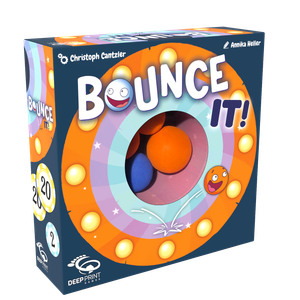
Partyspiele oder sogar noch besser Geschicklichkeitsspiele kann man mich mit jagen. Das liegt nicht an mangelnder Geschicklichkeit oder weil ich ein ungeselliger Mensch bin, sondern weil sie mich davon abhalten die rar gesäte Brettspielzeit zu vergeuden. Ich brauche auch keine Partyspiele, um endlich mal wieder einen Grund zu haben mich ordentlich zu besauf… lesen das eigentlich auch Kinder? … Genussmittel zu mir zu nehmen. Und dann kam Bounce It! ins Haus. Nach dem Auspacken und Anleitunglesen stand der Untertitel für mich schon fest. Dann kommen Kind und Frau an und erster fragt, was man machen muss. Frau: Hey, das ist ja Bierpong ohne Alkohol! Zwei doofe … aber lasst mich euch kurz abholen.
Spielprinzip
Spielaufbau und nächster Wurf.
Der Boden der Spielschachtel ist Teil des Spiels! Oder anders: wenn ihr den Deckel anhebt, sehr ihr ein kleines Loch, vier Bälle und zwei Spender mit bedruckten Pappchips aka Sieg-Punkten. Reihum muss jede Person versuchen die Bälle in das Loch zu werfen (sie müssen dafür mindestens einmal vorher auf dem Tisch aufkommen). Trefft ihr, dürft ihr euch entweder den Chip vom Rand nehmen und die Bälle weitergeben oder den Chip gegen den nächsthöheren auszutauschen und weiter zu werfen. Nach vier Bällen ist spätenstens Schluß. Liegt der letzte Ball dann im Loch gehört euch der Chip, sonst bleibt dieser liegen und die nächste Person hat die Chance darauf.
Wer als erstes 42 Punkte erreicht hat, hat gewonnen. Apropos gewonnen: die Spielenden mit den wenigsten Punkten (können auch mehrere mit gleich vielen Punkten sein) haben vier Bälle zur Verfügung. Alle anderen müssen mit drei Bällen auskommen.
Wer ne Schippe drauf legen will (oder anderen eine Chance geben möchte), beginnt die untere Schachtelhälfte weiter weg zu legen, zu erhöhen, eine Mauer vorzustellen und so weiter. Dies kann für alle oder nur eine Person gemacht werden. Es ist alles erlaubt was Spaß macht.
Unboxing
Hier gibt es nichts zu beanstanden oder hervorzuheben. Naja, einzig die Bälle! Vier unterschiedliche Bälle, die wirklich gut auf dem Tisch hüpfen. Nicht zu doll, nicht zu schwach. Genau was es dafür braucht.
Die Illustration kommt von Annika Heller, die ich auf der Berlin Con 2024 persönlich kennengelernt habe als sie mir mein Exemplar von Lumicora (Pegasus Spiele) signiert hat.
Kleinigkeiten sind wichtig
Bewertung
Wer hier ein ernsthaftes Spiel sucht, sollte besser bei jedem gescheiterten Treffer zur Flasche greifen. Hier geht es ausschließlich um Spaß, hämisches Auslachen bei Fehlwürfen, abfeiern von Treffern und die anderen immer anzuheizen lieber den nächst höheren Chip auf den Rand zu legen, als die sicheren Punkte mitzunehmen.
Das Spiel ist mittlerweile im Büro gelandet, wo es bei passender Feierabendstimmung oder kurz vor dem „komm wir gehen noch was trinken“ als Vorglüher dient. Wir haben es in vielen Gruppierungen und Konstellationen ausprobiert und immer wieder Spaß gehabt. Es bleibt ein kurzweiliges Party-/Geschicklichkeitsspiel und darf damit einen Platz im Regal behalten.
Bildergalerie
Nach erfolgreichem Wurf kann gegen den nächst höheren Chip getauschst werden.Der Ball muss in die Vertiefung.Drei bis vier Bälle stehen pro eigener Runde zur Verfügung.
As trading card games continue to drive growth across the tabletop industry, hobby retailers are increasingly looking beyond games themselves to the accessories that support organised play and competitive communities. In this sponsored article, TCG and board game accessories maker Sanseking explains how changing player behaviour is influencing retailers’ approach to inventory, merchandising and long-term store strategy, and why competitive accessories are becoming a more important part of the European hobby market.
A growing crossover between board gaming and trading card games is beginning to reshape hobby retail strategy across Europe according to TCG, board game, and collectible accessories maker Sanseking, with competitive accessories emerging as an increasingly important category for stores.
What was once a relatively clear divide between casual board game retail and competitive TCG communities has evolved into a far more interconnected ecosystem, the company says, where stores are expected to serve multiple types of players simultaneously.
Sanseking production manager Ding Guang
That shift is particularly visible in the accessories market according to Sanseking production manager Ding Guang, who says retailers are increasingly treating competitive sleeves and protective products as core components of long-term business planning rather than simple add-on purchases.
“Accessories used to be viewed mainly as supplementary sales,” Guang told BoardGameWire. “But competitive communities create repeat purchasing behaviour that changes how retailers think about stability, inventory, and customer retention.”
Hobby retailers now commonly operate within a mixed environment that includes casual board gamers, organised play communities built around titles such as Magic: The Gathering, Pokémon and Yu-Gi-Oh!, and players who actively move between both spaces.
That convergence has become especially visible at events such as Spiel Essen, where accessory brands increasingly exhibit alongside publishers and competitive card players mix naturally with broader tabletop audiences.
But for retailers, the two customer groups behave very differently.
Board games typically generate one-off purchases tied to seasonal launches or major releases, while competitive TCGs create recurring engagement cycles through tournaments, deck rebuilding, league play and shifting formats – and those cycles also generate consistent accessory demand.
Competitive players replace sleeves far more frequently than casual players, Sanseking points out, adding that frequent shuffling, tournament preparation, the need for consistency and sensitivity to tactile feedback all contribute to repeat purchases.
That rise in accessory demand has also been driven by the stellar growth of TCGs more generally, with long-time heavyweights such as Pokemon, Magic: The Gathering and Yu-Gi-Oh! joined more recently by a flurry of other successful entrants to the market, including One Piece, Disney Lorcana and Star Wars Unlimited.
That demand pushed the overall value of the global TCG market to $7.8bn last year according to veteran research firm BCC, which projects the segment will reach $11.8bn by 2030 with a CAGR of 7.9%.
In many European hobby stores, tournament nights now represent some of the most reliable recurring foot traffic. Players attending weekly organised play events increasingly view accessories not as optional extras, but as part of their competitive equipment.
According to Guang, that recurring demand can help retailers smooth revenue fluctuations during slower periods in the board game release calendar. But at the same time, competitive players also tend to be far more selective.
“They pay attention to things casual players may never think about,” Guang said. “Edge structure, shuffle consistency, durability over repeated use, and manufacturing consistency between batches all matter.”
The Growing Importance of Segmentation
That growing attention to performance characteristics is also pushing retailers to rethink how accessories are presented in-store, according to Sanseking.
Historically, sleeves were often treated as largely interchangeable products differentiated mainly by colour or price point.
But as organised play communities mature, stores are increasingly recognising that accessories serve multiple functional segments, ranging from casual ‘kitchen table’ play, to hobby-level regular play and competitive or sanctioned environments.
Retailers that fail to distinguish between those categories can create unnecessary friction, Sanseking says.
The company points out that a product optimized for softness and casual handling may not satisfy a competitive player seeking predictable shuffle feedback. Conversely, a structure-focused sleeve may feel unnecessarily rigid or specialized for a board gamer.
As a result, some retailers are beginning to adopt more structured merchandising approaches, using clearer pricing tiers, competitive-focused shelving, and staff recommendations tailored to different player types.
“The stores performing well are usually the ones creating clarity,” Guang said. “Not necessarily carrying the most SKUs, but helping customers understand which products fit which type of play.”
Risk, Inventory, and Shelf Strategy
From a commercial perspective, competitive accessories also offer several advantages compared to boxed games, including lower unit cost, a smaller shelf footprint, faster turnover when tied to active communities and strong repeat purchase potential.
Retailers can still perceive the category as niche, however – particularly when shelf space is limited. According to Sanseking, the most effective approach is usually a balanced one – not one that offers endless fragmentation, but a core range which covers general use, alongside clearly identified competitive-focused options for players who care about performance.
The importance of organised play also continues to shape purchasing behaviour, with competitive events a significant driver of repeat store visits, even amid wider economic pressure on hobby spending.
Within those communities, accessory choices increasingly function as part of player identity.
“Players often become loyal to specific performance characteristics rather than just aesthetics,” Guang said. “That creates opportunities for retailers to position themselves as serious competitive venues.”
Some stores are already leaning into that approach by highlighting ‘competitive-ready’ accessory sections, aligning certain products with tournament nights, and using more technical product descriptions instead of purely visual merchandising.
The growing overlap between board game audiences and competitive TCG players is also accelerating the trend, according to Sanseking’s experience of the market.
The firm said that many customers who first enter hobby stores through board games gradually become exposed to organised play environments, while competitive card players often purchase board games for more social settings.
Accessories sit directly at the centre of that crossover, with protective products one of the few categories that naturally serve both audiences while still supporting different performance tiers, it added.
For retailers, that makes accessory strategy not just an operational decision, but a bridge between communities, Sanseking says.
As Europe’s tabletop market continues to evolve, Guang believes accessories will become more strategically significant across the retail landscape.
“Players are becoming more informed about performance trade-offs, and retailers are having to serve more diverse communities across the same limited shelf space,” he said. “Clear segmentation and clear communication are becoming much more valuable.”
For brands, that means designing products with defined use cases rather than relying on broad universal claims. And for retailers, Guang argues, success may depend less on scale than structure.
“In a market where casual and competitive audiences increasingly overlap, clarity is often more important than simply offering more products.”

 Anmelden