Kosmos, 2026 Autor: Mariano Di Martino 2–10 Spieler:innen, ab 16 Jahre, 20 Minuten
Ein Song läuft an, irgendwo zwischen sicherem Kopfnicken und völliger Ahnungslosigkeit. Ihr kennt die Melodie, vielleicht auch den Refrain, aber war das nun 1987, 1994 oder doch schon viel später? Genau in diesem Moment sitzt „Play – The Music Party Game“ am richtigen Platz: nicht als trockenes Wissensquiz, sondern als Anlass zum Erinnern, Raten, Mitsingen und lautstarken Diskutieren. Die Grundidee ist angenehm direkt. Ihr hört Musikstücke, ordnet sie zeitlich oder geografisch ein und versucht gemeinsam oder gegeneinander, eure Einschätzungen möglichst gut zu platzieren. Das Spiel knüpft damit an ein vertrautes Erfolgsgefühl moderner Musikspiele an, setzt aber stärker auf Varianten und Wandelbarkeit. Besonders reizvoll ist, dass die Karten nicht fest an einzelne Songs gebunden sind. Sie liefern Jahreszahlen und Länder, während die Musik über unterschiedliche Playlists kommt. Dadurch fühlt sich das Spiel weniger wie ein einmal durchgespielter Stapel an, sondern eher wie ein flexibles Gerüst für viele Musikabende.
Im Kern hört ihr Songs und versucht, sie richtig einzuordnen. Mal geht es darum, ob ein Titel früher oder später erschienen ist, mal darum, gemeinsam eine zeitliche Reihe zu bauen, mal sammelt ihr Punkte über besonders gute Einschätzungen. Die Regeln stehen dabei nicht im Weg. Nach wenigen Minuten ist klar, worum es geht, und die eigentliche Partie entsteht durch das, was am Tisch passiert. Besonders stark zeigt sich das im Modus „Better Together“. Hier wird aus dem Raten kein stilles Abgeben einzelner Tipps, sondern ein gemeinsames Abwägen. Eine Person erkennt die Stimme, jemand anderes erinnert sich an ein Musikvideo, die nächste ist sich sicher, dass dieser Sound unmöglich aus den Achtzigern stammen kann. Genau daraus entsteht der Reiz. Nicht alle wissen gleich viel, aber fast alle können etwas beitragen. Manchmal reicht ein Gefühl für Produktion, Mode oder Sprache, manchmal hilft ein völlig zufälliger Erinnerungssplitter. Der Spielfluss lebt davon, dass die Technik schnell in den Hintergrund tritt. Wenn Songs ohne Fummelei starten, bleibt die Energie am Tisch erhalten. In unseren Partien lief das erfreulich flüssig. Gerade bei einem Partyspiel ist das entscheidend, weil jede technische Pause die Stimmung stärker bremst als eine Regelfrage in einem Strategiespiel. Hier blieb der Fokus auf der Musik, auf den Reaktionen und auf den kleinen kollektiven Aha-Momenten.
„Play – The Music Party Game“ überzeugt vor allem dort, wo es seine einfache Idee offen hält. Die größte Stärke ist nicht, dass ihr Songs erkennt. Die größte Stärke ist, dass ihr aus demselben Kartensatz sehr unterschiedliche Abende machen könnt. Andere Playlists, andere Genres, andere Jahrzehnte, andere Gruppen: Das verändert spürbar, wie sich eine Partie anfühlt. Weil die Karten nicht mit einzelnen Titeln verheiratet sind, entsteht ein erfreulich langer Atem. Ihr müsst nicht ständig neues Material kaufen, nur weil ihr die bekanntesten Songs irgendwann kennt. Die verschiedenen Spielvarianten geben dem Ganzen zusätzliche Luft. Nicht jeder Modus wird für jede Runde gleich wichtig sein, aber sie verhindern, dass sich das Spiel zu schnell wie dieselbe Nummer in anderer Reihenfolge anfühlt. Am stärksten wirkt für mich der gemeinsame Ansatz von „Better Together“, weil er genau das hervorholt, was ein Musik-Partyspiel tragen sollte: Gespräche, Gelächter, Mitsingen und diese herrlich falschen Sicherheiten, mit denen man sich gemeinsam in ein Jahrzehnt verrennt. Auch die Zugänglichkeit ist ein klarer Pluspunkt. Ihr müsst keine Regelmenschen sein und auch keine wandelnden Musiklexika. Wer gern hört, assoziiert und sich auf die Runde einlässt, ist sofort drin. Downtime war in unseren Partien kaum ein Thema, weil selbst fremde Züge durch Diskussion und Musik lebendig bleiben. Das Spiel schaut nicht nur auf die Person, die gerade antwortet, sondern bindet die Gruppe über die Songs fast automatisch ein. Beim Material bleibt der Eindruck nüchterner. Der Kartenstapel erfüllt seinen Zweck, die Chips sind funktional, die Gestaltung ist übersichtlich genug. Mehr emotionale Tischpräsenz entsteht vor allem durch die Musik, nicht durch das Material. Das umbaubare Innenleben des Kartons zur Klangverstärkung ist eine nette Idee, wirkt aber eher wie ein Gimmick, auf das man gut verzichten kann. Entscheidend ist, dass die Karten haltbar genug sind, denn sie werden in geselligen Runden sicher nicht immer mit Samthandschuhen behandelt. Der größte Wunsch bleibt die fehlende Möglichkeit, eigene Playlists oder Genres zu ergänzen. Gerade weil das System so offen wirkt, fällt diese Grenze auf. Wer sehr spezielle Musikrunden bauen möchte, etwa nur lokale Bands, Metal-Untergenres, Schlagerjahrgänge oder persönliche Partyklassiker, stößt hier unnötig früh an eine Wand. Das schmälert nicht den aktuellen Spielspaß, aber es begrenzt das Potenzial eines ansonsten sehr variablen Ansatzes. Unterm Strich ist das ein starkes Musik-Partyspiel für Gruppen, die nicht nur gewinnen, sondern miteinander lachen, singen und staunen wollen. Wenn ihr Musikspiele mögt, aber euch mehr Abwechslung, kooperative Momente und länger nutzbare Inhalte wünscht, findet ihr hier eine sehr empfehlenswerte Alternative mit eigenem Profil. Für stille Grübelrunden oder Menschen ohne Lust auf Popkultur ist das nichts. Für lebendige Runden mit Spaß an Songs, Erinnerungen und mutigen Fehleinschätzungen dagegen sehr viel.
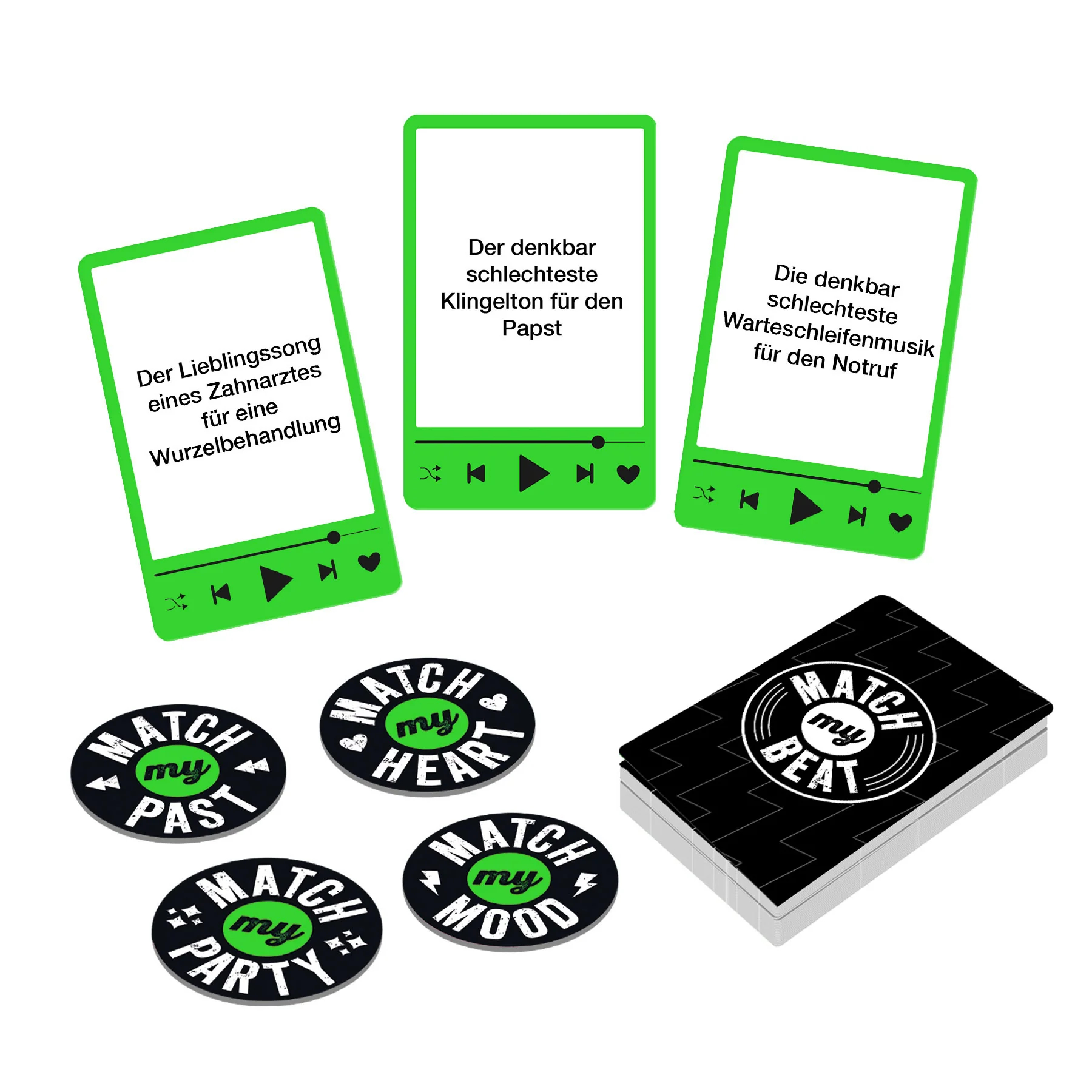
Der Song läuft, irgendwo zwischen Kopfnicken und Grinsen. Ihr schaut auf eure Handkarten, sucht nach der einen Situation, die diesen Beat plötzlich in eine kleine Szene verwandelt, und hofft, dass die Person am Zug denselben schrägen Film im Kopf hat wie ihr. Genau dort will „Match My Beat“ hin: Musik wird nicht abgefragt, sondern gedeutet, verdreht und mit Alltagssituationen verheiratet. Die Grundidee ist angenehm niedrigschwellig. Ihr müsst keine Titel erkennen, keine Interpret:innen wissen und keine Musikgeschichte auswendig können. Stattdessen hört ihr einen Song und legt verdeckt eine Karte aus, deren Text möglichst gut dazu passt. Das kann romantisch sein, albern, peinlich oder komplett daneben. Danach werden die Karten aufgedeckt, vorgelesen und eine Person entscheidet, welche Kombination ihr am besten gefällt. Das ist eine schöne Ausgangsidee, weil sie Musik als gemeinsamen Stimmungsauslöser nutzt. Das Spiel funktioniert nicht über Wissen, sondern über Assoziationen. Es fragt nicht, ob ihr den Song kennt, sondern welches Bild er bei euch auslöst. Gerade in größeren Gruppen ist das reizvoll, weil Musik sofort einen gemeinsamen Raum schafft, ohne dass vorher lange Regeln erklärt werden müssen.
Zu Beginn bekommt ihr Situationskarten auf die Hand. Eine Person übernimmt die Rolle der Wertung, startet einen Song aus einer Playlist und alle anderen suchen eine Karte aus, die ihrer Meinung nach besonders gut zur Musik passt. Anschließend werden die Karten vorgelesen. Die wertende Person entscheidet, welche Kombination überzeugt, und diese Karte bringt Punkte. Der Ablauf ist in wenigen Sätzen erklärt und nach der ersten Runde sitzt alles. Das ist eine der großen Stärken des Spiels. Ihr startet schnell, müsst kaum etwas nachschlagen und könnt auch Menschen dazuholen, die sonst bei Regelrunden innerlich aussteigen. Besonders angenehm ist, dass ihr nicht auf eine einzige Musikauswahl festgelegt seid. Die vorgefertigten Playlists geben eine Richtung vor, aber ihr könnt auch eigene Listen nutzen oder bestehende Playlists einbinden. Dadurch lässt sich die Stimmung am Tisch deutlich steuern. Spielerisch entsteht der Reiz aus dem Moment zwischen Song und Kartentext. Ihr hört eine Ballade und habt plötzlich eine völlig übertriebene Alltagsszene auf der Hand. Oder ein treibender Partysong läuft, aber eure Karten wollen alle nicht so recht passen. Dann beginnt das kleine Dilemma: Nehmt ihr die halbwegs passende Karte oder die, die für den größten Lacher sorgen könnte? Genau daraus ergibt sich aber auch die wichtigste Reibung. Die beste Karte gewinnt nicht immer, weil sie am treffendsten zum Song passt. Oft entscheidet eher, welcher Text die wertende Person am meisten amüsiert. Das passt zum Partyspielcharakter, verschiebt den Fokus aber weg von musikalischer Passung hin zu reinem Kartenhumor. Wer ein sauberes Bewertungskriterium erwartet, wird sich daran stören. Wer akzeptiert, dass am Ende Gruppengeschmack, Timing und gemeinsames Schmunzeln wichtiger sind als Präzision, kommt besser hinein.
„Match My Beat“ ist eine nette, zugängliche Partyspielidee, die besonders dann trägt, wenn die Gruppe Lust auf Musik, spontane Assoziationen und subjektive Entscheidungen hat. Das Spiel ist schnell auf dem Tisch, sofort verständlich und hält auch größere Runden gut zusammen. Niemand verschwindet gedanklich völlig aus der Partie, weil immer Musik läuft, alle ihre Karten prüfen und auf die Kombinationen der anderen warten. Dadurch entsteht ein lockerer Spielfluss ohne spürbare Downtime. Am stärksten ist das Spiel, wenn Song und Karte plötzlich ein kleines Kopfkino erzeugen. Dann reicht ein vorgelesener Satz, und alle wissen sofort, warum diese Kombination funktioniert. Solche Momente machen den Reiz aus. Sie entstehen aber nicht zuverlässig. Die Karten sind unterschiedlich stark. Manche Texte treffen einen komischen Punkt, andere bleiben eher blass. Manchmal habt ihr schlicht nichts Passendes auf der Hand und spielt eher Schadensbegrenzung als eine wirklich gute Idee. Das ist kein Beinbruch, weil das Spiel nicht den Anspruch hat, besonders taktisch oder kontrollierbar zu sein. Trotzdem prägt es den Eindruck. Wenn eine Runde eher nach dem lustigsten Kartentext entscheidet als nach der besten Verbindung zur Musik, kann sich das Spiel etwas beliebig anfühlen. Dann ist der Song eher Geräuschkulisse für eine Kartenwahl als der eigentliche Mittelpunkt. In der richtigen Gruppe stört das wenig, weil genau diese subjektive Schieflage zum Lachen führen kann. In Gruppen, die genauer vergleichen oder „fair“ bewerten wollen, wirkt es dagegen wacklig. Die Musikeinbindung überzeugt deutlich mehr. Die Songs funktionieren gut und die Möglichkeit, eigene oder andere bestehende Playlists zu nutzen, gibt dem Spiel viel Flexibilität. Ihr könnt es dadurch auf eure Runde zuschneiden: nostalgischer, poppiger, partytauglicher oder persönlicher. Das ist wichtig, denn mit der Musik steht und fällt die Stimmung. Beim Material bleibt der Eindruck solide. Die Karten erfüllen ihren Zweck, die Gestaltung ist übersichtlich, die Verarbeitung unauffällig ordentlich. Es gibt hier keinen besonderen Wow-Effekt, aber auch nichts, was den Spielfluss behindert. Für ein Partyspiel ist das völlig ausreichend. Am Ende ist „Match My Beat“ kein Spiel für Menschen, die klare Kriterien, strategische Tiefe oder besonders originelle Mechanismen suchen. Es ist ein lockerer Musikabend in Spielform. Für größere Gruppen, Musikfreund:innen und Runden, die gern über absurde Kombinationen lachen, kann das sehr gut funktionieren. Wenn ihr Partyspiele mögt, bei denen der gemeinsame Moment wichtiger ist als eine messerscharfe Wertung, werdet ihr hier eine schöne Zeit haben. Wenn eure Gruppe dagegen schnell genervt ist, wenn subjektiv entschieden wird oder Kartenhumor schwankt, bleibt das Spiel eher eine nette Idee als ein dauerhafter Hit.
Jumbo, 2024 Autor: Marcus Carleson 2–10 Spieler:innen, ab 16 Jahre, 30 Minuten
Musik verbindet, weckt Erinnerungen und sorgt fast automatisch für gute Laune. Genau darauf baut dieses Spiel auf. Ihr bewegt euch thematisch mitten in eine fröhliche Karaoke- und Tanzflächenatmosphäre, in der bekannte Songs, spontane Mitsingmomente und kollektives Rätselraten im Mittelpunkt stehen. Statt klassischem Musikquiz oder reinem Bingo verbindet dieses Spiel beide Welten und schafft damit einen Rahmen, der sofort zugänglich ist. Die Stimmung ist locker, laut und gesellig, oft begleitet von Gelächter, Diskussionen über Erscheinungsjahre und dem einen Ohrwurm, der den ganzen Abend bleibt. Besonders reizvoll ist dabei, dass musikalisches Vorwissen hilft, aber nicht zwingend nötig ist. Auch wer einfach nur Spaß an Musik und gemeinsamen Momenten hat, fühlt sich hier schnell abgeholt.
Zu Beginn wird die zentrale Discokugel vorbereitet, was beim ersten Mal etwas Fingerspitzengefühl erfordert. Danach läuft der Ablauf angenehm flüssig. Eine:r dreht die Kugel, die dann eine der Kategorien anzeigt. Mal müsst ihr das Jahrzehnt kennen, mal den Interpreten. Der zweiseitige Spielplan hat dabei unterschiedliche Schwierigkeitsstufen. Gespielt wird dann wie beim klassischen „Hitster“. Songs werden über eine App abgespielt, meist in kurzen Sequenzen, und ihr entscheidet gemeinsam oder gegeneinander, wie gut ihr die Titel erkennt und richtig zuordnet. Die Verbindung zum Bingo entsteht durch das Abstreichen passender Felder, während ihr versucht, Reihen oder bestimmte Muster zu vervollständigen. Entscheidungen sind schnell getroffen, Downtime entsteht praktisch nicht und jede Runde fühlt sich leicht anders an, abhängig davon, wer gerade musikalisch glänzt oder überrascht wird. Schön ist, dass sich dieses Spiel problemlos mit Karten aus anderen Sets kombinieren lässt, wodurch sich Abwechslung und Schwierigkeitsgrad flexibel an eure Runde anpassen lassen.
Als Partyspiel überzeugt „Hitster: Music Bingo“ vor allem durch seine perfekte Spieldauer. Eine Partie zieht sich nicht, sondern endet genau dann, wenn die Energie am Tisch ihren Höhepunkt erreicht. Die Interaktion ist hoch, weil ihr ständig reagiert, mitratet und euch gegenseitig kommentiert. Positiv fällt auch die Materialqualität auf, die stabil wirkt und dem häufigen Einsatz standhält. Optisch ist alles klar gestaltet und gut lesbar. Weniger gelungen ist, dass keine gedruckte Spielregel beiliegt, was gerade für Neulinge irritierend sein kann, auch wenn die Online-Regel schnell gefunden ist. Die App ist zentral für das Erlebnis, zeigt aktuell aber noch kleinere Schwächen, etwa wenn einzelne Modi nicht zuverlässig die vorgesehenen Musikausschnitte abspielen. Das kann den Spielfluss kurz stören, wird aber durch den allgemeinen Spaßfaktor meist aufgefangen. Insgesamt eignet sich dieses Spiel hervorragend für Familienrunden, Freundeskreise und Partys, weniger jedoch für Gruppen, die strategische Tiefe suchen. Wenn ihr Musik liebt, unkomplizierte Unterhaltung schätzt und gerne gemeinsam lacht, bekommt ihr hier ein sehr rundes Gesamtpaket.
Ihr übernehmt gemeinsam die Rolle einer Stadtverwaltung und versucht, in sechs Runden aus kleinen Ortstafeln eine zusammenhängende, stimmige Stadt zu bauen. Jede Runde ist ein anderer Spieler Bürgermeister: diese Person legt drei Bauplätze fest und denkt sich für jeden Platz eine passende Ortsblättchen aus. Die anderen diskutieren offen und versuchen, dieselben Entscheidungen zu treffen. Wer die besten gedanklichen Verknüpfungen findet, hilft der ganzen Stadt zum Wachstum. Das Thema ist simpel, aber charmant: gemeinsames Assoziieren bildet das Fundament, und aus banalen Einzelteilen entsteht eine skurrile, oft sehr persönliche Stadtlandschaft.
Die Partien dauern kurz, etwa 25–35 Minuten. Pro Runde markiert der Bürgermeister drei Stellen, nennt gedanklich die gewünschten Orte und legt verdeckt drei Blättchen. Die Mitspielenden beraten frei, schlagen vor und einigen sich auf drei Orte, die sie platzieren würden. Stimmen die Plätze mit denen des Bürgermeisters überein, gibt es Punkte für Verbindungen und Bonusziele. Das Spiel ist leicht zu erlernen: wenige Komponenten, klare Rundenschritte und ein hohes Maß an sozialer Interaktion. Varianten wie eine strengere Punktewertung oder heimliche Abstimmungen können die Spannung erhöhen, doch die Kernmechanik bleibt ein offenes, kooperatives Assoziationsspiel, das mehr Gespräch als Regelschliff verlangt. Das Spielgefühl ist kommunikativ, manchmal urkomisch und abhängig von eurer gemeinsamen Wortwahl und kulturellen Referenzen.
Was überzeugt: „Link City“ ist zugänglich, fördert Teamplay und sorgt für viele Aha- und Lachmomente. Gerade für Familienabende oder gemischte Runden ist die Hürde niedrig und die Beteiligung hoch. Was weniger überzeugt: Die optische Wirkung der fertigen Stadt bleibt vergleichsweise unspektakulär, und gelegentlich wirkt die Punktewertung etwas mechanisch gegenüber der eigentlich kommunikativen Idee. Materialien sind solide: Blättchen und kleine Hütchen sind funktional, aber nicht luxuriös; das Spiel richtet sich klar an leichte bis mittelstarke Spielrunden, nicht an Expert:innen. Für euch ist „Link City“ passend, wenn ihr Gespräche, kreative Assoziationen und kooperative Momente schätzt. Wenn ihr hingegen komplexe Taktik oder tiefe Solostrategie sucht, ist das Spiel nicht das Richtige. Insgesamt ein sympathisches, gut geschnittenes Party-/Familienspiel mit kleinem Makel bei der visuellen Inszenierung, das man gern öfter auf den Tisch bringt.
Nine score and seven weeks ago, I have inaugurated a new irregular series on my blog assessing the merits of UK prime ministers (illustrated through the lens of a single board game each). The rating system seemed robust enough to apply it to other countries/leaders (at least if they are more or less democratic). Thus, we branched out to American presidents, German chancellors, and even a German president. Today’s subject is another US president – Abraham Lincoln, our first rated subject from the 19th century. And which game could be more appropriate for him than the first real political-military game of the American Civil War – For the People (Mark Herman, GMT Games)?
The Rating System
Some caveats ahead: The presidents will be rated by the knowledge of their time. If they or their contemporaries could not have known about the effects of something, I will not use my hindsight to mark it as a mistake of theirs. The assessment is focused on their conduct as president, but includes their life after holding the office (in which they will still be regarded in the public eye as (ex-)presidents).
Now, to the system itself: There are three policy field categories (foreign, domestic, and economic policy) and three more general ones (vision, pragmatism, integrity). A president can earn from one to five stars in each category (for a total sum of up to 30). In detail, the president is assessed as follows:
Foreign policy: Did the president increase US influence in the world and the security of Americans at home? Did the president wield US power responsibly and with positive results for the regions affected (the latter counting for a greater deal in times of US power being great)?
Domestic policy: Did the president increase the liberty of Americans to express themselves and to participate in the political process? Did the president promote domestic security and shape the framework for fair justice dealing with offenses?
Economic policy: Did the president facilitate the prosperity and economic security of Americans (including in the mid- and long-term)? Was the president’s economic policy based on mutual benefit of those involved or did it unduly burden one side?
Vision: Did the president have an idea of what the United States and the world (the latter counting for more in times of US influence being great) should look like beyond the immediate future? Did the president’s policies steer the United States (and, if applicable, the world) in this direction?
Pragmatism: Did the president succeed in seeing his policy through from inception to completion? How well did the president manage the support from Congress, society, the administration, the media (the latter counting for more in more recent years)?
Integrity: Did the president understand the office as a means to benefit himself, special interest groups, the entire country, or another community? Did the president respect the boundaries of the office?
Lincoln’s Life
Beginnings on the Frontier
Abraham Lincoln was born on February 12, 1809, as the son of Kentucky frontier farmers. The family moved around often during his childhood – first to Indiana, then Illinois. Lincoln received little formal education. He worked on his father’s farm and as a hired laborer from his youth on. However, he loved reading and yearned to escape physical labor by self-improvement – thus, he jumped at the chance to work as a store clerk (and later, store owner), postmaster, and, finally, taught himself law from books and passed the bar to practice as a lawyer.
Lincoln ran for the Illinois state legislature in 1832 and was narrowly defeated – as he proudly noted later, it was his only defeat in a popular election. Two years later, he was successful. During his eight years in the state house, Lincoln focused on supporting the infrastructural development of the state – railroads, canals, and the state bank to finance these projects.
The dominance of the Democratic Party in Illinois left little room for Whigs like Lincoln to be elected to national office. Lincoln thus waited until it was his turn in the Whig party candidate rotation to try for the US House of Representatives in 1846. Lincoln went to Washington where he attacked Democratic president James K. Polk’s war against Mexico. The Whig rotation meant that he could not run for re-election. Lincoln resumed his law practice and gloomily assumed his political career was over.
Lincoln vs. the Expansion of Slavery
The Mexican-American War ended in a resounding success for the United States – and in an expansion of slave-holding territory in the south which upended the Missouri Compromise of 1820. Instead of being bottled up in the south, slavery now seemed on the advance. The proponents of the “peculiar institution” saw their chance to export it to the territories, new states, and enforce their customs in the free states of the north as well. The possible expansion of slavery electrified its opponents as well, and the territories in the west – especially Kansas – soon became embroiled in a violent struggle over their status as slave-holding or free.
Lincoln was elected to the Illinois state legislature again in 1854, but declined to take his seat to stand for election to the US Senate (then elected by state legislatures). As he failed to obtain a majority, he struck a pact with anti-slavery Democrat Lyman Trumbull and had him elected on a cross-party coalition of Whigs and Trumbull’s small faction of anti-slavery Democrats. A political re-alignment was near.
When the new Republican Party formed, united in its opposition to slavery, Lincoln abandoned the sinking ship of the Whig Party. He stood again for election to the US Senate in 1858, this time against Democratic heavyweight Stephen A. Douglas who had made his fame as the evangelist of “popular sovereignty” – the position that the federal government should neither allow the expansion of slavery to the new states and territories nor ban it, and instead leave the decision to be decided in local referenda. Lincoln followed the immensely popular Douglas on his campaign trail and got him to stand in a series of debates against Lincoln. While Lincoln lost the Senate election once more, the debates elevated him to national standing as a moderate opponent of slavery with great intellectual and rhetorical capabilities.
Elected by the People
Lincoln’s moderate stance – he opposed the expansion of slavery, but did not call for its abolition in the slave states of the American South – was a liability in the new Republican Party if they just wanted to make a statement for their supporters. Yet when the dominant Democratic Party which had won six of the last eight presidential elections fractured over the question of slavery (Douglas’s platform of Popular Sovereignty gained a majority, but not the required two thirds of the delegates; the southern proponents of federal enforcement of slavery outside of the South bolted from the Democratic convention and nominated John C. Breckinridge as their own candidate), it became an asset – for the Republicans now played for victory. Lincoln was nominated as the Republican candidate, beating the party’s more radical heavyweights such as Governor Salmon P. Chase (Ohio) or Senator William H. Seward (New York). As the pro-slavery field fractured even further (John Bell ran as the candidate as the Constitutional Union Party which had the same views on slavery as the southern Democrats, but opposed their flirt with secession), the Republicans were suddenly the frontrunners. While Lincoln only won 40% of the popular vote in the election of November 6, 1860, he was ahead in all the populous free states of the north which gave him an easy victory in the electoral college (180 of 303 votes). John Bell had carried three states for 39 electoral votes with only 13% of the popular vote; Stephen Douglas only 12 electoral votes even though his 29% of the popular vote placed him second behind Lincoln. Yet he had been crushed in the north by Lincoln, and in the south by John Breckinridge who had only received 18% of the popular vote, but carried eleven slave-holding states in the south for 72 electoral votes.
Lincoln was only a moderate opponent of slavery, but that was still likely to mean that he would end the federal practice to enforce slavery in the new states and territories as well as the free states (as when fugitive slaves were returned from the free states to their erstwhile masters). That thought put southern slaveholders in a frenzy. South Carolina declared its secession from the United States on December 20, 1860. Six other states followed suit in the next weeks. The seven proclaimed a new country, the Confederate States of America, on February 4, 1861 – one month before Lincoln had even taken office.
Any attempts to save the Union before Lincoln’s accession failed. Lincoln himself made a conscious effort not to provoke the southerners, he was also fiercely aware that their position was that of a political minority, having just been soundly defeated by the electorate, and that he could not act “as if I repented for the crime of having been elected, and was anxious to apologize and beg forgiveness.” Constitutional Unionist Senator John C. Crittenden proposed to enshrine slavery in the US constitution to allay the fears of the slavers. These constitutional amendments could not gain a majority in Congress, as the Republicans were unwilling to use their electoral victory to enact their defeated opponent’s platform, and the southern Democrats were bent on secession.
Entering the White House, Lincoln found a mess. His predecessor James Buchanan, a pro-slavery Democrat, had done nothing to prevent secession or reign in the secessionists. Parts of his administration had even helped the secessionists before their terms in office ended. Lincoln himself dared not act to boldly to quash the secession as he (falsely) believed that the majority of southern whites supported the Union and would rise up against the secession. As that did not happen, the only committed Unionists in the South were representatives of federal institutions – most notably, the army. The secessionists seized army installations, where they could, and sieged them, where they couldn’t: The shots fired at Fort Sumter, a fort in the harbor of Charleston (South Carolina) which its commander refused to hand over to the secessionists, marked the beginning of armed insurrection to the United States – the American Civil War. Encouraged by the brazen action further south, four more states (including the all-important Virginia) joined the Confederacy.
Limited War to Save the Union
Lincoln now walked a dangerous tightrope. The secession could only be put down by military force, but he needed to apply it in a way which would not make the Union look the aggressor lest the slave states which were still in the Union (Missouri, Kentucky, and Maryland) seceded as well. Lincoln managed these border states with a deft hand. In Missouri, the local unionists and the US forces overcame the secessionists. Lincoln left Kentucky deliberately alone until a Confederate invasion swayed the state in favor of the Union (and US forces defended it against the Confederacy). Maryland, the most crucial of the three for its position (it provided the only connection of Washington, D.C., to the rest of the Union), was put under tight control by the US military. Lincoln dispensed with the writ of Habeas Corpus to allow for a more effective control of secessionists there.
With the border states secured, the Union needed to put down the Confederacy. That proved to be a daunting task: While the Confederacy was far inferior in terms of manpower and industrial production, it only needed to hold out long enough for the war to become so unpopular in the North that the Union would seek a negotiated end to it. The Union, on the other hand, had to force the Confederacy into surrender by destroying its armies and taking its territory. This asymmetry is reflected in the victory conditions of For the People: The Union player can only win (the campaign game) by dragging Confederate Strategic Will all the way down from 100 to 0. The Confederate player, on the other hand, has other avenues of victory: Having more than twice the Strategic Will of the Union player will do, as will lowering Union Strategic Will under 50 in fall of 1864 – when Lincoln would be up for re-election.
Lincoln was thus on a timer. The Union needed to win decisively, and soon. Yet the first offensive toward the Confederate capital Richmond (Virginia) was repelled. Lincoln consequently approved a massive expansion of the army, the naval blockade of the south, and a multi-pronged approach into the Confederacy (not only in the east, but also through Kentucky and along the Mississippi River) – preparations for a long war.
Lincoln studiously avoided any infractions against slavery in the early phase of the war (and when his generals, such as 1856 Republican presidential candidate John C. Frémont, overstepped their authority in that regard, sacked them). Yet as no southern Unionist movement arose to challenge the Confederacy, Lincoln’s belief in the unionist leanings of the white Southerners dwindled. By 1862, he had grown convinced that the still undecided war had broken out to serve a larger purpose – the end of slavery. Thus, he slowly racked up anti-slavery measures. Slaves taken from Confederate owners were treated as contraband of war, not to be returned. Slavery was abolished in D.C. (with the former slaveowners compensated), and banned in the territories. And by late 1862, Lincoln had changed his views on the relationship between slavery and the Union altogether: He no longer thought that respecting slavery would convince the South to re-join the Union, but that attacking slavery would weaken the Confederacy internally and sap its external sources of support and would thus help to end the war and restore the Union.
Total War: Emancipation and Union
A more sweeping statement on slavery was thus necessary. With one military disappointment after another (excepting Ulysses S. Grant’s victories in the west), it would look like an act of desperation, though. Lincoln needed a success. The marginal Union victory in the battle of Antietam (which repelled a Confederate offensive on Union territory) on September 17, 1862, was as good as it would get – and so Lincoln proclaimed that the insurgent states had until January 1, 1863, to re-join the Union. Otherwise, all slaves living in states in rebellion would be freed. Of course, that had no immediate effects – after all, the thus emancipated slaves were in territories under Confederate control – but it forced the Confederacy to increase the effort to keep their slaves from running, and it effectively precluded the European powers Britain and France (pro-Confederate from the point of view of their economies and power politics, but strictly anti-slavery) to recognize the Confederacy.
The Emancipation Proclamation is a crucial event in For the People as well (which sets the game apart from earlier Civil War games, which focused almost exclusively on the movement of armies and made at best cursory references to slavery). It is one of the very few mandatory events – if the conditions are met (a Union battle victory), it must be played for the event. While it lowers the Strategic Will of the Union (reflecting the unwillingness of many northerners to fight a war for the Black people of the South), it hurts the Confederacy much more – not only in terms of Strategic Will (a further penalty will be applied henceforth every round), but also by removing some military forces (which, presumably, either are kept back to guard plantations, or cannot be supplied anymore as the fleeing slaves shrink the southern economy).
Lincoln was also done with his earlier attempt at limited war in another respect: US forces in the crucial eastern theater had been commanded by General George B. McClellan since July 1861. McClellan had mishandled them at almost every opportunity, and even when he succeeded (such as Antietam), he squandered his advantage by failing to pursue. Even his political value to Lincoln – McClellan was a high-profile Democrat – could not save him now. Lincoln sacked him, continuing his search for a general who would act aggressively, deliver battle to the Confederacy, and victory to the Union – going in succession through Ambrose Burnside, Joe Hooker, and George G. Meade.
Sacking McClellan is something that a Union player at For the People might also want to do – while McClellan’s battle rating of 0-2 (offense/defense) is not too bad, his strategy rating of 3 means his forces can only be moved when spending a powerful 3-value card – bad for any US president who means to go on the offensive! Yet McClellan’s high political value (10) makes it painful for the player to relieve him of his command, as it will incur a steep Strategic Will penalty.
McClellan where loved to be most – in command of the Army of the Potomac, the Union’s main force on the eastern theater.
1863 would mark the turning point of the war. The Confederacy meant to undermine Union morale by another large-scale incursion into Union territory. On July 1, 1863, the Confederate and Union main armies clashed at Gettysburg. After three days of bloody battle, the Confederacy retreated. One day later, Grant took Vicksburg (Mississippi) and thus put the entire Mississippi River under Union control, cutting the Confederacy in half.
Yet the war remained unpopular in the North. Only two weeks after the victories of Gettysburg and Vicksburg, riots against the draft broke out in New York. Lincoln had the draft momentarily suspended and quietly resumed a month later.
With only one more year until the presidential election, time was running out for Lincoln. The Democratic Party of the North, always split between the supporters of the war to re-establish the Union and its opponents, adopted a pro-peace platform… and selected George McClellan, whose incompetence had done so much to prolong the war, as their candidate. Lincoln had no problem securing his nomination (his control of the Republican Party was by now complete) and left it to the convention to select his running mate. They opted for Andrew Johnson, a Democrat who supported the war.
If the Union did not win great victories in 1864, Lincoln’s chances for re-election were slim. Yet there were reasons to be optimistic: Lincoln had placed Grant in command of the eastern theater, whereas Grant’s former subordinate William T. Sherman now headed the forces in Tennessee, ready to invade Georgia. Grant slowly wore down the Confederate forces in Virginia which could not bear the attrition. In the meantime, Sherman had taken Atlanta – a psychologically invaluable success which shifted the electorate’s mood in Lincoln’s favor – and marched on Savannah. Lincoln was re-elected with 55% of the popular vote and 212 of 233 electoral votes.
Now the great tasks of restoring the Union and abolishing slavery had to be brought to conclusion. While Grant and Sherman kept advancing, Lincoln worked to turn emancipation from a wartime measure to a constitutional right: The 13th Amendment would end slavery in the United States. The amendment showed not only Lincoln’s acumen in dealing with Congress, but also how much the country had changed – Lincoln had lost the 1858 Senate election on a much more moderate position than what was now to become part of the US Constitution. In his second inaugural address, Lincoln interpreted the war as a punishment for the nation’s original sin of slavery, but expressed hope for the nation to move forward together.
The Confederacy collapsed under Grant’s and Sherman’s campaigns. Confederate General in Chief of the Armies, Robert E. Lee, surrendered on April 9, 1865, with other commanders following suit. The Reconstruction of the South with the eventual goal of its re-admission to the Union and the integration of the former slaves into American society were now Lincoln’s chief tasks. Yet before he could begin to deal with the requirements of peace, he was murdered by the Confederate sympathizer John Wilkes Booth on April 14, 1865.
The Rating
Foreign policy
Lincoln left foreign policy largely to Secretary of State William H. Seward, yet intervened where necessary (for example, when the seizure of British mail ship Trent which carried Confederate envoys threatened to spark a crisis or even British intervention, Lincoln calmed the storm by releasing the envoys). He successfully forestalled foreign recognitions of the Confederacy (except by fellow slave-state Brazil), let alone military intervention on behalf of the Confederacy.
Lincoln recognized slavery as the chief obstacle to liberty in the United States. First tentatively, then boldly did he abolish the practice, resulting in the freedom of four million people. While he has been attacked for his alleged infractions on individual freedoms (most notably the suspension of Habeas Corpus), Lincoln used these measures in moderation. That Lincoln never even considered postponing the 1864 election (which he full well knew could end both his presidency and his policies) because of the war is the strongest testament to Lincoln’s deep respect for the rule of law.
Lincoln regarded economic policy as the prerogative of Congress and did not interfere with it. His own economic policy was concerned with the organization and financing of the war effort, in which he was largely successful (even though it must be said that the economic basis of the Union was much stronger than that of the Confederacy).
Rating: 4 out of 5.
Vision
Lincoln’s vision of the United States was that of a country which was no longer “a house divided against itself.” While his own preference would have been to contain slavery and let it extinguish by itself in the South, the secession both enabled and required him to take firmer measures. Besides ending slavery, Lincoln laid the foundations during the Civil War for the United States to be a unified country, largely centrally administered, rather than a collection of individual states, and thus prepared the country’s 20th century predominance. Not least of all, Lincoln’s unmatched rhetorical prowess allowed him to interpret political events in memorable language which shapes American thinking until today.
Lincoln was a Washington outsider. Before his presidency, he had only spent two years in federal politics. Still, he quickly developed a productive working relationship with Congress and his cabinet – all the more remarkable as Lincoln’s Secretaries were not selected for their loyalty and subservience, but came from the heavyweights which had competed for the 1860 presidential nomination (including Secretary of the Treasure Chase and Secretary of State Seward). Lincoln’s legacy is remarkable as well: He established the nascent Republican Party as the dominant political force which would win twelve of the next 16 presidential elections.
Lincoln respected the boundaries of his office and did not attempt to extend his influence into areas which were thought to be Congress’s province. The goodwill he extended to people of the most diverse backgrounds and convictions is legendary. Lincoln placed himself at the service of the Union – a nation he came to understand as larger than before, including four million heretofore disenfranchised slaves.
Rating: 5 out of 5.
Overall
Abraham Lincoln faced challenges like no other American president. The secession and Civil War were both a struggle for survival of the United States against those who would not accept the democratic process and a moral crucible which would resolve the awkward question of slavery after 80 years of failed attempts to skirt it. Lincoln met these challenges head on and with resounding success. He jumps to the top of the ranking – and it’s not even close.
How would you rate Lincoln? Let me know in the comments!
Further Reading
For an accessible biography of Lincoln, see Gienapp, William E.: Abraham Lincoln and Civil War America. A Biography, Oxford University Press, Oxford 2002.
For a “biography of the mind” of Lincoln, situating him in the intellectual currents of his time, see Guelzo, Allen C.: Lincoln. A Very Short Introduction, Oxford University Press, Oxford 2009.
For an overview of how Civil War games treat the causes of the war, slavery, and emancipation, see Wallace, Alfred: The War in Cardboard and Ink. Fifty Years of Civil War Board Games, in: Kreiser Jr., Lawrence A./Allred, Randal: The Civil War in Popular Culture. Memory and Meaning, University Press of Kentucky, Lexington, KY 2014, pp. 175—89.
Three years ago, I have inaugurated a new irregular series on my blog assessing the merits of UK prime ministers (illustrated through the lens of a single board game each). The rating system seemed robust enough to apply it to other countries/leaders (at least if they are more or less democratic). Thus, we branched out to American presidents and German chancellors. Today’s subject is the rare German president with political power – Paul von Hindenburg, the second and last president of the Weimar Republic. And which game could be more appropriate for him than Weimar (Matthias Cramer, Capstone Games/Skellig Games/Spielworxx)?
The Rating System
Some caveats ahead: The presidents will be rated by the knowledge of their time. If they or their contemporaries could not have known about the effects of something, I will not use my hindsight to mark it as a mistake of theirs. The assessment is focused on their conduct as president.
Now, to the system itself: There are three policy field categories (foreign, domestic, and economic policy) and three more general ones (vision, pragmatism, integrity). A president can earn from one to five stars in each category (for a total sum of up to 30). In detail, the president is assessed as follows:
Foreign policy: Did the president increase German influence in the world and the security of Germans at home? Did the president wield German power responsibly and with positive results for the regions affected?
Domestic policy: Did the president increase the liberty of Germans to express themselves and to participate in the political process? Did the president promote domestic security and shape the framework for fair justice dealing with offenses?
Economic policy: Did the president facilitate the prosperity and economic security of Germans (including in the mid- and long-term)? Was the president’s economic policy based on mutual benefit of those involved or did it unduly burden one side?
Vision: Did the president have an idea of what Germany and Europe (the latter counting for more in times of German influence being great) should look like beyond the immediate future? Did the president’s policies steer Germany (and, if applicable, Europe) in this direction?
Pragmatism: Did the president succeed in seeing their policy through from inception to completion? How well did the president manage the support from parliament, society, the administration, the media?
Integrity: Did the president understand the office as a means to benefit themselves, special interest groups, the entire country, or another community? Did the president respect the boundaries of the office?
Note: If you have read my UK prime minister or US president ratings, you will remember that I rated them on the global impacts of their vision as well. As the rating system is only really applicable to democratic leaders and no democratic German leader ever had the chance to conduct a truly global policy, I only assess their vision on national and European grounds.
In all other ratings (UK prime ministers, US presidents, German chancellors) the subject’s life after holding the office is also assessed (for they are still seen as ex-office holders, but as a secondary consideration). This does not apply here, as – spoiler! – both Weimar Republic presidents died in office.
Hindenburg’s Life
Paul von Beneckendorff und Hindenburg was born in 1847, when Prussia was still an absolute monarchy. Like most men in his family, he opted for a military career and had his baptism of fire in Prussia’s wars of unification: He fought at Königgrätz (Sadowa) against the Austrians at age 18, at Sedan against the French three years later. The socialist Paris Commune which had been formed against both the Prussian siege of Paris and the liberal French government filled him with a horror of civil war and revolution which would influence him all his life. Back from the wars, Hindenburg enjoyed a successful career as an officer, culminating in his promotion to (full) general in 1905. In the forty years between the victory over France in 1871 and his retirement (aged 63) in 1911 he would not fight another war.
Hindenburg was recalled into active service shortly after the outbreak of World War I and placed at the head of the 8th Army, the only German force dealing with Russia’s invasion of East Prussia. At the advice of his energetic chief of staff Erich Ludendorff, Hindenburg opted for a daring counter-attack which annihilated one of the two Russian invasion armies. The actual execution of the plan was left to Ludendorff. Hindenburg’s main contribution was to remain steadfast when Ludendorff wanted to abandon the plan in the middle of the operation during one of his nervous fits – a pattern which would become characteristic for the rest of the war. Hindenburg and Ludendorff had won the most significant German victory of the early weeks of the war, and they had done so on German soil. The fundament for the myth of Hindenburg was in place.
While Hindenburg, now the commander-in-chief of the German forces on the Eastern Front, had suddenly become the most admired and revered German, the ambitious Ludendorff also urged him to demand greater influence over the course of the entire war. That embroiled the duo Hindenburg-Ludendorff in a continued rivalry with the OHL (Oberste Heeresleitung, Supreme Army Command) under Erich von Falkenhayn. Hindenburg, brought up with the values of a Prussian officer, was now routinely insubordinate to his military superior Falkenhayn, until Emperor Wilhelm II sacked Falkenhayn in August 1916 and replaced him with Hindenburg. Of course, it was once more Ludendorff, who (now as First Quartermaster General) pulled the strings.
Hindenburg and Ludendorff widely sidelined the emperor and ran Germany as a quasi-military dictatorship. However, their double role of political and military decision-makers did not come with increased effectiveness: What the politicians Hindenburg and Ludendorff demanded (a victorious peace, vast annexations, a German hegemony over Europe), the generals Hindenburg and Ludendorff could not deliver. And while the military leadership of the German armies remained strong, the political decisions lacked judgment – unlimited submarine warfare drew the United States into the conflict on the Allied side in 1917; the mishandling of relations with post-revolutionary Russia tied down German forces in the east. Hindenburg and Ludendorff gambled on a last offensive in the west in 1918 – and lost. The reserves were spent now. As the Allied armies pressed forward in a counter-offensive, making peace seemed like the best option to Germany’s military dictators.
They applied to US President Woodrow Wilson for peace – in the hope that a lenient peace based on the Fourteen Points could be obtained. Wilson, however, remained firm: On the one hand, he insisted on parliamentary government for Germany (and thus the end of the OHL dictatorship); on the other, the territorial losses and military restrictions to be applied to Germany seemed dishonorable to Hindenburg and Ludendorff. One way or the other, their desire to remain responsible for the country waned – they complained in bitter terms how they had been “stabbed in the back” by a non-supportive home front. In the end, Ludendorff resigned, but Hindenburg stayed on as the head of the OHL – but complemented with a chancellor whose power base was the German parliament. Their attempt to save the German monarchy with an orderly transition out of the war was quickly swept away by the revolting masses in the revolution of November 1918.
Now Hindenburg showed remarkable pragmatism. While the revolution was made by the Social Democrats, pariahs under the monarchy to which Hindenburg was so attached, his dislike for them was outweighed by his horror of civil war. Together with Ludendorff’s successor, general Wilhelm Groener, he placed the German army at the disposal of the new government led by Social Democrat Friedrich Ebert… with the understanding that it would be used to quell any Bolshevik unrest. The (Majority) Social Democrats thus were able to complement their political dominance over the more left-leaning Independent Social Democrats with the hard power of the army and usher in a parliamentary republic.
The pact between Ebert and Groener allowed them to put down socialist revolutionaries. Note that the game event (which is a SPD card) could also be used against a right wing uprising!
As with Ludendorff, Hindenburg let Groener fill the active role in their partnership while providing the myth surrounding his person. Groener and he made sure that the army, still spread out from France to Ukraine, returned in an orderly fashion. When the Treaty of Versailles was offered to the German government, Hindenburg personally understood that there was no alternative to it – Germany could not have renewed the war with the Allies. As he felt the Treaty was humiliating, though, he left it to Groener to advise the government to accept.
The “stab-in-the-back myth” contributed to the re-legitimation of the German right wing after World War I.
Once the Treaty was signed, Hindenburg retired to private life, but remained immensely popular, a beacon of the anti-republican Germany. When he stated at the parliamentary committee of inquiry dealing with the end of the war that the German army, “undefeated in the field” had been “stabbed in the back,” (by whom exactly, he did not specify – listeners felt free to fill in the blank with their preferred choice of enemy, usually “the Jews” or “the Socialists”) it gave the myth a quasi-official sanctioning.
His relationship with the German right, however, was rather complicated. Hindenburg was close with some members of the DNVP (Deutschnationale Volkspartei – German National People’s Party), but never became a party member. He did join the ideologically similarly inclined Stahlhelm (Steel Helmet) association of former soldiers, though. He condemned both major right-wing coup attempts of the early Weimar Republic – reluctantly in the case of Kapp and Lüttwitz, forcefully in the case of his former partner Ludendorff with the upstart demagogue Adolf Hitler.
When president Friedrich Ebert died in 1925, lesser men had to fill his shoes. None of the various candidates running in the first round of the presidential election came close to a majority by themselves. Coalition building was the order of the day now. The pillars of the republican order (Social Democrats, (Catholic) Center, and left-leaning Liberals) would put the Center candidate Wilhelm Marx forward as a joint candidate. While the right-leaning Liberal candidate Karl Jarres had received the most votes in the first round, the parties of the right feared that he would not be able to stand against a united republican camp. The constitution, however, allowed for candidates to be entered in the second round who had not been running in the first. And which candidate would, on merit of his personality, have a better chance than the old war hero, the victor of Tannenberg?
Hindenburg electrified a certain part of the electorate. Others criticized his closeness to the old monarchy (Hindenburg had sought approval from the exiled Wilhelm II before running, but denied this), his lack of experience with parliamentary politics, and his age (he was 77 already, and would be 84 by the end of his term). Hindenburg was elected in the second round with a plurality of the votes.
Hindenburg has the best chances to be elected president in Weimar – and will give the slow-starting DNVP a great boost when in office.
The election of a Reichspräsident is one of the turning points in a game of Weimar: The winner receives the very powerful Reichspräsident card which allows the player to use one of their cards twice every turn. As you only hold five cards each turn, being president thus guarantees you to be 20% more effective! In the game, Hindenburg acts as the candidate for the DNVP (which is an amalgam of various nationalist groups extending beyond the DNVP proper). His chances to win are typically pretty good, as the DNVP has many opportunities to place more party bases early in the game… and, as the DNVP typically does not score a lot of points in the early game, other players might also be more likely to cast their votes for Hindenburg in the second round of the election.
Early in his term, Hindenburg surprised many of his critics: Despite his background, he kept within the confines of the republican constitution (and declared publicly that he did not seek a return to monarchy), despite his inexperience, he immediately found a role in the political process (for example, it was his stern intervention that brought the quarrelling parties to form a government in 1926), and despite his age, he did not seem to lack vigor.
Hindenburg even showed his trademark pragmatism: When Hans von Seeckt, the chief of the German army, invited a Prussian prince to an army exercise, Hindenburg promptly sacked him to avoid tensions with the Allies. And when the Social Democrats won the 1928 parliamentary elections and formed a “grand coalition” government with the Center and the Liberals, Hindenburg worked well with them.
Yet his old networks persisted, and in the eyes of the monarchists, the military men, the aristocratic magnates of the old Prussia, it was clear that the Social Democrats, no, the whole parliamentary system needed to go. As Hindenburg grew older and relied more on his advisers (chief of them his son Oskar and Kurt von Schleicher from the Army Ministry), his attachment to the parliamentary, constitutional system lessened. When the Social Democratic Chancellor Hermann Müller opposed an agricultural aid package from which the aristocratic magnates would benefit most, Hindenburg decided it was time for a change in government. Together with Oskar and Schleicher, he sounded out the parties on the political right to form a minority government which would not act through parliament, but through presidential emergency decrees. They were intrigued.
The last Weimar Republic government which had a parliamentary majority broke apart in 1930 – ostensibly over a rather minor disagreement regarding the budget for unemployment insurance (by then, Germany was in the throes of the Great Depression). The schemers behind the scenes quickly put up a new minority government led by Heinrich Brüning from the right wing of the Center. Brüning would spend the next two ears trying to combat the crisis with a deflationary policy exacerbating the economic woes of the country. The Social Democrats opposed Brüning and, when he couldn’t get a majority for his budget, forced new elections in September 1930. Neither they nor the government succeeded at the polls, though – instead, the Nazi Party leaped from a fringe group to the second-strongest force in parliament (behind the Social Democrats). Brüning continued his minority government based on presidential executive orders.
Hindenburg and Schleicher regarded the Brüning experiment with ever less enthusiasm, and sought to push the government to the right – but they could not find the partners for such an enterprise yet: The DNVP refused to join the government coalition, and Hindenburg dismissed the Nazi Party because of his assessment of Hitler as too vulgar (understandable) and socialist (confusing his positions with those of the “national revolutionaries” in the Nazi Party). Hindenburg even gave in to Brüning’s and Groener’s (now Army Minister) pressure to outlaw the SS and SA Nazi paramilitary forces to stop the ever-increasing political violence in the streets.
After the seven years of his first term ended, Hindenburg, now aged 84, stood for re-election 1932. His main opponent would be Hitler. The parties who had supported Marx in his failed bid of 1925 had no candidate who could match the charisma of the other two – and so the left-leaning and centrist democratic parties rallied around Hindenburg. One would suppose that this would ensure a blowout victory – yet most of Hindenburg’s old supporters on the political right, concentrated in the rural, Protestant areas of Germany, defected to Hitler. Hindenburg won 53% of the vote in the second round and remained president.
Schleicher then pushed for a new, entirely non-parliamentary government, and when Brüning proposed a plan to settle derelict agricultural land in the east with the unemployed (to the detriment of the aristocratic owners), Hindenburg agreed that it was time for change. He dismissed Brüning, and, advised by Schleicher, appointed Franz von Papen (no party affiliation) chancellor. Papen was to govern with a cabinet of aristocrats which had no parliamentary basis whatsoever – the Cabinet of Barons.
Papen and Schleicher both courted the Nazis, but disagreed on the methods: Schleicher wanted to split the Nazis by allying with its “national revolutionary” wing; Papen (supported by Hindenburg) lifted the ban on SS and SA, ostensibly to decrease political tensions. The opposite happened: Nazi paramilitaries started a riot with Communist supporters in the working-class Hamburg suburb of Altona in which several people were killed. The fear of political violence provided a pretext for forceful government action: When there was no government majority after the state elections in Prussia, Hindenburg authorized Papen by executive order to depose the acting state government of the democratic parties (an open breach of the constitution).
Papen, however, had maneuvered himself into a dead end. His attempt of governing detached from parliament ignored the political will of the German people: Some of them might prefer the Nazis, others the Social Democrats, the Communists, or the Center – but barely anyone supported Papen, as the parliamentary election of November 1932 showed. Hindenburg sounded out all parties from the Nazis to the Liberals (but not the Social Democrats or the Communists), but failed to find a workable government.
Another solution had to be found. Schleicher convinced Hindenburg to sack Papen and took over as chancellor himself. His attempt to form a cross-ideological front of the army, the trade unions, and the “national revolutionary” Nazis made the established elites uneasy. Papen took his revenge by agreeing with Hitler on a coalition government – headed by Hitler, but with only a few Nazi ministers. Papen convinced Hindenburg that this was the way to tame the Nazis: Use their popular support while demystifying them as they got bogged down in the minutiae of government. On January 30, 1933, Hindenburg swore Hitler in as chancellor.
In Weimar, Nazi parliamentary rule would end the game – with all players losing. Hindenburg, playing with people of flesh and blood, rather than with wooden meeples, also seemed defeated after the Nazi takeover. He ceased resistance to Hitler and stood by him at the old church of the Potsdam Garrison in a symbolic merger of the old and the new national movement. In the meantime, the Nazis dismantled the democratic order. Paul von Hindenburg died on August 2, 1934. No new president was elected. Instead, Hitler acted as joint head of state and government – Führer und Reichskanzler.
The Rating
Foreign Policy
Hindenburg generally supported the government position on foreign policy, which aimed at shedding the restrictions of the Versailles Treaty and re-admittance of Germany as a fully equal great power. He did misjudge at times how to achieve these goals – for example, he thought that the League of Nations would put additional shackles on Germany (unlike foreign minister Stresemann, who realized the League’s potential to adjudicate conflicts which were before handled directly between Germany and the Allies).
Hindenburg was not particularly interested in domestic policy and left it largely to the chancellors and their ministers. Whenever he did get involved, however, it was to detriment of the freedom of the German people: His initial refusal to outlaw SS and SA contributed to the rise of political violence, as did his speedy cancellation of the ban after only three months. The subsequent Strike on Prussia was the most obscene breach of the constitution before the Nazis dismantled it altogether – without encountering resistance from Hindenburg, whose credibility with the military, administrative, and business elites might have prevented their walkover.
Once more, Hindenburg largely went along with the policies of his chancellors. In the case of Brüning’s attempt to combat the recession with the tightening of spending, that was catastrophic. Whenever Hindenburg attempted to leave his own mark, it was in favor propping up the failing system of East Elbian agriculture in a lucrative way for the old aristocratic elites.
What did Hindenburg eventually want? – He favored monarchy over republic, but did not seek a return to it in office. He swore an oath to the constitution, but treated it ever more casually the longer he ruled. His preferences for governing with, against, or beside parliament shifted according to his chancellors and advisors. He attempted to include or exclude the Nazis at times, and eventually was swallowed by them.
Hindenburg started strong in this regard: He was instrumental in the formation of governments and got along well with parties as different as the Social Democrats and the German National People’s Party. He also got his way in the change of governments from 1930 on (even though a good deal of this was conceived rather by his son and Schleicher). Yet these tactical strokes did not lead to strategic gains, and in the end, Hindenburg outmaneuvered himself with the Nazi-led coalition government.
Hindenburg attached great importance to be regarded as above the parties, as a representative of all Germans. Yet in practice, he played favorites, most notably in his economic policy which was shaped by his close connection with the East Elbian agricultural magnates. Hindenburg could also be petty, as when he refused to visit the Rhineland and Westphalia in 1930 because the Stahlhelm had been outlawed there for their breaches of the Versailles Treaty. On a grander scale, Hindenburg tested the limits of the constitution from 1930 on with his various non-parliamentary governments… and in the end, attacked the constitution frontally in the Strike on Prussia.
Overall: Hindenburg played a complex role in the Weimar Republic. While his age and his tendency to let others plot the course of action excuse him from some of the blame, he crucially contributed to the extension of the economic woes and political violence which engulfed the republic, and directly aided the steady erosion of parliamentary rule from 1930 on. Hindenburg enters the list at the very bottom.
How would you rate Hindenburg? Let me know in the comments!
Further Reading
Hindenburg has found surprisingly little attention in recent English-language scholarship. The standard scholarly biography in German is Pyta, Wolfram: Hindenburg. Herrschaft zwischen Hohenzollern und Hitler [Hindenburg. Rule between the Hohenzollern and Hitler], Siedler, Munich 2007.
A shorter, more accessible treatment is Rauscher, Walter: Hindenburg. Feldmarschall und Reichspräsident [Hindenburg. Field Marshal and Reich President], Ueberreuter, Vienna 1997.
For the broader context, see: Herbert, Ulrich: Herbert, Ulrich: A History of Twentieth-Century Germany, Oxford University Press, Oxford 2019.
Last year, I have begun a new irregular series on my blog assessing the merits of UK prime ministers (illustrated through the lens of a single board game per prime minister). The rating system seemed robust enough to apply it to other countries/leaders (at least if they are more or less democratic). Thus, I’m branching out! Today, we’re doing our first US president. And we’re starting with none other than 20th century heavyweight Franklin D. Roosevelt. The accompanying game will be Cataclysm (Scott Muldoon/William Terdoslavich, GMT Games).
The Rating System
Some caveats ahead: The presidents will be rated by the knowledge of their time. If they or their contemporaries could not have known about the effects of something, I will not use my hindsight to mark it as a mistake of theirs. The assessment is focused on their conduct as president, but includes their life after holding the office (in which they will still be regarded in the public eye as (ex-)presidents).
Now, to the system itself: There are three policy field categories (foreign, domestic, and economic policy) and three more general ones (vision, pragmatism, integrity). A president can earn from one to five stars in each category (for a total sum of up to 30). In detail, the president is assessed as follows:
Foreign policy: Did the president increase US influence in the world and the security of Americans at home? Did the president wield US power responsibly and with positive results for the regions affected (the latter counting for a greater deal in times of US power being great)?
Domestic policy: Did the president increase the liberty of Americans to express themselves and to participate in the political process? Did the president promote domestic security and shape the framework for equality before the law and fair justice dealing with offenses?
Economic policy: Did the president facilitate the prosperity and economic security of Americans (including in the mid- and long-term)? Was the president’s economic policy based on mutual benefit of those involved or did it unduly burden one side?
Vision: Did the president have an idea of what the United States and the world (the latter counting for more in times of US influence being great) should look like beyond the immediate future? Did the president’s policies steer the United States (and, if applicable, the world) in this direction?
Pragmatism: Did the president succeed in seeing his policy through from inception to completion? How well did the president manage the support from Congress, society, the administration, the media (the latter counting for more in more recent years)?
Integrity: Did the president understand the office as a means to benefit himself, special interest groups, the entire country, or another community? Did the president respect the boundaries of the office?
Roosevelt’s Life
Franklin D. Roosevelt – or FDR for short – (1882—1945) came from a wealthy New York family. He studied law and ventured into politics soon after graduating: At age 28, he was elected into the New York state senate. Like his famous (distant) cousin Theodore Roosevelt who’d been president until a few years before, Franklin was a progressive in favor of ambitious reforms. Unlike Theodore, he was a Democrat. When fellow Democrat Woodrow Wilson became president in 1913, he appointed FDR Assistant Secretary of the Navy. Many of Roosevelt’s convictions – like the importance of a strong navy to control sea lanes and his commitment to an interventionist foreign policy – were shaped in that time. In 1920, FDR was nominated as the Democratic presidential candidates James M. Cox’s running mate. They lost in a blowout, but Roosevelt established himself as a national figure. Roosevelt fell ill soon after and became paralyzed from the waist down (traditionally, his illness has been identified as polio, but newer research suggests it might have been Guillain-Barré syndrome). Consequently, he retired from electoral politics for a few years.
Roosevelt returned to politics and was elected governor of New York in 1928. His energetic tenure recommended him as a presidential candidate four years later, when the country was suffering from the Great Depression. Roosevelt won the election against Republican incumbent Herbert Hoover in a landslide. He would be re-elected an unprecedented and never repeated three times, winning over 80% of electoral votes in every election.
Roosevelt immediately began a flurry of reforms – starkly different from Hoover’s aloof and seemingly indifferent reaction to the Depression. This “New Deal” included unemployed relief and federal work programs, the foundation of federal social security, and the regulation of the financial sector. Thus, Roosevelt restored trust in the American economy and government.
In his second term, Roosevelt’s reforms were opposed by the conservative majority on the Supreme Court. Roosevelt threatened to introduce legislation which would have increased the size of the Supreme Court. As Judge Owen Roberts left the conservative camp in the Court, the New Deal now had a reliable judicial majority and the “court-packing” bill failed in Congress.
Outside of the United States, storms were brewing. Germany, Italy, and Japan challenged the existing world order. Roosevelt recognized early that American isolationism was ill-equipped to deal with these challenges. He pushed for American rearmament and, once war had broken out in Europe, supported the United Kingdom, France, China, and later also the Soviet Union in their struggle against the Axis aggressors – especially by giving them war matériel which they were to return or pay for after the war (“Lend-Lease”).
The Pacific is large. Even for a country as wealthy and powerful as the United States, it is not easy to project power on the other side of it. Setup for scenario C.4 The Eagle and the Sun from Cataclysm, taken from the Vassal module.
The United States only joined the war after the Japanese attack on Pearl Harbor in December 1941 (and the subsequent declarations of war by Germany and Italy). Roosevelt mobilized the country on an unprecedented scale: Federal spending from 1941 to 1945 exceeded that from the founding of the United States to 1940. The demand for war materiel stimulated the economy. Thus, America overcame the Great Depression building the planes, ships, and trucks with which the Axis was defeated.
Roosevelt’s main allies, the communist Soviet Union and Britain with its large colonial empire were not always supportive of the president’s ideas for a post-war order based on national self-determination and a rules-based international community. Yet they went along, defeated the Axis powers together, and founded international institutions like the United Nations. Roosevelt, however, would not live to see it: He died on April 12, 1945, less than a month before Germany’s defeat.
The Rating
Foreign policy: Roosevelt’s impact on US foreign policy can barely be overstated. He overcame the traditional American isolationism and replaced it with the United Stated adopting a global role appropriate to its economic strength and ideological appeal as the beacon of democracy and capitalism.
Even before the United States entered the war, Roosevelt had succeeding in putting the country on a quasi-war footing, instituting selective service and supporting the beleaguered Allies first with the “cash & carry” option to purchase war matériel, then with the destroyers-for-bases deal, and finally with Lend-Lease).
During the war, he managed a coalition of unlikely allies and got them to agree with his outline for the rules-based post-war order in which we live until today.
Rating: 5 out of 5.
Domestic policy: Roosevelt expanded American liberties with the early, symbolically valuable decision to end prohibition. More substantially, his appointments for judgeships as well as cabinet and administration posts reflected American diversity much better than before – Frances Perkins, his secretary of labor, the first woman to hold a cabinet post, may have been the most famous, but besides her, countless FDR appointees were women, from racial minorities, as well as Catholic and Jewish. Thus, Roosevelt ended the practical monopoly of WASP men on the levers of political power.
While the practical implementation of some New Deal policies excluded disadvantaged Americans (particularly Black southerners), the programs overall were the first large-scale social scheme in America not designed to exclude them and contributed to their equality.
However, Roosevelt’s controversial decision to incarcerate ethnic Japanese (most of which were American citizens) from the Pacific Coast states was an act of state violence based on racial prejudice and taints Roosevelt’s record for liberty and equality.
Rating: 3 out of 5.
Economic policy: The strategy tips for the United States in the Cataclysm playbook state: “The United States can do everything. But in 1933, America is not doing anything.” That’s precisely the state in which Roosevelt found the United States. His deft management of competing interests quickly restored trust in the US government and economy, as when his early cuts in federal expenses increased support for the following spending on unemployment relief.
It is impossible to list all New Deal policies and their economic effects. Three examples might illustrate their breadth and depth:
Roosevelt’s labor rights legislation allowed for the establishment of minimum wages, maximum working hours, and codified the right to collective bargaining. Combined with the expanded access to higher education from the G.I. Bill, these rights ushered in an unprecedented age of prosperity for the American working and middle classes from the 1940s on.
The Glass-Steagall Act separated commercial and investment banking and thus limited the effect of stock market crashes on the “real economy”. Its repeal in the 1990s paved the way for the Great Recession beginning with the crash of 2007.
The Civilian Conservation Corps (CCC) did not only provide unemployment relief and conduct infrastructure projects, it also had a massive positive environmental impact (for example, with the three billion trees that were planted by CCC workers).
Rating: 5 out of 5.
The United States has great potential in Cataclysm, yet begins with a small force and low commitment. It is your task as the player – as it was FDR’s – to change that. United States power sheet from Cataclysm with counters from the beginning of the full game on them, taken from Vassal.
Vision: Roosevelt built the modern presidency and shaped US and world politics for decades to come. He elevated and enlarged the office of the president, which, as a strong executive center, allowed the United States to become a global superpower. His vision of achieving liberty, equality, and opportunity with the help of an active government dominated in US politics until the 1970s, and his vision of the rules-based world order even longer (even though it has been under attack in recent years both domestically and internationally).
Rating: 5 out of 5.
Pragmatism: As outlined above, Roosevelt undertook a massive transformation of American policy as well as of the role of US government. He succeeded in getting this transformation through Congress and the judiciary mostly by virtue of his immense electoral appeal: The public’s trust in Roosevelt was never more eloquently put forward than in his four landslide electoral victories. The “Roosevelt coalition” of urban working class, southerners, and racial/ethnic minorities proved almost unbeatable even after his death – from 1933 to 1969, Democrats held the presidential office for 28 of 36 years. Thanks to the Roosevelt coalition, they could always rely on Democratic strength in Congress. These endured even longer – the first time Republicans held both houses of Congress was after the “Republican Revolution” of 1994.
This combination of radical reform and enduring popular support in a democracy is remarkable. Cataclysm players need to keep their stability always at a high level if they want to emulate FDR!
Rating: 5 out of 5.
Integrity: Roosevelt did not use his vast power for personal benefit, but for that of his country and the world. Still, his reach for power knew no bounds. He frequently tested the limits of his office, as in the “court-packing” attempt or in his battles with Congress. He never relinquished power voluntarily. Only death parted him from the presidency.
Rating: 2 out of 5.
Overall: Roosevelt is not easy to rate. He is such a massively impactful president – by virtue of his long time in office, his re-shaping of the presidential role, his complete re-orientation of US foreign and economic policies – that in all the categories in which I have awarded him five stars he is likely still to stand out among future highly-rated contenders. The low points of his presidency – Japanese internment and his constant reach for more power – remind us that he was a flawed man, and that the flaws of a man with his power would shake a nation.
Summed up, he scores 25 out of 30 stars – a top contender.
Maybe I should tackle a less stellar subject for the next leader rating…
How would you rate FDR? Let me know in the comments!
Further Reading
For a recent, politically-focused Roosevelt biography, see Daniels, Roger: Franklin D. Roosevelt (2 volumes), University of Illinois Press, Champaign, IL 2016/2020.
William E. Leuchtenburg’s chapter on FDR in his treatment of the American presidents in the 20th century is almost a monography unto itself. See Leuchtenburg, William E.: The American President. From Teddy Roosevelt to Bill Clinton, Oxford University Press, Oxford 2015, pp. 143-242.
In a Board Games With Friends first, it’s a double feature! Rainbow Dash will come back with her recommendations for holiday games that are a little spicier next [unit of time] when I can get around to drawing the update.

 Anmelden


 Ein Song läuft an, irgendwo zwischen sicherem Kopfnicken und völliger Ahnungslosigkeit. Ihr kennt die Melodie, vielleicht auch den Refrain, aber war das nun 1987, 1994 oder doch schon viel später? Genau in diesem Moment sitzt „Play – The Music Party Game“ am richtigen Platz: nicht als trockenes Wissensquiz, sondern als Anlass zum Erinnern, Raten, Mitsingen und lautstarken Diskutieren. Die Grundidee ist angenehm direkt. Ihr hört Musikstücke, ordnet sie zeitlich oder geografisch ein und versucht gemeinsam oder gegeneinander, eure Einschätzungen möglichst gut zu platzieren. Das Spiel knüpft damit an ein vertrautes Erfolgsgefühl moderner Musikspiele an, setzt aber stärker auf Varianten und Wandelbarkeit. Besonders reizvoll ist, dass die Karten nicht fest an einzelne Songs gebunden sind. Sie liefern Jahreszahlen und Länder, während die Musik über unterschiedliche Playlists kommt. Dadurch fühlt sich das Spiel weniger wie ein einmal durchgespielter Stapel an, sondern eher wie ein flexibles Gerüst für viele Musikabende.