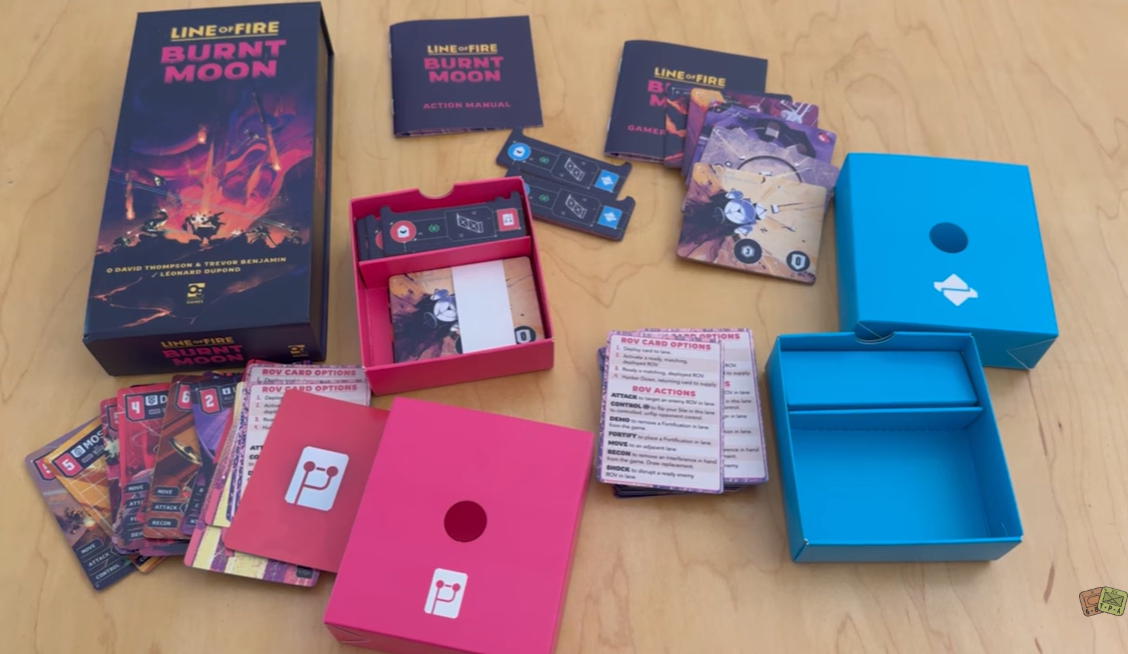
A group of black-hat hackers known as POSIWID plots to hijack the moon Io and hold the entire Jovian power grid to ransom. Standing in their way are the ultra-corporate LFA, the constructors of the lunar energy facilities. Both sides have engaged a fleet of ROV – advanced remotely-operated robots — to battle across the treacherous landscape. The machines are activated. Initiate combat sequence. The battle for Io has begun.
Line of Fire: Burnt Moon is a standalone 2-player card game that fuses the lean deck-building of the award-winning UndauntedSeries with fast-paced lane battling. Sharp decision-making and clever positioning combine in a nail-bitingly tense, endlessly replayable, and lightning-fast experience.
With this My Favorite Wargame Cards Series, I hope to take a look at a specific card from the various wargames that I have played and share how it is used in the game. I am not a strategist and frankly I am not that good at games but I do understand how things should work and be used in games. With that being said, here is the next entry in this series.
#90: Mob from Time of Crisis: The Roman Empire in Turmoil, 235-284 AD from GMT Games
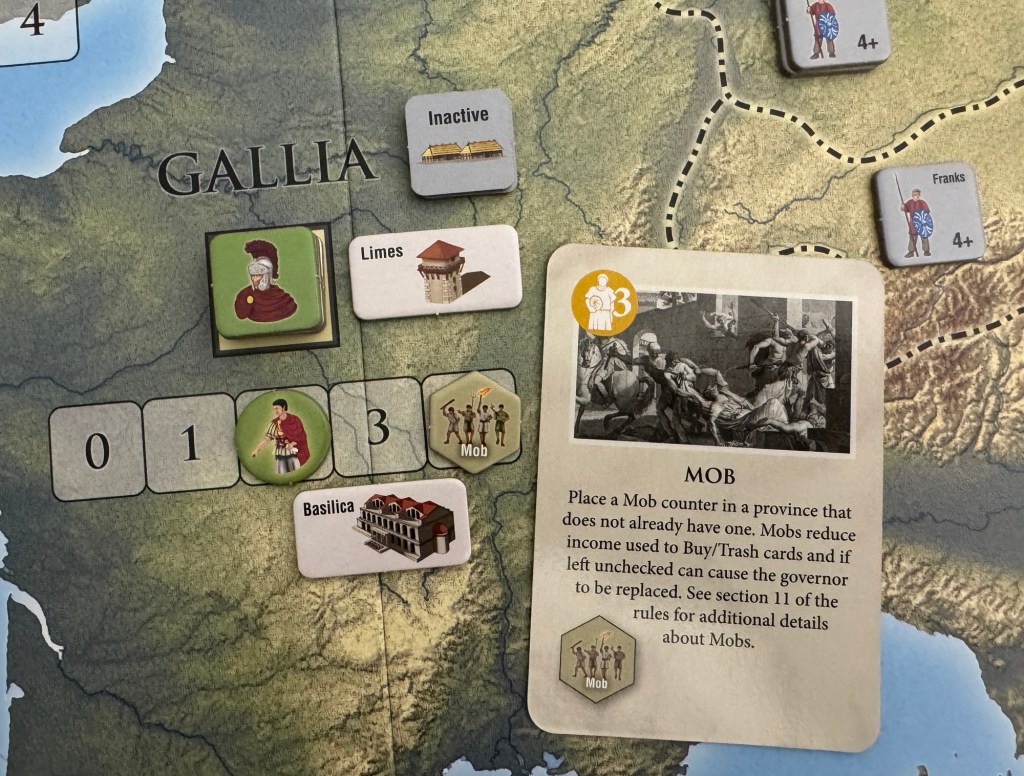
I really love Time of Crisis from GMT Games. This is a very light, introductory wargame that is just plain fun to play. I have been playing it a ton on the Rally the Troops! online platform and really enjoy it no matter what the outcome of those games are. One card that I enjoy using is called Mob, which is a 3 value Populace Card that really can be a devious way to usurp your enemies. Populace cards are intended to be used to increase the support level for your reign in various local senates, recruit militias to assist in the defense of the local populace, to remove Mob counters through the process of holding games and to build various improvements that provide various benefits such as a Basilica, Amphitheater or Limes. You will be unable to control your local provinces without the support of the people and the Populace cards will help you to build that support. But with the Mob card, this is an offensive focused Populace card that can be used to begin undermining your opponents hold on provinces.
When played, the card allows you to place a Mob counter in a province on the board that doesn’t currently have a Mob counter. Mob counters represent rioting and instability in the provincial capital of a province. The Mob in the province will reduce its income generation by the number of Mob counters in the province but also will grow if not dealt with. During the Support Check Phase, if the number of Mob counters in a province equals or exceeds the province’s support level the Governor is replaced with a Neutral Governor with a support level of 1. During the End of Turn Phase, one Mob counter is added to each governed provinces that already has a Mob counter and no Amphitheater. The presence of an Amphitheater doesn’t stop Mob counters from being added from the play of the Mob card but will stop them from growing. Remember, one of the maxims of Ancient Rome was bread and circuses, which is panem et circenses in Latin. It was coined around 100 AD by the Roman poet Juvenal in his Satires. The phrase criticizes how the Roman public traded their political freedom and civic duties for free grain and massive public spectacles.
The Mob card can be quite effective as it reduces the income of your opponents which is used to to purchase additional and more powerful cards but also forces them to spend their card values on suppressing the mobs, through military force with the Suppress Mob action or through placation with the Hold Games action. Both will be a thorn in the side of your opponents and will cause them to have to change their plans temporarily to deal with the issues you have caused them. A fun and delightful “take that” type of card.
Mobs in ancient Rome were powerful, volatile groups of urban plebeians, freedmen and workers who heavily influenced politics, food supplies and public safety. Driven by economic hardship, political gangs, and grain shortages, these crowds routinely rioted, burned government buildings and forced emperors or senators to heed their demands. Ancient Roman writers, politicians, and historians viewed the urban mob (plebs) with a mixture of fear, contempt and fascination, often describing crowds as volatile, lawless and easily swayed by demagogues. One of the more well known quotes from history comes to us by way of Titus Livy when he said, “Indeed, that is the nature of crowds: the mob is either a humble slave or a cruel master.” Livy also wrote: “As for the middle way of liberty, the mob can neither take it nor keep it with any respect for moderation or law.”
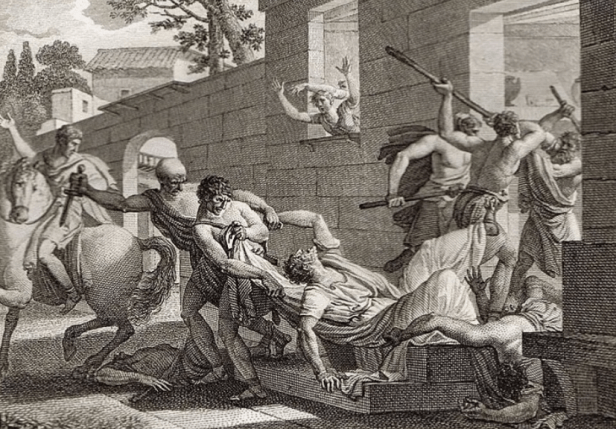
1799/1810 copperplate engraving titled The Death of Clodius (or Clodius killed by Milo’s mob) was drawn by the Polish-born French artist Silvestre David Mirys (1750–1810) as part of his series Figures de l’histoire de la république romaine.
About 18 months ago, while attending Buckeye Game Fest in Columbus, Ohio, we met up with David Thompson to get a quick look at a few of his newest upcoming games at the time including Line of Fire: Burnt Moon from Osprey Games and the very interesting American Civil War game with a twist called Rebels Against Rebellion from Flying Pig Games. I got to play Rebels Against Rebellion and very much enjoyed the game and what it was trying to convey about the lack of support for the secession of Tennessee from the Union as most of the residents of Scott County voted against breaking away during the American Civil War. The game pits the local groups against each other as the Free and Independent State of Scott fights against the local secessionist residents as violent confrontations between Loyalist and secessionist-aligned partisans and outlaws engaged in raids on farms, stealing livestock, and destroying property. Since that time, the game has progressed and has launched on Kickstarter. I reached out to one of the game’s designer David Thompson to see if he would be willing to share about the design and as always he was more than happy to oblige us.
Grant: David, welcome back to our blog. What is your new upcoming game Rebels Against Rebellion about?
Davind: Thanks for having me back! Rebels Against Rebellion is a card-driven war game for one or two players, set in Scott County, Tennessee, during the American Civil War. Tennessee’s own path to secession was messy. The state voted against a secession convention in February 1861, then reversed course and voted to join the Confederacy in June, following Fort Sumter. But East Tennessee never went along with it. And of all the counties in East Tennessee, none rejected secession more decisively than Scott County: 521 to 19. Later that year, the county court went so far as to pass a resolution declaring Scott County’s own independence from the state of Tennessee, calling itself the “Free and Independent State of Scott.” That’s the story we’re telling: Southern Loyalists trying to hold their ground against the Confederate army and their allied secessionist guerrillas, for the whole length of the war.
Grant: What should the title convey to the players?
David: I wanted the title to carry that irony right up front. Rebels Against Rebellion. The people of Scott County were, technically, rebelling against a rebellion by resisting the Confederacy in order to maintain their ties with the Union. History likes to flatten “Rebel” down to one side of the Civil War, but in Scott County that word cuts the other way too. I liked that the title does some of the historical educating on its own, before a player has even opened the box.
Grant: Why was this a subject you wanted to focus on?
David: It’s a story that doesn’t get told nearly enough. We hear a lot about the big battles and the big generals, but the internal fractures within the South (communities that stayed loyal to the Union under occupation, that organized home guards, that got raided by their own state’s army) that’s a different and much more personal kind of Civil War story. I’ve made a habit of chasing these under-told corners of history rather than the well-trodden ones, and Scott County is about as under-told as it gets. Once you learn about Julia Marcum defending her father’s house with an axe, or the Home Guard’s oath at the Huntsville courthouse, it’s hard not to want to build a game around it.
Grant: What are the unique features with the system used for the game?
David: The core of it is a deck that represents both your units and your locations. Playing a card from your hand isn’t just “move a piece,” it’s your people and your settlements acting together. Every location you control is physically a card sitting in your deck, hand, or discard pile, so controlling territory and building your deck are the same action. You don’t have a separate “buy phase” and “map phase.” When you improve control of a location or bolster in a new unit, you’re deck-building in exactly the same motion as you’re expanding on the board. I think that tight coupling between deckbuilding and area control is the thing that sets Rebels Against Rebellion apart.
Grant: What did you need to model regarding the American Civil War and the situation in Scott County, Tennessee?
David: Quite a lot, honestly. We needed the asymmetry between the two sides to feel true to what actually happened. The Loyalists start the game already holding six locations and 11 points, reflecting how entrenched they already were in the county by the time real fighting started, while the Confederates start with nothing on the board and have to earn their presence. We needed the food economy to reflect how much this was a war of resources and raiding: burned farms, stolen livestock, the constant question of how you feed yourself when supply lines are contested. We needed supply lines themselves to matter for Confederate regulars in a way they didn’t for local guerrillas, since regular units like the 43rd Alabama or Morgan’s Raiders came in from outside the county and depended on a route back to it, while home-grown units like the Home Guard didn’t need that at all. And we needed the map’s road, water, and path connections to reflect the real terrain. Scott County’s isolation and rugged geography is a huge part of why guerrilla warfare took hold there in the first place.
Grant: What is your design goal with the game?
David: We wanted a game that plays cleanly as a tight, two-player card-driven war game, and we wanted a player who knows absolutely nothing about Scott County going in to come away from a session with real curiosity about what actually happened there. Every named card, every location, every unit in the game is drawn from the historical record. If the mechanics are doing their job, “Capt. William Robbins” isn’t just a card with shield and gun icons on it. It’s a doorway into a real person’s story.
Grant: What other games did you use as inspiration?
David: The DNA is definitely there from our work on Undaunted, that idea of your deck representing your force on the board rather than being an abstract resource. But Rebels Against Rebellion pushes further into area control than Undaunted ever did, so we were also looking hard at how area-control and card-driven wargames handle territory scarcity and endgame tension. The most obvious influence comes from Martin Wallace’s A Few Acres of Snow, which serves as a the origin for the core concept of playing a location card as the source of movement. A lot of our actual influences, though, came out of the playtesting process itself.
Grant: What sources did you consult about the history?
David: We leaned heavily on the Scott County Historical Society throughout, especially David Jeffers, Alan Keeton, and James Cecil, who were enormously generous with their research and their archives. On the written side, Paul Roy’s Scott County in the Civil War was probably our single most important source. His overview chapter and his 148-page account of individual Scott County soldiers did a lot of heavy lifting for us. We also relied on Esther Sharp Sanderson’s County Scott and Its Mountain Folk and Scott County Gem of the Cumberlands, H. Clay Smith’s Dusty Bits of the Forgotten Past, Noel C. Fisher’s War at Every Door for the statistical picture of East Tennessee loyalism, Ben Garrett’s Enclave, decades of back issues of the Scott County Chronicle and the First National Bank Chronicle, and the Official Records of the Union and Confederate Armies for the military correspondence. Dr. Stuart Ellis-Gorman did our proofing and copyediting to help make sure we got the details right.
Grant: What did you learn from your trip to this area as part of your research?
David: Back in the fall of 2025 I went to Scott County to meet with folks from the Historical Society and access primary sources that were otherwise unavailable. This trip was absolutely critical to the design process. The men I met at the Historical Society had deep knowledge on the subject, so I conducted interviews with them. They also provided me some of the primary sources I had read about, but could not access without their help (mostly in the form of photocopied versions of printed documents from local authors). My trip to Scott County also gave me the opportunity to visit the area and experience the topography for myself.
Grant: What are the differences between the playable factions of the Confederates and the rebels?
David: Thematically, the Loyalists are defenders who start the game already dug in. They begin with six locations and a head start on the scoreboard, and their whole arc is about holding what’s theirs and expanding cautiously outward. The Confederates start with nothing on the board and have to fight for every location, but they’ve got the raw power to do it: bigger regular units, the ability to bring in outside firepower, provided they can maintain a supply line back to where those units are actually based.
Grant: How did you differentiate them in their mechanics?
David: A few ways. The Loyalists have much more extensive access to the Improve Control action, which allows them to place a second control marker into a location for an additional victory point and card benefit, while a couple of key Loyalist locations, Brimstone and Trammell’s, double as both a location and a unit card depending how you want to play them that turn. The Confederates, on the other hand, get access to harder-hitting regular army units, but those units can carry a supply line requirement, so playing them isn’t as simple as just having them in hand. You need an unbroken road connection back to their origin. It creates a real asymmetry: the Loyalists play a tighter, more efficient game, while the Confederates have more raw strength but have to work to unlock it.
Grant: How does the game use cards?
David: Cards do double duty as your units and your locations, and every card you play resolves a specific action before it goes to your discard pile. Food is the one shared resource, but everything else, from combat strength to your area-control footprint, lives directly on the cards moving through your deck.
Grant: Can you show us a few examples and explain their use?
David: Sure, take the Home Guard. It’s a Loyalist unit card linked to Huntsville, and if you upgrade it, you get an improved version with better combat value. Or take Chitwood’s, a basic location card: play it for its Take Food action to add to your supply, or play it to Move into an adjacent location, which is how you expand your territory or launch an attack. And then there’s Brimstone, which starts as a plain location card but can be improved into Capt. William Robbins. At that point it’s simultaneously the location and a combat unit, with its own attack value and shield icons, giving you flexibility about how you use it depending on what your turn needs.
Grant: How do the cards upgrade or power up?
David: There are two upgrade paths. Improve Control takes a basic location card, has you pay food, and swaps it for its improved version, which usually comes with better attributes and, for a couple of key locations, unlocks a linked unit. Improve Unit works the same way for unit cards directly. You pay the listed food cost, and the improved version replaces the original in your discard pile while the old card goes out of the game for good. Either way, you’re not adding new cards on top of old ones. You’re replacing weaker cards with stronger ones, so your deck gets more powerful without getting bigger and bloated.
Grant: How important is this to the design?
David: It’s central. Deck quality, not just deck size, is what wins you the game, and the choice of when to spend food on upgrading versus expanding onto the board versus bolstering in new units is the core tension every turn.
Grant: What is the layout of the board?
David: The board depicts Scott County and its surrounding area, with locations connected by roads, water, and paths. Each connection type governs how many cards you can commit to an attack moving along it, from one card on a path up to three on a road. Locations within Scott County proper are marked in brown; locations outside the county, like Somerset, Jacksborough or Jamestown, are marked in grey and generally serve as Confederate staging points and supply origins. Each location shows its star value, which doubles as its point value and its food cost to take control, along with any food production and, for locations that can be improved, their upgraded attributes.
Grant: What is the anatomy of the counters?
David: We use control markers rather than traditional counters. One per location per player, showing who currently holds it, with some locations (mostly limited to the Loyalists) able to carry a second marker once improved. The real “unit anatomy” lives on the cards themselves: name, faction affiliation, attack and defense attributes, a linked location, an improvement cost, and icons indicating whether the unit returns to its supply or is removed from the game entirely after a successful attack.
Grant: How are units activated?
David: You activate units by playing their card from your hand as part of a Move action or in response to an attack. There’s no separate “activation phase.” A unit card played in combat commits its attack or defense value to that fight; the same card, played on its own, might instead trigger a Bolster or Improve Unit action. Context and the icon panel on the card tell you what’s legal in the moment.
Grant: What is the general Sequence of Play?
David: Turns alternate, Confederates first. On your turn you play cards from your hand one at a time to take actions, resolving each fully, including paying food and playing any additional required cards, before moving to the next, and you can stop whenever you like. Once you’re done taking actions, you discard down as much as you want from what’s left in hand, then draw back up to a five-card hand, reshuffling your discard pile into a new deck if you run out.
Grant: What actions are available to players?
David: Take Food, Improve Control, Bolster, Improve Unit, and Move, which is also the action that triggers combat if you’re moving into a location your opponent controls.
Grant: How does combat work?
David: Once you move into a contested location, the attacker plays one required combat-eligible card face down, and the defender either matches with a card of their own (up to a maximum of two, since they can also commit the target location’s own card) or passes. This goes back and forth, both sides adding cards until they hit their limits or choose to stop, with the attacker’s ceiling set by the connection type they’re attacking along. Everyone reveals at once: the attacker totals their attack icons, the defender totals their defense (and any dual-purpose attack icons used defensively), and the defender wins all ties. Win as the attacker, and you strip your opponent’s control marker, shift points in your favor, and get the option to immediately take control as a follow-up action.
Grant: How is victory achieved?
David: You’re racing toward one of a few thresholds: reach 20 points while your opponent sits at 10 or fewer, or simply hold more points than your opponent once the game’s light-colored food tokens run dry and it tips into sudden death. The Confederates have a separate, blunter win condition too: if the Loyalists ever lose every control marker on the board, the Confederates win outright. And if the very last food token, one of the ten darker ones, gets taken, the game ends in a draw, so there’s a real, ticking clock underneath everything you do.
Grant: Who is the artist and how does their style assists in thematic immersion?
David: Kwanchai Moriya handled illustration and Jina Rueter handled graphic design, and I couldn’t be happier with how it came together. Kwanchai has this warm, painterly quality that makes Scott County’s mountains and creeks feel lived-in rather than just decorative. It goes a long way toward making cards like Capt. William Robbins or Julia Marcum feel like real people from a real place rather than generic Civil War stand-ins. Jina’s layout work keeps the cards (action icons, attributes, linked locations, improvement costs) legible at a glance, which matters enormously in a system where you’re constantly reading your hand.
Grant: What type of experience does the game create?
David: Tense and personal. Because the map is so tightly connected, and because food is always ticking down toward sudden death, every attack matters and every food token spent is a decision you feel. It plays fast for a war game, but it doesn’t feel light. The historical grounding and the asymmetry between a scrappy, entrenched Loyalist defense and a Confederate side that has to earn its foothold give it real dramatic shape.
Grant; What are you most pleased about with the design?
David: I’m just happy that we had such an amazing team come together to work on this game. Trevor and me from a design perspective, Kwanchai and Jina bringing the game together through their illustration and graphic design, with Denver at Flying Pig Games leading the way. It was a dream team for this project that I am so passionate about. Of all the games I’ve worked on recently, this is the game closest to my heart. I just want to spread the word about these amazing people who fought for what they believed in.
Grant: What other games are you currently working on?
David: It’s a busy stretch. Alongside Rebels Against Rebellion, I’ve got Night Witches coming, co-designed with Liz Davidson (Fort Circle Games); two expansions for Sniper Elite with Roger Tankersley (Rebellion Unplugged); Flintlock!, a Seven Years’ War and French & Indian War game built on Paolo Mori’s Blitzkrieg! System, also with Roger (Floodgate Games); For the Gods!, co-designed with Trevor and Brett J. Gilbert (Mighty Boards); Zheng He, co-designed with Geoff Engelstein (GMT); and Undaunted 2200: Revolution, co-designed with Trevor (Osprey Games). There are some others on the way, but those are further off…
Thanks as always for having me!
As always, thank you so much David for your time in answering our questions and for showing me the game about a year and a half ago. I very much look forward to playing the final product and wish you well with the Kickstarter campaign.
If you are interested, we did an interview video with David while attending Buckeye Game Fest in the spring of 2025 and you can watch that at the following link for more information on the game:
Ich schaue mir die Bilder an und denke – wow, was für eine Tischpräsenz! Überall Miniaturen, ein gewaltiges Spielfeld und jede Menge Aktionskarten. Da lag die Vermutung nahe, dass wir uns hier gegenseitig Armeen auf den Hals hetzen und Schlachten bestreiten, doch falsch gedacht. Byzantion ist ein ganz anderes Spiel.
Ich habe bei Spielen mit realem Bezug immer den Hang, in den Deep Dive zu gehen, und wühle mich gerne durch die Geschichte. Ich bin immer wieder überrascht, wie wenig ich eigentlich über die Details weiß, und gebe hier auch wieder einen kleinen historischen Exkurs. Wenn du keine Lust darauf hat, lies einfach bei den Eindrücken von der Bühne weiter.
Historischer Kontext
Wer im Jahr 527 nach Christus auf die Landkarte schaut, reibt sich erst mal verwundert die Augen. Das mächtige Römische Reich, das gefühlt jahrhundertelang die europäische Sandbox dominiert hat, sieht plötzlich verdammt asymmetrisch aus. Während der Osten mit Byzanz fett im Geschäft ist, hat der Westen den ultimativen Rage-Quit hingelegt.
Aber wie konnte die absolute Über-Fraktion der Antike so grandios gegen die Wand fahren? Da gab es sicher viele Faktoren, doch einer davon waren die leeren Staatskassen. Da kein Geld mehr für die eigenen Truppen da war, dachte sich Rom, dass sie einfach die Barbaren anheuern, die vor der Grenze campen, und sie mit Land bezahlen.
Das lief natürlich richtig gut. Die sogenannten „Verbündeten“ merkten ziemlich schnell, dass sie die Regeln im eigenen Vorgarten ab jetzt selbst schreiben können.
Das Römische Westreich war dem Ende nahe und im Jahr 476 n. Chr. hatte der germanische Heerführer Odoaker endgültig keinen Bock mehr auf das kaiserliche Mikro-Management. Er setzte den letzten weströmischen Kaiser ab. Der war ironischerweise noch ein Teenager und hörte auf den dramatischen Namen Romulus Augustulus. Frei übersetzt das kleine Römerlein.
Odoaker machte dann wahrscheinlich das einzig Logische. Er packte die kaiserliche Krone und den Purpurmantel in ein DHL-Paket, schickte den ganzen Ramsch nach Konstantinopel zum oströmischen Kaiser und legte einen Zettel bei „„Du, behalt den Kram. Wir brauchen hier drüben keinen eigenen Chef mehr. Ich schmeiß jetzt hier den Laden.“
Viel ist geschehen seitdem und inzwischen haben sich andere Spieler auf dem Brett breitgemacht. Die Ostgoten haben sich Italien geschnappt und chillen in Rom und Ravenna, während die Vandalen Nordafrika besetzt haben, was als ehemaliger Kornspeicher Roms natürlich der absolute Ressourcen-Jackpot ist. Den Rest von Westeuropa teilen sich unterdessen die Franken und Westgoten untereinander auf.
Nun schreiben wir das Jahr 527 nach Christus. Das Weströmische Reich ist längst Geschichte, aber im Osten brennt noch Licht! In Konstantinopel, auf den Ruinen des alten Byzanz, schlägt das Herz eines Imperiums, das kurz vor dem ganz großen Punkte-Sieg steht.
In genau diesem Jahr hievt sich ein neuer Babbo auf den Thron, nämlich Kaiser Justinian I.
Sein ambitionierter Masterplan ist die Restauratio Imperii, was auf gut Deutsch bedeutet, dass er die alte römische Map wieder komplett freischalten und zur alten Größe zurückkehren will. Unter seiner Herrschaft schaltet das Reich in den absoluten Turbo-Modus aus radikalem Umbruch und unermesslichem Reichtum. Der Kaiser hat verdammt Großes vor, doch wer wird im Schatten seines Throns wirklich die Fäden ziehen?
Schreiben wir die Geschichte des Oströmischen Reiches neu!
Eindruck von der Bühne
Was ist Byzantion?
Byzantion ist ein Deckbuilder mit Bietmechanismus und spielt sich gänzlich anders, als es die opulente Optik erwarten lassen würde. Wer hier Plastik-Schubsen vermutet, wird enttäuscht. Du musst in jeder Runde zusammen mit den anderen Spielern, hier staatstragend „Demoi“ genannt (gesprochen Di-mi), auf die aktuelle politische Situation reagieren und auf eine von zwei Entscheidungen bieten. Die eine Option ist der reale historische Pfad und Option zwei ist die fiktive „Was-wäre-wenn“-Variante der Geschichte.
Jede Runde beginnt erst mal mit dem klassischen Gerangel um die Initiative. Der Startspieler darf sich zuerst eine der vier Positionen schnappen. Die Position bestimmt nicht nur, wann du dran bist, sondern liefert auch noch einen zufälligen Ressourcenbonus frei Haus. Damit nicht genug, denn jede Position hat noch ein festes Gadget im Gepäck. Wählst du Position 1, darfst du nicht nur anfangen, sondern bekommst zusätzlich das Banner, mit dem du eine Aktion mehr hast als der Rest der gierigen Bande. Auf Position 2 gibt es einen Kelch, der dir imaginäre Ressourcen zum Bieten spendiert – quasi Falschgeld mit kaiserlichem Segen. Position 3 reicht dir das Szepter, das dir die Macht über alle Gleichstände verleiht, und auf Position 4 wartet die kuschelige Robe. Die verdoppelt bei einem Sieg deine Event-Belohnung und sorgt bei einer Niederlage dafür, dass du komplett ungeschoren davonkommst. Die Wahl ist echt kein No-Brainer, vor allem, weil der Startspieler-Posten hier nicht unbedingt ein Vorteil ist.
In der Bieterphase geht’s dann los. Position 1 auf der Initiativeleiste setzt seine Auctoritas auf den gewünschten Event-Ausgang. Wenn die Sache am Ende erfolgreich war, darf der Sieger meistens Miniaturen aufs Feld klatschen. Zum Beispiel könnte ein Event zum Ende des Dauerkrieges zwischen Persien und Byzanz bestimmen, dass der Handel wieder boomt, was dir zwei Händler einbringt. Steht die Ampel eher auf Plündern und Aushungern, stellst du stattdessen einen Belagerungsturm und eine Legion auf das Parkett. Doch wofür der ganze Stress? Du ziehst am Anfang geheime Aufgaben, die dir am Ende fette Punkte bringen kann. Die sind komplett unterschiedlich gestrickt. Wettet deine Quest darauf, dass jeder Händler einen Siegpunkt bringt, kann der Ausgang des Events entscheidend für deinen Punkteregen am Ende sein.
Das Blöde ist nur, wenn du zuerst bieten musst, stehst du im Dunkeln. Du hast keinen blassen Schimmer, was die Konkurrenz noch im Ärmel hat, und du hast genau diesen einen Schuss frei. Nebenbei legt die Mehrheit mit dem Gebot auch das Rundenziel fest. Gewinnt der Wiederaufbau des Handels, müssen alle Spieler am Tisch brav ein Frumentum (Nahrung) und sechs Nomisma (Geld) in den gemeinsamen Topf werfen. Ist das letzte Gebot platziert, können noch fiese Intrigenkarten gefeuert werden, die das Ergebnis beeinflussen. Danach ist das Ziel fix und es geht mit der nächsten Phase ans fröhliche Sammeln der für das festgelegte Ziel benötigten Ressourcen.
In der Aktionsphase gibst du deine Dynamis aus, also deine wohlverdienten Aktionsmarker, um eine von sechs Aktionen rauszuhauen. Die Anzahl deiner Marker richtet sich nach der Spielerzahl. Die Faustregel lautet: Je weniger Leute am Tisch, desto mehr Action pro Nase. Die Aktionen selbst erfinden das Rad nicht neu, sondern sind angenehm simpel, nämlich Karten kaufen, Karten spielen, Karten aktivieren, auf dem Ressourcenmarkt kaufen oder verkaufen oder ebendiesen resetten.
Bei den Karten unterscheidet das Spiel zwischen Helden, Intrigen und Ressourcen. Damit es auf dem Tisch schön bunt wird, sind alle einer Gattung zugeordnet. Siehst du das gelbe Waagensymbol, ist das eine Emporium-Karte, also die Abteilung Marktplatz. Spielst du einen Helden mit diesem Symbol, hat der eine Stufe von 1 bis 3, was du an den Lorbeeren um das Symbol erkennst. Der Clou an der Sache ist, dass ab sofort alle anderen Emporium-Karten um die Stufe des Helden günstiger werden. Das geht auf Dauer richtig steil, denn Karten ausspielen saugt dir ansonsten die Schatzkammer leer und wir wollen am Ende ja schließlich nicht so enden wie das alte Rom, oder? Ressourcenkarten triggern beim Ausspielen einen Einmaleffekt und produzieren später beim Aktivieren wertvolle Ressourcen. Da die Aktionen pro Runde knapp sind, musst du deine Karten zu sogenannten „Bandons“ zusammenschieben. Unter einen Level-2-Helden passen zum Beispiel bis zu zwei Karten derselben Gattung. Aktivierst du nun diesen Bandon, zünden alle Karten gleichzeitig und du scheffelst Ressourcen wie ein Großgrundbesitzer. Das Schöne ist, dass du diese Reihenhäuser jederzeit neu anordnen darfst, solange sie in der Runde noch nicht aktiviert wurden. Also lautet die Devise: Tolle Karten shoppen, clever ausspielen, fette Bandons bauen und abkassieren. Weil jeder durch seine Quests andere Ziele verfolgt, jagt zwar nicht jeder dieselbe Karte, aber das Gerangel am Markt ist trotzdem eine Herausforderung. Da ist es dann doch ganz geil, als Startspieler zuerst die Auslage plündern zu dürfen.
Wenn alle am Tisch entkräftet passen, geht es in Phase 3 und das Event wird ausgewertet. Alle schieben verdeckt Ressourcen in die Mitte. Für jedes beigesteuerte Ressource gibt es einen Siegpunkt. Du willst also eigentlich immer mitmischen, selbst wenn das Ergebnis so gar nicht in deine Strategie passt. Erreicht die Gruppe das gemeinsame Ziel, ist die Party erfolgreich und der fleißigste Spender darf die Belohnungs-Minis platzieren. Reißen alle zusammen die Latte, zahlt der Geizhals mit dem kleinsten Beitrag die Strafe. Hier im Prototypen war das Event-Versagen allerdings theoretischer Natur, meistens haben sogar mehrere Spieler den kompletten Beitrag im Alleingang gestemmt. Da darf die Redaktion gerne noch mal an den Stellschrauben drehen, wir wollen ja schließlich ein bisschen bibbern!
Nach knackigen sechs Runden ist Schicht im Schacht und es wird abgerechnet. Auch in diesem Spiel gewinnst du, falls du die meisten Siegpunkte hast.
Die Miniaturen sind wie die Karten einer bestimmten Kategorie zugeorndet. Erkennbar an der Farbe.
Byzantion liefert ein wirklich interessantes Spielgefühl und es macht tierisch Bock, sich diese Bandon-Engines zusammenzuschustern. Die ganze Aufmachung ist Premium und wenn wir ganz ehrlich sind, komplett überproduziert. Die halbe Box besteht aus Plastik-Miniaturen, die im Grunde nichts weiter tun, als dumm auf der Playmat herumzustehen und am Ende für Punkte gezählt zu werden. Aber ich will es gar nicht anders! Das Auge spielt schließlich mit und der Flair ist absolut grandios. Selbst im Prototypen-Status ist das Material ein Traum: Holztoken, Pokerchips als Aktionsmarker und das Brett ist eine gewaltige Neoprenmatte. Der ganze Spaß lag im All-In inklusive Steuern und Versand bei rund 189 €. Für diesen Berg an Material ist das definitiv ein absolut fairer Kurs. Wer kein Plastik braucht, greift zur Sparversion für einen Hunderter.
In allen Versionen ist die „Taktika“-Erweiterung direkt mit an Bord. Die verpasst jedem einen asymmetrischen Start und eine Spezialfähigkeit, also genau mein Ding. Dazu kommt ein kleines Area-Control-Element, womit man die Einheiten tatsächlich über das Feld scheuchen kann, um Boni abzugreifen. Mit dem Prototypen konnte ich das leider noch nicht testen, bin aber hoch interessiert.
Trotz des hohen Spaßfaktors merkt man dem Spiel an, dass hier und da noch geschliffen werden muss. Dass man die Events quasi nicht verlieren kann, nimmt etwas die Würze. Und obwohl die historischen Ereignisse super recherchiert sind, mutiert das Ganze im Spieldrang oft zum reinen Zahlenschubsen. Hauptsache, der Ertrag stimmt. Schade eigentlich. Ein QR-Code auf den Karten, der nach dem Bieten eine kurze Audio-Story abspielt, wäre der absolute Knaller, um die Geschichte an den Tisch zu bringen. Das Kartenbalancing ist sicher auch noch nicht ganz optimal.
Aktuell stört mich auch noch die Kartenauslage. Die liegt ziemlich starr wie Blei auf dem Tisch. Wenn kein Spieler Bock auf die ausliegenden Karten hat, verfilzt der Markt rundenlang und es wird nur noch blind vom Stapel gezogen. Ein automatischer Wipe am Rundenende oder die Kopplung an die Markt-Reset-Aktion würde hier Wunder wirken und die teure Reset-Aktion direkt viel attraktiver machen. Auf Nachfrage wurde mir aber geflüstert, dass die Autoren da tatsächlich noch am Grübeln sind.
Dass eine große Playmat als Spielfeld genutzt wird, ist ebenfalls eine gute Lösung, doch selbst die bereits große Matte mit ihren Maßen von 120 mal 80 Zentimetern ist immer noch etwas zu klein. Auf dem Neopren ist zwar für jeden Spieler ein eigener Bereich eingezeichnet, doch darin passen beim besten Willen keine zwei Karten untereinander. Durch die zahlreich ausgespielten Karten wird es auf dem Tisch verdammt voll und dass die Karten irgendwann untereinandergelegt werden müssen, ist nicht zu verhindern. Ein paar Zentimeter mehr Fleisch auf den Rippen hätten der Spielmatte hier definitiv gutgetan, um den Platzkollaps deiner ganzen Bandons und Einzelkarten zu verhindern.
So voll kann die eigene Kartenauslage anwachsen.
Man darf nicht vergessen: Das ist ein Prototyp und der hat schon wieder einige Monate auf dem Buckel. Ich bin jedenfalls ziemlich guter Dinge, dass Byzantion ein schönes Teil wird.
Noch ein kurzes Wort zu den Machern von Meeple Pug. Die Truppe aus Griechenland ist verdammt ambitioniert. Bisher haben sie zwar erst ein Spiel namens Dark Blood auf dem Markt, haben aber mit Byzantion und Mesopotamia schon die nächsten dicken Dinger gefundet, während mit Alexandria schon die nächste Kampagne in den Startlöchern steht. Klingt erst mal nach klassischem Kickstarter-Overload, aber die Jungs und Mädels liefern einfach ab. Die Kommunikation ist transparent, sie nehmen Kritik an und die Qualität stimmt. Keine ihrer Kampagnen wirkte bisher wie abgehobener Wucher. Ich mache mir da wenig Sorgen, dass die Boxen nicht auf unseren Tischen landen.
Groupie auf Tour (Björn)
Byzantion: The Justinian Era hat aktuell noch ein paar Stolpersteine, aber der Lapis Lazuli darunter schimmert schon verdammt vielversprechend durch. Das Basteln an der eigenen Produktion macht Laune und optisch ist das Ding eine absolute Wucht. Ob das fertige Produkt auch auf Langstrecke zündet, wird sich zeigen, aber allzu lange müssen wir darauf ja nicht mehr warten. Mi der Preview bin ich zwar etwas spät zur Party und der Late Pledge ist dicht, aber wer Blut geleckt hat, erwischt die Autoren vielleicht auf der Spiel in Essen für einen kleinen Schnack und kann die Box direkt einsacken! Dies allerdings ohne Gewähr. Wenn das fertige Spiel hier eintrudelt, werd ich über die Neuerungen und das Gesamtbild definitiv berichten.
Groupie auf Tour (Horst)
Ich hatte mega Lust auf das Spiel und dann hat Björn die Mechanik mit Mischung aus Biet-Mechanik und Deck-Builder beschrieben. So gern ich beim Skat zocke, so öde finde ich Bieten bei Brettspielen. Es geht sogar soweit, dass solche Spiele nicht mal einen weiteren Blick verschwende. Wäre schade gewesen. Mich hat Byzantion so richtig abgeholt. Das Bieten ist eher unwichtig. Die dritte Phase lädt zum Siegpunkt abgreifen ein, aber die zweite Phase – die Aktionsphase – ist das Herzstück. Mit den ausgespielten Decks baut man sich wie Björn schon geschrieben hat, Ressourcen-Engines zusammen, die den Sammler in mir erweckten. Ich wand es auch sehr erfrischend, dass die geilen Engines wieder neu zusammengesetzt werden konnten. Hat man erst einmal viele Karten auf dem Tisch, lässt sich jede neue Runde mit einem Lächeln im Gesicht starten. Quasi ein komplexes Rommé. Mich hat es vollends überzeugt. Das ging uns nicht allen so am Tisch – leider – sonst wäre es wahrscheinlich ebenfalls in meinen Einkaufskorb gelandet. Lieber haben, als brauchen.
Wenn es ein Spiel gibt, dem ich eine Menge zu verdanken habe, dann ist das Etherfields. Ist wahrscheinlich nicht ganz richtig, aber ich verbinde das Kampagnenspiel damit, dass ich sowohl mit Bill als auch mit Björn ein paar würdige Gegner im Brettspieluniversum und auch noch Mitstreiter bei diesem Blog gewonnen habe.
Warum Etherfields mir Albträume und uns alle schlaflose Nächte und nicht abnehmende Diskussionen bereitet hat, klärt dieser Artikel auf. Aber Achtung: Das wird keine echte Rezension.
Erlebnisbericht
Etherfields ist ein Traum-Dungeon-Crawler. Traumhaft schön? Naja, da kommen wir gleich zu. Unsere Charaktere sind in einem gemeinsamen Albtraum gefangen und widmen sich düsteren Gedanken, verwirrenden Wortfetzen in scheinbarer Geschichte versteckt und einer ganzen Reihe von einmaligen Dungeons. Wir wissen nichts von unserer Vergangenheit. Der Klassiker wie auch bei Sword & Sorcery. Erleben wir aber bei letzterem Abenteuer für Abenteuer mehr von uns, bleibt es auch nach unzähligen Quests immer noch ein Rätsel, worum es eigentlich geht. Zumindest haben wir es nicht herausgefunden … wir haben aber die Kampagne … ACHTUNG … einfach abgebrochen.
Das Warum ist schnell auf einen Punkt gebracht: die Story hat einfach nicht getragen. Der Albtraum ist bei uns Realität geworden. Immer wieder in einen neuen Dungeon geworfen, wieder keine Hinweise (oder Schlüssel) bekommen, wieder keine verwertbaren Story-Verweise und wieder haben wir uns frei gespielt, dass wir einen Dungeon noch einmal spielen könnten. Was bei T.I.M.E. Machine ein Teil der Spielmechanik ist, nervt bei Etherfields. Wir haben sogar bei einigen Abenteuer alle Karten und Hinweise einfach mal durchgelesen und festgestellt … keine neuen Erkenntnisse.
Dabei ist da richtig Potential drin. Jedes Abenteuer spielt sich komplett anders. Wie es sich für einen Albtraum gehört werden wir meist nur auf einen Kartenausschnitt geworfen und dann müssen wir erst einmal herausfinden, was sind eigentlich die Endbedingung. Auch verändern sich die Räume mitunter recht stark. Dabei werden die quadratischen Räumplättchen manchmal quer überdeckt und verbinden auf einmal Plättchen miteinander oder zeigen neue Elemente. So viel Vielfalt habe ich noch in keinem Crawler gehabt. Aber am Ende fehlt doch der Plot, warum bin ich überhaupt hier.
Die Storyelemente, die wir fanden, waren alle samt kryptisch und wirr. Klar zeugt das von einer gewissen Traum-Atmosphäre, aber irgendwann wünscht man sich doch mal den Speaker aus dem Off, der die Handlung vorantreibt.
Neben den Dungeons gibt es eine Stadt in unseren Träumen, dessen Karten wir ebenfalls erst komplett freispielen müssten. Das hat zwar geklappt, klaut aber nur wertvolle Spielzeit, da man viel von ganz links nach ganz rechts geschickt wird und dadurch auf einer anderen kleinen Karte noch mit kurzen Albtraum-Monstern konfrontiert wird. Die sind nur dafür da unsere Lebenspunkte und Kartenauswahl zu dezimieren bevor wir uns in das richtige Abenteuer stürzen können.
Also unsere Stimmung schon den Alpträumen sehr nah kam, sind wir nur noch direkt von Abenteuer zu Abenteuer gereist.
Bill hat sich damals in Unkosten gesteckt und sich alle Erweiterungen und vor allem die tollen Minis gekauft (ganz untypisch für ihn als Sundrop). Die Miniaturen sind natürlich 1a-Qualität und optische Highlights. Alle Tabletoppler und Brettspielenden, die günstig an das Minitaturen-Set kommen: Kaufen! Ihr werdet eure Quests auf ein gruseliges neues Level heben. Die meisten Minis zieht man dabei leider nur einmal aus der Verpackung.
Am Ende bleiben wenig Worte und wenig positive Worte übrig für dieses ambitionierte Projekt. Habe es nicht mehr recherchiert. Björn behauptet, dass es eines der ersten echten Kampagnenspiele war. Die Entwickungs- und die Auslieferungszeit hatten zwar Awaken Realms-epische Verzüge, aber es ist tatsächlich schon etwas älter.
Aber all dies schützt vor Strafe nicht. Am Ende ist es leider ein Flop, der viel zu viel Zeit frisst und mit belanglosen Abenden bestraft. Schade eigentlich. Das Setting ist dabei (Alp-)traumhaft gut und entspricht genau dem Thema, dass ich gerne habe. Nur leider überhaupt kaum Fortschritt und eine zum einschlafen schleppende Story.
Björns Meinung
Horst hat hier eigentlich schon alles Wichtige gesagt. Spielt man nach den normalen Regeln, verkommt es zu einem übertrieben unnötigen Grind und Gekämpfe, und wenn man ehrlich ist, ist das Kampfsystem nun wirklich nicht so ausgeklügelt, dass es das gesamte Spiel tragen würde. Das Ganze lebt von der Geschichte, aber die geht einfach nicht voran und die kleinen Mini-Stories variieren stark von der Qualität.
Die einzelnen Träume haben teils schon ihren Charme, aber der Metaplot entwickelt sich einfach null weiter. Fast so, als hätte der Autor ihn selbst nur geträumt und nach dem Aufwachen direkt vergessen. Hier fühlst du dich wie in diesen Klischeealbträumen, in denen du rennst und rennst, aber das Ziel immer weiter von dir wegrückt.
Ich war damals in ein fast All-in gegangen, weil es thematisch und vom Style her wie für mich gemacht wirkte. Ich wünschte wirklich, ich würde dieses Spiel lieben, aber man kann über die Probleme einfach nicht hinwegsehen, so fest man beim Spielen auch die Augen zukneift. Selten fand ich eine Enttäuschung so unfassbar schade wie bei diesem Spiel.
Ein Gutes hatte das Ganze aber: Horst und Bill habe ich eigentlich nur durch diesen Titel kennengelernt. Ich wollte damals nur mal bei einer Partie dabei sein, um die Regeln zu lernen (denn die sind obendrein furchtbar unübersichtlich, vermutlich wurden die auch von jemandem im Tiefschlaf verfasst). Naja, das Ende vom Lied ist – Ich bin geblieben und Etherfields musste gehen. Mal schauen, welches Spiel dann irgendwann mich am Tisch ablöst!
Bills Meinung
Meine Vorredner haben bereits alles aufzählt, was man meiner Meinung nach zu Etherfields sagen kann, daher halte ich mich mal mit meinem Teil möglichst knapp. Wäre die Geschichte nur annähernd so schön und episch wie das Setting und dessen Idee dahinter gewesen und ein roter Faden noch irgendwo unter den vielen Trümmern des verloren gegangenen Gameplays zu finden gewesen, wäre es sicherlich ein gutes Spiel geworden. Hätte man dazu noch etwas von den Ideen mit denen man die Miniaturen entwickelt hat in den Plottfließen lassen, hätte das Spiel weit über sein Potenzial hinaus wachsen können! Ich wollte es lieben und war zum vorzeitigen Ende hin der Erste der laut STOP!!! rief. Schade ist es allemal!
Awaken Realms hat mit den Jahren natürlich dazu gelernt. Dennoch sehe ich eine ähnliche Handschrift in anderen ihrer Titel immer wieder. Tainted Grail und ISS Vanguard oder Dragon Eclipse sind hier Beispiele für die stetig spürbare positive Entwicklung des Verlags und seiner Spieledesigner aber ich höre doch häufig die immer gleiche Leier: Tolle Idee, grandiose Figuren – aber die Story wirkt dagegen stiefmütterlich erstellt. Auch gerade jetzt bei dem neuesten Titel Lands of Evershade, wobei die Meinungen der kritischen Stimmen eher auf hohem Niveau schwimmen. Aber man erkennt schon einen gewissen Konsens, wobei mir die gerade genannten Titel, die ich bereits spielen konnte, persönlich wesentlich besser als Etherfields gefallen. Wir werden sicherlich hier davon berichten.

 Anmelden