With this My Favorite Wargame Cards Series, I hope to take a look at a specific card from the various wargames that I have played and share how it is used in the game. I am not a strategist and frankly I am not that good at games but I do understand how things should work and be used in games. With that being said, here is the next entry in this series.
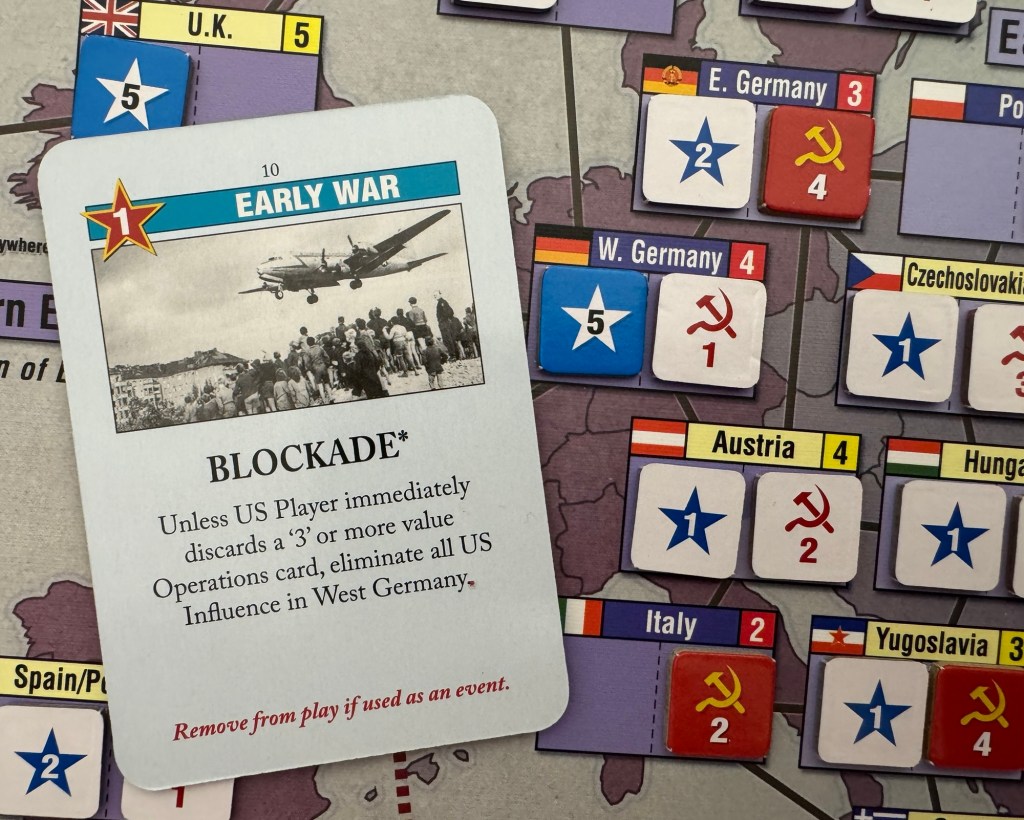
#69: Blockade from Twilight Struggle: The Cold War, 1945-1989 from GMT Games
Twilight Struggle is a 2-player game simulating the forty-five year ideological struggle known as the Cold War between the Soviet Union and the United States which can be played in 2-3 hours. The entire world is the stage on which these two countries “fight” to make the world safe for their own ideologies and way of life. The game starts right after the end of World War II in the midst of the ruins of Europe as the two new “superpowers” of the world squabble over what is left and ends in 1989, when only the United States remained standing.
The map is a world map of the period, where players move units and exert influence in attempts to gain allies and control for their superpower. The beauty of the CDG system used here is that each decision of whether to use a card for the event or the operations value is a struggle as if it is the other side’s event, it might go off hurting you very badly. There are mechanics to allow for the ignoring or cancelling of some of the best cards for your opponent in a side game within the game called The Space Race as well as nuclear tensions, with the possibility of game-ending global thermonuclear war (Shall we play a game, anyone?). I have played TS about 30 times and love it more and more with each sitting. The game makes me sweat, cringe, jump with joy and bite my fingernails. To me, a game that can do all of that in one sitting is worth the price.
One of my favorite type of cards from the game are those that force an action upon your opponent, such as discarding a card, reducing the Ops from card plays or causing them to have to make other plans than what they were working toward. These type of cards are more reactionary but definitely cause issues and mimic the various non-military focused strategies and tactics used during the Cold War. One of the most famous events from the early history of the Cold War is that of the Berlin Blockade. And there is a specific card that pays homage to the event in the game called Blockade. Blockade is an Early War Soviet Card that has an Ops Value of 1, which makes the card more valuable to be used for the printed event versus for the Ops.
When played, the card requires the US Player to immediately discard a 3 Ops or more value card from their hand or the consequence of not doing so will see all US Influence being removed from West Germany. This is a tough choice. Being early in the game, it is possible for the US to rebuild in West Germany and replace the lost influence over time if they do not wish to discard such as high value card. But, herein lies the real key to the Blockade cards use. The Soviet Player, who should be paying attention to not only their hand but also the card plays of the US Player, should try to use this card later in a turn once the US Player has played a majority of their cards in order to ensure that the event text can be realistically be achieved. If played quickly during a turn, the chances of the US Player being able to discard the required 3 Ops or great value card is higher and the card play will not generate any meaningful difference on the board state. I also would recommend a 2 card strategy here as the Soviet Player should be holding in their hand a high Ops card to be able to follow up this action with the placement of Influence into West Germany on their very next play. But, the real value to a card such as Blockade is that it forces the US Player to consider what cards are out there and to play around their negative effects as much as possible. Due to the nature of the game, and the randomness of card draws, having an expendable high Ops card ready and able to be discarded just in case of the play of Blockade is not really feasible. Also, remember that in Twilight Struggle that opponent events on cards that you play will go off and Blockade being drawn by the US Player can be bad as it will require them to play the event as you cannot discard a 1 Ops card to get rid of its negative effect in the Space Race Track due to the minimum requirement being a 2 Ops card. So the moral of the story here is that both players need to consider and plan for the play of or the mitigation of damage from Blockade.
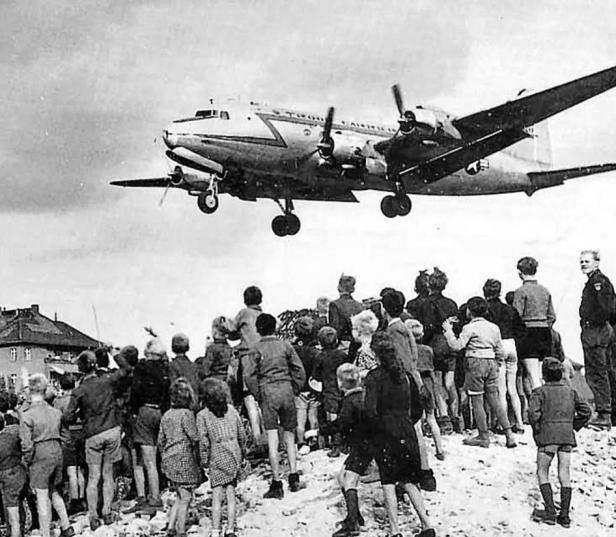
The Berlin Blockade, which lasted from June 1948–May 1949, was a major Cold War crisis where the Soviet Union blocked all land and water access to West Berlin to attempt to force Western Allies out. The Soviet Union was taking this action as a means of retaliation against the introduction of the new Deutschmark currency. The US and Britain responded with the massive Berlin Airlift, flying over 2.3 million tons of food, fuel and supplies to the city. At the peak of the Airlift, a plane landed in West Berlin every 30 seconds. The blockade failed and the Soviets lifted it on May 12, 1949, after realizing the Allied Airlift could sustain the city for an extended period of time, marking a significant victory for the West in the ideological struggle. This event led to the acceleration of the division of Germany into East and West and the deepening of Cold War tensions.
Last year, I have inaugurated a new irregular series on my blog assessing the merits of UK prime ministers (illustrated through the lens of a single board game each). The rating system seemed robust enough to apply it to other countries/leaders (at least if they are more or less democratic). Thus, we branched out to an American president and a German chancellor. Today’s subject is another US president – Harry S. Truman, the first Cold Warrior in the White House. And which game could be more appropriate for him than Twilight Struggle (Ananda Gupta/Jason Matthews, GMT Games)?
The Rating System
Some caveats ahead: The presidents will be rated by the knowledge of their time. If they or their contemporaries could not have known about the effects of something, I will not use my hindsight to mark it as a mistake of theirs. The assessment is focused on their conduct as president, but includes their life after holding the office (in which they will still be regarded in the public eye as (ex-)presidents).
Now, to the system itself: There are three policy field categories (foreign, domestic, and economic policy) and three more general ones (vision, pragmatism, integrity). A president can earn from one to five stars in each category (for a total sum of up to 30). In detail, the president is assessed as follows:
Foreign policy: Did the president increase US influence in the world and the security of Americans at home? Did the president wield US power responsibly and with positive results for the regions affected (the latter counting for a greater deal in times of US power being great)?
Domestic policy: Did the president increase the liberty of Americans to express themselves and to participate in the political process? Did the president promote domestic security and shape the framework for fair justice dealing with offenses?
Economic policy: Did the president facilitate the prosperity and economic security of Americans (including in the mid- and long-term)? Was the president’s economic policy based on mutual benefit of those involved or did it unduly burden one side?
Vision: Did the president have an idea of what the United States and the world (the latter counting for more in times of US influence being great) should look like beyond the immediate future? Did the president’s policies steer the United States (and, if applicable, the world) in this direction?
Pragmatism: Did the president succeed in seeing his policy through from inception to completion? How well did the president manage the support from Congress, society, the administration, the media (the latter counting for more in more recent years)?
Integrity: Did the president understand the office as a means to benefit himself, special interest groups, the entire country, or another community? Did the president respect the boundaries of the office?
Truman’s Life
Harry S. Truman was born on May 8, 1884 as the son of Missouri farmers. He took a few classes at a local business school, but remains the only US president of the 20th and 21st century to not have attended college. After a few years of odd jobs, he returned to help on his parents’ farm. As he had political ambitions, he joined the National Guard in 1905 and volunteered for service during World War I.
Back from the war, Truman opened a haberdashery (which went bankrupt in 1921) and was elected county judge (in 1922). His political career was tied to Tom Pendergast’s political machine. Over the course of the following years, he struggled both economically and politically. His fortunes only improved when he was named Missouri’s director for the Federal Re-Employment program (which got him in touch with important people from Franklin D. Roosevelt’s New Deal programs) in 1933 and was elected senator in 1934.
Truman’s first term in the Senate was unremarkable and he only barely won re-election in 1940. The following year, his career took off when he headed a special committee to investigate inefficiencies in US war production – a crucial task with war ravaging both Europe and the Pacific, which the United States would enter later that year. Truman’s reputation for honesty and efficiency recommended him to president Roosevelt who was looking for a running mate in the 1944 presidential elections. As the favorites of the two wings of the Democratic party – Henry Wallace for the liberals, James F. Byrnes for the conservatives – were anathema to the respective other wing, Roosevelt chose Truman as a non-offending alternative – the “second Missouri compromise”. Roosevelt barely met with Truman either on the campaign trail or after their successful election and kept him in the dark about his political initiatives, particularly regarding foreign policy. When Roosevelt died barely three months after the start of his term, Truman entered the presidency woefully unprepared.
His first task was the victorious conclusion of World War II. Germany surrendered only weeks after Truman’s inauguration. When soon after the first nuclear bombs were successfully tested, the United States dropped them on Japan in order to “shock” the country into surrender – a policy which Truman endorsed, but did not specifically authorize (the bomb was treated like any other weapon at the disposal of the commanders in the theater).
In the meantime, Truman grew more distant to America’s erstwhile Soviet allies. He had wanted the Soviets to join the United Nations and the war against Japan, but once they had done both, Truman took a hard line against what he perceived as Soviet expansionism. The first test of strength was Soviet refusal to leave Iran – in violation of the agreement among the Allies after their invasion of Iran in 1941, which specified that they would leave the country six months after the cessation of hostilities. Truman’s tough stance won the day by spring 1946 – but in a pattern typical for his presidency, he did not receive the credit for it among the American public.
A common sight in the first turn of Twilight Struggle: Iran is a focal point for both players if they want to contest the Middle East and have access to western Asia. …in this case, the US player used their +2 influence boost (according to competitive play standards) in Iran – a luxury which the historical Truman did not have! From the Playdek digital adaptation of Twilight Struggle.
At home, Truman was faced with the transformation of the economy back to peace time. Increased unemployment and inflation dashed the hopes for a beautiful, carefree post-war life for many Americans. Truman’s heavy-handed handling of a railroad strike – he proposed a law that would draft strikers into the army – intimidated the strikers into submission. Yet while it antagonized labor (and questioned Truman’s commitment to constitutional practices), it did not win him support among business or the middle class. Truman’s Democrats were shellacked the 1946 midterm elections.
The electoral defeat freed Truman from his obsession to walk a middle course and please everybody. Instead, he proposed the policies that he thought were right. Domestically, that encompassed a series of ambitious bills to preserve and expand civil and economic rights which he called the “Fair Deal.” Most of them were squarely defeated by a cross-aisle conservative majority in Congress, but Truman’s activity put Congress on the defensive and no further New Deal legislation was rolled back.
Truman’s greatest achievements belong to the realm of foreign policy. Faced with the challenge of possible Soviet inroads into the Eastern Mediterranean (from where the United Kingdom was about to withdraw), Truman countered with the promise of aid to any free nation which resisted subjugation – the Truman Doctrine. He backed this unprecedented American commitment to internationalism up with the European Recovery Program – or, as it was more popularly called, the Marshall Plan. (Truman was wise enough not to attach his own name to it, as his unpopularity in Congress would likely have resulted in a defeat of the proposal.) The ERP did not only help Europe in its recovery from the destruction of World War II, but also provided a welcome stimulus for the American economy on whose goods the money was spent, and it was a major PR success for the United States in the nascent Cold War with the Soviet Union. When the Soviets played hardball in 1948 and blockaded West Berlin, a western-controlled island within the Soviet occupation zone of Germany, Truman found a measured response in supplying West Berlin from the air – steering clear of both abandoning West Berlin and risking war.
Truman’s relationship with both wings of the Democratic Party had been uneasy through his tenure – the liberals disliked him for his handling of labor disputes and his tough stance on real and perceived Communists. As the Cold War developed, a second “Red Scare” swept the country. Truman, who personally did not believe that a large number of Communist spies had infiltrated federal institutions, nonetheless lent this conspiracy theory credence with the vain attempt to ward off more radical legislation on the matter by examining the loyalty of all federal employees – with “reasonable doubts” sufficient to be fired. Even though the past of five million federal employees was scrutinized, not a single Communist spy was found.
On the other hand, the conservatives, particularly those from the Democrats’ southern bastions, warily regarded his Civil Rights stance. Truman created a committee to make proposals for Civil Rights whose recommendations he endorsed. Yet only when the Southern Democrats abandoned him in the election year 1948 (and supported the segregationist Strom Thurmond instead) did he stick out his head and decreed the desegregation of the armed forces and the federal civil service.
Truman took to the campaign trail and vigorously attacked the Republicans for not supporting his domestic reform agenda. Against the predictions of the pollsters, Truman defeated his Republican opponent Thomas E. Dewey soundly, with Thurmond coming in a distant third (and defeated in most southern states as well). Truman’s inauguration in 1949 was the first to which Black Americans were invited as guests.
Truman’s second term was less eventful than his first – and less successful.
When North Korean forces crossed the 38th parallel to unite Korea by force (with Stalin’s approval), Truman faced another Cold War crisis. Truman attached an importance to it that went far beyond Korea – if such a blatant breach of the peace was not checked, it would spell doom for the rules-based peace order embodied in the United Nations. Thus, he sent in US forces to stop the Northern invasion and attained UN approval for the operation. US troops under General Douglas MacArthur blunted the offensive of the North Koreans and landed in their rear – thus throwing the entire invasion force back in disarray. As the coalition forces approached the 38th parallel, Truman disregarded Chinese warnings and authorized a crossing into North Korea. The ensuing Chinese entry into the war now caught the coalition forces off guard and forced them into an ignominious retreat. MacArthur then pressured Truman to extend the war to China – and the use of nuclear bombs. Truman refused, and as MacArthur kept defying presidential authority, relieved him of his command. For the remainder of Truman’s tenure, the Korean War would be a bloody stalemate.
Domestically, Truman did not fare better. His attempt to prevent a full-on Red Scare by the loyalty check program turned out to have failed entirely – instead Representative Joseph McCarthy levelled (unfounded) charges of Communist sympathies and activities at government officials, academics, left-leaning politicians, labor activists, and entertainers (especially in the film industry). The climate of fear which infringed on free speech also damaged the United States’ standing abroad.
Finally, another strike – this time in the steel industry – aroused the president’s anger. He seized the steel mills from their private owners to deal with the strike. This was deemed unconstitutional by the Supreme Court in April 1952. By the time of the Court’s decision, the deeply unpopular Truman had already announced that he would not seek re-election. The Democratic Party instead chose the governor of Illinois, Adlai Stevenson, as their nominee. Stevenson lost in a landslide against the Republican candidate Dwight D. Eisenhower, the general credited with winning World War II in Europe.
Harry S. Truman lived a relatively modest post-presidential life, devoting much of his time to writing his memoirs. He died on December 26, 1972.
The Rating
Foreign policy: Truman shifted from cooperation to confrontation with the Soviet Union with remarkable skill. He found adequate responses to most foreign policy crises – from the first test of strength in Iran over the Greek/Turkish crisis which prompted the Truman Doctrine to the Berlin Blockade and the North Korean invasion of the South. His rare misstep was the foolhardy decision to push further in Korea which drew the Chinese into the war.
Structurally, Truman’s influence is even more profound: Almost the entire modern US security architecture was founded by him – the US Air Force, the Department of Defense, the National Security Council, the Central Intelligence Agency and NATO.
Rating: 5 out of 5.
Domestic policy: Truman’s domestic record is mixed. While he was the first 20th century president to stick his head out for the equal treatment of Black Americans, he only turned to action after the Southern Democrats had abandoned him already. His anti-Communist loyalty checks infringed on the individual liberties of federal employees and did not achieve their goal of pre-empting more radical measures by the anti-Communist conspiracy theorists like Joseph McCarthy (and rather emboldened them). Finally, Truman’s invasive meddling in the economy – both his law to draft strikers and his seizing of the steel mills – show an instinctive preference for a security-based war presidency over individual economic freedoms.
Rating: 2 out of 5.
Economic policy: Truman faced the challenge to transform the US economy back to peace time – for which conservatives/business and liberals/labor had starkly different ideas. Truman initially attempted a middle course, but turned more liberal after his electoral victory in 1948. His Fair Deal legislation (most notably the near-doubling of the minimum wage, the expansion of Social Security to another 10 million Americans, the rural electrification programs, and the building of homes for low-income Americans) contributed to the broad prosperity of the post-war decades.
In the end, it was Truman’s foreign policy that was most influential for the economic development of the US: The Marshall Plan had shown how a further internationalization of American businesses could be profitable for them. Truman’s turn toward the security state after the outset of the Korean War led to a quadrupling of defense spending which would never again fall to the level of the inter-war years. This perpetual state of war-readiness and the resulting military-industrial complex of the United States play a crucial role for the structure of the US economy until today.
Rating: 4 out of 5.
Vision: Nobody regarded Truman as a visionary when he entered the presidency. Yet his policies captured not only the present but also the future: The Truman Doctrine, a sharp break with the American isolationist tradition, was employed for the remainder of the Cold War. Every other Cold War presidential doctrine rested on it (and usually interpreted it for a particular region). Its basic tenet – to aid free nations against attempts to subjugate them – informs US policy until today (say, in Ukraine). In practice, the Truman Doctrine resulted in the “containment” of the Soviet Union and global Communism – another basic principle of US foreign policy for the next 40 years.
Truman’s predecessor Franklin D. Roosevelt, much more a visionary in the public perception, had relied on his own personality to see through all the great breaks with political tradition. Truman, on the other hand, built the institutionalized security state which is until today the foundation of the US presidency. Despite the pivot to “security” as the new main goal of American government activity, Truman maintained the primacy of politics over the military and defeated the specter of Bonapartism when he fired MacArthur over his insubordination.
Rating: 5 out of 5.
Pragmatism: Truman’s early attempts to chart a middle path often antagonized both sides – and sometimes led to contradictions (as when he publicly endorsed both Henry Wallace’s and James F. Byrnes’s foreign policy statements which differed markedly on the matter if the Soviet Union was an ally or an opponent of the United States).
Truman was at best middling at winning public support for his initiatives. While he won the 1948 election, his Congressional allies fared badly both in 1946 and 1950, and Truman had low approval ratings through most of his tenure (excepting the honeymoon period in 1945 and his time of foreign policy glory in 1947), sometimes as low as 23%.
Despite these troubles with both Congress and the wider public, Truman could see some of his key policy initiatives through Congress despite their impulses towards isolationism and a limited role of government.
Rating: 2 out of 5.
Integrity: Truman honestly strove for the interests of the whole nation. Yet he tested the limits of the Constitution with his reaction to strikes and when he did not seek Congressional approval for the war in Korea. His appointments were often based on loyalty rather than merit (and turned out lackluster in these cases more often than not). While Truman never used the presidency to enrich himself personally, his reputation for being extraordinarily honest is rather an artifact of being compared favorably to his morally flexible successors Lyndon B. Johnson and Richard Nixon in the 1960s and 1970s.
Rating: 3 out of 5.
Overall: Despite Truman’s unassuming personality and his low popularity during his tenure, he laid the foundations for American foreign policy for decades. His many moments of foreign policy brilliance are interspersed with a mixed record at home and many individual mistakes in running the office. He was an above-average, but not great president.
How would you rate Truman? Let me know in the comments!
Further Reading
For a short and accessible biography, see Dallek, Robert: Harry S. Truman, St. Martin’s Press, New York City, NY 2008.
As always when it comes to American presidents of the 20th century, see the respective chapter in Leuchtenburg, William E.: The American President. From Teddy Roosevelt to Bill Clinton, Oxford University Press, Oxford 2015, pp. 243—326.

 Anmelden